EFFECT AND BLEACHING RESULT ON THE CERVICAL REGION
A pain-free treatment; a stunning aesthetic result
DR. STEFAN STÜBINGER (CH) JANUARY 2025
lntroduction
The individual smile of a person in its interplay between the teeth and the surrounding soft tissue structures such as the gums and lips is the characteristic feature of its effect on its social environment. The smile as an expression of the inner state has a strong influence on communication with the outside world. This is why people want a radiant and perfectly harmonious smile. The shade of the teeth has a considerable cosmetic value when it comes to the smile. The shade is also perceived in connection with the general skin type and the color of the surrounding gingiva. A radiant smile is thus also perceived in terms of general health.
Dark, brownish discoloration can be caused by pigments from drinks such as red wine, coffee, tea or tobacco components. These accumulate in the dental hard tissues such as enamel and dentine.
Excessive consumption of certain foods can also lead to discoloration if there is also poor oral hygiene. This often results in different deposits in the enamel and dentine or root cement. The color shades then vary and extreme or conspicuous borders or massive color gradients can occur.
In such cases, external bleaching, e.g. in the dental practice, at home or a combination of both, can be carried out.
External bleaching by professionals is a safe and recognized procedure that can maintain tooth whitening over a long period of time. ln-office bleaching or chair-side techniques depend not only on the experience of the treating professional, the individual discoloration pattern on the tooth, but also on the bleaching agent used and the location of the discoloration.
Nowadays, hydrogen peroxide gel in various concentrations is used in most cases. Recently, it was described that the use of a peroxy caproic acid (PAP) based composite gel could be selected as an effective vehicle for tooth-whitening. Thereby, PAP proved nearly harmless to the teeth enamel with a safe and reliable bleaching effect.
In the following, we would like to demonstrate the use of this new method, particularly with regard to the effect and bleaching result on the cervical region.
Discoloration in this area is very critical and difficult because, as described, different shades occur and the deposits in the dentin and root cement are different from those in the enamel.
Treatment protocol
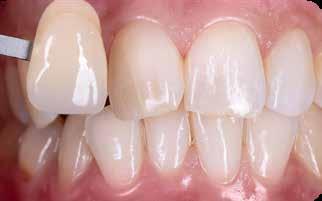
Before the whitening process a clinical examination of the oral and perioral region was conducted to reveal any signs of adverse changes to teeth or adjacent soft tissues. Further, all participants underwent a prophylaxis and oral hygiene guidance procedure . In a period of 90 minutes, n=4 application cycles of 15 minutes each were performed.
1
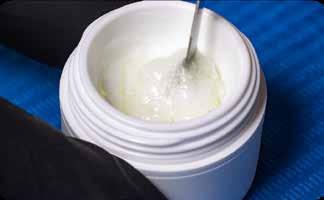
lnitially, to each portion of the gel n=3 drops of activator were added.
2
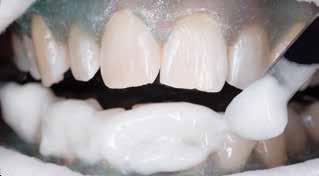
The ingredients were mixed homo geneously with a spatula for 60 seconds (see Fig. 2). After placement of a lip retractor and gingival barrier the ALPINE WHITE gel was applied manually on each tooth by a single-use brush (see Fig. 3).
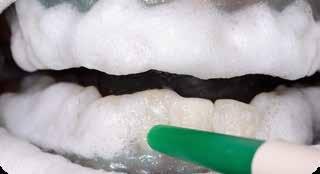
After 15 min, the bleaching gel was removed and teeth were cleaned with gauze (see Fig. 4).
Four bleaching sessions were performed with each dient and flnally teeth were washed with an air-water spray (see Fig. 5).
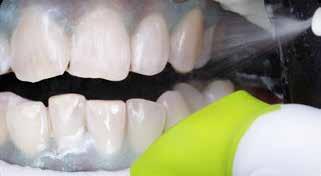
5
The lip retractor and gingival barrier was removed. Efficacy (tooth color) and safety (possible side effects) such as tooth sensitivity and gingival irritation were documented at baseline and immediately after treatment
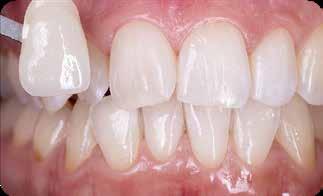
6
Case 1
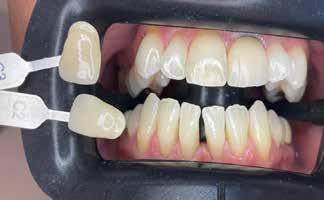
Female patient aged 44 years. Discoloration in the upper and lower anterior region. The patient had already had bleaching with hydrogen peroxide 10 years ago. Afterwards she had extreme sensitivity and pain. The tooth shade was B2 at the beginning of the treatment and A1 at the end. In this case, the cervical areas were also whitened with a clear dark discoloration. The treatment was performed by Albulena Tolaj (certifted dental hygienist, CH).
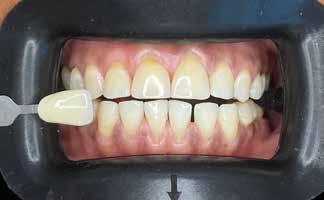
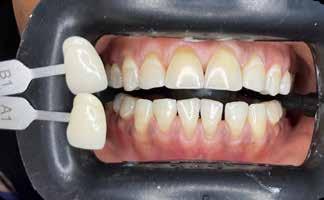
Conclusion
Case 2
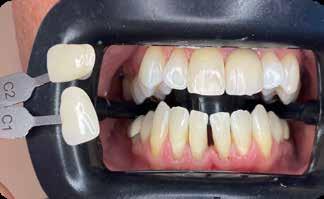
Male patient aged 60 years.The patient has a ceramic crown on tooth 21 and several small occlusal ftllings in the posterior region. The patient is particularly bothered by the small dark discolorations at the lower front teeth. These are also exposed due to the tooth position. Overall, teeth including the cervical parts could be whitened from C2 to C1. The treatment was performed by Albulena Tolaj (certifted dental hygienist, CH).
Case 3
Female patient aged 54 years. The patient has several small recessions. Years ago, a veneer was placed on tooth 11 and several small ftllings with a signiftcantly lighter color. Overall, the patient has good oral hygiene. The patient was primarily bothered by the darker areas in the cervical part of the canines. The treatment was performed by Albulena Tolaj (certifted dental hygienist, CH).
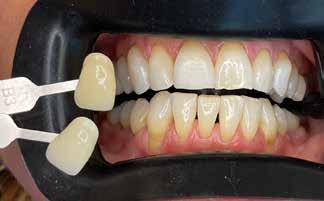
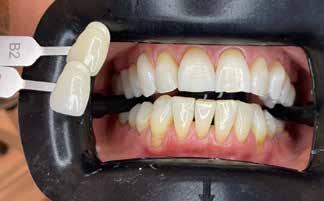
The present cases show that the new method can also be used to treat the difftcult and sensitive area of the cervical region. In all cases, visible improvements were achieved in the critical area. No injuries to the neighboring soft tissue structures were observed. There were also no sensory disturbances or pain in the cervical area after application. All patients were very satisfted with the result and could see the positive changes in the mirror. The application of peroxy caproic acid (PAP) has a gentle and long-lasting whitening effect on the teeth. Various dental hard tissues can be treated. Further long-term studies are being carried out to document and substantiate the lasting effect.
Contact
Department of Oral and Cranio-Maxillofacial Surgery
Research Group MIOSTE University Hospital Basel
Spitalstrasse 21
CH-4032 Basel
+41 61 265 70 70 stefan.stuebinger@unibas.ch