SPOTLIGHT 2025/26
MARIN ALSOP CONDUCTS
RIMSKY-KORSAKOV + GABRIELA
MARIN ALSOP, conductor GABRIELA MONTERO, piano
Friday, April 10, 2026 At 7:30pm
Saturday, April 11, 2026 At 7:30pm
Sunday, April 12, 2026 At 1:00pm
Boettcher Concert Hall
GABRIELA ORTIZ Antrópolis
MONTERO
GABRIELA MONTERO
Piano Concerto No. 1, “Latin”
I. Mambo
II. Andante Moderato
III. Allegro Venezolano
– INTERMISSION –
RIMSKY-KORSAKOV Scheherazade, Op. 35
I. The Sea and Sinbad’s Ship
II. The Tale of Prince Kalendar
III. The Young Prince and The Princess
IV. The Festival at Bagdad; The Sea; The Ship Goes to Pieces on a Rock
CONCERT RUN TIME IS APPROXIMATELY 1 HOUR AND 47 MINUTES INCLUDING A 20 MINUTE INTERMISSION.
PROUDLY SUPPORTED BY
Friday’s concert is sponsored by Women oF note saturday’s concert is sponsored by Knox college sunday’s concert is dedicated in memory oF mary Krugman





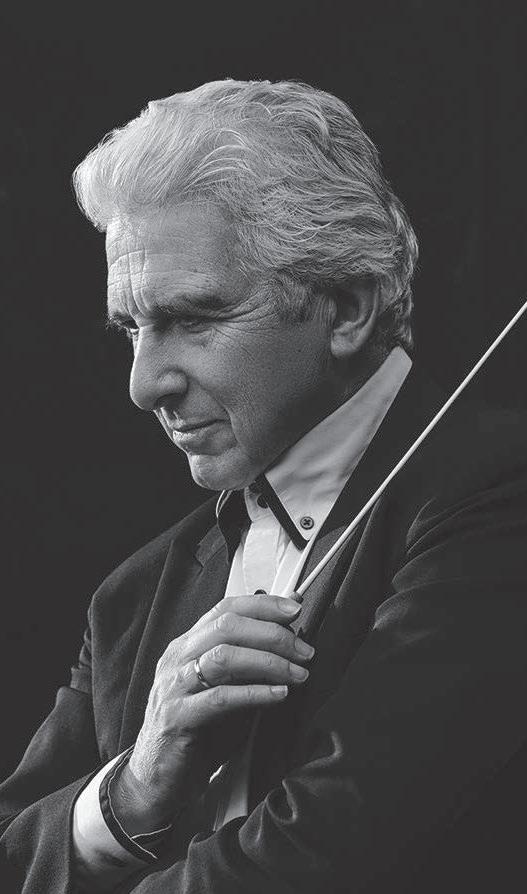
MARIN ALSOP, conductor
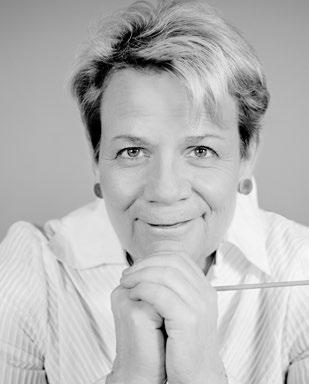
Marin Alsop is one of the foremost conductors of our time and a powerful and inspiring voice. She is the first woman to serve as the head of major orchestras in the United States, south America, Austria, and Great Britain. A “formidable musician and a powerful communicator,” and a “conductor with a vision” (New York Times), Alsop is internationally recognized for her innovative approach to programming and audience development, for her deep commitment to education, and for championing the importance of music in the world. She is also the first and only conductor to receive a MacArthur fellowship.
The 2025–26 season marks Alsop’s third as Artistic Director and Chief Conductor of the Polish National Radio Symphony; her third as Principal Guest Conductor of the Philharmonia Orchestra; and her second as Principal Guest Conductor of the Philadelphia Orchestra. She is also Chief Conductor of the Ravinia Festival, where she leads the Chicago Symphony Orchestra’s annual summer residencies.
To promote and nurture the careers of fellow women conductors, Alsop founded the Taki Alsop conducting fellowship in 2002. The fellowship has grown into a global platform for identifying and empowering extraordinary women conductors by providing intensive coaching, mentorship, and financial support throughout their careers. Today, all 36 award winners are working to ensure a more equitable future for classical music through their artistry and advocacy. Among them, they hold over 30 music director or chief conductor positions around the world. Building on her long association with Carnegie Hall, Alsop is a perspectives artist across 2025–26. She joins an elite group of top performers across disciplines who share their philosophies through a curated series of events. Alsop’s expansive series invites the Philharmonia Orchestra with soloist Alexandre Kantorow, as well as America at 250 programs with the Philadelphia Orchestra, National Orchestral Institute Philharmonic, and the Juilliard Orchestra, in which she leads an evening featuring a world premiere by Joan Tower. Alsop undertakes additional education projects in connection with the Weill Music Institute.
In October 2025, Alsop opens the Philadelphia Orchestra’s 125th anniversary season with the world premiere of John Adams’ The Rock You Stand On, a new work dedicated to her. The concert also reunites her with pianist Yunchan Lim, whose Cliburn Competition–winning performance of Rachmaninoff’s Third Piano Concerto—with Alsop on the podium—was named one of the “top 10 classical performances of 2022” by the New York Times. In the spring, she embarks on a U.S. tour with the Philadelphia Orchestra. Other season highlights include concerts with the Chicago Symphony Orchestra at Orchestra Hall—where she opens the America 250: a musical journey festival with Wynton Marsalis’ Liberty (Symphony No. 5)—and performances with the Dallas Symphony Orchestra, including the world premiere of a work for soprano and orchestra by Kathryn Bostic. She also joins the Houston Symphony, with concertmaster Yoonshin Songas soloist, and conducts West Side Story at Washington National Opera.
International performance highlights include Alsop’s return to Japan on tour with the Polish National Radio Symphony and pianist Hayato Sumino. She leads the Orf Vienna Radio Symphony Orchestra in concerts with soloists Claire Huangci, Bruce Liu, and Maria Loudenitch; conducts the Deutsches Symphonie-Orchester Berlin; and leads the Philharmonia Orchestra with Alisa Weilerstein performing Gabriela Ortiz’s Cello Concerto Dzonot. Last season, Alsop made her long-awaited Berlin Philharmonic debut. She made history as the first female conductor of the BBC’s Last Night of the Proms and was the first American to guest conduct it three times.
In 2021, Alsop assumed the title of Music Director Laureate and Orchkids founder of the Baltimore Symphony Orchestra. During her 14-year tenure as Music Director, she led the orchestra on its first European tour in 13 years, released multiple award-winning recordings, and conducted more than two dozen world premieres. She also founded Orchkids, the orchestra’s groundbreaking music education program for Baltimore’s most under-resourced youth. In 2019, after seven years as music director, Alsop became Conductor of Honour of Brazil’s São Paulo Symphony Orchestra (Osesp). She was Music Director of California’s Cabrillo Festival of contemporary music for 25 years, leading 174 premieres. In 2025, she was named Honorary Conductor of the Orf Vienna Radio Symphony Orchestra, where she served as Chief Conductor for six years. Alsop’s discography comprises more than 200 titles, featuring music from the standard repertoire and by contemporary composers. Her 2024 album with john Adams’ City Noir was nominated for a Grammy Award. Her latest album is Abstractions, featuring music by Anna Clyne (Naxos). Other recent releases include a live account of Candide with the London Symphony Orchestra and Chorus; a Kevin puts collection with the Baltimore Symphony; and, with the Vienna Rso, a Margaret Brouwer collection, a complete Schumann Symphonic Cycle, and world premiere recordings of two concertos by Malek Jandali. In 2021, Alsop and the Philadelphia Orchestra released a live recording of highlights from Gershwin’s Porgy and Bess
The 2020 recording of Clyne’s Cello Concerto Dance, with soloist Inbal Segev and the London Philharmonic Orchestra conducted by Alsop, has garnered over 12 million plays on Spotify.
In 2025, Alsop received the Golden Baton Award, the highest accolade conferred by the League of American Orchestras. In 2019, she received the World Economic Forum’s Crystal Award. She also served as the 2021–22 Harman/Eisner artist-in-residence of the Aspen Institute arts program and as 2020 artist-in-residence at Vienna’s University of Music and Performing Arts. In collaboration with YouTube and Google Arts & Culture, she developed and spearheaded the “global Ode to Joy,” a crowd-sourced video project to celebrate Beethoven’s 250th birthday in 2020.
The Conductor, a feature documentary about Alsop’s life, debuted at New York’s Tribeca Film Festival. It has been broadcast on PBS and screened at festivals and in theatres worldwide. The Conductor was nominated for an Emmy for Best Arts and Culture documentary and received the Naples International Film Festival’s Focus on the Arts Award. The film is available on Apple TV, Google Play, iTunes, Prime Video, and Vimeo. Alsop is the director of the graduate conducting program at the Peabody Institute of Johns Hopkins University and holds honorary doctorates from Yale University, Johns Hopkins University, and the Juilliard School.
GABRIELA Montero, piano

Gabriela Montero’s visionary interpretations and unique compositional gifts have garnered her critical acclaim and a devoted following on the world stage. Anthony Tommasini remarked in The New York Times that “Montero’s playing had everything: crackling rhythmic brio, subtle shadings, steely power…soulful lyricism…unsentimental expressivity.”
The 2025/26 season sees Montero as artist-in-residence at London’s acclaimed Barbican Centre, which will feature the UK premiere of her piano quintet Canaima with the Calidore String Quartet, her debut with the BBC Symphony Orchestra, and a new solo recital programme, Iberia, showcasing Spain’s rich influence on the piano repertoire through works by Albéniz, Granados, Alicia de Larrocha, Scarlatti, and others. This follows previous residencies with the Sao Paolo Symphony, Prague Radio Symphony, Bournemouth Symphony, Basel Symphony, and at the Rheingau Festival.
Montero’s other recent and forthcoming highlights include debuts with Amsterdam’s Concertgebouw Orchestra, Orchestra Dell’Accademia Nazionale Di Santa Cecilia in Rome, Munich Philharmonic, Orchestre National de France, and Deutsches Symphonie Orchester Berlin; extensive tours with the city of Birmingham and Prague Symphonies; duo performances with Martha Argerich at Munich’s Isarphilharmonie and Lisbon’s Calouste Gulbenkian Museum; and performances of her own “Latin Concerto” with the San Francisco and Dallas Symphonies (Marin Alsop), New World Symphony (Stéphane Denève), Vienna and Polish National Radio Symphonies (Marin Alsop), BBC Scottish and Antwerp Symphonies (Elim Chan), Swedish Radio Symphony(Marta Gardolińska), and National Arts Centre Orchestra (Alexander Shelley), where she concludes a four-year creative partnership in 2025. In the same year, Montero was commissioned as a jury member by the 17th Van Cliburn international Piano Competition to compose a new work for all 30 competitors, entitled Rachtime, a piece that pays tribute to Van Cliburn’s golden pianism and enduring place in the American cultural pantheon.
Montero has appeared with many of the world’s leading orchestras, among them the New York and Boston Philharmonics, the Boston, Chicago, Detroit, Pittsburgh, Houston, Atlanta, Toronto and Baltimore Symphonies, and the Cleveland and Philadelphia Orchestras in north America; in Europe, with the Zurich Tonhalle Orchestra, Gewandhausorchester Leipzig, Ndr Sinfonieorchester Hamburg, Ndr radiophilharmonie Hannover, and Zurich Chamber Orchestra –plus the Royal Liverpool, Rotterdam, Dresden, and Netherlands Radio Philharmonic Orchestras, and the Lucerne, Barcelona and Vienna Symphonies; and in Asia and Australasia with the Yomiuri Nippon, Sydney and New Zealand Symphonies.
A graduate and fellow of the Royal Academy of Music in London, Montero is also a frequent recitalist, having given concerts at such distinguished venues worldwide as the Wigmore Hall, Kennedy Center, Carnegie Hall, Vienna Konzerthaus, Berlin Philharmonie, Frankfurt Alte Oper, Cologne Philharmonie, Leipzig Gewandhaus, Sydney Opera House, New York’s 92nd Street Y, Paris’ Philharmonie and La Seine Musicale, Seoul’s lg Arts Centre, Hong Kong City Hall, the
National Concert Hall in Taipei; and at leading festivals in Edinburgh, Salzburg, Milan, Lucerne, Chicago (Ravinia), Gstaad, Aldeburgh, Cheltenham, and Ruhr. In June 2025, Montero was invited, as one of a handful of the world’s most celebrated pianists, to perform at the “Harmonies of Hope” concert at the Piazza Pio XII in Vatican City, which included a private audience with Pope Leo XIV. Montero also maintains an ongoing artist residency and international concert series at the Prager Family Center for the Arts in the historic coastal town of Easton, Maryland.
Montero made her formal debut as a composer with Ex Patria, a tone poem designed to illustrate and protest Venezuela’s descent into lawlessness, corruption, and violence. The piece was premiered in 2011 by the Academy of St. Martin in the Fields. Montero’s first full-length composition, Piano Concerto No. 1, the “Latin Concerto”, was first performed in 2016 at the Leipzig Gewandhaus with the MDR Sinfonieorchester and has since been performed over fifty times on five continents.
An award-winning and bestselling recording artist, her most recent album, released in autumn 2019 on the Orchid Classics Label, features her “Latin Concerto” and Ravel’s Piano Concerto in G Major, recorded with the Orchestra of the Americas. Her previous recording on Orchid Classics features Rachmaninov’s Piano Concerto No. 2 and her first orchestral composition, Ex Patria, which won Montero her first Latin Grammy® for Best Classical Album. Other recordings include Bach and Beyond, which held the top spot on the Billboard classical charts for several months and garnered her two Echo Klassik Awards: the 2006 Keyboard Instrumentalist of the Year and 2007 award for Classical Music Without Borders. In 2008, she also received a Grammy® nomination for her album Baroque, and in 2010 she released Solatino, a recording inspired by her Venezuelan homeland and devoted to works by Latin American composers.
Winner of the 4th International Beethoven Award, Montero is a committed human rights advocate whose voice regularly reaches beyond the concert platform. In 2024, she was named a recipient of the Václav Havel International Prize for creative dissent by the Oslo Freedom Forum. She was also named an honorary consul by Amnesty International in 2015 and recognised with outstanding work in the field of human rights by the Human Rights Foundation for her ongoing commitment to human rights advocacy in Venezuela. In January 2020, she was invited to give the Dean’s Lecture at the Harvard Radcliffe Institute and has spoken and performed twice at the World Economic Forum in Davos. She was also awarded the 2012 Rockefeller Award for her contribution to the arts and was a featured performer at Barack Obama’s 2008 presidential inauguration.
Born in Venezuela, Montero started her piano studies at age four, making her concerto debut at age eight in her hometown of Caracas. This led to a scholarship from the government to study privately in the USA and then at the Royal Academy of Music in London with Hamish Milne. From September 2024, Montero is the Jonathan and Linn Epstein Artist in Residence, and piano faculty member, at the Cleveland Institute of Music.
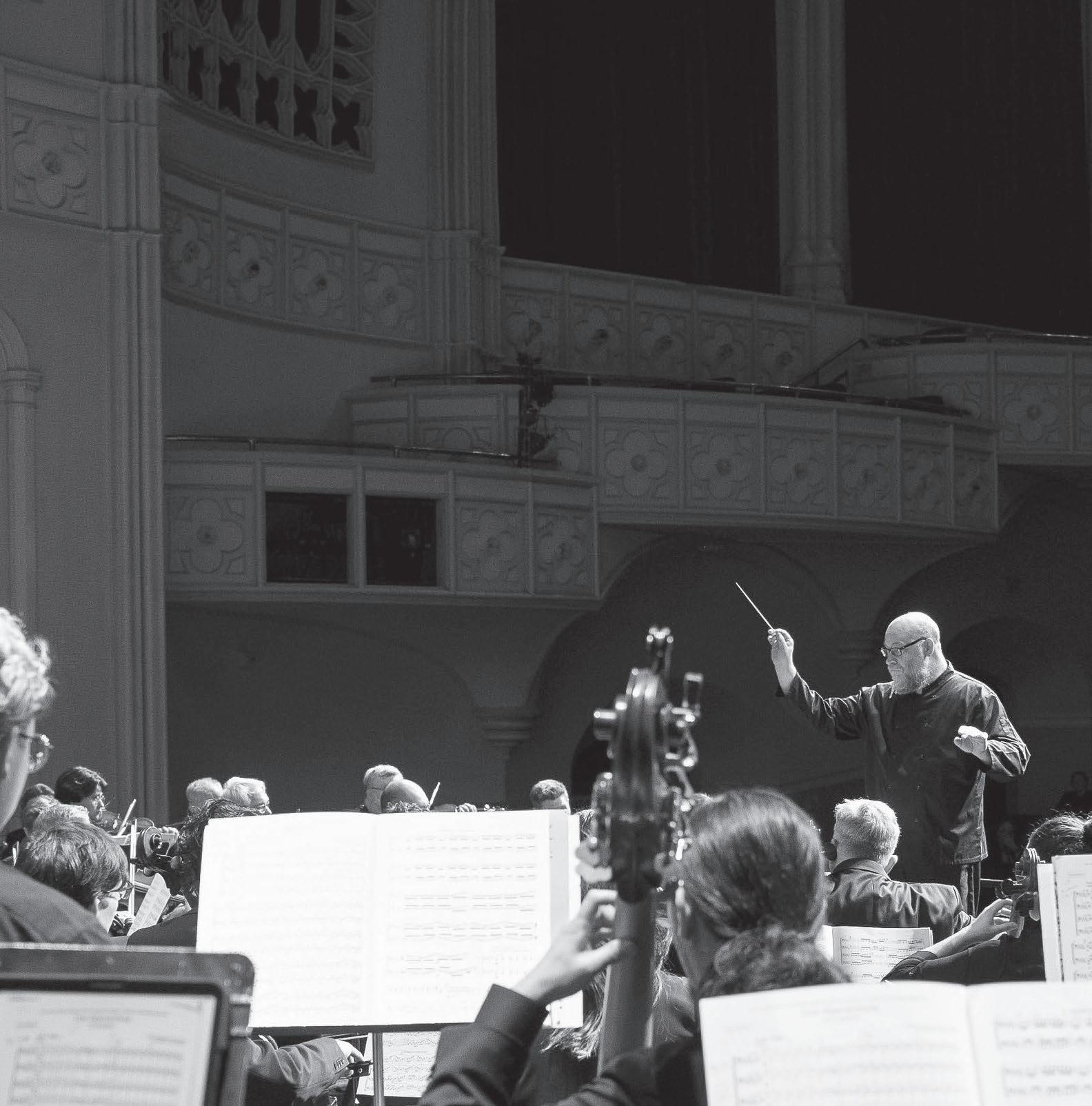
“In this performance he (Kenneth Woods) shows very impressive Mahlerian credentials… [N]ot only is the playing exciting but in addition countless little nuances are observed, hugely to the music’s benefit.” ~John Quinn, MusicWeb International

GABRIELA ORTIZ (BORN 1964)
Antrópolis
COMPOSITION & PREMIERE OF WORK:
Gabriela Ortiz was born on December 20, 1964 in Mexico City. She composed Antrópolis in 2017 and revised it in 2018. The work was premiered on February 28, 2018 at Carnegie Hall in New York city by the Louisiana philharmonic orchestra, conducted by Carlos Miguel Prieto; revised version premiered on April 1, 2018 at the palacio de Bellas Artes in Mexico City by the Orquesta Sinfónica Nacional de México, also conducted by Mr. Prieto.
CSA LAST PERFORMANCES:
This is the CSA premiere performance.
INSTRUMENTATION:
The score calls for piccolo, two flutes, two oboes, two clarinets, bass clarinet, two bassoons, four horns, four trumpets, three trombones, tuba, timpani, percussion and strings.
DURATION:
Duration is about 10 minutes.
Gabriela Ortiz, one of Mexico’s foremost composers, was born in Mexico City in 1964 into a family of musicians in the folk music ensemble Los Folkloristas, founded to preserve and perform the traditional music of Mexico and Latin America. Ortiz studied composition at the National Conservatory of Music and National University of Mexico, and won a British Council Fellowship in 1990 to study in London at the Guildhall School of Music and Drama; she completed her doctoral work two years later at the City University of London. Ortiz now teaches at the Mexican University of Mexico City and has also served as a visiting faculty at Indiana University. She has composed, often on international commissions, for opera, ballet, orchestra, chamber ensembles and film in a style rooted in classical, jazz and traditional Mexican music. Her work frequently focuses on gender issues, social justice, environmental concerns, racism, technological development and mass migration. Notably, her operas are framed by political contexts of great complexity and continuing relevance, such as the drug war in Only the Truth, illegal migration between Mexico and the United States in Ana and Her Shadow, and the violation of university autonomy during the student movement of 1968 in Firefly.
In addition to two Latin Grammy nominations, Gabriela Ortiz has been honored with the National Prize for Arts and Literature (Mexico’s most important award for writers and artists), induction into the Mexican Academy of Arts and the Colegio Nacional, Mozart Medal Award, First Prizes at the Alicia Urreta Composition Competition and Silvestre Revueltas National Chamber Music Competition, and grants and residencies from the Civitella Ranieri Center (Italy), Guggenheim Foundation, Ford Foundation, Rockefeller Foundation, Fulbright Fellowship and Banff Center for the Arts. In 2022, she was appointed Curator of the Pan-American Music Initiative with the Los Angeles Philharmonic and Gustavo Dudamel, and held the Debs Composer´s Chair at Carnegie Hall for the 2024-2025 season.
Gabriela Ortiz wrote of Antrópolis, “The word ‘antro’ has its origin in the Latin ‘antrum,’ meaning ‘grotto’ or ‘cavern.’ In Mexico until the 1990s, the term referred to bars or entertainment places of dubious reputation. Nowadays, and especially among younger people, the word refers to any bar or nightclub.
PROGRAM NOTES
“One time, while talking with flutist Alejandro Escuer, we imagined the title of a future work that would synthesize the music of Mexico’s legendary dance halls and bars: Antrópolis, a neologism, a precise, invented name for a piece that narrates the sound of the city through its dance halls and nightclubs. In 2017, when conductor Carlos Miguel Prieto commissioned me to write a short work — brilliant and rather light-hulled — to be premiered at the close of a concert celebrating the 80th birthday of American composer Philip Glass, performed by the Louisiana Philharmonic Orchestra at Carnegie Hall in New York, I retrieved the title Alejandro and I had imagined, and thus Antrópolis came to life.
“Antrópolis is a piece in which I wanted to pay a very personal tribute to some of those antros, the emblematic dance halls of Mexico City that left a special sonorous imprint in my memory. These cabarets or dance halls represent the nostalgia for rumberas and live dance orchestras, such as ‘El Bombay,’ where it is said that Che Guevara would twirl; or the ‘Salón Colonia,’ which seems to have come out of dreams taken from a film of the Golden Age of Mexican cinema. Who doesn’t remember the fun ballroom ‘Los Infiernos,’ a perfect place for those who, after a long day at work, would leave their cubicles to go dancing, drink and listen to music? Finally, the memory of the bar ‘Tutti Frutti’ leaves an impression, where I first met the punk couple who own the antro, where you could listen to experimental music from the 1980s.
“Antrópolis is the musical reflection of a city through its antros, including the accumulation of our experiences that form an essential part of our history in this very complex but fascinating Mexico City.”

GABRIELA MONTERO (BORN 1970)
Piano Concerto No. 1, “Latin”
COMPOSITION & PREMIERE OF WORK:
Gabriela Montero was born on May 10, 1970 in Caracas, Venezuela. She composed the “Latin” Concerto in 2016, and was soloist at its premiere, on March 20, 2016 at the Leipzig Gewandhaus by the MDR Leipzig Symphony Orchestra, conducted by Kristjan Järvi.
CSA LAST PERFORMANCES:
This is the CSA premiere performance.
INSTRUMENTATION:
The score calls for piccolo, two flutes, two oboes, two clarinets, two bassoons, two horns, two trumpets, two trombones, timpani, percussion, harp and strings.
DURATION:
Duration is about 35 minutes..
For her recording of the Latin Concerto with the Orchestra of the Americas and conductor Carlos Miguel Prieto on the Orchid Classics label, Gabriela Montero wrote:
“My story, a Pan-American story, is a modern one, in many ways.”
“I was born and raised in Venezuela until the age of 8, at which point I moved with my family to the United States for a decade. I landed at the Royal Academy of Music in London in my early twenties. I am a globalized, Latin-American woman raised on a diet of European classical music with multiple, circumstantial side-dishes of Pan-American folklore. I also consider myself to be a musician whose primary role is to tell stories that reflect the wide gamut of human experience across both time and geography.”
“Every era and continent has its story to tell, however joyful or troubling, from Renaissance Europe to the contemporary Americas, and composers are well positioned not only to tell it, but to provide a unique form of social commentary. The piano is my chosen instrument as a performer, but not my only narrative tool as a composer and communicator. It should come as no surprise, then, that my first concerto should be written for the piano as solo instrument, and that it should employ traditional, European musical structures to tell my contemporary story as a well-travelled Latin-American woman.”
“In a process of musical osmosis — a natural consequence of the globalized, interconnected world in which we now live — my Piano Concerto No.1, the ‘Latin’ Concerto, honors the musical traditions that have shaped me, while inviting the cultural idioms of my native continent to the concert halls of Europe and the wider world. European formalism and the informality of Latin-America’s rich, rhythmic identity merge in a complementary dance of both the joyful and macabre.” PROGRAM
PROGRAM NOTES
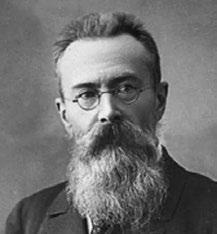
NIKOLAI RIMSKY-KORSAKOV (1844-1908)
Scheherazade, Op. 35
COMPOSITION & PREMIERE OF WORK:
Nikolai Rimsky-Korsakov was born on March 18, 1844 in Tikhvin, near Novgorod, and died on June 21, 1908 in St. Petersburg. He composed Scheherazade in summer 1888 and conducted the orchestra of the St. Petersburg chapter of the Russian Musical Society in the premiere on December 15, 1888.
CSA LAST PERFORMANCES:
September 30- October 20, 2022, with Christopher Dragon conducting
INSTRUMENTATION:
The score calls for piccolo, two flutes, two oboes, English horn, two clarinets, two bassoons, four horns, two trumpets, three trombones, tuba, timpani, percussion, harp and strings.
DURATION:
Duration is about 42 minutes. About 60 minutes.
“In the middle of the winter [of 1888], engrossed as I was in my work on Prince Igor and other things, I conceived the idea of writing an orchestral composition on the subject of certain episodes from Scheherazade.” Thus did Nikolai Rimsky-Korsakov give the curt explanation of the genesis of his most famous work in his autobiography, My Musical Life. His friend Alexander Borodin had died the year before, leaving his magnum opus, the opera Prince Igor, in a state of unfinished disarray. Rimsky-Korsakov had taken it upon himself to complete the piece, and may well have been inspired by its exotic setting among the Tartar tribes in 12th-century central Asia to undertake his own embodiment of musical Orientalism. The stories on which he based his work were taken from the Thousand and One Nights, a collection of millennium-old fantasy tales from Egypt, Persia and India that had been gathered together, translated into French, and published in many installments by Antoine Galland beginning in 1704. They were in large part responsible for exciting a fierce passion for turquerie and chinoiserie among the fashionable classes of Europe later in the century, a movement that left its mark on music in the form of numerous tintinnabulous “Turkish marches” by Mozart, Beethoven, Haydn and a horde of lesser now-faded lights, and in Mozart’s rollicking opera The Abduction from the Seraglio. The taste for exoticism was never completely abandoned by musicians (witness Bizet’s The Pearl Fishers or Puccini’s Madama Butterfly or Turandot or even The Girl of the Golden West; Ravel prided himself on his collection of Oriental artifacts), and proved the perfect subject for Rimsky-Korsakov’s talent as an orchestral colorist. Preliminary sketches were made for the piece in St. Petersburg during the early months of 1888, the score was largely written in June at the composer’s country place on Lake Cheryemenyetskoye, near Luga, and the orchestration completed by early August. Scheherazade was a success at its premiere in St. Petersburg in December, and it has remained one of the most popular of all symphonic works.
To refresh the listener’s memory of the ancient legends, Rimsky-Korsakov provided a preface the score: “The sultan Shakriar, convinced of the falsehood and inconstancy of all women, had sworn an oath to put to death each of his wives after the first night. However, the sultana Scheherazade saved her life by arousing his interest in the tales she told him during 1,001
nights. Driven by curiosity, the sultan postponed her execution from day to day, and at last abandoned his sanguinary design. Scheherazade told many miraculous stories to the sultan. For her tales she borrowed verses from the poets and words from folk-songs combining fairy-tales with adventures.”
To each of the four movements of his “symphonic suite” Rimsky gave a title: The Sea and Sinbad’s Ship, The Story of the Kalandar Prince, The Young Prince and the Young Princess and Festival at Baghdad–The Sea–Shipwreck. At first glance, these titles seem definite enough to lead the listener to specific nightly chapters of Scheherazade’s soap opera. On closer examination, however, they prove too vague to be of much help. The Kalandar Prince, for instance, could be any one of three noblemen who dress as members of the Kalandars, a sect of wandering dervishes, and tell three different tales. “I meant these hints,” advised the composer, “to direct but slightly the hearer’s fancy on the path that my own fancy had traveled, and leave more minute and particular conceptions to the will and mood of each listener. All I had desired was that the hearer, if he liked my piece as symphonic music, should carry away the impression that it is beyond doubt an Oriental narrative of some numerous and varied fairy-tale wonders.”
©2025 Dr. Richard E. Rodda