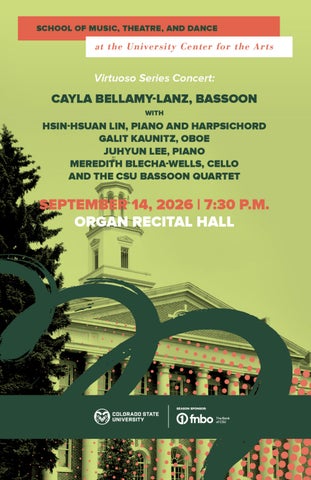
VIRTUOSO SERIES RECITAL “B IS FOR BASSOON” CAYLA BELLAMY-LANZ, BASSOON WITH HSIN-HSUAN LIN, PIANO AND HARPSICHORD | GALIT KAUNITZ, OBOE JUHYUN LEE, PIANO | MEREDITH BLECHA-WELLS, CELLO AND THE CSU BASSOON QUARTET SEPTEMBER 14, 2026 | 7:30 PM | ORGAN RECITAL HALL Trio in G minor, op. 17 (1846/2026)
Clara Wieck Schumann
Andante
arr. C. Bellamy-Lanz Galit Kaunitz, oboe Juhyun Lee, piano
Bright Leaf (2021)
Jenni Brandon
Concerto for Bassoon, K. 191 (1774)
Wolfgang Amadeus Mozart
Allegro ma non troppo Hsin-Hsuan Lin, piano Blue Set No. 2 (1993)
Peter Schickele
Gang of Wolves Evelyn Underwood, Zeke Graf, and Brody Ramirez, bassoons Sonatine, for Gustav Dherin (1952)
Alexandre Tansman
Hsin-Hsuan Lin, piano Noelia Escalzo Robles
Che Tango! (1982) Sonata in C Major, FaWV N:C1 (1720) Largo Allegro Andante Presto Meredith Blecha-Wells, cello Hsin-Hsuan Lin, harpsichord
Johann Friedrich Fasch
ABOUT THE MUSIC “Like her good friend Joseph Joachim, Clara Wieck Schumann’s reputation rested on her brilliance as a performer. Both were also gifted composers, but both eventually gave up composing to focus on performing. In Clara’s case, the reason was practical rather than artistic: During her marriage and especially after Robert’s death, concert tours were the way she was able to support her large family, and they left her little time for anything else. There was another reason, too. Charles Rosen has called Clara “perhaps the chief disaster of the 19th century’s prejudice against female composers.” Just as Fanny Mendelssohn let her music be published under her brother Felix’s name because few would believe a woman capable of such achievement, so did Clara allow songs she wrote to be published under the name of her husband, Robert. She did so in part because in both Clara’s and Robert’s eyes, Robert took priority. “Clara Wieck’s father began training her from an early age for a great musical career as both a pianist and a composer. She made her piano debut at eleven and began her Piano Concerto in A Minor when she was fourteen. Clara was already well known as a piano virtuoso when she married Robert. Theirs was a passionate relationship, with music at the center of their lives. She was devoted to him and ardently promoted his work. But putting Robert first, caring for their growing family (eventually they would have eight children), and concert tours left little time for composing. “Not one little hour in the whole day is left for me!” she wrote in 1841. “Most of Clara’s 23 published works were songs and short character pieces. A major exception was this Piano Trio in G Minor, a complex and beautifully written chamber work that shows her mastery both of counterpoint and of the long melodic line... If Schumann’s influence is apparent in the first movement, Mendelssohn’s can be heard in the melodious Andante, a Romantic Song without Words with an agitated middle section and some lovely writing for all three instruments.” — notes by Barbara Leish, Sebago-Long Lake Music Festival
“Bright Leaf for solo bassoon was written for Christin Schillinger and her now husband Mike for their wedding day in October 2021 They got married at a winery outside of Ithaca called Bright Leaf, and I wanted to write something that commemorated their wedding day and the beauty of this location. This work explores the beauty of the rows of vines and grapes in beauty that stretches out under the sun, and the possibilities of a beautiful life together.” — notes from the composer “Mozart’s Bassoon Concerto in B-flat major, K. 191, completed in Salzburg in 1774, stands at the head of his surviving concertos for solo wind instrument and orchestra. Written when the composer was 18, it combines symphonic ambition with unusually vocal writing for the bassoon— an early proof of how naturally Mozart could make a “supporting” orchestral voice sing. “The concerto’s reputation today is strikingly disproportionate to its early date. It has become a cornerstone of the bassoon repertory—often encountered in conservatory study and professional auditions—because it tests classical style, articulation, phrasing, and poised virtuosity more searchingly than its friendly surface suggests. What can be said with confidence is that K. 191 is Mozart’s earliest surviving concerto for a wind instrument, a fact that makes it a revealing point of departure for the later Salzburg and Vienna masterpieces for oboe, horn, clarinet, and flute. The writing already assumes a soloist fluent in rapid passagework and wide registers, but it just as often rewards a player who can shape long, aria-like lines with imaginative breath and color. “K. 191 occupies a special place in Mozart’s output because it shows, at age 18, a complete mastery of the classical concerto’s rhetorical balance: public brilliance tempered by intimacy, and virtuoso writing that remains inseparable from character and line. For bassoonists it has become a rite of passage, widely regarded as one of the most frequently performed and studied works in the instrument’s literature. Historically, it also stands as a reminder of Mozart’s early seriousness about wind instruments. Even before the great Vienna concertos and quintets, he was already able to individualize a timbre and write idiomatically for it—turning the bassoon from orchestral “foundation” into a persuasive solo voice. That transformation, achieved with modest forces and a seemingly conventional three-movement plan, is precisely why the concerto continues to deserve attention.” — notes from The Mozart Portal
“It’s not every composer who gets a commission to write a set of blues for four bassoons, but, hey, that’s the kind of charmed life I lead. I’m not sure if I had this in mind when I started out, but the Blue Set series seems to be made up of blues written for instruments not primarily associated with jazz and the blues. Illinois Jacquet and a few others have played jazz on the bassoon, but in general blues bassoonists are rarer than bald 1960’s rock ’n’ roll musicians... my own history as a putative bassoonist made me feel that I really ought to draw a couple of references to the composer of the most often played concerto in the bassoon repertoire; this feeling led to the final number, Gang of Wolves.” — notes from the composer “Despite their high energy, Alexandre Tansman’s music has been described as having a peculiar warmth, sensitivity, and lyric quality. The drive which his works possess results from a powerful rhythmic force which moves in a variety of shapes. The Sonatine for Bassoon was dedicated to Gustav Dherin, who was Professor of Bassoon at the Paris Conservatory and teacher of Maurice Allard. “The first movement is clearly formed with great motion resulting from a constant rhythmic variation and repetition of three and four note motives. The second movement augments these ideas and a beautiful, simple lyric quality pervades. The third movement returns to the rhythmic ostinato style of the first movement with tonal areas being felt through a constant repetitions of sonorities. “Tansman best describes his own music as: an independent and self- sufficient art and should, as far as, symphonic music is concerned, be motivated exclusively by musical elements of melody, harmony, rhythm and form without trying to express literary or pictorial subjects... Simplicity goes hand in hand with honesty, but artificial simplicity often results in vulgarity and is often more fabricated and contrived than the most complex score. The melodic line is the basis of all music, being shaped by its rhythmic design.” — notes by Douglas Kehlenbrink
“Noelia Escalzo is an Argentine composer, conductor, pianist, and folkloric singer whose work bridges the boundaries between concert music composition and the living traditions of Argentine popular and folk music. A graduate of the National University of Córdoba, she has established herself as a leading creative voice in Latin America, known for integrating regional idioms—particularly Zamba, Malambo, Vidala, and Milonga —into contemporary classical language. Her deep connection to Argentine folklore informs her compositional voice, which balances rhythmic vitality with lyrical expressiveness. “Beyond composition, she is an active performer and educator, advocating for the inclusion of Argentine and Latin American repertoire in academic and concert settings. Her efforts have contributed to the visibility of women composers in Latin America and to the transmission of folk heritage through contemporary composition.” — notes by Natasha Pizarro-Guerrero Johann Friedrich Fasch was a contemporary of Johann Sebastian Bach, though he never quite escaped the master composer’s shadow to the same degree as fellow composers such as Georg Phillip Telemann or Johann Stamitz. Fasch’s Sonata in C Major is a staple Baroque work of the bassoon canon and one of only a handful of works to be featured multiple times in the International Double Reed Society’s prestigious international competitions repertoire, first as a required work for the 2012 Fernand Gillet-Hugo Fox International Competition and then later in 2021, for the Norma Hooks Young Artist International Competition. The sonata follows the traditional Baroque sonata da chiesa structure, alternating between slow and fast movements and featuring the solo voice alongside a basso continuo and harpsichord. The varying movements highlight the expressive and singing qualities of the bassoon alongside its ability to play quick, leaping notes, as well as the performer’s expressiveness and ensemble skill through improvised or uniquely composed embellishments. As is traditional, the second times performing large sections in the formal structure are more ornamented than their initial statements. Listen in the first and third movements for repeated melodies with florid technique added and in the second and fourth movements for quick bursts of trills and passing notes to fill in leaping passagework with energetic runs. This sonata was written around the year 1720, at which point the Baroque bassoon would have included just four keys – an even more virtuosic display than what is possible on today’s 25 key model! — notes by Cayla Bellamy-Lanz
ABOUT THE PERFORMERS CAYLA BELLAMY-LANZ is a performer, collaborator, and pedagogue dedicated to advancing the music field through redefining standard practices in the bassoon studio and chamber ensemble settings. She serves as Associate Professor of Bassoon at Colorado State University, where she teaches applied bassoon, chamber music, and instrumental pedagogy, in addition to performing regularly with the Colorado Bach Ensemble and directing the Fort Collins-based Health and Wellness Community Orchestra. Cayla is a specialist in contemporary American concerto writing for the bassoon, with eight orchestral and wind band solo features in the past five years, including concerti by Jenni Brandon, Libby Larsen, Mathieu Lussier, James Stephenson, Jerod Impichchaachaaha’ Tate, Joan Tower, and Dana Wilson. Her contemporary music ventures extend beyond large ensemble works, as well, and she has been a recipient of numerous national and international performance invitations, as well as a grantee of the New Music USA Creator Fund alongside CSU colleague and flutist Dr. Megan Bellamy-Lanz. With this duo, she has commissioned and premiered nine works in the past three years, premiered the chamber orchestra setting of Noelia Escalzo Robles’ Idílico double concerto at the International Double Reed Society globalconference in 2026, and is embarking on recording her third commercial album, a collection of music inspired by the National Parks. Cayla’s debut album, Double or Nothing (2018), consists of premiere recordings for solo and duo bassoon and is available through the Mark Masters label on iTunes, Amazon, and Spotify. Recordings from this album earned her first honorable mention in the 2020 Ernst Bacon Prize for the Performance of American Music, and her second project, a collection of new compositions for bassoon titled American Bassoon Voices, released fall 2023. Live recital recordings from this album’s collection earned First Honorable Mentions in the 2023 American Prizes for Instrumental Performance and the Performance of American Music. As a result of her body of creative works to date, she was the sole faculty member to be named a Provost and Executive Vice President Research Scholar at Colorado State University in 2026. Cayla holds a Doctor of Music degree in Bassoon Performance and Literature from the Indiana University Jacobs School of Music, in addition to Bachelor and Master of Music degrees in Music Education and Bassoon Performance from the University of Georgia, where she was distinguished as a National Presser Scholar. Her primary teachers include William Ludwig, Amy Pollard, and William Davis, with additional studies with Nancy Goeres and Per Hannevold at the Aspen Music Festival and School. In addition to professional affiliations with the National
Association for Music Education and College Music Society, she was previously on the conducting faculties of the New York Summer School of the Arts and Emory Youth Symphony Orchestra. Currently, Cayla serves on the staff of the International Double Reed Society as Communications Coordinator and as Colorado state chairperson for the National Association of Wind and Percussion Instructors and was the founding President of the Southwest Regional Chapter of the International Double Reed Society. Offstage, Cayla is an amateur endurance athlete with academic research focusing on coaching psychology, methodologies, and the intersections of artistic and athletic training. Learn more about Cayla at www.caylabellamy.com. A native of Taiwan, DR. HSIN-HSUAN LIN is an all-round pianist of chamber music and largeensemble. She has a huge diversity of repertoires including winds, strings, operas, choirs, bands and symphonies. Dr. Lin started her collaborative journey by working with the choir at Pace Institute in Taiwan when she was twelve. She later served as a pianist in Pace Institute Orchestra (where she also played the flute.) That was the first time she felt the beauty of playing with other people than herself. During her undergraduate study, she performed with many of her colleague at school. She also served as a choir pianist and rehearsal pianist of Verdi’s opera ‘Falstaff” with all the voice faculties at TungHai Unversity. She was invited to many music festivals and contests such as Castleman Quartet Program, Texas String Camp and Festival, Longhorn Music Camp, Austin University Interscholastic Leagues Contests, and many regional competitions. Dr. Lin received her Bachelor’s degree in piano performance from TungHai University in Taichung, Taiwan under Min-Hwa Chen. She was admitted to University of Texas at Austin, where she studied with Gregory Allen and received her first Master degree in Piano Performance in 2014. She continued her study in collaborative piano at UT Austin, and earned her second Master’s and Doctoral of Musical Art in Collaborative Piano in 2018 and 2020 under Anne Epperson and Colette Valentine. She was a full scholarship recipient and appointed teaching assistant during her study of collaborative piano.
DR. GALIT KAUNITZ is an active orchestral musician, performs solo and chamber music recitals, and co-hosts the Double Reed Dish podcast with bassoonist Jacqueline Wilson. Galit explores themes of culture and identity through her solo and chamber music recitals. She has been invited to perform at International Double Reed Society conferences in 2016, 2019, 2021, 2022, and 2024, and College Music Society conferences in 2016 and 2018. She is dedicated to expanding the canon to include works by underrepresented and displaced composers and enthusiastically collaborates with composers to commission new works. She, Jacqueline Wilson, and pianist Fabio Menchetti recorded the album All Are Welcome in 2022, which features new commissions for oboe and bassoon by Connor Chee, brin solomon, Mason Bynes, and Kate Pukinskis. Galit is also uncovering the legacy of composer Elizabeth Gyring through performing and recording her works. Galit is a dedicated teacher who loves educating and empowering students so they can be successful in all of their future endeavors. She is grateful to have studied under Eric Ohlsson, Rebecca Henderson, Humbert Lucarelli, and Marilyn Krentzman. Galit is a Marigaux artist and plays on a Marigaux 901. DR. JUHYUN LEE has performed in a large number of recitals, concerts, and new music festivals, including a world premiere performance of Charles Strouse’s Sonata for Horn and Piano, Armand Qualliotine’s Duo for Piano and Alto Saxophone, and Moye Piano Sonata by Jim Klein and Ian Jamison. She joined a premier recording project of Sonata for Saxophone and Piano by Jim Klein and Ian Jamison and released an album in July 2023. This album has received recognition by magazine media such as Plastic, Dulaxi, KIMU, and EDM Rekords. As a collaborative pianist, Dr. Lee joined Bowdoin International Festival 2014 and SongFest 2016. She performed at the 47th National Flute Convention in Salt Lake City, Utah, in 2019 and Mid-Atlantic Flute Convention in Washington, D.C., in 2020. She was the guest pianist at MCC’s Summer Flute Project in Mesa, Arizona, and performed in faculty recitals and a chamber music concert. In 2023, she was appointed collaborative piano faculty member at Luzerne Music Center in New York.She also has served as an orchestral pianist in Arizona State University, Fort Collins Symphony, and Greeley Philharmonic. She performed in Jordan Hall as a guest keyboardist with the Boston Modern Orchestra Project in 2014. Dr. Lee received her M.M. in Collaborative Piano from the Longy School of Music, where she studied with Brian Moll. During her time in Massachusetts, she worked as the primary pianist
for the saxophone studios at the New England Conservatory, Boston University, and Boston Conservatory, where she worked with the renowned saxophonist Kenneth Radnofsky. After completing her master’s degree, Dr. Lee worked as a Longy School of Music staff pianist. She continued her studies with Dr. Andrew Campbell at Arizona State University, where she received her Doctorate of Musical Arts in Collaborative Piano and Chamber Music in 2019. Dr. Lee published A New Piano Reduction of the Nielsen Flute Concerto in December 2019. She served as a judge penal in concerto competition finals for the University of Northern Colorado Southard Music Competition and the University of Wyoming Jacoby Competition in 2023. Dr. Lee joined the Colorado State University collaborative piano faculty in 2018.
The CSU Bassoon Quartet** is comprised of members of the Colorado State University bassoon studio, students pursuing undergraduate and graduate study with Dr. Cayla Bellamy-Lanz. 2026-2027 CSU Bassoon Studio Aurora Barker, BM Performance ‘27 **Zeke Graf, BM Education ‘27 Jamie Hoel, BM Education ‘30 Olivia Fountain, BM Education ‘30 Atticus Johnson, BS Political Science ‘30 Rachael McReynolds, BM Education ‘30 Joy Perry-Grice, BM Education ‘29 **Brody Ramirez, BM Performance ‘30 Zach Talan, BM Composition ‘29 **Evelyn Underwood, BM Performance ‘27 Will Withers, BA Economics ‘28 Zhihong Zhang, MM Performance ‘28
Praised for her “beautifully full and lyrically strong tone” by Gramophone Magazine, MEREDITH BLECHA-WELLS is a sought-after performer and instructor. She has played throughout much of the United States, as well as Europe, Australia, South America, and Asia. Currently based in Colorado, Dr. Blecha-Wells recently joined the faculty at Colorado State University. As a recording artist, Dr. Blecha-Wells has released several CDs spanning the solo, chamber music, and orchestral spaces. Her solo album was described as “technically dazzling” (the Whole Note), and she was praised for her “lyrical warmth and her powerful athleticism” (Classical Music Discoveries). Dr. Blecha-Wells’ recordings can be found on labels including Naxos, Navona, and Onyx Lane Productions and broadcast on numerous radio stations such as WFMT (Chicago, IL), WMBR (Cambridge, MA), KALX (Berkley, CA), WRUV (Burlington, VT), WCNY (Syracuse, NY), KUCO (Edmond, OK), among others. Dr. Blecha-Wells previously served as the Professor of Cello at Oklahoma State University, where she was awarded the College of Arts and Sciences Junior Faculty Award for Scholarly Excellence as well as the First Lady of OSU Distinguished Music Professor award. A passionate pedagogue, Dr. Blecha-Wells is committed to raising the efficiency and joy in learning. Her students have gone on to remarkable programs including the Juilliard School, the New England Conservatory, the Eastman School of Music, Rice University, the University of Michigan, the Manhattan School of Music, the San Francisco Conservatory, Northwestern University, Indiana University, the Cleveland Institute of Music, the Oberlin Conservatory of Music, the University of Southern California, DePaul University, and the Cincinnati Conservatory of Music. Additionally, her students have won several competitions including the YoungArts National Awards, the Classics Alive Artists, Enkor International Competition, American Protégé Competition, Ad Astra String Competition, MTNA, Hyechka String Competition, among others. Dr. Blecha-Wells’ students have also been selected to participate in prestigious festivals including the National Youth Orchestra and the National Youth Orchestra 2, Aspen Music Festival, Brevard Music Festival, Eastern Music Festival, Green Mountain Music Festival, and several others.
Dr. Blecha-Wells has taught at numerous festivals, clinics, and institutes spanning six continents. She has had the pleasure of teaching at the International Cello Institute, the Alaska Cello Intensive, Gran Encuentro Chelistas in Colombia, the Saarburg Chamber Music Festival in Germany, the Chicago Suzuki Institute, the Austin Suzuki Institute, among others. She has given numerous clinics and was the featured cello clinician at the 2024 American String Teachers Association Conference. Dr. Blecha-Wells received a bachelor’s and master’s degree in Cello Performance from Indiana University and holds a Doctor of Musical Arts in Performance and Literature from the Eastman School of Music. Her teachers have included Janos Starker, Alan Harris, Emilio Colon, Helga Winold, Richard Hirschl, and Marc Johnson. Additional studies include festival participation at the Taos School of Music, the Norfolk Chamber Music Festival, Spoleto Festival USA, the National Repertory Orchestra, and the Bowdoin International Music Festival.
UPCOMING DOUBLE REED EVENTS AT CSU September 19, 2026 Pre-College Double Reed Workshop October 19, 2026 Virtuoso Series Recital, Dr. Galit Kaunitz December 6, 2026 Double Reed Studio Recital March 6, 2027 OboeRAMa and BassoonaRAMa
LEVEL UP. The NEW CSU ™
Visa Debit Card. ®
Show your Rams pride everywhere you go with the all-new CSU Visa® Debit Card — free with any FNBO checking account. New design. Raised detail. Premium finish.
Member FDIC