CSU SYMPHONY ORCHESTRA
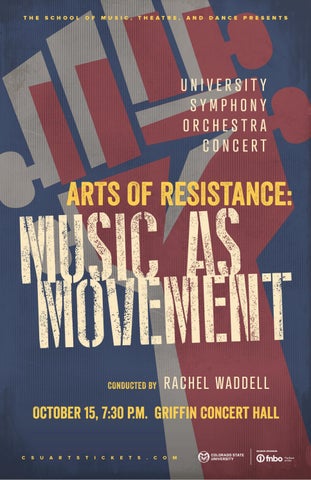
ARTS OF RESISTANCE (MUSIC AS MOVEMENT) OCTOBER 15, 2026 | 7:30 P.M. | GRIFFIN CONCERT HALL FOLLOW US ON INSTAGRAM @CSUORCHESTRAS
Program: “Danza final (Malambo)” from Estancia, Op. 8a Symphony No. 45 in F-sharp minor, Hob. I:45, “Farewell”
Alberto Ginastera (1916–1983) Joseph Haydn (1732–1809)
I. Allegro assai II. Adagio III. Menuet: Allegretto IV. Finale: Presto – Adagio INTERMISSION The Montgomery Variations I. Decision II. Prayer Meeting III. March IV. Dawn in Dixie V. One Sunday in the South VI. Lament VII. Benediction
Margaret Bonds (1913–1972)
PERSONNEL: Dr. Rachel Waddell, Music Director and Conductor SeungHyuk Yeom, Assistant Conductor and Graduate Teaching Assistant Flute Owen Krings, Principal for Bonds and Piccolo for Ginastera Jenna Kleven, 3rd Flute/Piccolo/Alto Flute for Bonds Lexi Nigro, Flute and Piccolo for Ginastera Claire Ardoin, 2nd Flute for Bonds Oboe Lexi Miller, Principal Sophie Haase, 2nd Oboe Olivia Zenzinger, English horn for Bonds Clarinet Orion Rayburn, Principal for Ginastera and Bonds Henry Buckley, 2nd Clarinet for Ginastera and Bonds CJ Ahlmann, Bass Clarinet for Bonds Bassoon Evelyn Underwood, Principal for Ginastera and Bonds Aurora Barker, 2nd Bassoon for Ginastera and Contrabassoon for Bonds Will Withers, Principal for Haydn and 2nd Bassoon for Bonds Horns Kaleb Harris, Principal Jonah Loschky, 2nd Horn Zoe Huff, 3rd Horn Maxine Ewing, 4th Horn Trumpet Lauren Smith, Assistant Principal for Ginastera and Principal for Bonds Adam Smith, Principal for Ginastera and 2nd Trumpet for Bonds Jaime Perez-Rosa, 2nd Trumpet for Ginastera and 3rd Trumpet for Bonds Trombone Silas Riep, Principal Wyatt Bond, 2nd Trombone Max Eckhardt, Bass Trombone Tuba Evan Allenson, Principal
Percussion Erin Brizic, Principal, Timpani for Ginastera and Bonds Ben Stordeur, Xylophone for Ginastera, Bass Drum and Triangle for Bonds Nathan Krause, Tambourine for Ginastera, and Rachet and Snare Clicks for Bonds Ryan Mikesell, Field Drum, Castanets, and Suspended Cymbal for Ginastera and Suspended Cymbal and Crash Cymbals for Bonds Emerson Marsh, Bass Drum, Triangle, and Suspended Cymbal for Ginastera; Tambourine and Gong for Bonds Simon Nguyen, Tenor Drum for Ginestera Sam Christensen, Tam, Crash cymbals, Triangle, Suspended Cymbal for Ginastera Piano Otto Huffman Harp Katerina Mead, Principal Violin 1 Russell Wolfe, Principal for Ginastera and Haydn * Ella Batson, Principal for Bonds * Nathan Newman * Mari Marsh * Mason England Kirby Miller * Li Gomez Aidan Ellis * Lydia Hagerman * Geneva Boersma * Violin 2 Alexander Latham, Principal for Ginastera and Haydn * Lamarana Baldé, Principal for Bonds * Fabian Kaltenbach * Nora Dukart * Isaac Watson * Jordan Olson * Taylor Green * Jasper Ruegge Noah Moreno * Blaire Wolfe-rocca Violas Cassidy Hall, Principal for Haydn and Bonds * Keira Botica, Principal for Ginastera * Bella Penna Noelle Judd * Josh Pluta * Kaden Cardonne Madison Ramonette *
Violas (cont.) Emily Kurulenko Nayeli Petersen * Raymundo Barrera Bryce Crawford * Andy Larsen * Cellos Sarah Bennett, Principal for Ginastera Logan Kuhlman, Principal for Haydn and Bonds * Aurora Farrel Talitha Marinho Iain Ross * Alisa Gorley * Taryn Limke * Avi Bender Matt Fox Javier Molina * Cade Schindler Caleb Kinter * Cian Sarton * Andrew Gilbert * Emi Smith * Cora Larson † Zuzu Davis † † Also performs in the Bass section Bass Lucy McHugh, Principal * Isaac Hermanson Mars Wagner * Zuzu Davis for Ginastera Cora Larson for Bonds * Performs in Haydn Librarians Adam Smith Logan Amick Set-Up Crew Claire Ardoin Andy Larsen
The CSUSO Wishes to Thank: Dr. Dawn Grapes John Herman Erin Brizic Mike Solo Jennifer Clary and her team Dr. Daniel Stein, Valerie Reed, and their team Jim Doser, Audio Engineer, and his team Nicole Darling Dr. Megan Bellamy-Lanz, Instrumental Resources & Operations Coordinator SeungHyuk Yeom, Assistant Conductor and Graduate Teaching Assistant Adam Smith, Librarian Logan Amick, Librarian Claire Ardoin, Set-Up Crew Andy Larsen, Set-Up Crew CSU Applied Faculty COLORADO STATE UNIVERSITY MUSIC APPLIED FACULTY
Violin Ron Francois
Flute Ysmael Reyes
Trumpet Stanley Curtis
Harp Kathryn Harms
Viola Rose Wollman
Oboe Galit Kaunitz
Horn John McGuire
Cello Meredith Blecha-Wells
Clarinet Wesley Ferreira
Trombone Drew Leslie
Piano Bryan Wallick Tim Burns
Bass Forest Greenough
Saxophone Peter Sommer Dan Goble
Tuba/Euphonium Brian Sugrue
Guitar Jeff Laquatra
Bassoon Cayla Bellamy
Percussion Eric Hollenbeck Shilo Stroman
Organ Joel Bacon Voice Nicole Asel Tiffany Blake John Lindsey
PROGRAM NOTES “Danza final, Malambo” from Estancia Suite Alberto Ginastera (1916–1983) Alberto Ginastera was born in Buenos Aires, Argentina and became one of the most influential Argentine composers of the twentieth century. He was trained in his hometown at the Conservatorio Williams, which was named after Alberto Williams, who played a prominent role in Argentinian music in the 1890s. There Ginastera studied composition under José André, Athos Palma, and José Gil. Ginastera graduated in 1938 with an impressive reputation, after his first ballet suite Panambi premiered in 1937. The dramatic work showed mass audiences his innovative orchestration skills and deep understanding of texture and rhythm. Ginastera’s inspiration for establishing a national Argentinian music only grew after he was commissioned by the American Ballet Caravan, based in New York City, for a new ballet. Ginastera completed Estancia Suite in 1941, but because of financial troubles and artistic burnout, the Ballet Caravan disbanded the following year. This caused the complete ballet production to be delayed ten years, with the first full performance finally taking place in 1952. Even with the initial cancellation, Ginastera had great success with the music in the concert world when an orchestrated suite was first issued in 1943. Estancia Suite was inspired by folk music of the rural areas of Argentina, representative of Ginastera’s love of traditional music. The composer embraces this passion, starting with the work’s title. Estancia is the Spanish word for the large Argentinian ranches where cattle are raised. The final movement of the suite, Malambo, is stylized after the malambo danza, a lively dance from areas near Buenos Aires, La Pampa, South of San Luis, Santa Fé, and Entre Ríos. This highly rhythmic country dance originated from the gauchos, horsemen from the plains of Argentina, and then became a national musical style connecting Argentinian culture. The final movement is filled with irregular cross rhythms that provide momentum to the fast-paced dance that explodes with energy from start to finish.
Symphony No. 45, “Farewell” Franz Joseph Haydn (1732–1809) Joseph Haydn, known as the “father of the symphony” for the 104 symphonies he composed, established the standard of the four-movement structure of the genre, which Mozart and Beethoven then modeled in their own works. This earned all three of these composers the
title of “Viennese Classics” as they continued to grow the Classical genre. After his death in the early nineteenth century, Haydn became understood as an absolute musician who focused on the feelings and stories infused into his music. Haydn composed Symphony No. 45 during his years as Kapellmeister at the Viennese Esterházy family court. In the summer of 1772, Haydn wrote this symphony as he and other musicians spent the season at the country palace named “Eszterháza.” The prince became quite attached to the music Haydn provided that year and the “summer” stay turned into ten months. This frustrated Haydn and the other musicians who wanted to go home to their families. So, the composer wrote the final movement of the symphony in such a way that, section-by-section, the musicians stop playing and begin to leave the stage, leaving only the first stand of first violins playing and sending a powerful message to their employer. — program notes by Erin Brizic, CSU Graduate Student in Percussion
Montgomery Variations Margaret Bonds (1913–1972) “Let America be the dream the dreamers dreamed— Let it be that great strong land of love Where never kings connive nor tyrants scheme That any man be crushed by one above.” — Langston Hughes (excerpt from “Let America be America Again”) Margaret Jeanette Allison Majors was born in Chicago, Illinois in 1913 to Alpheus Majors, a physician and author, and Estella Bonds, a church organist, teacher, and member of the National Association of Negro Musicians, both of whom were fervently active in the civil rights movement. In 1917, Margaret’s parents divorced and she moved in with her mother, taking the surname “Bonds.” Bonds was recognized as a prodigious pianist at an early age and by the age of sixteen had already studied piano and composition with leading figures in the field, Florence B. Price and William Dawson. Bonds was admitted to Northwestern University at sixteen where she notes having some of her earliest exposure to outward displays of racism. Although Bonds enrolled in the prestigious music department, she was not allowed to use university facilities such as practice rooms and the library on account of her race. In a 1971 interview with University of Colorado professor Helen Walker-Hill, Bonds called it a “terribly prejudiced place.”
After finishing her studies, she worked in Chicago for a few years, composing and performing for the Federal Negro Theatre, in various church musician roles, and on tours for civil rightsbased projects. In 1939, Bonds moved to New York City. Some writers speculate she moved to pursue a relationship with writer and social activist Langston Hughes (whom she had met at various events and parties), but research suggests that the move was to further her career. Speculation of a relationship between the two beyond simple friendship is drastically romanticized. Bonds even noted, upon moving to New York, that her relationship with Hughes was like that of a brother and sister. Through her connections with African American musicians across the United States and by closely following the news of the American south, Bonds became increasingly aware of civil rights mistreatment taking place in the 1950s and 1960s. Everything came to a halt for Bonds when news broke of the 1963 firebombing of Birmingham’s 16th Street Baptist Church by white nationalists, resulting in the deaths of four teenage girls and injuries of dozens of others. Many southerners were tempted to fight fire with fire, but the Rev. Dr. Martin Luther King Jr. and his civil rights movement constituents preached peaceful demonstrations and protests, prompting Bonds to write her 1964 Montgomery Variations. Bonds notes that she took inspiration for her compositional form of Montgomery Variations from J.S. Bach’s partitas, clearly stating a theme with variations in both major and minor iterations of the key. In Bonds’s case, the theme she chose was the hymn “I Want Jesus to Walk with Me,” in which the singer pleads with Jesus to be alongside them through all their tribulations. Even more poignantly, the hymn’s text directly references all the walking the Black community and their supporters endured for the duration of the Montgomery bus boycott following the arrest of Rosa Parks on December 1, 1955. The boycott was intended only to last one day, but the Montgomery Improvement Association, headed by its president, King Jr., voted that the protest would be better suited as a long-term campaign. The boycott lasted 381 days. Bonds’s Montgomery Variations is written in seven movements, each with its own subtitle and brief description that the composer wrote herself. Decision: “The Negro decides to rise against his oppressors.” Prayer Meeting: “Before the Bus Boycott the Negro calls on God.” March: “As the early Christians, now the Negroes of Montgomery were willing to be thrown to the lions. Jesus, walking with them, they refused to ride on segregated buses.” Dawn in Dixie: “Montgomery is no isolated town. Montgomery became a focal point of the
world. The entire South, ‘Dixie,’ began to wake up that something new was happening. Change, no matter how painful, is the Divine Plan.” One Sunday in the South: “What is meant by ‘Southern die-hards?’ The Negros were having such a good time praising God and Jesus one Sunday morning in Alabama. Little children were being taught Faith and to love their neighbors. Die-hards planted a bomb in the church to teach Negroes their place.” Lament: “In the Passive Resistance Movement, one does not resort to violence. ‘Vengeance is mine saith the Lord.’ One cries, moans and groans and calls for help from the MotherFather God.” Benediction: “A benign God, Father and Mother to all people, pours forth Love to His children – the good and the bad alike.” On top of the many demonstrations Bonds was present at in the movement for equality, she used her compositional superpower to tell the story of an active yet peaceful people who would not rest until they saw a world in which they belonged. Bonds understood music as movement, and her Montgomery Variations is an integral part of the way twenty-first century Americans understand the Civil Rights Movement. The Montgomery Bus Boycott was not the end of Jim Crow segregation in the South. Countless people lost their lives for years to come fighting for justice for the Black community. On the night before his murder, The Rev. Dr. Martin Luther King Jr. famously delivered his “I’ve Been to the Mountaintop” speech to striking sanitation workers in Memphis, Tennessee, with tragic irony. Dr. King’s sentiment is one shared amongst all who believe in an America where justice is living and breathing: “Somewhere I read of the freedom of assembly. Somewhere I read of the freedom of speech. Somewhere I read of the freedom of press. Somewhere I read that the greatness of America is the right to protest for right… I don’t know what will happen now. We’ve got some difficult days ahead. But it really doesn’t matter with me now, because I’ve been to the mountaintop… And I’ve looked over. And I’ve seen the Promised Land. I may not get there with you. But I want you to know tonight, that we, as a people, will get to the promised land!” — program note by John Herman, CSU Graduate Student in Choral Conducting
BIOS: Guided by the belief that orchestras are living ecosystems shaped by human connection, American conductor RACHEL WADDELL brings a narrative, collaborative approach to her work on the podium. With over fourteen years of experience across professional, educational, and community ensembles, Rachel shapes programs and performances that reflect her belief in music as a vehicle for connection, imagination, and shared experience. An award-winning conductor who has led ensembles across the United States and internationally, she balances high artistic standards with humility, humanity, and a commitment to shaping the trajectory of symphonic music in the 21st century. Professionally, Rachel is building a dynamic and expanding conducting career across the United States and internationally, earning recognition for her clarity, narrative approach, and collaborative leadership on the podium. She has guest conducted the Rochester, Las Vegas, and Denver Philharmonics, the Greater Bridgeport Symphony Orchestra, and the Southwest Michigan Symphony Orchestra, and has been a finalist in multiple Music Director searches. Her professional foundation includes a transformative five-year tenure advancing from Assistant to Associate Conductor with the Canton Symphony Orchestra. Internationally, she was named a Carlos Miguel Prieto Conducting Fellow in 2025 and studied with Yannick Nézet-Séguin at Domaine Forget, where she was selected to share the podium with him in leading the Orchestre Métropolitain on a subscription concert. She also conducted selections from Così fan tutte in Vienna through the Vienna Opera Academy, performing with a professional ensemble in ticketed concerts following rehearsals at the Musikverein. A tireless advocate for musical access, Rachel’s commitment to educational excellence earned her recognition as a 2026 GRAMMY Museum Music Educator Award Semifinalist. She serves as Assistant Professor and Director of Orchestras at Colorado State University, following a highly successful six-year tenure as Director of Orchestral Activities at the University of Rochester. Concurrently the Music Director of the Longmont Youth Symphony, she is a highly sought-after guest conductor for honor ensembles, including the 2025 TMEA All-State Orchestra Sinfonietta. In 2026, she launches a new collaborative initiative with the Colorado Symphony through the inaugural CONCERT Program (Collaborative Orchestral Network for Community Education, Resources, and Training), designed to bridge the professional and academic orchestral spheres.
Off the podium, Rachel champions institutional innovation. During the pandemic, she cofounded Conductors for Change, launching global seminars and award-winning programs that reimagine the role of orchestras in the United States. Her visionary approach to audience development has earned her the American Prize’s Vytautas Marijosius Memorial Award in Orchestral Programming in both 2020 and 2021. A voraciously curious learner dedicated to deepening her artistry and humanity, Rachel holds a DMA in Orchestral Conducting from the University of Nevada, Las Vegas, and is a member of The Recording Academy.
T H E S C H O O L O F M U S I C , T H E AT R E , A N D DA N C E P R E S E N T S
CONCERT ORCHESTRA CONCERT SERGEI PROKOFIEV’S
CONDUCTED BY
R A C H E L WA D D E L L NARRATED BY
NOAH RACEY CHOREOGRAPHED BY
MADELINE HARVEY FEATURING
CSU DANCE STUDENTS
OCTOBER 21, 2026 7:30 P.M. GRI F F I N C ONC E RT H AL L
C
S
U
A
R
T
S
T
I
C
K
E
T
S
.
C
O
M
LEVEL UP. The NEW CSU ™
Visa Debit Card. ®
Show your Rams pride everywhere you go with the all-new CSU Visa® Debit Card — free with any FNBO checking account. New design. Raised detail. Premium finish.
Member FDIC