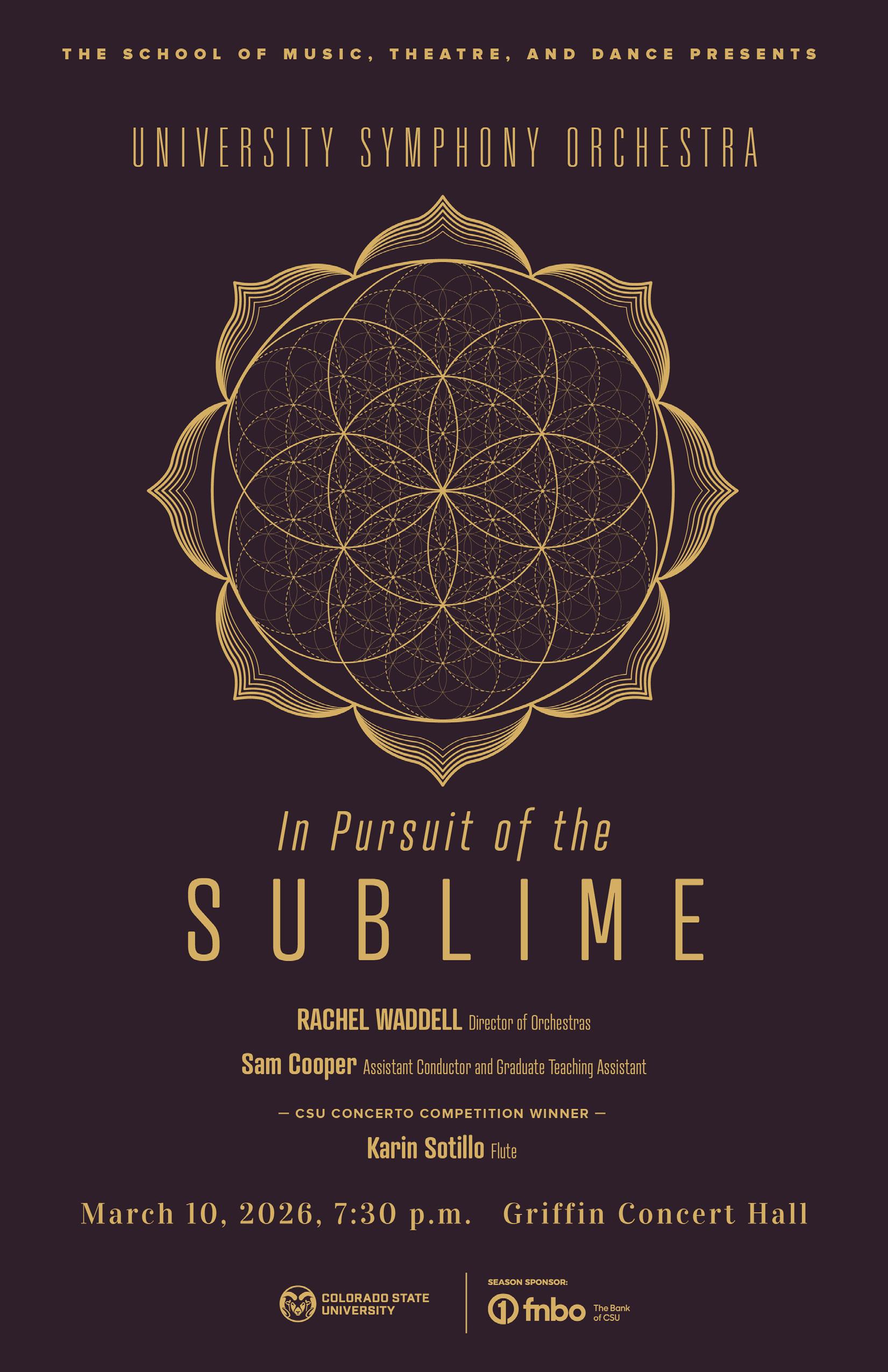
CSU SYMPHONY ORCHESTRA
MARCH 10, 2026 | 7:30 P.M. | GRIFFIN CONCERT HALL
CSU SYMPHONY ORCHESTRA
MARCH 10, 2026 | 7:30 P.M. | GRIFFIN CONCERT HALL
GRADUATE CONDUCTING RECITAL, SAM COOPER
Follow Us on Instagram @CSUOrchestras
“Like humans, nature is unbelievably creative and utterly destructive.”
— Yo-Yo Ma
Program:
The Oak Florence Beatrice Price (1887 – 1953)
Fantasie Pastorale Hongrois
Albert Franz Doppler (1821 – 1883) arr. Albert Klautzsch
CSU Concerto Competition Winner: Karin Sotillo, Flute
Symphony No. 6 in F major, Op. 68 (“Pastoral”) Ludwig van Beethoven (1770 – 1827)
I. Pleasant, Cheerful Feelings that Awaken in People Upon Arrival to the Countryside
II. Scene by the Brook
III. A Fun Gathering of Country Folk
IV. Thunderstorm
V. Charitable Feelings, Coupled with Gratitude Towards the Deity, After the Storm
Dr. Rachel Waddell, Music Director and Conductor
Sam Cooper, Assistant Conductor and Graduate Teaching Assistant
Flute
Lydia Chinchilla, Principal for Price and Beethoven
Elizabeth Movinsky, 2nd Flute for Price and Principal for Doppler
Annika Johnson, 3rd Flute for Price and Piccolo for Beethoven
Ella Patterson, Piccolo for Price and 2nd Flute for Beethoven
Oboe
Olivia Zenzinger, Principal
Sophie Haase, 2nd Oboe for Price
Amber Mills, English Horn for Price and 2nd Oboe for Beethoven
Clarinet
Orion Rayburn, Principal
Henry Buckley
Cole Boyd, Bass Clarinet for Price
Bassoon
Will Withers, Principal for Price and Beethoven
Brody Ramirez, 2nd Bassoon for Price and Principal for Doppler
Charlie Beauregard, 2nd Bassoon for Beethoven
Horns
Colby Hutson, Principal asst. Jenna Yonce
Jonah Loschky, Horn 2
Zoe Huff, Horn 3
Maxine Ewing, Horn 4
Trumpet
Adam Smith, Principal for Price and Beethoven
Bryce Wicks, 2nd Trumpet for Price and Principal for Doppler
Hannes Spiller, 3rd Trumpet for Price, 2nd Trumpet for Doppler, and 2nd Trumpet for Beethoven
Trombone
Carson Koch, Principal for Price, 2nd Trombone for Doppler, and 2nd Trombone for Beethoven
Silas Riep, 2nd Trombone for Price, 3rd Trombone for Doppler, and Principal for Beethoven
Amber Minich, 3rd Trombone for Price and Principal for Doppler
Tuba
Arabella Dunnington, Principal
Percussion
Lucille Harlow, Principal, Snare Drum, and Celeste for Price and Timpani for Beethoven
Noah Roppe, Timpani for Price and Doppler
Nathan Krause, Cymbals for Price
Neo Shaffer, Triangle and Tambourine for Price
Ryan Mikesell, Bass Drum for Price
Harp
Katerina Mead, Principal
Violin 1*
Geneva Boersema
Coverdale
Mason England
Li Gomez
Mari Marsh
Kirby Miller
Nathan Newman
Russell Wolfe, Concertmaster
Violin 2*
Lamarana Baldé
Maribel Brannan
Claire Davis
Taylor Green
Fabian Kaltenbach
Alexander Latham, Principal
Jordan Olson
Haley Rieger
Violas*
Raymundo Barrera
Cassidy Hall, Principal
Alan Larsen
Madison Ramonette
Genesis Tyler
Jade Vargas-Reynoso
Cellos*
Zuzu Davis
Amy Effinger
Aurora Farrell
Matt Fox
Axel Gallegos, Principal for Beethoven
Isabelle Howard
Caleb Kintner
Cora Larson
Taryn Limke
Talitha Marinho, Principal for Price and Doppler
Louisa Mitchell
Lillian Rogers
Iian Ross
Avery Stahla
Alex Strobel
Bass*
Hunter Dominguez
Isaac Hermanson
Lucy McHugh, Principal
*The members of the string section are listed alphabetically.
Librarians
Dr. Megan Bellamy-Lanz, Head Librarian
Sam Cooper, Librarian Liaison
Devon Bignell
Gabriela Greenberg
Set-Up Crew
Nathan Krause
Lucy McHugh
Sam Cooper
Dr. Megan Bellamy-Lanz
Devon Bignell
Gabriela Greenberg
Nathan Krause
Lucy McHugh
Principal Players in the Orchestra
Dr. Daniel Stein, SMTD Events Manager, and his student staff
Valerie Reed, Assistant Events Manager
Jim Doser, Audio Engineer
Mike Solo, Creative Director
Dr. Rose Wollman, Professor of Viola, for leading sectionals for this concert cycle.
Dr. John McGuire, Director of the Department of Music, Brass Area Coordinator, and Professor of Horn for leading sectionals for this concert cycle.
Professor Ron Francois, Violin, for leading sectionals with the 1st Violins for this concert cycle.
Dr. Zo Manfredi for helping with 2nd violin sectionals for this concert cycle.
Dr. Ysmael Reyes, Professor of Flute
COLORADO STATE UNIVERSITY MUSIC APPLIED FACULTY
Violin
Ron Francois
Viola
Rose Wollman
Cello
Meredith Blecha-Wells
Bass
Forest Greenough
Guitar
Jeff Laquatra
Flute
Ysmael Reyes
Michelle Stanley
Oboe
Galit Kaunitz
Clarinet
Wesley Ferreira
Saxophone
Peter Sommer
Dan Goble
Bassoon
Cayla Bellamy
Trumpet
Stanley Curtis
Horn
John McGuire
Trombone
Drew Leslie
Tuba/Euphonium
Brian Sugrue
Percussion
Eric Hollenbeck
Shilo Stroman
Harp
Kathryn Harms
Piano
Bryan Wallick
Tim Burns
Organ
Joel Bacon
Voice
Nicole Asel
Tiffany Blake
John Lindsey
Musicians and Colleagues in the CSU Symphony Orchestra. You all are amazing!
Musicians and Colleagues in the CSU Concert Orchestra. I have learned so much with y’all!
Dr. Rachel Waddell
Dr. Kesikli Egemen
Dr. Dawn Grapes
Dr. Dan Obluda
Dr. Abigail Shupe
Dr. Brandon Stephen Matthews
Dr. Emily Ondracek Peterson
Dr. Philip Ficsor
Dr. Carla Aguilar
Dr. David Farrell
Dr. David Kish
Dr. Silas Huff
Professor Cherise Leiter
Professor MB Kreuger
Michelle Ewer
Melissa Barru
Teri Willmarth
Ashley Cervenka Short
Amy Ward
Andrew Cogswell
Karissa Swanson
Carl Topilow
Dianne Wittry
Jaymie Giordano
Grace Dougherty
Carly Neumann
Axel Gallegos
Lydia Johnsen
Casey Lee
Amy Grundmann
John Hunter
Jessica Painter
Linda Coker
Kristi Reeves
Sue Akers
Karen Smaldone
Bob and Annette Reynolds
Emory Dombkowski
Max Cooper
Jade Severn
Rosa Hakimi
Liam Jones
Danny Hunter
Rachel Hunter
Maddie Reynolds
Kendall Allen
Amy Cooper
Derek Cooper
Katrina Cooper
Lars Cooper
Emily Johnson
Karin and Jim Buck
The Bacons
Bill, Ann, Shaylyn, and Ava Mount
Anyone I may have missed that has supported me.
I appreciate you all more than you know.
Immanuel Kant (1724–1804) was a German philosopher whose writings on the Beautiful and the Sublime profoundly shaped how we understand aesthetic experience today. The Sublime (according to Kant) describes an experience of encountering something so vast, powerful, or beautiful that it stretches beyond ordinary understanding. It often begins with a sense of awe or even fear — the feeling of standing before something greater than oneself, whether in nature, art, or human experience. Yet the sublime is not purely overwhelming; it carries a second moment of reflection, where that immensity gives way to humility, clarity, and/or gratitude. In this way, the Sublime is less about domination or spectacle and more about transformation. It is an emotional shift that reminds us of both our smallness and our capacity to feel deeply in the face of something immense.
Florence Price (1887–1953), born in Little Rock, Arkansas, was most active as a composer during her years in Chicago. Despite significant barriers as a Black woman in the American classical music world, she found support within the cultural circles of the Chicago and Harlem Renaissance while often being excluded by Eurocentric institutions. Over her lifetime she composed around 300 works, including songs performed by Marian Anderson at the historic 1939 Lincoln Memorial concert. Her symphonic poem The Oak, written in 1943 at age 56, was neither published nor performed during her lifetime and only received its premiere in 2019.
The Oak is a deliciously dark and thoughtful expression that draws on Price’s southern American Roots cultural heritage as much as her classically European style training. It sounds at once stylistically traditional to the late 1800’s while being thoroughly infused with early/mid 1900’s melodic and harmonic material — this weaving that reflects the essential American voice of classical music.
— Program Note by Catherine Beeson, Assistant Principal Viola of the Colorado Symphony
Additionally, within the framework of this concert, the piece invites a sense of sublimity: something that begins in stillness and gradually expands into something larger than life. Like the slow growth of an oak from a single seed, Price’s music unfolds with a sense of
inevitability — rooted, patient, and immense. In literature and cultural memory, the oak tree has long symbolized wisdom, endurance, and the passage of time, and those associations quietly resonate here. Rather than overwhelming through grandeur alone, the work cultivates awe through growth itself, inviting us to witness resilience not as spectacle, but as something lived, layered, and deeply human.
— Additional Note by Sam Cooper
Albert Franz Doppler (1821 – 1883), arr. Albert Klautzsch
Albert Franz Doppler is a Hungarian musician known for being an influential flautist, composer, and conductor of his time. His musical career began at a very young age, and he made his official debut at the age of thirteen in Vienna. Doppler held many notable positions throughout his lifetime including flautist at several theaters like the German Town Theater and The Hungarian National Theater. He also taught at the Vienna Conservatory. Doppler wrote pieces mainly for the flute and for opera performances. He often traveled and performed concerts with his brother and fellow flutist, Karl Doppler.
Fantaisie Pastorale Hongroise, op. 26 was written in 1870 during the Romantic Era. Doppler originally composed the piece for two flutes and piano, presumably for performances by him and his brother, and it was rewritten for flute and piano. Doppler is well known for using Hungarian folk music in his pieces, and Hungarian Pastoral Fantasy is no exception. This piece includes several different sections that portray vastly different characteristics of Hungarian music. It opens with a mysterious, floating melody in D minor. The flute sounds almost improvisatory while the piano has short interjections. The middle section is a contrast of the opening with a light, flowing melody in D major. The third section of the piece returns to d minor and is a march/dance like section with heavy accents in the flute. Finally, the piece closes with a cadenza like section in D major and an allegro flourish to the end. The entire piece is meant to show the virtuosity and flexibility of the flutist.
— Program Note by Rachel Ollestad
Tonight’s performance features Karin Sotillo, winner of the CSU Concerto Competition. The version heard this evening is the orchestral arrangement by Albert Klautzsch, a setting that is rarely heard in performance. This unique arrangement offers a fresh lens on Doppler’s virtuosic showpiece, making tonight’s performance a special treat for both performers and audience alike.
Rather than the vast, rooted sublimity of Price’s The Oak, Doppler offers a more fleeting kind: awe born from spontaneity. The piece captures a different face of the sublime — not permanence, but the exhilarating experience of something dazzling, immediate, and larger than the moment that contains it.
— Additional Note by Sam Cooper
Beethoven’s Pastoral Symphony hardly requires an introduction. In many ways, the composer gives us everything we need in the titles of the movements themselves. Yet taking a moment to encounter this symphony through a fresh lens reveals something deeper than simple description. Beethoven famously insisted that the work should not be understood pictorially (not as a literal depiction of nature), but rather as an expression of the feelings that arise when we encounter it. Each movement becomes less a painting and more a lived experience, exploring the dynamic relationship between humans and the natural world.
The first movement captures the quiet exhilaration of arrival, the emotional release we feel when leaving behind the bustle of communal life and stepping into open air. The second shifts perspective entirely. Here, we observe nature interacting with itself: a brook flowing, birds calling, thoughts wandering. We are present, but quietly so — listeners rather than participants. The third movement brings humanity back into the frame through celebration, depicting communal joy unfolding within the natural landscape.
This balance is suddenly disrupted in the fourth movement, where nature asserts its power through a violent thunderstorm. Fear, instability, and awe collide as the music reminds us how small we are in the face of forces beyond our control. Nature is forcefully interacting with us. From this upheaval emerges the final movement: a hymn of humbled gratitude. Having endured something greater than ourselves, we respond not with triumph but with reverence. In the broad, luminous chords that return repeatedly, we feel a sense of release — a deeply human recognition of both vulnerability and resilience. It is here that the symphony most clearly approaches the sublime. It is here that the symphony most clearly approaches the Sublime, not through sheer volume or grandeur, but through emotional transformation. The storm does not end in conquest, but in clarity. Beethoven allows us to feel the shift from fear to gratitude, from instability to grounding, reminding us that the sublime is not only about overwhelming power, but about the humbling awareness that follows it.
Unlike many of Beethoven’s symphonies, the Pastoral resists a teleological drive. It is not propelled by conflict toward conquest, but instead unfolds as a series of snapshots — moments of perception and reflection. Rather than striving toward a singular goal, the symphony invites us simply to dwell within experience itself, tracing the many ways we encounter nature and how, in turn, it shapes us.
— Program Note by Sam Cooper
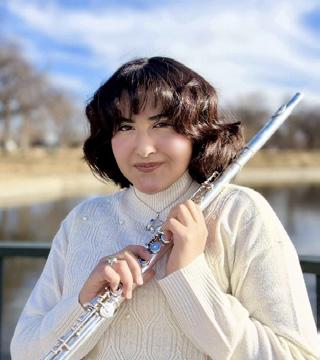
KARIN SOTILLO, originally from Venezuela, is a third-year Bachelor of Music Performance student with a concentration in flute at Colorado State University in Fort Collins, where she currently studies with Dr. Ysmael Reyes. She has been studying the flute since the age of seven and is dedicated to her continuous artistic and professional development. Karin grew up surrounded by music thanks to her family, as her father played the cello in his youth, which influenced her musical training from an early age. She was part of the National System of Youth and Children’s Orchestras and Choirs of Venezuela (El Sistema), where she received formal musical education and participated in flute seminars and workshops led by the renowned maestro José Antonio “Toñito” Naranjo, with guest professor Andrés Eloy Rodríguez.
After moving to the United States, Karin studied for two years at Abraham Lincoln High School, where she trained with Jennifer Keeney, and completed her final year of high school at Denver School of the Arts, where she continued her musical studies with Catherine Peterson. She also participated in flute festivals. In addition, she was an active member of the Colorado All-State Band and the Denver Young Artists Orchestra Conservatory (DYAO).
Along with her father, who plays guitar and the Venezuelan cuatro, and her brother, who plays the clarinet, Karin is a member of Guayana Acústica, a musical group they formed to perform traditional Venezuelan music. Currently, Karin works as a teaching artist at the CSU Spur Music Lab, where she supports music education programs and actively engages with the community through arts education. In her free time, Karin enjoys playing guitar and singing, painting with watercolors, baking traditional Venezuelan desserts, and spending time in nature.
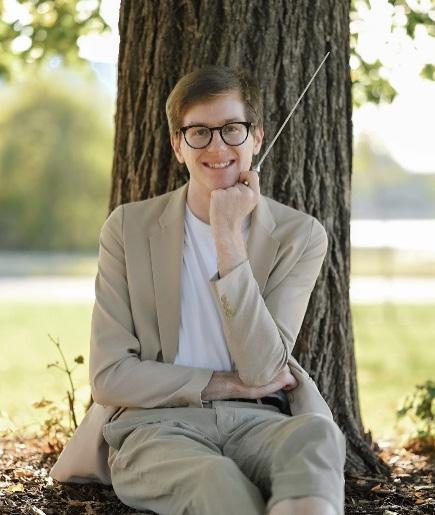
SAM COOPER is currently pursuing his master’s degree in instrumental conducting at Colorado State University under the mentorship of Dr. Rachel Waddell, where he also serves as the Assistant Conductor of Orchestras. In July 2026, he is thrilled to take the podium as pit conductor for the Empire Lyric Players’ production of Yeomen of the Guard
He additionally held the position of Assistant Conductor for both the Health and Wellness Community Orchestra during their 2024–25 season and the Loveland Opera Theatre’s production of The Sound of Music in October 2025. Sam was honored to be the pit conductor for the Empire Lyric Players’ July 2025 production of The Mikado…in Space!, a contemporary reimagining of Gilbert and Sullivan’s classic operetta that brought fresh perspective and humor to the original work.
Sam began playing violin in fifth grade, encouraged and mentored by Michelle Ewer. During the latter half of high school, he continued his studies with Melissa Barru. Sam studied violin with Dr. Philip Ficsor and Dr. Emily Ondracek-Peterson at MSU Denver, where he earned degrees in music performance and music education in December 2023. He has played violin with various musical groups, including the Aurora Symphony and Empire Lyric Players, and held the roles of concertmaster and assistant conductor with the MSU Denver Symphony Orchestra under the direction of Dr. Brandon Stephen Matthews. As a co-founder and violinist of the Apollo String Quartet, Sam remains actively engaged in chamber music.
In January 2025, Sam was selected to participate in a conducting workshop with Carl Topilow and the Cleveland Pops Orchestra. In June 2025, he took part in another workshop led by Diane Wittry and Dr. Silas Huff in New York City with the Collegium Musicum New York.
Sam encourages you to follow his conducting journey on Instagram: @cooper_conducts
Join us for an evening where art and science meet, celebrating the birds, bees, and insects that make our garden grow.

Concert Orchestra
Conducted by Rachel
Waddell
Assistant Conductor and GTA
Sam Cooper
April 26, 2026 • 7:30 p.m. • Griffin Concert Hall