

Spring Into Action
By Andy Carter Member Engagement Manager
April is a good time to make plans and start discussions with contractors about changes you want to make to your home during the warmer, longer days of summer. Homes require maintenance to keep them comfortable and safe. The age of your home and its major systems like the roof, windows, and heating and cooling equipment will help provide an idea on when you need to inspect your home to determine if repairs or renovation are in order.
Home upgrades and improvements are typically big investments. You will want to prioritize where to start to make sure your home is safe and comfortable before moving on to some of the “nice to have” items. Many repairs and improvements impact energy use in your home. You will want to understand how the changes will impact your monthly utility costs. Repairs and improvements can increase the efficiency of your home and reduce future utility bills.
An excellent way to start the planning process is to have a certified home energy auditor assess your home. The auditor will go room to room to identify problem areas from a safety and an energy efficiency perspective. Some auditors use equipment such as blower doors to measure how well your home is sealed, and infrared cameras to find areas where insulation is poor or missing. They can also evaluate appliances like furnaces and water heaters to make sure they are in good working condition. Most auditors will also evaluate the windows and insulation to determine if they are adequate.
A certified auditor will give you a written report that details their findings and recommendations on items that need immediate attention for safety as well as energy efficiency upgrades. Empire Electric Association offers audit rebates for members who have inspections performed by one of our approved, certified auditors. EEA will pay 50% of the cost of your audit, up to $500. More information and a list of EEA-approved auditors can be found online at eea.coop/programs-help-you-save-energy or by using the QR code at the bottom of the page.
If your audit recommends replacing your heating or air conditioning system, electric heat pumps are an efficient, cost-effective way to heat and cool your home. Air source mini-split heat pumps are the most popular, but there are also heat pump systems made to replace ducted forced air furnaces. EEA, in partnership with our power supplier Tri-State Transmission and Generation Association, offers rebates for several different types of heat pumps. EEA also offers rebates for heat pump water heaters if it is recommended to replace your water heater. Complete EEA rebate information can be found at eea.coop/ electrify-save-program.
Planning for success is important. Let EEA help you make your home improvement project a success by sharing the cost of a home energy audit.
Use the QR code to access information about EEA’s energy audit rebate.

Office
Monday–Thursday — 7:30 a.m. to 5:30 p.m. Friday — 7:30 a.m. to 11:30 a.m.
23999 Road L.4 Cortez, CO 81321 phone 970-565-4444 toll free 800-709-3726 pay by phone 833-923-1409 eea.coop
Power Outage Communications
By Andy Carter Member Engagement Manager
Sometimes it is obvious when the power is out. One moment you are making progress in your garage on your to-do list, listening to the radio and painting shelves with an airless sprayer, and then you are in the dark and it is eerily quiet. You do not need a text or email from Empire Electric Association telling you your power is out.
But what if you were traveling out of town and the outage occurred? Would you want to know so you can have your neighbor check your freezer when the power comes back on to make sure you don’t come home to a freezer full of ruined meat or produce? Or what if you own a business with multiple locations and you want to know when one of them has an outage?
EEA has provided planned power outage notifications by telephone for years so members can be ready. For unplanned outages we have an online outage map that can be accessed by a link on eea.coop. For larger outages, we provide additional information on the eea.coop homepage as well as on social media.
As technology improves along with our ability to integrate our business systems, we have been working toward offering members more communication options for power outages beyond telephone calls. Beginning April 1, EEA members will have the ability to receive email or SMS text messages for planned as well as unplanned outages. The emails and texts are like messaging we currently use for billing notices. We are still working with our software provider to transition voice calls for outage notices to our upgraded software. Until then, all members will continue to receive voice calls in addition to the new email or SMS options.
Like billing notices, power outage notification messages require you to opt in to receive them. You can add or update your contact information via SmartHub in the Settings menu under Contact Methods. Once you have your mobile phone and email set up, you can click on Manage Notifications and choose what outage notifications you would like to receive. Once on the Manage Notifications page, select Advanced Options and then Service to bring up the list of options.
The options include receiving a text and/or email message for a planned power outage, power outage, and when power is restored. If you want messages sent to more than one mobile phone or email, you will need to set up an additional user for your account. That can be accomplished through the Registered Accounts page in the Settings menu. You are in control of the message delivery and type, so if you find you are getting more messages than you want, you simply need to log in to SmartHub and remove that message type.
If you are ready to take advantage of these new communication options, please log in to SmartHub and make your selections. If you are not enrolled in SmartHub, visit eea.coop and click on Register for Online Access in the SmartHub section near the top of the page. We also have instructions on how to set up notifications in the Account menu under SmartHub Tips.
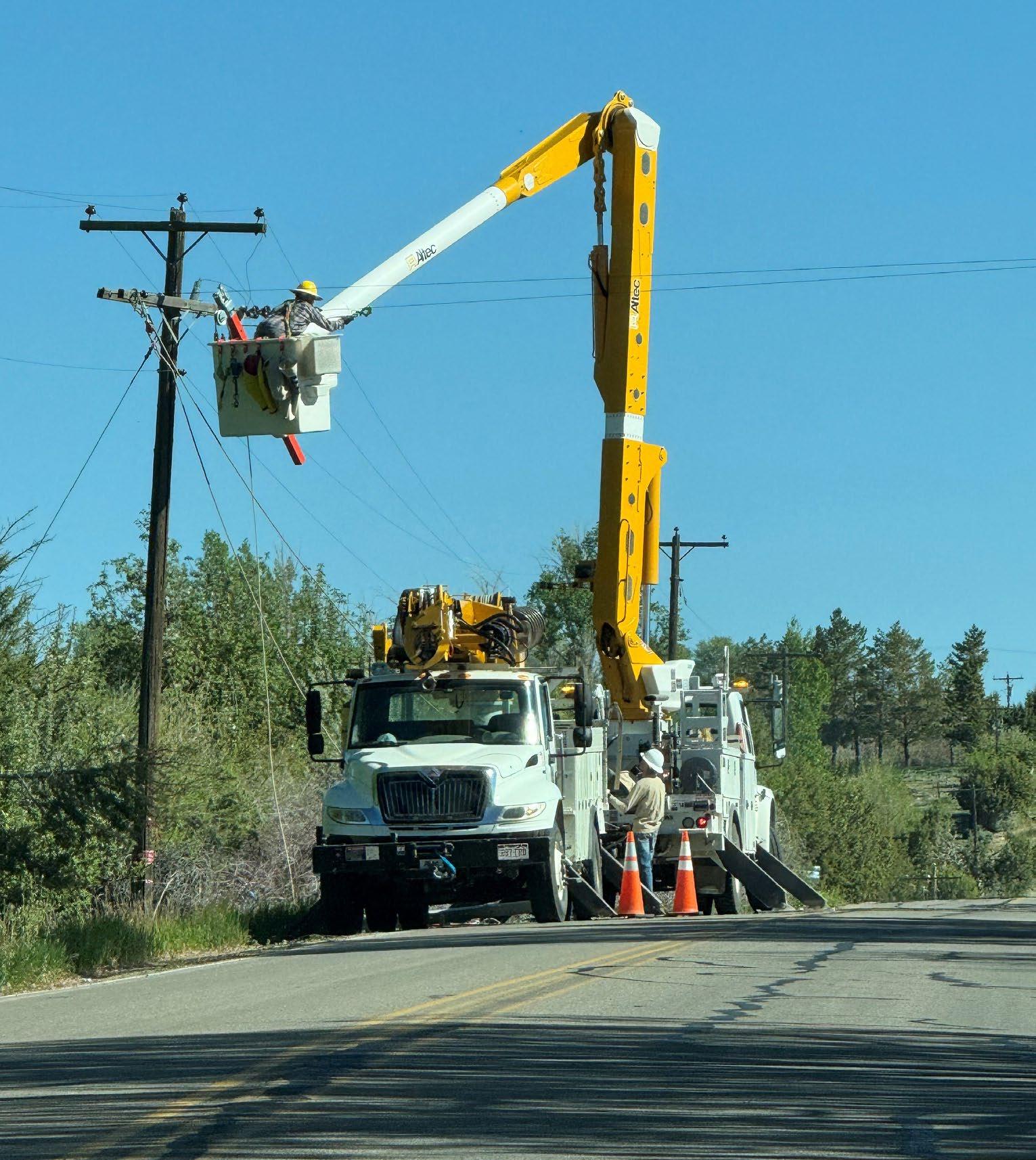
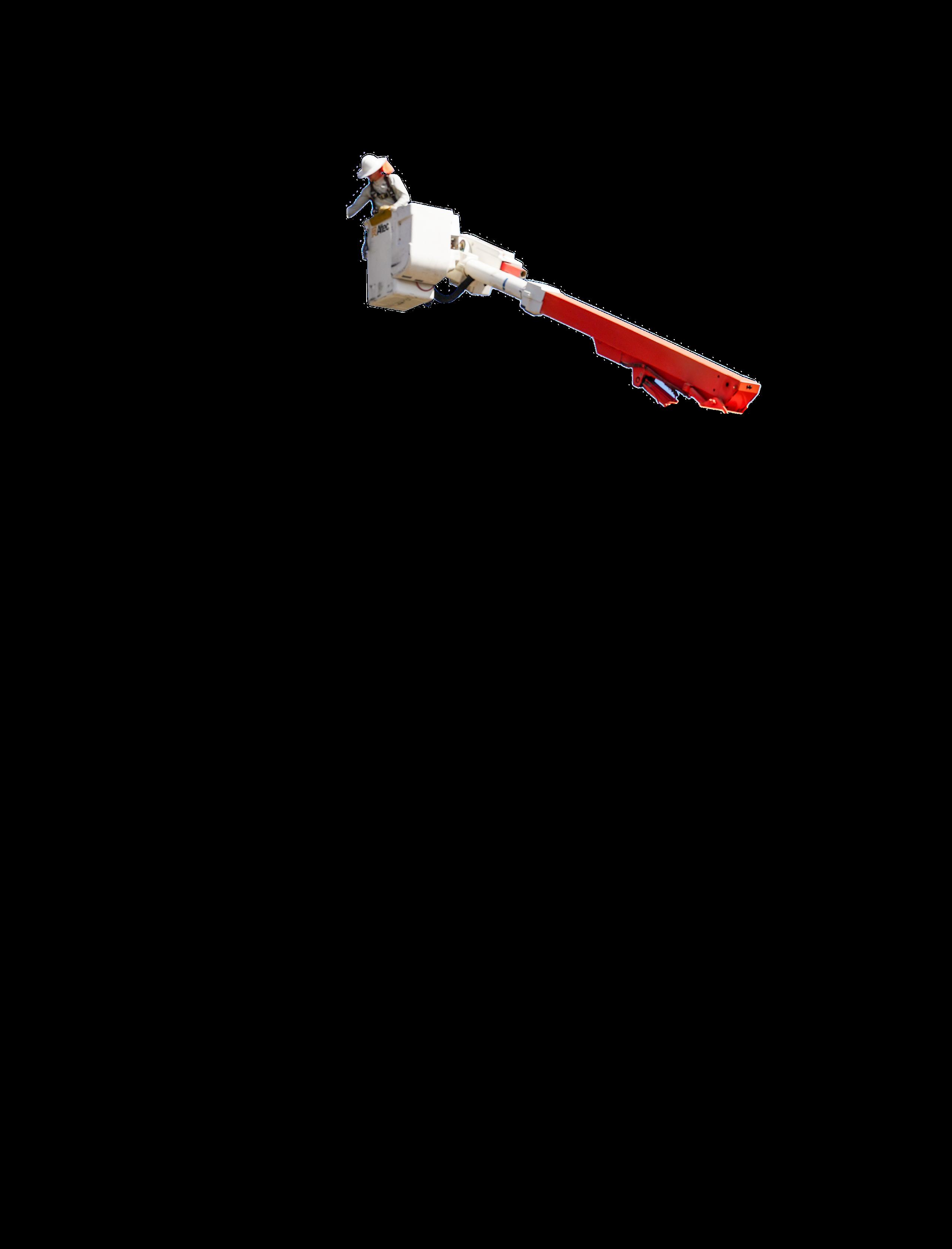
EEA line crew at work.
Photo by Shawna McLaughlin
Don’t Let Your Controlled Burn Turn Chaotic
Controlled burns are useful for vegetation and weed management, but a controlled burn can quickly become uncontrolled. Take precautions before starting a burn.
When planning your burn, check the weather forecast for wind direction and speed, as well as humidity. Also check for Red Flag Warnings or burn bans. Clear all vegetation and weeds at least 4 feet around the base of any power pole in the burn area and wet the ground at the pole base before beginning your burn.
If your fire gets out of control, gets too close to a power pole, or if the pole catches fire, call 911 first, then call Empire Electric Association at 970565-4444. NEVER spray water near the pole, power lines, or any other utility equipment. Electricity and water do not mix and you could cause a short circuit that could cause serious injur y or death.
Fire damage to a power pole is usually evident by blackening and scorch marks, but even slight discoloration can indicate a serious problem. The pole may look like it has little damage on the outside, all the while burning from the inside out. More extensive damage to the pole may result in a power outage or cause energized lines to fall near or on the ground, creating a potentially deadly situation.
In all cases, the result is the same: The utility pole is compromised and will most likely need to be replaced at the cost of the person who started the burn. The cost to replace a pole can be substantial. Visit SafeElectricity.org for more information about electrical safety.
LinemanAppreciationDay
April 18



NOTICE OF A CHANGE IN THE TARIFFS OF EMPIRE ELECTRIC ASSOCIATION, INC.
On February 13, 2026, the Empire Electric Association Board of Directors approved a change to EEA’s Rules and Regulations regarding late fees and approved a new Wheeling tariff. The Wheeling tariff is a new tariff that allows for the transportation of electricity across EEA’s electric system to the Bulk Electric System.
The change to the Rules and Regulations eliminates the five-day waiting period and allows a late fee to be applied immediately after the due date. This change aligns with a recent change to our billing schedule that gives members several additional days to pay bills compared to our previous billing schedule. Since members now have more time to pay bills, we determined the five-day waiting period is no longer necessary.
The updated Rules and Regulations and the new Wheeling tariff are scheduled to go into effect on April 1, 2026. Written comments about the proposed changes may be submitted electronically through EEA’s website or through hard copies delivered to EEA’s main office. Hard copies may be submitted by mail to P.O. Box K, Cortez, CO, 81321, or hand-delivered to EEA’s main office at 23999 Road L.4, Cortez, CO, 81321. Additionally, verbal comments may be submitted during the member input segment of EEA board meetings.
For any questions about this notice and/or the proposed changes, please contact us at 970-565-4444 or toll free at 1-800-709-3726. Copies of tariffs and pertinent policies are available on EEA’s website at eea.coop. Tariffs and policies are also on file at EEA’s main office and are available for inspection during regular business hours.
MONTHLY CALENDAR AND CO-OP PHOTO CONTEST WINNER
April 17 – EEA board meeting begins at 8:30 a.m. at our new headquarters in Cortez at 23999 Road L.4. The agenda is posted 10 days in advance of the meeting at eea.coop Members may attend in person or remotely. Instructions to attend remotely are included on the agenda.
April 18 – Colorado Electrical Lineworker Appreciation Day
April 20 – District 3 Director nomination packets are due and must be received by EEA before 5:30 p.m.
Scam Prevention Tip
Don’t fall victim to power outage scams. When widespread outages occur, scammers may target affected utility customers via call, text, or email, urging you to act quickly and provide personal information to restore service.

Always communicate with EEA through official channels: eea.coop SmartHub (970) 565-4444
Take time to verify who you are communicating with before you answer!
Source: FTC.gov
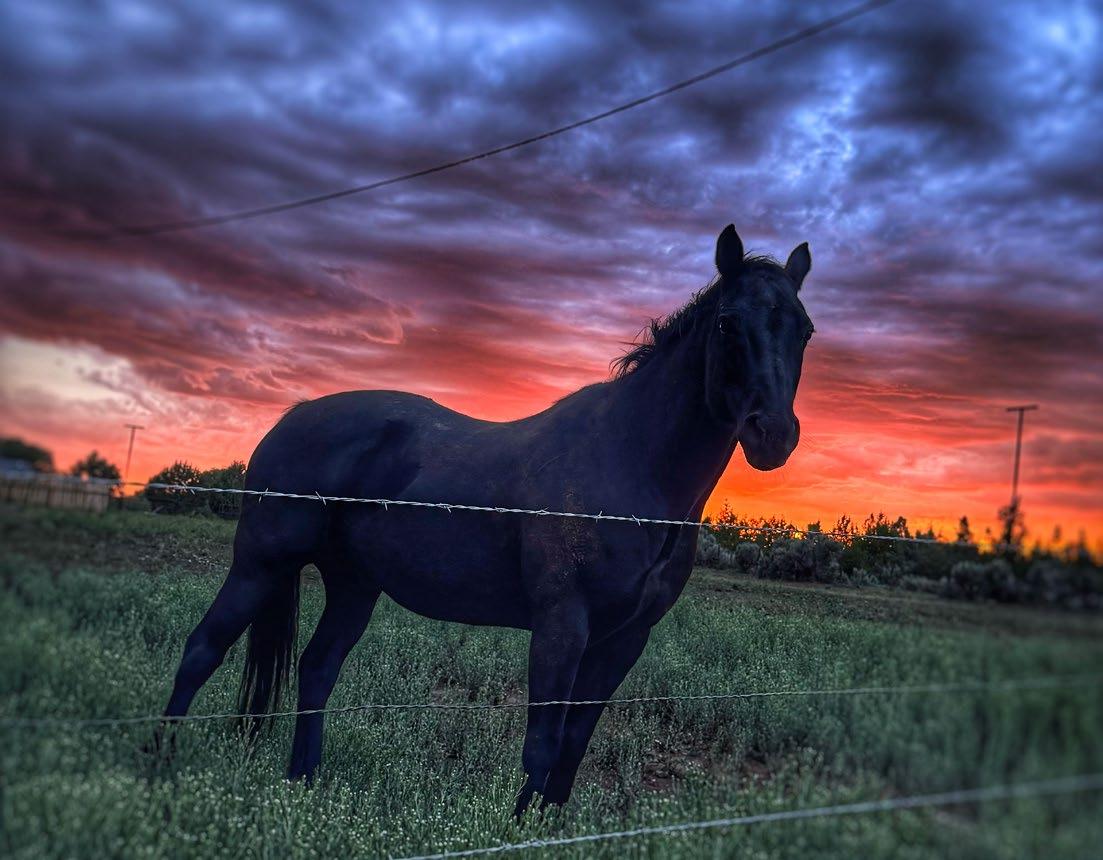
Scorpion Sunset.
Photo by Brie Chumley
Thank You to Our Lineworkers and Families
By Chrystal Dean Chief Executive Officer
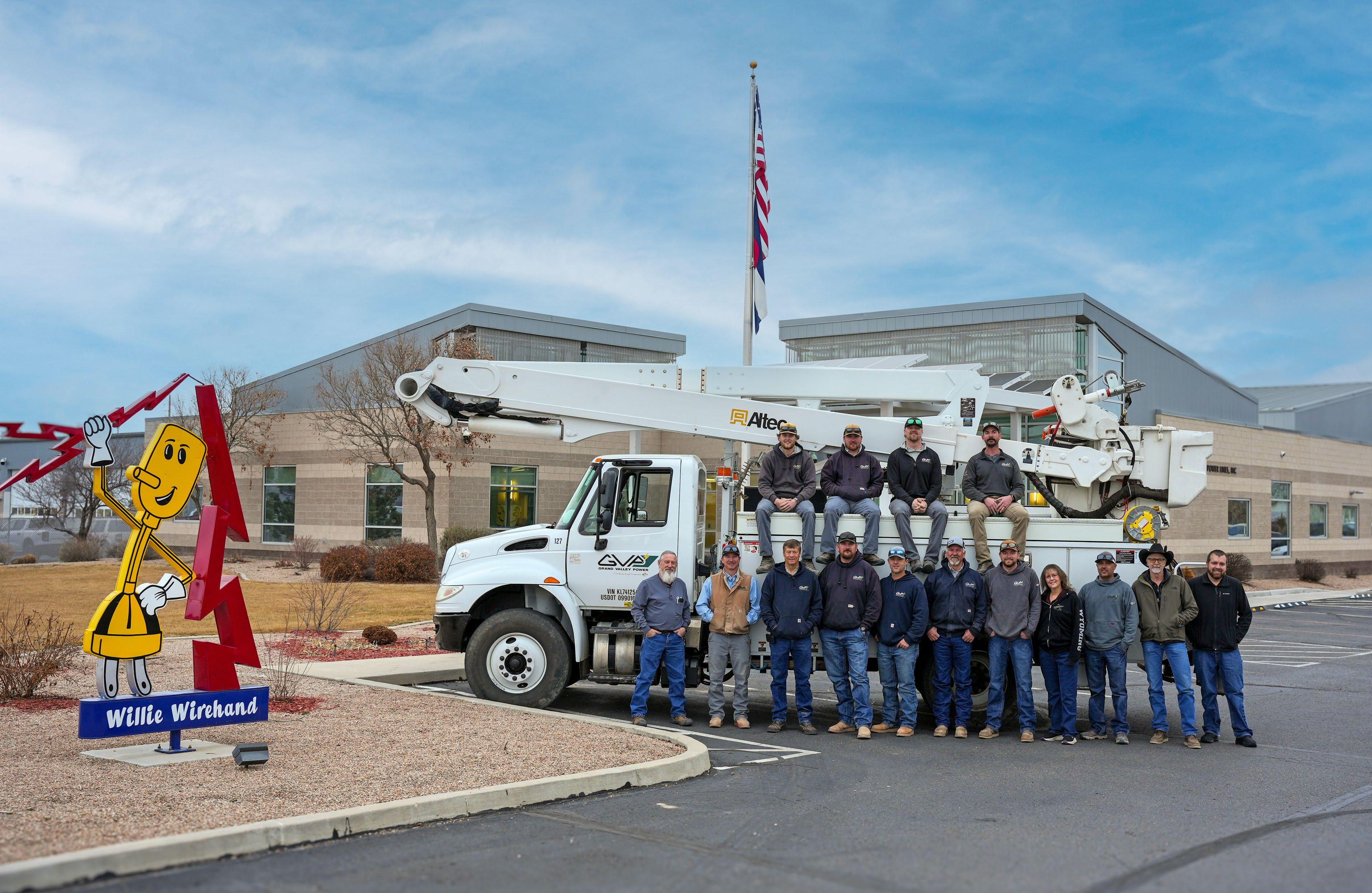
Ablack and white photo, circa early 1900s, hangs in my office. It captures a group of six linemen using pike poles to hoist a power pole up in the air on what I can only imagine was a sunny day in a rugged mountain meadow. What I see in this photo is extreme determination and pride from a group of men working together to bring electricity to communities that had none. Not because of a paycheck, not because of the notoriety, but because it was the right thing to do to turn a collection of homes into a community that could flourish and prosper.
This picture represents something that, even after more than a century, I see outside my office window every morning. As Grand Valley Power’s crews head out for the day in their service and bucket trucks to serve our members and community, I am inspired by their dedication, commitment, and their desire to do what is right.
If you feel as reverent about linework as I do, you might also be wondering why the first national recognition of electrical lineworkers did not occur until 2013. That year, a resolution by the U.S. Senate established April 18 as National Linemen Appreciation Day. Then in 2023, the Colorado General Assembly passed Senate Resolution 23-007 designating April 18 as Colorado Electrical Lineworker Appreciation Day. This is an especially important day for all of us who depend on the hard work and dedication of this craft to light our homes and power our communities across Colorado’s unforgiving terrain.
This year, I do not want to stop my gratitude there. I want to go one step further and thank the families who support our lineworkers. As a daughter and the wife of linemen, I know what it means to support them. These men do not see line work as a job or even a career, but as a way of life. And in a lineworker’s home, it becomes their family’s way of life.
A snowstorm and howling winds in the forecast have a whole new meaning. There is a shift in how the household runs: anticipatory and prepared to take on a little extra, juggle a little more when the phone call comes. Lineworkers and their families never know if
it is going to be a simple job or something that would turn into multiple, long nights and days, but they’re ready for both.
I remember vividly a time early on when my husband and I first met: I was working the night shift in the power operations center, and he was a lineman for the same company. He had been called out during a storm to several miles of lines downed by a tornado, but the weather was not over. The winds were high, and the radar tracked aggressive storm cells traveling across the area. I remember sitting behind a computer screen with my eyes glued to the weather monitor, watching the storm move toward the area I knew they were in, helpless but hopeful. It was one of the longest nights I have had, but it was also one of my proudest, knowing that he and his team were restoring power to communities that desperately needed it.
Lineworkers are sons, daughters, husbands, wives, moms, and dads. They have families at home who always carry a little extra worry in their minds knowing the risks of the trade, whether on a storm job or going out for a simple routine task. But they also know that neither they nor their lineworker would have it any other way, because line work is not just a job or a paycheck, it’s a commitment to service and a commitment to community.
So on April 18, we at GVP say thank you to all the lineworkers past and present for your dedication to the trade. We also thank the families who stand behind them and support the work they do every day. It truly takes a team, and for that we are grateful we have some of the best!
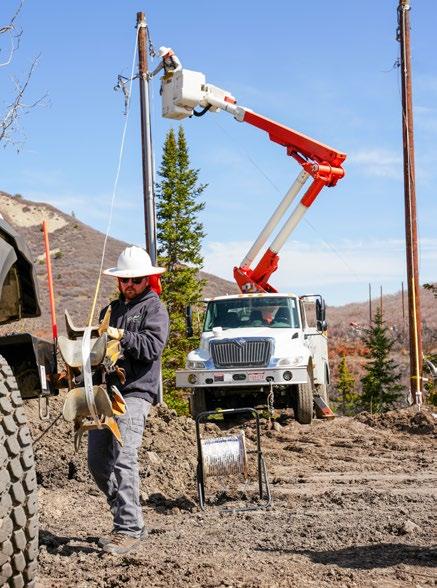
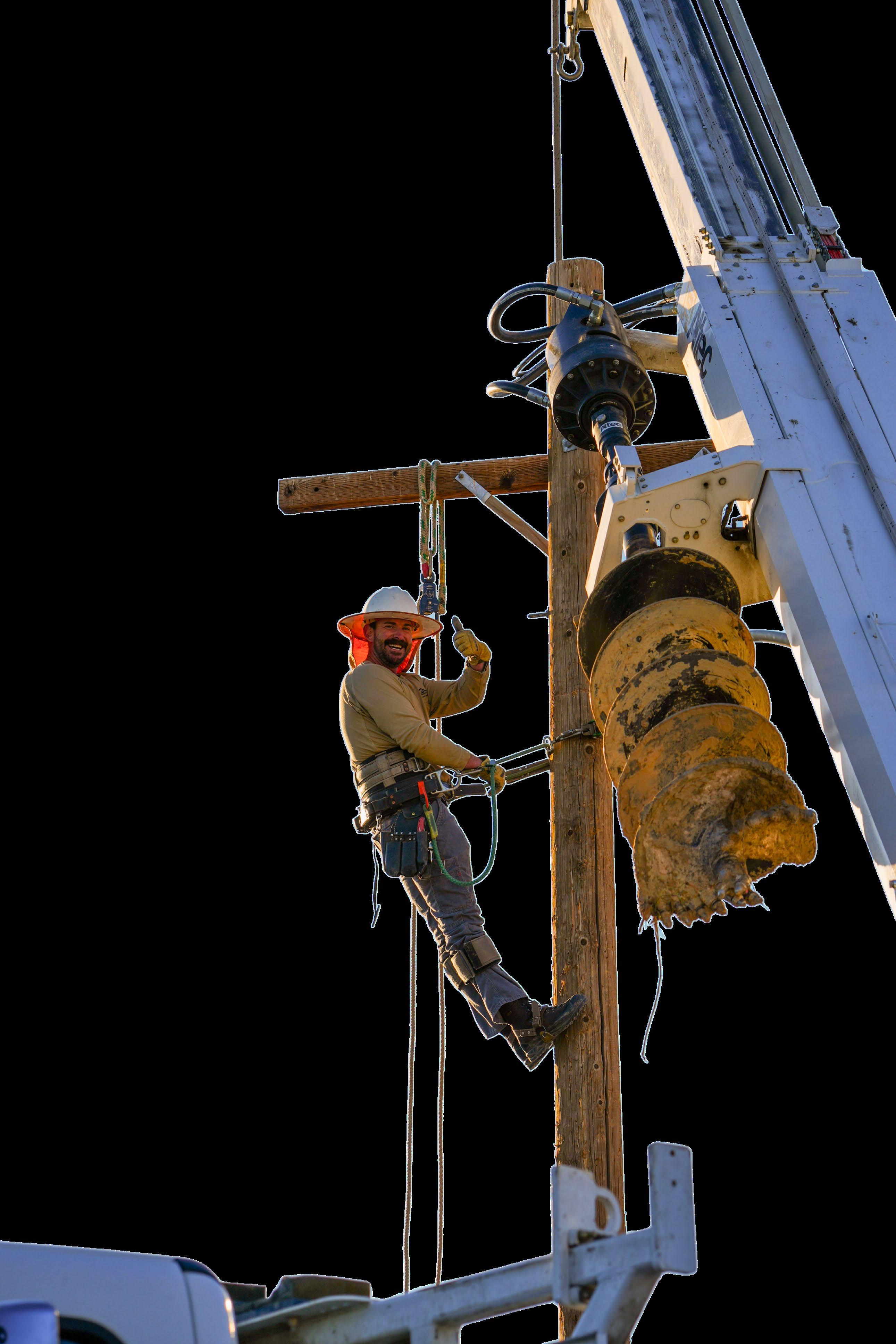
On the cover: GVP Foreman Preston Dillingham (on the ground) and apprentice Branson Padgett (in the bucket) pull wire for a line expansion in Collbran. Safety on the job is paramount for lineworkers and their families.
Photo by Tanya Marchun






GVP Director Earns Cooperative Credential
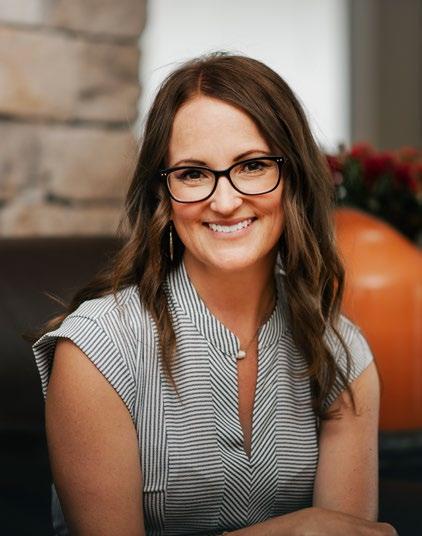
Grand Valley Power Director Lindsay Gray recently earned the Credentialed Cooperative Director Certificate from the National Rural Electric Cooperative Association.
The Credentialed Cooperative Director Certificate requires a director to take five courses focused on the necessary skills to serve as an elected official. Courses cover topics including director duties and liabilities, understanding the electric business, board operations and process, strategic planning, and financial decision making.
NRECA certificate programs ensure that cooperative directors continue to recognize, understand, and navigate industry trends and apply this knowledge effectively within cooperatives. The program offers three tiers of professional development, along with additional educational resources that provide direc-
tors with opportunities to continue their growth and advance their knowledge of the industry. Directors who have earned the Credentialed Cooperative Director Certificate can advance to earn the second tier, the Board Leadership Certificate, and then the final tier, the Director Gold Credential.
Thanks to the investment in their professional growth, GVP and our cooperative members gain educated and knowledgeable directors who are committed to serving the co-op.
DIRECTOR PETITIONS AVAILABLE IN APRIL
Grand Valley Power’s annual board of directors election is approaching. Nominating petitions will be available for pickup beginning April 27 at the GVP office. Three director positions are up for election every year. Directors whose terms expire in 2026 are Joseph Burtard, Joe Landini, and Janie VanWinkle.
To be eligible to become or remain a director, a person must receive electric service from GVP at the member’s primary residence. A director cannot be engaged in a competing enterprise or in other businesses involving a conflict of interest. GVP’s bylaws provide in-depth information on director qualifications, terms, elections, meetings, and officers.
Election procedures for the board of directors are governed by Colorado Statute. The cooperative’s bylaws and election policy comply with statutory requirements. These bylaws and policies are on GVP’s website at gvp.org/director-election. Upon request, these written documents can be picked up at GVP’s headquarters or mailed to you.
Petitions must be signed and returned no later than by 5 p.m. on June 5. If no more than three petitions are returned to fill the three positions that are open for this year’s election, there will be no mail ballot and the election of directors will take place at GVP’s annual meeting to be held on Thursday, August 6, 2026, at Colorado Mesa University’s Meyer Ballroom. More details on the election process are on GVP’s website at gvp.org/bylaws.




Director Lindsay Gray















On the Line
A lineman’s story of service and teamwork
By Justin Hulick GCEA Journeyman Lineman
When I was asked to tell specific stories about my time as a GCEA lineman for Colorado Country Life, it was hard to pick just one. There have been so many memorable moments in my career thus far. From the moment I was hired as an apprentice up until now, just about every moment has been a learning experience and an opportunity for growth.
As an apprentice I was able to go on a mutual aid mission during the Granby wildfires with Journeyman Lineman Andy Holsteen. Andy and I, along with Mountain Parks crews, were tasked with rebuilding and repairing lines that were damaged in the wildfire. It was eye opening to see the amount of devastation that our neighbors could endure and still rebuild with a sense of purpose. It was heartbreaking seeing entire neighborhoods burned to the ground, but inspiring and uplifting to see neighbors helping one another and not giving up.
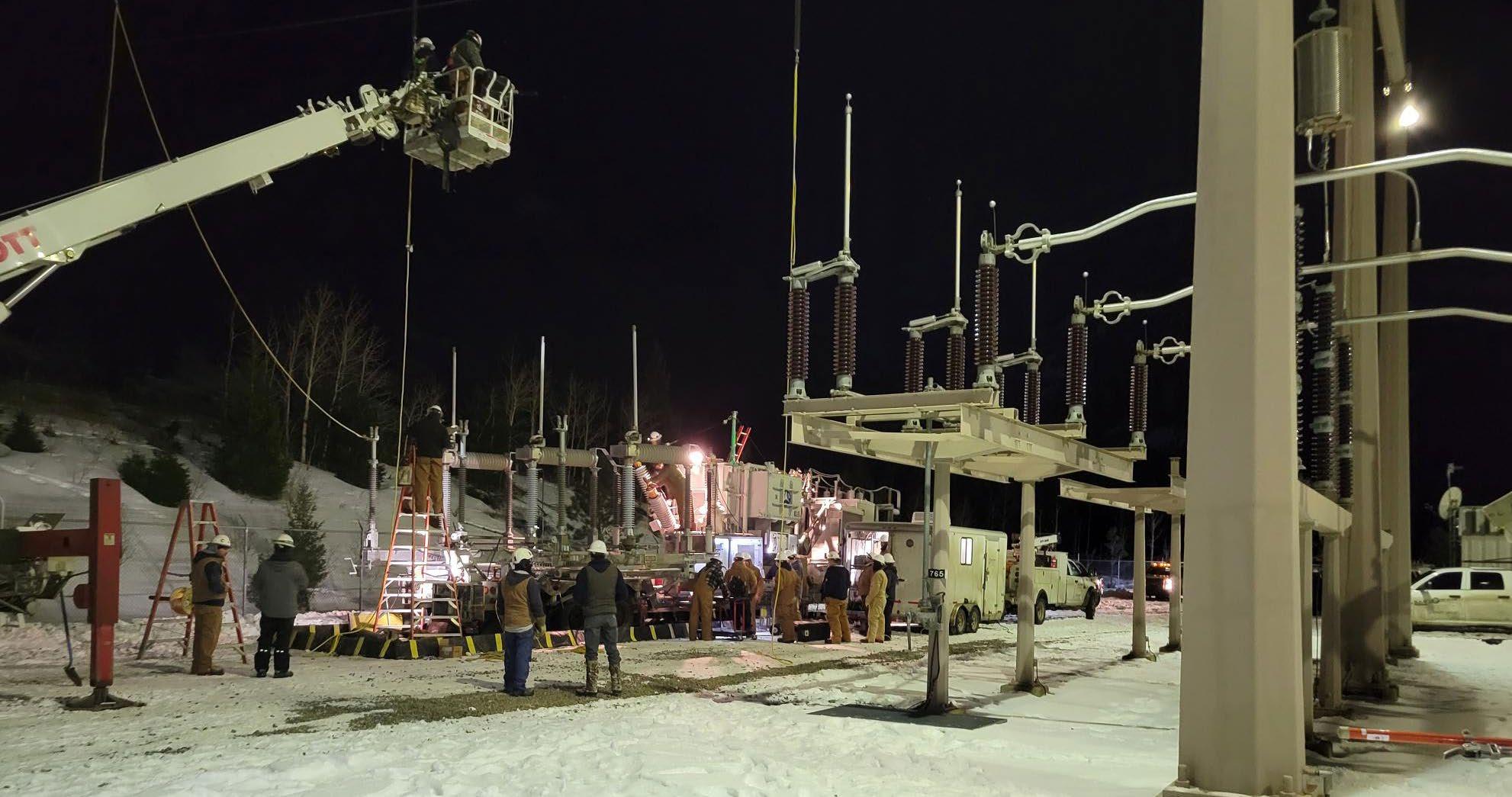
Another memorable incident occurred in February 2023 when a key component of the Lake City Substation failed and left the entire town without power, affecting approximately 1,900 people. The outage lasted over 28 hours and all GCEA linemen stood up and answered the call to get the power back on in subfreezing temperatures along with an army of Tri-State Generation and Transmission Association linemen.
We would not have been able to restore power to anyone if it were not for the expertise of Tri-State
Senior Manager Doug Dean and Substation Maintenance Supervisor Dan Fortney. The team worked throughout the night and everyone played a key role in getting the power back on. I was truly amazed to see the willingness of my teammates to serve a community. When situations get tough, I know I can count on these men to put on their boots and give everything they have to accomplish a goal.
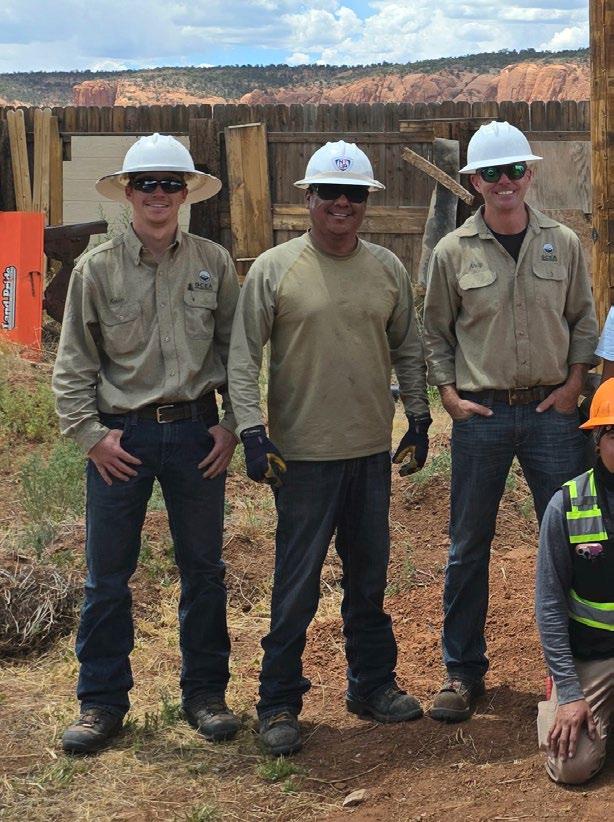
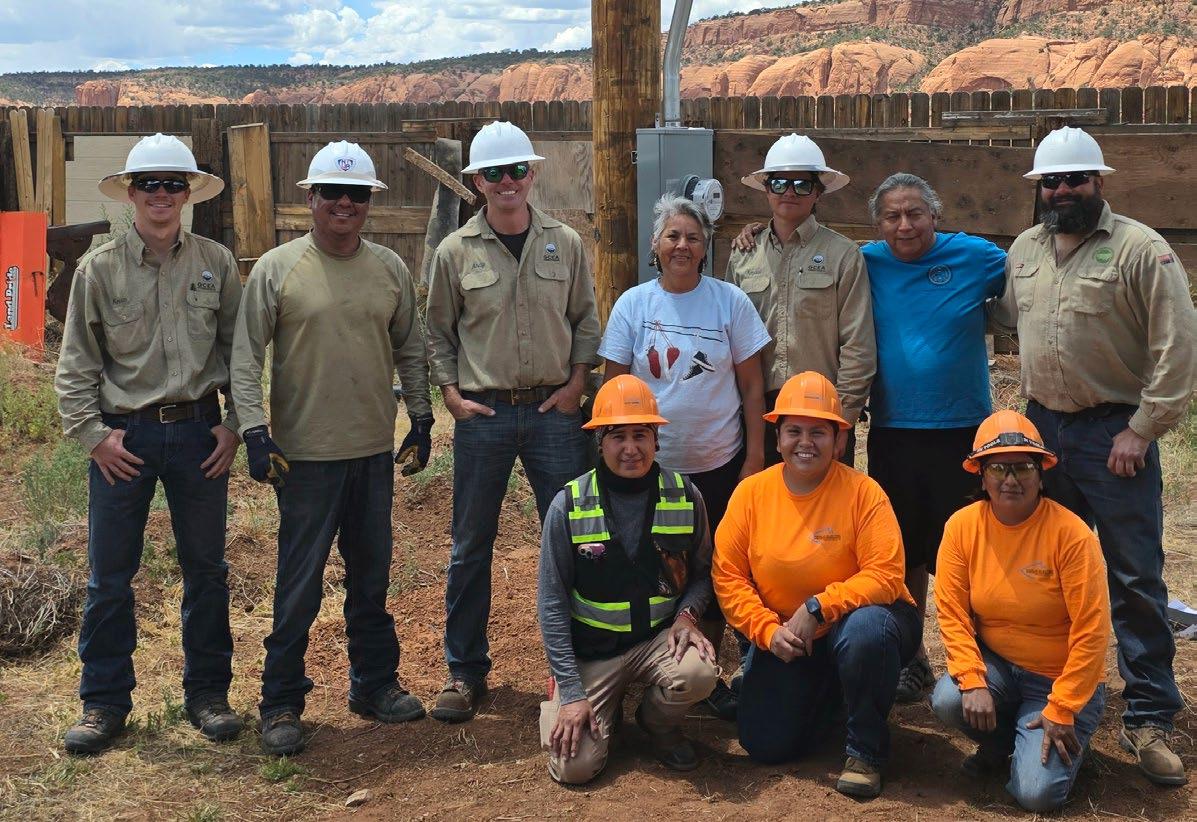
More unforgettable moments came when I volunteered for Light Up Navajo. This initiative brings power to one of the most impoverished areas of the United States. Thousands of Navajo families live without electricity, running water, or basic amenities.
My first year at Light Up Navajo, I was able to go with Journeyman Lineman Mike Pendy, and Apprentices Zach Beaver and Kevin Fox. My second year, I went with Journeyman Lineman Andy Holsteen, and Apprentices Kevin Purkat and Kendall Gardener. Both times, we were able to build multiple miles of electric line and connect families to the grid for the first time.
It blew me away knowing that something so small that we did could help impact the lives of other people so close to our own communities. Hearing a mother say that she can now refrigerate her food, no longer had to haul water, and her children could charge their computers for school was a humbling experience. It made me so grateful for the things I have and may take for granted.
continued on page 8
Following an extended outage in February 2023, GCEA linemen and Tri-State staff work in Lake City to get a mobile substation online and restore electricity.
continued from page 7
These are just a few of the moments that stood out to me and I am sure there will be so many more.
The thing I value most of all is the time I spend with my crew and the crews that serve GCEA. GCEA Foreman Dustin Cadwell is an incredible leader with a work ethic that is second to none. Robert Summer brings an unshakable sense of calm to the team and is always insightful when you need it most. Ty Percival is the life of the party, quick witted, and the first to answer the phone when you need a hand. Kevin Purkat is the youngest member of our crew and by far one of the smartest guys I work with. His thirst for knowledge and pursuit to become the best lineman he can be is quite admirable.
Our leadership is hands down the best in the industry and I couldn’t write this without saying “thank you” to GCEA Chief Operations Officer John Stoeber, and Line Superintendent Todd Fuller. Without them, I would not have had the opportunity to see and do the things I have. Their leadership ensures operations run smoothly, and most importantly, safely.
The men I have the honor of working with on other crews: Foremen Jeff Hanggi and Logan Rhodes; Journeyman Linemen Andy Holsteen, and Wyatt Miller, and Apprentice Linemen Zach Beaver, Kevin Fox, Tanner Hite, and Kendall Gardener. These men have all taught and shown me so much over my 8 1/2 years and I am so grateful for every one of them.
When I decide to hang up my hooks, I know I will always have these wonderful people and memories to look back on and I know that no matter what I have accomplished as a lineman, it will never measure up to what I received from the community and the people I have had the honor of serving.
A GCEA crew travels to Navajo Nation to work with a Navajo Tribal Utility Authority crew to electrify homes.
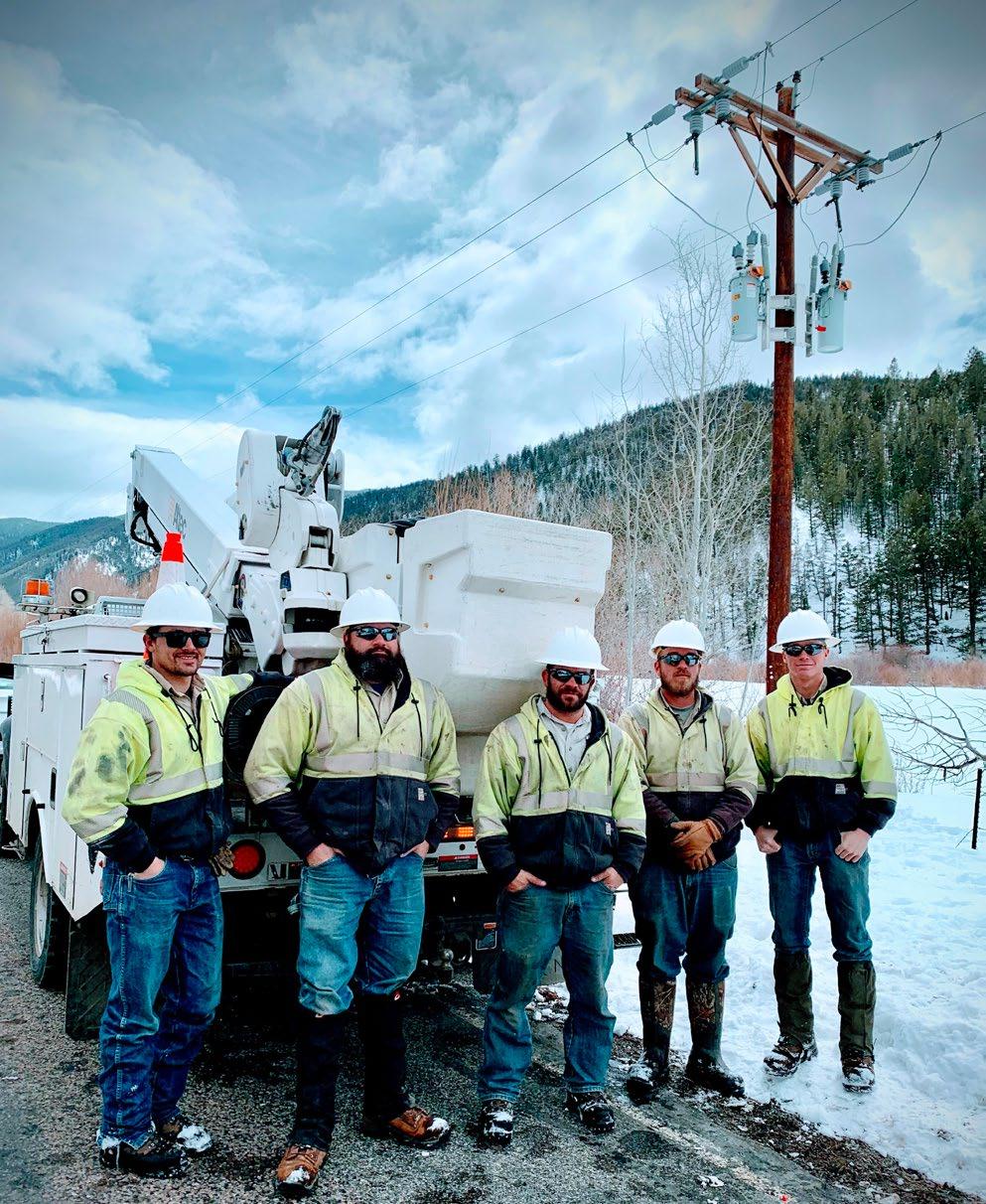
Left to right: Apprentice Lineman Ty Percival, Journeyman Justin Hulick, Journeyman Dustin Cadwell, Journeyman Robert Summers, and Apprentice Lineman Kevin Purkat. Photo by Alliy Sahagun
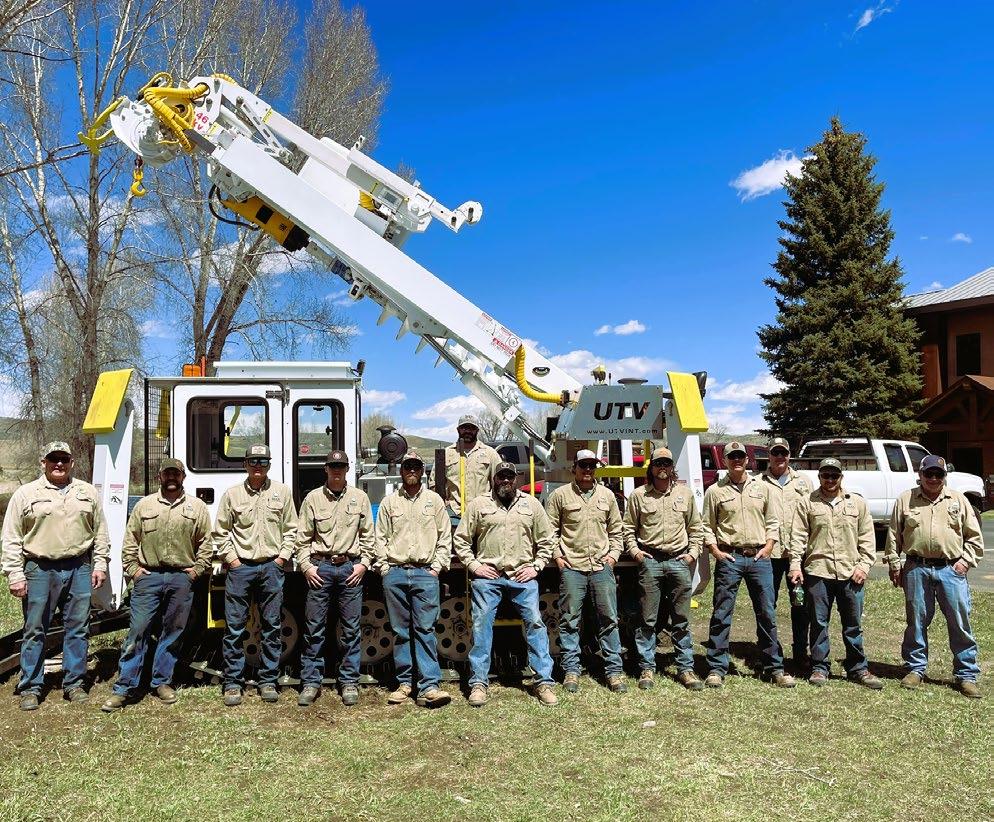
GCEA operations crew poses with their new equipment. Photo by Logann Long
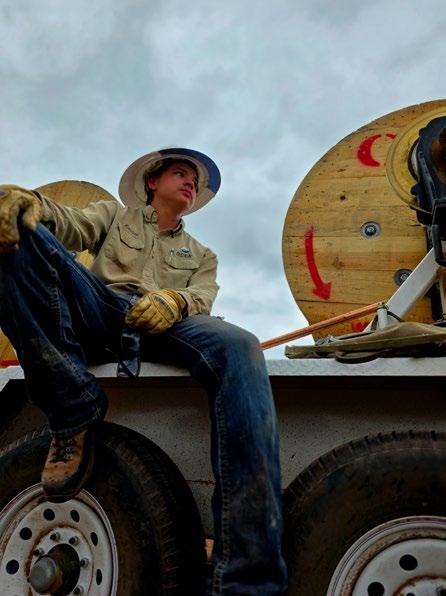
On the cover: Kendall Gardner works with Light Up Navajo to bring power to Navajo Nation homes in July 2025. Photo by Justin Hulick
GCEA Prepares for Wildfire Season
By Alliy Sahagun Member Relations Supervisor
In a dry landscape, even a small ignition can lead to devastating consequences. Whether it’s a lightning strike, an unattended campfire, or an overgrown tree too close to a power line, wildfire can take hold in a matter of seconds.
Coming off an exceptionally dry winter, wildfire risk is on many people’s minds, especially as we head into spring yard cleanup and summer recreation season.
As your local electric cooperative, GCEA works diligently to manage the inherent risks associated with our electric system. Safety is our highest priority: the safety of our members, our employees, and the land we all love. For more than 80 years, our crews have worked year-round to maintain our system to provide safe and reliable electricity to our members.
As climate change continues to warm and dry our region, addressing the risks associated with wildfires is an important priority for GCEA. That’s why GCEA is using new technology and strategic planning to strengthen our electric system and effectively manage wildfire risks associated with overhead electric distribution lines.
Here are some of GCEA’s key areas of activity:
1. Vegetation management – GCEA has partnered with Sheltera, a smart vegetation management company that uses satellite imagery and LiDAR technology to conduct aerial scans of our service territory. This technology helps us identify priority areas where vegetation poses the greatest risk to power lines.
We prioritize removing beetle-killed trees, dead vegetation, and trees located too close to electric lines. GCEA uses a targeted approach to allow us to focus resources where they will have the greatest impact on safety and reliability.
This summer, GCEA will partner with professional tree service crews to manage vegetation near power lines in the areas of Lake City, Almont, Pitkin, and Crested Butte. GCEA maintains a long-term vegetation management schedule as an effort to reduce wildfire risk across our system.
2. Fuse Replacements – Fuses are high-voltage protective devices used on electric distribution lines to isolate overhead or underground line faults or damaged equipment. Along with vegetation manage-
ment, GCEA is also researching replacement options for fuses used in our system. New fuse technologies provide an opportunity to reduce the likelihood of igniting nearby combustible materials when a fuse operates as designed to provide overcurrent protection in these locations.
3. Highway 149 Line Rebuild – In 2024, GCEA received a $5 million grant from the U.S. Department of Energy to replace 30 miles of aging distribution line between Lake City and the Gunnison (Skito) Substation. Construction begins this summer, with crews upgrading existing poles and wires to modern infrastructure designed to safely carry power to our members.
In the rebuild project, GCEA will use larger conductors with stronger poles to support future growth and increasing demand. As each phase of the project is completed, GCEA will be hardening its system while enhancing both safety and reliability for the communities we serve.
4. Move the system to “One-Shot” Mode – In particularly dry or windy conditions, GCEA’s ongoing practice is to move parts of the system to “one-shot,” or non-reclose mode. Watch for communications on
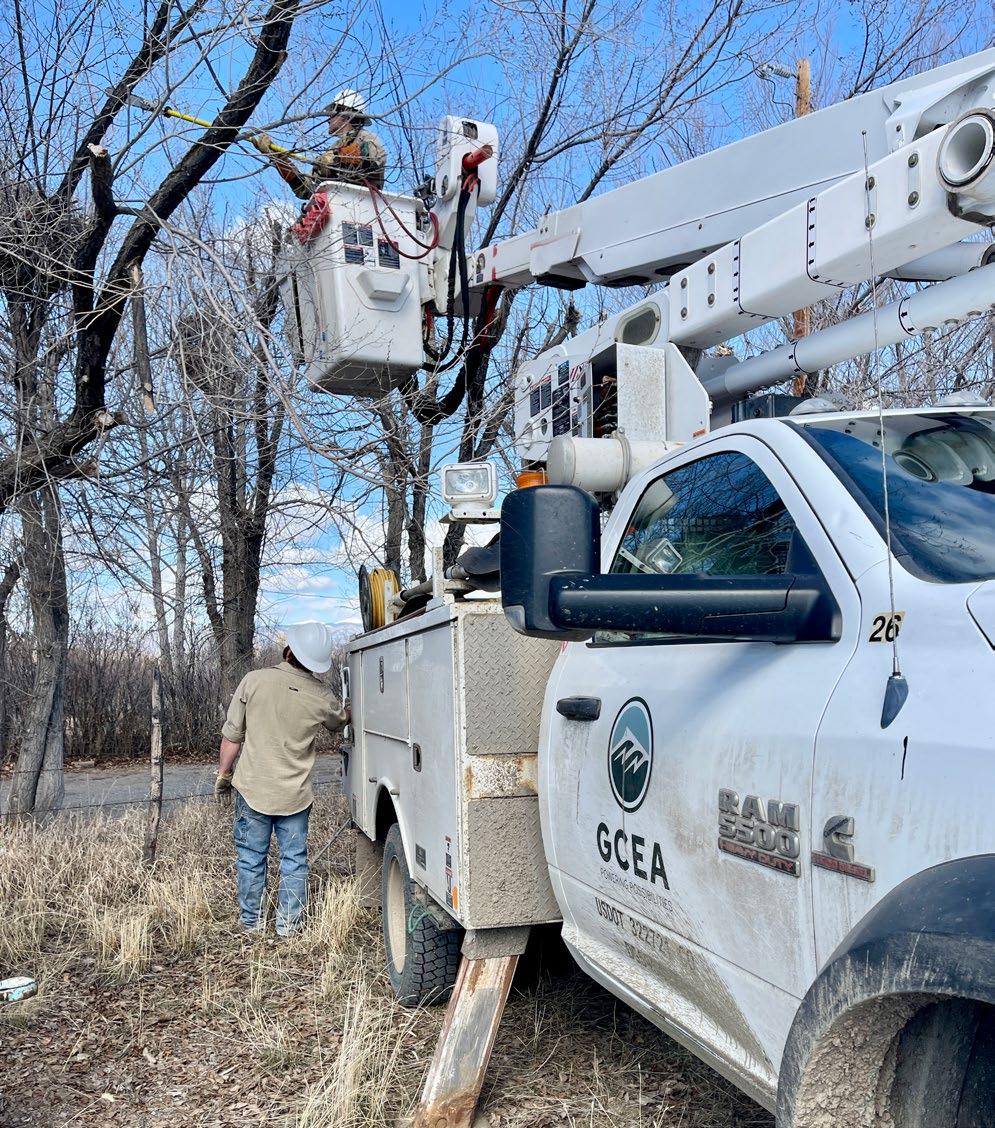
Gunnison Journeyman Lineman Ty Percival carefully clears tree limbs near the power lines as Foreman Dustin Cadwell observes. Photo by Logann Long
our website and social media when GCEA goes to one-shot mode.
Under normal conditions, circuit breakers — or reclosers — interrupt and automatically restore power if an outage is caused by something temporary—such as lines briefly touching or slapping in high winds. This allows power to come back on quickly.
In “one-shot” mode, the breaker/recloser shuts off power and stays off. The system will not attempt
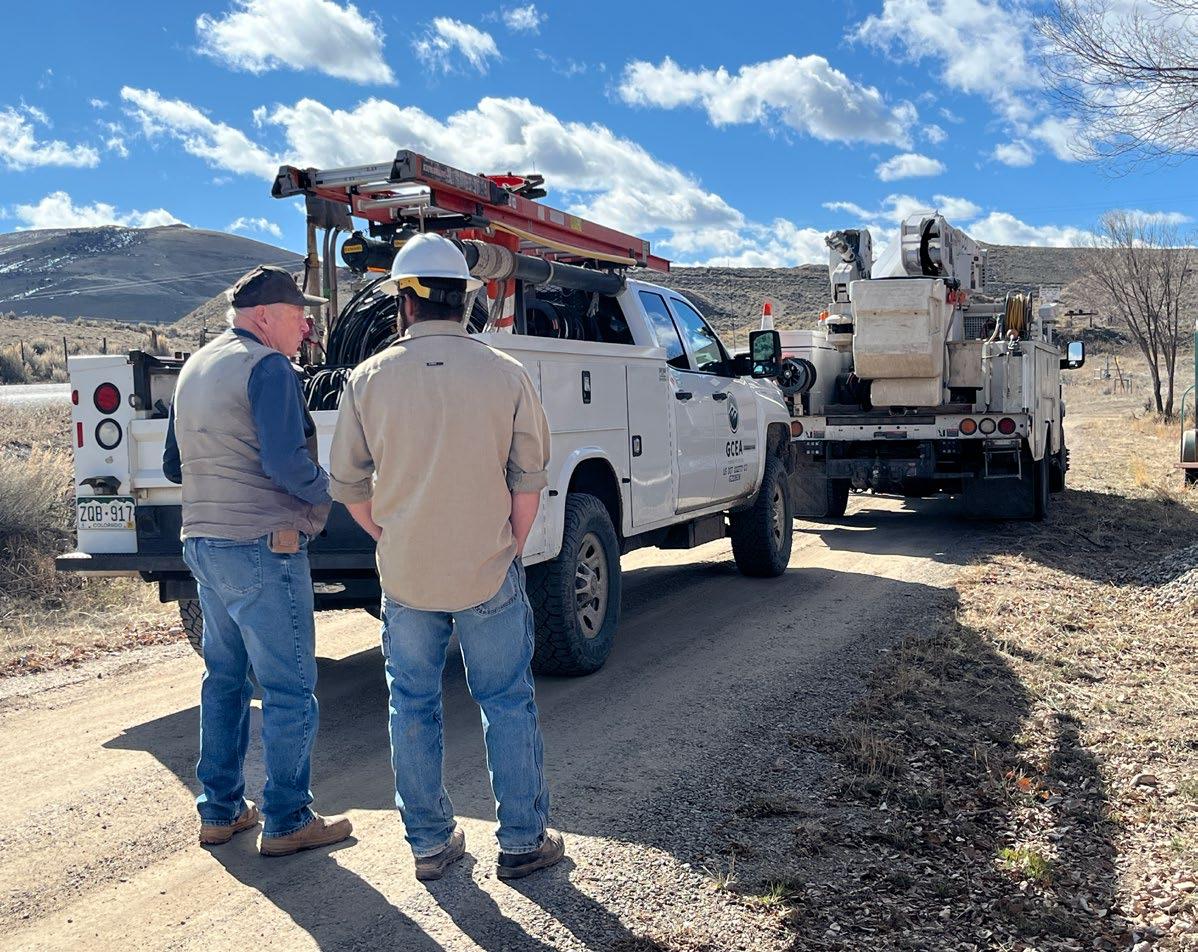
Gunnison Foreman Dustin Cadwell (right) visits with John Vader to review a project on the GCEA member’s property. Photo by Alliy Sahagun
Gunnison
to automatically restore power. Instead, our crews inspect the line and manually restore power once it is safe. This added precaution before restoring power greatly reduces the chance of sparks that could start a wildfire during hot, dry weather.
GCEA’s goal with these efforts is to improve safety, reduce wildfire risk, and decrease outage frequency. We understand how important consistent, reliable power is, and we work every day to keep the lights on for you—24/7.
GCEA will continue to communicate with you about our efforts to address risks of wildfires. As a not-for-profit cooperative, we are here to serve our members and support the quality of life in our communities.

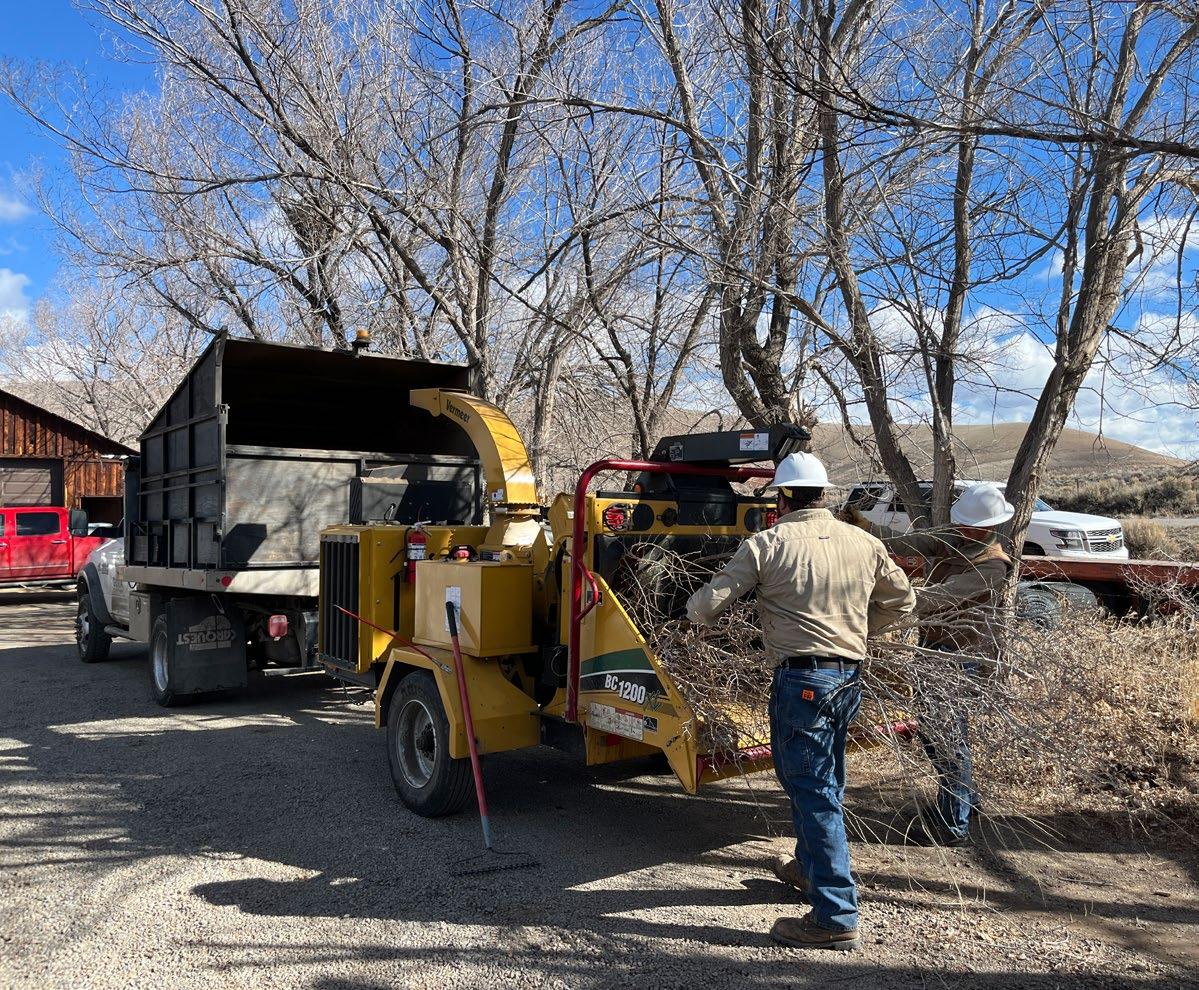
Lineman Justin Hulick and apprentice Kevin Purkat clear branches after cutting them away from power lines. Photo by Logann Long
JOIN US FOR THE WILDFIRE MITIGATION WORKSHOP
Visit with GCEA representatives at the Gunnison Wildfire Mitigation Workshop on Saturday, April 25, from 9 a.m. to 1 p.m. at the Fred Field Center.
We will share more details about GCEA’s wildfire mitigation plans and provide tips on how you can help prevent fires near electrical equipment around your home.
During your visit, be sure to pick up a free GCEA Go Bag to help you prepare for an outage or e emergency.
Lineworkers are Ready When it Matters Most
By Dennis Herman General Manager
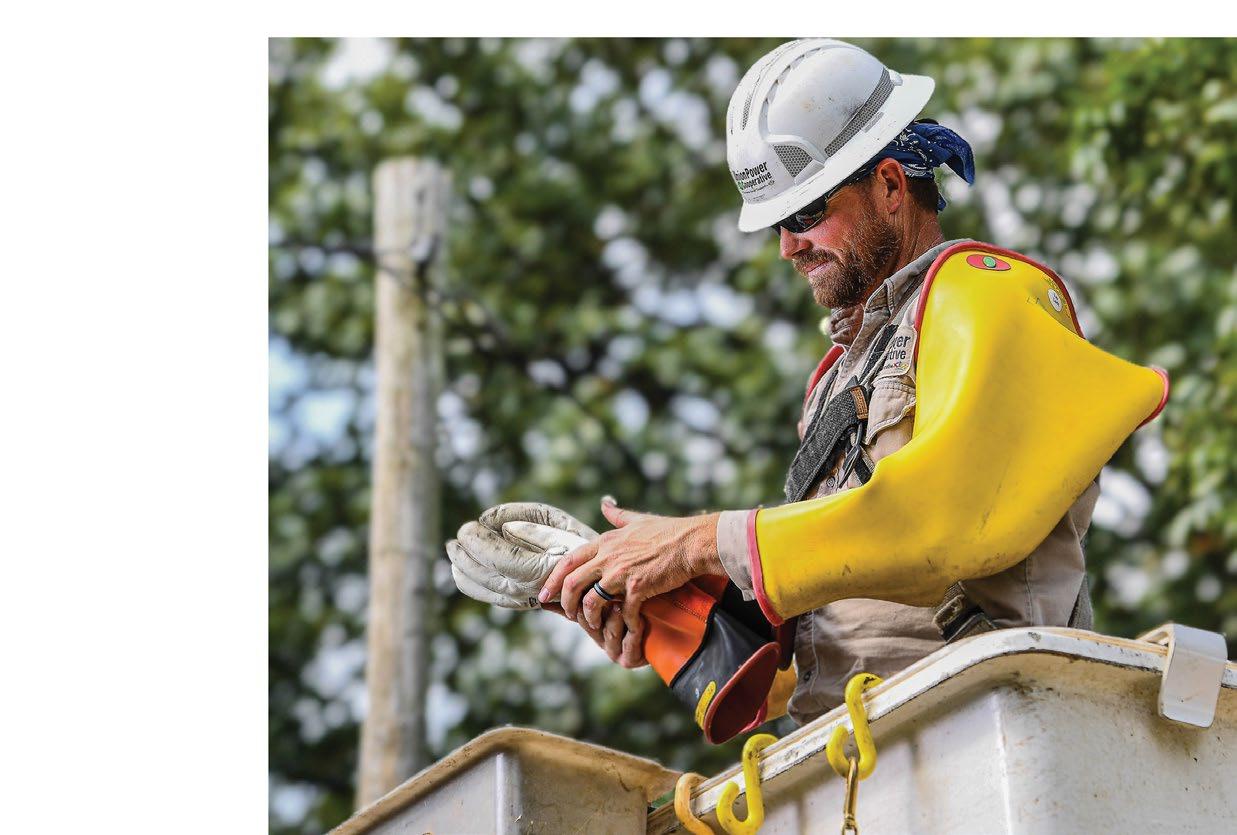
As General Manager of Highline Electric Association, I have the unique privilege of seeing firsthand what it truly takes to keep the lights on for our members. In April, we take time to pause and recognize the brave men and women who make that possible every single day — our lineworkers.

When storms impact our communities and outages occur, many people experience the inconvenience, but our lineworkers see a call to action. Our crews are always ready when it matters most. They leave family dinners, work through the night, and head into challenging conditions to restore power as safely and quickly as possible. That readiness is not accidental. It comes from rigorous training, deep experience, and a shared commitment to ser ving others.
What makes lineworkers especially remarkable is that they aren’t just restoring power to a system — they’re restoring power to their own communities. They live here. They raise their families here. They understand that electricity is more than a convenience; it’s essential to daily life, to local businesses, to schools, farms, and emergency services. Powering the places we call home is personal to lineworkers.
Electric cooperatives like Highline were built on the principle of neighbors helping neighbors, and our lineworkers embody that spirit every day. They are the first to respond and the last to leave, often working long hours behind the scenes. At times, serving our neighbors means going beyond our own service territory through a process known as mutual aid. During major outage events, Highline crews stand ready to
assist neighboring co-ops — sometimes close to home, and sometimes across state lines — to help restore power. This spirit of mutual aid strengthens all cooperatives and ultimately benefits the members we serve.
We understand any time the lights go out can be frustrating, bringing everyday life to a halt. We are incredibly grateful for your patience and encouragement during these times. Linework is demanding, physical, and at times, it can be dangerous. Our crews approach each job with a focus on safety and teamwork. They take pride in their craft and in the trust our members place in them.
On April 18, we will celebrate Lineworker Appreciation Day, but one day is hardly enough. Every day, we thank lineworkers for their service and dedication, which are the backbone of our cooperative.
To our lineworkers: thank you for your hard work, your readiness and your unwavering commitment to the communities we serve. We are proud to stand behind you and grateful for all that you do.
When the lights go out, lineworkers are ready to answer the call, day or night, to safely restore power and keep our communities moving forward. Today and every day, we thank lineworkers for their commitment.
Lineworker Appreciation Day April 18, 2026
ReadyWhen i t Matters Most
Pesticide Safety
Highline Electric employees work hard to maintain reliable service across our rural communities — often accessing fields, pastures, and rights-of-way to restore power or perform routine maintenance. When a field has been treated with agricultural chemicals, however, entering that area without warning can pose serious and immediate health risks to our crews.
Just as you take precautions to protect your family and employees, we ask for your help in protecting ours. A simple notification can prevent harmful exposure and keep everyone safe.
YOU CAN HELP
• If you apply any chemicals to a field, please notify Highline Electric.
You can call our office or place a notification flag at the entrance to the field.

• Free notification signs and flags are available. Stop by any Highline Electric office — we provide these markers at no cost.
• During outages, please inform us if the affected field has been sprayed. Crews often must enter fields quickly during restoration, and your communication helps ensure their safety.
Chemical exposure — even at low levels — can have serious short term and long term health effects. With your cooperation, we can reduce the risks our employees face while they work to keep your power on.
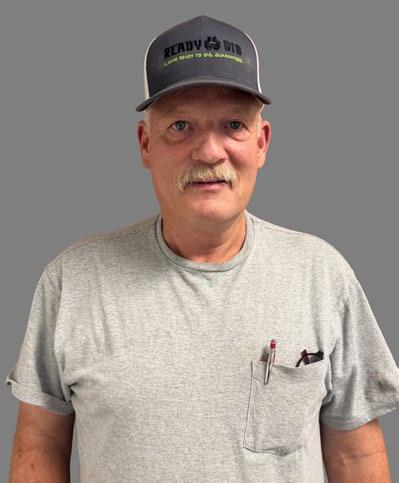
NEW EMPLOYEE: ED GLENNEMEIER
In February, Ed Glennemeier joined Highline as the new warehouseman. He is originally from Norton, Kansas, and likes fishing, camping, and woodworking. He also enjoys spending time with his wife, Tami. He stated, “I applied at Highline to better myself and learn new things,” and he looks forward to working with the team. Welcome, Ed!
IS YOUR PHONE NUMBER CURRENT?
If you haven’t reviewed your phone number with us recently, please take a moment to check and update if needed. Accurate contact information helps our enhanced outage management system work more effectively, ensuring we can keep you informed with timely outage updates.
Congratulations
TYLER HASE
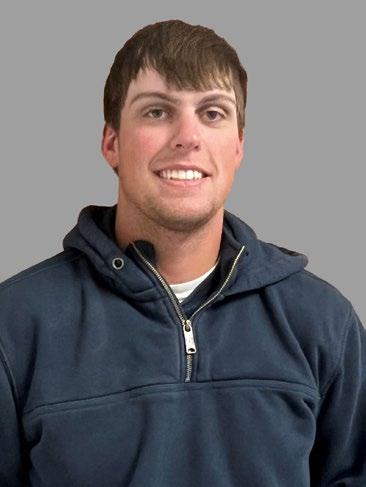
We are proud to share that Tyler Hase has been nominated and selected to attend the 2026
Lineworker Safety, Training, and Leadership Conference in Omaha, Nebraska this April. This conference is a highly respected, invitation-only event hosted by Quad State Instructors, and attendance is limited to one lineworker per utility across the country.
Tyler’s dedication to safety, his leadership on the job, and the steady support he provides to apprentices and coworkers make him an ideal representative of Highline Electric. His commitment to doing the job the right way — and helping others understand the “why” behind safe work practices — embodies exactly what this conference is designed to recognize and strengthen.
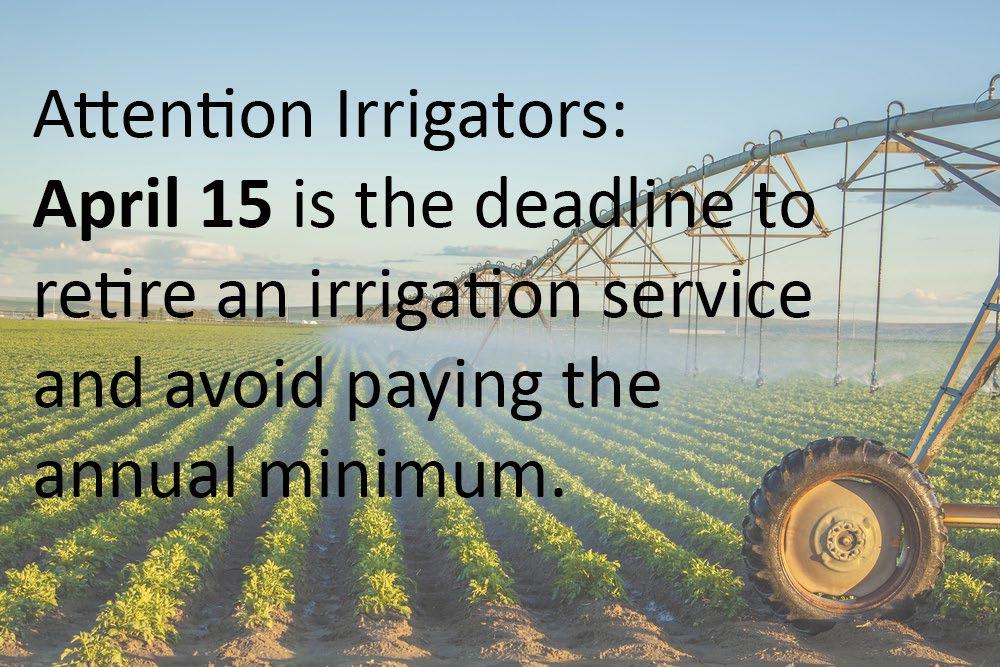
ATTENTION LOAD CONTROL PARTICIPANTS
Irrigators: If you are signed up for Load Control for 2026, it will start in May. Please know which option you signed up for.
Please join us in congratulating Tyler on this well-deserved opportunity.
DO NOT POST ON POWER POLES
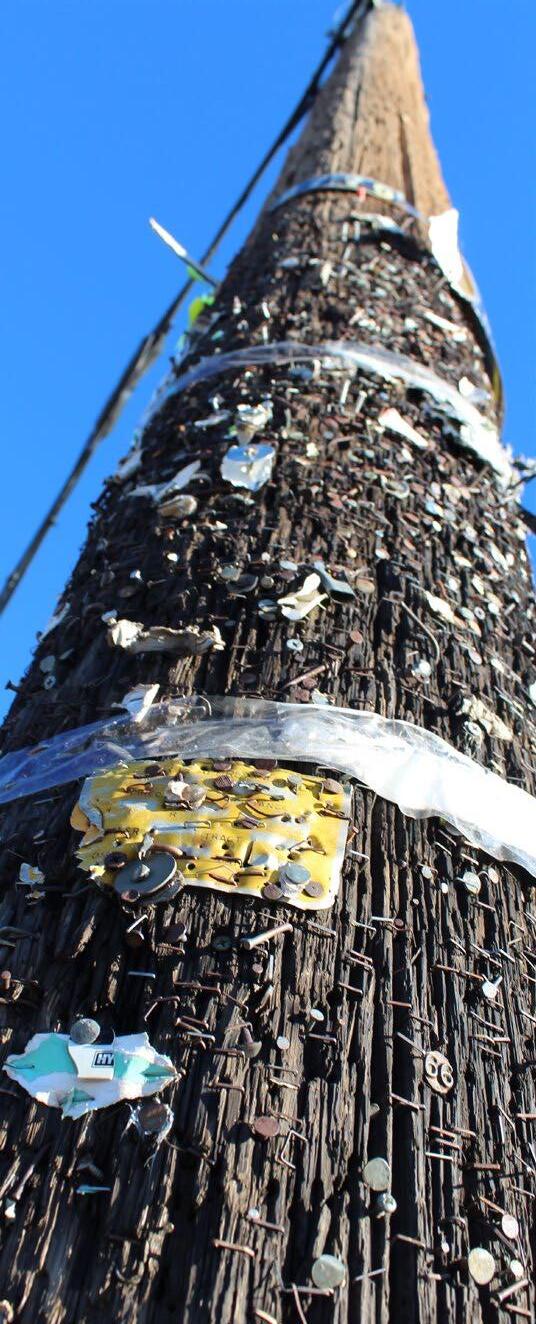
It’s important to keep utility poles free from all personal materials such as balloons, fliers, and metal objects like staples or tacks.
By respecting utility poles, you can help keep your community powered, and your local utility workers safe.
Utility workers use specialized climbing devices to perform regular maintenance and repair damaged power lines at the top of utility poles. Nails, tacks, and other metal objects that are used to attach objects to utility poles can interfere with the safe operation of the climbing boots used by utility workers.
Foreign objects that are embedded in utility poles can also snag or damage the protective clothing that keeps line workers safe from electrical shock. Lineworkers already work in extremely hazardous conditions, so everyone who relies on electricity should take steps to make their job as safe as possible.
Control dates for options 1, 1A, 2 and 2A include May 12-May 31, June 21-June 30 and September 1-September 10.
If you selected either the 1A or 2A options, you could also be controlled 1 day per week in July and August as well.
If you selected option 3, you may only be controlled 1 day per week in July and August.
Celebrating
HEA Anniversaries
Congratulations to the following employees who observe an employment anniversary in April:
Jeff Poe — 22 years
Matt McCabe — 11 years
Carson Ebke — 10 years
Josh Martin — 9 years
Kevin Humphreys — 2 years

Linemen: Ready When it Matters Most
By David Churchwell General Manager
As the General Manager of K.C. Electric Association, I have the unique privilege of seeing firsthand what it truly takes to keep the lights on for our members. This month, we take time to pause and recognize the brave men who make that possible every single day — our linemen.
When storms impact our service territory and outages occur, many people experience the inconvenience, but our linemen see a call to action. Our crews are always ready when it matters most. They leave family dinners, work through the night, and head into challenging conditions to restore power as safely and quickly as possible. That readiness is not accidental. It comes from rigorous training, deep experience, and a shared commitment to ser ving others.
working long hours behind the scenes. At times, serving our neighbors means going beyond our own service territory through a process known as mutual aid. During major outage events, K.C. crews stand ready to assist neighboring co-ops — sometimes close to home, and sometimes across state lines — to help restore power. This spirit of mutual aid strengthens all cooperatives and ultimately benefits the members we serve.
What makes linemen especially remarkable is that they are not just restoring power to a system, they’re restoring power to their own communities. They live here. They raise their families here. They understand that electricity is more than a convenience; it is essential to daily life, to local businesses, to schools, farms, and emergency services. Powering the places we call home is personal to linemen.
Electric cooperatives like K.C. Electric were built on the principle of neighbors helping neighbors, and our lineworkers embody that spirit every day. They are the first to respond and the last to leave, often
We understand any time the lights go out can be frustrating, bringing everyday life to a halt. We are incredibly grateful to you, our members for your patience and encouragement during these times. Linework is demanding, physical, and it can be dangerous. Our crews approach each job with a focus on safety and teamwork. They take pride in their craft and in the trust our members place in them.
The official day for Lineman Appreciation in Colorado is on April 18, but one day is hardly enough. Every day, we thank K.C. linemen for their service and dedication, which are the backbone of our cooperative.
To our linemen: thank you for your hard work, your readiness, and your unwavering commitment to the communities we serve. We are proud to stand behind you and grateful for all that you do.
K.C. Electric Staff
David Churchwell General Manager dchurchwell@kcelectric.coop
Bo Randolph Office Manager and CFO brandolph@kcelectric.coop
Phone 719-743-2431
Toll-free 800-700-3123 Web kcelectric.coop
Darren Fox
Operations Manager dfox@kcelectric.coop
George Ehlers Member Services Specialist and IT Manager gehlers@kcelectric.coop
Address 422 3rd Avenue Hugo, CO 80821
K.C. ELECTRIC MISSION
Thank You K.C. Electric Linemen!
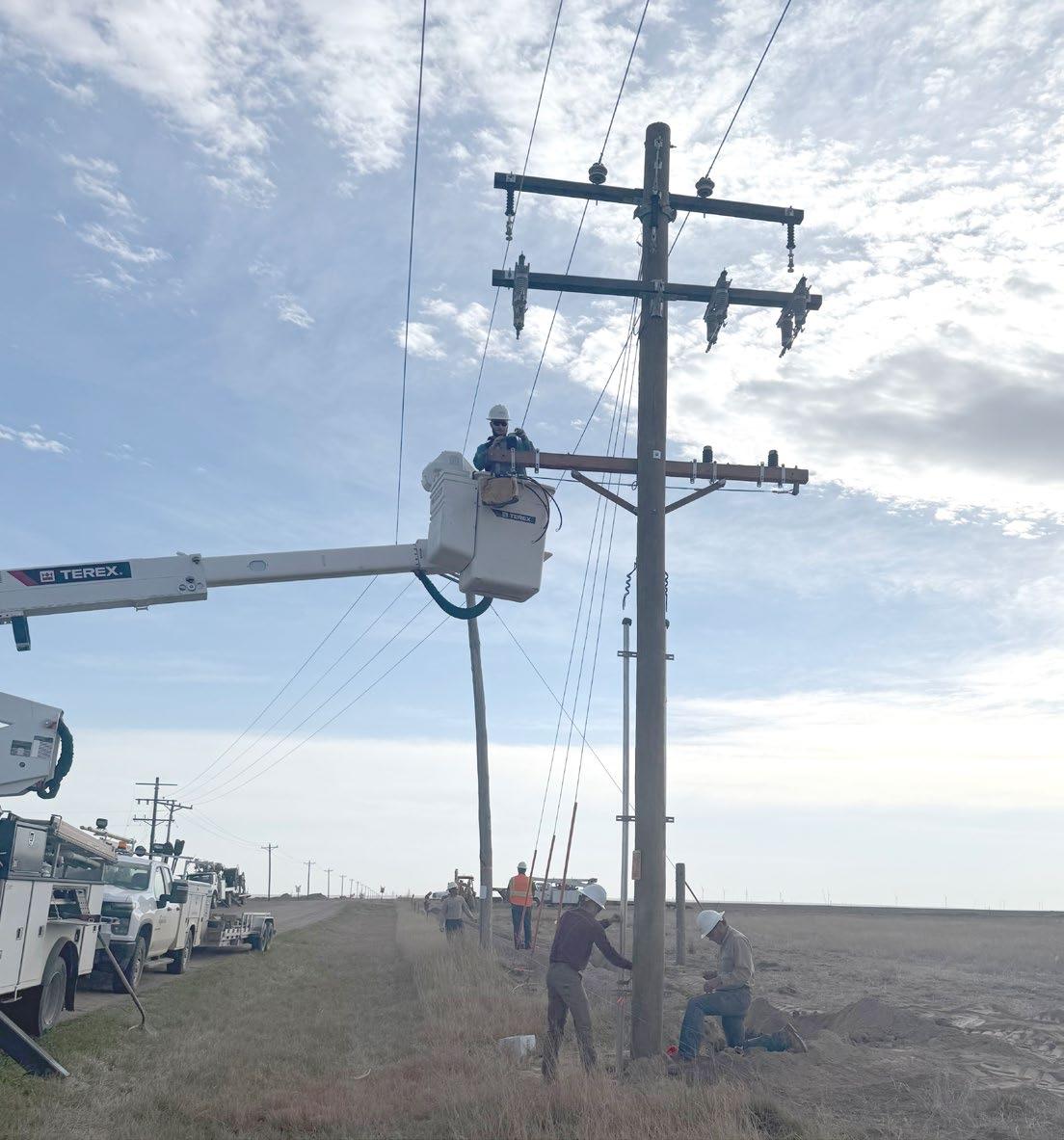
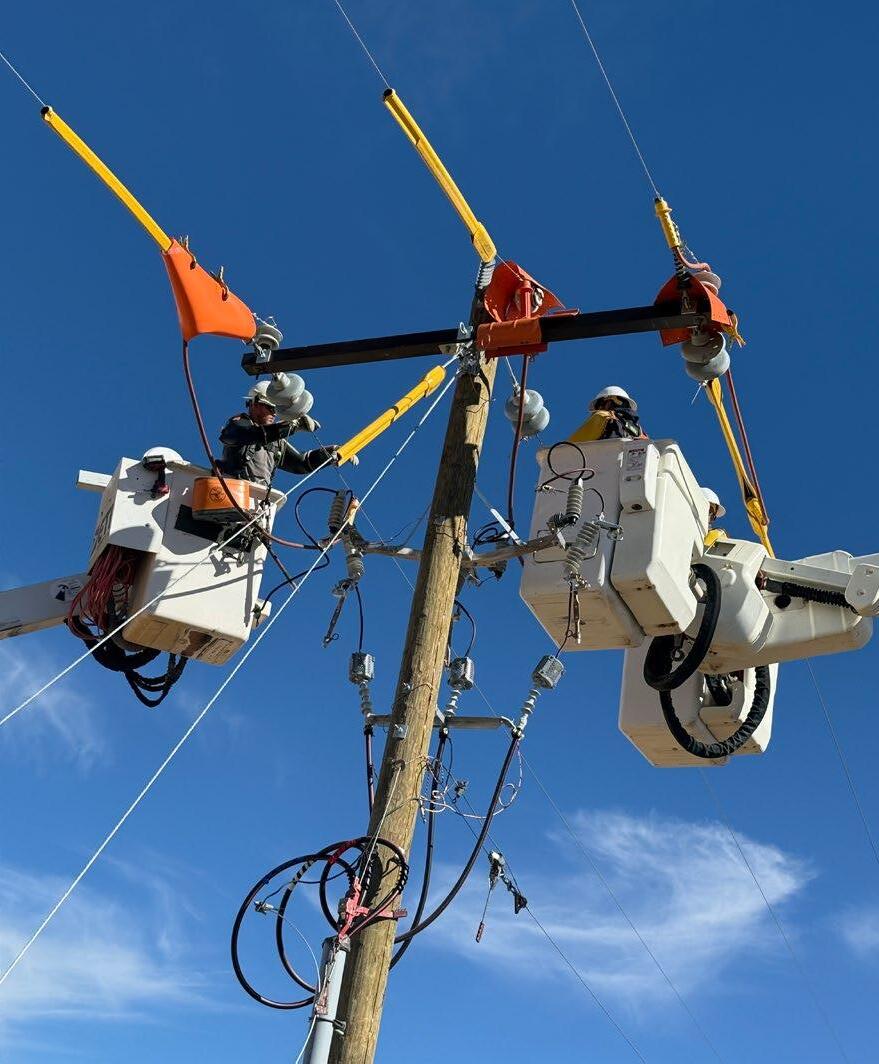
K.C. Electric Association linemen cover vast distances across the Eastern Plains, often working in extreme conditions to repair downed lines and maintain the grid. Their work is physically demanding and requires a high level of skill and safety. We appreciate the long hours worked and the dedication of our linecrews who serve our rural electric cooperative and small towns. Join us in thanking our crews in honor of Lineman Appreciation Day on April 18.
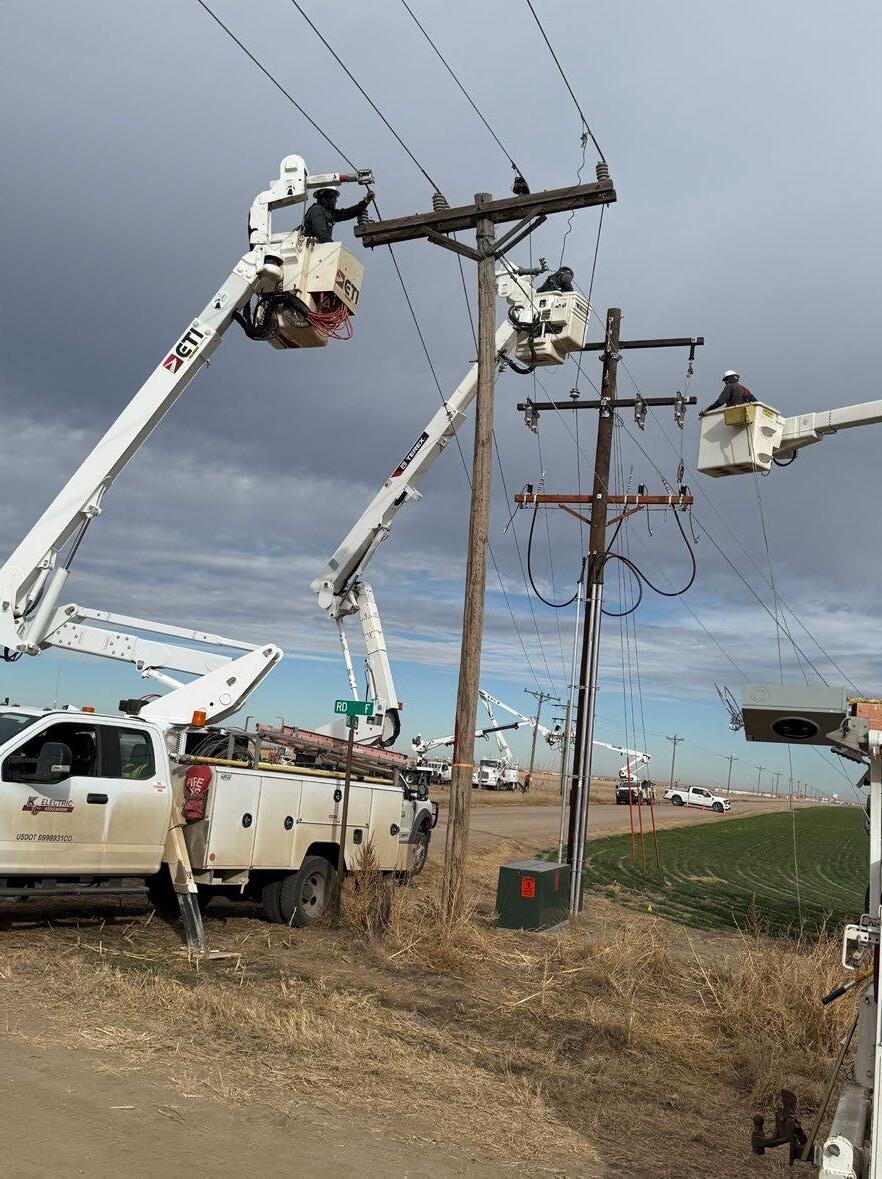
Top right, left to right: Flagler Lineman Jake Smith and Stratton Lineman Alex Cruz perform hotline work near Stratton in February.
Bottom right, left to right: Stratton Linemen Alex Cruz, Rogan Pike, and Skye Perry perform pole repairs and work to string new power lines in Stratton in February.
Below: Stratton Lineman Cameron Klann works in a bucket truck while linemen Rogan Pike and Alex Cruz work on direct buried line in Stratton in February. Stratton Line Foreman Austin Talbert is in the background observing.
DO YOU KNOW ABOUT LINEWORKERS?
Every April, we celebrate lineworkers and the hard work they do to make sure we have electricity to power our lives. How much do you know about lineworkers? Take the quiz below to find out!
(Use the answer key to check your work.)
1. Lineworkers have to wear a lot of gear to do their jobs. A lineworker’s gear can weigh up to ______.
a. 15 pounds
b. 50 pounds
c. 80 pounds
2. Lineworkers maintain and repair electrical lines, but they do not install them.
a. True
(no installation) (They maintain, repair and install lines.)
b. False
3. There are approximately ______ lineworkers in the United States.
a. 50,000
b. 90,000
c. 120,000
4. Lineworkers must wear ______ clothing to protect them from a possible electric arc while working.
a. fire resistant
b. extra thick
c. leather or rubber
5. Lineworkers must wear special conductive boots when climbing a steel structure.
a. True
b. False
CLAIM YOUR SAVINGS
Each month, K.C. Electric members have a chance to claim a $20 credit on their next electric bill. All you must do is find your account number, call the Hugo office at 719-743-2431, and ask for your credit. The account numbers are listed below. How simple is that?
You must claim your credit during the month in which your name appears in the magazine (check the date on the front cover).
Greg Andrews, Burlington — 1259xxxxx
Dale Ridder, Burlington — 11032xxxxx
Steve Daniel, Burlington — 11617xxxxx
Melissa Ross, Cheyenne Wells — 4093xxxxx
In February, four members called to claim their credit: Mike Hannigan, Mona Ebsen, Chase McCullough, and Laci Gardner.
You Are Invited
Join us for the K.C. Electric Association Annual Meeting and director election.
Thursday, June 4, 2026
Hi-Plains High School, Seibert
Registration: 6 p.m. | Meeting: 6:30 p.m.
There will be lots of prizes and giveaways, and one person in attendance will win $1,500.
Mark your calendar now and plan to join us June 4.
ENERGY EFFICIENCY TIP OF THE MONTH
As we prepare for the seasonal shift, remember to set your ceiling fan rotation accordingly. In winter months — or whenever your home heating system is running — fan blades should rotate clockwise, which produces an updraft that pushes warm air down. In summer months — or whenever your home cooling system is running — blades should rotate counterclockwise, which produces a downdraft or windchill effect that makes you feel cooler. When used correctly, ceiling fans can boost comfort and allow you to adjust the thermostat a few degrees for energy savings.
Source: energy.gov

Photo by Crisss12000
Risk Mitigation Protocols
Protecting the communities we serve
By Dave Frick General Manager
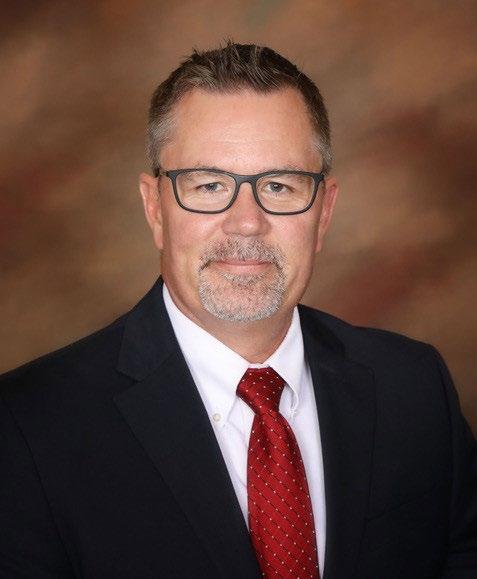
Earlier this year, you may have noticed Morgan County REA activated Risk Mitigation Protocols several times for our system, which is made up of nearly 3,000 miles of power line stretched across six counties. We weren’t alone in doing so, as electric companies throughout our region — both cooperatives and investor-owned utilities — put similar procedures in place. It raises the questions: What are RMPs? Why are they being used? I’d like to take some time to answer these questions and explain MCREA’s efforts towards protecting the areas we serve.
Unfortunately, this creates the conditions for wildfires to ignite and spread rapidly. While it’s impossible to eliminate all risk, our RMPs help reduce the likelihood of damaged lines sparking and causing a fire. In addition to enhancing our system’s safety settings, MCREA’s team closely monitors local first responder activity. In some emergencies, power needs to be shut off for first responders to work safely — and staying in the loop helps us dispatch linemen as fast as possible to those locations.
Under normal conditions, our system uses automated technologies to keep power flowing to our members. If a temporary interference causes a fault — perhaps lightning or a gust of wind that slaps the lines together — devices on the line will momentarily trip open to clear the fault, then close to restore power. These are called reclosers, and they help reduce outages to keep our system operating efficiently.
WHAT ARE RMPS?
During windy conditions or Red Flag Warnings, MCREA activates Risk Mitigation Protocols for our system. Under RMPs, we disable those automatic functions and operate in “non-reclose” mode. Now, if a recloser trips it will remain open and power will be off until MCREA has been able to visually inspect the affected section of line. These outages may be longer than usual since crews need to make those inspections. If no issues are found, the line will be re-energized.
WHY ARE THESE PROTOCOLS IN PLACE?
This past winter was much drier than usual, and we saw days with wind gusts well over 60 miles per hour.
MCREA MISSION
Morgan County REA, a member-owned cooperative, is dedicated to serving our members by providing safe, reliable energy with a strong tradition and vision for the future. This institution is an equal opportunity provider and employer.
WILL MCREA TURN OFF POWER AHEAD OF TIME?
Recently, other utilities have conducted Public Safety Power Shutoffs, where they preemptively de-energize power to targeted areas during extreme wildfire risk conditions. At this time, MCREA has not utilized this type of anticipatory outage. Does that mean our co-op will never have to implement preemptive shutoffs to combat fire risk?
After more than 35 years in this industry, I’m hesitant to never say never. However, should planned, proactive outages be part of our wildfire mitigation strategy, we will give as much notice as possible to our members and clearly communicate with you through those events.
At MCREA, safety is our top priority; for our members, our employees, and the areas we serve. Our RMPs are another way we remain committed to safety every day. Wildfire mitigation has become the primary focus for many electric co-ops, especially here in Colorado. While efforts to reduce risk can lead to other frustrations — like longer, more frequent outages — we genuinely appreciate your patience as we work to deliver reliable power, while protecting the communities we serve.
734 Barlow Road | P.O. Box 738
Fort Morgan, CO 80701
970-867-5688 | customerservice@mcrea.org mcrea.org facebook.com/MorganCountyREA @morgancountyrea

April 18: Lineworker Appreciation Day
Electricity is essential to our daily lives. From powering our homes to supporting our economy, electricity is a constant — until it’s not.
When the lights go out, that’s when you call the linemen. No, not the ones you’ll find on the football field. These are the ones found up above, working on high-voltage power lines, often in poor weather conditions, to restore power to our lives.
Lineworkers are protectors of safety and keepers of comfort for our communities and beyond. They bring a spirit of service, dedicated focus, and specialized knowledge to a job that demands both skill and heart. Their commitment to safety isn’t just a requirement — it’s a way of life.
Being a lineworker isn’t easy. It requires a high level of teamwork and trust to take on the unique challenges and hazards of the job. Lineworkers have each other’s back, and work together to keep the lights on. (Carl Syvertson, acct. #xxx0300)
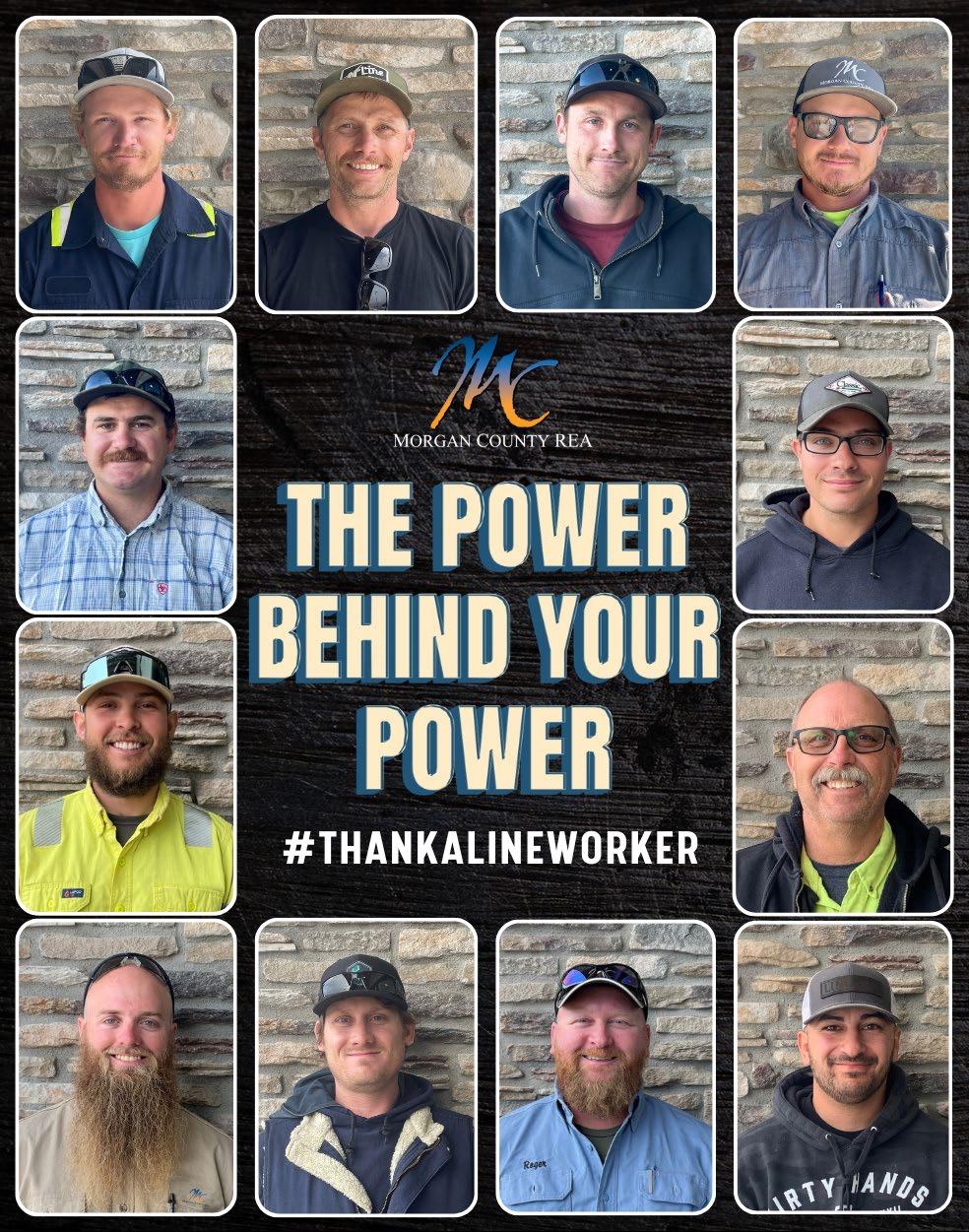
While Lineworker Appreciation Day is celebrated April 18, we are grateful for these individuals and the vital role they play all year long. This month, we especially recognize the lineworkers at Morgan County REA. Thank you for your continuous hard work and dedication to serving our members.

NEW EMPLOYEE: JOSH SCOTT
Morgan County REA is excited to welcome Josh Scott as our Communications and Public Relations Coordinator. Growing up in Brush and a University of Northern Colorado alum, Josh is ready to bring his business and communications knowledge to the team.
“After recently graduating, it’s nice to find a place where I can help my community,” Josh shared. “MCREA feels like a place where I can really put my skills to work!”
Josh and his wife Charina recently welcomed their daughter to the world last summer. Together, they enjoy traveling, visiting aquariums, and playing with their two cats and chinchilla.
Welcome to the team, Josh!
NOTICE: RATE INCREASE
The Morgan County REA Board of Directors has proposed an average overall rate increase of 6.81% for members, though the increase for each rate class will vary based on services required. These changes are effective April 1, 2026.
For more information on this rate increase, please visit our website at mcrea.org/rate-information.
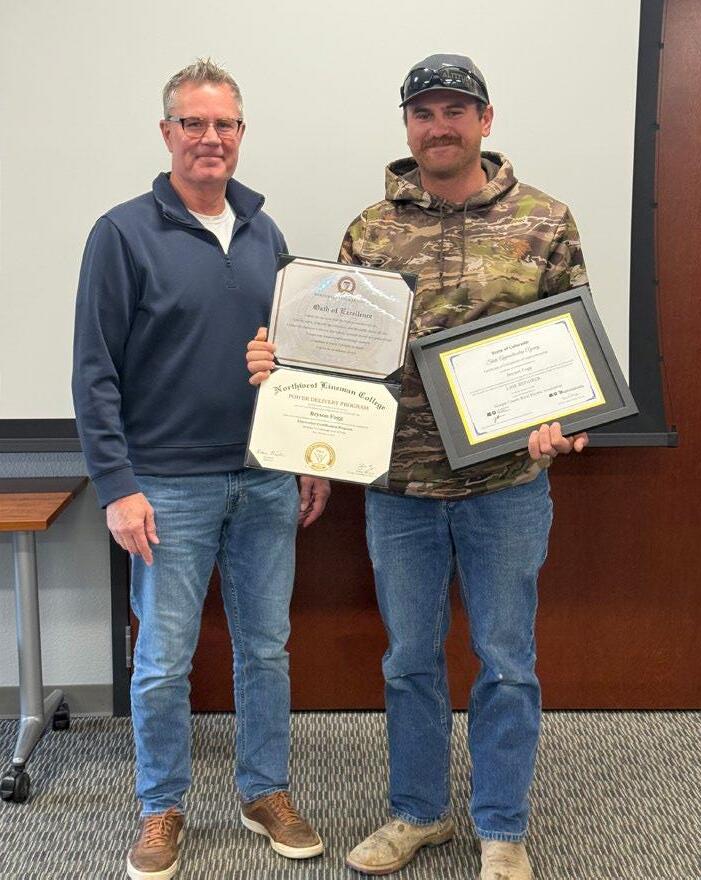
New Journeyman Lineman: Bryson Fogg
Morgan County REA congratulates Bryson Fogg on attaining his journeyman lineman certification. Becoming a journeyman is an important milestone in a lineman’s career; it requires 8,000 hours of training as an apprentice lineman while studying four years’ worth of training curriculum, completing a 200-question written exam, and rigorous field testing. During his training, Bryson has been an important part of MCREA’s operations department, and the team is proud to recognize his achievement. As a journeyman, Bryson will continue working to deliver safe, reliable electricity to our members.
Congratulations, Bryson!
Win a $30 Bill Credit!
Each month, Morgan County REA gives two lucky members a chance at a $30 bill credit just by reading Colorado Country Life. Congratulations, Larry Fleming! You spotted your name in February’s magazine and called to claim your bill credit.
There are two more member names and their account numbers hidden somewhere in this issue. If you find your name and account number call MCREA’s member services department at 970-8675688 by April 30 to claim a $30 bill credit on your next bill.

Bryson Fogg (right) is presented his journeyman lineman certificate by MCREA General Manager Dave Frick

Underground electric, gas, water, and communication lines can be dangerous if hit.
Always call 811 before digging to have underground utility lines marked. 811 is free to use and keeps you and your community safe!

ENERGY EFFICIENCY
TIP OF THE MONTH
As we prepare for the seasonal shift, remember to set your ceiling fan rotation accordingly. In winter months — or whenever your home heating system is running — fan blades should rotate clockwise, which produces an updraft that pushes warm air down. In summer months — or whenever your home cooling system is running — blades should rotate counterclockwise, which produces a downdraft or windchill effect that makes you feel cooler. When used correctly, ceiling fans can boost comfort and allow you to adjust the thermostat a few degrees for energy savings.
Source: energy.gov
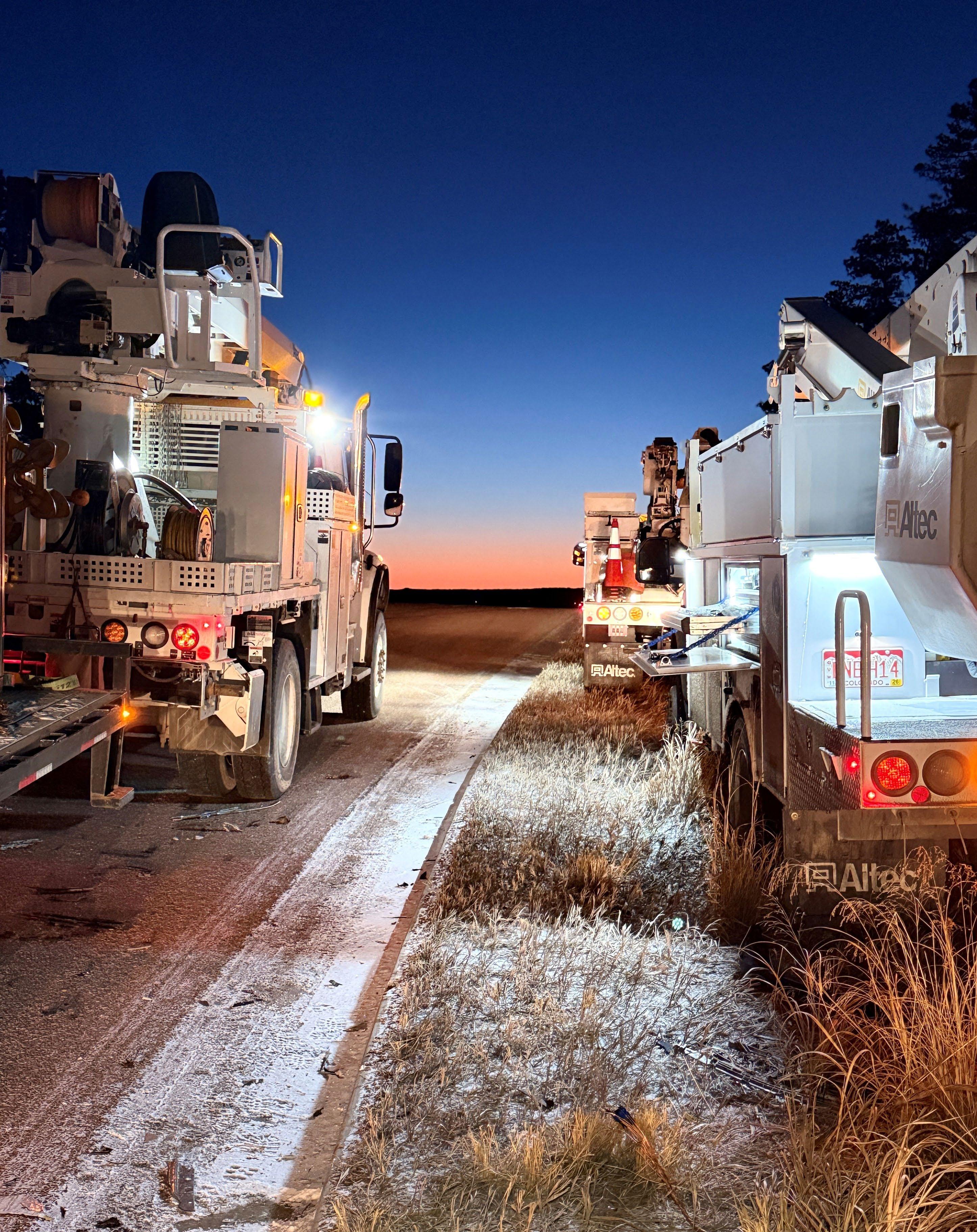

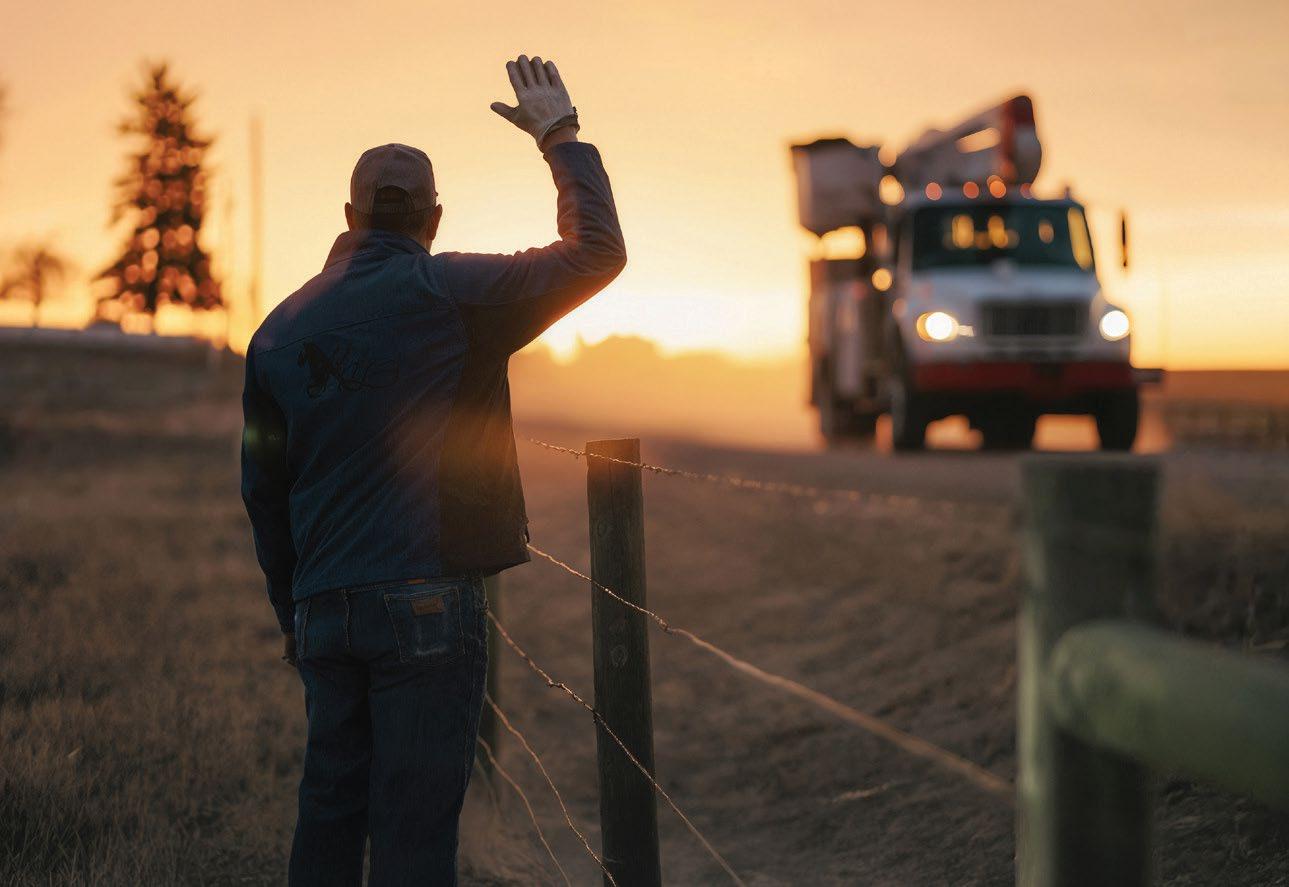
Dawn Breaks, Power Restored
Photo by MVEA Lineman Wyatt Farnum
Going Above & Beyond
Lineworkers Keep the Lights On
By Ruth Marks CEO
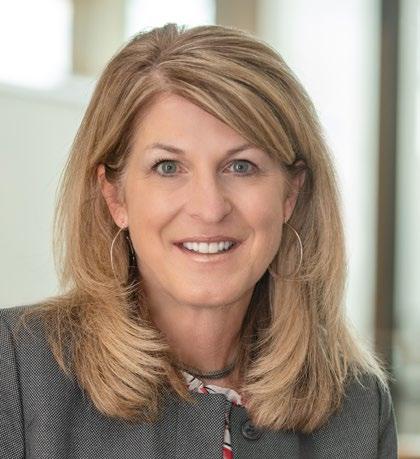
At Mountain View Electric Association, keeping the lights on takes more than poles, wires, and equipment. It takes people — dedicated professionals who are willing to answer the call when our members need them most.
As MVEA’s CEO, I have the unique privilege of seeing firsthand what it takes to keep the lights on for our members. It’s hard to believe, but behind every light switch in our service territory is a complex system of more than 6,500 miles of energized line spanning across 5,000 square miles. Our electric distribution system includes more than 95,000 poles, 25 substations, and thousands of pieces of equipment that must be inspected, maintained, and upgraded to operate safely and reliably. Maintaining infrastructure on this scale requires technical expertise, dedication, and a deep commitment to service.
What makes lineworkers especially remarkable is that they are not just restoring power to a system — they are restoring comfort, security, and normalcy to the lives of their neighbors. They understand that electricity powers far more than lights. It keeps homes warm, supports local businesses, powers schools and farms, and ensures emergency services can respond when they are needed most.
I have worked in the electric cooperative industry for more than 25 years and can proudly share that MVEA is blessed to have an experienced team of professionals keeping our system running and our communities powered through all types of weather. Their work requires years of training, technical expertise, and a deep commitment to safety. Lineworkers are often the first to respond and the last to leave, working behind the scenes so our members can go about their daily lives.
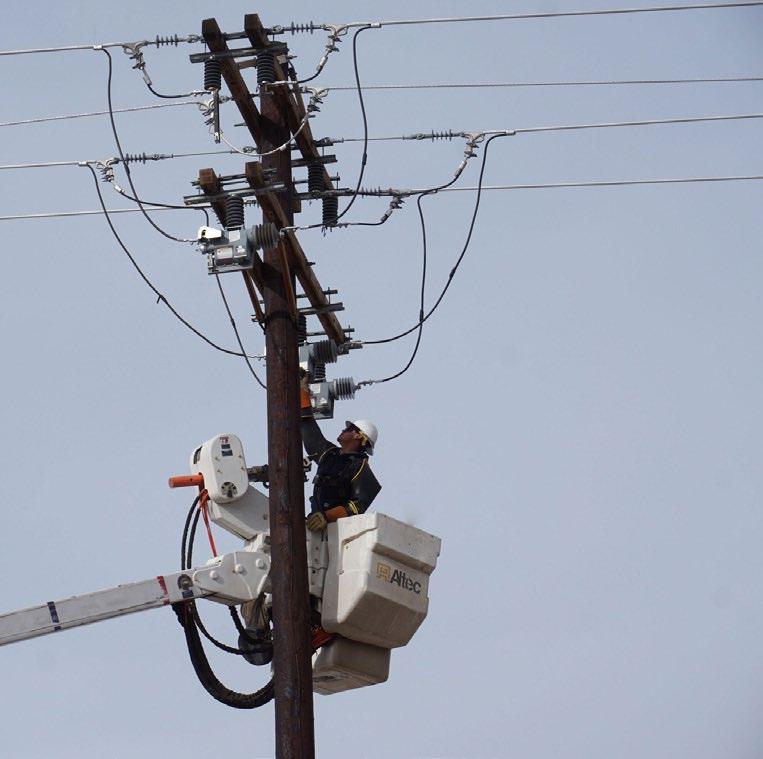
Some may find this surprising, but even with modern technology, linework remains one of the most demanding and dangerous professions in the country, with crews working around high-voltage electricity, at significant heights, and in unpredictable conditions. That is why safety is always our top priority at MVEA. I am incredibly proud to share that our team recently celebrated three years without a lost-time accident, a milestone made possible by a strong culture where employees look out for one another and take pride in doing the job the right way. From dispatch operators who coordinate crews to engineers who help map the way to power restoration, when the lights go out, our teams step in.
Please join us as we celebrate Colorado Lineworker Appreciation Day on April 18 to recognize the men and women who go above and beyond to keep the lights on 24 hours a day, 365 days a year. Visit the webpage or scan the QR code in the image below to send a thank you note to help us honor MVEA’s dedicated lineworkers.

Spring Into Energy Savings
As seasons change, temperatures warm, and daily routines shift. This spring, take some time to refresh your energy habits — a few small changes around your home can add up to meaningful energy savings.
Spring is the perfect time to schedule maintenance for your heating and cooling system. Spring and fall checkups conducted by a licensed professional can help ensure your system is running efficiently, safely, and reliably before the peak seasons begin. A well-maintained unit uses less energy, lasts longer, and helps prevent costly breakdowns when you need it most.
If you’re looking for a simple place to start saving, look no further than ceiling fans. Fans don’t actually cool or heat the air, but they help you feel more comfortable by moving it. During warmer months, make sure your ceiling fan blades are set to rotate counterclockwise. This creates a downward breeze that makes you feel cooler, allowing you to raise your thermostat a few degrees without sacrificing comfort. In cooler months, reverse the direction of fan blades clockwise to help push warm air down from the ceiling, improving efficiency when your heating system is running.
Speaking of thermostats, adjusting the temperature just a few degrees can make a noticeable difference on your energy bill. As spring arrives, try setting your thermostat slightly higher when cooling or slightly lower when heating. Even a two- or three-degree adjustment can reduce energy use
On-Bill Repayment Program (OBR)
Take advantage of the OBR Program for a simple and transparent low-interest financing option for an energy audit and energy efficiency upgrades. No money down. No credit check.
+ Windows & Doors + EV Chargers
+ Whole-home or Attic Fans + And More!
+ Electric HVAC Systems
+ Insulation
www.mvea.coop/electrify-and-save
while keeping your home comfortable — especially when combined with ceiling fans or open windows on mild, pleasant days.
Hot water use is another area where simple habits matter. Taking shorter showers can help reduce the amount of energy used to heat water, which makes up a significant portion of most energy bills. Cutting just a few minutes off each shower not only saves energy but also conserves water.
As a member-owned electric co-op, Mountain View Electric Association is committed to helping our members save energy and money all year long. We encourage members to explore our On-Bill Repayment Program and energy efficiency rebates, which support upgrades such as insulation, windows, and heat pumps. These programs are designed to make meaningful home improvements more accessible, helping members lower energy use today while improving efficiency for years to come.
Online account management through SmartHub® is another great tool to help members monitor their electric use. With daily and hourly energy reads available, members can track high energy use trends to identify causes and avoid them in the future.
While we have many resources to help co-op members save energy and money, if you have specific questions about your energy use, the best resource is MVEA’s team of Member Services Representatives. Please don’t hesitate to call (800) 388-9881. To explore more ways to save energy and money, visit www.mvea.coop/energy-resource-center.
PROGRAMS TO SAVE ENERGY & MONEY
Energy Efficiency Rebate Program
From select appliances to heat pumps, and electric mowers to EV charging equipment, there is a rebate to fit the needs of nearly every member who wants to save money and energy.
+ Smart Thermostats + Electric Heat Pumps
+ Select Appliances + EV Chargers
+ Electric Bicycles + And More!
www.mvea.coop/rebates
SAVE THE DATE
Thursday, June 4, 2026
Annual Meeting & Member Appreciation Event
Limon Public Schools • 912 Badger Way • Limon, CO 80828
5:00 p.m. Doors Open | Registration & Dinner 6:30 p.m. Business Meeting & Door Prizes www.mvea.coop/annual-meeting
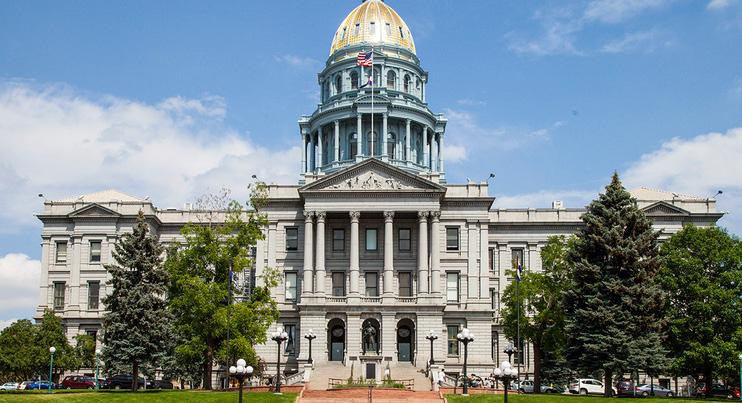
Decisions at the Capitol impact your electric service and your bill. MVEA’s Grassroots Network brings together members who want to stay informed and lend their voice on issues that impact electric cooperatives and the communities we serve. When co-op members speak together, our shared voice carries further and helps ensure that the interests of co-op communities are heard.
Joining the Grassroots Network doesn’t mean committing to advocacy or political action. It simply means raising your hand to stay informed. When legislation or policy decisions arise that could impact MVEA or our members, we’ll share ways to get involved — if you choose.
Learn more about the issues shaping our industry by reviewing MVEA’s 2026 Legislative Agenda, and sign up to stay informed through the Grassroots Network.
Read the agenda and join today: www.mvea.coop/grassroots-network
Local. Trusted. Serving You.
BOARD OF DIRECTORS
Kevin L. Paddock, District 5 President
Barry R. Springer, District 6 Vice President
Jim Riggins, District 7 Secretary-Treasurer
Joseph D. Martin, District 1 Assistant Secretary
Rick L. Gordon, District 2
Wayne Vanderschuere, District 3
Jim Beals, District 4
Telephone Numbers Toll-Free: (800) 388-9881 (719) 495-2283
Website www.mvea.coop
Falcon Office 11140 E. Woodmen Road Falcon, CO 80831
Limon Office
1655 5th Street • P.O. Box 1600 Limon, CO 80828
Office Hours
Monday - Thursday 7 a.m. to 5:30 p.m.
Stay Connected: Like. Follow. Share.
Make sure to connect with MVEA on social media for timely service and program updates.
www.facebook.com/@MVEAInc
www.linkedin.com/company/ mveainc
www.x.com/@MVEAInc
www.youtube.com/@MVEAInc

www.instagram.com/MVEAInc
To provide our members safe,
affordable, and responsible electric service and access to broadband services.
This Association is an equal opportunity provider and employer.
If You’re Interested In Going Solar, We’re Here To Help
MVEA regularly works with members and solar contractors to transition to solar power through our interconnection program. In fact, we currently have over 4,000 (and counting!) solar accounts spread throughout our service territory! As the demand for solar power has increased, so has the number of calls we receive from co-op members regarding the costs and logistics associated with the transition to solar. If you have questions about going solar, please call (800) 388-9881 or visit www.mvea.coop/interconnection.
Solar Power
MAKING THE SOLAR SWITCH?
COMMON MVEA
MEMBER SOLAR
INSTALLATION CONSIDERATIONS

Thoroughly investigate the company: Is it backed by the Better Business Bureau? Does it meet local and state licensing requirements? If a representative from a solar company contacts you claiming to be “with MVEA” or that they are “part of MVEA’s solar efforts,” please know that MVEA does not have preferred solar installation contractors. While we work with MVEA members in making the solar switch, at this time we do not have preferred vendors or send sales teams out to canvass neighborhoods. MVEA’s interconnection program is driven by member demand and we work with the companies our members choose to work with.
Know all the costs, not just those for equipment and installation. In addition to equipment and labor, there are also pricey “soft costs” that can cost more than the system itself, according to Energy.gov. Soft costs include permit acquisition, financing charges, “pass-along” marketing, advertising, and research costs. For helpful resources from the U.S. Department of Energy Solar Energy Technologies Office, visit www.energy.gov/eere/solar/homeowners-guide-solar.
How will the installer work with MVEA to meet interconnection requirements? Does the installer have experience coordinating and integrating solar systems with the electric grid? How much energy will the system provide and is it enough? Too much?
The installation of a solar system is a substantial investment with specific system requirements that need to be met. As such, MVEA requires members or their solar contractor to contact us prior to purchasing a solar system to ensure that it can fully integrate and connect with MVEA’s system.
Energy Resource Center • Renewable Energy • www.mvea.coop/save-energy-money




Few have
the
Lineman Appreciation: Recognizing the People Who Power Our Community
BY JEFF WADSWORTH PRESIDENT & CEO
privilege
of
seeing firsthand what it truly takes to keep the lights on for our members.
In April, and throughout the year, we recognize the skilled professionals who make that possible every day: our linemen. They work in the heat of summer, the cold of winter, and the uncertain hours of the night, performing essential tasks that often go unnoticed until power returns after going out.
When storms roll through our service territory and outages occur, many people experience the disruption. Our linemen, however, hear a call to action. They step away from family dinners, weekends, and holidays to respond in difficult conditions like high winds, snow, ice, and driving rain to restore service as safely and quickly as possible.
Recent wind storms have put our crews into action. While many of us shelter indoors, they are patrolling lines, clearing hazards, replacing damaged equipment, and restoring service one repair at a time. Their response is driven by disciplined training, hard-earned experience, precise coordination, and a shared commitment to serving our members and keeping each other safe.
Powering the places we call home is personal for our linemen. They are not restoring electricity to a system, they are restoring power to their own community. They live here. They raise families here. They understand that electricity is more than a convenience; it is essential to daily life.
Poudre Valley REA was built on the principle of neighbors helping neighbors,
and that spirit extends beyond our linecrews. While linemen are often the most visible during outages, restoring power is a team effort. From dispatchers and system operators to engineers, member services, communications, and support staff, it takes the entire PVREA workforce pitching in together to respond, communicate, and keep us moving forward.
Just as important, I want to thank the families who stand behind our team. When the phone rings and employees are called to act, it’s their spouses, partners, children, and loved ones who carry the added responsibilities and uncertainties at home. Their support makes it possible for our workforce to stay focused on the job and return home safely.
On April 13, we celebrate Lineman Appreciation Day, but one day is hardly enough. Please join me in thanking our linemen, the entire PVREA team, and their families for the skill, sacrifice, and dedication that strengthen our cooperative and keep our communities powered.
If you’d like to thank them in person, I invite you to attend our Annual Meeting on Saturday, April 11. Details can be found on page 7 or at www.pvrea.coop/annual-meeting.
To our entire employee team: Thank you for your professionalism, your readiness, and your commitment to the members we serve. We are proud of you, grateful for you, and committed to supporting you with the training, equipment, and culture of safety you deserve.
ABOUT YOUR CO-OP
PVREA serves energy solutions to more than 58,000 homes and businesses in Boulder, Larimer, and Weld counties. We are a memberowned co-op, led by those we serve.
OUR MISSION
We are committed to providing safe, reliable, efficient energy solutions with exceptional service to our members.
1.800.432.1012 pvrea@pvrea.coop www.pvrea.coop
MAILING ADDRESS
Poudre Valley REA 7649 REA Parkway Fort Collins, CO 80528
SOCIAL
facebook.com/PoudreValleyREA instagram.com/poudre_valley_rea youtube.com/PoudreValleyREA
BOARD OF DIRECTORS Chair Peter Hyland
Vice
Larimer
Larimer
Sheryl Dryer
Larimer




When Spring Snow Hits Hard
Heavy, Wet Storms Can Bring Big Impacts to Power & Safety
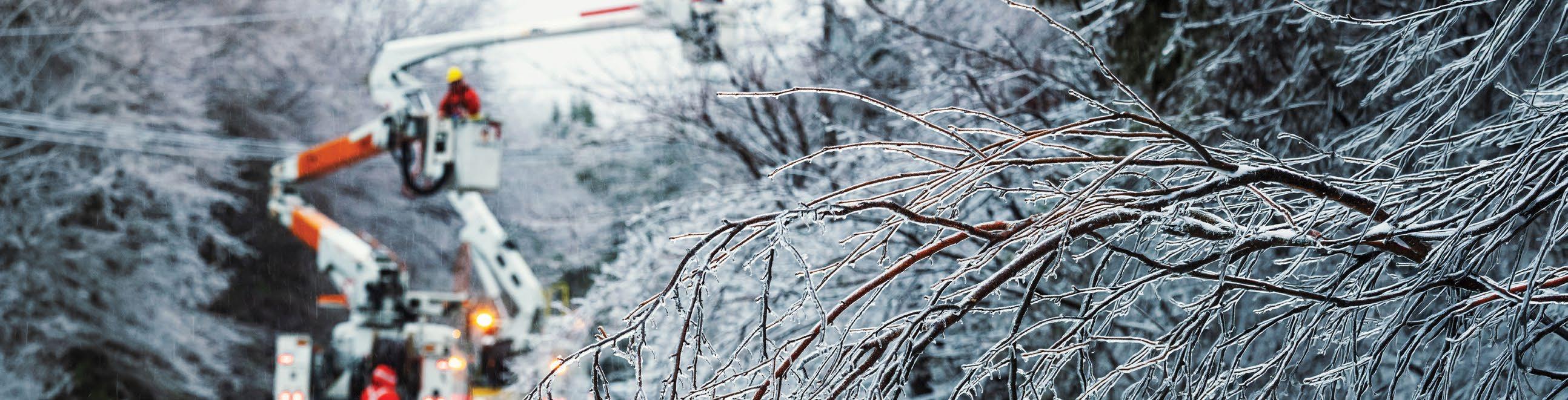
Along Colorado’s Front Range, March can be the snowiest month of the year. This moisture-packed snow can weigh down trees and power lines, increasing the risk of outages and electrical safety hazards.
• If you see a downed line, stay back and report it.
• Use generators safely and never indoors.

IT'S TIME
TO Speak Up

• Even after storms end, melting snow can shift debris or freeze overnight creating new risks.
Find more electrical safety and winter storm preparedness information online at www.pvrea.coop

Our electric cooperative is something special, and it’s worth protecting.
As a proudly member-owned, locally governed cooperative, we deliver the lowest rates in Colorado, top-tier reliability, and nationally recognized communications and service.
Our difference shines through as we’re owned by and accountable to you, our members, and not outside shareholders.
This legislative session, unnecessary and burdensome legislation may undermine our cooperative business model that has proven to deliver affordability, reliability, and exceptional service to our member-owners.
USE COOPERATIVE VOICES TO CONTACT COLORADO STATE LEGISLATORS.
Tell legislators not to judge our cooperative by the actions of others.
Too often, legislation is shaped by a one-size-fitsall approach that lumps all utilities together.
Don’t change what’s working — our cooperative is for the members, by the members, and it deserves thoughtful cooperative-aware policymaking.
LET OUR VOICE BE HEARD!
Email state legislators to advocate for your co-op.
Scan the code or go to www.pvrea.coop/cooperative-voices
SOMEONE YOU KNOW COULD HAVE UNCLAIMED MONEY — LIST

WALSENBURG
APRIL 18 is LINEWORKER APPRECIATION DAY
PUEBLO WEST TRINIDAD
Lineworkers Are Ready When It Matters Most
By Ryan Elarton General Manager
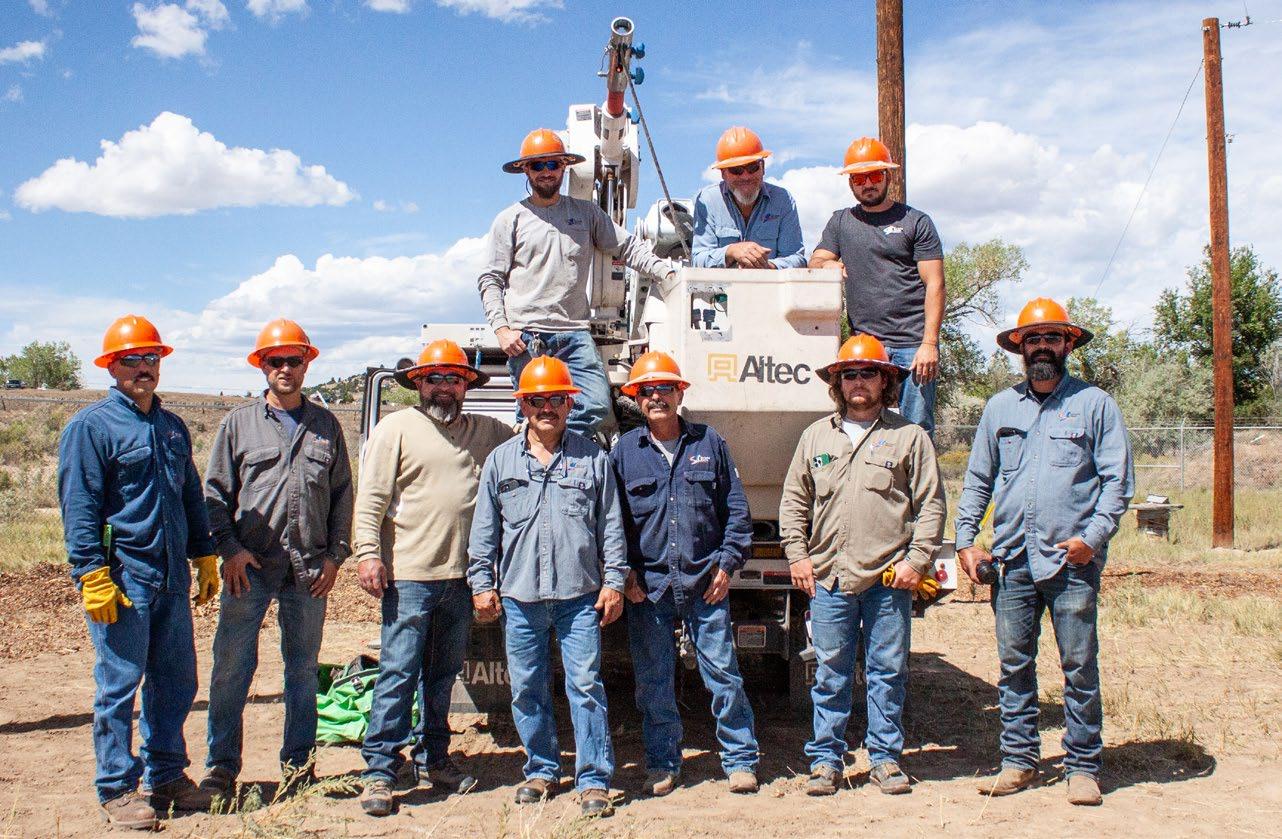
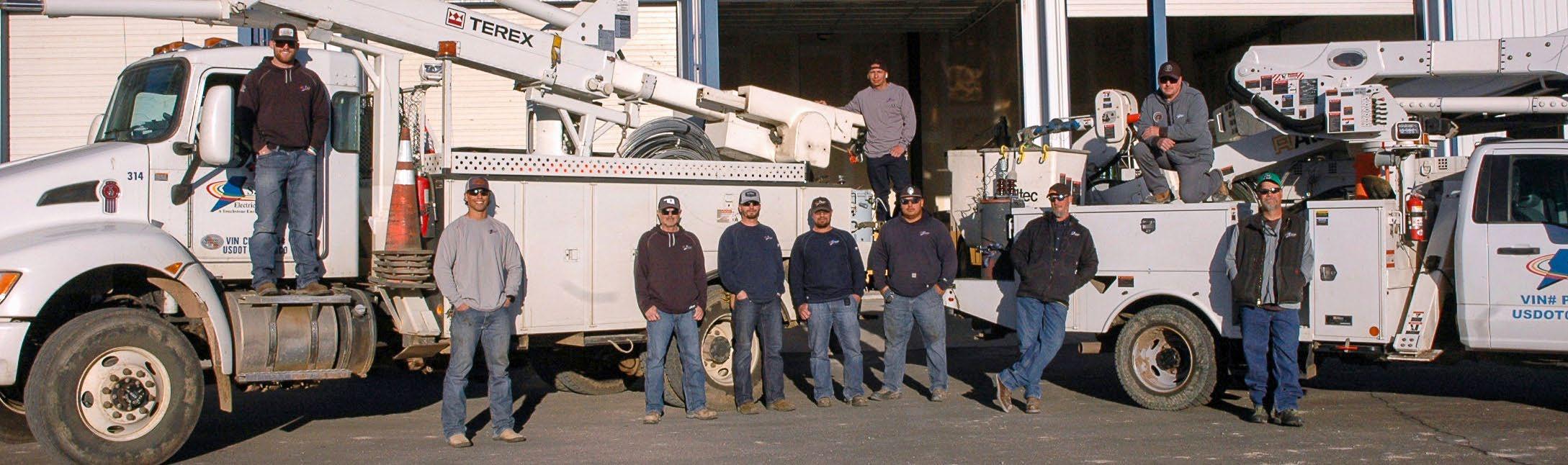
As General Manager of San Isabel Electric Association, I have the unique privilege of seeing first hand what it takes to keep the lights on and knowing all of the people involved in serving our members. In April, we take time to pause and recognize the brave folks who make keeping your power on possible every single day — our lineworkers.
When severe weather strikes and outages sweep across our service area, our line workers often work through the night — sometimes 16 hours straight — battling difficult conditions to restore power as safely and efficiently as possible. In those moments, they may only see their loved ones for a few minutes between grabbing a quick meal and getting a few hours of rest, often missing family dinners, celebrations, or milestones at home. Their readiness to respond at any hour is no accident; it’s the result of rigorous training, deep experience, and a shared dedication to serving their communities when they’re needed most.
What makes lineworkers especially remarkable is that they aren’t just restoring power to a system, they are restoring power to their own communities. They live here. They raise their families here. They under stand that electricity is more than a convenience; it’s essential to daily life, to local businesses, to schools, farms, and emergency services. Powering the places we call home is personal to lineworkers.
SAN ISABEL ELECTRIC ASSOCIATION
Phone: 800-279-SIEA (7432)
Email: contactus@siea.com
Website: siea.com
Facebook: /SanIsabelElectric
X: @sieacoop
LinkedIn: @SanIsabelElectricAssociation
YouTube: sanisabelelectricassociation

MAILING ADDRESSES
Headquarters 781 E. Industrial Blvd.
Pueblo West, CO 81007
Walsenburg Office
122 W. 6th Street
Walsenburg, CO 81089
Trinidad Office
1930 E. Main Street
Trinidad, CO 81082
Hiring and developing local talent is a priority at SIEA. We’re committed to showing our youngest members that meaningful, lifelong careers are avail able right here close to home. Through programs like Story Behind the Switch, we introduce elementary students to how electricity works and the people who make it possible. Our traveling workforce development program brings hands‑on demonstrations to high schools across our service area, giving students a real world look at util ity careers and the vital role they can play in powering their communities.
We understand any time the lights go out can be frustrating, bringing everyday life to a halt. We are incredibly grateful to our members for your patience and encouragement during these times. Linework is demanding, physical, and at times, the conditions can be unforgiving. Our crews approach each job with a focus on safety and teamwork. They take pride in their craft and in the trust our members place in them.
On April 18, we will celebrate Lineworker Appre ciation Day, but one day is hardly enough. Every day, we thank lineworkers for their service and dedication, along with the employees behind the scenes support ing the work in the field.
To our lineworkers: Thank you for your readiness, your perseverance, and your unwavering commitment to the communities we serve. We are proud to stand behind you, and grateful for all that you do.
BOARD OF DIRECTORS
District 1: Debbie Rose, Board Vice President • 719-485-3535 Beulah, Wetmore & Vicinity
District 2: Dennis Maroney 719-489-3853 • Rye, Colorado City & Vicinity
District 3: Edward Garcia 719-250-1505 • Gardner, Trinidad East & Vicinity
District 5: Jacque Sikes, Board President • 719-568-3315
City of Walsenburg, Southwest and Northeast Vicinities
District 6: Don Keairns 719-742-5278 • 719-989-1201
Town of La Veta, Cuchara and Vicinity
District 7: Gregory Costa, Board Treasurer 719-868-2281 • Aguilar, Trinidad West and Vicinity
District 8: Doris Morgan, Board Secretary 719-250-1525 • Pueblo West and Vicinity
It Pays to Stay in Touch
The projects listed below are funded with unclaimed capital cred its. Unclaimed capital credits are typically not claimed due to incorrect contact information. Because capital credit payments continue to be made many years after credits are earned, you should ensure that San Isabel Electric always has your current mailing address. A quick email or phone call is all it takes to ensure you receive every dollar you are owed.
If you have moved or changed your contact information and had electric service from SIEA, please reach out to us so we can make sure our records are up to date. Contact us online at siea.com/capitalcredits, by email at contactus@siea.com, or call us at 800 279 7432.

We May Owe You Money
In the following pages, you’ll find a list of people who have unclaimed capital credits from San Isabel Electric. The names are of members who were sent capital credit checks for $10 or more that were never cashed.
There are several ways to search for your name and see if we owe you money. You can look for your name in the printed list, or you can search our online database at siea.com/capitalcredits. If you find a match, you can file a claim online, email capitalcredits@siea. com, or call 800‑279‑SIEA (7432) for help.
A full list of unclaimed capital credits will be posted online by June 1.
A quick reminder about capital credits:
As a cooperative, we return extra revenue to the people who buy electricity from us, our member owners. We do not have outside investors. When our finances allow, we mail checks to members based on how much electricity they purchased during specific years. Typically, checks are mailed in September.
In 2025, more than 20,500 checks were mailed to members who purchased electricity from 1992 1994, 2013, and 2024 — nearly $1.75 million returned.
WHAT HAPPENS TO UNCLAIMED CAPITAL CREDIT IF IT’S NEVER CLAIMED?
After three years, unclaimed funds are used to support scholarships and community programs like hospitals, fire stations, school sports, county fairs, and other local services.
If you move, or change your email address, please make sure to share your updated contact information with us. If a member has passed away, their estate may still be able to claim capital credits — please contact us to check the status.
HOW CAPITAL CREDITS WORK
Because electric co-ops operate at cost, any excess revenues, called margins, are returned to members in the form of capital credits.
STEP 1:
Your co-op tracks how much electricity you buy and how much money you pay for it throughout the year.
STEP 2: At the end of the year, your co-op completes financial matters and determines whether there are excess revenues, called margins. STEP 3:
Your co-op allocates the margins to members as capital credits based upon their use of electricity during the year.
STEP 5:
Your co-op notifies you of how and when you’ll receive your capital credits retirement.
STEP 4: When the co-op’s financial condition permits, your board of directors/trustees decides to retire, or pay, the capital credits.
UNCLAIMED CAPITAL CREDITS
WICKS, RUSSELL M & EVELYN
WIDICK, SCOTT A & COLETTE M
WIGGINS, JOHN
WIGGINS, MARIO G
WIGGINS, MICHELE L
WIGHAM, CHAD J
WIGHT, ALBERT A
WIGTON, JAMES
WIKBERG, SHAWN M
WILCOX, VICTORIA
WILCOXSON, MARTHA
WILEY, BEN W
WILKERSON, ALVIN D & STEPHANIE J
WILKINS, LAUREN J
WILL, LESTER E & RACHEL M
WILLBANKS, FRANK R
WILLBURN, HAROLD E
WILLER, STEVE B
WILLIAM, R MEUTH TRUSTEE
WILLIAMS, A L & VERA
WILLIAMS, BETTY
WILLIAMS, CAITLIN M
WILLIAMS, CASEY L
WILLIAMS, CHARLES D
WILLIAMS, CHERYL A
WILLIAMS, DANIEL A
WILLIAMS, DAVID
WILLIAMS, DEADRA S & TRAVIS F
WILLIAMS, ED E & SHERRY
WILLIAMS, FRANCIS L
WILLIAMS, GLENDA L
WILLIAMS, GLENN H & MAYME
WILLIAMS, HELEN
WILLIAMS, J C
WILLIAMS, JAMES H
WILLIAMS, JERRY N
WILLIAMS, JOSEPH R
WILLIAMS, JOSH S & EMMA M
WILLIAMS, JULIE L
WILLIAMS, JUSTIN
WILLIAMS, LOIS I
WILLIAMS, MARK A
WILLIAMS, MORRIS S
WILLIAMS, PATRICIA A & RICHARD J
WILLIAMS, PAUL
WILLIAMS, RICKY
WILLIAMS, ROBERT F
WILLIAMS, SID
WILLIAMS, THOMAS
WILLIAMS, TRISTAN W & KOY W
WILLIAMS, WAYNE
WILLIAMS, WAYNE L
WILLIAMS, WENDELYNN A
WILLIAMSON, BARBARA
WILLIAMSON, BARBARA E / BONNIE L WEBB
WILLIAMSON, LYNETTE & KELLEY R
WILLIAMSON, M J
WILLIAMSON, MARY J
WILLIAMSON, R J & BEVERLY A
WILLIAMSON, RYAN
WILSON, ALI
WILSON, ALWYN
WILSON, CARROLL L
WILSON, DAVID R
WILSON, DWAYNE A / LA DONNA
WILSON, EDWARD L
WILSON, EDWARD T
WILSON, GARY L
WILSON, GEORGE / PAUL BRAY
WILSON, GERALD G
WILSON, GINA L
WILSON, JEFF C
WILSON, JERRY J
WILSON, JOHN M
WILSON, KAREN E
WILSON, LEA E
WILSON, MARILYN L
WILSON, WALTER B
WILSON, WILLIAM E
WILT, ALLEN C & CHRISTINE L
WILTON, THOMAS F
WIMBER, ERIC
WIMP, DONNA M
WINDES, COREY L
WINDOLPH, TONYA A
WING, MICHAEL L
WINNIE, CONNIE
WINSHIP, ROBERT WIII & SHER
WINSHIP, SETH C
WINTERS, BRENDA L &
MICHAEL
WINTERS, RYAN W
WINTERS, STANLEY
WINTERS, TIMOTHY & JULIE
WIPF, LEROY
WIRTZ, BETTY
WISE, COURTNEY M
WISE, SUSAN
WISE, TAMMY
WISECARVER, WILLIAM D
WISEMAN, KANDY J / TORI L
WALTERS
WISWALL, LARRY
WITHERSPOON, JERRY
WITHEY, VIRGINIA
WITTE, GARYLYNN T
WITTIE, STEVEN D
WIX, ERNEST S
WOERDEHOFF, ROBERT J & SANDRA
WOFFORD, SHERMAN & SUZANNE
WOJDYLA, WANDA J
WOJTALA, RANDY J
WOJTYLKA, MARY A
WOLAK, ARON S
WOLAK, DAINA
WOLAK, SUSAN
WOLF, DONNA K
WOLF SPRINGS RANCHES INC
WOLFE, DON W
WOLFE EXTRACTS LLC
WOLFE, JODI
WOLFF, LAWRENCE C
WOLFSWINKEL, RANDY
WOLGRAM, AGNES
WOLSKE, SUZAN L & TYLER G
WOLSKI, RYSZARDA
WOLTER, MICHAEL A / STEFANIE M BARRON
WOLTHER, LESLEY A
WOLVERTON, RICHARD
WONDER, BAR
WONER, BRUCE J
WOOD, ARTHUR
WOOD, CECILIA
WOOD, DAVID A
WOOD, EDWIN A
WOOD, JOYCE
WOOD, RICHARD A
WOODEN, NICK
WOODLING, HOWELL
WOODRING, SHANNON N & DRAKE
WOODS, BOBBY J
WOODS, DAVID R
WOODS, DEVON A
WOODS, JANET S
WOODS, JOYCE M & WILLIAM
WOODS, NANCY G
WOODS, ROBERT E & LORRAINE
WOODS, WILLIAM L
WOODWARD, MICHAEL
WOODWORTH, JAMES L
WOOLFE, HELEN L
WOOTTON, PHILIP HJR
WORGAN, MARK & CYNDI
WORKMAN, ANGELA
WORM, THANE A
WORM, TOM
WORMINGTON, GINA
WOZNIAK, T V / STEVE BLASI
WOZNIAK, WM W
WREN, CARLOS J & LUCY A
WRIGHT, ALBERT L
WRIGHT, DANIEL D
WRIGHT, EDWARD N & JUNE
WRIGHT, HANNAH L
WRIGHT, HELEN E & JEFFREY R
WRIGHT, JAMES W
WRIGHT, JUDITH K
FOUND YOUR NAME?
WRIGHT, KENNETH
WRIGHT, LYNNE E
WRIGHT, SHARI W
WRIGHT, SHARI W & BRAD T
WYATT, BURL D
WYBERG, HARRY M
WYCKOFF, CHRISTINA J
WYCKOFF, RANDY E
WYCKOFF, RAYMOND
WYCKOFF, RICKY & SUZANNE
WYNN, CHARLES TIII
WYOMING FUEL COMPANY
XIONG, KRISTEEN
YAKLICH, FRANK JR
YAKOVICH, L J
YANDALL, TERRIE L & CHARLES F
YARBERRY, WILLIAM E & PENNY
YARBROUGH, J R
YARBROUGH, JACK D & BETH
YARBROUGH, JANIS C YATES, RODNEY W
YATES, WALTER R
YBARRA, CARL A
YEISER, DANIELA P & BRIAR S YELLICO, JEAN L YELLICO, SANDRA L & ROBERT L YELVINGTON, SAMUEL & GERALD
YEPEZ, KITANA M / JOSEPH L
CHEDSEY
YING, YANG / JERRY
YODER, ERIKC M & DAWN YODER, JEREMY YODER, ROBERT YONUSHEWSKI, DOMINIQUE M & CHESTER
YOON, JOHN & EVA YOUNG, CARL H YOUNG, CAROL J YOUNG, COURTNEY YOUNG, ELLEN YOUNG, JAMES L YOUNG, KATHY YOUNG, MARY M YOUNG, MEGAN K YOUNG, ROBERT YOUNG, RONALD R YOUNG, VERLEYN M YOUNG, WILLIAM W YOUNGKRANTZ, HOWARD R & GRET YOUNGREN, D YVONNE YOUNGREN, JAY YOUNGREN, YVONNE YOURICK, MINA C YUNG, ELMER W
If you found your name in this list, you can file a claim by calling 800-279-SIEA (7432), emailing capitalcredits@siea.com, or by visiting siea.com/capitalcredits. See page 9 of this magazine for more information.
YVONNE L POTTS TRUST
ZABINSKI, MICHAEL T & NANCY J
ZABUKOVIC, RYAN
ZACHARIAS, CARL K
ZACHARIEV, EVSTATI
ZADOW, JEFF W
ZAGAR, ED A & MELVA
ZALESNY, FRANK
ZAMECKI, SARAH E
ZANCANELLI, CHARLES & ALYCE
ZANCANELLI, HELEN ZANCHETTI, JOHN ZANETELL, J A
ZAPATA, MANINA
ZAPPANTI, LARRY SR ZAR, JAMES E
ZAVESKY, STEVEN P ZAVISLAN, DON & ELAINE ZAVISLAN, MIKE F ZAYO GROUP LLC ZELAZNY, KEITH J ZELEZNIKAR, MELONIE M
ZELIC, SAMUEL I
ZELIDON, KELLY M
ZERBA, BEVERLY L
ZERR, DARREN J & LEAH
ZGAYNOR, RAMONA L ZIGLAR, TATE B
ZIMMER, BRENTON ZIMMERMAN, ADRIAN J ZIMMERMAN, JOHNALIN K ZINANTI, LOUIS
ZITTERKOB, JUNE H
ZNIDARSICH, KAY
ZOHAR, LESLIE
ZOOI VIDEO RTO ZOOROB, RICHARD B ZORICH, THEODORE MJR ZOSS, JIMMY II
ZOUTTE, ARNOLD A ZUBAL, JOHN A
ZUBAL, TOM JR & DORIS ZUBER, MASTON ZUFLACHT, LINDA ZUNDEL, CHRISTINE B ZUPANCIC, MARILYN K ZYWICKI, ALEXANDER
Always On — Your Power Beyond the Light Switch
By Jon Beyer CEO
As a member-owned cooperative, we have a responsibility to provide you with safe, reliable power in the most cost-effective way possible.
Most members are familiar with the energy-per-kilowatt-hour charge on their electricity bill. This charge reflects the energy you use over time. For example, if you run your 1,000-watt dishwasher for 1 hour, you will use 1 kWh and be charged the current rate for that use. This charge is straightforward — you pay for the energy you use.

The Service Availability Charge recovers the critical costs of maintaining our electric system, linemen restoring outages, the fixed costs of our buildings, vehicle maintenance, property taxes, finance costs, supplies and equipment, software, and staffing to operate the company. These costs are fixed, in that they are necessary to make service available on our system as a whole — whether a consumer uses their electricity one month a year or 12 months a year.
The demand charge from our wholesale power provider reflects the cost for the electrical grid to deliver power to all of our members 24 hours a day, 7 days a week, 365 days a year. The foundation of the demand charge is the highest 30-minute need for power during the month from 1 p.m. to 9 p.m., Monday through Saturday. These costs are currently included in our energy charge. In 2026, the demand charge could rise to 60% of our wholesale bill.
At the March Board of Directors meeting, SDCEA staff proposed a shift in electricity pricing to better manage demand cost during peak hours. The recommendation is to transition from the current two-part rate structure (Energy Charge and Service Availability Charge) to a three-part rate structure, which includes an Energy Charge, Service Availability Charge, and a Peak Demand Charge.
We understand that changes in rate structure can feel overwhelming. We are approaching rising demand costs with a solution that will allow our members to have more control over their future electric bills by
shifting how and when they use energy during these hours. Under the proposed plan, the residential rate Energy Charge, which is assessed on the total electricity used during the month, will decrease from $0.14370 per kWh to $0.13026 per kWh, and, a new $2.50 per kW Demand Charge will be added. This charge is based on each member’s highest one-hour energy need (kW) during peak hours — 5 p.m. to 9 p.m., Monday through Saturday — within the monthly billing cycle. Sundays are excluded from this calculation. These details may change, pending board consideration.
This adjustment aims to reflect the cost of energy more accurately during peak demand times. This change will impact members differently depending on how they use energy.
Aside from promoting fairer cost recovery among members, a three-part rate structure also gives members more control over their monthly bills. Currently, the only option to save on your bill is to use less energy. With the new proposed rate structure, members will be able to shift, stagger, and save to give you more influence over your bills. That means when you choose to use energy outside of SDCEA’s peak hours or stagger the use of appliances within peak hours, it will decrease your demand and demand costs. SDCEA also provides options for members to use less energy during peak times through programs and rebates, including pilot programs (water heater, EV charging, battery), efficiency rebates, and assistance options.
Starting with your April 1 bill (received in May), you will see your specific peak demand reading. While the proposed rate structure would not take effect until July 1, this information is provided to help you understand how your bill may change. You may use this information to plug into our online calculator to see what effect it may have on your bill. If you prefer, you are welcome to contact our office for help with this information.
If you have questions about our proposed new rate structure, any item on your bill, or any other questions related to the co-op, we will be hosting a virtual town hall at 2 p.m. on April 14. Details on how to access the virtual meeting are on our website. Or, you are welcome to join us April 15 for an in-person town hall in Buena Vista, 5:30-7 p.m. in the community room at
our business office located at 29780 US Hwy 24. You can also call our office or reach out to us by email at info@myelectric.coop with any questions you may have. SDCEA members are encouraged to attend and bring questions about any component of our service.

Got questions about your electric bill? Or anything else about SDCEA?
We’re here to help!
Meet with us!
April 14, 2 p.m.
Virtual Town Hall – Join us online to ask anything about your bill or your co-op. Visit myelectric.coop for access details.
April 15, 5:30-7 p.m.
In-Person Member Information Session – SDCEA Community Room, 29780 US 24.

The SDCEA Annual Meeting is scheduled for June 24 in Westcliffe. No members petitioned to run against the current incumbents during the 2026 election cycle. During the meeting, board incumbents Mark Boyle, Blake Bennetts, and Michael Robinson will be seated to serve new threeyear terms. We hope to see you at the meeting!
New Mailing Address for Mailed Bill Payments Only
Beginning April 1, all mailed monthly bill payments to SDCEA will be sent to a new mailing address in California. No action is required on your part — the new address will be preprinted on your payment stub for your convenience. This change is part of a cost-saving initiative designed to reduce staff time spent on manually processing payments, ultimately saving costs and benefiting our members.
Rest assured, even though the address is in California, your payments will continue to be processed through our local bank, which implemented this new payment system and will oversee its operation.
OTHER PAYMENT OPTIONS
• Online and automatic payment options will continue without change.
• You may continue to drop off payments in the drop box located in front of our Buena Vista business office.
• Feel free to visit our office to make payments in person if you prefer.
Important Reminder:
Never mail cash. If you mail a payment, only send a check or money order.
Also note: If you have an automatic check printer or third-party printer that prints a mailing address on a check that you mail to pay your bill, you will need to update to this address:
Sangre de Cristo Electric Assoc Inc PO Box 60505
City of Industry, CA 91716-0505
We do not anticipate any delays in payment processing due to this change. Thank you for your understanding as we work to improve efficiency and reduce costs for our members. If you have any questions, please contact our office.
Heating & Cooling Solutions Webinar
Looking for efficient heating and cooling solutions for your home or business? Check out this FREE on-demand webinar to learn all about heat pumps — your year-round comfort solution!
https://www.youtube.com/ watch?v=iGhMOp4Iqvg
Discover how heat pumps can keep you cozy in winter and cool in summer, all while saving energy.
NOTICE
ONLINE BILL PAYMENT SYSTEM
MAINTENANCE
SDCEA’s online bill payment system will not be available April 17-18 during scheduled maintenance. Online payment capabilities will resume on April 19.
Thank you for your understanding!
Top 10 Reasons We Appreciate Lineworkers
Electric utility work is essential to our daily and modern lives. From powering our homes and schools to supporting our economy, electricity is a constant until it’s not.
That’s when the true heroes step in. Line crews work directly with high-voltage power, often in severe weather and dangerous conditions, to maintain or restore service and safeguard communities from downed lines. Their vital role deserves more than a day of recognition — it deserves our ongoing gratitude.
Here are 10 of the many reasons we appreciate lineworkers:
1. They are expertly trained to work on power lines and equipment.
2. They are dedicated to safely and efficiently maintaining power.
3. They have a heart for service, always looking out for their communities.
4. They conquer heights without hesitation.
5. They prioritize safety every second of every day.
When the lights go out, lineworkers are ready to answer the call, day or night, to safely restore power and keep our communities moving forward. Today and every day, we thank lineworkers for their commitment.
Lineworker Appreciation Day April 18, 2026
6. They answer the call — day or night — to restore power.
7. They endure it all: rain, shine, and extreme weather conditions.
8. They go when they are needed, supporting communities nationwide when severe weather strikes.
9. They have each other’s back and work together like family.
10. They power our lives and energize our communities.
SDCEA lineworkers are protectors of safety and keepers of comfort for our communities and beyond. Every day, they bring a spirit of service, unwavering focus, and specialized knowledge to a job that demands both skill and heart. Their commitment to safety is not just a requirement, it’s a way of life.
So, to all the lineworkers out there, thank you for running toward electrical challenges when others step back. Thank you for your continuous training, hard work, and dedication to keep us all safe. Thank you, lineworkers, for all you do to keep the lights on.
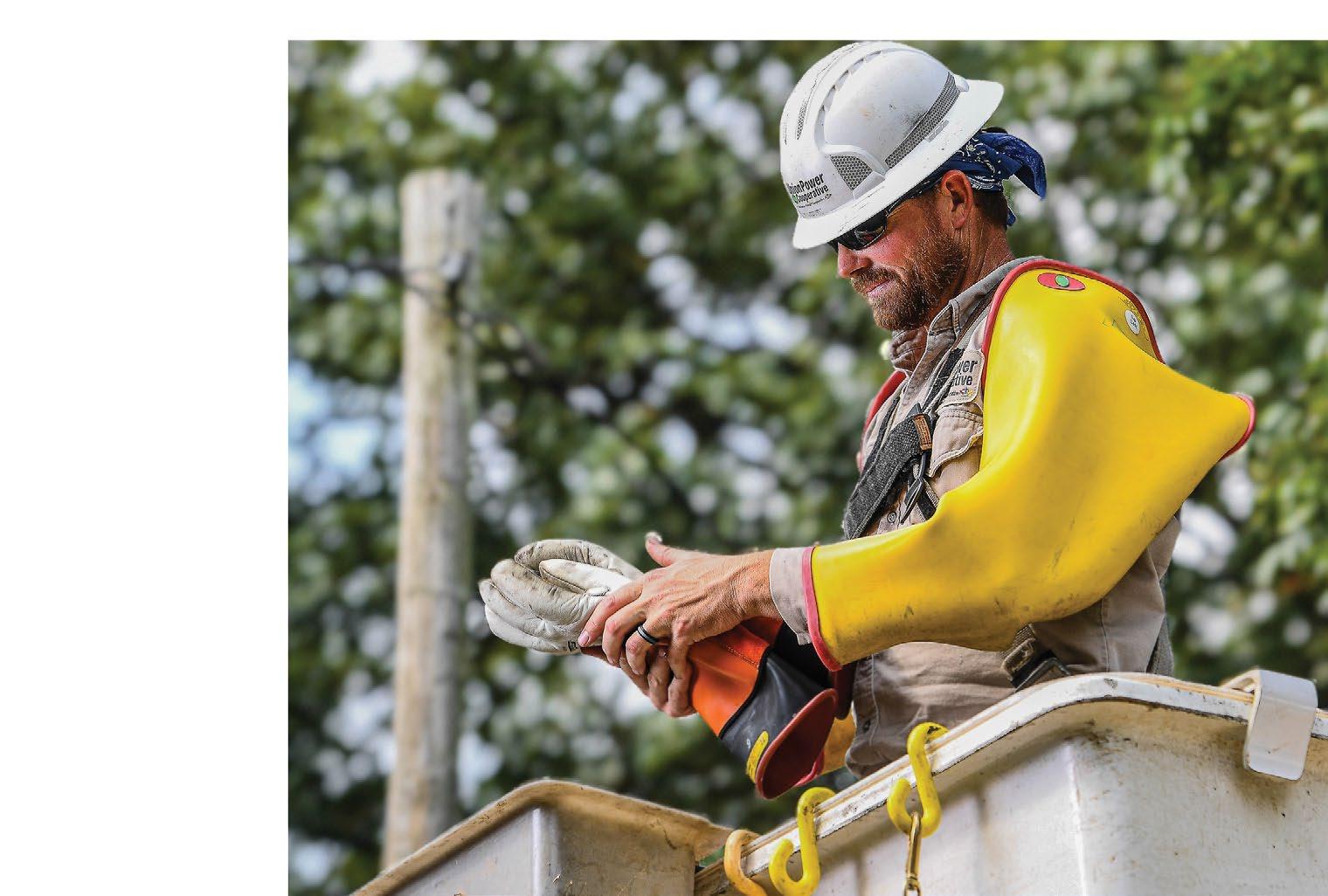
Lineworkers: Ready When it Matters Most
By Mark Hall CEO
As both a CEO and a journeyman lineman at Southeast Colorado Power Association (SECPA), I have the unique privilege of seeing firsthand what it truly takes to keep the lights on for our members. I’ve stood at the top of a pole in the middle of the night with the wind cutting through heavy gloves, and I’ve also sat at the board table making decisions that support the men who do that work every day. Few roles offer that full-circle perspective, and it’s one I carry with deep respect and gratitude.
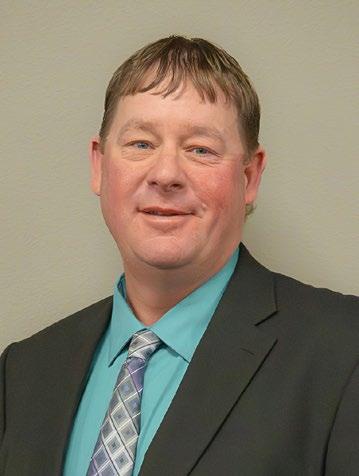
In April, we pause to recognize the brave men who make reliable power possible every single day — our linemen.
When storms roll across our service territory and outages occur, most people understandably experience the inconvenience. Our linemen, however, see a call to action. I’ve seen firsthand how quickly a quiet evening can turn into mobilizing crews, loading trucks, and heading into challenging conditions. Family dinners are left unfinished. Sleep is put on hold. Plans are postponed. Our crews are always ready when it matters most, working through the night and in all kinds of weather to restore power safely and as quickly as possible.
That readiness doesn’t happen by accident. It comes from rigorous training, years of hands-on experience, and an unshakable commitment to serving others. As a journeyman lineman, I know the discipline this trade demands. As CEO, I know the level of trust our members place in us. Both roles remind me daily that safety, preparation, and teamwork are non-negotiable.
What makes our linemen especially remarkable is that they aren’t just restoring power to a system — they are restoring power to their own communities. They live here. They raise their families here. They attend the same churches, shop at the same stores, and cheer in the same school gyms. They understand that electricity is more than a convenience. It powers our farms and ranches, keeps local businesses operating, supports our schools, and ensures emergency services can respond when needed. Keeping the lights on here is personal.
Electric cooperatives like SECPA were built on the principle of neighbors helping neighbors, and our linemen embody that spirit every day. They are often the first to respond and the last to leave, working long hours behind the scenes with little recognition. At times, serving our neighbors also means stepping beyond our own territory through mutual aid. When major outage events occur, SECPA crews stand ready to assist neighboring cooperatives sometimes just down the road, and sometimes across state lines. I’ve seen the pride our crews take in representing SECPA wherever they go. That spirit of mutual aid strengthens every cooperative involved and ultimately benefits the members we all serve.
We understand that any time the lights go out, it can be frustrating and disruptive. We are sincerely grateful to our members for your patience, understanding, and words of encouragement during those times. Linework is demanding, physical, and at times dangerous. Our crews approach each job with a sharp focus on safety and a reliance on one another. They take pride in their craft and in the trust, you place in them. The dedication and sacrifice of our linemen deserve year-round recognition. They are the backbone of our cooperative and the reason we are able to fulfill our mission to serve.
TO OUR LINEMEN: Thank you for your hard work, your readiness, and your unwavering commitment to the communities we call home. It is an honor to stand beside you in the field and in leadership, and I am profoundly proud of the work you do every single day.
NOTICE: NET METERING TARIFF
The Southeast Colorado Board of Directors has approved a change to the Net Metering Tariff effective May 1, 2026.
Tariff information can be accessed online at secpa.com/netmetering.
Thank you, SECPA Linemen!
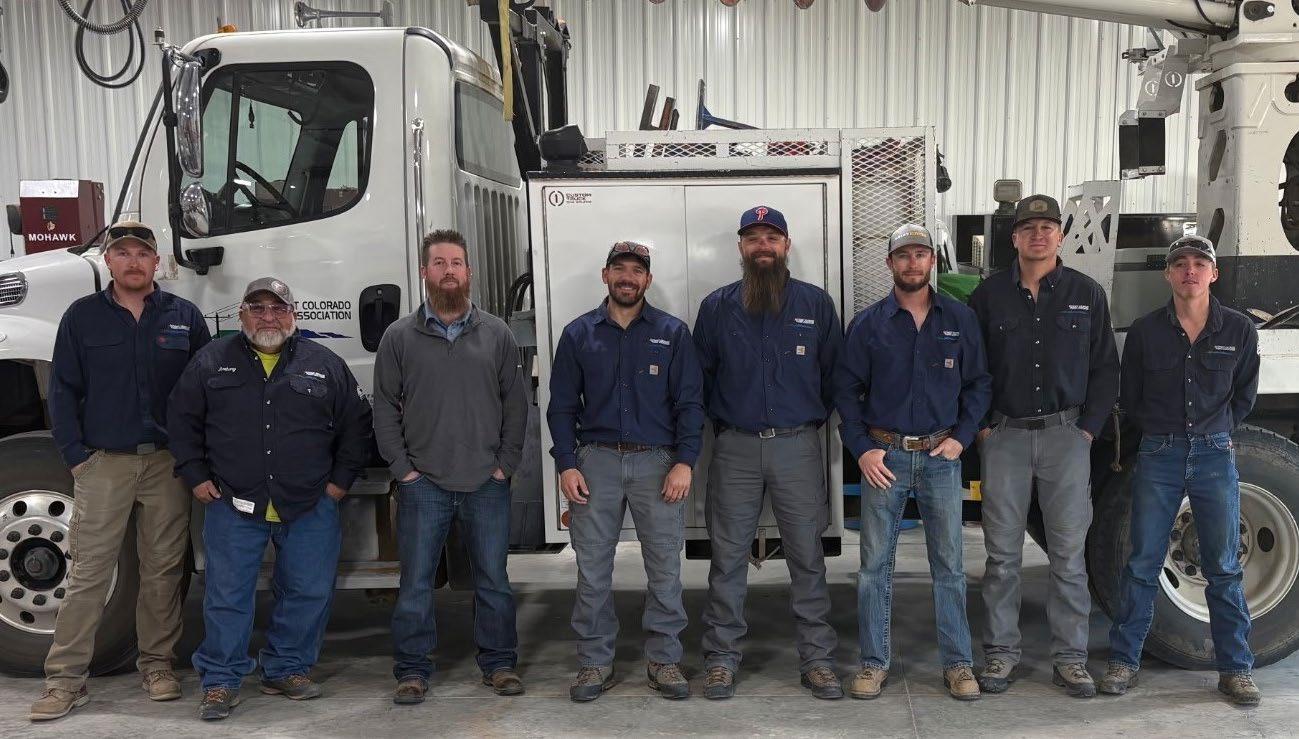
La Junta Crew
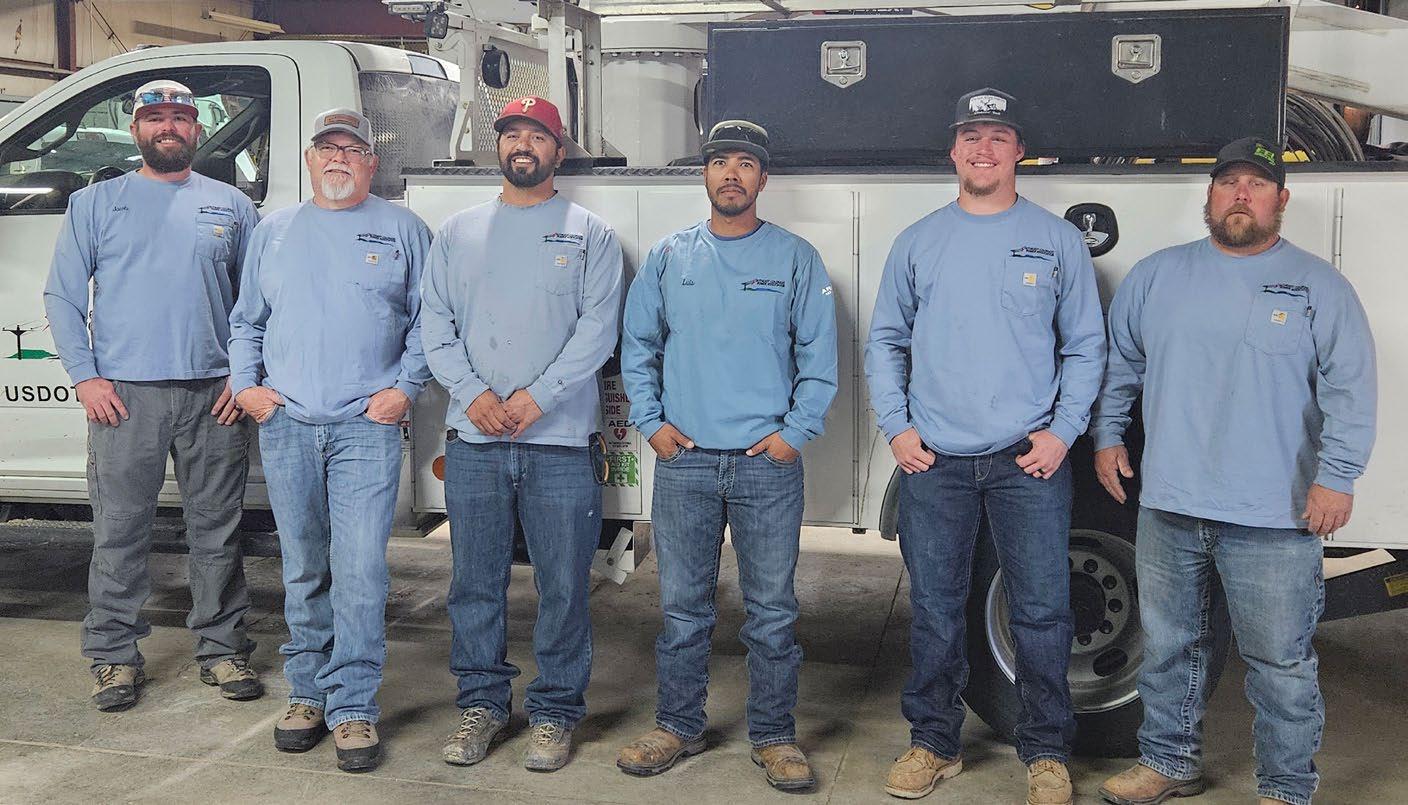
Lamar Crew
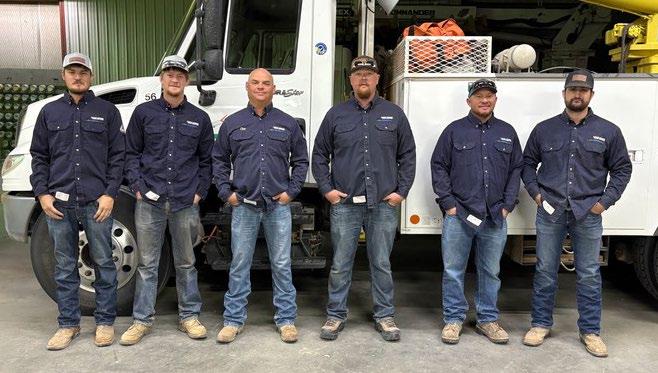
Springfield Crew
Left to right: Jace Noe, Anthony Lobato, Casey Briscoe, Patrick Wycoff, Josh Stoker, Tyler Schwartz, Trevor Johnston, and Jachai Eddy.
Left to right: Jacob Barnes, Troy Eberhardt, Angel Pecina, Luis Rodriquez, Colby Batterton, and Garrett Wertz. Not pictured – Mike Trumble, Line Superintendent.
Left to right: Quentin Doke, Tyler Pennick, Clint Arbuthnot, Gage Leathers, Jerrod Summers, and Trey Redner.

OFFICIAL NOTICE OF ANNUAL SECPA MEMBERSHIP MEETING
Notice is hereby given that the Annual Meeting of the Members of SOUTHEAST COLORADO POWER ASSOCIATION (SECPA) will be held at The Minnick Building, Baca County Fairgrounds, Springfield CO, 81073, on Thursday, April 23, 2026, beginning at 5 p.m. for the transaction of the following business:
1. Reports of officers, directors and committees.
2. The transaction of all other business that may be properly brought before an Annual Meeting.
When the lights go out, lineworkers are ready to answer the call, day or night, to safely restore power and keep our communities moving forward. Today and every day, we thank lineworkers for their commitment.
Lineworker Appreciation Day April 18, 2026
ReadyWhen i t Matters Most
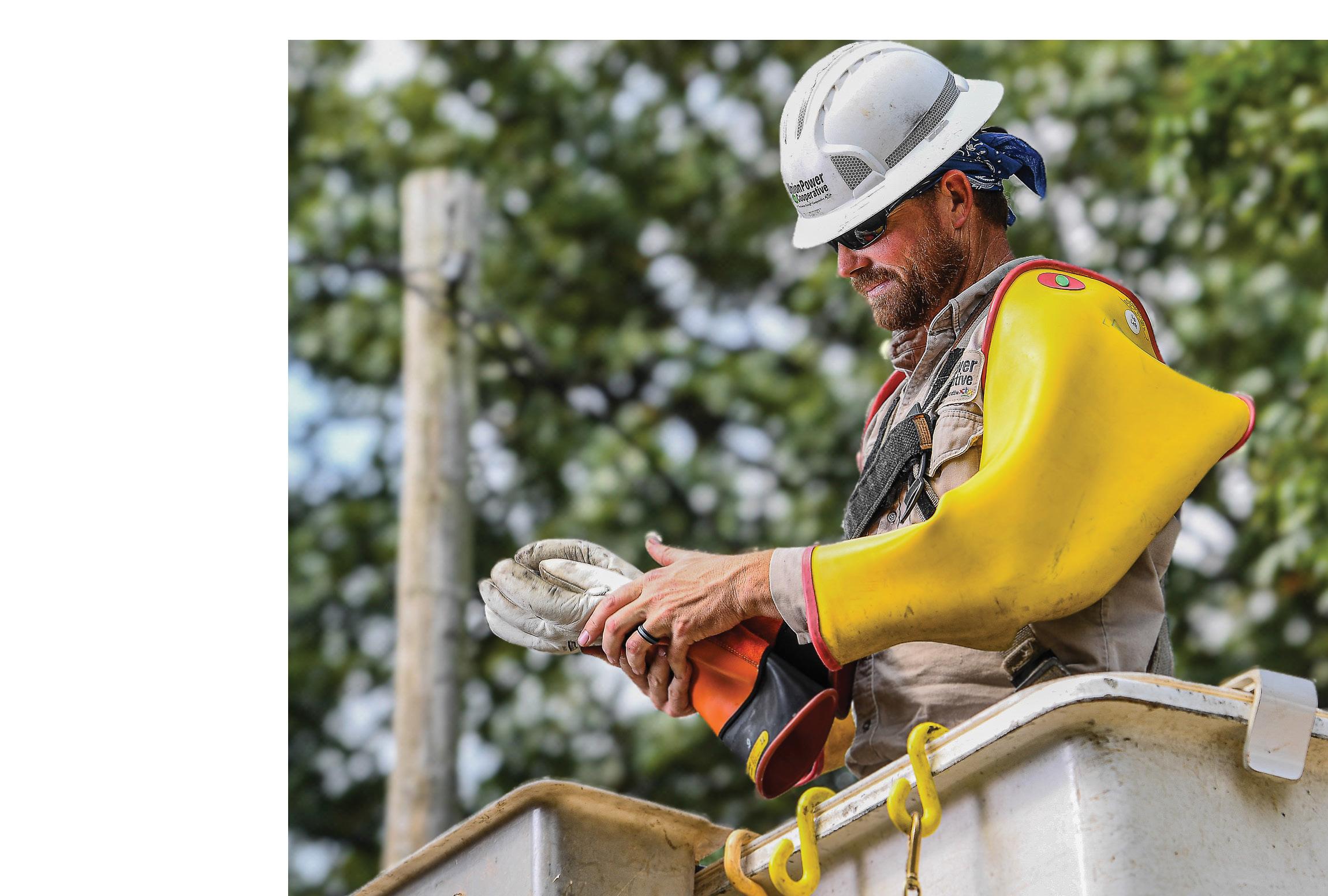
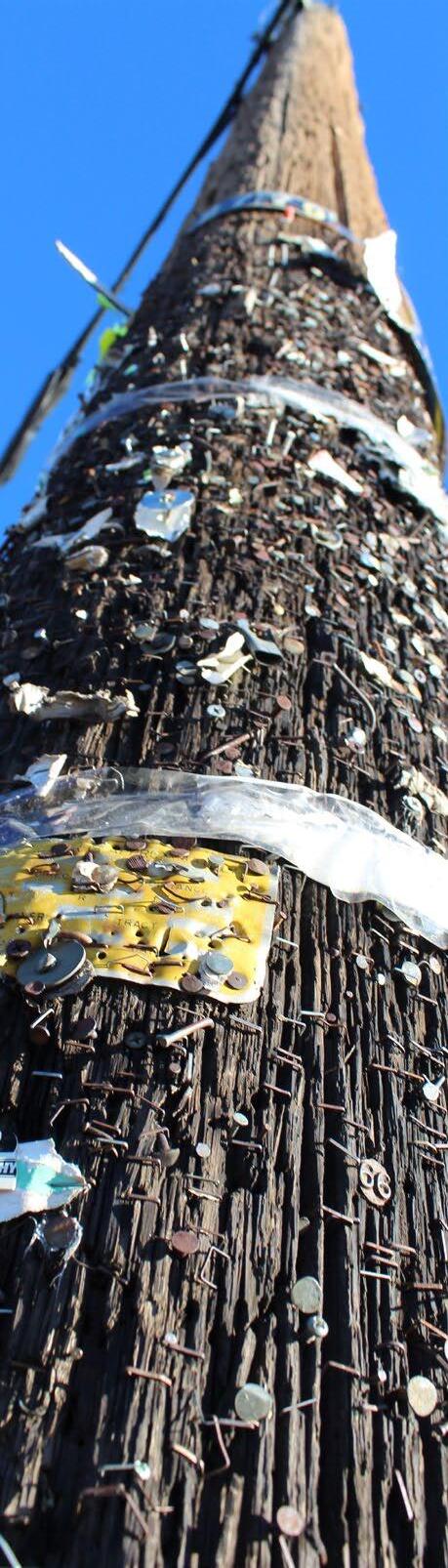

Do Not Post on Power Poles
It’s important to keep utility poles free from all personal materials such as balloons, fliers, and metal objects like staples or tacks.
By respecting utility poles, you can help keep your community powered, and your local utility workers safe.
Nails, tacks, and other metal objects that are used to attach objects to utility poles can interfere with the safe operation of the climbing boots used by utility workers.
Foreign objects that are embedded in utility poles can also snag or damage the protective clothing that keeps line workers safe from electrical shock. Lineworkers already work in extremely hazardous conditions, so everyone who relies on electricity should take steps to make their job as safe as possible.

If you find your name in this issue as follows (WIN* Your Name, your account number), contact Southeast Colorado Power Association at 719-384-2551 or 800-332-8634 to receive a $50 credit on your next power bill.
ENERGY EFFICIENCY TIP OF THE MONTH
As we prepare for the seasonal shift, remember to set your ceiling fan rotation accordingly. In winter months — or whenever your home heating system is running —fan blades should rotate clockwise, which produces an updraft that pushes warm air down. In summer months — or whenever your home cooling system is running — blades should rotate counterclockwise, which produces a downdraft or windchill effect that makes you feel cooler. When used correctly, ceiling fans can boost comfort and allow you to adjust the thermostat a few degrees for energy savings.
Source: energy.gov
Lineworkers are Ready When it Matters Most
By Trent Loutensock General Manager
As General Manager of Y-W Electric Association, Inc., I have the unique privilege of seeing firsthand what it takes to keep the lights on for our members. In April, we take time to pause and recognize the brave men and women who make that possible every single day — our lineworkers.
When storms impact our communities and outages occur, many people experience the inconvenience, but our lineworkers see a call to action. Our crews are always ready when it matters most — leaving family dinners, working through the night, and heading into challenging conditions to restore power as safely and quickly as possible. That readiness is not accidental. It comes from rigorous training, deep experience, and a shared commitment to serving others.
Electric cooperatives like Y-W Electric were built on the principle of neighbors helping neighbors, and our lineworkers embody that spirit every day. They are the first to respond and the last to leave, often working long hours behind the scenes. At times, serving our neighbors means going beyond our own service territory through a process known as mutual aid. During major outage events, Y-W Electric crews stand ready to assist neighboring co-ops — sometimes close to home, and sometimes across state lines — to help restore power. This spirit of mutual aid strengthens all cooperatives and ultimately benefits the members we serve.
Earlier this year, our lineworkers spent a significant amount of time making repairs and restoring power to our communities in the significant wind and high fire danger events that we experienced in our area.
What makes lineworkers especially remarkable is that they aren’t just restoring power to a system, they are restoring power to their own communities. They live here. They raise their families here. They understand that electricity is more than a convenience; it is essential to daily life, to local businesses, to schools, farms, and emergency services. Powering the places we call home is personal to lineworkers.
We understand any time the lights go out can be frustrating, bringing everyday life to a halt. We are incredibly grateful to our members for your patience and encouragement during these times. Linework is demanding, physical, and at times, it can be dangerous. Our crews approach each job with a focus on safety and teamwork. They take pride in their craft and in the trust our members place in them.
On April 18, we will celebrate Lineworker Appreciation Day, but one day is hardly enough. Every day, we thank lineworkers for their service and dedication, which are the backbone of our cooperative.
To our lineworkers: thank you for your hard work, your readiness and your unwavering commitment to the communities we serve. We are proud to stand behind you and grateful for all that you do.
Mailing Address
Box Y
CO 80720
Address
U.S. Hwy 34
CO 80720 PH: 970-345-2291
Grid Reliability During Weather Events
By Andrew Molt Director of Member Services
Last month we talked about the operational options available to protect power lines during high-wind and high-fire-danger conditions. Each choice balances reliability against risk. One reason we opted to use the Enhanced Powerline Safety Settings in these situations is the reality of extended outage restoration times. This month I want to pull back the curtain on what our line technicians face when outages occur during those same weather events, and why EPSS mode requires a different approach to restoring service.
When the system is operating in EPSS mode, an automated protective device only operates one time to trip — or shut off — a circuit. This effectively de-energizes a line to reduce fire risk and we’re required to perform a visual inspection of the de-energized conductors before re-energizing. That’s a good safety practice, but it adds time and complexity to restoration. Visual inspections that would be straightforward in calm conditions become difficult or hazardous when wind, heat, and difficult terrain are involved. As a former line technician, and after talking with several foremen, I want to share key challenges we repeatedly encounter. Robin and Carmen Roth 11401xxxxx
ACCESS
Terrain is not on our side. Many of the circuits most vulnerable during fire-weather are in areas that are hard to reach, including:
• Remote stretches with no access roads at all.
• No direct roads along the line — we often can’t simply drive parallel to the conductor.
• Locked or non-existent access gates that force long detours to get within sight distance.
• Tall, dry vegetation that becomes a fire hazard if we try to drive vehicles close enough to see the line.
• Sandy soils that vehicles can bog down in and that suffer long-term damage from repeated driving, increasing erosion and future maintenance needs.
MANPOWER AND PRIORITIZATION
Our service territory covers primarily two counties, with a mix of rural towns and vast rural stretches. In an extended event:
• Crews prioritize circuits that restore power to the most customers first. That’s essential for public health and safety, but it means remote circuits with few meters may wait longer.
• Some circuits run many miles and serve a small number of meters — inspecting those miles on foot or with off-road equipment takes time, especially if multiple lines are affected at once.
• Availability of trained personnel is finite; during severe weather we may be stretched across multiple simultaneous incidents.
VISIBILITY AND ENVIRONMENTAL OBSTACLES
• Even when we have access to a line, seeing the damage isn’t guaranteed.
• Wind-blown dust, smoke, and debris can severely reduce visibility.
• Inspections after dusk or at night are especially difficult. Portable lighting helps but it may not reveal all damage and can create its own hazards.
WHAT WE DO TO MANAGE THESE CHALLENGES
We use several approaches to reduce risk and speed restoration without compromising safety, including:
• Prioritizing resources. We dispatch crews first to lines that restore service to the most critical loads and customers.
• Using specialized access methods like ATVs. We are exploring drone inspection capabilities.
• Leveraging remote diagnostics. Using our remote monitoring and control system and using sectionalizing devices help to isolate problem segments of the power line, sometimes we can reroute power to lines that we can access for inspections.
• Performing safety-first inspections. If visibility is poor or conditions are unsafe, crews will hold the line de-energized until a safe, reliable inspection can be completed. Debra Latour 27210xxxxx
A PRACTICAL EXAMPLE
Imagine a substation circuit that serves a handful of homes and traverses scrubland with sandy soils and no service road for large stretches. This particular circuit includes nearly 90 miles of overhead power
line. The line trips to operating in EPSS during a windy afternoon during a Red Flag Warning. Crews, including nine line technicians, spent over 6 hours inspecting and restoring power to the line. In two instances, that particular line had not sustained damage requiring extensive repairs, but this new operational procedure requires that all the line be inspected prior to re-energization. As you can see, this effort takes significant time and personnel resources, and one area of required focus can have consequential time implications for other impacted line sections elsewhere in the system. This is where the prioritization of safety and restoration time comes into play, but you can rest assured that we will not gamble member or line technician safety to improve outage restoration times.
CLOSING THOUGHTS
Weather events force difficult trade-offs between restoring power quickly and protecting the community from wildfire risk. EPSS is a tool that reduces ignition risk, but it also creates operational requirements — like visual inspections — that lengthen restoration in certain environments. Our line technicians and foremen are constantly balancing these priorities using experience, equipment, and preplanning to get members back online safely and as quickly as conditions allow. If you have questions about how EPSS might affect service in your area or suggestions about access on your property that could help crews during storms, please reach out to member services — we appreciate partnerships that keep our system and communities safer.
SCAM PREVENTION TIP OF THE MONTH
Don’t fall victim to power outage scams. When widespread outages occur, scammers may target affected utility customers. They can contact you via call, text, or email, urging you to act quickly and provide personal information to restore service. Always communicate with your utility through official channels, such as their website, mobile app, or phone number listed on your bill. Your safety and personal information are worth taking a moment to pause and verify unknown senders.
Source: FTC.gov


Each month, Y-W Electric Association offers its members a chance to earn a $20 credit on their next electric bill. If you find your name and account number in this magazine, call 800-6602291 and ask for your credit. It couldn’t be easier. Get acquainted with your account number, read your Colorado Country Life magazine, and pick up the phone. You must claim your credit during the month in which your name appears in the magazine — check the date on the front cover.
Congratulations to the following members who claimed their $20 bill credit in February: Virgie Tomson, Dallas and Sandra Madsen, Joe Drum, and Jody and Heather Brandner.

FIELD CHEMICAL SAFETY
PLEASE PROTECT OUR EMPLOYEES
Y-W Electric employees face serious health risks when they unknowingly enter a field that was sprayed with any chemical. Just as you would not subject your family or employees to risk, we do not want to subject our employees to risk. Please post warnings and the date of when it is safe to enter the field.
Kevin Todd Shivelyn 12630xxxxx

BILLING CORNER
IRRIGATION BILLING
It is the time of the year when our irrigation consumers are getting ready for the growing season. If you are a Y-W Electric Association member with an irrigation account, please review how the irrigation rate is billed. Valson’s Restaurants Inc 52910xxxxx
Irrigation usage is based upon the calendar year, with a declining rate. The peak kilowatt (demand) is the basis for calculating the kilowatt-hour costs. Each month, a kW reading is recorded and stored for comparison throughout the year. Demand (kW) will reflect usage of all equipment turned on at one time. When multiple pieces of equipment connected to the same meter run at the same time — such as a grain bin and an irrigation well — your annual costs will increase.
If you have any questions about how your irrigation account is billed, please call the Y-W Electric office at 1-800-660-2291 or in the Akron area at 970-345-2291. Have a safe summer.
ENERGY EFFICIENCY TIP OF THE MONTH
As we prepare for the seasonal shift, remember to set your ceiling fan rotation accordingly. In winter months — or whenever your home heating system is running — fan blades should rotate clockwise, which produces an updraft that pushes warm air down. In summer months — or whenever your home cooling system is running — blades should rotate counterclockwise, which produces a downdraft or windchill effect that makes you feel cooler. Lex Daugherty 6201xxxxx When used correctly, ceiling fans can boost comfort and allow you to adjust the thermostat a few degrees for energy savings.
Source: energy.gov