

Full Court Press
By Andy Carter Member Engagement Manager
Even people who are not big college basketball fans know about the NCAA basketball tournament this month. It is the culmination of the season where teams that have worked hard to prepare and that have executed their plans will have a chance to shine on the national stage. For those unfamiliar with basketball strategy, some teams will employ a defensive tactic known as a full court press to apply pressure to the opposing team’s offense over the entirety of the court. There is no place where an offensive player will remain unguarded. To work on keeping rates affordable, Empire Electric Association employs the same strategy on costs.

nance costs on aging thermal dispatchable generators, ownership costs related to new generation coming online to maintain reliability and meet regulatory requirements, and increases in wholesale power costs. Most of you have already seen this increase reflected in the Power Cost Adjustment on your February bill.
As a member-owned electric cooperative that operates at cost, we recognize any money we spend is your money. The EEA board and staff have focused on finding opportunities to increase efficiency in our existing processes as well as looking for new opportunities in technology or with suppliers to keep rates affordable. One example of using innovative technology was our change of business software in 2021. By upgrading to National Information Solutions Cooperative and consolidating all our business systems into their available software, EEA has been able to achieve an annual average savings of more than $30,000.
EEA’s largest annual expense is for power we purchase from Tri-State Generation and Transmission Association. Tri-State announced last fall an increase on average of 7.5% beginning January 1. Tri-State’s rate increase is being driven by increased mainte-

Until recently, there was limited potential for EEA to reduce our purchased power cost. Tri-State heard this concern from its member cooperatives and entered into negotiations last year to add flexibility to our wholesale power purchase agreement. The new provisions in our updated agreement allow EEA to purchase up to 60% of its annual power requirement from suppliers through Tri-State’s Member System Distributed Resource Policy and the Bring Your Own Resource program.
The new limit is a substantial increase over the previous 5% allowance that EEA had already used in our power purchase agreements with the Totten Lake, Montezuma, and Rocky Ford solar generators. We are currently in discussions with several power suppliers that are developing eligible projects in our region. These projects include solar and fossil fuel generation.
Working with our teammate Tri-State on keeping purchased power costs affordable while developing the generation capability in our region and the reliability that it affords is just one more way we are running a full court press on cost control. We appreciate your support as we work to power your future.
Net Meter Maintenance and Safety
By Andy Carter Member Engagement Manager
Owning a home or business that generates its own renewable power can be satisfying and may even provide financial benefits. An integrated battery energy storage system can also provide a reliable back up in case of a grid power outage. However, owning a generator also brings additional responsibilities, such as ensuring the system operates safely and monitoring the production to make sure you are getting the savings you are counting on.
One of the easiest things you can do is review your energy use in SmartHub. Net meter accounts have an additional link in the Usage menu called Net Meter Analysis that allows you to look at your usage and excess generation. You can view monthly, daily, or hourly data. Monitoring this will help you spot a reduction in excess generation that may indicate generation problems.
Solar generation systems do not have maintenance items like filters or oil to replace, but you should perform periodic visual inspections to ensure all components are in working condition. Items you should inspect are:
• Solar panels — Look for any cracks or discoloration that would indicate a failing module. If they are dirty you should consider cleaning them following the manufacturer’s recommendations.
• Racking — Look for loose fasteners securing the panels to the racks and the racks to your roof or ground mounting structure. Also look for signs of stress cracking in the framing members.
• Wiring, electrical panels, and inverter — Inspect wiring and conduit to make sure they are secure. Also check exposed wiring for cracks in the insulation. Inspect wiring connections and all electrical components for discoloration that may indicate arcing. Check circuit breakers to make sure they haven’t tripped and fuses to ensure they haven’t burned through. Check the inverter for trouble codes or lights that would indicate a problem.
• Battery energy storage system — Make the same visual inspection of wiring and connections as the main generation system. Check cabinet or casings for signs of chemical leaks, odors, or corrosion. Also check circuit breakers or fuses to make sure they are in good working order.
Performing visual inspections will also keep you familiar with your system so if an emergency occurs you will know how to safely de-energize. The protective devices installed in your system should disconnect power in the event of a grid outage or a detected fault in your system, but you should also know how to safely de-energize your generator manually.
If you find something you are concerned about while doing an inspection, we recommend you contact a certified solar installer to take a look at your system and recommend the best course of action if they find a problem. Consistent and thorough monitoring helps ensure you are getting your money’s worth out of your solar generation system.
SmartHub Net Meter Analysis graph shows a net meter’s energy profile indicating EEA is receiving excess energy.
Congratulations to Asher and Leo on being selected for the 2026 Electric Cooperative Youth Tour in Washington, D.C. In June, both students will join peers from across the United States to sightsee and learn firsthand about electric cooperatives and government.


Asher Bennetts Montezuma-Cortez High School





Capital CREDITS How Work


Electricco-opsarenotfor profitandoperateatcost. Capitalcreditsareafinancial benefitofco-opmembership.

Jesstony (Leo) Griffin Southwest Open School

Memberspaytheirelectric bills,andEEAtrackstheir business ithuseachmonth.
EEApaysoperatingexpenses throughouttheyearand allocatesanyleftover revenueascapitalcredits.
Whenfinancialconditions permit,EEA’sboard votestoretireandpay capitalcreditstomembers.

EEA’sboardvotedtoretire$1.252 million in 2026. Retirementpaymentswill bemadetoqualifiedmembersinMarch as bill creditsorchecksaspreferred.
District3 Dir ct r cti

MONTHLY CALENDAR & CO-OP PHOTO CONTEST WINNER
March 8 – Daylight Saving Time begins

Nomination packetscan be pickedupbeginning March 20, 2026 at 23999 RoadL.4, Corte .
Completedpetitions must be returnedto EEA by 5:30PM April 20, 2026.
Completedetailscanbefound at eea coop
Plan
for Safety
This Spring
Part of your safety checklist before heading to the field should include inspecting transport routes and field entrances for low utility lines. EEA’s service area has experienced tremendous telecommunication growth. Watch for new fiber lines on power poles that may have lower clearance than you remember.

– EEA board meeting starts at 8:30 a.m. at our new headquarters in Cortez at 23999 Road L.4. The agenda is posted 10 days in advance of the meeting at eea.coop. Members may attend in person or remotely. Instructions to attend remotely are included on the agenda.
– St. Patrick’s Day
– First Day of spring

Safety Tip
Electrocution is the most common type of electrical injury for household pets. Pet-proof your home by pushing plugs fully into outlets. Partially plugged-in cords can expose metal prongs, which curious noses, paws or tongues might touch — leading to a dangerous shock.

Bean Tower Sunset. Photo by Autumn Brown

Grounded in Community, Guided by Principles
By Chrystal Dean Chief Executive Officer
It is with great pride that I pen my first column for Colorado Country Life as Grand Valley Power’s new chief executive officer. But it might not be the type of pride you’d expect. This pride is rooted in the opportunity to stand alongside the talented team at Grand Valley Power and lead within our network of Colorado cooperatives. It is pride in knowing that the things we face will be exciting and challenging. It is serving our members the best way we know how: with authentic hometown service. This is a sense of pride that has been building within me for years, and I am excited to share it with you.
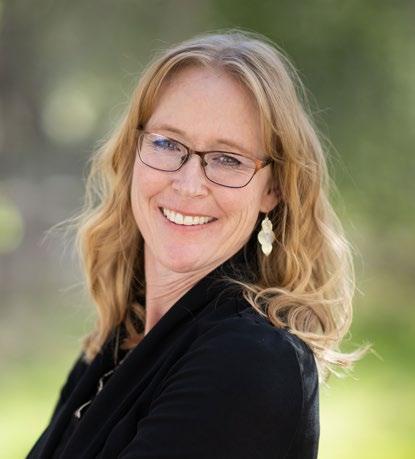
I had the opportunity to grow my knowledge and experience in the power industry from the ground up — even before making it my career path. I come from a family that has made its living in the cooperative space, starting with my dad, who was a lineman in every true sense: hardworking, committed, dedicated to his trade, and a bit tough-nosed when it came to safety. He instilled in me a deep understanding and appreciation for the men and women in the field who put in long days to keep our power on — and even longer and tougher days restoring power when storms rip through lines and our communities need them the most.
My mom also worked in the cooperative world. Some of my earliest memories are of sitting in her office after school in what can be best described as a big, cold, bright room with beige colored machines while she processed bills during the early MS-DOS computer days. Years later, I had the privilege to work alongside her at Western Area Power Administration,

serving rural towns and communities with public power.
My husband was also a lineman when we first met and has since built his career from the field and into senior management, overseeing crews across a large transmission network. Cooperatives and the power industry are the very foundation on which my life was built.
That was not always the plan.
After graduating from Montrose High School, I went to the University of Wyoming confident that my path would take me in a different direction. My plan was to be working every day in the field as a wildlife biologist. But like many best laid plans, mine took a turn. Ultimately, I graduated with a bachelor’s degree in journalism. A few short years later I found myself sitting in the dispatch center at Tri-State Generation and Transmission. It is there that I learned how to monitor electricity flows across a large power grid, and I couldn’t have been happier. I learned to truly love the intricacies of power system operations. There is something fascinating about monitoring an enormous map of the power grid, seeing the vastness of the system, knowing that you have a part in keeping your neighbors’ lights on because of the work you and your colleagues do behind the scenes — around the clock.
But, as much as my heart was captured by the work I was doing at the time, I was ready to come back home to the Western Slope. It is here where my husband and I wanted to build our lives and raise our kids with the same kind of childhood and values we enjoyed. Upon returning to Montrose in 2009, I began my nearly 16-year career with the Western Area Power
845 22 Road | P.O. Box 190 Grand Junction, CO 81052 (970) 242-0040 | communications@gvp.org gvp.org facebook.com/GVRuralPower
Administration, serving in a variety of roles. I planned and directed federal hydropower scheduling and energy marketing; closely followed evolving energy markets with a focus on how they would impact power rates and customers. And in my last role as the chief operating officer, I oversaw a broad operational program, setting policy in safety, system design and engineering, security, and reliability and compliance.
I feel fortunate to have had so many opportunities to build a diverse utility career and to have been raised in a family that believes in and understands the cooperative principles and Western Slope values. It was just a few months ago that I knew it was time to pair my years of experience in the utility industry with

my homegrown cooperative roots, and this knowledge brought me to Grand Valley Power. I am excited to work alongside the talented staff here to navigate the changes in front of us, to partner with our fellow cooperatives across the state, and to find innovative solutions that meet our members’ needs — all while continuing to provide you with the same hometown service you have come to know and expect.
I look forward to working every day to serve our members, and I am even more excited to meet you out in the community.
Welcome to GVP!
Donnie Schell Chief Financial Officer
Donnie Schell joined Grand Valley Power in January as the co-op’s chief financial officer. With 30 years of experience as a CPA and more than 12 years leading financial operations for various organizations, he brings a passion for creating financial reporting that is accurate, transparent, straightforward, and accessible to everyone. Donnie also has cooperative experience – he was the CFO at Sangre de Cristo Electric in Buena Vista for six years During his free time, he enjoys working out at the gym, watching sports, and spending time with his wife, five children, and three grandchildren.
Marcus Johnson joined Grand Valley Power in January as the network administrator. After six years as a computer programmer at Colorado Mesa University, Marcus spends his time supporting the GVP information technology department by providing network support, data security and protection, and software and hardware updates to ensure efficiency and reliability. He is a native of the Grand Valley and enjoys hiking and camping with his family
2026 Board Meetings
Regularly scheduled board meetings are held on the third Wednesday of each month at 9 a.m. at 845 22 Road, Grand Junction *Meeting date changed due to conflicts


Marcus Johnson Network Administrator
Residential Batteries
The future of energy flexibility?
By Chance Semones Energy Services Technician
Not too long ago, the hot topic among members who reached out to me was, “How can I harness the sun’s energy to generate some of the electricity I use?” Lately, though, those questions have morphed into “How can I collect and store energy and then use it during the evening when electricity costs more, and the sun isn’t shining?”
It makes sense. And with the cost of battery storage becoming more affordable, it’s a good question, too.
A home battery system can be many things, but at its core it is a rechargeable energy storage solution. It can provide backup electricity to a home during a power outage. It can act as a safety net, automatically detecting power interruptions and instantly switching to stored energy — ensuring that essential appliances like refrigerators, lights, and medical equipment remain functional. But with today’s technology, a battery system can also manage energy use in your home. That is, batteries can be programmed to align with Time-of-Use (TOU) rates to reduce monthly energy charges.
KEY ASPECTS AND BENEFITS
• Operation: Residential battery systems, which most commonly use lithium-ion batteries, connect directly to the home’s electrical panel and can charge from the utility grid or can be paired with rooftop solar panels.
• Performance: Modern systems are quiet and, when sized correctly, can provide enough power for critical loads for hours. Some have a larger capacity when paired with solar, allowing the battery to recharge daily.
• Backup: Not every system is designed to provide off-grid home backup during power interruptions. Additionally, battery backups should only be installed by a professional electrician so as not to put electrical workers in danger of life-threatening backfeed on the grid.
ENERGY MANAGEMENT
Some systems provide more than just energy backup; these systems offer “load shifting” to take advantage of off-peak periods, allowing homeowners to store energy when electricity rates are low and use it during higher, on-peak rate periods. Energy manage-
ment systems are becoming increasingly popular for enhancing energy resilience and independence. Home batteries such as the Tesla Powerwall or the Enphase IQ 5P store electricity for later use. For example, some battery systems offer TOU settings that can be programmed to align with GVP’s time of use periods.
1. Off-peak charging: During the day — if you have solar — or in the middle of the night when grid electricity is typically cheapest, the battery fills up with lower-cost energy.
2. Load shifting: During on-peak hours from 4 p.m.9 p.m. when rates are highest, your home automatically switches to first use the stored energy in the battery and then pulls from the grid any remaining power needed.
This strategy, also known as peak shaving or “energy arbitrage,” can help regulate your electricity bills by reducing or even eliminating the need to buy power during on-peak periods.
Here are a few things to keep in mind when exploring battery storage: Although there are many upsides, as with most things, it has its downsides as well. The initial purchase and installation of a home battery system are significant investments, often ranging from $10,000 to $25,000 or more. Most home battery systems have limited storage and may not be able to power an entire home through a prolonged, multiday outage without a charging source. Finally, batteries have a finite lifespan, and their storage capacity naturally declines with each charge/discharge cycle, meaning they will eventually need replacement, which adds to long-term costs.
Ultimately, a home battery with TOU-rate programmability can be a modern energy strategy. By shifting consumption to off-peak hours, you can turn a higher-cost energy plan into a lower-cost, sustainable energy solution that benefits both you and Grand Valley Power.
It is always good to remember that GVP can answer questions about renewable energy and energy solutions, including TOU hours and utility interconnection requirements for batteries and other distributed generation resources.
Grand Valley Power Energy Services Technician Chance Semones helps Grand Valley Power members explore their energy usage. He also enjoys exploring Colorado with his wife and two children and hitting the links.
Spring Forward
into ener g y s av ing s
M a r ch

8, 2026
Set clocks forward one hour the night before!
Smoke and carbon monoxide detector batteries
Replace
Clean

Clothes dryer filter and vent
Home gutters
Dirty air filters to maintain air circulation
Reverse ceiling fans to push cooler air down
Prepare
Furnace and water heater
Restock emergency kit




Digging? Call 811 First
By Alliy Sahagun Member Relations Supervisor | Photos by Alliy Sahagun
Springtime will be here before we know it, and that means thoughts of winter recreation are coming to an end and digging, planting, and building are now on our minds. You may have dreams of beautiful landscaping or moving ground for a new foundation, but before you dig, it is wise to think first what might be underground.
Striking a buried line can result in serious injury, service outages, costly repairs, and even life-threatening situations. Here are five helpful tips for safe spring digging.
1.LINE LOCATE REQUEST
Visit colorado811.org or call 811 to submit a line locate request. Line locators from all of the utilities will be notified of your request to have the underground cables, wires, and utilities marked before you begin excavating so that you are safe and do not destroy important underground facilities. Colorado 811 recently launched its new Exactix Ticketing System offering an easier, faster, and more accurate way to submit locate tickets and benefit from improved communication.
2.PLAN AHEAD
For weekend projects, submit your request early in the week so utility lines can be located and marked in advance.
3.CONFIRM
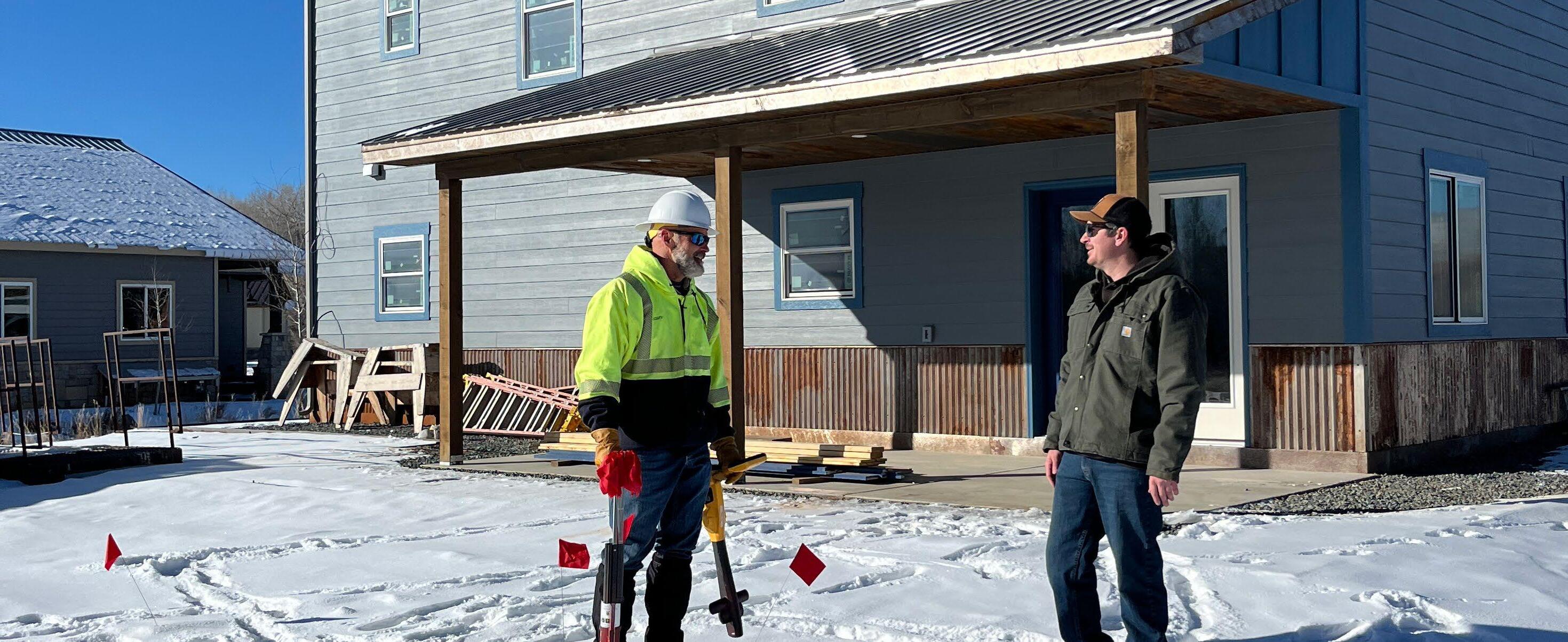
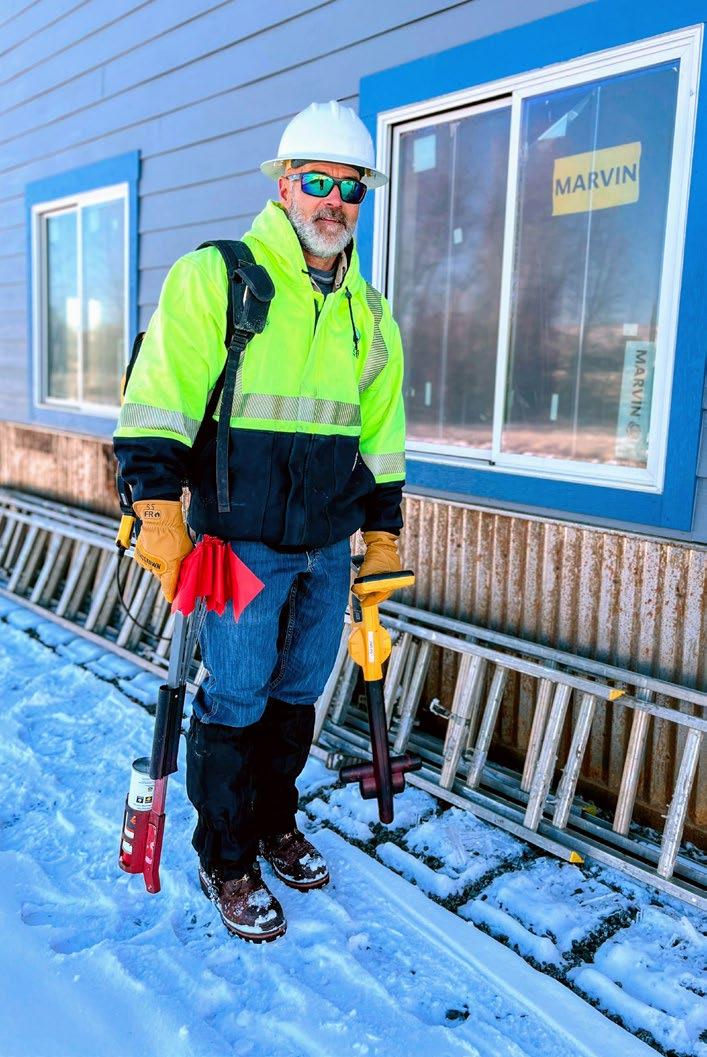
Make sure that all lines have been marked before starting a project. GCEA Line Locator Shawn Smithpeters marks electrical lines, cables, and conduits with
red paint or red flags. Other utilities are marked with different colors. If you provide your email address to 811, you will be notified when the work has been completed by each utility. When working with a contractor, confirm with them that lines have been identified before they begin their work.
4.ALTERNATE PLANS
Consider moving the location of your project if it is near utility line markings.
5.ALLOW FOR MARKING TOLERANCE
Locators are given an 18-inch grace on each side of their paint and flags. Allow for extra clearance and opt for hand digging in those areas.
Even small projects can be dangerous without proper line marking. Installing mailboxes, planting shrubs, or driving stakes into the ground can all put you at risk if you do not know what lies below the surface. Depth of utility lines can vary over time due to erosion, landscaping, or previous construction, so never assume it is safe to dig just because you have worked in an area before.
Remember, you can be seriously hurt if you dig into an electrical line — be sure to call 811 every time you dig. It’s never a question. Underground utilities are very dangerous and having paint or a flag markings can help prevent major harm or fatalities. It is always better to know before.
GCEA Line Locator Shawn Smithpeters (left) meets with General Contractor Tony McClurkan of Kowal Construction to discuss a locate on a new build.
On the Cover: When you call 811, GCEA Line Locator Shawn Smithpeters will mark all electric lines on your property.
Power Line Safety
By Alliy Sahagun Member Relations Supervisor
When I was young, my family lived in a rural part of North Carolina nestled in the woods, where we spent most of our time outdoors enjoying the freedom to roam and play with our friends. One afternoon, while lying in the grass and looking up at the sky, I noticed a steady, unfamiliar hum. Curious, I followed the sound and realized it was coming from the power line overhead.

At the time, I did not understand electricity or the serious danger associated with power lines. But something about that sound made me pause. That steady hum carried a warning, and I immediately felt a reverence for it. It was my earliest lesson that not every danger announces itself and that respect for unseen forces can be the difference between wonder and tragedy.
It’s easy to overlook power lines as we drive to school or work and return to our homes each day. Sometimes our vision is so focused on what’s right in front of us that we forget to look up or consider what is buried underground, and the deadly potential those wires contain.
When I visit local schools to teach electrical safety, one of the most important lessons I share is that electricity is “lazy” and follows the path of least resistance to get to the ground. If we put ourselves in that path, whether near a downed power line on the road, climbing a ladder, or flying a kite near an overhead line, we run the risk of injury or death.
FOLLOW THESE TIPS TO STAY SAFE AROUND POWER LINES:
1. Always look up and around before working or playing outdoors. Be aware of overhead power lines and keep your distance. Electricity can arc through the air, so be sure to stay at least 10 feet away from power lines.
2. Never touch a downed power line. Assume it is energized and extremely dangerous. Call 911 or GCEA immediately and keep others from the area until the line has been safely de-energized.
3. If a power line falls on your vehicle, stay inside if possible. Call 911 and wait for help to arrive. If there is immediate danger, such as a fire, safely jump out of the vehicle with both feet together and then hop to safety. Your goal is to avoid becoming the power’s path to the ground.
4. Teach children to stay away from electrical equipment and to recognize power line hazards. Today, I understand better what I did not know as a child. A single careless moment near overhead lines can change a life forever. My childhood memory serves as a reminder that safety begins with awareness. Teaching our children and our communities to look up, keep their distance, and treat power lines with caution is not optional. It is essential.
GCEA provides free electric safety presentations to schools and other community groups. If you are interested in having GCEA visit your group, please call 970-641-3520.
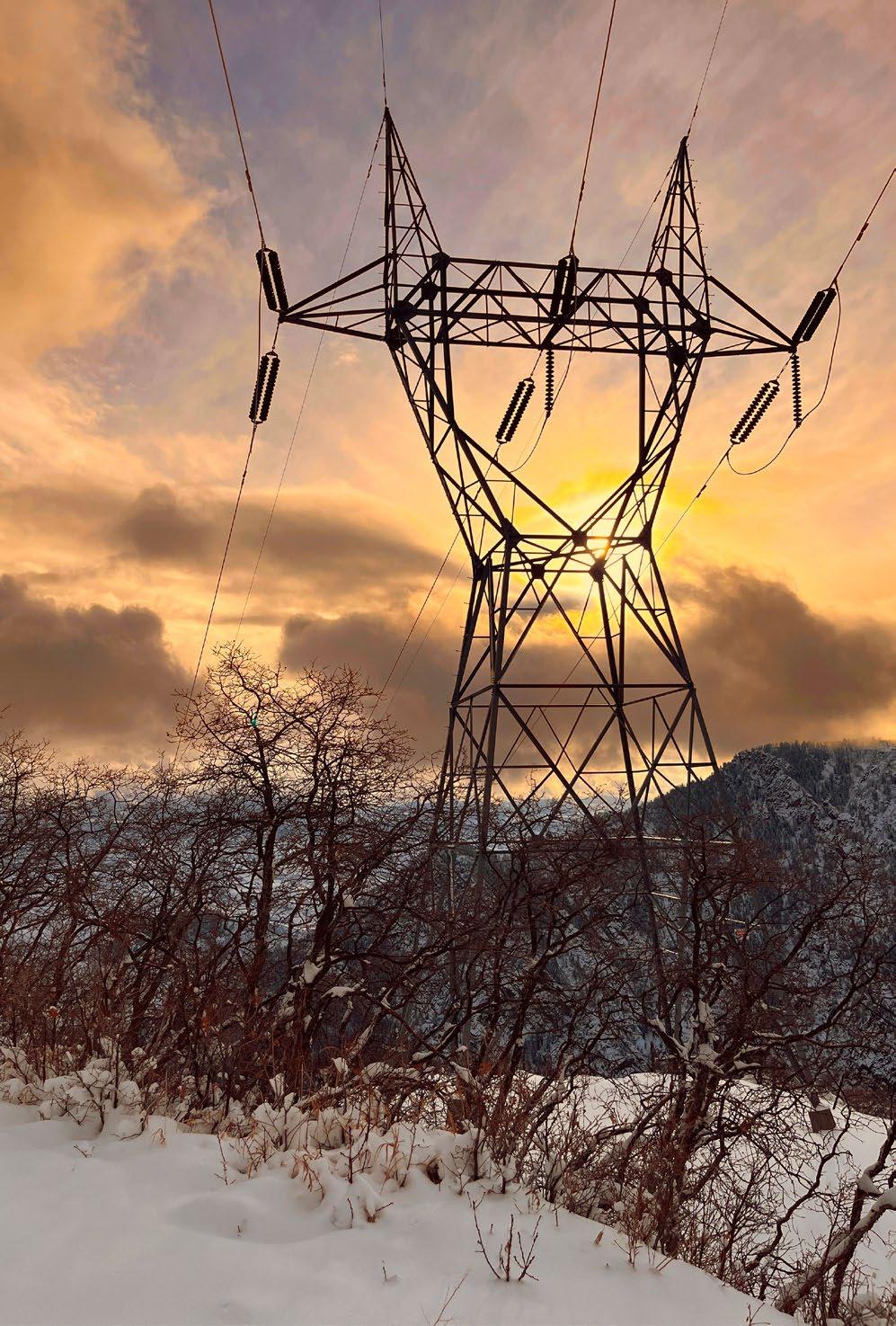
A transmission line near the Black Canyon carries a deadly amount of power. GCEA encourages safety near power lines.
Photo by Alliy Sahagun
DON’T BE PEAKY DON’T BE PEAKY
SHIFT, STAGGER, & SAVE
SHIFT, STAGGER, & SAVE

Use the delay start feature on your dishwasher to avoid running it during peak hours or in tandem with other electric appliances.
Take Control of Your Electric Bill

Idemand usage. If you need a refresher on what the demand charge means or how to read your bill, we can help.
WHAT’S ON YOUR BILL?
• Service availability charge – This charge provides access to the grid and covers a portion of the fixed costs for installing and maintaining equipment, as well as administrative costs.
• Energy charge (kWh) – This charge is for the total amount of energy (kilowatt-hours) consumed during the month.
• Peak demand charge (kW) – This is based on your highest usage during peak hours (5 p.m.9 p.m., Monday-Saturday). The peak demand is $1.00 per kilowatt.
Example: If your peak demand is 5 kW, your charge is $5
Managing when and how you use electricity can help lower your monthly bill. Here are some simple ways to keep costs down and track your usage:
STRATEGIZE YOUR DEMAND TO KEEP COSTS
n’t run multiple big appliances at the same time during peak hours. pread out laundry, dishwashing, and electric heating to off-peak times.
• Shift tasks to other hours to lower your peak demand.
TIPS TO TRACK AND MANAGE YOUR USAGE
1. Know Your Bill – Find your peak demand (kW) and energy usage (kWh). You can also view a sample bill on our website to help you understand key information about your electric usage and charges.
2. Use SmartHub – Track hourly, daily, weekly, or monthly energy use. Sign up for SmartHub at gcea.coop.
3. Understand Your Patterns – Timers, thermostats, and appliance delayed start features help avoid multiple appliances running at once.
Small changes like these can reduce peak demand charges and help you take control of your monthly bill. Follow GCEA on social media and continue reading Colorado Country Life magazine for more tips and resources to help you manage your energy use effectively.
Welcome to the GCEA Team
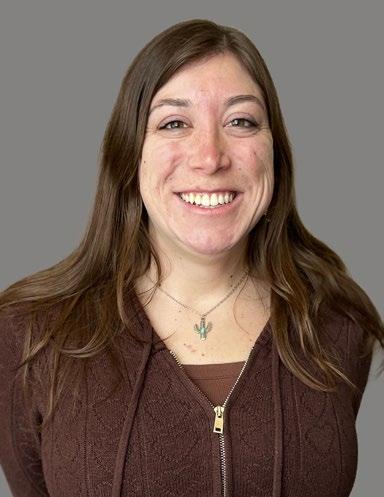
INTRODUCING BRENNA DAHL, BILLING ASSISTANT
GCEA is excited to highlight Brenna Dahl, who has been working as a billing assistant since October 2025.
Some of the Crested Butte membership might recognize this familiar face from Crested Butte Bank, where she served as head teller before joining GCEA.
In her current role with GCEA, Brenna helps post payments, resolves billing questions and errors, supports billing processes, and ensures all reads, rates, and data are accurate. Brenna enjoys collaborating with other departments to reliably and effectively serve the membership, and she has already learned a great deal by working alongside her coworkers in member services and across GCEA.
She is excited to continue working with members and supporting them in any way she can.
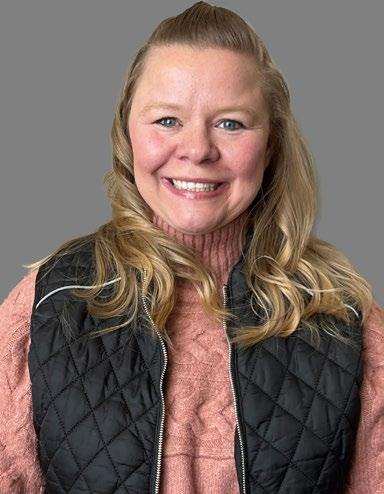
MEET JESSICA ISHAM, GCEA’S NEW MEMBER SUPPORT SPECIALIST LEAD
We are happy to announce that Jessica Isham started working at GCEA in December 2025 as the new member support specialist lead. Jessica brings more than six years of experience in emergency communications, and most recently as a supervisor with the Gunnison Hinsdale Combined Emergency Telephone Service Authority.
In her role at GCEA, Jessica supports members as the first point of contact by answering calls, fielding questions, processing payments, and assisting with service transfers. She also supervises the member support services team at GCEA’s Gunnison and

FROM LINE LOCATOR TO JOURNEYMAN
Congrats, Ty!
Congratulations to Ty Percival on earning his Journeyman Lineman Certificate. Ty has been with GCEA for eight years, starting as a temporary line locator and steadily working his way up the line to journeyman lineman. In January, he earned his Journeyman Lineman Certificate — an achievement that requires years of hands-on experience, completing rigorous training, and passing both written and practical exams. Congratulations to Ty on this well-deserved accomplishment.
Crested Butte offices. Jessica is eager to work alongside her team, which has been incredibly helpful during her transition into this role. Jessica has lived in the area for a while now but still enjoys meeting new people and is excited to get to know GCEA members and the communities we serve.
Jessica shared that being part of a cooperative means community to her; she was drawn to GCEA because of the helpful and kind culture she experienced from employees.

Wired for Growth Balancing data center demand and reliability
By Dennis Herman General Manager
Data centers may feel like a big-city phenomenon, but more and more of them are showing up in rural communities like ours — and there is good reason for that. Rural areas offer what data centers need most: affordable land, room to grow, and access to transmission lines that can move large amounts of power.

What makes data centers different from other large businesses is their appetite for electricity. These facilities run 24 hours a day, seven days a week. Servers must stay online constantly, which means power has to be reliable every minute of every day.
For electric cooperatives like Highline Electric Association, powering data centers creates both opportunities and challenges.
On the plus side, data centers have the potential to bring steady, long-term load growth that helps support investments to the local grid. With proper planning and policy support, those upgrades —

including new substations, stronger lines and smarter technology — could benefit all Highline members and help keep electricity rates steady. But providing power to data centers presents challenges, too. These large facilities can be constructed and become operational in as little as one year, but ensuring the necessary infrastructure, equipment, and electricity requires longer lead times and significant financial investment. Strategic planning and partnerships, as well as long-term power supply strategies are essential to the process.
While Highline does not currently serve any data centers, co-ops nationwide are fielding requests and inquiries from tech companies, and we anticipate similar requests in the not-too-distant future.
As a member-owned cooperative, our responsibility is twofold: to listen to the communities we serve and to provide reliable, affordable electric service to all Highline members. Balancing those responsibilities is not always simple, especially as new types of largescale energy users, like data centers, become part of
1300 S. Interocean P.O. Box 57 Holyoke, CO 80734-0057
phone 970-854-2236 toll free 800-816-2236
Holyoke & Sterling: M-Th 7 a.m.– 5:30 p.m.
info@hea.coop hea.coop facebook.com/HighlineElectric
Ovid: Mon., Tues., Thurs. 9 a.m.–3 p.m.
the local landscape.
No matter what the future holds, our priority will be supporting growth with fairness — that means ensuring large-scale energy users pay their fair share to mitigate the impact on other members, which ensures our local communities are supported.
The energy landscape is changing, and with it comes both opportunities and challenges. My commitment, and the commitment of the Highline board
and employees, is to continue listening, communicating, and working with our members and community partners to ensure all decisions reflect the best interests of the people we serve.
If you have questions or concerns regarding data centers, your energy bills or any other co-op matters, we encourage you to stay engaged and reach out.
Your voice matters at Highline Electric.
Big Data, Bigger Demands
Many companies are choosing rural areas for their data centers because of cheaper land, available power and potential tax breaks. Data centers require huge amounts of electricity to operate, which presents new opportunities and challenges for electric co-ops.
HVAC: Constant cooling is needed to ensure the servers function properly.
Servers: Servers run applications and process data 24/7. One server rack can consume enough electricity to power a small home. A large data center can house thousands of server racks.
Infrastructure: Data centers often require new electrical infrastructure to meet their power needs.
Water Source: Many large data centers are deploying evaporative cooling, which is more e cient than compressor-based systems.
Backup Power: On-site generators keep data centers running during power outages and can also be used to help lower demand when electricity use spikes.
The following employees observe a Highline Electric Association employment anniversary in March:
Deon Skomp — 33 years
Ryan Bingham — 10 years
Tracy Simpson — 10 years
Diana Baeza — 3 years
Celebrating 88 Years
Highline Electric Association is celebrating its 88th Annual Meeting. The meeting is scheduled for Tuesday, March 31 at the Phillips County Event Center located at the fairgrounds in Holyoke. Board President Mike Bennett and General Manager Dennis Herman will give reports on the status of the association, and a director election will be held.
Watch for more information arriving in your mailbox in March and visit Highline’s website at hea.coop for livestream information about the event.
ANNUAL MEETING OFFICE CLOSURES ON MARCH 31
Ovid will close at 3 p.m., per regular hours, and Sterling at 3:30 p.m. The Holyoke office will close at 4 p.m.

Autopay and Paperless Billing
Enroll in autopay and paperless billing today. Both programs are convenient options to help members pay bills quickly and without hassle. Sign up for each program and not only will you save time, you will also receive $0.50/month for autopay and $0.50/month for paperless. That’s $1 per month.
• Autopay: Have your balance paid automatically on the due date by credit card or checking account. Never worry about late fees or taking time to submit a payment.
• Paperless billing: Receive your monthly statement by email. You will be notified as soon as the statement is generated and ready to view online. It’s green, convenient, secure, and free!
Sign up for either service by calling 970-854-2236 or visiting a Highline office.

LET US KNOW ABOUT LIFE SUPPORT
If you have anyone on life-support systems at your residence, please notify Highline Electric Association. The co-op will try to notify all members on life-support systems of any planned outages. Highline will not terminate a service if a licensed physician makes a certification in writing of a medical emergency. This continuance of service will be effective for 60 days from the date of said medical certification. One 30-day extension may be granted if a second medical certification is received prior to the expiration of the initial continuance period. These provisions may be used only once during any period of 12 consecutive months.

ENERGY EFFICIENCY TIP OF THE MONTH
As spring arrives, take advantage of milder temperatures to save energy at home. Open windows on pleasant days to bring in fresh air instead of running your HVAC system. It’s also a great time to replace dirty air filters, which helps your system run more efficiently and improves indoor air quality. As daylight increases, turn off unnecessary lights and rely on natural sunlight when possible. Small seasonal adjustments like these can reduce energy use, lower monthly bills, and help keep your home comfortable as winter transitions into spring.
THE SEVEN
COOPERATIVE PRINCIPLES
Highline Electric Association operates on core principles that put the needs of their members first, unlike other electric utilities.
Voluntary and open membership
Democratic member control
Members’ economic participation
Education, training, and information Autonomy and independence
Cooperation among cooperatives
Concern for community

Controlled Burns and Power Lines
What You Need to Know
It’s called a controlled burn for a reason. If you don’t plan your controlled burn in advance and keep it under check, it can quickly spread far and wide.
Even with the best laid plans, a utility pole could catch on fire during a burn; however, planning in advance can decrease the chances. Fire damage to a power pole is usually evident by blackening and scorch marks, but even slight discoloration can cause serious problems. Sometimes the poles burn from the inside out and the damage is not immediately apparent.
To inquire about controlled burns near power lines and poles, call Highline Electric Association at 970-854-2236.

DAYLIGHT SAVING TIME BEGINS MARCH 8.
Set your clocks one hour ahead.
It’s also a great time to test the batteries in your smoke and carbon monoxide detectors.
TO ROBIE ADAMS
who is retiring after 21 years at Highline. He has been serving as Highline’s purchasing agent since 2017. Prior to that he was the co-op’s warehouseman.

Wired for Growth
Balancing data center demand and reliability
By David Churchwell General Manager
Data centers may feel like a big-city phenomenon, but more of them are showing up in rural communities like ours — and there is good reason for that. Rural areas offer what data centers need most: affordable land, room to grow, and access to transmission lines that can move large amounts of power. As many of you know, several new high-voltage transmission lines have been built in our service territory over the past few years which may attract data centers to eastern Colorado.
What makes data centers different from other large businesses is their appetite for electricity. These facilities run 24 hours a day, seven days a week. Servers must stay online constantly, which means power has to be reliable every minute of every day.
For electric cooperatives like K.C. Electric Association, powering data centers creates both opportunities and challenges.
On the plus side, data centers have the potential to bring steady, long-term load growth that helps support investments to the local grid. With proper planning and policy support, those upgrades — including new substations, higher capacity power lines, and smarter technology — could benefit all K.C. members and help keep electricity rates steady.
But providing power to data centers presents challenges, too. These large facilities can be constructed and become operational in as little as one year, but ensuring the necessary infrastructure, equipment, and electricity requires longer lead times and is a
Our mission is to provide our members with safe, reliable service at the lowest cost, while maintaining an environmentally responsible, accountable, and sustainable operation now and in the future.
significant financial investment. Strategic planning and partnerships, as well as long-term power supply strategies are essential to the process.
While K.C. does not currently serve any data centers, electric co-ops nationwide are fielding requests and inquiries from developers and technology companies, and we anticipate similar requests in the not too distant future.
As a member-owned cooperative, our responsibility is twofold: to listen to the communities we serve and to provide reliable, affordable electric service to all K.C. members. Balancing those responsibilities is not always simple, especially as new types of large-scale energy users, like data centers, become part of the local landscape.
No matter what the future holds, our priority will be supporting growth with fairness. That means ensuring large-scale energy users pay their fair share so prices to our members do not spike. And, we want our local communities to feel invested in.
The energy landscape is changing, and with it comes both opportunities and challenges. My commitment, and the commitment of the K.C. board and employees, is to continue listening, communicating, and working with our members and community partners to ensure all decisions reflect the best interests of the people we serve.
If you have questions or concerns regarding data centers, your energy bills, or any other co-op matters, we encourage you to stay engaged and reach out.
Your voice matters at K.C. Electric.
K.C. Electric Staff
David Churchwell General Manager dchurchwell@kcelectric.coop
Bo Randolph Office Manager and CFO brandolph@kcelectric.coop
Phone 719-743-2431
Toll-free 800-700-3123 Web kcelectric.coop
Darren Fox Operations Manager dfox@kcelectric.coop
George Ehlers Member Services Specialist and IT Manager gehlers@kcelectric.coop
Address 422 3rd Avenue Hugo, CO 80821
K.C. ELECTRIC MISSION
CLAIM YOUR SAVINGS
Each month, K.C. Electric Association members have a chance to claim a $20 credit on their next electric bill. All you must do is find your account number, call the Hugo office at 719743-2431, and ask for your credit. The account numbers are listed below. How simple is that?
You must claim your credit during the month in which your name appears in the magazine (check the date on the front cover).
Antonio Arroyo, Kit Carson — acct 7175xxxxx
Shane Leoffler, Flagler — acct 11114xxxxx
Tim Levin, Seibert — acct 8153xxxxx
Cynthia McCaffrey, Seibert — acct 8066xxxxx
Congratulations to Clint Flory from Hugo and Terry Smelker from Stratton! They both spotted their account number in the January issue and called to claim their bill credit.

& ways to save energy
(Spoiler Alert: Your clothes and dishes won’t know the difference)
Major home appliances account for approximately 16% of an average home’s energy consumption.
Run full loads of laundry instead of several smaller ones.
cold water to wash your clothes.
Keep your refrigerator at 35° to 38°F and your freezer at 0°F. Regularly defrost manual-defrost freezers and refrigerators. When buying new appliances, consider Energy Star versions. Unplug appliances you’re not using.
the heat-dry setting on your dishwasher.
Fully load your dishwasher before washing.

Notice of 2026 Annual Meeting and Board Election
Director nominations due April 5
Three directors will be elected to the K.C. Electric Association Board of Directors this year: one from Cheyenne County and two from Kit Carson County. Directors’ terms expiring are Robert Bledsoe from Cheyenne County and Dan Mills and Kevin Penny, both from Kit Carson County.
To be nominated, a person must be a member of K.C. Electric and a bona fide resident within the director’s district for which he or she is nominated.
NOMINATIONS TIMETABLE
Official nominating petitions shall be issued by the Association not earlier than ninety (90) days prior to the meeting at which the election is to be held. Petitions must be signed by at least fifteen (15) members, not more than one (1) member in a joint membership, of the Association and returned to the Association for filing with the Board no less than sixty (60) days prior to the election. Qualified candidates can pick up official nominating petitions at the Hugo or Stratton office. Official nominating petitions will be issued on March 6. The deadline for petitions is April 5, all materials should be turned in by close of business at the K.C. Electric Hugo or Stratton office.
Circulators of the petition should attempt to verify accuracy of the name and address of each signer and must require that the signature take place in the presence of the circulator. The circulator should sign the affidavit at the bottom of the petition and have the affidavit notarized before submitting the petition
YOUR 2026 ELECTION COMMITTEE
Toby Johnson
P.O. Box 376 Kit Carson, CO 80825 719-342-0142
Tim Pautler
20587 CR 33 Stratton, CO 80836 719-349-1424
Jeff Cure
P.O. Box 370 Burlington, CO 80807 719-346-7080
Troy McCue 221 Pine Arriba, CO 80804 719-768-3493
George Ehlers P.O. Box 815 Hugo, CO 80821 719-740-5002
to K.C. Electric. Please print the name as it appears on the electric bill. If you are a spouse of a member and not listed on the electric bill, please indicate by printing your name as well as signing the petition. If your listing is a business and the name on the bill is a business, please print the name of the business, then print your name and sign the petition.
Candidates should turn in a short biographical writeup to K.C. Electric Association Member Services Manager George Ehlers, located in the Hugo office, with the petition.
Directors are elected at the Annual Meeting on June 4, in Seibert, Colorado.
ENERGY EFFICIENCY TIP OF THE MONTH
As spring arrives, take advantage of milder temperatures to save energy at home. Open windows on pleasant days to bring in fresh air instead of running your HVAC system. It’s also a great time to replace dirty air filters, which helps your system run more efficiently and improves indoor air quality. As daylight increases, turn off unnecessary lights and rely on natural sunlight when possible. Small seasonal adjustments like these can reduce energy use, lower monthly bills, and help keep your home comfortable as winter transitions into spring.
Help the Lineworker Spring into Action
Did you know March 20 is the first day of spring? This time of year marks new beginnings and fresh blooms, but it can also bring powerful storms that interrupt electric service.
Help the lineworker find his way through the maze to the bucket truck so he can restore power.
MCREA 2025 Annual Report
By Dave Frick General Manager
On behalf of the board of directors, management, and employees of Morgan County Rural Electric Association, Inc., we are pleased to present the 2025 Annual Report.
MCREA is a not-for-profit electric cooperative dedicated to serving our members by providing safe, reliable energy, while maintaining a strong tradition and a clear vision for the future. Operating under the cooperative business model, we are proud to be owned by the members we serve. A member-elected board of directors provides guidance to MCREA staff in the administration of cooperative assets and oversight of financial responsibilities.
report detailing the Association’s financial position and operational performance. We encourage you to review the following pages, which offer comprehensive information about the current state of your electric cooperative.
I would also like to personally invite our members to attend MCREA’s 89th Annual Meeting on Tuesday, March 17, at 6 p.m., which will be held by phone call. Registration for this year’s meeting is available by clicking the banner on our website at mcrea.org
The MCREA Board of Directors and management team look forward to reviewing the past year with you, discussing future plans for the cooperative, and answering any questions you may have.
As a member-owned electric cooperative, the MCREA Board of Directors and management have a responsibility to provide our members with an annual
MCREA STATISTICAL INFORMATION*
As of December 31, 2025 Counties Served
We thank you for your continued support and we look forward to connecting with you at our annual meeting later this month.
Arapahoe, Logan, Morgan, Washington, Weld
From Jim Bostron
Treasurer, District I
All members of Morgan County Rural Electric Association, Inc., are encouraged to carefully examine this annual report. Included are the balance sheet as of December 31, 2025, and the statements of revenue and expense for the same year. Also shown are the trends of the previous year.
In my opinion, the financial report fairly presents the financial position of MCREA for the year ending December 31, 2025, and is in conformity with accepted accounting principles applied on a basis consistent with that of the preceding year.
Jim Bostron
BALANCE SHEET*
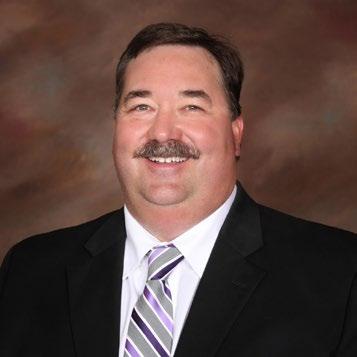
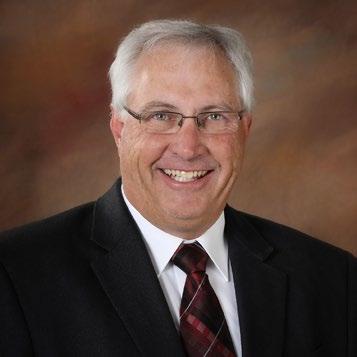
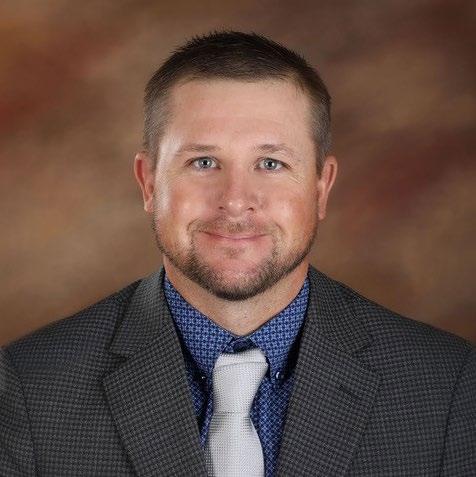
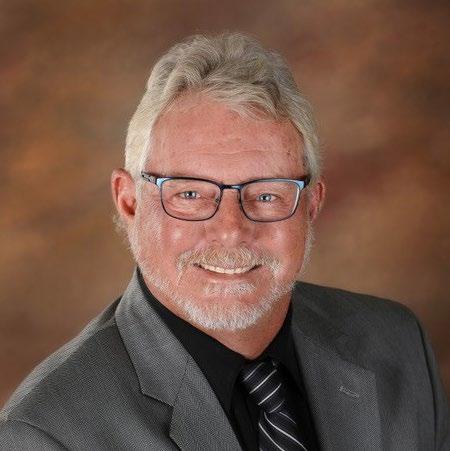
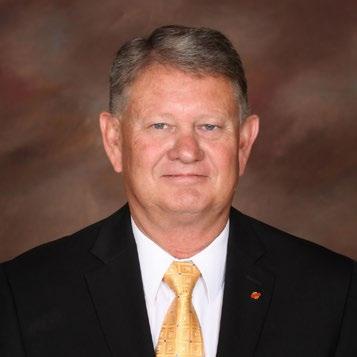

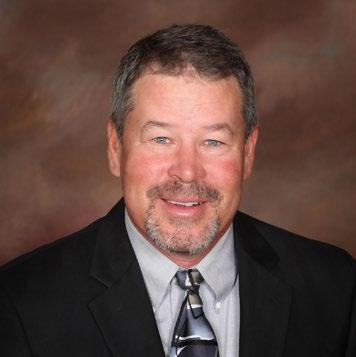
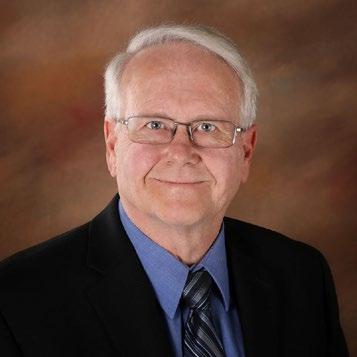

Brian Pabst President - District III
Terry Linker Vice President - District III
Kyle Eiring Secretary - District II
Jim Bostron Treasurer - District I
Tim Peggram District I
David Arndt District II
Cary Wickstrom District I
Terry Tormohlen District II
Larry Hoozee District III
OPERATING STATEMENT*
MCREA EMPLOYEES
Haiden Araujo
Chris Banz
Rob Baranowski
Curtis Berg
Chuck Blackwelder
Josh Bristol
Andron Brown
Curtis Covelli
Ryan Dunker
Cirildo Estrada
Bryson Fogg
Cody Flanigan
Dave Frick
Amanda Green
Ben Haight
Angie Hayes
Ryan Heagney
Tim Hishinuma
Zach Hornecker
Suzi Iungerich
Ben Johnston
Nolan Kauffmann
Brent Kliesen
Cheryl Lewis
Alan Mason
Di McKenzie
Trey Montel
Nick Mosqueda
Jennifer Ogley
Angie Pangle
Travis Petrino
Maddie Pollart
Rodney Rhoades
Josh Scott
Robb Shaver
Stacy Syphers
Brian Thomas
Travis Varelman
Fabian Vigil
Tammy Walker
Roger Wunsch
MEET MCREA’S BOARD DIRECTOR CANDIDATES
These five candidates have submitted petitions to serve on the Morgan County Rural Electric Association, Inc., Board of Directors. This year’s election is being held by mail-in ballot. All members have been sent their ballots and can return them by mail or in person to MCREA. All ballots must be received at MCREA headquarters by 4:30 p.m. on Monday, March 16. Ballots will be counted the following day by the member elections committee and results will be announced during the MCREA Annual Meeting on March 17.
DISTRICT I: TIM PEGGRAM (incumbent)
Tim Peggram has served on the Morgan County REA Board of Directors since 2003, earning the Credentialed Cooperative Director certificate, Board Leadership certificate, and Director Gold credential through the National Rural Electric Cooperative Association. He has held the roles of president, vice president, and treasurer of the MCREA Board. Tim has also served as president of Western United Supply Corporation and currently serves on the Mid-West Electric Consumers Association Board.
Raised in Wiggins, Tim earned an associate degree in agribusiness from Northeastern Junior College and returned to farming. He raises irrigated corn, alfalfa, wheat, and runs a cow/calf operation. Tim has been very involved in the Wiggins community and is an active member of Summit Baptist Church. Tim and his wife Eileen have five children and seven grandchildren.

DISTRICT II: DAVID ARNDT (incumbent)
David Arndt was first elected to the MCREA Board of Directors in 1993. He fulfilled one term as treasurer in 1994, and served as board president from 2006 to 2010. During his tenure, David has earned the Credentialed Cooperative Director certificate through the National Rural Electric Cooperative Association by completing five one-day courses, including Director Duties and Liabilities, Understanding the Electric Business, Board Roles and Relationships, Strategic Planning, and Financial Decision Making. He has also been awarded the Board Leadership certificate through the national association. David and his wife Pam farm in the Weldona area. They have four grown children and fourteen grandchildren. David is a past president of the Morgan County Fair Board and has been active with several youth organizations in our area.
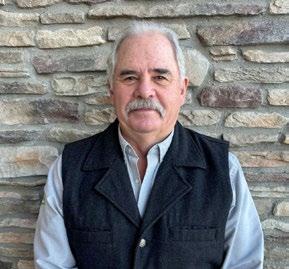
DISTRICT II: D OUGLAS WULF
Douglas Wulf is seeking his first term on the MCREA Board of Directors. A lifetime resident of Morgan County, Douglas has been actively involved in the agriculture industry. He currently works for 21st Century Equipment LLC in Fort Morgan, where he has served as an account manager in ag sales and marketing for over 30 years. In this role, he has exhibited strong and diverse leadership qualities and wishes to serve the needs of Morgan County in a more broad and meaningful capacity. Douglas and his wife Leigh Ann live in the Fort Morgan area. In addition to golfing, riding motorcycles, and tinkering with small mechanical projects, Douglas enjoys taking trips with family and friends.

DISTRICT II: D EREK GERKEN
Derek Gerken is seeking his first term on the MCREA Board. Derek is a farm and crop agent with Leavitt Group of Colorado and runs a Red Angus cow/calf operation. Derek has served two terms on the Fort Morgan School Board, serving as President and Treasurer. He has also served multiple terms on the Morgan Conservation District Board and held leadership roles at First Christian Church. Derek feels that Morgan County’s quality of life depends on affordable, reliable electricity and believes in protecting this. With experience in agriculture, business, and community leadership he feels he can contribute to a strong future for MCREA. Derek and his wife Elise have four grown sons and one grandson. He enjoys spending time with his family, working on the ranch, and watching sports.
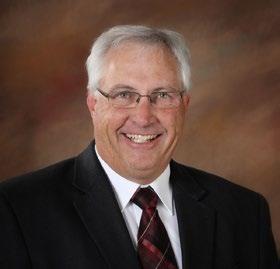
DISTRICT III: TERRY LINKER (incumbent)
Terry Linker is seeking his fourth term on the MCREA Board of Directors. He has earned his Credentialed Cooperative Director certificate, Board Leadership certificate, and Director Gold credential through the National Rural Electric Cooperative Association. Terry is employed by Nutrien Ag Solutions in Fort Morgan, and has served as president of the Lower Platte and Beaver Canal Company. Terry has also served on two other water boards for Jackson Lake and the Lower South Platte Conservancy District, and is interested in water law and regulations. In his spare time, Terry enjoys local sporting events, fishing, watching college football, and traveling to see different parts of the world. He has four children and seven grandchildren.
Rooted in Reliability
Turning Strategy Into Action
By Ruth Marks CEO
Last month we talked about the importance of investing in the electric system that serves you by strengthening reliability through technology, maintenance, and long-term planning. This month, I want to share how those investments are being put to work through our 2026 Strategy Map and the major initiatives that will deliver measurable benefits to our members.
Every year, Mountain View Electric Association’s Board of Directors and Executive Leadership Team collaborate to develop a strategic plan and strategy map grounded in our cooperative mission: to provide safe, reliable, affordable, and responsible electricity. While safety remains our top priority, this year reliability and affordability are focus areas for action.
Our strategy map outlines six priorities: Safety; Reliability & Resiliency; Affordability; Member Engagement; Employee Relations; and Technology & Innovation. These priorities guide every project we take on, ensuring our investments today strengthen the system for tomorrow. Here are a few examples of how that strategy is already taking shape:
BUILDING A SMARTER GRID
Work continues on implementing our Advanced Distribution Management System (ADMS), a tool that helps keep our communities powered and our members’ lights on by improving system visibility, automating outage detection and restoration, and enables safe power rerouting during outages or wildfire risk. With ADMS, power can be disconnected or redirected through software rather than sending in MVEA crews to manually complete the process. Alongside expanded drone inspections and enhanced GPS mapping, ADMS increases our speed, efficiency, and crew safety.
PROACTIVE WILDFIRE MITIGATION
As wildfire risk grows across Colorado, our comprehensive wildfire mitigation plan plays a vital role in protecting homes, communities, and critical infrastructure. In 2026, we are expanding vegetation management, deploying upgraded equipment, increasing inspections, and integrating new monitoring technologies.
A $771,000 Department of Energy grant is helping us strengthen infrastructure and improve fault detection during extreme weather events without driving up costs.
STRATEGIC SYSTEM UPGRADES
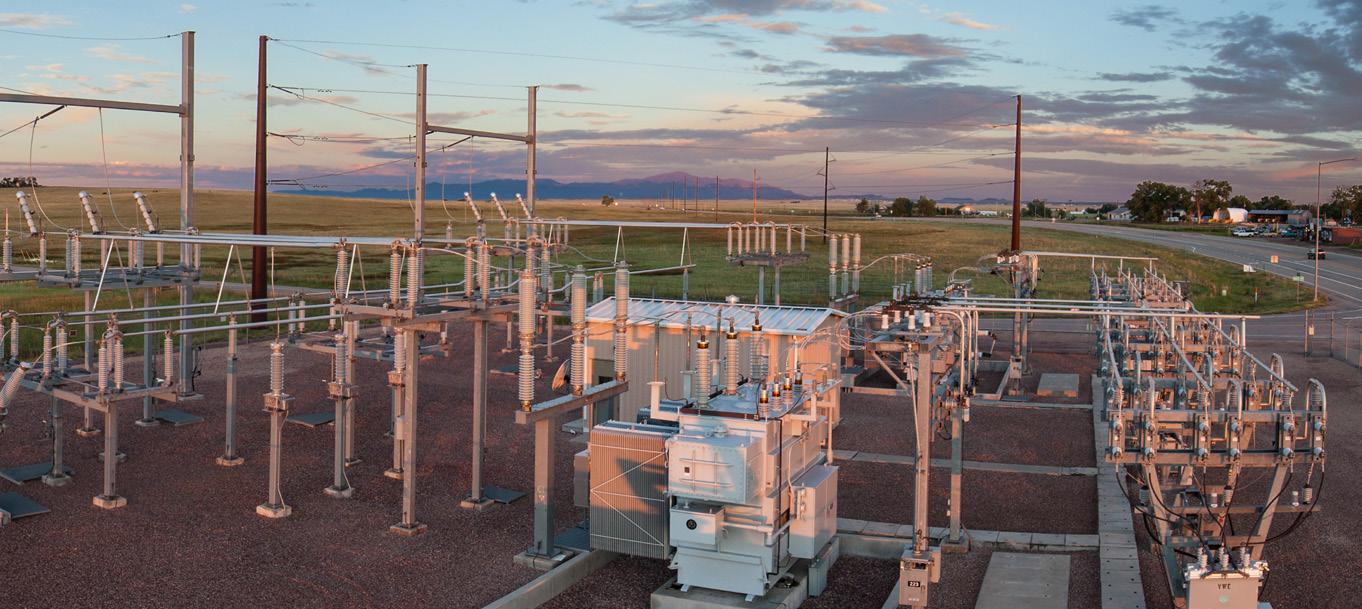
Major projects — including substation rebuilds, equipment upgrades, and targeted transmission improvements — ensure our system can support the needs of our growing electric co-op while improving service reliability. A recent example with far-reaching benefits is the replacement of over 150 relays in substations across our service territory. Relays are important because they make the electric system smarter, safer, and more reliable — which means fewer outages, faster restoration, and better service for MVEA members.
FIBER BROADBAND EXPANSION
Our fiber broadband project, now more than halfway complete, is about more than high-speed internet. The fiber network supports real-time grid communication, enhances wildfire mitigation tools, and allows ADMS to operate effectively across our 5,000-square-mile service territory.
As a member-owned electric cooperative, we’re here to power your homes, businesses, and daily routines with dependable service you can feel confident in. Every improvement we make is rooted in reliability and grounded in our commitment to you and the communities we serve.
PROTECTING OUR COMMUNITY & RELIABLE POWER SUPPLY

Mountain View Electric Association’s mission is vital: to deliver safe, reliable, affordable, and responsible electricity to you — our members. That mission has never been more important as Colorado faces increasing wildfire risk. A growing population, dry conditions, and suburban expansion into wildland-urban areas have increased the urgency for proactive utility wildfire mitigation planning. Our wildfire mitigation efforts play a critical role in delivering safe, reliable power while helping prevent potential fire risks before they start.
Visit MVEA’s webpage dedicated to wildfire mitigation and safety, where you’ll find helpful information and resources about the following topics:
• Vegetation Management
• Operational Practices
• Advancing MVEA’s Initiatives
• Working with MVEA Members
• Wildfire Preparedness
www.mvea.coop/wildfire-mitigation
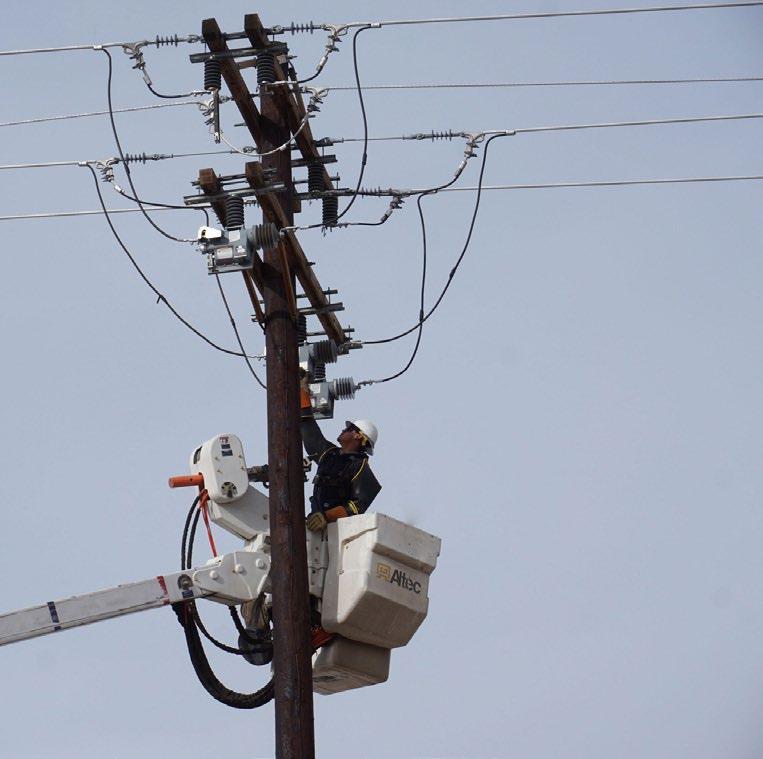
Tree Trimming | A key part of our Wildfire Mitigation Plan is active tree trimming and vegetation management. When you see MVEA crews, or our partners at Wright Tree Service, working in your neighborhood, they’re creating important tree and shrub “no-grow zones” to keep vegetation safely away from power lines and equipment. Cleared electric utility easements help prevent outages and blinks caused by branches brushing or breaking onto lines during storms or windy days. They also provide crews with safe access to equipment when maintenance or repairs are needed.
System Upgrades | Our wildfire strategy also includes enhanced operational practices, participation in the Department of Energy’s WARN project, and investments in advanced fault-detection technology. This work is designed to strengthen our system’s resilience and improve reliability during severe weather events. Our crews regularly patrol, inspect, and upgrade equipment to ensure it meets or exceeds industry safety standards. This includes system-hardening efforts such as replacing poles and hardware with fire-resistant materials and installing devices that minimize sparks and faults.
Red Flag Warnings | Recently, you may have noticed more “Red Flag Warnings” in our region due to unseasonably warm, dry conditions. When these warnings are issued by the National Weather Service, MVEA activates additional safety measures — including operating parts of our system in “one-shot mode.” This temporary adjustment disables the automatic reclose function on power lines. If a fault occurs, power stays off until crews can inspect the line and safely restore service. While this may mean longer outage restoration times, it significantly reduces the risk of sparks during high-fire-danger periods. We appreciate your patience during these events. Every step we take is designed with one goal in mind: protecting you, your property, and the communities we proudly serve.

Green P wer Blocks
Support Renewable Energy Development
Opt-in for as little as 10¢ a month.

Looking for a convenient and inexpensive way to go a little greener with your energy use? MVEA members may purchase Green Power blocks to help support the development of renewable energy through the purchase of Renewable Energy Credits (REC). Members who choose to participate in the Green Power program are purchasing RECs that are either sourced on the open market or from Tri-State G&T’s growing REC portfolio.
For the average residential member who uses 1,000 kilowatt-hours (kWh) per month, participating in the Green Power program would be an additional investment of only $1 per month for 10 blocks of Green Power.
Learn more at www.mvea.coop/green-power.

Unclaimed Capital Credits
Kevin L. Paddock, District 5 President
Barry R. Springer, District 6 Vice President
Jim Riggins, District 7 Secretary-Treasurer
Joseph D. Martin, District 1 Assistant Secretary
Rick L. Gordon, District 2
Wayne Vanderschuere, District 3
Jim Beals, District 4
Numbers
(800) 388-9881 (719) 495-2283
Website www.mvea.coop
Falcon Office 11140 E. Woodmen Road Falcon, CO 80831
Limon Office
1655 5th Street • P.O. Box 1600 Limon, CO 80828
Office Hours
Monday - Thursday 7 a.m. to 5:30 p.m.

MVEA Rising Stars
Youth Leadership Trip Winners Selected
For high school sophomores and juniors looking for a summer of discovery, new friendships, and meaningful leadership experiences, Mountain View Electric Association’s Youth Leadership Trip Contest opens the door to two exceptional opportunities: the Electric Cooperative Youth Tour in Washington, D.C. or the Cooperative Youth Leadership Camp near Steamboat Springs. To win, applicants were challenged to reflect on the seven cooperative principles, the leadership traits they admire, and what being part of an electric cooperative means to them. After reviewing all submissions, MVEA’s Education Committee — made up of Board members — selected four standout students to attend the all-expenses-paid, weeklong trips.
First Place (tie)
Nathan Alger

“Concern for community is the principle that speaks to me,” shared Nathan Alger, a LewisPalmer High School junior and National Honor Society member. A 4.0 student and multi-sport athlete, Nathan has earned Special Teams MVP honors, served as soccer team captain, and contributed to numerous youth sports camps. His commitment to service runs deep — from mission work in Detroit renovating a home for youth aging out of foster care to ongoing fire mitigation, community clean-ups, and support for Wreaths Across America. “Helping the people around you can be very beneficial for many,” he reflected. After graduation, Nathan plans to attend a four-year university and pursue a degree in aerospace engineering, with hopes of working for NASA or Boeing.
Third Place
Tager Vitt


“Autonomy and independence create a constant exchange of ideas,” explained Tager Vitt, a motivated Haven School sophomore whose leadership shines through Trail Life, his church, and service to others. A Junior Patrol Leader, Quartermaster, youth prayer service volunteer, and altar server team leader, Tager approaches leadership with vision and humility. His passions extend outdoors — from skiing and biking to backpacking, climbing, and even unicycling — along with orchestra and jiu-jitsu. “Great leaders look beyond the closest challenge and focus on the bigger picture,” he shared. Deeply committed to serving his country, Tager plans to join the United States Marine Corps after graduation, seeking discipline, camaraderie, and the opportunity to give back through service.
First Place (tie)
Yasmin Amandu

“Education can transform lives,” shared Yasmin Amandu, an accomplished Rampart High School junior whose achievements span academics, leadership, athletics, and community service. A National Honor Society member, varsity swimmer, AP Scholar, and officer in both FBLA and Speech & Debate, Yasmin earned 1st place at FBLA Nationals and contributes her skills to local nonprofits. She values education as a tool for uplifting others: “Knowledge is only valuable when it can be shared.” Through advanced enrichment and leadership programs focused on STEM and academic success, she continues to strengthen her skills and broaden her opportunities. While still exploring her path, Yasmin aspires to pursue a career in medicine, with the long-term goal of becoming a surgeon and giving back through meaningful community impact.
Fourth Place
Wesley Rains
“Education is one of the most powerful tools people have to improve their future,” noted Wesley Rains, a dedicated Liberty Tree Academy junior and National Honor Society member. A strong student in AP Calculus, dual-enrollment coursework, and the Gifted & Talented program, Wesley also excels as a varsity basketball and baseball player, youth sports volunteer, and builder of handson engineering projects — including a working model engine. Leadership, he says, means “working hard, supporting others, and setting a good example.” With a passion for aviation and problem-solving, Wesley plans to pursue aerospace engineering in college, explore internships, and one day launch his own business in aviation design and technology.





Stand Up for the Co-op You Can Count On
BY JEFF WADSWORTH PRESIDENT & CEO
At Poudre Valley REA, we don’t take your trust lightly.
Every time you flip a switch or turn up the thermostat on a cold Northern Colorado morning, you’re counting on us to deliver safely, affordably, and reliably. And we do, day after day, because this isn’t just an electric system. It’s all of ours.
That’s what makes the cooperative model so powerful. We’re locally governed. We’re not-forprofit. We’re accountable to the people we serve, our member-owners, not outside shareholders.
Decisions about your electric service are made by neighbors who live and work in the same communities you do.
burdensome legislation that would make it harder to keep rates low, maintain reliability, and invest in the improvements that matter most to you.
That’s why we’re asking you to stand up for your co-op by using Cooperative Voices to contact your state legislators today. Your message can help lawmakers recognize the importance of cooperative-aware policymaking that protects local control and doesn’t undermine a model that’s already delivering results for Northern Colorado families, businesses, and communities.
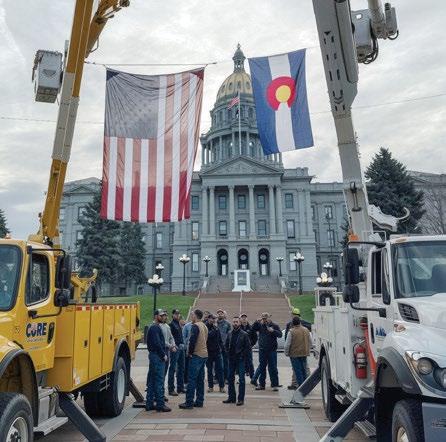
Poudre Valley REA has a proven track record we’re proud of: the lowest electric rates in Colorado, top-tier reliability, nationally recognized communications and service, and a top customer satisfaction score among electric utilities.
These successes don’t happen by accident. They happen because your co-op is designed to put people and communities first.
But here’s the reality: policy decisions made at the Colorado Capitol can either strengthen that model or unintentionally weaken it.
Too often, energy policy is shaped by a one-size-fits-all approach that lumps all utilities together. When that happens, cooperatives are judged by the actions or circumstances of other utilities, leading to unnecessary,
The ask to our elected representatives is straightforward: Keep our cooperative in mind when making legislative decisions. Protect what makes locally governed, member-owned utilities different. Don’t change what’s working.
To learn about Cooperative Voices and how we work to ensure Poudre Valley REA continues serving you well, join us at our Annual Meeting on April 11. As a member-owned cooperative, this meeting is a valued tradition and an opportunity for you to hear updates, ask questions, connect with neighbors, and be part of the local decisions that shape our shared energy future.
If you’re ready to join our advocacy network and contact legislators on behalf of your co-op, do so at www.pvrea.coop/cooperative-voices It’s easy, simple, and will take less time than making a cup of coffee.
Thank you for being an engaged member-owner. Together, we’ll keep Poudre Valley REA the co-op you can count on, today and tomorrow.
A
PLACE WHERE CARE COMES FIRST Mercy Housing


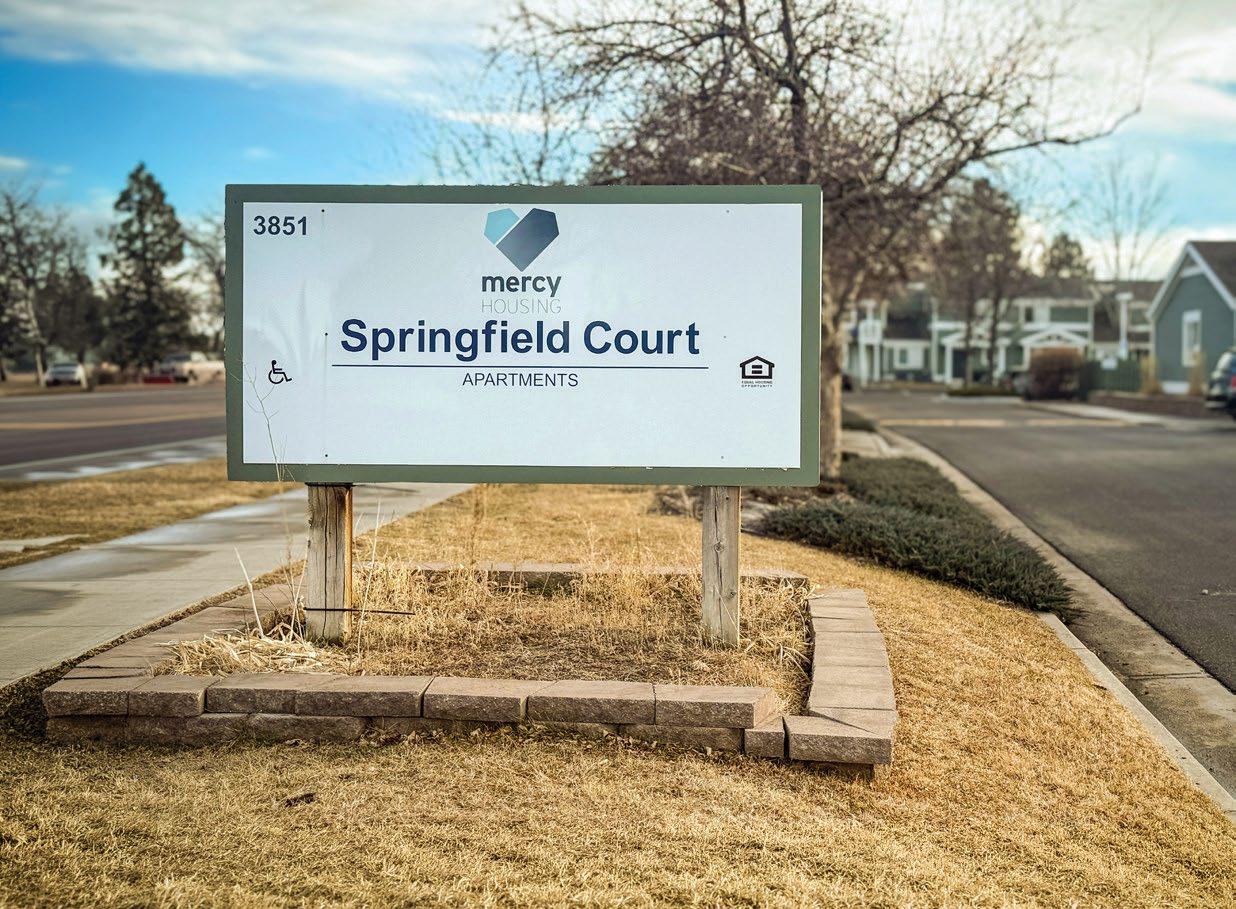
When Carol unlocks her workplace at Springfield Court Apartments each morning, she’s not just opening a management office. She opens a place of stability, dignity, and hope.
Springfield Court Apartments in Fort Collins is part of Mercy Housing, a national nonprofit organization dedicated to creating stable, vibrant communities through affordable, service-enriched housing.
Operating in 28 states, including 19 communities across Colorado and two in Fort Collins, Mercy Housing goes beyond providing a roof overhead. It’s mission is to support families, seniors, and individuals with disabilities who lack the economic resources to access quality housing by pairing affordability with enriched programs that promote health, financial stability, and long-term independence.
This mission is carried forward daily by people like Carol Pegg.
“We go out of our way to find ways to help our residents manage their lives and their home.”
and bedding — a gift of comfort and dignity during a vulnerable time. “So that was wonderful,” Carol said.
Moments like these are what keep Carol committed. “You go home and you feel good about what you did,” she explained. “People are surprised when someone cares enough to find them help or get what they need. It makes a big difference in people’s lives.”

As the property manager at Springfield Court, Carol is often the first person residents turn to when they need help, or simply someone to listen. Many residents arrive during moments of transition, some after experiencing homelessness, others navigating financial hardship.
Support extends well beyond housing. A communal pantry stocked with donated food, pet supplies, and household goods allows residents to access essentials when they need them most. If paying rent becomes difficult, residents are connected with financial assistance programs and local partners who provide job support, resume building, and financial planning. A flexible rent payment option even helps residents build positive credit while staying housed.
The impact of that support is deeply personal. Carol recalled a formerly homeless grandmother and her granddaughter who moved in with nothing. Through a community donation drive, they received air mattresses
Mercy Housing also fosters connection and opportunity through after-school programs, various donation drives, exercise events, cooking classes, and more. The goal is always the same: to help residents move forward. “We had a family of five who were here for around six years,” Carol said. “That’s really good to see them come in and get financially stable and on their feet, then move into their own place.”
Recently, Springfield Court received upgraded heating and cooling systems. Poudre Valley REA was proud to support Mercy Housing's mission by providing $88,500 in rebates for 140 new high-efficiency heat pumps to help improve residents' comfort and energy efficiency year-round. Special thanks to Mercy Housing's Green Hope and Regional Facilities teams and Springfield Court property staff for making this project possible.
“There’s a lot of need in the whole area,” Carol said. At Springfield Court, that need is met with compassion, consistency, and care one resident at a time.
To learn more about Mercy Housing or support their work, visit www.mercyhousing.org
Those interested in making local donations or getting involved should contact Shelton Dunn, Mercy Housing Mountain Plans, shelton.dunn@mercyhousing.org




When Spring Snow Hits Hard
Heavy, Wet Storms Can Bring Big Impacts to Power & Safety
Along Colorado’s Front Range, March can be the snowiest month of the year. This moisture-packed snow can weigh down trees and power lines, increasing the risk of outages and electrical safety hazards.
• If you see a downed line, stay back and report it.
• Use generators safely and never indoors.

IT'S TIME
TO Speak Up

• Even after storms end, melting snow can shift debris or freeze overnight creating new risks.
Find more electrical safety and winter storm preparedness information online at www.pvrea.coop

Our electric cooperative is something special, and it’s worth protecting.
As a proudly member-owned, locally governed cooperative, we deliver the lowest rates in Colorado, top-tier reliability, and nationally recognized communications and service.
Our difference shines through as we’re owned by and accountable to you, our members, and not outside shareholders.
This legislative session, unnecessary and burdensome legislation may undermine our cooperative business model that has proven to deliver affordability, reliability, and exceptional service to our member-owners.
USE COOPERATIVE VOICES TO CONTACT COLORADO STATE LEGISLATORS.
Tell legislators not to judge our cooperative by the actions of others.
Too often, legislation is shaped by a one-size-fitsall approach that lumps all utilities together.
Don’t change what’s working — our cooperative is for the members, by the members, and it deserves thoughtful cooperative-aware policymaking.
LET OUR VOICE BE HEARD!
Email state legislators to advocate for your co-op.
Scan the code or go to www.pvrea.coop/cooperative-voices


Unclaimed Capital Credits at Work
Every year, San Isabel Electric sends out thou sands of capital credit checks, but not all of them get cashed.
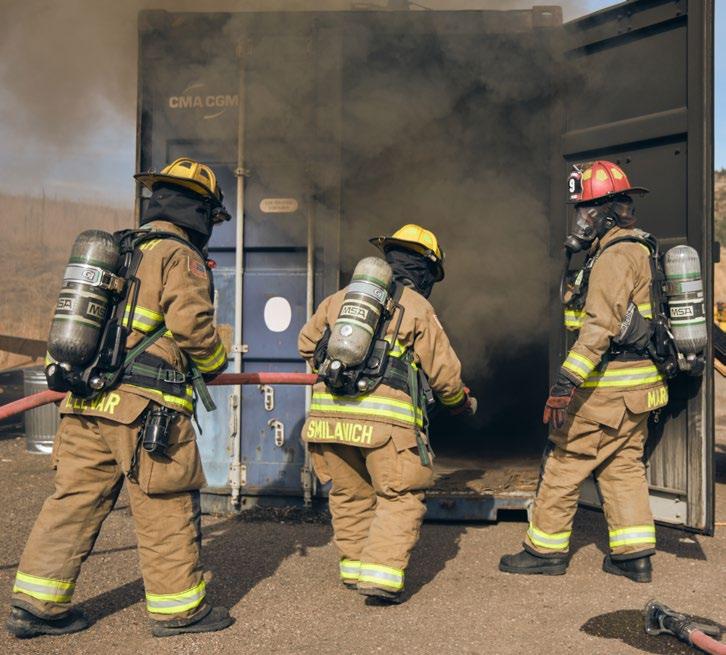
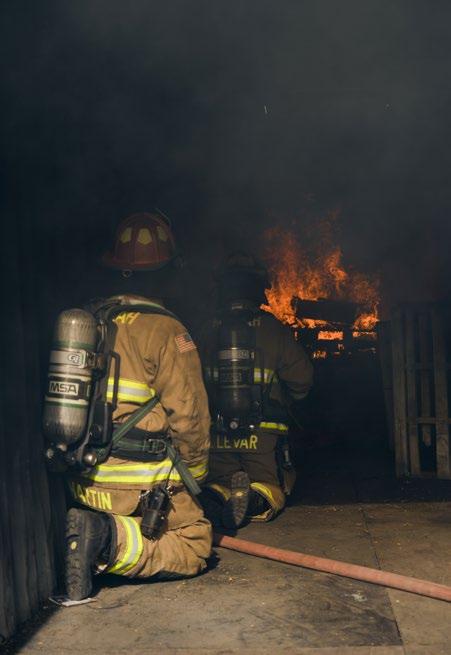
Instead of sitting unused, those unclaimed dollars are transformed into community investments that improve safety, education, and quality of life across southern Colorado. One recent example: a state‑of‑the‑art “burn box” that gives firefighters the live‑fire training they need to stay safe during real emergencies.
Capital credits represent leftover money that wasn’t needed to run the electric cooperative. Every September, San Isabel Electric returns capital credits to members with a mailed check, typically ranging from $10 to $100.
When checks aren’t cashed, the co op follows the state’s unclaimed property laws, and after three years, those unclaimed dollars are placed into a fund that the board of directors donates to community programs in the co op’s service area.
And sometimes, those forgotten dollars end up doing something extraordinary.
TURNING CAPITAL CREDITS INTO COMMUNITY IMPACT
Recently, the Beulah Fire Protection and Ambulance District presented a donation request for a project that would prioritize firefighter safety and reduce the risk of structure fires spreading to surrounding wildlands.
The San Isabel Electric Association Board of Direc tors approved $10,000 of SIEA’s unclaimed capital credits for the project and then approached coop erative partners CoBank and Basin Electric Power
Cooperative. Each stepped up with a $10,000 match ing donation. Cooperative power supplier Tri State Generation and Transmission donated the last $5,000 to meet the project’s funding goal.
Board of Directors Vice President Debbie Rose stated, “In southern Colorado, wildfires can occur any time of year. We are so grateful and proud that SIEA and our partners could support this project, helping ensure firefighters across the region receive the train ing they need to stay safe.”
The new Class A “burn box” provides firefighters with realistic experience in structure fire firefight ing. The facility helps them learn about structure fire behavior in a safe, controlled environment.
Before the project, rural first responder agencies had to travel to Pueblo or wait for a house scheduled for demolition to complete live fire training. Now fire fighters have access to weekly training sessions much closer to home.
TRAINING THAT SAVES LIVES
“Being able to offer new students and ongoing members live fire training builds confidence. They learn that their gear has limitations in those condi tions,” said Fire Chief Bryan Ware from Beulah Fire Protection District. “For seasoned firefighters, it’s a chance to study fire behavior in modern construction. The ultimate goal is simple: They go home at the end of every shift.”
SIEA Board President Jacque Sikes echoed the sentiment, “We’re honored to have the ability to use these funds to support the people that show up when the community calls 911,” she said.
A SMALL ACTION MAKES A BIG DIFFERENCE
While capital credits may feel like a small annual benefit, they represent something bigger, the coop erative business model at work. And when checks go unclaimed, those dollars don’t vanish, they’re rein vested into projects that strengthen, protect, and uplift the communities San Isabel Electric serves.
From scholarships to training facilities like the new burn box, unclaimed capital credits make a lasting impact, proving that even forgotten dollars can change lives.
Do you have capital credits waiting to be claimed?
Every April, we publish a list of names of members who have unclaimed capital credits. Check for your name next month here in this magazine and online at siea.com/capitalcredits. The webpage includes a search tool that is available year-round — it’s an easy way to look for your name and initiate a capital credits claim.
A certified fire instructor oversees students entering the Class A burn box to practice skills and techniques. On the cover (right): Firefighters create advanced fire conditions inside the Class A burn box to allow students to train in a hot, realistic, live-fire environment. Photos by Willie Peterson Photography
2026 Electric Heating Guide
As Colorado continues moving toward cleaner energy, electric heating systems are getting well‑deserved attention. Modern electric systems are among the most efficient home‑heating options available, and, unlike propane, natural gas, or wood‑burning systems, they produce no carbon monoxide.
Whether you’re building a new home, upgrading an aging system, or adding heat to a hard‑to‑reach space, San Isabel Electric sells, installs, and finances a variety of heating options designed for comfort, safety, and long‑term savings.
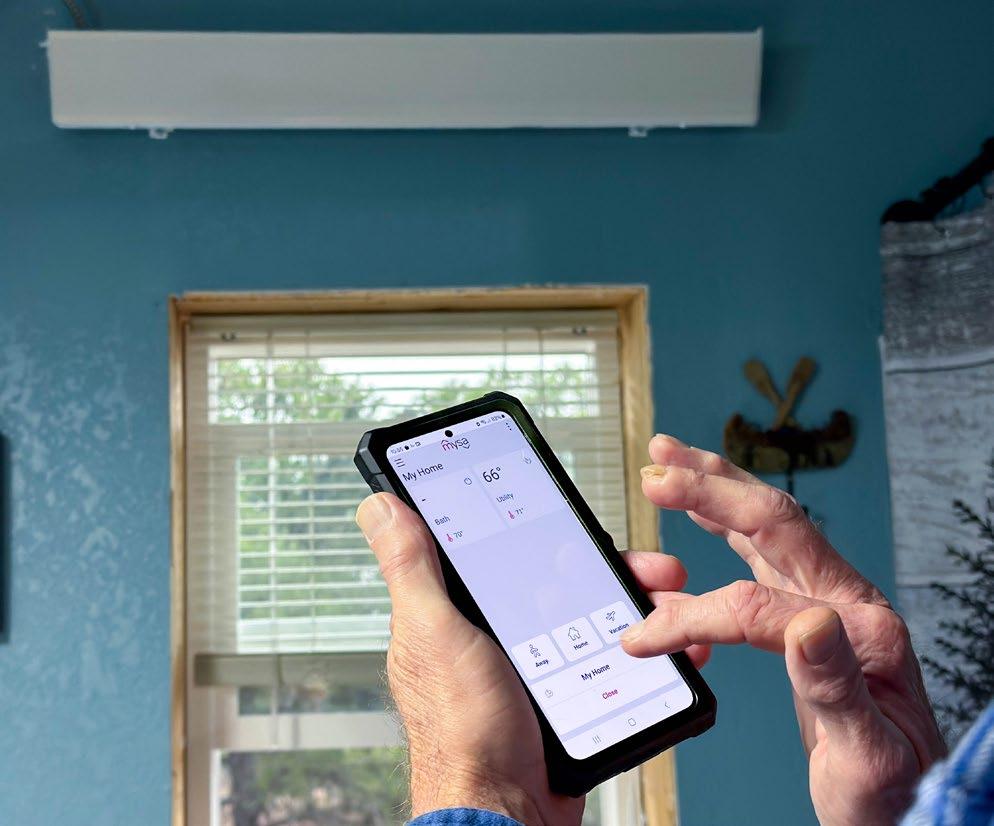

ELECTRIC THERMAL STORAGE HEATERS: SMART HEAT, LOWER COST
Electric thermal storage — ETS — systems are a practical choice for homeowners looking to cut heating costs while shrink ing their carbon footprint. ETS heaters convert electricity into heat and store it inside specially engineered ceramic bricks. The stored heat is slowly released throughout the day to maintain steady, comfortable temperatures.
Save with off‑peak rates
ETS owners can take advantage of off‑peak electric ity rates, which are nearly half the cost of standard rates. Members on the off‑peak ETS rate receive lower‑priced electricity for their entire household 13 hours per day in winter and seven hours per day in summer. Some ETS owners save 40% to 70% on their heating costs.
A safer, greener choice
ETS heaters are never hot to the touch, making them a safer alternative to portable space heaters. They have multiple eco friendly benefits as well. Because they can store surplus renewable energy, they lower strain on the electric grid, which helps reduce overall carbon emissions.
Long‑lasting and easy to maintain
ETS systems often provide decades of reliable service. San Isabel Electric now offers low‑cost lifetime repair contracts for new or existing units. Contracts start at $300, with pricing based on age and model. If issues arise, members get technicians from San Isabel Elec tric, not a call center, to keep their system running efficiently.
Almost two years later, the heaters are doing great and we still love them. They are so efficient.”
— SIEA members Tina and Ron Burden, owners of an all-electric mountain home in rural Huerfano County that relies on an ETS heater as the home’s main heat source with two supplemental cove heaters.
A cove heater has its own independent thermostat that can be controlled with an app or wall-mounted thermostat allowing custom temperatures in each room and multiple temperature settings throughout your home or business.
SIEA members Tina and Ron Burden enjoy the warmth and efficiency of their ETS heater in their all-electric home.
COVE HEATING: COMFORTABLE, QUIET RADIANT WARMTH
Cove heating units offer an efficient, unobtrusive way to warm individual rooms. Mounted near the ceiling, they radiate heat downward. Because radiant heat warms objects as well as air, walls and furniture absorb warmth and act as a natural heat reserve.
Each room can be controlled inde pendently with a wall‑mounted thermo stat, making cove heat ideal for offices, additions, or any space needing personal ized comfort without ductwork.
AIR‑SOURCE HEAT PUMPS: HEATING AND COOLING IN ONE
Air‑source heat pumps provide an all‑in‑one HVAC solution that cools in summer and heats in winter —

no separate furnace or air conditioner required. Today’s models deliver high efficiency even in cold weather thanks to advanced compressors and refrigerants.
Heat pumps work by moving heat energy rather than creating it, making them significantly more efficient and cleaner than fuel‑burning systems. They are especially effective when paired with rooftop solar.
Southern Colorado’s mild climate is ideal for heat pumps, but modern units can maintain comfort across all climate zones in the United States.
San Isabel Electric sells, installs, and finances a variety of home and commercial energy-efficiency products. Learn more today at siea.com/empower, call 719-647-6250, or email energyservices@ siea.com
IS OFF‑PEAK PLUS RIGHT FOR YOU?
San Isabel Electric recently introduced an optional Off‑Peak Plus rate for members who can avoid using electricity from 5 p.m. to 9 p.m. This rate offers nearly half‑price electricity for 20 hours per day, Monday through Saturday, and all day on Sunday. Visit siea.com/rateselectiontool to explore which rate best fits your home.

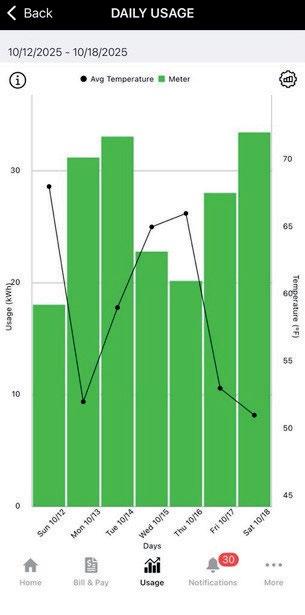

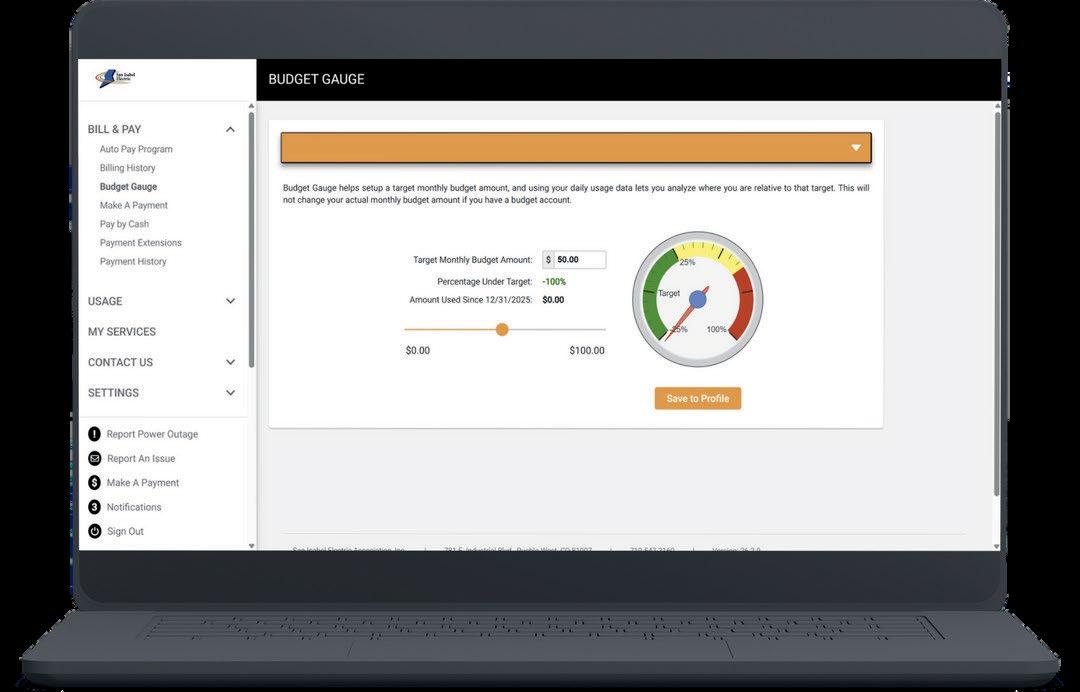




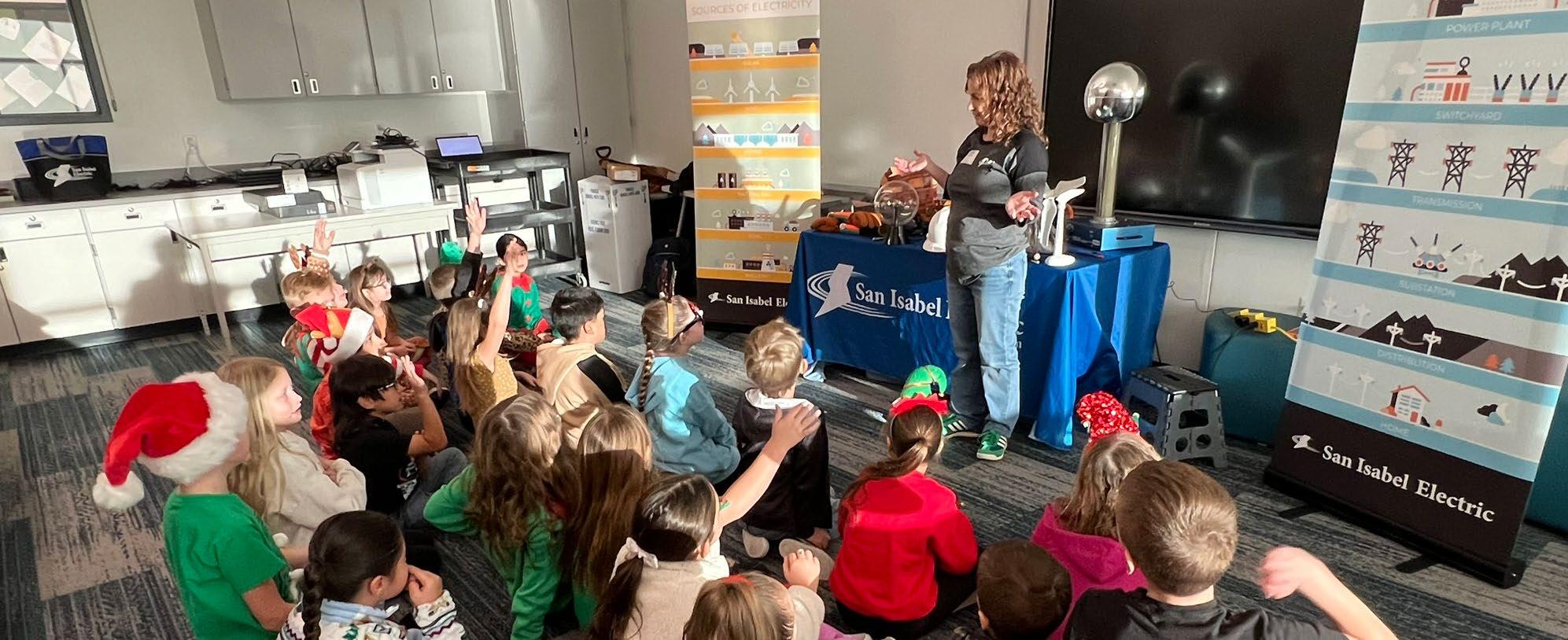
Engaged and excited second-grade Swallows Charter Academy students eagerly raise their hands to share their knowledge with their classmates.
Electricity Sparks Curiosity
San Isabel Electric’s “Story Behind the Switch” program is teaching elementary students about the science and dangers of electricity in unfor gettable ways that textbooks can’t.
The traveling 45 60 minute presentation transforms science lessons into an exciting adventure. Through hands on activities, students explore how diverse resources are used to make electricity, the journey of electricity from power plants to homes, electric utility career paths, and the fundamentals of circuits, conduc tors, and insulators.
The program goes beyond science and teaches life savings skills students can practice and share with their families, including what to do in an auto accident with electric equipment, downed power line safety, and lightning safety tips.
The highlight is always the Van de Graaf generator demonstration that makes students’ hair stand on end, which never fails to send the room into laughter.
Recently, SIEA took the program to Swallows Char ter Academy in Pueblo West.

“What made this program truly impactful was the emphasis on safety alongside scientific understand ing,” Executive Director Dr. Cindy Compton said. “The second grade students walked away not only excited about how electricity works but also equipped with practical knowledge they can share with their families — skills that could genuinely keep them safe.”
SIEA also provides a 16 page workbook with activ ities designed to reinforce what the students learned in the presentation.
The best part? The program is completely free to schools and nonschool youth groups within San Isabel Electric’s service area.
Interested in hosting a session for your school or youth group? Email communications@siea.com, or call 800 279 SIEA (7432) and ask for the communications department. Visit siea.com/storybehindtheswitch to learn more about the program.
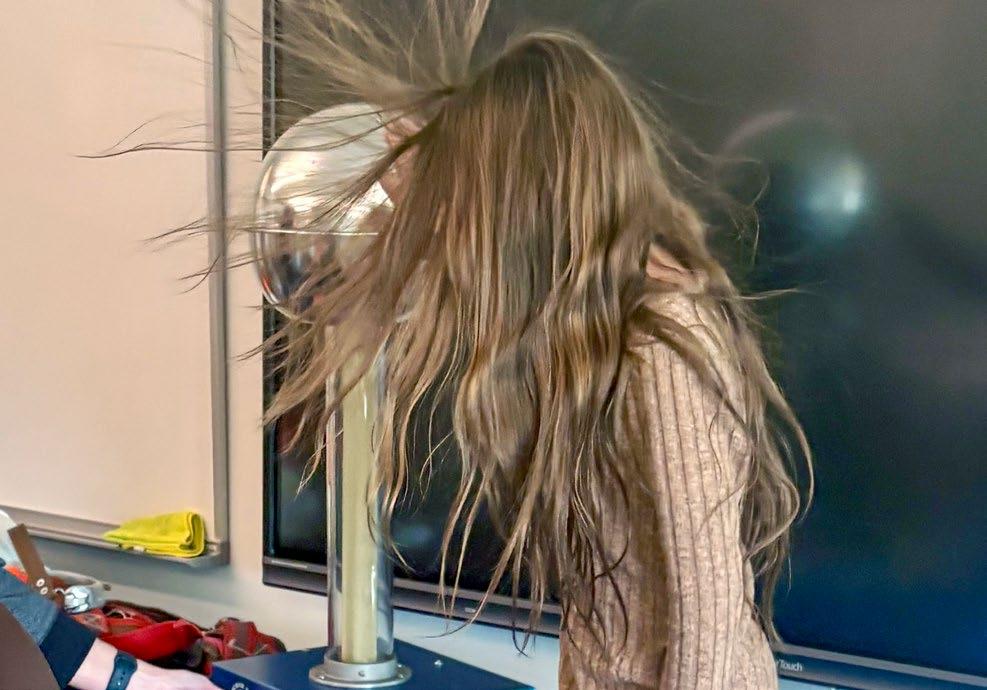
A plasma ball brings a lesson on lightning safety to life, demonstrating how objects with more surface area in contact with the ground make them more likely to be struck.
A student gets a temporary new hairstyle, thanks to a Van de Graaf generator. The experiment brings concepts learned in the presentation to life, such as which materials are conductive, insulating, how to make a conductive pathway, and grounding.
Managing Demand at Home
By Jon Beyer CEO
Sangre de Cristo Electric Association is a not-for-profit electric cooperative, and we exist to serve our communities. In that spirit, we are always looking for ways to make your essential electricity more affordable, particularly as energy costs continue to rise.
We are designing new programs to give members more options to manage the costs of their electric service. One way to help is by managing our individual contributions to the cooperative’s monthly peak demand — those times of day when energy charges are highest. This can be achieved, in part, by taking simple steps at home to reduce energy use during peak periods. These steps include shifting the times you use electricity when you can and staggering the use of your appliances.

Please contact Energy Use Advisor Tom Linza for more details at 719-395-2412 or info@myelectric.coop.
ADDITIONAL UPDATES
Substation battery — We continue to research the feasibility of installing a utility-scale battery adjacent to our Buena Vista substation to study and apply the same storage/discharge during peak demand time cost-savings concept as our residential battery program, just on a much larger scale. The installation may also provide some limited backup power for our system. More information will follow as this project develops.
Last month we introduced two new pilot programs designed to help members manage demand by shifting energy use to off-peak times for electric water heaters and electric vehicle charging. We are launching a third pilot program inviting members who are interested in managing their demand to integrate batteries into their home electric systems.
RESIDENTIAL BATTERY PILOT PROGRAM
Through this program, participants will charge their batteries during low-cost periods when purchasing power from our wholesale supplier is less expensive. During peak hours when power costs are higher, participants will discharge their batteries to meet their energy needs. This approach not only helps members manage their energy use but also reduces the cooperative’s purchased power costs during expensive peak times.
The program is open to the first 20 members who sign up — they must live in SDCEA’s territory full-time. It is available to both solar and non-solar consumers. Enrolled members who participate can receive a $3,000 one-time incentive toward the purchase of a battery system and installation.
Town hall — Thank you to all who tuned in to our first virtual town hall meeting in January. If you missed the live version, the recording is on our website. We are excited to offer this new way to reach out to you, our members, and plan to do this on a quarterly basis. The next scheduled town hall is in April.
Please contact us anytime with questions you may have about the cooperative. You do not need to wait for a town hall. Call 719-395-2412 or visit myelectric.coop/about/contact to get in touch. Our monthly board meetings are also open to members. Information about board meetings is posted on our website at myelectric.coop/boardinfo.
Electric Cooperative Youth Tour — Congratulations to our 2026 participants! On page 7, you’ll read about this group of four high school students. Interest was high in the program this year, and we hope it fosters the development of future leaders.
I also had the privilege of speaking with Buena Vista High School Honor Society inductees at the end of January. I am always happy to speak with organizations about SDCEA. If you would like me or someone else to speak with your group, please call our office.
We look forward to connecting with you about our programs at community events.
SDCEA and Basin Electric Partner on Museum Project
Sangre de Cristo Electric Association is proud to announce its support of the Buena Vista Heritage Museum with a $2,610 grant, provided on behalf of Basin Electric Power Cooperative. Basin is SDCEA’s after-hours dispatch center, based in Bismarck, North Dakota. SDCEA applied for and received the grant, which was awarded January 5, and will go toward the museum’s critical electric rewiring project.
The Buena Vista Heritage Museum, a 143-year-old cornerstone of Buena Vista, is a vital piece of local history. Known for its unique brick construction and iconic cupola weather vane, the building originally served as the area’s courthouse and later as a school. Today, it functions as an educational resource and a community hub — hosting meetings, dances, and events for residents of rural central Colorado, as well as visitors from around the world, including railroad historians.
However, the museum’s aging electrical system, which still includes cloth-wrapped wiring, poses a significant safety risk. The outdated wiring has already caused small fires, narrowly avoiding major damage thanks to the quick actions of staff and the local fire department. Immediate emergency repairs are necessary to protect the building, its historic artifacts, and the people who use this cherished space.
The electric rewiring project is part of a grassroots effort led by dedicated volunteers who have secured donations from local businesses and individuals, with contributions ranging from small amounts to $5,000.
The Colorado State Historic Fund has committed $151,000 toward the project, contingent on Buena

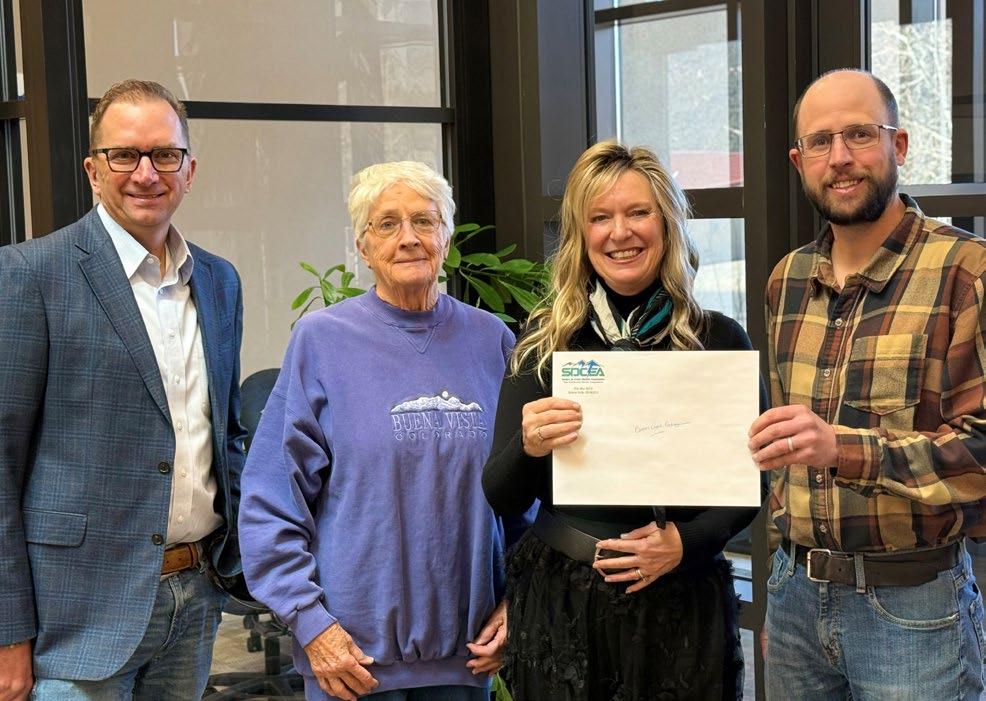
Vista Heritage raising a $37,000 project match. The Town of Buena Vista contributed to the project, hiring an electrical engineering firm to determine the scope of the project.
“Creating a safe, modern electrical system is essential not only for the safety of those who use the museum but also for preserving the history and heritage it represents,” Jon Beyer, SDCEA CEO said. “SDCEA and Basin Electric are honored to support this important project and the community’s efforts to protect such a significant landmark.”
For more information about the Buena Vista Heritage Museum and how you can support its preservation efforts, visit buenavistaheritage.org
Heating & Cooling Solutions Webinar
Looking for efficient heating and cooling solutions for your home or business? Check out this FREE on-demand webinar to learn all about heat pumps — your year-round comfort solution! https://www.youtube.com/watch?v=iGhMOp4Iqvg
Discover how heat pumps can keep you cozy in winter and cool in summer, all while saving energy.
SDCEA CEO Jon Beyer (left) and board member Blake Bennetts, representing the town of Buena Vista (right) present a check to Lisa Wagner (middle right) and Suzy Kelly (middle left) of Buena Vista Heritage.
Students Earn Trip of a Lifetime to Washington, D.C.
Four local students will pack their bags for an unforgettable journey to our nation’s capital this summer. Lexie Davis, Lincoln Gates, and Taya Martinez from Buena Vista and Samantha Bernsen from Cotopaxi secured their spots on the 2026 Electric Cooperative Youth Tour. Sponsored by Sangre de Cristo Electric Association, this experience offers these young leaders a front row seat to American history and government in action.
The adventure begins in Denver, where the group will join approximately 40 other student delegates from electric cooperatives across Colorado. They will start by exploring our state government and the role of local electric cooperatives before flying to Washington, D.C. Once there, they will meet with more than 1,800 high school students from rural communities across the United States for a week of intensive learning and exploration.
The itinerary is packed with educational seminars and visits to iconic landmarks. Students will walk through the halls of the Smithsonian, pay respects at Arlington National Cemetery, stand before the Lincoln Memorial, and visit Mount Vernon. Beyond sightseeing, the tour provides a rare opportunity for students to meet directly with their representatives in the House and Senate, fostering a deeper understanding of the democratic process.
The Electric Cooperative Youth Tour traces its roots back to 1957, when Senator Lyndon B. Johnson inspired the National Rural Electric Cooperative Association to bring rural youth to the capital. He declared that young people should see what the flag stands for and represents. Since then, the program has grown from a single busload of Texas students into a




massive nationwide youth leadership event coordinated by NRECA.
SDCEA selects participants based on a written essay demonstrating why they are the right candidates for this leadership opportunity. The trip fosters new friendships, builds leadership skills, and educates the next generation in our community on the vital role of electric cooperatives.
For students interested in future tours, applications open on the SDCEA website in early October, with submissions due by the beginning of January.
INTERESTED IN RUNNING FOR AN SDCEA BOARD OF DIRECTORS SEAT?
The deadline for the candidate nomination petitions and questionnaires to be received at Sangre de Cristo Electric Association’s Buena Vista office is 4:30 p.m. on March 13.
SDCEA’s annual meeting will be held at 10 a.m. on June 24 at our Custer County warehouse, 56495 Hwy 69, Westcliffe, CO 81252. More details will follow. Scan the QR code or visit myelectric.coop/about/sdcea-election-center for more information.

Lexie Davis Lincoln Gates
Taya Martinez Samantha Bernsen
Rebate Program Beneficial for Energy Upgrades
Sangre de Cristo Electric Association and our wholesale power supplier, Tri-State Generation and Transmission, are excited to offer a bill credit rebate program designed to help our members create more comfortable, efficient, and safe homes. This initiative makes energy-efficiency upgrades more accessible, promoting beneficial electrification to boost productivity, reduce carbon emissions, and support sustainable energy growth.
Since 1985, SDCEA and Tri-State have partnered to encourage the wise use of electricity and the adoption of innovative electric technologies. Our rebate program includes incentives for installing a variety of electric appliances, such as heat pumps, EV chargers, air conditioners, and more. By upgrading to modern, energy-efficient models, homeowners can enjoy lower energy consumption, reduced utility bills, and a smaller environmental footprint.
HOW IT WORKS
Rebates are available for qualifying purchases exclusively to eligible SDCEA account holders. Submit your rebate request online within 90 days of the product’s installation.
Program details, including product eligibility and rebate amounts, are subject to change.
Take advantage of this opportunity to make your home more energy-efficient and environmentally friendly. For more information about the program, scan the QR code or visit myelectric.coop/ energy-efficiency/energy-efficiency-credit-programs/.
Scan to Learn More About Rebates



Wired for Growth
Balancing data center demand and reliability
By Mark Hall CEO
Data centers may feel like a big-city phenomenon, but more of them are showing up in rural communities like ours — and there is good reason for that. Rural areas offer what data centers need most: affordable land, room to grow, and access to transmission lines that can move large amounts of power.
What makes data centers different from other large businesses is their appetite for electricity. These facilities run 24 hours a day, seven days a week. Servers must stay online constantly, which means power must be reliable every minute of every day.
For electric cooperatives like Southeast Colorado Power Association, powering data centers creates both opportunities and challenges.
On the plus side, data centers have the potential to bring steady, long-term load growth that helps support investments in the local grid. With proper planning and policy support, those upgrades — including new substations, stronger lines, and smarter technology — could benefit all SECPA members and could help keep electricity rates steady.
But providing power to data centers presents challenges, too. These large facilities can be constructed and begin operating in as little as one year, but ensuring the necessary infrastructure, equipment, and electricity requires longer lead times and a significant financial investment. Strategic planning and partnerships, as well as long-term power supply strategies, are essential to the process.
While Southeast Colorado Power Association does not currently serve any data centers, co-ops nationwide are fielding requests and inquiries from tech companies, and we anticipate similar requests in the near future.
As a member-owned electric cooperative, our responsibility is twofold: to listen to the communities we serve and to provide reliable, affordable electric service to all Southeast Colorado Power Association members. Balancing those responsibilities is not always simple, especially as new types of large-scale energy users, like data centers, become part of the local landscape.
No matter what the future holds, our priority will be supporting growth with fairness. This means ensuring large-scale energy users pay their fair share so residential bills don’t spike.
The energy landscape is changing, and with it comes both opportunities and challenges. My commitment, and the commitment of Southeast Colorado Power Association’s board and employees, is to continue listening, communicating, and working with our members and community partners to ensure all decisions reflect the best interests of the people we serve.
If you have questions or concerns regarding data centers, your energy bill, or any other co-op matters, we encourage you to stay engaged and reach out.
Your voice matters at Southeast Colorado Power Association.
27850 Harris Road, Ste. A La Junta, CO 81050
719-384-2551
Toll-free 800-332-8634
Fax 719-384-7320
www.secpa.com
facebook.com/secpaonline
@southeastcoloradopower
You Are Invited
SECPA ANNUAL MEETING APRIL 23
JOIN US
Thursday, April 23, 2026 (tentative)
Baca County Fairgrounds
Minnick Building, Springfield
REGISTRATION 5 P.M.
DINNER 6 P.M.
MEETING 6:45 P.M.
BOARD DIRECTOR ELECTION UPDATE
There will be no Director Election this year.

Spring Forward!
Daylight saving time begins March 8.
Set your clocks one hour ahead. It is also a great time to test the batteries in your smoke alarms and carbon monoxide detectors.


• MARCH 17 •
SECPA wishes you a lucky day!
Youth Tour Winners
Each year, Southeast Colorado Power Association sends a few outstanding students from our service area to Washington, D.C., to participate in the Electric Cooperative Youth Tour.
Addison Elam, Cash Neugebauer, and Grant Pickering were selected to represent SECPA at the 2026 tour. These students will spend one week in June learning about our nation’s capital, visiting numerous museums and memorials, and speaking with United States Senators and Representatives. All expenses are paid by Southeast Colorado Power Association.
Congratulations, Addison, Cash, and Grant! We look forward to hearing all about your trip.





ENERGY EFFICIENCY
TIP OF THE MONTH
As spring arrives, take advantage of milder temperatures to save energy at home. Open windows on pleasant days to bring in fresh air instead of running your HVAC system. Replace dirty air filters, which helps your system run more efficiently and improves indoor air quality. As daylight increases, turn off unnecessary lights and rely on natural sunlight when possible.
Small seasonal adjustments like these can reduce energy use, lower monthly bills, and help keep your home comfortable as winter transitions into spring. WIN* RACHEL BLATZACKER acct 1804xxxxxx

If you find your name in this issue as follows (WIN* Your Name, your account number), contact Southeast Colorado Power Association at 719-384-2551 or 800-332-8634 to receive a $50 credit on your next power bill.
Addison Elam Cash Neugebauer Grant Pickering
Help the Lineworker Spring into Action
Did you know March 20 is the first day of spring? This time of year marks new beginnings and fresh blooms, but it can also bring powerful storms that interrupt electric service.
Help the lineworker find his way through the maze to the bucket truck so he can restore power.
Electric Grid Reliability During Weather Events
By Trent Loutensock General Manager
Last month, I wrote to you about the importance of maintaining accurate contact information for you — the members of Y-W Electric Association, Inc. One of the key reasons we ask for updated contact details is so we can keep you “in the know” about electric grid conditions, especially during weather events that may impact service. Timely communication allows you to make emergency preparations when they are most needed. Emmett Wise 88260XXXXX
In mid January, Y-W Electric communicated with members about forecasted severe winds and high fire danger. During this period, our electric grid was operating in Enhanced Powerline Safety Settings. In this article, we want to take the opportunity to explain what that means, outline other strategies used across the electric industry, and discuss the advantages and disadvantages of each approach.
ENHANCED POWERLINE SAFETY SETTINGS
Enhanced Powerline Safety Settings are a proactive operating mode used by power companies — including Y-W Electric and its power suppliers — during periods of elevated wildfire risk.
When operating in this mode:
• Automated equipment that protects power lines and transformers is configured to operate differently than under normal conditions.
• Instead of attempting to automatically re-energize a line multiple times after a problem is detected, the system will automatically de-energize the line.
• If a line is de-energized, Y-W Electric follows a strict protocol that requires visual inspection of the power line before any attempt is made to restore power.
Advantages of Enhanced Powerline Safety Settings:
• Power remains on for members until a problem is encountered on the electric grid.
• Only the affected portion of the system loses power. This may be a small section of a power line, though in some cases — such as an issue impacting a substation or the transmission line feeding it —
an entire substation area may be de-energized.
• More members remain energized during the weather event and fewer miles of line must be inspected before service can be restored. Because inspections can take a significant amount of time — especially in severe weather or hard-to-access locations — this approach can greatly reduce outage duration.

Disadvantage of Enhanced Powerline Safety Settings:
• While risk is reduced, there is potential for wildfire ignition if a power line is damaged and produces sparks before the system de-energizes.
PUBLIC SAFETY POWER SHUTOFFS
Another strategy used in high-risk wildfire conditions is a Public Safety Power Shutoff.
With a PSPS:
• Power is intentionally shut off to entire geographic areas, typically at the substation level, before damaging weather occurs.
Advantage of PSPS:
• By fully de-energizing large areas, the risk of a spark igniting a wildfire is effectively eliminated.
Disadvantages of PSPS:
• Decisions to initiate a PSPS are based on several criteria, including:
࡛ Information from the National Weather Service, such as high wind warnings or Red Flag Warnings
࡛ The accuracy of the timing of these warnings
࡛ The accuracy of the geographic areas identified in the forecast
• After a PSPS event, all power lines must be visually inspected before service can be restored, even if
no damage is immediately apparent. This involves inspecting a large amount of line.
• Because of the scale of inspections required, restoration times are often measured in days rather than hours. Marcy Escobedo 20450XXXXX
VISUAL INSPECTIONS
Visual inspections are a critical safety step following severe weather events. If power is restored without first inspecting lines, damaged equipment — such as broken conductors, fallen poles, or debris contacting lines — can cause sparks and ignite fires. High winds can damage power lines in ways that are not visible from the ground or reported by the public, making inspections essential for the safety of our members and communities. Dominick and Samantha Anderson 10335XXXXX
OUR COMMITMENT TO SAFETY AND RELIABILITY
Y-W Electric is committed to balancing public safety, wildfire risk reduction, and reliable electric service. By using tools such as Enhanced Powerline Safety Settings and carefully evaluating all available information during extreme weather, we work to protect our members while minimizing the duration and impact of outages.
Remember: Keep your contact information up to date to ensure you receive timely notifications about grid conditions, safety settings, and potential outages. Together, we can stay informed, prepared, and safe during challenging weather events.

Remember to Spring Forward!
Daylight saving time begins March 8. Set your clocks one hour ahead. It’s also a great time to test the batteries in your smoke and carbon monoxide detectors. Darrel and Pamela Ritchey 12331XXXXX

ENERGY EFFICIENCY TIP OF THE MONTH
As spring arrives, take advantage of milder temperatures to save energy at home. Open windows on pleasant days to bring in fresh air instead of running your HVAC system. It’s also a great time to replace dirty air filters, which helps your system run more efficiently and improves indoor air quality. As daylight increases, turn off unnecessary lights and rely on natural sunlight when possible. Small seasonal adjustments like these can reduce energy use, lower monthly bills, and help keep your home comfortable as winter transitions into spring.

Win $20
OFF YOUR ELECTRIC BILL
Each month, Y-W Electric Association, Inc. offers its members a chance to earn a $20 credit on their next electric bill. If you find your name and account number in this magazine, call 800-660-2291 and ask for your credit. It could not be easier.
Get acquainted with your account number, read your Colorado Country Life magazine, and pick up the phone. You must claim your credit during the month in which your name appears in the magazine — check the date on the front cover.
Congratulations to Michael Penn and Daniel and Linda Dannar! They found their names in the January issue and claimed their $20 bill credit.

UTILITY SCAMS
TIP OF THE MONTH
Scammers and cyber criminals look for weak points to exploit before software companies can fix them. Update software programs on your computer, tablet, and mobile phone as soon as possible when a newer version becomes available. Software updates often contain critical patches and protections against security threats. Make sure automatic updates are turned on for your security software, browser, operating system, and apps — it’s an easy way to stay protected.

BILLING CORNER
BILLING NOTIFICATIONS
Have you visited ywelectric.coop lately? Our website gives you the ability to check your monthly usage, payment history, and past billing invoices. Payments can also be made on our website using SmartHub. Once you have registered, you can make payments, view your history, or contact our office. You can also manage notifications here.
There are two ways to be notified: by email and/or text message. These notifications will need to be turned on in your SmartHub account. Go to Notifications and Manage Contacts. You can add both your email and phone number for text messages. You will need to make sure the box to Receive Text Messages is checked. This is found by going to the Edit button on the Verified Contacts page. The phone number should be the number where you want to receive text messages and the box should be checked for text messages. Once this is correct, tap the green Continue box. At that point you’ll be prompted to read the Terms and Conditions and either agree or cancel. If you agree, a verification code will be texted to you. Once you enter this code in the box and save the contact, you are set up to get text messages.
Once you have your email and/or text message contact information set up, you can go to Manage Notifications. There are four types of notifications you can receive. Click through each one and chose the alerts you want to receive; you get to decide which are important to you.
The SmartHub app can be downloaded on a mobile device. It is compatible with both Android devices and iPhones.
When making payments, please make sure you are logged into our website — ywelectric.coop — or use the SmartHub app. Y-W Electric does not use a third-party for payments. If you are charged for making a payment, this is not being made on our website. Donald Jr & Debra Misner 54620XXXXX
Contact our office at 970-345-2291 if you have any questions about our website.
INDUCTION COOKTOPS
• $100 per unit for electric-to-induction replacement
• $350 per unit if replacing gas or propane.
• Cooktop must be 30” or larger
HEATING/COOLING
ENERGY STAR AIR-SOURCE HEAT PUMP
Ductless Systems
Energy Star version 6.1 and/or – 7.8 HSPF2
• $500 per system equal to or, less than 1.5 tons (18,000 BTUs)
• $1,500 per system greater than 1.5 tons (18,000 BTUs)
Ducted Systems*
Energy Star version 6.1 and/or – 7.8 HSPF2
• $500 per system equal to or, less than 1.5 tons (18,000 BTUs)
• $1,500 per system greater than 1.5 tons (18,000 BTUs)
• $500 bonus: Dual fuel combined with propane
• Provide at least 50% of heated area down to 17˚F
ENERGY STAR GROUND SOURCE
HEAT PUMP
• $700/ton for new installations
• $450/ton for replacement units
Rebate amounts will notexceed 50% of equipment cost.
Contact Y-W Electric for details.
WATER HEATERS
30-55 gallon storage
• $30 for new or conversion | standard warranty
• $50 for new or conversion | lifetime warranty
• $450 for a heat pump water heater
• $50 wiring allowance gas to electric

ENERGY STAR CLOTHES DRYERS
• $60 • $180 for ventless hybrid
IRRIGATION ELECTRIC MOTORS
The following applies to premium e ciency irrigation motors. Must not be rewound or moved from another location.
• $14/horsepower for motors 10-500 hp
• $1.50/hp if motor replaces fossil fuel Contact Y-W for a table of minimum standards.
VARIABLE SPEED DRIVE FOR IRRIGATION RETROFIT
• 25 hp = $1,600
• 30 hp = $1,750
• 40 hp = $2,050
• 50 hp = $2,350
• 60 hp = $2,650
• 75 hp = $3,100
• 100 hp = $3,800
• 125 hp = $4,600
• 150 hp = $5,300
• 200 hp and greater = $6,800
OUTDOOR ELECTRIC POWER EQUIPMENT*
• Mowers
• Snowblowers
• E-bicycles
• Chainsaws
• Trimmers
LEVEL 2
• Up to $250
• Pruners
• Leaf blowers
• Pressure washers
*Rebates vary. Contact Y-W Electric for Terms and conditions. Call 970-345-2291 for more information.
Energy Star is being used as a benchmark for Tri-State and Y-W Electric incentives in a number of areas in the Energy Efficiency Program.