Forget balancing a checkbook. Today’s teens need to know how to avoid identity theft, decode a credit score and gure out if that “buy now, pay later” plan is actually worth it. With a new state law requiring all Colorado high school students to complete a course in nancial literacy beginning with students in the 9th grade on or after Sept. 1, 2026, educators now face a practical challenge: how do you design a course that prepares 21st-century teens to make smart nancial choices in a world of skyrocketing rents, digital wallets, student loans and TikTok stock tips?
e law, House Bill 25-1192, mandates a semester-long course in personal nancial literacy for every public school student, beginning with the class of 2028.
But it leaves the details up to local school districts, many of which are still guring out what today’s students need most: the basics of budgeting and saving, yes, but also how to navigate the gig economy, manage online spending and protect themselves from increasingly sophisticated nancial scams.
What the law requires, and what it doesn’t
While the law sets a content requirement, it allows schools to integrate the nancial literacy standards into an existing course rather than create a new standalone class. But, students must understand and practice lling out the federal or state nancial aid form (FAFSA or CAFSA), unless they and their parents opt out.
Colorado has one of the lowest FAFSA completion rates in the country, according to the Colorado Department of Higher Education. is means Colorado students are missing out on signi cant amounts of federally available grant money.
WALKING THE LINE
Golden Mill hosts Johnny Cash-themed fundraiser P10
Je co schools consider deep cuts in 2025-26 budget
District may turn to voters for help but $39 million in cuts could be inevitable
BY SUZIE GLASSMAN SUZIE@COTLN.ORG
Faced with a looming $60 million structural de cit, the Je erson County school board reviewed the district’s proposed 2025-26 budget on June 4 and began a sobering discussion about what comes next.
In the upcoming school year, Je co is projected to spend more money than it brings in, relying on savings to bridge the gap.
2027-28 school year.
e district has already shuttered 21 schools since 2021, resulting in $20 million in recurring cost savings. Yet, Copeland said the overall budget continues to grow due to in ation, compensation increases and special education needs.
“ is is not a proposal. is is a hypothetical illustration,” Copeland said as she walked board members through a series of bleak multi-year forecasts. “If we just keep doing what we’re doing, we do not right the ship.”
Accountability and long-term planning
e district is statutorily required to adopt a high-level plan to address ongoing shortfalls when using reserves to fund recurring costs.
ers for additional funding through a mill levy override.
e new forecasts assume modest revenue increases and enrollment declines over the next three years. e district anticipates losing 800 students in both the 2026-27 and 2027-28 school years.
At the same time, it projects rising costs for salaries, bene ts, utilities and mandated services, such as special education.
Copeland said the forecasts already include sta reductions aligned to enrollment loss.
WESTMINSTER WINDOW WESTMINSTER WINDOW
e proposed budget relies on $39 million in one-time spending from the district’s fund balance, and Chief Financial O cer Brenna Copeland warned that without signi cant changes, reserves could dip to unmanageable levels by the
is year’s budget plan, presented in May and reiterated at the June 4 meeting, outlines a phased approach: reduce expenditures through program changes and sta ng cuts, avoid future cost increases where possible and consider asking vot-
“We are recognizing that when we lose 800 students, we do sta for fewer positions,” she said. “I get frustrated when people suggest that we’re not including reductions. We are.”
Still, the projected gap persists. By 202728, Je co’s unassigned reserves and its designated fund balance for future use are expected to fall to zero, leaving no cushion for emergencies or midyear adjustments.
Golden closes in on municipal center’s price tag
New geothermal wells will help heat, cool the building
BY CORINNE WESTEMAN CORINNE@COTLN.ORG
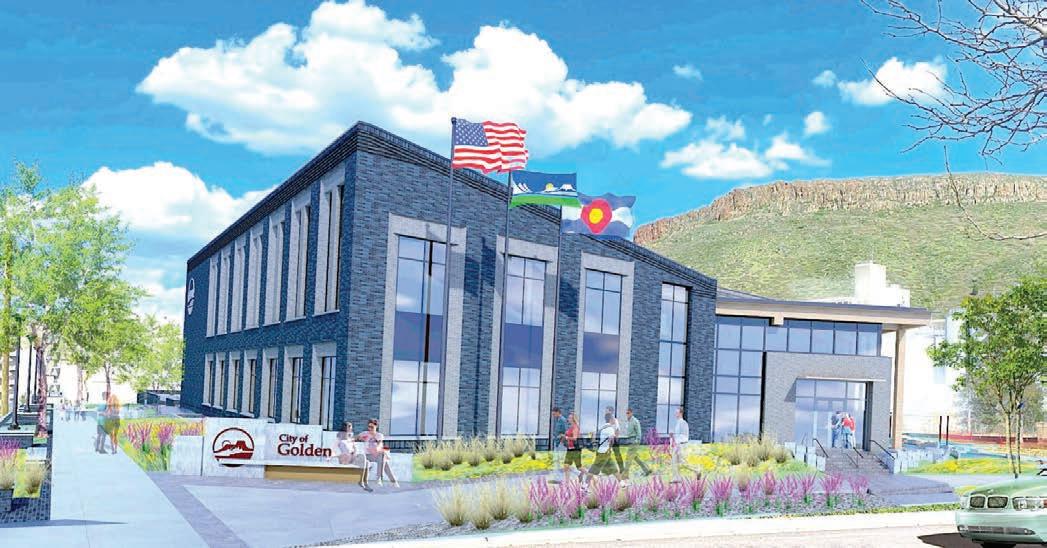
e City of Golden is scheduled tonalize its budget and receive the guaranteed maximum price for its new municipal center and police headquarters next month and City sta members said they hope the new facility’s budget will remain in the $47 million range as planned.
On July 22, the City Council will vote on whether to start construction by approving a contract amendment with its general contractor.
Separately, the project’s groundbreaking ceremony and open house are tentatively scheduled for the following day. Overall, the municipal center at 311 10th St. will cost an estimated $60 million and should be ready for move-in by mid-2027.
Some wins, some hits
City o cials are estimating $47 mil-
BY CORINNE WESTEMAN CORINNE@COTLN.ORG
Looking east from Archer Street, concept art from May 20 shows the exterior of the City of Golden’s new municipal center and police headquarters at 311 10th St. Construction is expected to take at least 18 months, with sta set to move into the building in 2027.
lion just for construction, not including furniture, moving costs or other pre- or post-construction items.
However, the general contractor is scheduled to present the guaranteed maximum price in July. With prices for construction materials uctuating, consultant Tom Wuertz of Handprint Architecture said there have been “some wins” and “some hits.”
He told the City Councilors at a May 27 work session: “We are still targeting $47 million for our budget, (but) we’re not sure exactly where it’s at.”
One of the wins is that the city has received a $800,000 state grant “to help fund sustainability elements, to be paid out throughout the construction,” Assistant to the City Manager Steve Glueck con rmed in a sta memo.
Mayor Laura Weinberg said she was excited about the geothermal wells that will help heat and cool the building. While others around Golden have used geothermal wells to help heat and cool their properties, Weinberg said this will be a rst for the City of Golden.
Nonprofits get boost from Golden Civic Foundation
is summer, local families in need will buy fresh food at the Golden Farmers Market, Foothills Fire & Rescue will carry injured hikers on their new stretcher, and the Colorado Railroad Museum will install an ADA ramp for a new exhibit. And it will all be thanks to people buying beer at last year’s Summer Jam, bidding in the auction at the fall gala, and generally supporting the Golden Civic Foundation.
GCF recently awarded almost $125,000 in grants to 47 local nonpro ts and causes, including $21,000 dedicated to Golden-area schools.
e foundation con rmed it has now raised and invested more than $19 million in the Golden community since its inception in 1970.
GCF, its partners and the grant recipients celebrated at the annual awards breakfast on May 14 at e Bu alo Rose, where GCF also introduced Catherine Withers as its new executive director.
“Together, with the organizations and individuals in this room, we will continue to create positive, lasting change for our community,” Withers said.
e recipients thanked GCF, saying the grants will support everything from teen internship programs and repairing cars for single mothers to the upcoming 4th of July and Bu alo Bill Days festivals. Overall, these funds will help keep locals healthy, safe and active this summer and beyond, they said.
BGOLDN’s Kevin Andrezejewski described how grant sources like GCF are being “bombarded with applications” because of the immense need across the country. As such, he was grateful for GCF’s continued support, saying, “ rough this grant, we’re able to get closer to our partners … and work on things like this together.”
Fresh food for local families
Andrezejewski, BGOLDN’s executive director, said his organization received a $3,000 grant to support part of its Local Food Access Program. is supplies lo-
cal families with prepaid debit cards to buy fresh foods at this summer’s Golden Farmers Market.
Andrezejewski said this program has been funded by two grants, including the GCF one. In the past, he said, the program has received as much as $22,000. However, because the other grant wasn’t available this year, he said BGOLDN will only have the $3,000 GCF grant to support this year’s program. at will be enough to help six families.
Andrezejewski explained how GCF is also supporting BGOLDN with a low-interest loan so BGOLDN can pay for a new, permanent location once it nds one. He said his organization has been looking for several months, and that he and his colleagues are hoping they’ll nd something by the fall.
In the interim, BGOLDN will continue operating out of the Golden Church of Nazarene campus, he said. ere, it serves hundreds of Goldenites through its fresh food pantry, home deliveries, food rescue and school snack programs, among others.
Andrezejewski said BGOLDN appreciates all the support it receives from GCF, its other community partners, donors and volunteers. He said Goldenites can continue supporting BGOLDN through food or monetary donations or by volunteering.
New stretcher to rescue trail users
For its rst GCF grant application, Foothills Fire & Rescue has received $2,300 to buy a new stretcher this summer. Chief Rod Cameron said it will help
carry people who get injured and/or exhausted on local trails.
Cameron said the new stretcher should be here by mid-June, just in time for the summertime in ux of hikers and bikers.
e department currently has three stretchers, but Cameron said they weigh about 30 pounds each, and are made of hard plastic with heavy steel frames. ey also don’t have handles, requiring four to six people to maneuver one, which he said is di cult on narrow trails.
In total, he said Foothills needs to use these stretchers about twice a month, with the Beaver Brook Trail and Matthews/Winters and Lair o’ the Bear parks seeing the most calls.
Foothills’ new stretcher, though, will be several pounds lighter and easier to maneuver around tight spots, thanks to its handles and the fewer people needed to carry it, he explained.
e department was hoping to purchase two stretchers, but Cameron said the GCF grant will only cover one. However, he’s trying to nd other funding sources to purchase a second one later this year. He thanked GCF for all its support, saying the application process was easy and the GCF sta were “nice people to work with.” He said he’d be willing to apply again next year.
“We’re a fairly small re department; we don’t have a big budget,” he said. “( is grant) may not be a lot of money, but even a little money helps support some of these needs that are tough to budget for.”
ADA ramp to help people access history
Over the past six years, GCF has been helping the Colorado Railroad Museum improve accessibility across its campus, whether that was paving sidewalks or adding ADA-compliant bathrooms. It might not be the most exciting or glamorous work, but museum personnel said it’s vital to ensure visitors with strollers, wheelchairs and other mobility challenges are able to access everything on the campus.
COURTESY IMAGE
In June 2024, Dinosaur Ridge camper Wim Singer, 6, looks over an informational sign along Golden’s Triceratops Trail. Friends of Dinosaur Ridge recently received a Golden Civic Foundation grant to help maintain the trail. CORINNE WESTEMAN
What I’ve Learned About Why Condominiums Are Getting Harder to Finance
Four years ago on June 24, 2021, part of a 12-story condominium building in Surfside, Florida, collapsed at 1:14 a.m. killing 98 residents and injuring 11 others.
But that’s only one event that has contributed to the increasing difficulty of selling and financing the purchase of condos across America.
Primarily because of severe weather, especially hail storms in Colorado, master insurance policies have gotten more expensive and their deductibles increased dramatically. When the deductible in a master insurance policy exceeds 5% of the insured value, units within a condo association become “non-warrantable” according to Fannie Mae and Freddie Mac guidelines — and over 90% of all loans are sold to those federal agencies after closing and must therefore meet those guidelines.
home for first-time homebuyers who are less likely to have that much cash. They could also go to a “portfolio” or “non-QM” lender, but those lenders don’t typically offer the low down payments of conventional or FHA lenders.
by a single entity
Fewer than 35% of the units are the primary or second home of the unit owner (FHA only)
The HOA has inadequate reserves
Every lender has its own condo questionnaire that must be completed by the association property manager. The questionnaire addresses the numerous concern areas of the lender. The loan could be rejected if:
Master insurance deductible is over 5%
Commercial space exceeds 35%
More than 15% the unit owners are 60 or more days delinquent on HOA dues
A construction defect lawsuit is pending Less than 10% of the HOA budget is allocated to reserves
There’s a lot of deferred maintenance
FHA does a lot of this analysis for lenders and will provide a 3-year certification which lenders can rely on, but the application process is tedious and many condo associations fail to apply for or renew their certification.
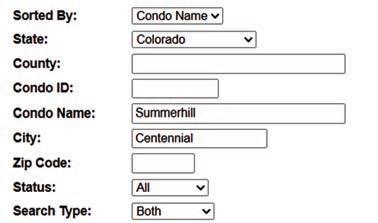
That FHA lookup website is https:// entp.hud.gov/idapp/html/condlook.cfm
Here’s what the screen looked like when I searched for the Centennial condo featured with a price reduction in last week’s ad:
Sometimes it’s hard to know whether a unit is a condo or a townhome. The simple distinction is that a townhome owns the land under it, but even a standalone home could legally be a condo.
Buyers can pay cash, of course, but condos have long been considered the entry-level
More than 20-25% of the units are owned
NAR Dilutes Its Rule Against Hate Speech by Realtors
In the aftermath of George Floyd’s murder by a Minneapolis cop in May 2020, and the heated rhetoric, much of it racist, which followed, the National Association of Realtors enacted a “standard of practice” to go along with Article 10 of the NAR Code of Ethics, which bars Realtors from denying professional services based on “race, color, religion, sex, disability, familial status, national origin, sexual orientation, or gender identity.”
Inspired by demand for social change and an unprecedented number of complaints received by NAR relating to discriminatory conduct and language by Realtors, the Board approved Standard of Practice 10-5 with language that expanded Article 10 to include the prohibition against harassment and hate language generally and not just limited to a Realtor’s professional life.
SOP 10-5 was implemented by the NAR Board of Directors on Nov. 13, 2020, and read as follows: “Realtors must not use harassing speech, hate speech, epithets, or slurs
based on race, color, religion, sex, disability, familial status, national origin, sexual orientation, or gender identity.”
Here’s the new language, which no longer enforces that rule on Realtors’ communications or actions outside their business life:
“Realtors, in their capacity as real estate professionals, in association with their real estate businesses, or in their real estaterelated activities, shall not harass any person or persons based on race, color, religion, sex, disability, familial status, national origin, sexual orientation, or gender identity.” (Emphasis added.)
SOP 10-4 continues as follows:
“As used in this Code of Ethics, harassment is unwelcome behavior directed at an individual or group based on one or more of the above protected characteristics where the purpose or effect of the behavior is to create a hostile, abusive, or intimidating environment which adversely affects their ability to access equal professional services or employment opportunity.”
The search showed that this condo is approved by FHA for the 3-year period beginning July 24, 2023.
Although regulators have determined that the buyer’s agent, not the listing agent, is obligated to check whether a condo is FHAapproved, a responsible listing agent should, in my opinion, do the simple search described above and not list “FHA” as acceptable financing if the community is described as “rejected” or “expired” on that website.
Even if the website shows the association as approved, the lender will still require the long-form questionnaire from the association and study the budget, declarations, bylaws and more before approving a loan, so the lender should request those documents as soon as possible after the buyer goes under contract — certainly within a week.
The legal description can sometimes mislead a lender, broker or buyer as to whether they’re dealing with a condo or a townhome. Typically, the legal description should refer to a “condo declaration” and not have a “block and lot” description that is more appropriate to a parcel that includes land. Some legal descriptions which include the word “condo” are in fact townhomes, and vice versa. The title company can quickly research the full legal description and answer that question, which becomes critical to obtaining loan approval. Another clue would be if the association is on the FHA condo lookup database.
Back to the subject of insurance coverage and deductibles, a buyer who purchases a condo as a primary resident or second home should get an HO-6 “walls-in” condo insurance policy which includes a “loss assessment” endorsement, which would pay for the deductible which is assessed to each unit owner as the result of a hail or other claim. The annual cost of such a policy is far less than the insurance policy for a single-family home and can save you up to a 5-figure special assessment from the condo association.
If the master policy does not include roof, exterior, etc., the unit owner should purchase a more expensive HO-3 policy instead of the HO-6 policy.
FHA is favored because of its low downpayment requirement — as little as 3.5% — but with a higher down payment it’s possible the lender will only require a “streamline” review, which is quicker and less expensive. That requires a minimum 10% down payment for a primary residence and 25% for a second home.
It’s important for a buyer to hire an agent experienced in condo purchases and who can refer you to the best lender.
$560,000
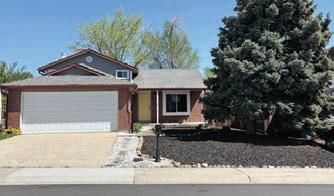
This updated, 4-bedroom/2-bath, 1,586-squarefoot tri-level home at 6337 W. 68th Place is in a quiet, established neighborhood. Each level has been thoughtfully renovated. The vaulted main level has new luxury vinyl plank floors, and there’s new paint throughout. The galley kitchen has new cabinets, complemented by white appliances. The upper level has 3 bedrooms with new carpet and an updated full bathroom. The lower level has a spacious family room with a brick fireplace and above-grade windows. There is a 4th bedroom, laundry, and updated 3/4 bathroom on that level. The windows and siding were replaced in 2018, and a new roof was installed last month. A narrated video tour is posted at www. GRElistings.com. Call Kathy at 303-990-7428 to request a private showing.
BUDGET CUTS
at, Copeland said, poses operational risks.
“I don’t know how schools would navigate a negative October adjustment without carryforward,” she said, referring to the reserve balances schools typically rely on when enrollment numbers change.
Board confronts painful choices: job cuts likely
At the board’s request, Copeland presented three models showing how the district could close a $60 million shortfall.
Each hypothetical model involved signi cant cuts to sta ng, showing that even steep cuts to software, supplies and other discretionary spending don’t go far enough.
One proposed a at 6% cut across all spending categories, totaling about $60 million. Another suggested a 6% cut to full-time sta , resulting in the elimination of approximately 564 positions. A third option varied the approach, cutting 5% to 10% in targeted areas while attempting to shield general instruction and school-based sta ng.
Board Member Danielle Varda asked why sta appeared to be the main target of cuts when some families might assume administrative or central expenses could be trimmed instead.
Varda said that if cuts to school-based sta are on the table, the district has a responsibility to explain why central services aren’t absorbing more of the burden.
Copeland explained that 84% of the general fund budget is tied to salaries
and bene ts. at includes not only teachers, but paraprofessionals, counselors, custodians, transportation sta and others.
“Of the $60 million target, $49 million would come from reductions to salary and bene t accounts,” Copeland said.
“ at’s where the money is.”
Board responds with urgency
“We’ve got to prepare our community for the fact that there are going to be sig-
limits, caps on consultant contracts and leaving vacancies un lled.
Deputy Superintendent Kym LeBlancEsparza said stakeholder input will be critical to shaping district priorities and understanding what families value most.
“In three decades of education, I’ve been through downturns before,” she said. “We have to establish criteria, involve stakeholders, educate people on what’s in each category and identify what’s undesirable versus what’s impossible.”
e board agreed to form a working group, likely comprising at least two board members and district leaders, to develop that framework this summer.
Applegate and others said the district should begin community conversations about asking voters to approve a mill levy override. Without one, they said, the kinds of cuts needed in 2026 and beyond could reshape Je co schools.
“If we are going to ask the community to support a mill, we need to be speci c,” Varda said. “We need to be clear about what we’re protecting, what we’re cutting and what we’re asking the money to do.”
is year’s resolution will include that required plan, she said, and will outline broader strategies for reducing expenditures and possibly going to voters with a tax request.
ni cant reductions in force,” said Board Member Paula Reed. “ at’s going to be unavoidable.”
Director Michelle Applegate somberly agreed.
“Even small gestures to demonstrate we are tightening our own belts are important. We need to show our community we are taking this seriously.”
Applegate suggested implementing cost-saving policies now, such as travel
CENTER
She believed the groundbreaking ceremony would be an opportunity to educate the public about the well-drilling process and how these geothermal wells will work long-term.
Open house plans
City Manager Scott Vargo con rmed the open house would have stations set up where various parts of the building will be, such as the lobby and the parking area. He said the geothermal wells will be featured at one such station.
Councilor Don Cameron asked sta
e board will vote on the 2025-26 proposed budget on June 12.
Looking ahead, board members acknowledged that decisions must come soon. School budgets are typically built in November for the following year, meaning discussions about sta ng, programming and potential tax requests can’t wait.
“We have to start talking now about what we will do,” Reed said. “Not just what we won’t.”
members to ensure that there would be spots for Golden’s time capsules at the municipal center and ensure they’re moved before the current City Hall is demolished.
Sta members said they’ve selected a tentative spot for the time capsules and the Liberty Bell in the municipal center’s east plaza.
Aside from the Liberty Bell and a few other items, Vargo said the city won’t be bringing most of its art to the new building. So, sta members are trying to decide whether and how to decommission the current pieces, saying Golden might host a public sale or auction for them. However, details are still being nalized. For more information, visit GuidingGolden.com.
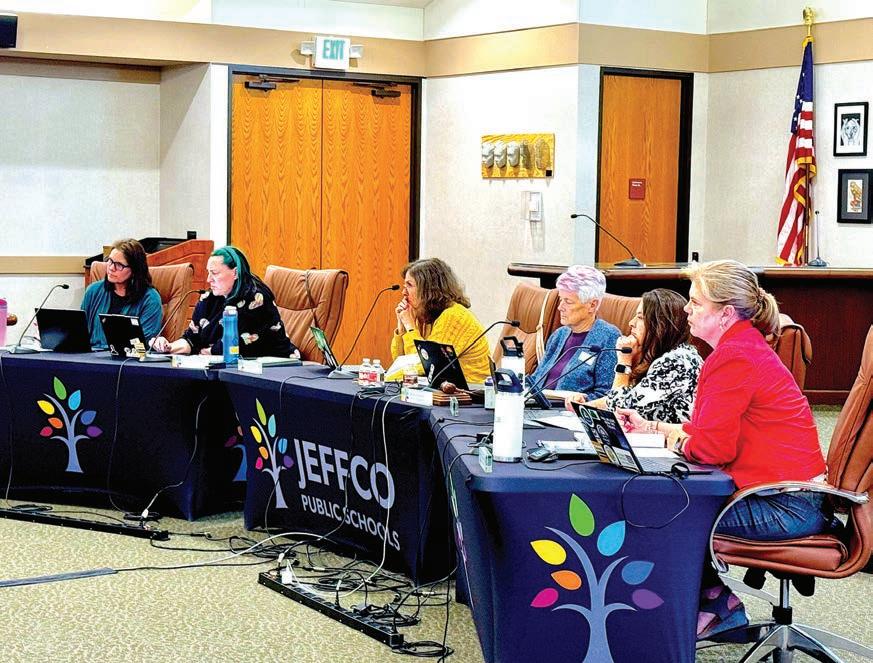
Je erson County Board of Education members and Deputy Superintendent Kym LeBlancEsparza listen intently during the June 4 budget discussion. Superintendent Tracy Dorland was absent from the meeting. SUZIE GLASSMAN
CURRICULUM
e law doesn’t include a standardized curriculum or end-of-course exam. Instead, it points to existing high school standards, last updated in 2020, as the foundation. ose standards cover budgeting and saving, credit and debt management and understanding taxes. But they also include topics like risk management and insurance, fraud prevention and identity protection and nancial decision-making and planning for college. Each district will determine how to implement the course, whether as a graduation requirement embedded in current o erings or as a standalone class
What’s useful for teens in 2025
Anneliese Elrod, chief operating ofcer of Westerra Credit Union, says the curriculum must go far beyond “checkbook math” to prepare students for reallife nancial challenges. at includes understanding how credit cards work, budgeting realistically and navigating everything from nancial aid to digital pay-
NONPROFITS
Deputy Director Rob Kramer said the most recent $3,000 grant was no di erent, as it will help the museum build an ADA ramp this summer. Once completed, it will connect to a platform where people can look inside two historic train cars.
ment scams.
“Budgeting by available balance is one of the most common mistakes we see young people make,” Elrod said. “ ey don’t understand the di erence between their current balance and what’s pending. It can lead to overdrafts or worse.”
She said teens should learn how to read a pay stub, build a credit score and avoid scams on payment apps like Venmo and CashApp. Lessons should also guide them through how to evaluate nancial decisions, such as whether to rent an expensive apartment or sign up for a “buy now, pay later” plan.
“Even understanding basic investing, like what a Roth IRA is or how to open an interest-generating savings account can give them a huge head start,” Elrod said.
Elrod said she was especially glad to see FAFSA covered in the new requirement.
“ at knowledge is something you just don’t intuitively understand, and it’s a very convoluted maze,” she said. “If we are doing it for that reason — bravo.”
Additionally, she emphasized that understanding FAFSA and student loans is crucial, as many students miss out on nancial aid by skipping the application process, which can leave them paying o
Kramer said one of the train cars and the roof over it are already in place, adjacent to the entry depot. e museum is hoping to complete the ADA ramp and platform this summer, so that by the fall, people can be on the platform and look into the train car’s windows.
e second train car will be moved into position later this year or early next year.
e entire project is about two-thirds complete and will total about $250,000,
debt well into the future.
While today’s teens may be more aware of traditional scams than older generations, Elrod said, they’re often more vulnerable to savvy marketing and highpressure sales tactics.
“Marketers are very good at making it feel good and immediate,” she said. “And kids are all about that.”
Keeping teens engaged in a dry subject
Teenagers may not be thrilled about taking a required money class, but educators can keep them engaged with realworld scenarios, Elrod said. at starts with relevance.
“ ey’re not going to understand purchasing a house. ey are going to understand going out to dinner with friends or buying new clothes,” she said. “Making the examples relevant helps students connect the dots.”
Elrod’s team at Westerra Credit Union o ers a classroom simulation that gives students a job, a salary and bills to manage and then throws high-pressure sales pitches their way.
“It’s one thing to talk about budgeting,” she said. “It’s another to experience the consequences of blowing your budget on
not including the train car restoration. However, the museum has been tackling it in phases, he explained. Overall, Kramer described how this setup will be the best of both worlds. e historic train cars will be preserved from the elements while people can still look inside them. e windows are large enough that almost everyone will be able to see inside them from the platform, including younger patrons and those in
an apartment with killer mountain views and realizing you can’t a ord to eat.”
When students walk through those decisions, Elrod said, the lessons tend to stick. “You can tell them they need to budget, but letting them feel what it’s like to make the wrong choice is much more e ective.”
What parents can do at home
Financial education doesn’t have to stop at school. Elrod encourages parents to involve teens in family budgeting, talk openly about money and consider opening joint accounts or debit cards when they’re ready.
“Every student is di erent. Some are ready at 10, others not until 16,” she said. “ e key is creating habits early and making the conversation feel relevant.”
Elrod recommends apps that help families gamify chores, savings and spending. Some allow parents to set savings rules, such as automatically diverting one-third of every allowance into savings and help kids track their spending in real-time.
“ e goal isn’t to lecture,” she said. “It’s to build con dence. When teens feel in control of their money, they make better choices.”
wheelchairs, he said.
Kramer said he hoped people would be able to see the ongoing work at GCF’s annual Summer Jam on June 25 at the museum. He said both the event and GCF do a lot of good for the community, and that the museum is happy to support them.
For more information about Summer Jam or the 2025 GCF grant recipients, visit goldencivicfoundation.org.
Community News
BY CORINNE WESTEMAN CORINNE@COTLN.ORG
Golden Farmers Market kicks o 2025 season
e Golden Farmers Market has returned to Clear Creek for its 24th season with a host of local vendors and goods.
e Golden Chamber of Commerce will host the market every Saturday from 8 a.m. to 1 p.m. through Oct. 4.
e market will be at its usual spot at 10th and Illinois streets, between the library and the tennis courts, except for July 26. Due to Bu alo Bill Days, the market will move to the Golden High School parking lot that Saturday only.
People are encouraged to take the Ore Cart shuttle and/or ride their bikes to the market. For those who wish to drive, there is parking information online.
For information about vendors and entertainers, or to volunteer for the weekly market, please visit goldenfarmersmarket.org.
Local hotel announces weekly creekside concerts
e Golden Hotel has launched a summertime music series every Wednesday evening this summer, so locals and others passing along the creek can enjoy music, food, camaraderie and sunset views along Clear Creek.
e Wednesdays on the Creek Summer Music Series will be from 5-8 p.m. every Wednesday through Aug. 27. Attendees will gather at the hotel’s Creekside Courtyard to enjoy a new musical artist each week, except July 2.
e artists range from solo artists to full bands, with genres spanning from country and folk rock to reggae and jazz.
Each event is free and open to the public, although the courtyard has limited seating so attendees are encouraged to bring their own chairs. Attendees are also asked not to bring outside food or drink. e hotel will have food and drink specials for those who are interested.
e patio will open at 5 p.m., artists will start performing at 5:30 p.m., with the event ending at 8 p.m.
In case of inclement weather, the music will be moved to the hotel lounge.
“We’re thrilled to be o ering this music series as a way for Goldenites to get together and enjoy local music and food with friends and
neighbors,” General Manager Tim Gerhold said in a recent press release. “Our summer music series is more than attending a musical event; it is about fostering community spirit and creating memorable experiences for all.”
For more information, including a list of upcoming performances, visit thegoldenhotel.com.
4th of July Festival returning with yoga, music, games and more
e Golden Lions Club is o ering a full day of family fun, live music, local food and hometown spirit at its annual 4th of July Festival.
e 53rd annual festival will run from 10 a.m.-8 p.m. in Lions Park.
e event will kick o with an hourlong yoga session with Rise Yoga and Wellness, before the Junior Jubilee gets going at 11 a.m.
e City of Golden is sponsoring the Junior Jubilee again this year, and it will o er rides, games and kid-friendly activities until 5 p.m.
Live music starts at noon with Je Goodwin and the Front Range Cowboys. under Roads – A Springsteen Experience and disco favorite Boogie Machines play in the afternoon and evening, respectively.
e event will feature local food vendors, and the beverage garden will have beers, hard seltzers and wine for sale.
e Lions Club will also have a community ra e with a grand prize of $1,000 along with other cash prizes.
All event pro ts will fund scholarships for Golden High School students, local food
COLOR ON A GRAY DAY
banks and community services for local families in need, and Porchlight – the local family justice center.
As the Lions Club’s Mark Bowman summarized in a recent press release, this beloved Golden tradition brings together residents, families, and visitors for an old-fashioned Independence Day celebration packed with entertainment and hometown pride.
“We’re honored to continue this longstanding tradition of community connection and celebration,” Bowman said. “It’s a wonderful opportunity for families and neighbors to come together, enjoy great food and live music, and support important local causes.”
For more information or to volunteer, contact Mark Bowman at markbowman1955@ gmail.com.
Web: GoldenTranscript.net
A publication of To subscribe call 303-566-4100 or Scan this QR Code
SCOTT TAYLOR Metro North Editor staylor@coloradocommunitymedia.com
CORINNE WESTEMAN Community Editor cwesteman@coloradocommunitymedia.com
For advertiser or vendor questions, please email our business department at accounting@ coloradocommunitymedia.com
Columnists & Guest Commentaries Columnist opinions are not necessarily those of the Transcript. We welcome letters to the editor. Please include your full name, address and the best number to reach you by telephone.
Email letters to staylor@coloradocommunitymedia.com
Deadline
Tues. for the following week’s paper.
Golden Transript (ISSN 0746-6382)
A legal newspaper of general circulation in Je erson County, Colorado, the Golden Transcript is published weekly on Thursday by Colorado Community Media, 3540 Evergreen Parkway, Evergreen, CO 80439.
PERIODICALS POSTAGE PAID AT EVERGREEN, COLORADO and additional mailing o ces.
POSTMASTER: Send address change to: Golden Transcript, 750 W. Hampden Ave., Suite 225, Englewood, CO 80110
CORRECTIONS
Colorado Trust for Local News asks readers to make us aware of mistakes we may have made.
Email staylor@coloradocommunitymedia.com if you notice a possible error you would like us to take a look at.
After several gray, rainy days in Golden, a male house finch
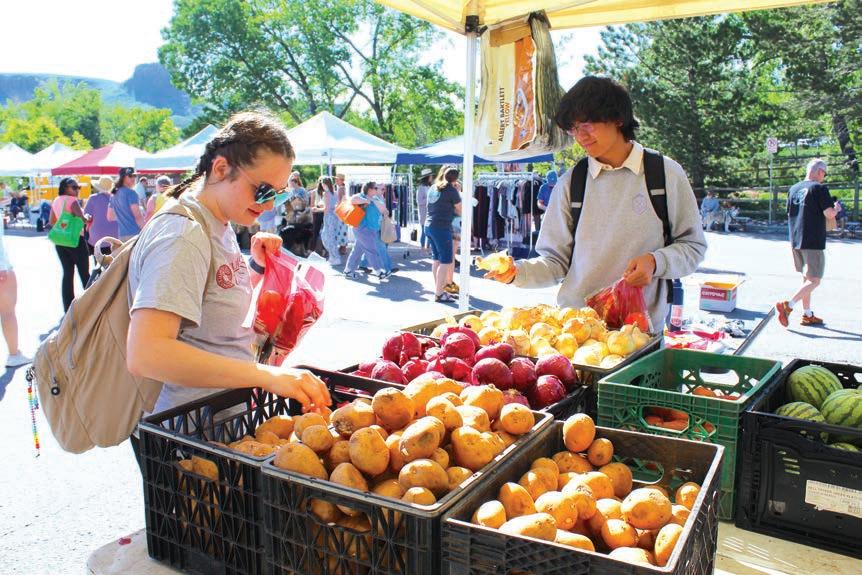
Golden Farmers Market customers fill bags of Miller Farms produce in June 2022. CORINNE WESTEMAN
BY CORINNE WESTEMAN CORINNE@COTLN.ORG
Moose takes a break in Golden park
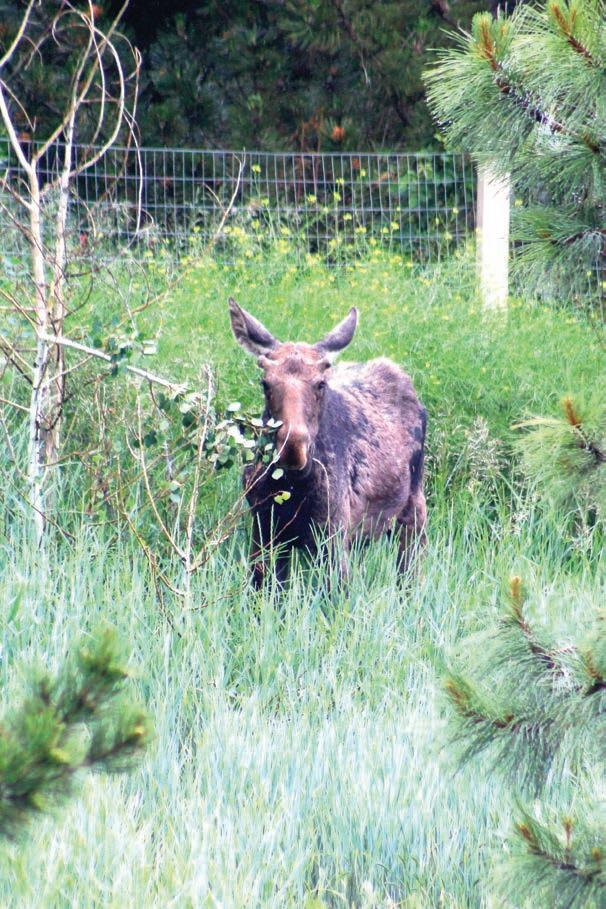
On June 6, a moose took up temporary residence around Golden’s White Ash Mine Park.
e moose was spotted by residents throughout the morning and afternoon, with Goldenites warning each other via social media to avoid taking their dogs to the park and to be cautious when visiting the area.
Around 2 p.m., the moose was trotting down White Ash Drive as rain poured down. It then headed down toward the park and started eating plants along the western boundary, including leaves on a small tree. e moose brie y laid down in the tall grass for a nap, but it quickly resumed snacking, chowing down on a resident’s rose bush.
Moose have been spotted in Golden before, but not very often. Residents should not approach moose and should avoid taking their dogs near moose, as the large animals are known to charge them.
For more information, visit cpw.state.co.us/living-moose.
Mount Evans brings recovery
State Patrol warns motorists to watch for wildlife
CSP enforcement ramps up for
calving season
BY MONTE WHALEY MONTE@COTLN.ORG
e Colorado State Patrol is stepping up patrols on Colorado State Highway 74 in Evergreen to protect motorists and local wildlife. e e ort is especially important in June and July during peak calving season for elk in the state.
e CSP’s “Give Me a Brake” campaign is being unveiled to increase enforcement and education about wildlife crossings, especially in Evergreen in Jefferson County.
“Highway 74 in Evergreen, like so many picturesque areas of Colorado, is an example of a roadway that sees many wildlife crossings,” said Col. Matthew Packard, chief of the Colorado State Patrol in a news release. “We want to warn drivers to slow their speeds and stay alert during this high activity season for new animals traveling with their mothers.”
While dusk and dawn are the most common times for wildlife-vehicle collisions, they can happen at all hours of the day – and they do. Colorado State Troopers will also be conducting weekly enforcement on Highway 74 this June to keep speeds down and increase knowledge on how to spot wildlife and what to do, the news release states.
Last year, animal-involved crashes
were the third most common crash factor among all crash types (fatal, injury, and property damage), the news release states. Troopers investigated 3,573 of these crashes. Ninety-six percent of the crashes caused property damage only for the motorist, but the wildlife often did not survive, the CSP states. e State Patrol o ered practical tips from Wild Aware and their Wild Eyes Program can reduce the risk of motorist/wildlife collisions. ey urge drivers to scan roads or shoulders for movement and eye shine and ask drivers to use bright lights at night when safe and ash lights at oncoming cars to warn of wildlife on the road. Do not honk at wildlife in or near road if stopped and use hazard lights to warn other drivers. ey also urge drivers to slow down and not to exceed the speed limit. Wildlife-vehicle collisions can be very costly to drivers, the CSP states. According to the Rocky Mountain Insurance Information Association, the insurance industry pays out nearly $1.1 billion yearly in claims for all wildlife collisions nationwide. e average property damage cost of these crashes is estimated at over $3,000.
If you are involved in a crash with an animal, Colorado State Patrol wants you to call 9-1-1 just as you would in any other emergency. In addition, if you witness wildlife in distress from possibly being struck on or near the side of the road, call *CSP for the proper resource to be notied and sent to the scene.
Where to find free meals for kids this summer
School across metro Denver o er free meals to kids all summer
BY SUZIE GLASSMAN SUZIE@COTLN.ORG
When school cafeterias close for the summer, thousands of Colorado families lose access to a vital resource: free and reliable meals for their children. Fortunately, public school districts across the state are stepping up to ll the gap through the federally funded Summer Food Service Program, which provides free meals to anyone 18 years old and under, with no registration or ID required.
Whether you live in Brighton, Fort Lupton, Golden, Westminster or the mountain communities served by the Canyon and Clear Creek Couriers, multiple locations are o ering nutritious meals all summer long.
Some locations o er breakfast and lunch each weekday, while others serve meals at parks, schools and community centers or provide grab-and-go options. Below is a district-by-district guide to help you nd a free summer meal site near you. Be sure to check dates and times. Some programs start as early as late May and run through early August, but hours and service days vary.
Eligibility: Free for children 18 and under. No registration is required.
Note: Meals must be eaten on site. Adult meals may be available for purchase.
Je co Public Schools
(Golden, Edgewater, Lakewood)
Monday to Friday, Dates vary by location
Lunch 11:30 a.m. – 12:30 p.m.
Locations:
Edgewater Elementary, 5570 W. 24th Ave., Edgewater June 2 – June 27, no service on June 19 Deane Elementary: 580 S. Harlan Street, Lakewood June 2 –July 31, no service on June 19 and July 4
Lumberg Elementary: 6705 W. 22nd Ave, Edgewater June 2 – July 3, no service on June 19 and July 4
Eligibility: Free for children 18 and under. Adult meals are available for $5.25.
Note: Meals must be consumed onsite. You do not need to be a Je co student.
Additional Resources
USDA Summer Meals Site Finder
(www.fns.usda.gov/summer/site nder):
Locate nearby meal sites across Colorado
Hunger Free Colorado (hungerfreecolorado.org/): O ers a Food Resource Hotline at 855-855-4626 for statewide assistance.
Local school districts across the region are o ering meals to kids 18 and under at no cost throughout the summer months. SHUTTERSTOCK
One (Musical) Piece at a Time:
Golden Mill hosts Johnny Cash-themed fundraiser for MAPAC
BY CORINNE WESTEMAN CORINNE@COTLN.ORG
For the last month, the Miners Alley Performing Arts Center has been hosting a Johnny Cash-themed party.
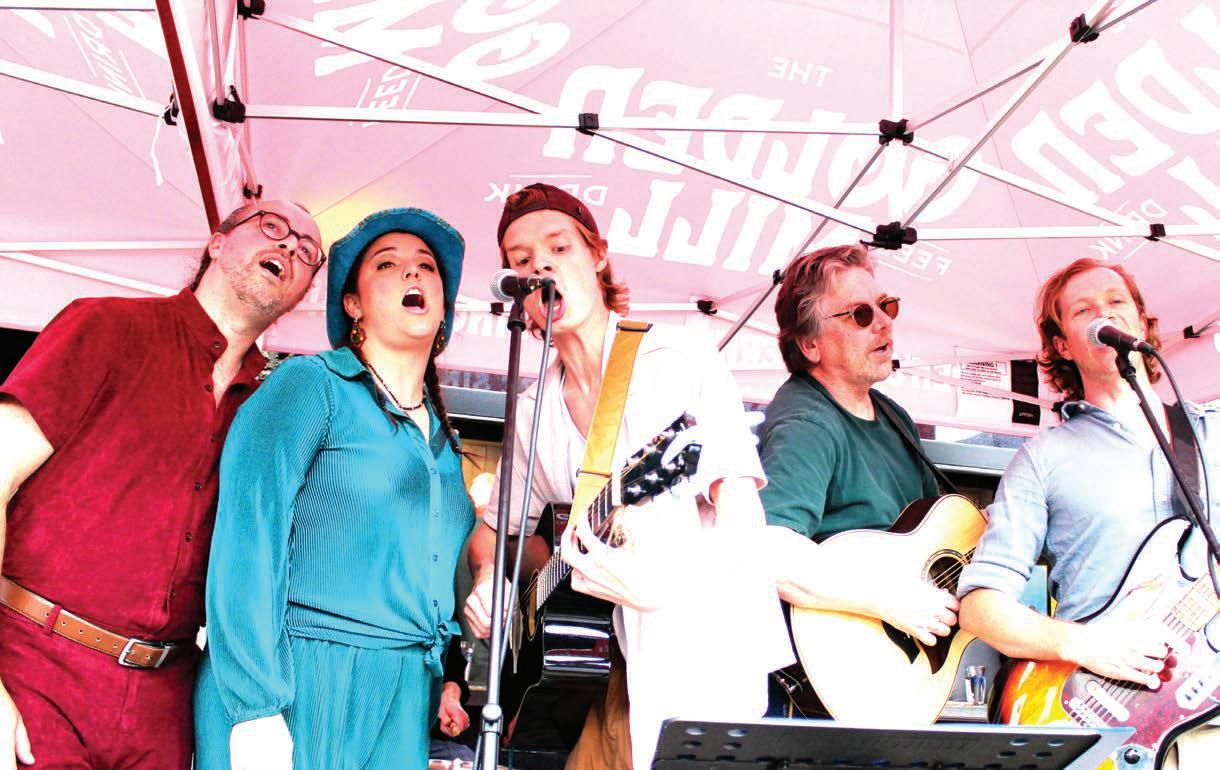
On June 4, that party temporarily relocated to the Golden Mill, as the venue hosted “Ring of Fire” cast members for a special performance that doubled as a fundraiser for MAPAC.
e Johnny Cash-themed jukebox musical “Ring of Fire: e Music of Johnny Cash” is playing at MAPAC through June 29. It portrays Cash’s journey of “misadventure, success, faith, redemption and the love of a good woman” through his music, according to the MAPAC website. “Ring of Fire” cast member David Otto, left, and Michael Phillips clap and sing during the June 4 concert at the Golden
Mill. Otto, Phillips and their fellow cast members performed Johnny Cash songs from the show, which runs through June 29.
Six cast members, who double as the musical’s band, showcased their vocal and instrumental talents June 4 at the Golden Mill. About 80% of the songs they played were arrangements from the “Ring of Fire” show, but they mixed in a few other songs from Cash’s contemporaries as well as some originals.
Overall, organizers from both MAPAC and the Golden Mill said the event was a “win-win-win” as it generated interest in “Ring of Fire,” raised funds for MAPAC and brought more people to the Golden Mill on a rainy Wednesday evening.
Right show, right time
Susan Ganter, the Mill’s co-owner, said she’s been wanting to host a fundraiser for MAPAC for years — even before her team took over the Mill in spring 2021.
However, MAPAC never had a show that could easily translate to a fundraising concert. at is, until “Ring of Fire” came along, MAPAC’s Producing Artistic
Director Len Matheo said.
“Ring of Fire” cast member David Otto plays guitar during the June 4 concert at the Golden Mill. Otto and his fellow cast members performed Johnny Cash songs from the show, which runs through June 29.
Matheo and MAPAC Executive Director Lisa DeCaro told Ganter about “Ring of Fire” about in April, and they all worked to make the June 4 concert and fundraiser happen. Ganter said 10% of the evening’s proceeds would go toward MAPAC, and hoped to raise about $3,000.
Ganter said, if possible, she’d like to host MAPAC for another fundraiser soon and make June the Mill’s cultural arts month.
e venue is also hosting the Circus Foundry aerialists’ annual ARTSWEEK GOLDEN show June 18, which will also be a fundraiser for Foothills Art Center.
For Johnny Cash and theater fans, DeCaro said there were still “Ring of Fire” tickets available, but she recommended people get them sooner rather than later as performances are selling out quickly.
Quadruple threats
She hoped Goldenites would come to see the show, describing the entire cast as quadruple threats who can act, sing, dance and play. She said most of them play several instruments and that watching them perform is impressive.
A Golden Mill patron watches “Ring of Fire” cast members’ June 4 concert of Johnny Cash music. e Golden Mill hosted the concert as a fundraiser for Miners Alley Performing Arts Center.
Because of how “Ring of Fire” is structured, no one performer plays Johnny Cash. e cast members described how they take turns as Cash depending on what aspect of his life they’re portraying.
“It’s the most unique way you’ll hear Johnny Cash music,” cast member Michael Phillips said of the musical.
Cast member David Otto described it as “high energy” and “a party.”
Clark Destin Jones said he’s had a lot of fun with his fellow cast members over the past several weeks and hoped to continue that through closing night on June 29. “I just love playing with these guys,” he said.
“Ring of Fire” cast member David Otto, left, and Michael Phillips clap and sing during the June 4 concert at the Golden Mill. The venue hosted cast members from Miners Alley Performing Arts Center’s “Ring of Fire” show as a fundraiser for MAPAC.
Golden Mill patrons applaud “Ring of Fire” cast members’ June 4 concert of Johnny Cash music. The Golden Mill hosted the concert as a fundraiser for Miners Alley Performing Arts Center.
PHOTOS BY CORINNE WESTEMAN
ARTSWEEK GOLDEN Highlights Community Importance
Summer is the perfect time to get out and about and enjoy beautiful public spaces, and if you can add some artistic touches to the mix, so much the better.
at’s just what visitors can do as part of the Foothills Art Center’s annual ARTSWEEK GOLDEN, which runs from Monday, June 16 through Sunday, June 22 at various locations around Golden “ e event was launched in 2018 by Foothills Art Center to bring creativity into Golden, showcase artists and build community through the arts,” wrote Maura Adamson, executive director of the Center, in an email interview. “At its core, it’s about celebrating creative expression and directly supporting artists by allowing people to engage, connect and buy original work.”
Art fans or budding creatives can participate in a range of events, including a Wearable art class from10 a.m. to noon on Tuesday, June 17 in the Foothills Art Center’s Astor House Courtyard, 1133 Arapahoe St. Attendees will work with professional artist Dyanna Csaposs on the art of natural dyeing and painting on silk.
ere is also an opportunity to create your own tarot cards from 5 to 7:30 p.m. on ursday, June 19 at Golden City Brewery, 920 12th St., Building No. 2. Participants will tap into the symbolic power of tarot and how it helps parse the variety of life experiences. All mediums welcome.
ere is also Modern kintsugi from 5 to 7:30 p.m. on Friday, June 20 at Golden City Brewery. All materials will be provided for this experience, which will walk
COMING ATTRACTIONS
and eager to stand behind the creative community.
Clarke Reader
people through this ancient Japanese craft. Additionally, places like Bob’s Atomic Burgers and e Golden Mill will be donating a portion of their sales to Foothills Art Center. e capper is the ARTSWEEK GOLDEN Festival, held on Saturday, June 21 and Sunday, June 20 in Parfet Park, 719 10th St. It will feature more than 70 artist booths selling original work, live demos and a local beer garden.
“ is year feels especially exciting. We have moved the festival to Parfet Park, right in the heart of downtown Golden,” Adamson wrote. “ e park o ers grassy space, shade from trees, and a central location that encourages visitors to stay, explore downtown and support local businesses throughout the weekend.”
Supporting local businesses and artists is the driver of the whole event, because these are the things that make a community unique.
“Local artists and creative nonpro ts don’t just make beautiful things, they shape the culture and identity of Golden,” Adamson wrote. Supporting them through events like this ensures creativity stays visible, valued and sustainable. When you buy a piece of art or donate to the cause, you’re directly supporting someone’s craft, their small business and the cultural health of Golden.”
e aim is no matter what event a person attends, they come away invigorated
“We hope everyone leaves feeling inspired and ideally taking home something handmade,” Adamson wrote. “Whether it’s a painting, jewelry, a bowl, a story, or just a renewed connection to art, we want people to walk away feeling like they invested in something genuine. ARTSWEEK GOLDEN is our mission in action, ‘We create stronger community through art.’
For the full schedule and more information, visit foothillsartcenter.org.
Catch Julia Stiles’ Directorial Debut on Amazon
As part of the annual Denver Film Women+Film Festival, actor and director Julia Stiles was at the Denver Botanic Gardens on June 30 to introduce her directorial debut, “Wish You Were Here,” and the lm is now available for streaming everywhere through Amazon
It’s a lovely, quiet lm based on a book by Renee Carlino and examines the enduring power of love, despite the challenges it presents.
“ is is a total dream come true because the story means so much to me,” Stiles said at the screening. “I think this kind of story is necessary in our world today.”
Watch the lm at Amazon.com.
Learn About a Crucial Resource at the South Metro Water Festival
While water is important all year round, during the summer it is more evident just how much we rely on this resource
for enjoyment and to keep our daily lives going. To teach families about its importance, South Metro water organizations are hosting the South Metro Water Festival from 2 to 6 p.m. on Wednesday, June 18, at the Amphitheater at Philip S. Miller Park, 1375 W. Plum Creek Parkway in Castle Rock. e event’s aim is to teach people about where their water comes from and attendees can learn everything from the internal workings of a toilet and how a watershed functions to using a water meter to nd a leak and more. ere will be science experiments, song and other activities, plus food vendors and a beer after-party.
For more information, visit the events page at https://www.crgov.com/.
Let me start o this week’s column by saying Happy Father’s Day to all you Dads out there.
I hope your day is lled with fun and some of the things you enjoy the most. For some of you, that will probably just be taking a nap in peace. Others may be more ambitious and have a full day’s agenda. Whatever you have planned, make it a great day.
Now that June is here, it’s time to take a little drive around the 10th Street and Washington Avenue area and see where all the parking lots and street parking are located close by. at’s the corner where Parfet Park is located and during the Summer, there’s some kind of event going on there almost every weekend. Since there are so many things you might want to check out, it’s a good idea to know where to nd easy parking so you don’t miss half of the event driving around in circles. Here are some of the places to park that you might want to be familiar with. First o is the free parking. You can nd that at the Clear Creek Lot, located at 10th Street and Archer Street (Space is limited, and it lls up quickly) as well as the Colorado
VOICES
Parking spots to begin your downtown adventures
AVENUE FLASHES
As Xcel Energy retires the last of its coal-burning power plants across Colorado, it faces a de ning choice: will it replace coal with the cleaner, renewable energy sources our climate and communities urgently need or tie us to expensive, polluting, and risky alternatives?
Xcel is going through what they are calling a “Just Transition Solicitation” process to determine what new energy resources will replace retiring coal plants. With the state’s largest coal plant, Comanche 3, closing by 2031 and other coal units winding down or converting, Xcel faces a rapid and massive transformation.
But the utility isn’t just replacing old energy sources, it’s preparing for a surge
School of Mines Lot K, located at the corner of 11th Street and Maple Streets.
Paid parking is available at Jackson Street North Public Garage on Jackson Street between 11th and 12th Streets, Jackson Street South Public Garage on Jackson Street between 12th and 13th Streets. Both o er paid parking using a parking app or kiosk.
Street Parking is available too, but all of downtown Golden and the 10th Street corridor is paid parking. You can use the kiosk or the HONK parking app.
You can nd out all the parking speci cs and information by going to www. parkgoldenco.com.
Of course, you can always ride a bike but remember to bring a lock. You don’t want to end up walking home with your whole day ruined. e rst event there I want to mention is the start of our annual Movies and Music
in the Park series, presented by the City of Golden. It’s a long-standing community event that features a combination of music and movies under the stars in the park. ey have a concert or live performance on stage at 7 p.m. followed by a movie shown on a large screen once it gets dark. e best part? It’s totally free to attend. You can bring along your own picnic basket and blankets or lawn chairs. But if you prefer, food is also available for purchase from food trucks on site, with dessert provided by Em’s Ice Cream truck. Of course, no movie can be properly appreciated without freshly popped popcorn, and that will be provided for sale by some local student groups.
ese programs will be happening on Friday nights once a month with the rst one being tomorrow, June 13 featuring music by Earl Nelson & e Company and e Wild Robot movie. e next on falls on Friday, July 11 with a performance by the Kalama Polynesian Dancers, which should be the perfect warm up for the Moana 2 movie. e last one is on Friday, August 8 and has e Man Cubs as the band followed by Air Bud as the movie.
So, mark your calendars and keep those in mind for a fun and a ordable family night out.
Next weekend is going to be busy at Parfet Park too. at’s when the Foothills Art Center will be hosting it’s 2025 Artsweek Golden Festival on Saturday and Sunday, June 21 and 22. is is a juried arts festival that will showcase the extraordinary works of 70 talented local and national artists right in downtown Golden. ey will all have booths set up with plenty of diverse and unique works of art for sale. ere won’t be any food vendors at this one but keep in mind that Parfet Park is within easy walking distance of the dozen restaurants and outdoor cafes and ve craft beer gardens right in Downtown Golden.
John Akal is a well-known jazz artist/ drummer and leader of the 20-piece Ultraphonic Jazz Orchestra. He also is president of John Akal Imaging, professional commercial photography and multimedia production. He can be reached at jaimaging@aol.com.
Xcel should prioritize renewable energy for Colorado’s future
Patty
For 10 years as Assistant Principal at Eaglecrest High School, I had the privilege of overseeing the program for students with unique educational needs. at experience was transformational. One portion of my responsibility included a program known as the Integrated Learning Center, ILC. at primarily self-contained classroom included students with particularly unique learning needs. In the ILC, I observed new dimensions to the human spirit and courage to depths I did not know possible. I learned what fun a lack of inhibition can be for everyone around and about the joy of being recognized. I actually had to stand outside the ILC to listen to what the teacher was saying before I entered the room, so that the students’ learning was not disrupted by an inevitable chorus of voices saying “Hi, Mr. Roome!”
Evans
in new demand, driven by arti cial intelligence data centers, electrication of buildings, and the rapid growth of electric vehicles. By 2030, Xcel expects to need an additional 10,000 to 14,000 megawatts – more than double its current generating capacity in Colorado. is moment presents a vitally important opportunity. Xcel should meet this challenge by maximizing investment in proven, zero-emission technologies like wind, solar, geothermal, and battery storage? Not only are these resources cleaner than coal or gas, they are cost e cient and also align with Golden’s climate goals and those of many cities and coun-
ties across Colorado. Clean energy can reliably power our homes and economy while cutting greenhouse gas emissions, protecting public health, and creating local jobs, especially in communities hardest hit by the coal transition.
Xcel’s current proposal includes new gas plants. We don’t know exactly where or how many just yet, but the current proposal is for 1,600 to 2,500 megawatts of new gas. Based on the sizes of gas plants approved in Xcel’s last plan, that could be anywhere from 4 to 10 new gas plants in Colorado. Gas plants emit carbon and other localized pollution and are expensive.
It’s important to emphasize that any transition must be equitable. at means
Finding joy to help overcome struggles
WORDS OF ENCOURAGEMENT
avoiding the mistake of replacing one polluting industry with another. Golden is committed to aligning our Greenhouse Gas Emission reductions with the Paris Accord by 2050. We cannot achieve these goals without partnership with our utility company. at’s why, as a Council member, I’d like to see Xcel’s plan maximize clean energy and emissions reductions to meet Colorado’s climate goals.
Colorado has the potential to be a carbon-free national leader. is is only possible if the state’s largest utility delivers a just transition that is truly just and truly clean.
Patty Evans is a Golden City Councilor
LETTER TO THE EDITOR
Jim Roome GUEST COLUMN
During that decade, the two most profound lessons I learned from students were about having an unwavering love of life and determination without bounds.
I watched students bounce with joy because they glimpsed a friend or grasped a favorite toy. I observed full-on belly laughs because of a word or a wink. In fact, I cannot think of a time when the room was void of smiles. It is not that life is easy or the road is clear for students in ILC. In fact, just the opposite. Students’ lives can be lled with unimaginable hardship, and yet there is still time for drinking the joy of living. ere is a
great lesson in that room for all of us. Why would we have been put on this earth if it were not to bask in the joy of living? at bottomless well of joy sits next to determination, which outshines all other ideas in the ILC. Determination to live, to be, to thrive, determination to overcome. e goal might be to walk or to speak, or to share an idea. e size of the mountain does not matter, determination rules the space. We can learn from the students and ll our lives with the determination to overcome the mountains we encounter. Six years ago, I stopped overseeing the ILC program. To the end of my days, thoughts about those wonderful students will bring a smile to my face and a resolve to my heart because of the joy and determination I observed in that space.
No Kings protest in Golden June 14 ere is an upcoming No Kings protest in Golden at 10th and Washington (and spreading out from there) on Saturday, June 14, 3-5 p.m. Golden residents, please support this protest. DOGE cuts to USAID have caused an estimated 300,000 deaths; 103 people an hour are still dying; and 1,500 babies a day are born HIVpositive. Shame on Trump, Musk, and Congress. ey were warned this would happen. In addition, DOGE cuts have harmed veterans. It’s important to mobilize.
So please join in supporting the No Kings nationwide protest on June 14. e No Kings protest in Golden is part of a nationwide protest that will include a number of cities in Colorado. Golden residents, please come and bring signs if possible. Bring your neighbors too. is is not a matter of Republican or Democrat, right or left, or conservative or liberal. is is a matter of democracy versus “autocracy,” where the head of state acts like a king with absolute power. President Trump has ignored 9-0 and 7-2 rulings by the U.S. Supreme Court and thumbed his nose at the idea of separation of powers or the rule of law. He must be stopped. Tom
Locke, Golden
John Akal
ROOME
Whatever your struggle, my hope is that you, too, will nd a lesson in this story of amazing students and that you will ll your week with joy and determination, no matter the struggle.
You have got this.
I hope my words encourage you and that you will share them with those who need support. ank you to everyone who has shared their stories with me so far; I truly appreciate hearing about the valu-
READER
Clarke’s Concert of the Week — James Taylor at Red Rocks
As someone who has experienced it in person several times, you really should see legendary singer/songwriter James Taylor at Red Rocks at least once in your life. e musician behind immortal songs like “Fire and Rain,” Carolina in My Mind” and “Sweet Baby James” stops at the venue almost every sum-
ABOUT LETTERS TO THE EDITOR
Colorado Community Media welcomes letters to the editor. Please note the following rules:
• Email your letter to letters@coloradocommunitymedia.com. Do not send via postal mail. Put the words “letter to the editor” in the email subject line.
• Submit your letter by 5 p.m. on Wednesday in order to have it considered for publication in the following week’s newspaper.
• Letters must be no longer than 400 words.
• Letters should be exclusively submitted to Colorado Community Media and should not submitted to other outlets or previously posted
Proclaiming Christ from the Mountains to the Plains
www.StJoanArvada.org
12735 W 58th Ave · 80002 · 303-420-1232
Daily Masses: 8:30am, Mon-Sat
Confessions: 8am Tue-Fri; 7:30am & 4:00pm Sat
Saturday Vigil Mass: 5:00pm
Sunday Masses: 7:30, 9:00, 11:30am, 5:30pm
“Find Connection…Discover Faith” All Are Welcome
Sunday Worship 10:00AM
Green Mountain Presbyterian Church 12900 W Alameda Pkwy Lakewood, CO 80228
303-985-8733 www.gmpc.net
able ideas you nd in these columns and how you use them to uplift those around you. You can reach me at jim.roome@ gmail.com.
Jim Roome lives in Arvada with his wife, Beth. He spent 34 years in public education. Lessons learned from the one two punch of being diagnosed with MS shortly before his best friend was diagnosed with terminal cancer led him into a new pursuit as a freelance writer and speaker. He uses his life experiences and love of stories to inspire, educate and encourage local, national and international audiences. Contact him at jim.roome@gmail.com.
mer, and it’s always a performance full of warmth and top-notch musicianship. is year’s concerts are at Red Rocks, 18300 W. Alameda Parkway in Morrison, at 7:30 p.m. on Friday, June 13 and Saturday, June 14 and he’ll be joined by alt-folk group Tiny Habits. It’s the perfect blend of artist and venue, so don’t miss this quintessential summer evening.
Get tickets at www.axs.com.
Clarke Reader’s column on culture appears on a weekly basis. He can be reached at Clarke.Reader@hotmail.com.
on websites or social media. Submitted letters become the property of CCM and should not be republished elsewhere.
• Letters advocating for a political candidate should focus on that candidate’s qualifications for o ce. We cannot publish letters that contain unverified negative information about a candidate’s opponent. Letters advocating for or against a political candidate or ballot issue will not be published within 12 days of an election.
• Publication of any given letter is at our discretion. Letters are published as space is available.
To advertise your place of worship in this section, call Erin at 303-566-4074 or email eadams@coloradocommunitymedia.com
BY ISABEL GUZMAN IGUZMAN@COLORADOCOMMUNITYMEDIA.COM
In a softly lit room in Centennial, Lilly Cadillac Unger shu es her tarot cards with practiced hands. e space, lled with gentle natural light, is the heart of her business, Altered Arcana. On the table, a classic three-card spread — past, present and future — unfolds a story. Among the cards drawn: Death, the Six of Cups and the Nine of Wands.
“I see here that there was some kind of huge transition,” Unger said, pointing to the Death card.
e card’s reputation, she said, is the most feared and is more Hollywood than reality — its real message is transformation and rebirth.
Unger’s journey with tarot began at age 12, sparked by curiosity and the little guidebook included with her rst Rider–Waite deck — the most popular tarot deck, she notes, and one she’s mis-
placed more times than she can count.
For Unger, tarot isn’t about predicting the future.
“Tarot really should tell you about your present,” she said.
e Rider-Waite tarot card deck, rst published in 1909, was created by artist Pamela Colman Smith under the direction of occultist A.E. Waite. e deck consists of 78 cards — 22 Major Arcana and 56 Minor Arcana — with each card featuring symbolic illustrations designed to evoke intuitive and emotional responses.
Distinctive for its fully illustrated Minor Arcana, the Rider-Waite deck’s imagery draws from esoteric traditions that embrace practices that involve secret or hidden knowledge, Christian mysticism and the teachings of the Hermetic Order of the Golden Dawn, a secret society that studied occultism and metaphysics, according to the University of St. omas.
Kate Kettelkamp, who reads tarot cards from her Denver o ce, also starts
with the three card spread that displays the past, present and future. After she shu es, she has the person receiving the reading pull three cards.
“I like people to choose their own cards,” Kettlekamp said. “Di erent tarot readers have di erent rules. I like people to select the cards because I feel like you bring your own energy to it.”
When the cards are pulled and laid out as reversals — meaning the card’s art is upside down — Kettlekamp said that can signify an energy blockage.
Looking towards the card that represents the past, Kettlekamp observed the Nine of Cups, reversed.
“Cups are water, so it has this emotional, imaginative quality to it,” she said. “With it reversed, it can (signify) wanting to move something forward but having some obstacle.”
When Kettlekamp moved from California to Denver almost 10 years ago, she said everyone she met in the new city knew their astrology signs and
owned a tarot deck, inspiring her to dive into the metaphysical world. She currently studies consciousness in a graduate program at the California Institute of Integral Studies.
In the program, Kettlekamp studies culture, the human journey, the soul and the environment, which she said sets her up for inquisitive knowledge for reading tarot.
“I like to approach (tarot) from a place of inquiry. Some people ask, ‘should I break up with my partner?’ But I nd that the tarot doesn’t answer deterministically,” she said. “ en they’ll pull the Death card and I’ll say, ‘well, possibly, what do you think? It’s up to you.’ at could just be their current energy that is creating a trajectory towards breaking up.”
Kate Kettelekamp reads tarot cards at Kronos Astrology in Denver. COURTESY
Florentino re ected on the readings she’s done that the cards portray a potentially negative message, and how she communicated it to her client.
Kettlekamp said the cards do not tell the future but can give insight into what struggles someone may be currently facing. She said it’s important for readers to uphold ethics when doing a reading.
“I’ve had people come into my o ce who have been disturbed from prior readings because they’ve been told things that make them anxious. So I do think that there’s some responsibility on the reader’s part to not induce anxiety by giving a deterministic prediction about someone’s life,” she said.
When the cards convey a negative message, Rachel Florentino from Bridge the Gap Tarot in Westminster said she views the cards as morphable.
“It’s not set in stone. ( e cards) are something we can bring to the present and change if we want to,” she said.
“ ere was a client that desperately wanted a baby … When I looked at her present, the problem was, she worked 80 hours a week and she wasn’t listening to her doctors telling her, ‘no, you cannot sustain that type of lifestyle while you’re pregnant,’” she said. “It hurt me because she wasn’t going to do that. I had to tell her she has to listen to people.”
Something Florentino did not always do at the beginning of her reading journey — even when she met the woman who wanted a baby — was shielding. In an e ort to protect herself from her clients’ energies, sometimes Florentino will imagine herself wearing a cloak that acts like a shield.
During another reading, Florentino pulled the Tower card in a past, present and future spread — with the Tower card in the future pile, she said it’s the harshest card of the deck.
“It’s because there’s things that you should be doing that you’re not doing and so the universe is going to make it happen. It can be harsh because it can no longer be in your control,” she said.
According to Florentino, the Tower card can show up when someone may be losing a job if they continue down their current trajectory.
“It’s de nitely a warning of: what do we know we need to be doing but we haven’t done yet?” she said.
Regarding the seemingly worrisome card — the Death card — Florentino said the image of the card, which typically displays a grim reaper-esque skeleton with a sword, scares people, largely due to Western society’s perspective of death.
“I think Hollywood has done a great job in scaring us with (death). In the United States, we’re not open about death and don’t view it as a rebirth but as the end of something. In a lot of other cultures, death is looked at as a deathrebirth process,” she said.
Regarding the online popularity of tarot card readings — from mass-collective tarot readings on YouTube to online psychic chats — Kettlekamp and Unger suggest looking at reviews to avoid being scammed.
“I would recommend for people to nd someone that has reviews because there are people who will take your money,” Kettlekamp said. “Anybody that has a physical location, not that that’s necessary, but it can indicate how much time they spend practicing.”
For Unger, reviews and having a connection with a reader are two ways to prevent scams.
“You just have to be honest with yourself about if it resonates, and I think you should be careful who you go to,” she said. “I think at the end of the day, getting reviews, and maybe just really asking yourself: ‘who am I being led to and why? Am I being led to this person because I saw something online that said: he’s thinking about you? And is that what I’m seeking?”’
LEFT: In the two photos, Lilly Cadillac Unger reads tarot cards in Centennial at Altered Arcana. PHOTO BY ISABEL GUZMAN
RIGHT: Kate Kettlekamp moved from California to Denver and was inspired to learn tarot card reading after meeting others who owned tarot card decks. COURTESY OF KATE KETTLEKAMP
CROWSSUPDRO ELZZ
1. AD SLOGANS: Which retail chain urges consumers to “Expect More. Pay Less”?
2. MATH: What is an obelus?
3. U.S. PRESIDENTS: Which president was the last to own slaves?
4. LITERATURE: Author Ian Fleming’s Jamaican estate has the same name as which James Bond movie?
5. TELEVISION: How many seasons of “Wheel of Fortune” did Pat Sajak host?
6. SCIENCE: What are cordyceps?
7. MOVIES: Which actor/comedian/ lmmaker made his lm debut in the movie “Donnie Darko”?
8. ACRONYMS: What does the acronym BBC stand for?
9. ANIMAL KINGDOM: What is the only bird that can y backward?
10. FOOD & DRINK: What is a mirepoix?
TrIVIa
Answers
1. Target.
2. e division sign.
3. Ulysses Grant.
4. “GoldenEye.”
5. 41.
6. A type of fungus or mushroom.
7. Seth Rogen.
8. British Broadcasting Corp.
9. Hummingbird.
10. A recipe base of onion, celery and carrots. (c) 2025 King Features Synd., Inc.
Mon 6/16
Adventure Quest @ 9am Jun 16th - Jun 19th
Bison Ridge Recreation Center, 13905 E. 112th Avenue, Commerce City. 303-289-3760
HIIT the Deck Summer Challenge June 16 @ 9am Jun 16th - Jul 24th
Bison Ridge Recreation Center, 13905 E. 112th Avenue, Commerce City. 303-289-3760
Skyhawks Volleyball Camp Eagle Pointe @ 9am Jun 16th - Jun 20th Eagle Pointe Recreation Center, 6060 E. Park‐way Dr., Commerce City. 303-289-3760
Rockin and Poppin @ 9am Jun 16th - Jun 19th
Chatter
Spineless Superheroes with Butter�y Pavillion @ 10:30am Jun 16th - Jun 19th Bison Ridge Recreation Center, 13905 E. 112th Avenue, Commerce City. 303-289-3760
Tue 6/17
Thu 6/19
National Museum of World War II Aviation Tour @ 8am Fort Lupton Recreation & Parks Depart‐ment, 203 S Harrison, Fort Lupton. 303-8574200 Monthly Birthday Celebration (6/19) @ 1pm
Little Moses Jones Live at the Thornton Juneteenth Concert! @ 7pm
Colorado
Thornton
MARKETPLACE
Miscellaneous
www.dental50plus.com/ads #6258
Prepare for power outages today with a Generac Home Standby Generator. Act now to receive a FREE 5-Year warranty with qualifying purchase* Call 1-855-948-6176 today to schedule a free quote. It’s not just a generator. It’s a power move.
Home break-ins take less than 60 seconds. Don’t wait! Protect your family, your home, your assets now for as little as 70¢/ day! 1-844-591-7951
Become a published author We want to read your book! Dorrance Publishing trusted since 1920. Consultation, production, promotion & distribution. Call for free author`s guide 1-877-7294998 or visit dorranceinfo.com/ ads
Wesley Financial Group, LLC Timeshare Cancellation Experts Over $50,000,000 in timeshare debt & fees cancelled in 2019. Get free info package & learn how to get rid of your timeshare! Free consultations. Over 450 positive reviews. 833-308-1971
Miscellaneous
Don’t let the stairs limit your mobility! Discover the ideal solution for anyone who struggles on the stairs, is concerned about a fall or wants to regain access to their entire home. Call AmeriGlide today! 1-833-399-3595
Water damage cleanup & restoration: A small amount of water can lead to major damage in your home. Our trusted professionals do complete repairs to protect your family and your home’s value! Call 24/7: 1-833887-0117. Have zip code of service location ready when you call!
DIRECTV Stream - Carries the most local MLB Games! Choice Package $89.99/mo for 12 mos Stream on 20 devices at once. HBO Max included for 3 mos (w/ Choice Package or higher.) No contract or hidden fees! Some restrictions apply. Call IVS 1-866859-0405
MobileHelp America’s premier mobile medical alert system. Whether you’re home or away. For safety & peace of mind. No long term contracts! Free brochure! Call 1-888-489-3936
Miscellaneous
Replace your roof w/the best looking & longest lasting material steel from Erie Metal Roofs! 3 styles & multiple colors available. Guaranteed to last a lifetime! Limited Time Offer up to 50% off install + Additional 10% off install (military, health & 1st responders.) 1-833-370-1234
AGING ROOF? NEW HOMEOWNER? STORM
DAMAGE? You need a local expert provider that proudly stands behind their work. Fast, free estimate. Financing available. Call 1-888-878-9091
Have zip code of property ready when calling!
We buy houses for cash as is! No repairs. No fuss. Any condition. Easy three step process: Call, get cash offer & get paid. Get your fair cash offer today by calling Liz Buys Houses: 1-844-877-5833
Jacuzzi Bath Remodel can install a new, custom bath or shower in as little as one day. For a limited time, waving all installation costs! (Additional terms apply. Subject to change and vary by dealer. Offer ends 6/30/25. 1-844-5013208
Donate Your Car to Veterans Today! Help and Support our Veterans. Fast - FREE pick up. 100% tax deductible. Call 1-800245-0398
Landscape & Garden
ONE AFFORDABLE MONTHLY PAYMENT PROGRAM
We work with you to set up a monthly payment that fits within your budget.
BECOME
DEBT
FREE IN AS LITTLE AS 24-48 MONTHS
Do you owe more than $10,000 in credit card bills, medical bills or other unsecured debt? National Debt Relief can help! Our Certified Debt Advocates have helped over 500,000 people nationwide resolve their debt for a fraction of what they owe.
NO UPFRONT FEES
You won’t pay a penny until your debt is resolved.
GUARANTEE
RESOLVE YOUR DEBT IN 24–48 MONTHS We’ll resolve your debt as quickly as possible so you can finally start living the life you want.
I am so happy with National Debt Relief. They just resolved one account and saved me over $11,000. They keep me in the loop and work with me to get the most savings. —Cheryl (Trustpilot review)
Purported common address: 4834 South Yank Way, Morrison, CO 80465.
THE PROPERTY DESCRIBED HEREIN IS ALL OF THE PROPERTY CURRENTLY ENCUMBERED BY THE LIEN OF THE DEED OF TRUST.
NOTICE OF SALE
The current holder of the Evidence of Debt secured by the Deed of Trust, described herein, has filed Notice of Election and Demand for sale as provided by law and in said Deed of Trust.
THEREFORE, Notice Is Hereby Given that I will at public auction, at 2 p.m. on Thursday, 07/10/2025 via remote, web-based auction service, sell to the highest and best bidder for cash, the said real property and all interest of the said Grantor(s), Grantor(s)' heirs and assigns therein, for the purpose of paying the indebtedness provided in said Evidence of Debt secured by the Deed of Trust, plus attorneys' fees, the expenses of sale and other items allowed by law, and will issue to the purchaser a Certificate of Purchase, all as provided by law.
https://liveauctions.govease.com/
First Publication: 5/15/2025 Last Publication: 6/12/2025 Name of Publication: Golden Transcript IF THE SALE DATE IS CONTINUED TO A LATER DATE, THE DEADLINE TO FILE A NOTICE OF INTENT TO CURE BY THOSE PARTIES ENTITLED TO CURE MAY ALSO BE EXTENDED;
DATE: 03/13/2025
Jerry DiTullio, Public Trustee in and for the County of Jefferson, State of Colorado
By: Amy Schiano, Deputy, for Public Trustee
The name, address, business telephone number and bar registration number of the attorney(s) representing the legal holder of the indebtedness is: Ilene Dell'Acqua #31755
The
COMBINED NOTICE - PUBLICATION
CRS §38-38-103
FORECLOSURE SALE NO. J2500096
To Whom It May Concern: This Notice is given with regard to the following described Deed of Trust:
On March 20, 2025, the undersigned Public Trustee caused the Notice of Election and Demand relating to the Deed of Trust described below to be recorded in the County of Jefferson records.
Original Grantor(s) Corey Joseph Emerson Original Beneficiary(ies) Mortgage Electronic Registration Systems, Inc., as beneficiary, as nominee for Choice Mortgage Group, its successors and assigns Current Holder of Evidence of Debt
NexBank
Date of Deed of Trust
April 28, 2023
County of Recording Jefferson
Recording Date of Deed of Trust May 01, 2023
Recording Information (Reception No. and/or Book/Page No.) 2023024676
Original Principal Amount
$365,000.00
Outstanding Principal Balance
$359,983.80
Pursuant to CRS §38-38-101(4)(i), you are hereby notified that the covenants of the deed of trust have been violated as follows: Failure to make timely payments required under said Deed of Trust and the Evidence of Debt secured thereb
THE LIEN FORECLOSED MAY NOT BE A FIRST LIEN.
Condominium Unit 213, ADVANTAGE AT WOOD CREEK CONDOMINIUMS, Jefferson County, Colorado, as shown on the Condominium Map for Advantage at Wood Creek Condominiums, recorded as Reception No. 84031345, and any and all Amendments and Supplements thereto, in the Jefferson County Records, and Subject to the Declaration of Covenants, Conditions and Restrictions Establishing a Plan for Condominium Ownership of Wood Creek Condominiums, recorded as Reception No. 83104616 and Notice of Annexation and Supplement to Declaration of Covenants, Conditions and Restrictions recorded as Reception No. 84031344, and any and all Supplements and Amendments thereto in the Jefferson County Records, County of Jefferson, State of Colorado
Purported common address: 5341 W. 76th Avenue #213, Arvada, CO 80003-2963.
THE PROPERTY DESCRIBED HEREIN IS ALL OF THE PROPERTY CURRENTLY ENCUMBERED BY THE LIEN OF THE DEED OF TRUST.
NOTICE OF SALE
The current holder of the Evidence of Debt secured by the Deed of Trust, described herein, has filed Notice of Election and Demand for sale as provided by law and in said Deed of Trust.
THEREFORE, Notice Is Hereby Given that I will at public auction, at 2 p.m. on Thursday, 07/17/2025 via remote, web-based auction service, sell to the highest and best bidder for cash, the said real property and all interest of the said Grantor(s), Grantor(s)' heirs and assigns therein, for the purpose of paying the indebtedness provided in said Evidence of Debt secured by the Deed of Trust, plus attorneys' fees, the expenses of sale and other items allowed by law, and will issue to the purchaser a Certificate of Purchase, all as provided by law. https://liveauctions.govease.com/
First Publication: 5/29/2025
Last Publication: 6/26/2025
Name of Publication: Golden Transcript
IF THE SALE DATE IS CONTINUED TO A LATER DATE, THE DEADLINE TO FILE A NOTICE OF INTENT TO CURE BY THOSE PARTIES ENTITLED TO CURE MAY ALSO BE EXTENDED;
DATE: 03/20/2025
Jerry DiTullio, Public Trustee in and for the County of Jefferson, State of Colorado
By: Amy Schiano, Deputy, for Public Trustee
The name, address, business telephone number and bar registration number of the attorney(s) representing the legal holder of the indebtedness is:
Deanne R. Stodden #33214 Messner Reeves LLP 1550 Wewatta Street, Suite 710,
The
Revised 1/2015
Legal Notice NO. J2500096
First Publication: 5/29/2025
Last Publication: 6/26/2025
Name of Publication: Golden Transcript
COMBINED NOTICE - PUBLICATION
CRS §38-38-103
FORECLOSURE SALE NO. J2500114
To Whom It May Concern: This Notice is given with regard to the following described Deed of Trust:
On March 27, 2025, the undersigned Public Trustee caused the Notice of Election and Demand relating to the Deed of Trust described below to be recorded in the County of Jefferson records.
Original Grantor(s)
Aleksei Sharp
Original Beneficiary(ies)
Mortgage Electronic Registration Systems, Inc., as beneficiary, as nominee for NBKC Bank, its successors and assigns
Current Holder of Evidence of Debt
NBKC Bank Date of Deed of Trust
September 15, 2023
County of Recording
Jefferson
Recording Date of Deed of Trust
September 19, 2023
Recording Information
(Reception No. and/or Book/Page No.)
2023057608
Original Principal Amount
$536,750.00
Outstanding Principal Balance
$531,777.68
Pursuant to CRS §38-38-101(4)(i), you are hereby notified that the covenants of the deed of trust have been violated as follows: Failure to make timely payments required under said Deed of Trust and the Evidence of Debt secured thereby.
THE LIEN FORECLOSED MAY NOT BE A FIRST LIEN.
LOT 42, BLOCK 4, MARIN SUBDIVISION, COUNTY OF JEFFERSON, STATE OF COLORADO.
Purported common address: 6631 W. 73rd Pl., Arvada, CO 80003.
THE PROPERTY DESCRIBED HEREIN IS ALL OF THE PROPERTY CURRENTLY ENCUMBERED BY THE LIEN OF THE DEED OF TRUST.
NOTICE OF SALE
The current holder of the Evidence of Debt secured by the Deed of Trust, described herein, has filed Notice of Election and Demand for sale as provided by law and in said Deed of Trust.
THEREFORE, Notice Is Hereby Given that I will at public auction, at 2 p.m. on Thursday, 07/17/2025 via remote, web-based auction service, sell to the highest and best bidder for cash, the said real property and all interest of the said Grantor(s), Grantor(s)' heirs and assigns therein, for the purpose of paying the indebtedness provided in said Evidence of Debt secured by the Deed of Trust, plus attorneys' fees, the expenses of sale and other items allowed by law, and will issue to the purchaser a Certificate of Purchase, all as provided by law. https://liveauctions.govease.com/ First Publication: 5/29/2025 Last Publication: 6/26/2025 Name of Publication: Golden Transcript
IF THE SALE DATE IS CONTINUED TO A
LATER DATE, THE DEADLINE TO FILE A NOTICE OF INTENT TO CURE BY THOSE PARTIES ENTITLED TO CURE MAY ALSO BE EXTENDED;
DATE: 03/27/2025
Jerry DiTullio, Public Trustee in and for the County of Jefferson, State of Colorado
By: Amy Schiano, Deputy, for Public Trustee
The name, address, business telephone number and bar registration number of the attorney(s) representing the legal holder of the indebtedness is:
Deanne R. Stodden #33214
Messner Reeves LLP 1550 Wewatta Street, Suite 710, Denver, CO 80202 (303) 623-4806 Attorney File # 8021.0073
The Attorney above is acting as a debt collector and is attempting to collect a debt. Any information provided may be used for that purpose.
Legal Notice NO. J2500114 First Publication: 5/29/2025 Last Publication: 6/26/2025
Name of Publication: Golden Transcript
COMBINED NOTICE - PUBLICATION CRS §38-38-103
FORECLOSURE SALE NO. J2500097
To Whom It May Concern: This Notice is given with regard to the following described
Deed of Trust:
On March 20, 2025, the undersigned Public Trustee caused the Notice of Election and Demand relating to the Deed of Trust described below to be recorded in the County of Jefferson records.
Original Grantor(s)
Wesley L Porter
Original Beneficiary(ies)
Sooper Credit Union
Current Holder of Evidence of Debt
Sooper Credit Union
Date of Deed of Trust
October 21, 2022
County of Recording
Jefferson
Recording Date of Deed of Trust
November 02, 2022
Recording Information (Reception No. and/or Book/Page No.)
2022099142
Original Principal Amount
$360,000.00
Outstanding Principal Balance
$359,999.20
Pursuant to CRS §38-38-101(4)(i), you are hereby notified that the covenants of the deed of trust have been violated as follows: The failure to make installment payments of principal, interest, taxes and/or insurance as provided for in the Deed of Trust and Credit Agreement
THE LIEN FORECLOSED MAY NOT BE A
FIRST LIEN.
LOT 16, AND THAT PART OF LOT 15, WADSWORTH ACRES, DESCRIBED AS FOLLOWS: BEGINNING AT THE NORTHWEST CORNER OF LOT 15, THENCE EASTERLY ALONG THE NORTH LINE OF SAID LOT 15 A DISTANCE OF 24.02 FEET; THENCE SOUTHEASTERLY TO A POINT ON THE SOUTH LINE AND 56.19 FEET EAST OF THE SOUTHWEST CORNER OF SAID LOT 15; THENCE WESTERLY ALONG SAID SOUTH LINE A DISTANCE OF 56.19 FEET TO SAID SOUTHWEST CORNER; THENCE NORTHERLY ALONG THE WEST LINE OF SAID LOT 15 TO THE POINT OF BEGINNING, COUNTY OF JEFFERSON, STATE OF COLORADO.
Purported common address: 9910 Ammons Cir, Broomfield, CO 80021.
THE PROPERTY DESCRIBED HEREIN IS ALL OF THE PROPERTY CURRENTLY ENCUMBERED BY THE LIEN OF THE DEED OF TRUST.
NOTICE OF SALE
The current holder of the Evidence of Debt secured by the Deed of Trust, described herein, has filed Notice of Election and Demand for sale as provided by law and in said Deed of Trust.
THEREFORE, Notice Is Hereby Given that I will at public auction, at 2 p.m. on Thursday, 07/17/2025 via remote, web-based auction service, sell to the highest and best bidder for cash, the said real property and all interest of the said Grantor(s), Grantor(s)' heirs and assigns therein, for the purpose of paying the indebtedness provided in said Evidence of Debt secured by the Deed of Trust, plus attorneys' fees, the expenses of sale and other items allowed by law, and will issue to the purchaser a Certificate of Purchase, all as provided by law.
https://liveauctions.govease.com/
First Publication: 5/29/2025
Last Publication: 6/26/2025
Name of Publication: Golden Transcript
IF THE SALE DATE IS CONTINUED TO A LATER DATE, THE DEADLINE TO FILE A NOTICE OF INTENT TO CURE BY THOSE PARTIES ENTITLED TO CURE MAY ALSO BE EXTENDED;
DATE: 03/20/2025
Jerry DiTullio, Public Trustee in and for the County of Jefferson, State of Colorado
By: Amy Schiano, Deputy, for Public Trustee
The name, address, business telephone number and bar registration number of the attorney(s) representing the legal holder of the indebtedness is:
To Whom It May Concern: This Notice is given with regard to the following described Deed of Trust:
On April 3, 2025, the undersigned Public Trustee caused the Notice of Election and Demand relating to the Deed of Trust described below to be recorded in the County of Jefferson records.
Original Grantor(s) Carlos T Chavez
Original Beneficiary(ies)
Mortgage Electronic Registration Systems, Inc. as beneficiary, as nominee for Integrity
First Financial, Inc.
Current Holder of Evidence of Debt
PennyMac Loan Services, LLC
Date of Deed of Trust January 18, 2017
County of Recording Jefferson
Recording Date of Deed of Trust
January 23, 2017
Recording Information (Reception No. and/or Book/Page No.) 2017008475
Original Principal Amount
$242,000.00
Outstanding Principal Balance
$214,174.60
Pursuant to CRS §38-38-101(4)(i), you are hereby notified that the covenants of the deed of trust have been violated as follows: Failure to pay principal and interest when due together with all other payments provided for in the evidence of debt secured by the deed of trust and other violations thereof.
THE LIEN FORECLOSED MAY NOT BE A FIRST LIEN.
Lot 12, Block 15, Calahan Homes, Unit Three Amended, County of Jefferson, State of Colorado.
Purported common address: 7520 W Oregon Dr, Lakewood, CO 80232.
THE PROPERTY DESCRIBED HEREIN IS ALL OF THE PROPERTY CURRENTLY ENCUMBERED BY THE LIEN OF THE DEED OF TRUST.
NOTICE OF SALE
The current holder of the Evidence of Debt secured by the Deed of Trust, described herein, has filed Notice of Election and Demand for sale as provided by law and in said Deed of Trust.
THEREFORE, Notice Is Hereby Given that I will at public auction, at 2 p.m. on Thursday, 07/24/2025 via remote, web-based auction service, sell to the highest and best bidder for cash, the said real property and all interest of the said Grantor(s), Grantor(s)' heirs and assigns therein, for the purpose of paying the indebtedness provided in said Evidence of Debt secured by the Deed of Trust, plus attorneys' fees, the expenses of sale and other items allowed by law, and will issue to the purchaser a Certificate of Purchase, all as provided by law. https://liveauctions.govease.com/
First Publication: 6/5/2025
Last Publication: 7/3/2025 Name of Publication: Golden Transcript
IF THE SALE DATE IS CONTINUED TO A LATER DATE, THE DEADLINE TO FILE A NOTICE OF INTENT TO CURE BY THOSE PARTIES ENTITLED TO CURE MAY ALSO BE EXTENDED;
DATE: 04/03/2025 Jerry DiTullio, Public Trustee in and for the County of Jefferson, State of Colorado By: Christine Thompson, Deputy, for Public Trustee
The name, address, business telephone number and bar registration number of the attorney(s) representing the legal holder of the indebtedness is:
Aricyn J. Dall #51467
Randall S. Miller & Associates, P.C. 216 16th Street, Suite 1210, Denver, CO 80202 (720) 259-6710
Attorney File # 23CO00077-2
The Attorney above is acting as a debt collector and is attempting to collect a debt. Any information provided may be used for that purpose.
Last Publication: 7/3/2025 Name of Publication: Golden Transcript
COMBINED NOTICE - PUBLICATION CRS §38-38-103
FORECLOSURE SALE NO. J2500123
To Whom It May Concern: This Notice is given with regard to the following described Deed of Trust:
DATE:
Public Notices
Outstanding Principal Balance
$354,691.70
Pursuant to CRS §38-38-101(4)(i), you are hereby notified that the covenants of the deed of trust have been violated as follows: Failure to make timely payments as required under the Evidence of Debt and Deed of Trust
THE LIEN FORECLOSED MAY NOT BE A FIRST LIEN.
LOT 7, FRIENDLY HILLS FILING NUMBER
4, COUNTY OF JEFFERSON, STATE OF COLORADO.
Purported common address: 4391 S Wright Ct, Morrison, CO 80465.
THE PROPERTY DESCRIBED HEREIN IS ALL OF THE PROPERTY CURRENTLY
ENCUMBERED BY THE LIEN OF THE DEED OF TRUST.
NOTICE OF SALE
The current holder of the Evidence of Debt secured by the Deed of Trust, described herein, has filed Notice of Election and Demand for sale as provided by law and in said Deed of Trust.
THEREFORE, Notice Is Hereby Given that I will at public auction, at 2 p.m. on Thursday, 07/10/2025 via remote, web-based auction service, sell to the highest and best bidder for cash, the said real property and all
purchaser a Certificate of Purchase, all as provided by law. https://liveauctions.govease.com
First Publication: 5/15/2025
Last Publication: 6/12/2025
Name of Publication: Golden Transcript IF THE SALE DATE IS CONTINUED TO A LATER DATE,
DATE: 03/13/2025 Jerry DiTullio, Public Trustee in and for the County of Jefferson, State of Colorado By: Christine Thompson, Deputy, for Public Trustee
The name, address, business telephone number and bar registration number of the attorney(s) representing the legal holder of the indebtedness is:
Amanda Ferguson #44893 Halliday Watkins & Mann, P.C. 355 Union Blvd., Suite 250, Lakewood,
NOTICE OF SALE The current holder of the Evidence of Debt secured by the Deed of Trust, described herein, has filed Notice of Election and Demand for sale as provided by law and in said Deed of Trust.
THEREFORE, Notice Is Hereby Given that I will at public auction, at 2 p.m. on Thursday, 07/24/2025 via remote, web-based auction service, sell to the highest and best bidder for cash, the said real property and all interest of the said Grantor(s), Grantor(s)' heirs and assigns therein, for the purpose of paying the indebtedness provided in said Evidence of Debt secured by the Deed of Trust, plus attorneys' fees, the expenses of sale and other items allowed by law, and will issue to the purchaser a Certificate of Purchase, all as provided by law. https://liveauctions. govease.com/
First Publication: 6/5/2025
Last Publication: 7/3/2025
Name of Publication: Golden Transcript
IF THE SALE DATE IS CONTINUED TO A LATER DATE, THE DEADLINE TO FILE A NOTICE OF INTENT TO CURE BY THOSE PARTIES ENTITLED TO CURE MAY ALSO BE EXTENDED;
DATE: 04/03/2025
Jerry DiTullio, Public Trustee in and for the County of Jefferson, State of Colorado
By: Amy Schiano, Deputy, for Public Trustee
The name, address, business telephone number and bar registration number of the attorney(s) representing the legal holder of the indebtedness is:
Name of Publication: Golden Transcript COMBINED NOTICE - PUBLICATION CRS §38-38-103 FORECLOSURE SALE NO. J2500121
To Whom It May Concern: This Notice is given with regard to the following described Deed of Trust:
On April 3, 2025, the undersigned Public Trustee caused the Notice of Election and Demand relating to the Deed of Trust described below to be recorded in the County of Jefferson records.
Original Grantor(s) Malvin Westfall, II Original Beneficiary(ies) MORTGAGE ELECTRONIC REGISTRATION SYSTEMS, INC. AS NOMINEE FOR AMERICAN FINANCING CORPORATION, ITS SUCCESSORS AND ASSIGNS
Current Holder of Evidence of Debt COLORADO HOUSING AND FINANCE AUTHORITY
Date of Deed of Trust November 13, 2020 County of Recording Jefferson Recording Date of Deed of Trust November 18, 2020 Recording Information (Reception No. and/or Book/Page No.) 2020152579 Original Principal Amount
$284,747.00 Outstanding Principal Balance $261,851.03
Pursuant to CRS §38-38-101(4)(i), you are hereby notified that the covenants of the deed of trust have been violated as follows: Failure to pay principal and interest when due together with all other payments provided for in the evidence of debt secured by the deed of trust and other violations thereof.
THE LIEN FORECLOSED MAY NOT BE A FIRST LIEN.
LOT 31, BLOCK 1, PHEASANT CREEK AT THE BEAR SUBDIVISION FILING NO. 2, COUNTY OF JEFFERSON, STATE OF COLORADO.
PARCEL ID NUMBER: 49-334-01-234
Purported common address: 10595 West Dartmouth Avenue, Lakewood, CO 80227.
THE PROPERTY DESCRIBED HEREIN IS ALL OF THE PROPERTY CURRENTLY ENCUMBERED BY THE LIEN OF THE DEED OF TRUST.
NOTICE OF SALE
The current holder of the Evidence of Debt secured by the Deed of Trust, described herein, has filed Notice of Election and Demand for sale as provided by law and in said Deed of Trust.
THEREFORE, Notice Is Hereby Given that I will at public auction, at 2 p.m. on Thursday, 07/24/2025 via remote, web-based auction service, sell to the highest and best bidder for cash, the said real property
to the purchaser a Certificate of Purchase, all as provided by law. https://liveauctions. govease.com/
First Publication: 6/5/2025
Last Publication: 7/3/2025
Name of Publication: Golden Transcript
IF THE SALE DATE IS CONTINUED TO A LATER DATE, THE DEADLINE TO FILE A NOTICE OF INTENT TO CURE BY THOSE PARTIES ENTITLED TO CURE MAY ALSO BE EXTENDED;
DATE: 04/03/2025
Jerry DiTullio, Public Trustee in and for the County of Jefferson, State of Colorado By: Christine Thompson, Deputy, for Public Trustee
The name, address, business telephone number and bar registration number of the attorney(s) representing the legal holder of the indebtedness is:
N. April Winecki #34861 Janeway Law Firm, P.C. 9540 Maroon Circle, Suite 320, Englewood, CO 80112 (303) 706-9990
Attorney File # 25-034400
The Attorney above is acting as a debt collector and is attempting to collect a debt. Any information provided may be used for that purpose.
Name of Publication: Golden Transcript COMBINED NOTICE - PUBLICATION CRS §38-38-103 FORECLOSURE SALE NO. J2500098
To Whom It May Concern: This Notice is given with regard to the following described Deed of Trust:
On March 20, 2025, the undersigned Public Trustee caused the Notice of Election and Demand relating to the Deed of Trust described below to be recorded in the County of Jefferson records.
Original Grantor(s)
Larry W Jenkins
Original Beneficiary(ies)
MORTGAGE ELECTRONIC REGISTRATION
SYSTEMS, INC. AS NOMINEE FOR NP, Inc., ITS SUCCESSORS AND ASSIGNS
Current Holder of Evidence of Debt
ATHENE ANNUITY AND LIFE COMPANY
Date of Deed of Trust
October 05, 2023
County of Recording Jefferson
Recording Date of Deed of Trust
October 16, 2023
Recording Information
(Reception No. and/or Book/Page No.)
2023062983
Original Principal Amount
$1,425,000.00
Outstanding Principal Balance
$1,417,779.26
Pursuant to CRS §38-38-101(4)(i), you are hereby notified that the covenants of the deed of trust have been violated as follows: Borrower's failure to make timely payments as required under the Evidence of Debt and Deed of Trust.
THE LIEN FORECLOSED MAY NOT BE A FIRST LIEN.
LOT 4, LONE EAGLE ESTATES RURAL CLUSTER MAP, COUNTY OF JEFFERSON, STATE OF COLORADO.
APN#: 69-312-01-004
Purported common address: 12346 Shiloh Point Drive, Littleton, CO 80127.
THE PROPERTY DESCRIBED HEREIN IS ALL OF THE PROPERTY CURRENTLY ENCUMBERED BY THE LIEN OF THE DEED OF TRUST.
NOTICE OF SALE
The current holder of the Evidence of Debt secured by the Deed of Trust, described herein, has filed Notice of Election and Demand for sale as provided by law and in said Deed of Trust.
THEREFORE, Notice Is Hereby Given that I will at public auction, at 2 p.m. on Thursday, 07/17/2025 via remote, web-based auction service, sell to the highest and best bidder for cash, the said real property and all interest of the said Grantor(s), Grantor(s)' heirs and assigns therein, for the purpose of paying the indebtedness provided in said Evidence of Debt secured by the Deed of Trust, plus attorneys' fees, the expenses of sale and other items allowed by law, and will issue to the purchaser a Certificate of Purchase, all as provided by law.
https://liveauctions.govease.com/
First Publication: 5/29/2025
Last Publication: 6/26/2025
Name of Publication: Golden Transcript
IF THE SALE DATE IS CONTINUED TO A LATER DATE, THE DEADLINE TO FILE A NOTICE OF INTENT TO CURE BY THOSE PARTIES ENTITLED TO CURE MAY ALSO BE EXTENDED;
DATE: 03/20/2025
Jerry DiTullio, Public Trustee in and for the County of Jefferson, State of Colorado
By: Amy Schiano, Deputy, for Public Trustee
The name, address, business telephone number and bar registration number of the attorney(s) representing the legal holder of the indebtedness is:
Alison L. Berry #34531
Janeway Law Firm, P.C. 9540 Maroon Circle, Suite 320, Englewood, CO 80112 (303) 706-9990
Attorney File # 25-034011
The Attorney above is acting as a debt collector and is attempting to collect a debt. Any information provided may be used for that purpose.
Name of Publication: Golden Transcript COMBINED NOTICE - PUBLICATION CRS §38-38-103 FORECLOSURE SALE NO. J2500108
To Whom It May Concern: This Notice is given with regard to the following described Deed of Trust:
On March 27, 2025, the undersigned Public Trustee caused the Notice of Election and Demand relating to the Deed of Trust described below to be recorded in the County of Jefferson records.
Original Grantor(s)
JC House Flippers LLC, a Colorado Limited Liability Company
Original Beneficiary(ies)
Kiavi Funding, Inc., a Delaware corporation
Current Holder of Evidence of Debt
U.S. Bank National Association, as Indenture Trustee, for LHOME MORTGAGE TRUST 2023-RTL2, Mortgage-Backed Notes, Series 2023-RTL2
Date of Deed of Trust
January 11, 2024
County of Recording
Jefferson
Recording Date of Deed of Trust
January 16, 2024
Recording Information (Reception No. and/or Book/Page No.)
2024002673
Original Principal Amount
$484,000.00
Outstanding Principal Balance
$484,000.00
Pursuant to CRS §38-38-101(4)(i), you are hereby notified that the covenants of the deed of trust have been violated as follows: You are notified as follows: the undersigned, on behalf of the Holder, gives notice and declares a violation of the covenants of said Deed of Trust including, but not limited to the Borrower’s failure to pay the debt in full following the maturity of the loan. Holder elects to foreclose and demands that the Public Trustee to give notice, publish for sale and sell said property to pay the debt and expenses of sale, all as provided by law and the terms of said Deed of Trust.
THE LIEN FORECLOSED MAY NOT BE A FIRST LIEN.
Lot 8, Block 1, Clear Creek Vista, County of Jefferson, State of Colorado.
Purported common address: 4625 Webster Street, Wheat Ridge, CO 80033.
THE PROPERTY DESCRIBED HEREIN IS ALL OF THE PROPERTY CURRENTLY ENCUMBERED BY THE LIEN OF THE DEED OF TRUST.
NOTICE OF SALE
The current holder of the Evidence of Debt secured by the Deed of Trust, described herein, has filed Notice of Election and Demand for sale as provided by law and in said Deed of Trust.
THEREFORE, Notice Is Hereby Given that I will at public auction, at 2 p.m. on Thursday, 07/17/2025 via remote, web-based auction service, sell to the highest and best bidder for cash, the said real property and all interest of the said Grantor(s), Grantor(s)' heirs and assigns therein, for the purpose of paying the indebtedness provided in said Evidence of Debt secured by the Deed of Trust, plus attorneys' fees, the expenses of sale and other items allowed by law, and will issue to the purchaser a Certificate of Purchase, all as provided by law. https://liveauctions. govease.com/
First Publication: 5/29/2025
Last Publication: 6/26/2025
Name of Publication: Golden Transcript
IF THE SALE DATE IS CONTINUED TO A LATER DATE, THE DEADLINE TO FILE A NOTICE OF INTENT TO CURE BY THOSE PARTIES ENTITLED TO CURE MAY ALSO BE EXTENDED;
DATE: 03/27/2025
Jerry DiTullio, Public Trustee in and for the County of Jefferson, State of Colorado
By: Barbara Lyons, Deputy, for Public Trustee
The name, address, business telephone number and bar registration number of the attorney(s) representing the legal holder of the indebtedness is:
Amanda Ferguson #44893
Halliday Watkins & Mann, P.C. 355 Union Blvd., Suite 250, Lakewood, CO 80228 (303) 274-0155
Attorney File # CO23621
The Attorney above is acting as a debt collector and is attempting to collect a debt. Any information provided may be used for that purpose.
To Whom It May Concern: This Notice is given with regard to the following described Deed of Trust:
On March 20, 2025, the undersigned Public Trustee caused the Notice of Election and Demand relating to the Deed of Trust described below to be recorded in the County of Jefferson records.
Original Grantor(s) Dustin Nadeau
Original Beneficiary(ies)
Mortgage Electronic Registration Systems, Inc., as beneficiary, as nominee for Fairway
Independent Mortgage Corporation
Current Holder of Evidence of Debt
TH MSR Holdings LLC
Date of Deed of Trust
July 08, 2021
County of Recording Jefferson
Recording Date of Deed of Trust
July 15, 2021
Recording Information (Reception No. and/or Book/Page No.)
2021106692
Original Principal Amount
$230,850.00
Outstanding Principal Balance
$220,449.22
Pursuant to CRS §38-38-101(4)(i), you are hereby notified that the covenants of the deed of trust have been violated as follows: Failure to pay principal and interest when due together with all other payments provided for in the evidence of debt secured by the deed of trust and other violations thereof.
THE LIEN FORECLOSED MAY NOT BE A FIRST LIEN.
CONDOMINIUM UNIT NUMBER 207, BUILDING NUMBER 4, SNOWBIRD CONDOMINIUMS, IN ACCORDANCE WITH AND SUBJECT TO THE DECLARATION OF COVENANTS, CONDITIONS AND RESTRICTIONS OF SNOWBIRD CONDOMINIUMS, RECORDED ON JULY 2, 1980 AT RECEPTION NO. 80048497, AND AMENDED AUGUST 29, 1980 AT RECEPTION NO. 80064135, AND MAP RECORDED ON JULY 2, 1980 AT RECEPTION NO. 80048498, AND AMENDED SEPTEMBER 16, 1980 AT RECEPTION NO. 80068871, COUNTY OF JEFFERSON, STATE OF COLORADO, TOGETHER WITH THE RIGHT TO THE EXCLUSIVE USE OF PARKING SPACE NO. 149, COUNTY OF JEFFERSON, STATE OF COLORADO.
Purported common address: 430 Zang St Apt 4-207, Lakewood, CO 80228.
THE PROPERTY DESCRIBED HEREIN IS ALL OF THE PROPERTY CURRENTLY ENCUMBERED BY THE LIEN OF THE DEED OF TRUST.
NOTICE OF SALE
The current holder of the Evidence of Debt secured by the Deed of Trust, described herein, has filed Notice of Election and Demand for sale as provided by law and in said Deed of Trust.
THEREFORE, Notice Is Hereby Given that I will at public auction, at 2 p.m. on Thursday, 07/17/2025 via remote, web-based auction service, sell to the highest and best bidder for cash, the said real property and all interest of the said Grantor(s), Grantor(s)' heirs and assigns therein, for the purpose of paying the indebtedness provided in said Evidence of Debt secured by the Deed of Trust, plus attorneys' fees, the expenses of sale and other items allowed by law, and will issue to the purchaser a Certificate of Purchase, all as provided by law. https://liveauctions.govease.com/
First Publication: 5/29/2025
Last Publication: 6/26/2025
Name of Publication: Golden Transcript
IF THE SALE DATE IS CONTINUED TO A LATER DATE, THE DEADLINE TO FILE A NOTICE OF INTENT TO CURE BY THOSE PARTIES ENTITLED TO CURE MAY ALSO BE EXTENDED;
DATE: 03/20/2025
Jerry DiTullio, Public Trustee in and for the County of Jefferson, State of Colorado By: Amy Schiano, Deputy, for Public Trustee
The name, address, business telephone number and bar registration number of the attorney(s) representing the legal holder of the indebtedness is:
Aricyn J. Dall #51467
Randall S. Miller & Associates, P.C. 216 16th Street, Suite 1210, Denver, CO 80202 (720) 259-6710
Attorney File # 24CO00207-1
The Attorney above is acting as a debt collector and is attempting to collect a debt. Any information provided may be used for that purpose.
Legal Notice NO. J2500101 First Publication: 5/29/2025 Last Publication: 6/26/2025 Name of Publication: Golden Transcript COMBINED NOTICE - PUBLICATION CRS §38-38-103
Public Notices
Pursuant to CRS §38-38-101(4)(i), you are hereby notified that the covenants of the deed of trust have been violated as follows: Failure to pay principal and interest when due together with all other payments provided for in the evidence of debt secured by the Deed of Trust and other violations thereof
THE LIEN FORECLOSED MAY NOT BE A FIRST LIEN.
THE SOUTHERLY 660.00 FEET OF THE WESTERLY 165.00 FEET OF THE WEST 1/2 OF THE NORTHWEST 1/4 OF THE NORTHEAST 1/4 OF SECTION 25, TOWNSHIP 5 SOUTH, RANGE 69 WEST OF THE 6TH P.M., COUNTY OF JEFFERSON, STATE OF COLORADO.
*Pursuant to that certain Affidavit Re: Scrivener’s Error Pursuant to C.R.S.§38-35-109(5) recorded in the records of Jefferson County, Colorado, on 2/12/2023 at Reception No. 2013017318 to correct the maturity date.
Purported common address: 5990 W Coal Mine Ave, Littleton, CO 80123-3906.
THE PROPERTY DESCRIBED HEREIN IS ALL OF THE PROPERTY CURRENTLY
ENCUMBERED BY THE LIEN OF THE DEED OF TRUST
If applicable, a description of any changes to the deed of trust described in the notice of election and demand pursuant to affidavit as allowed by statutes: *Pursuant to that certain Affidavit Re: Scrivener’s Error Pursuant to C.R.S.§38-35-109(5) recorded in the records of Jefferson County, Colorado, on 2/12/2023 at Reception No. 2013017318 to correct the maturity date.
NOTICE OF SALE
The current holder of the Evidence of Debt secured by the Deed of Trust, described herein, has filed Notice of Election and Demand for sale as provided by law and in said Deed of Trust.
THEREFORE, Notice Is Hereby Given that I will at public auction, at 2 p.m. on Thursday, 07/10/2025 via remote, web-based auction service, sell to the highest and best bidder for cash, the said real property and all interest of the said Grantor(s), Grantor(s)' heirs and assigns therein, for the purpose of paying the indebtedness provided in said Evidence of Debt secured by the Deed of Trust, plus attorneys' fees, the expenses of sale and other items allowed by law, and will issue to the purchaser a Certificate of Purchase, all as provided by law. https://liveauctions. govease.com/
First Publication: 5/15/2025
Last Publication: 6/12/2025
Name of Publication: Golden Transcript
IF THE SALE DATE IS CONTINUED TO A LATER DATE, THE DEADLINE TO FILE A
NOTICE OF INTENT TO CURE BY THOSE PARTIES ENTITLED TO CURE MAY ALSO BE EXTENDED;
DATE: 03/13/2025 Jerry DiTullio, Public Trustee in and for the County of Jefferson, State of Colorado By: Barbara Lyons, Deputy, for Public Trustee
The name, address, business telephone number and bar registration number of the attorney(s) representing the legal holder of the indebtedness is:
Ilene Dell'Acqua #31755
McCarthy & Holthus, LLP 7700 E. Arapahoe Road, Suite 230, Centennial, CO 80112 (877) 369-6122 Attorney File # CO-25-1009531-LL
The Attorney above is acting as a debt collector and is attempting to collect a debt. Any information provided may be used for that purpose.
LOTS NUMBERED FIFTEEN (15) AND SIXTEEN (16) IN BLOCK NUMBERED TWELVE (12) BERKELEY IN JEFFERSON COUNTY, COUNTY OF JEFFERSON, STATE OF COLORADO.
PARCEL ID NUMBER: 39-244-06-016
Purported common address: 4338 Fenton St, Denver, CO 80212-7342.
THE PROPERTY DESCRIBED HEREIN IS ALL OF THE PROPERTY CURRENTLY ENCUMBERED BY THE LIEN OF THE DEED OF TRUST.
NOTICE OF SALE
The current holder of the Evidence of Debt secured by the Deed of Trust, described herein, has filed Notice of Election and Demand for sale as provided by law and in said Deed of Trust.
THEREFORE, Notice Is Hereby Given that I will at public auction, at 2 p.m. on Thursday, 07/17/2025 via remote, web-based auction service, sell to the highest and best bidder for cash, the said real property and all interest of the said Grantor(s), Grantor(s)' heirs and assigns therein, for the purpose of paying the indebtedness provided in said Evidence of Debt secured by the Deed of Trust, plus attorneys' fees, the expenses of sale and other items allowed by law, and will issue to the purchaser a Certificate of Purchase, all as provided by law. https://liveauctions.govease.com/
First Publication: 5/29/2025
Last Publication: 6/26/2025
Name of Publication: Golden Transcript
IF THE SALE DATE IS CONTINUED TO A LATER DATE, THE DEADLINE TO FILE A NOTICE OF INTENT TO CURE BY THOSE PARTIES ENTITLED TO CURE MAY ALSO BE EXTENDED;
DATE: 03/20/2025
Jerry DiTullio, Public Trustee in and for the County of Jefferson, State of Colorado
By: Christine Thompson, Deputy, for Public Trustee
The name, address, business telephone number and bar registration number of the attorney(s) representing the legal holder of the indebtedness is:
Alison L. Berry #34531
Janeway Law Firm, P.C. 9540 Maroon Circle, Suite 320, Englewood, CO 80112 (303) 706-9990
Attorney File # 22-027284
The Attorney above is acting as a debt collector and is attempting to collect a debt. Any information provided may be used for that purpose.
Name of Publication: Golden Transcript COMBINED NOTICE - PUBLICATION CRS §38-38-103 FORECLOSURE SALE NO. J2500119
To Whom It May Concern: This Notice is given with regard to the following described Deed of Trust:
On March 27, 2025, the undersigned Public Trustee caused the Notice of Election and Demand relating to the Deed of Trust described below to be recorded in the County of Jefferson records.
Original Grantor(s) WAYNE E LOSEY AND DEBORAH A LOSEY
Original Beneficiary(ies)
MORTGAGE ELECTRONIC REGISTRATION SYSTEMS, INC., AS NOMINEE FOR INDYMAC BANK, F.S.B.
Current Holder of Evidence of Debt
DEUTSCHE BANK NATIONAL TRUST COMPANY, AS TRUSTEE FOR HOME EQUITY MORTGAGE LOAN ASSET-BACKED TRUST SERIES INABS 2006-E, HOME EQUITY MORTGAGE LOAN ASSET-BACKED CERTIFICATES SERIES INABS 2006-E
Date of Deed of Trust September 06, 2006
County of Recording Jefferson
Recording Date of Deed of Trust
September 14, 2006
Recording Information (Reception No. and/or Book/Page No.) 2006112382
Original Principal Amount
$272,000.00
Outstanding Principal Balance
$259,255.74
Pursuant to CRS §38-38-101(4)(i), you are hereby notified that the covenants of the deed of trust have been violated as follows: Failure to pay principal and interest when due together with all other payments provided for in the Evidence of Debt secured by the Deed of Trust and other violations of the terms thereof THE LIEN FORECLOSED MAY NOT BE A FIRST LIEN.
LOT 8, BLOCK 3, WOODLAND VALLEY
FILING NO. 1, COUNTY OF JEFFERSON, STATE OF COLORADO.
Purported common address: 12124 W 68TH PLACE,
ARVADA, CO 80004.
THE PROPERTY DESCRIBED HEREIN IS ALL OF THE PROPERTY CURRENTLY ENCUMBERED BY THE LIEN OF THE DEED OF TRUST.
NOTICE OF SALE
The current holder of the Evidence of Debt secured by the Deed of Trust, described herein, has filed Notice of Election and Demand for sale as provided by law and in said Deed of Trust.
THEREFORE, Notice Is Hereby Given that I will at public auction, at 2 p.m. on Thursday, 07/17/2025 via remote, web-based auction service, sell to the highest and best bidder for cash, the said real property and all interest of the said Grantor(s), Grantor(s)' heirs and assigns therein, for the purpose of paying the indebtedness provided in said Evidence of Debt secured by the Deed of Trust, plus attorneys' fees, the expenses of sale and other items allowed by law, and will issue to the purchaser a Certificate of Purchase, all as provided by law. https://liveauctions. govease.com/
First Publication: 5/29/2025
Last Publication: 6/26/2025
Name of Publication: Golden Transcript
IF THE SALE DATE IS CONTINUED TO A LATER DATE, THE DEADLINE TO FILE A NOTICE OF INTENT TO CURE BY THOSE PARTIES ENTITLED TO CURE MAY ALSO BE EXTENDED;
DATE: 03/27/2025
Jerry DiTullio, Public Trustee in and for the County of Jefferson, State of Colorado
By: Barbara Lyons, Deputy, for Public Trustee
The name, address, business telephone number and bar registration number of the attorney(s) representing the legal holder of the indebtedness is:
Carly Imbrogno #59553
Barrett Frappier & Weisserman, LLP
1391 Speer Boulevard, Suite 700, Denver, CO 80204 (303) 350-3711
Attorney File # 00000010408060
The Attorney above is acting as a debt collector and is attempting to collect a debt. Any information provided may be used for that purpose.
To Whom It May Concern: This Notice is given with regard to the following described Deed of Trust:
On March 20, 2025, the undersigned Public Trustee caused the Notice of Election and Demand relating to the Deed of Trust described below to be recorded in the County of Jefferson records.
Original Grantor(s)
Sherman Wheat Ridge, LLC and Terrapin Wheat Ridge, LLC
Original Beneficiary(ies)
JPMorgan Chase Bank,
National Association Current Holder of Evidence of Debt
Wilmington Trust, National Association, as Trustee for the benefit of the registered holders of Benchmark 2018-B5 Mortgage Trust, Commercial Mortgage Pass-Through Certificates, Series 2018-B5
Date of Deed of Trust
June 08, 2018
County of Recording Jefferson
Recording Date of Deed of Trust June 11, 2018
Recording Information (Reception No. and/or Book/Page No.)
2018052542
Original Principal Amount
$9,660,000.00
Outstanding Principal Balance
$8,851,587.27
Pursuant to CRS §38-38-101(4)(i), you are hereby notified that the covenants of the deed of trust have been violated as follows: failure to pay when due one or more payments required under said Deed of Trust and the Evidence of Debt secured thereby.
THE LIEN FORECLOSED MAY NOT BE A FIRST LIEN.
See attached "Exhibit A"
Purported common address: 10101 S. Frontage Rd., Wheat Ridge, CO 80033.
THE PROPERTY DESCRIBED HEREIN IS ALL OF THE PROPERTY CURRENTLY ENCUMBERED BY THE LIEN OF THE DEED OF TRUST.
NOTICE OF SALE
The current holder of the Evidence of Debt secured by the Deed of Trust, described herein, has filed Notice of Election and Demand for sale as provided by law and in said Deed of Trust.
THEREFORE, Notice Is Hereby Given that I will at public auction, at 2 p.m. on Thursday, 07/17/2025 via remote, web-based auction service, sell to the highest and best bidder for cash, the said real property and all interest of the said Grantor(s), Grantor(s)' heirs and assigns therein, for the purpose of paying the indebtedness provided in said Evidence
of Debt secured by the Deed of Trust, plus attorneys' fees, the expenses of sale and other items allowed by law, and will issue to the purchaser a Certificate of Purchase, all as provided by law. https://liveauctions.govease.com/
First Publication: 5/29/2025
Last Publication: 6/26/2025
Name of Publication: Golden Transcript
IF THE SALE DATE IS CONTINUED TO A LATER DATE, THE DEADLINE TO FILE A NOTICE OF INTENT TO CURE BY THOSE PARTIES ENTITLED TO CURE MAY ALSO BE EXTENDED;
DATE: 03/20/2025
Jerry DiTullio, Public Trustee in and for the County of Jefferson, State of Colorado By: Barbara Lyons, Deputy, for Public Trustee
The name, address, business telephone number and bar registration number of the attorney(s) representing the legal holder of the indebtedness is:
Craig K. Schuenemann #41068
Bryan Cave Leighton Paisner LLP
1700 Lincoln Street, Suite 4100, Denver, CO 80203 (303) 861-7000 Attorney File # 1067754
The Attorney above is acting as a debt collector and is attempting to collect a debt. Any information provided may be used for that purpose.
To Whom It May Concern: This Notice is given with regard to the following described Deed of Trust:
On March 27, 2025, the undersigned Public Trustee caused the Notice of Election and Demand relating to the Deed of Trust described below to be recorded in the County of Jefferson records.
Original Grantor(s)
Ronald Sewick
Original Beneficiary(ies)
Space Age Federal Credit Union
Current Holder of Evidence of Debt
Space Age Federal Credit Union
Date of Deed of Trust
February 06, 2023
County of Recording
Jefferson
Recording Date of Deed of Trust March 01, 2023
Recording Information (Reception No. and/or Book/Page No.) 2023011783
Original Principal Amount
$70,000.00
Outstanding Principal Balance
$67,101.00
Pursuant to CRS §38-38-101(4)(i), you are hereby notified that the covenants of the deed of trust have been violated as follows: Failure to make payments pursuant to the terms of the Promissory Note.
THE LIEN FORECLOSED MAY NOT BE A FIRST LIEN.
LOT 50, BLOCK 8, ALKIRE ACRES FILING NO. 1, COUNTY OF JEFFERSON, STATE OF COLORADO
Purported common address: 12977 West Dorado Place, Littleton, CO 80127.
THE PROPERTY DESCRIBED HEREIN IS ALL OF THE PROPERTY CURRENTLY ENCUMBERED BY THE LIEN OF THE DEED OF TRUST.
NOTICE OF SALE
The current holder of the Evidence of Debt secured by the Deed of Trust, described herein, has filed Notice of Election and Demand for sale as provided by law and in said Deed of Trust.
THEREFORE, Notice Is Hereby Given that I will at public auction, at 2 p.m. on Thursday, 07/17/2025 via remote, web-based auction service, sell to the highest and best bidder for cash, the said real property and all interest of the said Grantor(s), Grantor(s)' heirs and assigns therein, for the purpose of paying the indebtedness provided in said Evidence of Debt secured by the Deed of Trust, plus attorneys' fees, the expenses of sale and other items allowed by law, and will issue to the purchaser a Certificate of Purchase, all as provided by law. https://liveauctions. govease.com/
First Publication: 5/29/2025
Last Publication: 6/26/2025
Name of Publication: Golden Transcript
IF THE SALE DATE IS CONTINUED TO A
LATER DATE, THE DEADLINE TO FILE A
NOTICE OF INTENT TO CURE BY THOSE
PARTIES ENTITLED TO CURE MAY ALSO BE EXTENDED;
DATE: 03/27/2025
Jerry DiTullio, Public Trustee in and for the County of Jefferson, State of Colorado
By: Amy Schiano, Deputy, for Public Trustee
The name, address, business telephone number and bar registration number of the attorney(s) representing the legal holder of the indebtedness is: Harry L. Simon, Esq. #7942
The Law Office of Harry L. Simon, P.C. 10200
East Girard Avenue, Building B, Suite 120, Denver, CO 80231
(303) 758-6601
Attorney File # Space Age v. Sewick
The Attorney above is acting as a debt collector and is attempting to collect a debt. Any information provided may be used for that purpose.
To Whom It May Concern: This Notice is given with regard to the following described Deed of Trust:
On March 20, 2025, the undersigned Public Trustee caused the Notice of Election and Demand relating to the Deed of Trust described below to be recorded in the County of Jefferson records.
Original Grantor(s)
Jeffrey R. Standish and Kaleigh R. Standish
Original Beneficiary(ies)
Mortgage Electronic Registration Systems, Inc., as Beneficiary, as nominee for United Wholesale Mortgage, LLC, its successors and assigns
Current Holder of Evidence of Debt
Lakeview Loan Servicing, LLC
Date of Deed of Trust September 17, 2021
County of Recording Jefferson
Recording Date of Deed of Trust
September 22, 2021
Recording Information (Reception No. and/or Book/Page No.) 2021136840 Original Principal Amount
$575,000.00
Outstanding Principal Balance
$611,451.70
Pursuant to CRS §38-38-101(4)(i), you are hereby notified that the covenants of the deed of trust have been violated as follows: Failure to make timely payments as required under the Evidence of Debt and Deed of Trust
THE LIEN FORECLOSED MAY NOT BE A FIRST LIEN.
LOT 55, KING'S VALLEY CUSTOM RESORT DEVELOPMENT FILING NO. 2, COUNTY OF JEFFERSON, STATE OF COLORADO.
Purported common address: 31168 Witteman Rd, Conifer, CO 80433.
THE PROPERTY DESCRIBED HEREIN IS ALL OF THE PROPERTY CURRENTLY ENCUMBERED BY THE LIEN OF THE DEED OF TRUST.
NOTICE OF SALE
The current holder of the Evidence of Debt secured by the Deed of Trust, described herein, has filed Notice of Election and Demand for sale as provided by law and in said Deed of Trust.
THEREFORE, Notice Is Hereby Given that I will at public auction, at 2 p.m. on Thursday, 07/17/2025 via remote, web-based auction service, sell to the highest and best bidder for cash, the said real property and all interest of the said Grantor(s), Grantor(s)' heirs and assigns therein, for the purpose of paying the indebtedness provided in said Evidence of Debt secured by the Deed of Trust, plus attorneys' fees, the expenses of sale and other items allowed by law, and will issue to the purchaser a Certificate of Purchase, all as provided by law.
https://liveauctions.govease.com/
First Publication: 5/29/2025
Last Publication: 6/26/2025
Name of Publication: Golden Transcript
IF THE SALE DATE IS CONTINUED TO A LATER DATE, THE DEADLINE TO FILE A NOTICE OF INTENT TO CURE BY THOSE PARTIES ENTITLED TO CURE MAY ALSO BE EXTENDED;
DATE: 03/20/2025 Jerry DiTullio, Public Trustee in and for the County of Jefferson, State of Colorado By: Barbara Lyons, Deputy, for Public Trustee
The name, address, business telephone number and bar registration number of the attorney(s) representing the legal holder of the indebtedness is:
Amanda Ferguson #44893
Halliday Watkins & Mann, P.C. 355 Union Blvd., Suite 250, Lakewood, CO 80228 (303) 274-0155
Attorney File # CO22586
The Attorney above is acting as a debt collector
IN THE COUNTY OF JEFFERSON, STATE OF COLORADO Purported common address: 7957 Chase Cir Apt 192, Arvada, CO 80003. THE PROPERTY DESCRIBED HEREIN IS ALL OF THE PROPERTY CURRENTLY ENCUMBERED
heirs and assigns therein, for the purpose of paying the indebtedness provided in said Evidence of Debt secured by the Deed of Trust, plus attorneys' fees, the expenses of sale and other items allowed by law, and will issue to the purchaser a Certificate of Purchase, all as provided by law. https://liveauctions. govease.com/
First Publication: 5/29/2025 Last Publication: 6/26/2025 Name of Publication: Golden Transcript IF THE SALE DATE IS CONTINUED TO A LATER DATE, THE DEADLINE TO FILE A NOTICE OF INTENT TO CURE BY THOSE PARTIES ENTITLED TO CURE MAY ALSO BE EXTENDED; DATE: 03/27/2025 Jerry DiTullio, Public Trustee in and for the County of Jefferson, State of Colorado By: Barbara Lyons, Deputy, for Public Trustee
OF TRUST.
NOTICE OF SALE
The current holder of the Evidence of Debt secured by the Deed of Trust, described herein, has filed Notice of Election and Demand for sale as provided by law and in said Deed of Trust.
THEREFORE, Notice Is Hereby Given that I will at public auction, at 2 p.m. on Thursday, 07/10/2025 via remote, web-based auction service, sell to the highest and best bidder for cash, the said real property and all interest of the said Grantor(s), Grantor(s)' heirs and assigns therein, for the purpose of paying the indebtedness provided in said Evidence of Debt secured by the Deed of Trust, plus attorneys' fees, the expenses of sale and other items allowed by law, and will issue to the purchaser a Certificate of Purchase, all as provided by law. https://liveauctions. govease.com/
First Publication: 5/15/2025
Last Publication: 6/12/2025
Name of Publication: Golden Transcript
IF THE SALE DATE IS CONTINUED TO A LATER DATE, THE DEADLINE TO FILE A NOTICE OF INTENT TO CURE BY THOSE PARTIES ENTITLED TO CURE MAY ALSO BE EXTENDED;
DATE: 03/13/2025
Jerry DiTullio, Public Trustee in and for the County of Jefferson, State of Colorado
By: Amy Schiano, Deputy, for Public Trustee
The name, address, business telephone number and bar registration number of the attorney(s) representing the legal holder of the indebtedness is:
Ilene Dell'Acqua #31755
McCarthy & Holthus, LLP
7700 E. Arapahoe Road, Suite 230, Centennial, CO 80112 (877) 369-6122
Attorney File # CO-25-1009022-LL
The Attorney above is acting as a debt collector and is attempting to collect a debt. Any information provided may be used for that purpose.
CONDOMINIUM UNIT 277, BUILDING 47, DAKOTA STATION CONDOMINIUMS, FILING NO. 1, PHASE 5, IN ACCORDANCE WITH AND SUBJECT TO THE DECLARATION OF COVENANTS, CONDITIONS, AND RESTRICTION OF DAKOTA STATION FILING NO. 1, AND CONDOMINIUM MAP, RECORDED AT THE CLERK AND RECORDER'S OFFICE, COUNTY OF JEFFERSON, COLORADO ON FEBRUARY 3, 1983, AT RECEPTION NO. 83010327, AND ON MAY 9, 1983 AT RECEPTION NO. 83041308, RESPECTIVELY, COUNTY OF JEFFERSON, STATE OF COLORADO
Purported common address: 9660 West Chatfield Avenue A, Littleton, CO 80128.
THE PROPERTY DESCRIBED HEREIN IS ALL OF THE PROPERTY CURRENTLY ENCUMBERED BY THE LIEN OF THE DEED OF TRUST.
NOTICE OF SALE
The current holder of the Evidence of Debt secured by the Deed of Trust, described herein, has filed Notice of Election and Demand for sale as provided by law and in said Deed of Trust.
THEREFORE, Notice Is Hereby Given that I will at public auction, at 2 p.m. on Thursday, 07/17/2025 via remote, web-based auction service, sell to the highest and best bidder for cash, the said real property and all interest of the said Grantor(s), Grantor(s)' heirs and assigns therein, for the purpose of paying the indebtedness provided in said Evidence of Debt secured by the Deed of Trust, plus attorneys' fees, the expenses of sale and other items allowed by law, and will issue to the purchaser a Certificate of Purchase, all as provided by law. https://liveauctions. govease.com/
First Publication: 5/29/2025
Last Publication: 6/26/2025
Name of Publication: Golden Transcript
IF THE SALE DATE IS CONTINUED TO A LATER DATE, THE DEADLINE TO FILE A NOTICE OF INTENT TO CURE BY THOSE PARTIES ENTITLED TO CURE MAY ALSO BE EXTENDED;
DATE: 03/27/2025
Jerry DiTullio, Public Trustee in and for the County of Jefferson, State of Colorado By: Christine Thompson, Deputy, for Public Trustee
The name, address, business telephone number and bar registration number of the attorney(s) representing the legal holder of the indebtedness is:
David R. Doughty #40042 Janeway Law Firm, P.C. 9540 Maroon Circle, Suite 320, Englewood, CO 80112 (303) 706-9990
Attorney File # 23-030084
The Attorney above is acting as a debt collector and is attempting to collect a debt. Any information provided may be used for that purpose.
First Publication: 5/29/2025 Last Publication: 6/26/2025 Name of Publication: Golden Transcript
COMBINED NOTICE - PUBLICATION CRS §38-38-103 FORECLOSURE SALE NO. J2500110
To Whom It May Concern: This Notice is given with regard to the following described Deed of Trust:
On March 27, 2025, the undersigned Public Trustee caused the Notice of Election and Demand relating to the Deed of Trust described below to be recorded in the County of Jefferson records.
Original Grantor(s)
James L. Noble Original Beneficiary(ies)
U.S. Bank National Association ND Current Holder of Evidence of Debt
U.S. Bank National Association Date of Deed of Trust April 18, 2013 County of Recording Jefferson
Recording Date of Deed of Trust May 08, 2013
Recording Information
(Reception No. and/or Book/Page No.)
2013054838
Original Principal Amount
$123,000.00 Outstanding Principal Balance
$58,914.93
Pursuant to CRS §38-38-101(4)(i), you are hereby notified that the covenants of the deed of trust have been violated as follows: Failure to make timely payments as required under the Evidence of Debt and Deed of Trust
THE LIEN FORECLOSED MAY NOT BE A FIRST LIEN.
REAL PROPERTY, IN THE COUNTY OF JEFFERSON AND STATE OF COLORADO, TO WIT: LOT 3, BLOCK 1, SHERIDAN GREEN SUBDIVISION, COUNTY OF JEFFERSON, STATE OF COLORADO SUBJECT TO ALL EASEMENTS, COVENANTS, CONDITIONS, RESERVATIONS, LEASES AND RESTRICTIONS OF RECORD, ALL LEGAL HIGHWAYS, ALL RIGHTS OF WAY, ALL ZONING, BUILDING AND OTHER LAWS, ORDINANCES AND REGULA-
TIONS, ALL RIGHTS OF TENANTS IN POSSESSION, AND ALL REAL ESTATE TAXES AND ASSESSMENTS NOT YET DUE AND PAYABLE.
Purported common address: 11599 Kendall St, Westminster, CO 80020-3068.
THE PROPERTY DESCRIBED HEREIN IS ALL OF THE PROPERTY CURRENTLY ENCUMBERED BY THE LIEN OF THE DEED OF TRUST.
NOTICE OF SALE
The current holder of the Evidence of Debt secured by the Deed of Trust, described herein, has filed Notice of Election and Demand for sale as provided by law and in said Deed of Trust.
THEREFORE, Notice Is Hereby Given that I will at public auction, at 2 p.m. on Thursday, 07/17/2025 via remote, web-based auction service, sell to the highest and best bidder for cash, the said real property and all interest of the said Grantor(s), Grantor(s)' heirs and assigns therein, for the purpose of paying the indebtedness provided in said Evidence of Debt secured by the Deed of Trust, plus attorneys' fees, the expenses of sale and other items allowed by law, and will issue to the purchaser a Certificate of Purchase, all as provided by law. https://liveauctions. govease.com/
First Publication: 5/29/2025
Last Publication: 6/26/2025
Name of Publication: Golden Transcript
IF THE SALE DATE IS CONTINUED TO A LATER DATE, THE DEADLINE TO FILE A NOTICE OF INTENT TO CURE BY THOSE PARTIES ENTITLED TO CURE MAY ALSO BE EXTENDED;
DATE: 03/27/2025
Jerry DiTullio, Public Trustee in and for the County of Jefferson, State of Colorado
By: Amy Schiano, Deputy, for Public Trustee
The name, address, business telephone number and bar registration number of the attorney(s) representing the legal holder of the indebtedness is:
Name of Publication: Golden Transcript City and County
LEGAL NOTICE
JEFFERSON COUNTY, COLORADO ROCKY MOUNTAIN METROPOLITAN AIRPORT
NOTICE OF PUBLIC OPEN HOUSE PART 150 AIRPORT NOISE AND LAND USE COMPATIBILITY STUDY
NOTICE IS HEREBY GIVEN that Jefferson County, Colorado, and the Rocky Mountain Metropolitan Airport (RMMA), will conduct a public Open House to introduce and provide information regarding the commencement of the Part 150 Airport Noise and Land Use Compatibility Study (the “Part 150 Study”) for RMMA.
The Open House will be held on Thursday, July 10, 2025, from 6:00 p.m. to 7:30 p.m., at the Omni Interlocken Hotel, Centennial Ballroom, 500 Interlocken Boulevard, Broomfield, Colorado, 80021.
The Open House will be presented in an informal, drop-in format, allowing attendees to come and go at their convenience between the hours of 6:00 p.m. to 7:30 p.m. No formal presentation is scheduled. Informational display boards will be available for public viewing, and project representatives will be present to provide one-on-one engagement with members of the public. The displays will include information regarding the goals and needs, roles and responsibilities, the overall process of the Part 150 Study, as well as opportunities for public input and participation throughout its development. Members of the public are encouraged to attend and provide comments and feedback during this early phase of the Part 150 Study. For further information regarding the Part 150 Study, please visit the project website at: www. RMMApart150Study.com.
ADA Notice: If you require special accommodations to participate in the Open House, please contact Sydny Boyd, Public Affairs and Communications Specialist at 303-271-4861 or sboyd@flyRMMA.com by July 7, 2025.
Legal Notice No. Gold 2008
First Publication: June 12, 2025
Last Publication: June 12, 2025
Publisher: Golden Transcript Bids and Settlements
MENTS PROJECT
Bids will be received until June 16, 2025 at 10:00 AM Mountain Time by RG and Associates, LLC, on behalf of Westridge Sanitation District, electronically at gwelp@rgengineers. com or via mail at 4885 Ward Road, Suite 100, Wheat Ridge, CO 80033 (Attn: Gary E. Welp, P.E., CFM).
Plans, Specifications and bid forms are available online for a $22 download fee at http:// www.rgengineers.com/construction-bidding. html.
The 2025 SEWER MAIN CAPITAL IMPROVEMENT PROJECT consists of 808 linear feet of 18-inch, 290 linear feet of 20inch, and 250 linear feet of 24-inch cured-inplace-pipe (CIPP) in several locations with 2 service connections along the locations of the CIPP. This project also includes the removal and replacement of four manhole chimneys. This project is to be completed by December 19, 2025.
Legal Notice No. Jeff 6056
First Publication: June 5, 2025
Last Publication: June 12, 2025
Publisher: Jeffco Transcript
Pubic Notice
NOTICE OF FINAL PAYMENT
NOTICE is hereby given that Jefferson Center Metropolitan District No.1 of Jefferson County, Colorado, shall make retainage release payment at 141 Union Boulevard, Suite 150, Lakewood, CO 80228 on or after June 24, 2025, at the hour of 9:00 a.m. to the following: NRE Excavating Inc. 41-00 PO Box 85 Firestone, CO 80520
For all work done by said Contractors in construction or work on the Tank Drain Line Extension and performed within and/or for the Jefferson Center Metropolitan District No.1 in the County of Jefferson, State of Colorado.
This includes the Contract for Barbara Gulch Drain Line Extension.
Any person, co-partnership, association of persons, company or corporation that has furnished labor, materials, team hire, sustenance, provisions, provender, or other supplies used or consumed by such contractors or their subcontractors, in or about the performance of the work contracted to be done or that supplies rental machinery, tools or equipment to the extent used in the prosecution of the work, and whose claim therefore has not been paid by the contractors or their subcontractors, at any time up to and including the time for final settlement for the work contracted to be done, is required to file a verified statement of the amount due and unpaid, and an account of such claim to: Independent District Engineering Services, LLC, 1626 Cole Blvd, Suite 125, Lakewood, CO 80401, on or before the date and time herein above shown for final payment. Failure on the part of any claimant to file such verified statement of claim prior to such final settlement will release Jefferson Center Metropolitan District No.1, its directors, officers, agents, consultants and employees, of and from any and all liability for such claim. BY ORDER OF THE BOARD OF DIRECTORS JEFFERSON CENTER METROPOLITAN DISTRICT NO.1
By:Independent District Engineering Services, LLC, Brandon Collins, PE
District Engineer by and for the Jefferson Center Metropolitan District No.1
Legal Notice No. Jeff 6052
First Publication: June 05, 2025
Last Publication: June 12, 2025
Publication Name: Jeffco Transcript
Summons and Sheriff Sale
Public Notice
District Court, Jefferson County, Colorado Court Address: 100 Jefferson County Pkwy, Golden, CO 80401
Plaintiff: JOHANNES M. GEPKENS v.
Defendant:
UNITED STATES INTERNAL REVENUE SERVICE; MATTHEW D. SNIDER; LEONARD J. CORDOVA 3930 INDEPENDENCE COURT LLC; THE CITY OF WHEAT RIDGE COLORADO; CHUBBY'S INC.; STATE OF COLORADO, DEPARTMENT OF REVENUE; LIVING TRUST OF MR. SNIDER, MATTHEW DENNIS SNIDER, TRUSTEE; PUBLIC TRUSTEE OF JEFFERSON COUNTY, and THE SECRETARY OF HOUSING AND URBAN DEVELOPMENT
Attorneys for Plaintiff: Dennis B. Green, Esq. Atty. Reg. #: 7786 1901 W. Littleton Blvd. Littleton, Colorado 80120
You are hereby summoned and required to appear and defend against the claims of the complaint filed with the court in this action, by filing with the clerk of this court an answer or other response. You are required to file your answer or other response within 35 days after the service of this summons upon you. Service of this summons shall be complete on the day of the last publication. A copy of the complaint may be obtained from the clerk of the court.
If you fail to file your answer or other response to the complaint [petition] in writing within 35 days after the date of the last publication, judgment by default may be rendered against you by the court for the relief demanded in the complaint without further notice.
This is an action to quiet the title of the Plaintiff, Johannes M. Gepkens in and to the real property situated in Jefferson County, Colorado more particularly described as follows: THE NORTH 25 FEET OF LOT 7, AND THE SOUTH 110 FEET OF LOT 8, ROSE HAVEN
SUBDIVISION, COUNTY OF JEFFERSON, STATE OF COLORADO. Also known as 3930 Independence Court, Wheat Ridge, CO 80033.
This summons is issued pursuant to Rule 4 of the Colorado Rules of Civil Procedure.
Dated: May 20, 2025
HOWARD O. BERNSTEIN, P.C.
s/Mark B. Hamilton
Mark B. Hamilton, Atty. No. 34557
HOWARD O. BERNSTEIN, P.C. 1111 Pearl Street, Suite 203 Boulder, CO 80302
Tel: (303) 494-3321
Fax: (303) 544-5955
E-mail: Mark@bernsteinattorney.com
Attorney for Plaintiff
Legal Notice No. Jeff 1963
First Publication: May 29, 2025
Last Publication: June 12, 2025
Publisher: Golden Transcript Public Notice
COMBINED NOTICE OF RIGHTS TO CURE AND REDEEM AND NOTICE OF SHERIFF’S SALE
COUNTY COURT, JEFFERSON COUNTY, COLORADO 100 Jefferson County Parkway, Golden, CO 80401 Court Phone: 720-772-2500 Case No.: 11C05632 Div.: H
Plaintiffs: Marshall Recovery, LLC.
v. Defendants: Michael A. Kobzina
Attorneys for Plaintiffs
Joseph A. Murr, Atty. Reg. No. 14427 Murr Siler Eckels Delaney, PC 1999 Broadway, Suite 3100 Denver, Colorado 80202
Phone: 303-534-2277; Fax: 303-534-1313
Email: jmurr@msed.law
COMBINED NOTICE OF RIGHTS TO CURE AND REDEEM
TO WHOM IT MAY CONCERN: This Notice is given with regard to the following described Judgment and Writ of Execution:
Judgment Creditors: Marshall Recovery, LLC
Judgment Debtor: Michael A. Kobzina
Date of issuance of Writ of Execution: October 24, 2024
Date Judgment Entered: 1/4/2012
Date Judgment Revived: Original Principal Balance: $15,588.85
Outstanding Principal Balance: $15,588.85
Recording Dates of Judgment: 2/6/12 at Reception No. 2012013467; 1/22/17 at Reception No. 2017120721; and 10/31/23 at Reception No. 2023066716. County of Recording: Jefferson
PLEASE BE ADVISED that on October 24, 2024, a Writ of Execution was issued from the County Court for the County of Jefferson directing the Sheriff of the County of Jefferson, State of Colorado, to levy upon and seize the full interest in property owned by Judgment Debtor Michael A. Kobzina. The Sheriff of Jefferson County did levy upon and seize the full interest in the following described real property in the County of Jefferson, State of Colorado:
Lot 55, Block 8, Alkire Acres Filing No. 1, County of Jefferson, State of Colorado
Also known as 5716 S Zinnia St., Littleton, Colorado 80127.
YOU MAY HAVE AN INTEREST IN THE PROPERTY BEING FORECLOSED, OR HAVE CERTAIN RIGHTS OR SUFFER CERTAIN LIABILITIES PURSUANT TO COLORADO STATUTES AS A RESULT OF SAID FORECLOSURE. YOU MAY HAVE THE RIGHT TO REDEEM SAID REAL PROPERTY OR YOU MAY HAVE THE RIGHT TO CURE THE AMOUNTS DUE TO THE HOLDER OF THE JUDGMENT. A COPY OF SAID STATUTES, AS SUCH STATUTES ARE PRESENTLY CONSTITUTED, WHICH MAY AFFECT YOUR RIGHTS, ARE ATTACHED HERETO. HOWEVER, YOUR RIGHTS MAY BE DETERMINED BY PREVIOUS STATUTES. (C.R.S. §§ 38-38-103, 38-38-104, 38-38-301, 38-38-302, 38-38-304, 38-38-305, 38-38-306, and 38-37-108).
A notice of intent to cure filed pursuant to section 38-38-104 shall be filed with the officer at least fifteen calendar days prior to the first scheduled sale date or any date to which the sale is continued.
If the sale date is continued to a later date, the deadline to file a notice of intent to cure by those parties entitled to cure may also be extended.
A notice of intent to redeem filed pursuant to C.R.S. § 38-38-302 shall be filed with the officer no later than eight business days after
judgment are: Joseph A. Murr, Esq., Reg. No. 14427 Murr Siler Eckels
real property and improvements thereon will be sold to the highest bidder. Plaintiff makes no warranty relating to title, possession, or quiet enjoyment in and to said real property in connection with this sale.
**BIDDERS ARE REQUIRED TO HAVE CASH OR CERTIFIED FUNDS SUFFICIENT
TO COVER THEIR HIGHEST BID BY NOON
THE DAY OF THE SALE.
PLEASE NOTE THAT THE LIEN BEING
FORECLOSED MAY NOT BE A FIRST LIEN ON THE SUBJECT PROPERTY.
Judgment is in the amount of $21,018.80.
First Publication: May 15, 2025 Last Publication: June 12, 2025 Published In: Golden Transcript
If the borrower believes that a lender or servicer has violated the requirements for a single point of contact in C.R.S. § 38-38-103.1 or the prohibition on dual tracking in C.R.S. 38-38103.2, the borrower may file a complaint with the Colorado Attorney General at the Colorado Department of Law, Ralph L. Carr Judicial Building, 1300 Broadway, 10th Floor, Denver, CO 80203, 720-508-6000 or the Consumer Financial Protection Bureau, P.O. Box 2900, Clinton, IA 52733-2900, 855-411-2372, http://www.consumerfinance.gov/complaint/; or both, but the filing of this complaint will not stop the foreclosure process.
NOTICE OF RIGHT TO CURE AND RIGHT TO REDEEM
RE: Sheriff Sale of Real Property under Decree of Judicial Foreclosure, pursuant to Court Order and C.R.S. § 38-38-101 et seq.,County of Jefferson, State of Colorado
This is to advise you that a Sheriff’s sale proceeding has been commenced through the office of the undersigned Sheriff pursuant to Court Order dated September 23, 2024, and C.R.S. § 38-38-101 et seq. by The Lakewood Pines Owners Association., the holder and current owner of a lien recorded on October 12, 2021 at Reception No. 2021145559 in the records of the Clerk and Recorder of the County of Jefferson, State of Colorado. The foreclosure is based on a default under the Declaration of Covenants, Conditions, Restrictions and Easements for Lakewood Pines Townhomes, recorded on March 12, 1982 at Reception No. 82016131 in the records of the Clerk and Recorder of the County of Jefferson, State of Colorado (the “Declaration”). The Declaration establishes a lien for the benefit of The Lakewood Pines Owners Association against real property legally described as follows: LOT 14, BLOCK 1, LAKEWOOD PINES
TOWNHOMES FILING NO. 1, COUNTY OF JEFFERSON, STATE OF COLORADO
Also known as: 1930 S Balsam St, Lakewood, CO 80227
You may have an interest in the real property being affected, or have certain rights or suffer certain liabilities or loss of your interest in the subject property as a result of said foreclosure.
You may have the right to redeem the real property or you may have the right to cure a default under the instrument being foreclosed. For the purpose of paying off, curing the default, or redemption as provided by the aforementioned laws, intent must be directed to or conducted at the Jefferson County Sheriff’s Office, Civil Division, 100 Jefferson County Parkway, Suite 1520, Golden, CO 80419. A notice of intent to cure filed pursuant to section 38-38-104 shall be filed with the officer at least fifteen calendar days prior to the first scheduled sale date to which the sale is continued. IF THE SALE DATE IS CONTINUED TO A LATER DATE, THE DEADLINE TO FILE A NOTICE OF INTENT TO CURE BY THOSE PARTIES ENTITLED TO CURE MAY ALSO BE EXTENDED. A notice of intent to redeem filed pursuant to section 38-38-302 shall be filed with the officer no later than eight business days after the sale.
You are advised that the parties liable thereon, the owner of the property described above, or those with an interest in the subject property, may take appropriate and timely action under Colorado statutes, certain sections of which are attached hereto. In order to be entitled to take advantage of any rights provided for under Colorado law, you must strictly comply and adhere to the provisions of the law. Further, you are advised that the attached Colorado statutes merely set forth the applicable portions of Colorado statutory law relating to curative and redemption rights; therefore, you should read and review all the applicable statutes and laws in order to determine which requisite procedures and provisions control your rights in the subject property.
All telephone inquiries for information should be directed to the office of the attorney. The name, address and telephone number of the attorney representing the legal owner of the above described lien is Alyssa E. Chirlin, Esq., Reg No. 53311, Smith Jadin Johnson, PLLC, 1875 Lawrence St, Ste 730, Denver, CO 80202, 720-550-7280.
DATED 22nd of January
TAKE NOTICE that a Demand has been filed with The Agricultural Ditch and Reservoir Company in accordance with Colorado Revised Statutes, Sections 7-42-113 to 7-42-117, inclusive as follows, to wit: STATE OF COLORADO) COUNTY OF JEFFERSON)
To the Secretary of The Agricultural Ditch and Reservoir Company: The undersigned, Lew, LLC., whose address is 6375 West Lakeridge Road, Lakewood, CO 80227, hereby notifies you and the said The Agricultural Ditch and Reservoir Company (hereinafter, “the Corporation”) that they are the record owners of Stock Certificate No. 5771 for 5/40th of 1 share of stock in the Corporation, which said Certificate stands on the records of said Corporation in the name of Lew, LLC.
The undersigned further states that said Certificate above mentioned has been lost, mislaid or destroyed; that this Notice is made and given pursuant to the provisions of Sections 7-42-113 through 7-42-117, inclusive, of the Colorado Revised Statutes, and that such Certificate is the property of the undersigned and has not been transferred or hypothecated by the undersigned.
The undersigned or the undersigned’s predecessor(s) in ownership of said Certificate has duly paid all assessments levied by the Corporation against said stock. Accordingly, the undersigned hereby demands issuance of a duplicate Certificate in lieu of said Certificate so lost, mislaid or destroyed to the undersigned or assignee of the undersigned in accordance with Sections 7-42-113 to 7-42-117, inclusive, of the Colorado Revised Statutes.
Signed and dated this 2nd day of June, 2025. Joshua Erlich, Owner of Lew, LLC.
The foregoing Notice that Certificate has been Lost, Mislaid or Destroyed & Statement and Demand for Issuance of Duplicate Certificate, was subscribed & sworn to before me by Joshua Erlich, Owner of Lew, LLC., this 2nd day of June 2025.
You are hereby notified that The Agricultural Ditch and Reservoir Company will issue a new Stock Certificate by August 11th, 2025, or thereafter, in the name of Lew, LLC., or to the Direct Assignee of the record owners, unless a contrary claim is filed with the Secretary of said Corporation prior to August 11th, 2025.
THE AGRICULTURAL DITCH AND RESERVOIR COMPANY
Anthony Cline, Manager PO Box 260165 Lakewood, CO 80226
Legal No.tice No. Gold 2004
First Publication: June 12th, 2025
Last Publication: July 10th, 2025
Published in: Golden Transcript PUBLIC NOTICE
Notice of Sale of Lien Property
Notice is hereby given that a public auction will be held on 6/25/2025 at 12:00 p.m. at 5965 Sheridan Blvd., Jefferson County, City of Arvada, Colorado. The Attic Self Storage will sell to satisfy the lien on property stored at 5965 Sheridan Blvd., Arvada, Colorado 80003 by the following persons: No. 623Linda Selders 345 S 7th Ave, Unit A Brighton, CO 80601 No. 902Todd Cheatham 3590 Lee St, Wheat Ridge, CO 80033 No. 930Melissa Sierra 16737 E 102nd Pl Commerce City, CO 80022
Misc. household and other
This notice is being published on 6/12/2025 and 6/19/2025 in the newspaper in accordance with C.R.S. Sect. 38-21.5-101 (Colorado Law.)
This sale is subject to prior cancellation in the event of settlement between landlord and obligated party. Contact: The Attic Self Storage -- 303456-2882
Legal Notice No.: Gold 2001
First Publication: June 12, 2025
Last Publication: June 19 2025
Publisher: The Golden Transcript
Notice to Creditors
Public Notice
NOTICE TO CREDITORS Estate of Mark Atwater, a/k/a Mark A. Atwater, Deceased Case Number: 2025PR030646
All persons having claims against the abovenamed estate are required to present them to the personal representative or to the District Court of Jefferson County, Colorado on or before October 13 , 2025, or the claims may be forever barred.
s/ Emily T. Coleman Emily T. Coleman, #42299
Attorney for Personal Representative Timothy Atwater
280 E 1st Ave, #646 Broomfield, CO 80020
Legal Notice No. Gold 2002
First Publication: June 12, 2025
Last Publication: June 26, 2025
Publisher: Golden Transcript
Public Notice
NOTICE TO CREDITORS Estate of Teresa Irene Mucha, Deceased
Case Number: 2025PR202
All persons having claims against the abovenamed estate are required to present them to the personal representative or to the District Court of Jefferson County, Colorado on or before September 29, 2025, or the claims may be forever barred.
Richard Daniel Sadowski
Personal Representative 757 Emory Street., #211 Imperial Beach, CA 91932
Legal Notice No. Jeff 1959
First Publication: May 29, 2025 Last Publication: June 12, 2025
Publisher: Golden Transcript
Public Notice
NOTICE TO CREDITORS
Estate of Matthew James Holthaus, a/k/a Matthew J. Holthaus, and Matthew Holthaus, Deceased
Case Number: 2025PR30706
All persons having claims against the above named estate are required to present them to the personal representative or to District Court of Jefferson County, Colorado on or before Monday, October 13, 2025, or the claims may be forever barred.
Malgorzata Holthaus, Personal Representative of the Estate of Matthew James Holthaus 8693 West Iliff Avenue Lakewood, CO 80227
Legal Notice No. Gold 2000 First Publication: June 12, 2025 Last Publication: June 26, 2025
Publisher: Golden Transcript Public Notice
NOTICE TO CREDITORS
Estate of Hugh Robert MacMillan, aka Hugh Robert MacMillan, III, Deceased Case Number 2025PR30425
All persons having claims against the above named estate are required to present them to the personal representative or to the District Court of Jefferson County, Colorado, on or before October 20, 2025, or the claims may be forever barred.
/s/ William H. O'Rourke
Attorney to the Personal Representative 221 South Olive Street Denver, CO 8023--6947
Legal Notice No. Gold 1976 First Publication: June 5, 2025 Last Publication: June 19, 2025 Publisher: Golden Transcript Public Notice
NOTICE TO CREDITORS
ESTATE OF BRUCE L. MILLER, a/k/a BRUCE LEON MILLER, a/k/a BRUCE MILLER, DECEASED CASE NUMBER: 2025PR30596
All persons having claims against the above named estate are required to present them to the personal representative or to the District Court of Jefferson County, Colorado on or before September 29, 2025, or the claims may be forever barred.
Michael E. Miller, Personal Representative 7850 Frostline Ct. Anchorage, AK 99507
Legal Notice No. Jeff 1952 First Publication: May 29, 2025 Last Publication: June 12, 2025 Publisher: Golden Transcript Public Notice
NOTICE TO CREDITORS
Maria Wolodymyra Figlus, Maria Wolodymyra Chaikovski, Deceased Case Number: 2025PR030560
All persons having claims against the abovenamed estate are required to present them to the personal representative or to the District Court of Jefferson County, Colorado on or before October 10, 2025, or the claims may be forever barred.
Linda K. Reese. Personal Representative 10735 W. 26th Ave. Wheat Ridge, Colorado 80215
Legal Notice No. Jeff 1955 First Publication: May 29, 2025 Last Publication: June 12, 2025 Publisher: Jeffco Transcript
PUBLIC NOTICE
NOTICE TO CREDITORS
Estate of Moises David Arellano, Deceased Case Number: 2025PR288
All persons having claims against the abovenamed estate are required to present them to the Personal Representative or to the District Court of Jefferson County, Colorado on or before Monday, October 6, 2025, or the claims may be forever barred.
Moises David Arellano Personal Representative 7161 Saulsbury Circle Arvada, CO 80003
Legal Notice No. Gold 1982 First Publication: June 5 2025 Last Publication: June 19, 2025
Publisher: Golden Transcript
Public Notice
NOTICE TO CREDITORS
Estate of Billie R. Johnson, Deceased December 13, 2024. Case Number: 2025PR30458
All persons having claims against the above named estate are required to present them to the personal representative or to the District Court of Jefferson County, Colorado, on or before October 15, 2025, or the claims may forever be barred.
Leonard R. Higdon, Reg. No. 29078
Law Office of Leonard R. Higdon, PLLC 6565 S. Dayton St., Ste. 3650 Greenwood Village, CO 80111 Telephone: (303) 740-1966
Attorney for Personal Representative, David R. Garland
Legal Notice No. Gold 1996
First Publication: June 12, 2025
Last Publication: June 26, 2025
Publisher: Golden Transcript Public Notice
NOTICE TO CREDITORS
Estate of Robert William Benson, aka Robert W. Benson, aka Robert Benson, aka Bob Benson, Deceased Case Number: 2025PR030625
All persons having claims against the abovenamed estate are required to present them to the personal representative or to the District Court of Jefferson County, Colorado on or before September 29, 2025, or the claims may be forever barred.
Melissa Jean Benson, Personal Representative 32186 Castle Court, Ste. 301 Evergreen, CO, 80439
Legal Notice No. Jeff 1957
First Publication: May 29, 2025
Last Publication: June 12, 2025
Publisher: Golden Transcript Public Notice
NOTICE TO CREDITORS
Estate of NANCY L. MCNAUL, also known as NANCY L. MCNAUL, and as NANCY MCNAUL, Deceased Case Number 2025PR30651
All persons having claims against the above named estate are required to present them to the personal representative or to the District Court of Jefferson County, Colorado on or before October 5, 2025, or the claims may be forever barred.
Kerry E. Colchin,
Personal Representative c/o M. Lisa Clore, Esq. Lisa Clore, LLC 5500 Greenwood Plaza Blvd., Suite 130 Greenwood Village, CO 80111
Legal Notice No. Gold 1977
First Publication: June 5, 2025
Last Publication: June 19, 2025
Publisher: Golden Transcript
PUBLIC NOTICE
NOTICE TO CREDITORS
Estate of Eldean Eric Haugum, Deceased Case Number: 25PR285
All persons having claims against the abovenamed estate are required to present them to the Personal Representative or to the District Court of Jefferson County, Colorado on or before Monday, October 13, 2025, or the claims may be forever barred.
Erica Lauren Haugum-Medeiros
Personal Representative 401 Interlocken Blvd, Apt 6508 Broomfield, CO 80021
Legal Notice No. Gold 1997
First Publication: June 12, 2025
Last Publication: June 26, 2025
Publisher: Golden Transcript Public Notice
NOTICE TO CREDITORS
Estate of Hilario Banuelos, Deceased Case Number: 2025PR030689
All persons having claims against the abovenamed estate are required to present them to the personal representative or tothe District Court of Jefferson County, Colorado on or before October 12, 2025, or the claims may be forever barred.
Claudia Banuelos
Personal Representative c/o Pearman Law Firm 4195 Wadsworth Blvd Wheat Ridge, CO 80033
Legal Notice No. Gold 2009
First Publication: June 12, 2025
Last Publication: June 26, 2025
Publisher: Golden Transcript Public Notice
NOTICE TO CREDITORS
Estate of Kriste Lynne Vergari, aka Kriste L. Vergari, aka Kriste Vergari, Deceased Case Number: 25PR30664
All persons having claims against the abovenamed Estate are required to present them to the Personal Representative or to District Court of Jefferson County, Colorado on or before October 13, 2025, or the claims may be forever barred.
Personal Representative: Lance J. Roberts 13942 W. 74th Way Arvada, CO 80005
Legal Notice No. Gold 1999
First Publication: June 12, 2025
Last Publication: June 19, 2025 Publisher: Golden Transcript Public Notice
NOTICE TO CREDITORS LUCILLE F. LANGDON, a/k/a LUCILLE FRANCES LANGDON, a/k/a LUCILLE LANGDON, Deceased Case Number: 2025PR030602
All persons having claims against the above named estate are required to present them to the personal representative or to the District Court of Jefferson County, Colorado on or before September 29, 2025, or the claims may be forever barred.
Louis John Langdon, Personal Representative c/o RBS Law LLC 5610 Ward Road, Suite 300 Arvada, CO 80002
Legal Notice No. Jeff 1960 First Publication: May 29, 2025 Last Publication: June 12, 2025 Publisher: Jeffco Transcript
Public Notice
NOTICE TO CREDITORS Estate of Otto Joseph Bebber Jr., aka Joe Bebber, aka Otto J. Bebber Jr., aka Otto Bebber Jr., Deceased Case Number: 2025PR276
All persons having claims against the above named estate are required to present them to the personal representative or to the District Court of Jefferson County, Colorado on or before September 29, 2025, or the claims may be forever barred.
Kevin France, Personal Representative 867 S. Nelson St. Lakewood, CO 80226
Legal Notice No. Jeff 1962 First Publication: May 29, 2025 Last Publication: June 12, 2025 Publisher: Golden Transcript
Notice NOTICE TO CREDITORS Estate of Robert Dean Grossart, Sr., a/k/a Robert D. Grossart, Sr., Deceased Case Number: 2025PR30667
All persons having claims against the above named estate are required to present them to the personal representative or to the District Court of Jefferson County, Colorado on or before Monday, October 6, 2025, or the claims may be forever barred.
Glen T. Anstine, Esq. Attorney to the Personal Representative 7310 W. 52nd Ave. Ste. A# 145 Arvada, Colorado 80002
Legal Notice No. Gold 1978
First Publication: June 5, 2025
Last Publication: June 19, 2025
Publisher: Golden Transcript
Public Notice
NOTICE TO CREDITORS
Estate of Don G. Engelhardt, aka Don George Engelhardt, aka Don Engelhardt, Deceased Case Number 2025PR30621
All persons having claims against the above named estate are required to present them to the personal representative or to the District Court of Jefferson County, Colorado on or before September 29, 2025, or the claims may be forever barred.
Margaret Taylor-Veach Personal Representative 7584 S. Grand Baker Ct. Aurora, CO 80016
Legal Notice No. Jeff 1958
First Publication: May 29, 2025
Last Publication: June 12, 2025
Publisher: Golden Transcript Public Notice
NOTICE TO CREDITORS Estate of CHARLES EVAN REED, aka CHARLES EVAN REED Ill, Deceased Case Number: 2025PR30188
All persons having claims against the above named estate are required to present them to the personal representative or to the District Court of Jefferson, County, Colorado, on or before SEPTEMBER 30, 2025, or the claims may be forever barred.
Frederick P. Bibik, Personal Representative 892 Westview Drive Boulder, CO 80303
Legal Notice No. Jeff 1953
First Publication: May 29, 2025 Last Publication: June 12, 2025
Publisher: Golden Transcript PUBLIC NOTICE
NOTICE TO CREDITORS Estate of Cathy Maglione, Deceased Case Number: 2025PR282
All persons having claims
Val Ruland, Deceased.
NOTICE OF HEARING WITHOUT APPEARANCE BY PUBLICATION PURSUANT TO C.R.P.P. 24 and §15-10-401, C.R.S. Case Number: 2025 PR 30569, Div.: 11 ****Attendance at this hearing is not required or expected. ****
To: Possible Additional Unknown Heirs Last Known Address, if any: Unknown
A hearing on Amended Notice of Hearing
Without Appearance by Publication Pursuant to C.R.P.P. 24 and 15-10-401, C.R.S. for Order of Intestacy, Determination of Heirs and Formal Appointment of Personal Representative will be held at the following time and location or at a later date to which the hearing may be continued:
Date: July 09, 2025 Time: 8:00 am
Courtroom or Division: 11
Address: undefined
Any interested person wishing to object to the requested action set forth in the motion/ petition and proposed order must file a written objection with the court on or before the hearing and must furnish a copy of the objection to the person requesting the court order. JDF 722 (Objection form) is available on the Colorado Judicial Branch website (www.courts.state. co.us). If no objection is filed, the court may take action on the motion/petition without further notice or hearing. If any objection is filed, the objecting party must, within 14 days after filing the objection, contact the court to set the objection for an appearance hearing. Failure to timely set the objection for an appearance hearing as required will result in further action as the court deems appropriate. James A. Kaplan 5500 South Quebec Street, Suite 260, Greenwood Village, CO 80111 (303) 630-1055
JKaplan@rauschsturm.com
Legal Notice No. Jeff 1969
First Publication: June 5, 2025
Last Publication: June 19, 2025
Publisher: Golden Transcript
Public Notice
NOTICE TO CREDITORS Estate of Ida Jeanne Kramb, a/k/a Ida J. Kramb, a/k/a Isa Kramb, Deceased Case Number: 2025PR30699
All persons having claims against the abovenamed estate are required to present them to the personal representative or to the District Court of Jefferson County, Colorado on or before or the claims may be forever barred.
Lawrence J. Kramb
Personal Representative
c/o Arlene S. Barringer, Esq. GLATSTEIN & OBRIEN, LLP
2696 S. Colorado Blvd., Suite 350 Denver, Colorado 80222
Legal Notice No. Gold 2012
First Publication: June 12, 2025 Last Publication: June 26, 2025 Publisher: Golden Transcript
Public Notice
NOTICE TO CREDITORS
Estate of David Joseph Mossinghoff, Deceased Case Number: 2025PR235
All persons having claims against the above named estate are required to present them to the personal representative or to the District Court of Jefferson County, Colorado, or before October 10, 2025, or the claims may be forever barred.
Lisa Mossinghoff, Personal Representative 16895 W 85th Lane Arvada, CO, 80007
Legal Notice No. Gold 1975
First Publication: June 5, 2025
Last Publication: June 19, 2025
Publisher: Golden Transcript
Public Notice
NOTICE TO CREDITORS
Estate of MARY H. PETRILLO, aka MARY HAZEL PETRILLO, and as MARY PETRILLO, Deceased Case No.: 2025PR30663
All persons having claims against the abovenamed estate are required to present them to the Personal Representative or to the District Court of Jefferson County, Colorado on or before October 13, 2025 or the claims may be forever barred.
Michael A Mack
Personal Representative
17023 E. Progress Cir. N. Centennial, CO 80015
Legal Notice No. Gold 1984
First Publication: June 5, 2025
Last Publication: June 19, 2025
Publisher: Golden Transcript
Public Notice
NOTICE TO CREDITORS
Estate of Betty A. Mott, Deceased Case Number: 2025PR30586
All persons having claims against the above named estate are required to present them to the personal representative or to the District Court of Jefferson County, Colorado on or before September 29, 2025, or the claims may be forever barred.
Rebecca A. Wellensiek Theodore D. Mott
Co-Personal Representatives
202 Pike St., Golden, CO 80401
Legal Notice No. Jeff 1954
First Publication: May 29, 2025
Last Publication: June 12, 2025
Publisher: Golden Transcript
Name Changes
PUBLIC NOTICE
Public Notice of Petition for Change of Name
Public notice is given on May 22, 2025, that a Petition for a Change of Name of an Adult has been filed with the Jefferson County Court.
The Petition requests that the name of Eric Paul Jones Jr be changed to Eric Paul Hull Case No.: 25C728
/s/ Casandra Baird
Clerk of Court / Deputy Clerk
Legal Notice No. Jeff 1990
First Publication: June 12, 2025
Last Publication: June 12, 2025
Publisher: Golden Transcript Public Notice
Jefferson County, Colorado 100 Jefferson County Parkway Golden, Colorado 80401
In the Matter of the Petition of:
Parent/ Petitioner: Angelique Goodwin For Minor Child:
Asialeen Amelia Islah Castillo
To Change the Child’s Name to: Asialeen Islah Marie Goodwin
Case Number: 25C540
Division: H Courtroom: 360
NOTICE TO NON-CUSTODIAL
PARENT BY PUBLICATION
Notice to: Mark Castillo, non-custodial parent.
Notice is given that a hearing is scheduled as follows:
Date: June 26, 2025 Time: 1:00 p.m.
Location: 100 Jefferson County Pkwy, Golden, CO 80401
For the purpose of requesting a change of name for Asialeen Amelia Islah Castillo
At this hearing the Court may enter an order changing the name of the minor child.
To support or voice objection to the proposed name change, you must appear at the hearing.
Date: April 18, 2025
Legal Notice No.: Gold 1985
First Publication: June 6, 2025
Last Publication: June 19, 2025
Publisher: Golden Transcript
PUBLIC NOTICE
Public Notice of Petition for Change of Name
Public notice is given on May 29, 2025, that a Petition for a Change of Name of an Adult has been filed with the Jefferson County Court.
The Petition requests that the name of Mary Elizabeth Nelson be changed to Mary-Beth Nelson
Case No.: 25C752
/s/ Stephanie Kemprowski
Clerk of Court / Deputy Clerk
Legal Notice No. Gold 1993
First Publication: June 12, 2025
Last Publication: June 12, 2025
Publisher: Golden Transcript
Public Notice
Public Notice of Petition for Change of Name
Public notice is given on June 3, 2025, that a Petition for a Change of Name of a Minor Child has been filed with the Jefferson County Court.
The Petition requests that the name of Gianni Joseph Petrella be changed to Giovanni Joseph Petrella
Case No.: 25C788
/s/ Casandra Baird
Clerk of Court / Deputy Clerk
Legal Notice No. Gold 2007
First Publication: June 12, 2025
Last Publication: June 12, 2025
Publisher: Golden Transcript
PUBLIC NOTICE
Public Notice of Petition for Change of Name
Public notice is given on May 22, 2025, that a Petition for a Change of Name of an Adult has been filed with the Jefferson County Court.
The Petition requests that the name of Graciela De los Angeles Stabach Davila be changed to Grace Milan Stabach Davila Case No.: 25C667
/s/ Casandra Baird
Clerk of Court / Deputy Clerk
Legal Notice No. Gold 1995
First Publication: June 12, 2025
Last Publication: June 12, 2025
Publisher: Golden Transcript PUBLIC NOTICE
Public Notice of Petition for Change of Name
Public notice is given on May 22, 2025, that
a Petition for a Change of Name of an Adult has been filed with the Jefferson County Court.
The Petition requests that the name of Anna Margaret Martz be changed to Anna Margaret Hull Case No.: 25C727
/s/ Casandra Baird
Clerk of Court / Deputy Clerk
Legal Notice No. Jeff 1991
First Publication: June 12, 2025
Last Publication: June 12, 2025
Publisher: Golden Transcript
Public Notice
Public Notice of Petition for Change of Name
Public notice is given on May 29, 2025, that a Petition for a Change of Name of an Adult has been filed with the Jefferson County Court.
The Petition requests that the name of Jasmine Colleen Ila Fike be changed to Jasmine Colleen Ila Adams Case No.: 25C784
/s/ Stephanie Kemprowski
Clerk of Court / Deputy Clerk
Legal Notice No. Gold 1998
First Publication: June 12, 2025
Last Publication: June 12, 2025
Publisher: Golden Transcript
Public Notice
Public Notice of Petition for Change of Name
Public notice is given on May 29, 2025, that a Petition for a Change of Name of an Adult has been filed with the Jefferson County Court.
The Petition requests that the name of Joshua Bowman Kolbenschlag be changed to Joshua Kolbenschlag Bowman Case No.: 25C781
/s/ Stephanie Kemprowski
Clerk of Court / Deputy Clerk
Legal Notice No. Gold 2011
First Publication: June 12, 2025 Last Publication: June 12, 2025
Publisher: Golden Transcript
PUBLIC NOTICE
Public Notice of Petition for Change of Name
Public notice is given on May 29, 2025, that a Petition for a Change of Name of a Minor Child has been filed with the Jefferson County Court.
The Petition requests that the name of Sloan Isabelle Marie Nelson be changed to Sloane Isabelle Marie Nelson Case No.: 25C744
/s/ Stephanie Kemprowski
Clerk of Court / Deputy Clerk
Legal Notice No. Gold 1994
First Publication: June 12, 2025
Last Publication: June 12, 2025
Publisher: Golden Transcript
Children Services
(Adoption/Guardian/Other)
Public Notice
District Court, Jefferson County, Colorado 100 Jefferson County Pkwy, Golden, CO 80401
THE PEOPLE OF THE STATE OF COLORADO
In the Interest of: Guillermo Gamez Gamez, Child June 26, 2015: Date of Birth
UPON THE PETITION OF: Enrigue Dominguez De Jesus, Petitioner(s) AND CONCERNING: JOHN DOE Respondent(s)
Party Without Attorney: Enrique Dominguez De Jesus 7231 W. Archer Place, Lakewood, CO 80226
Phone Number: 720-953-9413
E-mail: Dominguez7dejesus@gmail.com
Case Number: 2025JA44
NOTICE OF ADOPTION PROCEEDING AND SUMMONS TO RESPOND PURSUANT TO §19-5-105(5), C.R.S.
To the above named Respondent(s): You are hereby notified that a Petition for Adoption has been filed and if you wish to respond to the Petition, you must file your Response with the clerk of this Court within 35 days after this Notice is served on you.
Your response must be accompanied by the applicable filing fee of $192.00.
Your failure to file a Response, or to appear, within 35 days after service, and, in the case of an alleged father, your failure to file a claim of paternity under Article 4 of Title 19, C.R.S., within 35 days after service, if a claim has not previously been filed, may likely result in termination of your parental or your alleged parental rights to the minor child.
The following documents are also served herewith: (check as appropriate)
■Petition for (Stepparent, Kinship, Custodial) Adoption ■Petition to Terminate the Parent-Child Legal Relationship (JDF 520).
■Affidavit of Abandonment (JDF 525)
January 15, 2025
Cali Wolf, Court Clerk
Legal Notice No. Gold 1989
First Publication: June 12, 2025
Last Publication: June 26, 2025
Publisher: Golden Transcript
Public Notice
District Court Mesa County, Colorado Court Address: 125 N. Spruce Street Grand Junction, CO 81501