Week of September 22, 2022
FREE
DOUGLAS COUNTY, COLORADO
A publication of
ParkerChronicle.net
INSIDE: VOICES: PAGE 12 | LIFE: PAGE 14 | CALENDAR: PAGE 17 | SPORTS: PAGE 22
VOLUME 20 | ISSUE 43
Commissioners meet again about San Luis Valley water project More information to come BY ELLIOTT WENZLER EWENZLER@COLORADOCOMMUNITYMEDIA.COM
A controversial plan to pipe water from the San Luis Valley to Douglas County may be seeing new life after
the county commissioners recently met behind closed doors to discuss it again. Four months after announcing they wouldn’t use federal COVID-19 funds on the proposal from Renewable Water Resources, or RWR, the commissioners heard a legal update on the project from the county’s
outside counsel, Steve Leonhardt, Sept. 13. Leonhardt, who recently met with RWR, provided advice and a piece of “work product” for commissioners to review. “We intend to provide the public with more input and information about any additional discussion
with RWR once each of us has had an opportunity to look at that work product,” Commissioner Abe Laydon said during the public portion of the meeting. In May, Laydon made the decisive vote not to use a portion of the SEE WATER, P10
Home prices see short-term drop Longtime Realtor not sold on recession talk BY ELLIS ARNOLD EARNOLD@COLORADOCOMMUNITYMEDIA.COM
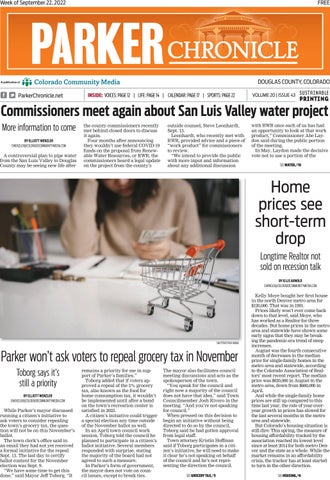
SHUTTERSTOCK IMAGE
Parker won’t ask voters to repeal grocery tax in November Toborg says it’s still a priority BY ELLIOTT WENZLER EWENZLER@COLORADOCOMMUNITYMEDIA.COM
While Parker’s mayor discussed running a citizen’s initiative to ask voters to consider repealing the town’s grocery tax, the question will not be on this November’s ballot. The town clerk’s office said in an email they had not yet received a formal initiative for the repeal Sept. 13. The last day to certify ballot content for the November election was Sept. 9. “We have some time to get this done,” said Mayor Jeff Toborg. “It
remains a priority for me in support of Parker’s families.” Toborg added that if voters approved a repeal of the 3% grocery tax, also known as the food for home consumption tax, it wouldn’t be implemented until after a bond on the town’s recreation center is satisfied in 2025. A citizen’s initiative could trigger a special election any time outside of the November ballot as well. In an April town council work session, Toborg told the council he planned to participate in a citizen’s ballot initiative. Several members responded with surprise, stating the majority of the board had not agreed to such a measure. In Parker’s form of government, the mayor does not vote on council issues, except to break ties.
The mayor also facilitates council meeting discussions and acts as the spokesperson of the town. “You speak for the council and right now a majority of the council does not have that idea,” said Town Councilmember Josh Rivero in the meeting. “And you’re not speaking for council.” When pressed on this decision to begin an initiative without being directed to do so by the council, Toborg said he had gotten approval from legal staff. Town attorney Kristin Hoffman said if Toborg participates in a citizen’s initiative, he will need to make it clear he’s not speaking on behalf of the council and he’s not representing the direction the council. SEE GROCERY TAX, P5
Kelly Moye bought her first house in the north Denver metro area for $120,000. That was in 1991. Prices likely won’t ever come back down to that level, said Moye, who has worked as a Realtor for three decades. But home prices in the metro area and statewide have shown some early signs that they may be breaking the pandemic-era trend of steep increases. August was the fourth consecutive month of decreases in the median price for single-family homes in the metro area and statewide, according to the Colorado Association of Realtors’ most recent report. The median price was $620,000 in August in the metro area, down from $660,000 in April. And while the single-family home prices are still up compared to this time last year, the rate of year-overyear growth in prices has slowed for the last several months in the metro area and statewide. But Colorado’s housing situation is still dire: This spring, the measure of housing affordability tracked by the association reached its lowest level since at least 2014 for both metro Denver and the state as a whole. While the market remains in an affordability crisis, the tracker has at least started to turn in the other direction. SEE HOUSING, P6