FREE
Week of September 22, 2022
DENVER, COLORADO
A publication of
VOLUME 95 | ISSUE 44
Pickin’ and singin’ to benefit Cameron church Denver Homeless program reduced hospital and jail visits
BY CHRISTY STEADMAN CSTEADMAN@COLORADOCOMMUNITYMEDIA.COM
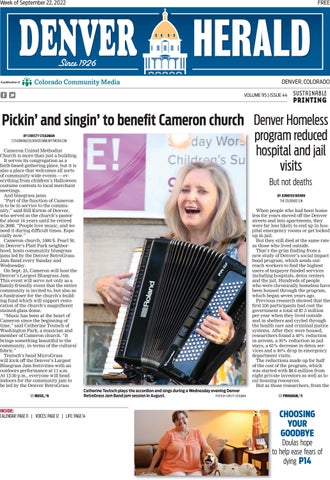
Cameron United Methodist Church is more than just a building. It serves its congregation as a faith-based gathering place, but it is also a place that welcomes all sorts of community-wide events — everything from children’s Halloween costume contests to local merchant meetings. And bluegrass jams. “Part of the function of Cameron is to be in service to the community,” said Bill Kirton of Denver, who served as the church’s pastor for about 16 years until he retired in 2008. “People love music, and we need it during difficult times. Especially now.” Cameron church, 1600 S. Pearl St. in Denver’s Platt Park neighborhood, hosts community bluegrass jams led by the Denver RetroGrass Jam Band every Sunday and Wednesday. On Sept. 25, Cameron will host the Denver’s Largest Bluegrass Jam. This event will serve not only as a family-friendly event that the entire community is invited to, but also as a fundraiser for the church’s building fund which will support restoration of the church’s magnificent stained-glass dome. “Music has been at the heart of Cameron since the beginning of time,” said Catherine Teutsch of Washington Park, a musician and member of Cameron church. “It brings something beautiful to the community, in terms of the cultural fabric.” Teutsch’s band MicroGrass will kick off the Denver’s Largest Bluegrass Jam festivities with an outdoors performance at 11 a.m. At 12:30 p.m., everyone will head indoors for the community jam to be led by the Denver RetroGrass SEE MUSIC, P6
But not deaths BY JENNIFER BROWN THE COLORADO SUN
Catherine Teutsch plays the accordion and sings during a Wednesday evening Denver PHOTO BY CHRISTY STEADMAN RetroGrass Jam Band jam session in August.
INSIDE: CALENDAR: PAGE 11 | VOICES: PAGE 12 | LIFE: PAGE 14
When people who had been homeless for years moved off the Denver streets and into apartments, they were far less likely to end up in hospital emergency rooms or get locked up in jail. But they still died at the same rate as those who lived outside. That’s the grim finding from a new study of Denver’s social impact bond program, which sends outreach workers to find the highest users of taxpayer-funded services including hospitals, detox centers and the jail. Hundreds of people who were chronically homeless have been housed through the program, which began seven years ago. Previous research showed that the first 250 participants had cost the government a total of $7.3 million per year when they lived outside and in shelters and cycled through the health care and criminal justice systems. After they were housed, researchers found a 40% reduction in arrests, a 30% reduction in jail stays, a 65% decrease in detox services and a 40% drop in emergency department visits. The reductions made up for half of the cost of the program, which was started with $8.6 million from eight private investors as well as local housing resources. But as those researchers, from the SEE PROGRAM, P3
CHOOSING YOUR GOODBYE
Doulas hope to help ease fears of dying P14