$1.00
Week of January 26, 2023
D
I
S
P
A
T
C
H
DENVER, COLORADO
A publication of
VOLUME 96 | ISSUE 10
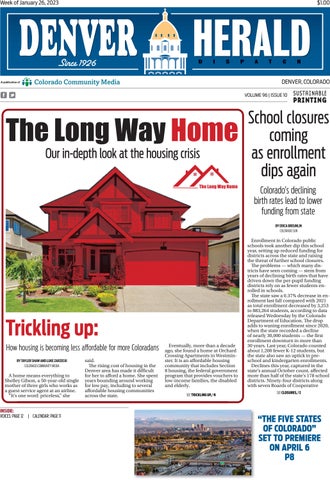
Our in-depth look at the housing crisis
School closures coming as enrollment dips again Colorado’s declining birth rates lead to lower funding from state BY ERICA BREUNLIN COLORADO SUN
Trickling up: How housing is becoming less affordable for more Coloradans BY TAYLER SHAW AND LUKE ZARZECKI COLORADO COMMUNITY MEDIA
A home means everything to Shelley Gilson, a 50-year-old single mother of three girls who works as a guest service agent at an airline. “It’s one word: priceless,” she INSIDE: VOICES: PAGE 12 | CALENDAR: PAGE 11
said. The rising cost of housing in the Denver area has made it difficult for her to afford a home. She spent years bounding around working for low pay, including to several affordable housing communities across the state.
Eventually, more than a decade ago, she found a home at Orchard Crossing Apartments in Westminster. It is an affordable housing community that includes Section 8 housing, the federal government program that provides vouchers to low-income families, the disabled and elderly. SEE TRICKLING UP, P6
Enrollment in Colorado public schools took another dip this school year, setting up reduced funding for districts across the state and raising the threat of further school closures. The problems — which many districts have seen coming — stem from years of declining birth rates that have driven down the per-pupil funding districts rely on as fewer students enrolled in schools. The state saw a 0.37% decrease in enrollment last fall compared with 2021 as total enrollment decreased by 3,253 to 883,264 students, according to data released Wednesday by the Colorado Department of Education. The drop adds to waning enrollment since 2020, when the state recorded a decline of nearly 30,000 students — the first enrollment downturn in more than 30 years. Last year, Colorado counted about 1,200 fewer K-12 students, but the state also saw an uptick in preschool and kindergarten enrollments. Declines this year, captured in the state’s annual October count, affected more than half of the state’s 178 school districts. Ninety-four districts along with seven Boards of Cooperative SEE CLOSURES, P2
“THE FIVE STATES OF COLORADO” SET TO PREMIERE ON APRIL 6 P8