





BY RYLEE DUNN RDUNN@COLORADOCOMMUNITYMEDIA.COM
As the Ralston Fields urban renewal tract nears completion of its 25-year redevelopment, residents in the up-and-coming neighborhood will soon have another local hotspot, the Arvada Beer Garden, which is set to open on Monday, July 7, pending nal inspections.
e beer garden, located at 9248 W. 58th Place, was built in partnership between the Arvada Urban Renewal Authority and City Street Investors, who have overseen construction of the Lowry Beer Garden, Edgewater Beer Garden, Green Valley Ranch Beer Garden and the recently opened Schoolyard Beer Garden.

Five years after the emerald ash borer arrived in Arvada, the city’s forester warns of a dying period ahead
BY RYLEE DUNN
Arvada’s 97,000 ash trees are in danger. e culprit? A green jewel beetle native to northeast Asia, called the emerald ash borer, which feeds on ash trees and reproduces in their bark crevices.
e borer’s larvae feed even more, wreaking havoc on the tree’s vascular system and causing dieback and eventual death.
e emerald ash borer (commonly called the EAB) was rst discovered in the Homestead Park neighborhood near 64th Avenue and Sheridan Boulevard in 2020, but has now spread across town, according to Arvada’s City Forester Ian MacDonald. “ e spread has increased dramatically,” MacDonald said. “Last year, I would say, 64th and Pierce, it was pretty obvi-
ous that it was in that area. And then on the east side of town, the Tennyson and Bowles neighborhood, but now I’m seeing trees at 72nd and Sims that have symptoms of emerald ash borer.
“ e time it took to go from the Homestead Park area to 64th and Wadsworth, it took about four years to get there, but now the di erence between year four and year ve is dramatic,” MacDonald said.
“Everywhere I’m driving now, I’m seeing it. For sure on the east side of town, north to south, I’m seeing trees with symptoms or just dead trees.”
MacDonald said that the EAB typically takes ve years to spread throughout a given area, and added that after that initial period, trees typically begin dying en masse.
“We’re ve years into it, and the ‘mortality curve’ is what they call it; other states that have dealt with this have a pretty good tracking of how this moves,” MacDonald said. “ e rst ve years is generally the build-up of emerald ash borer. And then ve to 10 years is when you really start seeing the trees to start dying.
“We’re at that ve-year mark, and mortality has really picked up,” MacDonald continued.
e EAB was rst discovered in North
America in 2002, with a population in Michigan that has killed tens of millions of ash trees in the state, according to the Michigan Invasive Species Program. Colorado is one of the westernmost satellite population sites for the EAB, though populations have also been found in Utah and Oregon.
e beetle’s presence in Boulder slightly predates its arrival in Arvada; the EAB was found there in 2013.
Boulder has approximately 70,000 ash trees, and through a variety of mitigation e orts — including chemically treating at-risk trees, introducing EAB predators and community educational outreach — the city was able to limit the impact of the pest, only removing 3,100 ash trees from 2013 to 2018, according to the city’s 10 year report on the EAB invasion.
MacDonald said that Arvada is working on utilizing some of the same procedures Boulder did in its mitigation e orts, treating at-risk trees and letting community members know that if they own ash trees, they should seek out trunk injections for larger trees and root system treatments for smaller ones.
In addition to o ering local and regional beers, the beer garden will o er a full food menu and be home to 44 trees and over 1,000 perennial plants and shrubs.
Joe Vostrejs, one of the founders of City Street Investors, said the goal is for the beer garden to become a community gathering place.
“I like to describe it as a little bit like going to a great park with a really, really good concession stand,” Vostrejs said. “It’s really going to be a nice, lush environment with lots of owers and trees that we’re going to be looking forward to growing into big shade trees in the coming years.” e beer garden is accessible from the Ralston Creek Trail, and its location within the budding Ralston Creek neighborhood brings a di erent dimension to the community, AURA Executive Director Carrie Briscoe said.
“It’s part of the Ralston Creek master plan, which includes e Shops at Ralston Creek; the Five Guys, Tokyo Joe’s, the Wingstop…So, we have the national tenants, kind of the larger food chains on the other corner,” Briscoe said. “ e beer garden is kind of a nice complement, a regional o ering, and really the cornerstone, I guess, ‘the living room’ of that master development.
“It’s a really great location there at Ralston Central Park, Ralston Creek Trail, the new Garrison Garden Paseo,” Briscoe continued. “So it’s really like a nice placemaking opportunity

Arvada press
A legal newspaper of general circulation in Je erson County, Colorado, the Arvada Press is published weekly on Thursday by Colorado Community Media, 3540 Evergreen Parkway, Evergreen, CO 80439.
POSTMASTER: Send address change to: Arvada Press, 750 W. Hampden Ave., Suite 225, Englewood, CO 80110
Call first: 3540 Evergreen Parkway, Evergreeen, CO, 80439
Mailing Address: 750 W. Hampden Ave., Suite 225 Englewood, CO 80110
Phone: 303-566-4100
Web: ArvadaPress.com
To subscribe call 303-566-4100 or Scan this QR Code

STEVE T STRICKBINE President steve@timeslocalmedia.com
NADINE JOHNSON Director of Operations nadine@timeslocalmedia.com
NICK OLIVERI Director of Sales nick@timeslocalmedia.com
COURTNEY OLDHAM Production and Design Director production@timelocalmedia.com
DYLAN LOTTS Editorial Supervisor dlotts@coloradocommunitymedia.com
RYLEE DUNN Community Editor rdunn@coloradocommunitymedia.com
ERIN ADAMS Marketing Consultant eadams@coloradocommunitymedia.com
LINDSAY NICOLETTI Operations/ Circulation Manager lnicoletti@coloradocommunitymedia.com
Columnists & Guest Commentaries
Columnist opinions are not necessarily those of the Press.
We welcome letters to the editor. Please include your full name, address and the best number to reach you by telephone.
Je erson County to invest about $7 million in fire mitigation, creating 37
BY RYLEE DUNN RDUNN@COLORADOCOMMUNITYMEDIA.COM
ree years after the Marshall Fire, the Je erson County Board of County Commissioners is taking a proactive approach to re mitigation, approving funding for a new Wildland Fire Management Program that will create 37 jobs in the eld of wild re prevention.
A $7 million budget request from Sheri Reggie Marinelli was approved at the June 24 Je erson County Board of County Commissioners meeting, which was prompted by the passage of Ballot Measure 1A, which allows Jeffco to retain revenue collected to help fund public safety measures. e funds will go toward creating a fully sta ed wildland re engine with two eight-person crews, hiring planning and ana-
lytics sta , and building out community engagement and risk assessment programs to help Jeffco residents avoid re risks. e program will also include a grant program that helps residents pay for re mitigation infrastructure in and around their homes.
“During the re season, we’re going to have seven-day coverage and sta ng for the county, which is something we’ve never had before,” Brian Keating, the Wildland Fire Program manager, said. “We’re going to have a community engagement component to this program, and within there, we’re going to be establishing a countywide home assessment program.
“So, we’ll work with homeowners, and we’ll send folks out to look at their property, and we’ll provide them with recommendations on what they can do, both in terms of defensible space and home hardening to mitigate the risk of wild re impacting them,” Keating continued.
Keating said that the $7 million is divided into a $2.3 million one-time capital investment in wildland re trucks, equipment for crews and other re ghting

infrastructure, while there will also be a sustained annual investment of $4.5 million to fund the jobs created by the program. ose positions will likely start to get lled by August, and Keating hopes to have the program fully sta ed by mid-fall.
A spokesperson for the county said that Je co ranks higher than 99% of counties nationwide for wild re danger and is the second-highest at-risk county in Colorado for wild re danger.
“ is initiative represents a signi cant step forward in our mission to better serve and protect Je erson County,” Marinelli said. “Wild re risk is extremely high in our county, and this program will allow us to be more proactive and better equipped to respond to re-related emergencies.”
Keating said he hopes the program allows the county to support its re protection districts and other re ghting partners more e ectively.
“My goal for this program is really to support our partners,” Keating said. “So we’ve been working very closely with all of the re protection districts in Je erson
County and the various re departments at the municipal level to identify what their needs are and what we can do to support them.
“And so everything that I just mentioned in terms of this investment are things that are going to help support them in the work they do, both with re response, responding to incidents, as well as working in the community to educate and create awareness and help them be more prepared for re,” Keating continued.
Risk assessments will be carried out by county sta ers on an as-requested basis, allowing residents to have a professional appraise their property for re damage. e program will also include a social media education component.
Je erson County Board of Commissioners Chair Lesley Dahlkemper praised the decision to fund the Wildland Fire Management Program.
“ is is an urgent need in our county, and the Board of Commissioners could not be more supportive of this comprehensive and well-thought-out plan,” Dahlkemper said.
Email letters to letters@coloradocommunitymedia.com
Deadline Tues. for the following week’s paper.




from the Colorado Department of Agriculture, and we’ve been treating our trees every other year for the past ve years,” MacDonald continued.


Colorado Community Media asks readers to make us aware of mistakes we may have made.
Email sgilbert@coloradocommunitymedia.com if you notice a possible error you would like us to take a look at.

“ e trees on city property, we have done a full evaluation twice now in the last eight years, and we’re currently working on a third evaluation,” MacDonald said. “We aimed to save about half of the (ash) trees that were in our park system. We had roughly 1500 to start with. We’re down to about 1100 and we are treating just about 750 trees.
“ ose are all treated in-house by our forestry sta , or they’re treated by licensed applicators
ose treatments have been mostly successful, MacDonald said, with 99% of treated trees surviving. e city lost two trees to the emerald ash borer this year, but plans to up the dosage of its trunk injection treatments to prevent further casualties.
For trees on private property, MacDonald suggested that homeowners contact service providers listed on Denver’s Licensed Tree Contractor List, which requires a thorough vetting process to be
placed on, MacDonald said. He added that almost all service providers who operate in Denver will be able to come out to Arvada. e city of Arvada does not have its own such list.
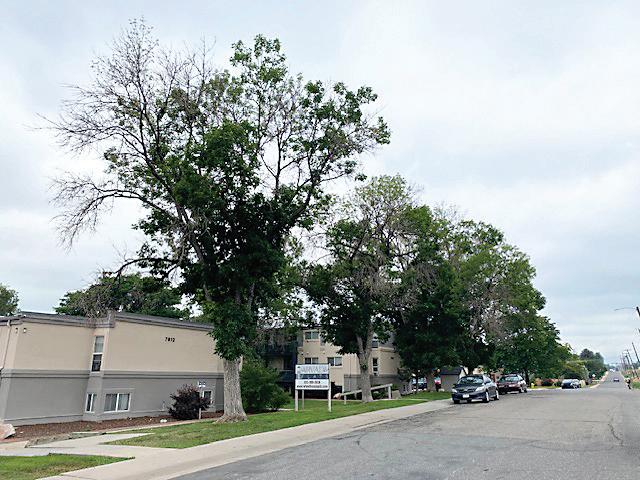
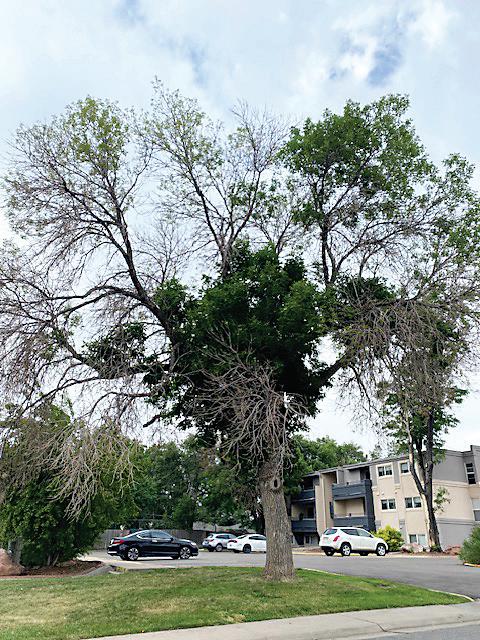
MacDonald said signs of an EAB infestation might be di cult to spot at rst, but generally show up after the rst year with symptoms manifesting in canopy dieback, leaving a thin upper canopy and generally accompanying a lot of growth in the middle of the tree, called epicormic growth, which is the tree’s response to not being able to get enough nutrients.
e emerald ash borer leaves D-shaped exit holes in trees af-
ter it leaves them. Its larvae leave serpentine patterns underneath leries,” when they are feeding on the tree’s phloem in the winter, which eventually depletes the tree’s vascular system and kills it.
If people are seeing bark loss and galleries on their ash tree, it’s a sign that the tree is likely already dead, MacDonald said.
For now, MacDonald and his team are working on protecting the city’s ash trees despite the rapidly spreading population of the EAB and the fact that the mortality period seems to have begun — and will likely continue for the next ve to 10 years.
This is the third installment of a monthly series about one of the hottest topics in real estate: Accessory Dwelling Units. ADUs have gotten a lot of attention recently as a housing option. You can read the previous installments online at my blog, http://realestatetoday.substack.com
My thanks to John Phillips of Verdant Living for helping with the research on this series of articles.
home improvement loan. It will probably be one of the largest loans the borrower has, exceeded only by the mortgage on their primary residence.
Talk About ADUs
ADUs — detached accessory (or additional) dwelling units, also called mini homes — are a wonderful idea for the right homeowner. They use an existing piece of residential real estate and create a separate living space. They are often used for intergenerational housing (aging parents, 20-somethings just starting out, etc.) and have long term value as rental property and add to the value of your real estate.
whatever) or with help from parents/ children/friends.


In my Real Estate Today column on February 20, 2025, which you can read on my blog referenced above, I discussed the basics of ADU finance. Today, I want to talk a bit more about the dynamics involved.
Financial issues are an impediment to getting an ADU built because of two general issues.
Have a friend or relative co-sign for the loan (a solution that could involve sharing ownership of the real estate).
Consider ways to show the lender the value of the ADU. A rental agreement with the tenant who will occupy the ADU, explain the ongoing rental value, or show how the ADU will increase the value of the real estate (thus increase the value of the mortgage security). Note, this sort of thing is just now being taken into account by the mortgage industry.
ADU and leave the primary mortgage in place; the result would be a “blended” interest rate that may be more palatable. In addition, there is an emotional issue, which may be present in buyers of moderate means. Taking on substantially more long-term debt can be intimidating. The “need” has to overcome the understandable reluctance.
So, you want to put an ADU on your property. How do you pay for it?
A couple of basics. First, an ADU is part of an existing piece of real estate (a primary residence). As a result, assuming money is borrowed to pay for it, the loan will be within the mortgage finance industry. Until recently, very few in that industry were knowledgeable about ADUs, much less about how they could be financed. Banks, other lending institutions, mortgage brokers, government finance authorities, didn’t understand how they fit in, but that is changing. Second, the amount of the loan will be relatively significant, far more than purchasing a nice automobile, or a
Credit Qualification. As anyone who has purchased a home knows, the mortgage industry has an extensive process to determine the credit worthiness of a borrower for a particular transaction (income, debt-toincome ratio, credit score, etc.). This is one of the reasons the majority of ADUs are built by relatively well off homeowners. For those of moderate means, financing the construction can be a challenge. This is unfortunate, because those are the homeowners who might benefit most having an ADU for intergenerational housing and, in the long term, creating rental income and building wealth by enhancing the value of their most valuable asset, their home. If a homeowner has a real need, and is determined to build the ADU, here are some practical suggestions that might improve credit worthiness:
Lower the amount of the loan and thus the monthly payment by increasing the down payment, using available cash (savings or
I recently learned about a fascinating program called TACT — Teaching the Autistic Community Trades. I was so inspired visiting their Denver facility that I must share it with you!
TACT is a pioneering and innovative nonprofit organization that provides hands-on vocational and technical training to young adults with Autism Spectrum Disorder (ASD). TACT aims to combat the historically high 90% under- and unemployment rate within this community by equipping individuals with practical skills that lead to sustainable careers. Through its immersive training programs, TACT is preparing young people with ASD — who now represent 1 in 36 children — for high-demand careers in the skilled trades. TACT offers a wide range of programs, including auto mechanics, computer coding, cybersecurity, carpentry, electrical work, electric vehicle conversions, 3D modeling, welding, and culinary arts.
As a “specialized day school,” TACT also bridges the gap between secondary and postsecondary education, creating clear pathways to employment. Its programs empower students to become more independent and earn a living wage in high-skill, high-wage occupations. TACT remains the first and only trade program in the country designed specifically for individuals with ASD, and it has positively impacted thousands of individuals and families throughout Colorado.
TACT envisions a world where neurodiversity is not only accepted but celebrated, allowing individuals on the autism spectrum to fully contribute their talents and find personal fulfillment. With a mission to empower the entire spectrum of individuals with ASD through education and employment in the skilled trades, TACT continues to build on a strong foundation, fostering opportunities for success. I’ve posted an inspiring video at http://RealEstateToday.substack.com
In Colorado, legislation supporting ADU development (which takes affect this July) includes a provision (and some funding), tasking the Colorado Housing and Finance Authority (CFHA) with organizing a program that would help ADU purchasers of moderate means qualify for financing. That program should be announced soon.
Lower the cost of the ADU by choosing lower cost options, ranging from less expensive building materials to things like more affordable appliances.
Borrower reluctance. It should come as no surprise that interest rates play a major role. Homeowners can use the equity in their main residence (by refinancing their current mortgage) to build the ADU. However, if the primary mortgage carries a low interest rate, as most do these days, the borrower will not want to refinance at current rates.
A good alternative is to apply for a home equity line of credit (HELOC) to pay for the
Finally, there is the possibility of a third party (someone not living on the property) investing in the ADU, thus facilitating the financial piece. Under recent legislation the legal mechanisms to make it work would need to be developed. It is an interesting possibility and could overcome the financing obstacles, particularly for those of moderate means.
Although the dynamics are very different, a similar idea has been tried in South Africa to help ease the need for housing there. I have a link to a Bloomberg article about that project on my blog.
To help with these issues, Verdant Living has published a very useful buyers guide, BuyersGuideColoradoADUs.com, with advice on financing. Another good resource is the VerdantLiving.us, or contact John Phillips at 303-717-1962
I want to thank the following people in addition to John Phillips for their input: Jaxzann Riggs, The Mortgage Network; Kristen Stultz, Macro Financial; Charles Edington, LOANstar; Cindy Beier, Cindy’s Property Solutions.
Next month: Why smaller living spaces work well
Clickable links for each column can be found at www.JimSmithColumns.com
May 29, 2025 — Divorcing Couples With a Home Need a Realtor With Specialized Training
May 22, 2025 — Home Sharing Helps Single Seniors Deal With Finance and Loneliness, Allowing Them to Age in Place
April 24, 2025 — Lennar to Build 1,500 Geothermal Homes; My Review of the Mustang Mach E
April 17, 2025 — Redfin Report Highlights the Increasing Cost of Buying versus Renting a Home
April 10, 2025 — The Typical Wood-Frame, SiteBuilt Home So Common Since the ’90s May Soon Be a Thing of the Past
Mar. 27, 2025 — Here’s How Money Is Handled at a Real Estate Closing
Mar. 20, 2025 — Thinking of Using a Reverse Mortgage to Purchase a Home? Here’s Some Information
Mar. 13, 2025 — Will Colorado Be Able to Sustain Its ‘Green Agenda’ Under Pressure From Washington?
Pollutants Emitted When Cooking With Gas
Oct. 31, 2024 — Cooperative Living Presents an Attractive Alternative for Downsizing Seniors
Sept. 26, 2024 — Some Thoughts on Keeping Your Death From Becoming an Undue Burden on Your Heirs
Sept. 5, 2024 — What Knowledge and Skills Should You Expect Your Real Estate Agent to Have?
Aug. 8, 2024 — Seniors Over 70 Might Consider Downsizing Into a Rental, Not a Smaller Home
July 25, 2024 — Many Homeowners Don’t Understand Title Issues, Which Could Lead to Big Problems Later On
June 6, 2024 — Here Are Some Simple Steps to Take to Avoid Unpleasant Surprises After Closing
Mar. 21, 2024 — What’s Behind the Buzz About ‘Indoor Air Quality’ and ‘Sick Building Syndrome’?
Feb. 22, 2024 — Most Sellers Don’t Know How to Interview a Listing Agent. Here’s Some Guidance.


$1,195,000



Here’s why. The fully equipped 511-sq.-ft. heated workshop shown here is included in the 3,500-sq.-ft. custom-built home at 2069 Garrison St. in Lakewood. Every possible power and hand tool a carpenter might want is in this workshop. The rest of this 3-bedroom/3-bath house is amazing, too, starting with the great kitchen, which has a built-in Miele espresso machine (my favorite!) plus a Sub-Zero refrigerator with cherrywood doors to match the kitchen cabinetry. The seller-owned 17-kW solar photovoltaic system meets all the electrical needs of the home, including charging the seller’s electric car. See all these features and more in the 11-minute video tour I posted at www.GRElistings.com. The website contains more photos and full descriptions of each room. Sorry, there will be no open houses. Call your agent or me at 303-525-1851 to see it in person.
Mar. 6, 2025 — 62% of Americans Think a 20% Down Payment Is Required, But It’s the #1 Myth
Feb. 27, 2025 — As Society Deals With Homelessness and Affordability, Expect a Greater Focus on Manufactured Homes
Feb. 20, 2025 — We Have a Tool to Help You Find the ‘Perfect’ Home That’s Not on the MLS
Dec. 26, 2024 — As Pro-Tenant Laws Expand, Some Small Landlords Are Considering Cashing Out
Dec. 19, 2024 — What Are the Costs of Buying or Selling a Home in Colorado?
Nov. 7, 2024 — We Need to Take Seriously the

Dec. 21, 2023 — D.R. Horton Inks Deal to Build Homes With OSB Made From Grass Instead of Wood
Nov. 23, 2023 — Scamming Has Become Its Own Industry, and We’re All Prospective Victims
Sept. 28, 2023 — Insurance Companies Are Pulling Out of California. Is That in Our Future?
Aug. 10, 2023 — What Are Some Common Mistakes That Homeowners Make When Selling?
June 15, 2023 — Don’t Let Capital Gains Tax Deter You From Cashing Out on an Investment Property
May 11, 2023 — Do Agents Inflate the Cost of Buying or Selling Your Home with ‘Junk Fees’?


Preliminary injunction does not bar Gov. Polis from finding another way to comply with subpoena
BY SARA WILSON NEWSLINE COLORADO
A Denver judge on Wednesday blocked the Colorado governor’s o ce from forcing a state employee to hand over records to federal immigration authorities on 35 sponsors of unaccompanied immigrant children in the state.
e information was sought in a U.S. Immigration and Customs Enforcement subpoena from April.
e preliminary injunction, handed down by Denver District Court Judge A. Bruce Jones, applies only to Scott Moss and sta ers in the Division of Labor Standards and Statistics within the state’s labor department. Moss is the division’s director.
“I will not enjoin the governor from otherwise responding to this subpoena if that’s what he wants to do,” Jones said. “And it’s not to say that there isn’t some other workaround where somebody could ask one of his supervisees to do something and they do it. I’m not enjoining them from doing it. I’m enjoining the governor from requiring that they do it.”
e ICE subpoena seeks personal information, such as addresses, telephone numbers, emails and employment history, on 35 sponsors of immigrant children, purportedly in order to check on
the children’s welfare and investigate any potential child abuse. Gov. Jared Polis, a Democrat, decided to comply with the subpoena in late May after some deliberation.
at’s when Moss led a lawsuit against Polis alleging that disclosing the data would violate a state law against data sharing with ICE unless it is for a criminal investigation or under a judge-signed subpoena. Moss’ lawyers argued in court this week that the subpoena does not t that standard because it does not point to any speci c, ongoing criminal investigation and could be an attempt from federal immigration authorities to nd the names and addresses of people to put in deportation proceedings.
“It’s essentially a shing expedition,” Moss lawyer Laura Wolf said in court on Monday.
In his testimony, Moss said that during an April 29 meeting with representatives from the Colorado Department of Labor and Employment, the attorney general’s o ce and the governor’s o ce, “nobody expressed the view that the production should be made in light” of the state law.
“We all agreed that if there were concerns about child welfare, those should be looked into by appropriate folks. But we all agreed that we had not seen any evidence of any harm to children,” Moss said. “If we had any evidence, it could be routed the appropriate way. ere are state and local agencies that cover such things.”
CDLE director Joe Barela then told Moss in late May that Polis had changed his mind and wanted to produce the records requested by the subpoena.
“He said that the governor didn’t want


to be accused of not helping ICE prevent any harm that might be happening to any children,” Moss said Tuesday in court. “He said that the governor … thought that the criminal exception (in the law) … gave him ‘cover.’”
Polis’ lawyers argued this week that the subpoena related to criminal matters, and that Moss was not at risk professionally if he decided not to tell his employees to produce the information. at could have meant Barela, or some other o cial, would make the order.

Two unions that represent state employees, Colorado WINS and AFL-CIO, are also plainti s in the lawsuit.
Polis spokesperson Shelby Wieman said the governor’s o ce is reviewing next steps.










“But the statute isn’t about protecting me personally. It’s about protecting the individuals named from having their (personal identifying information) released in a potentially injurious way. It wouldn’t make me feel any better if, to save me from the trouble, other state employees would have this thrust upon them,” Moss said Tuesday.
Colorado in recent years has enacted state laws, including legislation signed in 2021 and earlier this year, that limit the sharing of data about immigrants with federal immigration enforcement authorities.
“We will abide by the court’s decision as we have always said we would,” she wrote in an email. “Governor Polis remains committed to fully and promptly cooperating with federal criminal investigations into child tra cking and exploitation, while protecting unaccompanied children in Colorado. We hope if information is needed for criminal investigations, that going forward (Homeland Security Investigations) will provide subpoenas for state information consistent with this ruling.”
Polis has repeatedly said that he welcomes federal help to detain and deport “dangerous criminals.” is story is from Colorado Newsline. Used by permission. For more, and to support the news organization, visit coloradonewsline.com.
BY RYLEE DUNN RDUNN@COLORADOCOMMUNITYMEDIA.COM
ree men have been apprehended by law enforcement due to their alleged involvement in an attempted homicide that occurred in April.
At around 12:29 a.m. on April 26, Arvada police o cers responded to reports of a shooting on the 7400 block of W. 61st Avenue. When they arrived, ofcers found one adult male victim who had su ered multiple gunshot wounds. e individual was transported to the hospital for treatment and is believed to have made a full recovery.
After an investigation, o cers ascertained that the victim was asked to check on the residence, which is occupied by a family member of the victim, because the tenant received a suspicious message that indicated someone was inside
the apartment without permission.
When the victim arrived at the scene, three individuals wearing ski masks were present and red shots at the victim before getting into a pickup truck and driving away. e three men are believed to be Andrew Ortiz, Jaime Cesar Agustin Martinez-Garcia and Kevin Emmanual Arellano-Castillo, all of whom have been arrested by authorities.
Arellano-Castillo was arrested on June 16 for accessory to a crime, while Ortiz was arrested on June 20 in Brush for attempted murder in the rst degree, illegal discharge of a rearm and possession of a weapon by a previous o ender. MartinezGarcia was arrested in Denver on June 21 for second-degree burglary and theft. Law enforcement authorities report that Ortiz was on parole after serving 12 years in prison for a rst-degree murder case that occurred in 2008, for which he was sentenced to 24 years.
Dave Snelling, a public information o cer with the Arvada Police Department, said that the victim knew the alleged perpetrators before the incident.





for the community to gather and linger, versus, you know, the other side that’s more just like convenience, on-the-go type of stu .”
AURA sold City Street Investors the land for $230,000 and included a $1.6 million incentive to help with public improvements for the project, Briscoe said. Vostrejs said City Street Investors spent about $4 million on the project on their end.
Vostrejs said that if the nal inspections with the city go according to plan, the Arvada Beer Garden should open for the rst time at 11 a.m. on Monday, July 7.







Sunday Masses: 7:30, 9:00, 11:30am, 5:30pm ST. JOANOF ARC CATHOLICCHURCH
Proclaiming Christ from the Mountains to the Plains
www.StJoanArvada.org
12735 W 58th Ave · 80002 · 303-420-1232
Daily Masses: 8:30am, Mon-Sat
Confessions: 8am Tue-Fri; 7:30am & 4:00pm Sat
Saturday Vigil Mass: 5:00pm

“Find Connection…Discover Faith” All Are Welcome
Sunday Worship 10:00AM
Green Mountain Presbyterian Church 12900 W Alameda Pkwy Lakewood, CO 80228
303-985-8733
www.gmpc.net




BY STEVE SMITH SPECIAL TO COLORADO COMMUNITY MEDIA



ree new rules will be in play when the 2025-2026 ice hockey season begins in Colorado.

athletic participation survey, more than 32,000 boys participate in ice hockey in 1,641 high schools across the country, and more than 9,600 girls participate in the sport in 785 schools.

Advertise Your Place of Worship HERE

Join us in person: 1st & 3rd Sundays
7401 W. 59 Ave, Arvada
Other Sundays on Zoom 10:30 am Live Music Livingwaterunity.org Livingwaterspiritualcommunity@gmail.com 720-576-9193
All Are Welcome
To advertise your place of worship in this section, call Erin at 303-566-4074 or email eadams@coloradocommunitymedia.com
e puck is unplayable if it comes to rest on top of the goal between the crossbar and the goal frame.
According to the National Federation of High Schools’ web page, the rule also clari es the rules for pucks on the outside of the goal netting and below the crossbar. Play continues in this instance.
“ e primary reason for stopping play when the puck is on top of the net is for the health and safety of players and the goalkeeper,” said Dan Schuster, NFHS director of educational services and editor of the NFHS Ice Hockey Rules Book, in the statement on the NFHS web page.
“ e committee did not want to see sticks coming up high, trying to knock the puck o the shelf,” Schuster continued. “ e proximity of the goalkeeper is always sensitive, so there could be sticks coming in high in the direction of the goalkeeper and the committee did not want that in high-school ice hockey.”
Another rule will keep goalkeepers from wearing audio and video devices during games.
e last rule changes the word “linesman” to “linesperson.” e federation’s rule book replaced gender-speci c language earlier.
According to the most recent NFHS
Fifty schools eld boys teams that compete in seven conferences in Colorado, according to MaxPreps. Seven schools eld girls teams, according to MaxPreps. ose teams are in the southern end of the Denver metropolitan area, Castle Rock and one district team from Colorado Springs.
For more updates and rule changes, visit CHSAANow.com.








Bear-proof trash cans, septic inspections are part of proposed changes
BY JANE REUTER JANE@COTLN.ORG
A surprisingly small group came to the Je erson County administration building June 24 to hear about planned changes to the county’s short-term rental regulations.
While only about 75 people, two-thirds of them online, attended the meeting, planning supervisor Russell Clark called it a success.
“ e purpose was so people understood what the language meant,” he said. “I think it was a successful meeting from that standpoint.”
Je erson County is in the midst of a signi cant streamlining of its short-term rental regulations, with an eye toward encouraging and gaining much greater compliance from those who have Airbnbs, VRBOs and other short-term rentals.
e county estimates more than 700 STRs operate in unincorporated Je erson County, with less than 50 of those now doing so legally. e county doesn’t plan to go after those who are out of compliance, at least not initially, but instead change its regulations so they’re easier and cheaper to meet.
“I don’t think anyone who’s gone through the process will tell you it’s easy or cheap,” Clark said. “You might get some who’ll tell you it’s terrible. We’re looking to x that.”
e current process requires a public hearing before the county’s board of adjustment and “fairly strict standards to quality,” Clark said, including a lot size of over an acre, and a location within speci c zone districts.
“ en you still have to apply for the permit; it’s a not an insigni cant fee,” he said. “ en it’s only good for six months and you do it again.”
While the second permit is in e ect for a year, the same “long, drawn-out process” must still be repeated annually, Clark said.
“We’re proposing an administrative process with a set of black-and-white criteria,” he said. “If you meet that criteria, you’re approved. e time from submitting documents to approval should only be a few weeks, and we anticipate the fees will be signi cantly reduced because of the reduced amount of sta time it will take.”
No neighborhood involvement
While those fees aren’t set, Clark estimates they will be less than $500. Additionally, he said, applicants need only meet the criteria, so there would be “no neighborhood involvement” in obtaining a permit.
Some of the requirements in the proposed regulations include having bearproof trash cans, inspecting and pumping septic systems annually, a maximum occupancy limit of 10, strict limits on outdoor res, and having a contact within 30 minutes of an rental space who has authority to immediately address issues and make decisions on the owner-operator’s behalf.
“Typically for noise or parking complaints, we would want someone to come out right away,” Clark said. “If there’s an unruly guest who has a really loud party and a neighbor calls, we’d expect a fairly rapid response. If they’re blocking a narrow mountain street, that would get a pretty quick response as well. Fires would also
get a pretty quick response.”
While it would allow short-term rentals in townhomes, duplexes and accessory dwelling units, it also proposes limiting the number of STRs allowed to no more than 1% of total housing units in each re protection district, or a 750-foot minimum separation between investment properties.
ose who live in a neighborhood with a homeowner’s association will also be required to notify the HOA in advance and testify to the county that the use has been approved.
e planned changes also include a county ordinance that would give Je Co authority to regulate STRs and increase nes for non-compliance. Additionally, Je co would use an STR software company called Host Compliance to help the county identify short-term rentals and compliance rates, and provide a 24/7 complaint hotline service.
“ e intent is to get compliance, not go to citations,” he said.
Clark said the county isn’t aiming to discourage STRs.
“ ere are a number of perceived benets to short-term rentals,” he said. “A wellrun short-term rental can have bene ts to the community. But too many of them would also start causing some negativity as well.
“ e board of adjustment hears 1-4 at each hearing (currently). e vast majority are approved regardless of neighborhood concerns because generally, people complain about what could happen, not what has happened. In many cases, we’ve found the concerns of what may happen with an STR don’t always pan out. We also understand the people who are going through this process are trying to do it the right way.”
Nevertheless, Je erson County is prepared to take steps against an STR that is problematic.
“If there’s a bad operator out there, there are ways to get that taken care of, and get that license revoked,” Clark said. “And it’s not just that one license. at house itself has a scar against it. ey can’t just transfer it to a wife or child and do it again. e owner is prohibited from applying again for ve years. It’s a pretty sti penalty.
“We are as con dent as we can be we are mitigating to the extent practical the impacts of short-term rentals with these regulations.”
One woman, who did not give her name, objected to some of Clark’s comments and the elimination of neighborhood input.
“I’ve heard you say these are theoretical problems, and they’re not; they are real problems,” she said. “I think it’s very important for there to be property inspections and also to notify the neighbors beforehand. To completely eliminate any neighbors is not fair.”
Clark urged her to submit her comments to str@je co.us, and attend the planning commission and county commissioners’ hearings.
“No matter where you land on this, if you think this is the best or worst thing ever, it’s important you come to the hearings,” he said. “ ey’re the ones who are going to make the decisions on this. at’s when it’s really important to let your opinions be known.
“ is isn’t the end of this process. it’s the beginning.”
erevised STR regulations will likely be set for public hearings with the planning commission and county commissioners late this year. To submit a comment, email str@je co.us by July 20.







Ilove Paul Simon’s 1968 hit, “America.” It captures the soul of a wandering, wondering young man in search of his identity and the role he’s to play now that he’s an adult.
After she’s dozed o , he con des to his friend Cathy that he’s lost. I identify with that state of mind. At eighteen, I too was lost, and now in my ripened age, at times it feels as if I’ve come full circle. I sometimes wonder if this is still the land I came of age in, the one Jay and the Americans rhapsodized about in their 1966 pop hit, “Only in America.” My deep love for America says yes, that it’s only a matter of her temporarily losing her way. But I also admit to an occasional foreboding, troubled that she’s changing and the America of my lifetime is morphing into something I cannot put my nger on. And if that were the case, I wouldn’t like what I’d discover.
In his song, Paul has a limited view of America. He’s hitchhiked from Saginaw to meet Cathy in Pittsburgh where they hop a bus and head eastward across Pennsylvania to the New Jersey Turnpike. at was the part I found disconcerting. I felt they were heading in the wrong direction. From my earliest days, I sensed
JERRY FABYANIC

In August 1953, Pete Schoening and his teammates faced a di cult time. ey were attempting to climb K2, the second-tallest mountain in the world. e group was above 25,000 feet, at what they called Camp VII, when signi cant snowstorms hit. For seven days, the men hunkered down waiting out the weather. When the storms subsided for a short time, Alex Gilkey, a member of the tight-knit crew, got out of his tent to assess the situation. As he exited the tent, he collapsed. ey discovered that he had blood clots in his leg, and every minute above 25,000 feet created a growing likelihood that the clot could leave his leg and kill him by lodging in his lung or brain.
Knowing his life-threatening condition, the team immediately made plans to get him o the mountain. e weather did not support leaving their location at Camp VII because the storm had picked up again. e team did not care; they needed to get their friend o the mountain. So, they created a makeshift stretcher and began to take Alex to a safer altitude.
For safety’s sake, on the journey down, each group member was tied to the next. After great di culty, the team was within 150 vertical feet of the camp they were trying to reach when the lead climber slipped on an icy patch. His fall was so sudden that he pulled the climber tied to him o his feet and into a free fall. ree more climbers and the makeshift stretcher were all caught up in the sudden event and began fall-

Columnist

west was the way to go. Regardless, Paul gets at a strain in the American psyche: the urge to pick up and go and to explore new terrain. We’re a nomadic people even if it’s only in our daydreams. Packing up and heading to a new place causes con icting emotions to rise within a wayfarer. On the one hand, there’s the thrill and excitement about the adventure, discovering what’s out there and testing your mettle rst in surviving then thriving in your new land.
On the other hand, you realize you’re leaving all you’ve known and intuitively sense, even if you haven’t read Tom Wolfe’s “You Can’t Go Home Again,” that you’ll never be able to return. Oh, you certainly could go back to visit and reminisce, but the life you leave will invariably change in ways that you won’t be part of as you will in ways alien to your kith and kin. In a sense, you’ll become a stranger in the land of your birth.
I wonder how my grandparents might’ve felt after leaving their rural na-
tive lands in Eastern Europe and being thrust into the blast furnaces of Braddock, Pennsylvania and the factories in nearby towns where they scratched out a living under sub-human conditions. Did they yearn to return to Europe? Did they rue the choice they made? Or did they simply steel up and did what they could do so they could endow their children with the opportunity for a better life than what they would’ve had in the Old Country. A form of self-sacri ce perhaps? I like to think it was the latter. Coming from those beaten-down, impoverished lands, they had already learned that life can be brutal. us, they likely neither regretted their decision to emigrate nor dwelled in a self-pitying, woe-is-me cesspool. Plus, they’d die knowing they put their children and grandchildren in a better place. And that place was and is America.
I will never give up on America when she gets o kilter. e reason is she remains far greater than the specs of what’s currently being played out. As I wrote before, America is an idea, a most fantastic one. It’s still the land of opportunity for those who choose hope over despair. It’s on the faces of the beaten-down who

each day pick themselves up and struggle onward to make a better life for themselves and their kith and kin. It’s on the faces of immigrants yearning to become part of America’s story. Despite the calumny raining down on them, they’re personi cations of what America is about.
In his rendition of “America,” Neil Diamond captures that sensibility. He wrote the lyrics in tribute to his grandparents who ed czarist Russia and, like my grandparents, found a new start in America. In an interview, Neil said his song was also about the “immigrant in all of us.”
anks to the courage and steeliness of their immigrant ancestors, most Americans have likely found their place in America. Interestingly, for many, most from what I can ascertain, it’s the place of or relatively close to the place of their birth.
For the rest who didn’t and don’t just daydream, it’s somewhere else in America, not only between Saginaw and New Jersey.
Jerry Fabyanic is the author of “Sisyphus Wins” and “Food for ought: Essays on Mind and Spirit.” He lives in Georgetown.

Jim Roome

ing as well. With only seconds to react, Pete Schoening was able to halt the free fall of the other six using an ice pick, a snow-covered boulder next to him and the rope that connected him to the other six. Although they were battered and bruised, Schoening saved everyone on the team. at heroic moment is now, in mountain climbing lore, called “ e Belay,” and Schoening’s ice pick is on display in the American Mountaineering Museum in Golden.
e Belay gives us some amazing ideas to consider when we need encouragement.
e rst thing that comes to mind, for me, is the incredible impact that friends have on our lives. Alex’s friends stopped everything they were trying to accomplish to save him. Good friends are a gift. ey are di erence makers, lifesavers, and they should be celebrated.
Equally as important, this story reminds us that the ripples of our actions can be far-reaching. His entire life, Schoening insisted that he was not a hero; he was simply doing what needed to be done in that moment. In 2006, all 28 of the children and grandchildren born to the families of the men Schoening saved gathered to celebrate his quick thinking. Every one of those 28 owes their
lives to Schoening. Imagine how large that number will be in 100 years. ink about how di erent the world would be without all those people.
Our actions might not keep someone from falling o a mountain, but the ripples of doing the right thing, of continuing to push forward amid di culty, cannot be underestimated. Your push, your determination, your example might be the driving force behind someone else’s success. Do not underestimate the power and in uence of the model that you provide each day.
ere are amazing stories all around us. Celebrate the power of your story. ings may not be easy, but you have got this. I hope my words encourage you and that you will share them with those who need support.
ank you to everyone who has shared their stories with me so far; I truly appreciate hearing about the valuable ideas you nd in these columns and how you use them to uplift those around you. You can reach me at jim. roome@gmail.com.
Jim Roome lives in Arvada with his wife, Beth. He spent 34 years in public education. Lessons learned from the one-two punch of being diagnosed with MS shortly before his best friend was diagnosed with terminal cancer led him into a new pursuit as a freelance writer and speaker. He uses his life experiences and love of stories to inspire, educate and encourage local, national and international audiences. Contact him at jim.roome@gmail.com.
hat is a parade?
Some say it is a lineup of re trucks, high school bands, and people tossing candy. Others might describe it as organized chaos with oats, ags, and folding chairs. But if you have ever been behind the scenes — or on the sidewalk with your grandchild — you know it is something much deeper.
Ed C. Tomlinson

Here is the best de nition I have ever heard:
“Putting together a parade is like making a movie — what you have is a bunch of short clips,” said Cody McNutt, former executive director of the Arvada Harvest Festival. “ e goal is to take the child sitting on that curb to a di erent world every fteen seconds. Once you have done this, the adults will follow — simply by looking at the faces of the children.” at is it. at is the heartbeat of the whole thing.
A good parade is about moments. It is about the wide eyes of a child, the gasp of surprise, the contagious laughter that spreads down a sidewalk. Every fteen seconds is a chance to spark wonder.
It is about creating that moment when a child turns to a parent and says, “Can we be in it next year?” at is when you know you have done it right.
More Than Marching
ink about your favorite parade memory. It probably did not involve a sponsor banner.
It was a oat that made you stop and smile. A dance group that caught your attention. A school band that played their hearts out. at is the formula: 15-second stories strung together, live and in motion. Each entry is a tiny world of its own — cowboys, pirates, dancing seniors, little kids in oversized costumes.
Adults enjoy it, of course. But adults also watch the children. We watch their eyes light up. We remember our own childhood parades. at is how magic passes from generation to generation — not through instruction, but through emotion.
Parades do not just entertain us. ey reconnect us to each other.
Editor’s note: Senate Energy Chairman Mike Lee’s plan to sell o thousands of square miles of Western public lands has apparently been blocked for now due to Senate rules, but Lee has vowed to resurrect his idea of selling public lands to private interests.
To my fellow Coloradans, You may have heard that public lands are up for sale — but did you know they include our own backyard treasures? Gothic Mountain, the trails around Crested Butte, and parts of the Maroon Bells Wilderness could soon belong to billionaires or corporations, not to the people who love and rely on them. ese aren’t hypothetical risks — this was written into legislation that would allow buyers to sit on the land for any future use, including mining or development.
Edna Mae (Allmon) Fisher
September 28, 1938 - June 16, 2025


Prices aren’t going to be cheap and they certainly aren’t going to average Coloradans.
I’m a scientist and mom of three in Centennial. For over 20 years, I’ve conducted ecological research at the Rocky Mountain Biological Laboratory (RMBL), on Forest Service lands now at risk. Since 2018, I’ve tracked ground temperatures every ve minutes at 30 alpine sites to understand whether a species of Sulfur butter y caterpillars can nd microclimate refuges to survive climate change. is work may sound obscure — but it’s part of a bigger picture. We can’t x what we don’t understand. Long-term, place-based science like this is how we learn what to protect and how.
RMBL has conducted ecological research since 1928 — approaching 100 years — and revealed why 20% less water reaches our rivers today despite nor-
The Mission Moving Forward
As we plan this year’s parade, our mission is clear — make it unforgettable. Not by making it bigger or louder, but by making it more meaningful. We want someone to smile for the rst time that week. We want grandparents to tear up watching their grandkids march. We want kids to believe, for one day, that the world really is full of fun and possibility.
Colorado Community Media welcomes letters to the editor. Please note the following rules:
• Email your letter to letters@coloradocommunitymedia.com. Do not send via postal mail. Put the words “letter to the editor” in the email subject line.
• Submit your letter by 5 p.m. on Wednesday in order to have it considered for publication in the following week’s newspaper.
• Letters must be no longer than 400 words.
• Letters should be exclusively submitted to Colorado Community Media and should not submitted to other outlets or previously posted on websites or social media. Submitted letters become the property of CCM and should not be republished elsewhere.

mal snowpack — crucial knowledge for managing water for 40 million people across the West. RMBL scientists are also studying native bees which we barely understand — and may be crucial to rescue colony collapse and our food system, having already documented a 60% insect decline. ese insights matter deeply to our food, our farms, and our future. is is about more than science — it’s about access, community, and what kind of Colorado we’re leaving for our kids. Our local economies, recreation, and ranching depend on these lands. In 2023, outdoor recreation generated $65.8 billion in economic output and over 400,000 jobs in Colorado. I don’t want my children to grow up with “No Trespassing” signs where we once camped, hiked, and smelled wildowers. We must protect the lands that feed our bodies, minds, and spirits — not put them behind locked gates or luxury price tags. Wouldn’t you just love to pay ski ticket prices to camp on land you can now camp for free or a small permit fee? Call your senators. Tell them to stop this sale.
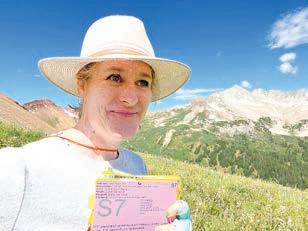
is guest column was written by Jeannie Stamberger, who has been conducting eldwork in ecology and evolution at Rocky Mountain Biological Laboratory since 2001, obtaining her Ph.D. in biology at Stanford University in 2006. She has served on the RMBL board and is a current principal investigator at RMBL. She is a mother of three who lives with her husband and family in Centennial.
So, if you are thinking about entering this year’s parade — whether you are a business, a civic group, a school, or just a creative neighbor with a great idea — remember what a parade really is.
Ask yourself, what can we do in 15 seconds to transport someone watching to another world?
at is the challenge. at is the magic. at is the heartbeat of a great parade. Ask me for advice. I will help you get there.
is guest column was written by Ed C. Tomlinson, who is the Arvada Harvest Festival parade chair. He can be reached at edctomlinson@gmail.com.
• Letters advocating for a political candidate should focus on that candidate’s qualifications for o ce. We cannot publish letters that contain unverified negative information about a candidate’s opponent. Letters advocating for or against a political candidate or ballot issue will not be published within 12 days of an election.
• Publication of any given letter is at our discretion. Letters are published as space is available.
• We will edit letters for clarity, grammar, punctuation and length and write headlines (titles) for letters at our discretion.
• Please don’t send us more than one letter per month. First priority for publication will be given to writers who have not submitted letters to us recently.
Edna Mae Fisher, passed away on June 16, 2025, at the age of 86 in Denver, Colorado. Born on September 28, 1938, she was cherished, known for her love of roses, western movies, and reading.
Edna graduated from Missouri Valley High School and dedicated much of her early life to raising her daughters. She later joined U.S. West, where she enjoyed working for 20 years. Even as she aged, Edna remained active, participating in senior classes at the Arvada Center, enjoying walks, and spending quality time with her family.
She is survived by her husband, Norris Fisher, whom she married on December 26, 1956; her brother, Keith Allmon; daughters Beverle Zirbel,
Carol VanDeWeghe, and Janice DeAndrea; sonsin-law Dale VanDeWeghe and A.J. DeAndrea; and grandchildren Jason and Austin VanDeWeghe; Christine Zirbel; Madalena and Elena DeAndrea. Edna was preceded in death by her parents, Elsworth and Helen Allmon; brother Eugene Allmon; sister Wilma Cates; and son-in-law David Zirbel.
A private service will be held at Arvada Cemetery on June 25, 2025, to honor Edna’s life and legacy. Her love for her family and her passions will be fondly remembered by all who knew her. Memorials to United Way or St. Jude’s Children Hospital.
June 9, 1933 - June 16, 2025
Mildred A Ferris passed away peacefully Monday, June 16, 2025 at the age of 92.
She was born Friday, June 9, 1933 in Kerrobert, Saskatoon, Canada to Cli ord Wilmer and Ada Mildred (Davis) Kennedy. She grew up in rural Canada, frequently traveling across the countryside by train with her father, a career railroad man. She also learned quilting and knitting, talents she would become well known for throughout her life. She was very proud of getting her nursing degree and used it to go see a little of the world.

far away as Japan
At the age of 65 she became a certi ed scuba diver and traveled the world diving with her husband. She also became a talented photographer, winning several photography shows with her unique eye for subject matter. She is survived by her children, Brian Ferris, Garth Ferris, Shaula Caves; grandchildren, Blake Ferris, Kerby Caves, and Kyla Pierce; and great grandchildren, Luca Pierce and Kynlee Caves.
While she was working in Honolulu, Hawaii she met her future husband Clinton Sylvester “Nick” Ferris Jr. where they started a long and adventure lled life together.
After they were married, they moved back to Wyoming and started a family, eventually moving to Colorado. She raised three children while becoming well known for her knitting and quilting talents. Her quilts were featured in numerous quilting magazines and often on display at various venues including the Colorado State Capital and as
Mildred was preceded in death by her parents and husband, Nick, on September 12, 2025.
A celebration of life is planned later this year. In lieu of owers, memorials to Central Wyoming Hospice Home, 319 South Wilson Street, Casper, Wyoming 82601 or to centralwyominghospice.org for online donations.
e Gorman Funeral Homes - Converse Chapel of Douglas, Wyoming is in charge of the arrangements. Condolences may be sent to the family at www.gormanfh.com.



BY ELISABETH SLAY ESLAY@COLORADOCOMMUNITYMEDIA.COM
In Denver’s bustling neighborhoods, it’s not uncommon to nd a shop cat curled up by the register or an excited dog greeting customers at the door.
Across the city, small businesses are embracing their four-legged companions, not just as pets, but as part of the store experience.
At Crystal Castle Beads, located at 2240 S. Broadway in Denver, two dogs — Ruby and Boss — have become as much a part of the shop’s identity as its crystals and handmade jewelry supplies.
Crystal Castle Beads
Owner Adrienne Lemke opened the shop with other co-workers in October 2023 after the previous bead store they worked at shut down.
“We just kind of came together and said, ‘Let’s start our own shop,’” she said.
Enter Ruby — a spirited pup with a nose for stones and a habit of napping on desks.
“I got her around the time we bought this building, on July 4,” Lemke said. “She’s been a part of this shop ever since. She helped us go through products, (she) tries to steal products … She knows the crystal business pretty well, and she has good taste in beads, too.”
Ruby quickly became the shop’s uno cial greeter, favorite distraction and emotional support creature all in one.
“People come for the dogs, not for us,” Lemke said. “Kids, husbands — everyone loves her. It really adds something special.”
But Ruby isn’t the only pup with a following at Crystal Castle Beads. General Manager Jennifer Niemela brought in her dog, Boss, under equally heartwarming circumstances.
After the loss of her previous dog, Niemela had no intention of adopting again. But life had other plans.
“Boss needed to be rescued, and I kind of needed a little extra happiness in my life,” she said. “So we in-



troduced him to Ruby to see if they got along. ey hit it o immediately.”
Now, Boss is a xture in the shop alongside Ruby.
“He’s happy, calm, super smart, and he loves sound healing,” Niemela said. “When I work with the bowls, he runs in like, ‘Yes, we’re doing sound healing.’ He just gets it.”
As customers wander through displays of stones and beads, it’s not unusual for them to be greeted by Ruby and Boss.
“People ask where they are before they ask about anything else,” Niemela said. “It’s kind of like they’re the real stars of the shop.”
While the pets might be the draw for some, they also reinforce something deeper — a sense of comfort and community.
“It’s soothing to have your dog at work with you,” Niemela said. “ ey make you smile. ey make everyone smile. at’s kind of what it’s all about.”








Jennifer
Owner of Sewn Denver Kirsten Coplans feels the same way about her dog, Kyoko, who can often be found lounging around the store located at 18 S.
Kyoko, who possesses a Japanese name that means “little girl,” is described by Coplans as smart, kind and
“ e question people ask me constantly is, ‘Is she always this chill?’” Coplans said. “ is is her second home. She’s used to everything — old people, young people, walkers, wheelchairs. She doesn’t get overly excited when people pet her. It’s just normal for her.”
Coplans adopted Kyoko from Low Riders of the West, a local small dog rescue, when she was just 8 weeks old. Kyoko isn’t the rst shop dog the business owner has
“My other dog, Pearl, was my shop dog for 13 years,” she said. “When she passed, I needed another dog in
Training Kyoko to be a shop dog started early.
“I wanted to do a rescue, and I wanted to get a young puppy so I could start bringing her from day one,” Co-
Now 7 years old, Kyoko has grown into her role.
“People lose their mind over a shop dog,” Coplans said. “It’s like they haven’t seen another dog anywhere else. ey might not say hi to me, but they’re de nitely gonna say hi to her.”
Kyoko has her own rhythm in the store and will move about the space seeking the best place to get comfortable — be it in front of a rack of vintage shoes or smack dap in the middle of the doorway.
“Sometimes she’s just like, ‘I’ve had too much attention today,’ and she’ll tuck herself away. But she also loves to see what’s going on outside,” Coplans said.
Coplans said Kyoko is very smart and always looking for food.
“She’s always checking people’s pockets or bags for treats. She’s de nitely an opportunist,” Coplans said. “ e UPS guy brings her treats. People bring her treats. She knows what she’s doing.”
Kyoko is a blue heeler, a breed known for being deeply loyal to their owner.
“She’s not really cuddly like a typical velcro dog,” Coplans explained. “But she always wants to know where I am. She just wants to have eyes on me.”
Sewn focuses on handmade and upcycled goods.
“We’ve got a handful of handmade artists, most of them local. One-of-a-kind items, eco-friendly, and we also carry vintage,” Coplans said. “My background is vintage fabric and patterns. I love connecting with people about what they’re making.”

BY RYLEE DUNN RDUNN@COLORADOCOMMUNITYMEDIA.COM
Wheat Ridge showed its support for the LGBTQ+ community with two Pride Month celebrations: the Pride Community Crawl featuring local businesses and the Pride Picnic at Panorama Park.
e Pride Community Crawl was held on June 21 and featured food and drink specials, discounts and other celebrations from businesses around town. Mountain Phoenix Community School hosted a weaving project and story times for kids, while Clancy’s Irish Pub had a full schedule of DJs and bands to celebrate the occasion.
On June 22, folks gathered at Panorama Park to share food, play games and build community. An art project was sponsored by Sweet Ridge

Studios, while Glory of God Lutheran Church sponsored yard games. e Wheat Ridge Police Department also stopped by to chat with fami-

Wheat Ridge City Councilmember Jenny Snell said that the community reception of the Pride celebration was overwhelmingly positive.
“I had several conversations throughout the day with folks who were so very happy to have a Pride celebration in our community,” Snell said. “ ere were longtime residents who said they were glad to nally see a Pride party in Wheat Ridge. ey all expressed how important it is to feel supported and safe in their community and were grateful for the e orts.
“It was such a great group of folks, from kiddos to seniors and everywhere in between,” Snell continued.
Much of the Pride programming was coordinated by the city’s Inclusion, Diversity, Equity and Accessibility (IDEA) Committee, Snell said. She added that the city is looking forward to hosting Pride again next year.















July 9th @ 9:00 A.M.
Inspection Times: July 7th & 8th from 8:15am - 4:45pm




























Thu 7/10

Eric Golden: Apex Arvada Summer Concert @ 7pm



McIlvoy Park, 5750 Upham St, Arvada
No Soap, Radio / Brittany Bridgewater & The Sparks / Sarah Adams at Roxy on Broadway @ 7pm Roxy on Broadway, 554 S Broadway, Denver
PUNKADELICK feat. Nikki Glaspie, Brian Haas, Mike Dillon + Sgt. Splendor feat. Eric McFadden, Kate Vargas @ Cervantes Other Side @ 8pm
Cervantes' Masterpiece Ballroom & Other Side, 2637 Welton St, Denver
Badlands Thursdays: TVBOO @ 10pm The Church Nightclub, Denver
Fri 7/11

Ace Engfer: Pickin' on the Dead @ IdyllWyld Denver @ 6pm
Idyllwyld Denver, 4101 Fenton St, Wheat Ridge

Dan Bublitz Jr Live at Gnarly's @ 7:30pm
Gnarly's, 1224 Washington Ave Suite 200, Golden
Strom @ 9pm Larimer Lounge, 2721 Larimer St, Denver


TAXI PAINT @ 7pm D3 Arts, 3614 Morrison Rd, Denver
Sat 7/12

Little Moses Jones Live At The Black Arts Festival @ 2pm
Colorado Black Arts Festival, City Park, Denver


Tue 7/15
Lucked Out @ 6pm Marquis Theater, 2009 Larimer St, Denver
Angela Autumn @ 7pm
Cervantes' Masterpiece Ballroom & Other Side, 2637 Welton St, Denver
A Tale Of Two: AMERICA'S SOUL LIVE! @ 7pm
Foothills Event Venue & Restaurant, 3901 S Carr St, Lakewood
Flummox @ 7pm Lost Lake Lounge, 3602 E Colfax Ave, Denver
Claire Morales @ 7:30pm Skylark Lounge, 140 S Broadway, Denver
Luna Sol @ 7pm Marquis Theater, 2009 Larimer St, Den‐ver
COLORADO BLACK ARTS FESTIVAL
[Kid Astronaut + The Nebula FULL BAND SET] @ 7pm
Colorado Black Arts Festival, City Park, Denver
Kowan & Da Homies @ 9pm
Appaloosa Grill, 535 16th St, Denver
Sunnery James & Ryan Marciano @ 10pm Club Vinyl, 1082 N Broadway, Denver
Borgeous (21+ Event) @ 10pm
Temple Nightclub Denver, 1136 Broadway, Den‐ver
Sun 7/13
Erin Stereo: Holey Moley @ 12pm Holey Moley Golf Club Denver, 1201 18th St, Denver
Keddjra @ 5pm Larimer Lounge, 2721 Larimer St, Denver
7Horse ft. The Music of Dada @ 8pm Bluebird Theater, 3317 E. Colfax Ave, Denver

Trouble Bound: BACK FROM OUTER SPACE @ 6:30pm
Gnarly's, 1224 Washington Ave Suite 200, Golden

Mon 7/14

Eric Church @ 7:30pm

Eyedress @ 8pm
Summit Denver, 1902 Blake Street, Denver

Wed 7/16
Liz Barnez: A Tribute to Joni Mitchell @ 6:30pm Four Mile Historic Park, 715 S Forest St, Denver

Moses Jones Quartet: Jazz & Wine
Wednesdays at VR Social With Moses Jones Trio @ 7pm
Red Rocks Amphitheatre, 18300 W Alameda Pkwy, Morrison

Virtual Reality Social, 5505 W 20th Ave suite 200, Edgewater

KenTheMan @ 7pm
Marquis Theater, 2009 Larimer St, Denver
shares @ 10pm
Mockingbird, 2737 Larimer St, Denver
Calendar
is



1. TELEVISION: What is the name of the bar where Homer Simpson hangs out?
2. MUSIC: What are the rst names of the Jackson 5?
3. MOVIES: What prop is found in almost every scene in “ e Fight Club”?
4. ANATOMY: What does the term “hallux” refer to in human anatomy?
5. GEOMETRY: What is the perimeter of a circle called?
6. LITERATURE: What is Ron Weasley’s patronus in the “Harry Potter” book series?
7. ANIMAL KINGDOM: How many tusks does a warthog have?
8. GEOGRAPHY: How many states does the Paci c Crest Trail cross?
9. SCIENCE: What is a common name for iron oxide?
10. U.S. PRESIDENTS: Which president was awarded the Distinguished Flying



Cross for bravery in WWII?
Answers
1. Moe’s Tavern.
2. Jackie, Tito, Jermaine, Marlon and Michael.
3. A Starbucks co ee cup.
4. e big toe.
5. Circumference.
6. Jack Russell Terrier.
7. Four.
8. ree (California, Oregon, and Washington).
9. Rust.
10. George H.W. Bush. (c) 2025 King Features Synd., Inc.







































































BY MONTE WHALEY MONTE@COTLN.ORG
All vehicle owners can bene t by being protective of their cars and trucks, but Hyundai and Kia models are especially vulnerable to theft in Colorado.
e Colorado State Patrol says that Hyundai and Kia represent nearly one out of every ve stolen cars in Colorado. Also, vehicles using a physical key for operation continue to be largely targeted by car thieves across the Denver Metro area, the CSP states in a news release.
e theft of Hyundais and Kias is also linked to organized crime in Colorado and is the focus of the Colorado Auto eft Preven-
tion Authority — Metropolitan Auto eft Taskforce, the news release states.
“ ese stolen cars are then used to commit other crimes across the Front Range,” the news release states. “From dangerous driving to business burglaries and beyond, preventing auto theft saves more than just a car: it makes our entire state safer.”
e CSP lists several precautions owners can take to keep their vehicles safe and o Colorado’s “Top Ten Most Stolen Cars” list.
ose include locking your car and taking your keys with you. Never leave a running car unattended. ey also suggest parking in a garage or a secure parking lot when possible, or in an area under constant supervision.
Another tip is to keep your car
clean. ieves hate clean cars and especially clean interiors. Anything left unsecured in a vehicle incentivizes a thief to target your car instead of a clean one.
Owners of a Hyundai or Kia should check with their local manufacturer service center to determine if their vehicle qualies for a security software update.
e State Patrol also suggests drivers of those cars or of any car on the top list should use a steering wheel lock, which is available from many local police departments. Drivers should also use technology like a GPS tag or enroll in programs like Denver Track or Metro Track.
Use physical vehicle theft prevention devices, such as parking boots, gear shift/pedal locks, and others, to stop thieves and alarms and immobilizing devices from a trusted installer.







Created from pollutants like car exhaust, ozone is the Front Range’s biggest air quality issue and a leading cause of respiratory problems.

Know when it matters most: text “BetterAirCO” to