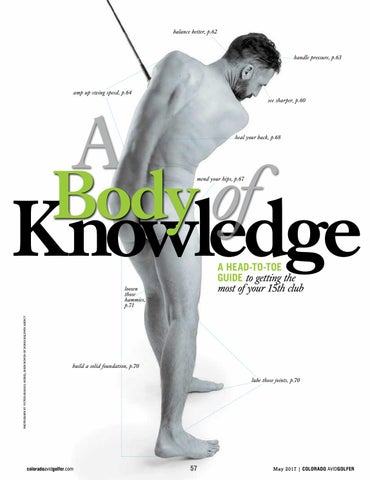
balance better, p.62
handle pressure, p.63
amp up swing speed, p.64 see sharper, p.60
A
heal your back, p.68
Body of mend your hips, p.67
Knowledge A HEAD-TO-TOE GUIDE to getting the most of your 15th club
PHOTOGRAPH BY VICTOR ARANGO; MODEL: JASON BOWEN OF DONNA BALDWIN AGENCY
loosen those hammies, p.71
build a solid foundation, p.70 lube those joints, p.70
coloradoavidgolfer.com
57
Spring May 2017 | COLORADO AVIDGOLFER
Our Passion is Helping You Follow Yours. More Coloradans choose the Sky Ridge Spine & Total Joint Center for spine surgery than any other hospital in Colorado. For an appointment with a spine surgeon, call
720-624-4906. SkyRidgeSpineSurgery.com
I-25 & Lincoln
Vision Quest
What, exactly is LASIK and can it help your golf game? By MALCOLM DEAN RORY McILROY had it done. So did Tiger Woods. John Elway swears by it in commercials. And avid Colorado golfers by the thousands have reaped its benefits. An acronym for laser-assisted in situ keratomileusis, LASIK is an outpatient refractive procedure to treat vision issues resulting from irregularities in the shape of the eyeball such as nearsightedness, farsightedness and astigmatism. The popular procedure—more than 604,000 people in the U. S. received LASIK in 2015, according to the ophthalmic news source Market Scope—has progressed immensely during the last few years as technology has improved. Initially, LASIK utilized small thin razor blades called microkeratomes that would crisscross the cornea, and cut the top layer, which would then be folded back. This technology, however, had limited accuracy, and the more items that physically touch the eye, the greater the chance for infection. The newer technology, WaveLight LASIK, eliminates these drawbacks. Instead of razors, it uses two cold lasers—the Femtosecond and Excimer—that cut without burning skin or tissue. Ophthalmologist Matthew J. Robinson, M.D. of the Eye Center of Northern Colorado performs the WaveLight LASIK procedure. It begins with an evaluation that scans the eyes for astigmatism, myopia, hyperopia, cataracts (in which case, Robinson refers the patient to a specialist) and other conditions. A computer stores the patient’s information, which will direct the laser on which types of cuts need to be administered the following week. With the patient lying on a table, Robinson places a speculum over one eye to hold the eyelids open. A technician adds numbing drops to the eye and then marks the eyeball with a blue marker dye to allow the laser to center itself over the pupil. “The Femtosecond laser is first used to COLORADO AVIDGOLFER | May 2017
create the flap in the cornea, which is the clear front surface of the eye,” explains Robinson. “The energy imparted to the eyeball forms micro-bubbles, which are sticky like Velcro. Then the second laser—the Excimer laser— reshapes the eye to the desired correction. Once that’s accomplished, the bubbles allow the flap to adhere to the eye, serving to promote faster healing. ” Dr. Robinson treats one eye with both lasers before starting on the patient’s second eye. “The entire procedure usually takes 20 seconds per eye with each laser,” he says. In addition to performing these corrective surgeries, Dr. Robinson also received one. He previously wore glasses and, occasionally, contacts. He experienced many of the issues he hears his patients describe—glasses slipping off, scratches in the lenses, dirty contact lenses or contact lenses falling out. A lifelong golfer, he has found many benefits. “LASIK gave me a much better field of view,” he explains. “The biggest difference was gaining the entire field of view of the golf course, tracking the ball and being accurate at gauging flag distance.” Improved depth perception made him more accurate at judging distances to the pin, and, he says, no longer needing corrective lenses allowed him to wear performance sunglasses, which helped him read greens better than he’d been able to read them in years. In addition to golf, LASIK enhances other outdoor activities, such as cycling and snowboarding. The first couple of days after treatment, a patient’s eyes may feel slight irritation, like an invasive eyelash, but it goes away. “As far as vision improvement, patients will see a difference right away,” Robinson says. “It’s immediate—you can play golf the next day if you feel like it.” The eyes continue to heal, with the best results coming about a month after surgery. The new WaveLight technology also
60
reduces the need for patients to return for additional correction. “Previous technology had six to ten percent needing enhancements after five to six years,” says Dr. Robinson. “Now it’s pretty close to permanent, especially after WaveLight; less than one percent come back after five to six years.” LASIK technology has made huge leaps and bounds since being approved by the FDA in 1996—and especially after WaveLight technology received approval six years ago. Lasers sound less frightening than razors, and they’re less invasive and more accurate. “Now we’re making little tweaks here and there for improvement,” says Dr. Robinson. “Who knows what technology we will see in 15 years.” Malcolm Dean is CAG’s editorial intern. For more information on LASIK, visit aao.org. coloradoavidgolfer.com
Revitalize your hormones to drive down your handicap
Age Well with Optimal Wellness
Bio-Identical Hormone Replacement Therapy Live Well. Age Well. Be Well. AgeWell MD is a medical practice
Benefits for women:
Benefits for men:
focusing on preventive care and
Improved energy and mood
Bio-Identical hormone replacement
Eliminates hot flashes and night sweats
Increased muscle mass and tone
therapy for men and women.
Decreased aches
Protects bones from osteoporosis
Protects against heart disease
Improves sex drive
Improves sleep
Improves memory and concentration
Improved sex drive and performance
Call today for a FREE consultation with Hope Engsberg, MD at 720.361.8080 We are conveniently located in the Heart of Cherry Creek 2 Steele Street, Suite 200 Denver, CO 80206 Visit us online at agewellmd-denver.com
Get Balanced It’s about more than just standing on a wobble board.
HOW MANY TIMES have you heard about the “balanced finish” in golf? But you can’t finish balanced if you have trouble starting there. Balance results from several body sensorimotor systems working together: visual (eyes), vestibular (inner ear) and proprioception (the body’s sense of where it is in space). Any impairment can lead to a lack of balance. VISUAL: Our vision deteriorates as we age, and all forms of reduced vision affect balance. According to a 2013 UC-Davis study of 4,590 adults aged 40 or older, participants with visual impairment and those with uncorrected refractive error had significantly higher rates of falling. Poor vision compromises the vestibular-ocular reflex that keeps us constantly stable. WHAT TO DO: Get your eyes checked often and make sure your glasses or con-
tacts are the correct prescription. People with vision issues can do exercises to address balance and joint stabilization. Visit visionaware.org for dozens of exercises. VESTIBULAR: During the 2015 U.S. Open Jason Day famously suffered from Benign Paroxysmal Positional Vertigo (BPPV). This is a common vestibular disorder, in which dislodged calcium carbonate crystals enter fluid canals and cause the inner ear to send false signals to the brain, which lead to dizziness and nausea. Another common disorder is mal de debarquement—or what we know as “sea legs.” This illusion of movement can last hours or days, so it’s best not to play golf immediately after disembarking from a boat, rough flight or drive down a twisting road. WHAT TO DO: For any suspected vestibular issues—dizziness, disorientation—con-
sult an otolaryngologist. In the case of BPPV, a doctor or specialist can maneuver the head and utilize gravity to guide the crystals out or return them to their appropriate chamber. PROPRIOCEPTORS: These are the sensory nerve receptors in muscles, joint capsules and surrounding tissues that signal information to the central nervous system about position and movement of body parts. They allow us to dress in the dark and gauge our backswing without looking over our shoulder. Joint injuries, broken bones, nerve damage, poor circulation and age-related muscle deterioration weaken proprioceptors, resulting in balance loss and falls. WHAT TO DO: See a physical therapist or trainer. A regular, progressive routine of balancing, strength and closed-eye exercises will rekindle your proprioceptive awareness.
A little birdie told us you should join. :: Certified personal trainers :: Increase flexibility and rotation throughout the swing :: Resistance training and stretching to increase club head speed :: Develop a stronger core for better balance and stability
49 enrollment
$
when you join by May 16.
Boulder | DTC | Flatirons | Inverness | Monaco | Tabor Center | Union Station 303.861.5646 | ColoradoAthleticClubs.com *Restrictions may apply. Cannot be combined with other offers. Amenities and programs vary by location, offer not valid at Union Station. Offer ends May 16, 2017. ©2017 Wellbridge
COLORADO AVIDGOLFER | May 2017
62
coloradoavidgolfer.com
Pressure Pushing Down on You?
Learning to RELAX may be the most rewarding golf lesson you’ ll ever receive. By STEPHEN WALKER, PHD THERE’S A ONE-WORD answer to why so many good golfers tend to play better in meaningless rounds than they do in championships: pressure. Pressure tightens a golfer’s muscles, chokes off their breathing and robs them of confidence. Big-tournament pressure can make a fundamentally sound golfer feel completely out of synch after the first hole. The biggest secret to playing well when it counts is to keep loose and calm. The more relaxed you are, the smoother your muscle function, the faster your club head speed, the better your feel, the softer your hands. Relaxation is key to playing in synch with smooth rhythm and crisp ball striking. Unfortunately, few golfers understand this important connection. And even those who do aren’t mentally disciplined enough to take that time to relax their muscles deeply and efficiently when they need to. Because golf is such a result-oriented game, and the slightest bit of doubt can fill a golfer’s mind with chatter and things he or she “must do” before teeing off, most tend to start a round by putting too much pressure on themselves. “I’ve got to make the cut.” “I have to beat Bob!” “I’ve got to go low.” These kinds of pre-round thoughts will make it impossible for you to relax and, as a result, deprive you of confidence, focus and a smooth swing. The bigger the tournament, the more important it is for you to stay cool and calm before teeing off. This should be your goal before every important event. However, too many golfers, coaches and parents don’t focus on it. They get caught up in the “outcome” goal. Outcome goals will take care of themselves if you make staying loose before your tournament your primary goal. Now that I’ve told you something you probably already know, what can you actually do to stay calm when the heat of competition is turned up really high? coloradoavidgolfer.com
1. STRETCH. It’s a great way to calm yourself and stay loose as long as you focus entirely on your stretching. Visualize your muscles getting warm, supple and relaxed as you also “breathe” into them. 2. FOCUS ON YOU. Paying attention to your competition will raise your level of nervousness. Limit your conscious awareness to those things you control. 3. TALK WITH TEAMMATES/FRIENDS. If hanging with your buds before a tournament distracts you from thinking too much about the event, make that an important part of your pre-round ritual. Avoid the “coach” who wants to psych you up. 4. GET A READ. Have some inspirational quotations or witty reminders that golf is a game—not mortal combat—taped on your bag or inside your hat. 5. LISTEN TO MUSIC. Be sure your pre-round tunes calm you and don’t amp you up. Let them aid you in finding your perfect rhythm and focusing your relaxation. 6. DISTRACT YOURSELF. Before teeing off, many golfers think too much about their event, a part of their game, or their opponents—and work themselves up at the worst possible time. Find other pre-round distractions like chirping birds. 7. GO SOMEWHERE RELAXING MENTALLY. I teach many of my golfer patients to go to a “safe place” in their mind’s eye—a beach, vacation spot or childhood home. If you mentally practice visiting this special place at night before bed, it will be available to you on any day….especially tournament day. 8. BREATHE DIAPHRAGMATICALLY. It is physiologically impossible to freak out if you are “belly breathing.” Sit quietly, inhale through your nose to a slow count of 4, pause, then exhale through your mouth to a little
63
faster count of 7 or 8. As you do this, focus on the rise and fall of your diaphragm. Practice this at home for four minutes a repetition, 10 times a day. When under pressure, one or two of these breaths will then help you chill out. 9. PRACTICE YOUR ROUTINES. Subject yourself to “pressure situations” and require yourself to become centered, loose and focused before you hit your next shot. These pressure situations can be “recall” of a
situation you’ve already played. Don’t underestimate the ability to relax, channeling that neuromuscular sensation into every muscle in the body. Those who make relaxation a daily ritual and incorporate some specific relaxation techniques throughout their warm-up and during their rounds can and will perform their best. Relaxation separates those who choke under pressure from the champions. It’s a learned skill, just like you the knockdown shot—only the times you need to summon it are far more frequent than the times you need to hit it low. Reach Boulder-based sports psychologist Dr. Stephen E. Walker at 303-530-4439 or drstephenwalker@gmail.com. May 2017 | COLORADO AVIDGOLFER
Blow Up Your Game Explosive exercises lead to powerfully long golf shots. By DILLON JOHNSON
COLORADO AVIDGOLFER | May 2017
phase (while the muscle is lengthening under load) of the exercise but accelerate with intensity when performing the concentric phase (exertion portion). These all-out efforts should result in only performing 6-8 repetitions of each exercise, per side. Plyometrics are a great simple example of power and speed training. This stimulus or training protocol activates muscle fibers specific to explosivity (type IIB fibers), uses energy system specific to explosivity (ATP-PC Energy System) and teaches our nervous system to coordinate efficient, powerful movements. Adaptations occur in all these areas, and we become a player capable of new levels of club head speed, distance, and consistency. For each of these exercises, do 2-3 sets of 6-8 repetitions per side with 90-120 seconds rest between sets.
PHOTOGRAPHS BY TANJA MELONE
“WHAT DO I need to do to hit the ball further?” is one of the most frequent questions I am asked as a Performance Golf Fitness Specialist—and it’s a loaded one. The answer clearly depends on the client. For a lean, hyper-mobile high-school player, I would recommend developing joint stability and overall body strength. For a 75-year-old player with limited range of motion, I would likely increase mobility and specifically teach their nervous system how to work in an explosive manner (a skill that often declines with age). Between these extremes are clients of varying ages, fitness levels, health and abilities. Every player is different, and I take that into account before strategizing an optimal plan for power and clubhead speed development. I can, however, offer some general guidance towards making you a more powerful player. My first bit of advice is to make sure you have spent plenty of time in Golf Training Phases 1 & 2, which have appeared in the previous two May issues and online. (Visit coloradoavidgolfer.com/magazine/magazinearchive.) Those phases concern developing stability, mobility and strength—which, for performance and safety reasons, are essential before diving into Power Training. When training for power we want to choose exercises that are very short in duration but are explosive, high- paced, fullout efforts. You want to be fairly slow and in control when you load into the eccentric
1. HANDS OVER SHOULDERS, SQUAT HOPS • Cross your arms over your chest and place your hands on your shoulders with feet hip width apart. • Slowly lower your hips towards the ground until you feel you have reached your maximum depth. • Explosively jump from this bottom position. • Land softly and absorb down into your next repetition.
64
coloradoavidgolfer.com
2. NO-BOUNCE MEDICINE BALL OVERHEAD SMASH • Start with your feet about hip width apart. • Slowly lift your no-bounce medicine ball overhead until your arms and body are fully extended. • Using your arms and core, throw the ball on the floor as hard as possible between your legs. • Let your hips travel down into a squat position as you throw and pick up from this position for your next repletion.
3. NO-BOUNCE MEDICINE BALL SIDE-STEP GOLF THROW • Start with your stance perpendicular to a concrete wall with your feet together. • Step laterally towards the wall. • During this lateral step, coil with your upper body into a backswinglike motion with the ball. • When your lead foot plants down, accelerate and throw the ball as hard as possible at the wall. Catch the ball and repeat.
4. SIDE STEP LIGHT CLUB SWOOSH (about 10-15% lighter than your normal iron)
• Performing your swing with a slightly lighter object at full effort on both your dominant side and offside can provide great increases in clubhead speed. • Start with your feet together, club in address position. • Step laterally. When your lead foot plants swing at your greatest effort looking for the loudest “swoosh” you can make with the club just past where ball impact would be. • Repeat.
coloradoavidgolfer.com
65
May 2017 | COLORADO AVIDGOLFER
PHOTOGRAPHS BY TANJA MELONE
At J. Gruber Health Solutions you will experience a unique and comprehensive approach to scientifically based medical treatment. While traditional medicine often focuses on suppressing the symptoms of medical conditions, Dr. Gruber searches for the underlying factors to uncover what is necessary to improve your health.
You are cordially invited to the 6th Annual...
W20i1n7 e
&
Friday, June 9th 6:30-10 pm SCHOMP MINI 1001 Plum Valley Lane in Highlands Ranch Benefiting
• Stand parallel to a concrete wall with your feet shoulder width apart and the ball resting in your hand by your chest and shoulder. • Slowly coil your torso as if you were rotating into a backswing.
Delectable Drinks and Hors d’oeuvres • Silent and Live Auction Live Entertainment by Maestro Hughes “The Hip Hop Violinist” Emceed by Emily of the Mix100 Special Guest Appearances by Adoptable Shelter Dogs
Presented by FONTS USED
5. GOLF STANCE, NO-BOUNCE MEDICINE BALL SHOT PUT THROW
PROMINENT COLORS
• Then engage your core and explode pushing the ball into the wall in a shot putlike motion. Catch the ball and repeat. NOTE: If you have any health concerns/issues please contact your physician before attempting these exercises.
C=100 M=73 Y=14 K=42 R=00 G=53 B=100 HEX = 003464 C=61.18 M=00 Y=100 K=00 R=110 G=190 B=68 HEX = 6EBE44 C=00 M=00 Y=00 K=66 R=117 G=118 B=121 HEX = 747679
Get Tickets Today!
Red
www.hsspv.org/woofandwine for $75 COLORADO AVIDGOLFER | May 2017
tone
Animal Hospital
66
A co-owner/partner of RallySport in Boulder, Dillon Johnson serves as director of golf and customer service. A PGA Professional, he is a Certified Personal Trainer and a Titleist Performance Institute Golf Fitness Specialist Level 3. rallysportboulder.com; 303-928-9007. coloradoavidgolfer.com
Suspended Play REDCORD THERAPY can reduce hang-ups after injury or surgery—and make you stronger and more flexible. By MALCOLM DEAN
MARK RUNYAN, a 68-year-old golfer who looks ten years younger, is recovering from a full ball-and-socket left hip replacement— including his femur—performed November 10th, 2016. A 1.5 handicap, Runyan also had his right hip replaced in 2000. After his first hip replacement, Runyan went with traditional physical therapy. “It took too long to recover, and I wasn’t seeing results,” he remembers. “This time I wanted physical therapy that was golfspecific, so I found Nick.” Nick Holm, a Titleist Performance Institute (TPI)certified physical therapist at ActivCore in Denver, uses Redcord, the zero gravity suspension exercise system developed 25 years ago for physical rehabilitation, sports performance and injury prevention. Using pulleys and slings to offload body weight, Redcord eliminates the compensatory muscle patterns impeding recovery from injuries and surgeries. “If you’re able to have the right muscles working without compensations, you gain mobility,” Holm says. “With conventional training and rehab, as you strengthen your muscles, you often lose mobility. With Redcord this doesn’t happen.” The system allows therapists like Holm to treat and train golfers of all ages— including, and especially, older ones. “With the Redcord physical therapy I was back to hitting balls in six weeks,” Runyan says, “As of February 27, I hit balls for an hour, went through a whole bag. I started therapy with Nick three days per week, then two, now I’m down to one.” According to Holm, Redcord therapy works neuromuscularly to isolate the muscles that need to be strengthened. “It’s not one-dimensional training,” Holm coloradoavidgolfer.com
explains. “It allows strengthening in multiple directions, and movements making the most of your therapy.” During one session, while suspended in the air on his right side, Runyan used his surgically repaired left side to pull himself up, conditioning the muscles weakened after surgery. Holm gradually increased resistance, promoting greater strengthening and conditioning. Additionally, this exercise, according to
back pain. The findings suggest that Redcord hip exercises for lumbar instability provide better recovery and reduction of low-back pain than conventional therapies do. Additional studies looked at maximum club head velocities in junior competitive golfers. The training was split into two groups—one using conventional training; the other with Redcord Sling Exercise Training (SET). The trial concluded that the Redcord therapy increased the maximum club-head ON THE ROPES: Redcord therapist Nick speed of junior competitive Holm trains a client. golfers. This translated into a 11- to 16-yard increase in drive distance compared to that achieved using conventional therapies. “Most of my clients come to me for rehab, but more are coming for performance,” Holm explains. “For example, a lot of golfers with tight hamstrings stretch and stretch and never get loose. A common reason is they’re not engaging their glutes or the abdominals that Holm, isolates the muscles used during golf stabilize their pelvis.” Isolating those muscles to improve stability. on the Redcord and doing exercises and “If there’s a weakness or injury, it alters treatments, Holm can loosen those hammies your neuromuscular control,” Holm explains. because they no longer have to compensate. “The Redcord system allows me to isolate Muscular inefficiencies caused by pain the muscles, joints and tendons that need or injury naturally rob golf swings of their strengthening and stabilizing. It puts them power. Holm strings up his clients to restore in an unstable situation that prevents other it. After surgery, Runyan admits his biggest muscles from compensating. That provides concern was losing distance, but, he says, neuromuscular feedback and reeducation. he’s again hitting drives in the 270-yard We reboot the muscles. We defrag you.” range like he was doing pre-surgery. Runyan Independent medical studies support says he no longer has any lower back or hip the Redcord approach. One evaluated the pain and returned to playing competitively range of hip motion between a lumbar in late March, four months after surgery. He instability group and lumbar stability group carded a 74 in one of his first rounds. using the Owestry Disability Index and Visual Analog Scale to determine the level Malcolm Dean is CAG’s editorial intern. ActivCore is located in Cherry Creek. Contact Nick Holm at of disability, along with the severity of low- nholm@activcore.com or 303-395-2931.
67
May 2017 | COLORADO AVIDGOLFER
The
X Factor
HIGH-TECH HEALING: Mazor X uses robotics and 3D imaging for precise spinal surgery.
MAZOR X, a revolutionary spine-surgery system, has arrived in Colorado—and only one hospital has it. By JON RIZZI
COLORADO AVIDGOLFER | May 2017
things worse,” says Michael Mulder, a 49-year-old Aurora resident who last year started to experience stabbing pains in his lower back and buttocks area. Mulder initially ascribed it to his active lifestyle that included golf and frequent hikes in the national parks. But with a family history of spinal stenosis, he suspected that, like his mother and siblings, he was also beginning to experience a degenerative narrowing of the spine. A visit to the orthopedist last June confirmed his suspicion. “My L3 and L4 vertebrae were pressing together, pinching off the nerves,” Mulder remembers. In September, he received the first of three
68
THE BACKBONE: Phil Jaklich (second from left) and the team at Sky Ridge Spine and Total Joint Center. team.
cortisone injections, “and to the doctor’s surprise, I got no relief.” With surgery as the only option, the orthopedist referred him to the Sky Ridge Spine and Total Joint Center at Sky Ridge Medical Center in Lone Tree. Having watched family members endure and recover from major spine surgeries, a somewhat apprehensive Mulder was intrigued when Neurosurgeon Brent Kimball, MD told him about the Mazor X—a technologically advanced surgical guidance system that employs digital data analysis, robotics and 3D modeling for precise, predictable and minimally invasive spine surgery. On February 15, 2017, Sky Ridge became the first hospital in Colorado—and a 10-state region—to use the Mazor X. Exactly one month later, Mulder underwent spinal fusion surgery. So what’s so amazing about the Mazor X? “The thing about the Mazor X is it’s an adjunct for more accurate diagnosis and planning,” explains Phil Jaklich, director of the Spine and Total Joint Center at Sky Ridge Medical Center. “Its pre-operative analytics suite of tools allows the surgeon to match up a CT scan and overlay it with an x-ray to create a 3D model of the affected area and map out a precise surgical plan for different spine angles.” The surgeon programs the plan into the Mazor X system. When the plan moves into coloradoavidgolfer.com
PHOTOGRAPHS COURTESY OF SKY RIDGE SPINE AND TOTAL JOINT CENTER
MEDIAL EPICONDYLITIS may be better known as “golfer’s elbow,” but as those who play the game can attest, golf attacks another region of the body with far more frequency. Back pain is endemic to a sport that requires repeated torquing of your torso while maintaining the same spine angle. The range of resultant problems—from tissue inflammation to muscle strains to nerve impingements to arthritis to compressed, herniated and degenerative discs—pretty much defies defining a single “golfer’s back” condition. The variety of treatments therefore varies accordingly. “I tried chiropractic, acupuncture and stretching, but they only seemed to make
procedure, the Mazor X’s intra-operative guidance follows the plan precisely as it assists the surgeon robotically and also provides real-time verification by comparing the performance to the plan with 3D imaging tools and data-enabled tracking technology. The precision with which the Mazor X accomplishes all this greatly reduces the amount of tissue and muscle damage that can occur during delicate spinal surgery. This results in less post-operative soreness, fewer complications, shorter recovery times and hospital stays. “The incision was less than an inch, and the precision with where they put in the screws was micronic,” Mulder marvels. “I was walking around the block within a week.” He went back to work two weeks after that, and less than a month removed from surgery, he started physical therapy to regain muscle mass in his core. As of April 12, his pain relief regimen consisted of two Tylenol a day. Tee times are coming. The success of Mulder’s surgery is immensely gratifying but not surprising to Jaklich, who praises the Mazor X’s capabilities not only surgically but also diagnostically—it sometimes precludes the need for surgery. “We like to have the big picture,” he says. “Can it be treated with physical therapy? Injections? Diet? Exercise? We focus on health, movement and mobility. For someone with an apparent structural issue, we’ll make a recommendation depending on how active they are.” Activity levels in Colorado are high, notes Jaklich. The average age of patients has dropped from around 60 to early 50s, not only because people engage in more activities, but they want to keep doing them into their golden years. “We’re part of their retirement planning,” he says. “Most people aren’t willing to give up activities just because of pain in their spine and joints. They’re okay with modifying their pursuits, but if they physically can’t do something like ski or play golf—or play with their kids or grandchildren—they’d rather get surgery than give it up.” And when they do, they know that the Mazor X system—and the Sky Ridge team of neurosurgeons and orthopedic surgeons who use it—will get them back to their lives faster.
“Take The Right Approach With ACP!” Business Solutions Copiers and Service Printers and Service IT Services and Hardware
303.388.6050 For more information, or to make an appointment, visit SkyRidgeSpineSurgery.com or call 720-624-4906 to schedule an appointment. coloradoavidgolfer.com
Go-ACP.com
Official Document Solution Provider of Colorado Avid Golfer Magazine
69
May 2017 | COLORADO AVIDGOLFER
Start Low to Go Low To build a better golf game, you have to start from the bottom up. By DEE TIDWELL The dominant weakness in every golfer I’ve ever worked with is posture. Posture isn’t just about standing straight. It’s the ability to maintain a position for an extended time, while allowing the prime movers to create locomotion. Why do golfers struggle with posture? Most of you spend, on average, 11-12 hours per day seated—at a desk, in a car, at a meal, in front of TV. Yet every time you show up at the range or first tee you expect to play better just because you had a lesson. Sitting negatively influences your body and doesn’t promote proper golf posture. To build a proper posture with a hip hinge, you literally need to start from the bottom with your lower body. It is the foundation of your posture and source of mobility and power. Done in sequence, these five exercises will help your posture, your posture will help these exercises, and it all will help your golf game.
1. BENT-KNEE CRAWL: FORWARD/BACKWARD/ SIDE-TO-SIDE
• Get on your hands and toes with your toes bent and wrists under your shoulders. • Make your arms and thighs vertical and maintain them in that position throughout.
Few golfers focus on properly preparing the feet and ankles to deal with ground reaction forces and the transfer of energy up to the head and back down to the ground. The following exercise can also help encourage joint circulation and hydration of the synovial fluid—the “WD-40” for joints—within each of these joints. • Bring your feet and knees together and place your hands on top of knees. • Perform a clockwise circular pattern for the recommended reps and counterclockwise way for the same. • Lastly, perform figure eights both ways for allotted reps. Perform 10-20 reps each side, and in the figure eight movement. • Perform 6-10 reps each side and do 2-3 sets.
• Crawl with small arm moves and push off from your toes with no leg movement. Perform 10-20 steps per side, one to three sets.
2. SINGLE-LEG DEAD LIFT WITH FOOT ON BENCH The dead lift is one of the best hip-hinge exercises you can perform. Using just one leg increases the difficulty and challenge. It will strengthen your hip hinge using the gluteus and and your lateral glutes. It will also help prevent a sway or slide in your golf swing. • Place a foot on a bench. • Make sure your hips are square, and be sure to keep them square, just like in your address stance. • Keep your chest up and keep your balance leg knee soft like in your address posture. • Hinge forward from your hips, keeping your lower back flat or unchanged from the start position. COLORADO AVIDGOLFER | May 2017
70
coloradoavidgolfer.com
PHOTOGRAPHS BY TANJA MELONE
This “primal movement” taps into the crawling pattern of an infant. When bent, the knee is a big stabilizer, while the hip helps to stabilize the leg, ankle and foot move in a functional pattern. This exercise also helps create trunk, shoulder, arm and hip stability
3. KNEE CIRCLES
4. CLOCK SINGLE LEG SQUAT AND REACH I love this exercise for golf athletes because it challenges the mobility of the hip joints, the flexibility of the hips, balance, coordination and stability through the entire body. Many golfers—especially men—don’t have very good awareness of where their body is in space, and this exercise helps tap into the conscious awareness of where exactly each part of your body is. • Start by keeping a good neutral spine with chest upright, head neutral and abs firm. • Pretend you are standing on top of a clock and 12:00 is in front of you. • Step out and tap your foot on every hour and a half: 12:00, 1:30, 3:00, 4:30, 6:00, 7:30, 9:00, 10:30 and back to 12. • Pay attention to the toe taps of 10:30, 12:00 and 1:30. They are different because for those three you will simply squat down, extend the working leg and tap the heel toward those times on the clock. • For the rest, reach with a straight working leg and simply tap each of the times and return back to the standing position. • Be sure to watch the kneecap of the non-reaching leg—that it tracks over the second toe, and that the same heel stays on the floor. Doing the right and left leg around the clock is considered one rep. Perform 1 to 4 reps around the clock going both directions. Do 1-3 sets.
5. CABLE/BAND IN-POSTURE HIP TURN Directly related to posture is “separation.” You’ve all been told to “separate your lower body from your upper body,” especially in the downswing. This drill teaches you how to turn your pelvis “onto” the backswing leg and then through impact “onto” the target leg. • If you do this at the gym, use a cable machine set up to chest height. If you do this at home, grab a light resistance band and close the one end into a door, then grab the other end. Align it to about chest height. • Get into a golf posture—you know, hip hinge, knees soft but not too bent, chest up, chin slightly tucked , equal pressure on your legs and feet, a little more pressure into your heels than your fore-foot • Grab the handle with the hand that’s farthest away from the origination point of the cable or band, and with straight arms, hold it in front of you about six inches above where you’d hold your club.
10:30
12:00
• Now, with straight elbows, hold the handle still and begin to slowly rotate your pelvis underneath your torso. • Keep your arms and torso still while your pelvis turns onto your right leg (femur to be specific) and then turn your pelvis onto your left leg, all while maintaining perfect posture. This, my friends, is called separation! Perform- 12-20 reps each direction, and do 2-3 sets. You can also use this as part of your golf practice or playing warm-up!
7:30
9:00
Dee Tidwell is the owner of Colorado Golf Fitness Club, the state’s only golf fitness studio, located in the Denver Tech Center. He is a level 3 TPI professional, Soma Golf Trainer and muscle therapist. Reach him at 303-883-0435; dee@coloradogolffitnessclub.com
6:00 coloradoavidgolfer.com
71
May 2017 | COLORADO AVIDGOLFER