

Serving the Communities of Morro Bay and Cayucos

By NEIL FARRELL for Morro Bay Life
California’s scenic Highway 1 has reopened months ahead of schedule, the state announced Jan. 14.
Work crews finished the majority of their work at Regent’s Slide, which came crashing down on Feb. 9, 2024, during a fierce winter storm. The latest in a series of massive land


slopes with thousands of steel reinforcements drilled up to 60-feet deep, and using cuttingedge monitoring systems to overcome extraordinary geological challenges while keeping
“This vital corridor is the gateway to California’s coast and the lifeblood of the Big Sur economy — and today it’s restored.”
Of course, there is still work to be done, and Caltrans said there might be future delays and closures. “Over the next months, travelers on Highway 1 at Regent’s Slide and other locations may encounter occasional full closures while crews remove debris following seasonal weather events and intermittent delays due to ongoing construction,” the agency said.
It’s been a monumental task clearing away
“In the days leading up to reopening the road-
way, Caltrans removed approximately 6,000 cubic yards of mud and debris [enough to fill 240 dump trucks] from the Regent’s Slide repair site after strong winter storms impacted the Big Sur North Coast,” Caltrans said.
The head of Caltrans called it a “significant milestone.”
“The full reopening of Highway 1 marks a significant milestone of local, national, and global interest,” Director Dina El-Tawansy said.
“There are few, if any, more iconic routes not just in California but anywhere in the world. Restoring access for residents and tourists boosts regional economies and reinvigorates the pride and cultural identity associated with one of the most scenic and picturesque roadways on the planet.”
In good economic times, when tourism is









Grant will help address structural issues at aging dock as city works through millions in harbor maintenance needs
By NEIL FARRELL for Morro Bay Life
Alocal commercial fishing organization has again stepped up and made a significant donation to the Morro Bay Harbor Department and its efforts to catch up on a litany of maintenance needs.
The Morro Bay Community Quota Fund has granted $150,000 to the Harbor Department to assist with needed repairs to the Fishermen’s Wharf, a fish unloading dock located adjacent to Dockside Too south of the North T-pier.
It was the second large donation made by commercial fishers in 2025.
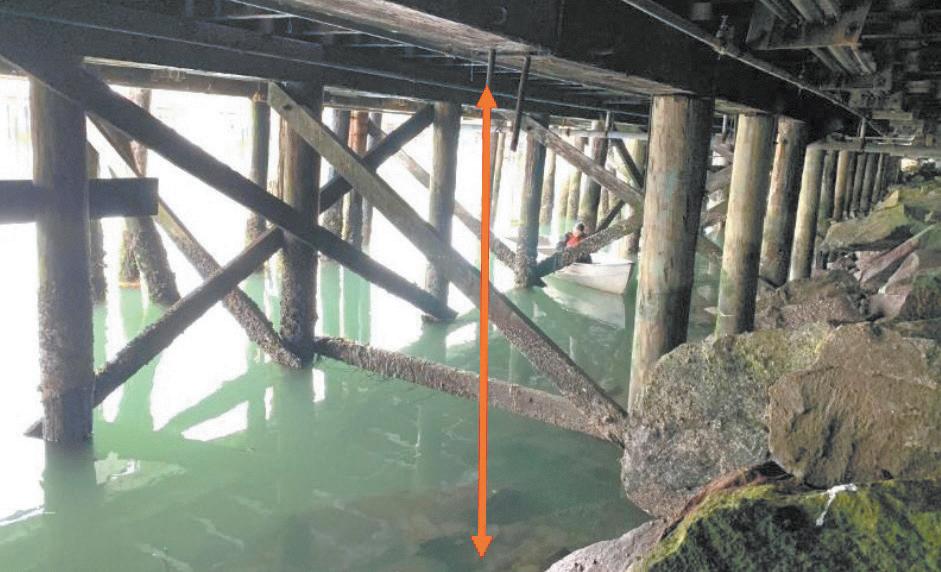
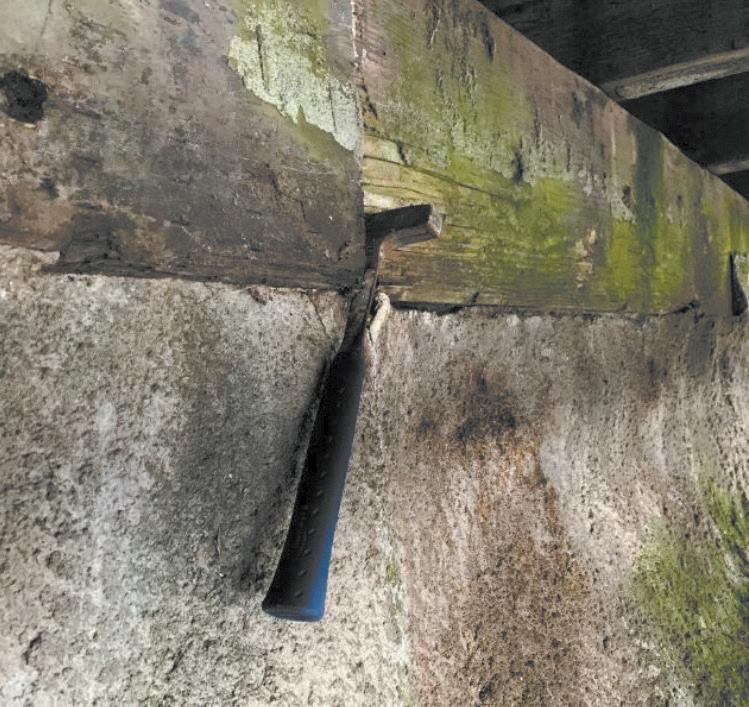
Last September, the Morro Bay Commercial Fishermen’s Organization turned over a $400,000 grant it received from yet a third fishing organization, the Joint Cable-Fisheries Liaison Committee, intended to assist with repairs to the Fishermen’s Wharf facility, which a recent city inspection showed had numerous issues, including missing support piles, an undermined seawall, and a deteriorating support timber.
That revelation was part of a larger effort the city has undertaken to address a backlog of maintenance needs to public facilities throughout the harbor, including repairs to seawalls, rip rap, floating docks, and the North T-pier, among numerous others and totaling tens of millions of dollars.
Morro Bay Life sat down with Quota Fund
Executive Director Dwayne Oberhoff and board members Andrea Lueker and Jeremiah O’Brien


to talk about the donation and catch up on the Quota Fund.
The Quota Fund was born in 2013 as part of an extensive overhaul of the trawl fishing industry that had come under fire for perceived damage to the seafloor done by dragging big nets across the bottom.
The fishery targets the so-called deep-water simplex, consisting of a number of species that live in the deep ocean along the bottom. Targeted species include Petrale sole, black cod, various rock cod species, and others.
The Federal Pacific Fisheries Management Council (PFMC), which sets federal regulations for the West Coast (but not Alaska) sought to limit the damage done by setting strict catch limits on the trawl industry, which had been the backbone of the local industry, bringing in the most fish and keeping the docks busy.
From that evolved a catch shares program that assigned each fishing boat a certain share of the new limits. Thenenvironmental groups began buying up the permits in an attempt to end trawl fishing, including buying up nearly every permit and fishing boat on the Central Coast — from Port San Luis to Monterey.
But the law requires these permits to be fished and so a quota system was developed and local quota committees wereestablished to ensure that fish caught in local waters are landed at local ports.
The MB Quota Fund was established to manage the allotted quota in Morro Bay and Port San Luis (Avila Beach), explained Oberhoff.
The Quota Fund leases out its share of the overall catch to local fishermen who then go out and catch the fish. And if a fisherman pulls up more of any species he has quota for, he’s got to buy extra quota space or face shutting down for the season, or potentially face stiff fines.





They also have quotas for some fish species, like whiting, that are not fished in local waters, so they are free to lease those fish to fishermen up north, where whiting is fished commercially.
That’s an oversimplified explanation of what is a very complex system that at this time has but one local fisherman working it. But Oberhoff said they hope to soon have a second boat working the local quota. With a shortage of fishermen, the Quota Fund is free to lease out unused quota to fishermen from other ports.
Those lease payments support the Quota Fund, which also has a grant program.
O’Brien said some of the money can be “dedicated to things like science and research.” They can also be used to support critical infrastructure, such as the wharf in Morro Bay.
He said Harbor Director Chris Munson had asked for grant monies during one of their recent board meetings, and the board voted to make the donation.
MBL asked Munson for comment about the donation and the extent of the work that needs to be done on the wharf, but he deferred for now, saying that he was working on a Memorandum of Understanding (MOU) that would lay out what the city would use the money for.
Lueker added that repairing vital infrastructure like the fish dock has a direct nexus to commercial fishing. “It’s the only place the quota that we lease can be offloaded,” she said.
O’Brien, who also played a hand in the MBCFO’s $400,000 donation, said the Cable Liaison Committee’s donation would not necessarily go towards fixing the same issues with the wharf. “The connection is commercial fishing,” he explained.
Where’d they get that kind of money to give away? Oberhoff said “it came from leasing the quota since the start [2013].” Also, when the local fund started out, it had to purchase the


quota from The Nature Conservancy, which had bought up all the quota here along with almost all the fishing boats. “We were paying them for the first six years,” Oberhoff said. But now that debt has been paid off freeing up more money for the Quota Fund to try and help out the industry overall.
The Quota Fund recently put out a request for grant proposals, with $200,000 available to fund scientific research projects beneficial to commercial fishing, and hoping to be able to fund at least two proposals.
They plan to make the awards in May.
While they’ve funded grants for research in the past this is the first time the Quota Fund has allocated money to repair infrastructure.
O’Brien called it a “one-off” allocation, as they don’t anticipate donating to repair infrastructure becoming a regular thing.
Oberhoff added that they make sure the quota they lease outside this area is at least fished and landed in a California port. “We lease about 7-8 million pounds of fish overall,” he said.
O’Brien said, “That’s what we own, the ‘catch shares’ and we can buy, sell or lease it.”
Oberhoff said they actually sold off some of their quota to pay off The Nature Conservancy. As for the work the city is planning, O’Brien said they only want to make sure it goes to what they agreed it would go to.
The MOU, when it comes out, should lay all that out in contract form.
The Harbor Department had commissioned a study of its revetments and seawalls, called The Brady Report. That study inspected all the city-owned facilities, identified problems and rated the various areas as to the severity of the issues at each one. It was an eye-opening report that estimated the total costs for needed repairs at from $25.5 million to $54.6 million.











By NEIL FARRELL and CAMILLE DEVAUL for Morro Bay Life
With sometimes violent protests against the Immigration and Customs Enforcement (ICE) deportation activities occurring in numerous cities across the nation, the Central Coast hasn’t been spared from the kerfuffle.
Protesters invaded the County Jail over the recent holidays after ICE agents were seen at the jail, erupting in anger and profanity-laced protest by about a dozen people inside the jail lobby.
Body camera video from one of the ICE agents posted on Facebook, showed how loud and hostile the protest had gotten, just from the presence of ICE at the jail.
Locally, protesters have held several sign-waving rallies in Los Osos, Morro Bay, and San Luis Obispo, as well as in Santa Maria.
Demands have also been made to elected officials calling on them to denounce ICE and to set up so-called “ICE-Free Zones.”
ICE-Free Zones are established through local laws and ordinances and prohibit immigration authorities from using specified government/ public facilities for unauthorized immigration enforcement purposes.
There is much debate over whether such laws can be applied to federal authorities, given that federal law and, in turn, law enforcement trumps state and local laws.
Nevertheless, in Los Angeles County, supervisors recently instructed their attorneys to draft such an ordinance.
Locally, the district attorney, who enforces county ordinances as well as state laws, issued a statement on the ICE protests and ICE-Free Zones.
“It is important for the public to understand that federal law applies nationwide under the U.S. Constitution, and local or state governments do not have the authority to prohibit lawful federal enforcement activities,” reads a D.A.’s Office news release dated Jan. 15. “Terms such as ‘ICE-Free Zones’ or ‘sanctuary’ designations are often symbolic and do not override federal jurisdiction.”
San Luis Obispo County District Attorney Dan Dow acknowledged people’s right to protest their government, but cautioned protestors not to cross a line into criminal conduct.
“I will always support the rights of people to protest,” he said. “However, I strongly urge them to do so safely and within the limits of both Federal and California law. Any behavior that is violent or otherwise criminal will detract from the weight and value of your political speech and may lead to arrest and prosecution. We encourage everyone to exercise their rights peacefully, responsibly, and safely. Our office remains committed to upholding the Constitution, protecting public safety, and ensuring equal justice under the law for all.”
Dow’s office has a history of prosecuting protestors when they go too far. In 2020, during the summer of George Floyd riots across the nation, a number of people connected to the Black Lives Matter movement held a demonstration in a downtown SLO park, and then marched onto
Highway 101, stopping traffic and causing a mileslong traffic jam on the freeway.
The organizer, as well as a handful of supporters, were arrested and charged with multiple misdemeanor counts.
However, Dow’s re-election campaign commented about the case in a social media post that led to defense attorneys successfully getting a judge to disqualify the entire D.A.’s office from prosecuting the cases.
They were turned over to the State Attorney General’s Office for prosecution, but all charges were eventually dropped.
Dow reminded everyone to remain civil.
“We encourage everyone to exercise their rights peacefully, responsibly, and safely,” he said.
“Our office remains committed to upholding the Constitution, protecting public safety, and ensuring equal justice under the law for all.”
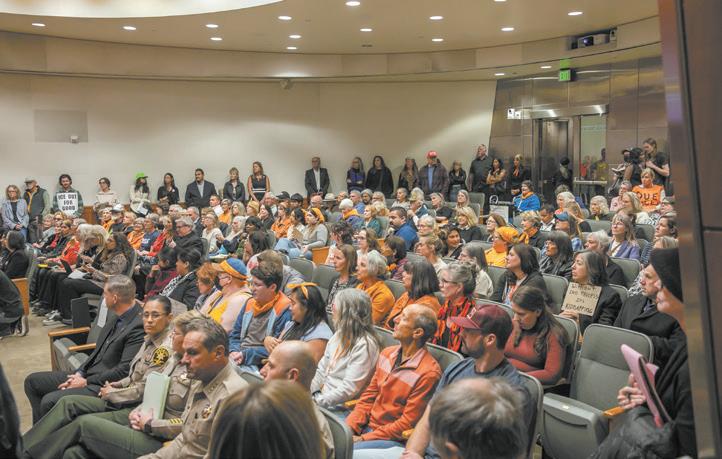
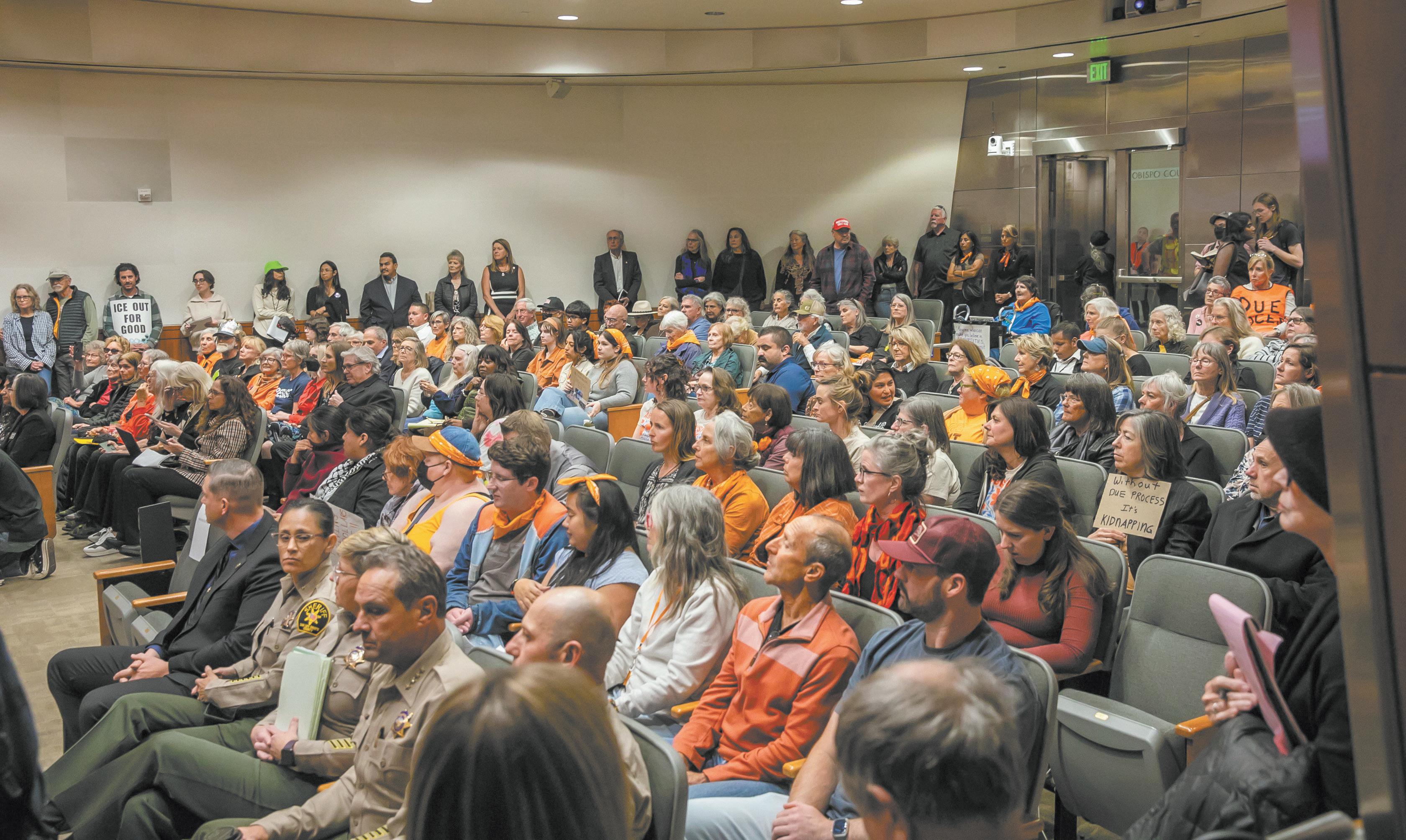
On Tuesday afternoon, Jan. 27, community members from around the county gathered at the San Luis Obispo County Board of Supervisors Chamber to hear the annual Transparent Review of Unjust Transfers and Holds (TRUTH) Act report. Over 100 people took to the podium to express their views on Immigration and Customs Enforcement (ICE) access to individuals in the county.
A crowd of activists stood outside the San Luis Obispo County Courthouse on Tuesday, holding their signs up for those entering the SLO County Supervisors Chamber meeting across the street. They shouted disapproval of ICE, asking for the county to become an ICE-Free Zone, and making comparisons between ICE and the Gestapo. Inside the County Government Center, the supervisors’ chamber was packed with community members filling the seats, lining the walls, and even filling an overflow room next door.
The forum provided the community a chance to hear from San Luis Obispo County Sheriff Ian

Parkinson on how the Sheriff’s Office has interacted with ICE regarding individuals in custody at the county jail. Parkinson provided data on his office’s interactions with ICE, the TRUTH Act, and the California Values Act (SB 54).
The TRUTH Act requires a community forum to be held by a local governing body if a local law enforcement agency has returned notification responses to ICE during the prior calendar year. It was signed into law in 2016 by then-Gov. Jerry Brown. Additionally, the TRUTH Act requires consent for ICE interviews with arrested illegal immigrants and gives the illegal immigrant the right to refuse interviews with ICE.
Parkinson clarified that the Act means, “If we provided access [to ICE], this hearing is required.”
Implemented in 2017, SB 54 restricts state and local law enforcement from assisting with federal immigration enforcement. However, there are exceptions to this in the case of serious and violent crimes. With SB 54, law enforcement is not allowed to ask about immigration status, make arrests for immigration violations, or share data with ICE — unless that individual is involved with serious felonies like murder or violent sexual assault.
Parkinson went through what his department does and does not do when it comes to illegal immigrants that come into their custody. The department does publicly provide all incarcerated persons release dates via the Sheriff’s Office website. He clarified that in state law, that if an agency is already publishing custody information, it is legal to continue. SLO County has been publishing custody data for decades, according to Parkinson.
His department also allows due process rights under CA Law (SB54), complies with CA DOJ Reporting, informs the right to refuse an interview or have an attorney present, jail will provide a copy of ICE’s requests to the incarcerated person, any compliance or non-compliance will be provided on the copy of the request, and helps undocumented
victims get U-Visas.
Parkinson explained that his agency does not enforce federal immigration law, deport anyone, have authority over ICE, ask about immigration status, conduct immigration sweeps, or detain anyone in jail for extra time due to immigration status.
Parkinson then explained his department’s process upon receiving anyone into the County Jail. First, the individual is identified — this can become complicated when false identification is given to arresting officers. Photographs are taken along with fingerprints to get the correct identification of the person being booked. When an individual is booked into county custody, their name may appear in federal records due to prior encounters, previous deportations, or documentation of unlawful presence in the country. This information can prompt ICE to issue a detainer to the Sheriff’s Office. The Sheriff’s Office then reviews the individual’s criminal history.
“I have a duty and responsibility to the safety and security of the residents of this county,” Parkinson said. “If I am going to release somebody back into the community that has been convicted of a violent felony, I don’t think that is very safe, number 1. Number 2, I think the second concern that I had was that I am putting this person back into the neighborhood. ICE is well aware that they were in our jail; they have more information on them through obviously public records, and now I am going to send them into the neighborhoods to pick up these people. Extremely dangerous in my mind.”
He added to why its safer for the community to have the individual arrested by ICE from the jail,
“The other challenge that I have ... if that person goes back to a residence and ICE goes to that residence to pick them up, if there’s four or three other family members living there that are not documented, they are taking everybody. That’s been their policy.”













Firm combines decades of experience with personalized service to support individuals and businesses
By CAMILLE DEVAUL for Morro Bay Life
For individuals and businesses seeking dependable financial guidance along the Central Coast, Ross | Carreiro | Brown CPAs, P.C. has built a reputation as a trusted provider of tax, accounting, and wealth management services. The firm combines professional expertise with a personalized approach, serving clients throughout the Estero Bay Area and neighboring communities, including Los Osos, Cayucos, Cambria, San Luis Obispo, Paso Robles, Atascadero, and Templeton.
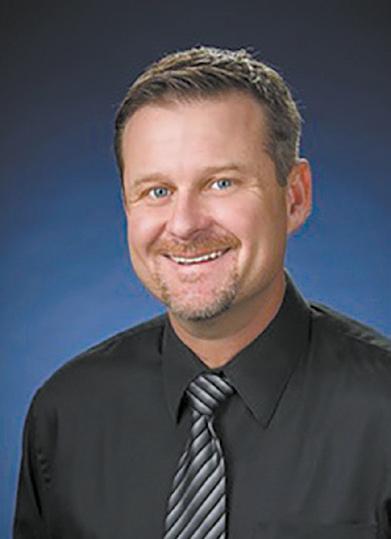
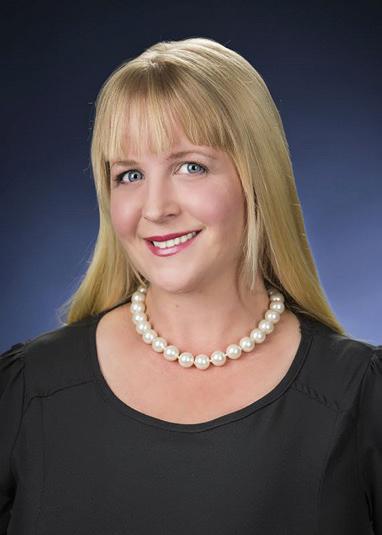
The leadership team brings decades of combined experience to the practice. George Ross, CPA, CFP, and Personal Financial Specialist, began his career after earning a Master of Science in Financial Planning from San Diego State University. Following the early-2000s technology downturn, he returned to SDSU to earn a second master’s degree in accountancy. Since obtaining his CPA and CFP credentials in 2005, Ross has accumulated more than 20 years of experience in public accounting and financial services, specializing in tax planning, preparation, wealth management, and insurance.
Partner Makinzie Carreiro, a Paso Robles native, earned her accounting degree from Cal Poly San Luis Obispo and became a CPA in 2018. She brings nearly a decade of experience and a strong connection to
the local community she proudly serves.
Fellow partner Brenda Brown, also a Central Coast native, followed a similar educational path through Cuesta College and Cal Poly before earning her CPA certification in 2018. Brown values building her career and raising her family in Los Osos. What sets the firm apart is its commitment to cultivating strong client relationships. By bringing personal attention, energy, and dedication to every engagement, Ross, Carreiro, and Brown deliver tailored solutions designed to meet each client’s unique financial needs. Their comprehensive services extend to individuals, small businesses, partnerships, corporations, nonprofits, estates, and trusts, making the firm a convenient “one-stop shop” for accounting and financial support.
Their core services include tax return preparation, accounting, tax planning, and bookkeeping, as well as integrated financial services such as wealth management, estate preservation, retirement planning, and business planning. Should clients face an IRS audit or examination, the team is authorized to represent them before the Internal Revenue Service and state tax agencies, offering an added layer of confidence during complex situations.
Together, the team at Ross | Carreiro | Brown CPAs, P.C. finds fulfillment in helping clients navigate today’s complex regulatory and business environment. Their goal is simple: deliver accurate, timely guidance that empowers clients to achieve their financial objectives with confidence.
Ross | Carreiro | Brown CPAs 895 Shasta Ave., Morro Bay (805) 772-2808 georgerosscpa.com

In the national spotlight, a local commitment
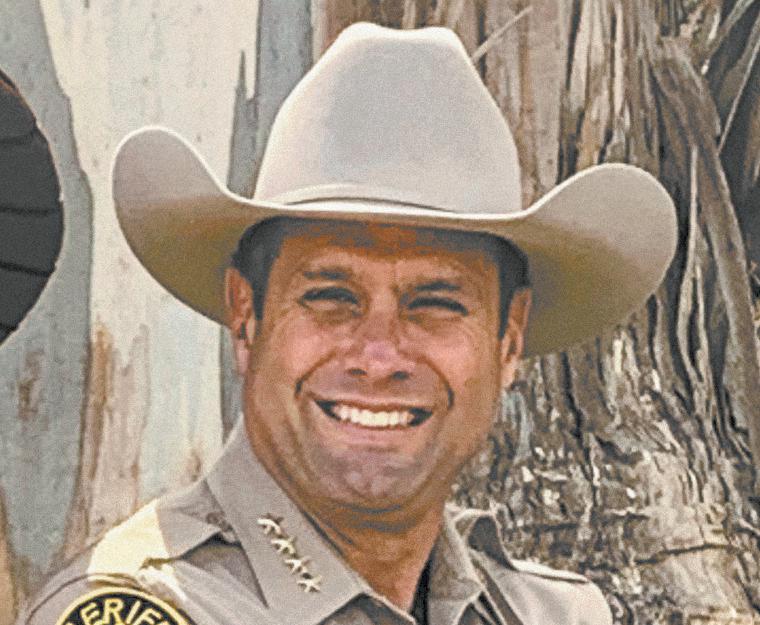
From time to time, cases investigated by our Sheriff’s Office draw attention well beyond the borders of our county. National media outlets, television documentaries, podcasts, and news programs shine a spotlight on our work, often revisiting cases years or even decades after the crimes occurred. While the headlines may come and go, the responsibility behind those stories remains the same: thorough investigations, accountability, and a commitment to victims and their families. There is no question that one investigation in

particular brought an unprecedented spotlight to our community. The disappearance of Cal Poly student Kristin Smart. Kristin vanished after a party in 1996, and for decades her family waited for answers, never giving up hope that the truth would one day come out. In 2022, her classmate Paul Flores was convicted of her murder and sentenced to 25 years to life in prison. While that conviction brought a measure of justice, the Smart family continues their search for Kristin’s remains. Their perseverance is something I will never forget.
The lead detective on that case was Clint Cole. After the conviction, Clint found himself doing interview after interview with major national news organizations, explaining the painstaking work that finally led to accountability after more than 25 years. For most detectives, that would be a career-defining moment. It was for Clint. But it turned out to be just one chapter.
Now, Clint is back in the spotlight again — not for one case, but two — and the media buzz has started all over.
One of those cases involves the 2018 murder of Nancy Woodrum in rural Paso Robles. On May 5 of that year, Nancy went missing from her home,
prompting an extensive six-month missing persons investigation by the Sheriff’s Office. In November 2018, a suspect, Carlo Fuentes Flores, was identified and brought in for questioning. He had been hired to paint Nancy’s deck in the weeks leading up to her disappearance. After a lengthy interview, he confessed and led investigators to Nancy’s remains in a secluded area off Highway 58 in the rural eastern part of the county. Clint was one of the lead investigators on that case as well.
This year renewed national interest in the Woodrum case has put Clint back on camera. In June, he was interviewed by the television show “Forensic Factor” on the Investigation Discovery Channel. In August, CBS Documentaries interviewed him for a program set to air in 2026. Also in 2026, NBC’s “Dateline” and ABC News’ “20/20” will each feature interviews with Clint focused on the Woodrum investigation. That’s a lot of airtime — but it’s also a reflection of the thorough, methodical work that went into solving a difficult and heartbreaking case.
The other case Clint has been working on is even older — and just as haunting.
In 1980, two kindergarten-aged girls, Teresa Flores and Martha Mezo, went missing from San
Miguel in broad daylight. Their naked bodies were later discovered near Camp Roberts. Both girls had been strangled, and one was sexually assaulted. Despite years of investigation, no one was ever charged.
In November, the popular podcast “Crime Junkie” revisited the unsolved murders and interviewed — you guessed it — Clint Cole. That episode generated several new leads, breathing fresh life into a case that is nearly 50 years old.
After the Kristin Smart trial, Clint retired. But retirement didn’t last long. He came back out of retirement for two reasons: to try and find Kristin’s remains and give the Smart family some closure. And to try and solve the Mezo-Flores case and bring answers to families who have waited far too long.
Clint is, without question, a superstar in our department. His dedication, experience, and refusal to give up are inspiring. But I also like to think Clint represents something bigger. Every day, our detectives work quietly and relentlessly, often without cameras or headlines, doing everything they can to seek justice for victims and their families.
And that’s news worth sharing.





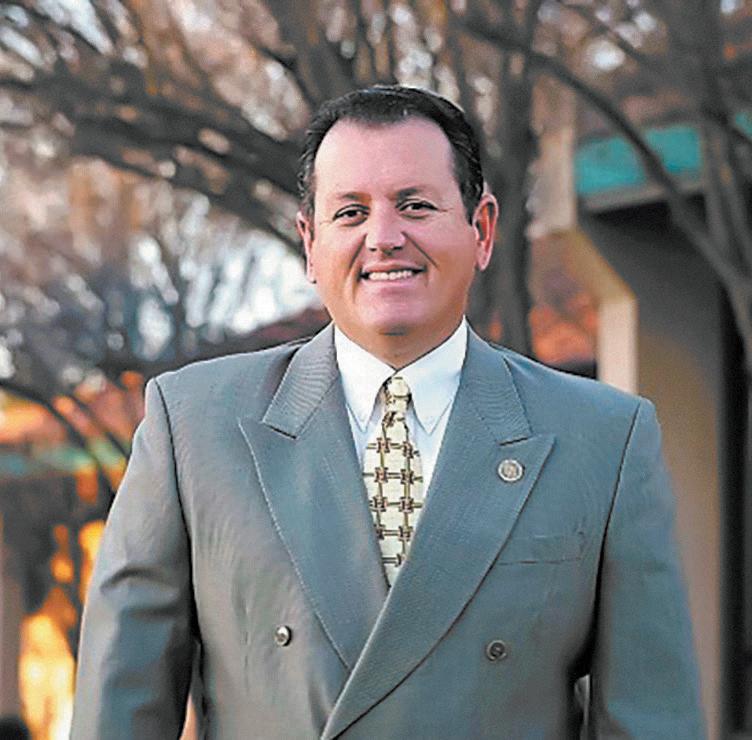
JAMES BRESCIA, ED.D.
SLOCOEDU SUPERINTENDENT
Iwas talking with a young person after an Opera SLO performance at the Center for Performing Arts, and the student said, “Wow, you have been a teacher that long?”
Yes, and I have enjoyed every moment because seeing our former students become successful, productive, and positive adults gives me
CONTINUED FROM A6
Parkinson then presented the county’s 2024 and 2025 statistics regarding communications with ICE:
2024 Statistics:
Total ICE requests received: 111
• Requests not complied with: 111
• Requests honored: 0
• Releases to ICE (CDCR): 1
• US District Court Warrants / Federal Warrants: 1
• Release to US Marshal’s Office: 1
• Requests for interview: 4
• Interviews completed: 0
2025 Statistics:
• Total ICE requests received: 287
confidence in the future. Karen Salvador’s 2021 Music Educators Journal article on the joy of teaching music explains how teaching music can foster courage, peace, and resilience. Since taking office, I have promoted local arts partnerships with our schools to boost academic success. Collaborations between arts organizations and schools that include professional artists working with students in programs are highly beneficial.
I was lucky to take part in the 2025 Opera SLO New Year’s Eve Gala at the PAC, which featured 200 performers and musicians. Fifty of these participants were students working alongside professionals from the local community, across California, and even from New York. Schools throughout San Luis Obispo County benefit from numerous arts outreach programs. Most notably, these activities are not funded through regular budgets but are supported by local arts patrons, foundations, and grants. In South County, the Clark Center Arts in Education Outreach Program provides programs for
• Requests not complied with: 204
• Requests honored: 83
• Releases to ICE: 69
• US District Court / Federal Warrants: 19
• Released to ICE: 15
• Pending releases: 4 Requests for interview: 11 Interviews completed: 0
“There is such a deep level of distrust in regards to the atmosphere of the country,” District 3 Supervisor Dawn Ortiz-Legg said. “It’s very important that we understand the distrust that is going on, but we want to separate the federal government and the county government.”
Following Parkinson’s presentation and questions from the Board of Supervisors, nearly four hours of
students in the county’s largest school district, Lucia Mar Unified. The Poly Arts for Youth (PAYF) program is Cal Poly Arts’ educational enrichment initiative for students of all ages throughout the county. Studios on the Park in Paso Robles and the Paso Robles Youth Arts Foundation collaborate with the community to deliver arts outreach programs that enrich the community. Other groups, such as Opera San Luis Obispo, Wine Country Theatre, Mary Bianco of the Moca Foundation, retired teachers Bob and Carol Grosse, and the SLO Career and Technical Education Foundation — which I started shortly after taking office — sponsor local student events. These are just a few examples that foster the creative spirit of San Luis Obispo County.
Luciano Pavarotti said, “For me, music-making is the most joyful activity possible, the most perfect expression of any emotion.” In addition to personal expression and growth, our local economy benefits greatly from the arts. According to a recent Arts and Economic
public comment took place. Public commentators were divided into one, two, and three-minute speaking groups.
Randall Jordan, chairman of the Republican Party of San Luis Obispo County, expressed his support for ICE and called on the community to support Sheriff Parkinson.
“It’s unconstitutional to cross our borders without being legal and without having permission,” Jordan said.
Supporters of ICE and the sheriff were met with repeated coughing noises from others in the room, prompting Supervisor Jimmy Paulding at one point to request that the disruption stop.
Chair of the Democratic Party of

Prosperity Survey, arts and related activities in San Luis Obispo County boost the local economy, generating over $30 million in economic activity. The arts are also among the most popular Career & Technical Education (CTE) pathways chosen by San Luis Obispo County students. The Central Coast Economic Forecast highlights the positive impact the arts have on our local economy. Our county is becoming more vibrant culturally and artistically because of the dedicated individuals who call the Central Coast home. Students participating in the performing arts develop a sense of community, communication skills, collaboration, public speaking abilities, empathy, and compassion. I hope this article continues to spark discussions among all educational stakeholders about the power of involvement in arts outreach as volunteers, patrons, or participants. It is an honor to serve as your county superintendent of schools.
“I started singing when I started talking.” — Mariah Carey
SLO Tom Fulks addressed the board during public comment, asking the supervisors to calm public fear by declaring SLO County an ICE Free Zone — an action echoed by many of the speakers that followed him. Many speakers said they are living in fear because of ICE and claimed the SLO County sheriff is working with ICE on a regular basis.
“ICE doesn’t respect the constitution, our local law enforcement does,” said Fulks.
Supervisors voted unanimously, 5–0, to create a subcommittee to further discuss and explore the options available to the county regarding ICE operations in San Luis Obispo County.
Staff will explore what extent to
which the county can regulate access to its nonpublic properties, including whether ICE can be barred from using those facilities for certain operations. Supervisors also expressed interest in the possibility of receiving quarterly reports, as well as exploring whether additional health and social services could be directed to families impacted by ICE activity.
“I think there’s an opportunity here for us to work together with the sheriff to help raise awareness to the fact that these are the good guys,” said District 4 Supervisor Jimmy Paulding.
The full TRUTH Act forum can be watched at slocounty.ca.gov/ departments/board-of -supervisors/boardm eetings,-agendas-and-minutes


Costumed crowds plunge into 57-degree surf during the 46th annual New Year’s Day tradition
By NEIL FARRELL for Morro Bay Life
Rainy skies didn’t dampen the spirit of thousands of folks who turned out for the 46th Annual Carlin Soulé Polar Bear Dip in Cayucos on New Year’s Day. As is custom, the day started early as dippers trickled onto Cayucos Beach, many wearing crazy costumes and toasting the start of 2026 before the noon dip into the 57-degree Pacific Ocean.
Dozens of lifeguards and paramedics with Cal Fire and the Morro Bay Fire Department patrolled the beach and water just past the breakers to make sure everyone who went into the water came out again, safe if not entirely sound.
Prizes were awarded during the pre-dip costume contest. The oldest dipper was an 85-year-old fellow and the youngest was a 17-month-old baby. A woman from Austria earned the award for traveling the farthest to be there and a group of Loraxes from Dr. Seuss took the prize for best costumed group. The best individual costume was a young man wearing a frizzy pink wig and Speedo, and nothing else. The most creative was a family of Chicago Bears fanatics and a family that has been attending in coordinated costumes for the past 16 years got a special award.
Hundreds of people lined the Cayucos Pier5 to watch an estimated 3,000-plus Polar Bear Dippers rush the waves to wash away 2025 and welcome in 2026.
CONTINUED FROM A2
strong, an estimated 2 million vehicles travel the Big Sur Highway every year, bringing tourists to both Carmel-Monterey and SLO County, including Cambria, Cayucos, and Morro Bay.
Having the road closed over a 6-mile stretch north of Lucia has forced travelers over the hill to Highway 101 to get from north to south or vice versa. That’s hurt tourism here as well as throughout Big Sur, which relies heavily on a tourism economy as well.
Other local politicians welcomed the reopening as well. Dist. 15 State Sen. John Laird said, “This reopening is welcome news for the Big Sur community, workers, and small businesses that have endured extraordinary challenges.
“For three years, I’ve worked with local leaders, Caltrans, Gov. Newsom’s Administration, business owners, and residents to secure resources, coordinate repairs, and keep Big Sur’s needs front and center.”
Sen. Laird stressed the importance of the roadway. “Highway 1 is more than a road,” he said. “It is a lifeline for families, small businesses, and visitors. The closure at Regent’s Slide created lasting hardship, cutting off access and threatening the region’s economic stability.


“Reopening this vital corridor restores jobs, revives local businesses, and reconnects people to their homes and livelihoods. I’m grateful to the Caltrans crews, state and local partners, and the Big Sur community for their tireless work, patience, and determination.”
Assemblymember Dawn Addis, who’s 30th District includes Morro Bay, also commented.
“The reopening of Regent marks an important step forward for the hundreds of families and workers in Big Sur and the millions of people who visit California every year,” she said. “This turning point will help restore revenue, access to our state parks, support jobs, public safety, and economic stability for many of our residents.”
Caltrans noted the Regent’s Slide repair job made use of cutting edge technologies. The slide started 450-feet above the road and completely closed 6.8 miles of the highway.
Innovations included (quotes from Caltrans):
• Remote-controlled heavy equipment. “Working with Caterpillar Inc., Caltrans deployed remotely operated bulldozers and excavators, controlled from a safe distance, allowing excavation to continue during periods of heightened geologic risk.”


• Shear dowels: “Over 4,600 steel bars, up to 60-feet long, were drilled and grouted into the slopes in a 10-foot by 10-foot grid to tie layers of the hillside together and reduce the risk of future slides.”
• Spider excavators: “Highly maneuverable smaller excavators were used in extremely steep terrain to remove material where conventional equipment could not operate.”
• Real-time monitoring: Daily drone flights, ground surveying, and subsurface monitoring provided data on slope movement, allowing crews to work under safe conditions.”
Though initially bid out at $35 million by contractor Papich Construction, (now part of Granite Construction), the cost of the job could run to as much as $82 million.
Regent’s Slide was a bit like working on an old house — new problems kept cropping up. After the initial landslide, crews started scaling off loose dirt and rocks, cutting back the hillside to reach bedrock.
During the early stages of the work, another slide, the Obvious Slide, started to open up above the top of the initial, 450-foot slip out.
That forced them to move farther uphill and further cut back the hillside, but then a third, much older slide, dubbed the Southern Slide, started to move adjacent to the original damaged area, forcing them to


move once again and start cutting out that loose soil.
During all this, they encountered a layer of blocky basalt granite that Caltrans said is inherently prone to sliding.
So what started out as a relatively narrow slide area had to be opened up considerably to address these additional slides.
And the future could hold even more issues, as during the recent holiday rainstorms, Regent’s Slide saw a significant amount of mud flow down
the steep slope and onto the roadway, forcing an evacuation of the job site for a day or two until the flows stopped and crews could go in and mop up the new mess.
The crews have been helped by a mild winter last year, and with the exception of a couple of big rainstorms in late 2025 and to begin 2026, have seen dry and sunny conditions throughout most of January, with the traditionally heavy rainfall on the Central Coast in late February and into March still to come.

FEBRUARY 6–7
FATHER & DAUGHTER
SWEETHEART DANCE
Pavilion on the Lake Friday & Saturday, 7–10pm
A semi-formal evening of dancing with DJ Manny Medina, plus snacks, door prizes, and more. Professional photos by Jimmy Dee available. Advance ticket purchase required at Colony Park Community Center; tickets not sold at the door.
FEBRUARY 12
VALENTINE’S
PAINT NITE
La Katrina Mexican Cocina 500 Embarcadero, Morro Bay
5:30–7:30pm
Create a take-home painting with step-bystep guidance from The Canvas Club while enjoying food and drink specials; perfect for date night, friends, or solo fun.

FEBRUARY 13
SWEETHEART STROLL: SIP & SHOP
Downtown Atascadero 5–8pm
Sip, shop, and celebrate the season with wine, beer, coffee, and treats from 15+ downtown businesses. Enjoy late-night shopping, tastings, and complimentary Historic City Hall tours with the City of Atascadero and the Atascadero Historical Society. For ticket details, visit the event website or call (805) 466-2044.
FEBRUARY 14
WOO AT THE ZOO
Central Coast Zoo, Atascadero 10am–1pm
Celebrate Valentine’s Day with keeper talks on animal matchmaking, special enrichment, and activities included with zoo admission or membership.


FEBRUARY 14–15
32ND ANNUAL BIG, BAD, & UGLY SURF COMPETITION
Morro Rock
Morro Bay Times vary
Annual retro-style longboard competition hosted by the Estero Bay Surf Club, celebrating classic surfing at The Rock.
FEBRUARY 19-22
BLENDFEST ON THE COAST
San Simeon and Cambria
Daily
Experience a taste of Paso Robles Wine Country on the beautiful California coast. Paso Robles BlendFest on the Coast will take place Feb. 19-22 in San Simeon and Cambria with a selection of exciting events.
MARCH 12
PAINT NITE / CELEBRATE INT’L WOMEN’S MONTH
La Katrina Mexican Cocina 500 Embarcadero, Morro Bay
5:30–7:30pm
Celebrate International Women’s Month with a guided paint-and-sip featuring “Divine Women Cherry Blossoms,” plus food and drink specials; ideal for friends, date night, or solo fun.
MARCH 20–22
MORRO BAY CITY-WIDE YARD
SALE
Citywide, Morro Bay Times vary
Shop neighborhood yard sales throughout Morro Bay; sale map available March 17 for bargain hunters.
MARCH 21
CENTRAL COAST
CRAFT BEER FEST
Sunken Gardens
6505 El Camino Real, Atascadero 12–4pm
Sample 55+ craft breweries, plus cider, wine, seltzers, kombucha, food trucks, vendors, games, live music, and shuttle service; souvenir glass included.




In today’s market, preparation and pricing aren’t optional, they’re what separate sold from sitting. While prices have softened slightly and homes are taking longer to sell, well-positioned properties are still attracting buyers and selling close to list.

MLS/December 20, 2025
With nearly half of active listings reducing price, pricing strategy and preparation are more important than ever. While median prices have softened slightly year-over-year, well-positioned homes are still selling close to list price. Strategic pricing attracts qualified buyers and minimizes costly market time.