VO LU M E 1 2 3
NO. 3
SUMMER 2026
COLORADO MEDICINE ADVOCATING EXCELLENCE IN THE PROFESSION OF MEDICINE
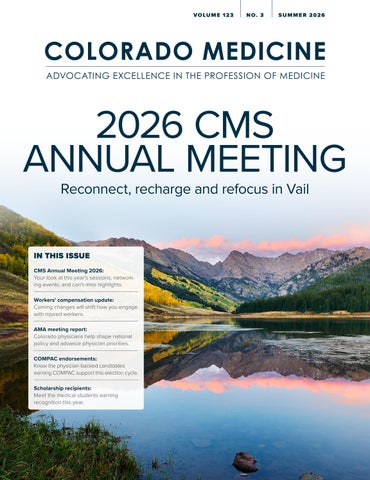
2026 CMS ANNUAL MEETING Reconnect, recharge and refocus in Vail
IN THIS ISSUE CMS Annual Meeting 2026: Your look at this year's sessions, networking events, and can't-miss highlights. Workers' compensation update: Coming changes will shift how you engage with injured workers. AMA meeting report: Colorado physicians help shape national policy and advance physician priorities. COMPAC endorsements: Know the physician-backed candidates earning COMPAC support this election cycle. Scholarship recipients: Meet the medical students earning recognition this year.
What keeps you up at night shouldn’t wait until morning. If an unexpected outcome occurs, you need someone to talk to now. With Copic, you get a 24/7 hotline staffed by experienced physicians. Day or night, they can offer guidance and help you consider options to navigate the way forward. We’re here for the humans of healthcare.
Copic is proud to be the endorsed carrier of the Colorado Medical Society. CMS members may be eligible for a 10% premium discount.
copic.com | 800.421.1834
C O NTE NT S
CMS Annual Meeting 2026: Reconnect, recharge and refocus in Vail
There is still time to join physicians from across the state Sept. 18-20 for the 2026 CMS Annual Meeting at The Lodge at Vail. Designed to help physicians reconnect with colleagues, recharge away from the daily demands of practice and refocus on the issues shaping medicine today, this year’s gathering offers timely education, leadership conversations and meaningful opportunities for connection in an inspiring mountain setting. PAGE 4 ⊲
F E ATU R E S
6
A new era for injured worker care: What 2028 means for Colorado physicians
I N S I D E
3
Perfectionism in medicine: When the drive for excellence goes too far The pursuit of excellence has long shaped physicians’ training and practice, but perfectionism can become a hidden driver of burnout when unrealistic standards, fear of failure and self-criticism take hold. Doris C. Gundersen, MD, explores how to recognize maladaptive perfectionism, preserve healthy striving and seek support before the cost becomes too high.
24 Final Word: How many of you are there? The strength of physician advocacy depends not only on the message, but on the number of physicians standing behind it. Ramnik Dhaliwal, MD, JD, makes the case for Colorado Medical Society membership by showing how dues, participation and a unified voice help protect physicians’ practice environment, influence state policy and ensure medicine remains represented where decisions are made.
President’s letter: Why membership matters more than ever CMS President Brigitta Robinson, MD, FACS, reflects on why physician membership and engagement are essential to strengthening organized medicine’s voice, calling on physicians to invest in collective advocacy, connect colleagues to CMS, and help shape the future of health care in Colorado.
Colorado physicians have a new opportunity on the horizon as workers’ compensation changes set for 2028 expand injured workers’ choice of treating provider, opening the door for physician-led care, stronger patient relationships and practice growth in a system built around focused, measurable recovery.
7
C M S
8
Colorado physicians help shape national policy at AMA Annual Meeting Colorado physicians, residents and medical students traveled to Chicago for the AMA Annual Meeting, where the state’s delegation advanced member-driven policy, served in national leadership roles and highlighted opportunities for physicians to bring ideas to the national stage.
10 COMPAC endorsements for the November election CMS shares the candidates endorsed by COMPAC for the November election, selected through a physician-led process focused on health care issues, support for patients and physicians, and strengthening medical practice in Colorado.
12 Student scholarships: Supporting medicine’s future The Colorado Medical Society Foundation recognizes 2026 medical student scholarship recipients whose leadership, service and commitment to rural care reflect the future of medicine in Colorado. Learn how these students are preparing to serve communities across the state.
D E PA R TM E NT S
14 Reflections: A poem for medical school
18 Introspections: On rounding, on my humanity
15 Reflections: What remains
20 Copic Comment: When patients bring AI into the exam room
16 News briefs • Boulder Community Health recognized as 2026 Wellbeing First Champion for supporting health workers’ access to mental health care • Three physician-authors, three extraordinary stories
22 Partner in Medicine Spotlight: True revenue integrity
CO LOR AD O M E D I CAL SOCI E T Y 7351 E. Lowry Boulevard, Suite 110 • Denver, Colorado 80230-6902 p 720.859.1001 • f 720.859.7509 • www.cms.org
OFFICERS, BOARD MEMBERS, AMA DELEGATES, and STAFF 2025-2026 OFFICERS
BOARD OF DIRECTORS
AMA DELEGATION
Brigitta Robinson, MD, FACS President
Brittany Carver, DO Elizabeth Cruse, MD, MBA Kamran Dastoury, MD Scott Dhupar, MD Dakota Hitchcock, MD Eleanor Jensen, DO Allison Kelley, MSC Rachelle M. Klammer, MD Marc Labovich, MD Kelly McAleese, MD Justin McCoy, DO Rhonda Parker, DO Lynn Parry, MD Darlene Tad-y, MD, MBA Andrew Tannous, MD
David Downs, MD, FACP Amy Duckro, DO, MPH Carolynn Francavilla, MD Mark Johnson, MD, MPH Jan Kief, MD Rachelle Klammer, MD A. “Lee” Morgan, MD Tamaan Osbourne-Roberts, MD Lynn Parry, MD Brigitta J. Robinson, MD Michael Volz, MD Patricia Weber, MD
Sean Pauzauskie, MD President-elect Kim Warner, MD Immediate Past President Hap Young, MD Treasurer Dean Holzkamp Chief Executive Officer
AMA PAST PRESIDENT Jeremy A. Lazarus, MD
COLORADO MEDICAL SOCIETY STAFF Dean Holzkamp Chief Executive Officer Dean_Holzkamp@cms.org Kate Alfano Director of Member Engagement Kate_Alfano@cms.org Jen Atchison, BHA, MSDA Director of Continuing Medical Education and Recognized Accreditor Programs Jen_Atchison@cms.org Virginia "Ginny" Castleberry Executive Director Denver Medical Society Virginia_Castleberry@cms.org
Cecilia Comerford-Ames Executive Director, Colorado Society of Eye Physicians and Surgeons Communications and Marketing Manager Cecilia_Comerford@cms.org Dorcia Dunn Membership Operations Manager Dorcia_Dunn@cms.org
Mihal Sabar Director of Accounting Mihal_Sabar@cms.org Chet Seward Chief Strategy Officer Chet_Seward@cms.org Debra Will Director of Business Development Debra_Will@cms.org
Crystal Goodman Executive Director, Northern Colorado Medical Society Crystal_Goodman@cms.org Blake Johnson Member Engagement Specialist Blake_Johnson@cms.org
COLORADO MEDICINE Vol 123 No. 3 Summer (ISSN-0199-7343) is published quarterly for $36 per year by the Colorado Medical Society, 7351 E. Lowry Boulevard, Suite 110, Denver, CO 80230-6902. 720-859-1001. Periodicals postage paid at Denver, Colo. POSTMASTER: Send address changes to COLORADO MEDICINE, P.O. Box 17550, Denver, CO 80217-0550. Address all correspondence relating to subscriptions, advertising or address changes, manuscripts, organizational and other news items regarding the editorial content to the editorial and business office. COLORADO MEDICINE magazine is the official journal of the Colorado Medical Society, and as such is also authorized to carry general advertising. COLORADO MEDICINE is copyrighted 2006 by the Colorado Medical Society. All material subject to this copyright appearing in COLORADO MEDICINE may be photocopied for the non-commercial purpose of education and scientific advancement. Publication of any advertisement in COLORADO MEDICINE does not imply an endorsement or sponsorship by the Colorado Medical Society of the product or service advertised. Published articles represent the opinions of the authors and do not necessarily reflect the official policy of the Colorado Medical Society unless clearly specified. Guest editorials and letters to the editor are published at the sole discretion of the Colorado Medical Society on a space-available basis. If you would like to submit a letter to the editor, email membership@cms.org. Dean Holzkamp, Executive Editor, Kate Alfano, Managing Editor, and Cecilia Comerford-Ames, Managing Editor. Design by Scribner Creative.
I N S I D E
C M S
P R E S I D E NT ’ S
LE T TE R
Why membership matters now more than ever Brigitta Robinson, MD, FACS President, Colorado Medical Society
In a time of constant change in medicine, one thing has become very clear to me: having a seat at the table is paramount. The Colorado Medical Society exists to represent physicians across our state, but our strength comes directly from the number of physicians who choose to participate. The more voices we have, the stronger voice we are able to bring – not just at the state level, but all the way through to the national level. We speak for all physicians, whether they are members or not. That matters. Our voice is louder, more credible, and more effective when more physicians are actively part of that effort. At its core, membership in CMS is about being able to make a difference. It is about having a unified voice, about being able to communicate directly with legislators, and about shaping decisions rather than reacting to them after the fact. There is also a practical side to this. Medicine today is complex and constantly evolving, and CMS is working continuously to help physicians navigate that environment. Whether it is advocacy, timely updates, or helping translate complicated policy changes into something meaningful for everyday practice, we are always working on behalf of physicians – even if that work is not always visible. One of the lessons I have seen reinforced time and again – whether here in Colorado or in conversations with colleagues across the country – is that we are stronger together. The louder your voice and the more people you speak for, the more trusted and effective that voice becomes. That principle carries through every level of organized medicine. It starts locally, with physicians coming together in their communities, building relationships, and identifying shared challenges. Those ideas move to the state level, and from there can influence conversations nationally. Each level builds on the other, and each becomes stronger as participation grows.
Our collective voice matters Advocating for you
Guidance through change
Physician support statewide
I also know that physicians are often asked to make choices about where to invest their time and resources. If that is the case, I believe strongly that your state medical society should be one of those choices. Most of the decisions that affect how we practice medicine happen at the state level, and supporting that work is one of the most direct ways to make an impact where you live and care for patients.
explore it, and ask questions. I believe the value becomes clear when you truly engage with what is available.
And to those of you who are already members, I would ask you to do something simple but important: reach out to a colleague who is not.
Ultimately, this is about our collective voice.
Share your experience. Encourage them to give CMS a try. As I often tell people, if you have doubts, give it a year. Use it,
This work – advocating for physicians and patients – does come with a cost. But the ability to have a say in how we practice medicine, and to help shape the future of health care in Colorado, is well worth that investment.
When we come together, support one another, and speak as one, we are far more effective than we could ever be alone – and that is how we move medicine forward in Colorado. ■
Helping medical professionals solve their mortgage puzzle Unique loan programs to fit your journey Expanded/Non-QM products including: DSCR for investors Doctor program with 100% financing options* Bank statement program Jumbo loan options
Let’s piece together your path to homeownership Justin Hopkins
Scan to visit my website
Loan Officer NMLS #1990002 631 Birch St. | Unit A-2 Windsor, CO 80550 M: 303.960.0487 jhopkins@guildmortgage.net Apply online guildmortgage.com/justinhopkins
Guild Mortgage Company; NMLS #3274; Equal Housing Opportunity; www.nmlsconsumeraccess.org. I am authorized to do business in the state of Colorado. For more licensing information, please visit www.guildmortgage.com/licensing. All information, loan programs & interest rates are subject to change without notice. All loans subject to underwriter approval. Terms and conditions apply. Always consult an accountant or tax advisor for full eligibility requirements on tax deduction. *For more information, contact a Guild Mortgage loan officer or visit: https://www.guildmortgage.com/mortgage-loans/doctor-program/. Guild Mortgage is not affiliated with Colorado Medicine Society.
C O LO R A D O M E D I C I N E
3
C OV E R
CMS Annual Meeting 2026: Reconnect, recharge and refocus in Vail Kevin Stansbury, MS, JD, FACHE, and Kenneth Blake, MD, FASCRS
A MEANINGFUL RETURN TO CONNECTION The Colorado Medical Society will bring physicians from across the state together Sept. 18-20 for the 2026 CMS Annual Meeting at The Lodge at Vail. Set in one of Colorado’s most iconic mountain commu-
nities, this year’s meeting is designed to give physicians time to reconnect with colleagues, recharge away from the daily demands of practice, and refocus on the issues shaping medicine today. The weekend will combine timely education, leadership conversations, network-
ing, family-friendly options and a signature celebration of Colorado’s physician community. Whether attendees come for practical education, meaningful peer connection or simply a chance to step back and reset, the Annual Meeting offers a thoughtful and energizing weekend in an inspiring setting.
Agenda overview
4
Friday, Sept. 18: The weekend begins with the Welcome Reception with Exhibitors from 5-7 p.m., followed by Mentorship “Speed Dating” from 5:306:30 p.m. and The Stories We Carry: Physician Authors on the Path from Idea to Publication from 7-7:45 p.m. with Pius Kamau, MD; Jay Ogsbury, MD; and Sean Pauzauskie, MD
Saturday afternoon, Sept. 19: Join colleagues for the COMPAC lunch from 11:45 a.m.-1:15 p.m., then hear Lotte Dyrbye, MD, present Advancing Faculty Well-Being: Leadership, Work Design, and Meaningful Action. An exhibit break with raffle drawings brings high energy before the second breakout sessions with Copic or the CMS outdoor experience group hike.
Saturday morning, Sept. 19: Start the day with breakfast at 7 a.m., then hear Tracee Metcalfe, MD, present Above the Clouds: Resilience, Risk, and Returning Stronger at 8 a.m., followed by John Lantos, MD, on Redefining the Role of the Physician in the Age of AI at 9:15 a.m. The first breakout session begins at 10:45 a.m., with options on practical AI in medicine or public trust in science communication.
Family-friendly options: Children’s camp will be available Saturday for children age 2 and older, with arts and crafts, snacks, an evening movie and other activities. Advance registration is required by Sept. 1.
C O LO R A D O M E D I C I N E
Saturday evening, Sept. 19: Gather for the President’s Reception from 5:30-6 p.m., then the President’s Celebration from 6-9 p.m. The evening includes dinner, music, dancing, recognition of physicians celebrating 50 years since medical school
graduation, the passing of the gavel from Brigitta Robinson, MD, to Sean Pauzauskie, MD, and a chance to meet Sunday’s keynote speaker Jerome Adams, MD. Sunday, Sept. 20: Close the weekend with breakfast at 8:30 a.m. and Coffee and Conversation: Public Health, Leadership and What Comes Next with Jerome Adams, MD, from 9-10 a.m. Credit Designation: AMA PRA Category 1 Credit™ : 7.00 Credits Attendance w/ No Credit : 7.00 Hour(s) Accreditation Statement: The Colorado Medical Society is accredited by the Accreditation Council for Continuing Medical Education to provide continuing medical education for physicians.
FEATURED KEYNOTE SPEAKERS
Tracee Metcalfe, MD Resilience, Risk, and Returning Stronger
2026 CMS ANNUAL MEETING
Jerome Adams, MD, MPH Public Health, Leadership and What Comes Next
TIMELY TOPICS FOR A CHANGING PRACTICE ENVIRONMENT 2026 CMS ANNUAL MEETING
The 2026 program reflects the realities physicians are navigating every day. Sessions will explore how artificial intelligence is moving from promise to practical use in clinical settings, how emerging technologies are raising new ethical questions, and how physicians can lead with clarity and trust at a time when patients and communities are looking for reliable guidance. The agenda also gives attendees room to explore practical topics that matter across career stages and prac tice settings, from physician wellbeing to public trust in science, mentorship and the evolving role of technology in medicine. Together, these sessions are intended to offer useful ideas physicians can carry back to their practices, organizations and communities.
FEATURED SPEAKERS Two featured speakers will help frame the weekend with perspective, purpose and practical inspiration. Tracee Metcalfe, MD, a Vail physician and world-class mountaineer, will open Saturday’s program with Above the Clouds: Resilience, Risk, and Returning Stronger, drawing on her experience in medicine and mountaineering to reflect on resilience, recovery and moving forward after challenge. The weekend will close with Jerome Adams, MD, MPH, former U.S. Surgeon General, who will lead Cof fee and Conversation: Public Health, Leadership and What Comes Next on Sunday morning. His keynote will offer a forward-looking discussion on public health, physician leadership and the role physicians can play in shaping what comes next for patients and communities.
OPPORTUNITIES TO CONNECT Connection is at the center of the Annual Meeting. In addition to formal education, attendees will have opportunities for mentorship “speed dating,” informal networking, discussion with Colorado physician authors and a research poster competition that elevates the work of medical student and resident members. Families are welcome, and childcare will be available during key sessions on Saturday and Sunday. JOIN US IN VAIL The CMS Annual Meeting is the premier gathering of Colorado physicians and a chance to invest in the profession, the physician community and yourself. Registration is open for physicians, guests, medical students, residents, fellows, component society executives, speakers, staff and exhibitors. Rooms at The Lodge at Vail are available on a space-available basis, with additional rooms available nearby at The Arrabelle at Vail Square. Physicians are encouraged to register now and make lodging plans soon. ■
C O LO R A D O M E D I C I N E
5
F E ATU R E
A new era for Colorado physicians: What the 2028 changes mean for your practice The Colorado workers’ compensation system is undergoing a significant shift that will reshape how physicians engage with injured workers. With the passage of HB 25-1300, beginning in January 2028, injured workers will be able to choose any physician accredited by the Division of Workers’ Compensation (DOWC) as their primary treating provider. This change moves the system toward a more open, competitive model of care. WHAT’S CHANGING AND WHY IT MATTERS
THE CLINICAL EXPERIENCE: FOCUSED AND IMPACTFUL CARE
Historically, access to treating injured workers has often been limited to the employer's discretion to a specific provider or group of providers. The upcoming change introduces a new dynamic in which injured workers have the autonomy to choose a primary treating provider.
Treating injured workers also presents a distinct clinical experience. Unlike broader primary care settings, where multiple conditions compete for attention, work-related injury care allows physicians to focus on a specific issue from the initial evaluation through recovery. This continuity allows physicians to manage a case from start to finish, see measurable progress over time, and support patients during a critical moment in their lives
For physicians, this means greater opportunity to serve injured workers directly, the ability to compete based on the quality of care and outcomes, and increased visibility for independent practitioners. Rather than navigating administrative barriers, physicians will be able to build patient relationships through reputation, accessibility, and clinical expertise. THE BUSINESS CASE FOR TREATING INJURED WORKERS The workers’ compensation system offers several practical advantages for physicians and practices. The DOWC establishes reimbursement rates and evaluates them annually, helping ensure alignment with the level of care required. For example, reimbursement for evaluation and management services is set at 175 percent of Medicare. Additionally, providers are reimbursed for required forms, which helps support the management of the administrative components of care. 6
C O LO R A D O M E D I C I N E
For many providers, this focused approach can feel more impactful and rewarding than other settings. One board-certified family medicine physician with over 15 years of experience in diverse medical arenas, from the ER to primary care, shared: “Performing workers’ compensation care in Colorado has been the most fulfilling professional setting of all that I have been involved in… Workers’ Compensation allows me to focus on helping injured workers recover while using an evidencebased approach that is centered on attaining the best possible functional outcomes. Building relationships with patients and treating them as a whole person are key components to this care, and align well with the reasons that I actually became a physician in the first place.”
PREPARING FOR 2028 As injured workers experience greater choice in medical providers in 2028, physicians may want to consider how workers’ compensation fits into their practice model. Physicians who are the primary authorized treating physician (designated to manage the injured worker’s case) are required to complete Level 1 Accreditation through the DOWC. The training provides foundational knowledge on the care of injured workers, case expectations, and system requirements. A Colorado provider recently stated that the Level 1 Accreditation was "one of the best courses I've taken in my professional journey." The shift taking place in 2028 represents more than a policy update. It introduces a new level of access, flexibility, and opportunity for physicians across Colorado. For those interested in expanding their practice, exploring workers’ compensation now can help position them for success in a changing landscape. Providers with questions about Level 1 Accreditation or treating injured workers can contact the DOWC Provider Relations team by emailing cdle_dowc_provider_ relations@state.co.us or by calling (303) 318-8122. ■
When perfectionism helps — and hurts F E ATU R E
C P H P
P H YS I C I A N
W E LLB E I N G
Perfectionism: “The perfect is the enemy of the good.” – Voltaire Doris C Gundersen, MD
By now, every practicing physician could, without preparation, give a TED Talk on burnout. Why? Because we have been talking about this painful, sometimes debilitating syndrome for years. Early on, we were educated about specific traits associated with burnout, but little explanation was provided about why certain traits increase vulnerability to burnout and other mental health conditions, including depression and anxiety. One significant driver of burnout is perfectionism, a trait that has helped launch many medical careers. Adaptive perfectionism, or striving for flawlessness, is not necessarily a bad thing. Athletes, to improve their performance, set the bar high. Similarly, as physicians, we engage in lifelong learning to hone our expertise and provide the very best patient care possible. Adaptive perfectionism is achievement oriented. According to the American Heritage Dictionary, perfectionism is: “A propensity for being displeased with anything that is not perfect or does not meet extremely high standards.” This is considered maladaptive perfectionism in which entirely unrealistic expectations are coupled with a deep fear of failure or harsh judgment. It invariably leads to emotional distress and, ironically, poor performance or failures. Unlike adaptive perfectionism, maladaptive perfectionism is fear-driven; making an error is experienced as a fatal flaw rather than a learning experience or opportunity for growth. Adaptive perfectionism can become maladaptive perfectionism when taken to an extreme, for example when an athlete engages in “doping” to enhance his performance to set a new world record.
will lead to emotional abandonment or rejection. Alternatively, children growing up in unpredictable and chaotic homes or who have experienced trauma may utilize perfectionism to create a sense of safety and control. Low self-esteem can lead to perfectionism to prove one’s worth or value. Certainly, societal influences play a role in perfectionism. For example, restrictive eating disorders tend to be more prevalent in the West where unhealthy body images are idealized. Finally, research supports that perfectionism can be genetically influenced. What are signs of maladaptive perfectionism? Failing to delegate in the spirit of “If you want the job done well, do it yourself,” leads to overwork and distress. Some jobs can be done “good enough for government work” and not diminish the final product, including patient care. If you are prone to avoidance, you may
ADAPTIVE Striving for excellence Achievement-driven MALADAPTIVE Fear of mistakes or failure Fear-driven be fearful that the project or task you are responsible for will lead to failure. This is true for procrastination. Finally, devoting disproportionate time to organizing, reviewing or editing work may be a sign that you do not accept anything less than perfection from yourself and often others. Too much attention to detail may also lead to a loss of creativity. How do you maintain adaptive perfectionism? For one, if you have skeletons in your psychological closet, get help. Insight-oriented and cognitive behavioral therapies can help you understand the origins of maladaptive perfectionism, confront irrational beliefs and help you set more realistic goals. Developing self-compassion is important. Reframing your definition of success may help. CPHP is happy to talk with you through our Doc2Doc service and provide additional resources when needed. ■
How is maladaptive per fec tionism created? Early childhood experiences can play a role. Highly critical or demanding parents who only recognized a child’s accomplishments or were intolerant of mistakes may lead to the child believing love is conditional. A child in this situation will perform well to achieve or maintain love. Significant fear may develop that failing to meet parental expectations C O LO R A D O M E D I C I N E
7
I N S I D E
C M S
Colorado physicians help shape national policy at AMA Annual Meeting
DELEGATION REPORT HIGHLIGHTS COLORADO LEADERSHIP, POLICY WINS AND OPPORTUNITIES FOR MEMBERS TO BRING IDEAS TO THE NATIONAL STAGE Kate Alfano, CMS Director of Member Engagement Colorado physicians, residents and medical students traveled to Chicago June 5-10 for the American Medical Association Annual Meeting, where more than 700 physician and medical student delegates gathered to debate policy, elect leaders and set priorities for organized medicine. The AMA House of Delegates serves as the organization’s policy-making body, bringing state medical associations, specialty societies, sections and other physician groups together to shape national positions on issues affecting patients and the practice of medicine. For the Colorado delegation, the meeting underscored both the state’s influence and the importance of member-driven policy. The small but mighty Colorado delegation is deeply connected across specialties, sections, regional caucuses and AMA leadership. These relationships help Colorado physicians build momentum for ideas that begin at home and move onto the national stage. COLORADO PHYSICIANS IN NATIONAL LEADERSHIP Colorado physicians were visible throughout the meeting in elected and appointed leadership roles. Several delegation members stepped into new posts, continued national service or completed important terms.
One Colorado physician’s idea can travel through organized medicine and become national policy
• Jan Kief, MD, completed service as
chair of the AMA Council on Long Range Planning and Development
COLORADO POLICY REACHES THE HOUSE OF DELEGATES
• Brigitta Robinson, MD, was appointed
One of the clearest examples of Colorado’s influence was the passage of policy opposing the use of the term “provider” when referring to physicians. The issue began as a concern raised by a physician member and advanced through Colorado’s delegation before reaching the AMA House of Delegates. Speakers described the policy’s adoption with minimal changes as an example of how one member’s idea can move through organized medicine and become part of national AMA policy.
to the Council on Long Range Planning and Development
• Tamaan Osbourne-Roberts, MD, is
moving into leadership as chair of the Council on Science and Public Health
• Carolynn Francavilla, MD, completed her term as immediate past chair of the AMA Private Practice Section
• Rachelle Klammer, MD, is a councilor
for District 4 within the PacWest region
• Jeremy Lazarus, MD, is AMA Foundation Board president-elect and Klammer is current AMA Foundation secretary
Colorado’s presence in these roles gives the state a strong voice beyond the size of its delegation, and medical student and resident involvement are an important pipeline for future leadership in organized medicine.
The AMA’s action reinforces the importance of clear terminology for patients, professionalism and patient safet y. Delegates also discussed major national issues including scope of practice, artificial intelligence in health care, Medicare physician payment reform, Medicaid and public health. Willie Underwood III, M.D., MSc, M.P.H., a urologic surgeon based in Buffalo, N.Y., was sworn in as AMA president and Sandra A. Fryhofer, MD, an internal medicine physician from Atlanta, Ga., was elected AMA president-elect. MEMBERS ARE INVITED TO BRING IDEAS FORWARD All Colorado physicians are invited to bring policy ideas forward through CMS, component societies, specialty groups or directly with members of the AMA delegation so that Colorado can continue advancing policies that reflect the experience of physicians practicing in the state.
8
C O LO R A D O M E D I C I N E
Colorado physicians have strong relationships across the House of Delegates, specialty societies and regional caucuses. Those connections help build support for resolutions before they reach the floor and amplify Colorado’s voice in national debates. There is a path up. When members identify policy concerns in their practices, communities or specialties, those ideas can move from local conversation to state society discussion to AMA debate. Members are encouraged to use that pathway more often.
Greater AMA membership can increase Colorado’s delegate strength, and broader participation in organized medicine can help ensure that the state’s physician leaders are most prepared to represent Colorado patients and physicians. Colorado physicians already have influence at the AMA, but that influence grows when more members participate, submit ideas and help shape the policies that organized medicine carries forward. ■
Colorado’s AMA delegation already reviews proposed resolutions for consistency with CMS policy, meaning the work physicians do within CMS helps guide what Colorado brings to the national level GROWING THE NEXT GENERATION OF PHYSICIAN LEADERS We need continued engagement from members, especially students, residents, fellows and early-career physicians.
Welter Healthcare Partners is the leading provider of integrated healthcare business management solutions. Welter can help you streamline the business side of healthcare with expert support in Provider Enrollment, Coding Compliance, and Contracting. We specialize in ensuring providers are enrolled accurately and on time, to protecting revenue through compliant coding and documentation, and strengthening payer contracts for better reimbursement. Welter delivers the expertise you need to stay efficient, compliant, and profitable.
Contact us today to get started! welterhp.com
•
877-825-8272
•
info@welterhp.com
C O LO R A D O M E D I C I N E
9
I N S I D E
C M S
COMPAC endorsements for the November election SUPPORTING CANDIDATES WHO PUT PATIENTS AND PHYSICIANS FIRST CMS staff report
Every election brings important decisions that shape the future of health care in Colorado. As the Colorado Medical Society’s nonpartisan political action committee, COMPAC evaluates candidates based on their positions on health care issues, their support for patients and physicians, and their ability to advance policies that strengthen medical practice and patient care. COMPAC’s endorsement process is guided by input from physicians and medical students across the state. Candidates are evaluated through a rigorous screening process that includes local interviews, review of policy positions, voting records for incumbents, and consideration of their commitment to issues important to Colorado physicians and the patients they serve. The following candidates have earned COMPAC’s endorsement for the November election. SENATE | District 1 Byron Pelton 7 Janice Rich 8 Dylan Roberts
R R D
9 11 15 20 21 22 24 25 29 30 31 32 35
Terri Carver Tony Exum Janice Marchman Sheila Lieder Adrienne Benavidez Monica Duran Kyle Mullica William Lindstedt Iman Jodeh John Carson Matt Ball Emily Sirota Rod Pelton
R D D D D D D D D R D D R
HOUSE | District 3 Gena Ozols 4 Cecelia Espenoza 7 Jennifer Bacon 8 Lindsay Gilchrist 12 Kyle Brown 14 Ava Flanell 17 Regina English 18 Amy Paschal 19 Dan Woog 20 Jarvis Caldwell 23 Alexis Hoffkling, MD 24 Lisa Feret 26 Meghan Lukens
D D D D D R D D R R D D D
27 28 29 30 32 34 36 37 38 40 41 44 45 46 48 49 50 52 53 55 57 59 61 63 64 65
Danielle Varda Dave Rein Lori Goldstein Rebekah Stewart Chris VanDijk Jenny Willford Michael Carter Chad Clifford Gretchen Rydin Naquetta Ricks Jamie Jackson Anthony Hartsook Max Brooks Tisha Mauro Carlos Barron Lesley Smith Ryan Gonzalez Yara Zokaie Andrew Boesenecker Rick Taggart Elizabeth Velasco Katie Stewart Eliza Hamrick Dusty Johnson Scott Slaugh Lori Garcia Sander
D D D D D D D D D D D R R D R D R D D R D D D R R R■
Medical Transcription Services Busy vs. Kinda Sorta Maybe Busy
Few can contest physicians and healthcare providers when they say they’re busy. They truly are. They barely have seconds to scarf down vending machine chips for lunch, let alone transcribe their patients’ medical charts. By bringing Ditto Transcripts on board, time’s back on your side to juggle more administrative tasks and care for patients—the work that matters most to you. The way it should be.
For the medical field, Ditto Transcripts delivers: • Experienced, U.S.-based medical transcriptionists • Speech recognition software editing skilled in EHR and EMR systems • Secure, private, confidential and HIPAA compliant • 99% accuracy for all transcription—guaranteed • Adhere to AHDI/AAMT standards • Access to speech recognition software editors • Unlimited customer support services • Rapid turnaround and on time for fast access to • No long-term contract required medical records and reports 24/7 • E-signature/digital signature available • Electronic file delivery in 24 hours or less When we say specific, we mean specific. We have deep medical transcription service expertise for cardiology, clinical, dermatology, emergency medicine, hematology/oncology, mental health, neurology, ophthalmology, orthopedic, pathology, podiatry, psychiatry, radiology, urology, among others.
Free Trial 10
Take us for a test drive. Enjoy 1,000 lines or 60 minutes free. No credit card needed—this trial’s on us. For pricing models and to learn more about our Free Trial, visit us at dittotranscripts.com.
C O LO R A D O M E D I C I N E
3801 E Florida Ave • Suite 500 Denver, CO 80210 • 720.287.3710
I N S I D E
C M S
Supporting medicine’s future: 2026 CMS Foundation student scholarships Cecilia Comerford-Ames CMS Communications and Marketing Manager Each year, the Colorado Medical Society Foundation (CMSF) proudly invests in the next generation of physicians through its medical student scholarship program. CMSF offers two distinguished opportunities: the Rural Track Scholarship and the Gilchrist Student Leadership Scholarship. The Rural Track Scholarship provides financial support to students in good academic standing who are completing their first or second year in a rural medicine track program at a Colorado medical school. This scholarship is designed to strengthen Colorado’s rural health workforce by supporting students committed to practicing in underserved communities. The Gilchrist Student Leadership Scholarship recognizes third- and fourth-year medical students who have demonstrated exceptional leadership within organized medicine. This award honors their commitment to advocacy, service, and the advancement of the profession. Below are the 2026 scholarship recipients, who are already making meaningful contributions to their communities and represent a bright future for health care in Colorado. RURAL TRACK SCHOLARSHIP RECIPIENTS:
JULIETTE COURTINE Juliette Courtine, recipient of the Rural Track Scholarship, brings a broad and deeply personal perspective to rural medicine. Growing up in a rural New Hampshire community affected by housing instability and the opioid epidemic, and later working with patients who traveled hours for lifesaving care, she saw how limited access can shape health outcomes and daily life.
12
C O LO R A D O M E D I C I N E
Her commitment has also been strengthened through global and public health work, including last-mile population research, diagnostic delivery in rural Eswatini, and response efforts in remote regions of Canada. Now training in Colorado, Juliette is preparing for a rural clerkship and plans to practice in underserved communities across the state. CMSF is proud to recognize her dedication to rural health equity and her commitment to community-centered care where access and advocacy matter most.
JACKSON LONG Jackson Long, recipient of the Rural Track Scholarship, brings a strong sense of place, service, and community to his path in medicine. Raised in Conifer, Co., he developed an early appreciation for rural communities that has grown into a commitment to improving access to care. Before medical school, Jackson spent nine months in a remote region of Madagascar conducting HIV research, where he saw the impact physicians can have in resource-limited settings and the importance of trust between providers and communities. Now training through the University of Colorado Rural Program, with clinical rotations in Cortez and Craig, Jackson has committed to serving at least two years in a rural Colorado county. CMSF is proud to support his dedication to rural service and his future impact in Colorado communities.
JOSLIN BLAIR Joslin Blair, recipient of the Rural Track Scholarship, is committed to returning to
rural Colorado as a primary care physician. Raised in small mountain communities, she understands the trust, continuity, and connection that define rural health care. Her path to medicine was shaped by her upbringing and by serving her community as a COVID tester. During her clerkship in Glenwood Springs, she has cared for patients across specialties, built lasting relationships, and seen both the strengths and ongoing access challenges facing rural communities. CMSF is proud to recognize Joslin’s dedication to rural communities and her commitment to caring for families in the places that shaped her.
CARSON CAMPISI Carson Campisi, recipient of the Rural Track Scholarship, is drawn to rural medicine through her appreciation for continuity of care and the relationships that define small-community health care. Growing up in rural Colorado and completing clinical rotations in Salida, she has seen how strong community bonds help physicians care for patients beyond a single visit or hospital stay. Through her clinical experiences, Carson has witnessed the unique role rural physicians play in walking alongside patients through illness, recovery, and everyday life. Knowing patients over time, understanding what matters most to them, and remaining part of their story continue to motivate her commitment to rural practice. CMSF is proud to recognize Carson’s dedication to patient-centered care, continuity, and serving rural communities where those connections are essential.
ALFRED GILCHRIST SCHOLARSHIP: CALEB MCGRATH Caleb McGrath, recipient of the Rural Track Scholarship, brings a deep generational connection to Colorado’s Western Slope to his path in medicine. A sixth-generation Coloradan raised around ranching communities, he grew up surrounded by resilience, service, and neighbor-to-neighbor support. His commitment to rural care was also shaped by his grandfather, a pediatrician who served families in the Four Corners region for more than four decades. Through that example, Caleb saw the lasting impact one physician can have as a trusted clinician, problem-solver, and anchor of care in a rural community. Caleb intends to return to rural Colorado to practice medicine and give back to the communities that shaped him. CMSF is proud to recognize his dedication to rural service and the enduring values that sustain Colorado’s rural communities.
KEELY OLSON Keely Olson, recipient of the Rural Track Scholarship, brings a deep connection to the Gunnison Valley to her path in medicine. Raised in rural Colorado, she grew up understanding both the strengths of close-knit communities and the challenges families face when access to care is limited. Now training through the University of Colorado School of Medicine Rural Program, Keely has returned to her hometown for hands-on clinical experience in the hospital where she was born. Her training has reinforced the broad scope, continuity, and personal connection that define rural practice. Keely plans to build her career in rural Colorado and give back to the Gunnison Valley community that shaped her. CMSF is proud to recognize her commitment to rural medicine and care close to home.
KATIE MCDERMOTT Katie McDermott, recipient of the Alfred D. Gilchrist Student Leader Scholarship, brings a patient-centered perspective to leadership in organized medicine. Grounded in her clinical experiences, she views advocacy as essential to addressing social determinants of health and improving the patient experience, particularly for vulnerable communities. Through CMS, Katie has served as Rocky Vista University co-president, Medical Student Component co-chair, and a medical student representative on the Council on Legislation. In these roles, she has helped engage students in Colorado’s legislative process and elevate the medical student voice in health policy. Her leadership also includes national service as a student liaison with the American College of Osteopathic Pediatricians, along with work as a peer tutor and mentor. CMSF is proud to recognize Katie’s compassion, leadership, and commitment to building a healthier, more equitable future.
LIZ JONES Liz Jones, recipient of the Alfred D. Gilchrist Student Leader Scholarship, has built a strong record of leadership in organized medicine rooted in advocacy, policy, and service to the profession. Her leadership began as co-president of Rocky Vista University’s CMS chapter and continued through roles with the CMS Medical Student Component and the CMS Board of Directors, where she helped elevate student perspectives in important policy discussions. Through CMS and the Council on Legislation, Liz has contributed to work on peer review protections, scope of practice, and prior authorization reform, gaining firsthand experience in coalition-building
and legislative strategy. Her participation in RVU’s Academic Medicine and Leadership Track has further strengthened her view of advocacy as an essential skill for future physicians. CMSF is proud to recognize Liz’s dedication to leadership, organized medicine, and building a more sustainable and equitable health care system.
RENEE DREHER Renee Dreher, recipient of the Alfred D. Gilchrist Student Leader Scholarship, has demonstrated a strong commitment to advocacy, collaboration, and student leadership in organized medicine. As CU co-chair of the CMS Medical Student Component and a member of the Council on Legislation, Renee has helped amplify student voices, contribute to legislative strategy, and create clearer pathways for medical students to participate in advocacy. Her leadership also extends nationally through the American Medical Association, where she has reviewed and advanced student-authored policy, presented testimony, and supported efforts to expand equitable access to care and protect LGBTQ+ families. CMSF is proud to recognize Renee’s leadership and her commitment to building a more inclusive, engaged future for medicine. ■
CONTRIBUTE TO THE FOUNDATION CMSF needs your suppor t to support the future of medicine. Visit cms.org/contribute to contribute or add a donation to your annual dues when you receive your 2027 membership invoice in September. ■
C O LO R A D O M E D I C I N E
13
D E PA R TM E NT S
R E F LE C TI O N S
Inside me: A poem for medical school Zoe Caswell
Zoe Caswell is a fourth-year medical student at the University of Colorado School of Medicine. She grew up in the greater Boston region of Massachusetts and earned bachelor’s degrees in Spanish and biology from the University of Massachusetts, Amherst. Since moving to Colorado to pursue her medical degree, she has expanded her interest in language learning to include a passion for working with underserved, international patient populations. She is planning to pursue a career in community-oriented primary care with a focus on women’s health and global health. A new bitterness is growing inside me against, of all things, my lungs Which are, I must admit, quite good at being lungs All that inhaling and exhaling and breath holding and song singing and run panting and sleep zzzzzing All that perfusion distention and vasoconstriction ventilation diffusion As for me, just confusion because though all of these things my lungs have been doing inside me nonstop for twenty-three years They never bothered to tell me the tiniest detail about it A strange indignation is growing inside me against, of all things, my liver Which is, doubtless, quite good
at being a liver At sitting there quietly doing its job whatever that is unnoticed As it smoothly takes care of pretty much everything Handling clotting short-term sugar storage sorting lipids and iron and Tylenol breakdown Wielding triads and transports and those CYP thingies All right now in this moment while I sit here complaining that though the liver inside me keeps up with this hugely gargantuan list of “to do’s” There’s no getting around that to me it was news An odd consternation is growing inside me against, of all things, my heart
Which is, I sure hope, quite good at being a heart At having four chambers and a strong sinus node and septa and heart strings and valves (So I’m told) At beating in rhythm not too fast nor too slow At opening channels to let calcium flow I see I’m waxing poetic as I think all this through, So I’ve scrolled up and back for a moment’s review of this bitterness, indignation, consternation milieu And perhaps what I mean by all of this verse Is that rather than mad at my heart, my liver, my lungs’ sneaky ways I’m really just the tiniest small bit amazed ■
Reflective writing is an important component of the University of Colorado School of Medicine curriculum. Beginning in the first year, medical students have the opportunity to write essays, stories or poetry, or create works of art, that reflect what they have seen, heard and felt. The Reflections column was co-founded by Steven Lowenstein, MD, MPH, and Tess Jones, PhD. It is edited by Dr. Lowenstein. It is dedicated to the memory of Henry Claman, MD, Distinguished Immunologist, Professor, and founder of the Arts and Humanities in Healthcare Program.
14
C O LO R A D O M E D I C I N E
D E PA R TM E NT S
R E F LE C TI O N S
What remains Allison Leigh
Allison Leigh is a fourth-year medical student at the University of Colorado School of Medicine. Originally from Palmer, Alaska, she headed east to Quinnipiac University, where she played volleyball and studied health sciences, then on to University College London for a master's in global health and development – before the mountains pulled her back west to Colorado. She is applying to psychiatry residency this cycle, with plans to ultimately pursue a fellowship in child and adolescent psychiatry. Outside of the hospital, she's happiest on skis or a mountain bike, though these days she’s most often trying to keep up with her two year old. Throughout medical school, we spend hours – in the lecture hall, in small groups, on the wards – talking about humanism in medicine. But what does it actually mean? To me, humanism is the commitment to recognize and honor the full humanity of every person, especially when time pressure, systems, or our biases make it easier not to. It means resisting the instinct to reduce people to diagnoses or tasks waiting to be done, and instead staying attentive to the lives, relationships, and experiences that shape how they move through illness and care. Now, as a fourth-year medical student, I have come to understand humanism as something practiced in small, everyday choices: what we notice, what we prioritize, how we show up. Two experiences have taught me what that looks like in practice: becoming a mother during my first year of training and caring for people experiencing homelessness through the Street Dog Clinic. When I gave birth during my first year of medical school, I had already known the loss of a pregnancy, and I came to that delivery from a place of vulnerability – exhausted, overwhelmed, and deeply reliant on others. What stayed with me were the moments when I felt seen: a nurse who slowed down to explain what was happening, a physician who spoke with calm reassurance. Just as striking
were the moments when that sense of in northern Colorado, where we care for humanity felt absent. Becoming a mother people experiencing homelessness and changed me at my core, and with that, the their pets alongside veterinarians, social physician I am becoming. Loving my child workers, and community partners. At one taught me the sheer magnitude of a single clinic, I met a man who waved off every life – how much weight one person carries, question about his own health but spoke and how inseparable any of us are from at length about the dog sitting beside him the relationships and circumstances that – his closest companion, and likely his only surround us. Now I cannot meet a patient one. He seemed to care far more for that without trying to see the whole of them: dog’s wellbeing than for his own. I could not the people in their life or missing from it, fix his circumstances, and I could not talk the histories they bring, the context that him into care he was not ready to accept. shapes how they experience illness and So, I followed his lead instead: we made care. It has changed how I practice. I move sure his dog was cared for, and I listened. more slowly. I listen for what goes unsaid. In time, the conversation turned to his own I try to meet the person in front of me not health. He taught me that humanism is not as a problem to solve, but as a life as full the work of persuading people toward our and complex as my own. priorities, but of honoring theirs. It requires humility, flexibility, and a willingness to A few months after my child was born, that redefine what “successful care” looks like. change met its test. During an emergency department shift, I cared for a woman I am drawn to psychiatry because it refuses experiencing a miscarriage. There was to separate a person from the life they nothing I could do to change what was are living – the relationships and circumhappening to her. But I had lived the stances that shape them, the histories same loss, and so I could offer more than they carry, the worlds they return to when information. I sat with her and shared that they leave our care. It is work that asks I deeply and personally understood the for curiosity, presence, and a willingness gravity of her loss and offering that small to understand a patient’s whole context, piece of myself seemed to ease her sense and I hope to carry these lessons into it. of being alone. The care I gave was not a Ultimately, humanism is not something cure; it was presence – a willingness to we achieve, but something we practice – stay with her suffering and not look away. how we listen, how we respond, how we choose to see the person in front of us. It I have carried that same lesson somewhere is what remains when there is nothing left very different: to the Street Dog Clinic to cure. ■
C O LO R A D O M E D I C I N E
15
D E PA R TM E NT S
N E W S
B R I E F S
Boulder Community Health recognized as 2026 Wellbeing First Champion for supporting health workers’ access to mental health care BCH VERIFIED BY ALL IN: WELLBEING FIRST FOR HEALTHCARE, ENSURING NO INVASIVE MENTAL HEALTH QUESTIONS ON CREDENTIALING APPLICATIONS Boulder Community Health is a 2026 Wellbeing First Champion, having been recently recognized by ALL IN: Wellbeing First for Healthcare. As a Wellbeing First Champion, BCH has verified that its credentialing applications are free from intrusive, stigmatizing mental health questions. This means that physicians and other clinical staff at Boulder Community Health can seek mental health care or treatment for substance use without fear of negative effects on their license or career.
which passed the Colorado legislature in 2025. This new law removes stigmatizing, invasive mental health and substance use questions from medical licensing applications. With the Lorna Breen Heroes’ Foundation, the work has continued with individual systems and their credentialing processes. Boulder Community Health is the latest to join a growing list of Colorado hospitals to receive this designation. View the full list here: drlorna-breen.org/ credentialing/#colorado
The Colorado Medical Society, working with the American Medical Association, already made gains in this area through the strong support of House Bill 25-1176,
Like everyone, health workers deserve the right to pursue mental health care confidentially. Removing these overly invasive mental health questions in licensing and
16
C O LO R A D O M E D I C I N E
credentialing applications takes one more step in changing the culture in health care and ensuring physicians and other health workers know their mental health and wellbeing is a priority. “Every health worker is a human being who carries the immense weight of caring for others. For too long, our caregivers have suffered in silence, fearing that seeking the confidential mental health care they need would cost them the career they love,” said Corey Feist, CEO and Co-Founder of the Dr. Lorna Breen Heroes’ Foundation, which leads the ALL IN: Wellbeing First for Healthcare coalition. “Boulder Community Health is breaking that silence – sending a powerful, compassionate message to their workforce that your life matters as much as your livelihood, and you never have to choose between the two.” ■
D E PA R TM E NT S
N E W S
B R I E F S
Three physician-authors, three extraordinary stories From a gripping courtroom memoir to a sweeping immigrant story to a literary novel, three CMS-member physicians have published books in the past year – each offering a different window into resilience, memory, and what it means to heal. Running with Lions Pius Kamau, MD A boy in colonial Kenya learns to face danger early – from the political forces bearing down on his community to a literal encounter with a leopard in the forest. Coming of age amid the upheaval of the Mau Mau Rebellion, where illness and loss are constant companions, he clings to one conviction: education is his way forward. That belief carries him through an attempted escape on foot, arrest, a hardwon scholarship, and eventually medical training abroad – before he returns home to practice medicine in a newly independent Kenya still wrestling with old inequities. Running with Lions is a memoir of grit, ambition, and the long road from a struggling village to the operating room. Dr. Kamau is a retired thoracic surgeon,
known for both his surgical career and his writing on identity and immigration. About Not Losing: A High-Stakes Trial. Life's Purpose Found. James Ogsbury, MD When a hospitalized patient suffers a devastating brain injury from a procedure performed by others that the neurosurgeon did not wish to be done, the resulting malpractice trial becomes far more than a legal proceeding – it becomes a crucible that reshapes everyone involved. Written as events unfolded, this memoir pulls readers into the courtroom's tension and uncertainty, then follows an unexpected settlement that closes one chapter while opening another. At its heart, About Not Losing is less about winning or losing a case and more about the surprising grow th, self- discover y, and lasting connections forged among the three people at the center of the storm. Dr. Ogsbury is a retired neurosurgeon whose memoir grew out of his own experience navigating a high-profile malpractice trial.
Stage of Fools Sean Pauzauskie, MD A powerful San Francisco businessman lies silent in an ICU bed, his body still but his mind adrift through memory, regret, and long-hidden truths – including a painful rift with his daughters. An experimental brain-stimulation therapy offers a fragile chance at waking, while a younger man navigating his own uncertain path begins to mirror the patient's unfinished story. Blending past and present, consciousness and dream, this literary novel echoes the emotional terrain of King Lear to ask timeless questions about power, forgiveness, and what it truly means to heal. Dr. Pauzauskie is a neurologist whose debut fictional novel draws on his clinical experience with neurological illness and recovery. Join us in Vail Meet all three authors in person at the CMS Annual Meeting, Friday, Sept. 18, in Vail. Bring your questions about writing, publishing and drawing inspiration from a medical career. ■
C O LO R A D O M E D I C I N E
17
D E PA R TM E NT S
I NTR O S P E C TI O N S
On rounding, on my humanity Brady Patterson
Brady Patterson is a graduate of Rocky Vista University College of Osteopathic Medicine, and he is currently training as an emergency medicine resident in Denver. In his writing, Brady focuses on moments that linger long after a shift ends: quiet acts of kindness, everyday resilience, and the ways communities shape who we become. He believes in the beauty of ordinary things, and writing allows him to make sense of chaos, find meaning in it, and hold onto the parts that matter. Outside of the hospital, Brady enjoys running, reading, playing basketball, and trying to convince his wife and dog that one more adventure is worth it.
Is it healing still? Is it truly healing to repair wounds while ignoring the pain that caused them? What good is mending broken arms if we send patients out to carry the weight of the world on their shoulders and all? The above writing was an impromptu poem created during a resident/medical student wellness activity at the end of my trauma rotation. I suppose I spoke it as a prayer just as much as a poem, but I never got the sense anybody was listening. Truthfully, I felt jaded and discouraged about the true healing capacity of medicine as my third year came to an end. The beginning of my final year of medical school would be spent in hospice, witnessing souls making sense of their lives, taking account of all they had experienced. I didn’t know what to do with that sort of permission; it felt like a greater responsibility than the medicine I had been taught knew how to hold. Morning meetings focused on medications and symptom control, as they should have, but I couldn’t shake the quiet reality underneath it all. We were continually failing to discuss what it meant that each room contained an entire world slowly preparing to become a memory. On rounds, I recall a 29-year-old woman lying in her bed dying from bone cancer that had spread to her lungs. She looked small in the hospital bed, smaller than someone her age should look. I stood there thinking about all the procedures she’d tried, all the medications she'd taken, and all the IVs and needle sticks she’d received with the hope of a treatment or therapy that might, at very least, 18
C O LO R A D O M E D I C I N E
help her feel better for the next couple of hours. None of it mattered now. What mattered was that she was dying, and we were standing there with nothing left to offer except our attention, efforts, and presence. I remember thinking during those early rotations that medicine was about fixing people. Cut here, prescribe this, order that test, and everything will work out. But nothing about watching someone die is simple or clean. I used to think: what if I can't help them? What if all my studying means nothing? What if I become one of those doctors who throws medicine at patients from behind my keyboard? What if I leave my heart and humanity at the door because it's easier than carrying it into rooms where people are suffering? I don't have anything profound to say about those fears. I can't report that my training prepared me perfectly or that I know now what to do. Articulating these experiences at times feels reductive to their reality and impact on my spirit. But I know I can tell you that it feels better than passively stepping around them. Somewhere along the way, I had begun to see detachment as professionalism and protection. It was learned as much as it was innate, as though the cost of surviving the limitations of our healing was to keep it all at arm’s length. After my hospice experience, I carried that posture into months of emergency department work, where everything happens quickly and loudly. I witnessed medicine have a massive impact, with countless lives saved in front of me. Equally, I watched medicine reach its limits over and over again, where certain sounds and frightened eyes followed me home some
nights. Slowly, I began to realize I’d been floating above it all for months, detached and protected, until one night I stood in the trauma bay while a new resident celebrated their first chest tube despite the passing of a young woman moments before. That moment broke something open in me that I'd been trying to defend against and keep closed. And maybe that's the point. Maybe medicine isn't about staying closed off. How we round is who we are. How we enter each room, how we sit with uncertainty, how we carry our hearts instead of leaving them behind; that's the answer. The answer is showing up with intention when the treatment pathway on the EMR runs out of arrows at the bottom of the screen. The answer is remembering that sometimes, our presence matters more than our prescriptions. Eventually, we all face patients we cannot cure, suffering we cannot eliminate, and deaths we cannot prevent. But maybe that's when we discover what we actually have to offer: not omnipotence, but humanity. Not fixes, but the willingness to sit with what cannot be fixed and call it sacred anyway. Is it healing still? Yes. It’s in the procedures that save lives and the humanity we bring to them. Maybe healing happens both when we repair what's broken and sit with what can't be fixed. Maybe we learn to carry our treatments and our hearts with equal intention, and we turn towards the pain and face it. Maybe that's what keeps our humanity as students and future physicians. ■
C O LO R A D O M E D I C I N E
19
D E PA R TM E NT S
C O M M E NT
When patients bring AI into the exam room MANAGING RISK AND LIABILITY WHEN PATIENTS RELY ON CHATGPT AND OTHER AI TOOLS
Gerald Zarlengo, MD, Chairman & CEO, Copic Insurance Company Chairman & CEO Copic Insurance Company Generative artificial intelligence (AI) and large language model tools such as ChatGPT and Claude are rapidly becoming part of the clinical encounter. Patients increasingly arrive at appointments with AI generated summaries of symptoms, differential diagnoses, and recommendations for testing or treatment.
particular attention. They affect expectations of care, perceptions of attentiveness, shared decision making, and—critically— how disagreements over testing or treatment are understood and documented. WHY AI-INFORMED PATIENTS CREATE NEW LIABILITY EXPOSURE
physicians but to prepare for visits and to advocate for themselves—particularly after feeling dismissed or unheard in prior encounters. When those advocacy efforts are met with defensiveness or dismissal, the risk is not merely dissatisfaction, it is erosion of trust, which remains a leading contributor to malpractice claims.1
From a risk management and liability perspective, these encounters warrant
Recent clinical commentary highlights that patients often use AI tools not to replace
Several liability-relevant dynamics are emerging:
• Explicit Requests for Testing
or Treatment: AI tools frequently suggest diagnostic studies (e.g., tilt table testing, advanced imaging, lab panels) without weighing patient-specific probability, sequence, or resource constraints.1
• Perceived Authority of AI Output:
The polished tone and medical fluency of large language models can lead patients to overestimate accuracy and underestimate uncertainty.2
• Heightened Sensitivity to Refusal:
When clinicians decline AI-suggested interventions, patients may interpret the decision as disregarded rather than clinical judgment—especially if communication is rushed or overly technical.1
• From a claims standpoint, these
encounters increase exposure to allegations of failure to order tests, failure to diagnose, or lack of informed decision-making—even when care aligns with evidencebased guidelines.
20
C O LO R A D O M E D I C I N E
COMMUNICATION AS PRIMARY RISK-REDUCTION TOOL
DOCUMENTATION: A CRITICAL LINE OF DEFENSE
The literature underscores a central finding relevant to risk management: patients value being heard and recognized at least as much as they value clinical accuracy. In medicolegal terms, acknowledgment is not a courtesy—it is a protective behavior.1
From a liability standpoint, documentation should reflect:
RECOMMENDED OPENING FRAMEWORK Before addressing the merits of AI-generated information, clinicians should explicitly acknowledge the patient’s effort and concern:
• “I can see you’ve put a lot of thought into this.”
• “Let’s walk through what you found
and how it applies to your situation.”
• This approach lowers defensiveness and creates a record of shared engagement rather than unilateral decision making.
INTEGRATING ACCURATE AI-GENERATED INFORMATION SAFELY When AI - generated content aligns broadly with medical knowledge, it can be incorporated into the encounter in a way that supports clinical authority and reduces risk. Best practices include: 1. Acknowledge partial accuracy. “That test is used in certain situations, and it’s reasonable to ask about it.” 2. Reframe around individualized risk assessment. Emphasize probability, timing, and clinical context rather than absolutes. 3. Clarify sequencing and thresholds. Many liability claims arise not from refusing tests outright but from failing to explain why now is not the right time. Documenting this discussion demonstrates that the clinician considered the patient’s input and applied professional judgment—an important defense if decisions are later questioned.
• That AI-generated information was discussed
• That patient concerns were acknowledged
• The clinical rationale for accepting or declining recommendations
• Evidence of shared decision making or informed refusal when applicable
Avoid chart language that implies irritation or dismissal (e.g., “patient insists,” “patient demands”). Neutral phrasing such as “patient inquired about…” or “patient requested discussion of…” is preferable. Patients increasingly arrive armed with information to be heard. Meeting them with recognition rather than resistance preser ves both the human core of medicine and the legal safeguards that support it. ■
Eligible Colorado Medical Society (CMS) members can receive up to a 10% premium discount on Copic policies. Get more information on CMS membership by contacting membership@cms.org. 1 Sundar KR. When Patients Arrive with Answers. JAMA. 2025;334(8):672–673. doi:10.1001/jama.2025.10678 2 ht tps: // w w w.medscape.com / viewar ticle/chatgpt-your-clinic-whosexpert-now-2025a1000lqt?ecd=a2a The information provided herein does not, and is not intended to constitute legal, medical, or other professional advice; instead, this information is for general informational purposes only. The specifics of each state’s laws and the specifics of each circumstance may impact its accuracy and applicability, therefore, the information should not be relied upon for medical, legal, or financial decisions and you should consult an appropriate professional for specific advice that pertains to your situation.
D E PA R TM E NT S
PA R TN E R
S P OTLI G HT
Margin for the mission: True revenue integrity
Mark Welter, Chief Strategy and Growth Officer Welter Healthcare Partners
The independent provider in Colorado is held to a near-impossible standard. Tasked at being a clinician, an office manager, an accountant, and a medical coder all at once, you find yourself wondering why this wasn’t all covered in medical school. There just isn’t enough time in the day to manage your patients and your clinic, let alone keep up with complex payer rules and the ever-changing state-level regulatory and legislative shifts. Yet, a fundamental truth remains: To protect independent medicine, a practice must remain financially viable. If there is no margin, there is no mission. Your practice cannot serve its community, invest in modern technology, or retain top-tier clinical staff if its financial foundation is constantly under pressure. Securing a positive impact on the bottom line is not about corporate greed – it is about longterm sustainability. To keep your clinic doors open and protect your autonomy, effectively managing your revenue cycle is non-negotiable. To find a solution to effective revenue cycle management, we must look at how we manage the various aspects that drive impact to the bottom line and create the foundation of your practice’s financial health: True revenue integrity. THE FOUR PILLARS OF REVENUE INTEGRITY: WHO, WHAT, WHY, AND HOW Revenue integrity isn’t a single back-office task, it is an interconnected chain. If one link fails, the entire bottom line suffers. For independent practices to effectively reclaim the exam room and shift the administrative burden, they must look at their operations through a clear, synchronized framework:
22
C O LO R A D O M E D I C I N E
1. CREDENTIALING: WHO GETS PAID. Provider enrollment and credentialing is the ultimate gatekeeper of the revenue cycle. You can have the most lucrative managed care contract and flawless coding, but if a provider’s credentials lapse, or if a new physician isn’t properly enrolled with a payer, the system halts. Missed credentialing windows or delayed enrollments result in immediate write-offs and untraceable leaks in revenue. Credentialing, when done correctly and timely, is the administrative mechanism that turns your work into realized revenue. 2. CONTRACTING: WHAT YOU ARE GOING TO BE PAID. Your commercial payer contracts establish the baseline value of your clinical services. In an era of high inflation and rising practice overhead, accepting “take-it-or-leave-it” fee schedules is a direct threat to sustainability. Strategic contracting and negotiations ensure your rates reflect the actual cost of delivering care in Colorado. If your contracts aren’t optimized, you are losing revenue on every single clean claim before the patient is even seen. 3. CODING: WHY YOU GET PAID. Once the care is delivered, your coding operations translate that clinical expertise into the highly specific language of reimbursement: the “why.” Through accurate and compliant documentation, precise coding ensures you capture every dollar you rightfully earned while shielding your practice from aggressive payer audits and automated downcoding.
4. BILLING: HOW YOU GET PAID. The final link in the chain is the execution engine. Billing is how you submit your claims to the payers, aggressively fight unfair insurance denials, and ensure the cash actually hits your bank account. A high-performing billing process prevents commercial payers from utilizing automated loopholes and administrative delays to withhold your cash flow. It ensures that the high-quality service you provide to your patients is fully realized by your business. SHIFTING THE BURDEN, PRESERVING THE CARE Managing this entire ecosystem effectively requires a level of time, vigilance, and specialized expertise that practicing physicians simply do not have the bandwidth to maintain while carrying a full patient load. Doctors should be doing what they do best: treating patients and reclaiming the focus of the exam room. True revenue integrity requires a holistic, synchronized approach where contracting, coding, billing, and credentialing work in perfect harmony. As the newest Partner in Medicine with the Colorado Medical Society, Welter Healthcare Partners has shouldered this exact operational burden for well over 30 years. By offloading the complexities of the business cycle to dedicated experts in Colorado health care operations, independent practices can confidently secure the financial margin they need – allowing them to focus entirely on the mission that matters most. ■
Plan Daycare Early Start your child care search for your growing family. Colorado Medical Society offers working parents 10% off child care at KinderCare Learning Centers. • Get more options for schedules, locations, and start dates before SURJUDPV ¿OO XS • )LQG WKH EHVW ¿W IRU \RXU IDPLO\ E\ WDNLQJ WLPH WR H[SORUH SURJUDPV • Get familiar with the teachers, staff, DQG FHQWHU EHIRUH GD\ RQH
• +HOS \RXU FKLOG HDVH LQWR FDUH DQG JHW FRPIRUWDEOH LQ WKHLU QHZ HQYLURQPHQW • Be more present at work, knowing \RXU EDE\ LV KDSS\ DQG VDIH • Explore tuition savings, subsidies, and HPSOR\HU GLVFRXQWV DKHDG RI WLPH
To learn more, visit kindercare.com/ coloradoms
F E ATU R E
F I N A L
WO R D
How many of you are there?
By Ramnik Dhaliwal, MD, JD Chair, CMS Council on Legislation
of roughly
18,000 6,244 licensed physicians CMS Members
A legislator asked me that question last fall. She was not being dismissive. She wanted to know how many physicians stood behind what I was about to say. Before I tell you my answer, let me acknowledge the argument against renewing your Colorado Medical Society membership, because many physicians make it quietly between opening the dues notice and setting it aside. The argument is simple: When CMS succeeds, every physician benefits, including those who never paid dues. Why pay for something others receive for free? It is a rational argument. It is also why our collective voice is more fragile than it appears. When physicians opt out, the work does not become less expensive. It becomes less effective. Insurance companies, hospital systems, attorneys and other wellfunded interests do not decide each year whether advocacy still feels worthwhile. Their representatives are at the Capitol because the policies being debated directly affect them. Physicians need the same consistent presence. Membership provides the numbers behind our message. Dues provide the resources required to deliver it. We need both. THE VALUE OF WHAT DID NOT HAPPEN The challenge in explaining advocacy is that the product is often an absence. You do not receive an email when a harmful provision is removed from a bill. There is no announcement when a regulation is changed before it reaches your practice. You may never know that someone proposed weakening your licensing protections, increasing your liability or making it harder to collect payment for care already provided. You simply continue caring for patients. Consider prior authorization. Colorado 24
C O LO R A D O M E D I C I N E
in colorado
reforms ex tended many approvals from 180 days to one year and reduced repeated authorizations for many chronic medications. Carriers must offer alternatives for physicians with strong approval records and cannot deny coverage for a related procedure discovered to be necessary during an operation. When the Colorado Medical Practice Act underwent sunset review, CMS helped preserve physician representation on the board that licenses us and opposed proposals that could have weakened due-process protections. CMS also defended the confidentiality of physician peer-assistance programs. These are not glamorous victories. They protect your license, livelihood and ability to seek confidential help. You do not receive a notification when a harm fails to reach you. Not every fight ends in victory. Colorado physicians still face a Medicaid payment reduction as the state attempts to balance its budget. We should not call a cut a win. But advocacy is also measured by what was prevented, reduced or improved and whether physicians remained at the table. In a difficult year, it can mean the difference between a cut and a rout.
ABOUT ONE-THIRD standing behind the collective voice of CMS
before a bill is introduced and experts who can identify unintended consequences before they become law. That requires voices, numbers and money. Most CMS members will never testify or attend a legislative meeting. The model still works. Your dues place a full-time team in the room while you are caring for patients. HOW MANY OF US ARE MISSING? When that legislator asked how many physicians I represented, I answered: 6,244. That is a meaningful number, but Colorado has roughly 18,000 licensed physicians. Only about one-third are standing behind the collective voice of CMS. Imagine the answer I could give, and the credibility it would carry, if physicians participated at the rate of Colorado attorneys. The Colorado Bar Association is also a voluntary, dues-supported professional organization. It has approximately 16,000 members and represents a substantial share of Colorado attorneys. Its voice at the Capitol is powerful because lawmakers understand that it speaks for a large portion of the profession.
COLORADO’S RULES ARE WRITTEN IN COLORADO
Physicians should expect and build the same influence.
National specialty societies are essential, but many decisions most directly affecting our work are made here.
I know CME funds are shrinking and physicians are questioning every professional expense. It is reasonable to ask what membership provides.
Prior authorization, licensure, Medicaid rates, scope of practice, insurance regulation and professional discipline are debated at the Colorado Capitol and within state agencies and regulatory boards. Your employer’s government-affairs team represents your employer. Your specialty society represents your specialty. CMS represents physicians: employed and independent, urban and rural, primary care physicians and specialists. Being proactive requires relationships before a vote is needed, physician input
CMS membership protects the environment in which you practice. It gives physicians a voice before decisions are made, not merely after the consequences arrive. Our influence must be rebuilt every year, one membership at a time. Renew your membership or join us. The next time a legislator asks how many of us there are, I want to include you in the answer. ■
We’ve researched and analyzed so you don’t have to. Copic Financial is an independent insurance brokerage firm serving the healthcare community since 1985. We provide advice and consulting for your insurance needs throughout your professional career and personal life. With the experience to help you navigate complex decisions, we make the unfamiliar familiar. We’re here for the humans of healthcare.
copicfinancial.com | 800.421.1834
» » » » » » »
Property & Casualty Insurance Employee Benefits Life/Disability Insurance Financial & Retirement Planning Workers’ Compensation Cyber Liability Insurance Wealth Management
STEP
1
STEP
2
STEP
3
COLORADO PHYSICIAN OR MEDICAL STUDENT CALLS 720-810-9131. 24/7 line answered by a Masters-Level Licensed Clinician (LCSW, LPC) to assess the clinical need of the caller, including life-threatening situations.
CONFIDENTIALITY IS REVIEWED AND PEER SUPPORT SERVICES ARE INITIATED. Only in circumstances where an individual is a threat to self or others or as outlined in the Medical Practice Act would confidentiality be breached. Doc2Doc Wellbeing Consulting has the same reporting obligation as all licensed Colorado physicians.
PHYSICIAN CALLER RECEIVES WELLBEING SUPPORT FROM A PEER PHYSICIAN. If Doc2Doc Wellbeing Consulting is the best fit based upon the caller’s presentation, a physician will return the physician’s call for the first of three free peer consultations. If CPHP traditional comprehensive evaluation services are a best fit based upon caller’s presentation OR if more help is needed at the end of three free Doc2Doc Wellbeing Consulting sessions, CPHP’s process will commence to ensure client has appropriate treatment supports in place.