


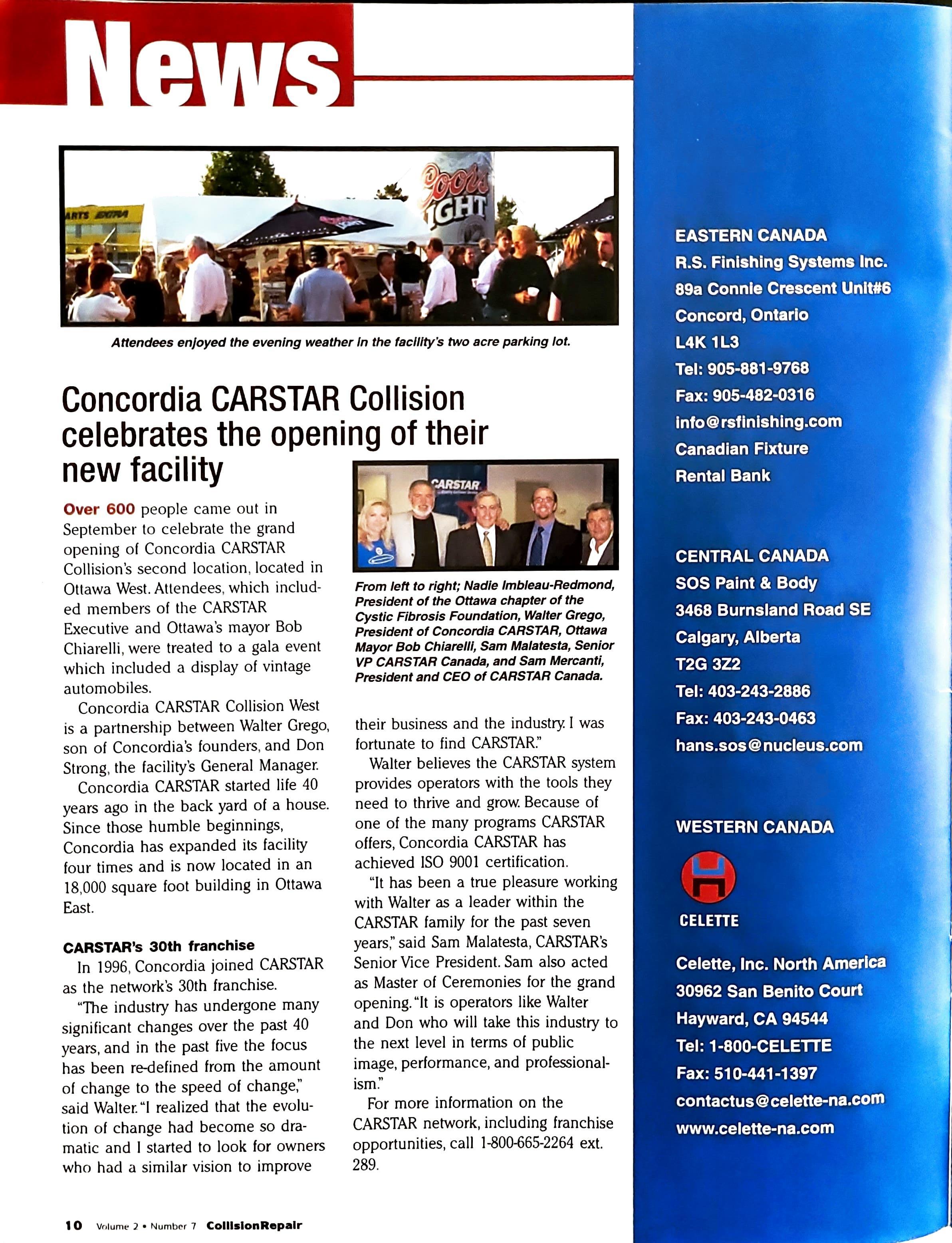


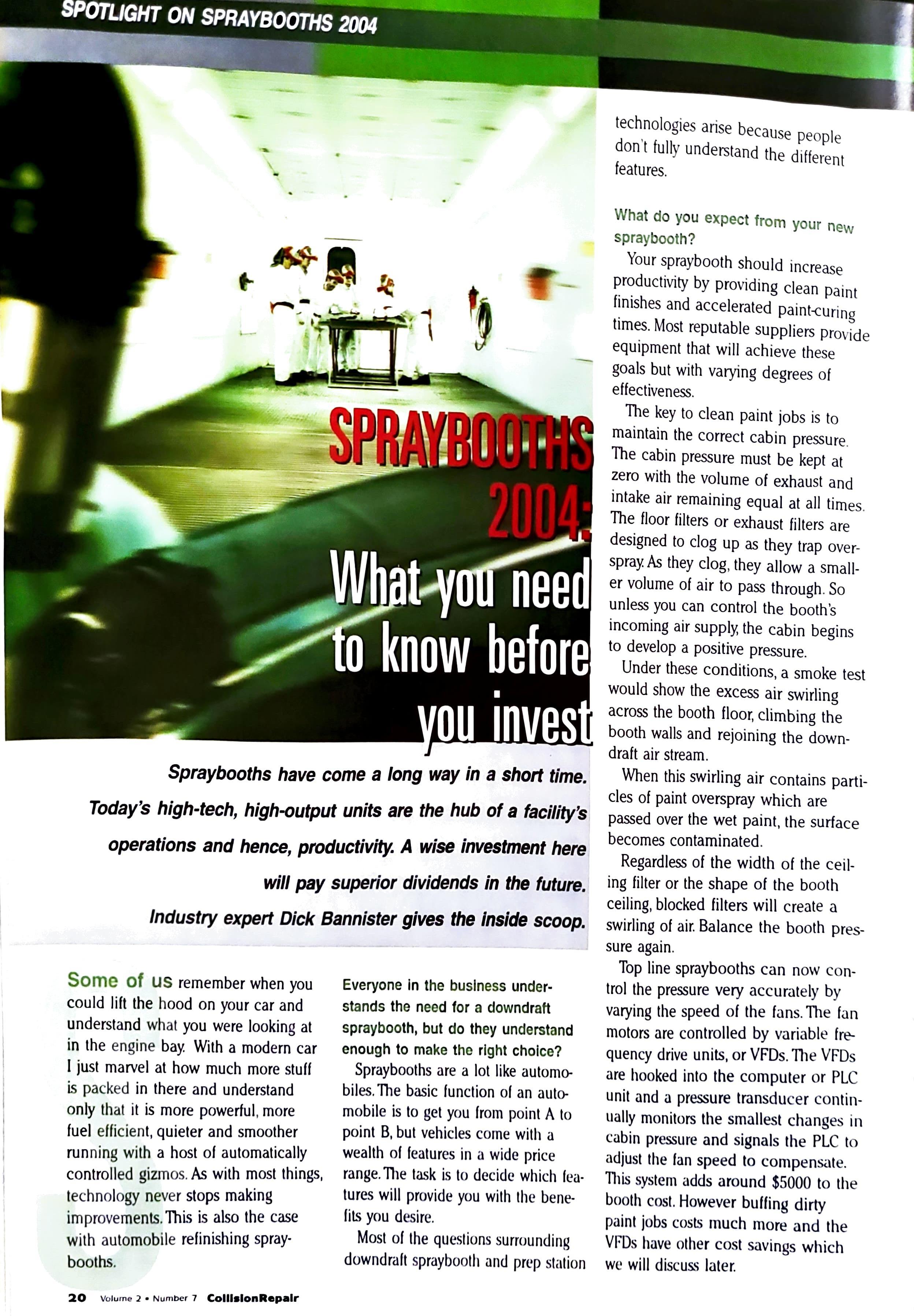


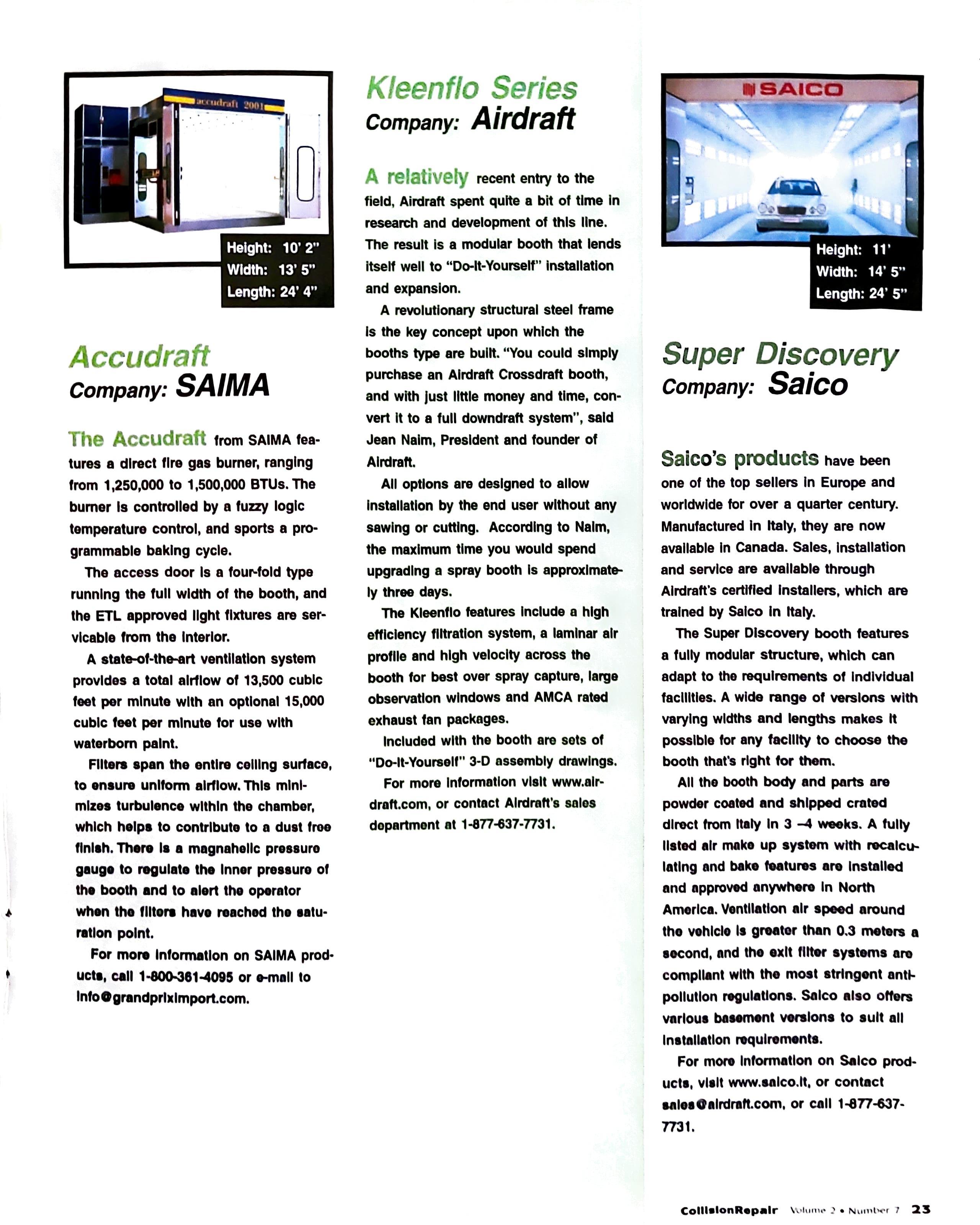

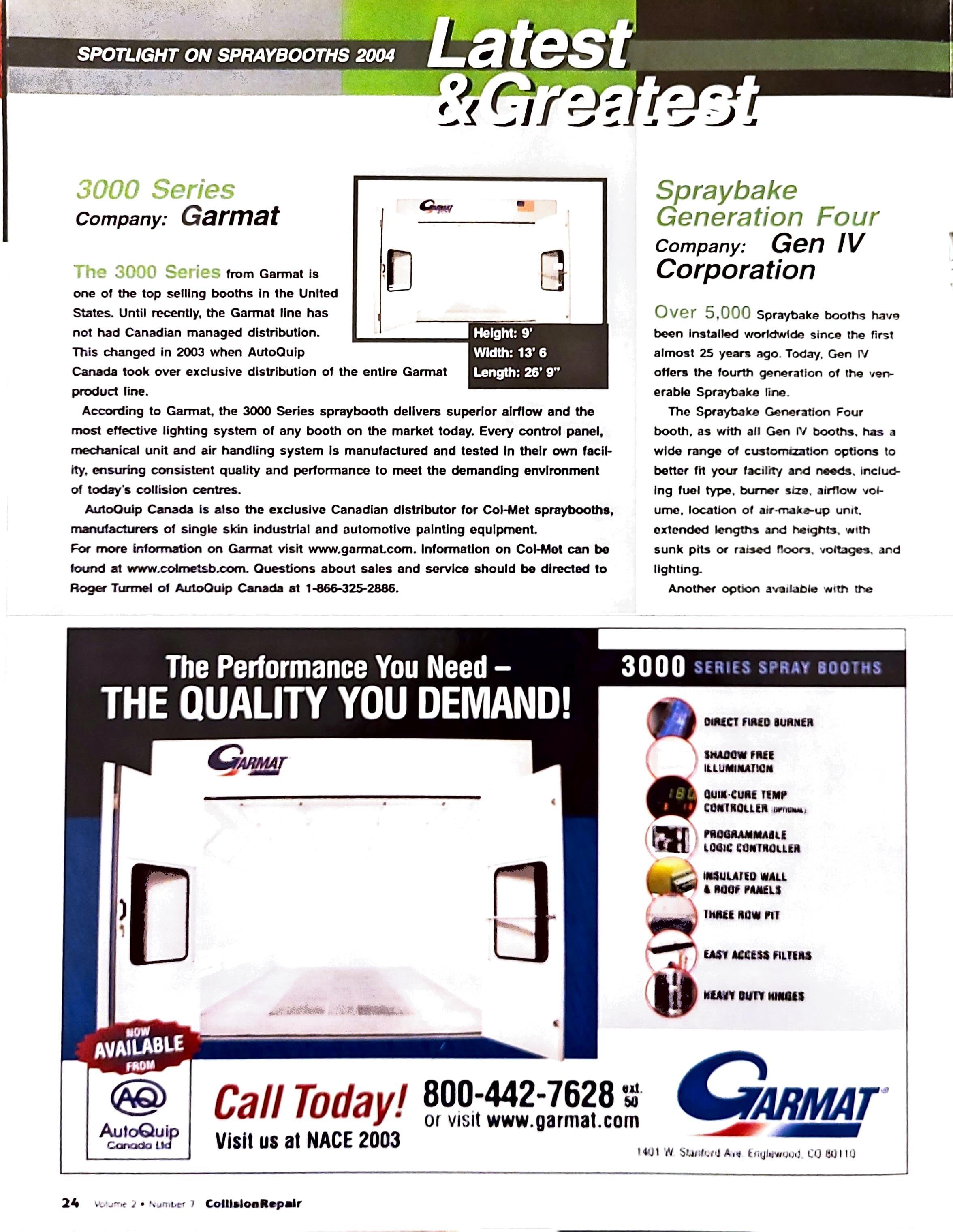
The 3000 Series trom Garmat is one of the top seling booths in the United States. Until recently, the Garmat Iine has not had Canadian managed distribution. This changed in 2003 when AutoQuip Canada took over exclusive distribution of the entire Garmat product line.
Length: 26 9"
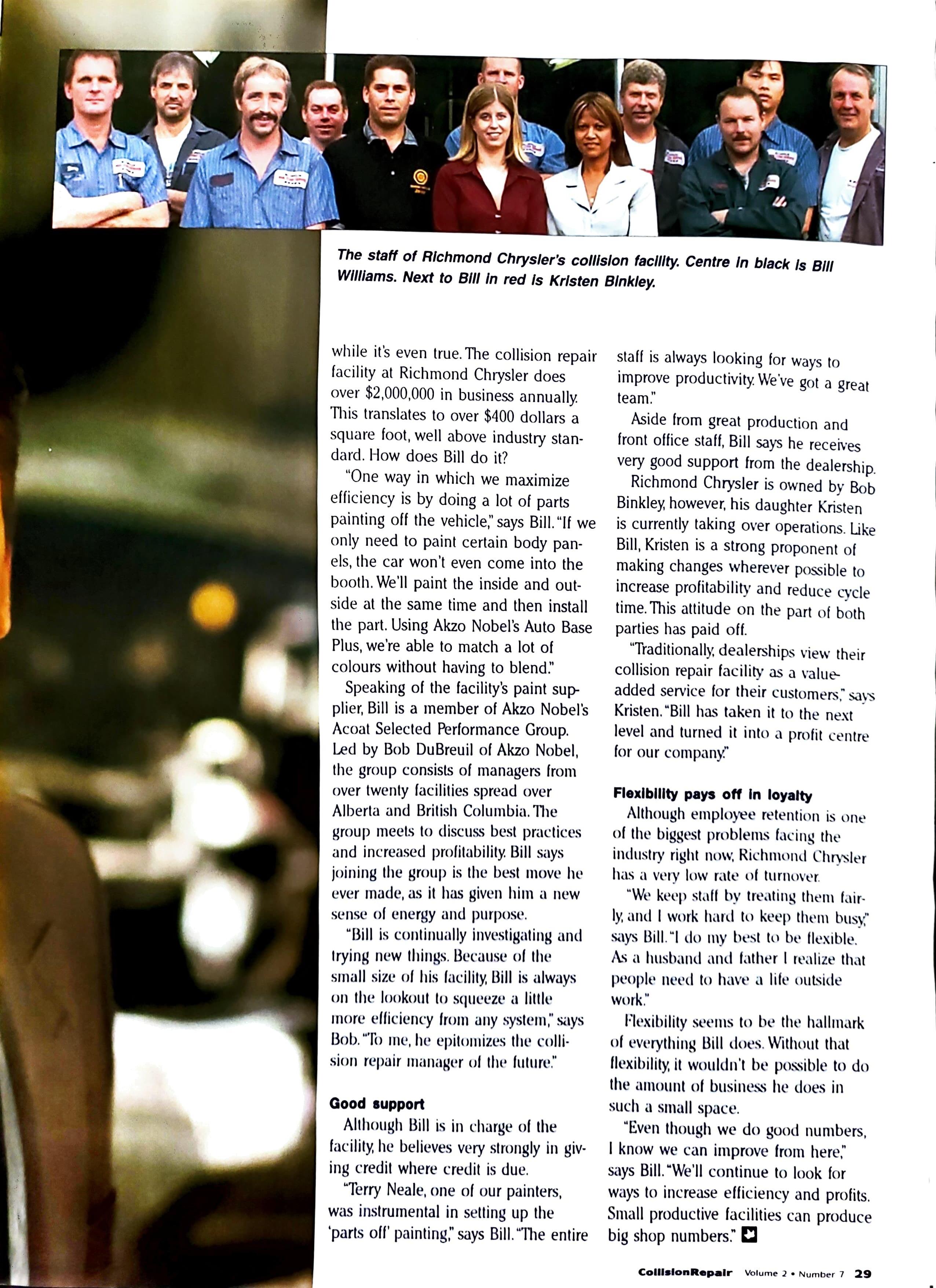
According to Garmat, the 3000 Series spraybooth dellvers superior alrflow and the most effective lighting systerm of any booth on the market today. Every control panel, mechanical unit and air handling system is manufactured and tested In thelr own facil ity, ensuring consistent quality and performance to meet the demanding environment of today's collision centres.
AutoQuip Canada is also the exclusive Canadian distributor for Co-Met spraybooths, manufacturers of single skín industrial and automotive palnting equlpment. For more information on Garmat visit www.garmat.com. Information on Col-Met can be found at www.colmetsb.com. Questions about sales and service should be directed to Roger Turmel of AutoQuip Canada at 1-866-325-2886.
Over 5,000 spraybake booths have been installed worldwide since the first almost 2s years ago. Today, Gen V offers the fourth generation of the ven erable Spraybake line.
The Spraybake Generation Four booth, as with all Gen V booths, has a wide range of customization options to beter fit your facility and needs, includ ing fuel type, bumer sizo, airflow vo ume, location of air-maka-up unit, extended lengths and heights, wtth sunk pits or raised loors, voltages, and lighting.


EVENTS By Mike Davey
Canadian Collision lndustry Congress draws stakeholders from across the country
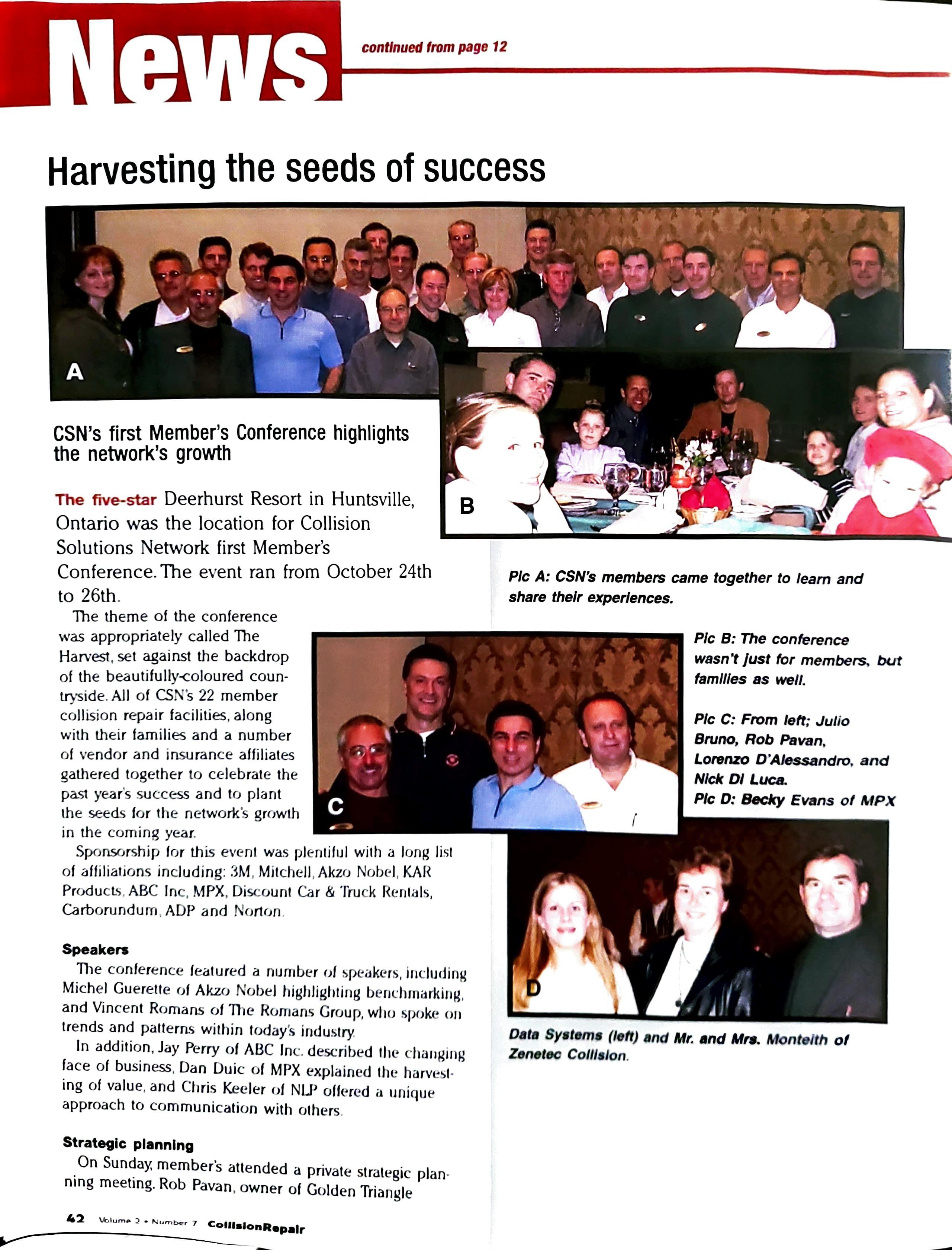
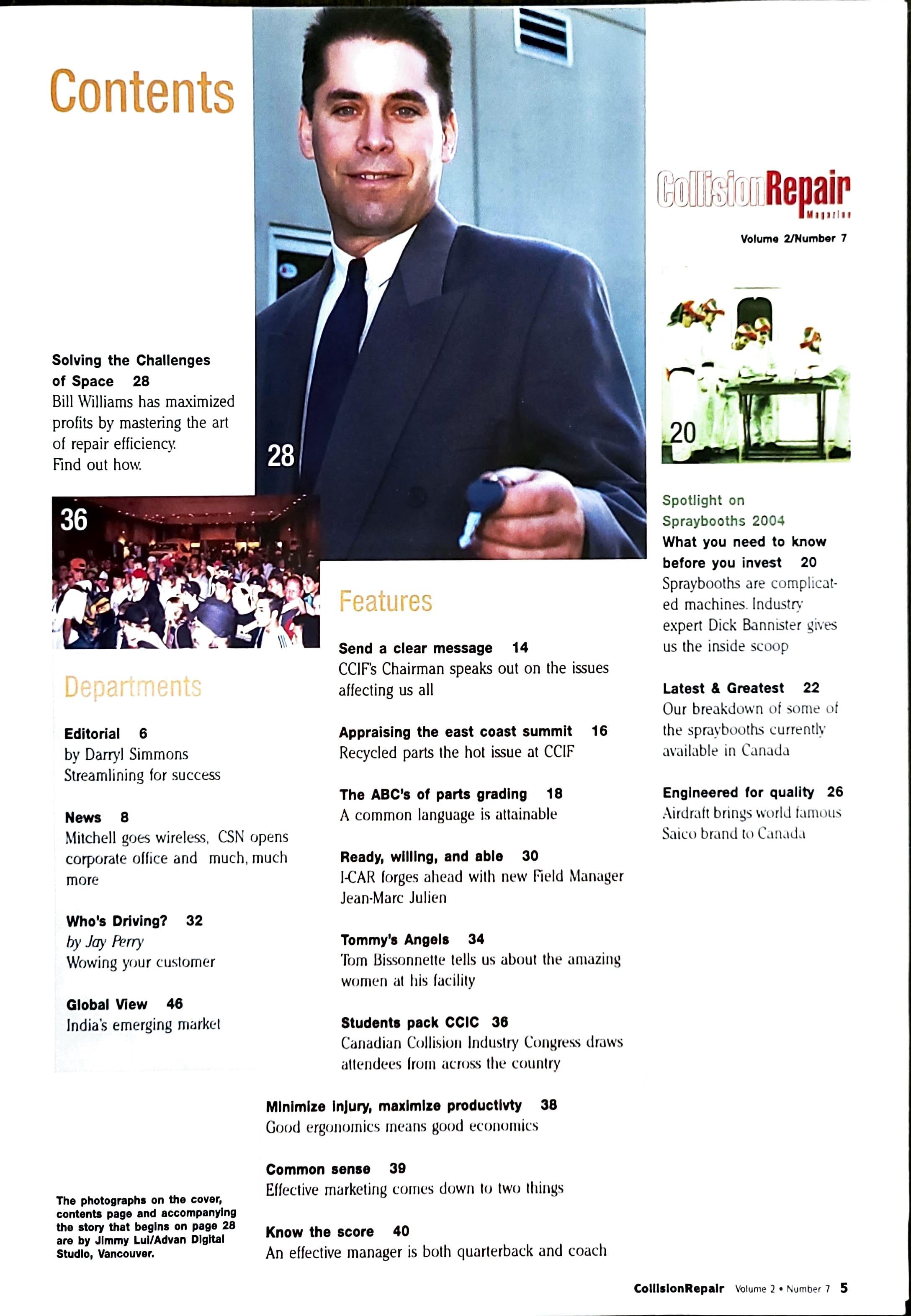
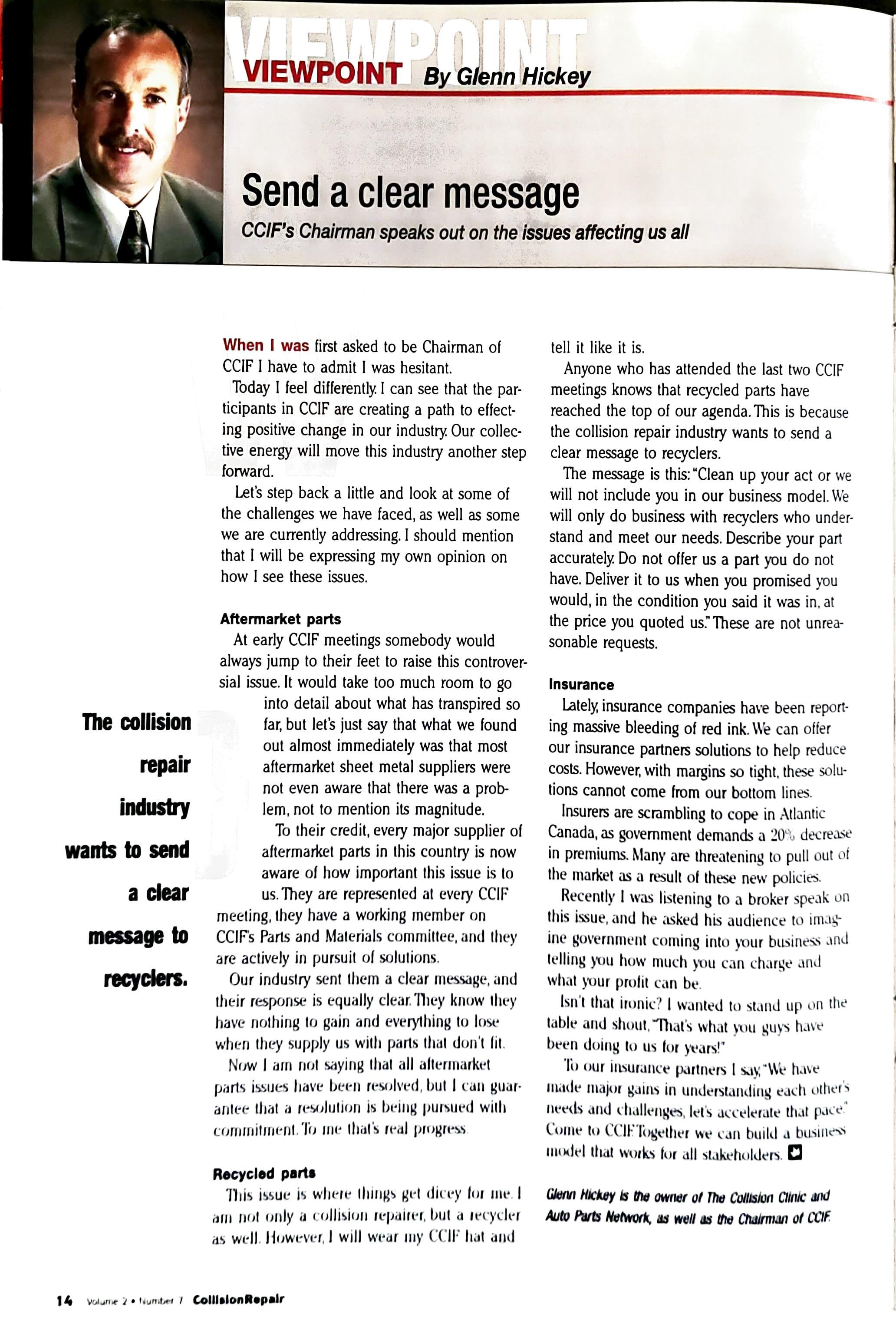
The highly anticipated Canadian Collision Industry -CAR Congress (CCIC) not only attracted key stakehold ers, expert speakers and a full slate of seminars. but literally, students by the bus load.
More than 1500 high school students attended from across Southern Ontario, lured by the promise of educa tion,apprenticeship and employment opportunities, and the chance to win a brand-newToyota vehicle for their school.
Run in conjunction with the CAR Canada General Session, highlights of CCIC included an information and services showcase and a host of informative workshops and seminars.
John Norris, Executive Director of the Collision Industry Action Group (CIAG) and one of the prime organizers of career day was very pleased with the amount of students who showed interest in careers in the collision repair field.
"These kids were asking really intelligent questions said Noris."This turnout shows that there definitely are young people who are looking to learn our business. Now it is up to us to make sure there is a place for them in our industry
The Canadian General Session of I-CAR featured updates on the Enhanced Delivery and Gold C Class programs.
"-CAR has a
very strong commitment to Canada" said I-CAR Executive Vice-President and CEOTom McGee. "In the coming year our intent is to focus on both growing our programs and expanding our network of instructors."
Robbie Robbs, Canada's representative on the -CAR'S International Board of Directors, feels events like CCIC are very important for the continued growth of the organization.
"Events such as CClIC are significant not only from a net working and educational perspective, but also from the knowledge that many of us are facing the same issues" said Robbs. "We are often too caught up in our own worlds to recognize the value and importance of developing rela tionships that fall outside the scope of our day to day busi
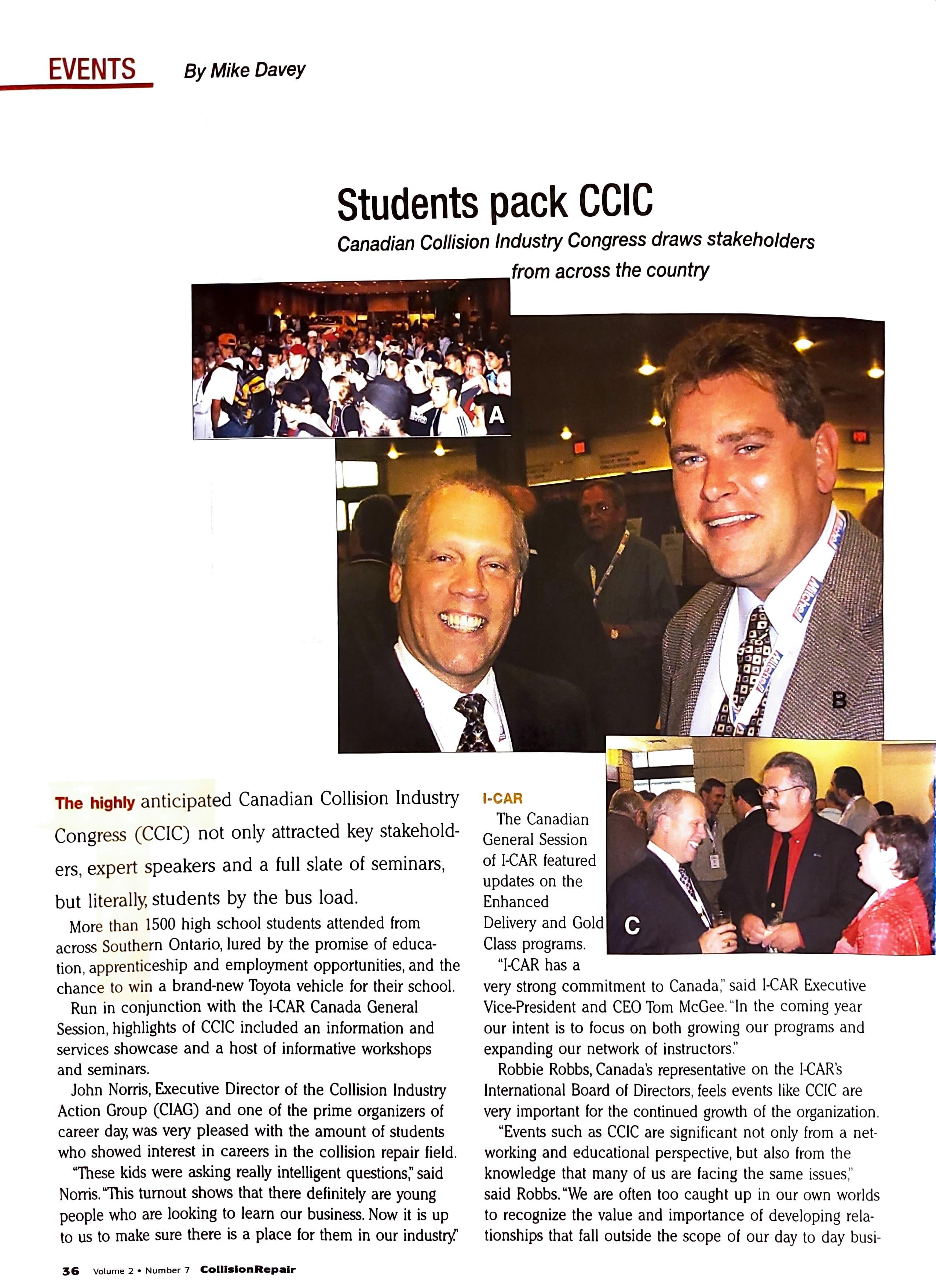
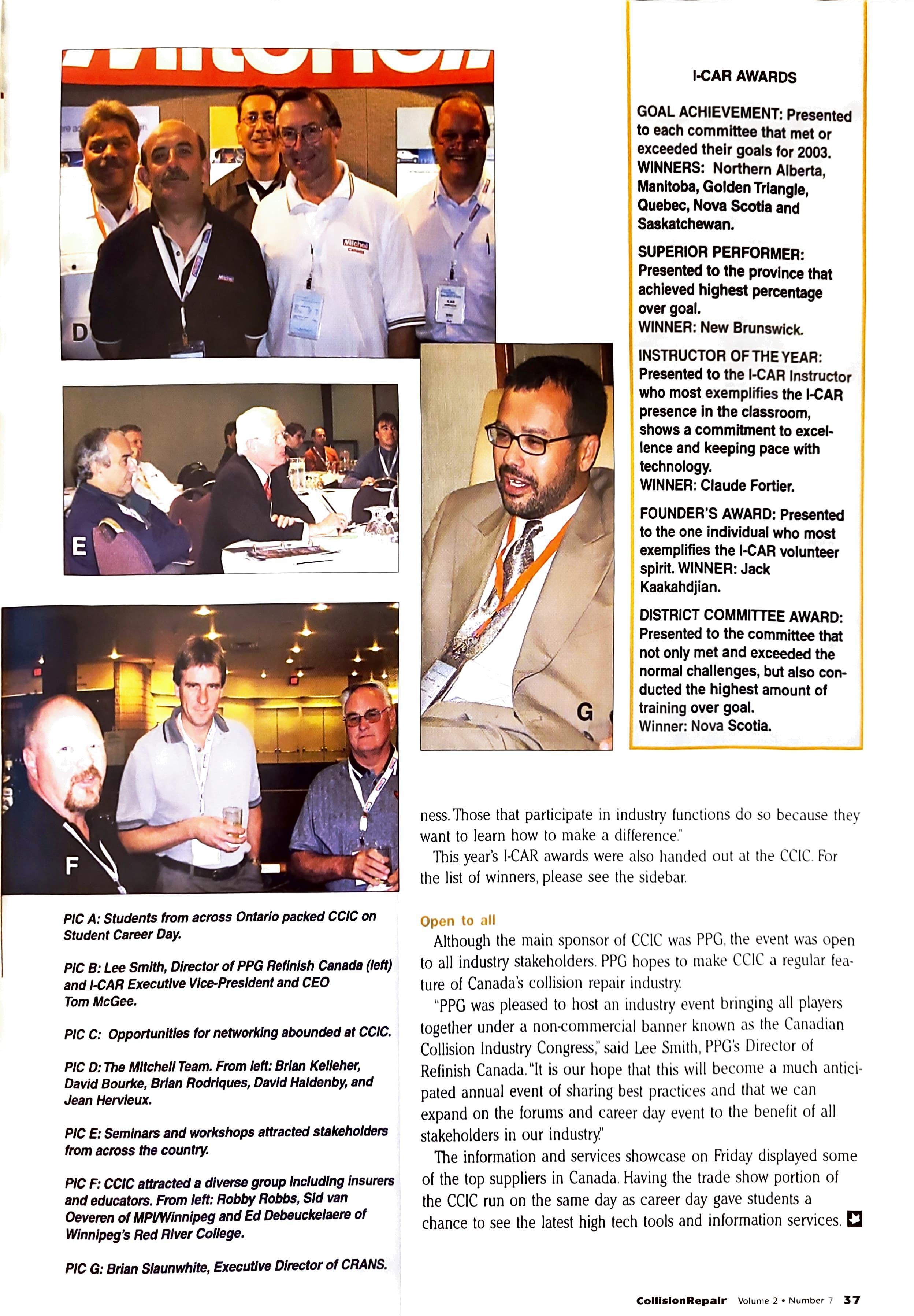
PIC A: Students from across Ontario packed CCIC on Student Career Day.
PIC B: Lee Smith, Director of PPG Refinish Canada (left) and I-CAR Executive Vice-Presldent and CEO Tom McGee.
PIC C: Opportunitles for networking abounded at CCIC.
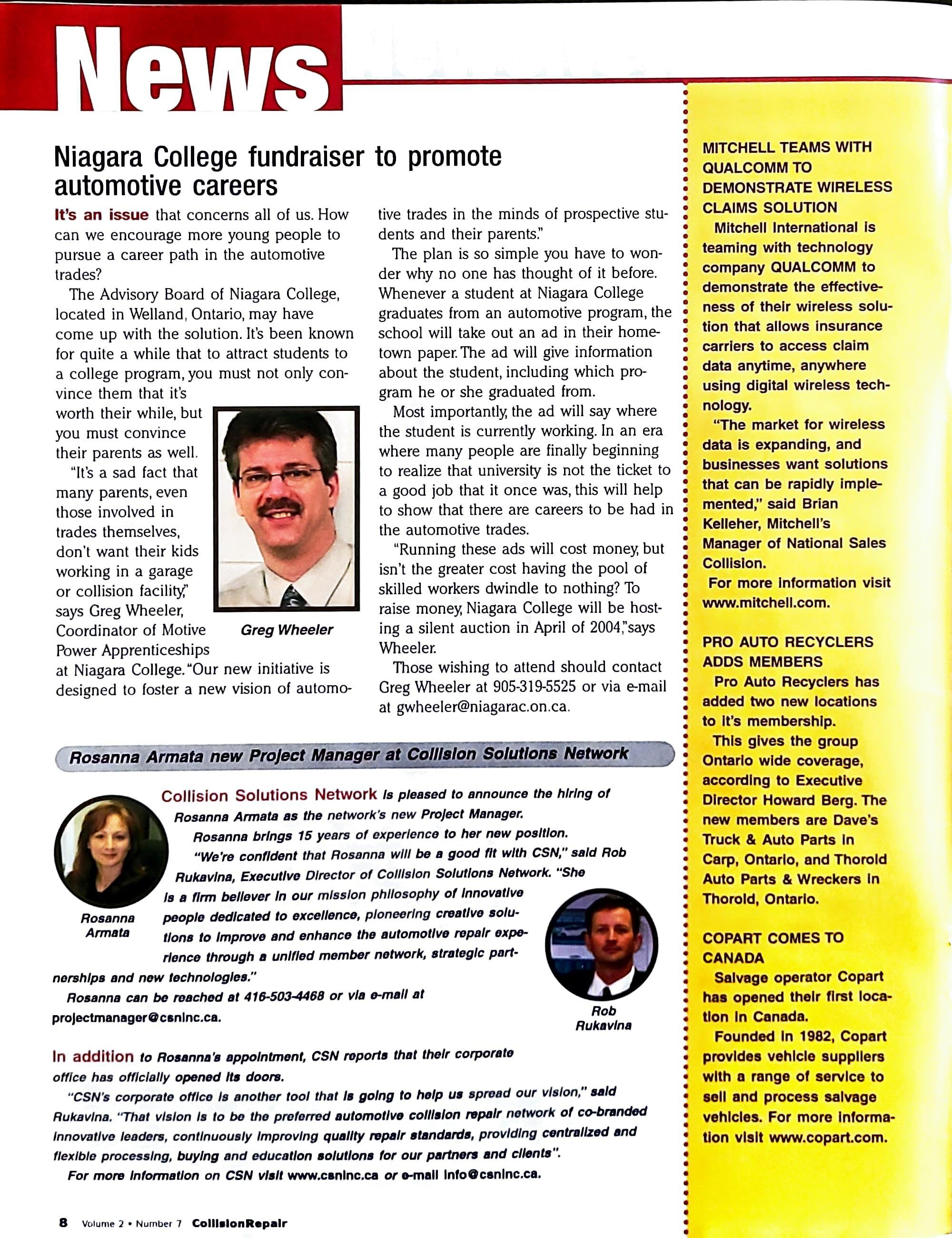
PIC D: The Mitchell Team. From left: Brlan Kelleher, David Bourke, Brian Rodriques, David Haldenby, and Jean Hervieux.
PIC E: Seminars and workshops attracted stakeholders from across the country.
PIC F: CCIC attractedadiverse group including insurers and educators. From left: Robby Robbs, Sld van Oeveren of MPIWinnipeg and Ed Debeuckelaere of Winnipeg's Red River College.
PIC G: Brian Slaunwhite, Executive Director of CRANS.
GOAL ACHIEVEMENT: Presented to each committee that met or exceeded their goals for 2003.
WINNERS: Northern Alberta, Manitoba, Golden Trlangle, Quebec, Nova Scota and Saskatchewan.
SUPERIOR PERFORMER: Presented to the province that achieved highest percentage over goal.
WINNER: New Brunswick.
INSTRUCTOR OF THE YEAR: Presented to the l-CARInstructor who most exemplifies the -CAR presence in the classroom, shows a commitment to excel lence and keeping pace with technology.
WINNER: Claude Fortier.
FOUNDER'S AWARD: Presented to the one individual who most exemplifiesthe l-CAR volunteer spirit. WINNER: Jack Kaakahdjan.
DISTRICT COMMITTEE AWARD: Presented to the committee that not only met and exceeded the normal challenges, but also con ducted the highest amount of training over goal.
Winner: Nova Scotia.
ness. Those that participate in industry functions do so because they want to learn how to make a difference"
This years I-CAR awards were also handed out at the CCIC. For the list of winners, please see the sidebar.
Although the main sponsor of CCIC was PPG, the event was open to all industry stakeholders. PPG hopes to make CCIC a regular fea ture of Canada's collision repair industry.
"PPG was pleased to host an industry event bringing all players together under a non-commercial banner known as the Canadian Collision Industry Congress" said Lee Smith, PPG's Director of Refinish Canada. "lt is our hope that this will become a much antici pated annual event of sharing best practices and that we can expand on the forums and career day event to the benefit of all stakeholders in our industry'
The information and services showcase on Friday displayed some of the top suppliers in Canada. Having the trade show portion of the CCIC run on the same day as career day gave students a chance to see the latest high tech tools and information services.
An ergonomic workplace provides many advantages.
By Lynne Henshaw
From the office to the production floor, it pays to keep your employees healthy and reduce injury by providing an ergonomic work environment and education program. The good news is it's generally easy and inexpensive to substantially reduce lost-workday injuries and illnesses.
Ergonomics is the science of adapting work processes and conditions to fit the physical capabilities of workers. The goal is to reduce the incidence of soft tissues or musculoskeletal injuries (MSI) by minimizing or eliminating risk factors.
The most commnon examples of this are ten donitis, carpal tunnel syndrome and back injuries involving muscles, ligaments, and/or spinal discs. Common symptoms include numbness in fingers or thighs, difficulty moving fingers, stiff joints or back pain.
Risk factors that increase the likeli hood of MSI include activities that require use of excessive force, highly repetitive movements and tasks, awk ward or static postures, manual handling of heavy loads, cold temperatures, and vibration such as sanders. Additionally, poor tool, equipment and workplace design can create ergonomic problems as well.
Providing a workplace free of ergonomic hazards can provide many advantages such as increasing productivity workmanship, job satis faction and employee morale, while reducing injuries, absenteeism, and employee turnover.
Start off right by selecting tools for ergonomic design:
• Select tools that can be used without bend ing the wrist.
• Select the tool with the workplace layout and job design in mind.
Select low-vibrating tools and choose tools with vibration-absorbing handles, like those covered with cork, rubber, plastic or plastic bonded to steel, to reduce hand-arm vibration.
Choose hand tools that have the centre of gravity within or close to the handle and tools with rounded and smooth handles that you can grip easily
• If they are available, choose hand tools with double handles to permit easier holding and better manipulation of the tool.
• Select tools with a trigger strip, rather than a trigger button. This strip will allow you to exert more force over a greater area of the hand that, in turn, will reduce muscle fatigue.
General ergonomic tips for the production floor:
• When using a tool, hold it close to the body. do not overreach.
Consider wearing anti-vibration gloves, how ever, you should not wear thick or heavy gloves if operating the tool requires precise move ments.
• Move work surfaces closer to the body and to a comfortable height.
• When lifting, maintain an upright position and avoid bending and twisting. Avoid lifting while sitting.
• If a job requires work in an awkward posi tion (e.g., with hands above shoulder level) be sure to take frequent breaks.
Putting in place an established employee safety and health committee can help employ ees communicate effectively with employers to ensure ergonomic problems are fixed, improv ing employee health and morale.
Lynne Henshaw is the Director of Marketing & Communications for Autoprise Solutions Canada, makers of Solo and Unity facility management software. She can be contacted at 604-408-4306 ext. 108, or via e-mail at Ihenshaw@autoprise.com.
You can be satisfied with the resuts of your marketing strategy.
Have you ever looked at your company's marketing materials and thought that there is something not quite right with what you are seeing?
Ifyou are like many people, your reaction to this runs to one of two responses. Response one is common to the assertive, take-charge kind of boss. You know the kind. They start nit picking the project right away Unfortunately, the final product often has little in common with the marketer's vision or the requirements of the business.
Reaction two is the other end of the spec trum.It is common to the Over-worked manager with too much to do and too little time. These people often chalk up their feeling to their own lack of knowledge. They assume the pros knew what they were doing. In these cases the end result is most often a glossy marketing piece that looks really good but fails to deliver.
Despite their obvious differences, both reactions stem from a common root. In both situations the goals of the mar keters and the business are not very well aligned. It is this that earns many marketers a reputation for expensive campaigns that pro duce less than satisfactory results. Bosses want to sell things. Marketers like to be creative. It doesn't have to be this way You can be sat isfied with the results of your marketing strate gy. All you have to do is keep a couple of very simple things in mind every time you face a marketingchallenge and every time you make a marketing decision.
Number one is knowing who you are trying to manipulate with your marketing. Number two is knowing whal you want then to do. lf the manager and the marketer can deline those two things in depth before they do any.
thing else, the campaign has a greater chance of falling into place. If they forget these two steps, they are destined to be dissatisfied.
A client came to me some time back with a request for some media relations support. He wanted me to convince the Globe and Mail to write about his company
"Who are you trying to reach with the story?" Iasked."Distributors for my products he answered. Istarted to drill down. It eventually became clear there were only five people in Canada we had to influence positively to make a real difference in his business. Once we had that figured out it was easier to define a mes sage.
Positive potential
We chose the best tactics for delivering the message based on cost and potential for pos tive results. The client was surprised that the Globe wasn't on the final list. He was even more surprised when he realized the best media outlet for his story was a trade asSOCi tion newsletter. We backed it up with a fevw carefully considered calls and he generated the business he was looking for
I won't kid vou. It is not alwavs that easy A huge amount of sophistication can go into a marketing campaign. There are times to leave it to the prOs. But the found.ation is alwas the same.
Stay away trom any discuSION ot tacties until manager and markeler agree on who our audience is and what you want them to do Make sure everything you do targets thse answers and you will spend tar less tme won dering what is going wrong
Larry Jackson is the President ot Editorkal Edge Communications, a non-traditional marketing and pubiic relations agency If you have marketing questivts or so rles that you would like to share in this column, he can be contacted at 905-305-9355 ext. 23 or vkt e-mail at LaryJacksonOeditorialedge com.