SPECIAL EDITION OF
INSIDE: LEARN MORE ABOUT THE 2026 SKILLS ONTARIO COMPETITION +
&
PAINT PROFESSIONAL
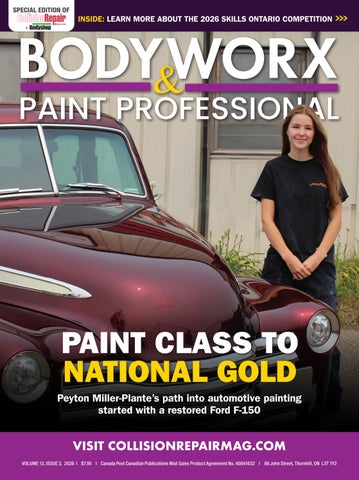
PAINT CLASS TO NATIONAL GOLD Peyton Miller-Plante’s path into automotive painting started with a restored Ford F-150
VISIT COLLISIONREPAIRMAG.COM VOLUME 13, ISSUE 3, 2026 l $7.95 l Canada Post Canadian Publications Mail Sales Product Agreement No. 40841632 l 86 John Street, Thornhill, ON L3T 1Y2
Versatility at its finest. 3M™ Hookit™ Flexible Foam Abrasives combine flexible aluminum oxide abrasives with a soft foam backing to create a high performing, versatile blending abrasive for dry or wet use with machine or by hand.
Also available in
Flexible Foam Abrasive Sheets Reduce the risk of burn through on edges, bodylines and thinly coated surfaces
Take it to the edge.
Conforms to irregular surfaces, ensuring a uniform and consistent finish The perforated double sheet can be folded in half to enhance grip and control of the abrasive
Warranty and Limited Remedy: 3M warrants that each 3M product meets the applicable 3M product specification at the time 3M ships the product. 3M MAKES NO OTHER EXPRESS OR IMPLIED WARRANTIES OR CONDITIONS, INCLUDING ANY IMPLIED WARRANTY OR CONDITION OF MERCHANTABILITY OR FITNESS FOR A PARTICULAR PURPOSE. If a 3M product does not conform to this warranty, the sole and exclusive remedy is, at 3M’s option, replacement or repair of the 3M product or refund of the purchase price. Limitation of Liability: Except for the limited remedy above, and except to the extent prohibited by applicable law, 3M will not be liable for any loss or damage arising from or related to the 3M product, whether direct, indirect, special, incidental, or consequential, regardless of the legal or equitable theory asserted. For industrial/occupational use only. Not for consumer sale or use. Copyright 2026 by 3M. All rights reserved. 3M and Hookit are trademarks of 3M Company.
CONTENTS SPECIAL EDITION OF
INSIDE: LEARN MORE ABOUT THE 2026 SKILLS ONTARIO COMPETITION +
&
PAINT PROFESSIONAL
PAINT CLASS TO NATIONAL GOLD Peyton Miller-Plante’s path into automotive painting started with a restored Ford F-150
VISIT COLLISIONREPAIRMAG.COM VOLUME 13, ISSUE 3, 2026 l $7.95 l Canada Post Canadian Publications Mail Sales Product Agreement No. 40841632 l 86 John Street, Thornhill, ON L3T 1Y2
CONTENTS
>>>
REGULARS
20
04 PUBLISHER’S PAGE by Darryl Simmons
ON THE COVER At just 18, Peyton Miller-Plante is already making her mark in automotive painting. From restoring a Ford F-150 with her father to winning gold at Skills Canada, her journey reflects determination, mentorship and a passion for the trade. Now, she’s looking ahead to a career that blends creativity, precision and hands-on skill.
06 PEOPLE ON THE MOVE 07 NEWS-IN-BRIEF 40 FINAL DETAIL by Mackenzie Grant
12
14
THE KEY TO KEEPING UP WITH A CHANGING TRADE As vehicle technology evolves, ongoing training is becoming essential for technicians, shops and safer repairs from OEM procedures and advanced materials to ADAS and specialized skills.
ONTARIO’S FUTURE COLLISION REPAIR PROS PUT SKILLS TO THE TEST Ontario students put their autobody repair and painting skills to the test, showcasing the talent shaping the next generation of collision repair professionals.
32
34
BUILDING THE COLLISION REPAIR WORKFORCE STARTS EARLY Reaching students before career decisions are made and giving them hands-on exposure to today’s industry could help bring a new generation into collision repair.
FABTECH CANADA SHOWCASES THE FUTURE OF FABRICATION More than 8,500 industry professionals gathered in Toronto to explore the latest in metal fabrication, welding, automation, finishing and repair technology.
ADVERTISE NOW FOR MAXIMUM IMPACT! REACH YOUR TARGET AUDIENCE PROMOTE YOUR BUSINESS GAIN VISIBILITY
&
PAINT PROFESSIONAL collisionrepairmag.com/bodyworx
BW13#3 2026 | BODYWORX PROFESSIONAL 3
>>> PUBLISHER’S PAGE
ONE INDUSTRY. ONE VOICE. A BIGGER FUTURE. BODYWORX & PAINT PROFESSIONAL IS BRINGING THE INDUSTRY’S BEST RECRUITMENT, RETENTION AND CAREER STORIES TOGETHER AND TAKING THEM TO THE PEOPLE WE NEED TO REACH.
I
more complex every year. It offers skilled careers, advancement and the opportunity to build a business. Yet much of the public perception of collision repair is stuck decades in the past. The industry has changed. The story being told about it hasn’t kept up. We’re going to tell that story, and we want the entire industry telling it with us. If you have a great apprenticeship program, we want it. If you’re doing something successful with a high school or college, share it. If you have a young painter doing remarkable work, introduce us. If you have a technician whose career could change a parent’s perception of
It’s time to stop talking about our people problem and start fixing it. There is some great work being done, but it’s scattered across the industry, reaching different audiences with different messages at different times. We don’t need more fragments. We need to bring the best of what this industry is already doing to one place, give it a clear and consistent voice and then send it everywhere modern media allows us to go. That’s what the new Bodyworx & Paint Professional is built to do. You’ll notice the change right on the cover. We have a new name and a new logo, and painters are now right there with Bodyworx. Painters have always been part of this publication, but we’re putting them front and centre because this is their industry and their publication too. We want technicians and painters to see themselves in these pages. We want to celebrate their skills, accomplishments and careers. We want them sharing our stories because they’re proud of what they do and want other people to know about it. But talking to the people already inside collision repair isn’t enough. We need to reach the 16-yearold who has never considered becoming a painter. The student who loves cars and technology but doesn’t know where that interest could take them. The parent who still believes university is the only route to a successful career. The teacher or guidance counsellor who may know very little about the collision repair industry of 2026. We have to show them what we see. This is an industry working with ADAS, EVs, computerized measuring, diagnostics, sophisticated refinishing systems and vehicles that become
VOLUME 13, ISSUE 3, 2026
PUBLISHER Darryl Simmons | publisher@collisionrepairmag.com ASSOCIATE PUBLISHER Orest Tkaczuk | orest@mediamatters.ca AUDIENCE ENGAGEMENT MANAGER William Simmons | william@mediamatters.ca
BY DARRYL SIMMONS
t’s time to stop talking about our people problem and start fixing it. Bodyworx & Paint Professional is taking on one job: make collision repair and refinishing a career young people want to join, a career skilled people want to stay in and a career they’re proud to talk about. We’re going after it with everything we have. For years, this industry has poured time, money and good intentions into attracting and retaining people. Suppliers have programs. Associations have programs. Repair networks, schools, OEMs, insurers and individual shops have programs.
&
PAINT PROFESSIONAL
the trades, we want to tell that story. It doesn’t matter whether it comes from an independent shop, MSO, banner, supplier, insurer, OEM, school or association. A strong tide lifts all boats. Bodyworx & Paint Professional will be the place where those efforts come together and the media engine that takes them beyond our industry. Magazine. Website. Digital. Social. Video. Events. Schools. And whatever comes next. We’re also establishing an Editorial Advisory Board so the people who live this industry can help guide where we take it. Technicians and painters need a strong voice in this effort, alongside educators and the companies and organizations that depend on them. Attracting and retaining people can no longer be a “want to have,” something we agree is important and get around to when there’s time or money left in the budget. For Bodyworx & Paint Professional, it is the reason we exist. One focus. One gathering point. One industry putting its weight behind a message we should have been shouting for years: This is a great industry. These are great careers. And we need to make damn sure people know it.
44 BODYWORXMAG.COM BODYWORXMAG.COM || BODYWORX BODYWORX PROFESSIONAL PROFESSIONAL
ART DIRECTOR Yvonne Maschke | yvonne@mediamatters.ca EDITOR Mackenzie Grant | mackenzie@mediamatters.ca VP OF INDUSTRY RELATIONS & ADVERTISING Gloria Mann 647.998.5677 | gd.mann@rogers.com DATA MANAGEMENT SPECIALIST Willow Campbell | willow@mediamatters.ca MEDIA PRODUCTION SPECIALIST Dayna Dicuangco | dayna@mediamatters.ca INTERIM ONLINE EDITOR Gideon Scanlon | news@collisionrepairmag.com CONTRIBUTORS Lucas Chang, Ryan Marrinan, Sadie McDonald, Bill Speed SUBSCRIPTION One-year $25 / Student Discount is 10%
Bodyworx Professional ™ is published quarterly, and is
dedicated to serving the professionals of the collision repair industry. It is published by Media Matters Inc. Material in Bodyworx Professional ™ may not be reproduced in any form without written consent from the publisher. The publisher reserves the right to refuse any advertising and disclaims all responsibilities for claims or statements made by its advertisers or independent columnists. All facts, opinions, statements appearing in this publication are those of the writers and editors themselves, and are in no way to be construed as statements, positions or endorsements by the publisher. PRINTED IN CANADA ISSN 1707-6072 CANADA POST CANADIAN PUBLICATIONS MAIL SALES PRODUCT AGREEMENT No. 40841632 RETURN POSTAGE GUARANTEED Send change of address notices and undeliverable copies to: 86 John Street, Thornhill, ON L3T 1Y2
“We acknowledge the financial support of the Government of Canada.”
Bodyworx Professional is published by Media Matters Inc., publishers of: &
PAINT PROFESSIONAL
PASSION FOR PAINTERS.
Made for each other. jet X and RPS.
A top choice for the jet X: The SATA RPS multipurpose cup system is ideal for mixing, painting, refilling, and storage. RPS cups ensure an immediate, even flow of material. They make quick color changes easier and are simple to use. And best of all: You don't need an adapter.
jet X. Works for you INFO www.sata.com/jetX
>>> INDUSTRY NEWS
People on the Move
Jake Korolis
Zach MacPhail
EXECUTIVE DIRECTOR SASKATCHEWAN ASSOCIATION OF AUTOMOTIVE REPAIRERS
BUSINESS DATA ANALYST CARSTAR CANADA
Jake Korolis has been appointed executive director of the Saskatchewan Association of Automotive Repairers. Korolis joins the Saskatoon-based organization from Tamarack Mining Services, where he worked in business development. He succeeds longtime executive director Tom Bissonnette, who will remain involved during the leadership transition. SAAR represents automotive repair businesses across Saskatchewan and supports the province’s independent repair industry through advocacy, education and member services.
CARSTAR Canada has appointed Zach MacPhail as business data analyst. In the role, MacPhail will support analytics initiatives across Driven Brands and the CARSTAR Canada network, with responsibilities including reporting, process automation and business analysis to identify operational and growth opportunities. He brings experience in SQL, Python, Power BI, process automation and large-scale business analytics. His technical expertise will support data-driven decision-making and operational performance across the network.
collisionrepairmag.com/15825656
collisionrepairmag.com/15827210
Lucas Malinowski
Greg Smith
PRESIDENT AND CEO GLOBAL AUTOMAKERS OF CANADA
REGIONAL VICE-PRESIDENT SOUTHWESTERN ONTARIO AUTOCANADA
Lucas Malinowski has been appointed president and CEO of the Global Automakers of Canada, succeeding David Adams. Effective immediately, Malinowski assumed leadership of the national trade association after most recently serving as its vice-president and director of federal affairs. He brings more than a decade of public affairs experience and has spent the past three years advancing the association’s advocacy efforts with all three levels of government. The appointment follows an extensive executive search led by the association’s board. collisionrepairmag.com/15826712
66 BODYWORXMAG.COM BODYWORXMAG.COM || BODYWORX BODYWORX PROFESSIONAL PROFESSIONAL
AutoCanada has appointed Greg Smith as regional vice-president for Southwestern Ontario, where he will oversee dealership operations across the region. Smith joins AutoCanada after more than five years with Leavens Automotive Group, where he most recently served as vice-president of operations overseeing seven dealerships and more than 300 employees. Earlier in his career, Smith held sales and market planning roles with BMW Group Canada and served as general sales manager at BMW and MINI London. He also taught in the Business Foundations Program at Western University’s Ivey Business School. collisionrepairmag.com/15828734
IN THE HEADLIGHTS
FINAL DETAIL
IBIS GLOBAL SUMMIT 2026: CONNECTING CHANGEMAKERS IN VIENNA The IBIS Global Summit returned to Vienna from 16-18 June, bringing together senior leaders from across the global collision repair ecosystem for two days of thought-provoking content, lively debate and valuable networking. Welcomed by IBIS Conference Director Robert Snook and Head of Sales Suzie Scott, with Sean Carey and Dave Smith guiding proceedings as co-moderators, delegates explored some of the biggest issues facing the industry today and the opportunities that will shape its future. Under the theme ‘Connecting Changemakers’, the programme focused on the decisions, technologies and leadership strategies that will define the next decade. Discussions ranged from industry consolidation and the race for scale through to the growing influence of AI, data and software-led business models. Delegates also considered the future of repairability, sustainability and the evolving relationships between insurers, repairers, OEMs and technology providers. What made the event particularly engaging was the willingness of attendees to share experiences, challenge perspectives and contribute to the conversation. The refreshed format encouraged greater interaction, ensuring that the discussions continued well beyond the stage and into the networking sessions. Closing the event, Snook unveiled the core IBIS events for 2027: IBIS North America (2-3 March), the IBIS Global Summit in Lisbon (18-20 May), IBIS DACH in Berlin (14-15 September) and IBIS Middle East in Dubai (16-17 November). For the latest updates, visit www.ibisworldwide.com or follow IBIS Worldwide on LinkedIn. Contact Emily Miles at emily@ibisworldwide.com for all registration bookings and queries. Contact Louise Cooke at louise@ibisworldwide.com for all event-related enquiries. For partnership enquiries, contact Suzie Scott, IBIS Worldwide Head of Sales, at suzie@ibisworldwide.com or call +44 7545 068455
Italy. Poland. France. IBIS Connects This Autumn. Connect with collision repair’s decision-makers at the heart of Europe this autumn.
9-10
4
16-17
IBIS Italia Palace Hotel, Milano Marittima
IBIS Central & Eastern Europe Warsaw, Poland
IBIS France Poitiers, France
Bringing the global collision repair community to the Italian market for the first time, in collaboration with Notiziario Motoristico.
Connecting the changemakers shaping collision repair across Central and Eastern Europe.
Reuniting the French collision repair industry for two days of insight, networking and debate.
October ‘26
November ‘26
November ‘26
Become a partner: suzie@ibisworldwide.com | Register as a delegate: emily@ibisworldwide.com Every IBIS Worldwide experience is a considered investment, designed to deliver the premium value our guests and partners expect.
IBISworldwide.com
@ibisworldwide BW13#3 2026 | BODYWORX PROFESSIONAL 7
>>> IN THE HEADLIGHTS
SPOTLIGHT ON
TRAINING
PRIDE OF MANITOBA: MVIM AWARDS SCHOLARSHIPS TO UPCOMING TECHS The Motor Vehicle Industry of Manitoba has awarded scholarships to 35 students and apprentices entering the automotive trades. MVIM is a not-for-profit registered charity founded by Don and Joyce Sobering in 2002. It provides financial support to young people training for automotive careers through its Technicians of Tomorrow scholarship program. The awards help students and apprentices cover education costs such as tuition, tools and books. The program supports several automotive trades, including collision repair and automotive refinishing. This year also brought a new supplierbacked scholarship fund. Color Compass Corporation has established an endowment fund within the MVIM family of scholarship funds. The fund will support one scholarship every year. “We were absolutely thrilled,” Sobering said. “Color Compass has supported us for more than 20 years, and now this fund means that support will continue every year.”
The 2026 recipients are Marcus Spies, Xi Chen, Patrick Spiess, Felisha Henderson, Adam Garcia, D.J. Wall, Joshua Shwaluk, Thomas Burnett, Randy Doerksen, Beverly Maloney, Carissa Zhou, Zachary Freund, Landon Klassen, Teila Wandowich, Mariel Balaswit, Cassandra Foy, Daniel Kotello, Ella Schmidt, Zendrick Blas, Branden Welch,
Brooke MacMillen, Charles Brisebois, Brady Wiens, Al Hartwig, Alan Do, A. Singh-Young, Silas Koop, Jake Birthwhistle, Dan Francisco, John Mwangi Njeru, Ethan Bouchard, Gabrielle Ragos, Stefan Girouard, Andrew McCartney and Matthew LeBlanc.
driver assistance systems as a training need. The same share selected paint and refinish, hybrid and electric vehicle systems, and collision structural repair. Electrical and electronic systems followed at 33.3%. Collision estimating was selected by 22.2%. Across all respondents, access to training improved in 2026. More than two-thirds
(69%) said they had access to the training they need. That was up from 59.37% in 2025. Among respondents who said they did not have access to needed training, 53% said the right topics were not available. Another 38% said quality training was not available.
collisionrepairmag.com/15829919
TRAINING NEEDS: SURVEY POINTS TO ADAS, EV AND REFINISH GAPS Collision repair technicians who responded to a new industry survey identified advanced driver assistance systems, paint and refinish, hybrid and electric vehicle systems, and structural repair as key training needs. The findings are included in the 2026 ATMC training benchmarks survey, conducted by the ASE Training Managers Council, a Virginian group focused on automotive training and professional development, which prepared the report. Collision repair technicians made up 0.5% of the total survey group. According to Matt Shepanek vice-president of credential testing programs at the National Institute for Automotive Service Excellence, the organization aims to collect more collision sector responses in future years. Among collision repair technician respondents, 44.4% selected advanced
8 BODYWORXMAG.COM | BODYWORX PROFESSIONAL
collisionrepairmag.com/15829469
>>> FINAL DETAIL
IN THE HEADLIGHTS
SPOTLIGHT ON
TRAINING CAREER START: SYA SCHOLARSHIPS FUEL SKILLED TRADES PIPELINE
The Saskatchewan Apprenticeship and Trade Certification Commission has awarded Saskatchewan Youth Apprenticeship Industry Scholarships to 110 high school students from 68 communities across the province. Each scholarship is valued at $1,000 and can be redeemed once recipients meet specific requirements. Students must, within two years of completing the SYA program, either register as apprentices in Saskatchewan and complete Level 1 technical training or complete a recognized pre-apprenticeship program in a designated trade in the province. “The SYA Industry Scholarship is a great bonus for youth entering the skilled trades in Saskatchewan,” said SATCC CEO Jeff Ritter. “New apprenticeship registrations are increasing, and this is a positive indicator for high school graduates looking to start their careers in the skilled trades. Congratulations to this year’s scholarship winners.” collisionrepairmag.com/15828631
TRAINING REACH: B.C. LAUNCHES $40M WORKFORCE READINESS INITIATIVE TRAINING PLAN: PROVINCE COMMITS $4M TO DUAL-TICKETING PILOT FOR SKILLED TRADES The Alberta government has invested $4 million in a new skilled trades training initiative aimed at expanding certification pathways and addressing labour shortages in the province’s construction sector. The funding supports the CLAC Dual Ticketing and Upskilling Pilot Program, delivered through the Christian Labour Association of Canada. The announcement was made June 3, 2026, at the CLAC Calgary Member Centre by the Honourable Joseph Schow, minister of jobs, economy, trade and immigration, and the Honourable Myles McDougall, minister of advanced education. The program is designed to help skilled trades workers obtain additional qualifications, including pathways to multiple Red Seal certifications. It is intended to strengthen apprenticeship and upskilling opportunities as demand for construction labour continues to rise across Alberta. collisionrepairmag.com/15828729
The Province of British Columbia is investing $40 million over three years in a new trades training initiative designed to expand workforce development opportunities and improve access to training throughout the province. The Look West Workforce Readiness Initiative will provide project-based funding beginning in 2026-27. The program is part of the province's broader Look West strategy, an economic plan focused on supporting major project delivery, strengthening B.C.’s workforce and economic resilience, and helping keep jobs and prosperity throughout the province. According to the province, the initiative builds on its more than $240-million Look West skilled trades training investment, which also includes 5,000 new training seats in 2026-27 and increased ongoing per-seat funding for apprenticeship programs. “We’re making sure everyone who wants to work in the trades has access to the training and skills they need to get there,” said Jessie Sunner. “This Workforce Readiness Initiative will help ensure training remains responsive to industry
and employer needs, while improving access to training for British Columbians in rural, remote and Indigenous communities.” Eligible applicants include SkilledTradesBCfunded training providers, such as public postsecondary institutions, union-affiliated training schools and designated specialized training institutions and organizations delivering Indigenous skills and employment training programs in B.C. Applications opened June 15 and will be accepted until Sept. 15, 2026. collisionrepairmag.com/15828517 BW13#3 2026 | BODYWORX PROFESSIONAL 9
>>> IN THE HEADLIGHTS
SPOTLIGHT ON
TRAINING
SASKATCHEWAN PARTNERS: MOU EXPANDS STUDENT PATHWAYS On June 22, Saskatchewan Distance Learning Centre, Saskatchewan Polytechnic and the Government of Saskatchewan signed a five-year memorandum of understanding to expand flexible learning and career exploration for students across the province. The agreement builds on existing work between Sask DLC and Saskatchewan Polytechnic to connect middle years and high school students with post-secondary options and career pathways. Over the past three years, the two organizations have offered one-day, oncampus learning camps in areas including autobody, mechanics, agriculture technician, parts and tourism. The new agreement will support work on additional programming in healthcare, building trades, welding and other sectors facing labour shortages.
Minister Responsible for Sask DLC Everett Hindley (pictured) said the partnership supports the organization’s role in connecting students with education and career options. “Providing Saskatchewan students with strong connections between education and career opportunities is an important part of
AKZONOBEL AWARDS: SKILLS AUTO PAINTING WINNER RECEIVES SCHOLARSHIP Cassandra Foy of Manitoba has received the Dave Smith Award after winning gold in post-secondary car painting at the Skills Canada National Competition 2026. The award includes a $2,500 prize from AkzoNobel, an Amsterdam-based paints and coatings manufacturer with automotive refinishing operations. Foy also received Manitoba’s RBC Best of Region Award, which recognizes top competitors from each province and territory at the national event. The Dave Smith Award is presented to the post-secondary gold medalist in car painting. AkzoNobel introduced the award in 2019 in memory of Dave Smith, a longtime automotive coatings industry figure who spent 25 years with AkzoNobel. The award was created to support continued education in vehicle refinishing. It has since become an annual prize connected to the Skills Canada National Competition’s post-secondary car painting category. collisionrepairmag.com/15828139 10 BODYWORXMAG.COM | BODYWORX PROFESSIONAL
Sask DLC’s mission,” Hindley said. “This partnership with Saskatchewan Polytechnic will help to open doors for students as they prepare to make decisions about future careers and contribute to Saskatchewan’s growing economy.” collisionrepairmag.com/15828384
>>> FINAL DETAIL
IN THE HEADLIGHTS
SPOTLIGHT ON
TRAINING
COURSE CORRECTION: TECHNICIANS WANT BETTER TRAINING More technicians said they can access the training they need in 2026, but many still reported gaps in course topics, training quality and time away from work, according to the 2026 Automotive Training Managers Council Training Benchmarks Survey. Automotive repair technicians made up 71% of respondents. Instructors accounted for 13%, shop managers 10%, truck repair technicians 4% and collision repair technicians 0.5%. The survey found 69% of respondents said they had access to the training they need. That was up from 59.37% in 2025. Among respondents who said they did not have access to the training they need, 53% said the right topics were not available. Thirtyeight percent said quality training was not available. Twenty-nine percent said they could not take time off work, 22% said training cost too much and 17% said they would have to travel too far. Collision repair technicians listed several equal priorities. ADAS, paint and refinish, hybrid/EV systems and collision structural repair were each selected by 44.4% of collision technician respondents. Electrical/electronic training was selected by 33.3%. Collision estimating was selected by 22.2%. The collision figures are based on a small group. Collision repair technicians made up 0.5% of total respondents. “Year after year, this survey helps us better understand what technicians truly need to succeed in today’s rapidly changing automotive landscape,” said Matt Shepanek, president of the Automotive Training Managers Council. “The growth in participation this year is a strong signal that our industry is invested in shaping better training opportunities and that technicians continue to value instructor-led education with meaningful hands-on workshop experience that directly translates to realworld repair environments.” collisionrepairmag.com/15827702
TRADE TRACK: TROPICANA OPENS APPLICATIONS FOR AUTOBODY PRE-APPRENTICESHIP Registration is now open for the Autobody and Collision Damage Repairer 310B PreApprenticeship L-1 Program, a 30-week training pathway designed to move participants into full apprenticeship opportunities in the collision repair sector. The tuition-free program, funded by the Government of Ontario, is delivered through Centennial College and combines classroom instruction, hands-on technical training and paid industry placement. The structure begins with five weeks of academic upgrading at Centennial College’s Progress Campus, followed by 12 weeks of Level 1 apprenticeship training at the Ashtonbee Campus. Participants then complete a 12-week paid work placement at a collision repair facility from September to November. Applicants must be between 18 and 30 years old, legally entitled to work in Canada and hold a Social Insurance Number. A high school diploma, equivalency certificate or OSSD is required along with a resume that includes volunteer experience and three non-relative references. collisionrepairmag.com/15829239
ALL ADAS: REVV LAUNCHES ON-DEMAND TRAINING THROUGH UAC Revv is launching a new suite of on-demand ADAS courses through the United ADAS Collective. The courses are designed around structured learning paths tailored to different experience levels. Participants begin with an ADAS Maturity Curve Self-Assessment, which identifies their current level of ADAS experience and recommends training to help improve operations. According to Revv, the coursework includes more than 80 lessons featuring short-form video content, quizzes and downloadable resources developed and taught by ADAS industry experts. Initial courses focus on foundational ADAS topics, including documentation, calibration considerations, workflow improvements and common industry challenges. collisionrepairmag.com/15828441 BW13#3 2026 | BODYWORX PROFESSIONAL 11
>>> TRAINING
training
IN THE 21ST CENTURY BY BILL SPEED
F
or those of you that have been around as long as I have (1978), you will remember how little training there was back in the day. You learned on the job, you went to a college for apprenticeship training (basic and advanced) and you hoped that they were up to date with their equipment and training. Most vehicles were mild steel and there were very few, if any, OEM procedures. I worked at a Toyota dealership in the mid 80’s and found collision repair manuals amongst the mechanics manuals by accident. MAG welders were introduced into the shops in the early 80’s. They were basically dropped off in the shop and if you were lucky the sales rep gave you a 15 minute orientation of how to use it. In my case, it was “there it is, figure it out”.
Bill Speed, a veteran auto body educator and longtime Skills Canada volunteer, is returning as Canada’s WorldSkills expert for autobody at the 2026 WorldSkills Competition in Shanghai, where he will help train and support Canada’s next competitor. Speed has served as Canada’s WorldSkills auto body expert at previous competitions in the United Arab Emirates, Russia and Switzerland.
A strong training culture leads to better repairs, fewer comebacks and safer vehicles. Day 1 of SCNC 2024 in Quebec City. “This is why we do it, because it’s worth it,” says Bill Speed.
I-CAR training started in Canada in the late 1970’s and it was the start of some form of standardized training. I recall going to classes where the shop paid for their technicians to go to class and they would sleep in the back (true story). I always gravitated to any training available, my feeling was that it would make me a better technician and possibly provide an opportunity to move to a better shop. I took every I-CAR course available and an advanced collision repair training course on an equipment manufactures 3 types of measuring systems from that time. In 1988 I took a year off to go to teachers college to become a high school autobody teacher. When I started teaching I took a number of paint
12 BODYWORXMAG.COM | BODYWORX PROFESSIONAL
certification courses since paint was not my specialty and I continued to take a number of I-CAR courses to stay on top of what was happening in industry. Sadly, taking courses in my field did nothing for my teaching pay. It was more advantages to take additional teaching qualifications in different tech areas. Those courses helped with pay category changes which helped in my compensation as a teacher. For those technicians taking additional training to make themselves better technicians and more knowledgeable in how today’s vehicles are built and what materials they are made of is more important than anything. Vehicle technology is changing faster than technicians can keep up. They should be compensated accordingly.
TRAINING
>>>
“I always gravitated to any training available, my feeling was that it would make me a better technician and possibly provide an opportunity to move to a better shop.” — Bill Speed
Bill Speed is a respected leader and mentor in the Canadian automotive collision repair industry. A retired autobody teacher with the Toronto District School Board, Bill has dedicated decades to education, skills development and advancing the trade. He served as skills Toronto tech chair for autobody and car painting from 1991–2017 and has been Skills Canada Ontario tech chair since 1995. Since 2001, he has also served on the Skills Canada National Technical Committee and, since 2017, as a WorldSkills Expert Canada. Throughout his career, Bill has played an important role in supporting the next generation of skilled automotive professionals and promoting excellence in the collision repair trade.
Shops that do not provide opportunities for their technicians to upgrade their skills will eventually lose out. I can see a day when the trade may have to be broken down into additional licenses. Gone will be the autobody and collision damage repairer and perhaps be replaced by the auto body electrical/ADAS/Air bag technician, auto body cosmetic damage repairer (PDR, glue pulling), structural technician, etc. The days of one technician being able to do everything on a vehicle will be gone. Having been involved with Skills Training for the past 34 years as a trainer, judge, technical chair at the local, provincial, national and a World Skills Expert has taught me how important training is to keep technicians engaged, up to date and hungry for the next new thing. I am going into my fifth World Skills competition in Shanghai with a young technician who is probably the best prepared young person I have ever taken to a World Skills competition. The shop he works for is very progressive and OEM certified for many, many OEM’s
including some very high end brands. The shop invests in their technicians training because it is mandated by the OEM’s and they foster a culture of ongoing training in the shop starting young apprentices off in training at a young age. This culture of training as part of their job fosters better repairs and fewer come backs. Training has to start at the shop management level, everyone has to buy in to the importance of proper training. Unfortunately much of that OEM training is in the US but, there are some private training facilities, I-CAR classes, equipment suppliers and some colleges will offer after hours training. Every year more and more training facilities are popping up. The shop and technicians need to go after the training, they need to buy into the importance of ongoing training. The training you received last year may have changed and what was OK to do last year is not OK anymore. It is a changing world and we have to keep up or fall behind and falling behind is not a safe option for anyone involved in a collision.
Ongoing training helps technicians keep pace with changing vehicle technology, materials and repair procedures.
Visit i-car.ca or skillscompetencescanada.com collisionrepairmag.com/15834432
BW13#3 2026 | BODYWORX PROFESSIONAL 13
>>> TRAINING
SKIlls ontario STUDENTS TEST COLLISION REPAIR SKILLS AT PROVINCIAL COMPETITION
A
utobody repair and automotive painting students from across the province put their skills to the test this week at the Skills Ontario Competition, completing timed, hands-on challenges in front of industry judges, educators and thousands of spectators. Roughly 40,000 visitors passed through the competition venue in a single day as employers, suppliers and schools observed students tackling real-world repair and refinishing tasks designed to mirror modern shop conditions. In the autobody repair competition, 12 students completed six hours of work beginning at 8 a.m. following a brief orientation, according to Bill Speed, Skills Canada autobody chair. “Most of these students haven’t even had the opportunity to touch this equipment before,” Speed said. Competitors were evaluated across four core modules reflecting modern repair practices, with a total possible score of 1,000 points. The largest portion of the event focused on a structural sectioning project requiring students to complete MIG welding and adhesive bonding while following precise measurement and sectioning points.
14 BODYWORXMAG.COM | BODYWORX PROFESSIONAL
TRAINING
>>>
“All of the judges are respected industry workers, all of the banners are here and recruiting. My former student, Catherine Mathewson, returned this year as a judge in the automotive painting competition.” — Bill Speed
Competitors were evaluated across four core modules reflecting modern repair practices, with a total possible score of 1,000 points.
Students were also tested on aluminum and silicon bronze welding, a computerized unibody measuring exercise and dent repair using BETAG equipment. Judges assessed accuracy, technique and adherence to industry procedures throughout the competition. Safety standards remained a major focus, with competitors required to wear approved personal protective equipment and demonstrate competency with tools and welding systems. Vehicles used during the competition are later scrapped, with disposal handled by Standard Auto Wreckers. For some competitors and volunteers, the event represented a full-circle moment. “It’s cool to see this competition from the spectator side,” said Ethan Almeida, last year’s gold medallist in autobody repair who will represent Canada at WorldSkills. “It’s surreal to see other young techs where I was a year ago.” Speed said the competition floor also gives
students direct access to industry employers and mentors. “All of the judges are respected industry workers, all of the banners are here and recruiting,” he said. “Catherine, my former student, was here years ago and there were judges giving her business cards while she was still in high school.” That former student, Catherine Mathewson, returned this year as a judge in the automotive painting competition. The two-day automotive painting event featured 10 students —- four secondary and six post-secondary —- completing bumper repair and refinishing exercises using industrystandard processes and equipment supported by Axalta and SATA systems. College competitors refinished bumpers repaired on the first day, while secondary students completed both repair and paint work. Tasks included following technical data sheets, applying primer sealer, basecoat and
clear coat systems, mixing paint materials and completing spray-out and polishing exercises. Students were also assessed on colour matching, blending techniques, spray gun setup and the safe handling of refinishing materials and equipment. “It’s very refreshing to see young people that are still engaged in trades and competing to be the best,” said Todd Marshall, business development specialist at SATA, who volunteered at the event. Competitors said Skills Ontario also helps raise awareness about careers in the trades. “I think it’s important for the young generation to get back to the trades,” said Peyton MillerPlante, a Grade 12 student with the Simcoe County District School Board. “I started painting in Grade 10, and was offered a position in Skills Ontario. In Grade 11 I got second place and then hopefully I’ll be winning this year.”
BW13#3 2026 | BODYWORX PROFESSIONAL 15
>>> TRAINING
“It’s very refreshing to see young people that are still engaged in trades and competing to be the best.” — Todd Marshall, SATA business development specialist
“I always loved nice paint jobs on cars, started practicing in Grade 9, got fourth place last year and this year I’m hoping to make it to the podium,” added Cash Hartin, a Grade 11 student with the Trillium Lakelands District School Board. Industry organizations also used the event to connect with students. Fix Network hosted interactive activities, including a “name the car part” challenge where students could win a pizza party for their class. “Fix loves the opportunity to be at events like Skills,” said Marissa Beattie. “It’s great to interact with students and bring awareness to the automotive industry — and to have fun while we do it.” Top finishers from the provincial competition are expected to advance to the Skills Canada National Competition later this month, where students will compete against peers from across the country for the opportunity to represent Canada internationally. collisionrepairmag.com/15826166
16 BODYWORXMAG.COM | BODYWORX PROFESSIONAL
TRAINING
>>>
Autobody repair winner results Post-secondary 1. 2. 3. 4. 5. 6.
Vincent L. – Mohawk College Ben H. – Algonquin College GiJeong J. – Centennial College Makenna M. – Fanshawe College Tyler H. – Mohawk College Jordan E. – Centennial College
Secondary 1. 2. 3. 4. 5.
Evan B. – Halton District School Board Xavier P. – Upper Canada District School Board Xavier P. – Greater Essex County District School Board Elizabeth M. – Limestone District School Board Ty C. – Halton Catholic District School Board
Automotive painting winner results “It’s surreal to see other young techs where I was a year ago.” — Ethan Almeida, 2025 autobody gold medallist and WorldSkills competitor
Post-secondary
1. Alisha H. – Algonquin College 2. Qasim M. – Mohawk College 3. Shelvin R. – Centennial College
Secondary
1. Peyton MP – Simcoe County District School Board 2. Tom M. – Halton District School Board 3. Amanda M. – Limestone District School Board BW13#3 2026 | BODYWORX PROFESSIONAL 17
THE INDUSTRY DOESN’T NEED ANOTHER DISCUSSION. IT NEEDS A UNITED VOICE.
&
PAINT PROFESSIONAL Bodyworx and Paint Professional magazine is that pivot point. A place where the industry can align, build a shared message, fund it and deliver it-together.
BODYWORX AND PAINT PRO MAGAZINE MATTERS For over a decade, Bodyworx and Paint Professional magazine has been the bridge between the collision repair industry. Even as the industry evolves, the mission remains unchanged: to tell its real story to those who need to see its value and opportunity.
A PLATFORM.
A VOICE.
A RECRUITMENT ENGINE.
ONE INDUSTRY.
ONE MISSION.
BODYWORX AND PAINT PRO IS ESTABLISHING AN EDITORIAL ADVISORY BOARD TO ENSURE EVERY CORNER OF THE INDUSTRY HAS A VOICE IN THIS MISSION. TECHNICIANS SUPPLIERS
PAINTERS INSURERS
SHOP MANAGERS EDUCATORS
ESTIMATORS OEMS
THE ADVISORY BOARD PUTS EVERYONE AT THE SAME TABLE.
RELAUNCHING BODYWORX AND PAINT PROFESSIONAL MAGAZINE The industry has a blind spot the size of a generation — and until insurers, manufacturers, suppliers and shops all look in the same mirror, the jobs will remain unfilled, the cars won’t get fixed and everyone loses.
THE INDUSTRIES ANSWER TO ATTRACTION AND RETENTION Expanded digital reach. Impactful video storytelling. Social media that connects. A modern platform built to reach the next generation — where they are, how they learn and what inspires them.
The labour pool is not dry. The interest simply never formed — because the story was never told.
THAT IS FIXABLE. But only if the industry decides, collectively, to fix it.
NO SINGLE SECTOR CAN SOLVE THIS ALONE. BUT TOGETHER, WE CAN CHANGE THE STORY.
JOIN THE ADVISORY BOARD. HELP TELL THE STORY. publisher@collisionrepairmag.com
>>> ON THE COVER
paint class
20 BODYWORXMAG.COM | BODYWORX PROFESSIONAL
T
TO
ON THE COVER
National GOLD
>>>
P E Y T O N M I L L E R - P L A N T E’S PAT H I N T O A U T O M O T I V E PA I N T I N G S TA R T E D W I T H A G R A D E 10 C L A S S A N D A R E S T O R E D F O R D F -150. N O W, T H E Y O U N G O N TA R I O PA I N T E R I S L O O K I N G A H E A D T O A CAREER IN THE TRADE AFTER WINNING G O L D AT S K I L L S C A N A D A .
BY MACKENZIE GRANT
P
eyton Miller-Plante is the 2026 Skills Canada national gold medallist in automotive painting, but her route to the top of the podium started well before she entered a competition. The Hockley Valley, Ont., painter first enrolled in automotive painting in Grade 10, initially viewing the course as a creative outlet. At the time, she was already spending much of her free time dirtbiking, racing and working on bikes. Her interest in automotive painting became more serious after she bought a 1996 Ford F-150 XLT at 15. Miller-Plante and her father spent more than a year restoring the truck, rebuilding the engine, suspension and drivetrain and completing the bodywork and paint. “I started to fall in love with the attention to detail that goes into prep and paint,” Miller-Plante says. “Once I completed the truck and was able to enjoy my hard work, I knew that I wanted to do this and really get good at it.” That experience gave Miller-Plante a clearer direction as she continued through high school. In Grade 11, she entered the Skills Ontario automotive painting competition and finished second. The result convinced her that she could compete at a high level and encouraged her to pursue work in the industry.
BW13#3 2026 | BODYWORX PROFESSIONAL 21
>>> ON THE COVER
2026 Skills Canada national gold medallist Peyton Miller-Plante celebrates her victory in automotive painting, following a journey that began with a high school automotive program and grew through hands-on experience at Hot Nights Hot Rods in Orangeville, Ontario.
At 16, Miller-Plante walked into Hot Nights Hot Rods in Orangeville, Ontario, résumé in hand. Owner Alex Torrance hired her, giving her an opportunity to develop her skills in a shop focused on classic vehicle restoration. “I was new to the trade and surrounded by some of the best painters and car builders in the country,” she says. Much of Miller-Plante’s technical development came under the guidance of painter Candy Takacs. She began with the fundamentals of preparation before moving into spray application, colour matching, cutting and buffing and the technical aspects of automotive refinishing. “Candy is the painter at HNHR and she is phenomenal,” MillerPlante says. “She takes the time to fully explain processes to me, guides me when I need it, challenges me and gives me advice or constructive criticism when needed.” The training paid off in Grade 12, when Miller-Plante returned to Skills Ontario and won the automotive painting competition. That provincial victory gave her two weeks to prepare for Skills Canada. She spent the time working with Takacs and BASF paint representatives on colour matching and fine-tuning her technique while reviewing competition scopes and familiarizing herself with the national event requirements. Despite the preparation, Miller-Plante says the nerves were high when she arrived at the competition. Once the event started, however, the experience felt familiar. “For me it was just like dirtbike racing,” she says. “You are super nervous at the gate waiting and waiting but as soon as the flag drops you know what you’re doing and start to really trust the years of practice and training.”
22 BODYWORXMAG.COM | BODYWORX PROFESSIONAL
ON THE COVER
>>>
“I jumped up, was smiling ear to ear and walked up to the stage. What a wonderful feeling.” — PEYTON Miller-Plante
Miller-Plante completed the two-day competition confident that she had done everything she could. The nerves returned at the awards ceremony. When automotive painting appeared on the screen, Miller-Plante waited to hear the results. Third place was announced, followed by second. “I heard third, second and at that moment I thought I didn’t place,” she says. Then her name was called for gold. “I jumped up, was smiling ear to ear and walked up to the stage,” she says. “What a wonderful feeling.” Her family, friends and boyfriend Cole Mercer were watching the ceremony through the livestream, and Miller-Plante’s phone quickly filled with messages following the announcement. The win marked a significant achievement, but Miller-Plante says the biggest lessons of her training have come from the difficult days between competitions. Her biggest challenge has been learning how to recover when something goes wrong at work.
BW13#3 2026 | BODYWORX PROFESSIONAL 23
>>> ON THE COVER
“I’ve always loved talking to people about the trade, giving advice as well as learning. I would love for my career to take me into a paint representative job.” — PEYTON Miller-Plante “Some days in the shop it would get tough and really tricky to enjoy the days,” she says. “But when I realized I’m still young and now is the time to make mistakes and learn from them, I was able to pick myself back up much quicker.” Miller-Plante credits Torrance, Takacs and Mercer with helping her through those challenges. Torrance gave her an opportunity when she was 16 and has continued to support her development at Hot Nights Hot Rods. Takacs has provided technical training and mentorship, while Mercer has supported her through day-to-day work and Skills competitions. “I couldn’t have done it without these three people,” Miller-Plante says. Working in classic vehicle restoration has also reinforced what she enjoys about automotive painting. “For me I enjoy the environment the most,” she says. “I work at one of the coolest classic restoration shops and have always been a huge fan of classics my whole life.” Miller-Plante says she enjoys seeing a project progress from its earliest stages to a finished vehicle and appreciates the level of detail required throughout the process. She also believes people outside the industry often underestimate the technical knowledge required to do the work. “Many people outside the auto body industry often misunderstand the trade as simple parts swapping, physical labour without skill and quick fixes,” she says. “They don’t see the deep science behind it, the technology, the matching, the blending, the hidden problems and the deep planning that it takes to create a show car.” That perspective has contributed to Miller-Plante’s interest in encouraging more young people to consider the skilled trades.
24 BODYWORXMAG.COM | BODYWORX PROFESSIONAL
ON THE COVER
>>>
She says the trades can offer hands-on learning, independence and a pathway to a long-term career while helping address labour shortages. “The skilled trades is also really beneficial for youth because it matches more natural learning styles, it creates independence and provides a good clear pathway to high paying lifelong careers,” she says. For students interested in automotive painting or collision repair, Miller-Plante recommends starting with hands-on exposure through high school automotive programs or Skills competitions. She also recommends seeking entry-level shop experience as a helper, detailer or paint prepper, allowing young workers to earn money while learning the trade. Safety, she says, should be part of that education from the beginning. “Always wear your PPE and proper respirators,” Miller-Plante says. As she looks beyond her Skills Canada victory, Miller-Plante wants to continue expanding her knowledge of the industry, become more involved with customers and learn more about the business side of the trade. Eventually, she hopes to move into a paint representative role. “I’ve always loved talking to people about the trade, giving advice as well as learning,” she says. “I would love for my career to take me into a paint representative job.” Miller-Plante says her experience in automotive painting has given her a career where she can combine technical skill, creativity and hands-on work -- something she had been searching for before entering the trade. “If you are young and have an itch to try something new or out of your comfort zone, go for it,” she says. “Now is the time to.”
BW13#3 2026 | BODYWORX PROFESSIONAL 25
>>> TRAINING
ROAD MAP: SKILLED TRADES ONTARIO CHARTS COURSE THROUGH 2029
T H E AG E N C Y ’S N E W T H R E E -Y E A R S T R AT EG I C P L A N TA R G E T S FA S T E R S E R V I C E S, U P DAT E D S TA N DA R D S A N D S T R O N G E R PAT H WAY S I N T O O N TA R I O’S S K I L L E D T R A D E S
S
killed Trades Ontario has released its 2026-2029 Strategic Plan, outlining how the provincial agency intends to improve apprenticeship and certification services through faster digital processes, updated training standards and expanded industry engagement. The strategy marks the agency’s next phase after STO assumed responsibility for apprenticeship registration, examinations and Certificates of Apprenticeship in April 2025, becoming Ontario’s point of contact for apprenticeship and certification services. Over the next three years, the agency plans to focus on improving service delivery while supporting workforce development across the province. “Ontario’s skilled trades sector has reached a pivotal moment, with innovation and infrastructure growth driving an urgent need for a highly skilled workforce,” said board chair Michael G. Sherrard, in the release. “Over the next three years, we will focus on strengthening industry partnerships, improving access to services, expanding awareness, and building a resilient sector.” The plan is built around five strategic priorities: streamlining
registration and certification, modernizing training standards and curriculum, increasing public awareness of skilled trades careers, improving equity opportunity and access, and strengthening stakeholder engagement and service delivery. Planned initiatives include expanding access to certification exams across Ontario, improving the agency’s digital registration portal, updating training standards to reflect evolving industry needs and establishing regional hubs, an employer support unit and dedicated apprenticeship advisors. The strategy also calls for increased outreach through marketing campaigns and career fairs, while introducing measures to support underrepresented groups, internationally trained professionals and Canadian Armed Forces members and their spouses entering Ontario’s skilled trades workforce. Since its launch in 2022, STO reports issuing more than 30,500 Certificates of Apprenticeship and 23,000 Certificates of Qualification while registering more than 60,700 training agreements with firsttime apprentices. The complete 2026-2029 Strategic Plan is available through Skilled Trades Ontario skilledtradesontario.ca. collisionrepairmag.com/15828831
26 BODYWORXMAG.COM | BODYWORX PROFESSIONAL
TRAINING
>>>
TALENT PIPELINE: TROPICANA JOB FAIR CONNECTS STUDENTS, EMPLOYERS
S
tudents in Tropicana Community Services’ autobody pre-apprenticeship program have met directly with collision repair employers and industry representatives as part of a job fair focused on moving trainees into the workforce. The event brought representatives from the Toronto Transit Commission, CARSTAR Danforth, Tom Smith CARSTAR, SATA and Weins Collision Repair Centre to meet with students. The day began with a workshop led by TTC representatives on career opportunities and employment pathways in the autobody and collision repair sector. From 10 a.m. to noon, students took part in speed interviews with participating employers. Najma Mahamud, coordinator of Tropicana’s pre-apprenticeship program, said the sessions gave students a chance to practise interview skills while learning what employers look for when hiring new technicians. “For many students, this was more than simply an interview,” Mahamud said. “It was an opportunity to build confidence, ask questions,
receive feedback, and begin establishing professional relationships within the industry.” SATA representatives also operated a resource table focused on refinishing, giving students information on paint technology, equipment and careers on the refinishing side of collision repair. Students and employers continued discussions over lunch before taking part in an afternoon networking session focused on entering the trade, advancing in the industry and dealing with challenges early in a collision repair career. Mahamud said the event was intended to give students direct exposure to employers
and help connect classroom training with available jobs. “Events like this are incredibly important because they provide students with something that cannot be fully replicated in a classroom — the opportunity to interact directly with industry, understand employer expectations, build confidence, and see firsthand what a career in the autobody and collision repair sector can look like,” she said. Tropicana Community Services operates employment and training programs in Toronto, including pre-apprenticeship training for people seeking careers in the automotive trades. collisionrepairmag.com/15832668 BW13#3 2026 | BODYWORX PROFESSIONAL 27
CWB Automotive Repair Technician Welding Program NOW AVAILABLE Get the training and welding qualification you need to stay ahead of the game. Automotive Welding Qualification is a must-have for all technicians that repair and weld vehicles in your collision repair facility. To achieve the highest quality repair, utilize best practices, and ensure vehicles are properly and safely repaired, choose the CWB Automotive Repair Welding Qualification program for your team. For over 70 years, the CWB Group has provided training and testing services to companies across Canada seeking Certification and Welder Qualification.
CWB Automotive Welding Qualification Benefits • Automotive Welding Training and Qualification at your own facility with your own equipment • Ensure all your technicians have the training and skills needed for welding • Increased skill levels = quality assurance for Collision Repair Facilities • Satisfies welding certification requirements for most OEM Certification programs • Third party oversight and onsite training by certified welding specialists • Enhanced credibility provided by CWB Automotive welding certifications • Savings when you register multiple technicians to participate • Technicians receive CWB Automotive Welding accreditation after completing training and testing
Register for Welding Education and Certification today at: www.cwbgroup.org/autorepair Direct Testing scheduling at: cwbautomotive@cwbgroup.org | 1.800.844.6790 ext. 290
WITH WITH
SMART REPAIR SMART REPAIR
Steel Steel
SPOT SPOT WELDING WELDING
Aluminium Aluminium
WELDING WELDING Steel Steel Silicon Bronze Silicon Bronze Aluminium Aluminium
MMA AD DE E I INN I I TT AA LL YY
CHARGERS CHARGERS STARTERS &&STARTERS T EE LL W W I I NN . . CC OO MM
NOW NOW IN IN CANADA CANADAvia via (905) (905) 364-5093 364-5093 crescentindustries.ca crescentindustries.ca Youmay mayqualify qualifytotoget getany anyTelwin Telwin product product for You for FREE!!! FREE!!! ASK ASKUS USHOW HOW
>>> EVENTS
EV Ready CWB GROUP, I-CAR CANADA LAUNCH EV TRAINING INITIATIVE
C
BY WILLIAM SIMMONS
anada’s collision repair industry took another step toward EV preparedness this week as I-CAR Canada and CWB Group welcomed industry stakeholders to the newly renovated CWB Centre of Innovation in Milton, Ont., home of I-CAR Canada’s new electric vehicle hands-on skills development course. The open house brought together collision repairers, educators, OEM representatives and industry partners for an introduction to the facility and a discussion about the growing need for standardized, hands-on EV training across Canada. While attendees had the opportunity to tour the facility and learn more about the program,
the focus of the afternoon quickly shifted to a larger conversation: how the collision repair industry prepares technicians to safely work on increasingly complex high-voltage vehicles. “Great to see so many industry partners come together today around one shared priority: EV repair readiness,” said Scott Sinclair, business development manager for I-CAR Canada. “EV repair readiness is no longer optional. It is becoming a safety, quality and confidence standard for our entire industry.” The new training centre will serve as the Canadian home of I-CAR Canada’s five-day EV Hands-On Skills Development course, a program designed to provide technicians with
30 BODYWORXMAG.COM | BODYWORX PROFESSIONAL
practical experience working around highvoltage systems in a controlled environment. The curriculum focuses on vehicle shutdown procedures, diagnostics, electrical systems and safe work practices for collision repair facilities. According to I-CAR Canada, the program was developed in response to growing demand from OEM certification programs and collision repair businesses seeking consistent training standards for electric vehicles. Several vehicle manufacturers are already requiring high-voltage training as part of their collision certification programs, a trend expected to accelerate as EV volumes continue to grow.
EVENTS
Stuart Klein, vice-president of collision programs and executive director of I-CAR Canada, has previously noted that many OEMs identified a gap in standardized highvoltage training available to Canadian repairers, creating the need for a dedicated domestic training solution. The facility itself reflects the industry’s growing focus on practical learning. Technicians participating in the program begin by learning electrical fundamentals and working with EV-specific tools before progressing to simulator systems and real vehicles, allowing them to develop confidence before encountering high-voltage repairs in production environments. That emphasis on hands-on learning resonated
with attendees, many of whom acknowledged that EV repair is no longer a future consideration but a present-day requirement. For collision repair facilities, the challenge extends beyond simply understanding vehicle technology. Shops must also develop procedures for receiving damaged EVs, assessing battery safety concerns and ensuring technicians have the knowledge required to work safely around energized systems. The partnership between I-CAR Canada and CWB Group reflects a broader effort to establish consistent national standards as vehicle technology continues to evolve. The two organizations have already collaborated on welding training and certification initiatives
>>>
designed to support safe, OEM-compliant repairs across Canada. As more electric vehicles enter Canadian repair facilities, industry leaders at the event agreed that technician development will be one of the most important factors determining whether shops can safely and profitably participate in the growing EV repair market. “EV repair readiness is becoming a baseline expectation,” Sinclair said. “This facility gives technicians an opportunity to build those skills in a practical environment before they encounter those challenges in the shop.” collisionrepairmag.com/15827343 BW13#3 2026 | BODYWORX PROFESSIONAL 31
>>> TRAINING
START EARLY L U C A S C H A N G S AY S S O LV I N G C O L L I S I O N R E PA I R’S WO R K F O R C E C H A L L E N G E M E A N S E N G AG I N G S T U D E N T S B E F O R E T H E Y ’V E A L R E A DY C H O S E N A N O T H E R PAT H
BY LUCAS CHANG
T
he collision repair industry has a workforce challenge. But if we want to understand why it exists, I think we need to look much earlier in the pipeline. One of the factors behind the technician shortage is when students start deciding whether a trade is right for them. For many, those decisions are being made while they are still in high school -- and sometimes even earlier. Students need to start putting their post-secondary plans into action as early as Grade 10. Working backwards, that means taking the Grade 11 prerequisites they need for the Grade 12 courses required by their program and school of choice. By the beginning of the second semester of Grade 10, many students have already started making decisions about what comes next. That makes Grade 11 a difficult time to first introduce someone to a career in automotive. By then, they may have already made up their mind. I think we have an opportunity to get in front of that by introducing students to automotive and the trades much earlier, particularly in Grades 6-8. Simple repair, building and assembly activities can give students a
chance to figure out what they enjoy and what they are good at before they are thinking about post-secondary applications. Teachers are an important part of that process, too. Teachers who have experience in the trades can help students understand what those career paths actually look like. But many teachers have never worked in a trade themselves. They may not know what the path to becoming an apprentice looks like or what students can expect from trade school. Giving teachers better access to industry information could help. That could be as simple as providing information about developments in EVs, new technology or what a typical day looks like for someone working in a particular trade. The more teachers know, the better equipped they are to have those conversations with students. It also ties into something I think will become even more important in the workforce: problem solving. Technology, including AI, is changing the nature of work. Some jobs will change dramatically and some may disappear. At the same time, new problems will continue to emerge. The technical skills needed to
32 BODYWORXMAG.COM | BODYWORX PROFESSIONAL
Lucas Chang, Founder and Director, Programming Y2 Entrepreneurship Labs.
address those problems will change, but the ability to solve problems will remain valuable. This is where design thinking can be useful. At its simplest, design thinking is a way of approaching a problem by putting the person affected by it at the centre. Instead of assuming you already know the answer, you start by understanding the person, identifying what they actually need and then developing possible solutions. You then test those solutions. That might mean creating a prototype, drawing, model or something else, showing it to the people you are trying to help, getting their feedback and making changes based on what you learn. That approach applies to almost any business. Shops have customers. Doctors have patients. Lawyers have clients. Software developers have users. If your business exists to solve a problem for someone, understanding that person and what they actually need should be part of the process. I think the same way of thinking can be useful when it comes to recruitment. Two parts of a design-thinking mindset are curiosity and pragmatism. Curiosity means
TRAINING asking questions and trying to understand how a problem actually affects someone. It also means figuring out whether what you are seeing is a real need or simply an assumption. Pragmatism is about finding out whether your idea actually works. It is easy to come up with a solution. It is harder to build something, put it in front of the people you are trying to help, listen to what they say, make changes and try again. Those are qualities employers can look for when hiring. Technical knowledge will always matter for many positions, but it is also worth looking at how someone approaches a problem, whether they can turn an idea into something tangible and what they do when their first attempt does not work. Those skills can be developed, too. They can come through classroom work, hands-on training and simply giving people opportunities to try things. When we talk about attracting younger workers, I also think we should be careful about assuming their expectations are completely different from those of previous generations. Young people want meaningful work. They
fundamentally different from everyone who came before them. They have many of the same basic needs. We just need to understand how those needs are showing up now. If we do that, we can also make better use of the skills new workers bring with them, including their comfort with technology and their approach to problem solving. For collision repair, I think meaningful engagement with potential workers has to start well before post-secondary education. When I think about students in Grades 6-10, I tend to put them into three groups: the “In” group, the “Out” group and the “Maybe” group. The “In” group is already interested in automotive or collision repair. The “Out” group has already decided on another career. The “Maybe” group is interested but needs more information before deciding whether the industry is right for them. For the “In” group, give them more opportunities. Let them learn good techniques, introduce them to the theory behind the work and give them more hands-on experience. They are already interested, so there is an opportunity
“One of the factors behind the technician shortage is when students start deciding whether a trade is right for them.” — Lucas Chang
want recognition for what they do. They want opportunities to learn and grow, a fair and safe workplace, people they enjoy working with and a manager they can respect and learn from. What has changed, in many cases, is how those needs are met. Young people now have access to an incredible amount of information through YouTube, Khan Academy and AI. Technical information is often only a few clicks away. That can make a good mentor even more valuable. Someone who understands the organization or industry and is willing to share their experience can offer something that a video or online course cannot. Many companies have developed around the expectations of their leaders and more experienced employees. Sometimes they simply have not had the time, opportunity or reason to rethink how they work for a newer generation of employees. I am not suggesting companies should cater to Gen Z at the expense of everyone else. I think it is more useful to recognize that young workers are not
to build on that. For the “Out” group, there may not be much reason to try to change their minds. They have chosen another direction. The “Maybe” group is where I see the biggest opportunity. We need to show these students what collision repair actually looks like today. A student’s impression of the industry may come from a parent, relative or other adult whose experience with collision repair dates back to the 1980s or 1990s. That is a very different industry from the one students would walk into today. Show them the modern repair process. Let them see what happens from the initial intake through the repair and eventually to customer pickup. Show them the physical and digital tools technicians use. Let them talk to the people doing the work. That can change the way they see the industry. The engagement should also be hands-on. A company could bring in a Grade 8 class, for example, give students a tour of safe areas such as the front office and service
>>>
area and then have them take part in an activity related to the business. After lunch, students could present what they learned to staff before taking part in a short career panel with people working in three or four different areas of the company. That gives students a much better sense of what the business is actually like than a guest speaker coming into the classroom for an hour. Schools and school boards have an important role to play in making these opportunities happen. They are the gatekeepers to students, and their willingness to work with industry can make these kinds of experiences much easier -- or much harder -- to organize. There are also real limitations on the education side. Teachers have to work within the curriculum, the space available to them and their own experience. Schools and school boards also have to work with the number of teachers available and their skill sets. When a school has qualified automotive technology teachers, appropriate space and the equipment needed to teach the subject, students benefit. But not every school has those resources. Some schools have difficulty finding qualified auto-tech teachers. Others do not have the space or equipment. And even when those resources are available, teachers may not have an opportunity to stay current with what is happening in the industry. Not every student is going to have the same access to automotive education or exposure to the modern collision repair industry. Ultimately, I think addressing the workforce challenge means looking beyond the question of how we recruit more technicians. We need to give young people opportunities to figure out what they enjoy and what they are good at early enough for those experiences to influence their decisions. We also need to show them what collision repair looks like today -- and that the industry is about much more than repairing vehicles. Someone who likes cars but does not want to fix them can still find a place in collision repair. There are opportunities in customer service, human resources, IT, facilities management, marketing, sales and many other areas. The goal is not to convince every student to become a collision repair technician. It is to help young people see where they might fit, give them a chance to experience the industry for themselves and let them make an informed decision about whether it is right for them. The earlier we start that conversation, the more opportunity we have to reach the students who might otherwise never consider collision repair at all.
BW13#3 2026 | BODYWORX PROFESSIONAL 33
>>> EVENTS
FORWARD Momentum “The crowd wasn’t just passing through— we were engaging with highly motivated professionals who brought serious interest and genuine buying intent to our booth. For the entire Westway team, FABTECH Canada 2026 was an overwhelming success.” — Matt Walter
R EC O R D - B R E A K I N G AT T E N DA N C E H I G H L I G H T E D T H E S T R E N G T H, I N N OVAT I O N A N D C O M P E T I T I V E N E S S O F C A N A DA’S M A N U FAC T U R I N G S EC T O R BY SADIE MCDONALD
F
ABTECH Canada 2026 was held at the Toronto Congress Centre from June 9-11, bringing more than 8,500 people to North America’s largest metal fabrication event. Established in 1981, FABTECH has grown from a regional trade show into Canada’s largest metal forming, fabricating, welding and finishing event. FABTECH displays the automation, machinery and tools autobody shops need, spanning more than 95,000 square feet and featuring more than 280 exhibiting companies across 40 technology focus areas.
34 BODYWORXMAG.COM | BODYWORX PROFESSIONAL
“FABTECH Canada 2026 exceeded our expectations,” said Mark Hoper, senior vicepresident of expositions and media for the Fabricators & Manufacturers Association, in the news release. “The show floor was busy and full of excitement, with attendees discovering new solutions to their challenges. The success of this event is a testament to the strength of the Canadian manufacturing industry and its commitment to quality, innovation and global competitiveness.” Showcased equipment included, but was not limited to, dent repair tools, industrial spray equipment and laser welding technologies.
EVENTS
>>>
Exhibitor-led presentations from Lincoln Electric, ABB, KUKA, Nederman, Infor, Surface Prep, Comairco, West Chem and Green Integrations educated manufacturers on real-world applications. “We always head into FABTECH Canada with high expectations, but this year completely blew us out of the water,” said Matt Walter, marketing manager at Westway Machinery, in the news release. “While overall attendance was fantastic, what really stood out to me was the incredible quality of the leads. The crowd wasn’t just passing through — we were engaging with highly motivated professionals who brought serious interest and genuine
BW13#3 2026 | BODYWORX PROFESSIONAL 35
>>> EVENTS
36 BODYWORXMAG.COM | BODYWORX PROFESSIONAL
EVENTS
>>>
“The show floor was busy and full of excitement, with attendees discovering new solutions to their challenges. The success of this event is a testament to the strength of the Canadian manufacturing industry and its commitment to quality, innovation and global competitiveness.” — Mark Hoper
buying intent to our booth. For the entire Westway team, FABTECH Canada 2026 was an overwhelming success.” FABTECH also featured keynote speakers, including Ian Johnson, host of Build for OffRoad; Amber Mac, host of The Amber Mac Show podcast; and Dale Malcolm, vice-president of Strategy at IRCO Automation. Johnson’s opening presentation, titled “Fabrication Meets Modern Media: What Owners Need to Know to Stay Competitive,” explored how fabrication and manufacturing companies can utilize modern media to drive growth, visibility and long-term competitiveness, with an emphasis on the practical use of social media, streaming content, influencer partnerships and owned media platforms. Attendees also got a close-up look at the Project Arrow Vector and Project Arrow Borealis
vehicles, a part of Canada’s national vehicle innovation program led by the Automotive Parts Manufacturers’ Association (APMA). Day two of the event included Women of FABTECH, where Sierra Mercer, mining sector manager at Critical Industrial Technologies, discussed the impact of women in manufacturing and fabrication. “The energy on this year’s record-breaking show floor was a clear reflection of the manufacturing industry’s strength and forward momentum,” said Tracy Garcia, CEM, group director — FABTECH Series at SME, in the news release. FABTECH Canada 2026’s strategic partners included APMA, CWB Group, CTMA and the Ontario Structural Steel Fabricators Association (OSSFA). FABTECH Canada will return to Toronto in 2028. To learn more, visit canada.fabtechexpo.com.
BW13#3 2026 | BODYWORX PROFESSIONAL 37
SPONSORED CONTENT
BUILDING BETTER TECHNICIANS The Value of Hands-On Training in Today’s Collision Repair Industry
BY RYAN MARRINAN, APPLICATION ENGINEER, TRAINING AND EDUCATION, 3M AUTOMOTIVE AFTERMARKET DIVISION
A
s the collision repair industry faces a growing technician shortage and rapidly evolving vehicle technology, structured, hands-on training has become essential. While digital learning offers convenience, it cannot always replace the depth of understanding and skill development achieved through practical, instructor-guided experiences. For shop owners and technicians considering training solutions, hands-on training can offer several benefits, including superior learning outcomes, stronger workforce capabilities and greater alignment of repairs to OEM procedures and safety requirements. The industry is experiencing an urgent need for qualified collision repair technicians. Many new technicians enter the field because they want to work with their hands, yet their training environments can often rely heavily on virtual or online instruction. While digital tools have value, it’s not always possible for them to replicate the learning that occurs when technicians apply procedures directly and receive immediate feedback while using the equipment and materials found in modern collision repair facilities. WHY HANDS-ON TRAINING MATTERS
2. Direct Access to Expert Instructors
1. Higher Knowledge Retention
Direct access to instructors during hands-on training ensures technicians receive real-time evaluation and guidance. Working side by side allows instructors to immediately confirm correct techniques or address areas needing improvement, which reinforces confidence and deepens understanding of OEM required repair procedures. This immediate, practical interaction plays an essential part in d e v e l opi n g t e c h n i c i an s w h o c an consistently perform safe, accurate and high quality repairs.
Technicians can learn more effectively through direct practice. Hands-on exercises may reinforce proper techniques, correct ineffective habits and help learners connect concepts to real-world applications. When technicians physically carry out structural repairs, welding operations or aluminum processes, they have the potential to retain substantially more knowledge than they would from passive methods such as videos or virtual sessions.
38 38 BODYWORXMAG.COM BODYWORXMAG.COM || BODYWORX BODYWORX PROFESSIONAL PROFESSIONAL
HANDS-ON TRAINING HAS BECOME ESSENTIAL IN A COLLISION REPAIR INDUSTRY SHAPED BY A TECHNICIAN SHORTAGE AND RAPIDLY EVOLVING VEHICLE TECHNOLOGY.
SPONSORED CONTENT
3. Peer Networking and Shared Best Practices
stronger confidence and a higher level of repeatability in their work. Hands-on upskilling allows them to connect theory Training groups often include participants to real world application, correct ineffective from shops nationwide. As technicians habits and build proficiency across the full collaborate, they share techniques, shop spectrum of repair tasks. processes and practical insights they may not encounter within their own facilities. WHERE HANDS-ON DEVELOPMENT These interactions frequently extend beyond CAN BE MOST IMPACTFUL the training session, forming long-term professional networks that support continued For body repair and structural work, growth and development. technicians should gain exposure to performing actual structural procedures such as sectioning, 4. Exposure to Advanced Tools weld removal, welding through adhesives and Materials and completing test welds. Understanding the reasoning behind each step — including Shops differ significantly in their equipment proper cutting strategies, avoiding damage and capabilities. A dedicated training to reinforcement panels and interpreting centre can provide access to advanced OEM repair information — is critical tools technicians may not have in their for high quality structural performance. own facilities, such as self-piercing rivet Aluminum repair requires a similar level of systems, squeeze type resistance welders, practical engagement. Because aluminum MAG welders, specialized aluminum repair behaves differently from steel, technicians tools, dent pulling equipment or ADAS need opportunities to work directly with systems for ADAS-focused courses. This its unique grain structure, understand exposure expands their technical skill set, work hardening and practice controlled prepares them for current and emerging heat management, proper bonding, rivet vehicle technologies and enables them to bonding and flow form riveting using return with informed recommendations specialized tools. on equipment, tools or systems that may Welding continues to be one of the benefit their shops. most significant skill gaps in the industry, making dedicated welding practice essential. 5. Reduced Distractions and a True Technicians can benefit from time spent Learning Environment setting up welders correctly, performing destructive testing and gaining a strong Training within an active shop often leads understanding of weld theory and execution. to frequent interruptions. A purpose built Practical welding development not only training centre removes these distractions, strengthens fundamental capability but also allowing technicians to focus entirely on supports those seeking welding certifications learning, practice and application. This or completing OEM specific requirements. controlled environment improves learning In paint and refinish roles, technicians efficiency, provides a safe space to make should receive hands-on instruction that mistakes and reduces the risk of rushed reinforces core refinishing skills, including or incomplete understanding. Many technicians benefit from training environments that provide structured, hands-on instruction tailored to the job roles and responsibilities they perform each day. As vehicle technology advances and repair expectations increase, practical skill development is essential for ensuring safe, accurate and efficient repairs. Technicians who engage directly with tools, materials and procedures develop deeper understanding,
feathering, priming, blocking, masking, undercoat application, texture matching, booth cycle efficiency, spot repair, blending and paint correction. Direct practice in these areas can help ensure consistency, high quality finishes and contributes to more efficient overall shop workflow. Estimating and repair planning personnel can also benefit from practical training that strengthens communication and improves accuracy in documenting and transferring OEM required procedures. Understanding commonly missed operations, and how they translate into technician tasks, supports more efficient shop processes and better outcomes for both customers and repair teams. Finally, educators and instructors play a key role in developing the next generation of technicians. Comprehensive, hands-on training helps ensure they remain aligned with current repair methods, tooling requirements and industry expectations, strengthening the talent pipeline and helping the industry maintain a high standard of repair excellence. This broad approach to hands-on upskilling supports technicians across all roles, preparing them for modern vehicle technologies and ensuring consistently safe, high quality repairs. Hands-on training is not optional in today’s collision repair environment — it is essential. As vehicles become more advanced and the technician shortage grows, investing in practical, instructor -guided education ensures repairs are performed safely, correctly and according to OEM standards. Shops that prioritize hands-on training are able to strengthen technician skills, reduce repair risk and ultimately deliver safer vehicles back to customers.
>>> FINAL DETAIL
NEVER STOP LEARNING AS A NEW SCHOOL YEAR BEGINS, IT IS WORTH REMEMBERING THAT TRAINING AND MENTORSHIP HAVE A PLACE AT EVERY STAGE OF A CAREER
“The future of collision repair will depend on the people coming into the industry, but it will also depend on how willing all of us are to keep learning alongside them.” BY MACKENZIE GRANT
T
here is something about back-to-school season that makes us think about what comes next. For young people, it might mean starting a new school year, beginning an apprenticeship or figuring out what they want to do after graduation. For the collision repair industry, it is also a good time to think about the people who will be shaping its future. We spend a lot of time talking about the need to bring more young people into the skilled trades. We talk about technician shortages, retirements and how quickly vehicle technology is changing. Those conversations are important, but I think it is worth looking at the other side of that conversation, too. Young people are not just a solution to a workforce problem. They are future technicians, shop owners, trainers, educators and leaders, and we have a responsibility to give them the tools to build those careers. That starts with training, but it does not end there. It means having experienced people who are willing to answer questions, share what they know and give someone new to the industry a chance to learn. A good mentor can have just as much impact on a young person’s career as a formal training program. Sometimes, it is simply having someone in your corner who is willing to take the time to explain something. Of course, learning does not stop once someone leaves the classroom. Collision repair has changed dramatically, and it continues to change. New materials, ADAS, EVs, scanning and evolving repair procedures mean even experienced professionals have plenty of reasons to keep learning. The knowledge that got someone through the first part of their career may not be enough to carry them through the next part. That is one of the things I like about this industry. There is always something new to figure out, whether you are an apprentice learning your first repair procedure or an experienced technician trying to understand the latest technology. Everyone has something to learn, and everyone has something they can teach someone else. As another school year gets underway, it is easy to think about training as something that belongs to young people. I think it is a good reminder that it belongs to all of us. If we want to attract the next generation and keep them in the industry, we need to keep investing in them, while also creating an industry where learning is simply part of the job. The future of collision repair will depend on the people coming into the industry, but it will also depend on how willing all of us are to keep learning alongside them.
40 BODYWORXMAG.COM | BODYWORX PROFESSIONAL
Precision-Crafted Parts for Your Vehicle Demand the best for your Ford.
Order OEM Parts at Aftermarket Pricing through CollisionLink®
The trusted Ford dealer below has the genuine OEM parts you’re looking for. Order now and keep your repairs on track.
YONGE-STEELES Ford Lincoln Sales Limited 7120 Yonge St, Thornhill, ON L4J 1V8 Tel: 905-889-7343 Fax:905-764-4105 yongesteelesfordlincoln.com
FORD PARTS
DIRECT PARTS: 905-764-4131 Email: parts@yongesteelesfordlincoln.com
ONE OF FORD OF CANADA’S LARGEST COLLISION LINK® DEALERS
Make every minute count with our proven systems. Fix Auto is a game changer.
Your craftsmanship in auto body provides a solid foundation which continues to get stronger. But as you already know, there’s much more to this business. Fix Auto is invested in forward thinking and bringing global best practices to building your local business. Drive your business forward with: • Solid performance-driven operational model and ongoing training. • Full branding and marketing support for local awareness and promotion. • Proven experience in winning insurance work. • Established global supply and fleet arrangements. Our owner started as a franchisee, and this inspires our commitment to the success of the local business owner.
Find out more at
fixauto.com