Snap Science case studies_combined

Page 1


CASE STUDY

ABOUT THE SCHOOL

Field Court Junior Academy is a three-form entry junior school in Quedgeley near Gloucester. There are up to 360 children in Years 3- 6, described as S.T.A.R.S. in the making:

S– Self-Confident, T– Trustworthy, A– Aspirational, R– Resilient, S– Socially Minded.

Field Court Junior Academy began teaching with Snap Science in September 2024.

At the end of summer term 2025, we interviewed Sam Conway, Curriculum Leader and Lucy Daniels, Subject Leader for Science.

WHY FIELD COURT JUNIOR ACADEMY CHOSE TO ADOPT SNAP SCIENCE

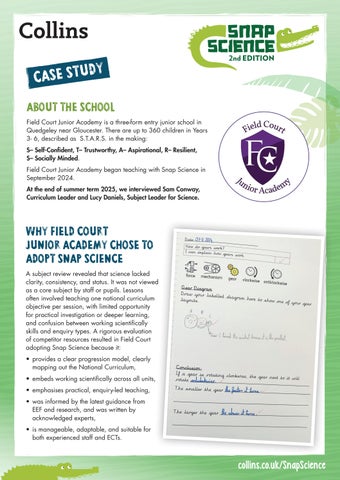
A subject review revealed that science lacked clarity, consistency, and status. It was not viewed as a core subject by staff or pupils. Lessons often involved teaching one national curriculum objective per session, with limited opportunity for practical investigation or deeper learning, and confusion between working scientifically skills and enquiry types. A rigorous evaluation of competitor resources resulted in Field Court adopting Snap Science because it:

• provides a clear progression model, clearly mapping out the National Curriculum,

• embeds working scientifically across all units,

• emphasises practical, enquiry-led teaching,

• was informed by the latest guidance from EEF and research, and was written by acknowledged experts,

• is manageable, adaptable, and suitable for both experienced staff and ECTs.

Safeguarding Policy Statement (October 2024)

The purpose and scope of this policy statement

Field Court Junior Academy works with children and families as part of its activities. The Academy ultimately an educational establishment but equally our mission is for all children to be ā€˜STARS in making’ (Self-confident, Trustworthy, Aspirational, Resilient and Socially-minded). The Academy also committed to supporting young people and families with offers of Early He lp – working with partners to help children, young people and families deal with their issues as early as possible; providing information, advice and services at the right time; supporting them to resolve their concerns as soon as needs emerge.

The purpose of this policy statement is:

• to protect children and young people who receive Field Court Junior Academy’s services.

• to provide parents, staff and volunteers with the overarching principles that guide our approach to child protection.

This policy statement applies to anyone working on behalf of Field Court Junior Academy including senior leaders and the board of trustees, staff, volunteers, sessional staff, agency staff and students.

Legal framework

This policy has been drawn up on the basis of legislatio n, policy and guidance that seeks to protect children in England. A summary of the key legislation and guidance is available from www.nspcc.org.uk/childprotection

1

HOW FIELD COURT JUNIOR ACADEMY USE SNAP SCIENCE

Snap Science is now the core of the science curriculum. All planning begins with the Snap Science materials. Modules are adapted slightly to suit local context and linked with other curriculum areas – for example, DT in Year 5 forces.

ā€œWe used the staff meeting CPD resources provided, and gave teachers time to plan collaboratively in Year groups – planning from the scheme was CPD in itself.ā€

Each lesson provides clear objectives, working scientifically skills, and a question-led approach that helps structure both teaching and reflection on learning. Teachers use and adapt the provided resources and supplement them with school-designed ā€˜power-up’ tasks to revisit prior learning. Assessments are tailored in-house, using checks aligned with Snap Science’s learning intentions. Working scientifically is tracked using a spreadsheet based on the Snap Science model, with a focus on identifying pupils who need support or who missed certain activities.

ā€œBefore Snap Science, teachers tried to cover whole objectives in one lesson. Now, we see that some objectives need multiple lessons. The Snap Science progression document clarified this for us.ā€

WHAT TEACHERS AT FIELD COURT JUNIOR SAY ABOUT SNAP SCIENCE

The benefits for teachers have been substantial. Confidence has increased, particularly among less experienced staff. The scheme reduces planning workload and builds subject knowledge through its structured, research-informed approach. Teachers have a clear sense of progression and know which objectives to prioritise – reducing over-teaching and misconceptions. The materials are flexible enough to allow experienced staff to make adaptations while still providing strong guidance for ECTs.

ā€œSnap Science has a spiral curriculum – e.g., Year 6 light links back to Year 3 light and also Year 4 sound. It connects topics so children build knowledge and skills progressively.ā€

Assessment is practical and manageable. Rather than relying on generic tests, staff use observation, work scrutiny, and formative endof-unit checks to determine pupil understanding. These assessments also feed directly into lesson starters and revisit content strategically.

Lessons are inclusive. Snap Science avoids assumptions about home background. All children can access learning regardless of prior experience, thanks to clear modelling

and scaffolded vocabulary. The use of visual word maps supports all learners, especially EAL pupils, and supports the development of oracy.

Oracy is embedded across Snap Science. Lessons are structured around question-led learning, and pupils are regularly asked to discuss their ideas, explain their reasoning, and reflect on what they’ve learned. Reflective tasks at the end of each lesson consolidate understanding and provide teachers with valuable formative insight.

The design of Snap Science promotes sustainability. Lessons require minimal consumable resources and encourage reuse of materials.

ā€œWe reuse materials, avoid single-use plastics, and compost organic matter. The scheme is practical without being wasteful.ā€

Teachers particularly value the progressive teaching of scientific vocabulary. Snap Science defines key Tier 2 and Tier 3 words appropriately, enabling teachers to build language systematically across the key stage. Teachers have developed vocabulary aids and these are displayed prominently in classrooms to aid retrieval.

ā€œStaff confidence and enthusiasm have grown hugely. Science now has a buzz – teachers know they’re delivering high-quality lessons, and Ofsted confirmed this.ā€

HOW HAS SNAP SCIENCE CHANGED CHILDREN’S LEARNING OF SCIENCE?

Snap Science has transformed the way science is experienced by pupils. Science is now a subject children look forward to. Lessons are filled with practical activity – from making a model of blood to filming melting ice hands – and reallife examples that deepen understanding. Learning is secure and enjoyable. When asked what they thought of science, pupils responded immediately, ā€˜We love it!’ They could articulate what they had learned, describe their favourite units, and link science to other areas of the curriculum.

ā€œIf I know it’s science the next day, I’m really excited to come to school because it’s science and we get to learn loads of experiments and how they work. We learn the reasons behind what is happening.ā€

Snap Science has supported Field Court Junior Academy in raising science’s status across the school.

ā€œScience is now a core subject again.ā€

Staff now have the tools to teach science with clarity and confidence. Children engage deeply with the subject and are excited by practical, investigative learning. The scheme’s emphasis on depth, clarity, progression, and inclusion has transformed the quality and consistency of science provision.

Scan here to find out more and sign up for a free trial.

CASE STUDY

ABOUT THE SCHOOL

Mellor Community Primary School in Leicester is a large, vibrant, inclusive school which is proud of its close community links and extended school provision. There is a big focus on pupil voice, with lots of groups led by children, including an Eco Council, Forest School Champions, Oracy Champions, Digital Leaders, and Wellbeing Champions. Mellor’s vision is for all members of its community to ā€˜Be the best you can be’ and it is committed to providing:

• A planned and relevant curriculum

• A learning environment that supports linguistic and cultural diversity

• A professional environment in which all staff have the opportunity to develop their thinking and professional practice

The science subject leader is Saleha Patel who is an experienced teacher and associate assistant head teacher.

Mellor School has been using Snap Science across the school for four years and have now transitioned to the second edition.

WHY MELLOR PRIMARY SCHOOL CHOSE TO ADOPT SNAP SCIENCE

To provide professional support for staff – Snap Science provides comprehensive support to deliver the Science National Curriculum for a large staff with a range of different experience and expertise in planning, teaching and assessing science.

To ensure progression – Snap Science is underpinned by a clear and expert progression of both the conceptual and disciplinary knowledge in the National Curriculum, ensuring that science learning builds logically over time. So that children learn disciplinary knowledge in a relevant and progressive way – Snap Science aligns with Ofsted’s recommendations, ensuring that children are taught to Work Scientifically in every lesson.

To help manage staff workload

– The national curriculum has been organised into 6 manageable modules per year, each containing a sequence of learning steps organised over 5–8 lessons, ensuring that science concepts and skills are all taught and learned effectively. Snap Science provides detailed lesson planning, which supports teachers by providing clear guidance on prior learning, key intended learning and next steps.

To allow for flexibility and teacher autonomy – Snap Science fits easily into Mellor’s whole school curriculum and its systems for planning and assessment. It provides a solid foundation that enables lessons to be easily modified to fit children’s diverse learning needs, the school context and to integrate other resources.

To support the strong focus on the development of oracy across all subject areas – This is particularly important in a school where 96% of students speak English as an additional language. Snap Science includes explicit vocabulary instruction, identifying Tier 2, and Tier 3 scientific terms. It also encourages children’s curiosity through questions, supports their vocabulary development, and fosters their articulation of scientific ideas.

To enable a learning environment that puts the child first – Snap Science lessons are engaging and hands-on. Children are encouraged to share contributions from their own experiences and interests.

To support practice in assessment for learning – Snap Science builds assessment for learning strategies into every lesson, building on children’s prior learning, supporting formative feedback, and developing children’s metacognition by ensuring that they always reflect on what they have learned.

To enable accurate and meaningful tracking of children’s progress –Snap Science provides clear guidance for teachers to help them recognise when children have met a National Curriculum objective and a straightforward system for recording achievement.

THE IMPACT OF SNAP SCIENCE

An interview with Science Lead, Saleha Patel

Teaching is now more confident and efficient, as Snap Science provides a solid framework that can be easily adapted to individual classroom needs.

Teachers no longer waste time searching for scattered resources – everything they need is conveniently accessible in one place.

Children make steady progress, building a strong foundation of key concepts and skills. Teachers feel prepared and confident discussing the curriculum with inspectors, articulating clearly what is taught at each year level and how it connects across the years. Workload is well-managed with Snap Science, enabling seamless cross-year planning. The Focus is on learning, not finding activities to do.

ā€œYou’ve got the exciting lesson for the pupils, but you’ve also got the knowledge that its been constructed to teach the key knowledge and skills.ā€

Pupils genuinely enjoy science, make notable progress, and understand its relevance to themselves, their community, and the world.

Every lesson builds scientific vocabulary while encouraging children to ask thoughtful questions, articulate their understanding, and effectively communicate their learning. Snap’s Excel-based assessment tracker integrates smoothly into the school’s system, allowing teachers to monitor progress in both conceptual and disciplinary knowledge while identifying students who need additional support.

THE BENEFITS OF SNAP SCIENCE SECOND EDITION

The slimmed-down version of the original Snap Science edition is highly valued for its fewer lessons and clearer module titles. The progression is very clear and offers the right level of detail. Subject leads are able to monitor progression easily.

Teachers appreciate knowing exactly what key knowledge needs to be taught, with one noting, ā€œThe new version of Snap Science does a really good job of that.ā€

It aligns well with the school’s Learning Journey approach and provides subject knowledge for teachers at the right depth, along with explanations of commonly held misconceptions, which are especially appreciated. The consistent lesson structure, combined with varied pedagogic strategies and content, is well-received by both teachers and children. Snap Science 2nd Edition is easy to manage and suitable for all teachers, from early career to experienced, regardless of their science background.

MELLOR TEACHERS’ EXPERIENCE OF USING SNAP SCIENCE

(interview with Year 1 and Year 5 teachers)

Snap Science provides a strong foundation that can be tailored to fit children’s language needs and experiences, with an emphasis on prioritising vocabulary. It encourages teachers to actively engage with lessons rather than passively follow scripted plans, offering a flexible professional support system instead of a rigid programme.

This approach boosts teacher confidence, reduces workload, and focuses on key learning to help educators retain and apply knowledge effectively.

Hands-on experiences, such as handling fish and materials, significantly enhance engagement and create memorable moments for children. Lessons also value children’s personal experiences and connect classroom learning to their home lives, such as sharing stories about their pet fish or visits to the fishmongers. Additionally, the use of video and picture resources is highly valued in enriching the learning experience.

CHILDREN’S EXPERIENCE OF SNAP SCIENCE LESSONS (interview with Year 5 pupils following Materials lesson)

The pupils at Mellor are excited about science, with many naming it as one of their favorite subjects. They particularly enjoy hands-on learning and practical experiments, which make their science lessons memorable and engaging.

Testing ideas through investigations is preferred over simply reading about them, as it allows them to explore and understand the world around them. Pupils recognise science as a part of daily life, citing examples like electricity, healthy eating, and environmental care. They see its importance for future careers in fields such as biology and chemistry and value learning how to test materials for different properties and answer questions by conducting experiments.

Writing conclusions at the end of experiments helps them reflect on what they’ve learned, and they view science as a way to improve the world—whether by solving environmental challenges or creating better materials and inventions. They also understand that scientific progress relies on testing, refining, and improving ideas over time.

Scan here to find out more and sign up for a free trial.

Turn static files into dynamic content formats.

CreateĀ aĀ flipbook
Issuu converts static files into: digital portfolios, online yearbooks, online catalogs, digital photo albums and more. Sign up and create your flipbook.