MARKET DATA
OFFICE MARKET SNAPSHOT Q1 2026 Stock
Avg. Vacancy
Spec. Vacancy
+1.3% yoy
-2.02 pps. yoy
-1.93 pps. yoy
4,483k sqm
Avg. Rent
12.04%
15.5%
Prime
New Build
EUR/sqm/mth
EUR/sqm/mth
25.5
19-21
Net Take-up
25,726 sqm
Completion
DISTRIBUTION OF TRANSACTIONS (Q1 2025, Q1 2026) Pre-lease
42,810 sqm
New
Cat. A
32,9%
17.2
EUR/sqm/mth
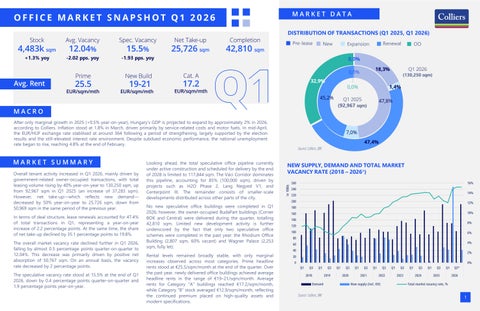
In terms of deal structure, lease renewals accounted for 47.4% of total transactions in Q1, representing a year-on-year increase of 2.2 percentage points. At the same time, the share of net take-up declined by 35.1 percentage points to 19.8%. The overall market vacancy rate declined further in Q1 2026, falling by almost 0.5 percentage points quarter-on-quarter to 12.04%. This decrease was primarily driven by positive net absorption of 50,767 sqm. On an annual basis, the vacancy rate decreased by 2 percentage points. The speculative vacancy rate stood at 15.5% at the end of Q1 2026, down by 0.4 percentage points quarter-on-quarter and 1.9 percentage points year-on-year.
No new speculative office buildings were completed in Q1 2026; however, the owner-occupied BudaPart buildings (Corner BOK and Central) were delivered during the quarter, totalling 42,810 sqm. Limited new development activity is further underscored by the fact that only two speculative office schemes were completed in the past year: the Rhodium Office Building (2,807 sqm, 60% vacant) and Wagner Palace (2,253 sqm, fully let). Rental levels remained broadly stable, with only marginal increases observed across most categories. Prime headline rents stood at €25.5/sqm/month at the end of the quarter. Over the past year, newly delivered office buildings achieved average headline rents in the range of €19–21/sqm/month. Average rents for Category “A” buildings reached €17.2/sqm/month, while Category “B” stock averaged €12.9/sqm/month, reflecting the continued premium placed on high-quality assets and modern specifications.
Q1 2026
(130,250 sqm)
1,4%
0,0%
45,2%
Q1 2025 (92,967 sqm)
47,8%
7,0% 47,4% Source: Colliers, BRF
NEW SUPPLY, DEMAND AND TOTAL MARKET VACANCY RATE (2018 – 2026*) In 1000s
Looking ahead, the total speculative office pipeline currently under active construction and scheduled for delivery by the end of 2028 is limited to 117,844 sqm. The Váci Corridor dominates this pipeline, accounting for 85% (100,000 sqm), driven by projects such as H2O Phase 2, Lang Negyed V1, and Centerpoint III. The remainder consists of smaller-scale developments distributed across other parts of the city.
18,3%
0,0%
After only marginal growth in 2025 (+0.5% year-on-year), Hungary’s GDP is projected to expand by approximately 2% in 2026, according to Colliers. Inflation stood at 1.8% in March, driven primarily by service-related costs and motor fuels. In mid-April, the EUR/HUF exchange rate stabilised at around 364 following a period of strengthening, largely supported by the election results and the still-elevated interest rate environment. Despite subdued economic performance, the national unemployment rate began to rise, reaching 4.8% at the end of February.
Overall tenant activity increased in Q1 2026, mainly driven by government-related owner-occupied transactions, with total leasing volume rising by 40% year-on-year to 130,250 sqm, up from 92,967 sqm in Q1 2025 (an increase of 37,283 sqm). However, net take-up—which reflects new demand— decreased by 50% year-on-year to 25,726 sqm, down from 50,969 sqm in the same period of the previous year.
OO
0,0%
MACRO
MARKET SUMMARY
Renewal
Expansion
260
16%
240
14%
220 200
12%
180 10%
160 140
8%
120 100
6%
80 4%
60 40
2%
20 0
0% Q1
Q3
Q1
2018 Demand
Source: Colliers, BRF
Q3 2019
Q1
Q3 2020
Q1
Q3 2021
Q1
Q3 2022
New supply (incl. OO)
Q1
Q3 2023
Q1
Q3 2024
Q1
Q3
Q1
2025
Q3* 2026
Total market vacancy rate, %
1