
Macro Newsletter



May 2026
Hungary’s Economy Gains Momentum While Base Rate Holds
Steady in May
• Hungary’s GDP grew by 1.7% year-on-year in Q1 2026, up from 0 8% in the previous quarter and marking the strongest expansion since Q3 2022. Growth was mainly supported by the services sector especially professional, scientific, technical, and administrative activities while industry also contributed positively Full-year growth is expected to reach around 1.5%.
• Inflation edged higher, with the annual rate rising to 2.1% in April from 1.8% in March, a threemonth high. The increase was driven by food prices and a rebound in other goods, including fuels. Core inflation also picked up to 2.2% from 1 9%
• In response to global uncertainties, including geopolitical tensions pushing up energy prices, the National Bank of Hungary kept its benchmark interest rate unchanged at 6.25% in May.
• Meanwhile, labour market conditions showed some weakening. The unemployment rate rose to 4.7% in January–March 2026 (from 4.3% a year earlier), with the number of unemployed increasing to 226 4 thousand and total employment declining by 65 thousand to 4.627 million.

Strong Rebound in Hungary’s Industry and Retail Boosts Market Confidence
• Industrial production in Hungary rose by 6.7% year-on-year in March 2026, in line with preliminary estimates and rebounding from a revised 0 9% decline in February. This marks the strongest growth since September 2022, driven by broad-based expansion in manufacturing (7% vs -0.3%), which makes up around 95% of total industrial output. Overall, industrial production increased by 1% in the first quarter compared to the same period last year.
• Retail sales also showed strong momentum, rising 8.2% year-on-year in March, up from 3.8% in February and reaching the highest level since May 2022. Growth was supported by a sharp increase in automotive fuel sales (20 6% vs 6.4%) and continued strength in non-food products (8.4% vs 5.0%).
• Financial markets reflected improving sentiment. As of 26 May, the forint traded at around 357 per euro, supported by post-election adjustments, stable base rate and easing geopolitical concerns. Meanwhile, the yield on Hungary’s 10year government bond fell further to about 5.7%, down nearly 130 basis points year-on-year, driven by stronger international investor confidence.
EUR/HUF ex. rate (2021-2026)

Source: MNB
Energy market
Energy Prices Rise on Renewed Geopolitical
• European natural gas prices climbed more than 4% to about €47.5 per megawatt hour on 26 May, recovering from a two-week low as uncertainty around a Middle East peace agreement resurfaced following new US military action in the region
• Brent crude also increased, rising above $98 per barrel as fresh US operations in southern Iran and ongoing negotiations kept markets volatile. Despite the rebound, oil prices remain over 10% lower compared to a week earlier, reflecting continued optimism about potential progress in US–Iran talks..
Eurozone
Inflation Pressures Rise and German Industry Weakens
• The European Central Bank kept its key interest rates unchanged at its April meeting, maintaining the main refinancing rate at 2.15% and the deposit facility at 2 0% Policymakers took a cautious approach as they evaluate the economic impact of the Iran conflict, noting increased upside risks to inflation alongside growing downside risks to economic growth.
• Inflation in the Euro Area was confirmed at 3.0% year-on-year in April 2026, its highest level since September 2023 and well above the ECB’s 2 0% target The rise was largely driven by a sharp 10.8% increase in energy prices amid supply concerns linked to Middle East tensions. Price pressures also intensified for non-energy industrial goods and unprocessed food, while core inflation eased slightly to 2 2%
• In Germany, industrial production declined by 0.7% month-on-month in March, following a revised 0.5% drop in February and falling short of expectations The contraction was mainly due to weaker energy output and reduced activity in mechanical engineering. Although construction and automotive production showed some growth, overall industrial activity fell by 1 2% in the first quarter compared to the previous three months. On an annual basis, output dropped 2.8%, marking the steepest decline since August 2025.
US Inflation Rises on Energy Shock, Labour Market
Shows Signs of Weakening
• US annual inflation rose to 3 8% in April 2026, up from 3 3% in March and above expectations, marking its highest level since May 2023 The increase was largely driven by the oil price shock linked to the Iran conflict, pushing energy costs up by 17.9%, with sharp gains in gasoline (28.4%) and fuel oil (54.3%). Core inflation also ticked higher to 2.8%, slightly exceeding forecasts.
• Despite the unemployment rate holding at 4.3%, labour market conditions weakened. The number of unemployed increased by 134,000 to 7.37 million, while employment fell by 226,000. The labour force also declined, lowering the participation rate to 61 8%, the lowest since October 2021
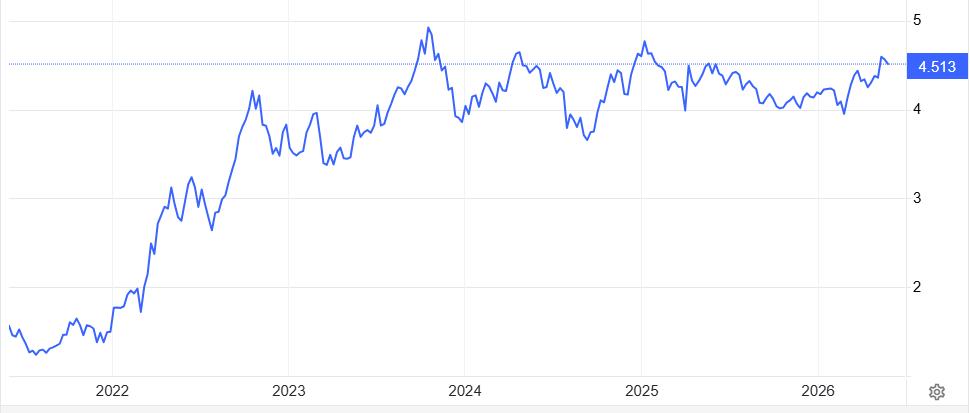
• Financial markets showed cautious optimism. On 26 May, the US 10-year Treasury yield edged down to around 4.5%, as investors balanced Middle East uncertainty with hopes that a potential US–Iran agreement could ease inflation pressures and limit further rate increases.

Forecast- Hungary

Source: Colliers