

Macro Newsletter



January 2026
Hungary’s Economy Set for Gradual Recovery Amid Cooling Inflation
• After two years of no or limited growth, GDP is projected to expand by 0.4%–0.5% in 2025 and by around 2% in both 2026 and 2027, supported by household consumption and the recovery of investment and exports.
• The National Bank of Hungary kept its key interest rate at 6.50% in January, extending its pause for the 16th consecutive meeting, in line with market expectations Headline inflation fell to 3.3% in December, remaining within the 3% ± 1 percentage point target range for the second time in a year helped by a stronger forint and declining global commodity and food prices.
• Inflation reached its lowest level since October of the previous year, mainly due to slower price increases for food (2.6% vs. 3.2% in November), alcoholic beverages and tobacco (7.1% vs. 7.5%), and household energy and heating (8.9% vs. 9 8%) Annual core inflation, which excludes
volatile items such as food and energy, eased to 3.8% in December its slowest pace since August 2021, down from 4.1% in November.
• Hungary’s unemployment rate stood at 4.4% in October–December 2025, unchanged from the same period a year earlier. The number of unemployed individuals decreased by 3.2 thousand year-on-year, reaching 213.1 thousand Of the total unemployed, 116 thousand were men, with an unemployment rate of 4 5%, while 97 thousand were women, with a rate of 4.3%. The average job-search duration was 12.7 months. Among the unemployed, 39.1% had been seeking work for less than three months, while 36.2% had been unemployed for at least a year.

Source: National Bank of Hungary
Industrial Weakness Persists, While Retail Trade and Forint
Remain Resilient
• In January–November 2025, compared to the same period of the previous year, industrial production fell by 3 5% The volume of export sales which accounted for 64% of all sales declined by 2.6%, while domestic sales, representing the remaining 36%, decreased by 4.6%. Out of the thirteen manufacturing subsectors, production declined in eleven The sharpest drop, 12 3%, occurred in the manufacture of electrical equipment. Output in the manufacture of transport equipment, the largest subsector, fell by 4.5%.
• In November 2025, the volume of retail trade both raw and calendar-adjusted was 2 5% higher than in the same month of the previous year The total turnover of non-food retailing increased by 4.6% in volume. Sales rose by 5.4% in pharmaceutical, medical goods and cosmetics shops; by 4.5% in non-specialized manufactured goods stores; by 2 1% in furniture and electrical goods stores; and by 1.4% in second-hand goods shops. However, sales volumes declined by 0.8% in textiles, clothing and footwear stores, and by 2.5% in book, computer equipment and other specialized shops Mail-order and internet retailing which accounts for 11% of all retail sales expanded by 12%.
• In financial markets, the forint traded around 383 per euro on January 27, supported by the central bank’s stable policy stance. Hungary’s 10-year government bond yield eased to 6.63%, reflecting declining inflation and expectations of future monetary policy easing.
EUR/HUF ex. rate (2021-2026)

Source: MNB
Energy market
European Gas Prices Ease While Oil Declines on Supply
• European natural gas futures fell toward €39 per megawatt-hour on 27 January 2026 after two consecutive weeks of gains that had pushed prices above €40 the highest level in around ten months as investors assessed weather forecasts and ongoing supply risks. Prices had risen on concerns over falling US LNG flows, disrupted by winter storms, just as Europe prepares for another deep freeze and relies heavily on LNG following the loss of most Russian pipeline supplies. LNG now covers roughly half of Europe’s gas demand, with the EU sourcing 27% of its total gas and LNG imports from the US in 2025, up from 6% in 2021. Unusually cold weather is expected to persist into early February, sustaining heating demand. EU gas storage levels are being depleted quickly, with inventories at 45 6%, well below 56 5% a year earlier, including particularly low levels in Germany (37.5%), France (36.4%) and the Netherlands (31.1%), keeping medium-term supply conditions tight.
• Brent crude oil futures fell to around $65.2 per barrel on 27 January 2026, extending losses from the previous session amid the resumption of Kazakh crude exports. Kazakhstan’s Tengiz oil field is expected to restart soon, while the CPC announced that its Black Sea export terminal has returned to fullcapacity operations Losses were partially offset by ongoing supply disruptions in the US and elevated geopolitical risks. Traders now await the upcoming OPEC+ meeting later this week, where the group is expected to maintain its plan to keep output steady

Eurozone
ECB Holds Rates as Inflation Falls; German Industry Shows Resilient Growth
• The ECB kept borrowing costs unchanged for a fourth consecutive meeting in December 2025, with the main refinancing rate steady at 2.15% and the deposit facility rate at 2 0% Policymakers noted that economic activity had been more resilient than expected, unemployment remained at historically low levels, and the inflation outlook was favourable, with prices projected to remain close to target over the forecast horizon. However, the ECB also warned that future developments could diverge significantly from current projections due to a wide range of potential risks As a result, monetary policy will continue to be adjusted based on evolving conditions rather than following a preset trajectory.
• Eurozone consumer price inflation eased to 1 9% in December 2025, down from 2.1% in November and slightly below the preliminary estimate of 2.0%. This marked the first time since May that inflation fell below the ECB’s 2% target, reinforcing expectations that interest rates will remain on hold for an extended period.
• Germany’s industrial output rose by 0.8% monthon-month in November 2025, slowing from a revised 2 0% increase in October but surpassing forecasts of a 0.4% decline. The continued expansion was driven primarily by a strong rebound in the automotive sector (+7 8%), along with solid gains in mechanical engineering (+3.2%) and machine maintenance and assembly (+10 5%) On an annual basis, total industrial production increased by 0.8%, following a 1.0% rise in the previous period.
US Inflation Steady as Industrial Output Strengthens; Treasury Yields Stabilize
• The annual inflation rate in the United States remained at 2.7% in December 2025, unchanged from November and in line with market expectations. Price pressures eased notably in the energy sector, where prices rose at a slower pace (2.3% vs. 4.2% previously).
• Industrial production in the United States increased by 0.4% month-over-month in December, matching the growth rate in November and surpassing market forecasts of a 0.1% rise. Manufacturing output grew by 0.2%, outperforming expectations of a 0.2% decline The utilities index rose by 2 6%, supported by a sharp 12% jump in natural gas output On a year-on-year basis, industrial production expanded by 2% in December 2025, following an upwardly revised 2.7% increase in November. Yearly growth was broad-based, with utilities output up 2.3%, manufacturing up 2%, and mining increasing by 1.7%.
• In financial markets, the yield on the US 10-year Treasury note held steady around 4 26% on 27 January after declining in recent sessions, as investors awaited the Federal Reserve’s upcoming policy decision, where interest rates are widely expected to remain unchanged.
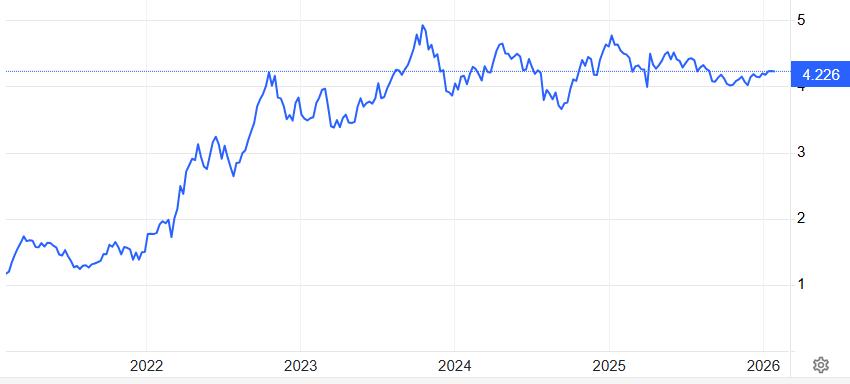

US 10 year Bond evolution, %
Forecast- Hungary

Source: Colliers


Hungary BEM Center, Bem József u. 1/B., Budapest, 1027 Hungary Colliers | Budapest