



February 2026

February 2026
• GDP increased by 0.4% in 2025, followed by stronger growth of around 2% in both 2026 and 2027. The recovery is primarily supported by resilient household consumption, alongside a gradual rebound in investment activity and exports.
• The annual inflation rate slowed to 2.1% in January 2026, down from 3.3% in December 2025 and below market expectations of 2.4%. This marks the lowest reading since March 2018. The deceleration was mainly driven by more moderate price increases in key categories, including food, alcoholic beverages and tobacco, household energy and heating, and services. Core inflation, which excludes volatile components such as food and energy, declined to 2.7% from 3.8% a month earlier, reaching its lowest level since January 2019.
• In response to easing inflationary pressures, the National Bank of Hungary reduced its base rate to 6.25% in February, ending a pause that had been in place since September 2024. The decision was underpinned by inflation stabilising within the central bank’s target tolerance band.
• Labour market conditions remain broadly stable. The unemployment rate stood at 4.4% in the October–December 2025 period, unchanged year-on-year. The number of unemployed persons fell by 3,200 compared to the previous year, bringing the total to 213,100. Of those unemployed, 39.1% had been seeking work for less than three months, while 36.2% had been searching for employment for at least one year

Source: National Bank of Hungary
• Industrial production in Hungary increased by 1.8% year-on-year in December 2025, recovering from an upwardly revised 5.5% contraction in November. This represents the strongest expansion since April 2024. The rebound was mainly driven by improved manufacturing performance, which grew by 3 9% following a sharp decline of 5.8% in the previous month. Within manufacturing, output of electrical equipment recorded particularly robust growth, rising by 12.5% after a significant drop in November. Despite the late-year improvement, total industrial output for 2025 was still 3.2% lower than in the previous year.
• Retail activity also strengthened toward the end of the year. Retail sales expanded by 3.5% year-on-year in December 2025, accelerating from 2.5% in November and marking the fastest increase since April. Growth was primarily supported by stronger automotive fuel sales. Non-food retail sales remained solid, though growth moderated slightly, particularly in cosmetics and online/mail-order segments. For 2025 as a whole, retail sales rose by 2.9%, exceeding the 2.6% increase recorded in 2024.
• In financial markets, the Hungarian forint traded at around 380 against the euro on 24 February. Meanwhile, Hungary’s 10-year government bond yield declined to 6.56%, reflecting easing inflationary pressures and investor expectations of further monetary policy loosening in the coming months

• European natural gas futures dropped below EUR 32 on 23 February 2026 after comments from Donald Trump signaled that any potential U.S. action against Iran would likely be limited in scope The remarks reduced concerns about a major disruption to LNG shipments through the Strait of Hormuz, a critical transit route for roughly 20% of global LNG exports, including supplies from Qatar. Additional downward pressure came from milder weather forecasts, stable Norwegian gas flows despite outages, and stronger renewable energy generation in Germany Nevertheless, storage levels across the European Union remain low at around 32%, with German inventories below 22%, limiting further downside potential.
• Meanwhile, Brent crude futures climbed toward $72 per barrel on 24 February 2026, reaching their highest level in nearly seven months. Prices have been supported by investor caution ahead of a new round of U.S.–Iran negotiations and ongoing fears of military escalation in the Middle East Recent supply disruptions have also underpinned the rally, offsetting expectations of a significant oil surplus later this year. At the same time, markets are weighing renewed trade tensions, as Trump advances new tariff measures following a Supreme Court decision that struck down several of his previous broad-based levies

• The European Central Bank kept interest rates unchanged at its first policy meeting of 2026, reaffirming its expectation that inflation will stabilize at the 2% target over the medium term. The main refinancing rate remains at 2.15%, while the deposit facility and marginal lending rates were held at 2 0% and 2 4%, respectively. Policymakers described the euro area economy as resilient but highlighted persistent uncertainty, particularly stemming from global trade policy risks and ongoing geopolitical tensions
• Inflation in the euro area moderated to 1.7% in January, down from 2 0% in December 2025, reinforcing expectations that price pressures are gradually easing.
• Meanwhile, Germany’s industrial sector showed renewed weakness Output fell 1 9% month-on-month in December 2025, reversing a downwardly revised 0.2% increase in November and undershooting market expectations of a 0.3% decline. The drop was primarily driven by sharp contractions in automotive production (-8.9%), machinery and equipment (-6.8%), and machine maintenance and assembly. On an annual basis, industrial production decreased by 0.6%, following a downwardly revised 0 5% gain in the previous month, signaling continued fragility in Europe’s largest economy.
• Annual inflation in the United States slowed to 2.4% in January 2026, marking its lowest level since May and down from 2.7% in each of the previous two months. The figure came in below market expectations of 2.5%, with the deceleration largely driven by base effects as stronger readings from early 2025 dropped out of the annual comparison Core inflation also eased, declining to 2 5% its lowest level since March 2021 from 2.6% in December, in line with forecasts.
• At the same time, industrial activity showed renewed momentum Industrial production rose 0 7% month-over-month in January, the strongest increase since February and above expectations of a 0.4% gain. Manufacturing output advanced 0.6%, also exceeding forecasts, supported by broad-based gains across industry groups. On an annual basis, total industrial output grew by 2.3%, accelerating from a revised 1 3% increase in December
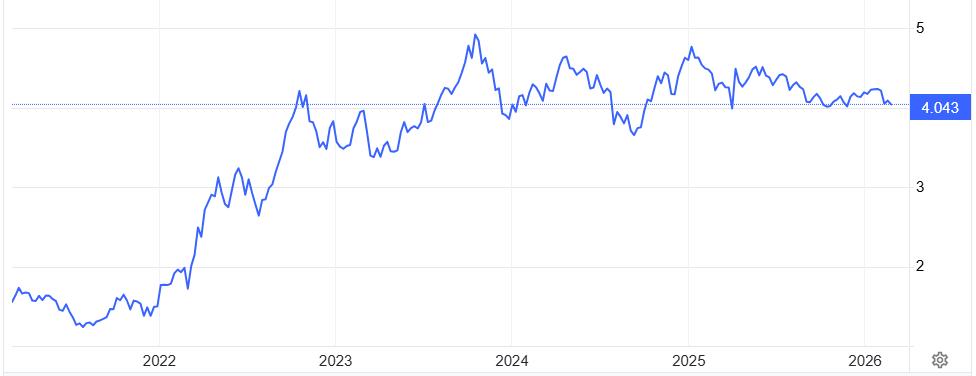
• In financial markets, the yield on the 10-year US Treasury note climbed to around 4.05% on 23 February 2026, rebounding after a sharp decline in the previous session as investors continued to weigh uncertainties surrounding US trade policy


Source: Colliers


Colliers Hungary BEM Center, Bem József u. 1/B., Budapest, 1027 Hungary Colliers | Budapest