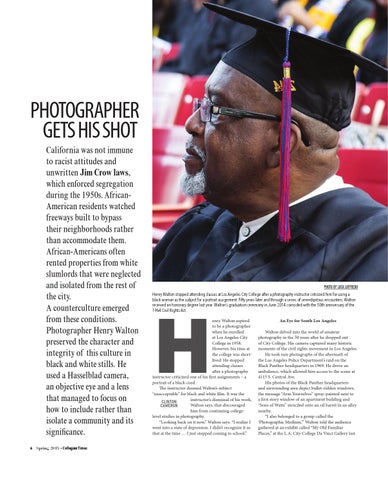
PHOTOGRAPHER GETS HIS SHOT California was not immune to racist attitudes and unwritten Jim Crow laws, which enforced segregation during the 1950s. AfricanAmerican residents watched freeways built to bypass their neighborhoods rather than accommodate them. African-Americans often rented properties from white slumlords that were neglected and isolated from the rest of the city. A counterculture emerged from these conditions. Photographer Henry Walton preserved the character and integrity of this culture in black and white stills. He used a Hasselblad camera, an objective eye and a lens that managed to focus on how to include rather than isolate a community and its significance. 6 Spring 2015 – collegian times
PHOTO BY LUCA LOFFREDO Henry Walton stopped attending classes at Los Angeles City College after a photography instructor criticized him for using a black woman as the subject for a portrait assignment. Fifty years later and through a series of serendipitous encounters, Walton received an honorary degree last year. Walton’s graduation ceremony in June 2014 coincided with the 50th anniversary of the 1964 Civil Rights Act.
H
enry Walton aspired to be a photographer when he enrolled at Los Angeles City College in 1958. However, his time at the college was shortlived. He stopped attending classes after a photography instructor criticized one of his first assignments – a portrait of a black coed. The instructor deemed Walton’s subject “unacceptable” for black and white film. It was the instructor’s dismissal of his work, CLINTON Walton says, that discouraged CAMERON him from continuing collegelevel studies in photography. “Looking back on it now,” Walton says. “I realize I went into a state of depression. I didn’t recognize it as that at the time … I just stopped coming to school.”
An Eye for South Los Angeles Walton delved into the world of amateur photography in the 50 years after he dropped out of City College. His camera captured many historic moments of the civil rights movement in Los Angeles. He took rare photographs of the aftermath of the Los Angeles Police Department’s raid on the Black Panther headquarters in 1969. He drove an ambulance, which allowed him access to the scene at 4115 S. Central Ave. His photos of the Black Panther headquarters and surrounding area depict bullet-ridden windows, the message “Arm Yourselves” spray-painted next to a first story window of an apartment building and “Sons of Watts” stenciled onto an oil barrel in an alley nearby. “I also belonged to a group called the ‘Photographic Medium,’” Walton told the audience gathered at an exhibit called “My Old Familiar Places,” at the L.A. City College Da Vinci Gallery last
I GOT TO A PHONE BOOTH AND CALLED THE PRESIDENT [OF PHOTOGRAPHIC MEDIUM] AND I TOLD HIM WHAT WAS GOING ON, AND WE SENT A BUNCH OF YOUNG PHOTOGRAPHERS IN THERE AND TOOK PICTURES, AND ACTUALLY I THINK THAT’S THE ONLY RECORD OF THAT PARTICULAR EVENT.
-HENRY WALTON
year. The solo exhibit featured Walton’s original prints from 1965 to 1975. “I got to a phone booth and called the president [of Photographic Medium] and I told him what was going on, and we sent a bunch of young photographers in there and took pictures, and actually I think that’s the only record of that particular event,” Walton said. A local church purchased his photos of the LAPD raid and put them on exhibit throughout the U.S. and beyond – as far as Vietnam, according to Walton. From then on, Walton’s subjects included other activist groups. He photographed the United Slaves (US), a rival black power group to the Black Panthers, and the Sons of Watts, a group formed to monitor the police. He consistently focused his lens on the black community. Pictures of the Black Panthers and US reveal his ability to capture candid shots from rival organizations within the same community. Beyond South Los Angeles Throughout the years, Walton moved from South L.A. to the South Bay, the San Gabriel Valley, the San Bernardino Valley, and to the Westside neighborhood of Mar Vista. “I’ve been all around the Southern California area,” Walton says. “I am surprised I remember all of those places.” It was sometime between 2003 and 2006 that he moved to Macarthur Park near downtown Los Angeles. There he met Cori Alegria. He had no idea at the time that Alegria would play a key role in righting a past wrong. She responded to an ad in a newspaper from a filmmaker looking for local artists to feature in a documentary. Walton responded to the same ad. “We both showed up at the Rec. Center [in Macarthur Park],” Alegria says. “That was the beginning.” Soon after they met, Alegria helped Walton schedule shows and solo exhibitions at various galleries and venues, including the il Tramezzino restaurant at the UCLA Anderson School of Management. By 2012, his collection of photographs captured the attention of more than half a dozen galleries in Los Angeles. Walton’s Story Inspires Action It was at il Tramezzino that Alegria introduced Walton to Daniel Marlos, chair of the media arts department at Los Angeles City College. “I wanted to involve Dan Marlos,” Alegria says. “That’s what I do. I coordinate my people to meet.” Walton opened up to the photography professor. He told Marlos how one professor’s comment so
PHOTO COURTESY OF HENRY WALTON Henry Walton photographed this woman on the Los Angeles City College campus during the late ’50s. Walton’s instructor told him she was not an appropriate subject for black and white photography because of the color of her skin. Discouraged, Walton stopped attending the class and received a non-passing grade. long ago, caused him to abandon formal studies in photography. Walton’s story moved Marlos. He encouraged the photographer to complete the course he had started more than 50 years earlier, and assured him the experience would be different. “I told Henry to consider enrolling in my class,” Marlos says. “I would teach him how to expose film correctly, especially for people with darker skin tones.” Walton enrolled in Marlos’ class and completed it with an “A.” However, after taking into consideration Walton’s past treatment at the college and his contributions to the community, Marlos says he decided Walton deserved more than a passing grade in photography. “I thought that Henry was sort of like the perfect person to recognize what students were going through on this campus 50 years earlier and the obstacles that many of them may have faced at the time,” Marlos says. He submitted a resolution to the LACC Academic Senate to award Walton an honorary degree. On March 27, 2014, it passed 35 to one in favor of Walton. Walton’s graduation ceremony in June 2014 coincided with the 50th anniversary of the 1964 Civil Rights Act. It was no coincidence.
“I just thought it was really a nice opportunity to tie Henry’s personal struggles with civil rights and his personal documentation of the civil rights movement,” Marlos says, “as well as to honor him with a degree that he should have earned many years ago.” In the intervening years, Walton set aside his dream of a photography degree. He pursued other studies, and by 2003 he had earned an associate degree in political science from L.A. Valley College, and a bachelor’s degree and a master’s in human services from Springfield College in Massachusetts. An Honor Awaits at Commencement Walton arrived more than two hours early for the 2014 commencement ceremony in June. He found shade where he could as he waited in line to enter the Greek Theatre in Griffith Park. Cap-and-gown uniformity disguised the excitement and disorderly conduct in the line. Once it was time to enter, faculty members dressed formally in cap and gown restored order and the students marched in unison to the floor seating area. Cheers, screams and whistles from relatives, friends and supporters sounded out as graduates walked to their seats. Spring 2015 – collegian times 7
Walton sat with more than 500 fellow students. He waited through the national anthem, an invitation from the chancellor for students to take selfies, introductions and speeches, and then he heard his name called from the stage. “Henry Walton embodies perseverance,” California Senate President Pro Tem Kevin De León told the graduating students and their families and friends. “This is a man who has continued his love for photography, taking pictures of the beauty of South L.A.” Los Angeles Community College District Chancellor Francisco Rodriguez and LACC President Reneé Martinez presented Walton with his long overdue degree in applied photography. “Mr. Walton, on this 50th anniversary of the civil rights movement, we present this degree to you with great respect,” the chancellor said. “It is my great pleasure on behalf of the Board of Trustees of [the] Los Angeles Community College District to present this honorary degree to Henry Walton – an associate of arts in applied photography. Congratulations, Mr. Walton.” Walton maneuvered his way to the stage at a moderate and careful pace. He appeared humbled yet proud as he shook hands with the chancellor and the president and accepted his degree. “That’s better than my master’s,” Walton said, as he studied the degree. A Reunion at the Ceremony It appeared things had come full circle, until Walton heard a woman call his name. It was the voice of Homeselle Smith, one of Walton’s former classmates from the 1950s. She attended the ceremony to watch her goddaughter graduate. President Martinez’s final remarks echoed through the sound system, and drowned out Smith’s calls to Walton. “This marks the end of the formal graduation ceremony,” said Martinez as Kool and the Gang’s “Celebration” blasted through the sound system. “I know you want to go celebrate.” Smith’s voice competed with the commotion of the crowd and the music, but she finally got Walton’s attention from her wheelchair. “Henry! Henry!” she called. “I knew that was you.” Smith and Walton first met more than 50 years ago at Ben’s Café, a local restaurant where black students felt comfortable meeting. Smith studied English and poetry and was involved in the Watts Writers Workshop while Walton studied photography. “We felt comfortable there and in the Student Union,” Smith says. Walton entertained the idea that Smith’s image could have been the subject of the assignment his instructor rejected more than five decades ago. Smith, however, says it is not hers, and she is not familiar with whose image Walton captured. It remains a mystery. “It’s no longer a racial issue,” Walton said as he left the ceremony. “To call it an issue is too much. It was a particular racial point about which the guy was wrong, and history has proven him wrong. How many good pictures are there of dark skinned people, of black people, of people of every race, of every ethnicity of the world? That’s not what photography was about. He was simply looking from the wrong angle and seeing the wrong thing, and I’m sure over the years even he realized that.” 8 Spring 2015 – collegian times
IT’S NO LONGER A RACIAL ISSUE. TO CALL IT AN ISSUE IS TOO MUCH. IT WAS A PARTICULAR RACIAL POINT ABOUT WHICH THE GUY WAS WRONG, AND HISTORY HAS PROVEN HIM WRONG. HOW MANY GOOD PICTURES ARE THERE OF DARK SKINNED PEOPLE, OF BLACK PEOPLE, OF PEOPLE OF EVERY RACE, OF EVERY ETHNICITY OF THE WORLD? THAT’S NOT WHAT PHOTOGRAPHY WAS ABOUT. HE WAS SIMPLY LOOKING FROM THE WRONG ANGLE AND SEEING THE WRONG THING, AND I’M SURE OVER THE YEARS EVEN HE REALIZED THAT. -HENRY WALTON
PHOTOS COURTESY OF HENRY WALTON Left: A sidewalk view of the Los Angeles Black Panther Headquarters at 41st and Central Streets, hours after a raid by Special Weapons and Tactics Team (SWAT) on Dec. 9, 1969. Three SWAT Team members and three Black the country. top: Two children pose on the front porch of a home located in Watts, California during the mid to late ’60s. Bottom: Watts Festival parade through the intersection of 103rd and Central Streets during the late ’60s. Spring 2015 – collegian times 9