Collegian Los Angeles
The student voice of Los Angeles City College since 1929
Wednesday December 4, 2013 Volume 171 Number 6
NEWS BRIEFS
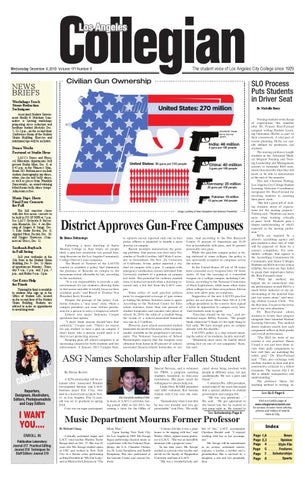
Civilian Gun Ownership
Workshops Teach Stress-Reduction Techniques
By Michelle Berry
Associated Student Government Health & Nutrition Committee is hosting workshops promoting stress reduction and healthier student lifestyles Dec. 5, 12-2 p.m., on the second floor Conference Room of the Student Union Building. Exercise and nutritional tips will be included.
SOURCE: Small Arms Survey (2007)
India: 46 million
Dance Works Featured at Studio Hour
4 guns per 100 people
LACC’s Dance and Physical Education departments will present Studio Hour, Dec. 6, at 6:45 p.m. in the Women’s Gym, Room 202. Performances include student choreography, tap dance, urban cha-cha and belly dance, as well as pieces from Mandala Danceworks, an award-winning tribal-fusion belly dance troupe. Admission is free.
United States: 89 guns per 100 people
Textbook Buyback in Full Swing Sell your textbooks at the Cub Store in the Student Union Building, Dec. 9 - Dec. 13. Hours of operation are Monday - Thursday 9 a.m.-2 p.m. and 3 p.m.-7 p.m., and Friday 9 a.m.-3 p.m.
Get Extra Help for Finals Tutoring for finals is available to students who sign up in the Office of Student Life, located on the second floor of the Student Union Building. Students are advised to make an appointment to avoid long waits.
China: 40 million 5 guns per 100 people
Germany: 25 million 30 guns per 100 people
Pakistan: 18 million
Music Dept. Hosts Final Free Concerts for Fall The fall semester closes with five free music concerts to be held in SU-3F MPR at 7 p.m. See LACC Orchestra & Percussion Ensemble, Dec. 4; An Evening of Singers & Songs, Dec. 5; Solo Guitar Recital, Dec. 6; Applied Music Recital, Dec. 10; and Singers Showcase (Commercial Voice), Dec. 11.
12 guns per 100 people
Image courtesy of New Hampshire Gun Violence Prevention
District Approves Gun-Free Campuses By Diana Nakayenga Following a mass shooting at Santa Monica College in June where six people died, a gun-free resolution was passed banning firearms on the Los Angeles Community College District’s nine campuses. The Board of Trustees of the LACCD wanted to establish a policy that eliminates the presence of firearms on campus to the maximum extent allowable by law, according to the resolution. “It is our responsibility to provide a safe environment for our students, allowing them to feel secure and able to totally focus on their academic goals,” said Board of Trustees Vice President Scott Svonkin. Despite the passage of the policy, California remains a “may issue” state, where a campus president can issue written permission for a person to carry a weapon at school. Liberal arts major Indynesia Cooper questions that option. “I don’t think anyone should have that authority,” Cooper said. “There’s no reason for any student to have a gun on campus. I don’t know why a person would need it if they’re not protecting anyone.” Keeping guns off school campuses is an increasing concern for both students and law enforcement. A January 2013 Campus Safe-
ty opinion survey reported only one in four police officers is prepared to handle a mass shooter on campus. Recent incidents demonstrate the growing problem. One person was shot early November at North Carolina A&T State University in Greensboro. On Nov. 20, University of California, Irvine, police reported a student on campus with a gun. A campus-wide emergency notification system informed Yale University students of a gunman on campus last week. The potential for violence reached close to home last month when a shooting occurred only a few feet from the LACC campus. Some critics of such gun-free policies point to exaggerated coverage of gun crimes as fueling the debate. Statistics seem to agree. According to the National Center for Education statistics, fewer than one percent of student homicides and suicides take place at school. In 2010, the odds of a student being the victim of a school-associated homicide was one in 2.5 million. However, most school-associated student homicides do involve firearms, often weapons readily available in the perpetrator’s environment. The National Association of School Psychologists reports that the weapons were obtained from home in 80 percent of schoolassociated firearm-related homicides or sui-
cides. And according to the Pew Research Center, 35 percent of Americans age 18-29 live in households with guns, and 16 percent personally own guns. While the gun-free campus policy is being enforced at some colleges, the policy is not universally accepted on campuses across the nation. In the United States, 49 out of 50 states have concealed carry weapons laws. Of those states, 22 ban the carrying of a concealed weapon on a college campus, including California, according to the National Conference of State Legislatures, while many other states allow colleges to set their own policies. Eleven states now allow guns on campuses. Supporters of the new LACCD gun-free policy are not alone. More than 350 of 4,150 college presidents in the country have signed a letter in opposition to campus carry laws. And students seem to agree. “Gun-free should be the way,” said undeclared major Jeffrey Estrada. “Do people think otherwise? I think it’s the right thing to feel safer. We have enough guns on campus already with the sheriffs.” LACCD’s policy is a step toward ensuring the safety of its students, faculty and staff. “[Students] must never be fearful about setting foot on one of our campuses,” Syonkin said.
ASG Names Scholarship after Fallen Student L L A G ALLIN
C
Reporters, Designers, Illustrators, Editors, Photojournalists and Copy Editors
I WANT YOU…. ENROLL IN Publication Laboratory: Journal 217 Practical Editing: Journal 218 Techniques for Staff Editors: Journal 219
SLO Process Puts Students in Driver Seat
By Denise Barrett A $250 scholarship will be renamed after Associated Student Government Senator and LACC business major Eric Cruz, who died in a motorcycle accident Nov. 11, in Los Angeles. The 31-yearold was set to graduate in spring 2014. Cruz was an eager participant
Eric Cruz photo courtesy of ASG
in many of LACC’s activities, having joined ASG in fall 2013, becoming a tutor for the Office of
Special Services, and a volunteer for TRIO, a program assisting students transition to four-year institutions. His peers recall his willingness to always help out. Linda Doo, RAISE president and ASG volunteer, first became friends with Cruz over the summer. “Immediately when I met him he was very friendly and very approachable,” said Doo. “He really
cared about being involved with people in different areas, not just academically. He was a peer and friend.” Catherine Ho, ASG president, noted some of the traits that made him a special addition to student government and campus life. “He was very persistent …,” Ho said. “He got appointed to the board late but he wanted to just jump right in. He wanted to See Scholarship Page 6
Music Department Mourns Former Professor By Richard Chang Critically acclaimed singer and LACC voice teacher, Marilyn Taylor Savage died on Oct. 27. She was 81 years old. Ms. Savage studied opera at USC and worked in New York City as a theater actor, performing as Eliza Doolittle in “My Fair Lady,” and as Marion the Librarian in “The
Music Man.” Upon leaving New York City for Los Angeles in 1969, Ms. Savage began performing classical music as a performer with the National Symphony, the L.A. Chamber Orchestra, St. Louis Symphony and Seattle Symphony. She also performed at the Lincoln Center and various festivals.
“I always felt like it was a great honor to be singing with her,” said Wesley Abbot, adjunct music professor at LACC. “She was an incredible musician with a gorgeous voice.” In her later years, Ms. Savage worked as a private voice teacher and served on the faculty of Pepperdine University and here at LACC. “She was a wonderful lady and
lots of fun,” LACC accompanist Christian Stendel said. “I enjoyed working with her as her accompanist.” Ms. Savage will be remembered as an actress, acclaimed mezzosoprano, a teacher, a mother and a grandmother. She is survived by a daughter, a son and two grandchildren.
Nursing students took charge of expectations this semester after Dr. Francis Rice-Farrand assigned writing Student Learning Outcomes (SLOs) as part of their coursework. A vital part of course planning, SLOs, are usually defined by professors, not students. The nursing professor taught students in her Advanced Medical Surgical Nursing and Nursing Leadership and Management courses to formulate SLO statements that describe what they will know or be able to demonstrate at the end of the semester. This fall, Christine Tinberg, Los Angeles City College Student Learning Outcome Coordinator, recognized Dr. Rice-Farrand for involving students in assessing their peers’ work. “She did a great job of making students aware of expectations for the nursing projects,” Tinberg said. “Students can learn more when looking critically at peers’ work. Students gain a deeper understanding of what’s expected in the nursing profession.” SLOs are required by a school’s accrediting agency and give students a clear view of what will be expected of them by a course’s completion. For community colleges, that agency is the Accrediting Commission for Community and Junior Colleges. Students see SLOs in every course syllabus, but some say they failed to grasp their importance before Dr. Rice-Farrand’s class. “With her method, she helped me to understand that my performance in each SLO is a much better indicator of my understanding of the material than just test scores alone,” said nursing student Lauren Clark. “For the first time, I’m put in the driver seat of my own education.” Dr. Rice-Farrand allows students to review their progress alongside their intended Student Learning Outcome. This method shows students exactly how each assignment reflects in their grades and overall performance. “The SLO for both of my courses is very practical. Hence I hand it out and have them review their daily assignments to how well they are matching the rubric grid,” Dr. Rice-Farrand said. “They also exchange with another student in class and give constructive criticism to a fellow classmate. The reason why I do this is simple: transparency and understanding.” The professor likens her teaching method to writing, alSee SLO Page 6 Visit our tumblr page at www.collegianwired.tumblr.com for access to even more articles, photos and videos of events here at City.
Index Page 1,6 Page 2,3 Page 4 Page 5 Page 7 Page 8
News Opinion Style File Features Scholarships Sports
2
Opinion & Editorial
Wednesday December 4, 2013
Los Angeles | COLLEGIAN
Collegian
editorial
Editor-in-Chief Denise Barrett Managing Editor Clinton Cameron Design Consultant Beatrice Alcala Multimedia Producer Richard Martinez Opinion/Editorial Rocio Flores Huaringa Arts & Entertainment Inae Bloom Sports Jake Carlisi Gabriel Killian Graphic Designers Monica Ebanks Rocio Flores Huaringa Gegham Khekoyan
Gun-Free Campus is Common Sense
Illustrators Stephanie Bolhuis Steffen Williams Photo Editor Inae Bloom Illustration by Stephanie Bolhuis/Collegian
Passing a gun-free resolution by the Los Angeles Community College District Board of Trustees was a positive move that will help ensure the safety of its campuses. With this year’s surge of campus shootings, the measure is a common-sense move for our college district. Too often, students think of these shootings as situations that happen elsewhere. When reports of shootings happen with regularity in the news, they become background noise to our ears. However, as this year’s reports from Santa Monica Col-
lege and LAX have proven, gun violence can happen very close to home. They remind us of what happens the moment we ease up on enforcing gun policy or ignore warning signs. If John Zawahri decided to attend LACC instead of Santa Monica College, we could have been the ones in the news. The new policy reinforces the idea that guns do not belong in our schools. Allowing them even for instructional use opens the door to too many potential issues. There are few arguments for allowing concealed weapons on school grounds that are not already an-
swered by the presence of the L.A. County Sheriff’s Department. Campus enforcement is only one part of the solution, though. The symbolic measure’s greatest strength is drawing attention to the issue so conversation can be created among students. School shootings are complex. They involve a variety of topics ranging from the Bill of Rights to gang violence and mental illness. Many of the problems stemming from deadly weapon use can only be solved by addressing the gun culture among ourselves. We must acknowledge that
Letters to the Editor Regarding "Sheriff's Cite Bikes Out of Zone" As a bike riding person, I am outraged at what the campus police are doing. In no way is the parking of bikes out of designated zones affecting them. They should focus their efforts on stopping crime around campus. Have they got any leads on stolen bikes? Or any leads on the flasher or the guy that was exposing his private parts to a women while she was in her car? Probably not. They are just wasting their time targeting bikes and their bike owners. And what is up with the whole vehicle parking violation? It sets up a precedent. Esthela Roman, Nursing
Illustration by Shelli Pruett
Collegian Los angeles
Have an Opinion? Write a Letter to the Editor CONTACT INFO losangeles.collegian@gmail.com Letters may be edited for brevity. (323) 953-4000, ext. 2831
schools should be a sanctuary free of deadly weapons. Disputes are inherently part of living in a large metropolitan area, but these conflicts can be solved with words and debate, not violence, while in the classroom. Preventing easy access to firearms helps return our focus to that education. Of course, one resolution cannot completely prevent random acts of violence. We must also be aware of the tools available to us if an emergency does occur. Students can sign up for LACC’s optional AlertU system, which notifies students through
text messages of emergencies near campus. Such a fast-response warning system can save lives. Law enforcement officials are also readily available if suspicious activity needs to be reported. The Board of Trustees has taken the proper first step by passing the gun-free resolution. The fight does not stop there. Students must keep that momentum going so that it stays fresh in our minds. Our district cannot become just another headline for the rest of the country.
Where is Your School Spirit? By Thomas Wisniewski School spirit. MacMillan Dictionary defines it as the “feeling of being proud and enthusiastic about the school that you go to.” It is an old tradition that can sometimes promote a rivalry between different schools, conjuring a competitive atmosphere in which each group wants to be the best. Some argue that it’s prideful (negative connotation intended) to think this way about your school, whereas I think it’s an absolute necessity for a student body to thrive and grow. If you’re reading this, it’s likely you attend LACC. If you can name our mascot, I’d be surprised; I certainly know I can’t. What great awards have we won? Where can I
go to look at them? Are they tucked away in the bowels of the school where you’d need a map and Harry Potter to help you find them? I’m sure there are a great many awards that have been granted to the students of this school, and I’m sure if I search hard enough, I can find some. But why not trumpet those achievements for all to see and hear? If I had a daily reminder in the courtyard telling me, “Hey, people from this school do great things!” then perhaps I’d be a little more enthusiastic about showing up to an aged and unkempt campus. As it is, it doesn’t really seem like the school is even proud of itself. School spirit is important, very important. Competition stirred by a healthy dose of school spirit can help push each of us to demand more of ourselves instead of less and, quite honestly, Los Angeles City College needs more of that.
Photographers Jessica Brecker Dave Martin Jorge Ponce Julia Salazar Maria Vallarta Reporters Jessica Brecker Richard Chang Tanya Geddes Gloria Lee Kristle Mitchell Pedro Moran Diana Nakayenga Vanessa Ruiz Laticia Sawyer Advertising Staff Clinton Cameron Richard Chang Dave Martin Nico Nava Adviser Rhonda Guess Deadline Schedule NEXT ISSUE: Spring 2014 Editorial deadline: February 2014 For all submissions including letters to the editor and publicity releases send materials to Collegian office: Chemistry 207 losangeles.collegian@gmail.com For all insertion orders and advertising questions. Email: pr.collegian@gmail.com The college newspaper is published as a learning experience, offered under the college journalism instructional program. The editorial and advertising materials published herein, including any opinions expressed, are the responsibility of the student newspaper staff. Under appropriate state and federal court decisions, these materials are free from prior restraint by virtue of the First Amendment to the United States Constitution. Accordingly, materials published herein, including any opinions expressed, should not be interpreted as the position of the Los Angeles Community College District, Los Angeles City College, or any officer or employee thereof. Collegian © 2013. No material may be reprinted without the express written permission of the Collegian.
Los Angeles | COLLEGIAN
Opinion & Editorial
City Views
Can You Take Your Phone Call Somewhere Else? By Maria Vallarta
How are you preparing to avoid stress during finals?
Compiled by Dave Martin and Jorge Ponce Photos by Jorge Ponce
Alejandra Cardenas - Undecided
“I give myself time. I also do hobbies that I like, so it’s always balancing. When you study you need somebody. You cannot do it all by yourself, at all. I know I need somebody. Even my teachers recommend that you do need somebody. ”
Alex Bulger - Cinema
“In cinema, we’re more into the handson stuff right now. We’re doing final projects. There’s a lot of stress. But I just breathe and take it in. I mean we can only do our best. There’s no sense in stressing about it, it’s not going to get done any better if we stress about it. Probably better if we stress less.”
You are studying in the first floor of the Martin Luther King Jr. Library, and only have 10 more math problems to do. All of a sudden, you hear a ringtone version of Miley Cyrus’ “We Can’t Stop.” You lose your focus after listening to Cyrus’ horrible song. You try to concentrate, but someone decides to answer the phone and starts jabbering like a parrot. With all these noises and distractions, it is impossible to study. I cannot count the numerous times this has happened to me. Every time I hear someone talking on the phone, I just want to yell, “shut up,” but I remember I am in the library, so I stop myself. I do not know why people talk on their phones while they are in the library. Maybe they have no idea how disruptive they are being or they do not know what a library is used for. Libraries are where students can check out books and study in a quiet environment. They are not places where people can talk ob-
noxiously on their phones. There are plenty of places around campus for people to do that without being disruptive to others. It is already difficult enough to find a quiet place to study at home. I do not have my own room or my own desk. I usually study on the kitchen table, but it is hard to concentrate when my mom blasts her Filipino soap operas on the loudest volume setting the TV has to offer. It is even more challenging to study when I hear my mom yelling at the TV because she feels the protagonists are being idiots. I tried to study at the Student Union Building, but there are even more distractions there than the library. There are students playing card games and talking with their friends. I cannot focus with all the noises and disruptions. The Martin Luther King Jr. Library is my sanctuary. It provides me with books, cozy chairs, desks, and most important, a quiet environment. The silent atmosphere allows me to relax my mind and focus on my assignments. Please remember, the next time your phone rings in the library, please do not answer it. There are students like myself who need complete silence to study.
New Student Email Not Very Smart
Virginia Sterling - Cinema By Gloria Lee "I think mostly getting work done ahead of time, so there’s not a lot of last minute rushing. We work a lot on group projects. So, it’s really just having a good team and helping to pick up the slack where it needs to be picked up."
Kenia Maram - Undecided
"I’m trying to study, actually, everyday, and trying not to put off to the last minute. So, that’s the only way I’ll be able to do it."
Onitra Johnson - Cinema
"I’m preparing for finals. Luckily for me I don’t have too many finals. I have three tests. I’m just doing my normal studying. Three hours a day, just trying to study and getting it done. I try to stay stress free by spending time with my family and working here in the veterans resource center, and talking to people I know and eating some cake."
Los Angeles City College would love for us to utilize the new student email system, but it is annoying. I should be checking my student email inbox daily, but I log in to it once a month. Only an ulterior motive drives me to check my school email: extra credit. My cinema professor emails her students an extra-credit opportunity before examination day. If it were not for those points, I would not be logging in at all. Like many other college students, I have different usernames and passwords for Facebook, Instagram, SnapChat, Tumblr and Wordpress. Remembering a school email username is not the problem. The username is my student identification number and the password is the first four digits of my birthdate. There is a big disparity between my daily desire to log in to all of those social media outlets and my perpetual reluctance to use the student email system.
Logging into our student email system is not difficult. It is an inconvenience. I can explain why I check my personal Gmail account on an hourly basis and I only check my student email account monthly. To check my personal Gmail account, I only need to tap the refresh button in the Gmail application on my smartphone to receive my hourly dose of emails. Whenever I have to check my student email account, I have to go through three different windows just to get access to the login page. When I check the inbox, I usually have one new email waiting for me. My initial thought is that I have wasted a considerable amount of time logging in, but am pacified by the few extra-credit points towards my next exam. “I haven’t tried it yet, but I know you’re supposed to,” said Allison Stepka, a dual major in accounting and psychology. “You’re so used to the one on your smartphone that it just doesn’t make sense to force anyone to use it.” If LACC wants more students to use the new email system, perhaps they should create a smartphone application for it.
Micheal Magdeleno - TV, Photo and Cinema
Wednesday December 4, 2013
3
Chronicles of a Nobody Silence
Illustration by Jose Tobar/Collegian By Byron Umana Bermudez It was the first day of his sophomore year. Everything had changed that summer. Everything he wished he never found out or even knew. But then it happened; he had feelings for someone that in society’s eyes was wrong. How would he deal with it? How could he deal with it? As he walked into his first class, his phone rang. It was an instant message that said, “I miss you, I love you.” Two seconds later a guy came up to him and called him “faggot.” I was never one to let a phrase affect me before I realized my sexuality. Being a gay man, I have learned how words can affect a person mentally. I used to be taunted by many words when I was young. None really affected me. In fact, the idea of sexuality never ever crossed my mind until high school. I didn’t feel the need to define my whole life by one single word. It’s funny how society on the other hand can’t help but place everyone in a box. From the moment we are born we are assigned numbers and that is how society sees everyone, as just a number. No one takes into account the person’s background, intelligence or even personality. Labelling allows insecurities to develop and then they could lead to the acceptance of bullying. According to stopbullying. gov, “Bullying is unwanted, aggressive behavior among schoolaged children that involves a real or perceived power imbalance. The behavior is repeated, or has the potential to be repeated over time.” The website goes on to state, “Both kids who are bullied and who bully others may have serious, lasting problems.” What does this mean to you? This means that the victim, those who are bullied, feel that they have no power over their tormentors. The victim and the tormentors go through a power struggle to see who has more power over the other. This can result in mentally and even physical complications. The sad part is that many people who witness these acts of bullying do nothing to defend the victim. I remember being afraid to stand up against those who were bullied in my early years of education because I was afraid that those people would come after me. It doesn’t seem like things have
changed for students today. One of the major reasons bullying is difficult to control is because it has moved from the classroom to the World Wide Web. Just little over a year ago the movie, “Cyberbully,” starring Emily Osment, appeared on the screens of the ABC Family cable network. The movie tells the story of a girl who signs up for a social network that many of her fellow classmates belong to. Everything goes south after someone writes on her wall, “You’re a slut and you gave me an STD.” She faces social suicide as many of her classmates ridicule and make fun of her. She finds it hard to go to school and ends up making a video of herself almost committing suicide. The movie takes you on an emotional roller coaster as you figure out that a bully can be anyone. Osment’s character figures out that silence does nothing when she apologizes to the bullied gay outcast from her school for doing nothing. Has society made it acceptable to do nothing? Not a day goes by that a person can hear, even on our very own campus, slurs about homosexuality, racist remarks or even hate speech. It has been 50 years since Martin Luther King Jr. wrote his Letter from a Birmingham Jail and spoke from the steps of the Lincoln Memorial. However, his words have lost their meaning. We are taught the rhyme, “Sticks and stones may break our bones, but words will never hurt me.” Is it appropriate to tell this to a Jewish person who was a victim of the holocaust? What about to the African descendants every time the word “nigger” is tossed around? No. Then, why is it okay for these very same people to call a person a faggot? Why is it okay to look at a person’s Facebook page with messages on their wall containing the same phrase, and do nothing about it? We have all been a witness to this bullying, not only at school, but every time we see a status update. Many people who have been victims of cyberbullying have committed suicide. Most have been victims’ of sexually crude slurs. Yet we scroll down and pass these comments when looking at our very own Facebook page. Will we be the society that leads our people to slaughter because of our silence? Or, are we the society that will give a voice to these Nobodies?
For the Record "I sleep and study hard, but when I study, I divide up the time--15 minutes of study and a 30-minute break. I do this for about two-and-a-half hours." Illustration by Steffen Williams/Collegian
In Issue 5, "Scholars Recognized by Honor Society," Dr. Danielle Muller was incorrectly credited for the following quote: "Being part of Phi Theta Kappa is not only meeting the required GPA and being successful students. It also has to do with us being part of a group of people who get together to share our experience, grow together and make this journey to transferring or getting a degree less difficult." The correct attribution is Vice President Judith Sorto.
4
Style File
Wednesday December 4, 2013
Los Angeles | COLLEGIAN
L.A. FASHION WEEK
PROJECT ETHOS LANDS ON RUNWAY AT AVALON
By Clinton Cameron
T
he latest in spring 2014 fashion is here. A preview of what to expect was featured at the Avalon this fall when Project Ethos visited Hollywood for an evening as part of L.A Fashion Week. The red carpet event included more than just runway models. Live performances and artwork populated every f l o o r of the venue. Sponsors in-c l u d edScion, French Tuesday, TNT Agency, AIDS Healthcare Foundation, and Out of the Closet and featured a musical performance by the band Yacht. The following designers came to showcase their spring 2014 collections for men and women: Ermelinda Manos, Marialia Collection, Kristen Dorsey Designs, Tumbler & Tipsy by Michael Kuluva, Alexander Vinash, Vitamin A, Krammer & Stoudt, and Glaudi by Johana Hernandez. From New York’s 2014 Fashion Week, Tumbler & Tipsy brought East Coast fashion models to the West Coast runway. Their presentation included signature sequin garments, neon animal prints, and neon and floral snapback hats. The ‘50s retro look was set appropriately to “Jail House Rock,” “Rock Around the Clock” and other classic rock ‘n’ roll songs. Alexander Vinash brought bright feathers and daring vintage-inspired prints to Project Ethos. The audience got a chance to see shiny suits with unique textures, snakeskin pants and velvet blazers for men. For women, cotton ball skirts with feathers and lace were presented. Krammer and Stoudt showed the audience men’s tweed suits. The casual and light colored suits included grey, yellow and solid colors and shirts with flower prints, horizontal and ver
tical stripes. Designer and owner of Krammer and Stoudt, Michael Ruben came up with the name by combining his mother’s maiden name and his father’s last name. For Ruben, there was little time to get the show together. Since they had just done a show the day before, much of what was shown was used for Project Ethos. At the event, he spoke about his experience during the busiest week for fashion. “We did a show yesterday at a pop-up showroom. We were contacted [for Project Ethos] at the last minute. We had an hour to get it all together,” Ruben said. His brand is not a luxury brand but a bridge brand that is affordably priced according to fabric. Ruben said the price can vary depending on the fabrics for the season. “The summer stuff is usually a little less expensive because I use cottons and linens,” Ruben said. “The stuff that we do for the winter is mostly ... Italian wools and things like that, so the price tends to go up.” There is pride in his voice for his signature work. “My signature pieces are the suits that I do: ‘Wesley suits,’” he said. Ending the runway show, Glaudi by Johana Hernandez presented one and two-piece suits for women, dresses and skirts. Pieces included cheetah and python print designs, gold lamé, gauze, and lace fabrics. Hernandez' talent was recently featured on the NBC show, "Fashion Star," in which 12 designers were selected from around the world to compete in a series of challenges with the ultimate goal being to sell their work to buyers. The contestants were mentored by celebrity designers Nichole Richie, John Varvatos and Jessica Simpson.
1
“I'm always inspired by women who are strong and bold and are that woman on the spotlight,” said Hernandez. "No one can beat their beauty and style because they’re bold and not afraid to try new things and GLAUDI is modern elegance.” Joshua Kenzo is a former Los Angeles City College art student and a fan of fashion. He has helped designers make costumes and came to Project Ethos as one of his many runway stops for fashion week. What captured his imagination in this show was the use of themes. “It’s pretty good,” Kenzo said. “A lot of themes from nature to sci-fi.” He has an eye for fabric and appreciated designer Johana Hernandez' work. He liked the use of
sheer fabric for the cutaway area of the peekaboo back. “It was soft material that was constructed well,” Kenzo said. “It was very soft and natural. The cutaway area, where the fabric is sheer; I like how it caught the light.” Sebastian Professional demonstrated the use of their hair products by bringing a threechair salon to the runway. Five stylists worked on four models. As the beauticians sprayed, hair was teased and styled on stage. Blasts of spray burst into a dramatic cloud above the runway as the stylist produced fantastic patterns with hair. Ending the show was an impressive performance by the rock band Yatch. The band did not appear phased by the dwindling crowd or technical difficulties.
The role of lead vocalist was shared by guitarist, Jona Bechtolt and singer-keyboardist, Claire L. Evans. Evans enthusiastically addressed the crowd with some cynicism. “Thank you for being in this dark room with us tonight,” she said. “Good to see your faces; your beautiful, beautiful faces.” DJ Stubbs spun the latest hip-hop and pop remixes during and between runway shows.
2
Photos: Inae Bloom/COLLEGIAN CLOCKWISE FROM TOP: Models from Tumbler & Tipsy close out the show with a final walk around the runway.
FASHION - MUSIC - ART
1. Black tablet tulle over nude stretch fabric, handmade with straps in black stones and a cross-back design by Alexander Vinash, part of a Lana del Rey-inspired collection.
3
2. Kendall Kiland wears an Ermelinda Manos royal blue circular retro dress with gold separating zipper. 3. Aaron Mann wears a Krammer & Stoudt yellow organic twill Wesley suit, $750, with a blue floral Pomeroy shirt, $180, inspired by mid-century Palm Springs. 4. Yana Jones wears a GLAUDI sheer galaxy dress in a two-color black-toiridescent green sequence with sheer details and a low back, $1200. 5. Jeffrey Brodsky (drums) and Claire L. Evans (vocals) of indie-rock band Yacht perform the headline set at Project Ethos L.A. Fashion Week in October at Avalon in Hollywood.
5
4
Los Angeles | COLLEGIAN
A&E
Wednesday December 4, 2013
5
Not Your Grandmother's
DRAG SHOW
Art major David Stamp suggests that the central quad at LACC should be used more for music, performances, and—why not—drag shows. By Tanya Geddes “'AutoPLAY' was great, because it was right out in the open, and everyone could see that something exciting was going on,” Stamp said, referring to LACC Theatre Academy’s fall production, where cars served as the stage for the actors. Stamp may be the one to don the wig and start the shows. “Olive Oily,” his first drag alter ego, came about from his work at the Lyric-Hyperion Theatre and Café. Just up the street from LACC, the theatre is host to a new and inspired incarnation of drag entertainment. In an intimate dinner theater-style setting, “Science Friction: Plan B, the Morning After” delighted a Saturday night audience in late November. Although “Science Friction” features elements one might typically find in a drag show—bawdy sexual humor, lip-synching, bitchy competition between ‘co-space travelers’—the show contains refreshing new elements. It starts out like a play, with two earthlings spotting a UFO. Having fallen prey to visitors from ‘Plasticon 9’, they are inserted into the 'Drag Modulator,' a low-budget yet charming foil-wrapped smoking box with flashing lights. “It looks like we have successfully drag-modulated the first two earth peoples,” said Ophelia Knotts, the show’s lead of the same name. “They look delicious,” said Rocky her co-pilot, played by Amir Levi. The two earthlings exit the smoking box, and for the remainder of the show, they dance in unison to all of Ophelia and Rocky’s songs. The most interesting segment midway through the show was an Extraterrestrial Dating Game. Three volunteers are chosen to participate in the game as bachelors and bachelorettes. The creative elements of using improvisation and the unpredictability of the audience in an otherwise scripted show added a level of excitement to the production. In addition, the questions were not your typical fare. “Bachelor Number 3, two weeks ago I ate a cricket, and I was violently ill. Why? Am I allergic, or was it the guilt?” asked one character. The audience member chose allergy—since Ophelia was "not from this earth, and wasn’t used to earth insects." The star also asked a question about a three-legged gi
Inae Bloom/COLLEGIAN Drag queens Rocky Belvoir (Amir Levi) and Ophelia Knotts (Damian Kerr) arrive from Planet Plasticon 9 and initiate a ritualistic dance with earthlings in “Science Friction” at the Lyric-Hyperion Theatre & Café in Silver Lake on Saturday, Nov. 23.
“It looks like we have successfully drag-modulated the first two earth peoples.” raffe, and went on to twist a typical dating question: “Number 1, yellow is not my favorite color. What is my third favorite color, and why not the first two?” “I’m gonna guess brown maybe,” Bachelor Number 1 said. “It’s a surprising color, brown. You never think you like it until you see it,” Ophelia said.
The show culminated with a rendition of Katy Perry’s “E.T.,” a coupling with Rocky and the winner of the dating game, and an 'abortion' performed on a balloon filled with sparkly silver confetti. According to Stamp, in the works now for Ophelia Knotts and co-creators will be the “Knottcracker Suite,” a Christmas show loosely based on the classic ballet.
Music Legend
Fish Swim Against the Tide at LACC
Herb Alpert Gives Back
By Gloria K. Lee Music legend Herb Alpert is donating $300,000 to Los Angeles City College Music Department. The money will be channeled into the Applied Music (AA-T) program which enables students to receive a fullride scholarship to a four-year university or music conservatory in their junior year of college. “I think this is honestly the biggest gift that we have received in the Music Department in many years,” said LACC Music Department Chair Christine Park. “It’s going to give wonderful, amazing opportunities for our students who are in financial need. It is designed to help students who are very talented but can’t afford to take classes or transfer elsewhere.” The grant will purchase new computers and music instruments for the Music Department. Alpert, 78, is donating the generous sum through the Herb Alpert Foundation over three years. Recipients of the scholarship are full-time music majors who will be known as Alpert Scholars. Alpert Scholars are given an opportunity to transfer from LACC with an Associate of Arts degree. These students will receive full tuition, textbooks and supplies. The foundation was established in 1980 and has funded programs at CalArts, California Dance Institute, and Brubeck Institute University of the Pacific Conservatory of Music. Donations to the Music Department are a tangible reflection of the foundation’s core values. The foundation supports arts education and encourages compassion in modern society. Alpert is a philanthropist who extends opportunities for more talented artists to make it big. “This just opened doors for all of our music majors in so many ways,” said Music Chair Park. “I couldn’t be more completely grateful for the Herb Alpert Foundation
“It is kinda racy, it touches on everything—nothing is out of bounds,” Stamp said. The shows are produced by Lyric owner David Diller and manager David Honigman. Until LACC starts its own drag theater, consider heading to the Lyric-Hyperion Theatre and Café this season for your holiday entertainment.
Collegian Staff
Cinema major Roger Montgomery interviews a fellow Los Angeles City College student in front of Holmes Hall during the fall 2013 semester. His documentary, "Fish Out of Water," explores how younger and older students relate, and he hopes its message encourages older students to continue their education.
By Gabriel Killian
Photo courtesy of jazzuality.com for even thinking about giving us $100,000 and then expanding it to $300,000.” The Applied Music program will be doubled in size as a direct result of the donation. The grant will fund upgrades for computers, equipment and software utilized in the department labs. The Herb Alpert Foundation grants are not given upon request, but are by invitation only. “We truly appreciate the generosity of the Herb Alpert Foundation,” said LACC Foundation Executive Director Robert Schwartz. “More specifically of David and Merrill Alpert who are alumni of City College. We feel that this contribution is going to have a transformational impact on the Music Department here at Los Angeles City College.” Herb Alpert’s older brother David Alpert studied music at LACC. He funds scholarships for first-semester music majors at LACC every year. Herb Alpert, a Los Angeles native, is an eight-time Grammy award-winning trumpeter-producer. He has a star on the Hollywood Walk of Fame and was inducted into the Rock and Roll Hall of Fame in 2006. He has 14 platinum albums and 15 gold albums. Alpert was awarded a National Medal of Arts by President Obama in July 2013.
While strolling across campus, the diversity of Los Angeles City College is quite noticeable. There are a variety of students from different nationalities, races and religions attending LACC, but campus diversity is not limited to these categories. Age also plays a part in the diversification of the school's landscape. At any time, young, middle-aged and elderly students can be seen sharing the same classrooms, subjects and instructors. In his film, “Fish Out of Water,” Roger Montgomery interviews students attending Los Angeles City College who are between the ages of 18 to 20 and 50 to 80. A fish out of water himself at 54 years of age, Montgomery attends Los Angeles City College as a cinema major. His grandmother, Catherine Kennedy, received her high school diploma at 84 years of age. Her story motivated Montgomery to go back to school. He currently works toward earning his degree in associate degrees. One year ago, Montgomery attended the West Coast Documentary Festival. When he was told by one of the founders of the festival that he was the oldest student he had ever met, the comment planted a seed in Montgomery’s head. One month later, the documentary “Fish out of Water” was in full swing. Through his interviews, which were all conducted on campus, we find out how the younger and older students feel about each other. “It’s kind of a weird thing to see at first; seeing all
those older people in the same class as you, but I got accustomed to it. I actually prefer it now,” said Bobby Vivios, mathematics major. Some younger students admit to having a preference for classes where students are closer to their age range than their parent’s or grandparent’s. However, most students say they prefer having the older students in their classrooms. “I like having the older students in my classes, because they usually know a lot more than the younger students,” said Diana Sarkisian, a psychology major. “When it comes to group projects, I prefer to have the older students in my group.” Montgomery’s intent for “Fish out of Water” is to inspire older people to go back to school. His message is simple: It’s never too late. You are never too old to learn, and never too old to do what you wanted to do when you were younger, but didn’t. The 54-year-old cinema major is near wrapping up production on his documentary, and hopes to have the film ready for festivals in the coming year. Montgomery is certainly very passionate about his project. “I’m not doing a documentary because it’s a rich mans game. As a matter of fact, you’re lucky if you could break even. You do it because you like the story, and a lot of the times the story is personal. You don’t do it for a market out there, because it’s a personal thing to you, and you want to make a story out of it,” Montgomery said.
6
News
Wednesday December 4, 2013
Los Angeles | COLLEGIAN
Massive Telescope Enables
Students to Map the Skies
Have your AA Degree? You Can Attend Law School.
Jessica Brecker / COLLEGIAN
Astronomy professor Paul McCudden instructs his Monday-night astronomy lab on the rooftop observatory of the Science and Technology Building in the shadow of Mount Hollywood's Griffith Observatory.
By Jessica Brecker The iconic dome of the Griffith Observatory looms high on a hill overlooking Los Angeles City College. Inside is one of the largest public solar telescopes in the world. In its shadow, on a viewing deck perched on top of the Science and Technology Building at LACC, is a similar, though smaller, dome. LACC has eight telescopes that are impressive in size, and one massive reflective telescope with a 28-inch wide mirror. “This is the biggest telescope in the district,” said physics professor Dean Arvidson. “I don’t think Cal State LA has one. I mean, it’s big enough that you can do research with it, you can see details.” The department has a name for its pride and joy. “We just call it The Webster,” said astronomy professor Paul McCudden. The Webster was the result of funds from the Walter O’Connell Endowment. Walter O’Connell died in 2006, but LACC remembers the beloved physics professor with a memorial lecture every semester. The last one was in May 2013. During the Memorial lectures Physics professors from Cal Tech give enlightening discussions reminiscent of O’Connell’s series of lectures, Innovation in Science. O’Connell’s legendary lectures started in 1958, and took place every Friday at noon in N Hall. Topics included Concerning Ashby’s Design for a Brain, which explored the “similar behavior between living organisms and computing machines,” according to the September 1958 issue of Collegian.
You can attend Trinity Law School upon completion of your Associates Degree. Go straight to law school. Save time, save money, and get a great education with unlimited opportunities. Apply today FREE!*
*Application fee waiver code: JCA213 For more information: www.tls.edu
Finish Your Bachelor’s Degree at Azusa Pacific University
Jemel Thomas ’12
B.S. IN ORGANIZATIONAL LEADERSHIP
The school received $341,000 from the Walter O’Connell Endowment in 2005, to fund scholarships, awards, and distinguished speakers, according to the May 2005 issue of Collegian. The telescope was a welcome bonus. Because the machine cost thousands of dollars, students were advised to use care. McCudden’s class meets every Monday evening for astronomy lab. As the sky began to darken last Monday, McCudden told his class that The Webster tracks the stars too, a necessity since stars and planets are always moving. Many students were huddled around the tables nearby, mapping out the stars and measuring the Pleiades. They did this to the red light of small desk lamps. “It’s red, so when we look up at the stars, it’s not as disturbing as white light would be,” said student Marcy Mejla. “Our city has so many lights that it’s difficult to see how many stars are out.” This phenomenon is known as “light pollution,” and to escape it, one has to travel out of the city and to the desert. McCudden and Arvidson host star parties for students who want to experience this, and according to both professors, The Webster comes apart and fits into McCudden’s Rav 4. When it arrives at its destination it is simply reassembled and is good to go. On Monday night the telescope was in its home inside the LACC observatory dome. Students climbed up a special set of stairs and used the supplied rail to lean on as they looked through the eyepiece, careful not to touch the telescope itself.
The Andromeda Nebula was viewed through The Webster. The Nebula is about three million light years away, and appeared as just a bit of fuzziness. At a recent star party in Bryce Canyon, The Webster revealed more. “We went with the Astronomy Club in May 2012,” Arvidson said. “There was an annular eclipse. The moon was a little farther from the earth, so it was smaller in the sky. It passed directly in front of the sun, but it was a little smaller than the sun, so you can see a little ring of sunlight, it was the most amazing thing.” One of Arvidson’s students had an iPod with him and played the Johnny Cash song Ring of Fire as they viewed the spectacle. But there was plenty to see from the roof of the Science and Technology Building, even unaided by telescopes. A satellite was plainly visible to the naked eye as it cruised through the sky. McCudden used a laser pointer to help show students various constellations. To the north, towards Griffith Observatory, Polaris, or the North Star, was visible. McCudden also pointed out Pegasus, which appeared as a big square to the South East, a star marking each corner. To the west was Cygnus, which McCudden described as “the swan swimming through the Milky Way.” On Friday, Dec. 13, at 5 a.m. students are invited to come up to the third floor of the Science and Technology Building to view the comet, providing it doesn’t burn up. Saturn will also be visible at that time. “I hope part of the goal is to have students say, ‘this is my universe, I am a part of that,’” Arvidson said.
SLO from page 1 lowing students the benefit of errors and progression from day one of the course. “My feeling is that it is a process in motion, something like the writing process,” Dr. Rice-Farrand said. “One may have to make a lot of revisions in the process to achieve desired outcomes. The desired outcome is a holistic view of the patient, connecting multiple pieces to tell their story.” Students are responding positively to her method. “Her approach when it comes to teaching is quick and realistic. It’s a focused way of learning rather than a systemic approach,” said Kevin LaFuente, another student who learned to write outcomes in Rice-Farrand’s class. “I learn best this way. It’s simple, yet requires critical thinking and analysis.” Clark finds the breakdown of expectations important for her growth as
Earn your accredited degree in as little as two years. Azusa Pacific’s accelerated programs can help you complete your bachelor’s degree and advance your career. Take classes in a streamlined sequence as you progress toward graduation day with a community of peers. C H OOSE FROM :
Leadership
B.S. in Organizational Leadership (also online)
Teaching
B.A. in Liberal Studies (also online)
Technology
B.S. in Information Security (online)
Nursing
RN to B.S. in Nursing (also online)
Ministry
B.S. in Christian Leadership
It only takes 30 units of transferable credit to get started.
Julia Salazar / COLLEGIAN Dr. Francis Rice-Farrand
a nursing professional. “Reading the assigned chapters and reviewing notes are only one part, but looking at an outcome allows me to really understand my strengths and weaknesses,” Clark said. Dr. Rice-Farrand’s goal is to prepare her students for the National Council Licensure Examination for Registered Nurses (NCLEX). Her
emphasis on critical thinking further ensures her students’ success in the NCLEX. It is this attention to critical thinking that has led to NCLEX pass rates of nearly 98 percent for LACC students. “If the student does not learn to think critically in school, the National Council Licensure Examination will be extremely difficult, if not impossible,” Dr. Rice-Farrand said. “Our NCLEX passing rates for LACC are strong and our graduates are entering health care prepared for the challenges.” Lauren Clark certainly feels prepared. “In nursing, understanding course content is important, but being able to apply the information in the clinical setting is crucial. My confidence as a nurse has improved tenfold with Dr. Farrand’s approach,” Clark said.
Scholarship, from page 1
Take the next step. Contact us today! (626) 815-5301 • aps@apu.edu • apu.edu/go/degreecompletion School of Adult and Professional Studies 701 E. Foothill Blvd., Azusa, CA 91702 AZUSA | HIGH DESERT | INLAND EMPIRE | LOS ANGELES | MURRIETA ORANGE COUNTY | SAN DIEGO | VENTURA COUNTY | ONLINE
15089
made him a special addition to student government and campus life. “He was very persistent …,” Ho said. “He got appointed to the board late but he wanted to just jump right in. He wanted to go to all the trips and conferences, he wanted to be part of that right away, no questions asked. He was very passionate about what we did here.”
It is that dedication to others that inspired the scholarship. “He believed in achievement and pursuing goals,” said Doo. “Along with that, he also believed in being of service to those in his environment because together is the way things get accomplished. In a nutshell that’s kind of his legacy.”
Scholarships
Los Angeles | COLLEGIAN
Wednesday December 4, 2013
7
STOP STRESSING & Ace Those Finals By Denise Barrett College life is stressful. Students are on their own for the first time, feeling the pressure to get good grades while finding time to work and have some kind of social life. Add to that the necessity of taking finals, and it can quickly become overwhelming. Finals Week begins Dec. 9, at LACC. Reduce stress and ace those finals with just a few changes to study habits: Review old coursework—Going over tests, quizzes and homework, can help with recall. Explaining concepts to friends or study partners can help evaluate your understanding of the material. Don’t procrastinate—Waiting until the last minute to complete a task adds stress. Start studying as soon as the finals schedule is posted. Reduce distractions—Studying in a quiet place helps to focus on the task at hand and maximize concentration. Get some sleep—The mind retains less information when it is deprived of sleep, so all-night cram sessions may hurt, not help, performance. Eat healthy meals—Limit sugar intake and choose healthy alternatives like fruit, granola and vegetables. Say no—Prioritize tasks and don’t take on too much. Maintain perspective—Constant worry about the exam can negatively affect performance. Do things that help calm frustrations, like exercise, talk to friends, take a break or study a different subject for a while. Sources: Suite101; Collegetips.com
Jessica Brecker / COLLEGIAN
Students cram for finals Monday, in the Martin Luther King Jr. Library.
Write the Perfect Cover Letter By Krystle Mitchell Great cover letters are essential to getting a call back from a potential employer. Standing out from the crowd among college-age competitors can be tough. According to career counselors at Los Angeles City College and Los Angeles Harbor College, students make some common mistakes, like providing too much information instead of highlighting what is most relevant for the hiring manager. Forty-three percent of managers recently surveyed by Adecco said spelling errors can automatically disqualify a graduate from being interviewed. “A cover letter is usually formatted in the same way as a regular business correspondence letter. It should entail why you are perfect for the position, and what you can offer to the company. Career planning textbooks and the Eureka site are also great references,” said Joy Fisher, a career counselor at L.A. Harbor College. Career counselors at Los Angeles City College Career & Job Development Center are prepared to walk students through a step-by-step process of creating the perfect cover letter. LACC Career Center Director Dr. Emma Tiscareño provided a list of what to do—and what not to do—when preparing a cover letter for a job. Read more tips for creating an effective cover letter at http://lacitycollege.edu/services/career/docs/CoverLetter. html, or visit the Los Angeles City College Career & Job Development Center in Room 109 of the Administration Building.
DO
DON'T
-Include relevant information -Be unique -Proofread -Be assertive -Value the company -Maintain friendly business-like approach -Get to point fast
-Be a robot -Repeat information -List non-relevant skills -Use first name of employer -Use slang -Use bad grammar -Make reader work hard -Discuss salary -Begin with “I”
S C H O L A R S H I P I N F O R M AT I O N By Denise Barrett Check out these scholarships from AfterCollege.com, the largest job-search and internship-matching network for college students and recent graduates. For official scholarship rules, visit: http://www.aftercollege.com/content/ article/scholarship_official_rules/ AfterCollege Succurro Scholarship $1,000 Deadline to Apply: Dec 31, 2013 Prizes Awarded:1 Eligibility requirements: - Open to currently enrolled students in an accredited program, working toward a degree (AA, AS, BA, BS, MA, MS, MFA, PhD, MD, JD, etc.) in any discipline STEM Inclusion Scholarship $1,000 Deadline to Apply: Dec 31, 2013 For students in: Biological Sciences Computer Science Engineering Math & Statistics Physical Sciences Prizes Awarded:1 Eligibility requirements: - Open to currently enrolled students working toward a degree in a field of Science, Technology, Engineering or Mathematics from a group underrepresented in their field of study. Underrepresented groups may be defined by: gender, race, ethnic background, disability, sexual orientation, age, socioeconomic status, nationality and other non-visible differences. - Minimum 3.0 GPA ** In your personal statement,
please briefly describe how being part of an underrepresented group has uniquely impacted the experience you’ve had in your field. You may also mention any diversity student groups that you participate in. ** AfterCollege Engineering Student Scholarship $500 Deadline to Apply: Dec 31, 2013 For students in: Engineering Prizes Awarded:1 Eligibility requirements: - Open to currently enrolled students working toward a degree (AA, AS, AAS, BA, BS, MS, PhD) in a field of engineering - Minimum 3.0 GPA AfterCollege Science Student Scholarship $500 Deadline to Apply: Dec 31, 2013 For students in: Biological Sciences Physical Sciences Prizes Awarded:1 Eligibility requirements: - Open to currently enrolled students who are working toward a degree (AA,AS, BA,BS, MS, PhD) in one of the many fields of science ~ Science can include (but is not limited to): Astronomy, Biology, Chemistry, Geology, Meteorology, Oceanography, Physics, Zoology, etc. - Minimum 3.0 GPA Stanford Hospital & Clinics Medical Imaging Student Scholarship $1,000 Deadline to Apply:
Dec 31, 2013 For students in: Healthcare Prizes Awarded:1 Eligibility requirements: - Open to currently enrolled students working towards a degree or certificate in a field of Medical Imaging. Medical Imaging includes, but may not be limited to: Sonographer, Radiation Therapist, Nuclear Med Tech and MRI Tech - Minimum 3.0 GPA AfterCollege Rehabilitative Therapies Student Scholarship $1,000 Deadline to Apply: Dec 31, 2013 For students in: Health care Prizes Awarded:1 Eligibility requirements: - Open to currently enrolled students studying to be a PT, PTA, OT, OTA, SLP or Audiologist - Minimum 3.0 GPA AfterCollege Business Student Scholarship $500 Deadline to Apply: Dec 31, 2013 For students in: Business Prizes Awarded:1 Eligibility requirements: - Open to currently enrolled students working toward a degree (AA,AS, BA,BS, MS, PhD) in a field of business. Business may include (but is not limited to): Accounting, Advertising, Business Administration, Economics, Finance, Human Resources, International Relations, Management, Political Science, Public Relations, etc. - Minimum 3.0 GPA
8
Sports
Wednesday December 4, 2013
Los Angeles | COLLEGIAN
The Return of Hayward Nishioka Beginning spring 2014, judo will once again be taught by three-time National Champion and PanAmerican Games winner Hayward Nishioka. Having retired from 41 years of full-time instruction this past spring, Nishioka will be back at Los Angeles City College to teach judo part time, so students may take the opportunity to learn from this master of martial arts. By Tanya Geddes The benefits that come with martial arts are vast and may be appealing to many students. Head of intramural sports Aristote Tumba was once a student of Nishioka. “I actually challenged him one time,” Tumba says. “I thought, ‘he’s an old dude’--I couldn’t move him! He’s like a tree, you know? He doesn’t move!” In his book, “Judo Heart and Soul” Nishioka asks, “Why did someone who looked like Rambo lose to the guy who looks like Ichabod Crane?” He was referencing the fact that judo is for all types of people. “Guys come in that are really overbearing and pushy,” Nishioka says. “Some of my smaller guys… can throw them around. And so they go, ‘Hmm, I don’t even know who I should be tough against anymore!’ And they calm down.” Students not only get into shape and have fun in his class. The benefits go far beyond that, and Nishioka wants to make clear that judo is not just for guys. “One semester I had six or seven girls come into my class. I hear all this laughter. I go, ‘What are you girls laughing about so much?’ And they go, ‘This is so much fun!’ Most women don’t get a chance to wrestle. Now they come here, and they’re expected to do it, and they have fun! They’re laughing and giggling, and for the first time they’re picking up somebody at their own weight, or heavier even, and
tossing them through the air!” Nishioka has watched students walk out of his class different people than when they walked in. The art form teaches them confidence, pride and humility. It also gets them into great physical shape. He expresses disappointment at the direction physical education has gone in recent years, especially with the near elimination of the requirement in high school and college, where students are only required one unit of P.E. to graduate. “If you eliminate it out of the 11th and 12th grade, and [the students] come to college, they ask ‘why am I having to take a college class in physical education?’ That to me is kind of ridiculous, because do we stop taking care of our bodies when we become 18 years of age? You have the rest of your life that you have to take care of your body. People don’t realize that we are physical entities. Look at what our nation looks like today. We have a nation of overweight kids.” But the teachings of judo go far beyond a routine exercise. Nishioka describes how when the body goes through experiences in judo, those experiences go to the brain, and communicate to it that you can overcome adversities. So when you start to learn judo techniques, for example, flipping people around and executing maneuvers, the body is talking to your brain and telling you that you are capable and that you are tough. This information and transformation can be carried into life. “Is it a world in which we always have to physically fight other people? No. We can use the same energy we
use in a fight in different directions,” Nishioka says. He gives the example of fighting with oneself to do homework, or attempting to excel at something challenging. With the experiences learned in judo, the body starts to give the mind the energy to find “different means to do the best job possible.” For those who know him personally, Nishioka has an impeccable reputation. Chester Whitmore, dance instructor at LACC, recalls Nishioka as being an excellent instructor, as well as a practical joker. Before coming back to LACC to teach, Whitmore was a student here in the mid-1970s. He enrolled in Nishioka’s judo class, and was inspired to start a martial arts club on campus called “The Flaming Dragons.” “We would do these demonstrations,” Whitmore says, “and of course with the Hayward name behind it, we didn’t want to embarrass him--everybody respected Hayward in the world of judo and in martial arts. In fact, he put us in a magazine, in Black Belt magazine! Bruce Lee even has writeups saying that when he came to town, Hayward Nishioka was one of the driving forces that kept him in line.” The love of judo started early for Nishioka with his step-father, a third degree black belt. “I just kept bugging him and bugging him, and he said, ‘okay, come on.’ He would start throwing me, and I’d be landing on the hardwood floor, and I started going, ‘do that again, do that again!’ He finally said after about 15 of these throws, ‘that’s enough!’
Inae Bloom/COLLEGIAN Giovanni Ramirez (right) executes an Inside Tripping Throw or “Kouchi-gari” on Kalil Washington (left) Nov. 27, in the Men’s Gym.
And I’d say, ‘one more, one more!’ Nishioka trained from then on, growing up in the diverse and gangladen area of East Los Angeles, and went all the way to winning the PanAmerican Championship. “[I] was standing on the podium and listening to ‘The Star-Spangled Banner’ playing, and I represented this
country,” Nishioka says. He chokes up. “Boy, something just hit me funny…” Nishioka says. “I represented this country. This other lady that is in Kendo said, ‘you know, it’s really strange, you had the same feeling that I had, because it was the first time I ever felt I was an American.’…We are Americans, but it’s as if you strive to
be that because you’re not white, Anglo-Saxon, Protestant. It’s not about that.” Nishioka has enjoyed a year off in retirement. He scuba-dives, snorkels, and practices Kendo. In the introduction to his book “Judo Heart and Soul,” Nishioka’s daughter writes: “Judo… Judo. Any writing on my father should
New Club Brings Back Old Feelings The Women’s Gym on Los Angeles City College’s campus gives off somewhat of an odd aura. The walls of the building act as a shrine to the school’s athletic excellence of yesteryear. One side of the building features rows of national championship banners won by the men’s basketball team. The opposite side of the wall is covered in the dozens of Division I jerseys, worn by former City College athletes who went on to compete at the highest level of collegiate athletics. By Jake Carlisi
I’m on the right track to my CSUDH degree. If a CSUDH degree is in your plans, then sign up for CSUDH
connects
the Los Angeles City College and CSUDH Pathways to Success Enrollment Partnership Program. We’ll make sure you’re ready to transfer to CSUDH with: • Guidance on which classes to take now • Simplified credit transfers and application process • Introduction to the CSUDH campus
Learn more at CSUDH.EDU/CCPartnershipsVisits.
(310) 243-3422 • 1000 E. Victoria Street • Carson, CA 90747
Come to campus today, and the Womena’s Gym is often empty. Walking through its doors is a sad reminder of the lost competitive spirit that once engulfed campus. If you look closely however, you can still find glimpses of that combative fervor. For a few hours every Monday through Thursday, the Women’s Gym plays host to the LACC Volleyball Club. While most athletic clubs and activities on campus feature a more low-key atmosphere, the Volleyball Club is a different animal. The Volleyball Club runs more like a varsity team practice. This is different from most clubs that allow for a very relaxed sense of freedom from its participants. In a surprisingly rigorous practice, both men and women compete. Assistants yell orders like proper coaches while the students prepare for very real competition. Members are seen running laps whenever they do something incorrectly. Whether it is serving or spiking exercises, students who join the club practice the same routines repeatedly to improve in the most traditional way possible. “We compete against the Tuesday and Thursday night volleyball class, and we competed in a tournament at Venice High School against some Olympian and collegiate athletes,” Club President Mariah Bassett said.
Jessica Brecker / COLLEGIAN Volleyball Club President, Mariah Bassett, executes an overhand serve during a practice game last Wednesday in the Women’s Gym.
The plan is not only to continue intercollege play and the occasional tournament, but to expand upon the success that comes with traveling as a unit. “We do want to compete with other schools. We want to go to other colleges and find other volleyball clubs and compete against them,” Bassett said. The club is off to a fantastic start for being just over a month old. Having participants showing up on a nightly basis after such a short period of time is an impressive feat, and the style of the club gives players at all levels the opportunity to learn and compete. While many student-run clubs may have a tendency to fade away, the Volleyball Club appears to be here to stay.
Costly Errors Plague New Campus Construction By Pedro Moran Twelve years after ground was broken the physical Education Department opened its new $52 million track on Oct. 14 above the new parking structure. According to Christopher Dunne, project director of Harris and Associates, LACC’s representative overseeing all campus construction, the track opening was delayed by 10 months as a result of repairs resulting from the work of the first contractor, Universal Metro. All tracks have a slight incline on the curve and the original contractors only did 60 percent of the incline before pulling out of the project, according to Dunne. Harris and Associates has since filed a claim against Universal Metro on behalf of LACC. “I’m here to fight for the college … It’s in our best interest to stand and represent to make sure things are done right,” Dunne said. Beyond the construction problems are the problems of misuse. Problems cropped up when people were riding bikes and skateboards on the new track, activities not permitted on the rooftop area because of the potential damage they can cause. “It’s a nice facility. I would hate for it to get messed up due to lack of security,” said kinesiology professor Thomas Cano. Construction delays have also slowed other campus construction at Kinesiology North and the new pool. Already a month behind schedule, these
two facilities should open at the end of the month as long as Division of State Architect (DSA) approves the new plans. According to Dunne, problems with the $32 million Kinesiology North project included doors not wide enough for wheelchairs and the use of materials like glass not up to fire code. There was also a miscalculation when the approved integrated ionized filtration system in the original design turned out to be larger than what the Science Department needed. It would have cost more to maintain the larger system so some mobile filtration systems were purchased. Though easily fixed, Dunne said the changes designed by the current architect, Steinberg Architects, have to be reviewed by district and program managers, and will still need DSA approval. “Things happen in construction … now we have to re-submit plans to DSA in order to put the right doors in,” Dunne said. He also said it is only a couple hundred dollars for every request of approval from the DSA and that the few mistakes pale in comparison with the project’s completion. Dunne was unable to give figures on how much some of these mistakes cost LACC. “Everybody is happy [with] the way the new kinesiology building looks and we look forward to finally moving in … the dean even joked about moving in with us.”