LACC WEATHER FORECAST WEDNESDAY
84/58
THURSDAY
87/59
FRIDAY
83/60
SATURDAY
82/61
SUNDAY
78/58
Collegian Los Angeles
Wednesday, November 5, 2014 Volume 173 Number 4
Students Get Second Chance at Affordable Health Care
The Voice of Los Angeles City College Since 1929
BY KELLY CHAPMAN Round two of open enrollment for the Affordable Care Act, or Obamacare is fast approaching. Nov. 15 marks the first day of the enrollment period, which grants health care subsidies to enrollees based on their income. Anyone who wants to change their existing plan has one month to do so before the deadline on Dec. 15. People who want to buy a plan for the first time have until Feb. 3, 2015 to make a decision. Individuals who purchase health coverage during this period will be guaranteed coverage through 2015. “I think having medical insurance is better than not having anything,” said Karen Duh, a nurse practitioner at the Los Angeles City College Health & Wellness Center. “It increases the chance for people to be more proactive about their health. When [students] have medical insurance they are more likely to seek help when they have a medical issue, instead of waiting until they are very sick.” Findings from a recent Kaiser Family Foundation poll describe a lack of public awareness about the upcoming enrollment period. It estimates that nearly nine out of 10 of the nation’s uninsured do not know the next enrollment cycle begins in November. “If they missed it, then they have another opportunity,” said Darren Kavapalu, a business administration major at Los Angeles City College. Under Obamacare, health coverage is mandatory. With few exceptions, anyone who is not enrolled in a health care plan will incur tax penalties. Penalties will increase next year. Students are not exempt. “It’s their right to do what they want with their money,” said nursing major Matt Shaffer. “Making [health care] available is a good thing, but making it mandatory is not.” Chief Justice of the United States Supreme Court, John G. Roberts said this clause could be reasonably characterized as a tax. Though controversial, the Supreme Court upheld the decision in 2012. In 2015, the penalty will either be two percent of an individual’s income or $325 per person for the year – whichever is greater. Anyone can find out if they qualify for a subsidy, how much that subsidy could be, compare different plans, and purchase the plan best suited to their needs online. To enroll, individuals can use one of several health care marketplaces like healthcare.gov and Covered California (coveredca.com). Locally, Healthy Way L.A. (healthywayla.org) links users to services within the Los Angeles County Department of Health Services. Some say that the enrollment process is time consuming, which may pose a challenge for students with full schedules. In addition, some students say information needs to be convenient and easier to understand. “If they’re going to try to make this an effective campaign they should probably go back to hiring Shepard Fairey,” Kavapalu said, referring to the street artist famous for his “Hope” posters featuring President Barack Obama. “Give it some infographic marketing or information so that it’s informative right off the bat instead of making them go do their homework.” Glitches on the federal and state marketplace sites presented challenges for would-be enrollees during the first enrollment period, which began October of last year. Both healthcare.gov and Covered California have since announced improvements to their sites.
INDEX
Opinion Campus Life Arts & Entertainment News Sports Photo Focus
2-3 4 5 6 7 8
Star Sightings Dazzle See Page 4
Civil Rights, Education Intersect at College Symposium BY JAKE CAMARENA
submit a claim that is postmarked by Jan 23, 2015. United States District Court Judge Vanessa L. Bryant will preside over a Settlement Fairness Hearing on Nov. 24 to determine whether the $15 million settlement is fair, reasonable and adequate. The hearing will take place at the U.S. District Court for the District of Connecticut in Hartford, Connecticut. Following the hearing, the court
A jazz trio’s music accompanies the patrons of the dimly lit Camino Theatre to their seats, moments before the panel and some of the audience members create a tearful scene. Students, faculty, guests and the general public gathered at the Camino Theatre to see Suzan Johnson Cook, former Ambassador-at-large for International Religious Freedom speak on civil rights. Rosalind Goddard, a Los Angeles City College professor of library science for the Martin Luther King Jr. Library facilitated the event as one of the honored hosts. Before introducing her peers, she addressed the audience. “We’re just waiting for the guest of honor to arrive,” Goddard said. Since the historical Jobs and Freedom March on Washington in June of 1963, sociology professor Anthony Clark says society still has work to do when it comes to civil rights. Clark, the first speaker, made the reason for everyone’s attendance clear. “Certain societal events such as the events that we see in Ferguson, Missouri right now make it clear that we still have a lot of work to do,” Clark said. “Consequently, the theme of this program is the ‘civil rights movement is not over.’” He spoke from a small podium to his peers on stage and to the audience waiting for the former ambassador to speak. Seated next to the podium, President Renée Martinez, Goddard and former California State Senator Dr. Diane Watson joined the keynote speaker. Martinez introduced Cook to the audience. “She has been the first in many things,” Martinez said. “Sue J., as she is kindly called, is considered one of the top 40 most powerful women. The civil rights activist has served under President Barack Obama and former President Bill Clinton as a religious advisor, globally. She has written 10 books, three are best sellers. She is considered a leader of leaders.” Cook has served as the principal adviser on religious freedom to the Secretary of State and to President Obama. She has also headed the Office of International Religious Freedom in the Bureau of Democracy, Human Rights, and Labor. She has served as a dean at Harvard University and her portfolio includes relations with religious leaders from 199 countries. Her story begins in the South. Cook is the only daughter of two black sharecroppers. She has one brother. “I was born a civil rights baby,” Cook said. “[My parents] picked cotton and tobacco in the fields
SEE HIGHER ONE PAGE 6
SEE AMBASSADOR PAGE 6
PHOTO BY RICHARD MARTINEZ/Collegian
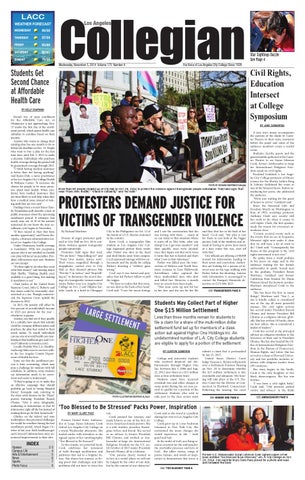
More than 60 people showed up at City Hall on Oct. 26, 2014 to protest the violence against transgender people nationwide. They held signs that read “Trans lives matter,” “Stand in solidarity,” and “No hate.”
PROTESTERS DEMAND JUSTICE FOR VICTIMS OF TRANSGENDER VIOLENCE By Richard Martinez
Dozens of angry protesters gathered at City Hall on Oct. 26 to condemn violence against transgender people nationwide. Protesters held signs that read, “We are here,” “Stop killing us!” and “Trans lives matter, justice now.” Their voices, magnified through a megaphone, carried over to City Hall as they chanted phrases like “Put the ‘t’ in justice,” and “Stop killing us,” to denounce the recent slayings of a transgender woman named Aniya Parker near Los Angeles City College on Oct. 2 and Filipina Jennifer Laude in a hotel in Olongapo
City in the Philippines on Oct. 12 at the hands of a U.S. Marine stationed in the country. Kerri Cecil, a transgender film student at Los Angeles City College organized protest three weeks after Parker was shot in the head and died blocks away from campus. Cecil expressed outrage with law enforcement and the media for calling Parker’s shooting a “robbery gone wrong.” Cecil says it was hatred and prejudice that led Parker’s killers to pull the trigger. “We have to realize that this woman was shot in the back of her head,” Cecil said. “I saw the uncut footage
and I saw the conversation that she was having with them … many of us can relate to that situation where it starts off as ‘Hey baby, what you doing? Can I get your number?’ and then quickly, once we’re clocked, once they figure out that we’re trans it turns that fast to hatred and that’s what I saw in that videotape.” Parker was killed near the intersection of Melrose and North Kenmore avenues in East Hollywood. Surveillance video captured the three unidentified men who shot and killed her. However, a month later no arrests have been made. “That man came up and hit her in her face and she ran for her life
and they shot her in the back of her head,” Cecil said. “My plea is just for them to just look at the bigger picture, look at the numbers and instead of having to prove how much of a hate crime this was, start off with that.” City officials are offering a $50,000 reward for information leading to their arrest and conviction. Authorities are looking for a person of interest seen on the tape walking with Parker before the shooting. Anyone with information is encouraged to contact the Rampart Homicide detectives at (213) 484-3623. SEE TRANSGENDER PAGE 8
Students May Collect Part of Higher One $15 Million Settlement Less than three months remain for students to ¿ OH D FODLP IRU D VKDUH RI WKH PXOWL PLOOLRQ GROODU VHWWOHPHQW IXQG VHW XS IRU PHPEHUV RI D FODVV DFWLRQ VXLW DJDLQVW +LJKHU 2QH +ROGLQJV ,QF $Q XQGHWHUPLQHG QXPEHU RI / $ &LW\ &ROOHJH VWXGHQWV DUH HOLJLEOH WR DSSO\ IRU D SRUWLRQ RI WKH VHWWOHPHQW BY CLINTON CAMERON
PHOTO ILLUSTRATION BEATRICE ALCALA
College and university students who received financial aid disbursements through Higher One Inc. between July 1, 2006 and Aug. 22, 2012 may share in a $15 million class action settlement fund. Students must have incurred overdraft fees and other charges at some point during the six-year period to qualify for a portion of the settlement. Students who wish to take part in the class action must
‘Too Blessed to Be Stressed’ Packs Power, Inspiration BY MARY CLARE PACE Former United States Ambassador at Large Suzan Johnson Cook visited Los Angeles City College on a warm Wednesday afternoon. She traded smiles with attendees as she signed copies of her autobiography, “Too Blessed to Be Stressed.” In this simple, yet powerful book, Cook celebrates her testament of faith through meditations and pathways that led to a brighter future. She shares her journey as living proof that challenges and life’s problems did not have to stress her
out. Cook penned her journey, and made history as one of the first African-American female pastors. She is a wife, mother, preacher, theologian, writer, and friend. She served as an adviser to former President Bill Clinton, and worked as Ambassador-at-large for International Religious Freedom for the U.S. until October of 2013 under President Barack Obama, all in a lifetime. “Our parents [have] wanted us to live in a world where we will not be judged by the color of our skin, but by the content of our character,”
Cook said as she stood at a podium during her visit to Los Angeles City College. Cook grew up in a one-bedroom tenement in New York City. She envisioned the many changes she would experience in life – both good and bad. In the midst of it all, one thing remains constant for the ambassador: the inevitable presence and love of God. She offers stories, songs of praise, hymns, and words of inspiration to demonstrate that stress is SEE ‘TOO BLESSED’ PAGE 6
Former U.S. Ambassador Suzan Johnson Cook signed copies of her book entitled “Too Blessed to be Stressed,” at L.A. City College on Oct. 20, 2014. Cub reporter Mary Clare Pace posed for a photo and read and reviewed the book
2
OPINION & EDITORIAL
Los Angeles Collegian — Wednesday, November 5, 2014
COMPILED BY Tomas Rodriguez PHOTOS BY Jorge Ponce
WHY IS THE STRUGGLE FOR CIVIL RIGHTS STILL IMPORTANT?
DANIEL ORTIZ Computer Science
KENYA VILLA Music
ROBERT SMITH Nursing
JESSICA GONZALEZ-LECHER Computer Science
“I feel like Hispanics get treated differently. When people address us, they think right away that we are all Mexicans. I get offended when people think right away I am Mexican. It is just one of the things that is happening all over the nation.”
“People are still fighting for equality in social and economic situations, but I feel like the media influences many people to take into consideration different ideas at different times.”
“Too many people are holding on to the past. Everything has become an even playing field. However, people are still holding on to excuses rather than working harder to achieve their goals.”
“Women’s rights are still an issue. To this day I still see it. For me, I am a half-Hispanic woman and if I go into a job interview, males have the greater chance of getting the job, just because I am a woman.”
EDITORIAL
STAND UP, SPEAK OUT, DO SOMETHING SOCIETY’S STRUGGLE FOR EQUALITY REMAINS
ILLUSTRATION BY JOSE TOBAR
Every day brings another opportunity for growth. Look around: at the person sipping coffee, reading a book or having a quick bite to eat while rushing to class. Notice the differences. Someone once said that what makes you special is being a part of something special. This campus is a unique place. We are surrounded by groups of diverse people who connect at L.A. City College to grow and learn. Just two weeks ago, the campus community gathered at the Camino Theatre for an inspired speech by Suzan Johnson Cook, former United States ambassador at large for international religious freedom. She spoke to the audience about the ongoing struggle for equality in the U.S. The civil rights movement in the 1950s and ‘60s defined a generation. The battle rages on in the trenches of Los Angeles. Looks can be deceiving here at City College. Bigoted statements uttered by fellow students provide proof. Recently, on this very campus, a student made fun of another stu-
dent’s learning disability. He called the other student “retard.” This is bullying and should inspire rage. No student has a right to ridicule or demean another student for his or her challenges or limitations. Nearly half of all hate crimes are motivated by the victim’s race, according to last year’s “Hate Crime Report” published on the FBI website. Close behind; hate crimes based on the victim’s sexual orientation amount to 19.6 percent. These are only the reported cases. Talking about someone’s race, ethnicity, sexual orientation, religion or disability in a derogatory manner is a gateway to hate, and hate can lead to violence. Three unidentified men killed a transgender woman named Aniya Parker, just blocks away from campus one month ago. Many members of the LGBT community believe gender identity prejudice led to Parker’s murder. The civil rights movement came at a time where there was a need for equality, but equality is still lacking in our society. Students have the power to end injustice. Speaking out
for others and standing for integrity are ways we can make the future better. Like what occurred on Sunday, Oct. 26, when people rallied in front of City Hall by the dozens, in unison, to protest the killing and mistreatment of transgender men and woman throughout the country. That is the America people should strive for, one in which individuals take it upon themselves to stand up against injustice. No one should have to live in fear or with ridicule. City College, wake up. Take responsibility. Speak out and take a stand against those who spread bigotry and hate. Lutheran Pastor Martin Niemöller said it best when he visited Dachau Concentration Camp in 1945: “First they came for the socialists, and I did not speak out, because I was not a socialist, then they came for the trade unionists and I did not speak out, because I was not a trade unionist. Then they came for the Jews and I did not speak out, because I was not a Jew. Then they came for me and there was no one left to speak for me.”
HAVE AN OPINION? A STORY IDEA? WRITE A LETTER TO THE EDITOR CONTACT: rmartinez.collegian@gmail.com 323.953.4000 ext. 2831 Letters may be edited for brevity.
Yes Means Yes? Finishing BY BARBARA PLANEK California students now have an extra resource to combat sexual assault in Senate Bill 967, also known as the “Yes Means Yes” law. However, the policy’s “affirmative consent clause” is ultimately unenforceable and potentially costly. The law concedes that universities and colleges receiving state funds for financial assistance of students must put into place a policy addressing sexual assault, domestic violence, dating violence and stalking of another student both on and off campus. All parties involved must give “Affirmative consent”. It must be unambiguous and ongoing throughout sexual activity. This is where the problem lies. Unless every sexually act is recorded, from beginning to end and both parties continually confirm consent, how can consent be proven? This new law is the result of various universities and colleges reportedly mishandling sexual assault cases.
These educational institutions are now under investigation. To address this issue, a portion of this law says that institutions must adopt policies to take proper reports, preserve evidence, do proper investigation and receive proper contact information both on and off campus. These policies will assist in the training As it always should have been, the new law will ensure that an outreach programs be part of student orientation. I have issues with the vocabulary used in this law. The bill’s use of the word “victim” assumes the guilt in thee accused. That is not how our laws work. Supporters of SB967 have said that the law will serve to better define consent and rape. It will also provide a universal standard for reporting instances of assault and more assistance to victims by providing access to counseling and advocacy. “Yes Means Yes” is a great slogan for an anti-rape campaign but not a law. Rape is horrible no matter who it happens to. “Affirmative consent” is not the answer. We are talking about college students and sex. They are not going to stop and confirm consent. The problem of he said/she said would remain. The law should only included support and education for potential victims and survivors.
Trash on Campus: The Issues of Littering Around Campus BY: CARLOS MARTINEZ Barrier surrounds the campus daily. Not made of wire, this barrier contains trash and cigarette buds left by students. Everyone, including students and faculty, at Los Angeles City College is responsible for our campus’s image. We should keep it clean so that the college has a reputable environment. I am sure everyone would enjoy having a well-maintained college campus. Thanks to the cleaning personnel at LACC, we are on our way. However, it is also our duty as students to do our best to keep it that way. Unfortunately, a normal day at LACC consists of seeing a variety of trash throughout campus, especially on Willow Brook Avenue. There is everything from unfinished containers of food, cigarette butts and old
rags of clothing. I know that there are homeless people who roam the streets surrounding LACC, but we should not put the blame on them. As students, we need to realize the directed impact. Every time we toss something on the ground, because we are too careless to dispose of it, we are contributing to the pollution of our environment. This is affecting and lowering the standards of the student’s campus experience. We need to take care for our college campus in a more proactive manner. One possible solution is a “campus cleaning” day, organized by our Associated Student Government. Every student on campus should be encouraged to pick up trash and maybe even rewarded with things such as store discounts and book fees. However, that would only be a temporary solution to what seems to be a never-ending problem. Students should start thinking about disposing garbage in the correct places. If we all show a little effort, we, along with the college’s janitorial staff, can ensure that, our campus will shine brighter than the sun.
College, 20 Years Later BY DELL CHARBONNET Remembering that precious time in life, where one felt free and control of their destiny. Where did it go? What went wrong? As a recent high school graduate, with a newfound zest for life and responsibility, I embarked on a journey for knowledge and enrichment that brought me to community college. Venturing into unfamiliar territory, where I was no longer under the prying and watchful parental eyes. I was getting a realistic taste of how it felt to be the master of my own universe. The possibilities were extremely exciting. Unlike high school where everything is very structured and predictable, similar to the work force, I felt very free and grown up. I researched the market and figured out my profession. Together with my counselor, we formulated an educational strategy. I picked courses in the order of most interesting to not so much. I felt free. I did not have much to worry about except going to class and letting my efforts do the talking. I was studying what I was passionate about, regardless of other’s opinions. Tragically, after my first two years in college, I learned my girlfriend was with child. Feeling the needed to take responsibility and provide for this child, I dropped out of school and joined the military, an epitome of not being free. Drill sergeants broke me down to the infant stages of my core with their constant yelling and barking orders. Only to build me into a lean mean fighting machine. Those memories of being free were not distant memories. I began earning a private’s modest wage, also, acquired monthly bills. Further separating me away from my goal of a college degree and eluding the feeling of being free. After surviving a grenade blast during the Persian Gulf War, “Operation Desert Storm,” I was able to come back and regain the freedom I once lost. Now, at 40, I am back in school and regaining the elusive feeling, I have sought after since the early 90’s. Planning to acquire my bachelor degree of Arts in Sociology, I start a new chapter in life, hopefully a better one. The feeling being free is great and rewarding. All thanks to the obnoxious Career College commercials that come after the Maury show and right before Jerry Springer.
OPINION & EDITORIAL TODAY AT CITY
ILLUSTRATION BY JALEEN WEDLOW
Overcoming Obstacles an International’s Perspective BY: ELBEGSAIKHAN DULGUUN Switching from a high school environment to a college campus lifestyle is challenging for freshman and especially for international students. First couple of weeks, students sp ends countless hours paying fees, meeting with counselors and adding or dropping classes. We also spend h o u r s studying and doing homework. However, in my high school no one taught us how to apply to colleges, how to make appointments with counselors. In addition, I never understood the concept of taxes. What are taxes and how do they work? All these challenges are difficult for incoming freshman who went to school in the United States. However, no one takes into account how complicated this is for international students. The education system opportunities in my country, Mongolia is limited, forcing me to study elsewhere. Luckily, I acquired chance to study in the United States I worked hard to get my student visa so I could enroll at Los Angeles City College (LACC). However, the process is challenging. My parents will spend more than $20,000 for my two-year degree. Being an international student is expensive. For international student, it is hard to interact with students who were born in the U.S. When I try to write an essay, it is hard. It would be easier to get straight as on my essays if I was able to write in my own language. Unfortunately, that is not the case. Another complication coming with the tuition fees, primarily the difference between out-of-state residential and foreign citizen tuition fee. For instance, international students pay more than $4,000 each semester while someone who is a resident pays only $500 per semester. There is also no guarantee for international students to get free books from bookstores. There are many things to complain about life, as an international student. However, I committed to doing my best to get excellent grades, keep on moving forward and chase my dreams.
Should eBooks Become Mandatory? BY: JIMMY MARTINEZ As a returning Los Angeles City College student, I have learned that college can definitely take a toll on finances. When I attended L A C C my first semester, I remember spending almost $500 on the books I needed for my classes. Since I only used one of the four textbooks I bought that semester, most of the money I spent was a waste. By the end of the semester, I felt ripped off and cheated. The only hope I had was selling my textbooks, but I only got around $200 in return, less than half of what I paid. The following semester, I avoided making the same mistake by only purchasing my math textbook. I knew that it was the only subject where I needed a physical copy. For other books, it was cheaper to buy or even rent an eBook. I showed up to class on the first
day, with my eBook loaded onto my laptop. That is when my professor asked me to put my computer away. The professor did not allow electronics during lecture; including tablets, kindles and computers. I knew it was partially my fault for assuming the professor allowed eBooks in the classroom. However, I still could not see the logic in banning such useful tools. What was even more illogical was the fact that there was no wireless signal in his classroom. I ended up shelling out the extra $100 for a physical copy of the book and again I felt ripped off, this time for buying the same book twice. This semester however, I was actually encouraged by one of my professors to buy the eBook instead of the physical copy. So far, I have had zero problems with doing so. I only paid $20 to rent a digital copy of my textbook, and I feel relieved knowing that I will not have to worry about selling anything or sending anything back. It is a lot easier for me to type out notes on one side of my computer and continue reading on the other. Renting eBooks is definitely cost-effective and I recommend it to everyone -- that is, if your professor allows it.
Los Angeles Collegian — Wednesday, November 5, 2014
3
Liberation From Smokers, Addiction BY: ANGIE RIVERA OLMEDA Students find themselves in the front, back and side of the college sneaking a puff, almost segregating t h e m selves from the smokefree zone. Sm ok i ng is a health hazard, especially for people that are not smokers. On Monday June 16, 2014, Los Angeles City College became a smoke-free campus. This policy may encourage students and faculty to keep in mind healthier habits. Another positive effect is that the campus is cleaner than every before. Enforcing this policy helps influence a non-smoking environment, possibly helping to prevent a lifetime of smoking. On January 11, 1964, Luther L. Terry MD Surgeon General of the U.S. Public Health released the first report concluding that cigarette smoke is a cause of lung cancer. Fifty years later, its important to consider the facts, a non-smoking campus is a step forward. For instance, according to ‘thetruth.com’, “Over 36,000 people die
each year from cancer other than lung caused by smoking. Only 9% of teens smoke, that is down from 23% in 2000. The tobacco Industry spends more than $24 million each day marketing its products in the U.S. alone”. Now to see the numbers of teen smokers lowering every year is amazing. Encouraging college students to reduce their smoking habits, may have a strong impact on the new students attending the campus next year. Alternatives to smoking are always available. Keeping your hands busy during breaks by using a Rubik’s Cubes, writing, reading, or even origami will help strengthen your brain, unlike smoking. Furthermore, the money one saves soon after the habit of smoking will quickly adds up. Rewarding yourself to a nice treat is a good idea. One is not alone in the battle against smoking addiction. Asking for help and support from your family or loved ones to quit smoking is admirable. Los Angeles offers plenty of way to quit smoking. Taking the first step towards a healthier future will enrich you energy, time and wallet. Sooner than later, society will face the facts, health is most important and by applying restrictions on school campuses to reduce health-damaging routines. This is when the world will advance in true wealth.
SAFETY APPS, TAKE NOTE
Collegian Media Arts Department, Chemistry 207 Los Angeles City College 855 N. Vermont Ave. Los Angeles, CA 90029
Editor-in-Chief Richard Martinez Graphic-Layout Editor Beatrice Alcala Multimedia Producer Dave Martin Frank Vidrio Opinion/Editorial Tomas Rodriguez Sports Kevin King Graphic Designers Beatrice Alcala Illustrators Jose Tobar Jaleen Widlow Photo Editor Jorge Ponce Photographers Jessica Brecker Curtis Sabir Reporters Byron Umana Bermudez Clinton Cameron Jessica Brecker Gloria Lee Tomas Rodriguez Lorenzo Quintana Krystle Mitchell Lynn James Kenneth Jara Cheyenne Finch Jake Camarena Kelly Chapman Kevin King Advertising Staff Clinton Cameron Adviser Rhonda Guess
Eliminating the ‘Catch-22’ of School Tuition BY CURTIS SHINGLETON Ever rising tuition costs combined with a competitive global job market have joined forces to place prospective college students in a “Catch 22.” The cost of your future career and goal comes with an endless price. T h e phras e “Catch-22” refers to a novel, written by Joseph Heller, explaining an e x a sp e r a tion situation where rules are against you and causes entrapment. After finishing high school, the traditional route of college enrollment leads many students buried under substantial debt from tuition. Tuition costs only seem to be escalating at a quicker pace than other positive economic sections as income growth, leaving students at an immediate financial disadvantage after college graduation. Students have a dimmed future in their career and economic success. Combine this financial albatross with the competitive job market and students feel the pressure to take on enormous debt, in pursuit of higher education. Many students who cannot afford to take on such debt and those who do not excel enough academically to qualify for scholarships can take another career route. Vocational and
trade schools offer a viable alternative to a college degree. These students gain valuable skills in a particular field or trade. However, it is somewhat of a trade off, with the hope that it will eventually offer them quicker access to earning an income. This route can leave many without critical intelligence skills and knowledge essential to furthering one’s education. Nevertheless, merely having employment can also offer personal growth. For some students, such as myself, the specter of massive debt forced me towards the second route. By covering my tuition out of my pocket, it has enabled me to earn a degree without the frustration of mounting debt. I am less likely to settle for just any employment out of need to pay off future debt payments, but at a steep price. Acquiring that degree much later on can ensure the financial freedom from possible student loan debt. Students should not have to be stuck with such extremes when it comes to furthering their education, to address spiraling tuition their needs to be a more humane approach. We owe students and children the opportunity for a solid education as possible. It is critical that we expand that opportunity on bringing tuition back down to an affordable level for everyone. That alone will guarantee us a leadership role and success story for the rest of the world and afford us unlimited potential in this 21st century.
ILLUSTRATION BY JALEEN WEDLOW
BY KELLY CHAPMAN As both a resident of East Hollywood and Los Angeles City College student, a recent string of murders in the 90029 zip code are cause for a significant level of alarm. Ru mbl i ng sounds of police helicopters overhead-though ubiquitous in the area and certainly nothing new— create a newly harried version of myself as I go about my life. These days more than ever before, I watch my back. Our campus sits squarely in the middle of 90029 and has an open layout. Almost anyone can enter and leave as they please. Despite the presence of the sheriff ’s department, a 100 percent, fully secure campus is nearly impossible to achieve. In light of recent events, students might want to remember that point. Security resources are available on campus, but it is important that students know exactly what they are and how to access them. Putting an emphasis on awareness, a professor of mine once began the semester by writing the sheriff ’s number on the board. She waited until every student plugged the number into their phones before she started the first lecture. That num-
ber is (323) 662-5276, the sheriff ’s department can also be reached by dialing #3 from any campus phone. This was a smart tip on her part. She mentioned that when on campus, a call to the sheriff ’s department is more direct than dialing 911. It can actually initiate a faster response time. For further information about emergencies on campus, students are encouraged to download the Emergency Notification portal app. This service— which is already available to every student and faculty member via email— delivers push notifications to app subscribers. Links for the signup and app download are located on the campus safety website: http://www.lacitycollege.edu/citymain/aboutlacc/ campus-safety.html From what is usually a packed and populated space during the day, at night LACC’s atmosphere changes. With far less students on campus, it can feel desolate. Walking along the nearly empty quad one night, a sense of insecurity prompted me to research security applications on my phone. After some reading I downloaded TrackerAssist. This app enables the user to contact authorities with the push of a button. Help can then locate you by way of global positioning technology. National reports aiming to provide transparency about crime on every college campus and its surrounding area are available via the Clery Act. Statistics for LACC can be found on the campus safety site.
Deadline Schedule NEXT ISSUE: November 19, 2014 Editorial deadline: November 14, 2014 For all submissions including letters to the editor and publicity releases send materials to Collegian office: Chemistry 207 losangeles.collegian@gmail.com For all insertion orders and advertising questions. Email: pr.collegian@gmail.com The college newspaper is published as a learning experience, offered under the college journalism instructional program. The editorial and advertising materials published herein, including any opinions expressed, are the responsibility of the student newspaper staff. Under appropriate state and federal court decisions, these materials are free from prior restraint by virtue of the First Amendment to the United States Constitution. Accordingly, materials published herein, including any opinions expressed, should not be interpreted as the position of the Los Angeles Community College District, Los Angeles City College, or any officer or employee thereof. Collegian © 2014. No material may be reprinted without the express written permission of the Collegian.
FOR THE RECORD In the Arts & Entertainment section of the Oct. 8, 2014 issue of the Collegian, the photograph used for the article “Professor Captures Time, Space,” was published without giving credit to the photographer. The photograph was courtesy of Luca Loffredo. We regret the error.
4
CAMPUS LIFE
Los Angeles Collegian — Wednesday, November 5, 2014
FOOD FORWARD PICKS UP GROCERIES FOR STUDENTS
STAR SIGHTINGS ON CAMPUS
By Ekaterina Garbuzova
PHOTO BY JESSICA BRECKER/COLLEGIAN
Anthropology professor Brian Bartelt peers through cardboard viewing glasses during a partial solar eclipse on Oct. 23, from the roof of the Science and Technology Building. Over 100 students and faculty members crowded onto the roof to view the eclipse safely with the help of the Astronomy Club.
Solar Eclipse Attracts Stargazers to Astronomy Club Viewing Party By Jessica Brecker More than 100 students and faculty members stood transfixed as they watched a partial solar eclipse lasting more than three hours from atop the Science & Technology Building on Oct. 23. Three-year-old Benjamin Centeno gazed with wonder at a sight he may well remember for years to come. “He started smiling right away as soon as he put these glasses on,” his mother, Violeta Centeno, said. The Los Angeles City College Astronomy Club organized the event and set up four telescopes and handed out special cardboard glasses to attendees upon arrival. “These are our old Celestron eightinch Schmidt Cassegrain telescopes, and they have this nice solar filter on the front,” said Dean Arvidson, an astronomy professor at LACC. “We have that smaller hydrogen alpha filter solar telescope, that’s actually our best one; you can see the prominences and other features. Then we do the solar projection viewing with
the six-inch Newtonian reflector [telescope].” A solar eclipse results as the moon passes between the Earth and sun. When this happens, the sun can be partially or totally obscured by the moon, depending on where the viewer is standing on the Earth’s surface. “The moon’s curve that’s blocking the sun, if you look carefully through the telescope, you see that it’s not a perfectly smooth curve; it’s slightly jagged,” Arvidson said. “That jaggedness is certain features on the moon. The moon has mountains. The silhouette of the moon shows the little mountains and valleys, a very interesting feature to notice.” While at the eclipse-viewing party, anthropology professor Brian Bartelt gazed up at the sun through cardboard glasses, seemingly in awe. However, he has witnessed something more rare before – a total solar eclipse. “I was in Guadalajara in 1990 for the total solar eclipse, and that was awesome,” Bartelt said. “That was re-
ally incredible; it was exactly in the middle of the day, so it was bright, and then completely dark for a couple minutes. We are all on the rooftops, and everyone starts going crazy, and you hear all these sounds, and parties, and everyone [is hollering] ‘woo!’ and then [the light] starts to come back again. So I did experience that. It’s a little different from this, but I think this is great what the Astronomy Club is doing, just fantastic.” For attendees who looked through the telescopes, it was impossible not to notice a huge dark spot on the sun that had nothing to do with the moon. “[It] means probably that all life on Earth will be destroyed in the next week or so,” astronomy professor Paul McCudden jokingly said. “No, it doesn’t mean anything. Sunspots are just [a] cool spot in the surface of the sun where very strong magnetic fields suppress the heat in a way that keeps those areas a little cooler, so they appear darker. The sun goes through regular cycles of lots of sunspots and fewer sun-
spots, and that doesn’t seem to have any clear correlation to climate or weather.” He explained the sun has huge magnetic fields inside it and they “swirl around” and pop through the surface causing the spot. “It’s a regular 11-year long cycle, from [a] quiet to noisy sun … It’s nothing unusual,” McCudden said. Speaking of cycles, will young Centeno see a total eclipse in his lifetime? The answer is no, not unless he travels outside of Los Angeles to see it. According to NASA, the last total solar eclipse visible from Los Angeles occurred in 1724 C.E. and the next will occur in 2121 C.E. However, it might be worth traveling for a “total” solar eclipse, which will completely cover the sun’s light on Aug. 21, 2017. It will be visible in Oregon, Idaho, Wyoming, Nebraska, northeastern Kansas, Missouri, southern Illinois, western Kentucky, Tennessee, and South Carolina. The LACC Astronomy Club meets every Thursday at 4 p.m. in Science & Technology Building, Room 208.
CITY TURNS OUT TRICKS, TREATS Left: Daniel Marlos, chair of the media arts department at Los Angeles City College seen here dressed as Ebola “in- fects” astronomy professor Dean Arvidson at the Astronomy Club’s Pre-Halloween Night at the Quad on Oct. 30. Above: Los Angeles City College President, Renee Martinez looks through “The Webster,” on Oct 30 during the Astronomy Club’s Pre-Halloween Telescope Night on the Quad. The telescope’s 28-inch mirror is the largest in the Los Angeles Community College District. PHOTOS BY JESSICA BRECKER/ COLLEGIAN
SCAN QR CODE
FOR MORE COSTUMES AND DIA DE LOS MUERTOS PHOTOS or visit
www.collegianwired.tumblr.com
Food Forward is a nonprofit food recovery program that works with 12 different farmers markets to distribute food throughout Los Angeles. Volunteers collect produce from vendors that would otherwise be thrown away. Vendors that participate in the Food Forward program receive a tax break for their donation. According to Resource Center Manager Heidi D. Johnson, the program gives away 500 pounds of organic, fresh fruits and vegetables every Sunday at the Student Union. Participants can take as much food as they want. She says they never have food left over. Johnson and Los Angeles City College Foundation Director Robert Schwartz worked together to bring the Food Forward program to LACC last semester. During the summer months, the program gave volunteers gas and Target gift cards as an incentive to continue working to hand out food at the Student Union. “I have a phenomenal volunteer staff that I am always looking to increase, especially with drivers,” Johnson said. “With the volunteer
team, we are able to actually be of service and give back to community every Sunday.” At their weekly produce giveaways, volunteers get first pick. Associated Student Government members go next, followed by members of the community. “[Johnson] had an idea and it kind of sprouted,” said Brandon Wagoner, a volunteer at the Food Forward program. “She said ‘You know what? I want to create a program that is [going to] give out food for those that are in need’ … People come from all around the community to get fresh food, fresh produce and to see it being done and see the smiles on people’s faces as they walk away is amazing.” Attendees are encouraged to bring a reusable bag to carry the produce they will take home with them. The Food Forward program gives away food every Sunday at 3 p.m. in front of the Student Union. Students who are interested in volunteering for the program can speak with Johnson at the food giveaway. “You feel good, because you are making a difference in peoples lives,” Johnson said. “We are like a family here.”
Street Poets Host Open Mic on Vermont Avenue It’s Wednesday afternoon. While some students rush to a bus stop or the train station near campus, others are on their way to class. Those who stop for a cigarette break away from the smoke-free campus have something to watch – a spontaneous open-mic poetry session hosted by the group Street Poets. By Clinton Cameron A white L.A. County Sheriff ’s patrol car slows down between Normal and Vermont avenues. After one glance at a small gathering of poets, the officers continue south. Street Poets Inc. are at it again. On Wednesday, Oct. 22, they occupied the sidewalk 20 feet from Los Angeles City College’s free speech area for the third time this year. Jaynese Poole is a cinema major at LACC. She works the soundboard. Cameron Swift from Santa Monica College and Arturo Quiros take turns as the master of ceremony. Despite their impromptu arrival, the skeleton crew of poets appears in uniform. DJ Keith Morgan from Mount Sac Community College sets up using their van as a backdrop. The logo on the side of the vehicle matches the front of their T-shirts. It reads, “Street Poets” and resembles two corners of a building with the abbreviation “Inc.” as the sidewalk. On the back, their shirts read “Meta-phors Be With You.” “We’re a non-profit organization that uses poetry as a tool for transformation,” Quiros said. “We’re trying to take [poetry] to different places where maybe you won’t see poetry on the streets. Now, we have the Poetry in Motion Van where we go to different sites every week and we basically engage the community through poetry.” Quiros estimates they have had the Poetry in Motion Van for two years. This helps them visit more places within the larger Los Angeles community. During the afternoon, Quiros’ schedule shows visits to Freemont High School, East L.A. College and Camp Fred Miller for workshops or performances. They have also taken their brand of poetry around the world. “We’ve gone to Belize,” Quiros said. “We’ve gone to Navajo reser-
vations, Apache reservations and worked out there.” Today, Street Poets Inc. hosts eight poetry events or more per year at Eco-LogicalART Gallery in Los Angeles. They also run weekly workshops twice a week during the afternoon. At LACC, they welcome rappers, poets or anyone with something creative to say to participate. By 2:30 p.m., close to a dozen people responded to the Street Poets’ impromptu, guerrilla-style open-mic tactics. Leil Steinberg, a LACC music major, was one of them. “I heard the beat. I just walked by,” Steinberg said. She is no stranger to performing poetry. Steinberg performs regularly at Da Poetry Lounge at the Greenway Court Theatre on Fairfax Boulevard. On Vermont Avenue, she showed off her skills to the sidewalk audience. “Be-impeccable, respectable, if you sit in silence your noth’in but a vegetable. Liv’in loud your CDs become collectible,” she said. A white board and markers for participants sat a few feet from the sound system. It’s another way for the community to participate. There were six comments on the “community board” written in various colors. “We start off with a starter line,” Quiros said. “We ask everybody to add one line and then we have a community poem after that.” Participants left the open mic with writing pads for poetry, CDs and information about Street Poets, and inspiration to create more poetry. Street Poets Inc. is located at 2116 Arlington Ave. Suite 310, Los Angeles, CA 90018 (323) 737-8545. Street Poets Inc. is a 501(c)(3) non-profit organization. Donations to the organization are tax deductible. For more information and free downloads visit their website www. streetpoetsinc.com.
FOLLOW THE THREAD COLLEGIAN WIRED MULTIMEDIA JOURNALISM
www.youtube.com/CollegianWired
ARTS & ENTERTAINMENT
Los Angeles Collegian — Wednesday, November 5, 2014
5
PHOTO BY CURTIS SABIR/COLLEGIAN
3URIHVVRUV &KULVWLDQ 6WHQGHO RQ WKH SLDQR DQG 'DYLG 6WDKO RQ WKH à XWH perform a selection for Los Angeles City College’s music department faculty concert on Oct. 24, 2014. The music department hosts a faculty concert twice a year in an effort to raise funds for student scholarships.
‘INGLOURIOUS BASTERDS’ Composer Talks Hollywood
PHOTO BY JESSICA BRECKER/COLLEGIAN
0RUH WKDQ PXVLF DQG Ă€ OP VWXGHQWV DWWHQGHG D PDVWHU FODVV E\ Ă€ OP FRPSRVHU &KDUOHV %HUQVWHLQ RQ 2FW LQ 'D 9LQFL +DOO 5RRP Bernstein is known for his work in classic horror movies like “Nightmare on Elm Street,â€? and Stephen King’s “Cujo.â€? BY JESSICA BRECKER Students sat at the edge of their seats as esteemed composer Charles Bernstein addressed them in a “master classâ€? hosted by the music department last month. The mastermind behind the film scores of classic horror films such as Wes Craven’s “A Nightmare on Elm Street,â€? Stephen King’s “Cujoâ€? and Quentin Tarantino’s “Inglourious Basterdsâ€? also took the opportunity to pay homage to Leslie P. Clausen, a former professor of his. Clausen taught music at Los Angeles City College from 1931-1972 and worked as department chair during the last 26 years of his career. He also organized the weekly concert series in 1932 -- a series that exists today as Music 152. Bernstein told the audience it was at City College that he learned what his strengths and weaknesses were and where his passion lay. “[Clausen] instilled in us incredible musical tools,â€? Bernstein said. “He would bring in working men and women from Hollywood and was able to integrate [a student] into a career.â€? For Bernstein, this was the key to educational success. “It did everything for me,â€? Bernstein said. “I have been carrying around a student debt. I owe a real debt.â€?
Bernstein said that it is not necessary to go into debt to get an education. He said he learned as much at City College as he did at the University of California Los Angeles and Juilliard. At the top of his presentation, Bernstein showed a scene from Stanley Kubrick’s “2001: A Space Odyssey� in which actress, Heather Downham retrieves a pen floating sans-gravity while aboard a spinning space station. Bernstein played the scene with three different soundtracks to illustrate the concept of gravity in music. The audience, he explained, would be unsure of the tone of the scene and the emotions involved if not for the appropriate musical soundtrack. The first track Bernstein used was from the film “Star Trek,� composed by Jerry Goldsmith. The second track he played was atonal, which conveyed a sense of dread. Then, he played the actual music Kubrick used in the film. The audience immediately recognized “The Blue Danube Waltz,� written by Johann Strauss II in 1867. It ground the audience, because they knew it. The scene is set in an unknown, unfamiliar future and literally has no gravity. According to Bernstein, this is precisely why the waltz works so well. Bernstein took the opportunity
to point out that Goldsmith also attended City College. Goldsmith won an Academy Award for scoring “The Omen� in 1976. Known for scoring most of the “Star Trek� films and television shows, Goldsmith worked on other films like “Gremlins� and “Planet of the Apes.� In such esteemed company, it is easy to understand why Bernstein is so grateful to LACC. He said he had to learn how to write lyrics, and claims he owes special thanks to his English professor. “If it wasn’t for Otis Dunbar Richardson I would not have known how to write sentences and get my idea across,� Bernstein said. Richardson was the English department chair at LACC. “I’m interested in the fact that some of you will go into this world and find your way,� Bernstein said. He then explained to students the importance of the collaboration between film and music. Most composers love it if a director speaks to them as they would an actor, according to Bernstein. When Bernstein was finished talking he opened the floor up to questions from the audience. Many students wanted to know what to do after graduating from LACC. “Education goes on through your whole life,� he said. “Here you get your foundation, your tools.� He suggested studying in the
ALBUM REVIEW
‘HELL CAN WAIT’ FOR VINCE STAPLES BY JIMMY MARTINEZ
W
ithin the past 10 years, hip-hop has branched out from its original sound. While the ‘90s saw a rise in boom bap and gangster rap, today’s hip-hop is home to many diverse abstract artists, many of whom deviate from the genre’s roots. While this is certainly not bad by any means, it creates an audience of listeners who crave that classic gangster rap that seems to be missing in today’s music scene. Vince Staples is here to fill that void, with his seven-track EP “Hell Can Wait.� Staples talks about his past actions and the hardships he faced as a young, gang-affiliated high school dropout. The pictures he paints are grim and dark, but also perceptive and self-aware. Right from the first track “Fire,� Staples introduces his narrative with a harsh, abrasive delivery and a beat to match. It sets the tone for the rest of the album, but certain tracks like “Screen Door,� “Hands Up� and “Blue Suede� stand out among the rest. In “Screen Door,� Staples raps about his drug-pushing father and the paranoia he felt while under his roof. This took a toll on Staples. He slept with one eye open to catch the drug fiends lurking around his house late at night, as exemplified on the hook: “Who’s that peekin’ in my screen door? I got what you need, what you fiend for.� Things quickly spiral downward. “Pots on top of the furnace, glocks
on top of the kitchen, table-tables is turning, now my father is trippin’� Staples questions authority in “Hands Up.� He raps about police brutality against black people, referencing Deangelo Lopez and Tyler Woods, who were both shot and killed by police. He displays his lyricism on this track line after line, just like a modern day poet. He stays on topic and it shows. The production on this EP is amazing as well, equally matching Staples’ technical ability as a rapper. Most of the beats are minimalistic and rely heavily on bass and drums. However, production does change throughout the album, and the best example of this is on the EP’s lead single “Blue Suede.� Marvin Thomas, aka Hagler Tyrant produced more than half the songs on “Hell Can Wait,� including “Screen Door,� “Limos� and “Feelin’ the Love.� He is best known for working with Drake on his 2013 singles “Trophies� and “Furthest Thing.� However, “Blue Suede� is easily his best. The song starts with a highpitched, record-scratching sound followed by a hard-hitting heavy bass. The beat is in your face with a
gritty, crazy and nasty tempo perfect for lines like, “F-----, the face toothless, easy, and so ruthless. Ask where he from, then leave his dome roofless.� The EP does have its weak points, especially with “Limos.� The production on this song definitely stands out and the atmospheric beat choice is definitely a contrast when compared to other tracks. In the song, Staples raps about men and women who love for the wrong reasons. This is the only song that features his singing, but it comes across as forced, maybe due to the song’s subject matter. Staples closes up the album with “Feelin’ the Love,� a song in which he reflects on the choices he made throughout his life. He attributes his hunger for money as the motivation to join a gang as an adolescent. This song sums up the EP and makes it worth listening to. Records that deal with gang violence and struggle are a dime a dozen, but few rappers have the technical and poetic ability to pull it off like Staples. Everyone should look out for this up and coming artist. His next album is set to release sometime next year.
SCAN QR CODE
TO WATCH A VIDEO OF VINCE STAPLES’ “FIRE� Or visit Http://www.defjam.com/fire/
movie theater and watching certain films. He said he learned to conduct by going to the Hollywood Bowl in the mornings and watching conductors rehearse. He would also get film scores from studio libraries and study them. “Most people come out of film school woefully, unprepared with how to deal with music,� Bernstein said. “Just knowing what it is you want to say.� Other students wanted to know what to do if left stumbling in the dark. “Oh my god, I have no clue what to do,� Bernstein said. “Every time I finish a job I am out of work.� However, he said to value the important things and people in life. “Each of you in this room has something special, whatever makes you that unique being that you are,� he said. “Trust that. Get to know that.� After the questions were over, Bernstein took one last look around the room. “I have wanted to do this since I was sitting in these seats with Leslie Clausen.�
Faculty Concert Raises Scholarships BY KRYSTLE MITCHELL
M
elodies filled the night air as students, faculty, family and friends gathered at Los Angeles City College for the bi-annual “Music Faculty Concert.� The Music department organized a concert to help raise money for student scholarships. Performances included LACC’s talented musical staff. “Our students are our number, one priority. Without our students, we wouldn’t be who we are,� Music Department Chair Christine Park said. The music department’s mission is to prepare students for a four-year university by teaching them literacy, performance and critical thinking skills. One way to prepare students is providing opportunities to fund their education. Faculty held this concert in an effort to uphold this mission, as well as, encourage students to continue perfecting their musical talents. Faculty members performed musical selections for solo clarinet, piano and vocals. The performance
kept the audience engaged and in awe. Faculty members spoke about music selection, taught lessons about the musical pieces, and even shared their experiences. “I was sitting [here] listening to this concert and musing about growing old and hearing talent over the years is a marvelous experience,� stated Adjunct Faculty Member Wesley Abbott. Faculty members of the music department host the show every semester. This fundraiser helps students who struggle financially to continue their music education with minimal financial difficulties. The music department also has 33 adjunct faculty members who are dedicated and supportive. The members volunteer their time every semester to help students outside the classroom. All of the members have participated in “LACC Faculty Concert� throughout the years. In spring 2015, the concert will be in Clausen Recital Hall. To donate money to help students continue their musical education you can visit https://donate.laccfoundation.org/ donate
6
NEWS
Los Angeles Collegian — Wednesday, November 5, 2014
NEWS BRIEFS COMPILED BY JIMMY MARTINEZ
EMMY-WINNING PRODUCER VISITS LACC Emmy winner Dan Harmon, creator of NBC’s “Community� and executive producer of “Rick and Morty� on Adult Swim will be speaking at the Camino Theatre Wednesday from 7:30-9 p.m. Harmon will talk to students about how to break into the entertainment industry and pitch a television show. Panelists will also take questions from the audience.
‘BODY MILLENNIAL/ WHISPERED IN SILENCE’ EXHIBIT TO CLOSE THURSDAY Thursday is the last day of the “Body Millennial/Whispered in Silence� art exhibit. Students interested checking out the exhibit, can go to the Da Vinci Gallery Monday through Thursday from 12-3 p.m.
CAMPUS TO HOST A FREE RESOURCE FAIR FOR VETERANS, MILITARY FAMILIES Agencies that aim to provide assistance in housing and employment to veterans and military family members will meet on the Quad on Nov. 6 from 12:30-3:30 p.m. The event is free.
THEATRE ACADEMY PRODUCTION DEBUTS THIS MONTH Tickets are on sale for the Theatre Academy’s next fall production. “Anton in Show Business,� will open on Nov. 13 and run through Nov. 22 at the Caminito Theatre. Tickets start at $10 for students and are $14 for the general audience. For more information, visit theatreacademy.lacitycollege.edu.
SCAN QR CODE
TO WATCH AMBASSADOR COOK’S SPEECH or visit Http://youtu.be/YQHirXgg-BI
HIGHER ONE FROM PAGE 1
PART OF A $15 MILLION SETTLEMENT MAY BE AVAILABLE TO STUDENTS will decide whether to approve the settlement. Students can complete and submit a claim form online or obtain a print copy at www.OneAccountSettlement.com. Physical forms must be mailed to Higher One OneAccount Settlement, P.O. Box 1631 Faribault, MN 55021-1631, and be postmarked before Jan. 23 2015. Students who want to verify if they are class members in the lawsuit may call the claims administrator toll-free at 1-(877) 310-4642. Once the court approves the settlement, individuals who filed a claim will receive a cash payment in the mail. The amount of the cash payment will depend on the number and type of fees incurred, and the number of claims made against the settlement fund.
COURT APPOINTS COUNSEL TO REPRESENT CLASS ACTION MEMBERS The court appointed the law firms of Tycko & Zavareei LLP; Shepherd, Finkelman, Miller, Shah LLP and Gentle Turner Sexton DeBrosse & Harbison; and Jones Ward PLC to represent all class members. This “class counsel� will receive no more than 30 percent of the settlement fund in fees. According to the district court, Higher One used misleading policies and hidden fees to take advantage of college students in violation of Section 5 of the Federal Trade Commission Act. “Higher One has a track record of taking advantage of students, so the fact that this settlement will reimburse students for some of their losses at the hands of Higher One is heartening,� Christine Lindstrom, higher education program director at the U.S. Public Interest Research Group told the Collegian in an email. “However, the settlement does not issue lasting protections for the millions of students who are currently Higher One customers, so the U.S. Department of Education must step in to ensure students have permanent protection.� Higher One denies any wrongdoing, but has agreed to make some changes as a result of litigation. Higher One and its banking partners have agreed these changes will remain for at least two years following the settlement.
LAWSUIT PROMPTS NEW POLICIES AT HIGHER ONE Higher One will no longer open accounts for students without first receiving express consent to the fee schedule and account terms and conditions for Higher One accounts. They will also attempt to improve the “clarity and readability� of their fee schedule in accordance with the Pew Charita-
ble Trust guidelines for consumer checking accounts. Higher One will also simplify the process through which students transfer funds to their non-Higher One checking accounts. They will also eliminate a variety of fees on their OneAccount services.
COMPILED BY JIMMY MARTINEZ
UNKNOWN NUMBER OF LACC STUDENTS PAID HIGHER ONE FEES
10/14/14, 8:40 a.m. - Student sprained ankle near LACC Bookstore. A rescue call was made and an ambulance was dispatched. Report taken.
Nursing major Destiny Montelongo and her sister received their financial aid disbursements through Higher One at Los Angeles City College. When Montelongo began to receive financial aid in 2011, she says relatives and friends warned her about the fees she would accumulate if she continued to use the Higher One debit card. As a result, she had her financial aid funds transferred to her personal bank account. “I was told that it just takes about like four business days for it to go in to your card,â€? Montelongo said. “So, I just automatically sent it to my debit card ‌ rather than sending it to the ‌ Higher One card.â€? Although she did not incur fees for using her card, she recalls her sister ‘s experience with the controversial fees. “From what she told me, there’s a fee for every little thing,â€? she said. “When you slide the card there’ll be like a fee and that’s just like a waste of her money that she could be having for herself.â€? According to Laura P. Perry, a Rust Consulting Inc. representative for Higher One, the fees were not any higher than comparable accounts. Higher One says there is no merit to the accusations of hidden fees and other deceptive practices. “Higher One has entered into this settlement agreement in principle to avoid a lengthy and costly litigation process and to minimize business disruption in offering its valued services to students and institutions of higher education,â€? Perry told the Collegian in an email. Journalism major Luis Rivas attended Los Angeles City College from 2010 to 2012 when he began to receive financial aid. He claims he was aware of the fees and says they were excessive. “Every time we had to [withdraw] from an ATM that wasn’t Higher One we were charged a fee. It was probably 50 cents or something like that,â€? Rivas said. “I do know the charges were there and they were numerous, but small ‌ I try to read the agreements. They warned you. It’s just so inconvenient. All these charges just really add up.â€? For more information on the lawsuit against Higher One, the settlement, benefits and other legal proceedings associated with the class action suit, visit www.OneAccountSettlement.com.
10/14/14, 11:40 a.m. - Campus incident. Student reported someone was possibly following her near Jefferson Hall, Room 312. Report taken, pending investigation. 10/15/14, 3:45 p.m. - A lost property report was filed near the Business Office. Report taken. 10/16/14, 5:50 a.m. - Report of a student harassing another student in the bathroom on the first floor of the Student Union. Report taken. 10/16/14, 6:45 p.m. - Campus incident. Student makes other student feel uncomfortable in Da Vinci Hall. Report taken. 10/17/14, 9 p.m. - Campus incident. Employee lost cub card. Report taken. 10/20/14, 5:15 p.m. - A supplemental report was taken on a found bicycle. Bike was located at the bike rack near the East Theatre. 10/23/14, 7 p.m. – [An incident of] petty theft occurred on the second floor of the Kinesiology Building. Report taken. 10/24/14, 12 p.m. - Student incident occurred at Franklin Hall, Room 310. Report taken. 10/27/14, 7:30 p.m. - Student incident occurred at Jefferson Hall, Room 201. Report taken. 10/27/14, 9:24 p.m. - A strongarmed robbery took place on the fourth floor at the Staff Parking Lot. Report taken. 10/27/14 - 10/28/14, 5 p.m.8:30 a.m. - A burglary occurred on the first floor of Jefferson Hall. Report taken. 10/30/14, 3 p.m. - Campus incident on the second floor of the Communications Building. Report taken. 10/31/14, 11:10 p.m. - Campus incident. Employee is injured near the station. Report taken.
FOR THE RECORD In the Arts & Entertainment section of the Oct. 8, 2014 issue of the Collegian, the photograph used for the article “Professor Captures Time, Space,� was published without giving credit to the photographer. The photograph was courtesy of Luca Loffredo. A photo caption in the Arts & Entertainment section of the Oct. 22, 2014 issue of the Collegian mistakenly refers to the Camino Theatre as the “El Camino Theatre.� In the same issue, the article “Green Screening at Rideshare� in the Campus Life section says that Employee Transportation Director Vera Tylecek owns two cars. She does not. We regret the errors.
PHOTO BY CURTIS SABIR/Collegian
6X]DQ -RKQVRQ &RRN ERWK WKH À UVW EODFN SHUVRQ DQG WKH À UVW ZRPDQ WR hold the position of United States Ambassador at Large for InternationDO 5HOLJLRXV )UHHGRP YLVLWHG &LW\ &ROOHJH DV NH\QRWH VSHDNHU IRU D FLYLO rights symposium on Oct. 20, 2014 at LACC’s Camino Theatre. To her ULJKW 3UHVLGHQW 5HQHp 0DUWLQH] ORRNV RQ AMBASSADOR FROM PAGE 1
COOK DESCRIBES CIVIL RIGHTS PATH with bare hands ‌ They were born poor, black and in the South with no opportunities. The only way for blacks to get out of the field was to become a nurse or a teacher.â€? Education allowed Cook’s mother to transition out of the fields and into teaching. “My mother went to teachers’ college in North Carolina, went back to the fields seasonally and taught her cousins and all the people in her family in a one room schoolhouse,â€? Cook said. The education experience her parents shared with her dates back through multiple generations of segregation embedded in the Jim Crow South. “Blacks and whites told stories of how they died trying to march, trying to vote, trying to have freedom, to sit at a counter and be able to eat their meal,â€? Cook said. As a baby, Cook crawled through the pre-civil rights treatment of segregated blacks and at 6 years old she walked into the basement of a church to attend a Freedom School. “Freedom Schools were organized by civil rights leaders and hosted in schools and churches,â€? Cook said. Because Cook was too young and small to make the long day’s journey to Washington in the summer of 1963, she experienced the historic March on Washington in Freedom School. In the basement of Abyssinian Baptist Church in Harlem, New York she heard the famous, “I Have a Dreamâ€? speech. At 6 years old she was desperately trying to figure out what was going on in the world. “The nation was ignited,â€? she said. “The civil rights movement was at its height. Blacks and whites were racing all over. They were running and charting buses filled to capacity. They were on waiting lists to go to Washington, D.C. to see the historic March on Washington.â€? Not only was Cook learning about civil rights and leaders in the movement in Freedom School, but at home she also would read the Negro Heritage Library Encyclopedia. Before the Internet and popular search engines, these books were the reference for Cook. “We were glad to have pictures and images of our people,â€? Cook said. “I went through it and I would see pictures of Coretta and Dr. King.â€? A few years later, she became more familiar with King at a sym-
posium where he spoke. She walked up to Coretta Scott King, King’s wife, and asked for her address. “This happened in a theater about this size,� Cook said. “Here I stood as a little girl in the midst of both of them. I had just flipped through the pages of ‘Where Do We Go From Here’ and ‘Letters from a Birmingham Jail’ that were written by Dr. King, but I could only comprehend it as much as a third-grader could comprehend.� As a third-grader, Cook sent Mrs. King a handwritten letter thanking her for attending the New York event. “[Mrs. King] wrote back,� Cook said. “From that moment, my trajectory was changed.� In the Camino Theater people were exposed to life through the lens of a civil rights baby. A life touched by racism and education. Adriney Chepain, paralegal studies and marketing major at City College attended the symposium. “I thought it was an amazing eye opener,� Chepain said. “We never get this in-depth personal experiences from people who actually made it happen.� Black Student Union President Elizabeth Alvarez said the symposium was life changing. “I loved [the symposium],� she said. “It makes me rethink my major. I might want to do politics now. I come from a minority background and she gives me hope to be able to bring change.� From the keynote speaker to the students playing in the jazz trio, education brought the crowd together that day. “You can’t get anywhere without education and that’s something that I want to focus on,� said Joanna Ruano, president of the American Sign Language Club. “I want to be involved in my community and teaching them what I’ve learned.� To be free from judgment based on skin color, but rather by the content of our character is a central ideal of King’s. These ideals have influenced Cook on the national and international stage. “We must be able to find common ground across the waters, across the political divides, across the aisles, across ethnicities and across cultures,� Cook said. “If we are going to succeed in the 21st century there has to be a common ground and they must know that you are present.�
‘TOO BLESSED’ FROM PAGE 1
COOK’S BOOK MAKES QUICK READ manageable and that God has dedicated lives worth living for every woman-on-the-move. “Too Blessed to be Stressed� offers more than words of inspiration as it takes readers on a personal journey of success found through peace, perseverance, and education. It guides the reader toward one’s path with simplicity, humility, appreciation, and directness.
“We must find a purpose together,� Cook said as she concluded her speech at L.A. City College. “Find your purpose. We are here in this wonderful school. Stay focused on it. Let no distraction, no detours, no derailments, no discouragements happen on your way to your purpose, or what I call a ‘destiny.’ Everyone has a destined place, find your purpose.�
SPORTS
Los Angeles Collegian — Wednesday, November 5, 2014
We’ve Got Spirit! Where? BY KENNETH JARA From new buildings to new professors, a lot of things have changed at City College in the last two years. However, there is one thing that has not changed: The college still does not have official sports teams. As a big fan of sports, I believe that having a collegiate sports program is important for every college. There are physical education classes that you can take at LACC, like basketball, aerobics, track and field, and even yoga. I am still waiting for actual sports though, and have been waiting for three years. There are many colleges in California that have sports teams;
even colleges close to LACC, like Glendale City College and Pasadena City College. There is no better feeling than getting to represent your school in the athletic arena, and having a sense of school pride. I remember how important having school pride was back when I was in high school. I remember how every football game was sold out, so it felt really weird for me as a freshman going to a school that had no sports teams, student rallies, etc. I believe that having a sports team that students can join is important for every school, because it can help them with their academics. In high school, you had to maintain a certain GPA to play on a team. Having a sports team can also help bring in revenue for the school. Whenever there are games, the school can make a profit simply by having a set price for tickets, which does not only build a strong school community, but also helps the school in the long run.
7
PHOTO BY FRANK VIDRIO/Collegian
1XPEHU %ODNH *ULIÀ Q GXQNV D EDVNHW GXULQJ D SUHVHDVRQ JDPH DJDLQVW WKH 3KRHQL[ 6XQV RQ 2FW 7HDPPDWHV KDYH KLJK KRSHV IRU WKLV À UVW VHDVRQ ZLWK D QHZ RZQHU
SUNS CHARGE INTO CLIPPERS TERRITORY
T
BY CHEYENNE FINCH
he Staples Center filled with cheers for the L.A. Clippers and boos for the Phoenix Suns on Oct. 22. In the distance “Let’s go Clippers! Let’s go!� rang out as a woman seated in the stands shouted in an attempt to get the crowd riled up and ready for what would be a long, heart-racing game. In the beginning, the Suns gave the Clippers a run for their money. The score stayed close, but the Suns stayed ahead. Fans never lost hope in their team though. As Phoenix Suns’ forward, Markeiff Morris, stepped up to make two free throws, a man stood and yelled “Excuse me number 11! Who are you?� followed by multiple passionate boos. The crowd
laughed, but Morris still made the shots. As the game picked up again, the Phoenix Suns continued scoring baskets and the man in the back cheered “U-G-L-Y! You ain’t got no alibi! You ugly!� in hopes of being a distraction. Quarter one ended and the Phoenix Suns were up 33-28. The crowd groaned in disappointment, but the mood immediately lifted as their faces were displayed on the big screen in the center of the stadium. Everyone smiled and danced to songs such as ‘Everybody Dance Now’ and the ‘Party Rock Anthem.’ While the teams discussed strategies, the L.A. Clippers Spirit Dance Team came out to entertain the waiting fans. ` When quarter two finally came around. The Clippers gave it all they
had, but the Suns were up 61-58. The crowd rushed out to buy their snacks during halftime and the players returned to the locker room to discuss plays. You could feel the disappointment in the air, but the Suns were still shining bright. After halftime came to a close, the Clippers brought their A game. The Suns looked stunned as the Clippers came back in quarter three, but they didn’t stop fighting. The quarter ended with the Clippers one point behind the Suns, holding a score of 80-79. Tensions rose across the stadium as quarter four began and the battle continued. In the end, the Los Angeles Clippers prevailed over the Phoenix Suns with a score of 108-105. Most can probably agree the first half of the game made fans a lit-
tle anxious for their team. Phoenix made the Clippers sweat as the score bounced back and forth. “It’s a 48-minute game. You got to take the first half and then throw it out,â€? says Clippers forward Matt Barnes. “The second half we played better and we got the win‌ our goal is to win every game, and I think we did a good job as a team doing that tonight.â€? Barnes is a supporter of collegiate athletics and was surprised to learn that at LACC, sports are a thing of the past. “I think collegiate sports are very important,â€? Barnes told the Collegian. “They keep kids out of trouble. Keeps kids focused.â€? After four quarters of anxiety and hard work, the Clippers proved that they had that focus on the court.
PHOTO BY CURTIS SABIR/Collegian
6WXGHQWV SUDFWLFH WKHLU VZLPPLQJ VNLOOV GXULQJ FODVV DW WKH VZLPPLQJ SRRO LQ IURQW RI WKH .LQHVLRORJ\ %XLOGLQJ
Pool Access Reveals its Slippery Slope
I
BY KEVIN KING
checked, swimming is healthy. “After classes everyday. They split the [new] pool and have community service,� said Tanya Geddes, a facility assistant in the kinesiology department. “ T h a t ’s when other LACC students can use the pool. We have swimming for adults and lessons for youngsters in the community.�
Like tag team wrestling, another faculty member taps in and elaborates on the issue. “One cannot swim without a lifeguard,� said Tom Cano, a swimming instructor at LACC. “[A] lifeguard isn’t a full-time employee.� The two colleagues say, “It is more of a safety issue than anything else.� The Los Angeles City College Community Services catalog says the pool program was implemented to provide lessons for the L.A. community. Community Services hours start when the swimming classes for registered students end. The Community Services pool program offers a plethora of activities, like Aqua Zumba for an hour on Sunday mornings and Aerobic Aqua fitness for an hour on Saturday
evenings for a class fee of $50 per month. They also offer an Open Fitness Swim or “Lap Swimming� class on Mondays, Wednesdays and Fridays from 7-8 p.m. and on Tuesdays and Thursdays from 5:15-7 p.m. for a $50 a month fee. What do all these lessons have in common? You guessed it, a fee. Stop the presses! Why do students at LACC have to pay a fee to use the new pool? I propose that Community Services host open fitness swim for LACC students on Tuesdays and Thursdays from 5:15-7 p.m. and bypass the $50 fee. The Community Services program is doing a service for the community. OK, but what about doing a service for LACC’s deserving students?
8
Los Angeles Collegian — Wednesday, November 5, 2014
PROTESTERS PUSH BACK
PHOTO FOCUS
AGAINST VIOLENCE TRANSGENDER FROM PAGE 1 “There  [are]  individuals  in  the  video  that  you  can  see  that  know  exactly  what  happened,â€?  said  Los  Angeles  Police  Department  detective  Motto,  one  of  the  lead  detectives  in  the  case.  “They  saw  everything,  they  heard  everything.  Those  people  KDYH QRW EHHQ LGHQWLÂżHG \HW ÂŤ :KDWHYHU WKHLU reasons  are,  if  you  know  those  people  you  need  to  talk  to  them,  you  need  to  try  to  get  them  to  come  talk  to  us,  because  that’s  the  only  way  we’re  going  to  get  to  the  bottom  of  the  entire  case.â€? Protesters  cheered,  clapped  and  waved  their  signs  while  the  blue,  pink  and  white-Âstriped  WUDQVJHQGHU SULGH Ă€DJ Ă€HZ KLJK LQ WKH VN\ DV they  raised  their  voices  in  a  chant.  Protest  leaders  then  invited  attendees  to  come  up  and  address  the  crowd. Nicole  Cababa  shared  Laude’s  story  and  that  of  Mary  Joy  AĂąonuevo,  a  55-Âyear-Âold,  small  busi- QHVV RZQHU LQ WKH 3KLOLSSLQHV ZKR LGHQWLÂżHG DV transgender  and  was  stabbed  33  times  and  killed  in  her  store  last  month. “Thirty-Âthree  times  she  was  stabbed,  33  times  our  community  was  stabbed,â€?  Cababa  said.  “This  cannot  go  on  any  longer.  We  must  continue  to  educate  and  organize  our  communities  to  combat  transphobia,  to  combat  a  capitalist  system  that  de- values  trans  communities,  that  devalues  the  lives  of  LGBTQ  people,  and  tell[s]  them  they’re  not  worthy  of  life,  they’re  not  worthy  of  love  and  in- stead  we  must  replace  that  with  a  beautiful  future  that  says  that  human  rights  matter.â€? Stephen  David  Simon,  executive  director  at  the  City  of  Los  Angeles  Department  on  Disability  and  president  of  the  Stonewall  Democratic  Club  told  demonstrators  that  it  is  important  for  all  mi- nority  groups  to  “be  visibleâ€?  in  government  and  to  come  together  and  work  for  equality. “We  need  to  be  visible  in  there,  [but]  not  just  when  there’s  a  murder,  not  just  when  there’s  a  hate  FULPH ÂŤ ´ 6LPRQ VDLG Âł:H JRWWD EH YLVLEOH DQG we  gotta  be  vocal,  we  gotta  let  them  know  we  care  DQG ZH VHH ZKDWÂśV JRLQJ RQ ÂŤ >$W 6WRQHZDOO@ ZH say  the  same  thing.  We  don’t  want  to  just  be  part  of  Stonewall  Democrats  because  we’re  trying  to  raise  trans  visibility  in  Stonewall.  That  needs  to  happen  anyway.  We  need  to  be  out  there  for  peo- ple  of  color  rights,  women’s  rights  [and]  across  the  board  equality  and  be  part  of  these  kinds  of  organizations  to  force  them  to  change.â€? Clinton Cameron contributed to this story
PHOTOS BY RICHARD MARTINEZ AND JORGE PONCE/COLLEGIAN
Clockwise from top: .HUUL &HFLO D ÀOP PDMRU DW /RV $QJHOHV City College and the organizer of the Oct. 26, 2014 protest on the steps of City Hall stands in the background and in solidarity with others from the transgender community. She also organized the vigil held in the wake of the shooting death of Aniya Parker, a transgender woman who was killed on Oct. 2, 2014, near the intersection of Melrose and Kenmore Avenues in East Hollywood. Jennifer Thompson is an adjunct history professor at Cal State Fullerton. At the
protest, she shared her experience coming out as transgender to her family and at work. She acknowledged that coming out LV GLIĂ€FXOW IRU WUDQVJHQGHU SHRSOH EXW VDLG it was necessary for the community to gain momentum. The blue, pink and white transgender pride Ă DJ Ă HZ KLJK LQ WKH VN\ ,WV EULJKW FRORUV served as a colorful backdrop to the angry chants of the protesters. Protesters stand on the steps of City Hall holding handmade signs that bear messages like “Put the ‘t’ in justiceâ€? and “No hate,â€? during a protest to raise awareness
of the dangers transgender people face nationwide. /RFDO EDQG /XQGHQ 5HLJQ SHUIRUPHG DQ acoustic version of their song “American Stranger� at the protest. Lead singer Nikki Lunden expressed outrage at the seeming lack of anger over the killings of transgenders. /XQGHQ 5HLJQ OHDG VLQJHU 1LNNL /XQGHQ screams out in rage over what she considers a weak community response to the mistreatment of transgender people. She and band guitarist Lora G. Espinoza performed a song at the rally.