Collegian
Special Issue
Los Angeles
The student voice of Los Angeles City College since 1929
Wednesday November 20, 2013 Volume 171 Number 5
HOURS TO LIVE
Theories on Conspiracy
Lyndon B. Johnson
11:20 a.m.
The Vice President was a Texas native, and could easily influence local law enforcement. Conspiracy experts theorize that LBJ feared he would be dropped from the Democratic ticket.
AIR FORCE ONE DEPARTS FOR DALLAS Air Force One, with the presidential couple aboard, departs Carswell Air Force Base for the short flight to Dallas.
11:38 a.m.
AIR FORCE ONE LANDS Air Force One lands at Love Field.
CIA
11:44 a.m.
KENNEDYS DISEMBARK AIR FORCE ONE
Three or four rogue CIA officers acting independently or on behalf of the mafia, big oil, or even LBJ may have planned and executed the assassination.
President Kennedy, Mrs. Kennedy, Texas Governor Connally and Mrs. Connally disembark Air Force One.
11:46 a.m.
KENNEDYS GREET THE CROWDS President and Mrs. Kennedy bypass scheduled plans and approach welcoming crowds at fence line of Love Field. Over 2,500 people had turned out to greet the Kennedys.
11:52 a.m.
MOTORCADE LEAVES LOVE FIELD The motorcade departs Love Field Airport, headed for the luncheon at the Dallas Trade Mart.
12:21 p.m.
MOTORCADE TURNS ONTO MAIN STREET The presidential limousine turns off Harwood onto Main Street in downtown Dallas.
12:27 p.m.
MOTORCADE PASSES ADOLPHUS HOTEL Large crowds line Main Street in downtown Dallas near the Adolphus Hotel. Over 150,000 people lined the 10mile motorcade route.
12:30 p.m.
THE PRESIDENT IS SHOT President Kennedy and Governor Connally are shot in Dallas' Dealey Plaza.
Photo Courtesy http://narademo.umiacs.umd.edu/cgi-bin/isadg/viewobject.pl?object=8977 Cecil W. Stoughton President John F. Kennedy and Jacqueline Kennedy arrive at Love Field, Dallas, Texas. Kennedy was assassinated later in the day.
HOURS TO LIVE: NOV. 22, 1963 Examining the Life, Politics, and Death of President John F. Kennedy, 50 Years Later
By Jessica Brecker
P
resident John Fitzgerald Kennedy was shot and killed Nov. 22, 1963, exactly 50 years ago this month. The Social Sciences Department of Los Angeles City College and the campus observed the five-decades since JFK’s death with a three-day symposium in the Student Union during the first week of No-
vember. Students from all over campus were invited to hear eyewitnesses to the assassination and subsequent investigation discuss the 35th president’s time in office, his death and ensuing controversies. Guest presenters included reporter Bob Huffaker, special investigator Dr. David Montague, and Parkland Hospital trauma room nurse Phyllis Hall. LACC’s political science professor Joe Meyer interviewed Dallas Deputy Sheriff Eugene Boone and took questions from the largely student audience. Boone found assassin Lee Harvey Oswald’s rifle on the sixth floor of the Texas School Book Depository. Boone set the scene of that afternoon in Texas with a description of the political climate. He said Texas was heavily democratic, but there were two kinds of Democrats in 1963. “Liberal Conservatives [tore] the Democratic Party of Texas to pieces,” Boone said. The 1960s presidential camp was fractured accord-
ing to Boone, and JFK could not win the support of the people unless he went to Texas to heal the wounds of the Democratic Party. The John Birch Society, an extremist conservative group, was also causing friction between liberals and conservatives. “We didn’t have any responsibilities for the motorcade,” said Boone as he described why he was off duty that day. “My area was the downtown Dallas area. We didn’t have any reason for parade security of any kind.” But Boone was there and he saw and heard shots fired. The president had already spoken to the Chamber of Congress that drizzly, rainy morning. When the motorcade set out later, the weather had changed and it became a beautiful sunny day. “He ordered the Plexiglas taken off the presidential vehicle,” Boone said, “because [Kennedy] felt it would interfere.” Dressed in plain clothes, the Dallas sheriff blended into the crowd of several hundred people. “Yes, I heard the shot. I was about 25 feet from Houston Street when I heard the shot,” Boone said. When Professor Meyer asked how many shots were fired, Boone answered without hesitation.
Secret Service Although little physical evidence for this theory exists, some believe a Secret Service officer’s gun was accidently deployed ending the life of JFK.
Photo Courtesy Wikipedia Russian Premier Nikita Khrushchev and President John Fitzgerald Kennedy in Vienna, Austria in 1961.
Nikita Khrushchev The two nations were on the verge of war, and Soviet Premier Nikita Khrushchev was recently humiliated over having to back down following the Cuban Missile Crisis.
See JFK Page 4
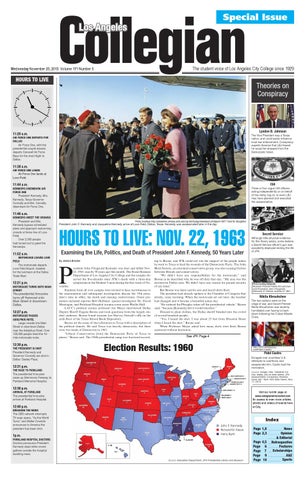
Election Results: 1960
http://trcs.wikispaces. comFidel+Castro
Fidel Castro
12:31 p.m.
Enraged over countless U.S. attempts to overthrow and assassinate him, Castro had the motivation.
The presidential limousine races up Stemmons Freeway to Parkland Memorial Hospital.
Source: Ginger, Otis. "Whether it's CIA, Mafia, LBJ or even aliens, JFK assassination conspiracy theories never die." New York Daily News, Nov. 17, 2013.
THE RACE TO PARKLAND
12:36 p.m.
Visit our tumblr page at www.collegianwired.tumblr.com for access to even more articles, photos and videos of events here at City.
ARRIVAL AT PARKLAND The presidential limousine arrives at Parkland Hospital.
12:40 p.m.
BREAKING THE NEWS The CBS network interrupts TV soap opera, "As the World Turns" and Walter Cronkite announces to America the president has been shot.
Index Page 1,8 Page 2,3
1p.m.
PARKLAND HOSPITAL DOCTORS Doctors pronounce President Kennedy dead while crowd gathers outside the hospital awaiting news. Source: Education Department, JFK Presidential Library and Museum
Page 4,5 Page 6 Page 7 Page 9 Page 10
News Opinion & Editorial Retrospective Features Scholarships A&E Sports
2
Opinion & Editorial
Wednesday November 20, 2013
Los Angeles | COLLEGIAN
Collegian
EDITORIAL
Editor-in-Chief Denise Barrett Managing Editor Clinton Cameron Design Consultant Beatrice Alcala Multimedia Producer Richard Martinez Opinion/Editorials Rocio Flores Huaringa Arts & Entertainment Inae Bloom Sports Jake Carlisi Gabriel Killiam Graphic Designers Inae Bloom Monica Ebanks Rocio Flores Huaringa Joshua Hernandez Vanessa Ruiz Anna UreĂąa Illustrators Stephanie Bolhuis Steffen Williams
Illustration by Stephanie Bolhuis/Collegian
Illustration by Stephanie Bolhuis/Collegian
Don’t Let College Go to Waste Getting  a  higher  education  has  not  always  been  as  easy  to  obtain  as  it  is  today,  yet  we  take  it  for  granted.  We  come  to  class  without  doing  our  homework  or  advancing  in  our  readings;Íž  we  skip  classes,  are  dis- ruptive  in  the  classrooms,  or  a  lot  of  us  drop  out  before  the  end  of  the  se- mester.  We  do  not  put  enough  effort  into  our  education  as  we  should.  Before  there  was  an  oppor- tunity  to  choose  from  a  myriad  of  colleges,  many  students,  particu- larly  students  of  color,  were  denied  admission  to  a  number  of  schools.  It  wasn’t  until  after  the  court  case Â
in  which  two  African-ÂAmerican  students,  Vivian  Malone  and  James  Hood,  had  been  blocked  from  en- tering  the  University  of  Alabama  because  of  their  race  that  John  F.  Kennedy  proposed  the  Civil  Rights  Act  of  1964,  allowing  them  to  be  admitted  to  the  university.   Kennedy’s  actions  opened  the  door  to  all  students,  giving  them  an  opportunity  to  receive  a  higher  education  at  schools  previously  reserved  for  a  limited  population.  That  opportunity  is  still  available  today  and  results  in  better  jobs,  ZLGHU LQĂ€XHQFH RQ WKH HFRQRP\
and  in  politics,  and  a  generally  more  prominent  place  at  the  table.  These  opportunities  to  attend  college  are  met  with  new  challeng- es  in  today’s  modern  world.  Sadly,  a  great  number  of  students  drop  out  of  college  for  a  variety  of  reasons  such  DV ÂżQDQFLDO KDUGVKLS GLIÂżFXOW\ LQ school,  family,  or  work.  Despite  the  obstacles  we  en- counter  or  the  temptation  to  drop  out,  let’s  keep  in  mind  that  it  is  a  privilege  to  receive  a  higher  educa- tion,  a  right  that  comes  from  that  Civil  Rights  Act  of  1964  and  the  many  brave  actions  taken  to  make Â
Who Killed Kennedy? By Dave Martin November  22,  1963.   While  riding  through  the  streets  of  downtown  Dal- las,  in  his  presi- dential  motor- cade,  John  F.  Kennedy  is  shot  and  killed.   Many  people  believe  that  Lee  Harvey  Oswald  was  the  lone  gunman.   Was  he?   On  Nov.  4-Â6,  2013,  a  three-Âday Â
symposium  was  held  at  Los  Ange- les  City  College,  commemorating  the  50th  anniversary  of  Kennedy’s  death.   On  the  second  day  a  debate  was  held  to  determine  if  Oswald  had  acted  alone  or  if  there  was  a  conspiracy.   The  overwhelming  majority  of  those  who  participated  believed  there  was  a  conspiracy  to  kill  the  president. The  evidence  for  both  views  is  compelling.   However,  I  have  al- ways  believed  that  one  man  could  not  have  acted  on  his  own.   In  order Â
to  do  what  many  claim  Oswald  did  alone  requires  much  planning  and  preparation.   It  is  a  task,  I  believe,   much  too  big  for  one  person  to  car- ry  out  by  himself. According  to  witnesses,  three  shots,  some  say  four,  rang  out  on  that  fateful  day  in  Dallas.   I  can  believe  that  Oswald  may  have  had  time  to  squeeze  off  one,  maybe  two  shots,  but  not  three  or  four.   Not  only  is  it  highly  improbable,  it  is  highly  unlikely.    Therefore,  the  fa- tal  shot,  the  one  that  struck  Kenne-Â
Generation Ruined by iPads By Tara Rumore The  educa- tion  budget  in  California  is  a  constant  hot  top- ic  on  the  minds  of  educators.  With  the  increase  in  sales  tax  ear- lier  this  year,  schools  saw  a  little  ZLJJOH URRP LQ WKH HGXFDWLRQ GHÂż- cit.   This  allotted  the  Los  Angeles Â
Collegian LOS ANGELES
School  District  $30  million,  which  they  used  to  purchase  iPads  for  ev- ery  student. Thanks  to  the  passing  of  prop- osition  30  during  the  2012  general  election,  sales  tax  has  increased  to  nine  percent,  up  three-Âquarters  of  a  percent.   This  increase  is  sup- posedly  going  toward  California’s  education  budget.  The  Los  Angeles  8QLÂżHG 6FKRRO 'LVWULFW KDV GHFLGHG that  this  money  is  to  be  used  by Â
buying  students  iPads  for  learning.   LAUSD’s  decision  is  generating  some  strong  opinions  with  half  of  them  opposing  this  purchase  and  the  other  half  in  favor.  Back  in  elementary  school  I  used  textbooks  for  my  classes.   Sure  they  were  worn,  old  and  written  in,  EXW WKH\ PDQDJHG WR ZRUN MXVW ÂżQH Using  an  iPad  in  classrooms  is  a  big  mistake.  They  are  likely  to  be  misused,  stolen  or  broken.   The  cost Â
it  law.  College  is  always  going  to  be  challenging  because  we’re  always  learning  information  we  have  not  seen  or  heard  before,  but  that’s  why  we  decided  to  attend  college  in  the  ¿UVW SODFH WR EHFRPH EHWWHU HGX- cated.  If  you’re  struggling  in  a  class,  seek  the  help  of  tutors  that  are  pro- vided  here  at  Los  Angeles  City  Col- lege,  like  the  Writing  Laboratory  for  those  struggling  with  writing  skills  located  in  Jefferson  Hall  or  the  Pi  Shop  for  math  students  located  in  Franklin  Hall.  Both  students  and  faculty  are  available  there  and  are Â
willing  to  help.   Not  only  that,  pro- fessors  also  provide  us  with  their  of- ¿FH KRXUV LQ ZKLFKHYHU FODVV ZHÂśUH taking  so  that  we  can  go  to  them  for  assistance.  Financial  aid  and  child  care  assistance  are  available  as  well. Kennedy’s  decision  to  propose  the  act  became  a  stepping  stone  for  every  student  in  America  to  get  a  college  degree,  whether  associate’s,  bachelor’s  master’s,  or  even  a  doc- torate.  College  is  where  we  can  all  learn  and  develop  our  skills,  so  let’s  not  give  up.  Let’s  meet  the  chal- lenges  and  use  the  Civil  Rights  Act  of  1964  to  realize  our  full  potential. Â
dy  in  the  head,  and  killed  him,  had  to  have  come  from  a  different  loca- tion  altogether.    The  grassy  knoll,  perhaps?   Or  another  building,  or  even  an  expressway  overpass?   But  QRW IURP WKH VL[WK Ă€RRU RI WKH 'DO- las  School  Book  Depository.   Unfortunately,  the  mystery  of  who  actually  shot  John  Kennedy  (one  person  or  several)  will  prob- ably  never  be  resolved.   Just  as  in  the  case  of  John  Wilkes  Booth,  who  killed  Abraham  Lincoln  one  week  after  the  Civil  War  ended,  both  he  and  Oswald  were  gunned  down.   Booth  was  killed  by  a  Union  sol- dier,  while  he  was  trapped  inside  a Â
blazing  barn,  and  Oswald  by  night- club  owner  Jack  Ruby,  while  he  was  in  the  process  of  being  trans- ported  from  Dallas  Police  Head- quarters  to  the  local  jail.   Both  men  were  silenced  before  either  one  had  a  chance  to  speak  or  have  their  day  in  court.   Today,  the  greatest  crime  of  the  20th  Century  still  has  many  un- answered  questions,  questions  one  person  could  have  answered,  but  was  silenced  before  he  was  able  to.   So,  it  is  left  up  to  us,  the  people,  to  decide  who  really  killed  Kennedy.   Was  it  one  man?  Or  was  it  a  con- spiracy? Â
of  maintenance  and  repair  of  iPads  exceeds  the  cost  to  replacing  an  old  textbook.  Some  may  argue  we  have  computers  in  classrooms  so  what's  the  difference.  Well,  mobility  is  the  difference.   Students  can  easily  put  an  iPad  in  their  backpack,  a  desk- top  computer  not  so  much.  Offering  students  iPads  also  detaches  their  interest  from  the  teacher  who  can  offer  hands-Âon  experience  and  com- munication. Secretary  of  Education  Arne  Duncan  believes  this  plan  will  save  money.  He  also  argues  that  it  will Â
support  student  achievement.  Tech- nology  not  only  disrupts  discus- sion  and  social  interaction,  but  also  enables  students  to  decrease  their  physical  activity  level  which  can  lead  to  obesity. Instead  of  focusing  on  high- tech  gadgets,  LAUSD  should  fo- cus  on  educating  students  on  the  importance  of  physical  education.   They  should  also  focus  on  making  healthy  foods  and  nutrition  more  accessible.  iPads  are  a   great  gadget  for  personal  use,  but  they  don’t  be- long  in  the  classroom.
Photo Editor Inae Bloom Photographers Jessica Brecker Dave Martin Jorge Ponce Julia Salazar Maria Vallarta Reporters Felicia Allen Jessica Brecker Richard Chang Monica Ebanks Rocio Flores Huaringa Rachael Garcia Tanya Geddes Gloria Lee Diana Nakayenga Vanessa Ruiz Advertising Staff Clinton Cameron Richard Chang Dave Martin Nico Nava Adviser Rhonda Guess Deadline Schedule NEXT  ISSUE:  Dec.  5,  2013  Editorial  deadline:  Dec.  2,  2013 For  all  submissions  including  let- ters  to  the  editor  and  publicity  re- leases  send  materials  to  &ROOHJLDQ RI¿FH Chemistry  207 losangeles.collegian@gmail.com For  all  insertion  orders  and  advertising  questions. Email:  pr.collegian@gmail.com The  college  newspaper  is  published  as  a  learning  experience,  offered  under  the  college  journalism  instructional  pro- gram.  The  editorial  and  advertising  ma- terials  published  herein,  including  any  opinions  expressed,  are  the  responsibil- ity  of  the  student  newspaper  staff. Under  appropriate  state  and  federal  court  decisions,  these  materials  are  free  from  prior  restraint  by  virtue  of  the  First  Amendment  to  the  United  States  Con- stitution.
Have an Opinion? Write a Letter to the Editor
Accordingly,  materials  published  here- in,  including  any  opinions  expressed,  should  not  be  interpreted  as  the  position  of  the  Los  Angeles  Community  College  District,  Los  Angeles  City  College,  or  DQ\ RI¿FHU RU HPSOR\HH WKHUHRI
CONTACT INFO losangeles.collegian@gmail.com Letters may be edited for brevity. (323) 953-4000, ext. 2831
Collegian  Š  2013.  No  material  may  be  reprinted  without  the  express  written  permission  of  the  Collegian.
Los Angeles | COLLEGIAN
Opinion & Editorial
City Views
Compiled by Clinton Cameron Photos by Jessica Brecker
Josh Barnhart - English
i&6%K9=%5;,8+45?:+%67%=++l=++%9;4%C+98% .#$% !& %$ #! % $ ' # !&$ 5;45I54>9:=% KC7% K+8+% K56;+==+=% l% ?+,9>=+% C+985;A% 6C+58% =6785+=% 5=% 9% :76% 45MM+8+;6%M87@%8+945;A%=7@+6C5;A%5;%9% ?77S%78%=++5;A%9%47,>@+;698E-m
3
Creating Balance Between Work and School By Stephanie Bolhuis
What was your overall impression of the JFK events?
Wednesday November 20, 2013
V 9 : 9 ; , 5 ; A% K78S% 9;4% 9% M>::% =,C77:% =,C+4>:+% 5=% 67>AC-% Y9;E% 7M% >=% =68>AA:+% ?9:9;,5;A% ?+5;A% ?76C% 9% 4+D+;49?:+% K78S+8% 9;4% 9% =>,,+==M>:% =6>4+;6-%O% 6ED5,9:% K++S% ,7;=5=6=% 7M% A75;A% 67% K78S/% ,7@5;A% 67%,:9==/%9;4%>=5;A%6C+%;+L6%49E%7MM% 67%,96,C%>D%7;%C7@+K78S-%O%=7,59:% :5M+% 5=% =++@5;A:E% ;7;+L5=6+;6U% M8++% 65@+%?+,7@+=%9%D85I5:+A+&;% 0122/% 6C+% (-'-% F+;=>=% "!#% .# % % " # % ! 6C+% ,7>;68Eh=% 2^-G% @5::57;% ,7::+A+% >;4+8A894>96+=% K+8+% K78S5;A-% cM% % % & # ! .' $%& %$ K+8+% K78S5;A% 3.% C7>8=% 78% @78+% 9% K++S-% TC5:+% 8+=+98,C% =>AA+=6=% 6C96% K78S5;A% 2.% C7>8=% 78% :+==% ,9;% . !# & # # K78S5;A% @78+% 6C9;% 01% ,9;% ?+% 4+685@+;69:%67%9%=6>4+;6W=%=>,,+=="I+;% =7/% 56% 5=% 5@D+8965I+% 67% 8+,7A;5b+% 6C96% 7;+W=% 9,94+@5,% =>,,+==% 5=% >:65@96+:E% >D% 67% 6C+% 5;45I54>9:-%TC5:+%+@D:7E@+;6%@9E% :+94%67%=:++D%4+D85I9657;/%=68+==%9;4%
6>8;5;A% 5;% ,:9==% 9==5A;@+;6=% :96+/% 56% C9=% 9:6+8;965I+:E% ?++;% D87I+;% 67% +;,7>89A+%=6>4+;6=%67%@9;9A+%6C+58% 65@+%@78+%+MM+,65I+:E'69E5;A% D879,65I+% 9;4% =,C+4>:+B785+;6+4% 5=% 6C+% ?+=6% K9E% 67% ,7D+% K56C% ?76C% K78S% 9;4% =,C77:% 7?:5A9657;=-% T8565;A% :5=6=% 5;% 9% ;76+?77S% 78% D:9;;+8% ,9;% C+:D% 78A9;5b+% D+;45;A% 9==5A;@+;6=% 9;4% 69=S=-% \++D5;A% 9C+94% 5;% ,:9==% ?E% 475;A%D87N+,6=%+98:E%,9;%C+:D%9I754% #& %! % ! / %$ TC5:+% 56% @9E% ?+% ,C9::+;A5;A% 67% ?+% 9==+865I+% K56C% =,C77:/% 56% 5=% 6C+% 7;:E% K9E% 67% ?+% =>,,+==M>:% 5;% ?9:9;,5;A% ?76C% =,C77:K78S% 9;4% K78S:794-% &6% 5=% D7==5?:+% 67% 9,C5+I+% A774% A894+=% KC5:+% K78S5;A% :7;A% C7>8=-%&6%K5::%?+%9%:76%7M%K78S/%69S+% 9%:76%+MM786/%9;4%@9S+%M78%9%M+K%:96+% ;5AC6=-% [7K+I+8/% 6C+% 7>6,7@+% K5::% @9S+%56%K786CKC5:+*7;W6% :+6% E7>8% N7?% ?+% E7>8% +L,>=+-% T56C% 7;:E% `-.% D+8,+;6% 7M% POFF% =6>4+;6=% D+8M78@5;A% 96% ,7::+A+%:+I+:/%&%>8A+%=6>4+;6=%67%68E% C984+8%9;4%67%?+%I5A5:9;6%K56C%6C+58% =6>45+=-%&6W=%9::%9%?9:9;,5;A%9,6/%9;4% 7;+%,9;%68E/%78%7;+%K7;W6-%T+5AC%6C+% 7D657;=
Illustration by Steffen Williams/Collegian
Julia Uribe - Business
i&% M7>;4% 6C96% 6C+E% e6C+% :+,6>8+=f% K+8+% I+8E% 5;M78@965I+% 7I+89::% E7>% S;7K% ?+,9>=+% 56% A5I+=% E7>% ?76C% =54+=% 7M% 56% KC+6C+8% 56% K9=% 6C+% :7;+% =C776+8% 78% KC+6C+8% 56% K9=% 9% ,7;=D589,E/% 56% A5I+=% E7>%@78+%67%6C5;S%9?7>6%KC+6C+8%56%K9=% 7;+%78%6C+%76C+8-m
David Feurtadot - Russian Studies/History
i$C+% +I+;6% K9=% @9=6+8M>:-% $C5=% 5=% =7@+6C5;A%K786CE%7M%9%@9N78%>;5I+8=56E% >;4+869S5;A-%T+%N>=6%C9I+%67%A5I+%56%67% 7>8% '7,59:% ',5+;,+=% *+D986@+;6% M78% 475;A%9;%5;,8+45?:+%N7?%7M%D>665;A%6C5=% D87A89@%67A+6C+8-m
Manar Ahamad - Nursing i&6% K9=% ,7@D:+6+:E% @5;4% ?:7K5;A% M78% @+-% &% K9=% 8+9::E% 7;+% 7M% 6C7=+% 6C96% 8+9::E% K9;6+4% S;7K% 9?7>6% e6C+f% \+;;+4E% 9==9==5;9657;-% <58=6% 49E% &% K9=% 5@D8+==+4% l% =7/% &% K+;6% ?9,S% 7;:5;+% 9;4% 685+4% 67% 6+::% 9::% 6C+% 76C+8% =,C7:98%=6>4+;6=%67%,7@+%69S+%9%:77S-% $ $ ! ! % $ . % ' %$ &% ,9@+% 9:7;A% +I+8E49E% 9;4% &% :+98;+4% +I+8E%=5;A:+%=+,7;4-m
Your Vote Does Count By Wesley Smith $C+% :7,9:% ? 8 5 ; S = @ 9 ; = C 5 D% 7I+8% 6C+% M+4+89:% =C>647K;% 9;4% 4+?6%,+5:5;A%C5ACB :5AC6+4%5;,8+9=5;A% M8>=689657;% 5;% 6C+% %!( # $ !&# % ! . $ $C+% 98A>@+;6=% 8+@5;4+4% >=% 6C96% KC96%C9DD+;=%5;%7>8%+:+,657;=%C9I+% 9%I+8E%8+9:%5@D9,6%7;%7>8%:5I+=-%$C5=% 5=% +=D+,59::E% 68>+% M78% ,7::+A+B9A+4% I76+8=% KC7% 98+% =68>AA:5;A% 9A95;=6% 6C+% =6+8+76ED+% 7M% ?+5;A% 9D96C+65,% 67K984=%I765;A$C+% 8+=>:6=% 7M% +:+,657;=% =>8B 87>;4% >=% ,7;=69;6:E-% 'D++4% :5@B 56=/% @+45,5;9:% @985N>9;9% :9K=/% 7>8%
. !& %$ $%&B 4+;6% :79;% 5;6+8+=6% 896+=% 98+% 9::% 4+B 6+8@5;+4% ?E% C7K% K+% I76+-% "I+;% 6C7>AC% @9;E% 7M% 6C+% 5==>+=% 69,S:+4% * % ! . $ ! -% $ "B D:5,9?:+%67%E7>;A%I76+8=/%6C+%68>6C%5=% 6C96%K+%98+%6C+%7;+=%KC7%7M6+;%M++:% 6C+58%+MM+,6=%6C+%@7=6 % *!& '!% #$ % . $ 2oB0^% 5;% 0120% +L56% D7::5;A% ?E% 6C+% (;5I+8=56E% 7M% F7;;+,65,>6/% C94% 9;% 9?E=@9:% 6>8;7>6% 7M% 2^% D+8,+;6% 5;% 6C+% :9=6% D8+=54+;659:% +:+,657;-% $C+% ;+L6%9A+%A87>D%>D%C94%9%0G%D+8,+;6% 6>8;7>6$C5=% :+94=% 67% 9;% 5==>+% KC+8+% @9;E%7M%6C+%D+7D:+%,C7=+;%67%8+DB 8+=+;6% >=% 9,6>9::E% C9I+% ;7% 54+9% KC96% 5==>+=% 6C+58% E7>;A+8% ,565b+;=%
# &$ %! $" .' &% $ (# %B 5;A%67%6C+58%8+D8+=+;6965I+=%7;%6C7=+% =9@+%5==>+=-%&M%=6>4+;6=%47;W6%K856+/% 78%+I+;%,C77=+%67%I76+/%6C+;%6C7=+% 5;% F7;A8+==% K5::% 9==>@+% K+% 47;W6% ;++4%9;E6C5;AO% ,7@@7;% ,7@D:95;6% 5=% 6C96% I765;A% K7;W6% @966+8% ?+,9>=+% 6C+% 7>6,7@+% K5::% ?+% 6C+% =9@+-% $C96% 5=% $ & . "#!" * % % ( ;76% ,C9;A+% >;:+==% K+% 69S+% 6C96% .#$% $% " %! % !&% % # ( % !&# 7D5;57;=-% '6>4+;6=% 7M6+;% K9;6% 5@B @+4596+%8+=>:6=/%9;4%K5;;5;A%=@9::% D7:565,9:% ?966:+=% KC5:+% :7=5;A% 6C+% :98A+% 7;+=% ,9;% ?+% 45=,7>89A5;A-% [7K+I+8/% K56C% 9;% 9,65I+% ?9=+% 9;4% D+8=5=6+;,+/%56%,9;%:+94%67%D87A8+==% 5;%6C+%:7;A%8>;-
CHRONICLES OF A NOBODY Trinity By Byron Umana Bermudez
Supin Kim - Nursing
i&%9@%;76%M87@%C+8+/%=7%&%454;W6%S;7K% 9?7>6% 6C+% 9==9==5;9657;-% <87@% j6C+% +I+;6k/%&%:+98;+4%9%:76%7M%KC+;%C+%45+4% l%9;4%KC+8+-%&6W=%A774%M78%@+%?+,9>=+% &%C9I+%67%:+98;%9?7>6%C5=678E/%&%C9I+%67% :+98;%@78+-m
Brian Bartelt - LACC Anthropology Professor , # -$ !% %% .#$% C9;4% 9,,7>;6% 7M% KC96% K+;6% 47K;% l% V>6% &% ,9;W6% :+6% A7% 7M% 6C+% M++:5;A% 6C96% 6C+8+% 5=% =7@+6C5;A% @78+% 5;I7:I+4% C+8+%l%+=D+,59::E%KC+;%E7>%69S+%5;67% 9,,7>;6%9::%6C+%9==9==5;9657;=%6C96%K+8+% C9DD+;5;A%987>;4% 6C96%65@+%l% Y9865;% P>6C+8%\5;A%l%V>6%6C96W=%KC96%&%:5S+4% l% j*+D>6E% 'C+885MM% ">A+;+% V77;+W=k% 9%=6895AC6%=C776+8-%[+W=%9%,7D%9;4%+I+;% C+%C94%67%94@56%6C96%56%=++@+4%S5;4%7M% =>=D5,57>=lm
# !&% ' # ! . 5;% 6C+% [7>=+% 7M% ]+D8+=+;6965I+=% 5=%.G%E+98=%7:4-%$C96%85=+=%67%_0%5;% 6C+%'+;96+-%(;65:%K+%,9;%?85;A%6C96% ;>@?+8%47K;%>=5;A%6C+%E7>6C%I76+/% 6C+8+%K5::%,7;65;>+%67%?+%9%45=,7;B ;+,6%5;%54+7:7AE !( ( )" % ! . $ KC7%454%;76%A87K%>D%K56C%@74+8;% 6+,C;7:7AE%67%>;4+8=69;4%56%+;7>AC% 67%@9S+%D7:5,5+=%8+A9845;A%;+6%;+>B 689:56Ed%&M%6C+E%454%;76%A7%67%=,C77:% 4>85;A%65@+=%7M%>;D8+,+4+;6+4%85=B 5;A% 6>5657;% 9;4% 4+?6/% 47% K+% 8+9::E% 6C5;S%6C+EW::%A5I+%7>8%,>88+;6%=56>9B 657;%@>,C%6C7>AC6d '6>4+;6=% ,9;W6% ,7;65;>+% 67% =D+;4%2.%@5;>6+=%6ED5;A%7>6%9%,7@B D:95;6% 9?7>6% D7:565,=% 7;% ]+4456% E+6%
Illustration by Jose Tobar/Collegian
iP57;=/% 9;4% 65A+8=/% 9;4% ?+98=n% cC%@Enm &WI+% 9:K9E=% M+:6% 9% ,7;;+,657;% 67% 6C+% 6C8++% @9:+% ,C989,6+8=% 6C96% M7::7K% *7876CE% 5;% i$C+% T5b984% 7M% cb/m% ?+,9>=+% 7M% KC96% 6C+E% 4+=58+-% $C+% ',98+,87K% :7;A+4% M78% 9% ?895;/% 6C+%$5;%Y9;/%9%C+986/%9;4%6C+%F7KB 984:E%P57;/%,7>89A+"9,C%7M%6C+@%4+=58+4%9;%+==+;B 659:%C>@9;%96685?>6+%5;%6C+58%N7>8;+E% 67%D+8=7;9:%=>,,+== * ' #* .#$% * ! $ !! @7=6% S54=% 987>;4% @+% K+8+% ,8EB 5;A% 9=% 6C+58% D98+;6=% 487DD+4% 6C+@% 7MM-%&%K9=;W6%7;+%7M%6C7=+%,C5:48+;-% ',C77:%M+:6%:5S+%C7@+$C+8+M78+/%56%=C7>:4;W6%,7@+%9=% 9%=>8D85=+%6C96%&%,85+4%9=%6C7>AC%@E% C7@+% K9=% ?+5;A% 69S+;% 9K9E% KC+;% &% M7>;4% 7>6% &% K9=;W6% 9,,+D6+4% ?E% 6C+%:7,9:%D85I96+%+:+@+;698E%=,C77:-% $C+E% 67:4% @E% @76C+8% 6C96% &% K9=;W6% 96%6C+%i+4>,9657;9:%:+I+:m%67%966+;4% 6C+58% =,C77:-% P5S+% 6C+% ',98+,87K/% &% 677%M+:6%:5S+%&%454;W6%C9I+%9%?895;-% &% K9=% C7@+:+==-% &% K+;6% M87@% =,C77:%67%=,C77:%M78%6C+%;+L6%,7>D:+% 7M% E+98=-% &% ?+,9@+% 9KSK984/% =CE% 9;4% 5;687I+86+4-% $C7=+% 987>;4% @+% 4+6+,6+4% 6C5=% 9;4% K7>:4% C>@5:596+% @+/%?+:566:+%@E%,C989,6+8%9;4%DCE=5B ,9::E% 9==9>:6% @+-% $7% 6C+@/% &% K9=% ;76C5;A&% =6986+4% 67% 45=69;,+% @E=+:M%
M87@% M9@5:E/% @E% 6+9,C+8=% 9;4% +IB +8E7;+% +:=+-% P5S+% 6C+% $5;% Y9;/% &% ?+,9@+%8>=6E%9;4%K78;%M87@%9?>=+/% K56C%;7%75:%,9;%5;%=5AC6 * !% # ( $ . * %! A+6% @+% 5;67% '6-% X5;,+;6W=% ":+@+;B 698E-% &6% M+:6% :5S+% 9% ;+K% ?+A5;;5;A% + & % * .#$% * ! $ !! =6+DD+4%7>6%7M%6C+%,98%9;4%8+9:5b+4% 6C96% &% K9=;W6% :5S+% 6C+% 76C+8% S54=-% OM6+8%9%,7>D:+%7M%49E=/%&%89;%7>6%7M% % !&# (!# ! * .#$% * K9=%:5S+%6C+%F7K984:E%P57;/%9M8954% 7M%C5=%7K;%=C947K'7%C+8+%&%K9=/%9%,C5:4%K56C%;7% ?895;=/%;7%C+986%9;4%;7%,7>89A+/%9;4% &%M+:6%6C96%K9E%6C87>AC%C5AC%=,C77:F7::+A+% K9=% 45MM+8+;6-% OM6+8% . !&% "" % ! $ %! ' #* $ B A:+% =,C77:% 987>;4/% &% ,C7=+% POFF-% $C5=%5=%KC+8+%&%M7>;4%@E%A5M6=&6W=% M>;;E% C7K% @9;E% D+7D:+% :77S% 5;% 6C+% @58878% 9;4% 47;W6% =++% 6C+%M9,6=-%&%K9;6+4%67%?+%=@986/%=7%&% =6>45+4-%&%K9;6+4%67%,98+/%=7%&%685+4/% 9;4%&%454%9::%6C5=%K56C%,7;I5,657;-%!7% K5b984% ,9;% A5I+% E7>% 6C+=+% 6C5;A=/% ?+,9>=+%E7>%98+%E7>8%7K;%K5b984-%&% 67:4%@E=+:M%5M%&%K9;6+4%=7@+6C5;A%&% ;++4+4%67%A7%A+6%56/%56%K7>:4;W6%N>=6% 9DD+98%67%@+%89;47@:E%78%?E%:>,S&% ?+,9@+% 9% ;7?74E% ?+,9>=+% 7M% KC96% 76C+8=% 67:4% @+-% T+::/% 6C5=% ;7?74E% M7>;4% 9% ?895;/% 9;4% 9% C+986% 9;4%6C+%,7>89A+%67%=69;4%>D%M78%@EB =+:MU% ?>6% @7=6% 5@D7869;6:E/% &% M7>;4% 9%I75,+-
4
Retrospective
Wednesday November 20, 2013
Los Angeles | COLLEGIAN
Remembering
JFK
years later
More than 100 students, faculty and community members gathered early in November for a special sym F. Kennedy's assassination.
from JFK Page 1
Death of a President
Jessica Brecker/COLLEGIAN Political science professor Joe Meyer, (right), leads a discussion with Dallas Deputy Sheriff Eugene Boone, (left), who found the rifle used to shoot President John F. Kennedy from the sixth floor window of the Texas School Book Depository in Dallas on Nov. 22, 1963.
The Day It Didn't Rain on the Parade Assassination in America By Jessica Brecker News reporter Dr. Bob Huffaker was standing only a few feet away when Lee Harvey Oswald was shot by Jack Ruby. It was an event millions of Americans watched live on CBS television as Huffaker broadcast from Dallas Police Headquarters. Anthony Clark, associate professor of sociology at LACC, interviewed Huffaker for a unique, interactive three-day symposium focused on the 50th anniversary of the JFK assassination. Speaking to a crowd of students at the Student Union, Huffaker recalled that the day JFK was shot did start out gloomy when he first arrived on the field at 4:30 a.m., but that soon changed. “As it turned out, it was a beautiful spring day in late November,” Huffaker said. “When the motorcade came by, it was sweet.” Huffaker fondly remembers the “glittering dark blue limousine” the president rode in as the motorcade made its way through “tall buildings, like a canyon down there.” He also recalled that his own unmarked news van was “covered up by kids.” However, Huffaker somehow missed the events that transpired next, as he returned to the studio only to have his idealism shattered with the news of the attempt on the president’s life. He was told to head right back out to Parkland Hospital where the president had been rushed after he was shot. Huffaker went into emotional shock, but he managed to function on his journalistic instincts. When he got to the hospital he found he couldn’t get to the emergency room through normal channels, so he jumped curbs to get back to the parking lot and found another entrance. “What was a wonderful welcome in downtown Dallas has become a scene of indescribable horror,” Huffaker broadcast over the radio. “Faces are ashen white and people are wondering, is our president going to live?” Huffaker remembers when attending physician Dr. Charles Crenshaw pronounced the death of JFK. “We are at Parkland Hospital, where the horrible announcement has just come … that our president is dead,” Huffaker said, obviously choked up over KRLD radio. Huffaker stayed on the beat though, and reported all he saw and heard. But far more emotional than that broadcast was the one Huffaker made two days later in
the basement of the Dallas Courthouse, when Jack Ruby walked up to Oswald and shot him in the chest, in front of Huffaker, his cameras, and anyone who was tuned into CBS on their television sets. “I watched what the police did that morning,” said Huffaker of the carefully constructed security plan he witnessed. “I was shocked as anybody when Ruby lunged forward and shot Oswald.” In retrospect Huffaker feels his film crew was partly to blame for the breach in security. “Not one member of the Dallas Police Department would have wanted to make that a public transfer,” Huffaker said. “It was my job to shoot it, if we hadn’t have taken our shots, Jack Ruby couldn’t have taken his shot.” However, if was not Huffaker, but patrolman Roy Vaughn, who was guarding the entrance when the decoy armored truck, which did not contain Oswald, exited and Jack Ruby walked in and shot Oswald. Vaughn, a traffic cop by trade, stepped out to direct traffic 50 seconds before the shot was fired. “Yes it’s an improbability,” Huffaker said to the audience, “so was your birth, so was mine.” Although Huffaker was only about 10 feet away, he said he did not see the shot because the blue Ford Fairlane which was the actual vehicle meant to transport Oswald to jail was backed into position a split second before the shot was fired. He did see Oswald grimace and grab his abdomen. “I had a hot CBS mic,” Huffaker said, “talking about what I could say at a time like that, I had to keep saying what I was seeing.” Huffaker continued the broadcast as Oswald was taken away in an ambulance. To this day, he is adamant about one thing: “This was not a conspiracy; it might have been improbable, but it was true.” As the segment ended and they prepared to take questions from the audience, Huffaker noted the significance of being at LACC for the historic symposium about the assassination. “The man who knows more about it than anyone I ever met is sitting beside me,” Huffaker said of Professor Anthony Clark. Considering Huffaker was there in Dallas, and reported bravely and professionally in a way few reporters can, one can hardly think of a higher compliment to bestow on an LACC professor. After speaking, Huffaker stayed behind and personally signed copies of When the News Went Live: Dallas 1963, his recollections of those three days the country will never forget.
“T
hree. Three shots were fired,” Boone said. As Boone said to Vincent Bugliosi in the 1988 television special, “On Trial Lee Harvey Oswald,” he was in front of the sheriff’s office at 505 Main Street at 12:30 p.m. when he heard shots coming from the Texas School Book Depository Building and the freight yard. He headed to the freight yard first. “I ran down Main Street and around the cement works, across this grassy area here, and then eventually over the fence and cement abutment here, and into the freight yards,” said Boone back in 1988. For the City College audience on Nov. 6, however, Boone was more descriptive about what he saw in the grass on his way to the freight yard. “I saw two people to my right were on the ground and I thought ‘there are two dead ones’,” Boone said. Soon though, he saw them began to move. The grassy area Boone had to traverse to get to the freight yard would include the infamous grassy knoll, and he would have had to climb over the picket fence, touted by conspiracy theorists as the location of the additional shooters. Boone recalled cars being parked in the area just above the knoll and fence at this time. “I did examine the flower bed and the foliage in this area,” Boone said, in 1988, and he reiterated that for the LACC audience. Both times he said he saw no footprints in any of the flower beds surrounding the knoll, nor did he see any evidence of gunpowder burns on the plants. At the freight yard, Boone questioned Lee Bowers, a railway signal man in the railroad control tower. At the time Bowers said he did not hear shots or see anyone, even though he would later change his mind. “As the search centered on the school book depository, it became a more organized search,” Boone said. The interior of the building was very dark, so Boone used his battery-powered flashlights and dry cell flashlights to see. Boone made his way up to the famous sixth floor. “I just happened to be one of the officers,” Boone said, as he explained how he bumped right into the now famous sniper’s nest. “Oh yeah, we had to go over to take a look.” Boone once again could not smell or see gunpowder. What he did see was two rows of boxes and a crevice that he said, “looked like someone had set it up beforehand.” In the crevice he saw a gun. “There wasn’t any way for me to tell [if it had been fired],” Boone said. “It had a scope. I looked at the weapon. I never touched it. I looked at my watch and it was 1:22 p.m.” It was at this time that Oswald, according to Boone, slipped by city police officers in the stairwell. “Mr. [Roy S.] Truly said ‘he works here’ and they let him go,” Boone said. But later Truly, Oswald’s employer, would find Oswald missing. “I went to the sheriff’s office and made my report to the sheriff,” Boone said. “Everyone wants a statement, right now, so it was really chaotic in the sheriff’s office. I was kinda stunned. It was probably 10 at night before I left to go home.” Oswald was ultimately arrested by another police officer, James Leavelle, for fatally shooting Dallas patrolman J.D. Tippitt. This happened 45 minutes after killing Kennedy, a fact seldom discussed as
Oswald is most often associated with the president’s assassination. Boone and Jack Ruby, Oswald’s eventual killer, had a past. Before he was deputy sheriff, Boone worked for the Dallas Times Herald in advertising. He was familiar with Ruby because he would buy ads for his Carousel nightclub. “I knew Jack because he was one of my clients when I worked for the newspaper. He was always trying to get some gimmick or something unusual to get people to go to his club,” Boone said of the man who would shoot Oswald later that weekend. According to Boone, Ruby voted for Kennedy, and Boone feels he was capable of shooting Oswald. “I believe that’s the way he thought,” said Boone, who also explained that Ruby, “hung around the fire department.” Boone saw Ruby as a legitimate businessman, even though he ran a strip club. Ruby, according to Boone, did not have prostitution or gambling at his club, nor was he a gangster. Boone’s wife, Charmaine Boone, also knew what Ruby looked like. “It looked like Jack Ruby shot Oswald,” said Charmaine, when she called Boone at work after viewing the Oswald shooting broadcast live on television. Ruby was convicted of murder. He would later appeal, but he died of cancer in 1967. “He was the kind of guy that you saw, but you didn’t see,” Boone said. “He’d go get a sandwich for ‘em, he just liked police officers, I think that’s how he got in [to city hall].” Boone’s life was distinctly changed afterwards. “We were all afraid we’d have to move away from Dallas,” said Boone. “I didn’t talk about this for the first 12 or 15 years. I’ve just really never talked. We didn’t have the time to talk about it.” Boone’s reasoning was that, at the time, it was not socially appropriate to talk about it. Life moved on. It’s possible that he grew tired of the conspiracy theories, some of which implicate him in a cover-up. “No, I didn’t plant the rifle,” Boone said. “I didn’t touch it, I just found it.” He also explained that, contrary to what many believe, only three shots were fired; three spent shells hit the floor. “Deputy Moony found three shell cases on the floor,” said Boone. Boone believes that the release of the Oliver Stone movie “JFK,” which came out in the 1990s, is the root of many of the theories claiming Oswald did not act alone. “Oliver Stone made a big deal of a tree in front of the window [of the sniper’s nest in the book depository], Boone said, “there were only leaves over the windowpane then; 25 years later, the tree grew!” However, Boone did mention that Secret Service men muscled in and took JFK from Parkland Hospital in Dallas before the autopsy could be performed. He also questions Oswald’s behavior. “From an investigative standpoint, Oswald denounced U.S. citizenship, lived in Russia, Mexico and New Orleans, yet all of a sudden the president is coming to Dallas and he’s moving books around in the school book depository?” Boone said. “If there was a conspiracy, it was to put him there. The only way to come through downtown was to make a right on Houston and a left on Elm, and the only way to get out was to get on the freeway.”
Retrospective
Los Angeles | COLLEGIAN
Wednesday November 20, 2013
5
Voices
Julia Salazar/COLLEGIAN
Miss the interviews? Scan here for more Kennedy content.
Jorge Ponce/COLLEGIAN mposium commemorating the 50th anniversary of John
“It’s still something that’s unknown. We’re still trying to put the pieces together, because [of] how it happened and why it happened.”
“My generation was born between two wars; the Cold War and the War Against Terrorism.” —Keegan King, English Major
—Francis Gomez, History Major
Recollections of a Trauma Room Nurse: ‘It Wasn’t Real to Me’ By Jessica Brecker Students and faculty were on the edge of their seats as Los Angeles City College as journalism professor, Rhonda Guess led a lively discussion with Phyllis Hall R.N., who worked at Parkland Hospital, in Dallas Texas on Nov. 22, 1963, the day JFK was shot. “My name does not appear on any record,” Hall said. “This was my first job.” Hall had been working at Parkland Hospital for about four years the day the 35th president of the United States was to speak in Dallas. “It was very cold and rainy,” Hall said of that morning. She acknowledged that Dallas, at that time was not a very hospitable place for a Democrat to visit, but JFK was there to smooth the waters and make things better for his political party. Hall’s day started like any other, perhaps even slower than most days, but that would soon change. “It was about 10:30 a.m. and I was looking out the window,” Hall said, “and the clouds just broke apart, and the sun just came through beautifully, and the sky was as blue as I have ever seen it.” Hall says it was at this point that she noticed the presidential plane coming into Dallas Love Field. It was visible from the vantage point of Parkland Hospital. “I could see this airplane coming into view, I was about a city block away,” Hall said. “You could see the president’s insignia on the side.” Hall was just about to leave for lunch when her supervisor spoke to her. “There’s been an accident in the president’s motorcade, and they are on the way here,” Hall was told. But just as soon as the words left her supervisor’s lips, the doors to Trauma Room One exploded. “There was lots of pandemonium and yelling and screaming for carts, ‘get out of the way,’” Hall said. Normally carts were called for when a baby was being born in route to the hospital, but when Hall and her co-workers went outside with the carts; they found the presidential limousine instead. “It was like watching something on television,” Hall said. “It wasn’t real to me.”
Photo Courtesy Gegham Khekoyan Phyllis Hall, R.N.
Hall first saw the mayor of Dallas enter the trauma room, followed by Vice President Lyndon Johnson. “He was so pale and sweaty that they thought he was having a heart attack,” Hall said. Governor [John] Connelly was so gravely wounded it’s a miracle he survived his wounds.” Hall explained how a bullet had gone through his lung, wrist, and thigh, causing profuse bleeding. Finally, Kennedy was wheeled in. “Jackie Kennedy was laying across the president’s head and shoulders,” Hall said. “I felt for vital signs, detected no pulse. This president was, in my estimation, dead on arrival. The first thing Hall noticed was a huge exit wound near JFK’s adam’s apple. Mrs. Kennedy refused to leave her husband’s side, holding onto the president’s foot with her left hand. “The only thing I heard her say was, ‘no, I’m going to stay with him,’” Hall said. It was at this point that Dr. Ken Clark, the head neurosurgeon began to examine the president, pulling the skin back from his head wound. “It looked like someone had taken a couple of ice crème scoops and scooped his brain out,” Hall said. She saw brain tissue all over Mrs. Kennedy and Gov. Connelly, and after 45 minutes of effort, the obvious became clear. “OK, let’s just stop this,” Clark said, according to Hall.
And with that, the surgeon made his way toward the door, turned, and said to Mrs. Kennedy as he walked out of the trauma room: “Madame, your husband is dead.” Hall looked at the first lady. “She was probably in the deepest state of shock I have ever seen anybody in,’ she said. Other recollections for Hall on the day JFK died include memories of feet shuffling and the sounds of cursing and arguing between the Dallas FBI and Federal Secret Service men in the hallway outside the trauma room. The agency personnel could not agree on who should stay with the president’s body. Hall left the trauma room at this point, as her superiors stayed to clean up. JFK’s body was then removed from the hospital, placed aboard Air Force One, and taken to Bethesda Naval Hospital in Maryland. “With the massive brain injury there was just nothing we could do,” Hall said. “There was just too much damage there.” At this point, professor Guess asked Hall if she accepts all the explanations the government has offered, and Hall answered with a prompt “No.” The audience applauded as the nurse admitted, she is a “conspiracy theorist.” “The nurses that were working there started getting threatening letters,” Hall said. “I got a letter, I don’t know why because nobody knew that I was even involved in that.” She also indicated that the body did not arrive at Bethesda in the same condition that Parkland Hospital had left it. It had been tampered with according to Hall. There was a $10 fine for illegally taking the body before an autopsy could be performed in Dallas. “The signal Nurses that were working that day, there were four or five of them, they left the state within three months because they were very frightened of the aftermath that happened, so no I haven’t spoken to anybody [about it],” Hall said. “But about three years ago my niece went down to the Sixth Floor Museum and she spilled the beans on me. The museum called me, and now I just talk about everything.”
“I’ve always heard about him, but I never really knew who he was, and so I went [to the Clouds over Cuba screening] and saw that he was very influential, especially, I guess in the Cold War.” —Reneze Lopez, History Major
Generation Y, Millennials Embrace Kennedy Legacy By Clinton Cameron With so much vested in the digital age, it seems unlikely that Generation Y and Millennials would show any interest in hearing first-hand accounts of a president’s assassination 50 years ago. The unlikely occurred between Nov. 5, and Nov. 8, at Los Angeles City College. Students in their 20s converged on the Student Union Building’s third floor to engage in learning opportunities as speakers recounted theories and memories of the day JFK died. For all the excitement, the Multipurpose Room was quiet and the 70 to 80 attendees were attentive on the second day of the three-day event. Fewer notes were taken by pen and pad than by iPads and other electronic devices. Keegan King is an English major at LACC who attended the symposium Nov. 5. He was born in 1992, eight months after the Los Angeles uprising associated with the acquittal of the police officers who were accused of beating Rodney King. His ninth birthday was a month and a week after 9/11. King believes there is a reason for his peer group’s specific interest in Kennedy’s assassination, as opposed to other historical events. He describes the events surrounding the assassination as a puzzle piece connecting two wars. “My generation was born between two wars; the Cold War and the War Against Terrorism,” Keegan said. He admits being motivated to attend the events strictly for the social experience, but says he also took the time to think of it in today’s context. Keegan has seen three presidents during his lifetime. He recalls Bill Clinton’s presidency during his childhood, the George W. Bush years as a pre-teen and as a teenager, he watched Barack Obama assume the highest office in the nation. He imagines how he would react if a president during his lifetime met with the same fate as Kennedy. “If it were Clinton, I don’t think I would have understood. If it were Obama I’d be shocked more than anything,” Keegan said. Reneze Lopez is a chemistry major who was born in 1996. She attended the Kennedy symposium with a friend, Francis Gomez. Gomez was born in 1996 and is majoring in history. They made their way to the Student Union Building to screen “Clouds over Cuba.” Lopez was born in the Philippines and came here when her parents migrated to the United States in 2006. As she recalls, her parents introduced Kennedy as an influential person when she was five or six years old. The name also came up in high school history class. “I’ve always heard about him, but I never really knew who he was,” Lopez said. “And so I went [to the Clouds over Cuba screening] and saw that he was very influential, especially, I guess in the Cold War.” Gomez’s parents met in 1982. His mother is from Guatemala and his father is from El Salvador. He says he became familiar with the idea of corrupt government power from stories he heard from his grandfather. “My grandfather was, I think, in the secret police [in El Salvador]. I heard very high-powered people were assassinated,” Gomez said. As far as conspiracy theories, Gomez is still on the fence, but doesn’t count anything out.
“It’s still something that’s unknown,” Gomez said. “We’re still trying to put the pieces together, because [of] how it happened and why it happened.” Political Science major Loui Vasquez turned 19 this past June. Like Gomez, his parents were from Central America and migrated to the United States between the 1960s and ‘70s. He did not hear about the assassination from his parents, but another relative talked about Kennedy with admiration. “He just remembers that the community he was in, they were really surprised, because they believed he was going to be one of the local leaders that was going to change the atmosphere when it came to immigration.” Vasquez said. The political science major attended the first day of the program, and gives credit to the professors who brought classes to the event. He remarked that the classes brought a high level of energy to the room. “It was definitely brought on by the professors that were there,” Vasquez said. “I saw some of the professors I had before. What they teach isn’t usually correlated with the event.” Days after the program, the discussions spilled over into another class for Vasquez. The assassination became a topic in his cinema class. “The Tuesday right after the event my cinema teacher showed clips of how JFK would talk and a debate with him and someone else.” Vasquez said. “It actually brought out emotion in class with people that are actually from that era that actually saw it.” Despite their youth, members of Generation Y and Millennials can be vested in the idea that Kennedy’s assassination involved conspiracy and a cover-up. Ana Sanchez is a 22-year old nursing major. Her primary interest for attending the event during the second day was to see if the nurse who was on duty when Kennedy’s body arrived at the hospital, supported any conspiracy theories. “The nurse mentioned that it took 43 minutes for him to be announced dead when he had [come] in already in the hospital, dead,” Sanchez said “So what I asked was how was it that it took them 43 minutes to say ‘OK he is dead.’’’ Sanchez says that some of the information supported conspiracy theories. She says there may have been a second or third shooter. “According to them [the official government record] there was only one bullet, but for her [Phyllis Hall R.N.], she said there [were] two bullets and the second bullet was never photographed,” Sanchez said. “It was funny because the man who had spoken before, they asked him the question, ‘did you ever see that second bullet?’ and he said it was brought up, but they just never brought it up to the public. So, that was really interesting. “ Sanchez said that seeing eyewitnesses was the most impressive part of the event. “What I found fascinating was they brought people who were eyewitnesses and so it’s really cool to bring it up in the light,” she said, “so you’re not just in the dark and you don’t know about this stuff. So you’re kind of more educated about what happened.” In three days, a 20-something and younger audience connected to historical events interactively. “I’m sure we talk about it in history class, but it wasn’t as interesting,” Sanchez said. “Now you’ve got witnesses that were there and then it makes you want to research more. ”
Features Producers, Writers Show Students Entertaiment Ropes
6
Wednesday November 20, 2013
Beatrice Alcala/COLLEGIAN Comedy veterans shared laughs and important information with students interested in the entertainment industry last month in the Caminito Theatre. (Left to right) Producer Jay Kogen and his father Arnie are each three-time winners of primetime Emmys. Producer-writer Alan Zweibel began working on Saturday Night Live in1975, and is also a three-time Emmy winner."Simpsons" image courtesy of todoseriesok.blogspot.com; "Curb Your Enthusiasm" image courtesy of Mark McLaughlin; "Saturday Night Live" photo courtesy of Google Images.
By Richard Chang Three veteran comedy writers gave students a rare peek inside the Hollywood machine in October, when the LACC Foundation sponsored a panel on the entertainment industry. Alan Zweibel, Jay Kogen and Arnie Kogen delivered advice and anecdotes that were as funny as they were forthcoming. With the weight of eight com-
bined Emmys among the three men and credits that include “Curb Your Enthusiasm,” “The Carol Burnett Show,” “The Simpsons,” “Saturday Night Live,” “David Letterman,” “Frasier,” “Mad TV” and countless other programs, the panel fielded questions on topics ranging from practical writing advice, to how to network in Hollywood, to what to do on stage if a joke bombs. Arnie Kogen delivered most
of the noteworthy one-liners during the evening. Kogen began his comedy writing career with Mad Magazine before moving on to shows such as “Newhart,” “Empty Nest” and “The Carol Burnett Show.” Besides being nominated for seven Emmys (winning three), one of Arnie’s greatest accomplishments was raising his son, Jay Kogen, an industry kid that grew up watching his dad write for television and decided he wanted
to follow in his father’s footsteps, sort of. Jay initially pursued acting before, admittedly, discovering he wasn’t very good and turned to comedy writing. He wrote spec scripts for Gary Shandling, which got him a job writing a sketch for Tracy Ullman, which got him his big break – writing for “The Simpsons.” Jay was encouraging throughout the evening, but he warned students of the harsh realities that
Los Angeles | COLLEGIAN
come with pursuing a career in the entertainment industry. “You’re going into a field where 98 percent of the time you’re told, No!”Jay said. “But keep your eye on whatever your goal is and eventually you’ll get a break.” He also offered practical advice to get a job as a writer’s assistant for hands-on work experience. Where Jay offered insight on writing for a living, the third panelist, Alan Zweibel, gave straight talk to the artist within each of the audience member. “Hone your craft,” Zweibel said. “Writers are born, they aren’t made.” Zweibel began his career at the bottom and worked his way up. He performed bad stand-up comedy routines hoping someone would recognize the quality of his material over his lackluster stage presence. Someone did – Lorne Michaels. Zweibel was hired as one of the original writers for "Saturday Night Live" and has been a working comedy writer ever since. He’s written books, movies, contributed to Broadway shows and is credited on his friend Larry David’s HBO show, “Curb Your Enthusiasm.” “Friends are good to have, because when you’re working long hours on a creative project, who do you wanna be with at two o’clock in the morning?” Friends are good to have for another reason: networking. In an industry with such a high bar for entry, who you know can be just as important as what you know. “One of the biggest advantages of being at LACC is that the students are in the midst of the entertainment business throughout the year, which is an enormous advantage over students who are studying at schools outside of L.A. or
California,” said Robert Schwartz, Executive Director of the LACC Foundation. “The aspect of creating networks and being present at all that L.A. offers in the way of networking opportunities cannot be understated. The students just need to take advantage of these opportunities as relationships can often make the difference between success and failure.” Panels like the one that brought these three writers to LACC are designed to entertain and inform students about what the professional world is really like. “It is intended to provide some insight as to how, on a practical basis, to launch one's career and to move it forward as this is not generally offered as part of coursework at any college or university,” Schwartz said. After an hour or so of roundrobin questions and answers from the host, the panel began fielding questions from the audience. Many students used it as an opportunity to plug themselves and their projects. Some asked for jobs, or offered their screenplays to the panel for notes, but the recurring question from audience members seemed to revolve around one ubiquitous hurdle: taking the next step. The next step was never made clear. If it exists at all, based on the insight from the panel, the next step seems a sort of mishmash of hard work, thick skin and luck. “The most important thing that we try to explain is that the reality of the entertainment business is that everyone will experience some form of rejection and/or failure, but that persistence, focus, and talent will lead to some level of success,” Schwartz said.
Plant of the Century By Jessica Brecker Native plant expert, John Uloth, lives as a houseguest on the Lloyd Wright compound in Malibu. He literally watches Century Plants bloom and fall. Uloth has seen them send up their huge center stalk at alarming rates right before his eyes and has observed the plants as they dry up and plummet to the ground, dead. The landscape of the beautiful and unique compound in Malibu is the creation of Eric Lloyd Wright. Uloth has been working for Wright and his son Devon for 13 years landscaping and house sitting. “I’m just playing around with native plants in their planters,” Uloth said. A few weeks ago students may have noticed our own wilted Agave type plant in front of Camino Theatre start to lean over, and maybe wondered if the poor plant needed a little water. The plant then made a mysterious and quiet disappearance. The mythology surrounding its birth and death has already started. “To be honest, I don't have a clue [about the plant’s origins],” said photo-journalism professor, Joe Dojcsak. “However, thinking backward about who might have known, I'm almost positive the late Barbara Joe Hoshizaki, professor of biological science, clearly identified the plant, put a label on it as she did with all plants throughout the entire campus, and may have planted it.” It is indeed possible that she did. “Barbara Hoshizaki spent most of her non-class time identifying and cataloging,” said Ren Colantoni, director of academic computing, as quoted in the April 12, 1999 issue of The Collegian. In the article, “Destroyed Plants to be Replaced,” LACC journalist April Ingram expands on the extent of Hoshizaki's involvement with campus plant life. “She brought many exotics in here--perhaps several hundred exotic and rare trees and plants you won’t find anywhere else in the city,” Colantoni said.
Unfortunately Hoshizaki retired in 1988. After she retired LACC’s interest in botany waned and the school’s greenhouse was left to rot. Now it is gone. On the United States Department of Agriculture’s website, the Century Plant is formally called Agave americana L. from the family Agavaceae. It’s a perennial--a plant that lives for more than two years. “The reason why they called it the Century Plant is because it was wrongly believed it lived up to 100 years,” said professor of life science, Sean Phommasaysy. The plant thrives in inhospitable environments, conserving all of its energy and nutrients until one day when it sends up a big central stalk topped by dozens of flowers. Once the stalk is sent out, there is an extremely fast rate of growth. The Century Plant has been known to grow 17 feet and higher. “They grow where nothing else does,” Uloth said. “They are a monster, awesome!” Dan Marlos, head of the photography and journalism departments, captured the plant in its full glory, and Danni Connor, a Photo 1 student, documented the fall of the Century Plant with her camera (see photos and captions). “Patty Schmolze, a retired faculty member from the Child Development department, mentioned to me that the Collegian should do an article on the Century Plant,” Marlos said. “I used the opportunity to demonstrate the use of a 4 x 5 view camera to my students, by photographing the Century Plant.” In the Marlos photos the stalk looms all the way up and over the roof of the theater building. It looks like an asparagus stalk fit for giants. Eattheweeds.com is a website dedicated to the edibility of plants. Depending on climate, it can take the plant from 10 to 60 years to bloom according to their website. “The Century Plant’s leaves are used by the Sonoran Desert’s Indians who used its fiber for rope, ate its roasted pineapple
Sepia Photo Courtesy of Dan Marlos
Agave americana L., better known as the Century Plant towers over the Theatre Academy Building in an image of the wilting succulent, captured in early October.
Photo by Danni Conner Santiago Gonzalez, a campus gardner, chops down the Century Plant in early October. The stalk presented a potential hazard, because it would have eventually fallen over.
center, and probably brought it north to Arizona,” Uloth said. “It’s pollinated by hummingbirds and bees.” Eattheweeds.com offers suggestions on how to consume the plant. The flower stalk and heart of the Century Plant can be roasted, and the seeds ground into flour for bread or soups. Even a beer-like drink can be made from its sap, and what health nut hasn’t heard of Agave sweetener? However eattheweeds.com suggests not to drink the juice raw and to consult with an expert prior to preparing the plant for consumption to avoid illness. Perhaps the key to understanding why this plant is so tasty
and nutritious is the fact that it spends years, even decades, building up a storage of nutrients so it can send up its huge stalk. After the flowers bloom, all its energy is spent, and then it dies. But that is not the end of its story. “It might not be dead,” Uloth said. He says to look for a “pincushion-like thing,” or anything that looks like a dead celery stalk with smaller green shoots coming up right next to it. “It makes a flat seed that looks like a large tick.” Found at the site were dried flowers and flat seeds that did resemble flat ticks. Professor Phommasaysy confirmed that these were indeed from the dead plant
and sure enough, right next to where the dead stalk of the plant is, are several shoots and a large “pincushion” like foliage. “Is human-assisted suicide for plants an ethical issue?” wondered environmental world history professor Glenn Britton. What about the plant’s civil liberties for that matter? “A lot of the plants have disappeared since I attended campus in 1999,” said Ingram, who still attends LACC part time. Presently, Ingram walks around the quad and laments the loss of some rosemary and lavender plants she recalls fondly, as well as some tall birds of paradise plants she remembers residing next to the ad-
ministration office. “It seems like plants have not been a priority over the last few years,” Ingram said. “The bushes keep getting shorter, sparser.” Ingram seems to recall a lusher and greener campus, but realizes it is fall now, and some plants may be out of season. She also understands the Century Plant does wilt and die on its own, and confirms that after the initial growth and flowering of the stalk dries up the plant loses its beauty. So the myth continues. But one thing is for certain, the Century Plant has left its mark on history at LACC, and we can look forward to another one, although we may have to wait a few decade
Scholarships
Los Angeles | COLLEGIAN
Did you win a scholarship? Then tell us about it.
Do you have a Scholarship to Share? SPREAD THE WEALTH! Write to LAcollegian@ yahoo.com
All Access Scholarship $2,500
Deadline: Nov. 21, 2013 Eligibility: Open to all U.S. College students Provider: www.collegeweeklive. com Information: Sign up at College Week Live; visit three colleges of your choice while logged on to earn an entry.
Courage to Grow $500
Deadline: Nov. 30, 2013 Eligibility: Open to U.S. College students with a minimum of 2.5 GPA or better. Provider: www.couragetogrowscholarship.com Information: Complete the entry form and submit a 250 word or less statement on why the scholarship should be awarded to you.
Foreclosure.com Scholarship Program Contest $6,000
Deadline: Dec.1, 2013 Eligibility: Must be currently enrolled in an accredited college, legal resident of the U.S., and 13 years or older Provider: www.foreclosure.com Information: Complete entry form. Submit an essay (800 – 2,000 words) on the following topic: What sort of creative programs, solutions or initiatives must a presidential candidate come up with in order to help stimulate the United States housing market and secure your vote. Come up with your own original stimulus plan or idea, which can be included as your response.
Elie Wiesel Prize in Ethics Essay Contest $500 to $5,000
Deadline in early December 2013 Eligibility: Open to full-time juniors and seniors in college or university during fall 2013. Contact: The Elie Wiesel Foundation for Humanity, 555 Madison Avenue, New York, NY 10022, (212) 490-7788, samantha@eliewieselfoundation.org, http://www. eliewieselfoundation.org
SMART Scholarship $10,000
Deadline: Dec. 16, 2013 Eligibility: U.S citizen 18 years and older with availability to participate in summer internship at DoD laboratories, willing to accept a post-graduate employment with the DoD, minimum cumulative GPA of 3.0 and pursuing an undergraduate degree in one of the disciplines listed on the SMART page. Provider: Science, Math, and Research for Transformation (SMART) www.smart.asee.org Information: Applicants are required to submit an application online including supporting materials including test scores and references.
Wednesday November 20, 2013
7
Steven J. Brady STOP Hunger Scholarship $5,000 Deadline: Dec. 5, 2013 Eligibility: Must be enrolled in an accredited educational institution, citizen of the U.S., demonstrate ongoing commitment to their community with performance of unpaid volunteer services impacting hunger in the U.S. within last 12 months, and volunteer service must be helping non-family members.
Provider: www.sodexofoundation. org Information: Complete application and register email address through ISTS. Provide information on all volunteer activities completed in the last 12 months; write an essay or video essay regarding the most outstanding of your volunteer service, community service recommendation, and up to two supplemental materials related to volunteer service.
Recycling Scholarship $4,000
Deadline: Dec. 13, 2013 Eligibility: Open to all U.S. College students Provider: www. DOSomething.org Information: Help the environment by running a recycling drive at school or in your community. For every 50 aluminum cans collected, participants will receive an entry into the scholarship drawing.
Sh*t You Can’t Say To Your Teacher Scholarship Slam $1,000 Deadline: Dec. 13, 2013 Eligibility: Applicants must be between the ages of 13 – 25 years old who is attending a U.S. college. Register to become a Power Poet online, and write an original poem in response to the topic. Provider: www.powerpoetry.org Information: Is there something you want to change in a class or even the entire school? Show your teacher who you are and what matters for you in education.
Dr. Pepper 2013 Tuition Giveaway $100,000 Deadline: Dec. 13, 2013 Eligibility: Must be between the ages of 18 – 24 during participation in contest Provider: www.drpeppertuition. com Information: Tell your one-ofa-kind story on how you plan to influence the world to receive a chance to compete and win up to $100,000 in tuition.
Savvy Saver Scholarship $2,500
Deadline: Dec. 15, 2013 Eligibility: U.S. college student attending an accredited 2-year or 4-year school, at least 18 years old Provider: www.offers.com Information: Students write an essay telling how they used the Internet to save money on their college expenses.
Crosslites Scholarship Contest $2,000
Deadline: Dec. 15, 2013 Eligibility: Open to all High School, College, and Graduate students both domestic and international Provider: www.crosslites.com Information: Select one of Dr. Park's original quotes and write a reflective essay (400 – 600 words) on it, and submit your official transcripts along with it.
Jessica Brecker/ COLLEGIAN
Cesar Franco (left), and Gary B. (right) were among the many students lined up in front of the Financial Aid Office in early November on a Monday morning. Students waited for up to two hours in a line that seldom moved, in many cases still waiting for their Fall semester financial aid checks, as well as those for the winter semester.
QuickshipToner.com Essay Contest $1,500 Deadline: Dec. 15, 2013 Eligibility: Any student enrolled in an undergraduate or graduate degree program in fall 2013 or spring 2014 at an accredited American college. Provider: www.QuickshipToner. com Information: Submit a 1,000-word minimum essay on one of the two topics: 1. How will technology affect the printing industry? 2. How has printing contributed to your education?
Custom-Made Scholarship $1,000
Deadline: Dec. 15, 2013 Eligibility: Any student enrolled in an undergraduate or graduate degree program in Fall 2013 or Spring 2014 at an accredited American college. Provider: www.custommade.com Information: Submit a 1,000-word minimum essay on the topic, “Why buy custom furniture?”
MyBookBuyer.com Textbooks For a Year Scholarship $1,250
Deadline: Dec. 15, 2013 Eligibility: Legal residents of the U.S., 18 years and older Provider: www.mybookbuyer.com Information: Complete online application. Submit essay (750 – 1250 word) on the following topic: Name a published author you admire greatly and write the reasons why. Use one of their books to help support your reasons.
Birkenstock Scholarship $1,000 Deadline: Dec. 16, 2013 Eligibility: Must be 15 years or older and enrolled in an accredited secondary or post-secondary institution. Provider: Footwear University www.birkenstocks.sandals4less. com/blog Information: Use creative humor writing to talk about the best shoes you have ever had, or your grandmother’s beautiful toes. Be interesting and educate the judges in 400 – 1,000 words.
Save a Life Scholarship $4,000
Deadline: Dec. 19, 2013 Eligibility: Must be 18 years or older Provider: www.DOSomething.org Information: Organize an event for people to join the bone marrow donor registry to earn an entry to win the scholarship.
Gates Millennium Undergraduate Scholars Program Deadline: Jan. 15, 2014 Award: Cost of tuition, fees, and books not paid for by grants and scholarships already committed as part of the recipient’s financial aid package. Graduate school funding for continuing Gates Millennium Scholars. Eligibility: Must be African American, American Indian/Alaska Native, Asian Pacific Islander American or Hispanic American; a citizen, national, or legal permanent resident of the U.S.; have attained a cumulative high school GPA of 3.3 on an unweighted 4.0 scale or have earned a GED; will enroll for the first time at a U.S. located, accredited college or university (with the exception of students concurrently pursuing a high school diploma) in the fall of 2014 as a full-time, degreeseeking, first-year student; have demonstrated leadership abilities through participation in community service, extracurricular, or other activities; and meet the Federal Pell Grant eligibility criteria. Contact: Gates Millennium Scholars, P.O. Box 10500, Fairfax, VA 0, (877) 690-4677, contactus@gmsp. org, http://www.gmsp.org
Frank L. Greathouse Government Accounting Scholarship
$5,000 stipend Deadline: Website places their deadline in early February. Follow website for details. Eligibility: Must be a full-time undergraduate, at least a junior, or graduate student in accounting preparing for a career in state and local government finance. Must be a citizen or permanent resident of the U.S. or Canada. Cannot have been a previous winner of a GFOA scholarship. Contact: Government Finance Officers Association, Carole Colin, Manager, Scholarship Committee, 203 N. La Salle St., Suite 2700, Chicago, IL, (312) 977-9700, ccolin@gfoa.org, http://www.gfoa.org
CenturyLinkQuotes.com Internet Safety Laws Scholarship $1,000 Deadline: Dec.18, 2013 Eligibility: Open to all U.S. college students with minimum cumulative GPA of 2.5 or higher Provider: CenturyLink www.centurylinkquote.com Information: Is there anything you would change about your current internet safety laws? Should anonymity online be continued to be allowed? Include credible research with your answer.
Harry S. Truman Scholarship Foundation
Deadline: Application opens August 1. Deadline in early February 2014, follow website for details. Award: Up to $30,000 for graduate study, attendance at the Truman Scholars Leadership Week, and entrance into the Summer Institute and Truman Fellows program following graduation. Eligibility: Undergraduate juniors in the fields of public service and government with a 3.0 minimum GPA. Must be a U.S. citizen or a U.S. national from a Pacific Island. Preference given to students planning to attend graduate school and a career in government. Contact: Harry S. Truman Foundation, 712 Jackson Place NW, Washington, DC 20006, (202) 395-4831, office@truman.gov, http://www.truman.gov
American Atheists Founders' Scholarship
Deadline: Scholarship due late January. Check website for details. Award: One $2,000 award and one $1,000 award, and an addional award of $1,000 is offered for LGBT atheist activism Eligibility: For current college students or high school students entering college next year who are Atheists and have a cumulative GPA of 2.5 (in academic subjects) or better. Must be a member of American Atheists to accept the scholarship. Applicants are judged based on their actions as atheists. Contact: American Atheists, AJ Johnson, P.O. Box 158 Cranford, NJ 07016, (908) 276-7300, ajohnson@atheists.org, http://atheists. org/scholarships
Clair A. Hill Scholarship
Deadline: Feb. 1, 2014 $5,000 Eligibility: Applicant must be: California resident; Full-time junior or senior in the year the scholarship will be applied. Attending an accredited, publicly funded college or university in California. Demonstrate commitment to the field of water by pursuing degree related to engineering, agriculture/ urban water supply, environmental studies, or public administration; Planning to attend school for the complete academic year Contact: Association of California Water Agencies/Patterson Irrigation District, 910 K Street, Suite 100, Sacramento, CA, http://www. acwa.com/content/clair-hill-scholarship-0
Minorities in Government Finance Scholarship
Deadline: Website places their deadline in early February. Follow website for details. $5,000 stipend Eligibility: Must be a full- or part-time upper-division undergraduate or graduate student in public administration, governmental accounting, finance, political science, economics, or business administration. Must be a minority who is a citizen or permanent resident of the U.S. or Canada. Cannot be a past winner of a GFOA scholarship. Contact: Government Finance Officers Association, Carole Colin, Manager, Scholarship Committee, 203 N. La Salle St., Suite 2700, Chicago, IL, 60601 (312) 9779700, ccolin@gfoa.org, http:// www.gfoa.org
The Getty Center Multicultural Undergrad Internship Grant Program
Deadline: Applications due early February Award: A 40-hour per week internship position at the Getty Center with a stipend of $3,500. Eligibility: Applicants must be of African American, Asian, Latino/ Hispanic, Native American, or Pacific Islander descent and be currently enrolled undergraduates. Students must have completed at least one semester of college by time of applying. Graduating students in spring are also eligible. (Students who are enrolled in a second BA or BS program are not eligible.) Applicants must reside or attend college in Los Angeles County and be a United States citizen or permanent resident. Contact: The Getty Foundation, 1200 Getty Center Drive, Suite 800, Los Angeles, CA, (310) 4407320, summerinterns@getty.edu, http://www.getty.edu/foundation/ initiatives/current/mui/mui_students.html
CHECK OUT OTHER SCHOLARSHIP SOURCES ONLINE THROUGH THE LOS ANGELES CITY COLLEGE FOUNDATION WEBSITE: WWW.LACCFOUNDATION.ORG
8
News
Wednesday November 20, 2013
Los Angeles | COLLEGIAN
Finish Your Bachelor’s Degree at Azusa Pacific University
Jemel Thomas ’12
B.S. IN ORGANIZATIONAL LEADERSHIP
Earn your accredited degree in as little as two years.
Inae Bloom/COLLEGIAN Newly inducted Phi Theta Kappa Honor Society member Albina Che signs the Chapter Record Sheet before lighting a candle as a symbol of the torch of knowledge. Phi Theta Kappa welcomed five officers and 20 members during an induction ceremony that took place in the Conference Room of the Student Union last Friday evening.
Azusa Pacific’s accelerated programs can help you complete your bachelor’s degree and advance your career. Take classes in a streamlined sequence as you progress toward graduation day with a community of peers.
Scholars Recognized by Honor Society
CHOOSE FROM :
By Vanessa Ruiz
Leadership
B.S. in Organizational Leadership (also online)
Teaching
B.A. in Liberal Studies (also online)
Technology
B.S. in Information Security (online)
Nursing
RN to B.S. in Nursing (also online)
Ministry
B.S. in Christian Leadership
It only takes 30 units of transferable credit to get started.
Take the next step. Contact us today! (626) 815-5301 • aps@apu.edu • apu.edu/go/degreecompletion School of Adult and Professional Studies 701 E. Foothill Blvd., Azusa, CA 91702 AZUSA | HIGH DESERT | INLAND EMPIRE | LOS ANGELES | MURRIETA ORANGE COUNTY | SAN DIEGO | VENTURA COUNTY | ONLINE
Have your AA Degree? You Can Attend Law School. You can attend Trinity Law School upon completion of your Associates Degree. Go straight to law school. Save time, save money, and get a great education with unlimited opportunities. Apply today FREE!*
*Application fee waiver code: JCA213 For more information: www.tls.edu
15089
Beta Pi Kappa Chapter of Phi Theta Kappa inducted 21 new members from Los Angeles City College into the official and highly recognized Honor Society of the American Association of Community Colleges Nov. 15. Beta Pi Kappa’s Induction Ceremony was located on the second floor of the Student Union Building. Current club officials, President Rocio Flores Huaringa, Vice President Judith Sorto, along with club adviser Dr. Danielle Muller, worked together to induct the new members. The ceremony started at 5 p.m. and went until 5:45 p.m., and was followed by a reception for the members and guests. A brief presentation on Beta Pi Kappa’s history was given by the treasurer Kimberly Thomas and Recording Secretary Marnee McClellan. “Phi Theta Kappa traces its beginnings to a Society that originated with six charter members under the name of Kappa Phi Omicron at Stephens College in Columbia, Missouri in 1910,” McClellan said. PTK’s origins are rooted in women’s only junior colleges, but after the passing of 1924’s constitutional amendment, the activity field was enlarged to cover all ju-
nior colleges. “Today, Phi Theta Kappa is the largest honor society in American higher education with more than two million members and 1,200 chapters located in 50 United States, U.S. Territories, Canada, Germany, Peru, the British Virgin Islands, the Republic of Palau, the Federated States of Micronesia, the Republic of the Marshall Islands and the United Arab Emirates,” Thomas said. Each society chapter helps provide students with the opportunity of growth and development through honors, leadership and service programming. “These students have fulfilled all requirements for membership and have been selected because they have chosen scholarship, leadership, service and fellowship as their hallmarks,” said Dr. Muller, who is also a professor of English/ESL. Professor Muller also serves as the Director of the Ralph Bunche Scholars Program here on campus. “Being part of Phi Theta Kappa is not only meeting the required GPA and being successful students,” said Professor Muller, “It also has to do with us being part of a group of people who get together to share our experience, grow together and make this journey to transferring or getting a de-
gree less difficult.” During the induction process, new members were called to the induction table where they signed the chapter record and lit a candle, symbolizing the torch of knowledge. After the members were inducted, they remained standing while the current officials were inducted. Once they were finished taking the oath, each student was presented with a white rose, symbolizing each member’s newly formed intellectual friendship in the club. The emblem for PTK is a gold slab keyed at both the top and bottom, and it has a black band with letters on it. “Shining through the black enamel background are three Greek letters which are the initials of the Greek words meaning wisdom, aspiration and purity,” said Vice President Sorto. Students who are interested in becoming a member must fulfill the following criteria: be enrolled in an accredited two-year institution, maintain a 3.5 or higher GPA, and complete at least 12 hours of coursework that is applicable to an associate degree. Students must also receive an invitation of membership from the chapter at the college the student is enrolled in, and adhere to the moral standards of society.
Supplies Needed to Help Student Scholars in Asia
By Rocio Flores Huaringa
Teaching students how to read and write is one of the main objectives of a school located in Forward Operating Base Torkham, a military base on the border of Afghanistan and Pakistan. However, achieving this objective is difficult because school supplies are lacking. LACC communications major Amber Mason wants to help her fellow scholars on the other side of the world. She has started a school supply drive with City College’s Phi Theta Kappa Honors Club (PTK). She hopes her efforts will provide the students in Torkham with the supplies they need. “Since PTK Honors Club has the motto ‘scholars helping scholars,’ I thought it would be a great opportunity for us to extend our helping hands to our fellow scholars who are especially in need,” Mason said. Judith Sorto, the vice president of PTK Honors Club and a psychology major, supports the project. “When Amber Mason presented her project, I felt obliged to help my fellow scholars, Sorto said. “I am blessed to live in a place where I receive aid and support to fulfill my educational goals, and it is only right that I do the best I can to help others who are not as fortunate as me.” Supplies needed in Torkham are spiral-bound notebooks, folders with pockets, unopened packs of pens and pencils, highlighters, sta-
plers and loose-leaf paper. The Associated Student Government (ASG) approved the event request to host the drive submitted by Mason and professor Danielle Muller, the adviser of the club. The ASG also helped create a drop box that is located on the second floor of the Student Union Building. To make people aware of this project, students are making announcements in their classes. Jocelyne Palant, a dietetic technician major, is one of these students. She talked to professor John Giarelli in her English 103 class, and he gave his consent to announce the project. “I encouraged students to open their hearts, to give something for the project,” Palant said. “The students responded very well, all of them clapped for a few minutes. Then professor Giarelli went further to speak about the difficulties in these countries.” Palant’s classmates are not the only ones responding well to the project. Several students have dropped by the Student Union leaving notebooks, binders, markers and other supplies. Everyday members from the ASG collect the materials left in the drop box and store them in their office. To contribute to this project, students may visit the drop box located on the second floor of the Student Union Building, or contact laccptk@gmail.com.
CALLING ALL
Reporters, Designers, Illustrators, Editors, Photojournalists and Copy Editors
I Want You…. Enroll in Publication Laboratory: Journal 217 Practical Editing: Journal 218 Techniques for Staff Editors: Journal 219
Arts & Entertainment
Los Angeles | COLLEGIAN
Wednesday November 20, 2013
9
‘Big Brother’ Keeps His Eyes Trained on Campus Inae Bloom/COLLEGIAN
Students, faculty, and artists attend an opening reception for a “1984” themed student-curated art exhibition at Da Vinci Gallery on Tuesday, Nov. 12.
By Maria Vallarta If totalitarian leader Big Brother were real, he would have been furious that Los Angeles City College students highlighted his oppression in the “1984” student art show at Da Vinci Art Gallery last week. Student artists submitted more than 39 artworks that celebrated George Orwell’s dystopian novel “1984.” They created various artworks, ranging from acrylic paintings to cardboard sculptures. The art show gave students the opportunity to showcase their talents and to gain publicity. “I have been drawing a lot lately, and I considered this an opportunity to use it as an outlet,” said Dawn Burns, an anthropology major. “[‘1984’] seemed like an interesting theme.” The pieces that students created had to relate to the themes of “1984,” or to the book itself. Even though most students chose similar themed pieces, each artwork still had its own uniqueness.
Scott Cardona, an art major at LACC, made an acrylic painting of a security camera with a Facebook logo on its side. His artwork focused on the novel’s theme that “Big Brother is watching you.” “I thought about the whole fact that Big Brother was watching,” Cardona said. “I thought it was perfect because Facebook is always watching us, too. Most people don’t know that Facebook gives our information to corporations. I decided it would tie well with the piece and the book.” Patrick Chumnikai, a fine arts major, submitted two pieces to the student art show that dealt with different aspects of Orwell’s “1984.” One of his pieces was a cardboard sculpture of a broken Rubik’s Cube called “Spirit of Man.” His sculpture represented a critical scene in the novel when the protagonist Winston is being tortured. “For ‘Spirit of Man’ I took a scene from the book where Winston is being interrogated and tortured,” Chumnikai said.
“At the time, Winston had a strong mind and he always believed in what he did and he never betrayed Julia. O’Brien tortured him in order to make Winston into a follower of Big Brother.” Alfredo Diaz drew inspiration from the novel’s theme of oppression and Paulo Freire’s “Pedagogy of the Oppressed,” a book that focused on themes of oppression and the manipulation of education and history to paint his portrait of Freire with the word ‘truth’ blacked out. “It’s kind of this whole thing about the manipulation of truth, you know, trying to cover it up,” Diaz said. “[These kind of things] happen now. You never know when some newspapers change things.” Many who attended the “1984” student art show seemed impressed with the kind of artwork LACC students created. “[I attended] the show so I can see what is being done by our students and particularly our art students,” said Lawerence Schenck, a professor of marketing.
You never know when some newspapers change things. “I am very impressed because everything looks very professional and intriguing.” Music major Bisquite Powerpoppin was not aware of the art show, but stumbled into the show because he heard music coming from Da Vinci Gallery. “I didn’t know there was an art show going on. I heard music coming from the building, particularly a Jay-Z song,” Powerpoppin said. “I wanted to know which Jay-Z song was playing and I found the show. I definitely see some potential in their work.” According to art professor Alexandra Wiesenfeld, the “1984” art show was completely student driven. Students created most pieces outside of class, and they also curated the show. “I advised them in class and we talked about the themes,” Wiesenfeld said. “Five or six students curated … Everything was done by the students.”
Patrick Chumnikai used acrylic on cardboard for “Spirit of Man” (2013). Scan the code for more “1984” insights. http://www.youtube. com/watch?v=Jomc 0uLjdYc&feature=yo utu.be
Classic Comedy Hits Theatre Academy Stage By Tanya Geddes
PHOTOS: Inae Bloom/COLLEGIAN
THE THEATRE ACADEMY presents
THE COMEDY OF ERRORS
by William Shakespeare
Join the Bard on a comic adventure in exotic lands! Two sets of twins separated at birth are mistaken for each other in hilarious confusion before being reunited in Shakespeare’s madcap classic.
directed by Louie Piday scenic design Tesshi Nakagawa lighting design James Moody costume design Benny Lumpkins & Yuliya Mozgova sound design Vern Yonemura production stage manager Victoria Chediak Tuesday Wednesday Thursday Friday Saturday
November November November November November
19 20 21 22 23
@ @ @ @ @
THE CAMINITO THEATRE INFORMATION AND TICKETS: 323-953-4000, x 2990
$12 General, $8 Students/Seniors/Veterans
7:15 PM - Preview 7:15 PM - Open 3:00 PM & 7:15 PM 8:00 PM 2:00 PM & 8:00 PM
ABOVE: Antipholus of Ephesus, played by Kristian Rasmussen (center), is restrained by officers Vincent Perez (left) and Jai Marquel (right) after falling into the fountain in Shakespeare’s “The Comedy of Errors” during a dress rehearsal in the Caminito Theatre last Friday. BELOW: Officers Vincent Perez and Jai Marquel break up a fight between merchant James Gil (left) and Antipholus (right).
Mistaken identity pushed to its limits runs the show of Shakespeare’s “The Comedy of Errors,” directed by Louie Piday and now showing at the Caminito Theatre through Nov. 23. Anyone who has experience with twins knows that the wool is easily pulled over the eyes of the beholders. When twins switch places in school classes or bestow elicit kisses, the deception can be successful, especially when the teacher or loved one is unaware that a double exists. That slight degree of plausibility has added to the enormous success of mistaken identity themes featured in entertainment throughout the ages. From “The Importance of Being Earnest” to “Dead Ringers,” an audience delights in being complicit in the secret of identities, until the truth is finally revealed (for better or for worse). Shakespeare’s “The Comedy of Errors,” is no exception, and its entire premise is based on two sets of twins separated at birth. When one set, consisting of master and servant, arrives unknowingly in the other set’s town, the series of mix-ups ensues. The main characters find no recourse but to repeatedly blame the confusion on “nimble jugglers that deceive the eye,” and “dark-working sorcerers that change the mind.” This holds the rather flimsy fabric of the play together. The Theatre Academy actors appear to understand Shakespeare’s text and convey its meaning quite well. Especially compelling and still relevant to the times is the scene between the wife and her sister. Riley Dandy, last seen in a VW Bug as a 1960s sex-savvy British schoolgirl in LACC’S production “AutoPLAY,” plays the part of Adriana. Playing Adriana’s sister is Chanelle Danylowich, who was also last seen in “AutoPLAY,” taking down a
corrupt senator in the back of a limousine. The relationship and tensions between the two women is well conveyed through their back-and-forth dialogue about relationships: ADRIANA: Look when I serve him so, he takes it ill. LUCIANA: O, know he is the bridle of your will. ADRIANA: There’s none but asses will be bridled so. LUCIANA: Why, headstrong liberty is lash’d with woe. Kristian Rasmussen is very strong as the two twin leads, Antipholus of Syracuse, and Antipholus of Ephesus. Maury McFadden is almost too good as the servant Dromio. I found myself wincing each time he was hit on his 'pate' by his master. Shakespeare has tons of puns and witty jokes about the abuse--so it’s all in good fun. The supporting cast adds lively vitality to the play. Noah Katz carries over his comedic talents from his role as a hilarious-yet-tragic junkie in “AutoPLAY,” to his role as the pathetic and forlorn estranged father of the Antipholuses. The comedy starts out with his melodramatic lines: “Proceed, Solinus, to procure my fall; And by the doom of death end woes and all.” Stayton Danylowich plays Doctor Pinch, ‘a conjuring schoolmaster,’ who also adds dramatic comedic flavor, as he proclaims that demon possession is most surely the explanation for all the madness. Additional supporting actors include Jose Furlan, Stan Nessum, Vincent Perez, Ryan Connolly, Jai Marquel, James Gill, Gabby Duguay, Meme Scott, Emily Putnam, Stephanie Hernandez, and David Gafafyan, all of whom are wonderful or a twin to fool their professors and take their tests for them before the last-minute cram sessions can relax, perhaps with a fantasy in the seats of the campus theatre. The Comedy of Errors plays at the Caminito Theatre on Nov. 19 and 20, at 7:15 p.m., Nov. 21, at 3 p.m. and 7:15 p.m., Nov. 22, at 8 p.m. and Nov. 23, at 2 p.m. and 8 p.m. Tickets are $12 general admission; $8 students/seniors/veterans.
10
Sports
Wednesday November 20, 2013
Los Angeles | COLLEGIAN
SPORTS BIN Photo Courtesy Bryan Tong Minh Matt Barnes (left) of the Los Angeles Clippers argues a call, as teammate Ryan Hollins (right) looks on.
Modern Athlete, in 140 Characters or Less
By Jake Carlisi
Jorge Ponce/ COLLEGIAN
Aristote Tumba heads for a layup while Giorgio Tiozon attempts to block his shot to the basket in a special "Faculty/ Staff versus Students" game in the Women's Gym on Monday during Spirit Week.
Big Men Dominate Intramual Play By Jake Carlisi Playoffs are just around the corner as the door to intramural basketball's regular season has closed. The teams were focused during the last day of regular season play on Nov. 15. Four teams played two games in preparation for the playoffs. The first game of the day saw Unity taking on Run ’N Gun in an especially intense match-up. Both teams tied in the standings at 4-2, trying to improve their playoff seeding. The first half saw great backand-forth action. Both teams appeared eager to jump out to an early lead. The man simply referred to as “C-Smoove” had a productive first half, using his distinct athletic advantage to play well above the rim and throw down a dunk whenever possible for Run N’ Gun. Mohammed Manhani got things going early for Unity, using his versatility to score from multiple positions on the court including from the free-throw line. Marc Bautista also contributed well for Run N’ Gun, hitting multiple timely threes whenever his team needed a basket. It was a total team effort on both ends as the first half ended with a score of 30-30. The second half of this one saw what was likely the most intense basketball that has been played all semester. Both teams were committed to the defensive
end. Unity went with an unlikely zone, while Run N’ Gun simply locked down on their man defense. Marc Bautista was able to hit two shots from beyond the arc early, causing Giorgio Tiozon to go off on his teammates. When any one player would miss a defensive assignment, Tiozon was the first one to make sure his teammate was aware. Rather than encourage Unity however, the team seemed to get more discouraged as the game drew closer to an end. “CSmoove” got yet another dunk in traffic while Henry Edwards hit a dagger late in the clock to put away Unity and give Run N’ Gun the win at a score of 61-56. The second game of the day featured two teams with many familiar faces. The first half began as Jermaine Small asserted his dominance inside early for Elite, while The Runnerz put in a combined effort. True to their name, The Runnerz got out in transition while Brandon Kilgore sliced his way through the defense getting to the basket easily as he has done all semester. While his shot selection was questionable, Jason Taylor hit multiple shots from beyond the arc that were crucial in keeping The Runnerz so close. Small used his nearly seven-foot frame to dominate, while Chad Gammon used his athleticism to get to the hole and finish over his defenders. With Elite up 24-18 at the half, Small immediately demanded the ball in the post when ac-
tion resumed. He began with a nice drop step to draw the foul and complete the three-point play for Unity. The Runnerz were determined though. Kilgore got an early layup while Taylor once again pulled up for a nice transition game. Small quickly decided to take over, however, getting deep post-position and seemingly being put on the line every time down the court. Gammon and Aristote Tumba provided nice help for Small, finding space on the perimeter and making nicely timed cuts to complement the big man. Bryan Orellena finally asserted himself on the glass while Victor Lowe made a couple shots for The Runnerz, but to no avail. Elite was just too athletic and too big, especially with Small continuing to dominate the post. Elite drove the score up to 38-27 with around seven minutes remaining, and by the two-minute mark they were up 47-33. Lowe continued to fight for The Runnerz, even taking the ball coast to coast through all five defenders for a beautiful lay in, but it was too late as Small and Elite won the game 51-35. Tumba, who along with playing for Elite also serves as Intramural Coordinator, seemed very pleased with the day’s action. “Everyone played really hard; it was exciting. We are looking forward to next week when the playoffs start for sure.” Playoffs begin Nov. 22, and Dec. 6, at 1 p.m., in the Women's Gym.
ARMENIAN VS BRAZILIAN By Gabriel Killian The Ultimate Fighting Championship (UFC) will be live from Jaragua do Sul, Brazil on Feb. 8, 2014, with UFC Fight Night 35. Headlining the event is a middleweight contest between the Armenian, Gegard “The Dreamcatcher” Mousasi and the Brazilian, Lyoto “The Dragon” Machida. The winner of the bout will likely be a number one contender for the UFC middleweight title. Machida is coming off a very impressive first-round knockout victory over “The Filipino Wrecking Machine” Mark Munoz, in what was his middleweight debut, after having competed in the light heavyweight division throughout the entirety of his career. He put Munoz out with a well-timed head kick, making an immediate impact in the UFC’s middleweight division. Mousasi has been competing in the light heavyweight division for most of his career. Much like Machida, he never needed to cut weight in order to make 205 pounds like most light heavyweights. He will now be dropping down to middleweight for this match-up against Machida, who he has been asking to fight for a very long time. Mousasi considers Machida to be one of the
best fighters in all of mixed martial arts, and certainly one of the best in his division. UFC matchmaker Joe Silva did an excellent job pitting these two Octagon warriors against each other, as fight fans everywhere already can’t wait to see this battle. There is lots of talk about it all over MMA forums, social media, and even amongst students at Los Angeles City College. “My cousins and I were talking about this fight yesterday,” said Karo Abrahamian, biology major at LACC. “We’re Mousasi fans. We’re really looking forward to this. We were saying we wish we could save up and fly to Brazil for the fight.” “The Dreamcatcher” will be in enemy territory, as he steps inside the UFC’s Octagon to square off against the Brazilian in front of his fellow countrymen. He will be in a very loud and hostile environment, but I don’t think that will faze him. Mousasi seems to have a superpower that allows him to remain calm and collected, regardless of the situation. “The dude is like a zombie robot, always looks like he just woke up from a nap and doesn’t care about the fight, but goes in there and destroys his opponents,” says Eddie Tran, a cinema major at LACC.
“The Dragon” is a former UFC Light Heavyweight Champion, and with a drop down to middleweight, he looks to become the champion in his new home at 185 pounds. Coming off a knockout victory over Munoz, a win over Mousasi will surely get him there. “Machida is going to dominate the fight, every single round,” said Joey Locolano, an undeclared student at City College. “I don’t see how he loses.” That is in fact the public perception, as oddsmakers have the Brazilian as a 3-to-1 betting favorite over the Armenian. However, not everybody agrees with those odds. “No way, man, that fight is a coin flip,” Tran said. "Mousasi could take it. Wouldn't surprise me at all if I had to bet, I would bet on Mousasi." While Machida is coming off a knockout win in his middleweight debut, Mousasi is coming off a long layoff following knee surgery. "The Dreamcatcher" is now healthy, training harder than ever and will be ready to face "The Dragon" on his home turf. Fight fans at LACC now look ahead to UFC Fight Night 35, for a potential Fight-of-theNight caliber matchup where surely anyting could happen.
During a recent NBA game between the Los Angeles Clippers and the Oklahoma City Thunder, Clippers forward Matt Barnes got i nvo l ve d in a scrum with Thunder forward Serge Ibaka after coming to the aid of his teammate Blake Griffin. Barnes shoved Ibaka, who feigned an attempt at retaliation by clenching his hand into a fist that he never would have actually thrown. In another case of overreaction by NBA referees, both players were ejected. Incidents like this have been all too common for decades upon decades in sports. A player gets irritated, shoves an opponent out of frustration and then gets tossed from the game and sent back to the locker room. Six years ago, Matt Barnes would have perhaps broken a few things in the dressing room, and then taken a couple of minutes
to cool down before his chat with an agent or publicist regarding the proper thing to say in response to the situation. Fast forward to 2013 and instead of letting his frustration fade, Barnes went to his locker where he immediately grabbed his phone and headed for the Twitter app. During the third quarter of that game, Barnes tweeted, “I love my teammates like family, but I’m DONE standing up for these n#**as! All this s*#t does is cost me money.” During the same game from which he was ejected, Barnes managed to stir up debate over use of a particular racial slur and have his loyalty toward his teammates brought into question … all in a single mistimed tweet. But these are simply the times in which we are living. Athletes continuously stir things up on Twitter. The social media tool has given fans an opportunity to get a glimpse into the real lives and thoughts of their favorite players. Like so many before him, Barnes quickly deleted the tweet he composed in his fury and apologized for his language. Not surprisingly
however, once a tweet is sent it can’t truly be deleted from the Internet. For the higher-ups of the NBA as well as other major league sports, Twitter represents a loss of power. Athletes’ voices are no longer heard simply through clichéfilled interviews and politically correct press conferences. The current athlete has the ability to say what he wants, wherever he wants, for millions to read. For the fans, this is something special. Twitter has brought a sense of realism to the game and has provided a different way to connect to any given athlete. Entire articles are being written based simply on stories created on the social networking super-tool. Sure, there have been many attempts to prevent these Twitter outbursts. Ironically, Barnes’ frustration over losing money on technical fouls cost him $25,000 for his use of inappropriate language. League officials across all sports are going to continue to try and minimize the impact of Twitter as much as possible, but the landscape of sports has already been changed, possibly forever.
I’m making sure my credits count toward my degree. Taking the right community college classes now will save CSUDH
connects
you time, money and make transferring easier. That’s why Los Angeles City College and California State University, Dominguez Hills are partnering to provide you extra guidance on the courses that will help you earn your degree, faster and with less cost. Learn about the LACC & CSUDH Pathways to Success Enrollment Partnership agreement at CSUDH.EDU/CCPartnershipsVisits.
(310) 243-3696 • 1000 E. Victoria Street • Carson, CA 90747