CITY ORIGINS
On the Trail of the Tongva PHOTOS BY JESSICA BRECKER ILLUSTRATION BY JOSE TOBAR
Spring 2015 – collegian times 11
N
early 20,000 students and faculty crisscross the 49-acre campus of Los Angeles City College in a week. They have a problem. They are looking for something to eat. Some, go to El Pollo Loco across Vermont Avenue; others, walk to the vending machines where they pay $1.25 for a plastic bottle of water, or to Harry’s Mid-Eastern and Mexican Fusion food truck for a $2.75 fish taco, or a $4.95 salmon burger. They might take their purchase to the Quad to find a spot on the grass to sit and eat, as construction noise blocks out the sounds of JESSICA birds in the few trees left on BRECKER campus. What they do not know is that a freshwater creek once flowed right by campus full of sparkling clean water, rainbow trout and king salmon fresh for the taking. The hallowed ground beneath their feet grew lush with vast fields of grasses and wildflowers, wild grapes, wild rose hips and wild lettuce. Reeds and tulle grew in large, damp swampy areas called cienegas. Sycamore and willow trees lined the banks of rivers, streams, creeks and lakes, which teemed with fish. If ever there was a “Garden of Eden,” California was it. Present-day Los Angeles City College stands near the campground where Father Junipero Serra and Don Gaspar de Portola rested while they traveled from Mexico northward along the coast toward Monterey Bay in 1769. Serra took “El Camino Real,” or The Royal Road, which connected the early California missions from San Diego to Sonoma.
PEOPLE WONDER, ‘I THOUGHT YOU GUYS WERE EXTINCT,’ BUT WE ARE VERY MUCH ALIVE. WE ARE THOSE DESCENDANTS OF THAT ANCESTRY THAT WAS HERE 10,000 YEARS AGO. -CHIEF RED BLOOD, ANTHONY MORALES Southeast of the Quad and in front of Da Vinci Hall, a “Mission Bell” marks the path of the historic journey. According to an article on the City College website, the California Federation of Women’s Clubs plotted out a map in 1902 to commemorate the road that Father Serra and the early Spanish explorers traveled. They established more than 400 Mission Bells along the route. The historical society erected the first bell in 1906 at the Plaza Church in the Pueblo near Olvera Street in downtown Los Angeles. Another was placed on the City College campus. The 1966 inscription reads: “Father Serra and the Portola Expedition while traveling to Monterey in 1769, camped near the site of this campus. It is appropriate that Los Angeles City College should be located near the trail that was traveled by the Padres, California’s first teachers.” Today, students from all over the world come to L.A. City College, but few ever learn about the area’s native inhabitants. City College sits on an area once inhabited by the Tongva – L.A.’s original residents. The Tongva village of Cahug-Na or, “Place of the Hill,” spanned from modern-day Hollywood to Atwater Village. 12 Spring 2015 – collegian times
Spring 2015 – collegian times 13
“People wonder, ‘I thought you guys were extinct,’ but we are very much alive,” says Chief Red Blood Anthony Morales, Tribal Chairman of the Gabrieleno Tongva Band of Mission Indians. “We are those descendants of that ancestry that was here 10,000 years ago.” Tongva villages and holy places now lie buried beneath concrete and asphalt, and most people in Los Angeles remain unaware that the City of Angels was founded on the backs of its indigenous peoples. According to the Public Broadcasting Service’s (PBS) “Indian Country Diaries,” the Spanish whipped, branded, mutilated and executed hundreds and thousands of Native Americans. Hundreds more – in both the missions and surrounding areas – died from malaria, smallpox and other diseases the Spanish brought with them. Six thousand Native Americans were interred in the San Gabriel Mission from 1778-1865, according to a plaque at the entrance to the mission cemetery. “Many of them were stricken with the devastating cholera and smallpox epidemic of 1836,” the plaque reads.
WE PERFORM A LOT OF DANCES AND EACH DANCE IS SYMBOLIC. THE SONGS ARE ALSO SYMBOLIC – A COMMUNICATION WITH THE SPIRITUAL WORLD. -GUIDING YOUNG CLOUD, ANDY MORALES
Pieces of the Past Nearby, remnants of the Tongva’s history have surfaced in Laurel Canyon, a little over seven miles northwest of the L.A. City College campus. “It’s my understanding that [the Tongva] came up here in the summer mainly to escape the heat,” says architect and Website Editor for the Laurel Canyon Association, Rick Seireeni. “And of course they went places where there was water. This gave them yearlong access to fresh-flowing water without being too far from the marshy floodplain – the vast cienegas that filled the flatland between Baldwin Hills and Beverly Hills.”
WITH A LITTLE IMAGINATION, WE CAN PICTURE A TONGVA SETTLEMENT WITH REED HUTS AND A COMMUNAL SWEAT HOUSE NEAR A LITTLE STREAM AT THE SITE OF THE CHEVRON STATION AT SUNSET AND LAUREL CANYON BOULEVARD. -RICK SEIREENI, WEBSITE EDITOR FOR THE LAUREL CANYON ASSOCIATION Artifacts similar to those discovered in Laurel Canyon were found in Franklin Canyon, San Pedro and in downtown Los Angeles near the L.A. River, according to Seireeni. “With a little imagination,” Seireeni says, “we can picture a Tongva settlement with reed huts and a communal sweat house near a little stream at the site of the Chevron station at Sunset and Laurel Canyon Boulevard.” Ronny Reece, piano major and astronomy lab assistant at City College lived at the foot of Laurel Canyon near Sunset Boulevard in 1995, when a neighbor and friend invited him over. “In [my friend’s] backyard there was a remnant of the creek that came down from the hills,” Reece says. “We found arrowheads in the creek itself.” Reece says his friend collected the arrowheads and also found the type of grinding stones the Tongva once used. There are approximately 50 known village sites in the greater Los Angeles area, according to Michael D. Mauer, who has taught a class about California 14 Spring 2015 – collegian times
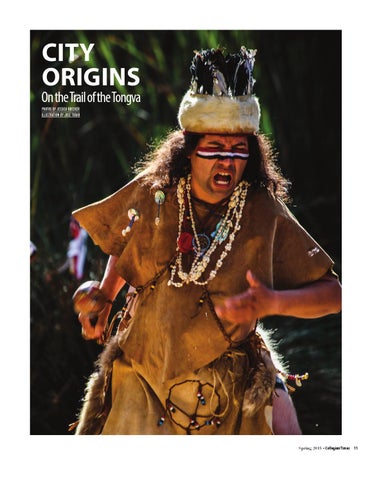
“Guiding Young Cloud” Andy Morales of the Gabrieleno/Tongva Tribal Council of San Gabriel, leads a sacred dance during “Life Before Columbus,” an annual Columbus Day festival held at Kuruvungna Springs, a scared village site located on the campus of University High School in West Los Angeles, California. The dance symbolizes a journey aboard a “ti’ at,” or traditional wooden canoe used by the tribe to traverse bodies of water in Los Angeles.
“They were buried in the fill as they developed this property,” he says. “They mixed the Native American artifacts in the dirt all around here.”
THIS WISE ELDER, THIS LADY ELDER, IN THE BACK OF THE CROWD, SHAKING VOICE, FRAGILE, SAID; ‘I KNOW WHERE TO HIDE [THE CULTURE] CHIEF, LET’S HIDE IT IN THE CHILDREN’ … AND HOW TRUE THAT IS, BECAUSE THEY ARE THE PROTECTORS OF THE CULTURE, THEY ARE THE ONES WHO ARE GOING TO CONTINUE THE CULTURE SO THAT IT WILL NEVER BECOME EXTINCT.
Tribal Rites Bridge Past to Present Surrounding tribes considered the Tongva “the enlightened ones,” according to anthropologist Alfred L. Kroeber, who became widely known as the father of California Indian studies following his fieldwork and 1925 “Handbook of the Indians of California.” According to Kroeber, the Tongva pass on most of their history and cultural knowledge through songs, dances, poetry and stories. “I don’t see enough of [the Tongva culture] because it was so destroyed,” says Rosanne Welch, professor of interdisciplinary general education at Cal Poly Pomona. “It’s taken a long time to rise again.” When she speaks about the Tongva, however, she seldom uses the past tense. “They’re redefining themselves for a new century,” Welch says. Chief Red Blood’s son, Andy Morales aka Guiding Young Cloud works to pass along the Tongva culture to the younger generation. He and his father lead a dance troupe that participates in cultural events for the public. “We perform a lot of dances and each dance is symbolic,” Andy Morales says. “The songs are also symbolic – a communication with the spiritual world.”
-CHIEF RED BLOOD, ANTHONY MORALES
Protectors of the Culture
Native Americans for more than 10 years at College of the Canyons in Valencia, California. He says some villages were seasonally occupied to take advantage of a particular, locally available food resource. “What’s usually said is [that the Tongva’s territory’s] north border is Aliso Creek, its south border Malibu-Zuma Beach, its east border the crest of the San Gabriels, and its west border was Catalina, San Clemente and San Nicolas Island,” Mauer says. Ten miles west of Laurel Canyon at Santa Monica Boulevard and Barrington Avenue, stands University High School. Native American and Spanish artifacts surfaced during construction of the school in 1924. Artifacts continue to surface to this day. In a small corner of the campus, a sacred freshwater spring continues to flow from the ground.
The land where the spring runs once belonged to a Tongva village, according to Angie Behrns, president of the Gabrieleno/Tongva Springs Foundation. “We’ve found grinding stones, arrow tips and knives and even pieces of pottery,” Behrns says. Behrns identifies as a Gabrieleno Indian and in the 1990s, she established the foundation to protect the small plot of land from encroaching developers. The Tongva consider the springs to be one of their last remaining sacred sites and regularly make it the centerpiece of ceremonial events. “I was [the] springs archaeologist here for three years while they were building the new gym project on campus,” says anthropologist Robert Porter. Artifacts emerged as soon as construction began, Porter says.
Sun Richmond, a suburban mother originally from Korea, brought her eight-year-old son, Caleb to the Southwest Museum of the American Indian to learn about Native Americans’ history. “Caleb is learning about California Native Indians in school right now,” she says. “So, we thought it would be helpful for him to see some things here.” However, Caleb did not know about the Gabrieleno/Tongva tribe that occupied the land where he and his mother stood, and the ground where so many L.A. City College students tread daily. His mother however was familiar with the name. “We live in Studio City,” she says. “We live very close from Tujunga and I didn’t know it was a name from the Tongva tribe, we didn’t know, so we’re finally here.” Richmond says she came her with her son to get an authentic experience, but also to get in touch with her own roots. “Especially that I’m Asian, I can relate myself to Native American[s],” she says. “I think it’s very important to inherit their history. There are different kinds of histories for all kind[s] of people, [and they] are very important, because otherwise we will forget where we are from.” Yet the Tongva are here, and many of them work to protect the sacred lands of their ancestors, even if they do not hold deeds to the land. President Barack Obama used his executive power to protect the San Gabriel Mountain Range by giving it national monument status on Oct. 10, 2014. “We still exist,” says Two Moons, a member of the Gabrieleno/Tongva Tribal Council of San Gabriel. “It was a blessing that the San Gabriel Mountains actually got chosen to be a National Park … the next step is to federalize the people it belongs to.” Richard Martinez and Clinton Cameron contributed to this story.
Spring 2015 – collegian times 15