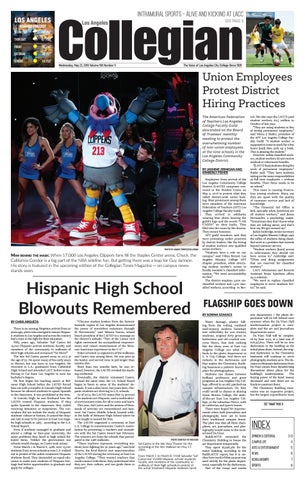
los angeles Weather ForeCast
WEDNESDAY
68°/57° 68
THUrSDAY
67 67°/55°
friDAY
70 70°/56°
SATUrDAY
70 70°/57°
SUNDAY
74 74°/59°
Collegian Intramural sports - alIve and kIckIng at lacc see Page 8
los angeles
Wednesday, May 23, 2018 volume 180 number 5
the voice of los angeles City College since 1929
Union Employees Protest District Hiring Practices The American Federation of Teachers Los Angeles College Faculty Guild descended on the Board of Trustees’ monthly meeting to protest the overwhelming number of non-union employees at the nine schools in the Los Angeles Community College District. By Jasmine JerniGan and KimBerly Fisher
Photo by AnwAr torres/CollegiAn
MAN BEHIND THE MASK: When 17,000 Los Angeles Clippers fans fill the Staples Center arena, Chuck, the California Condor is a big part of the NBA sideline fun. But getting there was a leap for Guy Jackson. His story is featured in the upcoming edition of the Collegian Times Magazine -- on campus newsstands soon.
Hispanic High School Blowouts Remembered By chris arGUeTa There is an unsung, forgotten activist from 50 years ago, a hero who emerged to ensure Hispanic students in Los Angeles and across the country had a voice in the fight for their education. Fifty years ago, Salvador ‘Sal’ Castro led 15,000 Hispanic activist students, faculty, and members of the community to walkouts of their high schools and screamed “No More!” The late Sal Castro passed away in 2013 at the age of 79. He spent many of his early years in Mexico, but was born in Los Angeles. He returned to L.A., graduated from Cathedral High School and attended LACC before transferring to Cal State Los Angeles to earn his bachelor’s degree. He first began his teaching career at Belmont High School before the LAUSD forced him out with a transfer to Lincoln High School because he allowed students to speak Spanish in the classroom. It was prohibited at the time. At Lincoln High, he saw firsthand how the LAUSD treated Hispanic students. If they spoke Spanish in the classroom, they risked receiving detention or suspension. The curriculum did not include the study of Hispanic students’ culture or history. It caused the dropout rate to soar to 60 percent in East Los Angeles high schools in 1967, according to the L.A. School Report. Even if students managed to graduate and attend a college or four-year university, the same problems they faced in high school followed them. Neither the government nor schools would change, so Castro took action. From March 1 to March 8, 1968, over 15,000 students from seven schools across L.A. walked out in protest of the unfair treatment Hispanic students faced. They demanded an equal education to make sure students of Hispanic heritage had better opportunities to graduate and apply for colleges.
“Chicano student leaders from the historic Eastside region of Los Angeles demonstrated the power of nonviolent resistance through El Movimiento,” said Mónica Garcia, school board president of the LAUSD in a message on the district’s website. “Part of the Latino civil rights movement for sociopolitical empowerment, and raised consciousness of the Mexican-American experience in the U.S.” Police arrested 13 organizers of the walkouts, and Castro was among them. He was seen as the leader, and served time in jail longer than anyone else. More than two months later, he was released, however, the LAUSD revoked his teaching credential. Eventually, the district reinstated Castro. Around the same time, the LA. School Board began to listen to some of the students’ demands. It was a slow burn, but years later, Hispanic students are thriving in L.A. schools. As of 2013, the LAUSD states that 74 percent of its students are Hispanic, and a multicultural environment exists for all to come and learn. This year, Sal Castro and the actions of thousands of activists are remembered and honored. Sal Castro Middle School, located within the halls of Belmont High School where he once taught is named for him. The LAUSD organized a ceremony at East L.A. College to commemorate Castro’s contribution by presenting 11 teachers and counselors with the Sal Castro Award last February. The winners are from the schools that participated in the 1968 walkouts. “These teachers represent everything students were fighting for 50 years ago,” said José Huerta, the local district east superintendent of the LAUSD during the ceremony at East Los Angeles College. “They wanted teachers that could connect with them, they understand who they are, their culture, and can guide them to succeed.”
Photo Courtesy of roCKero
Sal Castro at the Isla Vista Theater for the screening of the film Walkout on May 17, 2006. From March 1 to March 8, 1968 Salvador ‘Sal’ Castro led 15,000 Hispanic activist students, faculty, and members of the community to walkouts of their high schools in protest of the unfair treatment Hispanic students faced.
Employees from several of the Los Angeles Community College District (LACCD) campuses convened at the Student Union on May 9, 2018 to protest what they called district-wide union busting. Most prominent among them were members of the American Federation of Teachers (AFT) Los Angeles College Faculty Guild. They arrived in solidarity wearing blue shirts bearing the guild’s logo and the words “I AM UNION” on their backs. They filed into the room by the dozens. They meant business. AFT guild members said they were protesting unfair practices by district leaders, like the hiring of student workers over qualified union workers. “Students have a role on our campus,” said Vilma Bernal, Los Angeles Mission College AFT chapter president, while drecrying student worker’s access to faculty member’s classified information. “We need accountability on this.” The district employs 3,000 unclassified workers and 1,300 classified workers, according to Ber-
nal. She also says the LACCD paid student workers $2.5 million in October of last year. “They are using students in lieu of hiring permanent employees,” said Velma J. Butler, president of the AFT Los Angeles College Faculty Guild. “A student worker is supposed to come to work for a few hours [and] then pick up a book. This is abusing the student.” However, unlike classified workers, student workers do not receive medical or retirement benefits. “[LACCD has] students doing the work of permanent employees,” Butler said. “They have students taking on the same responsibilities as full time employees – without benefits. Their focus needs to be on school.” This issue is causing frustration among students. Many say they are upset with the quality of customer service and lack of knowledge. “The Financial Aid Office is hell, specially when [workers] are all student workers,” said Jessie Hernandez, a psychology major. “Sometimes they don’t know what they are talking about, and that’s how my file got messed up.” Jackie Ambridge, senior secretary at Los Angeles Mission College, says the influx of students doing classified work is a problem that extends beyond customer service. “Student workers [have] access to information they should not have access to,” Ambridge said. “[They are] doing assignments that are reserved for classified workers.” LACC Admissions and Records Assistant Brian Spoelstra offers up a solution. “We need to replace classified employees to serve students better,” he said.
Flagship goes doWn By sorina sZaKacs Water damage, plaster falling from the ceiling, outdated mid-century modern furniture (not collectible), for 21st century students, original dirty grout in bathrooms and old cracked concrete floors, that look nothing like the shiny ones at East Los Angeles College are what one finds in the photo department at L. A. City College. And there are rodents in the darkrooms and that makes the Chemistry Building basement a pathetic learning place for photographers. Students can choose between brilliant professors and great programs at Los Angeles City College, offered in an old, patched-up campus infrastructure. Or, they could enroll in classes at shining Santa Monica College, the stateof-the-art East Los Angeles College, or the suburban Pierce, with its cafeterias and sports teams. There were hoped for improvements when both journalism and photography were set to leave their traditional campus home. The plan was that all three disciplines, art, journalism, and photography would move to the modernized Da Vinci. BuildLACCD renovated the Chemistry Building to house the art department temporarily. They spent $5,096,480 for the entire building, according to the BuildLACCD report, but it is unclear how much of that amount was used strictly for the photo department, especially for the darkrooms. Part of the visual and media
arts department – the photo department will be left behind next summer when the Da Vinci Hall modernization project is complete and the art and journalism departments move. Da Vinci Hall will be completed by June 2019, at a total cost of $28,377,822. There will be no new darkrooms in the building as the initial plans show. Instead, the original darkrooms in the Chemistry basement will continue to serve photography students as is. The decision to eliminate darkrooms from Da Vinci comes from decades-long discussions about plans for the building’s modernization. The buying power of the bond money decreased and now there are no funds to construct them. The Chemistry Building renovation was an expensive project, but the largest expenditures went SEE “VAMA” PAGE 6
Index opinion & editorial
2-3
campus life
4
arts & entertainment
5
news
6
scholarships
7
sports
8
2
opinion & EDitoriAL
Los Angeles Collegian — Wednesday, May 23, 2018
Haiti cityviews
COMPILED BY Ande Richards
How did you feel when you heard the comments made by U.S. President Donald Trump? “Why are we having all these people from shithole countries come here?” “Why do we need more Haitians?” “Take them out.”
ROeseKenia deJuen student at École elie duBois
taisHa KiMaRa BeRCY student at École elie duBois
Wasna guillauMe student at École elie duBois
JenniCKa JOsePH student at École elie duBois
“I heard exactly what Donald Trump said about us and I completely disagree with that. I wonder if this is the way Haitian people behave overseas while they are living abroad that makes Donald Trump say that. If it is, then I think it would be better for Haitian people to change the way they are living abroad so they can have better behavior for such things not to be said about Haitian people.”
“I feel bad. I disagree with what Donald Trump said, but I put the blame on Haitian people. Instead of fighting for good things they prefer to have contests everywhere on the street. Every day they fight for bad things and not for things that can help Haiti ... I disagree with what Donald Trump says but I kind of disagree with Haitian people and the way that they behave to push Donald Trump to say that.”
“When I heard that I felt very bad, but I put the blame on the Haitian authorities who have the power to change things. So, if people were united together to change this country Donald Trump couldn’t say such a thing. I feel really, really bad and I put the blame on Haitian people because their behavior is sometimes very bad.”
“It’s very awful, very ridiculous and when I heard that I was very upset. I feel that I was diminished as a Haitian to hear that Donald Trump said such a thing about us. What I hate about people that go back and forth from Haiti is that they only show bad things from Haiti, but they put good things under cover. The way they present Haiti is not the way Haiti is.”
Editorial
ameriCa Fails in aFriCanameriCan historY
P
resident Donald J. Trump has derided nations across the world and members of the African-American community in America. This world leader who promotes himself as Ivy League educated should come to Los Angeles City College and take a class in African-American studies because it is the underreported history of America. Earlier this year, the president referred to Haiti and other countries in Africa as shitholes. “Why do we want all these people from ‘shithole countries’ coming here?” He said on Jan. 11, 2018 in the Oval Office during a bipartisan meeting. Lawmakers discussed a potential bipartisan deal to preserve DACA and secure funding for border security when the president made his negative remarks about El Salvador, Haiti and Africa. He made another controversial comment last summer about protests in Charlottesville. “We condemn in the strongest possible terms this egregious display of hatred, bigotry and violence, on many sides,” the president said, equating white supremacist hatemongers who took the life of a protestor to those speaking out against them. He took a much harsher tone last September when referring to football players who chose to kneel during the national anthem at NFL games. “Wouldn’t you love to see one of these NFL owners, when somebody disrespects our flag, to say, ‘get that son-of-a-b**** off the field right now, out. He’s fired,” the president said. A recent spate of incidents from across the nation may speak to the president’s leadership and rhetoric with regard to attitudes toward people of color. People notice the president’s words and his tone. A woman in a Rialto, Calif. neighborhood suspected three black women loading luggage into the trunk of a car at an Airbnb of stealing. She called the police. Police arrested two black men in a Philadelphia Starbucks who had been accused of trespassing after a manager called police. She said the men refused to leave or make a purchase. A grey-haired, 65-year-old black woman was pulled over in Alpharetta, Ga. and ticketed for drifting into another lane while exiting a highway. When she refused to sign the ticket, police ordered her out of the car and called for backup. One of the officers could be heard screaming, “You’re not in charge, shut up and get the f--- out of the car!”
illustrAtion by nAtAliA zePeDA/CollegiAn
“hIstory teaches us about the mIstakes of the past and It shows us how we have evolved and what we stIll need to work on. the racIal dIvIde stIll has a wIde gap, one that Is fIlled wIth Ignorance.” A black man’s neighbors welcomed him to his new upper west side Manhattan apartment by calling the police on him for allegedly breaking and entering. Darren Martin was moving into his new apartment as he prepared to take on a new job with the city of New York. He was a former White House official under President Barack Obama. A group of black women, part of a group called Sisters in the Fairway, teed off at Grandview Golf Course in York County, PA. They were told by the club’s owners they were not keeping a quick-enough pace. The club offered to refund their memberships and then called 911. These people were seen as nuisances at the very least, and as threats to the safety of those around them. Average people leading average lives now seemingly under attack. The common denominator is their race and the perceptions others harbor for them. The words of true leaders should empower people. So, if the president says people come from “shithole” countries and are “thugs” and “sons of bitches” then why shouldn’t the public follow suit? Rapper Kanye West expressed an opinion about slavery on TMZ that ignited a firestorm. In addition to calling the president his “brother,” he then said, “When you hear about slavery for 400 years ... for 400 years? That sounds like a choice.” Political pundits, cultural commentators, and the general public sounded off about the comment and about West’s intentions. Some in defense and agreement, and others deeply disturbed by what was taken as a deep cut in a wound that has never fully healed. Racism. Here are two men, one the leader of the free world and the other an
internationally renowned rapper, who choose to use their pulpits to malign people of African descent. Freedom of speech should not be curtailed. Responsibility and sensitivity cannot be thrust upon the likes of Trump or West, but there is something that can be done to counter superficial talking points and the people who take what is thrown at them as gospel. African-American studies must be mandatory and an integral part of the national curriculum. The free labor of African slaves was significant to the development of this country’s wealth and at the very least should be rewarded with accurate representations in history books. At Los Angeles City College, African-American studies remains a popular elective among students. Yet, year after year the course offerings dwindle. In past years the department offered more classes on a variety of related topics that speak to the black experience today. History teaches us about the mistakes of the past and it shows us how we have evolved and what we still need to work on. The racial divide still has a wide gap, one that is filled with ignorance. LACC, and other educational institutions must teach the complete history of the United States. A thorough understanding of the history of people from the African diaspora, including the “peculiar institution” of slavery will give people a deeper understanding of our cultural chasms, and lead to informed discussions which will make our society stronger. It will stretch the thinking around what it means to be black, and soundbites from uninformed attention-seekers will not hold weight. Knowledge of the past will contribute to a true reconciliation of what divides us.
Have an OpiniOn? a StOry idea? write a letter to the editor! email: losangeles.collegian@gmail.com
opinion & EDitoriAL
COMPILED BY Sahara Velasquez PHOTOS BY Anwar Torres
How do you feel about Kanye West’s comment regarding slavery being a choice?
Los Angeles Collegian — Wednesday, May 23, 2018
3
aMY alvaRadO sociology Major
JOdY HaRRisOn History Major
glenn BRigHtWell Cinema Major
HannaH geHRels French Major
“Honestly, it made me laugh because the first thing I saw on social media was the memes. So, I was like what happened. Then I had to watch the clip, which was like only 50 seconds. When I watched it, it did piss me off. But, I went on to a different link and I saw the complete video of it. Now I just don’t know what to say and I don’t know how to feel.”
“#Eyeroll #What?! He’s just doing it for publicity. Can anyone justify the fact that slavery was a choice? That makes no sense. The concept is asinine, it blows my mind. I mean, you can talk about how some slaves had it better than others and they were fed. But if you are property, that is unethical, period, full-stop. There is a lot of history behind this, and it is history that this person probably needs to look up, read and study a little bit more.”
“I think Kanye’s perspective is reflective of a lot of the disorientation that prevails amongst the most privileged layers of society. Their material needs are not under threat and so it’s very convenient for them to be able to espouse all these very backward notions. Whereas the working class is faced with devastating problems and difficulty in the ability to succeed or survive on a day- to-day basis.”
“It made me feel disappointed, angry, and after feeling disappointment and anger, I was thinking to use this and educate people. Don’t assume that people know stuff. With my disappointment and anger, I am going to use it to act more aggressively towards informing people and putting the truth out there.”
Ink Style:
Free Thinkers Only
a vIsual representatIon of the world as we know It
the Coronation oF KanYe West
illustrAtion by Juventino velAsQuez/CollegiAn
Scan the QR code TO VISIT OUR MULTIMEDIA BLOG FEATURING COVERAGE OF OUR COMMUNITY AND BEYOND or visit: collegianwired.tumblr.com
By Thomas chaVira When Kanye West expressed support for President Donald Trump a few weeks ago, a firestorm of backlash rapidly followed that reveals that the only oppression in America today is that of individual thought. Without embracing any specific policies, West – arguably the greatest influential artist in music the last decade – said of Trump: “He is my brother. I love everyone. I don’t agree with everything anyone does. That’s what makes us individuals. And we have the right to individual thought.” When he said slavery was a choice, he implied that the mentality of victimhood is self-inflicted, given that slavery ended in 1865. Of course, no one bothered to look for clarity or analysis in this age of extreme pearl-clutching. In the immediate aftermath there was no shortage of outrage towards West for being open-minded about the president and our culture. “Uncle Tom,” “Coon” and “Token” were among the go-to favorites of those who opposed Kanye. When last I checked, this wasn’t North Korea or Syria, where thinking aloud could get you barred from society. However, in 2018 thinking against the grain is the most surefire way to be dismissed from the cultural landscape and labeled a hatemonger. The oppressive left didn’t relent, going so far as to claim that his black card was revoked, as if his identity as a black man depends solely on his political alignment. Remember that in 2005 Kanye famously denounced President George Bush in a telethon for Hurricane Katrina. But Bush was a Republican, and Kanye was widely applauded and celebrated for his bold proclamation that Bush “doesn’t care about black people”. But sup-
Los Angeles Collegian
for all submissions including letters to the editor and publicity releases, send materials to Collegian offices located in Chemistry building, room 207, or email: losangeles.collegian@gmail.com.
the voice of los angeles City College since 1929
Los Angeles City College Visual & Media Arts Department
855 N. Vermont Ave. Los Angeles, CA 90029
porting a Republican? Make way for the lynch mob led by elitists and petulant children. Days after Kanye’s twitter bromance with Trump, Chance the Rapper tweeted, “Black people don’t have to be Democrats.” Predictably, the reaction was as extreme as it was unreasonable, with people suggesting that Chance and Kanye had betrayed African-Americans. Again, this line of thinking is extremely shortsighted and harmful. To say that a black person must think a certain way because of their skin color robs that individual of their agency and personal experience. Kanye’s support of Trump makes him no less a black man than any other African-American, regardless of politics. Calling Kanye a traitor to his people means that the expectation of black people is limited in thought, it’s putting minorities in a box that does not allow for new ideas. This expectation asks us to think with our skin color, not our minds. This also confirms Kanye’s assertion that the victim mentality of slavery is a choice. We have created an “Oppression Olympics,” where minorities illustrAtion by CAssAnDrA Munoz/CollegiAn are asked to compete with each other to find out who has been oppressed the most. Kanye’s tweets blows that apart, encouraging us to take responsibility for how we see the world, how to take charge of our actions and have ownership of our future. None of us should care about which politicians celebrities endorse. They are out of touch with the average American and ultimately have a skewed view of the working class. Kanye Omari West is not an exception. However, when a culturally relevant figure risks his icon status for the sake of promoting an honest dialogue (see Ye vs. the People), we should all be paying attention.
to advertise in the Collegian, direct all insertion orders and questions to: pr.collegian@gmail.com.
323.953.4000 ext. 2831 losangeles.collegian@gmail.com
neXt issue: september 12, 2018 EDITOR-IN-CHIEF Ande Richards
LAYOUT EDITOR Richard Martinez
PHOTOGRAPHERS Cliff Cheng, Eve Moreno Luz, Anwar Torres
GRAPHIC DESIGNERS Juventino Velasquez, Joanna Guevara MULTIMEDIA PRODUCER Dave Martin
REPORTERS Chris Argueta, Clinton Cameron, Thomas Chavira, Felicia Gaddis, Verena Hecht, Kimberly Fisher, Jasmine Jernigan, Trissean McDonald, Kilmer Salinas, Sorina Szakacs, Sahara Velasquez.
editORial deadline: september 9, 2018
ILLUSTRATORS Cassandra Muñoz, Natalia Zepeda
ADVISER Rhonda Guess
the college newspaper is published as a learning experience, offered under the college journalism instructional program. the editorial and advertising materials published herein, including any opinions expressed, are the responsibility of the student newspaper staff.
under appropriate state and federal court decisions, these materials are free from prior restraint by virtue of the first Amendment to the united states Constitution. Accordingly, materials published herein, including any opinions expressed, should not be
issues of our award-winning newspaper and magazine are instantly available to our readers on issuu.com/collegianwired. facebook.com/CollegianWired @CollegianWired CollegianWired.tumblr.com youtube.com/CollegianWired
interpreted as the position of the los Angeles Community College District, los Angeles City College, or any officer or employee thereof. Collegian ©2017. no material may be reprinted without the express written permission of the los Angeles Collegian.
4
CAmpUs LiFE
Los Angeles Collegian — Wednesday, May 23, 2018
TED LUMPKIN
an aMeRiCan HeRO Ted Lumpkin attended Los Angeles City College and UCLA, but never graduated because he was drafted into the military. The young soldier moved from California to Alabama to be trained as a Tuskegee Airman at the height of World War II. Lumpkin persevered through the “Great War” and through the stings of bigotry to receive a Congressional Medal of Honor for his service as one of the elite Tuskegee Airmen. By ande richards
T
ed Lumpkin scored well on his placement tests, so representatives selected him to be part of the “Tuskegee Experience.” At first, he did not understand the significance of this distinction. “I was assigned to the 100th Fighter Squadron,” he said. “Orders from San Pedro said I was in the 689 Signal Corps, but [another soldier] Arnold Bankston said the orders were wrong we’re going to Tuskegee. His orders were correct.” The Signal Corps is a part of the Army that is involved with communications and is attached to the Air Force as their communications arm. “I was assigned to the Corps because of radar – it was top notch and top secret – it was a way to know what was going on behind enemy lines without them knowing it,” he said. Lumpkin was in intelligence initially, but took the exam to be an air force officer. If he graduated he would be in the Air Force and not the Signal Corps. He passed the test and was sent to Tuskegee as a member of the 100th Fighter Squadron in an administrative job. “Advanced training was specifically designed for the pilots,” he said. “For every pilot there were 10 people on the ground to keep them in the air. As an intelligence officer I was one of those 10.” Lumpkin says while he was enlisted the military was very interested in the appearance of the service-
men and women. They wore khakis in the summer and officers wore “Pinks and Greens” uniforms in the winter. “I thought those uniforms were very attractive,” he said. “I was disappointed when they changed the uniforms to the way they are now.” However, now that he is used to them, he thinks they look good and others look dated. When it came to meals Lumpkin says they received military issued rations, which were either very good or very bad. “It took a month to get across the ocean,” he said. “We went in convoys on Liberty ships, which were built to transport troops, built rapidly, they were good ships but not the most comfortable. We took salt water showers, which meant the soap didn’t lather and we slept in bunks.” Lumpkin says they ate mostly D rations. While the K-ration was meant for meal time, D-ration, or the emergency ration, was intended for survival. It
would provide a quick hit of energy to carry the soldiers through grueling combat. “When we got to Italy, we walked to the first base (uphill) and we got to eat C rations,” he said. “It was one of the best meals I’d had in my life. It was basically spam, but to this day I still like spam.” In Italy, Lumpkin says initially he and fellow African-Americans were a question mark to the local people. “They didn’t know what to make of us, we were a curiosity,” he said. “They wanted to touch our hair and stare at us and white American soldiers spread negative stories about black servicemen.” No matter what the Italians thought of them, or what rumors the white soldiers spread, the Tuskegee Airmen were in Europe to fight. “The tails of the P47 and P51 planes were painted red so the squads could be identified,” he said.” “All fighter squadrons did that, you would see checkboard type tails, striped tails, but the Tuskegee Airmen wanted to be identified easily and quickly, they would have a different design on the wings as well. We knew they were our fighters, but other bombers did not know that until later.” Lumpkin made lifelong friends as a serviceman. “The experience of war pulled you together,” he said. “Even though you had differences of opinion that commonality is something you don’t lose.” He counts Colonel Benjamin O. Davis Jr. (his rank at the time) as a friend and a hero. “He was a marvelous man and one of the keys to the Tuskegee Airmens’ success,” he said. “He could deal with egos and would not let the Red Tails engage the enemy unless they were attacked. The servicemen didn’t care for that at first,
illustrAtion by JoAnnA guevArA/CollegiAn
but ultimately it became their legacy.” Davis became the first black general in the United States Air Force. Lumpkin returned to the U.S. on a passenger ship, a stark contrast to the Liberty ship he traveled aboard to get to Italy. He counts this voyage as one of his most significant experiences because the atom bomb was dropped in Japan on the way back to the U.S. “We wouldn’t have to go to Asia,” he said. “Life plans shifted and changed.” When Lumpkin finally made it home to L.A. he realized the city had changed. He went to the army base in Santa Ana to decide whether or not to reenlist. He decided to leave, but joined the reserves two weeks later and retired from there. On reflection, Lumpkin says that black servicemen felt they needed to do more to convince the United States that blacks were valuable. If black enlisted men and women were successful they would improve their chances of being judged on their ability and not by the color of their skin. He says things are better for African-Americans and society is always evolving. “With the efforts of the Tuskegee Airman and the civil rights movement it’s better,” he said. “It’s endless … you improve one thing then there is something else. You have to be continually observant and realize that prejudice is an issue at all times and it needs to be combated.” In 2007, Lumpkin and his fellow Tuskegee Airmen were decorated with the Congressional Gold Medal. At the ceremony, President George W. Bush saluted the airmen in recognition of the many salutes they did not receive when they served. “It was a very emotional experience,” Lumpkin said. Los Angeles City College provided a good foundation and was integral to Lumpkin’s success. “LACC should be congratulated for lasting 90 years,” he said. “It has a role, an important one in my life. It helped me get to UCLA, helped me with the examinations I had to take to get into the military, which helped me get to Tuskegee, which helped me to help become an officer in the air force and to have the experience to become what is known today as the ‘Tuskegee Experience’.”
Jazz Ensemble Stays in the Pocket By Kilmer salinas Entering the Herb & Lani Alpert Recital Hall, the stage is bright and the grand piano stands in the middle with a drum kit to the side and music stands with chairs in front. Musicians are about to walk onto the stage to perform. The hall quiets down as professor Christine Park walks on stage to greet the audience. On May 9, the Los Angeles City College Music Department organized a concert that included the music of Ludwig van Beethoven, Johannes Brahms and Zequinha de Abreu. Each musician played with great confidence and emotion and the dynamic between the musicians was excellent. Their hard work and practice showed on stage with each musician glancing at one another to stay in rhythm. Performing at the concert was the groups chance to show the skills they practiced during the semester. One piece that really painted a picture was “Tico-Tico no fubá” (Sparrow in the Cornmeal), a guitar piece written by Zequinha de Abreu and performed by Michael Heringhaus and Ian Wasdin. It is a Brazilian song performed with two guitars. Anyone who hears the music will recognize the melody. Byron Burchard who plays the saxophone, led his jazz ensemble
Photo by KilMer sAlinAs/CollegiAn
David Holguin (middle) and his jazz ensemble perform a Latin version of “Autumn Leaves“ at the Herb & Lani Alpert Recital Hall on May 9th, 2018. playing an original piece called “Spicy Mayo” that he wrote. The entire jazz band rocked the stage and appeared to enjoy playing for the audience. “I felt good up there,” Buchard said. “I wasn’t thinking about anything, just in the moment.” David Holguin led the final performance with his jazz ensemble. He shared his thoughts after the concert and praised the members of his jazz band. “Feels good having a good view of everyone,” Holguin said. “It’s
good to have everyone practice and know their cues, as well as making sure everyone is in the right pocket.” For this small jazz ensemble, musicians did not use charts. Everything was memorized and the musicians showed knowledge of music theory and played seamlessly through their solos. Professor Park showed her love and gratitude to the students after the concert. She asked all of the musicians to return to the stage and take a bow.
I feel broken; yet, there’s hope. I feel anger; yet, there’s joy. I feel grief; however, there’s faith. I feel anxious; yet, at peace. I feel nothing…I…feel…something. I feel you; you feel me. I love you; you love me. You keep me; I’ll keep you. You guide me; I will follow.
STUDENT UNION LOBBY www.laccbookstore.com
i Feel ... By Trissean mcdonald
LOS ANGELES CITY COLLEGE CUB STORE
I feel fear; yet, there’s bravery. I feel dark; but, there’s a light. I feel gentle; but, also rough. I feel negative; yet; also positive. I feel nothing…I…feel…something. I feel you; you feel me. I love you; you love me. You keep me; I’ll keep you. You guide me; I will follow.
illustrAtion by JoAnnA guevArA/CollegiAn
MAY 29 - JUNE 4 *****HOURS***** MONDAY thru THURSDAY 9am - 2pm and 3pm - 7pm FRIDAY 9am - 2pm
STUDENT ID REQUIRED. We pay up to 50%, no matter where you bought your books! We buy your books, even if you purchased them online. Bring all CD’s DVD’s and supplemental materials purchased with your textbooks. .
Arts & Entertainment
Los Angeles Collegian — Wednesday, May 23, 2018
Journey into Art
5
Preger Fine Tunes Her Art Los Angeles City College alum, Elizabeth Preger, proves that hard work and dedication do pay off in the long run. By Kimberly Fisher
Photo by Anwar Torres/Collegian
Students listen to LACC Art Professor Nicole Belle discuss her work in sixth installment of the VAMA Artist Lecture Series on May 1. I sort of hate to say this,” Belle said. “I was dating a guy who was a photojournalist. I was sort of just like open. So, I asked him ‘teach me about photography’.… he bought me a [Pentax] K1000.” By Felicia Gaddis
V
isual and media arts professors Nicole Belle and Alexandra Wiesenfeld shared their journey into art, what inspires them and their process at the Artist Lecture Series’ latest event on May 1. Professor Nicole Bell fell into photography after she graduated from New York University. “I got an undergraduate degree in French literature and then didn’t have any idea what to do with myself,” Belle said. After graduation Belle asked her then boyfriend to teach her photography. “I sort of hate to say this,” Belle said. “I was dating a guy who was a photojournalist. I was sort of just like open. So, I asked him ‘teach me about photography’ … he bought me a [Pentax] K1000.” This started Belle’s journey down the “art hole” as she calls it. With a bachelor’s degree in French literature under her belt, Belle moved back to her parent’s home and began experimenting. “I moved back home to Minneapolis because I didn’t know what to do,” Belle said. “But I took the camera with me and then I was by myself sort of … There was not a lot going on and I was just like ‘I’m going to figure this thing out. And that was it.” Influenced by Rudolf Schwarzkogler and Yves Klein, Belle’s early works in many cases are re-creations of their work, but with her own unique perspective. Using craft store birds and gauze, Belle’s photographs paid homage to Schwarzkogler’s bandage-wrapped subjects. Belle gave visual reference to performance artist Ana Mendieta’s work “Blood and Feathers,” which depicted a live chicken being sacrificed. However, Belle used “International Klein Blue” – a color created by Klein – and a grocery store chicken for her version. Mendieta’s work was also compelling to Belle but was too intense for her at that time. “There’s a whole vein … the gore of the performance, using animals and blood that I was really into, but in a very hands-off kind of way,” Belle said. Belle is fascinated with the extremes and the intensity of performance art and avant-garde imagery, but she sterilizes it to take the trauma out of it to suit her conservative mid-westerner sensibilities and personal shyness. Belle reconstructs Klein’s performance of his “Anthropometry” paintings, but instead of using naked women as paint brushes as Klein did, Belle retreats to her craft store birds dipped in International Klein Blue paint, swirled and blotted on white paper before an audience of attentive (non-judgmental and artificial) bird patrons. The resulting image is a true representation of the original Klein work, but completely sanitized of any sexual connotation – there is
no nudity or commentary on voyeurism– and completely safe. “It was a way for me to work with representation and action and all the things that kind of come out of performance, but from a photographic standpoint,” Belle said. “And I didn’t have to talk to anyone or deal with another person.” Belle applied for graduate school with her all-bird portfolio and was accepted at UC Riverside for their BFA program. At this point, Belle decided she didn’t want to be known as the “craft store bird lady” and attempted to tackle her fear of photographing people – in baby steps. In her first series with actual people titled, “Group Sweaters,” Belle stitched the identity of the subjects out of personal photographs. Belle uses photos from a trip with friends to Death Valley, family photos, and a wedding photo and stitches colored thread through faces and body parts, giving the images new life and showing the connectedness of the subjects.
“I’m no longer using any source material. My process is … if I know too much about the image I let it go and if I can replicate it I have to destroy it and if it comes too easy I have to destroy it – I’m trying to circumvent language.” - Alexandra wiesenfield In the wedding photo, the bride and her bridesmaids are prominently centered and intricately and lovingly woven together with hands and arms entwined. The viewer gets a real sense of the relationship of the women in the image to each other and to the bride. However none of the faces are visible and if she hadn’t told the audience, no one would have know that this was in fact Belle’s wedding photo. She, the artist has become visibly invisible. Belle’s need to be invisible has persisted throughout her work. Her current work with gloves, aprons and pockets all feature her prominently and unrecognizable, with her identity hidden by pattern and objects. Painting professor Wiesenfeld gave the second talk of the evening. Weisenfeld is the daughter of American realist painter Paul Wiesenfeld who was born here in Los Angeles, but moved to Munich, Germany to study and that is where Alexandra was born. As a child, Alexandra had no desire to be a painter. She spent most of her childhood as the subject of her father’s work, who was known for detailed portraits and interiors. Wiesenfeld said she always felt more like a prop.
Photos by Anwar Torres/Collegian
Top row: Professor Alexandra Wiesenfeld discusses her painting “Man Made” at the VAMA Artist Lecture Series on May 1. “I started first as a sculptor,” she said. “I taught myself how to draw and then I started painting and I couldn’t stop. I was really quite obsessed.” Bottom row: Professor Nicole Belle discusses an image from her “Rev Sanchez” series at the VAMA Artist Lecture Series on May 1. It wasn’t until 1986, when the Chernobyl nuclear power plant exploded and released a dangerous radioactive cloud across western Europe that Wiesenfeld began her journey out of Germany and into art. “They said that in every family at least one person freaked out and, in my family it was me,” she said. “But without Chernobyl, I don’t think I would have left.” No longer under the influence of her father, Weisenfeld felt free to try art. She had never studied art as a child and began to teach herself. “I started first as a sculptor,” she said. “I taught myself how to draw and then I started painting and I couldn’t stop. I was really quite obsessed.” When the Los Angeles riots broke out in 1992, she left L.A. for Montana, where she entered graduate school. “Since I’m a coward, as soon as the next catastrophe came, namely the riots and earthquakes, I decided the best thing for me would be to move there,” Wiesenfeld said. “Nothing could happen to me in Montana and I used grad school as an excuse. No one told me that it’s not the art center of the world.” Wiesenfeld spent the next 10 years in Montana, in artistic solitude, photographing herself in the decaying, abandoned ruins of forgotten homesteads. Entire towns had been abandoned when the topsoil could no longer produce a living for the families that worked the land. What people left behind was personal and haunting. “So, when you go to these houses you have these tiny little elements that are super personal, but the space decays so slowly because it’s dry,” Wiesenfeld said. “I travelled in these spaces and photographed myself and I wanted to juxtapose my timeline as this ridiculous young woman in
these spaces … This is when my obsession with space and the psychology of space started.” Wiesenfeld’s second series was based on an incident in the life of actress Margot Kidder. She had the opportunity to have drinks with Kidder in Livingston, Montana and later found out that Kidder had had a psychotic episode where she stayed in a yard for eight days before she was taken to a hospital for treatment. Wiesenfeld’s series, titled “Queen M,” is the artist’s depiction of what could have been going through the delusional mind of Kidder during that time, illustrated in fourteen Stations of the Cross. This was the beginning of Wiesenfeld’s prolific figurative painting work. Wiesenfeld has since transitioned from figurative painting. She’s no longer using symbols or recognizable imagery. Her current work is completely intuitive. “I’m no longer using any source material,” Wiesenfeld said. “My process is … if I know too much about the image I let it go and if I can replicate it I have to destroy it and if it comes too easy I have to destroy it – I’m trying to circumvent language.” In her latest collaboration Wiesenfeld supplies images for writer Monona Wali’s “O.” However, the images are not intended to be an illustration of the written word. “The drawings – I’m not illustrating her writing nor is the writing explaining the drawings, but they’re perfect,” Wiesenfeld said. “Everything that was in my mind and in her mind for the longest time came into this book and it’s super organic.” Wiesenfeld says that she has given up the structure of a conceptual framework. “Which is a little scary,” she said. But for an artist, “scary” is a good place to be.
When you first meet Elizabeth Preger, it is immediately clear that she loves what she does. Her charismatic way of talking about her art is both encouraging and warming. Preger received her Master of Fine Arts in photography and media from the California Institute of the Arts (Cal Arts) in April. However, she got her start at LACC and continues to work in the Visual and Media Arts Department on our campus. “I actually started my studies at LACC over ten years ago,” Preger said. “This is where I took my first photo class and Professor Daniel Marlos was my first photo instructor.” She stayed at LACC for a couple of years before transferring to UCLA to get her bachelor’s degree. “I have really deep roots to LACC,” Preger said. She considers Marlos to be her mentor of over a decade and feels extremely grateful to have that relationship and privileged to be able to work with him. She has been able to collaborate with him and considers him to be a friend. Her thesis project at Cal Arts, titled “Cross Bind,” was installed in the L-Shape gallery. It is a hallway in the shape of an L, but is also part of a thoroughfare allowing a lot of potential viewers to see her art. The installment was comprised of two-foot-wide and 10-foot-long transparent trees affixed to the ceiling with no floorbased connection making for a billowing effect. “It became like a forest,” she said. “Wind blowing, birds chirping, airplanes taking off.” She also included a viewing area where people can sit and listen to stories from her family. The stories were originally from Siberia and translated by her mother, a professional interpreter. The themes focused on the family’s immigration to America and how they got out of Siberia. Preger plans to travel to Colom-
Photo courtesy of Elizabeth Pregger
A man stands behind one of the transparent trees from “Air Transport” in Elizabeth Preger’s “Cross-Bind” MFA Thesis exhibit at California Institute of the Arts in April 2018. bia for a six-week residency in a community based independent study program. She hopes to return to Los Angeles with a teaching position. She has an upcoming interview with Venice Arts as a photography instructor and plans to continue her job working at LACC. Preger and her fellow MFA graduate artists will have an exhibition at The Box in Downtown L.A. June 1 from 6 p.m. to 9 p.m., The show will remain up through June 13. The gallery hours are noon to 6 p.m. Wednesday through Saturday. The Box is located at 805 Traction Ave., Los Angeles, CA 90013. Their contact information is 213625-1747, or email at info@theboxla.com.
Photos courtesy of Elizabeth Pregger
Additional images of Preger’s “Air Transport” piece from her “CrossBind” thesis installation in April at California Institute of the Arts in Santa Clarita, CA.
6
News
Los Angeles Collegian — Wednesday, May 23, 2018
Visual and Media Arts Celebrates Students
Photo by Eve Moreno Luz/Collegian
Artist, lecturer and former LACC art professor Raoul De La Sota attends the VAMA reception in the Chemistry Building at LACC on May 17, 2018. De La Sota attended LACC from 1954 to1959 and taught Mexican-American art history from 1968 to 2004. He and his wife Leticia is also an alumna of City, and together they created the Raoul and Leticia De La Sota scholarship to benefit current students who study art at LACC.
International Students Allege False Advertising By Verena Hecht
the money that I had to pay extra.”
International students at LACC are accusing the college of scamming money from them and they are demanding better service. Nearly 20 international students attended an ASG Senate meeting on April 26. They informed the ASG board of major issues with the international office on campus and also addressed inconsistencies with tuition. Students shared concerns and allege false advertising when it comes to tuition. The international student website advertises a specific amount of money online, but the actual amount that is paid is very different. The tuition and costs advertised online are not consistent with what international students are being charged. “The current situation with the international office is very upsetting,” said Sinan Payat, Senator of diversity and equity at ASG. “My family in Germany is going through a lot of sacrifice in order for me to study here in the US. I hope to achieve to get reimbursed
There are multiple inconsistencies on the website. The number of units that are required for transferring is not mentioned. A lot of important information seems to be purposefully left out. International students on a F1 visa, which is the visa that international students are on if they study in the United States, are not allowed to work outside of campus. Their tuition is high. They pay out of state tuition each semester, which equals $6000 per semester. Not for a year – per semester. The website of the international office states $20,000 that you have to pay for LACC, until you transfer and claims to be the cheapest, which is not true. This equals private tuition in other schools. Just for comparison, Cal State LA charges $35,560 for three full years. Isabella Garcia is an international student from Brazil that is studying cinema at LACC. She says that it is clear what the students are requesting. “The requests of the students
are very clear,” said Garcia. “Reimbursement of the money that was not advertised, a clearer structure and mentorship program for international students, scholarship opportunities specifically for internationals, more help for on campus employment,” said Garcia. Furthermore, students have complained that the office staff is rude and they are not helpful. Many international students leave their support systems and family behind before landing on cmpusses like LACC. They should be welcomed under friendly circumstances, especially if they have traveled here by themselves. Instead, they experience culture shock and the only thing the international office provides is a short 45-minute introduction on how to choose classes. There is no help with housing, understanding American life and culture, or how to get a Tap card for transportation. Students are given no help with skills on how to survive in a city like Los Angeles. They even pay a high fee for an international health insurance and
no one in the office explains how the process of using it works. They limit the explanation to handing students a pamphlet while saying things like “You need to call them yourself, I don´t know.” “The international office is a joke,” said Patrick Gomez de Sousa, an International student from Brazil. “The people that are working in there are rude, incompetent and unreliable. I have never left this office with anything useful or promising, only anger.” The presentation to the ASG board seemed successful. The students were asked a lot questions afterwards and the board was very engaged in listening to the complains. The members of the board were absolutely flabbergasted to find out how much international students pay for LACC and that their treatment is so rough. Alen Andriassian, counselor at the office of student life, offered to look into things further and help. The next upcoming step is a meeting with the Dean of the international office where the students will present their demands as well.
LAPD Investigates Police Response at Vermont Avenue Strip Mall An incident in East Hollywood with a LAPD officer in March is under investigation. Witnesses say a policeman punched a suspect in the face after the man allegedly tossed a cup of water in the officer’s direction. Police say the man battered the officer. By Trissean McDonald Employees at a strip mall located at 1000 Vermont Avenue called police and watched as a man tried to break into cars in the parking lot and yelled as he walked from door to door of the businesses. More than six black and white Los Angeles Police Department (LAPD) SUVs parked on the street and on the lot of the East Hollywood strip mall, as helicopters circled overhead. Police received several calls about the disturbance. Subway restaurant employees in the shopping center contacted the police initially to report a man inside the fast food sandwich shop. The strip mall houses, Subway, Boost Mobile, the Coolest Boba Shop and other businesses. The man harassed employees, set off a car alarm, and yelled obscenities, according to valet attendant
Jose Espinosa. “The guy opened the Subway door … and he jumped over the car – the grey one,” Espinosa said, referring to a Mazda minivan that belonged to Jackie Martinez, the manager of MoneyGram. Martinez witnessed the man attempting to break into her car. To avoid contact with the alleged man, Martinez waited until police arrived before checking on her car, which was not damaged. “He was trying to get inside but the door is locked,” Martinez said. “I was watching him. I was working. I came out and the police were here.” Boost Mobile employees at the center say the suspect was screaming and yelling for a while before the police arrived. Twelve police officers responded and placed the man inside an SUV, but not before witnesses said he threw water on one of the policemen.
That part of the incident occurred inside the Subway restaurant. The alleged suspect began to walk away from police officers when they asked him for I.D. He then walked into the Subway sandwich shop and began drinking the complementary water. “[He was] just a guy everyone said was causing a disturbance inside the shopping mall,” officer Gonzales said. “I don’t know what kind of disturbance because nobody when we got here had anything to say about it, just ‘He’s the guy that’s bothering everybody.’” Los Angeles City College student, Alex Lopez, witnessed the dispute between the man and the officer. He said that the alleged suspect was combative after being told by police to leave the Subway sandwich shop. He saw the man throw water at one of the officers. The officer then retaliated with a blow to the man’s face. “He came into the Subway to drink water and he was losing his temper. He just kinda like, threw one of the waters at him. Barely threw it, barely missed him and the cop came up and punched
him,” Lopez said. While the alleged suspect was inside of the Subway sandwich shop, police asked him to leave. He put up a fight and things escalated once he threw water on one of the officers. Officers then called for backup to help detain the man. “We told him he had to leave, and he put up a fight,” Gonzales said. “He’s going to go to jail for battery to a police officer.” Police are facing intense scrutiny across the nation for the way they deal with citizens in certain situations. Many say police are using excessive force to handle non, life-threatening situations. The LAPD Media Relations Department gave confirmation to the Collegian via email that one of their officers used force to detain the suspect. “We can confirm the incident. The alleged suspect was resisting arrest and there was a use of force. There is an ongoing investigation,” said Officer Herrera of the Media Relations Department. The officer involved in the incident did not suffer any injuries during the altercation.
“Flagship” From Page 1
Bad Planning Leaves VAMA Students Divided to the construction of the disabled access ramp and the new emergency exit in the basement. According to the documentation received from the Division of the State Architect, California, Department of General Services Public Records, the plans submitted by BuildLACCD regarding the Da Vinci Hall date from 2012-2014. The Education Code (EDC), section 81130 (6), states that “in each case the application for approval of the plans shall be accompanied by the plans and full, complete, and accurate specifications, and structural design computations, and estimates of cost, which shall comply in every respect with any and all requirements prescribed by the Department of General Services.” In a phone conversation, a district source confirmed that the new plans for the third floor do not include the darkrooms and that between 2016 and 2018 there were other changes made to the plans. “We submitted the plans with the changes in 2016, we have all the files stamped,” the source said. At the closing of this edition it was still not clear if BuildLACCD submitted any recent plans that include all the changes made over the last two years to the Division of the State Architect. This means that the District is not following the California Education Code requirements and they are violating state policies by not submitting changes to the plans in the timely manner. In an email sent to David Vela, BuildLACCD Communications Manager on April 30, the Collegian requested specific information regarding Da Vinci Hall and the Chemistry Building renovation projects and costs. The Collegian received a response on May 8, that gives general information and nothing related to the questions asked. “In response to your inquiry, the capital improvement projects at Los Angeles City College for Da Vinci Hall and the Chemistry Building are Los Angeles Community College District projects funded with bond program money. The Da Vinci Hall capital improvement highlights the modernization of the existing […]
Excerpt from Education code section 81705: (d) Each contract with a design-build entity shall provide that no construction or alteration of any community college facility pursuant to this section shall commence prior to the receipt of the written approval of the plans, as to the safety of design and construction, from the Department of General Services. Compliance with this provision shall be deemed to be in compliance with Section 81133. three-story building to accommodate various functions, such as Art + Architecture, an Art Gallery, Journalism and provide general assignment classrooms, administrative offices and support functions. The Chemistry Building’s renovation efforts were to prepare the structure as swing space to house existing users during construction. These are projects of the Los Angeles Community College District, overseen by Build LACCD in cooperation with the Los Angeles City College, as such, either the District’s Communications Director or myself would be happy to answer any additional questions,” Maricela Gomez, Communications Manager wrote. The second email sent to Gomez on May 8, with questions regarding the two buildings, canceled projects on campus and the redistribution of money, if there was any, remained unanswered. “Media arts in the 21st century means convergence, students learning to work across different platforms,” said professor Rhonda Guess who advises the Collegian. “They got it right when they put journalism and photography together 30 years ago, and they got it right when they recently put journalism, art and photography together. They were ahead of the curve. But they are dead wrong to remove photography from the VAMA mix.”
NEWS Briefs Compiled by Ande Richards
Chancellor Announces New City College President Dr. Mary Gallagher will be the next president of Los Angeles City College, according to an email from LACCD Chancellor Francisco Rodriguez. The Board of Trustees will take formal action on the appointment at its June 6, 2018 meeting. Gallagher has served as interim president at LACC since January.
College Gives Perks, Removes Registration Holds Through Saturday All account holds are temporarily lifted from Monday, May 21 through Saturday, May 26. Counselors will be available to help students choose summer and fall classes on a walk-in basis. The first 100 students registered for both summer 2018 and fall 2018 classes will be entered into a drawing for a fall 2018 preferred parking permit, courtesy of the LACC Foundation. Students may visit the college website at lacitycollege.edu and click on the button on the top right to see the schedule of classes, or
register via the mobile app, or go the Welcome Center in the Student Services Building. Holds will be reinstated on Sunday, May 27.
Course Offerings Guaranteed for 2018-2019 Students can plan with confidence for summer and fall now that the college has guaranteed class offerings through 2018. The college administration will not cancel any classes offered in the schedule. Students may visit the college website at lacitycollege.edu and click on the button on the top right to see the courses that will be offered through 2018.
Visual and Media Arts Celebrates Students VAMA celebrated the work of students at a reception that showcased sculpture, fine art, photography and journalism on Thursday, May 17 in the department’s current home in the Chemistry Building. Students received scholarships, which came from a pool of donations from current and former professors, alumni and newspaper advertising revenue.
Have an Opinion? A Story Idea? email: losangeles.collegian@gmail.com
sCHoLArsHips
Los Angeles Collegian — Wednesday, May 23, 2018
sCholarships
Final eXam sChedule Creative scholarships MAy 29 - June 4 compiled By Kilmer salinas and Joanna GUeVara
laFCa Ruth Batchelor scholarship
Tuesday, May 29 Class start time
Class Meeting day(s)
Award: $500 Deadline: December 10, 2018
Final exam time
8:00 AM
TR or TRF
8:00 - 10:00 AM
9:35 AM 11:10 AM
T or TR
10:15 - 12:15 PM
12:45 PM
T or TR
1:00 - 3:00 PM
2:20 PM 4:00 PM 4:40 PM
T or TR
3:15 - 5:15 PM
5:15 PM 6:00 PM
T or TR
5:30 - 7:30 PM
6:50 PM
T or TR
7:30 - 9:30 PM
Wednesday, May 30 Class start time
Class Meeting day(s)
Final exam time
8:00 AM
W
8:00 - 10:00 AM
9:35 AM 11:10 AM
M. W, MW, or MTWR
10:15 - 12:15 PM
12:45 PM
W
1:00 - 3:00 PM
2:20 PM 4:00 PM 4:40 PM
W or MW
5:15 PM 6:00 PM
W
5:30 - 7:30 PM
6:50 PM
W
7:30 - 9:30 PM
3:15 - 5:15 PM
Thursday, May 31 Class start time
Class Meeting day(s)
Final exam time
8:00 AM
T
8:00 - 10:00 AM
9:35 AM 11:10 AM
R or TR
10:15 - 12:15 PM
12:45 PM
R
1:00 - 3:00 PM
2:20 PM 4:00 PM 4:40 PM
R
3:15 - 5:15 PM
6:00 PM
T
5:30 - 7:30 PM
6:50 PM
R
7:30 - 9:30 PM
Friday, June 1 Class start time
Class Meeting day(s)
Final exam time
8:00 AM
F
8:00 - 10:00 AM
9:35 AM 11:10 AM
F
10:15 - 12:15 PM
12:45 PM
F
1:00 - 3:00 PM
4:00 PM
F
3:15 - 5:15 PM
6:50 PM
F
7:30 - 9:30 PM
Saturday, June 2 Class start time
Class Meeting day(s)
Final exam time
8:00 AM
S
8:00 - 10:00 AM
9:35 AM 11:10 AM
S
10:15 - 12:15 PM
2:20 PM
S
3:15 - 5:15 PM
Monday, June 4 Class start time
Class Meeting day(s)
Final exam time
8:00 AM
M, MW, MTW, MTWR, or MTF
8:00 - 10:00 AM
9:35 AM
M, MW, or MTWR
10:15 - 12:15 PM
12:45 PM
M, MW, or MTWR
1:00 - 3:00 PM
2:20 PM 4:40 PM
M, MW, MWR, or MTWR
3:15 - 5:15 PM
5:15 PM 6:00 PM
M, MW, or MTW
5:30 - 7:30 PM
6:50 PM
M or MW
7:30 - 9:30 PM
Description: The Los Angeles Film Critics Association is excited to announce that we have established a $500 scholarship for an aspiring female film critic who is a student at a Los Angeles-area community college. We encourage women of color to apply. Applicants should email a cover letter including a description of their experience and/or aspirations in film criticism along with three writing samples. To apply: http://www.lafca.net/pressReleases/21Nov17.html.
Microsoft imagine Cup global Competition Award: $100,000 Deadline: May 31, 2018
Description: Open to students around the world, the Imagine Cup Competition seeks to honor the most innovative, ground-breaking and appealing software built with Microsoft tools and technology. You must be at least 16 years of age as of October 24 to enter, actively enrolled as a student an accredited educational institution that grants high-school or college/university (or equivalent) degrees (including home schools). Residents of Cuba, Iran, North Korea, Sudan, Syria, and the Region of Crimea are not eligible to apply. For more information or to apply, please visit: https://imagine.microsoft.com/en-us/Category/11.
vsa emerging Young artists Program Award: $20,000 Deadline: May 31, 2018
Description: The VSA Emerging Young Artists Program, a Jean Kennedy Smith Arts and Disability Program, recognizes and showcases the work of emerging young artists with disabilities, ages 16-25, who are residing in the United States. Winning artwork will be exhibited in a yearlong, nationally touring exhibition, and artists will attend an all-expenses-paid professional development workshop in Washington, DC. For more information or to apply, please visit: http://education.kennedy-center.org/education/vsa/programs/emergingartist.cfm.
Womenin scholarship
Award: $2,500 Deadline: September 30, 2018 Description: The WomenIn Scholarship is part of the AIAS Foundation’s WomenIn Initiative, a collaborative effort to increase gender equity in the interactive entertainment industry. This scholarship opportunity is for women pursuing careers in either video game development or the business of video games. Undergrad and graduate students in any discipline including programming, game design, law, business, and marketing are eligible to apply. For more information or to apply: https://aiasfoundation.wufoo. com/forms/q5707ml1jdm4nw/.
7
dents in the country. A minimum 3.5 GPA is required as well as demonstrated unmet financial need. Students must be a current student at an accredited U.S. community college or two-year institution with sophomore status or a recent graduate. To apply: http://www.jkcf.org/scholarship-programs/undergraduate-transfer/.
Korean american scholarship Foundation Award: Varies Deadline: June 30, 2018
Description: Applicants must have have a cumulative GPA of 3.0 or higher and can demonstrate need for financial assistance. Recommendations is needed for this application and must be turned in by June 30th, 2018. Students who reside, or will reside, in the US during the 2018-19 school year, whether US citizens or foreign nationals, are all welcome to apply. For more information or to apply, please visit: http://www. kasf.org/western.
nBCuniversal/lnesC national scholarship Award: $5,000 Deadline: November 6, 2018
Description: The NBCUniversal/LNESC Scholarship Program is intended to assist and encourage outstanding Latino students with an interest in the media and entertainment industry. Applicants must be enrolled full-time in an accredited college or university; at least 18 years of age or older; have a cumulative grade point average of 3.0 or better on a 4.0 scale; be a U. S. Citizen or Legal Permanent Resident; and have an interest in the media and entertainment industry; all majors are welcome. To apply: https://www.lnesc.org/nbcuniversal-scholarship.
PepsiCo Cesar Chavez latino scholarship Fund
Award: $5,000/annually and will continue to do so until 2021 Deadline: May 31, 2018 Description: Scholarships are granted solely based on academic excellence, leadership in extra-curricular activities, commitment to volunteer service in the community and financial need. They are designed to supplement the students’ financial resources from family, government, and other sources. To apply: http://www.chavezfoundation.org/_page. php?code=010004000000000&page_ttl=Instruction&kind=1.
Randy Pausch scholarship application Award: $2,500 Deadline: June 30, 2018
Deascription: The Randy Pausch Scholarship was established to support students who are pursuing careers specializing in the development of interactive entertainment. Possible career paths for Randy Pausch applicants include (but are not limited to) art, animation, programming, engineering, game direction, game design, sound design, and music composition. Students must have a minimum 3.3 GPA and be a full-time undergraduate student starting their second year or a graduate student. To apply: https://aiasfoundation.wufoo.com/forms/z120qvlc0fux3w8/.
academic scholarships business scholarships CBC spouses education scholarship
Mark Beaumont scholarship Fund
Description: Seeing an educational need in their congressional districts, the CBC Spouses Education Scholarship was established in 1988 by the spouses of Congressional Black Caucus members in response to federal cuts in spending for education programs and scholarships, which disproportionately affect people of color. This scholarship awards scholarships to academically talented and highly motivated students of all majors who intend to pursue full-time undergraduate, graduate, or doctoral degrees. Selected applicants will be qualified African-American or black students. For more information or to apply, please visit: https://cbcfinc.academicworks.com/opportunities/468.
Description: The Mark Beaumont Scholarship was established by the Academy of Interactive Arts & Sciences in 2010 to honor the memory of COO of Capcom North America and Europe, Mark Beaumont. This scholarship has been established to support students who are pursuing careers specializing in the business of interactive entertainment. Possible career paths for Mark Beaumont applicants include (but are not limited to) executive leadership, law, marketing, public relations, and business development. For more information or to apply, please visit: http://www.interactive. org/foundation/scholarships.asp.
JKCF undergraduate transfer scholarship
Media Fellows Program
The Jack Kent Cooke Foundation Undergraduate Transfer Scholarship makes it possible for the nation’s top community college students to complete their bachelor’s degrees by transferring to a selective fouryear college or university. The Foundation provides up to $40,000 per year to each of approximately 55 deserving students selected annually, making it the largest private scholarship for two-year and community college transfer stu-
Description: The Media Fellows Scholarship supports the academic development of undergraduates dedicated to pursuing a career related to the public policy advertising industry each academic year. Applications for the summer distribution are due by midnight (Eastern Time) on July 13th, 2018. For more information or to apply, please visit: http://www.mediascholars.org/media-fellows.
Award: Varies ($500 - $8,200) Deadline: May 18, 2018
Award: $40,000 Deadline: October 25, 2018
Award: Varies Deadline: June 30, 2018
Award: Varies Deadline: July 13, 2018 at 12 ET
IN CASE YOU MISSED IT Scan the QR code TO VISIT OUR MULTIMEDIA BLOG FEATURING COVERAGE OF OUR COMMUNITY AND BEYOND.
or visit collegianwired.tumblr.com
8
Sports
Los Angeles Collegian — Wednesday, May 23, 2018
Soccer Kicks into Gear
By Thomas Chavira Sports have returned. It is not quite the full-fledged athletic department that has been missing for years, but the Intramural Sports Program is very welcome. The campaign to reinstate sports started with flyers around campus and the school’s website teasing the “LACC Intramural Soccer Kickoff Event” scheduled on April 13. Teams would be able to play every Tuesday and Friday with a championship match scheduled on May 18. For Armineh Dereghishian, the student services specialist in the Office of Student Life, this process began last year. “We tried to do this nine months ago,” she said. “It’s been administrative hurdles, district paperwork, contracts … To get this off the ground we got stopped every step of the way. The last step, the contract, wasn’t going through. It was delayed. We were supposed to launch in January.” Eventually help arrived in the form of the Los Angeles City College Foundation. “The foundation stepped in,” Dereghishian said. “They pickup up this tab for the season to get us going and then [Associated Student Government] will keep funding.” Despite all the obstacles, Dereghishian has found support in the kinesiology department. “They’ve been very helpful,” she said. “They lent us jerseys, they brought balls, they let us use their water jugs.” In partnership with L.A. Sports Net, Dereghishian has been able to secure the necessary supplemental insurance. The biggest factors in their success according to Dereghishian came from Interim President Mary Gallagher who “signed off right away” and the LACC Foundation. The high turnout on April 13 proved that her efforts were not in vain. Players signed up for teams and those who didn’t have a team became free agents. Team shirts were assigned, but some teams took it upon themselves to buy and distribute their own jerseys. Second year student Abraham, who is studying to become an interpreter, was one of the many who jumped at the opportunity to play his favorite sport. “I saw flyers,” he said. “Also, I know a lot of people from the soccer skills class. They were trying to recruit. I showed up the day of the inauguration and signed up.” The excitement of organized sports as opposed to playing pickup games offered a legitimacy to the program. “I’ve always played soccer but official teams, no,” Abraham said. “Been a long time since I joined a tournament.” Along with physical wellness and teamwork, the Intramural Sports Program aims to achieve socialization as well – one of the more rewarding aspects that students like Abraham appreciate. “It’s great, I have a lot of fun,” he said. “You meet new people, get to
It’s All Fun and Games
Photo by Anwar Torres/Collegian
City students fight for possession at a soccer match on Friday, May 4 at the LACC soccer field. This event is one of several games that will determine the winning Intramural Soccer champions. know new people. Most of all, you have fun doing it. A lot of people find soccer as a passion.” The excitement for sports was evident by the dozens of players warming up and stretching on the sidelines, with hip-hop music energizing those in the crowd and those waiting to take the field. “It’s good that they’re taking initiative on sports here in the college,” Abraham said. “It’s been gone for several years. Everybody here is from a different country so it’s very diverse.”
City College remains the only school in the Los Angeles Community College District without any sports teams, but the Intramural Sports Program has been such a hit that even the sheriffs on campus have asked to play the tournament champions. Dereghishian has plans to bring intramural basketball and flag football next semester. She says she hopes to instill life in the student body. “Hopefully this shows the administration that there is a thirst for school spirit,” she said.
Photos by Cliff Cheng/Collegian
Players wear red noses as part of a gift exchange between the Los Angeles Sparks and the Chinese National Women’s Basketball team at Pasadena City College on May 12, 2018. The Sparks beat the Chinese National team 82-61 in pre-season play.
Association of Volleyball Players (AVP) team member Carol Salgado in action at the Huntington Beach Pier on May 6, 2018. The AVP started its annual tour with the Huntington Beach Open. The Brazilian team won the competition on the final day.
Left-to-Right: Kemond Cohran and Dillon Lynch of West L.A., Lam Nguyen of Santa Barbara City College, and Cutberto Salgado of Bakersfield College in the Men’s 100-meter dash at Santa Monica College on April 20, 2018. Winners of the Western State Conference preliminaries will go on to compete in the Western State Conference Championship.