Collegian Los Angeles
Wednesday, October 17, 2018 Volume Number Wednesday, February 28, 2018181 Volume 180 3Number 1
The Voice of Los Angeles City College Since 1929
Facebook, YouTube: The Collegian covers AB 705, changes to math and English courses. Mary Paronyan anchors Collegian Wired, East Hollywood News
BY ARLEN RAMIREZ AND CINDY AGUILERA
LACC Alumnus Mike Stoller
GRAMMY AWARDWINNING MUSIC PRODUCER RETURNS TO CAMPUS
The Dream Resource Center opened its doors on Oct. 1 providing a haven for undocumented students looking for assistance and guidance from supporters. Located in the Kinesiology building, dreamers, allies, and undocumented students are welcome to take advantage of free services like immigration resources, application assistance, scholarship opportunities and DACA related information. The DRC aims to bring undocumented students in, as well as, AB 540 and DACA recipients attending LACC. The mission of DRC is to actively encourage awareness, provide immigration resources, counseling, DACA updates, and opportunities to students that fit the profile. There, students can work with a team of counselors, coordinators and volunteers to create unity and a safe space where they can dream their way toward suc-
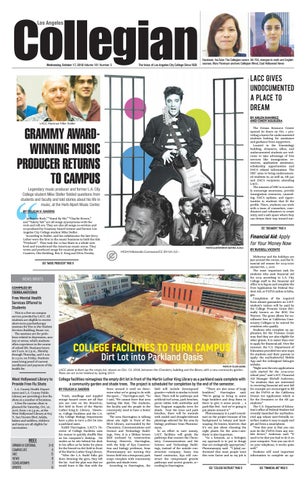
Legendary music producer and former L.A. City College student Mike Stoller fielded questions from students and faculty and told stories about his life in music, at the Herb Alpert Music Center. BY FELICIA V. GADDIS Jailhouse Rock,” “Stand By Me,” “Charlie Brown,” and “Yakety Yak” are all songs synonymous with the rock and roll era. They are also all songs co-written and co-produced by Grammy Award winner and former Los Angeles City College student Mike Stoller. According to Stoller, and his collaborator the late Jerry Leiber were the first in the music business to hold the title “Producer”. They took the 12-bar blues to a whole new level and transformed the American music scene. They wrote and produced songs for musical greats like the Coasters, Otis Redding, Ben E. King and Elvis Presley.
SEE “DREAMERS” PAGE 6
PHOTO ILLUSTRATION BY BEATRICE ALCALA
MGM/Wikimedia Commons/CC-BY-SA-3.0 -
SEE “MUSIC PRODUCER” PAGE 6
NEWS BRIEFS COMPILED BY TIERRA AKIYOSHI
Free Mental Health Services Offered to Students This is a free on campus service provided by LACC. All students are eligible to receive short-term psychotherapy sessions for free in the Student Services Building, Room 120. The sessions are for problems related to depression, anxiety or stress, which students often experience in the course of school life. Business hours are 8 a.m. to 7 p.m., Monday through Thursday, and 8 a.m. to 2 p.m. on Friday. Students must bring proof of current enrollment and payment of the health fee.
COLLEGE FACILITIES TO TURN CAMPUS Dirt Lot into Parkland Oasis
PHOTO BY FELICIA GADDIS
LACC plans to liven up the empty lot, shown on Oct. 13, 2018, between the Chemistry building and the library with a new community garden. Plans are set to be finished by Spring 2019.
West Hollywood Library to Provide Free Flu Shots
College facilities reimagines the empty dirt lot in front of the Martin Luther King Library as a parkland oasis complete with a community garden and shade trees. The project is scheduled for completion by the end of the semester.
L.A. County Health Department and L.A. County Public Library are providing a free flu shots at a number of locations. A free flu vaccine clinic is planned for Saturday, Oct. 20, 2018, from 1 to 5 p.m., at the West Hollywood Library at 625 N. San Vicente Blvd. Adults, babies and toddlers, children and teens are all eligible for vaccination.
BY FELICIA V. GADDIS
INDEX Opinion & Editorial campus life a&e news Scholarships Sports
2-3 4 5 6 7 8
Trash, sandbags and toppled orange hazard cones are all that you see now on the fenced-in, dirt field in front of the Martin Luther King Jr. Library. However, College Facilities and the L.A. City College Biology Department have a plan to turn a dirt lot into a parkland oasis. Kahlil Harrington, LACC’s Director of College Facilities uses his mouse to quickly shuffle files on his computer’s desktop. He smiles as he sits behind his desk in his office as he looks for plans for the fenced-in dirt field in front of the Martin Luther King Library. “After the L.A. Build folks got done demoing the gym, they left the lot. And the plan was that we would leave it like that with the
fence around it until we determine what we’re going to do with the space …” Harrington said. “So I said, ‘We cannot leave that area looking like that. The students, the faculty and the people in the community need to have a better option.” The area Harrington is talking about sits right in front of the MLK Library, surrounded by the Chemistry, Communications and Science and Technology Buildings. Now, it is a lifeless brown field enclosed by construction fencing. However, Harrington, with the help of Kya Construction and biology professor, Sean Phommasaysy are turning this brown field into a temporary park scape complete with community garden and shade trees. According to Harrington, the
field will include decomposed granite—which is similar to brick dust. There will be pathways and artificial turf areas, park benches, picnic tables with umbrellas and four fragrant magnolia trees for shade. Near the trees and park benches, there will be mounds with mulch and drought-tolerant plantings selected for the area by biology professor Sean Phommasaysy. In an effort to save money, LACC facilities will grade the pathways that connect the Chemistry, Communications and the Science and Technology Buildings, instead of the outside construction company. Santa Ana based contractor, Kya will construct the compressed granite pathways and accent granite, according to Harrington.
“There are also areas of large boulders,” Harrington said. “We’re going to bring in some huge boulders and drop them in there to give it some accent … a park-like feel. And we’re going to put plants around it.” Phommasaysy is a paid consultant on the project because of his background in botany and landscaping. He knows, however, that it’s not just about choosing the right plants for the area—aesthetic is also important. “As a botanist, as a biologist, my approach is to put in things that are ecologically appropriate,” Phommasaysy said. “I [also] understand that most people want this wow factor and so my job is
SEE “COLLEGE FACITILIES” PAGE 6
Financial Aid: Apply for Your Money Now BY RUSSELL VICENTE Midterms and the holidays are just around the corner, and the financial aid season for 2019-2020 started Oct. 1, 2018. The most important task for students who seek financial aid for 2019 according to L.A. City College staff in the financial aid office is to log on and complete the Free Application for Federal Student Aid, or FAFSA online at fafsa. gov. Completion of the required form almost guarantees an LACC student’s tuition will be paid by the College Promise Grant (formally known as the BOG Fee Waiver). The grant allows for enrollment fees at California Community Colleges to be waived for residents who qualify. Students who complete an application for the Promise Grant may find they are also eligible for other grants. It is easier than ever to apply for financial aid. Over the summer, the U.S. Department of Education provided two new ways for students and their parents to apply: the myStudentAid Mobile App and the redesigned fafsa.gov website. “Right now the new applications cycle started for the 2019-2020 school year,” said LACC Financial Aid Manager Michell Anderson, “so students that are interested in receiving financial aid next fall for example are encouraged to fill out the FAFSA or the California Dream Act Application which is for the Dreamers or the AB 540 students.” The U.S. Department of Education’s office of Federal Student Aid recently launched the myStudentAid app whose user-friendly interface makes it easy to apply and get aid from a smartphone. “New this year is that you can now do the FAFSA from any mobile device,” Anderson said. “It used to be that you had to do it on your computer. Now you can do it on your telephone, it works quite well.” Students will need important information to complete an ap-
SEE “FINANCIAL AID” PAGE 6
2
OPINION & EDITORIAL
Los Angeles Collegian — Wednesday, October 17, 2018
EDITORIAL
BUILDING MOVEMENTS: A NECESSARY COROLLARY Sometimes a statement is so important that it rightfully deserves to be repeated. Now is such a time. The statement: Students must be proactive. Last week, the Collegian emphatically delivered the point that besides turning out the vote, students must hold their elected politicians accountable on a continual basis. In essence, the Collegian editorial staff has issued a call to action, immediately concerning the upcoming midterm election, but also moving beyond the midterm. So let us recall the powerful implication expressed in the following two words:
movement building. Movement building is more than a mere slogan that one may be inclined to dismiss. Make no mistake: movement building is real deal stuff, which should never be mistaken as trite and is certainly never outmoded. A statement made by our country’s 32nd president, Franklin Delano Roosevelt, well affirms the point. In 1932, after his election, FDR agreed to talk with labor leaders concerning their grievances over work conditions, pay and policies they wanted to see implemented.
Service Animals Assist Disabled, Fill a Need, But … BY DAWSON FICKUS I fully support the concept of a service animal but when it’s obvious that a person is taking advantage of the way they’re so loosely regulated, I object. As of M a r c h 2011, under the Americans with Disabilities Act (ADA), a service animal is a dog that has been individually trained to do work or perform tasks for a person with a disability, and public accommodations or commercial facilities must permit these dogs to accompany their person in all areas where members of the public are allowed to go with very few exceptions. I work as a front desk agent at a Downtown Los Angeles hotel. We do not allow pets, but service ani-
mals are welcome. It is important to be able to distinguish between the two, so that I know which animals are allowed and which ones must be turned away. The current laws make that very difficult to do accurately. In of July 2018, I was checking in a hotel guest carrying her Yorkshire terrier in her arms. I knew I was in for it when the dog barked at a small child in the lobby. I try my hardest to be politically correct. I was aware of the questions I am allowed to ask, so I did. The guest was also well aware of what she needed to say and she seemed to understand the limits of what I could do. I gave her a room key, and she was on her way. In keeping with my expectations, I learned the following day when I started my shift that there were complaints about barking coming from her room overnight. Furthermore, we had to charge her the extensive cleaning fee because the dog was not house broken. My manager scolded me for letting in a pet and was uninterested when I tried to explain why.
This dog was obviously a pet, but nothing could be done because of the insufficient regulations surrounding service animals. Because the ADA recognizes unofficial training methods, animals do not have to be certified by the government; therefore, owners are not required to carry an I.D. card, registration information, or anything that would normally prove something to be official. This means, as a customer service representative, I cannot require any verification that the service animal is legitimate. Anyone serving a person with a yet-to-be-identified service animal is only allowed to ask two determining questions provided by the ADA: “Is the dog a service animal required because of a disability?” and, “What work or task has the dog been trained to perform?” As long as the person names a service, legally, representatives must take their word for it without any proof. With laws like these, it is easy for anyone with a pet to lie and take full advantage of privileges reserved for the disabled. If proper rules were in place, the guest would not have had to pay the $500 cleaning fee, the other guests in neighboring rooms would have avoided irritation, the hotel would not have a room out of service for the day, and I would not have been unjustly reproached for following protocol to the letter. Reform is necessary.
Speak Truth, Suffer the Consequences BY DIANA CAMPBELL “My heart goes out to you, ‘Eric,’ but unlike professor Ford, you knew where it happened, how you got there, and how you got h o m e . That’s a big reason for believing you, but not professor Ford.” These are not my words; they’re copied from a comment I found on a Chris Cuomo telecast. It is in response to a man named Eric who said he had been the victim of a sexual assault as a teen. My words now: I cannot believe his theory or logic considering the trauma that professor Christine Blasey-Ford endured. I am sorry people don’t believe her because she does not remember “exactly” how she got to the party, the time, place or how she got home. Some things are buried for a reason. She does remem-
ber being sexually assaulted and she has the exact details on who was present. Some claim that she wasn’t actually raped and what she experienced was horseplay! I believe the trauma of the sexual assault contributed to her lack of exact details, and the length of time since her near rape and claustrophobic assault experience that made her feel at the time she was going to die: a hand over her mouth by a strong, athletic and aggressive person on top of her pulling her clothes off and his friend turning up the radio to drown out her screaming. I also had a first-hand experience of a gang-bang, sexual assault to relate to what happened to professor Blasey-Ford. When I was 15, I was offered a ride by a boy in my high school. He lured me to a dark, vacant area. Maybe it was a park. I don’t remember after an extreme amount of years (67). I don’t remember exactly where it happened. I only know it was night, not the ‘exact’ time. How I got home is a total blank. I do remember the nickname of the boy who lured me there: ‘Peanuts.’ I don’t remember the
losangeles.collegian@gmail.com
names of the six other boys who attended my high school who were also there, but I can still see their laughing faces as I screamed and fought them off. No penetration was achieved, so perhaps some would say it was no big deal. But to this day, I have nightmares and trust issues. And, like Dr. Ford, I remember the laughter and did not tell anyone. It’s been scientifically proven that exact details of a traumatic experience can result in a loss of memory in order to protect us. There is an abundance of research on the condition known as PTSD – Post Traumatic Stress Disorder – available. I believe Dr. Christine Blasey-Ford unquestioningly. Not remembering exact details for Justice Bret Kavanaugh is attributed to his drinking bouts and the length of time that has passed. In Dr. Ford’s case, it is used as an indictment to say she is lying. Don’t use the oldest trick in the book on her. Intelligent people of both parties know which one of these two is telling the whole truth and nothing but the truth.
After some time discussing the issues at hand, Roosevelt abruptly relented, saying, “OK, so you’ve convinced me, now go out there and make me do it.” It was a revealing moment. In capturing the admission made by the nation’s chief executive - the president - history itself immortalized the importance of ground level activism. Indeed, history’s archival record confirms the distinctive role, which organized unions; interest groups and student-led movements have played in bringing about needed and necessary change to the civic sphere. Students inherit a rich legacy of civic engagement. The Freedom Riders and Berkeley’s Free Speech Movement stand out as perhaps the two most celebrated. There are others more recent such as Black Lives Matter. At the Collegian, we ask students to uphold this legacy, now, at a time when there continues to be so much at stake. As regards civic engagement, movement building is the genuine article and best answer to bring about significant change. There will always be serious, life-impacting issues at stake. This happens to be the nature of the world we live in. Police brutality. Mass deportations. The injustices do not seem to go away, but instead, revolve
and change order as to which is more egregious in any given month or year. Yet, we believe that there is a sense making way to go about expressing discontent, and most important, usher in progress. Through the vote process, we choose the civil servants who best represent our values. We then hold them accountable by way of dialogue and citizen engagement. In addition, we draft and support direct vote initiative, for added measure, when certain needed legislation moves along too slowly. But the capstone of it all is that we mobilize -that is, we build durable movements, as a means of checking the balance of power and working to ensure that all voices are heard, especially those of the working and lower income classes. As a testament to the importance of movement building, it pays to remember that the current White House Administration, in coming to prominence, itself relied heavily on the power of movement building strategy. Movement building is imperative. Essential. Therefore, students, we implore you: gather facts, know your history and turn out your charismatic selves to build a movement - one that will put fire to the feet of those elected officials who claim to serve you.
DO YOU KNOW ELIAS? I THINK YOU DO BY RUSSELL VICENTE Invisible cracks in the mental health care system, along with apathy, and hanging out with the w r o n g c r o w d stole the innocent life of my friend, Elias Birnbaum. He was 24, but he had the mind of a 10-year-old. What makes it even more tragic is that it didn’t have to happen. It was unnecessary. Elias was a high-functioning autistic man who smoked marijuana and drank alcohol, but he did not do hard drugs. If there were better channels of communication between substance abuse programs and the autistic community in society, especially here in L.A., perhaps Elias would still be alive.
Studying in the Cooler Box BY TIERRA AKIYOSHI I came to Los Angeles City College in spring semester 2016. Since then, I’ve noticed what I think is a “hyper active” air conditioning system at the College. I don’t believe I’m the only one who is uncomfortable with the freezing temperatures in some of the buildings. Admittedly, I have spent most of my time at Jefferson Hall and the Communications-Cinema buildings, so my opinion is based on these two. As we all know, the City of Los
I believe we let him down. He came from a New York family of means to live in a sober living facility here in L.A. Those are typically reserved for hardcore drug addicts and severe alcoholics. That wasn’t Elias. After two years, he left the facility and moved in with his best friend: a former rock star with Tourette’s syndrome who also had substance abuse issues. Elias’s “best friend” kicked him out after two months, so he would “learn how expensive it was to live on his own.” Elias checked into the Wilshire Motel in Santa Monica; not long after, he made his way to the famous Venice Boardwalk. That was the beginning of the end. Elias, a good-natured person, befriended the wrong caliber of people. He went back to the Wilshire Motel to “party” with these individuals. They partied for two days. On the third day, Elias made panicked phone calls to family members and friends and sent alarming posts to Facebook.
His last post read, “This guy has to leave my hotel room he’s out of control.” Elias was found dead at the Wilshire Motel in Santa Monica, on Aug. 28, 2018. He was high functioning, but he still had the mind of a 10-year old child. He was too innocent to do hard drugs without being cajoled. He should not have been left alone. The only reason he survived to the age of 24 was because his family had financial resources. Hindsight is 20/20. The police say there is no case. According to them, he was an autonomous adult and completely responsible for his overdose. I don’t believe someone with the mentality of a child should be considered an autonomous adult. I think this is an invisible crack in our society. Everyone knows someone who needs help. Everyone knows an Elias. He fell through the invisible cracks. Unfortunately, there are others who will follow in his footsteps
Angeles tends to be fairly warm all year. During the summer, it can get ridiculously hot. As a student, I expect my campus to have a nicely air-conditioned environment that will allow me to comfortably concentrate on my studies. Jefferson Hall and the Communications-Cinema buildings are always welcoming me with icy cool air once I arrive. That’s great – if you’re only going to stay there for about 10 minutes. The coolness actually helps bring down my body temperature after walking out in the hot sun. But staying in the buildings for a few hours of lectures? That is a completely different story. When I have classes in these two buildings, along with my backpack, a jacket and a blanket are my must-haves. Most of my classmates and professors complain about the freezing classrooms, but there is nothing we could do to raise the temperature. In December, it was warmer outside than it was inside the building
(the average temperature of Los Angeles in December is approximately 68 degrees)! When I was in class I would check the time every five minutes, hoping class would be over soon, so I could get out of that refrigerator. The cold actually disturbed my study. Since Los Angeles has such a mild temperature year round, it’s understandable and commendable that the college does its best to keep the buildings nice and cool. A way to manually adjust the temperature in each classroom would be a wonderful addition. Each class has a different number of people; a classroom with many students might be warmer than a classroom with fewer students. Manual temperature switches would solve that. Also, if we were able to turn the air conditioning on and off by ourselves, that would also be energy efficient. There would be no reason or need to cool large (or small) classrooms that no one is using. Be more comfortable and be more efficient LACC.
LETTER TO THE EDITOR Dear Editor: Like many students I am troubled by some of the conditions at LACC. Many of my experiences, good and bad, have likewise been experienced by others and shared in this paper. Unfortunately, they have also included class and study session disruptions by seemingly troubled individuals. In the context of LACC’s location it’s easy to attribute these situations to the local homeless population. When examined in the context of our government’s historical treatment of dissenters and my own affirmation that Black Lives Matter, these experiences resemble COINTELPRO1 tactics. Wikipedia’s entry about COINTELPRO begins, “COINTELPRO (Portmanteau derived from COunter INTELligence PROgram) (1956-1971) was a series of covert,
and at times illegal[1][2] projects conducted by the United States Federal Bureau of Investigation (FBI) aimed at surveilling, infiltrating, discrediting, and disrupting domestic political organizations. [3][4]” I fell down the surveillance and civil rights rabbit hole in 2016 when Professor Paul Butler gave a speech about the criminal justice system and its disproportionate incarceration of African Americans. He invited his audience to attend the “Color of Surveillance2” conference the following day at Georgetown Law School’s Center for Privacy and Technology. The day-long conference provided speeches about the historical aspects of surveillance of blacks, current surveillance technology, policy, and law. Invigorated after attending the Color of Surveillance conference,
I sought to learn as much as possible about the topic. Surveillance and civil rights inevitably led me to learning about COINTELPRO after I read about the FBI’s surveillance of Black Lives Matter3 and even the Department of Homeland Security’s monitoring of the Funk Parade4 held on U Street in Washington, DC. The LACC community includes people of diverse backgrounds. This diversity could be used against us with COINTELPRO tactics by creating tension between various groups. You’re here to learn. Educate yourself. Study COINTELPRO. Sincerely, Kimberly Kawaguchi Reference https://en.wikipedia.org/wiki/ COINTELPRO accessed October 8, 2018.
OPINION & EDITORIAL
COMPILED BY Russell Vicente PHOTOS BY Beatrice Alcala
WHAT DO YOU THINK ABOUT PROPOSITION 10, WHICH SUPPORTS RENT CONTROL?
Los Angeles Collegian — Wednesday, October 17, 2018
WILL JACKSON Cinema Major
STACY WRATH Cinema Major
“We need rent control. Right now, I’m staying in a $485.00 a month hotel, because I can’t afford to stay anywhere else, down on Skid Row, because I’m a student. I can’t afford $1500.00 a month. They have cheap rooms in the seedier part of town. A few years back you could get a place for $400, $500. Today, it’s crazy. Who could afford a $1000.00 a month
“I think rent control is great. I have rent control in my building. Look at the problem in Los Angeles with housing going up so much. It just pushes people out onto the street. I think it increases our homelessness. They kind of connect with each other in some ways. Like people can’t pay their rent and then there’s an increase in homelessness. As rent keep going up, they are pushing more people into the street. ”
DIEGO SALAZAR English Major “I live in the south end of Koreatown. There are a lot of properties there that are under rent control. There are a lot of families that rely on it, so the abolishment of it is uncalled for. I’m hearing stories of my neighbors that are moving away because they are changing the rent every fiscal year ... Knowing that it’s not [rent] going to jump above a certain price can provide a comfort to certain families. It’s important to me to vote NO on 10. ”
3
JOSE RAUDA Music Major “I feel like it should go. Not everybody can afford the rent. If you are going to be stable, then yeah, that’s what’s up. That way everybody can be equal. ”
A VISUAL REPRESENTATION OF THE WORLD AS WE KNOW IT
Collegian Los Angeles City College Visual & Media Arts Department
855 N. Vermont Ave. Los Angeles, CA 90029
Editor-in-Chief JASON PISKOPUS KIMBERLY FISHER
Social Media Editor JASON PISKOPUS
Photo Editor KAITLYN KIMBLE
Layout Editor BEATRICE ACALA
Opinion & Editorial Editor THANDISIZWE CHIMURENGA
Photographers KAITLYN KIMBLE FELCIA V. GADDIS BEATRICE ACALA VICTOR RESENDIZ
Sports Editor WILL PENNINGTON
323.953.4000 ext. 2832 losangeles.collegian@gmail.com
Illustrators NATALIA ZEPEDA JUAN CARLOS DIEGO ANGULO BEATRICE ALCALA Reporters LOUIS PRIMAVERA, FELICIA V. The college newspaper is published as a GADDIS, RUSSELL VINCENTE, learning experience, offered under the college CINDY AGUILERA, ARLEN journalism instructional program. RAMIREZ, BRIAN LOVATO. TIERRA The editorial and advertising materials pubAKIYOSHI, NICK MORELAND lished herein, including any opinions expressed, are the responsibility of the student newspaper staff.
For all submissions including letters to the editor and publicity releases, send materials to Collegian offices located in Chemistry Building, Room 207, or email: losangeles.collegian@gmail.com. To advertise in the Collegian, direct all insertion orders and questions to: pr.collegian@gmail.com.
Issues of our award-winning newspaper and magazine are instantly available to our readers on issuu.com/collegianwired. facebook.com/CollegianWired @CollegianWired CollegianWired.tumblr.com
NEXT ISSUE: October 31, 2018 EDITORIAL DEADLINE: October 24, 2018
Under appropriate state and federal court decisions, these materials are free from prior restraint by virtue of the First Amendment to the United States Constitution. Accordingly, materials published herein, including any opinions expressed, should not be
youtube.com/CollegianWired
interpreted as the position of the Los Angeles Community College District, Los Angeles City College, or any officer or employee thereof. Collegian ©2017. No material may be reprinted without the express written permission of the Los Angeles Collegian.
4
CAMPUS LIFE
Los Angeles Collegian — Wednesday, October 17, 2018
Tomorrow
at Grant Still Museum: PROFESSOR EALY, DEAN DAY TO SPEAK ON HAITI PANEL Eighteen people died when a 5.9 magnitude earthquake shook the northwest department of Port-de-Paix, Haiti, located about 135 miles from the capital of Port au Prince last week. Headlines about Haiti often tell stories of natural disasters and the destruction they visit on the nation. Haiti presents a complicated face to the world: the 7.0 earthquake in 2010; a subsequent cholera epidemic that killed over 3,000
citizens; and the catastrophic flooding caused by Hurricane Matthew in 2016 portray a poverty-stricken people with little means to help themselves. Combine that with complicated politics that often feature demi-gods and coup d’états. Earlier this year President Donald J. Trump made comments about several countries including Haiti. According to an article in the Wash-
ington Post he said, “Why are we having all these people from shithole countries come here?” He went on to say, “Why do we need more Haitians ... Take them out.” LACC Professor Emeritus of African-American studies Henry Ealy, and Dr. Thelma James Day, Dean, of STEM and Curriculum will join a discussion about Haiti beyond the headlines that will show another side of Haiti – one of his-
PHOTO CONTRIBUTED BY ANDE RICHARDS.
torical significance, rich art, culture and hope. The discussion will be hosted by multimedia journalist Ande Richards at the Department of Cultural Affairs’ William Grant Still Arts Center, 2520 S. West View St., L.A. CA, 90016 on Thursday, Oct. 18 from 7 p.m. to 9 p.m. This event is free to the public. Light refreshments will be served. For more information, call (323) 734-1165.
REPORTERS NOTEBOOK
BLUELA CARS:
PHOTO BY VICTOR RESENDIZ
Access to a vehicle is just steps away from the MLK Jr. Library, Oct. 15, 2018. Car sharing service charges by the minute.
Ready to Roll
BY TIERRA AKIYOSHI BlueLA electric car share service can be a savior for those who cannot afford expensive car insurance, or who have short-term visitors, or for those who live in areas where parking is a challenge. At the beginning of October, representatives from BlueLA participated in the L.A. City College Ride Share event in the Quad. I had seen BlueLA cars parked at the corner of Willow Brook and Vermont Avenues near the Martin Luther King Library, so I decided it was time to give it a shot. Anyone who is 18 or older can use BlueLA. All that’s needed is a debit card, a Tap card or a BlueLA card and a valid California driver’s license to use the car-sharing service. Drivers do not pay for gas, maintenance or insurance. There are three price plans. Standard members pay $5 per month, and .20 per minute. A second plan offers an option for low-income persons who qualify to pay $1 per month, and .15 per minute. The most expensive pay option is .40 per minute. Since this service will charge you every minutes, not by the distance you drive, I do not recommend it for a road trip, but it is good for local destinations. My husband and I have one car. He uses it most for long fishing trips at lakes around California. This leaves me to walk to the grocery store and walk back carrying all of the groceries. I could take Uber, but I do not like that feeling of riding in a car with a stranger. I like that BlueLA is very private and affordable. The car is easy to drive and the ride is smooth. It is 100 percent electric and environmentally friendly with zero emissions. The only thing that I do not like about this service is that they charge by the minute, not the distance traveled. Time was not a concern for me since I picked up the car in downtown L.A. at midnight and drove it to Vermont and Willow Brook near the MLK Library. But just the thought of driving a BlueLA car during rush hour makes me think it could become the most irritating and frustrating driving experience ever. Each minute I am stuck in traffic, the BlueLA car vehicle is eating into my account. If they change the method of charging from time to distance, I will definitely keep my membership at the standard level. There are 100 cars in the network and the company is still expanding. The majority of the 14 stations are located in the downtown LA area. I look forward to their expansion. So far, BlueLA gets thumbs up!
PHOTO BY FELICIA GADDIS
Students line up for free produce and snacks outside of the Student Union, Monday, Oct. 8, 2018. The “Pop-Up Food Bank” is every Monday in the Quad starting at 11 a.m.
College Sponsors Pop Up Food Bank Food for Thought Hits the Spot
BY BRIAN LOVATO AND ARLEN MARTINEZ Students and their families seemed ecstatic to receive free food, compliments of Los Angeles City College in front of the Student Union last Monday. Attendees stuffed their bags full of oranges, cauliflower, bell peppers, plums, oranges, tomatoes and corn chips. Some students were smiling from ear to ear as they had a chance to take a break and indulge in fresh fruits and vegetables free of charge. There was almost a farmer’s marketlike atmosphere as students were able to pick and choose through all the produce. “It’s really important to recognize the fact that many students don’t have access to healthy food,” said LACC President Mary Gallagher. “We are starting slowly, but hope to have more
available.” This event is brand new to Los Angeles City College and happens every Monday at 11 a.m. in front of the Student Union on a first-come firstserve basis. The food is provided by the Los Angeles Food Bank. As the students in the front of the line pile chips into their boxes and bags, the air of anticipation is visible on the faces of the students near the end of the line. “So far it’s a good thing, but the lines are long,” said Esmeralda Gutierrez who says she is grateful for the opportunity. Darren Linne, the administrative assistant to the vice president of student services at Los Angeles Trade Tech College organizes the food pop up with Los Angeles City College to provide free nutritional assistance to students in need. She wants to expand the giveaway to bring even more
produce and is in talks to give out snacks during midterms and finals. Like all new events, there is room for improvement. “Have more variety of fruits like bananas, strawberries, and mangos,” said LACC student Yawa Dessou. Currently, the only fruits being provided are plums and oranges. Some students say they crave “better chip options.” Other than more variety, another common complaint among students was some of the produce seemed old and moldy. Some fruits and vegetables did not appear edible. Some of the oranges didn’t even look like oranges anymore. They were brown. “I would have not picked those oranges at a grocery store,” said LACC student Rojelio Corral. Students say food quality complaints can be easily addressed and many look forward to the next event.
A&E
Los Angeles Collegian — Wednesday, October 17, 2018
5
PERFORMANCE PROS OPEN MIC TO STUDENT PERFORMERS BY LOU PRIMAVERA Married couple Rocky and Mishalene Cusseaux are not only experienced entertainers and cinema majors at LACC, they are both community oriented entrepreneurs. Last year, they launched a comedy show called “Roc the Mic Live,” next to City College that takes place every Thursday night. Rocky and Mishalene, both have extensive experience in theatre, dance and stand-up comedy. Most importantly, they place a large emphasis of community within the campus. They encourage students to attend the comedy show, whether they want to participate in the open mic event or want a great night of entertainment. Collegian: What made you want to start your own comedy show? Rocky: I’ve always been business minded, and to get stage time you often have to bring several people, jump through so many hoops and its expensive. So, if I had to do all this work just to get five minutes on stage at other venues, I figured I might as well create my own show, “Roc The Mic Live,” with my wife. Collegian: What made you
collaborate with your significant other? Mishalene: One of the main reasons I came on board is because Rocky is so passionate about community, bringing others together in a safe space to perform and to give feedback is so important. You need a village to help you grow. It’s a hidden treasure right here in the LACC community. We want everyone, especially students, to know about it. Collegian: What projects do you have going on at City? Mishalene: I’m doing an independent documentary called “Depressed” in Dylan Shields’ class. Last semester, I had a bout with depression. I was dealing with a lot of pressure in my personal life and school. I had no desire to do much at the time. That’s what sparked me to do a documentary, independent study on depression. Film gave me the platform to do what I love and spread the word and increase awareness about depression. Rocky: I’m taking an editing and screenwriting class because I have two scripts I wanted to work on. I figured what better place to workshop scripts than at City. My professor, Michele Gendelman, is great to work with, and it’s great to have access
PHOTOS BY KAITLYN KIMBLE
Mishalene Cusseaux sits behind the scenes at Skiptown Playhouse, Friday, Oct. 5, 2018. She works hard to put on a flawless production and says she feels at home in her element. to all these wonderful resources on campus. Collegian: With all of your talents--dance, cinema and comedy--why did you choose to launch a comedy show? Rocky: I never chose comedy-it was a given. The way I grew up, even the way we deal with tragedy in our family, we start cracking jokes. We used humor to deal with pain and grief. When I did improv, it combined everything. That’s why I fell in love with improv, it’s comedy, it’s performance and it’s being on stage. Collegian: Who is your biggest influence in entertainment? Rocky: Dave Chappelle and Bill Cosby. I had the privilege to open for Bill Cosby. What I loved about
his work on a professional level is that his comedy is a storytelling style which is similar to my style. I admire the way he structured the Cosby show. When my wife Mishalene emphasized how strong community is, I also have a background in community organizing. Cosby always had that. He changed the way society perceived black families. His show revolutionized how the public saw black people and black families at a time where something like that was not seen. Black kids wanting to attend college skyrocketed after they saw it on the silver screen. Collegian: What advice or message do you have for LACC students? Rocky: As a performer I want
to create opportunities for fellow student performers, locally, next to the campus in the heart of Hollywood. It is open to all. But with my relationship with the school, I would love the students to know this resource is here. Even if you’re not a performer and always wanted to try comedy, you can give open mic a shot or just enjoy a great show. Mishalene: “Roc the Mic Live” is a great place for the art students to come to work on their projects as well. If it’s to work on a rehearsal for an audition, craft a monologue or showcase-whatever they choose. Let’s say a musician, dancer or actor has something they would like to experiment on in front of an audience, they have a six-minute
set to explore and work on their performance in a natural, supportive creative community. Collegian: How much is it get into the show? Rocky: It’s $5 to get in and free parking. Just come and enjoy a good show whether you participate or just want to experience the entertainment. We really wanted to create an affordable date night, as well as create a show for entertainers from the perspective of entertainers. “Roc the Mic Live” Thursdays: doors open at 9:45 p.m. and show begins at 10 p.m. Skiptown Playhouse 665 N. Heliotrope Dr. L.A., CA 90004 | $5
THEATRE ACADEMY SHOOTS FROM THE HEART BY KIMBERLY FISHER
PHOTOS BY NICK MORELAND
Left: Phung Huynh speaks with students individually. Right: Huynh mentions past and current cultural beauty standards and how they influence her art. Art Lecture performed at LACC, Chemistry Building, Tuesday, Oct. 2, 2018
SERIES BRINGS ACTIVIST ARTIST, EDUCATOR TO SPEAK IN VAMA SERIES Immigrant and refugee artist takes unusual path, which includes art counseling in prisons, community involvement and the classroom.
BY NICK MORELAND Prominent painter, artist, educator and activist Phung Huynh spoke with students about her story and work. Huynh is a well-known Los Angeles painter who has been featured in numerous galleries from L.A. to New York, and as far away as Cambodia. Huynh is also a professor of art history, drawing, painting, design and illustration at Los Angeles Valley College. She takes a very active role in the community with her artwork and education. “I exhibit in galleries and museums. I also do a lot of community work that involves art,” Huynh said. “I served on the advisory council to provide art counseling in prisons. I’m a community college teacher, and I feel really strongly about-and am proud of that.” Huynh is a first generation immigrant and refugee who came to America as a child. She says she began to learn English from television. “My birthplace is Vietnam, but my home
is Los Angeles,” Huynh said. “I came to the United States as a toddler and learned to speak English with my parents and grandparents in the living room watching TV shows like, ’Mr. Rogers Neighborhood.’” Last week, students, professors and faculty gathered in Chemistry Building, Lecture Hall 3, to hear Huynh’s story. The audience sat silently while Huynh recounted the stories of her family fleeing war-torn countries to find a better life. She talked about the struggle of growing up with language and cultural barriers, a story that many students at LACC are all too familiar with. “I am very honored to speak to the students of a community college. I don’t want to just talk about my work, but I want to share my story,” Huynh said. “I think it’s important for students that I share my story. There’s going to be a lot of crossover between your story and mine.” Huynh also spoke about the ways in which her upbringing in L.A. and cultural identity inspired much of her artwork. Los Angeles gangs, hip hop and rap music, all
influenced her works. “My cultural identity is a slippery combination of Chinese, Vietnamese, Cambodian and American in equal parts,” Huynh said. “There were three generations composed of 11 family members living in a small apartment in Chinatown, where seven languages were exchanged in the household.” She also talked about the influence that past and current cultural beauty standards have on young women, and how she uses art to capture that aspect of society. It seemed to make an impression on art history professor Biz Lopez. “She resonated with me because it’s just so true of my own family’s experience,” Lopez said. “I also grew up in Chinatown, we went to the same school.” Art can be used as a means of very strong protest, both politically and socially. She wants her work to expand understanding for students about the current political climate. “I feel like this a very unusual and intense time in our political history. I
think a lot of my work is very connected to how things are, and how women are treated, and our discussion about race and immigrants,” Huynh said. “So I’m hoping that through my work and my story, students will walk away with a broader understanding of those things, especially at a community college that is incredibly diverse.” The ability to tell her story and relate it to her artwork made the experience more significant to the audience. Attendees were able to identify missed connections between various cultures through her lecture. “I thought it was great. I like that it was about herself, so she was able to incorporate a personal narrative in a way that appealed to everyone,” said art student Michael Duggan. “We all can relate to it. I’m a white, gay man, and I could relate to it.” The next artist lecture series event will be on Oct. 16 in Chemistry Building, Lecture Hall 3. Artist lectures are free and open to the public.
Lance Larsen’s “The Shooters Bible” directed by Louie Piday is the second offering of The Los Angeles City College Theatre Academy on Oct. 25, 2018 in the Caminito Theatre. The play originally premiered in 1975 and was a tribute to Larsen’s friends and fellow artists during the Vietnam War. Larsen, as well as the four friends he penned the play in honor of, were the founders of Los Angeles’ The Company Theatre in the 1960s. Together, they were a part of the Los Angeles Independent Theatre Movement. More importantly, they had a brotherhood. That is what the show is all about. It focuses on friendship and bonds according to the director’s note. The play takes place on one night in one room in Vietnam on March 14, 1970. It is the story of five men that serve together. It was the author’s wish that the men he wrote it for were honored. Rightfully so. The bond that comes from brotherly friendship is something that many can relate to and embrace. “The Shooters Bible” runs: Oct. 25 through Nov. 3 on Thursdays, Fridays and Saturday. Show times are 8 p.m. with additional 3 p.m. matinees on Saturdays. Tickets are available through the LACC website or at the door. Seating is limited. Veterans, students and seniors can purchase tickets for $10. Regular ticket price is $15.
6
NEWS
Los Angeles Collegian — Wednesday, October 17, 2018 “COLLEGE FACILITIES” FROM PAGE 1
“MUSIC PRODUCER” FROM PAGE 1
LACC CAMPUS FACILITIES GET A FACE LIFT to find a happy medium.” Finding the “happy medium” he mentioned is a real challenge considering the reality of California’s drought. The goal is to select flowers that are both drought tolerant and visually appealing, and that can be a difficult task. “It is somewhat challenging trying to come up with something that has beautiful flowers, under this intense heat that also does not require a lot of water,” Phommasaysy said. “And I think from Kahlil’s perspective, he also does not want plants that leave too much of a mess, because he’s got a limited number of gardeners to help clean up … It’s challenging but I think we can do it.” Phommasaysy has been instrumental in the selection of plants and the creation of the community garden. While the plant’s beauty and ability to tolerate heat are important decisions to be made, there is still more research to be done to make sure there are no issues with what is planted. “We’re thinking of having planters, maybe two feet by four feet or two feet by three feet, we’re not sure yet -- so whoever’s interested will have access to grow vegetables, maybe even fruit,” Phommasaysy said. “We do have to be careful about what’s allowed, so … we’re looking into other policies that other community gardens have to make sure that we don’t grow anything that might be
‘controversial,’” Thanks to the efforts of Harrington and Phommasaysy, LACC students will have a beautiful and more tranquil campus to return to for spring 2019. Harrington wants students to have a place to escape to while still on campus. “I think that will be a good add to the school,” said LACC student Santana Mendez. Students on campus seem to be excited about the plans for the field. The addition of shade trees and green space are a welcome addition to the student body. The oasis could become a destination for students as they wait for their next class or organize a study group under the shade trees. “I was just thinking how important that is actually,” said humanities major William Iwneferi. “I was just looking around at how we almost have landscaping but not quite. That would really be nice to just have something pretty.” “I wanted to be able to make it parklike and have a path of travel, to be able to leave MLK and still go on the other side of Communications, Sci-Tech or Chemistry and cut through,” Harrington said. “And also offer some space so if they wanted to be able lay down on the grass and do some reading or sit there … have lunch. That’s my concept. I just couldn’t bear to leave it like that for the next three to five years.”
FOR THE RECORD In the Oct. 3, 2018 issue, an article titled “Photo Professor Gives Crash Course in Darkroom Techniques for Annenberg” by Jordan Rodriguez, Lovepreet Gill’s name was spelled incorrectly. We regret the error. “FANANCIAL AID” FROM PAGE 1
TIME TO APPLY FOR FINANCIAL AID plication, such as a social security number and tax returns to provide a snapshot of financial circumstances. Dependent students must have their parents create a username and password. Applicants must be certain that the information is correct and the name entered on the FAFSA matches the social security card. If there are any discrepancies it might cause the application to get rejected. “One of the things that drives students crazy, is the fact that to satisfy certain criteria is that you must be a U.S. citizen or eligible non-citizen so that when you submit a FAFSA the Department of Education will compare your information with the Social Security Administration to make sure you’re a citizen,” Anderson said. “If you are a non-citizen they will compare it with the information with the Department of Homeland Security, so those are database matches. A common mistake is that when someone becomes a naturalized citizen they forget to report the information to the Social Security Administration and when they do the database match it gets rejected.” It is extremely important to file as soon as possible because some aid is on a first-come first-serve basis. Once the budget is exhausted, funds are no longer available. Students who complete the FAFSA will receive a Student Aid Report or SAR within a week. Check it for errors. Make any corrections immediately, or funds may be delayed. It’s a good idea to check with the financial aid office to make sure they have everything they need.
PHOTO BY FELICIA GADDIS
Mike Stoller speaks to LACC students for a Q&A in the David Alpert Lecture Hall, Tuesday, Oct. 2018. He shares memories of his collaborations with famed artists like Elvis Presley.
LEGENDARY MUSIC PRODUCER AND LACC ALUMNUS RETURNS TO CAMPUS A young Elvis heard “Hound Dog,” a song written by Stoller and Leiber. He adapted it and it went to Number one. It set Stoller and Leiber on a path that would one day lead them to the Rock and Roll Hall of Fame, the Songwriters Hall of Fame, seven Tony Award nominations and two Grammy Awards. Stoller shared his memories of collaborating with Elvis Presley with students and faculty in the David Alpert Lecture Hall last week. “He was easy to work with … we were surprised that he knew as much about R & B as we knew. Who was this other white dude -- come off knowing this stuff,” Stoller said. Mike Stoller returned to L.A. City College and engaged in a lively question and answer session on Tuesday, Oct. 9, 2018. Stoller and his late music partner Jerry Leiber wrote and produced some of the most iconic rock and roll and R&B songs of the 20th century. Stoller is a native of Long Island, New York. He had a progressive upbringing long before it was fashionable. His parents sent him to an integrated summer camp in the 1940s where he first became acquainted with African American music. On one occa-
sion during his camp stay, Stoller hid in a corner and listened as an African American boy played the piano. “I’d never heard anything like it,” Stoller said. From that moment forward, he says he developed a love for the music. Years later, Stoller enrolled at Los Angeles City College where he met his lifelong writing and producing partner, Jerry Leiber. It was 1950 and rock and roll had not been invented yet, according to J. Poet on Grammy. com. In the beginning, Stoller played piano and had no interest in working with Leiber who was a songwriter and lyricist. “When Jerry asked if I was interested in working with him, I said ‘No … I don’t like most of what I hear on the radio,’” Stoller told students in the HAMC Auditorium last week. Stoller preferred blues, jazz and classical music.” Stoller says Jerry Leiber showed up on his doorstep one day with his songbook under his arm. That changed everything. “I opened the door and there was this nice young man and I kept staring at him because I’d never seen anybody who had one blue eye and one brown eye, and Jerry in-
deed did have that,” Stoller said. “Eventually I asked him to come in.“ Stoller spotted Leiber’s notebook. ”‘Those are your songs?’” Stoller asked Leiber. “’Let me take a peak.’” Stoller flipped through Leiber’s book. “And I saw a line of lyrics, a line of ditto marks and a rhyming line,” Stoller said. “I said, ’These are 12-bar blues’ … and we decided we would work together … and shook hands.” It was the start of a prolific writing and producing partnership that would last 61 years. The official fan site for “Elvis Australia” calls Leiber and Stoller “the rap artists of the 1950s.” “[They were] pushing buttons, inviting scorn and testing limits, as rock soared into being from its roots of blues and rhythm and blues. They were writing music for black artists … “ according to a 2004 article from the site, “For Elvis Fans Only.” Leiber and Stoller’s music resonates nightly off Broadway in New York in a revival of “Smokey Joe’s Café.” It won a Grammy Award in 1995 for Best Musical Show album and is the longest-running musical revue in Broadway history.
“DREAMERS” FROM PAGE 1
POLICE WIRE Oct. 1, 2018, 7:30 p.m.: Assault with a deadly weapon occurred on the 1000 block of Heliotrope Dr. Oct. 1, 2018, 9:00 a.m.: A burglary occurred on the 4000 block of Melrose Ave.
COMPILED BY LOUIS PRIMAVERA. Sept. 26, 2018, Time Unknown: Lost property reported (flute) Oct. 4, 2018, 7:50 a.m.: A verbal disturbance occurred on campus. LAPD Crime Report Sept. 28, 2018, 12 p.m.: A petty theft occurred on the corner of Willow Brook Ave and New Hampshire St.
Oct. 5, 2018, 7:00 p.m.: A burglary occurred on the 700 block of Heliotrope Dr. Oct. 5, 2018, 6:30 p.m.: A vehicle break-in occurred on 4400 block of Melrose Ave. Oct. 7, 2018, 10:45 p.m.: An assault with a deadly weapon occurred on the corner of Vermont Ave. and Willow Brook Ave. Oct. 7, 2018, 1:00 a.m.: Assault with a deadly weapon occurred on the 4000 block of Marathon St.
Sept. 28, 2018, 5:30 p.m.: A burglary occurred on the 900 block of North Kenmore Ave.
Oct. 8, 2018, 7:00 a.m.: A theft/larceny occurred on the 4400 block of Lockwood Ave.
Sept. 28, 2018, 6:40 a.m.: A motor vehicle theft occurred on the 4200 block of Normal Ave.
Oct. 10, 2018, 4:00 a.m.: A theft/larceny occurred on the 4300 block of Melrose Ave.
PHOTO BY KAITLYN KIMBLE
The Dream Resource Center opens up in Kinesiology South, Friday, Oct. 12 , 2018. Dreamers and DACA recipients can seek help and counseling at the center.
DREAMERS FINALLY GET A PLACE ON CAMPUS cess. The Los Angeles Community College Chancellor’s Office enforced a mandate in which all nine community colleges in our district are now “safe campuses” for all students no matter their immigration status. “We will continue to advocate relentlessly, fearlessly and unapologetically for the rights of all students, regardless of their immigration status,” states Los Angeles Community College District Chancellor Dr. Francisco C. Rodriguez on the district’s website. Walking inside the DRC office there are flags from all over the world framing the walls like the United Nations Headquarters. Images of pro-immigrant rallies,
posters and slogans adorn the walls as reminders of the fight that lies ahead. Further inside is a lounge type area with a small couch and a round table which is intended to seat students that need somewhere to do homework away from the noise of the world. It may not be much, but to many undocumented students it will be home. Nathalie Orsepian, a Social Work major at LACC, has been volunteering at DRC and wants to eventually do social work with homeless youth. She explains the necessity of success for undocumented students as, “We want to let students know we are here to help them succeed. We have to be on the level of other LACCD
schools and encourage more students to come in.” Volunteers are passionate about helping students in the workforce and motivating undocumented students. “They have heard too many ‘no’s’. We need more ‘yeses,” said Orsepian. Immigration changes and uncertainty can be frustrating and discouraging to students who just seek normalcy and peace to study and achieve their academic goals. “There is a lot of fear, uncertainty, and lack of information and resources. The purpose of this Center is to build that gap on this campus to make sure that all of our students are supported including undocumented students, and that they know they are safe
at any of our LACCD campuses.” said Andrea Eke, a coordinator at DRC. Many students, like Keila Mena, a biology major, are in favor of the center being open. “It’s nice to know that my school is actually helping dreamers and is supportive of students who want a higher education but have different obstacles because they are undocumented.” The Dream Resource Center is in its beginning stages, but with all the help that it provides, undocumented students no longer have to live in fear of their status. Along with a great staff at LACC the journey to success just became simpler, and after all that is what students seek.
Los Angeles Collegian — Wednesday, October 17, 2017
SCHOLARSHIPS COMPILED BY WILLIAM TORRES
Future Leaders of IT Scholarship
American Copy Editors Society Scholarship
Dina Reis Film & Media Scholarship
Deadline: 12/02/2018 Amount: $2,000 Eligibility: College students pursuing a career in information engineering, information management (or related academic discipline). The Future Leaders of IT Scholarship includes $2,000 payable to your academic institution on your behalf. Submission materials: -Most recent high school or college transcripts -Three letters of recommendations from teachers and or counselors -High school seniors must provide proof of university or college acceptance -An essay (1,000-word minimum) on why you are pursuing a career in information engineering, information management (or related academic discipline) and what you hope to accomplish in your career Visit: http://www.connect-community.org/philanthropy/
Deadline: 11/16/2018 Amount: $2,500 Eligibility: College juniors, seniors and graduate student. Finding and hiring talented copy editors has always been challenging, but a world hungry for information needs copy editors more than ever. To help meet that need, the American Copy Editors Society has awarded scholarships to deserving students since 1999. The scholarships are open to college juniors, seniors and graduate students who have demonstrated an interest in and aptitude for copy editing jobs or internships. Visit: http://aceseditors.org/edfund/apply/
Deadline 12/22/2018 Amount: $1,000 Eligibility: Students in United States & Canada, currently enrolled in undergraduate or postgraduate film studies. Film and Media studies can be expensive. The goal of the Dina Reis Film & Media Scholarship is to assist student filmmakers with the cost of their studies. We wish to help you in accomplishing your goals to pursue a career in filmmaking. Visit: http://reismag.com/dina-reis-film-media-scholarship/
Dr. Robert H. Goddard Memorial Scholarship Deadline 12/02/2018 Amount: $10,000 Eligibility: The applicant must be a U.S. citizen, in at least the junior year of an accredited university, and have the intention of pursuing undergraduate or graduate studies in science or engineering during the interval of the scholarship. The National Space Club awards a $10,000 scholarship each year, in memory of Dr. Robert H. Goddard, America’s rocket pioneer. The scholarship is presented at the Goddard Memorial Dinner each spring, for the following academic year. The award is given to stimulate the interest of talented students in the opportunity to advance scientific knowledge through space research and exploration. Submission Materials: -Official transcript of college record -At least two (2) letters of recommendation from faculty -Statement of Intent -Provide your academic plans that would lead to future participation in some phase of the aerospace sciences and technology: 500 words minimum, no longer than two (2) pages -Past research, leadership, and participation in space-related science and engineering Visit: https://www.spaceclub.org/education/goddard.html
Google Lime Scholarship for Students with Disabilities Deadline: 12/10/2018 Amount: $10,000 Eligibility: Students must have a visible or invisible disability, be enrolled as an undergraduate or graduate student at a university for the upcoming school year and plan to enroll as a full-time student at a university in the US or Canada for the upcoming school year. Google partnered with Lime Connect to help university students with disabilities work toward their academic goals in the field of computer science. They must also be pursuing a degree in computer science, computer engineering or a degree in a closely related technical field. Visit: https://buildyourfuture.withgoogle.com/scholarships/
LAFCA Ruth Batchelor Scholarship Deadline: 12/10/2018 Amount: $500 Eligibility: For an aspiring female film critic who is a student at a Los Angeles-area community college. The Los Angeles Film Critics Association is excited to announce that we have established a $500 scholarship for an aspiring female film critic who is a student at a Los Angeles-area community college. The recipient will receive a $500 award, as well as an invitation for her and a guest to attend LAFCA’s annual awards dinner held at the InterContinental hotel in Century City, California, on January 13th. Visit: http://www.lafca.net/pressReleases/21Nov17.html
NBCC Foundation Military Scholarship Deadline: 12/15/2018 Amount: $8,000 Eligibility: These scholarships provide financial support to students who are currently enrolled in a Council for Accreditation of Counseling and Related Educational Programs (CACREP)-accredited, master’s-level counseling program; are active duty, have served in the military, or are a military spouse; and who commit to serve military personnel within one year of graduation for the duration of a minimum of at least two years post-graduation. The NBCC Foundation is pleased to announce the spring military scholarships for service members, veterans, and their spouses pursuing a career in professional counseling. The military scholarship was created to increase the number of counselors available to serve military personnel and families. Visit: http://nbccf.applicantstack.com/x/openings
Academic Hero 2018 Scholarship Deadline: 12/01/2018 Amount: $10,000 Eligibility: 3.0 minimum GPA, 16 years old and over. Applicants must be enrolled us U.S. high school or college, fill out the application and submit a detailed essay responding to prompt provided. Visit: https://www.coursehero.com/scholarship/
Truman D. Picard Scholarship
14. CSUB Filipino Excellence Scholarship Deadline: 11/30/2018 Amount: Varies Eligibility: Must be a new or reentry CSUB student preferably of Filipino ancestry and have a minimum 3.0 GPA Filipino Excellence Scholarship is a CSUB initiative to increase access to a college education for academically sound and needy students with leadership potential. Students from CSUB’s service area of Kern, Kings, Inyo, and Mono counties have been awarded the Filipino Excellence Scholarship since 1990 totaling over $60,000. Visit: https://csub.academicworks.com/opportunities/3941
Pulliam Journalism Fellowship
Deadline: 1/18/19 Amount: $2,500 Eligibility: Native American students pursuing higher education in natural resources. Applicants are required to submit a letter of application, resume, three letters of recommendation, proof of validated enrollment in a federally recognized tribe or Alaska Native Corporation, as established by the U.S Government and transcripts. Visit: http://www.itcnet.org/about_us/scholarships.html
Deadline: 11/01/2018 Amount: $6,500 Eligibility: College juniors, seniors and graduate student pursuing a degree in Journalism. You’ll be a member of our newsroom, work hard and gain valuable journalism experience. Our Pulliam Fellows earn $650/week for the 10week program. You’ll also get to participate in writing workshops and learn over lunch from some of the best minds in journalism. Visit: http://www.indystar.com/story/news/2016/08/15/apply-pulliam-journalism-fellowship/88807636/
Scholar Helping Collars Scholarship
NBCUniversal/LNESC Scholarship
Deadline: 02/28/2019 Amount: $1,000 Eligibility: High School Seniors For consideration, applicants must submit a 500 to 1000-word essay describing the impact you have made in the life of a rescue animal welfare cause in general. You must also submit two to three photos of your volunteer efforts. Visit: https://www.petplay.com/scholarship
Deadline: 11/06/2018 Amount: $5,000 Eligibility: Must have a minimum cumulative 3.0 GPA and must have scored 26 or higher on the ACT test, or 1770 or higher on the SAT test (for high school seniors only). The NBCUniversal/LNESC Scholarship Program is intended to assist and encourage outstanding Latino high school seniors and undergraduate students who plan to pursue a bachelor’s degree at a U.S. post-secondary institution. Visit: https://www.lnesc.org/#!nbcuniversal-scholarship/cun4
Surety & Fidelity Industry Intern-Scholarship Program for Minority Students Deadline: 11/22/2018 Amount: $5,000 Eligibility: Minority students studying accounting, business/ finance, or other related fields. Applicants must have a declared insurance/ risk management, accounting or business/ finance major with an overall and major GPA of at least 3.0. They must also have satisfactorily completed at least 30 semester hours, equivalent college work including six semester hours in their declared major and be enrolled as a full-time undergraduate student at an accredited four-year institution. Visit: https://www.thesuretyfoundation.org/application
Stephen L. Teller & Richard Hotson TV and Cinema Scholarship Deadline: 11/01/2018 Amount: $1,000 U.S. students who are enrolled in a community college film, television, cinema, or theater program and have completed at least 12 credits in their programs are eligible for this award. Students must reside and attend school in Los Angeles, Orange, Riverside, or Ventura counties. Visit: https://ncjwla.org/wp-content/uploads/2018/08/NCJW-Scholarship-Application-Revisions-AUG2018.pdf
National Council of Jewish Women Scholarships Deadline: 11/01/2018 Amount: Varies Multiple scholarships offered with varying requirements. Applicants must be able to articulate a clear statement of goals, the likelihood of goal attainment, the personal courage and personal commitment of the applicant, and the financial need. Visit: https://ncjwla.org/what-we-do/scholarships/
AAMI Foundation Scholarship Deadline: 01/31/2019 Amount: $3,000 Eligibility: full-time college students seeking a career in the healthcare The AAMI Foundation Scholarship will be awarded to seven students studying to become biomedical equipment technicians, or health technology specific engineering, including clinical engineering. Visit: http://www.aami.org/scholarship
APIASF/TAAP (A Toyota Giving Circle) Scholarship Deadline: 01/11/2019 Amount: $2,500 Eligibility: Be of Asian and/or Pacific Islander ethnicity as defined by the U.S. Census and a minimum GPA of 2.7 The Asian & Pacific Islander American Scholarship Fund (APIASF) is the nation’s largest 501(c)3 non-profit organization that provides scholarships to Asian and Pacific Islander Americans (APIAs) with financial need. Visit: http://www.apiasf.org/scholarship_apiasf_taap.html
19. California Assn. of Collectors Educational Scholarship Foundation Deadline: 01/20/2019 Amount: $2,500 Eligibility: California high school seniors. The Educational Scholarship Foundation was founded in 2005 by the California Association of Collectors (CAC). The scholarship requires a simple one-page application and essay on “The Importance of Establishing and Maintaining Good Credit During Your College Years”. Visit: http://www.cacesf.org/rules_app.html
8
SPORTS
Los Angeles Collegian — Wednesday, October 17, 2018
1
2 1
PHOTOS BY KAITLYN KIMBLE
3
4
Cutline 1: Student athletes play intramural flag football on Friday, Oct. 12, 2018. Betania Perez gets ready to throw the ball to her team’s quarterback. Cutline 2: Teams fight for possession of the ball on Friday, Oct. 12, 2018. Alishia Kennedy catches the ball and scores a touchdown.
Indios Beat White Team for Three-Game Winning Streak
Cutline 3: Female athlete Laura Colbert poses for the camera on Friday, Oct. 12, 2018. She encourages other female platers to come out and join the team. Cutline 4: Football players gather on field, Tuesday, Oct. 9, 2018. Team members group together to plan their next play. Cutline 5: Teams battle it out on the field, Tuesday, Oct. 9, 2018. The Orange team intercepts the ball.
A
BY LOU PRIMAVERA
rdshep Ghuman was a key factor in keeping the Los Indios winning streak. The Indios won their third straight game against the unnamed White Team with a final score of 36-16 on Tuesday, Oct. 9. The Indios, who represent the ASG, are undefeated in The LACC Intramural Flag Football League. Ghuman, a biology major, was awarded player of the game after scoring three touchdowns and one interception. Indios’ quarterback and psychology major Edwin Lopez threw a solid pass to Ghuman late in the second half which sealed the deal and helped Ghuman score his third touchdown. “My game has been improving a lot since the first game. We really didn’t score as much and only won by a 3-point margin in the previous game,” Ghuman said. “So, I feel like we are running plays a lot better now.” Sociology major, Betania Perez brought down Stevie Carpenter of the Indios on the third yard line to prevent a touchdown early in the game. The White Team rallied together and put in tremendous effort to stay in the game with a touchdown by Guillermo Savaria in the second half. Ivan Guijalva had a great interception in the first half as well, but the Indios’ momentum eventually leads them to They demonstrated great chemistry and control of the field due in part to the great coaching of Jemere Calhoun. “We really feel like we have a good team,” Calhoun said. “Players don’t mind sacrificing and overall there is just a lot of positivity on the team.” LACC Intramural Flag Football originally had six teams but was cut down to four--making the league’s first year more competitive and exciting.
5
Betania Perez, Laura Colbert and Alishia Kennedy represent some of the women athletes playing this term. For more on the female athletes at LACC, check out Kaitlyn Kimble’s multimedia piece on Facebook.com/CollegianWired or youtube. com/user/CollegianWired.