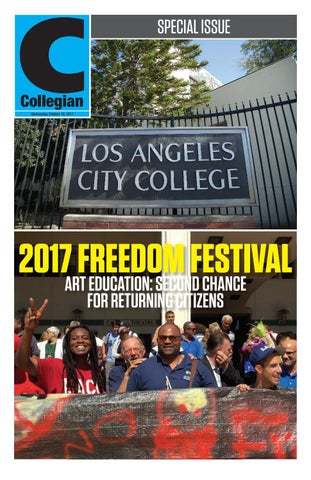
SPECIAL ISSUE
Collegian Wednesday, October 18, 2017
2017ARTFREEDOM FESTIVAL EDUCATION: SECOND CHANCE FOR RETURNING CITIZENS
2
(T) Clara Vasquez is a member of the High Risers Club who volunteered at the Freedom Festival in the Quad on Sept. 28, 2017. The club provides resources for members including tuition, books and other activities and support. Photo by Angel I. Maciel
2017 Freedom Festival
Los Angeles Collegian Wednesday, October 18, 2017
(B) Information and guidance on programs offered to returning citizens ranged from literature on voter registration to employment and housing opportunities at tables set up in the Quad during the two-day Freedom Festival. Attendees received a free box lunch from Subway. Photo Courtesy of Clara Vasquez
BEGIN AGAIN Freedom Festival Celebrates New Starts
BEHIND BARS Sixty-eight percent of state prison inmates did not receive a high school diploma.
The mission is an ambitious one: Keep previously incarcerated citizens on the road to stability and success. The Freedom Festival partners seem up to the task. And with the promise of a college level education, they appear to be off to a fast start.
Approximately 26 percent of state prison inmates reported completing a GED program while serving time in a correctional facility.
T
California has one of the highest recidivism rates in the nation – more than 61 percent of inmates released from California prisons return within three years.
By Angel I. Maciel
hree organizations including L.A. City College, the Strindberg Laboratory, and the Los Angeles Mission combined forces to create the Freedom Festival, “Break it to Make It,” during a twoday event on campus Sept. 28 and 29. Freedom Festival activities highlighted issues related to freedom, the arts and civil rights. Volunteers from the nine-month-old High Risers Club also attended the event. Organizers and workshop participants want to help returning citizens make the transition to outside life. Another goal of the Freedom Festival was to raise awareness of the need for basic human rights, social justice and equality, and to end the stigmas associated with incarceration. “We want to change our lives in a positive way through education rather than causing trouble,” said Leo, who is vice president of the High Risers Club. The group provides resources for members. Tuition and books are provided through donations from club supporters. The club also plans events like ice skating, bowling and movie nights. From the opening remarks from President Renee Martinez and LACC Music Department, to “Words of Freedom,” & “Words from the Inside,” with the LACC Theatre Academy Students at the theater arts portico, the College rolled out a schedule of ongoing events in the Quad and also in the Student Union Building. The festival program specifically highlighted the role of the arts and education in helping to reintegrate formerly incarcerated people back into society. Clara Vasquez, a High Risers Club member from the organization “Break it to Make It” spoke about why it’s important, as she handed out Subway meals to students who attended. “Right now, the ‘Break it to make it,’ is here in the Los Angeles City College, and it helps me,” Vasquez said. “It’s a lot of individuals who have been in the same place that I have been, so it doesn’t make me feel alone, that I’m here doing it by myself.” Information and literature on voter
State prisons have a five-year recidivism rate of 76.6 percent. In contrast, federal prisons have a 44.7 percent re-arrest rate after five years.
registration and available support services was provided at the tables in the Quad. Organizers encouraged students to become informed of the efforts being made on their behalf while they enjoyed a free sandwich meal. Local housing and employment agencies provided information on jobs and volunteer opportunities. The Freedom Festival marked the first time the Los Angeles Mission, L.A. City College and the Strindberg Laboratory teamed up for a program. Returning citizens often live at the Los Angeles Mission. The Strindberg Laboratory is a theater group made up of formerly incarcerated people. The group performs and sponsors workshops inside Los Angeles County jails and state prisons. The California Department of Corrections and the Los Angeles County Jails work on the challenging process of helping the returning citizens as they re-enter mainstream life. Some volunteers stood out on the first day of the festival as they passed out lunches to participants. One student wore a Tee Shirt with the hash tag: “Make schools not prisons.” She was too busy to talk. A man dressed in a Homeboy Industries Tee-shirt with tattoos worked quickly as he arranged Subway boxes. Homeboy Indus-
tries employs former gang members and previously incarcerated individuals. He spoke passionately about his journey. “It’s helped me in a way where I don’t expose myself with people I know would harm me and my family,” said Aaron Rodriguez who says he served four years in jail, but was released early for good behavior. “The gang life is something to look forward to, it not only f#*ks with you physically, but emotionally.” L.A. City College welcomes returnees who are committed to acquiring an education. There are about 50 students who are retuning citizens enrolled in classes at LACC. “There’s a growing movement for work and correction,” said a staff member from the Community Based Art Program located at California State University, San Bernardino who identified herself only as Alex. The Community Based Art Program has six facilities where the incarcerated may participate in art projects. The festival was also designed to help society connect with returning citizens by putting negative thoughts of the past behind them. It provides a second chance so they can “feel like community.” Abigail Robinson, Yanina Lopez and Fabion Reeves contributed to this report.
Among adult men in 2013, African Americans were incarcerated at a rate of 4,367 per 100,000, as opposed to 922 for Latinos, 488 for non-Latino whites, and 34 for Asians. As of 2007, one out of every 131 Americans has been incarcerated in prison or jail. In 2009, the U.S. Supreme Court ordered California to reduce its prison population to 137.5 percent of institutional design capacity. In March of 2015, it stood at 135.8 percent of capacity. Sources: U.S. Department of Justice, Bureau of Justice, California Department of Corrections and Rehabilitations, Public Policy Institute of California, The Sentencing Project.
3
PICTURES ON EXHIBITION Photos by Peter Merts
2017 Freedom Festival
Los Angeles Collegian Wednesday, October 18, 2017
STAFF BOX Editor-in-chief Naomi Johnson Art Director Beatrice Alcala Managing Editor Richard Martinez Reporters Tessa Flores Yanina Lopez T.J. Lowell Angel I. Maciel Fabion Reeves Abigail Robinson Sorina Szakacs Anwar Torres Photographers Beatrice Alcala Angel I. Maciel Eve Moreno Curtis Sabir Sorina Szakacs Anwar Torres
Photo 1 (top) Snow covers the ground as bird sits on a leafless tree in this untitled watercolor painting done by John Skult in 2008. Skult’s work is featured on PeterMerts.com in an album titled “Artworks from San Quentin State Prison-2008.” Photo 2 (middle left) Dennis Crookes utilizes oil on this 20 inch by 16 inch canvas painting titled “Dreams Rekindled.” Crookes work is on PeterMerts.com in an album titled “Artworks from San Quentin State Prison-2014 Feb.” Photo 3 (middle left) Anh “Ben” Nguyen uses pencil to illustrate his piece titled “View of My Cell.” Nguyen’s work is on PeterMerts. com in an album titled “Project PAINT at Donovan State Prison - 2014 Dec.” Photo 4 Henry Frank (Hawk) illustrates his piece titled “In Flight” using colored pencils and pens in 2014. Frank’s work is featured on PeterMerts.com in an album titled “Artworks from San Quentin - 2015 March.”
Collegian Wired reporter Sarah Hope covers the Freedom Festival and stories of change and new beginnings. See her report on Collegian Wired www.youtube.com/user
Broadcast Franco Aguirre Sarah Hope Dave Martin Curtis Sabir Cynthia Torres Adviser Rhonda Guess NEXT ISSUE: October 25, 2017 Editorial deadline: October 20, 2017 The college newspaper is published as a learning experience, offered under the college journalism instructional program. The editorial and advertising materials published herein, including any opinions expressed, are the responsibility of the student newspaper staff. Under appropriate state and federal court decisions, these materials are free from prior restraint by virtue of the First Amendment to the United States Constitution. Accordingly, materials published herein, including any opinions expressed, should not be interpreted as the position of the Los Angeles Community College District, Los Angeles City College, or any officer or employee thereof. Collegian ©2017. No material may be reprinted without the express written permission of the Los Angeles Collegian. Cover photos by: (T) Beatrice Alcala (B) Curtis Sabir
4
2017 Freedom Festival
Los Angeles Collegian Wednesday, October 18, 2017
Art and photography come into focus under the expert eye of Peter Merts whose workshop showed a different side of prisoners and prison life during the two-day Freedom Festival.
PETER MERTS CREATES PHOTOS OF REDEMPTION 1
V
By Tessa Flores
ivid and brightly colored masks resourcefully fashioned out of harvested fiber from palm trees in the prison yard. Tableaus of individuals of every race move through the middle of a choreographed dance routine. Compelling pieces of art held up with pride by their artists, bedecked in their prison blues. These are just a few of the images that photojournalist Peter Merts shares in his workshop as an ongoing portrayal of the positive impact art programs have on the incarcerated. It is a goal of the Freedom Festival at L.A. City College: to show the importance the arts and education have on reintegrating formerly incarcerated people back into society and eradicating the stigmas associated with imprisonment. Merts’ workshop promotes awareness of fundamental human rights, social justice and equality. But most of all, it creates a dialogue on the notion of redemption and second chances. Classes range from acting to poetry, or to movement or sculpting. According to Merts, they incite collaboration and the breaking down of internal barriers. See Peter Merts Pg. 6
7
4
5
Photos by Peter Merts
2
3
5
2017 Freedom Festival
Los Angeles Collegian Wednesday, October 18, 2017
6
6
8
2017 Freedom Festival
Los Angeles Collegian Wednesday, October 18, 2017
From Peter Merts Pg. 4
9
MERTS CHALLENGES STEREOTYPES PEOPLE FORM ABOUT PRISONERS
Merts has photographed inmates in prisons across California since 2002. In August of 2012, he collaborated on a book with Larry Brewster, a professor of public administration and former dean at the University of San Francisco. The book is entitled “Paths of Discovery: Art Practice and Its Impact in California Prisons,” and it provides an intimate look at how important art programs are to the self-improvement and evolution of these individuals. He initially began his photographic journey as a sort of fly on the wall. Then he gradually started engaging with the inmates and incorporating the human with the art. He got the idea to act as a kind of liaison between the inmate and the outside world. He created an online archive for their art and the photos he was taking. This platform made everything he was doing available to the loved ones of those in prison, and even became a way to promote funding for more programs. The result, in Merts’ opinion, was pivotal. Instead of hard exteriors, he was getting real people staring back at him through the lens. People emoting pride, self worth and vulnerability. “At that point I felt validated by their appreciation and openness and willingness to share their art with me,” Merts said. “A lot of it was intense and personal material.” Merts says he was motivated to break down the misconceptions and challenge the stereotypes people have about those in prison. “These are redeemable people,” he said. “They are human. All they need is a little nurturing and I wanted to show that.” His works depict how art classes created compassion, dignity, support and friendship among each other. The discipline of an artistic process instilled in many of these individuals the skills and healthy self-expression that they didn’t have before incarceration. Marquis, who was previously incarcerated but is now a trainee at Homeboy Industries, attended the workshop. He says he personally benefited from these programs. “The background where we come from, we weren’t used to these things,” she said. “We are guarded and protective of our emotions and feelings. To get to see this is amazing. I’ve come a long way and I’m doing better than I ever have before and it’s because of what these classes did for me.” A fellow trainee who chose to keep his name
private agreed. “I appreciate his photos,” the returning citizen said. “Those art classes were the only time I could share my progress with my loved ones. And that’s who you’re thinking about everyday in there.” Homeboy Industries has been training formerly incarcerated individuals and reformed gang members in the Los Angeles area since 1988. Cherrele Lenoire has been a part of Homeboy Industries for eight months. “I’m working on myself,” Cherrele said. “I’m staying positive and we’re all human and we make mistakes.” Mario Escalante, a counselor at L.A. City College is one of the organizers of the Freedom Festival. He spoke in favor of the education programs in prisons and says he has witnessed the improvements and positive outcomes first hand. Escalante says he was incarcerated and a former gang member for most of his formative years. He saw the need to educate those in jail, especially the youth, in order to bring about any kind of change. “Education is key,” Escalante said. “I didn’t have a high school degree and being in a gang was my life. I knew things needed to change when my best friend was murdered when I was only 23.” Fast forward several years later, and Escalante is a member of the “Break It to Make It” program and a counselor at LACC where he provides support and a wide variety of resources to the formerly incarcerated. Escalante says a lot of the young people who leave prison come out with a GPA of 3.6 or higher and have made vast improvements in their lives. They have the desire and have gained the skill set to become contributing members of society. “If the streets didn’t break me, I knew school wouldn’t either,” Escalante said. The message that Peter Merts offers in his works is a clear one. It depicts his advocacy for those in prison who are just finding their voice through art, and it shows the transformative effect of these programs. He shows the possibility of a life after prison and demands acceptance and forgiveness rather than discrimination. “It just confirms my faith in humans,” he said. “I wanted to bring a little humanity back to the world with my photography, and I hope that I did that.”
Photos by Peter Merts Photo 1 – Drumming instructor Wilfred Mark leads his students at Salinas Valley State Prison in June 2005. Photo 2 – A female inmate at the California Institute for Women has makeup applied to her face during an acting class hosted by Los Angeles-based theater company The Actors’ Gang in March 2014. Photo 3 – The Actors’ Gang started The Prison Project in 2006 in response to California’s high recidivism rate. During their acting exercises, inmates gather in a circle, wear white makeup and improvise scenes as characters from the commedia dell’arte tradition. Photo 4 – Members of the “Artistic Ensemble” are frozen mid-air while performing “Faultline” at the San Quentin Prison on Nov. 20, 2015. The Artistic Ensemble is a “rigorous, creative practice” at San Quentin Prison whose participants explore the intersections poverty, violence, power and incarceration as they hone their artistic skills. Photo 5 – An inmate at Pelican Bay Prison gets into character during an acting class in March 2016. The class is lead by Zuzka Sabata and Janessa Johnsrude of Dell’Arte International School of Physical Theatre in Humbolt County. Photo 6 – The Actors’ Gang conducts weekly and seven-day intensive programs inside the California prison system, a weekly re-entry program in the community and a program in juvenile facilities. “We’ve seen this approach transform prison yards,” said Sabra Williams, director of The Prison Project at the Los Angeles Hope Festival earlier this year. “We’ve seen it bring down barriers of race and separation, and that has happened through the courage of these people picking up the tools that we’ve offered them and using those tools to transform their emotional lives.” Photo 7 – Students in the Applause Demo Project at the Substance Abuse Treatment Facility and Sate Prison in Corcoran perform in the original play “ALL ABOARD” written by Deborah Tobola from student writings. The project measures the impact of creating and performing live theater on inmates about to reenter society. Photo 8 – Women happily pose for a photo for “Dance at Central Women’s Facility” on June 5, 2017. Additional photos of the dance session can be found on PeterMerts.com in an album titled “Dance at Central Women’s Facility - 2017 June.” Photo 9 - A woman soars as her hair flies and her skirt flows while she dances in all white attire for “Dance at Central Women’s Facility “ on June 5, 2017. Additional photos of the dance session can be found on PeterMerts.com in an album titled “Dance at Central Women’s Facility - 2017 June.”
7
ADORNO PAYS IT FORWARD Programs like “Make it to Break it,” ARC, and Homeboy Industries connect students to new opportunities, support services and a pathway to an education to help them accomplish their academic goals. One former student rebounded from the past and is now paying it forward
2017 Freedom Festival
Los Angeles Collegian Wednesday, October 18, 2017
Alexander Adorno participated in the Freedom Festival. He is a motivational speaker and an alumnus of L.A. City College who was once a returning citizen. He shares his story in the hope that he can inspire others who may have experienced similar hardships. Adorno has traveled across the U.S. and other countries sharing his story. There was a turnaround for him on his birthday one year when he says he realized he had no one to celebrate with or wish him a happy birthday. It was at this point that he decided to make a change for the better. Interview and photos by Anwar Torres Anwar: What brings you out today? Alexander: “I’m in a program. I’ve had a spiritual awakening in 2014, and it was something that was brought upon me … to change, to help people. I found myself feeling, and caring and it was something that I didn’t think I had anymore, you know? I wanted to become a motivational speaker for youth, troubled teens. I want to remove my tattoos after I go through a certain procedure, and some sort of judgment. I know I was put here for a reason, you know? God, and God as my guider, I know he put me here for a reason. I’ve never done no violent crimes, never been to prison for no violent crimes, just little dumb stuff that accumulated and you know, I ended up incarcerated. But ah, I recapped on everything I’ve done, I go, man I’m not a hateful person, I’ve never killed anybody, you know, I just got misguided so why not take that time, now. Because, I’m about to be 38 next month, and I’m getting old.” Anwar: Happy early birthday. Alexander: (quiet chuckle) “The time is now, you know, and this program brings me here as well as myself, not just the program, myself. It is up to me, I could have walked out, at any time. But me as a grown man you know, that has to take responsibilities now and set my priorities first, is doing this, so that’s what brings me here.” Anwar: That’s awesome. And you say this started in 2014? What was your wake-up call? What clicked? Alexander: “My wakeup call, actually, it’s going to sound weird but it was actually my birthday. And I saw that I had no birthday cake, no birthday nothing, no birthday present. Why? Because I got used to being incarcerated, and nobody to say happy birthday or this or that. It was just another day; I was tired of, ‘just another day,’ same thing over and over, ‘Oh just another day.’ I wanted to have feelings I wanted to do things that meant something, you know, that I can go back and say, wow that was cool, while being on the streets, not incarcerated, you know. But what happened was, I just paroled, I was in the city I grew up in, and it’s my birthday and I heard a voice tell me, “Hey, you just got to get up you know.” And I was feeling sad and I went around the corner and people had left out some things, you know. And it was something I wanted, it was a bicycle I wanted. It so
happened to be thrown out and be right there. I got blessed with it, and little things started happening to me as I was walking the tight line. And I tested it. I went back and you know, I would do something that was inappropriate or what not, and I would see, wow, check it out, the correction is there. And it sent people and things and sent me to certain places. To notice hey check it out man, God is good, and when you do good…(sound cut off). It is so big; the opportunities are so big once you know how to deal with yourself. Find yourself, care for yourself, love yourself, so you can love others.” Anwar: But it comes from you first? Alexander: “It comes from me first. I’m not going to be knowing what you really want. But the basics, the respect, you know. Because me, I may not like somebody but I’m going to respect them no matter what color, where they’re from, where they come from, I’m going to respect them and give them their way because that is another person, you know. I may not agree with them but I sure will respect that person.” Anwar: How does this event make you feel? Alexander: “It makes me feel comfortable, recognizable like in way that I can get up and say something amongst a crowd, you know. But no scare behind me, no fear, you know, I’m drug free so I’m not just there like a hermit. It’s a blessing man.” Anwar: Is this one of the first events you’ve attended? Alexander: “No. I’ve been to quite a few events in my life.” Anwar: Like this? Alexander: “Like this … First time. I’ve been to job fairs and job interviews and a couple of things, I’ve been around you know, I’ve traveled the world, I’ve been to Costa Rica all over Mexico, Puerto Rico, Tampa Bay, I’ve been around, you know and It’s been a pleasure to do that. And like I’ve said, to waste me, would be sad, to waste me, the person that I am, you know, it would be sad. So, hey, I’m trying to change, open up some eyes, you know, turn some heads and say hey man, check it out.” Anwar: And this is the perfect place. Alexander: “Yup, big time!”
(T) Alexander Adorno, a public speaker and former L.A. City College student, shares his story as a former “returning citizen” during a Freedom Festival session at Los Angeles City College on Sept. 28, 2017. Adorno said the Freedom Festival made him feel “comfortable, recognizable like in a way that I can get up and say something amongst the crowd, but no scare behind me, no fear.” (B) Khalis Holloway performs a spoken word piece for a group of participants at LACC’s Freedom Festival on Sept. 28, 2017. The Freedom Festival showcased a variety of art, performances and speeches, as well as booths with information on housing, education and employment opportunities.
Anwar: We have a lot of people here that might have gone along the same lines as you have. Do you see that other people also change or do you see people still with conflict? Alexander: “I see people change, you know what I see is, when people see me, a person like me, because they judge me every day and I get it of course, and I don’t know why I got these tattoos but obviously for a reason, you know. I think of it like this, now I sat down and was like, what am I really doing, what is this? And I talked to God and got some answers from him, and then I got into myself, you know, I call it my zone. I meditated and I got that this is a sort of test for me. To give out my testimony after the fact that I was judged, and treated certain way. See, I want to do a documentary on my face where my face is all tattooed and after I remove my tattoos. Because I’m going to have my tattoos
removed and make a comparison from having and not having tattoos. I also was wanting to do a survey done behind a tinted window. Where I give a speech, or answer a call and see the person reaction after. And I want to see who would point to me. You know? Because it changes, it’s not how a person looks but what a person knows. And who he knows to help them get in there, and so on and so forth. Because I know I have skills, I have presentation skills I’m a people person. I’ve always have, I’ve always brought in people. That’s been my gift, driving people in through my voice, through my way of being, my acting, so I can’t let that go to waste.” Anwar: That’s awesome brotha, I’m glad to hear that, congratulations. You definitely made it. Thank you for your interview. Alexander: “Thank you for your time.”
8
2
2017 Freedom Festival
Los Angeles Collegian Wednesday, October 18, 2017
1
FORMER INMATES LEARN LANGUAGE OF FREEDOM Fresh Canvas, Fresh Start: Former Inmates Remove Tattos
F
By T.J. Lowell
ormerly incarcerated individuals face no shortage of challenges when making the transition back to free society. Ordinary difficulties in securing stable employment and a safe place to live can be overwhelming enough, even for those who have never spent time in prison. As former inmates attempt to again become contributing members of their local communities, their self-inflicted battle scars are constant reminders of the past lives they wish to leave behind. Prison tattoos, for many, are one of the few ways people behind bars can exercise agency over their bodies. In a system designed to completely stifle dissent, ink is a way to telegraph individual beliefs and priorities. It can also be a way
to protect oneself from violence. “Part of jail life, you get people with tattoos and you look at them, step back, ‘Watch out for that guy’ sort of thing,” said former inmate Mike Cropp in a recent interview to the New Zealand Herald. The outside world is less receptive to this type of signaling. Implicit dress codes and expectations of appearance in professional environments have pushed people to seek out tattoo removal services upon their release. Homeboy Industries is one example of an organization that provides this critical service. Overall they aim to “provide hope, training, and support” to individuals with gang-related histories or experiences with incarceration. The tattoo removal service is free, and thought of as a “gateway” service into the organization’s holistic approach to rehabilitation. It is provided by 35 volunteer doctors who treat over 950 clients per month. As the largest gang intervention, rehabilitation and reentry program in the world, Homeboy Industries helps over 10,000 individuals annually make positive changes in their lives. “Homeboy Industries has been the tipping point to change the metaphors around gangs and how we deal with them in Los Angeles County,” said founder Rev. Gregory Boyle, on the organization’s website. Since their beginnings in 1988, Homeboy Industries boasts to have “engaged the imagination” of over 120,000 gang members. Over the past 28 years, the organization has had a broad reach. In that time, they’ve collaborated with more than 40 other organizations to replicate the practices of Homeboy Industries’ services for individuals across the nation. In addition to tattoo removal,
3
Photos by Peter Merts Photo 1 –She wears her art while creating as a “Break it to Make it” participant. Photo 2 – Participants carve at a linoleum block during a printmaking class at San Quentin State Prison in September 2008. Photo 3 – Inmates work together to create a mandala out of organic materials at the California Institute for Women in December 2016. The class is taught by a team of teaching artists and interns from the Prison Arts Collective – a community-based group based out of CSU San Bernandino.
programs offered include case management, paid workforce development, legal aid services, mental health services and substance abuse support. One notable resource is the Solar Panel Installation Training and Certification Program: a tuitionfree program for clients with a 92 percent graduation rate and a 70 percent job-placement rate within 90 days of graduation. One of their biggest challenges is simply finding enough candidates to fill all of the available jobs. Homeboy Industries wants to change the conversation and perspectives surrounding gang membership and incarceration. Gang activity in Los Angeles
has fell since 1980s, thanks to Homeboy’s innovative approach. “What if we were to invest in this population rather than just endlessly incarcerate?” asks the organization’s website. Rev. Boyle believes in investing in rehabilitation programs rather than trying to suppress gang activity. At an Oct. 7 forum in Yakima, Washington, he explained his unconventional approach to gang intervention and rehabilitation in Los Angeles. The reverend specifically challenged ideas that kids join gangs in the hopes of becoming part of something larger than themselves. “Hopeful kids don’t join gangs,” Boyle said.