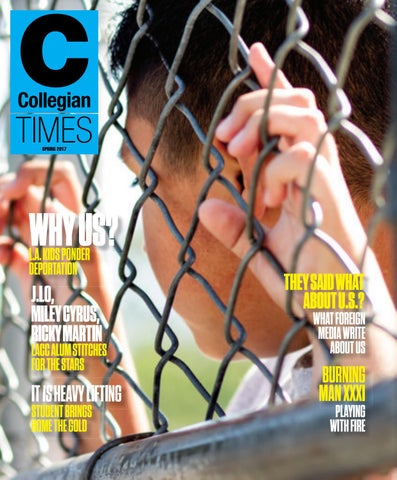
C Collegian
TIMES SPRING 2017
WHY US? L.A. KIDS PONDER DEPORTATION
J.LO, MILEY CYRUS, RICKY MARTIN
LACC ALUM STITCHES FOR THE STARS
IT IS HEAVY LIFTING STUDENT BRINGS HOME THE GOLD
THEY SAID WHAT ABOUT U.S.?
WHAT FOREIGN MEDIA WRITE ABOUT US
BURNING MAN XXXI PLAYING WITH FIRE
Turn Moments Into Memories
SEVEN LOCATIONS AND A MAIL ORDER TEAM TO SERVE YOU LOS ANGELES 323-938-2420 | CULVER CITY 310-450-4551 | PASADENA 626-796-3300 SANTA ANA 714-557-9400 | SANTA BARBARA 805-963-7269 | SAN FRANCISCO 415-621-8400
WWW.SAMYS.COM 1-800-321-4726 FOLLOW US
SamyCamera_LACityCollegeAd_9x11in.indd 1
5/2/17 11:24 AM
STAFF Executive Editor ANDE RICHARDS
LETTER FROM THE EDITOR:
Los Angeles City College opened its doors in 1929, and since then student journalists have published many outstanding issues of the Collegian Times. However, this is the first year a formal class has been offered. Many of us thought it was going to be an easy class because we could officially say that we had guidance and structure, but it was not what we expected. We were in over our heads and there was mayhem. Then we discovered our theme: “Order and Chaos.” As time went on, order was restored in the newsroom, and we put our chaos into words and images. We recognized the order and chaos reflected in the lives of people in our communities who face challenges every day in America. Our stories speak to this. Each editor brings a vision to the Collegian Times newsroom. In this issue, we meet Americans whose families escaped concentration camps and American “hopefuls” who paid “coyotes” to get here. Marsha Perry’s interest in children who may face deportation, sent her into the field to the Los Angeles Unified School District to meet them. Many Latino families nationwide face the threat of being torn apart. We also listened to the complaints of Roy Payan, a visually challenged student who dreams of finding a way to train people with disabilities to prepare for emergencies. And there’s Jason Piskopus’ experience working in a psych ward where he meets “Ms. Rabbit.” If you crave a desert escape, immerse yourself in William Torres’ Burning Man festival experience. You will not forget his behind-the-scenes look at the nine-day festival. Svetlana Yurash profiles a superstar Siberian weightlifter, and Ande Richards makes a soft landing in the Mother Plucker showroom of alumnus Willy Zelowitz. He shows us rooster, ostrich, turkey, and peacock feathers he uses to outfit Jennifer Lopez and Ricky Martin. We have grown accustomed to living and working side by side with people of various ethnicities, nationalities, and races. We invite you to dive into the pages of the Collegian Times magazine for a closer look. Ande Richards Executive Editor
Art Director BEATRICE ALCALA Managing Editors LAVIELLE HIBBERT MARSHA PERRY RICHARD MARTINEZ Contributing Illustrators GEORGE SUMMERS NATALIA ZEPEDA Photo Editor CURTIS SABIR Writers JASON PISKOPUS WILLIAM TORRES SORINA SZAKACS BEATRICE ANOH EDWARD LOCKE HIROKO HATA HECTOR LOPEZ CLINTON CAMERON NAOMI JOHNSON ANGEL JOHNSON SVETLANA YURASH Photographers ERIKA ALMANZA NECHAMA KERMANSHAHI FRANK VIDRIO ANDREW PILOT Courtesy Photos JASON SIADEK LIAM HAYES Copy Editors REBECCA GRAZIER JOHNATHAN HIBBERT JORDAN RODRIGUEZ Advertising Sales ANDE RICHARDS CLINTON CAMERON MARSHA PERRY Faculty Adviser RHONDA GUESS
FEATURES
ORDER AND CHAOS
PAGE 10 RETURN TO SENDER
Immigrants and their families take different paths in three stories where they break bad in search of the “melting pot” promise.
PAGE 14 PHOTOJOURNALIST’S NOTEBOOK An undocumented teacher—turned—tailor from Mexico worries about being caught and deported.
PAGE 20 WHY US? Children learn where to go and how to survive in case they or their parents are suddenly deported.
PROFILES PAGE 18 MOTHER PLUCKER City College alumnus stitches for the stars and creates jaw-dropping, feathery rainbow garments.
PAGE 26 WEIGHTLIFTER BRINGS GOLD STANDARD TO L.A. CITY COLLEGE
From snowbound Siberia to sun-drenched So-Cal beaches, Denis Knyazev shares his training secrets for competitive success.
A DIFFERENT PERSPECTIVE PAGE 8 I VOTED: WHAT THE STICKER REALLY MEANS PAGE 16 SEE ME FALL PAGE 30 COMMENTARY They said what about U.S.?
PAGE 33 CAN GOING VIRAL BE AN UNHEALTHY OBSESSION?
WAY OFF THE BEATEN PATH PAGE 6 TALES FROM THE DEMENTIA WARD: THE WHITE RABBIT AND FRIENDS PAGE 24 BURNING MAN XXXI, PLAYING WITH FIRE PAGE 34 FAUST’S HIDING PLACE: OLD WORLD BOOKS CARRIED BY THE OPPRESSED
C
Collegian Times Magazine The Student Magazine of L.A. City College Spring 2017 Cover photo by Curtis Sabir
Collegian
TIMES SPRING 2017
WHY US? L.A. KIDS PONDER DEPORTATION
J.LO, MILEY CYRUS, RICKY MARTIN
LACC ALUM STITCHES FOR THE STARS
IT IS HEAVY LIFTING STUDENT BRINGS HOME THE GOLD
collegiantimes.tumblr.com.
THEY SAID WHAT ABOUT U.S.?
WHAT FOREIGN MEDIA WRITE ABOUT US
BURNING MAN XXXI PLAYING WITH FIRE
The college magazine is published as a learning experience offered under the college journalism instructional program. The editorial and advertising materials published herein, including any opinions expressed are the responsibility of the student staff. Under appropriate state and federal court decisions, these materials are free from prior restraint by virtue of the First Amendment to the United States Constitution. Accordingly, materials published here, including any opinions expressed should not be interpreted as the position of the Los Angeles Community College or employee thereof. ©2017 Collegian Times Magazine. No material may be reprinted without the express written permission of the Collegian Times Magazine.
26
20
14
24
10
S TALES FROM THE DEMENTIA WARD: THE WHITE RABBIT AND FRIENDS [BY JASON PISKOPUS]
Before becoming a writer and editor for the Collegian, I spent 11 years working with dementia and Alzheimer’s patients as a nurse. Five days a week, I walked in and out of a world of total insanity. I enjoyed it because people who are truly insane cannot be blamed for their actions. Crazy people don’t know they are crazy. 2017 SPRING Collegian Times
ILLUSTRATIONS BY SORINA SZAKACS
he is a petite thing from Mississippi who I call the White Rabbit. I gave her this nickname because she is very pale, has long white hair always neatly tied into a ponytail, and a long, pointed nose that demands attention in the landscape of her face. Aside from her physical appearance, she is by far the most “gone.” She is my favorite. Miss Rabbit babbles in unending stories that twist and turn more than any carnival ride. “My sister and I used to bake cookies with our grandmother, but she wouldn’t let us have any because they were for the dogs. So, we ate while the cats had the fish,” Miss Rabbit says. “What did you eat?” I ask. “What did we eat? That cats of course! Why else would we have them there?” Miss Rabbit says. “Why didn’t you just eat the fish that the cats were eating?” I ask. “Because then the dogs would go hungry,” she says. This dialogue continues for hours, usually without anyone else present. She always has invisible friends with her, keeping her company or giving her grief. Today is no exception. Miss Rabbit begins to argue with an imaginary visitor. “Caroline, I said shut that baby up! Christ! Haven’t you fed her anything yet?” Miss Rabbit says one day to no one. “When babies don’t get enough food, they dry up and die. Don’t talk back to me just do it!” She sits in a wheelchair in the dining room, wearing a light blue hospital gown. As she and “Caroline” go back and forth, I walk up to her and try to bring her back to reality. “What’s wrong, Mama?” I ask. “My niece won’t feed her kid, and now the postman is here and I’m late for work,” she says. “I have a million things to do today and I don’t have time for Caroline’s malarkey.” “What time do you have to be at work?” I ask. “At six,” she says. “You forgot that it’s daylight saving time,” I say. “You have an extra hour before work.” She looks at me briefly for reassurance and asks me if I am sure. “Yes,” I say. “In fact, I almost overslept today because I forgot to set my clock back.” She calms down, no longer worried about being late. “Caroline” had apparently left the room or started feeding the “baby.” The real Caroline, I would later find out through family, died 23 years prior. She never had 6
children. I still wonder whose “baby” Caroline was caring for in Miss Rabbit’s delusion. A few weeks after “Caroline’s” visit; a full moon rises over the 68-bed wing of the hospital. It makes the average shift a nightmare, especially for the nurses who work in “psych.” “If the moon can raise and lower the sea levels, and you are at least 70 percent water,” an older and more experienced nurse once said, “what makes you think that the moon is not having an impact on you physiologically?” It’s in my nature to question everything. However, after my first year on the dementia unit, I came to believe that the moon affects people deeply. Miss Rabbit and her friends would reinforce that belief over dinner conversation. One night during a full moon, Miss Rabbit’s normally disconnected and ludicrous stories became more bizarre. “And then my friend and I were playing outside by a stream. We were laughing and drinking tea. But then the men came and started chasing us,” she says. “Which men?” I ask. “The men in the white sheets,” she says. “They wanted my friend because she was black and we were so scared, and we ran and we ran. Then we found an old woodshed and hid inside. But the men came, and they found us and killed us.” “They killed you?” I ask. She nods and replies “Yup.” I ask how. “They killed us with axes,” she says. “Yup. Chopped us up to a million pieces and threw us all over the woodshed. There was blood and guts on the walls, all over the floor. Pieces of our bodies flung everywhere. My head was over there and my foot was over there. It was an awful mess.” I choke down a laugh as I imagine the scarecrow from “The Wizard of Oz” with her face. “Wow. But, if they killed you, then how are you here now?” I ask. “Oh, we weren’t really dead,” she says. “Just pretending.” “You were pretending to be chopped up into a million pieces?” I ask. “Yup,” she says. “How did you do that?” I ask. “Oh, it’s simple,” she says. “When they left, we just pulled ourselves back together and ran out the back door.” I sat in a state of surprise unable to speak. Yelling at kids, dogs, and who knows what, were all normal for her. Stories of death and miraculous resurrections were not. I knew I was in for a rough night. This is life for dementia patients and their caregivers. Reality constantly shifts for both the sufferers and the ones taking care of them. After dinner came bedtime. One by one, nurses take their charges to their rooms, cleaned up and dressed for the night. As I push Miss Rabbit down the hallway in her wheelchair, I arrive at Miss Kahn’s room. Dementia presents differently for different patients. Some are manic and laugh for no reason. Others lock up and cannot speak or move. Kahn’s condition presents as fear and constant worry. Children are missing, cats are stuck in walls and there is always some impending natural disaster. As I pass her door, I notice Kahn is on the edge of her bed, clutching the handrail. She is about to fall out. She is 100 pounds overweight. She will not be easy to catch. I leave Miss Rabbit in the hall and run into Kahn’s room. I slam myself up against the bed to prevent her from falling. “Help!” I shout while pushing the call button repeatedly. “Shawna,” one of my coworkers comes in. “What did you do?” she asks. “What did I do?” I say in frustration. “I stopped her from falling on the floor and busting her head, now help me.” Kahn begins to cry. She screams, punches and bites as we try to move her to the center of the bed. “I don’t want to drown! I don’t want to drown!” she says screaming. “What are you talking about?” I ask. “The water is up to your waist!” she says still screaming with tears in her eyes. “Can’t you see it? We’re all going to die in here. We’re all going to die.” The only water running in the room were the tears cascading down her
face. Chasing away imaginary dogs is easy. Fighting off three-foot-deep floodwaters is not. The three of us go back and forth for 10 minutes, all the while forgetting about Miss Rabbit seated in the hallway in her wheelchair. She uses her only leg – the other was amputated below the knee – to shuffle herself three doors down the hall and starts fighting with Miss Moore, a particularly unpleasant patient. “Get the hell out of my room you bitch!” Moore says in her usual harsh tone. “I told you your kind is not welcome in here.” I quickly remove Miss Rabbit and take her to her room. Her roommate, Miss Allen, is a pleasantly confused patient who speaks to all the nurses as if they were her children. She only complains about one thing: the magician who lives in her closet. Rather dapper in a top hat and cape, the magician periodically pokes his head out of the closet and scares her into hysterics. She yells toward the closet and begs him to leave her in peace. Tonight is no exception. As I wrestle Miss Rabbit into bed, Miss Allen begins to get worked up. “Shut up! I said shut up, you!” Miss Allen says to “the magician.” “Damn it, you never leave me alone, especially when my shows are on. I said shut the hell up!” “Miss Allen, what’s he saying to you,” I ask. “He keeps sticking his tongue out at me and telling me I’m ugly and dumb,” she says. “I try to ignore him, but the more I ignore him the more he acts up. Shut up, you bastard!” I know the only way to manage her delusion is to go into it myself. As nurses, we are trained to bring the patient back to reality, regardless of their delusions. Experienced nurses know better. The fact is that reorienting patients doesn’t always work. Often, the only way to get through to them is to acknowledge the delusion and try and defeat it. I slide the closet door open and step in, closing it behind me. “Now I’ve told you before to leave Miss Allen alone,” I say. I punch the wall inside the closet. “You keep scaring her and that’s not right you son of bitch,” I say. I kick the door and it rattles on its tracks. “I’m going to teach you a lesson about picking on helpless women,” I say. I punch the wall again. Flinging the door open, I chase the “magician” out of the room. “Get out and stay out,” I say shouting down the hall to no one. “Thank you, son,” Miss Allen says. “That man has been pestering me ever since I got here.” There is something strange about that room. Ultimately, the hospital administrators converted it to storage because so many nurses refused to enter. I have never been superstitious, but I still cannot explain what would eventually happen there. None of us can. When the unit finally falls silent, everyone gathers at the nurses’ station to chat about their day, and count down the minutes until the shift ends. Debates on who had the worst night, who took the worst hits and who received the worst tongue-lashings begin. We tease each other about the shift. The nurses’ creed is ‘laugh, or you’ll go insane.’ Six weeks later, Miss Allen dies in her sleep. We clean out the drawers in her room and pack away her belongings. By 7 p.m., the nurses settle in a new patient. She is a sweet, soft-spoken woman who is surprisingly direct. We assign her to the same bed Miss Allen slept in for several years. At 9:30 p.m., I begin my walking rounds to check on patients. When I came to Miss Rabbit and Miss Goldstein’s room, I notice that Miss Goldstein looks agitated. This is normal for patients in a new environment. “How are you settling in Miss Goldstein?” I ask. “Oh, fine, fine,” Miss Goldstein says. “My bed is comfy and the room is nice. My roommate is sweet. She gave me a cupcake earlier. It’s just that – ” She pauses, and a confused almost frightened look comes over her face as she turns pale. “It’s just that what, Miss Goldstein?” I ask. “You can tell me, I’m here to help you.” “Good,” she says with a slow nod. “Can you do something about that man in my closet? The one in the top hat and cape? He keeps sticking his tongue out at me.”
‘I VOTED:’
What that Sticker Really Means illustrAtion By nAtAliA zepedA
2017 SPRING Collegian Times
[By Angel Johnson]
8
I
was attending West Los Angeles College through the Upward Bound Math-Science program offered at Dorsey High School on June 16, 2015. It was just another day for me. I studied microbiology and communications. However, this was not a typical Thursday for me. This was the day that Donald Trump announced he was running for president. That entire summer, we made jokes about what it would be like if Trump became our president and how terrible he would be. When we returned to school in the fall, Trump was all anyone could talk about. At lunch one day, I sat at a green and white table with friends like Zheniah, Nahje, Diamond, Krystal and Dashawn among others near the dean’s office. It was a hot day and the table’s umbrella shielded us from the Los Angeles sun. My friends and I were laughing at the thought of Trump becoming our next president. Since we were all high school students, we were not worried about the election or who won. We were too busy looking forward to our final year in school. My friend Dashawn wanted to know “who is he and what is he famous for?” The only thing I knew about Trump was that he was running for president, is filthy stinking rich, and he made a cameo in the movie “Home Alone 2: Lost in New York.” Once I started to read his Twitter posts, I became disgusted. As a young black woman, the things he said about other women disgusted me. I did not feel comfortable knowing that he might possibly become the president of the U.S. By my birthday in November 2015, I realized that I was going to be able to vote in the 2016 election. I was so excited to vote for the first time. A few days later, I started to do my research on all the candidates and the parties. After I read numerous articles, I decided that I would vote for Bernie Sanders. He seemed like the only candidate who would do more to help than hurt the people of the United States. During my final semester, Dorsey High School administrators organized several assemblies on the importance of registering to vote. Many staff members tried to encourage students to register. I asked some students why they did not register to vote and they said, “eh, I don’t care.” Others were too lazy. I was a little obsessed. I was more concerned about voting on laws, measures, and candidates than choosing what color I wanted to wear to prom. Prom is only one night, but the effects of the laws that might pass last four years. This was only the primary election. The day before graduation, I went with my brother and sister to our polling place to vote. All everyone talked about was Bernie Sanders. I knew he had it in the bag. When I found out that he lost to Hillary Clinton, I was devastated. I was sure about the outcome of the primary because of the rumors about Clinton’s email scandal. People who live in my community were outraged over the results, but there was nothing we could do. About a week after graduation, I started working my first job. I worked most of the week, so the primary results never really crossed my mind after Sanders’ loss. On a typical crowded Wednesday afternoon at Hot Dog on A Stick in Santa Monica, my manager returned from a break. “Guess who’s on the pier at the Bernie Sanders rally,” she said. “Bernie
Sanders himself!” My co-workers were so excited, but it’s not like we could have just left work. Throughout the day, all I saw were these amazing people carrying drawings of Sanders, “Feel the Bern” T-shirts and posters. After Sanders lost, I lost interest in the election. I was still going to vote. I just didn’t care about who would win. Clinton and Trump were the only choices. I believed that both Clinton and Trump could possibly destroy the U.S. economically and politically. The best thing for me to do was choose the candidate that would harm the country the least. I thought Clinton’s campaign was stronger than Trump’s, so I went with her. Toward the end of the summer, I decided to go to school full time at Los Angeles City College. Once enrolled, my classmates never included me in conversations about the election because they could tell that I was young. About a month before the election, the leaked video of Trump and former “Access Hollywood” host Billy Bush went viral. As a young woman, I was, and still am offended by the comment he made about grabbing women “by the p#*sy.” That comment was far worse than any email scandal. As the election drew closer, I started noticing the candidates’ campaign ads. These ads were grimy, but what else would one expect from Trump or Clinton. “Saturday Night Live” played a huge part in this election for me. They lightened the mood for such a humorless campaign run. I noticed the weekend before the election that there were many ads that could kill Clinton’s chances. I was pulling for her anyway. I was anxious on Election Day, but I kept a smile on my face because it was my first time voting and it was my sister’s birthday. We left school early to go vote at our church. Once I left the polling place, all I could think was my vote brought Clinton one-step closer to the White House. Later that day, my sister and I returned to the Collegian’s newsroom to watch election returns. As time went by, my patience grew thin. Trump was in the lead by over 50 points. I started to feel jittery. I began to think about all of the worst things that could happen to my family, my friends, and me. But the election was not over. Every time Clinton went up a little in the polls, Trump went up with her. How could anyone vote for a man who belittles women, stereotypes minorities and wants to have wars with other countries? Although Trump was close to 270 electoral votes, I was hopeful that Clinton would win because polls were still open in a few states. Once the election was over, I was completely devastated. Before I left the Collegian newsroom that night, all I remember hearing were sirens of police cars, and seeing them speed down the street. I wanted to cry because I was and I still am afraid of what could happen over the next four years. We did not get home until after midnight; we waited until we could no longer hear sirens. The mood was miserable the day after the election. At school, at home, all anyone talked about was Trump’s win. I felt as if my vote did not matter and questioned whether or not I would ever vote again. Clinton should have won the election based on the popular vote. If we live in a democracy and respect its rules and laws then we should count the popular vote. The Electoral College votes determined the president. None of the other votes even mattered. It was useless for me to register if my vote or the votes of others never counted in the first place. Depending on the slate of candidates, I may not vote in 2020. My first vote was ignored. As of now, I feel voting is completely useless and is just a waste of my time. Thanks for the sticker.
ILLUSTRATION BY NATALIA ZEPEDA 2017 SPRING Collegian Times
RETURN TO SENDER: BREAKING BAD FOR MELTING POT PROMISE
[BY CLINTON CAMERON] 10
Oscar Prospects looked grim for “Oscar Salazar.” He moved from one job to another, but the money he made never matched the hard work he put in. Although he had lived in Los Angeles since he was seven years old, he never became a citizen. “He decided to move south of the U.S. border to Tijuana in order to find better work. He imagined better pay without the fear of deportation.” Juan “Juan Diaz,” his mother and sister fled Mexico one rainy night in December 1992. They escaped domestic violence. The family left their home in Tijuana with a few possessions. They settled in downtown Los Angeles and started a new life. Juan spent the rest of his childhood north of the Mexican border. He has lived in the shadows working under a false identity for more than 20 years. That decision could derail his dreams of citizenship. Elizabeth Elizabeth Preger’s family emigrated from Siberia the coldest part of Russia during the coldest part of history: the Cold War. It was a challenging time for Russian and American relations. Leaving Siberia presented a challenge for Elizabeth’s parents because some relatives stayed behind. Elizabeth came into the world one year after they migrated. She tells her story as the first American-born member of the family. Oscar’s Run for the Mexican Border When “Oscar Salazar” was seven years old, his father brought him and his younger brother to America. Their father paid for the amnesty application of the younger brother, but did not provide the same support for Oscar who started working jobs without documentation as a teenager. Oscar decided to go back to Mexico after years of working low-paying jobs with little advancement. He wrote about his experience in Campus News, the student newspaper at East Los Angeles College where he worked as a writer and editor. “I packed my bags, bid my friends and family goodbye and walked across the border into Tijuana,” Oscar wrote. “It all seemed like a dream at first. I stood on the steps of the Pyramid of the Sun in Teotihuacán after having read so much about it. I stood on the steps of Frida Kahlo’s Casa Azul in Mexico City. I ate real authentic tacos for the first time in ages, drank honest-togoodness tequila, and even saw Aztec dancers right in the heart of Mexico City who invited me to join in, which I did inebriated and ecstatic.”
Oscar found a job in Mexico after the honeymoon phase. He lacked the papers to qualify for a decent job in America, and soon discovered he had the same problem on the opposite side of the border too: no diploma. “He got paid $65 a week to be the janitor and handyman in a whore house and he worked 12 hours a day, six days a week for $65,” said Jean Stapleton, the faculty adviser for Campus News. Oscar began having second thoughts about paradise after he worked in a bar as a custodian. He spent most of his life in America, so he stood out among other Mexicans. “The thing that I thought was interesting was how badly he was treated when he got back over there,” Stapleton said. “And of course his Spanish is not their Spanish. They made fun of him because he spoke the kind of Spanish that people in East L.A. speak.” Police and criminals began to target him for bribes. The shakedowns occurred because they assumed he was American and thought he had money. Six months was all he could take before he decided it was time to leave. “Even though America didn’t want me and I got lousy pay, I got more than $65 a week and I didn’t have to work 12 hours a day, six days a week,” Oscar wrote in Campus News. Oscar Bids Mexico Goodbye Immigration attorney Farnoush Farzad says anyone who returns to America after living here illegally for more than a year may be permanently banned. This follows changes made to the U.S. Immigration and Nationality Act (I.N.A.) in 1996. Oscar knew and he took that risk. “The law is very clear on that,” Farzad said. “Those questions will always come up [in deportation hearings].” Oscar’s return to the U.S. was nothing like his departure. He arranged for his father to pick up his belongings in Tijuana and bring them back to America in preparation for the trip. His father then hired a “coyote”— someone who smuggles people across the border—to bring him back. The coyote narrowly escaped Border Patrol with Oscar inside of a car packed full of people. They survived the trip through rocky hills and a fenced-off border, and were robbed twice on the way. Luckily, most of Oscar’s belongings were with his dad. The odyssey from Mexico was just the beginning. Once they arrived in the U.S., the coyote demanded extra money before he would let Oscar go. “I was locked in a garage with a revolving group of people for three days, because I could not get in touch with my family to pay the coyotes,” Oscar wrote. “We ate twice a day and mostly slept or talked about the places in Mexico where we’d come from and where in the U.S. we were headed to.” His father settled the balance with the coyote like an exchange in a kidnapping. Only then, did the coyote deliver Oscar to his father at a gas station in South Gate, about 7 miles southeast of downtown Los Angeles. When he returned to the United States, Oscar enrolled at East L.A. College again and earned an associate degree in journalism. According to Stapleton, Oscar is trying to resolve his citizenship status with the help of a sponsor. Closer to Home “Juan Diaz” crossed paths with the American flag in the center of Los Angeles City College as he walked across campus after a meeting for students applying for Deferred Action for Childhood Arrivals (DACA). The policy started during the Obama administration and grants immigrants who arrived in the U.S. as minors a two-year period of deferred action from deportation. Juan arrived in the United States with his mother 25 years ago under difficult circumstances. She decided to leave her husband after enduring years of verbal and physical abuse. She brought Juan and his sister across the U.S. border with the help of her boyfriend on a rainy night in December. “We grabbed some of our shit, got in the car and drove here and we crossed the border through the desert, and on the way we got chased by Border Patrol [while] stuffed into a little 1989 Civic,” Juan said. The smell of Christmas permeated the air as Juan lost track of time
during the ride. He says he became hypnotized by a flashing red light that never stopped blinking; warning the driver some function of the car needed attention. They made it across the border safely. However, his 14-year-old brother who lived with an uncle decided to stay in Mexico, which compromised his safety. The father promised he would kill Juan’s brother if their mother ever left. Juan’s father showed up at the ranch where his son lived shortly after his wife left with intentions to carry out that threat. Relatives armed with rifles protected the oldest sibling and the father backed down. He never tried again. Status Unmasked The family arrived at the home of Juan’s soon-to-be stepfather’s house in downtown Los Angeles. Juan felt isolated and unaccepted by his future family. He says he kept to himself at first and learned English by watching television. He adjusted to his new home and surroundings and until he attended high school, did not know he was undocumented. It had never been an issue. He says he grew up like a “normal kid.” Then Juan had a rude awakening. “Suddenly, it became a problem in my sophomore year when it came time to apply for colleges and financial aid and stuff like that,” Juan said. “I couldn’t apply for any of that stuff … and suddenly the reality dawned on me that I was undocumented and I didn’t have the same rights as other kids, that I thought I had.” Juan experienced similar setbacks applying for jobs after he graduated from high school. He turned down his first job offer as an art tutor at a new downtown high school. He did not have a Social Security number, so he took on jobs that did not ask a lot of questions about his status and paid cash. “I’ve worked whatever jobs I could get,” Juan said. “My first job was a video store clerk where they paid me cash and I’ve been a day laborer, I’ve been a bricklayer, I’ve been a ranch hand, I’ve been a cook, I’ve been a painter, a freelance artist … I did a few occupations mostly where I could be paid cash, but nothing was very stable, so the only thing that I could do was get a fake Social [Security number] and work under a fake name.” His decision to work with a fake identification helped him get a better job, but may have jeopardized his chances of ever obtaining legal citizenship in the United States. “In the past when I’ve tried to apply for DACA,” Juan said. “I’ve been again told to wait until there’s some sort of change in policy, because I’m working with a fake social. That’s identity theft. That’s fraud. It’s called false claim to citizenship.” Several immigration attorneys advised Juan he should wait to apply for DACA. He changed his mind in March and applied anyway against their advice. Farzad is one of the attorneys who says students in Juan’s situation should not apply after the fact. “Basically, I’m a little bit concerned,” Farzad said. “It’s an incredibly difficult thing. The bottom line is there are some people who are incredibly vulnerable.” In a February 2017 news conference, President Trump promised to handle any decision regarding DACA “with heart” while accusing some DACA recipients of being drug dealers and gang members. Juan fits neither of those labels. His only crime: false claim to citizenship. Yet, he faces the threat of deportation daily, and continues to pay taxes under a false name and Social Security number. Family Migrates from the East Russian echoes through the hallway of the Chemistry Building basement as Elizabeth talks on her cell phone to a relative. It’s 5 p.m. and it’s time for her to begin her shift as the photography lab assistant at Los Angeles City College. Aside from speaking Russian, she does not appear to be from another country and she’s not. Everyone in her immediate family including her older sister was born in Russia. “The thing is, I am first immigration or first generation, because my parents and my family are immigrants,” Elizabeth says. “Even my sister is an
immigrant and I was the first one in my family to be born in America? So, technically I am first generation and they are simply immigrants. It took me a long time to figure out what the hell ‘first generation’ was because it’s so complicated.” The Pregers left Siberia for an “Italian vacation” to throw off suspicion. Their intent was to get to America. The government-required parents’ signatures before Russian citizens could travel abroad. “My mom got permission from her parents,” Elizabeth says. “The thing they couldn’t get was my [paternal] grandma to sign off and she refused.” Eventually, Elizabeth’s aunt convinced her grandmother to sign the required paperwork. However, her grandmother would not leave. Elizabeth says everyone knew why the rest of the family left Russia. “So, there was this huge stigma that went with being left behind and everyone knowing your family had immigrated to the West and so [my grandmother] didn’t want to deal with that and she also—I don’t know, maybe she did think ‘What am I going to do without my family? How will I survive? How will I carry on?’” Elizabeth says. Both her paternal grandmother and maternal grandmother joined the family in the U.S. three years later. By the 1990s, Elizabeth’s immediate family had moved from the U.S.S.R. to America and eventually attained citizenship with the help of an organization called Jewish Family Services. For the past 150 years, the Jewish Family Services agency helped newly arriving immigrants from all over the world. The agency helped the Pregers get to America through Italy before the family settled in Los Angeles. Simple conveniences to the average Westerner came as a shock to the family once they arrived. In Russia, the government rationed food and produce. People stood in long lines to buy groceries, and some resorted to buying goods on the black market. Oranges were rare when Elizabeth’s grandmother lived in Siberia. They were reserved for special occasions like Christmas. When the grandmother first saw a display of oranges in an American grocery store, she panicked. “‘We have to buy it. It’s not going to be here. We gotta stock up. Quick! Quick!’” said Elizabeth in her grandmother’s voice. American grocery stores eventually gained her grandmother’s trust when oranges continued to appear in piles after several visits. The family adjusted to cultural norms. From green card holders to permanent residents, they became citizens in the mid 1980s. Policy through Another Lens In a lecture hall near Elizabeth Preger’s workspace, Howard Hyde, author of “Escape from Berkeley,” takes part in a panel discussion. The conservative professor from USC edits a website that advocates the removal of foreign languages on official election material. He claims the Obama administration failed to work with Republicans on immigration. “There’s a great deal of good will on the right, perhaps more than you’re aware of from organizations like the Cato Institute, [a] libertarian think tank in Washington, D.C., the Wall Street Journal editorial page … ” Hyde told students and faculty during the panel discussion at Los Angeles City College in January, 2017. “These are not democratic institutions obviously, but … they are highly favorable to a liberalization of immigration law.” Farzad insists he does not have solutions to anyone’s immigration issues. He advises those whose citizenship may be pending, to proceed with caution and remain informed. “At this point, the decision is extremely complex and should be accessed on a case by case basis,” Farzad says. “Certain people that may have other various forms of relief available to them in case they are placed in removal proceedings may want to apply [for DACA] as long as their decision is informed and based on the understanding of the risk involved.” There are different paths to citizenship. Every experience is different and varies based on time, place and circumstance. “[Citizenship has] been something I’ve always been very aware of and really grateful for because my family just got pretty lucky,” Elizabeth says. “You know like there was the amnesty in ‘88 and so they had green cards, but then they got citizenship and they just, you know they got really lucky.”
1. Study African-American History 2. Earn a Skills Certificate 3. Apply for a Scholarship
COURSE OPTIONS: Afro AM 4 - The African-American in the History of the United States I Afro AM 5 - The African-American in the History of the United States II
African-American studies at Los Angeles City College provides a
required courses. Nine of those credits must be in AfricanAmerican studies.
SCHOLARSHIP REQUIREMENTS: Applicant must have a 3.0 GPA Total units completed should not exceed 90 Plan to transfer to a four-year university or college
Afro AM 7 Afro AM 20 - African-American Literature I Afro AM 60 (same as Music 135) - African-American Music
THE MOON, COLLINS, EALY SCHOLARSHIP
Anth 102 - Human Ways of Life (Cultural) history 73 - Race and Racism in the United States sociology 11 States
“Education is the passport to the future, for tomorrow belongs to those who prepare for it today.” - Malcolm X
PHOTOJOURNALIST’S NOTEBOOK
MEMOIR OF
AN
UNDOCUMENTED TEACHER
F
acundo’s story is not unique, but it is still important to conceal his identity. He is so paranoid about being deported that a friend of his takes his place on camera, while he stays in the shadows. He is afraid to show his face, but he still wants to tell his story. Facundo Speaks “I am a teacher, really,” Facundo says in reference to the fact that in Spanish slang, a “professor” is a person who works in the lowest level of construction. He laughs at me. “I am a teacher in a small village in Zacatecas, Mexico,” he said with pride in his eyes. At that moment, I cannot believe Facundo is here in Los Angeles. We have a shortage of teachers in Mexico, and all Facundo does here in the United States is sew from early morning to late night. “In my town in Mexico, there are not that many students left anyway,” he says. “Many have emigrated to other bigger states or are living here in Los Angeles.” His neighbors in Zacatecas wanted to learn English because they planned to come to the U.S. one day. They also told Facundo that by speaking English, “We can understand and defend ourselves too.” I asked Facundo about his opinion of President Donald Trump. “One thing I can say, and it is not just because of Trump, but jobs are fewer here,” he says. “Companies have moved abroad. We, in the clothing industry have suffered much because of the Immigration and Naturalization Service [INS] tactics.” Facundo recalls chaos during INS raids in Los Angeles during the 1980s. He says his undocumented co-workers would run for the windows and jump from the fire escapes to evade officials. “It was sad. Many times, we would hurt ourselves because of the height we had to jump from,” he says. “The next day, we would return to the same place 2017 SPRING Collegian Times
[BY ERIKA ALMANZA]
all hurt, but at least with a job and without being deported.” The INS raids decreased by the 1990s according to Facundo. But there were new barriers. In 1994 a ballot initiative passed in California that would make the undocumented ineligible for benefits like public school and routine medical care. The U.S. Supreme Court ultimately overturned the measure. “I remember when Proposition 187 was passed, requiring teachers to report undocumented students,” Facundo says shaking his head. “Can you imagine? Teachers removed students out of the classrooms and out of the country.” Facundo says this will not be repeated under President Trump because there are too many ways to communicate now. He even supports part of the president’s agenda. “What I can tell you is we were going through hard times way before Trump,” he says. “There’s not much work here in downtown. Factories are moving out of the Garment District and some are moving their factories to other countries. For that, I got to give credit to Trump if he can bring us back the manufacturing industry.” Today people are afraid of Immigration and Customs Enforcement (ICE) Facundo says. So they prepare—just in case. “And what they do is that they hide telephone numbers inside the belts, and hide money too, just in case they have to stay in Tijuana, as well as they can call someone over here [in the U.S.], while they cross again,” he says. Facundo seems relaxed at times, but he lives in fear— on the bus—at work, and at home in his apartment. “I would say that my fear is more of me being caught and losing my job as a seamstress,” he says, “maybe because if I get deported, no one will save my spot, no one will save my sewing machine.” 14
HE CROSSES THE DESERT WITH A GALLON OF WATER IN EACH HAND AND A ROTISSERIE CHICKEN STRAPPED TO HIS BELT,
says Erika Almanza describing Facundo’s trips between Mexico and Los Angeles.
The construction cart was not parked on the side with public safety in mind; it was parked on the walkway with the poles hanging out for anyone to walk into. Not only could a blind student get hurt, but also someone who is on their phone, or someone who is not paying attention could have sustained an injury. In the fall of 2016, “How To Get Away With Murder,” was filmed on campus. Outside the buildings, there were thick cables on the walkway. I was walking in the area unaware that the production company had put cables on the ground. There were many people standing around, but no one bothered to inform me of the hazard. I confronted them and asked why they did not warn me. The response I received was that the cones are there to warn people. But I am blind, and cannot see the cones.
PHOTO BY NECHAMA KERMANSHAHI
“I was walking to the old OSS Building on campus and a woman yelled stop!” Payan says. “There was a pole hanging from a construction cart a foot or two away from my head.”
MANY DISABLED STUDENTS ARE BEING MISTREATED AT LOS ANGELES CITY COLLEGE. PROFESSORS ARE NOT HELPFUL, AND CONSTRUCTION ON CAMPUS POSES A SERIOUS THREAT. AS STUDENTS, WE HAVE CERTAIN EXPECTATIONS FROM ALL OUR INSTITUTIONS - ESPECIALLY WITHIN OUR EDUCATIONAL INSTITUTIONS. —ROY PAYAN
SEE ME
FALL
I was not always blind, but after an accident overseas and an unsuccessful operation, I lost my eyesight and am now considered legally blind. Throughout my career as a student, I have enrolled in many classes with each one posing its own set of challenges. Most professors are helpful and understanding. Occasionally, there are professors who present obstacles for students with disabilities. There are instances where professors want to help disabled students in class, but the chair of the department will not allow it. For example, I was enrolled in a math class with a professor who would not allow me to record the class even though I had no other way to take notes. “I don’t care -you can’t record,” the professor said. Construction also poses a serious threat to visually impaired students. Cones on the ground and the walkways protect and warn sighted people, but for the blind or the visually impaired it is a hazard. I was walking to the Office of Special Services (OSS) on campus and a woman yelled “stop!” The woman came over to me and said there was a pole hanging from a construction cart just a foot or two from my head. Had this good Samaritan not been there to help me, I could have been badly injured. 2017 SPRING Collegian Times
I have been at City College for two years and I have never heard about the OSS posting anything regarding the training of disabled students in the event of an emergency. I went to the department to ask about this, and the response was “our staff is trained.” That may be true, but when push comes to shove in the event of an emergency most people will put themselves first. It is human nature. Students with disabilities need to be prepared in the event of an emergency so that they have the tools they need to stay safe and survive. My goal is to transfer to Cal State L.A. or USC. I want to major in rehabilitation services for the disabled. I also want to be the architect of plans that prepare disabled students for major disasters and emergencies like an earthquake, flood or fire. I want to prepare people in the disabled community to take care of themselves and their families. In addition to me, there are three other disabled students pursuing individual lawsuits against this school. I believe students with disabilities have fears that come from feelings of inadequacy, and perhaps that is why they are not aggressive about claiming their rights. Because I was not always blind, I have a different mindset than most. 16
THE DISRUPTERS: Learn to love them! TV
P
R
C C
R
TV
Journal 101: Collecting and Writing the News Journal 218: Publication Lab Journal 219: Techniques for Staff Editors Journal 217: Practical Editing Visit Facebook.com/Collegianwired Call (323) 953-4000, ext. 2832 Los Angeles City College Collegian Student Voice of LACC Since 1929
PHOTO BY ANDE RICHARDS
SHOWGIRLS FLOCK TO MOTHER PLUCKER [BY ANDE RICHARDS]
Jennifer Lopez, Ricky Martin, Queen Latifah and Miley Cyrus have something in common; they are proverbial birds of a feather and clients of Willy Zelowitz. Their birdman was almost a marine biologist, but a chance look at a friend’s earrings propelled him on a different course. Now, the who’s who of Hollywood flock to Willy’s Mother Plucker Feather Company. 2017 SPRING Collegian Times
F
Willy Zelowitz models black ostrich feathers in his Mother Plucker Feather Company showroom in Los Angeles, CA.
eathers fall from fans as dancers tap around them, careful not to trip as they rehearse an elaborate dance number. Jennifer Lopez’s Las Vegas show “All I Have” could have been dubbed “Something’s Missing” if the tattered fans remained in the show. When Willy Zelowitz’s company collaborates with an entertainer like Jennifer Lopez or Ricky Martin, they work on everything together: the timeline, budget, color scheme and feather durability are covered. Will the feathers be on a wall, or are they going to be on a Brazilian dancer’s Carnival costume? Willy knows his plumes can go the distance because he’s been using the same glue company for decades. His eye for design and knowledge of construction has been a constant since his early days. After the dance troupe’s feathered fans disintegrated on the first day of rehearsal, J.Lo’s production team turned to Willy’s Mother Plucker Company. “So they came to us and we just made them fans,” Willy says. The new feathered creations cast a dreamlike effect on stage as dancers open and close them around the star of the show. The plush lavender and sea greencolored fans complement J.Lo’s sequined bodysuit, which seems to change from silver to lavender, and sea green when she moves. The scene is visually stunning and fits the energy of the artist’s hit song “Let’s Get Loud.” “They’ve been out for a year,” he says. “In shows three times a week and they just came back to us to fine tune a bit, but they didn’t fall apart and that’s after a whole year of abuse.” Willy has been in business for 42 years. Mother Plucker is headquartered just five minutes east of Los Angeles City College. The space serves as an office, a sewing room, a pattern-making room and a showroom for their costumes and supplies. 18
A gallery of superstars adorns the hallway that leads to the showroom. Queen Latifah, Miley Cyrus and J.Lo are all featured in costumes accented with Plucker feathers. Queen Latifah wears an all-black “Maleficent” costume while Miley Cyrus appears in red hot pants and a crop top, as a cloud of feathers envelopes J.Lo. If you have watched “The Muppets,” or flipped through a Jenny McCarthy spread in “Playboy” you’ve seen Willy’s work. “Wings” sitcom star Crystal Bernard donned his feathers for the cover of “TV Guide,” back in the ‘90s and Sacha Baron Cohen flew across the stage and crash-landed atop Eminem at the 2009 MTV awards wearing Mother Plucker’s wings. Willy started his company while he attended Los Angeles City College. One day at school, he noticed his friend wearing feather earrings and decided he could design them better. Just like that he started his career. “I saw something that someone else had made and I knew I could improve on that design … more integrated textures and colors,” Willy says. Rooster, peacock and ostrich feathers shaped the design of the earrings. He would source them from a guy named Joe at Hollywood Fancy Feather. Willy, a self-proclaimed hippie says that LACC was mellow in the mid ‘70s. “I took biology, a couple math classes and general requirements, but my passion ideally, had I gone in that direction, was marine biology. You can’t keep me out of the water.” Ultimately, design won over school and Willy took flight. “My best friend – and he still is – kinda thought up the name [Mother Plucker] it fell out of his mouth about a tenth of a second before mine. His name is Phred Kaufman.” Phred’s girlfriend was one of his first employees. Willy took his earrings to Westwood Village on Broxton and Westwood boulevards where there was an open-air market. He had a six-foot table set against a wall and on top he placed a cardboard backing with fabric where he pinned the earrings. He would work the market on Friday and Saturday nights and made $80 on his first weekend. He says it was good money considering his rent at the time on a little two-bedroom house was $85. Willy says on weekends the atmosphere at the market had a party vibe to it. “We used to blast the “Saturday Night Fever” soundtrack and dance in the aisles,” he says as he sways his body remembering their moves. Willy recalls that the kids from Bel Air used to come down to Westwood to hang out. He remembers giving Henry Mancini’s kid a ride home once. Mancini composed the “Pink Panther” theme song and won multiple awards including four Oscars. “I’m very lucky,” Willy says. “A young lady at the time was designing for Coca Cola and I had the name up, Mother Plucker Company. She was laughing hysterically and said, ‘I’m not going to charge you for it, and I charge a lot of money for my work, but here’s my phone number call me in three days and I’ll have some artwork for you.’” He says the artwork turned out to be three little chickens with their tushes pointed straight up in the air with the letters printed in Octopus font type. “To this day I’ve not stopped laughing since I saw the three little chickens and my name.” Soon, he was showcasing his feathered jewelry at craft shows and swap meets and finally retail stores. He branched out to create custom pieces for clients. His initial angel wing design had a life force of its own. It took a year to develop, and a great deal of time to make them balanced and to create the perfect shape. That force brought him his first big deal: Victoria’s Secret. “I did all the windows for Canada and the U.S.,” Willy says. “I installed approximately five wings in each window in about a thousand stores and it took three and a half months.” Willy is an immigrant like many people in Los Angeles. “I was born in a U.S. military police barrack in Bamberg, Germany,” he says. His mother Margaret lived through three concentration camps including Auschwitz and Dachau. His father Jacob, a tailor by trade was also interned at a work camp. His parents knew each other before the war when they lived in Budapest.
PHOTO COURTESY OF JENNIFER LOPEZ, MOTHER PLUCKER COMPANY Jennifer Lopez strikes a dramatic pose surrounded by a sea of bright green and lavender feathers while she performs at her Las Vegas show “All That I Have.” The photo hangs on a wall of the Mother Plucker Company studio next to other luminaries of stage and screen. “They were picking up strays off the street,” Willy says. “Nobody had money, clothes, shoes, food, nothing. The U.S. military police had four-square blocks of buildings and they took in everybody they could grab that was homeless.” His parents reconnected after their liberation from the Nazis and returned to Hungary only to realize nothing was there for them. Interviewers at Ellis Island changed their name when the family came to America and Zelkovic became Zelowitz. “I got here when I was 3 years old and I didn’t speak English. My first language was Yiddish,” Willy says. Jacob Zelowitz took his craft a step further and created a fashion line and that is when he changed his name again – this time to Jacques Zell. Willy says one way survivors dealt with the aftermath of the Holocaust was to change their names and try to forget, but he is quick to say “you can’t ever forget.” His mother died years ago, but his father remarried and is still going strong at 94. Willy works the tradeshows and is still fit at 70. At the 2017 DragCon convention his warm personality makes it easy for Willy to draw people to his wares. A diverse crowd of drag queens in their gowns, high heels and intricate make up, as well as their fans in casual shorts and flip-flops marveled at the feathered pens, and fancy feathered shrugs and elaborate jackets. They are expensive, but sell like T-shirts at a rock concert. “My only gifts are in sales and design,” he says. “Everything and anything else … I have to defer to the wonderful people I have working with me otherwise I wouldn’t get anywhere.” Willy says he had to pay his dues for many years, but as his career evolved it jelled into something he’s passionate about, and he’s still doing it because he loves his work. “It’s been a fun ride,” says Willy as he hands an onlooker a bright red plume. “I’ve worked hard to turn myself into the person I want to be. I’m sure school had a lot to do with it.”
PHOTO BY CURTIS SABIR Students participate in the ICE Interfaith Protest and Civil Disobedience Rally outside of the Federal Bureau of Prisons, Metropolitan Detention Center in downtown Los Angeles on April 13, 2017. Police arrested over 20 protestors of various faiths who were there to bring attention to the plight of detainees and their families.
WHY US?
L.A. KIDS PONDER DEPORTATION [BY MARSHA A. PERRY]
2017 SPRING Collegian Times
It is a frightening experience that begins with a knock at the door. Then shouts begin from the Immigration and Customs Enforcement (ICE) agents. It is a recurring nightmare for many documented and undocumented students enrolled in the Los Angeles Unified School District (LAUSD) and their parents. 20
S
tudents and their families are not alone as they wonder if ICE agents will knock on their doors. Teachers and faculty are sometimes the only ones left when nightmares give way to reality. “One morning, one of my students didn’t show up for class Monday, Tuesday, Wednesday — a week had passed. I was wondering where this child was,” said “Paulina” an English Language Development (ELD) coordinator at a Los Angeles Unified School District (LAUSD) school. “Eventually, by Friday I called the home and I’m like ma’am where’s your daughter?” Paulina learned that the ICE agents showed up Monday morning in the student’s neighborhood. They knocked on the door — the wrong door. Paulina’s student was listening through a window nearby as her neighbor told agents where to find the right family, directing them to a garage where the student’s family was living. “There were three or four siblings and the mom,” Paulina said. “The dad had already left for work, so he saved himself. But the ICE team arrested the mom and took her children and put them in foster homes.” The father searched for his wife, but she was lost in the system. “[The mom] ended up in Texas,” Paulina said. “They couldn’t find her for about two or three weeks. Eventually they found her. Life goes on. That’s an example of reality. Those three children are all American, U.S. citizens.” This type of story is familiar to middle school classmates “Yesinia” and “Fernanda” who will need more than eight hours of sleep to make it through a tough day of academics in a Los Angeles classroom. They are not typical teens worried about boyfriends, gossip, or hanging out during lunch break. Instead, they worry night and day about the possibility of being separated from their parents, siblings and each other. Yesinia, her brother and sister were born in the U.S., but her mother and stepfather were not. She has been fearful of President Donald Trump’s plan to “build a wall” since she first saw his campaign speech on “TMZ,” a celebritygossip television show. Now, daily thoughts of her family being deported haunt her. “I am worried that I won’t have my mom,” Yesinia said as tears rolled down her face and she rubbed and squeezed her hands together. “I won’t have my family with me.” Yesinia is 13 years old and a native of Los Angeles. She says she has accepted the possibility of caring for her two-year-old sister and four-year-old brother who were also born in Los Angeles. Yesinia says being her siblings’ caregiver would ultimately help her mom by keeping their family together. Her voice softened and cracked as she described a worst-case scenario of the future. “[My mom] told me that if she gets deported, that one of her friends that I know will take care of me and my younger brother and sister,” Yesinia said. President Trump’s stance on deportation has increased her political awareness. Yesinia says that if she could, she would offer the president one piece of political advice: punish criminal immigrants. “If people have not done crimes then they should be allowed papers,” Yesinia said. Yesinia’s best friend Fernanda sits next to her in “Mrs. C.’s” classroom ready to study history. Each girl is about 5 feet 3 inches tall, with long dark hair. The teens have been inseparable since they met two years ago in the sixth grade. They talk and laugh together. Now, they try to comfort one another. Fernanda gently rubbed Yesinia’s arm to comfort her best friend. The gesture brought a smile to Yesinia’s face. Fernanda says she encourages Yesinia to think positive, and to pray that President Trump will change his mind about immigrants and deportation. Fernanda also advises her friend to live life without fear. Fernanda is 14 years old. She does not worry about being deported as much as Yesinia does even though Fernanda, her mother and brother are undocumented immigrants from Mexico. However, Fernanda wonders how President Trump plans to prevent Latinos from coming into the United States when there is already a U.S.-Mexico border fence that does not prevent people
from crossing the border. Most of the 700-mile border fencing was completed under the Obama administration as a result of the Fence Act of 2006, signed by the Bush administration. Fernanda says she became aware of President Trump’s immigration reform plans while watching Fox News with her mother. Although she does not want to leave the United States, Fernanda is not afraid. “I am not scared of deportation,” Fernanda said. “My mother said that we have built a life here, and me and my brother were kind of raised here, but she thinks about it. She thinks coming from her country and going back could be a blessing, but this country has given us opportunities.” Fear of being separated from their families and the ongoing discussion regarding immigration can take a toll on children, according to Silvia Gutierrez a clinical licensed psychologist from Children’s Hospital in Los Angeles. Gutierrez has been licensed since 2001. Although most of her clients speak Spanish, and many are children whose parents are undocumented, Gutierrez says parents who are legally documented or U.S. citizens also have concerns. Gutierrez says fear, anxiety, family stress and family instability not only have short-term psychological effects on children, but also long-term effects. “Research shows that children may experience nightmares, or have difficulties with appetites ... ” Gutierrez said. “As time passes they may experience more anxiety, more aggression or [social] withdrawal. These symptoms may become more severe and they don’t disappear. Younger children who have parents who are unstable may also experience speech delays … show lower academic attainment. So the parents’ [stability] status has a direct impact not only on the child’s development, but also on their ability to succeed in school.” Gutierrez suggests that parents offer constant reassurance to their children, allow space for children to talk about their feelings, and to make family plans. “Parents should talk to their children about the possibility of deportation … ” Gutierrez said. “They should have a plan of who would take care of the child … It is very important to be reassuring to the child … that they are going to get through this.” Gutierrez was a 15-year-old undocumented immigrant when she came to the U.S. from Mexico. She was just a couple of years older than classmates Fernanda and Yesinia. A Culture of Fear Grows at School Inside of her small and organized classroom, Mrs. C. removes the lid from her pre-packed lunch. She has 16 years teaching experience. She speaks with passion about her craft and seems committed to the educational success of her students like Fernanda and Yesinia. She is also a political enthusiast who says President Trump’s presidency is disheartening. “What a good president would do,” Mrs. C. said as she takes a small bite of salad, “is unify the people, but he has done the opposite ... he has helped the divisions to be more obvious with his rhetoric, which has brought people out of the woodwork that have hatred and fear and real racist ideas.” Mrs. C. relates to the psychological effects students may endure as they struggle with the possibility of deportation of friends or family. “I can relate because I’m Latina … One kid is now seeing the school psychologist for counseling because they are having nightmares about their parents getting deported,” Mrs. C. said. “It’s really affecting the kids and it’s just really sad that [Trump] is causing havoc, sadness and fear.” People just want to make a better life Mrs. C. says as she talks about the immigrant roots of Donald Trump. The lunch bell interrupts her midsentence. She pauses briefly, and then continues. “I think about [how Trump’s] mother is from Scotland,” she said. “She was an immigrant. His wives, two out of three of them are immigrants … That’s bothersome.” Mrs. C. begins to place the empty food containers into a recyclable lunch bag. She says the situation is heartbreaking, and she wants the kids to understand that this will all pass. Mrs. C. hopes that “everyone survives” the affects of Trump’s presidency.
has a heart. Most likely with time he will think with his heart and feel for the people.” ‘Sanctuary City’ Shows Signs of Resistance, Support
A Family Plans for an Uncertain Future Students’ assignments cover the walls like an expensive tapestry inside of “Ms. O.’s” tidy seventh grade English classroom. Ms. O. says the election of President Trump seems to have dampened her students’ spirits, especially “Diego.” He is 11 years old. He was born in the United States, but he worries about his mom, “Lucia.” She is not American. “[Trump’s] making a wall for Mexicans to leave and go to Mexico for good,” Diego said with his head held down as he began to cry. “If my mom cannot find her papers, I will be sad.” Diego says a good president would not separate children from their parents. He says he would “break the wall and let Mexicans come into U.S.A. and ‘make America great again,’” as he smiles and wipes away tears. Lucia needs a Spanish-English interpreter, but no translation was necessary for her to understand Diego’s plea. She smiles, kisses and hugs her youngest son. Lucia has two adult children who were also born in the United States. She says the fear of deportation is a constant. Lucia wants other parents to know how President Trump’s deportation plan is wreaking havoc on her family. “I’m frustrated because any moment I can be deported ... I would really like to be legal in this country,” Lucia said through an interpreter. “It’s been a big impact in my son’s life … He’s had a lot of difficulty focusing in class. He gets easily frustrated because we have switched presidents and we have these new rules taking away his parents and friends from him.” Lucia is leaving nothing to chance. She says she will transfer legal custody of Diego to her adult daughter. “I throw in the towel because psychologically [Trump] is attacking us … ” Lucia said. “I can’t understand … why is [Trump] making decisions to separate families? If he were in my place he would be as frustrated as I am … He is a father and to think of his child. [Trump] has big powers and I feel he
Yesinia, Fernanda, Diego, and Lucia hope for better times and solutions as they live in the shadows of a Sanctuary City — Los Angeles. Sanctuary cities are supposed to offer a safe haven to undocumented families, and first appeared in America in 1790, to protect fugitive slaves from slaveholders. Undocumented students can also find refuge under the U.S. Supreme Court landmark case, Plyler v. Doe (1982), which prohibits states from constitutionally denying students access to a free public education based on their undocumented status. LAUSD is home to the nation’s second-largest school district with approximately 664,774 enrolled students. The district covers an area of 710 square miles according to the LAUSD website. L.A. Unified school board President Steve Zimmer says he believes all children have the right to education. “Los Angeles Unified does not intend to cooperate with any effort to enforce President Trump’s executive action, or with any other immigration enforcement activity,” Zimmer wrote in a three-paragraph email obtained from the Communications and Media Relations Office for the Superintendent on Jan. 25, 2017. Zimmer goes on to say the district’s commitment to its students is based not only on academic success, but also on the United States Constitution. He says part of the district’s mission is to serve every child that comes to the schoolhouse door. “President Trump’s executive order on immigration is the single most significant act of mean-spiritedness by a president in my lifetime,” Zimmer wrote. “Beyond the hostile aggression against families and communities, this executive action counters the core values of our nation and the vision of our founders. This is also an action that could be aimed directly at our school district.” In spite of the district’s support, ELD coordinator, Paulina says enrollment of undocumented students has dramatically dropped this year compared to last year. A Doctor’s Analysis Gutierrez says a shift occurred at the end of the Obama administration. The former president deported many Central and South American immigrants during his eight years in office, yet it did not receive as much media coverage as deportation proceedings under the Trump administration. “I think that this is definitely a change in rhetoric … ” Gutierrez said. “We know that the deportation rate under Obama was definitely high, but his rhetoric was so friendly and so different, supportive, hopeful and optimistic ... American citizens who are minorities are [now] being treated as if they were immigrants or undocumented.” Gutierrez encourages parents to take advantage of mental health services available to their children who are enrolled in public school. She says churches are also an effective way to find resources, especially within the Latino community. “Get informed instead of being afraid,” Gutierrez said. “Realize that there are some avenues available to help you to cope with stressors. They don’t have to do it alone.”
1. For resources on Human Rights / Immigrant Rights, please visit: www.weareoneamerica.org 2. For resources on Free Adult/Youth Services, please contact: Hollywood Family Source Center 1075 N. Western Ave., Suite 110 Los Angeles, CA. 90029 (323) 836-0055 3. For resources about Pro Bono & Legal Aid services and Immigration Attorneys, please visit: Justia.com
POP OF DESERT CULTURE:
BURNING MAN
[BY WILLIAM TORRES]
During the sweltering heat of August, more than 70,000 people from around the world converge in the middle of the Nevada desert. They come to escape the default world and dive into the seven-day art festival called “Burning Man.” Ashes to Dust—Alkaline Dust The festival unfolds on seven miles of alkaline dust that is dry lakebed. Attendees trudge through the grounds referred to as “the playa,” because the dust resembles sand. Inside the playa, there is a grilled cheese camp, a pancake camp, a spaghetti-burrito camp and many other theme camps that offer, dance, art, live music, mixed drinks and exotic beverages, hot showers and anything else the human heart desires. Each camp offers something unique, but expects nothing in return. Neither money nor barter is required. It is the art of gifting. A man stands at the center of the festival in all its glory. The man is a huge wooden structure that becomes the focal point for anyone who is exploring Burning Man. On Saturday night, all 70,000 people gather to watch the man set ablaze then burn to ashes in the most incredible display of red, blue, gold, green and orange fireworks. For a lot of attendees, it’s a cathartic moment or a new beginning. Bikes are one of the most common ways to navigate the grounds of Burning Man. As I ride through the playa, I notice the sun beaming off of a structure that reaches into the air. I approach, and as I get closer I see it is a humpback whale made of stained glass. It is called “The Space Whale.” Only in Burning Man will you see a 50-foot, glass whale in the middle of the desert. The numbers of art installations are unbelievable. The most astonishing thing is that all of the art installations and theme camps disappear after seven days. Burning Man is not Coachella. Burning Man is not the Electric Daisy Carnival. Burning Man is unique. The sun beams in the sky and people dance to the live set of DJ Skrillex at Duck-Pond, a daytime dance party theme camp. Just “follow the duck in the sky and the noise,” proprietors say. Partyers don bandannas, dusk masks, or goggles to protect their faces from the usual dust storms. It’s the worst environment a person can experience, but magic happens here. People from all over the world—the burners—come to create or participate in a functional “city” where clinics, post offices and a temporary airport are available. It is the way Katie Perry, Paris Hilton and Puff Daddy access the festival. Public transportation is available to enjoy the art installations around the playa in the form of a shark car, a rocket-ship car, or even a car in the form of the head of a Mayan god. Cars, school buses, and fire trucks are deconstructed and transformed to create art cars. 2017 SPRING Collegian Times
PHOTOS BY WILLIAM TORRES
One mutant art car evokes a Mayan warrior as it glides along the playa with electrifying lights and immersive surround sound system. Famous DJ’s spin their music on top of the art car for every “burner” to enjoy during the week of festivities.
Art cars, also known as mutant vehicles, come in all different shapes and sizes with paint, decorations, and lights to roam around the playa. It can be a large octopus that shoots fire through its tentacles or an anglerfish with razorsharp teeth and luminescent lures hanging in front of its jaws to attract its prey. A mutant vehicle is integrated into the community and celebrated as part of the event’s identity for one week. The designer of a futuristic mutant vehicle called the Sensatron built the art car less than 10 miles from L.A. City College. It is shaped like a pyramid with strands of colorful lights. There are 50 light-emitting diode (LED) sets, each with the capacity to display a variety of colors. There are also 12 flags attached to each strand of light, emitting every color of the rainbow as it blows with or against the wind. To make it more unique, purple fur covers every seat in the Sensatron, making it a perfect vehicle in the world of Burning Man. Designer Jason Siadek talked about his mutant vehicle to the Collegian at his west side apartment. “There are 600 pixels in 12 strands of lights and 1800 individuals LEDs,” Jason says. “There are some arts cars that have many more LEDs to them, but we have these spaced out as an organic kind of thing like a jellyfish.” The Sensatron made its first appearance at Burning Man in 2009. It was originally a used 1989 Cutlass Ciera that Jason bought in Los Angeles. With the help of his friends, Jason began building the Sensatron near Highland Park. The original design for the Sensatron was a hexagon or diamond shape art car, but instead, they went with a pyramid. “There is a lot of power in pyramids.” Jason says. “The story of the Sensatron is that it’s from 5,000 light years away, corresponding to 5,000 years ago when the first pyramids where being built.” 24
The Reno-based art collective called Pier Group built a 50-foot tall, stained glass sculpture named “Space Whale.” A stained whale during Burning Man in 2016. Jason says his idea was that people from another planet were looking at the pyramids on earth, proving there is life on earth and 5,000 light years later, the Sensatron will appear as “We see your pyramid and here is ours.” Mutant vehicles are supposed to be an out-of-this world art car, where burners are welcome to climb into the vehicle and check them up close and personal. That is exactly what the Sensatron has been doing for the last eight years. “The Sensatron is a Burning Man participant, meaning it wants to go around and see things, it wants to meet people, it’s really curious and happy to be there,“ Jason says. It has not been an easy process to maintain the Sensatron. For the one week out of the entire year, it roams around the playa. For the rest of the year, it sits motionless in a local ranch in Gerlach, Nevada. Gerlach is a town with a population of less than 300 people. It is 142 miles south of Lake Tahoe, and it is the closest town to Burning Man. Jason goes to Gerlach at least once or twice a year with one of his collaborators, including welder and mechanic Scott Keeler, to work on the Sensatron. “Right now, it’s just the pyramid, “Jason says. “There are no arms on it, and no flags on the pole, and the lights are all currently wrapped onto the pole. The lights have to be plugged in, and assembled on the playa.” For most burners, it is a one-week celebration. For Jason it’s a little longer. His experience at Burning Man is around 10 days. He has to set up all the lights for the Sensatron and make sure it’s running smoothly.
“If you are doing an art car, you need to set up, then the event starts, and then after the event, it’s breaking down the car and then getting it ready for transport,” Jason says. “It’s definitely a lot of setup and a lot of process, but luckily, the Sensatron has so many friends to make it possible.” But this is not the first time Jason tackled an art car. The Sensatron is actually the third art car he built for Burning Man. In 2003, he designed an art car that represented the NASA Apollo Lunar Roving Vehicle in the 1970s. “The theme of that year was ‘Beyond Belief ’ and I wanted to make a car that sort of made you feel like you were on the surface of the moon, and so the idea was to make the Lunar Rover,” Jason says … “[It] was a very simple car; it was just a flat baseboard, wheels, the collector’s dish and two folding chairs that you bring to the beach.” Despite the simplicity of Lunar Rover, it was still very ahead of its time. It had a giant collector’s dish in back of the car that one of the collaborators found at a massive junkyard. Each mutant vehicle at Burning Man always tries to outdo the other. Whether it uses state-of-the-art surround sound system and outlandish creations—like the Rubber Duck art car in 2008—art cars raise the bar each year. Some artists spend hundreds of thousands of dollars in the hope the Department of Mutant Vehicles (DMV) will approve their art car. The DMV inspects each art car on site before it’s allowed to go inside the playa. The DMV has to make sure each vehicle is radically transformed and radically illuminated to meet Burning Man standards. The Lunar Rover lasted for one year. “My first burn was in 1998, and at the time the sense of Burning Man that was instilled in me was ‘what are you expressing this year?’ and to me what I wanted to express that year was an art car,” Jason says. “The Lunar Rover was born in a time when I really thought of art cars or any other art for the playa as being a one off.” August is coming, and the Burning Man website has announced the 2017 theme: Radical Ritual. Jason will start making modifications to the Sensatron soon. Some LED lights might need to be replaced and the brake fluid needs to be drained. Each year, it needs a new air filter because of the alkaline dust it consumes within the week. Dust storms occur almost every day at Burning Man and the alkaline dust in the playa goes in every nook and cranny. Jason is an artist all year long, working as a filmmaker, game designer, and during his slow season, he works as a driver for Uber and Lyft. Financially, it’s really difficult for Jason to maintain the Sensatron. “In 2009, I had no senses of putting my art on YouTube,” Jason says. “It was before Kickstarter was available to the public. I didn’t receive any funding from investors or from businesses at the time, and I’m very often paying and budgeting my own work.” Jason says the Sensatron has cost more than $20,000, but his art car would not have been possible without the help of his friends. He says building the Sensatron has involved many artists working on different parts of the art car over the years. They donated time, money, and talent. There’s a full list in the credits at the end of the documentary he produced called “The 7 Voyages of Sensatron.” No matter if Jason is scrapping for cash or barely getting by, there has never been a time when he regrets working on his mutant vehicle each year. “This particular art project is like a magic ride that you can fly around to a magical city that only appears a week for the year,” Jason says. “This particular project allows all of my friends and a whole bunch of strangers to come together and drift through art.” There are other things in life that can stress people out, and building an art car isn’t one of them, Jason concluded. Follow the Sensatron Instagram as Sensatron5000 Facebook as Sensatron5000 Jason’s documentary, “The 7 Voyages of Sensatron,” can be viewed at http://www.vimeo.com/siadek/ sensatron
Denis Knyazev warms up and works out at a gym in Studio City. He practices positioning his body under increasing amounts of resistance for long periods. He spends the rest of his time in East Hollywood studying English at L.A. City College
PHOTO BY ANDREW PILOT
WEIGHTLIFTER BRINGS GOLD STANDARD TO L.A. CITY COLLEGE CAMPUS
W
[BY SVETLANA YURASH]
inter is cold and summer is hot in Omsk, Russia where Denis Knyazev grew up. Buses, trolleys and minivans constantly zip across the city, which is located in southwestern Siberia. It was founded in 1716, and became an administrative capital of Western Siberia by 1822. In 1918, it was proclaimed the capital of Russia, and its central bank housed the former empire’s gold reserves. Today, it is the ninth largest city in Russia with a population of more than 1.5 million people. Many elite athletes were born in Omsk and Denis is one of them. He has earned the prestigious rank of “Master of Sport, International Class.” Denis began training when he was 6 years old after his parents enrolled him in the Russian equivalent of a magnet school for future athletes. He began with swimming and he would eventually participate in professional swimming competitions for 11 years. He won many medals in regional competitions.
2017 SPRING Collegian Times
After years of swimming, he developed an interest in boxing, and in two years became a “Candidate for Master of Sport” in boxing. He even won boxing medals, but then his focus shifted to a new passion: powerlifting. “When I was engaged in swimming and boxing, I always paid attention to physical training at the gym,” he says. “One day at the gym, I met a coach of powerlifting who saw my results and suggested I can do powerlifting. From that moment, I began to devote all my time to powerlifting.” Denis Travels the Road to Victory In only his second year of powerlifting, Denis won the championship of Russia and received his second “Master of Sport, International Class.” He was accepted on the Russian Men’s National Powerlifting Team. Denis was turning heads in the sport, and the Russian Sports Committee began to finance his efforts. Powerlifting is a strength sport that consists of three attempts at maximal weight on three lifts: squat, bench press and deadlift. Just like the sport of Olympic weightlifting, powerlifting involves the athlete attempting a maximum weight, single lift of a barbell loaded with weight plates. In 2009, Denis experienced a stroke of luck at the World Championship in Sao Paulo, Brazil. In the third attempt of the squat, he decided to set a new world record when he asked his trainer to increase the weight for 391.5 kg (861.11 pounds), and make it heavier than the previous world record weight of (391kg). However, it turned out the weight he lifted that day added up to 392.5 kg (865.31 pounds). “It was better for me,” Denis says. “I lifted more than I expected. It was my first World Championship where I won and set up a new World, European and Russian record. It was the most serious championship for my entire career at that moment, because I was responsible not only for my city, and myself, but for the whole country. I represented my country, and I was going to win.” 26
Denis says the feeling of victory was unforgettable. As he stood on the firstplace podium with a Russian flag, the Russian national anthem played in the background. “I was so proud for myself and my country,” he says. Staying the Course Denis says the most important qualities for a world-class athlete are discipline, self-esteem, self-confidence and a strict diet. In time, he understood how difficult it was to prepare for the championship. He spent considerable time and effort training. It consumed his life. “When your friends invite you [to] nightclubs, bars, out of town or somewhere else, you have to say no, because you have to work out and keep focusing on the main goal,” Denis says. The Los Angeles City College student and Omsk native won numerous titles in powerlifting and also set the record – 265 kg, in bench press in Russia. As time went on, however, Denis faced difficulties. The sports finance committee in Russia lost its funding, and Denis had to find financing for competitions on his own. He joined a professional federation called World Powerlifting Congress (WPC). The group has sponsored competitions for more than 20 years, and it was there he found a coach and sponsor in one person. “It was a hard time,” Denis says. “I took a break and got back to boxing, but one day Yuriy Korikov, the president of [the] Federation of Omsk County helped me to get back to my favorite sport.” So, Denis joined WPC. Since 2010, he has been competing in the WPC federation, and there he improved his results. He experienced a string of firstplace wins in bench press, including the 2011 WPC World Championships in Riga, the capital city of Latvia, the 2012 WPC World Championship in Las Vegas, the European Championship in 2014 in Baku, the capital of Azerbaijan, and the most recent World Championship in West Palm Beach in late 2014. He also set a new world record in bench press 341.5 kg (753 pounds). However, life is not all heavy lifting for Denis. It was through his sport that he found love and a partner when he met the woman he would marry. “It’s so great to see my husband on [the] winning podium,” says Olga Knyazeva, Denis’ wife. “I feel so proud and happy for him, for his perseverance and dedication.” Secrets to Success Revealed His wins seem phenomenal in such a short period of time, and the power lifter shares the secret to his success: It is called autogenic training (AT). Denis says AT teaches the body to respond to verbal commands. These commands “tell” your body to relax and control breathing, blood pressure, heartbeat, and body temperature. He says he sits in a comfortable chair or recliner, closes his eyes, relaxes and thinks positive thoughts about what he wants to achieve. Nothing should distract the individual during AT, and there should be complete silence. “You have to imagine how you win competitions,” he said. “How you lift the weight [and] which you want to lift. No negative thoughts should distract you. You have to imagine how much energy you have to distribute to every attempt. You have to feel and see the picture in little details.” Denis keeps in shape by following a meal plan. He includes sport supplements such as protein shake, gainer, vitamins, and antioxidants among other nutritious foods in his daily intake. “The key is to eat small portions five to six times a day,” Denis says. “In the first half of the day, I mostly eat food with carbohydrates to have enough energy during the day. Later … I mostly eat food full of protein. It helps my muscles to recover faster after workout and I do not overload my stomach before I go to sleep.” Denis uses his experience in the world of athletics in his job as a personal trainer at a private gym in Los Angeles where a lot of actors and musicians train.
Denis Knyazev becomes world champion for he breaks the previous world record and sets a new one in Sao 2009. He says powerlifting is about explosive controlled and it is how he prepares his body for recordsetting lifts.
PHOTO COURTESY OF DENIS KNYAZEV
“I help my clients achieve their results,” Denis says. “I train not only athletes, but regular people as well. I train people who want to lose weight, to gain muscles, recover after surgery and injuries. Power of Love Olga also attends L.A. City College and is an athlete too. Like Denis, she has been involved in sports since she was a child. She played volleyball for eight years when she was studying at school. Olga switched from volleyball to Olympic weightlifting. She has earned the Master of Sport rank in Olympic weightlifting as well. She competed in many regional competitions in Russia, and won many medals too. She even won the Championship of Russia in weightlifting. Denis and Olga met in a regional competition in Omsk in 2006. Since they are both athletes, they say they understand each other perfectly. They both enjoy an active lifestyle and they always seem to be in motion. Even when they go to the beach, they surf or play volleyball. In spite of his strenuous physical conditioning, Olga says she is uncomfortable when Denis approaches the podium for a lift. “[At] each competition, I worry about Denis and I’m so nervous,” Olga says. “It feels like I’m worried about him twice as much as when I compete. myself.”
and dancing inappropriately. There are videos of children bullying one another, fighting and embarrassing themselves in attempts to go viral. There are even videos of people being murdered. In September 2007, I saw my very first viral video: the “Leave Britney Alone” video by Chris Crocker. I remember it consumed the news. It was the topic of conversation among my elementary school friends. This video showed support from an extremely compassionate, caring fan. He was fed up with the criticism aimed at pop star Britney Spears during a difficult time in her life. I recall waiting for AOL to finish logging on before I could visit a new site called YouTube that a friend told me about. Logging on took forever and before I knew it, my grandmother had to use the phone. It was now dinnertime, and I did not get the chance to go on the Internet. My grandmother turned on the news as she always does before we went to bed and there it was, “leave Britney alone,” Crocker sobbed as his makeup ran down his cheeks.
GOING VIRAL,
UNHEALTHY
O
OBSESSION? [BY NAOMI JOHNSON]
nce you leave the privacy of your home, people secretly videotape you and capture your photograph. Privacy? It is nearly nonexistent today. Victims often have no idea they are about to become the subject of the next viral video. Clothing, hair, and looks are some of the reasons people are mocked in videos. We live in a world where no one is safe to make common mistakes without fear of being exposed in a viral video. Celebrities, public figures and civilians are equally vulnerable to having their privacy violated by someone with a smartphone. Millennials are not the only ones obsessed with going viral. Baby Boomers, Gen Xers and Gen 2020s have also joined the club. Some, for no reason other than the short-term fame associated with it. Many videos go viral for all the wrong reasons. They showcase violence or parents embarrassing their kids for misbehaving. Others use the obsession with viral videos as a means to expose alleged misconduct by law enforcement officials; harassment, use of excessive force and more. Viral videos even influence news and media content and sometimes noticed as much as real news. Worldstarhiphop (WSHH) is one of the largest video publishing websites today aside from YouTube that provides a platform for viral videos. Although YouTube has been around much longer, WSHH has quickly become a competitor because their videos are more provocative. I saw one on WSHH that a woman and her boyfriend filmed while they were having sex. Her face was exposed. His was not. It makes you wonder if he decided to post the video for revenge after a bad breakup. No matter the reason, she was subjected to cyber-bullying from strangers around the world. It is even possible friends and family members may have viewed the video. The videos on WSHH range from cute baby moments to children swearing 2017 SPRING Collegian Times
MY GRANDMOTHER ALMOST IMMEDIATELY TURNED THE NEWS OFF AND PROCLAIMED ‘OH HELL NO, WHAT ELSE ARE THEY GOING TO PUT ON THE NEWS NEXT, DON’T YOU GO ON THAT TUBE SITE, YOU HEAR ME?’
Growing up in a household where Christianity prevails and family members are held to a certain religious standard, I had never been subjected to what I was about to witness. At the age of nine, I was shocked. A guy on the news was wearing makeup and crying about how badly the paparazzi and the news media were treating Britney. My grandmother almost immediately turned the news off and proclaimed “oh hell no, what else are they going to put on the news next, don’t you go on that tube site, you hear me?” I remember receiving a cell phone to use for emergencies only, but now a person armed with a smartphone has endless possibilities at their fingertips. Nowadays, virtually anyone has access to the Internet at all times, which makes going viral far too easy. Recently, there has been a dramatic increase in videos going viral and being plastered on local news stations’ social media pages. Some even make it to live broadcasts and into the homes of people who may not be interested in social media or the new “going viral” obsession. Information from around the world allows viewers to see what they normally cannot through mainstream media. It is no accident. Now, everyone is a comedian, critic, cook or pretty much anything they need to be to go viral and earn money from advertisers. In addition to life lessons and arithmetic, parents must now teach their children about the dangers of online content. They can end up being the subject of the next viral incident gone wrong. Another devastating viral video making the rounds shows a maid in Kuwait hanging from a window pleading with her employer for help. Instead of helping, her employer records the incident as she falls from the window. People will whip out a smartphone to record human suffering while they record and scream out “world star,” instead of lending a helping hand. Life’s private or embarrassing moments are uploaded by strangers and on display to the public. The stigma that comes with being the subject in a viral video can be devastating. It is up to the individual to curb this unhealthy obsession and refuse to exploit others. 28
LACC WEATHER FORECAST WEDNESDAY
84/63
THURSDAY
87/63
FRIDAY
88/63
SATURDAY
84/60
SUNDAY
80/55
$50,000 reward offered in shooting death. Page 6
Los Angeles
Wednesday, October 22, 2014 Volume 173 Number 3
The Voice of Los Angeles City College Since 1929
Job Fair Promising for Student Attendees
Senate Bills
ENCORE: Nun Goes Missing in Benefit Students Theatre Academy Production With a flick of his wrist, Gov. Jerry Brown signed into law at Odyssey four bills last month that
By Carlos Martinez Representatives from more than 50 companies set up tables at the Student Union to recruit job seekers who attended the Fall Classic Hiring Spree to look for employment on Oct. 9. The Student Union teemed with hundreds of applicants who stood in long lines as the job fair returned for a second consecutive year. The event was free, but required advance registration online for admission. The job fair was a collaborative effort between the Los Angeles County Office of Education (LACOE), Los Angeles City College, the Los Angeles County Department of Public Social Services (DPSS), the Los Angeles Area Chamber of Commerce, the Weingart Center Association and the Hollywood WorkSource. Organizers said more than 60 employers signed up to attend the job fair, with more than 2,000 available positions. Twenty-three-yearold Tanya Sullan attended the “Hiring Spree” and says she felt hopeful about the possibility of finding a job. “I came here all prepared with my resume and my cover letter, ready to make the best impression and hopefully get hired,” Sullan said. “I am looking for a job that would offer a flexible schedule, because I am also a student … I have a child development diploma, so I’d like to work as a teacher’s aide or something related to that field.” Students from LACC were not the only job seekers. Alfonso Carreras is a 20-year-old Hollywood resident who’s been unemployed for five months. He heard about the event through a friend and says he hoped the U.S. Army would recruit him. “I am here because I want to become a U.S. Army official,” he said. “I checked out their website and decided to come out here and find out more about it.” Time Warner Cable, Aflac, Catholic Charities, Child Care Careers, Panda Express and Sears were among the many companies that attended. The hiring process varied from company to company. Time Warner Cable sent prospective employees to interview with job recruiters who were located downstairs after an initial screening. Other companies referred job seekers to their websites to fill out applications. Northern California-based ChildCare Careers recruits teachers and teacher’s aides for staffing in 15 cities throughout the state. Natalie E. Fletcher, a recruiter for the company told the Collegian what the company is looking for in a potential employee. “We are looking for people with experience in education, education majors, child development majors that would work in pre-schools,” Fletcher said. “LACC does have a fantastic child development program, so there’s no reason why I wouldn’t be at this job fair. I’m here because I’m going to get the kind of candidates that I’m looking for.” An event organizer talked about the process and logistics of sponsoring the hiring spree. Organizers
L
BY GLORIA LEE
eslie Ferreira will direct the cast of ”Our Lady of 121st Street” in an encore performance at the Odyssey Theatre in Los Angeles, two weeks after performing at the Caminito Theatre in the first Theatre Academy production of the semester. SEE THEATRE PAGE 4
PHOTO BY CURTIS SABIR/COLLEGIAN
EXTERMINATORS CALLED IN TO SPRAY FOR BEDBUGS IN 2 CAMPUS BUILDINGS
By the 1940s, bedbugs were nearly exterminated in the city of Los Angeles, according to Admiral Pest Control. However, bedbug infestations in motels, hotels, dormitories and apartment buildings are on the rise. Students, faculty and staff report seeing bedbugs at the Martin Luther King, Jr. Library and the Office of Special Services within the last two months
will affect student access to food assistance, student loans, bachelor degrees and sexual assault counseling. BY BYRON UMANA BERMUDEZ
AB 1930: ACCESS TO QUALITY FOOD
Assembly Bill 1930, or the CalFresh Bill, will allow low-income college students enrolled in “employment training programs” access to food assistance. CalFresh’s mission is to provide healthy and nutritious meals to low-income families. Under the previous law, students enrolled at institutions of higher learning were not eligible for the Supplemental Nutrition Assistance Program (SNAP) benefits unless they met one of several exemptions. One of these exemptions was participation in “employment training programs.” Under the new law, certain educational programs will be branded as training programs by the State Department of Social Services. This means that students in several community college programs may be eligible to apply. “I think it would be a great program for students, because that’s one less thing they would have to worry about,” said Mario Alejandro, a music major.
SENATE BILL 850: EARN A B.A. FROM A COMMUNITY COLLEGE
Gov. Brown also signed Senate Bill 850 into law. This bill will change the way many students in California obtain their bachelor degrees. Starting in the fall semester of 2017, 15 community college districts in the state will offer one baccalaureate program each. That means 15 community colleges in the state will be able to confer bachelor degrees in a variety of fields ranging from dental hygiene and industrial technology, to emergency medical technology and health care data management. The undergraduate programs at the 15 appointed colleges will not include degrees that schools in the California State University and University of California systems already offer. Students would have to pay $84 more per upper-division unit than they do now. This pilot program will end in the spring semester of 2023. “I feel this is a great option,” said Cal State Northridge graduate, Cindy Sanchez. “The downside is that the credibility [students will receive] when they apply to certain jobs or other schools. [Employers] are going to look at the school that you went to and will see that you stayed in your ‘comfort zone.’ Many people might get denied certain jobs because of this.”
GO SEE BROADCAST NEWS AT ITS VERY BEST AND WATCH THE PROS.. BY CLINTON CAMERON
At least two students have been treated at the Los Angeles City College Health & Wellness Center after reportedly being bitten by bedbugs on campus. Students have reported three bedbug encounters since last spring, according to faculty and staff. Last month, a male student reported being bitten by a bedbug on the first floor of the Martin Luther King, Jr. Library. The student reported the incident to Librarian Rosalind Goddard. “I don’t remember the exact date, but it was last month,” Goddard said. “A male student came to the reference desk and said he had been bitten by an insect.” She followed the student to the periodicals section on the first floor, only a few feet from the reference desk. “While I was there, lo and be-
hold, it emerged,” Goddard said. “A little red bug.” Administrative assistant Rick Robles works at the Student Health Center and treated the student bitten by bedbugs in the MLK Library. “A young male student came in complaining of bedbug bites,” Robles said. “He was in the library in one of the chairs and he noticed some bugs crawling, so he began to get really itchy and he noticed when he began to feel around [that] he had bug bites on his back.” Robles treated the student with hydrocortisone cream to stop the itching and advised him to see a doctor. “It was pretty basic,” Robles said. “It was just maybe five minutes and that was it.” A staff member and a student both spotted a bedbug at the Office of Special Services last Friday. The staff member reportedly saw a small red bug crawl from the stu-
Then come back to City and learn from a pro... PHOTO BY CURTIS SABIR/Collegian
dent’s hair onto the side of her neck. The student responded by picking it off her body and throwing it in a trashcan. Campus custodians responded immediately and found no sign of the bug. A source who wishes to
remain anonymous advised the student to visit the Health & Wellness Center. Robles said he instructed the student to inspect her body and clothes for more bugs and possible bites. No bites or additional bugs
SEE BEDBUGS PAGE 6
Journal 101-News wriTiNg aNd reporTiNg, MoNdays aNd wedNesdays 11:10 a.M. Journal 217-publiCaTioN laboraTory, MoNdays aNd wedNesdays 1 p.M.F Journal 218-praCTiCal ediTiNg Tba Journal 219-TeChNiques for sTaff ediTors Tba Journal 220-MagaziNe produCTioN, spriNg 2018 INDEX
2-3 4 5 6 7 8
In an effort to combat instances of sexual assault involving California’s students, Brown also approved SB 967. This bill is intended to ensure that university and college governing boards and other administrative bodies collaborate with on-campus and community-based organizations to protect victims of sexual assault. These institutions will have to adopt comprehensive prevention and outreach programs concerning sexual assault, domestic violence, dating violence and stalking, in order to continue to receive state funds for student financial assistance. “I feel a lot of times people don’t have a lot of money to pay even for school,” said Ivy Lopez, a liberal arts
SEE FREE PHONE PAGE 6
SEE SENATE BILL 6
BY KELLY CHAPMAN
SEE FALL HIRING PAGE 6
Opinion Arts & Entertainment Campus Life News Scholarships Sports
PHOTO ILLUSTRATION BY CURTIS SABIR
SENATE BILL 967: PROTECTION FOR SEXUAL ASSAULT VICTIMS
or students who struggle with finances, the LifeLine program could provide a bit of relief. The program, commonly referred to as the “Obama phone,” provides a discount of up to $12.65 off of a customer’s monthly phone bill. In some cases, participants receive a cell phone free of charge. LifeLine recently expanded in California and extended its subsidy to include wireless services. “Anything free for a college student from food to rent to a phone, it helps out,” said Anmira Sumler, a business major. “That way, they can actually concentrate on their studies and put more into their education.” Estimates from the United States Census Bureau show that more than 51 percent of college students who reside off-campus live below the poverty line.
Students May Qualify for Free Phones, Subsidized Bills
A
THEY SAID WHAT ABOUT U.S.?
merica is a melting pot. People from different nations live, work and play every day on common ground. A sense of unity and well-being pervades concerts, food festivals, and amusement parks and sports venues as fans cheer for their favorite collegiate or professional teams. This union of many people offers great advantages and presents an opportunity for Americans to be exposed to other cultures and different languages, or just grab the opportunity to become aware of political views in other countries. Sadly, it turns out to be more of an inconvenience because often we do not celebrate one another, or have little interest in learning the culture of others or different political points
of view. Other countries watch and closely analyze America in general and its politics in particular. Collegian Times “polyglot” reporters surveyed media in Japan, France, El Salvador, China and West Africa to present a different view of how America and Americans value and American values are perceived at this moment in other parts of the world in politics, history and culture.
BEATRICE ANOH (West Africa) Excerpts from Pan African Media Translated from French and edited by Beatrice Anoh On the American mindset for solving problems: “The content and the training that we have received in general regarding the Western institutions have trapped us from a methodological point of view. Whenever we analyze the actions and facts of Western countries, we speak in terms of geostrategy and geopolitics. Intelligent things. We talk about rationalities. We get the impression that there is rationality in their actions. From an entropological point of view, the West or the peoples who come from the West are still barbarians, and as barbarians they solve their problems first by violence.” ---Tayou Kamgue, President and Chief Executive Officer Superior Institute of Fine Arts Cheick Anta Diop Cameroon Africa Media.TV 04/09/17 Reaction to military action in Syria: “The Syrian situation came after the Arab Spring. It was from a revolt in southern Syria where the population demanded a little more freedom. While the government was negotiating with the leaders of this movement, the European Union had been eager to tell Mr. Bashar al-Assad, ‘You are no longer legitimate,’ that is what has aggravated the Syrian’s situation …” “For me, Mr. Trump’s action is a sword in the water, without effect, for the following reasons: First reason is the geopolitical situation of the world. In the world you have a geopolitical situation an Arab-communist block supported by Russia and China. Then you have the second block supported by the United States and the European Union. Here are the two blocks. In spite of the divergent interests, they have secret agreements to manage the world, by the establishment of the U.N. Security Council. That is to say that they have arrogated the right to have the right of veto. From there, they paralyze each other by flexing their muscles.”
ILLUSTRATIONS BY GEORGE SUMMERS 2017 SPRING Collegian Times
----Bernard Tatsinda, Political Science Specialist Nuclear and Atomic Physicist Republic of Cameroon, Central Africa. Africa Media.TV 04/09/17 30
EDWARD LOCKE (China) Excerpts from Chinese-Language Media One Full Month of Trump’s New Deal, Let the Bullets Fly Once More Translated from Mandarin and edited by Edward Locke Note: China Press is a Chinese-language newspaper with a close relationship with China’s political, commercial and mainstream intellectual circles, on the “liberal” side of China’s political spectrum, and published in the United States. Trump’s policies of withdrawing from Trans-Pacific Partnership (TPP), limiting immigration, building a border fence along the Mexican-American border, prohibiting entry of undocumented aliens and of citizens of seven Middle-Eastern countries, “... Indicates a historical regressive turn: in terms of foreign policy strategy, the United States is moving from globalism to isolationism; in terms of domestic policies, from liberalism to conservatism. All of these are done under the banner of America First.” The editorial discussed some concern in the Chinese-American communities regarding issuance of H-1B visas, immigration of relatives of current immigrants, investigation of welfare fraud and others. The editorial also raised concern about Trump’s potential policies with China, such as on the issue of Taiwan, China’s trade imbalance with the United States, but also noticed that the Trump team’s attitudes toward China are changing all the time in response to changing reality. Therefore, in general, the editorial is neither positive nor negative, but suggests that people need to keep watching over the development of Trump’s policies. China Press Editorial, Page A2, Monday, Feb. 20, 2017 Excerpt from Chinese-Language Newspaper, World Journal Editorial: Trump’s Tax Cut Will Destroy the Taxation System and Steal from the Nation’s Treasury for 10 Years Note: World Journal is a conservative, right-wing, and anti-Communist Chinese-language newspaper historically associated with Generalissimo Chiang Kai-shek’s Chinese Nationalist Party now exiled in Taiwan. Last week, Trump announced his tax cut plan at the White House just before the 100th day of his presidency. Because of its giant scale, it has
attracted people’s attention. The serious impact of his tax cut plan is its inclination toward the rich people without any method of balancing the budget deficit, and this equals stealing of the treasures of the Nation for 10 years, putting the money into the pockets of the rich. In other words, Trump is making himself a fat cat by cutting his own tax and at the same time cutting tax for people like him in the class of rich people. Last year, it was discovered that back in 1995, Trump reported to the Internal Revenue Service a loss of $916 million for corporate business operation under his name and thus received a 18-year-long exemption from corporate income tax. In addition, he keeps refusing to make his income tax data public and all of this causes a lot of people to believe that he will do anything possible to the extreme of his abilities to get all possible tax cut benefits for himself and the class of rich people. World Journal, Section 3, “On Focus,” Page A4, April 30, 2017 (El Salvador) Excerpts from Spanish-Language Media Deported Gang Members are Reorganizing Cliques in El Salvador By Diana Escalante Translated from Spanish and edited by Hector Lopez General Prosecutor Douglas Meléndez made assurances on Wednesday, the Public Ministry has discovered that gang members that have been deported from the United States are amplifying and reconstructing the delinquent structures (cliques) in El Salvador, in which they are baptizing them with names of North American places or cities where they lived in the U.S. These structures have been operating in different areas throughout El Salvador, Meléndez did not offer any more information, arguing that the, “investigations are ongoing.” The institution, according to the functionary, have also detected the
(Japan) Excerpt from Japanese Media ‘Abe’s Government has already alarmed people’ Translated from Japanese and edited by Hiroko Hata
constant fluctuating orders given by the head gang members from North America, which are carried out by their Salvadoran accomplices to commit felonies. Fearing that the deportation of the members of these groups can increase delinquency, the prosecutors of the Northern Triangle (El Salvador, Honduras and Guatemala), reunited days ago with their counterpart from United States, Jeff Sessions, in which according to Meléndez, have agreed to conjunct investigations to confront the problem. Meléndez gave these declarations in a reunion in which they talked about how to deal with these actions that can ruin El Salvador, before a possible massive deportation of Salvadorans from the United States. Also, those who participated in the meeting were representatives from the Commission of Security of the Legislative Assembly, the Vice President of the Republic Óscar Ortiz, the head of the Supreme Court, Justice Armando Pineda, the ministers of External Relations Hugo Martinez and Security Mauricio Ramírez Landaverde. http://www.elsalvador.com/noticias/nacional, May 17, 2017
HIROKO HATA
North Korea launched missiles again for…? North Korea seems committed to continue provocation. South Korea’s new President Mr. Moon Jae-in says there is a high possibility of war with the North Koreans. President Donald Trump commented that North Korea has been too obvious a threat in the world. Japanese journalist Yamaguchi Noriyuki commented on the previous missile launch by North Korea. “The U.S. already has an operational strategy to eliminate Kim Jong-un if China does not succeed to calm down North Korea. The reason why the U.S. does not do it yet, is they are still planning a second strategy not to let other countries such as South Korea, Japan, and China get counterattack from North Korea. However, it will be a tough operation, if the U.S. starts a war with North Korea. Actually, North Korea already succeeded in launching multiple missiles toward the Japanese Sea in the last few months (March), and it is expected the U.S. only can intercept half of them,” he said. Since North Korea has been aggressive and launching lots of missiles, the name of “Yamaguchi Noriyuki” has become familiar on TV and in newspapers. You will see his name in almost all North Korean news as well. However, he is also famous as “Abe’s favorite,” [Abraham Lincoln’s favorite] and questioned as to whether he is really informed on the facts or exaggerated facts to bring advantages to “Abe’s government.” Yomerumo NEWS, by GMO May 7, 2017 Sankyo News, May 14, 2017 ‘Yahoo News, April 15, 2017
“I remember my husband waiting in line for hours just to buy a book years later,” says Tatiana Rodzinek, the West Hollywood outreach coordinator. “They had nothing Russia, they brought the books with them.”
FAUST’S HIDING PLACE: OLD WORLD BOOKS CARRIED BY THE OPPRESSED
H
[BY SORINA SZAKACS]
e unfolds a pink towel and black leather covers appear. Tucked away from curious eyes, covered in a bath towel, it is the most treasured book in the Russian Library in West Hollywood, and only one person knows its hiding place. Books were the most important valuables in the homes of Soviet Jews who began fleeing persecution in Russia in the 1970s. A trip to the bookstore was not easy back then. People borrowed books from friends and family members, and they clandestinely shared banned books in the Soviet Union under the table and read them late at night. Many Soviet Jews revered books and read Fyodor Dostoyevsky, Leo Tolstoy, and Anton Chekhov, but they also read Western authors like Voltaire, Guy de Maupassant or Gustave Flaubert, and somehow managed to organize extensive libraries in their homes. Tatiana Rodzinek was only a little girl when books were being banned in Russia, but decades later she still remembers how difficult it was to buy them. “You couldn’t go to a bookstore, so books were considered treasures,” says Tatiana who is the Russian Community Outreach Coordinator for the Department of Public Safety in West Hollywood. “I remember my husband waiting in line for hours just to buy a book, years later. They had nothing else, except books, so when they fled Russia, they brought the books with them.” 2017 SPRING Collegian Times
PHOTOS BY FRANK VIDRIO Trust Builds over Time It is no wonder then that the Russian language, 1889 edition of Johann Wolfgang Von Goethe’s “Faust,” the oldest book in the Russian Library stays hidden from sight. There is a dedication on its first page to a duchess. Grygoriy Golodnytsky works as a volunteer at the Russian Library. He opens a book during an afternoon visit that shows three men drinking vodka in chest-high water in a frozen lake. He lived most of his life in Ukraine. It turns out that he is one of the men in that picture from so many years ago before he left Ukraine and moved to the United States with his late wife. Grygoriy’s hair is white and his shoulders hunch forward slightly. Eyeglasses rest on the tip of his nose. He walks too fast for his age – 83, and he looks like years of living weigh on his shoulders. He is the key keeper and the guardian of secrets as well. Twenty Years The Library opened its doors to the Russian Community in Los Angeles 20 years ago with a few boxes filled with books. It is considered by some to be a testimony of love for the written word. It began with the help of patrons and book donations from the Russians who settled in the Los Angeles area during WWII, and as the personal project of Naum Reznik. “A human legend of WW II,” is what Grygoriy calls the library founder. Reznik was an officer of the 11th Ukrainian Brigade and helped liberate the concentration camp at Auschwitz in January 1945. Collection Grows and Library Provides a Step Back in Time The library settled in at the Chabad Russian Synagogue in West Hollywood for a while, then moved half a mile east to a room in Plummer Park. The book donations continued. Eventually, the library relocated to a small two-story stucco building on Santa Monica Boulevard. The small building is sandwiched between a pharmacy and an antique frame shop. At first, it seems out of place and resembles an old, dimly lit haunted building, but the white and baby blue paint somehow make it fit into the eclectic urban landscape of West Hollywood. Behind its doors, and within the 34
walls, lie secrets known only to visitors. On a sunny afternoon, the front door of the Russian library is locked. A security guard opens the door, and after he confirms that the librarian is in he stretches out his right hand and says: “all the way to the end.” The walls of the narrow hallway have pictures and signs on both sides. A sign reads, “Los Angeles Russian Association of Veterans of WWII.” Across from it, pictures of Russian soldiers who fought in WWII cover almost the entire wall. Those are “the heroes,” many of whom were Jews who decided to fight in the war instead of fleeing Russia. Any “Harry Potter” fan that walks the hallway would think of the Order’s House and its similar setting in the J.K. Rowling series. It seems like a hologram of the wizard named Dumbledore could emerge at any second. It is almost 3 p.m. The library is open from 10 a.m. to 1 p.m., three days a week. Grygoriy is still there. He is engaged in what seems to be—judging from his volume—a serious phone conversation in Russian. To enter this small library is to step from the “outside world” and instantaneously travel back in time and space. It feels like “Alice in Wonderland,” stepping into the rabbit hole. The room smells of yellowed book pages, dusty paper, and lead. Thousands of books pack the ground-to-ceiling shelves that dominate the entire space from one side to the other. The room is small with only one window on the south wall. Some books sit on the concrete floor, others in white office boxes. There are rows and rows of books arranged like soldiers ready for battle. The books crossed continents and oceans to find their special place in a small, secluded room that is a hidden gem. Hundreds of years of Russian and world literature live between thousands of book covers. Grigoriy’s Mission: Overcome the Language Barrier Two weeks later, Grygoriy waits on the sidewalk outside the library with a printed map and a grey Russian-English dictionary in his right hand. He is on a mission to find a Russian-speaking interpreter. He is wearing a Gap button-down shirt, navy blue jeans, and New Balance sneakers. He is on his way to the University of California, Los Angeles. Once in the car, he perches his glasses on the tip of his nose, and opens the old dictionary. Taped letters on its side resemble a phone book and help him find the words he needs. The first word he points to is humanities. The Humanities Building at UCLA was where he wanted to search for someone to help him tell the story of the library. The Russian Flagship Center of the Department of Slavic, East European and Eurasian Languages and Cultures finds Ekaterina Anoufrieva, a business economics major and Russian speaking student to interpret. Not far from the Humanities Building, Grigoriy and Ekaterina sit at a corner cafe on campus and he begins to speak. After Naum died in 2012, Grigoriy took over the library. The most faithful readers are 75 or older. “Our clients are allowed to take as many books as they want and for how long they want,” Grigoriy says. “Over the years we moved a few times because we needed a bigger space when we got to 23,000 volumes. We had the largest Russian language library in the United States prior to moving into this location and after donating part of the books to UCLA.” There are many poetry volumes published outside of Russia among the books that have a special place in an area called “Books with authors that live among you.” “We have a very interesting Russian history collection, academic books, children’s books, geography books, Western literature and new releases also,” Grigoriy says. A $1,800 grant from the City of West Hollywood provides the sole revenue to maintain the library, pay bills, and buy new books. “I am trying to bring some life to this library,” Rodzenik says. She works closely with members of the California Russian-American Foundation, a nonprofit organization determined to keep Russian traditions alive. “On weekends, kids in the community come and play chess or read books, but I would like to extend these activities to puppet theatre, etiquette classes and other interesting activities that might bring the younger generation to the library.”
Naum Reznik was the library founder, and Ukrainian Brigade that helped liberate the Besides Grigoriy, volunteers Sofia Fikham and Arnold Libmin help out a few times a week. Sofia is a tiny woman of 77, with white hair and a wide smile. She sits at a small table, helping Margareta Karpetyan on a Thursday at noon. Margareta was about to leave with a stack of “detective stories.” “Nobody has an official title here,” Sofia says. Everyone does everything from returning books to the shelves, helping clients, and keeping track of all checked-out books. Sofia keeps all the reader cards in a wooden box and handwrites on them when someone borrows a book. Arnold is a 70-year-old Russian immigrant who is in a hurry to leave. He lingers a few moments and says that the library is the center of the Russian community. “ … We have old people coming here to take books, to talk to us. They feel very alone, their kids are far, they live by themselves, and their interactions with us are helping … and they feel part of the community.” Back to Faust’s Hiding Place The library closed, and the silence took over the small room filled with thousands of books. Grigoriy eats some candies and stands up. He takes his time and walks slowly toward a small door on the other side of the room, holding the yellow lanyard. He opens the door and says “no picture.” In a room no larger than a studio bathroom, some shelves, two end tables and a metal organizer are filled with papers, books, plastic wrappers, and old, apparently useless stuff. The chaos is surprising. There is nowhere to step unless you move things out of the way. Cardboard boxes, a pair of old flip-flops, bags, and old cassettes are scattered on the floor. Grigoriy clears one of the end tables, picks up dozens of items, one by one, and you can finally see the tabletop. He lifts it open and takes out the book, which is wrapped in a pink bath towel. He unfolds the towel and reveals the black leather cover of the 128-year-old copy of “Faust.” Greek motifs decorate the first page in brown and gold. Slowly, afraid to damage the pages that seem to become sand at the slightest touch, this reporter turned several pages, one by one. The contour of a harlequin on the second page, a signature on the third and probably the dedication to the duchess on the fourth, and Grigoriy closes the book. He says something in Russian in an irritated voice, and begins the “hiding process,” all over again slowly returning every little useless object to the table.
WHAT IS A DENTAL TECHNOLOGIST?
HOW MUCH DO DENTAL TECHS EARN?
Dental technologists improve a patient’s appearance and quality of life.
According to the Department of Labor, Dental Prosthodontic Technology is “One of the Fastest Growing Professions.”
Dental Technology is the perfect blend of science, art and technology. Learn how to make dentures, bridges, crowns, implants, orthodontic appliances and other prostheses, and become the co-creator of beautiful smiles. Dental technicians use their skills in a variety of situations. They work in dental offices, laboratories and hospitals.
WHAT TYPES OF JOBS ARE OPEN TO A DENTAL TECH? Dental technicians work as entrepreneurs, instructors in vocational education programs, technical advisers for manufacturing companies or as dental sales representatives.
Dental technicians are in high demand and earn from $33,000 to $46,000 annually in the early stages of their careers. Experienced dental technologists, lab owners and sales representatives earn in excess of $100,000 a year.
ACCREDITATION The Dental Technology (DT) Program at Los Angeles City College (LACC) is one of the only two community college programs in California accredited by the Commission on Dental Accreditation of the American Dental Association. The LACC DT Program is ranked #1 in the country. LACC students pass the Recognized Graduate (RG) Dental Technologist exam at a rate of 95%.
FOR MORE INFORMATION CONTACT ARAX COHEN (323) 953-4000, EXT. 2501 COHENAS@LACITYCOLLEGE.EDU
Los AngeLes City CoLLege: students First
Mission:
suMMer session
FALL session
Monday, June 12 through Sunday, auguSt 27
Monday, auguSt 28 through Sunday, deceMber 17
Enroll Now! Students may join a class once the semester begins with the instructor’s permission. There are more than 50 subjects to choose from.
RegisteR online LACityCoLLege.edu
Financial aid (323) 953-4000 ext. 2010 student services 1st Floor
New students - Thursday, June 1 Students who have lost priority Friday, June 9 K-12 Special Admits - Friday, June 23
Take the Stress Out of
DIGITAL PRINTING Now is the time to take total control of your digital printing process and leave the stress behind! Whether you’re a photo educator looking to redo your print lab or a photo enthusiast wanting to take total control of your printing process, we can show you how to outfit your digital printing workspace efficiently, effectively and for less cost than you think.
1
Calibrate your monitor so it is projecting color accurately.
2 Select your paper and have a custom profile created so that your printer is printing color accurately and you are printing the maximum amount of colors with maximum shadow detail.
SAVE TIME! SAVE MONEY!
3
Stop Wasting Ink & Paper ! Call or send an email to etj@freestylephoto.biz for a Free Consultation! With our digital workflow solution, we guarantee that you get your print perfect the first time...
Get a perfect print every time by taking total control of the process!
... EVERYTIME!
“ Your Authorized CANON imagePROGRAF Large Format and EPSON Pro Focus P-Series Printer Dealer!” 800. 292.6137 FreestylePhoto.Biz / Inkjet
Photo & Imaging
Supplies
5124 Sunset Blvd Hollywood, CA 90027