Collegian
LACC
Los Angeles
WEATHER FORECAST WeDnesDAy
70/55
ThursDAy
70/55
FrIDAy
72/57
sATurDAy
75/57
sunDAy
82/61
armenian CeleBration in tHe quad
Wednesday, April 27, 2016 Volume 176 Number 4
neWs BrieFs
Pg. 5
The Voice of Los Angeles City College Since 1929
Compiled By lynn JAmeS
Running Club Hosts Track Meetings The Running Club meets at the track located on top of Parking Lot 4 on Tuesdays 2-2:30 p.m. and Thursdays 12:30-1 p.m. For access, students may enter the stairway on Monroe Street and Heliotrope Avenue.
By Clinton CAmeron
Time to Study in Paris If you ever wanted to study abroad, then this is your chance. City College students have the opportunity to experience Paris, France while learning about French culture. For more information contact professor Francine Rozenkopf located in Jefferson Hall, Room 114 F.
Meet the Author of ‘Orhan’s Inheritance’ at LACC There will be a meet and greet with Aline Ohanesian, hosted by the LACC Book Program. She is the author of “Orhan’s Inheritance,” a book about her grandmother’s experiences during the Armenian Genocide. Ohanesian will be in Clausen Hall, Room 210 at 12:30 p.m. on April 27.
LGBT Club to Host Transgender Awareness Panel The LACC Spectrum Alliance and Organizational Development Committee will host a panel featuring the cast from the hit reality shows “I Am Cait” and “Transparent” at 7 p.m. on April 27 in Clausen Hall, Room 140.
Free Microsoft Office 365 Available for City Students All actively enrolled students at LACC qualify for Microsoft Office 365 free of charge. Students can take advantage of Office 365 for by signing up at https://products.office.com/en-us/ student?ms.officeurl=getoffice365.
Sharpen Your Interview Skills at CalWorks Have you ever been in an elevator and wanted to pitch for a job but didn’t know how? If so students may want to attend the CalWorks Speed Interviewing and Networking event on this Friday, April 29 from 9 a.m. to 12 p.m. It will be in the Student Union Building on the 3rd Floor in the Multi-Purpose Room. RSVP on Eventbrite and dress in business attire.
Foreign Language Day Hosted at Student Union Building The foreign language and humanities department will highlight various cultures and languages at the Student Union Building on April 28. There will be treat bags that will be given with candies from different countries around the world
InDeX opinion & editorial
2-3
Arts & entertainment
4
Features
5
news
6
Scholarships
7
Sports
8
Science Clubs Come Together for Earth Day
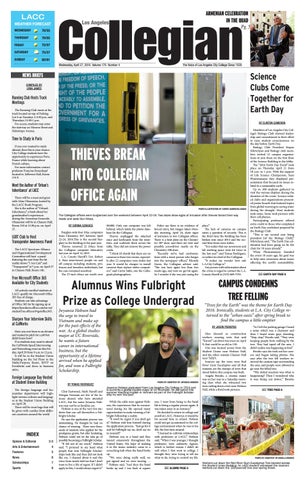
tHieVes Break into ColleGian oFFiCe aGain photo illUStrAtion By CUrtiS SABir/CollegiAn
The Collegian offices were burglarized over the weekend between April 22-24. Two doors show signs of intrusion after thieves forced their way inside and stole four iMacs. By SorinA SzAKACS Burglars stole four iMac computers from Chemistry 207, between April 22-24, 2016.This is the second burglary in the building in the past year. Thieves removed 22 iMacs from the Collegian computer laboratory last year on April 14, 2015. L.A. County Sheriff ’s Det. Robert S. Ruiz interviewed people on and off campus including students, professors and homeless individuals, but the case remained unsolved. The 27-inch iMacs are worth over
$8,000. Only one computer was left behind, which holds the photo database for the Collegian. Thieves unplugged the attached mice and keyboards from the monitors, and scattered them across the table. They did not remove the power cords. “I think it’s dumb that there are no cameras in these two rooms, especially after 22 computers were stolen last year. It would be cheaper to install cameras than replace stolen computers,” said Curtis Sabir, one the Collegian’s photographers.
Police say there is no evidence of forced entry, but images taken Monday morning, April 24, show signs of intrusion in two Collegian offices. There is a bent plate on the Chemistry 207 door, and there are wire and possible screwdriver marks on the Chemistry 208 door. “Recently we’ve had confrontations with a street person who barges into the newspaper offices,” Rhonda Guess, the Collegian adviser said. “She was here again less than two weeks ago, and now we get hit again. So I wonder if she was just casing the
Alumnus Wins Fulbright Prize as College Undergrad Jwyanza Hobson had the urge to travel to Vietnam and make up for the past effects of the war. As a global studies major at UC Riverside, he wants a future career in international business, but the opportunity of a lifetime arrived when he applied for, and won a Fulbright Scholarship. By tomAS rodrigUez Clint Eastwood, Mark Hamill and Morgan Freeman are few of the famous alumni who have attended LACC, but the name Jwyanza Hobson may not be so familiar, yet. Hobson is one of the very few students that can call themselves a Fulbright Scholar. He says the application process was intimidating. He thought he had no chance of winning. There were thousands of students who applied for the prestigious grants, but after hesitating, Hobson could not let the idea go of possibly becoming a Fulbright Scholar. “It felt out of my reach,” Hobson said. “I pictured in my head what people that won Fulbright Scholarships look like and they did not look like me. I chanted about it and this voice from inside told me that I don’t want to live a life of regret. If I didn’t apply to this, I would always regret it.”
place.” The lack of cameras on campus raises a question of security. This is the third time the building has been broken into since 2014 and the second time items were stolen. “It is unfair that our newsroom and lab working space were hit twice in the last year” said Tomas Rodriguez, co-editor-in-chief of the Collegian. “It makes me wonder how safe L.A.City College is.” Any person with information about the crime is urged to contact the L.A. County Sheriff at (323) 669-7555.
Jwyanza Hobson graduated from Los Angeles City College in 2014 and is currently a global studies major at UC Riverside. He will spend this summer teaching English in Vietnam as part of the Fulbright Scholarship he won this year. While the odds were against Hobson, the experiences that he encountered during his life opened many opportunities to make winning a Fulbright Fellowship a reality. “It won’t be regret if you don’t get it,” Hobson told him himself during the application process. “Just go for it and let Fulbright say no, don’t say no to yourself.” Hobson was in a band and they toured extensively throughout the United States. His hope of making it in the music industry came to a screeching halt when the band broke up. “We were doing really well, we got signed and we were touring … ” Hobson said. “And then the band broke up and I was back at square
one. I went from being in the band life to being a regular person again. It was taken away in an instance.” He decided to return to college and enroll at LACC. However, it would be his second time in school. Hobson could not get accustomed to the college environment when he was in his 20s, the first time around. “I learned to cultivate relationships with professors at LACC,” Hobson said. “When I was younger, I thought professors were authority figures, which is further reason I didn’t do well when I first went to college. I thought they were trying to tell me what to do, trying to control my life. SEE AlumnI PAge 6
SEE eArTh DAy PAge 6
Campus Condemns tree FellinG
“Trees for the Earth” was the theme for Earth Day 2016. Ironically, students at L.A. City College returned to the “urban oasis” after spring break to find the campus a little emptier By JASon piSKopUS
photo By CoUrteSy oF JWyAnzA hoBSon
Members of Los Angeles City College’s Biology Club showed leadership and commitment in their effort to raise student consciousness on the day before Earth Day. Biology Club President Stepan Mkrtchyan and Biology club members invited 12 campus organizations to join them on the first floor of the Science Building in the lobby. The “2016 Earth Day Event” took place on Thursday April 21 from 10 a.m. to 1 p.m. With the support of Life Science Chairperson, Sean Phommasaysy they displayed presentations that focused on issues related to a sustainable earth. Up to 100 students gathered to visit the various displays during the duration of the event. Science-related clubs and organizations presented poster boards that featured topics from global warming to saving water during the drought. Most students took notes. Some took pictures with their cell phones. Participating professors offered extra credit to those who completed an Earth Day worksheet prepared by the Biology Club. “This is my second year being president [of the Biology Club],” Mkrtchyan said. “The Earth Day celebration had been going on by the chair for 10 years already.” When Phommasaysy founded the event 10 years ago, his goal was to help raise awareness about issues affecting the earth’s sustainability.
Men dressed as construction workers wearing vests that said “Kiewit” cut down two trees on April 9, that could be as old as 150. One was located across from the Student Union near Holmes Hall, and the other outside Clausen Hall near Tully’s. Sources say the trees were Red River Gum Eucalyptus and all that remains are the stumps of trees that stood before this campus was built. Angela Brooks, a cinema major was on her way to a Saturday morning class when she witnessed two men cutting down a tree near Holmes Hall, while a third took pictures.
“As I left the parking garage I heard a noise which was a chainsaw and then I heard some guys shouting, “Stop, stop,” Brooks said. “They were keeping people from walking by the tree. They had taped off the area. I didn’t realize was happening at first.” Brooks says she took out her camera and began taking photos. She says after the tree fell workers removed the caution tape surrounding the area, and people were allowed to go near the felled tree. “My initial reaction was what is happening? Then I wondered why it was being cut down,” Brooks SEE Tree PAge 6
photo By CoUrteSy oF AngelA BrooKS
Workers cut down the Red River Gum Eucalyptus Tree located across the Student Union Building. An LACC student witnessed the moment workers cut down the 100-year-old tree over spring break.
2
opiNioN & eDitorial
Los Angeles Collegian — Wednesday, April 27, 2016
Compiled By Ande richards photoS By Curtis Sabir and Ande richards
WHAT DO YOU THINK ABOUT GENDER INCLUSIVE BATHROOMS AT LACC?
lAVel Berry ASg Senator
ShAnnon godly photography major
gABriellA CAStro mathematics major
ChriStiAn lopez environmental Science major
I think gender-neutral bathrooms extend the underlying belief that equal opportunity and rights are afforded to those who by our forefathers promised them. So encompassing our multi-cultural campus we cannot exclude those of us who identify from whatever perspective they choose.
I don’t have an issue with gender-neutral bathrooms. Self-identification of gender should grant access to bathrooms first and foremost. If all bathrooms were open to any identification of gender, however, I may not view public bathrooms with the same level of privacy.
I believe it’s all about safety. That’s my main concern. Even here in restrooms people can get jumped. Including both genders, is it really safe? Not just guys, girls can be just as perverted. Guys and girls being in the same bathroom raises a concern for harassment whether verbal or physical.
I wouldn’t mind. It’s not something that would bother me, but I feel like it would cause problems in the bathrooms because guys being in an area where girls are doing their business… It could benefit both genders and people that don’t identify with either gender. It seems less discriminatory.
Native Americans Win the Battle of Lexi
editorial
By JAred BirdSong
illUStrAtion By lUiS FernAndez
let’s drink to earth day — With a glass By Ande riChArdS
C
alifornia’s coast was devastated in 1969. The Santa Barbara oil spill featured an oil slick 35 miles long in the Santa Barbara Channel. Caught up in the sludge and killed, was an estimated 3,500 seabirds, as well as dolphins, elephant seals and sea lions. That event, and the energy of anti-war protesters at the time, gave Senator Gaylord Nelson of Wisconsin an idea. He founded Earth Day, a national day to focus on the environment. Knowing students would be instrumental to this movement he selected the date April 22, which falls between spring break and final exams. Despite forty-seven years of environmental awareness we get a fail on this year’s Earth Day report card. The Great Pacific Garbage Patch is a spectacle that illustrates what relentless destruction and dumping of waste into the ocean can produce. According to The National Oceanic and Atmospheric Administration (NOAA) scientific research predicted that our ocean would become a landfill. Ten years later, it happened. We cannot continue on this path. We must do everything to reverse the damage we have created. Here’s what you need to know. According to several environmental
groups including National Geographic, the Great Pacific Garbage Patch is a collection of our discarded trash that ends up in the ocean. It is estimated to be twice the size of Texas. Picture large masses of trash stuck in a holding pattern in the five major gyres found in oceans around the world. When ocean waterways, or gyres, link together in convergence zones they act like a highway that moves debris into a natural, floating landfill. The circular motion of the gyre draws debris into this stable center, where it becomes trapped. Forever. Every piece of plastic ever created still exists today. Most debris comes from plastic bags, bottle caps, plastic water bottles, and Styrofoam cups. Much of the accumulated waste in the ocean is plastic, and is there because it is not biodegradable - it never fully breaks down. Plastics only break down into tiny pieces, so to the naked eye the water just seems cloudy. North America and Asia account for 80 percent of the debris in the Great Pacific Garbage Patch according to NOAA. Most of this debris is from land-based activities. Greenpeace conducted studies that assert trash in the ocean harms a variety of marine life. There is a trail from the marine life that leads directly back to our food chain. A bottle of water and a tuna sandwich may seem like the per-
in CAse you misseD it SCAN THE CODE
fect low-calorie, nutritional meal. However, there are two things we need to consider. One is that plastic bottle of water, and the other is the toxicity of the tuna. As plastics degrade in water, they leach colorants and chemicals. Furthermore, as tiny pieces of plastic and other trash collect on, or near the surface of the ocean, they block sunlight from reaching plankton and algae below. Algae and plankton are the most common producers in the marine food web. If algae and plankton communities are threatened, animals that feed on algae and plankton such as fish and turtles will have less food. If these populations decrease, there will be less food for their predators, such as tuna, sharks and whales. Eventually, seafood will be toxic, less available and more expensive for people. Issues concerning the environment can be overwhelming. However, we cannot afford to throw our collective hands up in the air and accept what we perceive to be the inevitable. Earth Day was activated with the help of students, and we can be at the forefront of change now. We can change our attitude, we can change our ways, and we can improve our health and sustain our planet. There is an immediate, singular thing that each of us can do to reduce pollution in our oceans: reduce our consumption of plastic.
TO VISIT OUR MULTIMEDIA BLOG FEATURING COVERAGE OF OUR COMMUNITY AND BEYOND or visit collegianwired.tumblr.com
Twenty years ago, I met my friend Corey in high school. We had a U.S. government class together. While working together, I learned that Corey’s mother is American Indian from the Siksika tribe (Blackfoot) and that his father is Caucasian, and a former Mormon missionary. Meeting Corey when I did was especially cool because the previous summer I attended a family reunion where I learned that my greatgreat grandmother, Fannie Birdsong, was a member of the Choctaw tribe. Passed in 1978, the Indian Child Welfare Act (ICWA) was a response to the systematic degradation of the American Indian family. Since the first settlers laid down roots in the Americas, the American Indian family has fought a wave of disease, warfare, enslavement, indoctrination, relocation and forced miscegenation that has had a devastating and existential effect on indigenous populations. The recent case of Lexi, the 6-year-old at the center of a dispute between the Choctaw Nation and foster parents Rusty and Summer Page, has shown us even though laws have quietly sought to address the historical injustices heaped upon the American Indian population, very little has been done to educate society about the need for these laws. Before Lexi was removed from the custody of her foster parents and sent to Utah to live with her paternal grandparents, Lexi’s biological family on her father’s side filed a petition in 2012 with the Department of Children and Family Services (DCFS) under the Indian Child Welfare Act (ICWA). Lexi’s biological father is a member of the Choctaw tribe. It was through the ICWA petition that
DCFS workers were sent to the Pages’ home to retrieve Lexi. The U.S. government failed to protect indigenous children. In the 1950s, the Child Welfare League of America had a plan to remove Indian children from their homes and place those children in non-Indian homes without the possibility of reunification. Before ICWA was passed, state courts removed up to 25 to 35 percent of American Indian children from their homes and placed them in non-Indian homes, welfare agencies, and private adoption agencies. Most judges were unable to appreciate traditional Indian child-rearing practices and perceived the day-to-day life in the children’s homes as contrary to their best interests. As stated in its charter, the purpose of the first boarding school on the Navajo reservation was “to remove the Navajo child from the influence of his savage parents.” This policy was continued for over a hundred years. In addition to overt and malicious attacks on American Indian society, intermarriage between American Indians and people of other groups led to a steep decline in the number of people who self-identify as American Indian. Indeed, a progressive and tolerant society wishes for its citizens to marry and procreate as they would like, but that does not mean that they should turn a blind eye to the cultural and racial attrition that has hammered this community for centuries. That brings us back to Lexi. No doubt, the tearful images of Lexi and her foster family are heart wrenching. At one-sixty fourths Choctaw, Lexi’s connection to her tribal ancestry pushes the limit of legitimacy for many. But, her father and grandparents are actual members of the tribe, and one-sixty fourths of any tribe fits within the legal guidelines for tribal ancestry. The Page family represents the best image of what the foster care system can hope for. They took in Lexi and offered her love and care. A sentiment that in many ways goes beyond race and ethnicity.
Because the American Indian population has largely been relegated to reservations with very little political power, some Americans are content to believe laws like ICWA are obsolete. Statistical and anecdotal studies have shown that American Indian children who grow up outside of their tribe become spiritual and cultural orphans. Many of these children find it hard to fit into the culture in which they are raised and later in life, they long to learn about tribal culture. They may also experience identity problems, drug addiction, alcoholism, incarceration and suicide. If used well, laws like ICWA are a safeguard against those issues and can help to thwart a legacy that continues to have adverse effects on American Indian youth today. Ultimately, the question should be: Is the law working? Is it moving the U.S. in a direction where situations like Lexi’s and the Page’s will no longer split communities and hurt families? If anything, ICWA has brought attention to the unique needs of Indian children and provides a cross-cultural tool to educators, state agencies and judges. Although the removal of American Indian children from their biological families and their foster families still frequently occurs, the ICWA mandates a process that may eventually ensure the survival of Indian tribes and their cultures well into the future. At one-thirty second Choctaw, very little of the DNA made it to me, but the name passed on. Though I grew up in the racially diverse county of Los Angeles, I had not made any friends that identified their family heritage as American Indian. I was excited to have Corey in my life, someone that was as interested in the history and heritage of American Indians as myself. Not that all tribes are interchangeable, but even as a teenager, Corey always planned to marry someone of American Indian Ancestry. For Corey’s purposes, whomever it was that agreed to marry him, would not have to be from the same tribe, just from the same race. I didn’t understand it then, but I do now.
April Fools’ Joke Creates Havoc For Google Users By mArio rAmoS In an attempt to celebrate April Fools’ Day, Google missed the mark. Google added an April Fools’ gif of an angry minion dropping a microphone to illustrate effectively shut-
ting down a conversation. This resulted in loss of jobs and had other severe repercussions for many who use Gmail’s services. I believe Google was wrong and should never have pranked its users through the email services. Millions of students, educators, business owners, and people in the medical profession to name a few depend on the email service to successfully execute their daily obligations. In tampering with their email service, Google put people’s jobs, grades, money and peace of mind in jeopardy. Google received great amounts of
backlash and a substantial number of complaints on their forums. Google’s excuse for this disaster was the prank button had a bug that caused it to malfunction, but while this may be the case it does not make up for the many headaches it created. Google should make an effort to reach out to negatively affected users and see how they can be compensated for their troubles. The technology company will have time to make folks forget about their mistakes and will hopefully get its users laughing again this time around next April.
opiNioN & eDitorial
Los Angeles Collegian — Wednesday, April 27, 2016
Trump Makes America Hate Again
Drop Stitch
By yoSelin FloreS
illUStrAtion By Jimmy mArtinez Nine states have implemented reactionary legislation in opposition to gender-neutral bathrooms. Acknowledgement and acceptance of all people continues to challenge society. The illustration above is based on Keith Haring’s Ignorance = Fear. His art helped spread awareness and education during the AIDS epidemic in the ‘80s and early ‘90s.
Ignorance Equals Fear in Illinois, Kansas, Kentucky, Minnesota, Missouri, Mississippi, Oklahoma, North Carolina, South Carolina, Tennessee By Ande riChArdS
i
n the corner of the bathroom stood my friend’s husband Stéphane, whose naked body was being used as a canvas by the late Contemporary Pop Artist, Keith Haring. That scene was the norm back in the ‘80s when I went to clubs. I was underage, hanging out with artists, entertainers, Wall Street brokers, other club kids, and “pharmaceutical entrepreneurs” - every type of character you can imagine. Bathroom doors at clubs had proper designations: they were labeled male and female, with corresponding figures – woman in dress, man in pants, but they were a mere suggestion. No one followed these rules. So what were we all doing in the bathroom? Everything. With all the activity that went on no one complained, no one was put in harm’s way. In our downtown N.Y.C. club universe we were happy. We could escape into art, find comfort with each other, and self-identification was encouraged and praised. Outside the clubs the social order was beginning to change. Reality was harsh in New York. Our lives punctuated by Ronald Reagan’s inhumane policies such as cutting funding for the mentally disabled. He also refused to take charge of the AIDS crisis. These are just two of the Reagan era repercussions I experienced. I was living in a progressive utopia at night, and a conservative nightmare by day. Now, many years later, the discussion of gender-neutral bathrooms is a hot topic, coping with issues that relate to people who identify as transgender, and the subsequent backlash against their quest for equality. Several states have enacted laws, or have Bills pending that speak to the topic of gender-neutral bathrooms. To date, nine states have active bills that relate to anti gender-neutral facilities. The states and their corresponding bills are: Illinois (HB 4474), Kansas (SB 513, HB 2737),
Kentucky (HB 364), Minnesota (HF 3395, HF 3396, SF 3002), Missouri (HB 1624, SB 720), Mississippi (HB 1258), Oklahoma (HB 2215, HB 3049, SB 1014), South Carolina (SC 1203) and Tennessee (HB 2414, SB 2387, HB 2600, SB 2275). This legislation seeks to ban transgender people from using public bathrooms that match their gender identity, and even criminalizes it. In North Carolina, Gov. Pat McCrory signed House Bill 2, which specifically addresses who can use public bathrooms. In summary, the bill outlines that bathrooms must be for single-sex usage. People using the male or female bathrooms must use the bathroom of the gender they had at birth - as stated on their birth certificate. This rule also extends to showers, locker rooms and changing rooms in schools. House Bill 2 is a response to a February ordinance passed in Charlotte that created anti-discrimination provisions for LGBTQ customers at private businesses. It allowed transgender people to use the bathroom of the gender they identify with. House Bill 2 revoked that ordinance and banned local governments from drafting their own anti-discrimination policies. There has been backlash to House Bill 2 by the citizens of North Carolina, by entertainers who planned tours in their cities and by corporate America. According to The Duke Chronicle, several local businesses in Durham chose to display anti-HB-2 signs in their shops. Bruce Springsteen cancelled his April 10 concert in Greensboro in response to the bill and corporate giant PayPal announced that it would no longer be moving its global operations center to Charlotte. Discrimination seems to be bad for business. I watch a PBS show “Borgen” (Borgen is the Danish word for government). In this drama the protagonist, Brigitte Nyborg is elected the first female prime minister of her country. The drama draws you into the political underpinnings of their government, and it also gives you the opportunity to look at Danish culture. Interestingly, in scenes where characters are in the bathroom you see both genders, in the same room. Apparently men and women, however they are packaged and present themselves, can co-exist, in politics and in the bathroom.
Drop stitch is a knitting term. It happens when a stitch falls from the needle and creates a run in the fabric – it’s a mistake. However, sometimes stitches are dropped on purpose to create a new design. Ande Richards is an L.A.-based artist who does not know how to knit, but knows a lot about mistakes and reinvention.
Perfect Image Gets a New Look By BrendA romero Growing up as a teen, I felt I was different from some of the girls I would see on magazines, commercials and TV shows. I knew my image was the opposite of many girls my age, but I was ignorant to what society portrayed as the perfect image. It wasn’t until I got older I realized I didn’t fit the measurements of beauty in the eyes of society. I saw models like Adriana Lima grace the runways of Victoria’s Secret and cover
of Vogue magazine. Women like her were the epitome and every girl strived to be like them. So it’s no surprise that I began to grow up feeling very insecure and less than everyone else. There were no women of a bigger figure being celebrated on the cover of Vogue or Elle magazine. For the past 52 years Sports Illustrated has photographed countless beautiful and thin women. That all changed when for the first when Ashley Graham, a plus size model graced the cover of the Sports Illustrated Swimsuit 2016 issue. She has stretch marks, wide hips, and no thigh gap, but she is beautiful. This is a step in the right direction, toward the acceptance of women of all shapes and sizes. People have argued that Graham’s cover photo promotes an
unhealthy lifestyle. I don’t see it any worse than promoting girls with a body type that most people will never achieve. The truth is most women are bigger than a size 8 and there is nothing wrong with that. It is time to set realistic standards and accept ourselves as we are. As a plus size woman I still love to watch models like Kendall Jenner and Cara Delevingne stunningly strut the runways, but I also love to see someone I can relate to. I hope to see other magazines take the initiative of body acceptance and feature models like Ashley Graham. It was hard for me when I was in high school seeing only small women in the limelight. I am glad that girls today have more realistic options in body types to look up to.
To think Donald Trump can become the next president of the U.S. truly terrifies me. Over the past few months Trump has been a focal point of discussion in the news. He has won 15 states and is a dominant force in the Republican primaries. At the start of his campaign I thought he was too outrageous and would not be taken seriously as a candidate. I never believed he could cultivate such a large following or that he could win this many Republican primaries. One of the main reasons the public supports Trump is because he is a self-proclaimed “great businessman” who will make America thrive. I do not believe this. Trump did not start from the bottom. He had economic security. His wealth was inherited from his father, Fred Trump, who was a real estate tycoon. This inheritance gave Trump the ability to venture into, and fail at, several enterprises including Trump University, Trump Airlines, Trump Magazine, Trump Mortgage, Trump Vodka and Trump Steaks to name a few. It comes as no surprise that Trump has filed for bankruptcy numerous times. The failure of Trump University points out that he is a lying con man. Launched in 2005, Trump University offered courses in real estate and entrepreneurship strategies. Fees ranged from $1,500 to $35,000. The University was never accredited and resulted in the loss of thousands of dollars for several hundred students. During his campaign, Trump offended everyone who does not fit his ideal of “American.” He offended the disabled, reporters, Mexicans, Hispanics, Muslims, African-Americans, Asians, women, prisoners of war, and his own Republican competitors. Trump energizes his supporters with hateful speech. He brings out the worst in people and this has resulted in hate crimes
against minorities at his rallies. His tactless comments also raise questions about his temperament. We cannot employ someone with that kind of character and careless use of language to negotiate with foreign countries. Trump’s brash character is revealed in his ideology. Trump said he would “open up” libel laws, making it easier to sue news organizations. As a student who aspires to be a journalist this disturbs me. What kind of career will I have if I have to censor everything I write? He also said that he would eradicate birthright citizenship to “anchor babies.” I am a child of immigrant parents and was born well after my parents established themselves here. To hear someone threaten my citizenship, and say that they will fight to take away my rights, and deport my parents sickens me. When Trump talks about deporting immigrants he is talking about separating families and leaving children without parents. This is devoid of morality. My mother and father have worked hard all of their lives to give my brother and I a better future. I am proud of my Mexican parents, and I know that they have as much right as I do to be an American citizen. This nation was built on immigrants, and it would not be what it is today if colonists had not migrated to the Americas. Trump also wants to re-establish torture, but this goes against the Constitution. Most of his ideology goes against the Constitution. Removing libel laws goes against the First Amendment. Removing birthright citizenship goes against the Fourteenth Amendment. Reinstating torture goes against the Eighth Amendment. How can we have a president who does not respect the foundation of the nation he seeks to represent? Trump has been a businessman for a long time, but his career in politics has been short lived. Our country is not a business. It is a country filled with people who strive for better futures. These are people who come here in search of the American dream. I cannot see Trump leading this country. Trump may be a businessman, but he is not a man of the people.
City needs Better Food CHoiCes By JASon piSKopUS City needs diverse food options. H a r r y ’s food truck that sits just outside of the Quad is not bad. The food is decent, though it can be a bit pricey for some. We need more choices for students who are on special diets, such as vegetarian or vegan, or simply just watching their weight. The vending machines on campus leave a lot to be desired, especially when it comes to variety and price. Many students don’t like the idea of eating pre-packaged food out of a vending machine, in fact some are just plain disgusted by it. The campus’ Cub Store is also limited in options. There are both healthy and junk foods offered, as well as a variety of drinks, but students seeking something more than Clif Bars or a Snickers bar will not find it there. A solution to this problem can be summed up in one word: cafeteria. A campus cafeteria would benefit LACC on multiple levels. First: the school would make money. Classes at City College start as early as 7:25 a.m. and end
typically as late as 10 p.m., so offering breakfast, lunch and dinner would satisfy demand. Second: cereal, fruits and select hot food items could be served buffet style for all three meals throughout the day. Options could be relatively simple and easy, steamed vegetables, fresh fruit and a different main course each day would satisfy many. A self-service cafeteria would be cost effective. There would be no need for servers, reducing the cost and need for staff. This in turn could reduce the cost of the food offered. The cafeteria would include a salad bar with fresh, raw vegetables for the vegetarians and vegans. Students would have control over the cost of their salad if it were weighed and paid for by the ounce. A variety of dressings would give students even more options. L.A. Trade Tech, one of LACC’s sister colleges, offers AA’s in both culinary arts and baking. LACC could set up an internship program. Trade Tech students could work in City’s cafeteria, receive a paycheck to help support themselves and gain valuable experience that can help them get jobs after school. Los Angeles City College has the potential to become the pinnacle of a healthy campus. Better food options mean better nutrition. Better nutrition means healthier students and healthier students are better students.
HAVE AN OPINION? A STORY IDEA? WRITE A LETTER TO THE EDITOR
CONTACT: rmartinez.collegian@gmail.com 323.953.4000 ext. 2831 letters may be edited for brevity.
3
Collegian media Arts Department Chemistry 207 los Angeles City College 855 n. Vermont Ave. los Angeles, CA 90029
Editors-in-Chief Sorina Szakacs Tomas Rodriguez Opinion/Editorial Ande Richards Sports Hector Lopez Cheyenne Finch Layout Editor Richard Martinez Graphic Designers Jimmy Martinez Photographers Curtis Sabir Erika Almanza Reporters Jason Piskopus Clinton Cameron Beatrice Anoh Naomi L. Johnson Emmanuella Durogene Rebecca Klinesmith Multimedia Producers Dave Martin Frank Vidrio Advertising Staff Mike Frenes Adviser Rhonda Guess
deadline Schedule neXt iSSUe: may 11, 2016 editorial deadline: may 7, 2016 For all submissions including letters to the editor and publicity releases, send materials to Collegian offices located in Chemistry Building, room 207, or email: losangeles.collegian@ gmail.com. to advertise in the Collegian, direct all insertion orders and questions to: pr.collegian@gmail.com.
the college newspaper is published as a learning experience, offered under the college journalism instructional program. the editorial and advertising materials published herein, including any opinions expressed, are the responsibility of the student newspaper staff. Under appropriate state and federal court decisions, these materials are free from prior restraint by virtue of the First Amendment to the United States Constitution. Accordingly, materials published herein, including any opinions expressed, should not be interpreted as the position of the los Angeles Community College district, los Angeles City College, or any officer or employee thereof. Collegian ©2016. no material may be reprinted without the express written permission of the Collegian.
4
arts & eNtertaiNMeNt
Los Angeles Collegian — Wednesday, April 27, 2016
‘red VelVet’ premiered WitH a siXWeek run on tHe West Coast By SorinA SzAKACS
photo CoUrteSy oF AdriAn lArA
Costume design students produced the whimsical outfits worn by the ensemble featured in director Louie Piday’s updated “A Midsummer’s Night Dream.” Shakespeare’s classic was the first play the Theatre Academy produced back in 1966.
‘A Midsummer’s Night Dream’ Goes Disney
F
By lynn. A. JAmeS
ifty years ago, audience members flocked to the Camino Theatre for the opening performance of William Shakespeare’s “A Midsummer’s Night Dream.” Shakespeare’s classic was the first play the Theatre Academy produced back in 1966. In the current production, Director Louie Piday included a Disney twist. Each character plays two roles: the traditional Shakespearean role and a Disney counterpart. “That is pretty epic,” said fairy and “Tinkerbell” actress Drew Anderson. Successful actors like Mark Hamill received training at the Theatre Academy and performed at the Camino Theatre.
“
We are ConstruCting the Costumes From sCratCh, so that’s Why it has Been so Challenging. But We are getting it doWn.”
photo CoUrteSy oF AdriAn lArA
Two Theatre Academy students dressed as “Peter Pan” and the “The Beast” rehearse their lines for “A Midsummer’s Night Dream.” The director Louie Piday inserted a Disney twist into Shakespeare’s classic.
-Chloe ginsBurg Comstume design Costume design majors work to produce whimsical outfits painted in bright green and blues,under the direction of Armand Flores. Their job is to assemble the costumes and ensure the actors have easy, quick changes. They bring Flores’ vision to life through the costumes. “It’s a Disney theme and we are constructing the costumes from scratch, so that’s why it has been challenging … since there are so few [costume designers] and so many [actors] but we are getting it down,” said costume design student Chloe Ginsburg. Usually, plays are performed on a proscenium stage. Proscenium stages have a wall that separates the stage from the auditorium and provides an arch that frames it. However, this production was performed on a thrust stage, which extends into the audience on three sides and is connected to the backstage area by its upstage end. This change has been a bit of a challenge when it comes to production, according to soundboard operator Valentina Tonini. “I’m excited to use Disney sounds, I love Disney and I get to
photo CoUrteSy oF AdriAn lArA
Theatre Academy students dressed as the “Seven Dwarves” as part of the play’s theme to incorporate famous Disney characters. Some of Disney’s most recognizable characters like “Cinderella,” “Tinker Bell” and “Peter Pan” make appearances throughout the play. use all of the sounds from them,” Tonini said. Cast members are excited to revisit the premier performance from 1966. It was the opening show for the first production of the Theatre Academy. “Shakespeare is always amazing,” said ‘‘A Midsummer’s Night Dream’’ actress Mariana Rogen. “I love Shakespeare and after the stage was
set up, it was much easier to get into character and find the sweet spots between the Disney character and the Shakespearean one.” ‘A Midsummer’s Night Dream’ runs through April 30. Showtimes are available through the Theatre Academy website, http://lacitycollege.edu/academic/ departments/theatreacademy.
Audiences at the Junction Theatre in Atwaters Village are turning out to see “Red Velvet,” the story of an African-American actor who took London by storm in 1833. “Red Velvet” is a riveting story of a young African American man who played the lead in Shakespeare’s “Othello.” His name was Ira Aldridge. He was born to a African-American couple in Manhattan, New York. He attended African Free School. His love of the stage began at Mr. Brown’s African Grove Theater in New York, one of the first Black theater companies. The theater was threatened and challenged until whites eventually burned it to the ground.
Aldridge made the decision to go to Liverpool, England in 1824. He made his acting debut at London’s Royal Coburg Theatre in 1825. He was the first African American actor to perform in a foreign country. At the time he had taken the London stage to play “Othello,” he was replacing Edmund Kean, who was considered the greatest actor of his time and white. The audiences liked his performance, but the press wrote scathing reviews. Red Velvet opened to West Coast Public on March 26 with a six-week run, until April 30 at the Junction Theatre in Los Angeles, on Fri. and Sat. from 8 p.m. and Sun. from 5 p.m. Darcell Hoover contributed to this story.
For more on tHe red VelVet story, use tHe qr Code BeloW.
or visit YouTube.com/CollegianWired
Author Captures Spirit of Neighborhood By Clinton CAmeron There once was a neighborhood on the southeast side of downtown Los Angeles where the Staple Center now stands. Men and women roamed the streets 30 years before Kobe Bryant made his last shot. Author P.Y. Wilkes spent his early adulthood in this downtown neighborhood full of slumlord-owned apartment building, trash filled alleyways and rundown liquor stores. Once the Staples Center moved in, it symbolized a property takeover akin to Chavez Ravine. Pimps, drug dealers, blue-collar workers and their families were forced to move out to make room for the Lakers, L.A. Live and other “shoppertainment” commercial
buildings. Wilkes brought to life the struggles these displace people in his short novel, “The Sun Porch Gallery.” In 107 pages, Wilkes takes the reader through the landmarks of this Los Angeles neighborhood before it people were uprooted. Character by character, each story captured a moment in time where of the conflict people faced in these street. Cast of character include: “Clayton” was at the center of the story. He called himself an artist but in reality he hustled daily to make ends meet. “Peaches” who falls in love with him – a man she barely knew. “Moonchild” a alcoholic shoplifting heroin-addict. “Jean” and her husband Bar owned the
raggedy hotel where many of the characters lived. The story asked the question “How can a hustler, a love-struck girl, a couple of slumlords and a schizophrenic shoplifter save their neighborhood?” Readers find the answers in the journey that took these characters from a rent party to an independent art gallery. On path to the gallery’s opening night the Wilkes characters faced betrayal, drug use and violence, but also found love, commitment and community spirit. Wilkes accomplished something few writers could. He wrote about an area displaced by the progress of development and manage to give a voice to those often times silenced by the trajectory of progress.
FeatUres Campus Rallies for Armenian Culture Day
Los Angeles Collegian — Wednesday, April 27, 2016
F
By tomAS rodrigUez or the first time in LACC history, students and staff celebrated the Armenian culture in the quad with art, food and guest speakers
on April 21, 2016. There were poem recitals, dances and songs illustrating the passion and culture of the Armenian community. The event was presented by the Armenian Student Association (ASA) and their theme for the day revolved around the past, present and future of the Armenian culture. “I think sometimes when we think about the Armenian culture, all the tragedies can be easy to get weighed down with,” said Henry Williams, ASA Vice President. “We tend to think about the past and not look toward to how it makes us stronger and move towards the future.” Speakers were invited to speak on Armenia’s past, present and future. Professor S. Peter Cowe from UCLA spoke to the audience about Armenia’s history. He is currently the Narekatsi Chair of Armenian Studies with a PhD from the University of Jerusalem. “Armenia is a relativity small country on the world map,” Cowe said. “But one thing that continues to amaze us is that [Armenia] punches so much above its weight, making an impact on global culture beyond its demographics. More Armenians live outside the country than within its borders. Los Angeles is home to at least half a million Armenians.” Although it was three days before the 101st commemoration of the Armenian Genocide, this event was not to protest or argue for recognition of the genocide, but to look forward to the future as one whole. “The month in April commemorates the death of one and a half million of its inhabitants and the displacement of most of its population to the Middle East, Europe and the Americas,” Cowe said. “It occurred during the years 1915 to 1922 in what is come to be known as the first genocide of the 20th century. However, far from annihilating the people, these events have presented an opportunity to regroup and draw on their powers of reliance and endurance to emerge from this process with renewed vigor and resolve. Advancing into the future with a stronger sense of purpose and a will not only to survive but to thrive and succeed.” However, the ASA are not the only people with an Armenian ethnic background at LACC. Besides there being many Armenian students in campus, there are also many faculty members with an Armenian background. Alen Andriassian, dean of student life at LACC, is all too familiar with the effects of the Armenian Genocide. Although he was born in Glendale, he had family who was personally affected in the genocide. “Imagine,” Andriassian said. “Genocide. Killings in every direction in every city around you. You go one way and you stop at a stream at one point and somehow you find your mother.” His grandparents escaped from being killed, but his grandfather
5
first hand saw the reality of the massacre. As Andriassian’s grandfather escaped with his wife, he had one last look at his mother. She was just one of the millions of Armenians who were victims of the genocide. “I try to tell the youth, what is important to me as an Armenian today is, don’t let that sacrifice be in vain,” Andriassian said. “People have sacrificed for me. It is my duty to do better for than they did and it is my duty to sacrifice for the next generation which are my children and the students I work with on a daily basis.” Andriassian says that he will never forget the impact that their grandparents made to escape the genocide. It is a reminder to him to be a role model and influence many students he encounters on a daily basis, whether they are Armenian or not.
“
my goal today Was to eduCate people oF the armenian Culture With musiC, danCe, poetry and Food.” -meri ghaZaryan, asa president
In between the speakers, there were performers who sang, recited poetry, danced or played musical instruments to the tune of Armenian music. Hasmik Torosyan recited two poems. “It’s about the Armenian Genocide,” Torosyan said. “The injustices we faced.” While the genocide was a topic for the poem, there was a dancer who brought the audience to their feet. When the event ended, she got up and began to get the students to dance around the tents. The idea for this event was not just abrupt, it was part of the ASA president’s plan when she first came to LACC. “When I first started as student here two years ago, I wanted to unite students together and educate people about the Armenian culture,” Meri Ghazaryan said. “My goal today was to educate people of the Armenian culture with music, dance, poetry and food.” She wants to make this event an annual thing. She says she is proud to be Armenian and wants to make her culture proud as she holds the key to the future. Jonathon Elias, Chair of the Programming Board at ASG, was one of the many volunteers who helped put the event together. “This is a really beautiful event it is amazing. I think its great to have appreciation of one’s culture but even more beautiful when you understand someone else’s culture. As for me I have a deep appreciation for the Armenian culture, I have been touched by many people in so many ways.
photo CoUrteSy oF SteVe ChAVArriA
69 year old Ruban Hovhanissyan has played the accordian for the past twenty years with Duduk player Megerdiich Malkhasian. This duo performed at Los Angeles City College at the Armeninan culture day festival, April 21, 2016.
photo By eriKA AlmAnzA/CollegiAn
Luiza Khachatry engaged the crowd and performed a variety of Armenian cultural dances. At the end of the event, she gathered students and staff and danced around the tents while holding hands.
photo By eriKA AlmAnzA/CollegiAn
Manik Manukian was one of the performers present at the Armenian Cultural Day on April 21. The LACC alumni sang in her native tongue in front of the Camino Theatre.
Would you like to advertise With the Collegian? Call (626) 734- 9547, or email, mFrenes. Collegian@gmail.Com photo CoUrteSy oF AdriAn lArA
BMX hobbyist Anton Refsteck (left) sports his ride in front of The Block, a hang out-spot for bike enthusiasts who want the latest updates on biking events.
6
News
Los Angeles Collegian — Wednesday, April 27, 2016
Book Club Hosts Talk on Future of LGBT Community By Byron Umana Bermudez Students and Faculty crowded Clausen Recital Hall to hear firsthand from Brad Sears, executive director at the Williams Institute on Wednesday March 20. The Williams institute is an organization whose sole mission is to conduct rigorous, independent research on sexual orientation and gender identity. Hosted by the Los Angeles Community College Book Program, Sears was invited to discuss “The Future of [Lesbian Gay Bi Transgender] Equality in the United States.” The LACC Book program come together twice a month to discuss upcoming events. Their events revolve around a centered theme. This year’s theme is: “How We Came Here: Histories and Stories of Diversity.” “We decided to include the LGBT community as one of the many aspects of diversity represented on this campus,” said Alexandra Maeck, chair of the LACC Book Program. “Advocates of social justice are the often highly articulate and informed legal experts who can bring their expertise to our students.” The committee invited Sears to bring his knowledge with law policy and its effects of the LGBT community. Sears helped with the creation and development of the institute’s core programs and strategies. Sears began his discussion with a famous poem by Langston Hughes called “Dream Deferred.” He mentioned that the LGBT have had great achievements in their fight to gain
equality. However, the journey has not ended. “There is a lot of work that has to be done,” Sears said. “The moment a dream is fulfilled does not mean the work is over … the other way for social movements to react to something like marriage equality is to explode, explode in the sense [to be] energized.” Sears went on to talk about strategies that have been used In opposition to the equality rights movement. One specific strategic plan reflected the laws passed after “Roe vs. Wade.” These law were used to target institutions that provide reproductive healthcare. Studies by Sears and the William Institute help counteract these strategical laws. “The Williams Institute plays an important role in changing perceptions by getting this information to the public.,” Maeck said. “As Sears himself noted, just showing up at meetings, demonstrations, is courageous. Much of the discussion focused on data collected by the Williams Institute. Sears began to look at the nation as a whole. One charted showed a percentage of laws that benefited the LGBT community. Midwest and Southern states scored a low percentage while costly states like California and New York have a higher percentage. Other charts reflected the same generic outcome, members of the LGBT community tend to struggle economically, socially and intellectually in Midwest/ Southern states than Coastal regions. Sears took a closer look at California. Although, California is consider
a LGBT friendly state when broken down by region the states mirrors a similar constant statistics. A lack of support coming from areas where the social climate is worse. After looking at the breakdown of geography, he looked at the subgroups in the LGBT community. Surprisingly the highest rates of poverty come from the LGBT community. Most people tend to think of a “white middle class white gay couple” when thinking about the LGBT community. Sears made it a point to distinguish the reality that many LGBT members face compare to what is portrayed on mainstream media. After a quick Q and A, Sears emphasized the power that this data has in regards to change. “When we do that and the paper [prints] an article with the data,” Sears said. “Then you have a whole story about a community. Here’s this data and we now know a whole community exist.” The discussion to invite Brad Sears was a success for the Book Club Program. “After hearing him today, I think his research is crucial,” Maeck said. “As he noted, their data has been cited in various court decisions. Data, not assumptions and bias, matter in shaping attitudes and policies.” For more information on the Williams Institute visit their website at http://www.willaiminstitute.law.ucla. edu, or follow them on Facebook at http://www.facebook.com/williamsinstitute.
Earth Day From Page 1
Biology Club Celebrates Earth Day Science and science-related clubs and organizations were asked to help. He thought that by using their disciplined areas of study to relate to students, they could make a difference with the information they received. A lesson on sustainability began before receiving the worksheet as Phommasaysy gave students a water taste test at the Biology Club booth. “Before I give you the worksheet, I need to prove something to you because I see you have bottled water,” said Phommasaysy to undeclared major Oliver Prudhomme. “I can prove that you can’t tell the difference
between tap and bottled [water].” Prudhomme declared both samples tasted identical. Phommasaysy’s point was that both types of water were safe to drink. By drinking water from the tap, it helps the environment. Plastic bottles often end up in the ocean, pollute the water and harm or sometimes kill the animals they come in contact with. Pre-nurse student Janet Yu showed up to the event to receive the extra credit offered by her Physiology professor. It took her 40 minutes to complete the worksheet with an average of
3 questions per display. She answered her final question at one of the water topic presentations. “It’s really eye opening by there being so many different aspects of preserving the earth that I didn’t really know about,” Yu said. Other displays and activities included a drought tolerant succulent plant sale with plants from Phommasaysy’s personal garden and vegan dessert samples. Topics covered by the various displays included veganism, medicinal plants, green house gasses, GMOs and California’s drought.
Tree From Page 1
Tree Cut Down Over Spring Break said. “I didn’t feel like it was malicious or mean. I kind of figured with construction it was in the way or maybe it was diseased.” Students are forming their own opinions about the reasons behind the two trees coming down over spring break. Workers removed the trees on a Saturday, the first day that classes resumed following spring break. Most students were away from campus. “I am saddened they cut down the trees,” said Greg Bennett who is a psychology major. “I think it is a bad idea, unless they are rotten and going to fall on somebody or a building.” The Collegian has not been able
hqbrand.com
(213) 493-4805
to confirm whether or not the tree was diseased. LACC Director of Facilities Bob Garcia was not available for comment. The Collegian also attempted to speak to representatives of Harper Construction, the project manager in charge of campus construction, without success. Students are not the only ones confused about the trees. Some faculty and staff are also at a loss as to what happened to the two Red River Eucalyptus trees. Faculty Senate chair Dan Wanner is just one of many professors left to wonder. “I don’t have much information … the topic is on the agenda for
the next Academic Senate meeting,” Wanner said. “The project manager will be there to make a report and answer questions.” Academic Senate meets on Thursday, at 3:30 p.m. Wanner says there will be a question and answer session following Harper’s presentation. Many professors the Collegian contacted for comment were already aware the trees were cut down. “I have no idea what happened,” said Michael Farrell, the chair of chemistry and earth sciences. “It’s as much a mystery to me as it is to you. When you do find out, I’ll be looking for it in the paper.” Beatrice Anoh and Steve Chavarria contributed to this story.
Alumnus From Page 1
LACC alumni to travel to vietnam, teach english What changed now is that I realized that these professors are really just holding doors open of success.” Hobson also worked in the casino business industry for 10 years, but it was not until the fall of 2012, that Hobson became more involved in school. He ran for ASG president and was elected for a year, and he eventually transferred to UC Riverside in 2014. The “picture in his head” became a reality when Hobson won the grant for the Fulbright English Teaching Assistant Program. He will teach English this summer in Vietnam. “I went to Vietnam last summer, as part of a summer study abroad program studying history,” Hobson said. “I was working on a research project about Vietnamese artists and the way that they transform the memory of war. I really loved it.” Hobson does not know the exact city where he will be teaching, but it will be in rural Vietnam. He says he also wants to make a change in the way people there view Americans.
“My goal is to have an enriching experience engaging with people on the other side of the planet,” Hobson said. “There’s a deep family history. My dad was in Vietnam and I happened to know a lot about the Vietnam War and just what a grave mistake it was for the U.S. It was a war that was based on capitalism, economic colonialism, economic expansion and racism to a degree.” It’s possible that Hobson’s work will benefit more than just the locals. The war in Vietnam left an emotional scar on Hobson and he says it is a chance for him to heal. “It’s a way of me personally mending a wound that was created as a result of war,” Hobson said. “I want to be a diplomat and be able to show people there is a different idea of what an American is that other people may have otherwise. I will be going there to teach English and at the same time acting as an ambassador for culture.” Hobson says the idea of traveling to Vietnam to teach English is still not sinking in. He is in disbelief that he
actually won the grant. “I was riding my bike up to the library,” Hobson said, reflecting on the moment when he first heard he had won. “I got an email in my phone about winning the grant. But by this time I had gained a lot of confidence, I was starting to feel like I was going to get it. It still has not really hit me yet.” Hobson could have been a rock star. He could have even been a casino manager, but the decision to come to LACC helped him seize the opportunity of a lifetime. He has been a different person after giving college another chance. “I’m a different person as result of the time I spent at LACC ... Students really need to embrace that and know that time is so valuable,” Hobson said. “Time is going to be spent no matter what you do, but the time you spent obtaining an education is really giving you a foundation and that foundation can’t be taken away. Value the time and take it seriously and build those relationships with the professors and take every opportunity you can.”
scholarships Actuarial Diversity Scholarship Announcements Scholarship Compiled By Emmanuella Durogene
The Ella Fitzgerald Charitable Foundation Joins L.A. City College in Saluting “The First Lady of Song” on the 99th anniversary of her birthday. L.A. City College nursing students receive the support of the Ella Fitzgerald Charitable Foundation in the form of scholarships, an expression of the late jazz singer’s charitable legacy.
Los Angeles Collegian — Wednesday, April 27, 2016
Award: $4,000 Eligibility: You must be pursuing a career in the actuarial profession. Must have at least one birth parent who is a member of one of the following minority groups: Black/African American, Hispanic, Native North American, Pacific Islander. You should be a full-time undergraduate student at a U.S. accredited educational institution. A minimum GPA of 3.0(on a 4.0 scale), emphasis on math or actuarial courses. Entering college freshmen must have a minimum ACT math score of 28 or SAT math score of 600. Deadline: May 2, 2016 Visit: http://www.actuarialfoundation.org/programs/actuarial/act-diversity.shtml
#LiveLikeLyly Memorial Scholarship
Award: $1,000 Eligibility: Must be of Asian ethnicity and citizen. You should be enrolled in a high school or enrolled in college full time and must be a full time, degree-seeking student by the upcoming academic calendar year and pursuing a major in fashion or graphic design. A GPA of 3.0 or a 4.0 scale is required. Deadline: May 31, 2016 Visit: http://www.againstthegrainproductions.com/livelikelyly-memorial-scholarship/ Art by Katte Schindler
R&D Systems Scholarship in Science for Overseas Students in USA, 2016
Award: $1,500 Eligibility: Applicant must be proficient in English with a minimum TOEFL score of 78 iBT/547 PBT or an IELTS score of 6.5. Applicants must have a major declared in a science related field. You should be enrolled or accepted for enrollment (baccalaureate, graduate, associate degree, or diploma) with a declared major in a science related field. Deadline: July 8, 2016. Visit: http://scholarship-positions. com
Two Nineteen Scholarships
Award: $1,000-$5,000. Eligibility: Applicant must be an AB540 student attending a Community College in California; have financial need; have demonstrated a history of community involvement; possess a minimum 2.5 GPA; a graduating high school senior, undergraduate, graduate or professional student; reside and study in California; and pledge to help other students through mentoring, tutoring and other community service opportunities offered through SALEF. Deadline: April 30, 2016 Visit: http://careerinfonet.org/scholarshipsearch
Society of Women Engineers Scholarship Application System
Award: Total over $660,000 Eligibility: The SWE Scholarship Program provides financial assistance to women studying baccalaureate or graduate programs, in preparation for careers in engineering, engineering technology and computer science. In 2015, SWE awarded approximately 220 new and renewed scholarships valued at over $660,000. Deadline: April 30, 2016 Freshmen Application due March 1, 2016- May 16, 2016 Visit: http://societyofwomenengineers.swe.org/index.php
Against Grain Groundbreaker Leadership Scholarship
Award: $1,500 Eligibility: The Against The Grain Groundbreaker Leadership Scholarship provides financial assistance and promotion of Asian-American college seniors and graduate students who have exhibited exemplary leadership, vision, and passion that is blazing a trail for others to follow and changing lives in the Asian-American community. Scholarship winners will be invited
to attend our annual charity event, Fashion for a Passion, held in the fall in Dallas, Texas. Deadline: May 31, 2016 Visit: http://www.againstthegrainproductions.com/groundbreaker-leadership-scholarship/
AJLI Scholarship Program to Study in Israel
Award: Scholarship awards are applied toward one year’s tuition. Eligibility: The purpose of the program is to foster Jewish spiritual and cultural values through the experience of living and studying in Israel and, at the same time, strengthen the ties that bind Jews in the United States to Jews in Israel so that upon returning to the United States, scholarship winners will be better able to communicate those ties to American Jewry. Deadline: May 1, 2016 Visit:https://www.scholarships.com/ financial-aid/college-scholarships/ scholarships-by-type/religious-scholarships/jewish-scholarships/ajli-scholarship-program-to-study-in-israel/
Alpha Gamma Rho Excellence Scholarship
Award: $1,000 Eligibility: Alpha Gamma Rho urges excellence from undergraduate brothers and provides encouragement and recognition for intellectual attainment in addition to rewards given by the college. The fraternity considers good scholastic standing a key measure of its members’ success and sense of purpose in college. To that end, AGR is offering scholarships to the undergraduate Brothers of Alpha Gamma Rho. The criteria for eligibility for each scholarship differs, but is based on the individual’s pursuit of excellence in scholarship and leadership, and for his contributions to community and fraternity. Deadline: April 30, 2016 Visit: http://www.alphagammarho. org/national-scholarship
AAAE Scholarship Program
Award: $4,000 Eligibility: Awards ranging from $900 to $4,000 are offered to Accredited Airport Executives (A.A.E.s), their spouses, and their children. Scholarship recipients can be enrolled in any course of study, and all eligible applicants receive scholarships so long as funds are available. Accredited members are sent information on the program annually in early January and awards are made in July. In addition to the A.A.E. being an executive member at the national level, the A.A.E. also must be a member of his/her regional chapter Deadline: May 31, 2016
A&T PRINTING WEPRINTAT@GMAIL.COM
323-608-3364
-LOGO MUST BE 5in x 5in OR SMALLER -ANY COLOR SHORT SLEEVE T-SHIRT -1 COLOR PRINT ANY COLOR
YOUR LOGO
5X5 LOGO
25 SHIRTS
50 SHIRTS
$150
$250
YOU LOGO -LOGO MUST BE 11in x 5in OR SMALLER -ANY COLOR SHORT SLEEVE T-SHIRT -1 COLOR PRINT ANY COLOR
11x5 LOGO
25 SHIRTS
50 SHIRTS
$200
$300
7
Consignment | Buy | Sell | Trade 4605 Santa Monica Blvd. L.a. CA 90027 FOLLOW: @CLASSICERA_LA #CELA
8
Sports
Los Angeles Collegian — Wednesday, April 27, 2016
Disabled Students Enjoy Challenge in Judo By Mike Frenes
A
s a disciplined judoka, Rolland Romero heads to the HQ Gym in Downtown Los Angeles at least four times a week. He is a stocky 225-pound powerhouse. He sends his opponent flying over his shoulders with a shocking blow to the back. As their body crashes to the ground, Romero shouts Morote Seoi Nagi, meaning two-shoulder throw. It was six months after giving birth that Rosa Romero received the disheartening news from the doctor. Her newborn son had cancer in his eyes and would be blind for the rest of his life. At age 27, Romero has beat the odds at living a rich and profound life, despite being 90 percent visually impaired. Romero currently holds a brown-belt in Judo under the mentorship of the famous Sensei Nishioka at Los Angeles City College. “It makes me laugh when people talk loud to me too.” Romero said. “HELLO. I’m blind NOT deaf!” Romeo said jokingly. “I don’t think I feel any different than anyone else other than my disability. To overcome that, you have to always see yourself as an example for others. I’m not a victim or anyone to be afraid of either. I’m an example.” Romero’s drive and zeal for life is unstoppable and he makes no excuses for any setbacks and learning experiences, he says. With a smile he reflects back to his competitions at the tournament level. After only four matches, he is not shaken in the least about not getting in a win yet. “It’s frustrating sometimes,” Romero said. “But again, I don’t make excuses for anything. I just keep fighting and I’ll get my victo-
Photo courtesy of Adrian Lara
Two of Los Angeles City College’s judokas Rolland Romero (right) and Kelvin Hernandez (left) pose in their basic fighting stance after a grueling and strenuous judo session. Even though they have disabilities, they say they enjoy the challenge in judo. ry soon enough.” His long-term goal is to eventually compete in the Para-Olympics in Tokyo in either 2020 or 2024, which is for athletes with disabilities. It is his dream that he reflects on day and night and he will stop at
“
nothing to get there. LACC has many examples of students with various challenges that let nothing hold them back from building an extraordinary life. Kelvin Hernandez was born deaf. He is in the same Judo class.
i don’t think i feel any different than anyone else other than my disability. To overcome that, you have to always see yourself as an example for others -roland romero, lacc student
Although Hernandez and Romero have different disabilities, their bodies have adjusted to help them compete in vigorous sports like judo. Hernandez is an upbeat person between working at his job at the Farmers Market, road biking and volunteering for the Boys Scouts of America. He also competes in Judo tournaments with an impressive 12 wins and 4 losses. “I am happy,” Kelvin says, gestured in sign language to his interpreter. “If anything, my disability is a motivator in life.”