LACC WEATHER FORECAST WEDNESDAY
79/55
THURSDAY
85/57
FRIDAY
84/58
SATURDAY
79/56
SUNDAY
78/54
NEWS BRIEFS
Collegian Los Angeles
JOB CENTER OFFERS RESUME, JOB INTERVIEW WORKSHOPS Workshops in resume building and interview skills are available to students through the Career and Job Development Center. A full schedule is available on the college website. The next workshop is scheduled for Tuesday, Nov. 24 at 1 p.m. in Room 109G of the Administration Building.
MUSIC DEPARTMENT TO HOST WEEKLY CONCERTS
Wednesday, November 18, 2015 Volume 175 Number 5
Storm Clouds Gathering for El Niño
Actor Mark Hamill from the original three Star Wars films is set to appear for a Q&A session hosted by the LACC Foundation on Dec. 6 at 2 p.m. Tickets are on sale now. For more information, call the LACC Foundation at (323) 953-4011.
REGISTRATION OPEN FOR SPRING SEMESTER
CURTIS SABIR/COLLEGIAN
This pump located in the Chemistry Building's basement is one of the four pumps on the campus of L.A. City College tasked with pumping water in case of flooding. It is just a piece of the Bimini Creek puzzle - the water source that runs under the campus. See story on Page 4.
THEATRE ACADEMY DEBUTS “THE GLORY OF LIVING”
ENROLLMENT OPENS FOR CHILD DEVELOPMENT City’s Child Development Center is now accepting applications for winter and spring. Applications are available on the college website, under Child Development Center. For more information, call (323) 953-4000 ext. 2220.
FORENSICS SPEAKS UP College Forensic team members dominated in this year’s California State University Northridge Swing Tournament. City College students Wendy Siquenza and Eva Reyes advanced to the final round in their perspective categories. Conrad Korbal is the tournament champion in Impromptu Speaking. The team will compete next at the Pacific Southwestern Collegiate Association Fall Championship tournament at Mt. San Antonio College during the first week of December.
INDEX
Opinion Bimini imini Creek Veterans eterans A&E News Features Sports
2-3 4-5 6 7 8 9 10
ARMED FORCES PAGE 6
DARLING AVILA:
BELOVED JUST LIKE HER NAME BY TOMAS RODRIGUEZ Darling Avila never took life for granted, she was not a follower but a leader, according to her family. Avila, who transferred in to Los Angeles City College from Glendale College in 2013, died in a motor vehicle accident on Oct. 9. She came to the college in search of new outlooks and as a result, she had the opportunity to travel across the nation. Known as an entrepreneur by her family, Avila learned from her past jobs and organizations. She volunteered, which gave her the confidence and experience to set bigger goals in her life. Avila’s mother, Caroline, says her daughter wanted to open her own beauty salon with help from her mother. “She came up to me and asked if I wanted to be her business partner, to open her own spa,” Avila’s mother said. “She went to school to become an aesthetician. Unfortunately, her appointment to become certified by the state just came too late.” Her mother says that her daughter is an intelligent and charismatic businesswoman and that her attitude towards life was never bleak. Her free spirited attitude made her who she is.
LACC FOUNDATION HOSTS STAR WARS STAR MARK HAMILL FOR Q&A
Theatre Academy students will present Rebecca Gilman’s drama “The Glory of Living” at the El Camino Theatre from Dec. 2-5. For more information, visit lacitycollege.edu/academic/departments/theatreacademy.
THE
The Student Voice of Los Angeles City College Since 1929
Music department students and faculty will host weekly concerts free for current students. The full concert schedule is available on the LACC website. The next show is scheduled for Nov. 24 at 7 p.m. in the Clausen Recital Hall.
As the spring semester approaches, students can now search on the Student Information Services (SIS) for registration appointment times and dates. Class schedules are available now on the college website for both the winter and spring terms.
HONORING
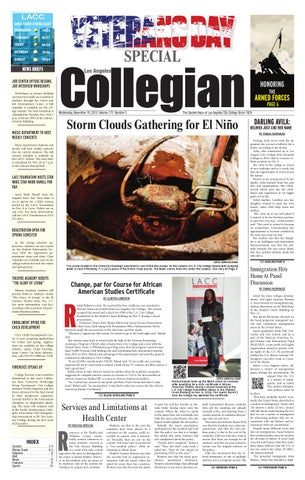
Change, par for Course for African American Studies Certificate
R
SEE BLACK SCHOLARS PAGE 8
Services and Limitations at Health Center BY MELISSA BRECCIA
R
esources at the Health and Wellness Center consistently remain unknown to many students. Located in the Life Science Building in a room with only a small sign above the door to distinguish it, the center is almost hidden. However, to the students who are aware of its existence, one of the reasons for visiting is to acquire free condoms.
Students say that in the past the condoms have been placed in a container on the counter, easily accessible to anyone who is interested. Presently, they are not on the counter and some have encountered a “two-condom policy” while attempting to obtain them. Student Victoria Boutros says that she recently had an unpleasant interaction with the center when she asked for more than two condoms. Boutros says that the man she spoke
Immigration Hits Home At Panel Discussion BY TOMAS RODRIGUEZ
ually transmitted diseases, students who ask for condoms are already sexually active, and denying them a certain amount of condoms discourages safe sex practices. The nurse practitioner, Karen Duh says that the incident was a miscommunication and that the two-condom policy is due to the cost of the condoms. Duh says that they want to ensure that there are enough for all students, and that the past administration was the original enforcer of the policy. Duh also mentioned that she offered abstinence as one of multiple options, not as a singular answer. She
Amid the latest refugee developments, civil rights attorney Thomas A. Saenz hosted an immigration legislation discussion on the third floor of the Student Union Building on Nov. 12. The panel discussion focused on the book program’s immigrant stories and continuous immigration issues in the United States. Saenz graduated from Yale University and Law School, and he is part of the Mexican American Legal Defense and Educational Fund (MALDEF), a non-profit civil rights organization aimed to protect Latino rights in the U.S. He previously worked for L.A. Mayor Antonio Villaraigosa’s executive team as Counsel to the Mayor. Saenz, a Los Angeles native, addressed a variety of immigration topics during the presentation. He argued that the U.S. is a nation of immigrants, and to justify this, proper immigration policies must be in place. “You have probably heard, accurately, the United States described as a nation of Immigrants,” Saenz said. “It’s almost a cliché. In fact, [many] will talk about undermining the fact that we are a nation of immigrants by advocating policies that are inconsistent with our history and inconsistent with our constitution.” Despite many different views and laws on immigration, Saenz believes that a federal policy must be in place for all states to follow. If every state can pick and choose what they want, then Saenz believes that the U.S. is not one nation but rather 50 different nations instead. “For potential immigrants from Mexico, where the demand is high-
SEE SERVICES PAGE 8
SEE PROFESSOR PAGE 8
BY CLINTON CAMERON
ashid Bahati is a first. He received the first certificate ever awarded in African American Studies from Los Angeles City College. The veteran accepted the award and a check for $500 at the L.A. City College Foundation in the Student Union Building on Nov. 9, during a closed presentation. Professors Henry Ealy, Mattie Moon and Social Science Department Chair Tony Clark along with Foundation Office Administrator Sylvia Martinez made the presentation to the television and film major. “[Because] I appreciate this money, I’m about to go to the bank right now,” Bahati said. The veteran came back to school with the help of the Veterans Retraining Assistance Program (VRAP) after a hiatus from City College and a tour with the United States Army. A Whitehouse.gov blog states that the program assisted more than 76,000 Veterans with finding jobs and continuing their educational training from 2011 to 2014. Bahati took advantage of the opportunity and used the grant to continue his education at City College. “It was $2,500 a month under VRAP,” Bahati said. “It was really nice covering expenses for me to come back to school. I took all my TV courses, my film courses. I had a great time.” Bahati chose to take African American studies when his academic counselor suggested he complete elective courses to transfer to UCLA. He first enrolled in African American Studies 007, a course in African Americans politics. “So, I started my courses at one point and then I had a break and then I came back,” Bahati said. “In coming back, I only had to take one course [for the African American Studies Certificate].”
SEE DARLING PAGE 8
CURTIS SABIR/COLLEGIAN
Rashid Bahati holds up the $500 check he received after qualifying for a skills certificate in African American Studies during a closed ceremony at the L.A. City College Foundation offices in the Student Union Building on Nov. 9, 2015. This marks the first time the college has awarded the certificate.
to gave her and her friends an attitude while tossing more onto the counter. When she asked to speak to the supervisor, she eventually met with the nurse practitioner who she hoped would explain the new policy. Initially the nurse practitioner apologized for the incident and said that the policy was due to a budget. She added that other students had not complained about the policy. “People don’t complain,” Boutros said. “They just don’t come back. I asked her, ‘How do you intend on preventing STDs in this area?’” Boutros says that the nurse practitioner mentioned abstinence. Boutros acknowledges that although abstinence is one way to prevent sex-
2
OpiniOn & editOrial
Los Angeles Collegian — Wednesday, November 18, 2015
compiLed By sheila thorne pHotos By tomas rodriguez
hoW do YoU FeeL aBoUt PoLiCe PreSenCe on CaMPUS and YoUr PerSonaL SaFetY?
kaaNeN daVis cinema and television
mike cHoy mechanic engineer
peggy dotsoN dental technician
coLtoN daVis cinema and television
“I would say I feel safe here because we have the police office’s number and not only is it a smaller campus, it’s not a lot of students ... I like how the police patrol around the campus. You can see them patrolling doing their job.”
“I do not feel safe here, because this is an open campus although there’s police and they do patrol around. However, with all the school shootings around the world, the criminals can sneak in ... and shoot everyone up.”
“Actually, I feel safe on this campus. Since I have been attending here ... and if there’s any security problems we’ll get notified on our phones. They’ll let us know what’s going on ... So I feel pretty safe here.”
“I feel safer here, because it’s not just a campus security, but there are actually police officers on campus. We have their telephone number in case we see something suspicious. We’re all working as a team basically.”
Letter to the Editor In a letter to the Collegian sent by Horus I. Msemaje, in reference to an article titled “Boost Efficiency, Brainpower”on Sept. 30, 2015: After reading an article titled “Boost Efficiency, Brainpower” in your paper on 30 Sept 2015, I knew there was a need for another viewpoint. I thought I knew how to study, having two masters degrees and having been in two Ph.D. programs. But, during my study of the material I am writing about I realized that I didn’t really know how to read! What a surprise that was, but my comprehension went out the roof the
moment I understood what study barrier I was encountering and what to do about it. Since gaining the knowledge referred to herein, the gains from study have been enriching and non-ceasing. I use the material every day. After I study something now, I can think with it and therefore apply it. Now the world is a toy store, I can learn anything I choose to learn. I just had to share what I had found to be effective and workable.
HiP-HoP: PaSt, PrESEnt colliDE By moLLy deras
Editorial “i’m Not goNNa Lie, i’m druNk” iLLustratioN By Jose toBar/coLLegiaN
oPEn camPUS caUSES concErn
S
chool gates are always open at Los Angeles City College during classroom hours so that students and teachers have easy access to the various buildings across campus With the gates always open it makes LACC more inviting but that is the problem. It is too inviting. There have been several issues at LACC with nearby homeless people coming onto campus. Students and campus security have caught homeless people showering and sleeping in numerous bathrooms on campus. The homeless coming onto campus is not the real issue, it is the fact that some are becoming a security threat for students and faculty. Last month a homeless woman came onto campus and entered the Collegian newsroom. She screamed and threatened the academic advisor and several students that were present. Luckily no one was harmed but she did make off with two stacks of the Collegian, which she threw in the streets surrounding campus.
This was a hostile situation and it could have easily have been worse. The most unnerving part of this ordeal is that she can still be spotted around campus. This incident also raises a bigger question: are students and faculty prepared for a dangerous encounter on campus? With so many entrances and people it makes it harder for students and faculty to be fully aware of their surroundings. Campus security needs to be better prepared and respond quicker to incidents such as these. There is no way of knowing if a person with a mental illness is posing a threat, if they will turn violent or if they are armed. There is a security staff on campus but their numbers are limited and students cannot rely on their help at all times. They were not present for the incident at the Journalism lab. Even though the Sheriff ’s office is close to the Chemistry building where the newsroom is located, it took almost 15 minutes for an officer to arrive. Students should feel safe at all times and in all places while on campus. L.A. City College’s campus needs better protection, more patrolling and police presence.
City vOiCeS ande riCHardS
LiVe365.CoM 8 P.M. daiLY!
inStaLLMent oF CitY VoiCeS on
City vOiCeS iS dediCated tO tHe LOS anGeLeS COMMUnity, OUr eaSt HOLLyWOOd neiGHBOrS and BeyOnd. On eaCH SHOW, We FeatUre pLayLiSt CUrated FrOM City COLLeGe StUdent and StaFF reCOMMendatiOnS.
collEgian: WinDoW into camPUS lifE By LyNN James
tUne in For the SeCond
hosted by
Hip-Hop is not just a music genre, it is a culture. Anyone can find a song that will relate to their life or current situation. The beauty of it is its ability to relate to its listeners, combined with instruments that bring beats and lyrics all together. Since the 1970s hip-hop has changed. Compare today’s music to the late ’90s early 2000s, there is no doubt that hip-hop has morphed into something different. Of course every artist has their own goals in the music business. Some want to produce hits to attract more of the limelight, while others want to display originality. Ultimately, they want everyone to listen to their recordings, not just at the moment, but also for years to come. Los Angeles native Dr. Dre is a prime example of giving his musical contributions to the world. Albums such as “The Chronic” and “Chronic 2001” have been heralded as masterful and timeless by both VH1 and MTV. Dr. Dre is known for being an exquisite producer, sampling slow heavy beats, he adds his own funk and turns it into a piece of art. He has helped artists such as Eminem, 50 Cent and Kendrick Lamar produce songs. Pete Rock, another producer who has worked with many artists, has a style that is very different from Dr. Dre’s. Rock samples jazz and funk sounds – such as drums and horns – into his music. He has produced tracks people still listen to today. Rock produced tracks for artists such as Big L, Nas, and J-Dilla. Though Rock does not have the
Scan qr code for access to Collegian Wired Radio, or visit: www.live365. com/stations/lacccollegian.
notoriety he deserves, his work as a producer is as great as Dr. Dre’s. J Dilla, once Rock’s protégé, has produced music that will endure for generations. Today’s hip-hop seems to be more electronic. Lacking beats and having no instrumentals to go along with the lyrics, many artists only seem to be concerned with making a catchy song rather than a piece of art. Although there are artists today who take pride in their work, many people are not into their sounds because it is not something they can tune in to. They would rather hear Drake or Future, who are known today for making “hype” music that many people are into but doesn’t carry the same depth as hip-hop once did. Drake and Future are both great examples of what today’s hip-hop sounds like. Their lyrics do not really have much meaning or any at all, but they are artists who are listened to by the majority of listeners. They are the artists who get airtime on the radio. They also lack originality in both their lyrics and production, and won’t be remembered years later, at least not like the legends that came before. When you rap about nothing how do you expect your music to live on? It simply can’t. Although hip-hop has changed to this electronic, sloppily-composed music which many claim “is dead,” people have to give more credit and recognition to these new artists who truly show passion for the genre through their originality. The majority has allowed these shallow artists to prosper. So when it is said that hip-hop is dead it’s not the artists’ fault, it’s the listeners’.
One of the best things about attending Los Angeles City College is the access I have through its newspaper, the Los Angeles Collegian. The newspaper includes news, sports and entertainment. There is something for every type of reader. Time prevents many students from attending or learning about events on campus. Reading the Collegian provides information about the events that happen. The Collegian has been covering information about resources for students since 1929. This information can improve their college experience. This is the same year of the Great Depression, yet this newspaper still emerged. The Collegian is operated by stu-
dents interested in writing and media broadcast. There is a multi-platform of media with the newspaper being it’s base. Professor Rhonda D. Guess is the adviser and the reason why many students are in the program. There is also an open door policy over at the newsroom of the Collegian. If you have an interest in writing for a newspaper you are welcome to come be a part of it. If an issue on campus is bothering you, you are encouraged to write about it. If you just want to inform the masses about information of interest to college students this is your outlet. Take advantage of your resources, students, and read the Collegian. Stay informed by reading it and support a student produced newspaper. The Collegian, your campus buddy.
Opinion & editorial Yes, Your Black Life Matters Rescue Me
Los Angeles Collegian — Wednesday, November 18, 2015
By Ande Richards Ralph showed up in my driveway about a year ago. He sat in the middle of it so that no one could enter or exit without the risk of running him over. He was scratched, bloody and had a broken leg. It was love at first sight. M a n y things changed once Ralph came into the picture. I had to fight to stay in my apartment. I had new expenses too, such as surgery on his leg, multiple visits to the vet, his organic, grain free food and treats. Then there were the daily walks. I’d never really walked the neighborhood before Ralph. The first thing I noticed was how much attention I received because of him. People would say hello in English and Spanish and inquire about his injury. It was nice chatting with my neighbors; I was no longer just driving through, but actually connecting to the people that make up the neighborhood. But there was a flip side to my neighbors. They generated a lot of trash and it was on the street for all to see for days on end. It appeared that certain households of whatever was in their wake - old school tube television sets, mattresses, vacuum cleaners, car seats and more. My awareness of litter became keener and my internal voice musings turned into external vocal rants. I began to notice food, trash, paper bags
filled with remnants of Jack-in-theBox combos and meals bought from street vendors that were half eaten and then discarded, wrapper and all. In other areas of our daily route I saw piles of cigarette butts, empty beer bottles, trash dumped from haul trucks and graffiti - not the ornate, artistic graffiti, but tagging prominent in its pathetic attempt for attention and self-validation. The more we walked, the more I noticed. Beautiful Victorian and Craftsman style homes with manicured lawns competing with unattended rentals featuring a depressing mix of dirt patches where grass once grew, mixed with trash and dog droppings. Apparently no one knew that picking up after their dog was necessary much less a city mandate. On top of the dog mess, dogs were off leash without their human counterparts at times leaving Ralph and me to frantically run down streets and into neighbor’s front yards to escape potential harm. One incidence of trash made the other things pale in comparison. A baby, umbilical cord still attached, was found down the street on the corner of a busy intersection discarded like all the other waste my neighbors had to offer. My new connection to the neighborhood has transformed me into a loving advocate, pushing me to embrace civic participation. Now, I talk to my neighbors, learn their names, their dog’s names. I attend neighborhood and city council meetings and I work to make my neighborhood cleaner and safer by using my skills as a filmmaker and journalist. I rescued my dog. That baby on the busy street corner was rescued, and I’ve been rescued from selfish indifference.
Eliminating Terror: POTUS Destined By Tomas Rodriguez After a recent attack by terrorists in various locations in Paris, the new focus for pre s i d e n tial hopefuls in 2016 is going to rely on who has a better agenda on containing and eliminating extremism. Despite a number of topics already in the mix of debate, such as raising the minimum wage and arguing for stricter gun control, both republican and democratic nominees need not to focus on domestic affairs. Dealing with internal problems within the nation may seem more important, but for this country to excel and prosper in the future, the federal government needs to assure that terroristic acts cease. Foreign extremism has to be dealt with before it even reaches the U.S., then the government can assure that terrorism will be harder to infiltrate. . Debates for both democratic parties tend to revolve around news headlines and the unfortunate events that took place in France is now the hot topic. Despite terrorism being alive and
thriving throughout the Middle East, these prior crimes were not even part of the discussion. However, terrorism has been an ongoing problem. Presidential nominees who have the best solution to fighting extremism will surely gain traction in the upcoming presidential elections. Current president, Barack Obama, has made efforts against the war on terror but the next president has to declare immediate attention to fight extremists throughout the world. After the mass shootings in Paris Americans suddenly remembered the tragic events that occurred on September 11. In an effort to shed light on the situation Americans throughout the nation gathered and united as one to offer commodity to the victims who succumbed to terror attacks. The U.S. cannot afford to be hit again. Police brutality and mass shootings have been a heated conversation, but the fight on terrorism is far more important. Extremism has to be fought now, it is spreading fast and taking numerous lives. The government needs a swift response. To stop it and eradicate it. If any presidential nominee can unite the country to support one solution to bring an end to terrorism, then they would win the election in a landslide.
Have an Opinion? A Story Idea? Write a Letter to the Editor Contact: losangeles.collegian@gmail.com 323.953.4000 ext. 2831 Letters may be edited for brevity.
An Open Letter to the Movement
I
By Jake Camarena
am not a black male. Your Black Life, it matters. The black male lives. Today my brother, we walk, but we question whether your life matters. Why? All lives proclaim that your plight is history. I am bombarded with voices that scream the race war is over. Yet, all alone, I walk next to you at night with my minds-eye aware of modern black torture. On this sidewalk, I fear that unbeknown to you, I stand with you. I look at you with subconscious hesitation. I notice the black disparities in schools and institutions. Exiled, social unequal, minority black-brothers must speak the loudest for peace. In this society, social change takes
martyred lives. Dr. Martin Luther King Jr. galvanized peaceful actions and civil disobedience to disrupt lingering, 19th century racial oppression. Malcolm X understood that mainstream leaders preached against violence, yet committed violent acts. Post-segregation masses even created the notorious rapper. Today, the black life continues to be bought and sold. A perverted, social ideology defines the black birthright. Think back to the racial torture that blacks received for the glory of white land ownership and wealth. Then, look around you at the industrial-age people that populate the United States. Black genocide and slave labor fueled colonial commerce that the modern American economy continues to burn. Black brothers and sisters, rooted in anger, your body emits fierce emotions. Your heart pumps the
blood; let it run. Embrace the anger. Today, the black life still walks the fields of past victims. In no divine name, did you ever deserve to be subhuman. Your churches should never rejoice and be slayed in it. Your sister’s lifeless body does not need to be on the prison floor. If you run, bullets should not chase you. Steal everything in my store; your life is worth more than profit. Please walk in your black soul; it is that peace that humans need. My straight-face looks forward, below the horizon, and I know we are one. Still today, the media capture you and your story. Your ancestry’s alchemy placed itself in my memory, and the police, they said you shot him. I did not choose to be human, and neither did you. We walk in silence. If you smile, then I will wave. I stand with you brother, your black life matters.
Capitalism Ruins the Holidays By Hector Lopez Black Friday is considered the best day of the year to go out shopping. Big retail companies such as Bestbuy, Amazon, and Macy’s put many items on sale ranging from electronics to clothing. However, Black Friday sales are no longer just on Friday. The sales are now as early as Thursday, the day of Thanksgiving. Year round consumers are on the lookout for the best deals, but Black Friday sales are the epitome of discounts.
Since consumers are in the craze of looking for the best-priced items, it has forever changed the shopping tendencies of consumers. During the Black Friday sale some shoppers get injured or arrested during the rush. People still go out because the sales are too good to pass up. Consumers are quick to blame retailers for making hostile environments, but they are not the ones acting inappropriately. To combat the long lines and petty fights people now babysit their computers at home to purchase their goods. Seems like surefire way of preventing chaos at the stores, but sometimes people cannot buy the items because they are no longer available online so they have to go to the stores anyway.
In my opinion I do not think it is the people’s fault for this infatuation of sales, nor is it the retailer’s fault. The real culprit is capitalism. Consumers are exposed to many products and this fuels the consumer’s desire for new things. When there’s a demand for goods retailers find new ways to out sell each other. In the old days retailers competed with other retailers. Now they have added competition from online merchants. The competition adds stress to the holiday season, stress on employees to sell and stress on people to get the perfect gift. Capitalism has created a ripple effect and it is not only costing consumers money, but also precious time that they will never be able to recuperate.
3
Collegian Media Arts Department, Chemistry 207 Los Angeles City College 855 N. Vermont Ave. Los Angeles, CA 90029
Editor-in-Chief Jason Piskopus Tomas Rodriguez Front Page/News Jake Camarena Opinion/Editorial Hector Lopez Arts & Entertainment Byron Umana Bermudez Sports Taylor Corbin Reporters Ande Richards Lynn James Sheila Thorne Sorina Szakacs Melissa Breccia Monica L. Monroe Lee Graybill Kevin King Copy Editor Naomi Johnson Photo Editor Curtis Sabir Photographers Jorge Ponce Illustrators Jose Tobar Graphic Designers Richard Martinez Jimmy Martinez Beatrice Alcala Multimedia Producers Dave Martin Frank Vidrio Adviser Rhonda Guess
Poor Advertising Carries Big Impact By Jason Piskopus We should all want what’s best for the future generation. They will be the doctors and nurses who take care of us when we are older. They’ll be the our firefighters, police and so on. Most of us would agree that kids and tobacco shouldn’t mix, but a recent ad campaign by TobaccoFreeCA has gone too far in trying to make this point. Their commercials show children being exposed to tobacco products and claim that tobacco products have smells, colors and flavors that are appealing to children. These smells, colors and flavors are appealing to adults as well.
Tobacco companies got a lot of flak in the past for marketing to minors. Stricter regulations placed on advertising changed that. Though tobacco companies may still try to market to minors, they are not blatantly placing minors together with tobacco products The issue here is exposure. In TobaccoFreeCA’s ads the children are laughing and having fun smelling and touching cigars, blunt wrappers and clove cigarettes. But there is the hypocrisy: the organization that is attacking tobacco companies for exposing children to tobacco products is itself exposing children to tobacco products. Doing this just to make a point is as socially irresponsible as marketing to minors. Surely the producers and directors of these commercials told the child actors that the products they were playing with were bad, but exposure happened nonetheless. Telling a child not to play with
something makes it more enticing. These children are at the very least set on a path of curiosity about tobacco products. How could something that smells so good be bad for you? Any child viewing these ads can be influenced into thinking these products are fun. The music is cute, childlike and the children are clearly enjoying themselves. Children are exposed to a myriad of advertising daily. Being able to understand that the ads presented by the anti-tobacco campaign becomes next to impossible for a child when faced with appealing music and smiling peers. In a time when busy parents use television as an easy babysitter ads like these are not always put into the right context. Organizations such as these need to think harder about the potential impact of their ads. We don’t know who is watching these ads, or how they are going to interpret them.
Seeing Red? Starbucks’ in the Clear By Monica L. Monroe I’ll have an extra large coffee with a side of “CHRIST”mas please. Just exactly how soon is too soon to start the Christmas holiday and how do you celebrate it? According to Starbucks Coffee Company, you can celebrate it however you want. The company was recently scrutinized after their new holiday cup was revealed at the beginning of this year. This year’s cup is completely red and features the company’s signature
green and white logo. When it debuted on November 1, many Christians complained that the cup wasn’t Christmassy. It took a total of four days for controversy to stir up and Evangelical pastor Joshua Feuerstein had quite a bit to say. Feuerstein even took it a step further and produced an online video in which he said, “Do you realize Starbucks wanted to take Christ and Christmas off of their brand new cups?” Well, lets just slow it down a moment. Now, if Feuerstein would have done his research on the coffee company and their Christmas coffee cups he would have known that the company has never had the words “Christmas” or “Christ” emblazoned on their mugs. As a Christian, I’m very disap-
pointed with Feuerstein’s video and the message he is sending out. Starbucks never put the word Christmas on any of its holiday mugs, but if they had and decided to ax the “Christ” out of Christmas (Xmas) like some other companies have opted to, then I’d see the issue. But as of right now, lets give the coffee company a break shall we? A Starbucks spokesperson said, “Starbucks is inviting customers to create their own stories with a red cup that mimics a blank canvas.” How many people have taken a pen to their coffee cups and doodled? I myself am guilty of this and I see no flaw in Starbucks’ Christmas cup. Hey, you can’t please everyone. Kudos to you Starbucks for trying something new, and oh yeah before I forget, Merry Christmas to you.
Deadline Schedule NEXT ISSUE: December 9, 2015 Editorial deadline: December 2, 2015 For all submissions including letters to the editor and publicity releases send materials to the Collegian offices located in Room 207 of the Chemistry Building, or email: losangeles.collegian@gmail.com. To advertise in the Collegian, email all insertion orders and questions to: pr.collegian@gmail.com.
The college newspaper is published as a learning experience, offered under the college journalism instructional program. The editorial and advertising materials published herein, including any opinions expressed, are the responsibility of the student newspaper staff. Under appropriate state and federal court decisions, these materials are free from prior restraint by virtue of the First Amendment to the United States Constitution. Accordingly, materials published herein, including any opinions expressed, should not be interpreted as the position of the Los Angeles Community College District, Los Angeles City College, or any officer or employee thereof. Collegian © 2015. No material may be reprinted without the express written permission of the Collegian.
4
NEWS
Los Angeles Collegian — Wednesday, November 18, 2015
EL NIÑO RAINS COULD OVERWHELM CAMPUS WATER PUMPS Parts of Los Angeles City College sits in an age-old swamp. In basin areas, to prevent a flood during inclement weather, there is a balance between the amount of water that falls on the ground and the amount of water that needs to be pumped out of the area.
H
BY SORINA SZAKACS
eavy rain and rising water levels have served as a warning since the ‘60s on campus, and now a predicted El Niño winter coupled with building modernizations might turn this “oasis of learning” into a watery one. Water pump malfunctions have caused floods and water damage in the past according to published articles in the Collegian in 1964, 1998 and 2003. Leaves and debris can cause the pumps to clog and overflow. During the 1960s, LACC’s five drainage pumps prevented the rise of water levels on campus according to an article in the Collegian in May 1964. The pumps were installed along the course of a subsurface spring that runs from the Hollywood Hills and travels under the campus to Third Street. Five decades later, two original pumps remain in the Chemistry Building. It is not clear what those pumps do now. A third pump, once located outside the old Men’s Gym, is now covered. Another active pump is located in the old Physical Education dressing room, next to the old pool. The fifth drainage pump installed in 1962 under Franklin Hall has been covered. Plumbers installed a new one in a pit located on the Northeast corner
WE DO HAVE A SILVER RECOVERY SYSTEM, BUT THESE PUMPS DON’T HAVE ANYTHING TO DO WITH PHOTOGRAPHY,” –DANIEL MARLOS of the Quad outside Franklin Hall. This year’s El Niño could last until the spring of 2016 and turn out to be the worst one on record, According to the National Oceanic and Atmospheric Administration (NOAA). If this year’s El Niño is as strong as scientists predict, the campus community could experience more floods. Two hours of rain in September caused water damage to the Chemistry Building and the Library, and it slowed construction on the site next to the Administration Building for two days the Collegian has learned. Leaks in the south wall of the Chemistry Building cause floods when it rains according to Larry Smith, LACC lead plumber. He says the leaks have caused water damage to the Chemistry Building for years. “These leaks have been there for the past 20 years,” Smith said. “The
WATER LEVELS WERE A CONCERN IN THE PAST AT PRESENT [1964], WATER CAN BE FOUND 18 TO 22 FEET BELOW THE SURFACE OF THE CAMPUS,” – EDWARD PETERSON
Before the 1920s, streams flowed from the Hollywood Hills and formed a pool at the corner of Third Street and Vermont Avenue. What is now Koreatown, used to be a geothermal, mineral-water public bathhouse. The bathhouse has been called The Bimini Baths or Bimini Hot Springs and Sanitarium. Now, the site is known as The Bimini Slough Ecology Park, and is situated just west of Downtown, near Third Street and Vermont Avenue. Riddle says that the erosional features start in Hollywood, then, they merge with one another, flowing just east of the campus and running north and south along Melrose Avenue. “[This is] where I believe the water would have run as it backed up against the hills and drained south into Sacatela Creek, then on to Ballona,” Riddle said. On May 19, 1964 The Collegian published an article entitled, “Pumps Halt Flow of Spring Water: Underground Stream from Hills Needs Careful Check, Attention.” In the article, workers talked about subsurface water. “At present [1964], water can be found 18 to 22 feet below the surface of the campus,” said Edward Peterson, supervisor gardener at LACC in 1964. “City college campus actually begins a large pooling region extending south into the town, which, in turn, is controlled by huge drainage systems under the City.” Collegian reporter Al Gonzales writes in the same 1964 article that the water level remained at approximately two feet below the building floors since the pumps have been installed. Recent excavations on the Vermont Avenue side of campus near the library confirm the presence of subsurface water. “When we started construction on the site next to the Library, we hit water 10 feet down,” Westfall said.
contractor who did the renovation didn’t fix them. The drywall needs to be removed from the first floor to the basement in order to fix the issue.” Currently, there are two pumps inside the Chemistry Building. At least one administrator says those pumps are for chemical waste from the photo lab, but Daniel Marlos, vice-chair of the Visual and Media Arts Department acknowledges the presence of the water pumps. He showed the Collegian the three buckets used for silver recovery. “We do have a silver recovery system, but these pumps don’t have anything to do with photography,” Marlos said. In 2008, workers covered the water pump outside the old Men’s Gym when they built the Martin Luther King Jr. Library. Also, LACC facility employees identified leaks and other renovation relatedissues in the MLK Library that could increase water damage if predictions of heavy rain are correct. “The contractor that did the renovation of the MLK Library didn’t use a sealer around the drains,” Smith said. “That’s causing leaking on the back wall, next to the women’s restroom on the first floor.” Build LACCD is the Los Angeles Community College District’s $6 billion Building Program. Stan Westfall works as a Build-LACCD
EL NIÑO VALUES
TEMPERATURE COMPARISON
JULY/AUGUST/SEPTEMBER 1.7 AUGUST/SEPTEMBER/OCTOBER 2.0 SEPTEMBER/OCTOBER/NOVEMBER 2.2 OCTOBER/NOVEMBER/DECEMBER 2.3 NOVEMBER/DECEMBER/JANUARY 2.3
JULY/AUGUST/SEPTEMBER 1.5 AUGUST/SEPTEMBER/OCTOBER 1.7 SEPTEMBER/OCTOBER/NOVEMBER NOT MEASURED YET OCTOBER/NOVEMBER/DECEMBER NOT MEASURED YET NOVEMBER/DECEMBER/JANUARY NOT MEASURED YET
1997-1998 representative, and says that the MLK Library Building leaks are “an easy fix.” College and district representatives say they are not worried about flooding in Franklin Hall. Bob Garcia, Director of Facilities says there are standby pumps that can be used if the main pump malfunctions. “It’s impossible to deal with flooding in Franklin Hall,” Garcia said. “We haven’t had [a flood] in there since the new construction was completed in 2010.” Randy Riddle is a soil scientist and soil survey project leader at the Los Angeles County, Southeastern Part Soil Survey of the United States Department of Agriculture, Natural Resources Conservation Center. He says that sloughs - a stagnant swamp - in low spots of the city created natural, scattered intermittent streams like Bimini Creek, which runs under LACC.
2015 “It is possible that there was an incised area or dip in the landscape on the campus, but we don’t have anything mapped that would suggest a stream channel,” Riddle said. “Regardless, any former dip or low spot would have certainly been filled during construction of the campus. The hydrology in this case has significantly been altered.” So it could be argued that the path of water that flows under Franklin Hall might have changed. This could increase the water level during heavy rains and cause floods. During heavy rains, the low grounds allow water to form pools in the Quad. On Feb. 25, 2003, the Collegian published a photo of the flooded Quad. In 2015, September rains also created a pool between four to five inches high, half way through the Quad, and along the fence on the construction site next to the Administration Building.
1 1. Soil survey of the Los Angeles Area. L.A. City College is represented by the red rectangle. Photo curtesy to United States Department of Agriculture. 2. 2003 Spring semester started with heavy rains. The picture of a flooded Quad was published in the first Collegian issue of the semester. 3. Newspaper add in the 1920s showing one of the outside pools of Bimini Hot Springs.
2
3
NEWS
Los Angeles Collegian — Wednesday, November 18, 2015
FRANKLIN HALL AFFECTED BY 1997 EL NIÑO Today the Bimini water pit is located outside Franklin Hall, hidden by overgrown roots of a pink-floss silk tree. This well is where water levels used to be checked by lowering a stick into the gully, according to the article. Now, a bucket suspended 20-feet down the well, acts as a buoy to keep track of the water level. At the end of September, the water level was 18-inches high. Weather forecasters predict El Niño could peak in early winter. This should give some temporary relief to Southern California’s extreme drought conditions, but it may rain down water that needs to be pumped out. In August, NOAA announced that El Niño is “significant and strengthening.” There is an 85 percent chance that El Niño will last into early spring of 2016, experts at NOAA say. In a March 10, 1998 article in the Collegian entitled “Rainstorms Add To Campus Construction Woes,” the 1997-1998 El Niño caused serious damage on campus. “The most taxing of the immediate problems that El Niño has caused is the emerging of a sinkhole in the staff parking lot behind Franklin Hall,” the article stated. “Some areas in the Franklin Hall lower level were flooded, including the Photography department. Apparently this is a result of the rainfall mingling with an
underground stream that flows beneath the school. Water pumps, used to siphon off the water from the lower level, malfunctioned.” In another Collegian article on May 27, 2003 entitled “The Safety Issues at City College,” a pump malfunctioned in Franklin Hall and heavy rains caused serious damage to the basement where Room One is located. The Nursing Department, once housed in Room One, complained numerous times about moisture, the smell and a few inches of water after any rain. They were moved to a different building. When the Shipping and Receiving Department moved into Room One, heavy rains hit, and the basement flooded. Computers, books and packages were destroyed. Room One of Franklin Hall is now a lecture hall. There is no pump inside the building, but plumbers say that there is no need for one. “The old pump was covered but there is no need for a pump inside Franklin Hall. A new pump was installed outside, in the Bimini Creek pit when the building’s renovation was done,” Smith said. Renovations caused the slope of the lecture hall to change directions. Heavy rains could bring flooding to Room One because there is no pump inside the room, according to a source who did not wish to be identified.
The cover removed to access the only water pit on campus outside of Franklin Hall. After construction in 2010 a new sump pump was installed here.
OLD SWAMP TURNED INTO COLLEGE El Niño Becomes a Tale of Two Seasons The Oceanic Niño Index (ONI) measures sea surface temperatures in Celsius in the Tropical Pacific Ocean, starting from zero as an average. All values above 0.5 Celsius are considered El Niño conditions, and everything above 1.5 Celsius describes a strong El Niño. “All the numbers in red, signal when El Niño is or was present,” said Susan Buchanan, NOAA public af-
fairs specialist. “The current values for July, August, September 2015 (JAS 2015) are 1.5. That means the three-month average temperature is 1.5 °C above normal.” The forecast currently predicts a strong event through winter. The last strong El Niño was winter 1997-98, when the ONI value peaked at 2.3 Celsius. If this year’s El Niño is as strong as scientists predict, the campus is at risk.
IN AUGUST, NOAA ANNOUNCED THAT EL NIÑO IS “SIGNIFICANT AND STRENGTHENING.” THERE IS AN 85 PERCENT CHANCE THAT EL NIÑO WILL LAST INTO EARLY SPRING OF 2016, EXPERTS AT NOAA SAY. The area around the old Men’s Gym was formerly called Sullivan’s Swamp. In 1870, Dennis Sullivan began to farm much of the area now bordered by Santa Monica Boulevard, Melrose, Vermont and Normandie Avenues. Sullivan’s farmhouse sat near the
present site of the Administration Building. Over the course of time, he planted eucalyptus trees. Some of them marked the route of King's Highway, between what was the Fine Arts Building and the North Hall Arcade, a half-century after the College was built.
According to a book published in 1954 by LACC, entitled “Twentyfive Years of Community Service-A History of Los Angeles City College,” Sullivan sold the ranch to the state in 1911. Then, Los Angeles State Normal School (LASNS) opened in 1914. Nine Northern Lombard Italian style brick buildings began to rise. Gardeners planted fig vines, jacaranda trees, pepper trees, and Morton Bay figs throughout the school. In 1919, LASNS expanded to a four-year institution and eventually became the University of California at Los Angeles. At that time, Willowbrook Avenue was shaded with willow trees while Vermont Avenue was bordered with bushes. Currently, no willow trees shade Willowbrook Avenue, but a few eucalyptus and pepper trees still exist. Sullivan’s Swamp was covered when the construction of the new school started back in 1911, but the trees remained there. They tell a story about the land’s past.
[THIS IS] WHERE I BELIEVE THE WATER WOULD HAVE RUN AS IT BACKED UP AGAINST THE HILLS AND DRAINED SOUTH INTO SACATELA CREEK, THEN ON TO BALLONA,” - RANDY RIDDLE
El Niño Checklist Climatologists predict “a Godzilla El Niño” for this winter and the upcoming spring. While there may be a change for moderate rains, heavy ones could also hit this part of California. To be prepared and stay safe, The Collegian put together an El Niño checklist to help you get ready for “the worst storm on record”.
"THIS DEFINITELY HAS THE POTENTIAL OF BEING THE GODZILLA EL NIÑO," BILL PATZERT, A CLIMATOLOGIST WITH NASA'S JET PROPULSION LABORATORY IN LA CAÑADA FLINTRIDGE TOLD NATIONAL PUBLIC RADIO.
SOURCE: L.A. TIMES
5
6
Veteran’S daY FeatUre
Los Angeles Collegian — Wednesday, November 18, 2015
Los angeles C ity Co the largest stu llege has dent veteran population in the district a nd houses the la rgest Veteran resource Cen ter. Source: Vetera ns affairs pHotos By curtis saBir aNd tomas rodriguez
camPUS ralliES for VEtEranS
U
By tom rodriguez aNd JasoN piskopus
.S. veterans had their day in the Quad to show off their talents and support every veteran who wants to continue their education on Nov. 10, 2015. LACC’s Veteran Resource Center put together the “Veterans Got Talent” show, displaying the talent of student veterans. They also hosted a luncheon with special guests for the day. Prizes were also raffled off. On the day before Veterans Day, students and staff gathered at the Quad to hear speeches honoring the student veterans. To commemorate the event, the Los Angeles Air Force Base Honor Guard conducted a flag-raising ceremony followed by the national anthem sung by ASG president Bryant Woodert. LACC is home to many student veterans. Dr. Regina Smith, vice president of student services, opened the ceremony by sharing some facts about student veterans at City College. “We truly appreciate [veterans] here at LACC, we are here to make sure that we are offering the best services to our veterans,” Smith said. “LACC has the largest veteran program in the entire LACCD school district. We have 500 students that are veterans. LACC also has the largest resource center for veterans, so not only do we have the largest veteran population, but we have the space and resources to accommodate them.” The LACC Foundation was a big supporter of the event. Robert Schwartz, executive director for the foundation spoke about the importance of recognizing student veterans. “This is the veterans’ college,” Schwartz said. “This day will come and go, but what won’t come and go is the effort of the L.A. City College Foundation to continue to bring the most recourses to our veteran population in this college, district, and state. Hopefully this will be a model for the entire the nation in terms how veterans are treated on community college campuses.” Blas Villalobo, veterans affairs manager for the mayor’s office, spoke about how important it is to support veterans within the community.
“
LACC HAS THE LARGEST VETERAN PROGRAM IN THE ENTIRE LACCD SCHOOL DISTRICT. WE HAVE 500 STUDENTS THAT ARE VETERANS. LACC ALSO HAS THE LARGEST RESOURCE CENTER FOR VETERANS, SO NOT ONLY DO WE HAVE THE LARGEST VETERAN POPULATION BUT WE HAVE THE SPACE AND RESOURCES TO ACCOMMODATE THEM.” -DR. REGINA SMITH, VICE PRESIDENT OF STUDENT SERVICES
“On behalf of Eric Garcetti, it’s a pleasure to honor the veterans,” Villalobo said. “Garcetti’s commitment toward the veteran community continues to grow. The 10,000 Strong Initiative, which was implemented last year, has helped place over 4,500 veterans into employment. We are also working to ensuring that veterans have access to housing vouchers to help them maintain housing and prevent them from becoming homeless.” Among the scheduled speakers, California Congressman Adam Schiff expressed support for LACC’s commitment to continued success for student veterans. “It’s important that you have institutions of higher learning, like at LACC, that commit themselves to making a real place for veterans,” Schiff said. “To making sure veterans can find an education and service they need and that they have earned and deserved. I am enormously proud of what LACC has done and the work that continues.”
“
Clockwise from top left: Los Angeles Air Force Base Honor Guard members perform a flag raising ceremony at the start of the “Veterans Got Talent” event sponsored by Los Angeles City College and the Los Angeles City College Foundation on Nov. 10, 2015. Navy veteran and LACC Alumni Steven Stapleton spoke with Congressman Adam Schiff at “Veterans Got Talent” on Nov. 10, 2015. During his speech, Schiff congratulated the City College administration for their commitment to support student veterans. Students pose for a group photo during the “Veterans Got Talent” showcase on Nov. 10, 2015. For the talent show many participants opted to sing, play a musical instrument or dance. Christoph Quinn performed his rap song, “What Race, the Human Race” for the “Veterans Got Talent” showcase on Nov. 10, 2015. Quinn says he believes people should ignore ethnic backgrounds and attempt to unite as one.
Voices are VeteranS aPPreCiated aFter their SerViCe iS oVer? compiLed By Jason piskopus, pHotos By curtis sabir
“no, not enough. [People] don’t even realize ... what kind of service these men and women have done. i believe that they come back from a war and are just thrown off to the side. People even have the stereotype that people who go into the military don’t have anything else to do with their lives, or maybe they are poor, whatever. But it’s so far from the truth, you have to have something inside. if people are being paid millions of dollars to bounce a basketball, i think that military personnel should be paid more. these men and women should be in held in the same regard as athlete or politicians. i think veterans need to come home and have everything taken care of.” keLLy daVis military dependant
“i come from a city where being in the military isn’t something people are really passionate about. had i got out [of the service] and moved to somewhere down south or some other city, i would hear “oh, my God, thank you so much for your service.” But if you go back to where i’m from it’s a cold world. the reality sinks in that life in the uniform is totally different than the life that you’re going back into. the same issues that i had before i went in, even after serving my country, i came back and the same issues were still relevant. things like gun violence, discrimination, racism, racial profiling – all of those issues are still prevalent ... but, having different programs set up for those who are returning is a positive thing.” adam Harris Navy
I KNEW IN THE FUTURE THAT EDUCATION WAS THE WAY TO GO. I MADE THE CHOICE TO JUST GO FOUR YEARS AND GO BACK TO SCHOOL. THE VETERAN RESOURCE CENTER HAVE BEEN LOTS OF HELP, ANY QUESTIONS YOU HAVE THEY GO ABOVE AND BEYOND ON WHAT THEY ARE SUPPOSED TO DO.”
“Coming back from Vietnam [veterans] were offered very little, really nothing. But as time has gone more and more programs have come along to help veterans. When i first returned i had a hard time. People were calling me “murderer” and “baby-killer.” it was hard. nowadays you can get medical treatment, dental, housing support. the system has gotten a lot better ... People know now what happens to the men and women who serve in the military. People understand things like PtSd and the depression that many military personnel experience when they return home. things have definitely gotten a lot better, we still have a way to go, there’s still room for improvement, but things are definitely better.”
-NELSON ARTEAGA, FORMER MARINE Student veterans say they are grateful for the help they receive from the Veteran Resource Center. Nelson Arteaga, joined the Marines in 2009 and served for four years. He says he plans to attend CSULA and become involved in law enforcement. “I knew in the future that education was the way to go,” Arteaga said. “ I made the choice to just go four years and go back to school. The Veteran Resource Center have been lots of help, any questions you have they go above and beyond on what they are supposed to do.” Following the guest speakers, the veterans took part in the talent show featuring many singing and dancing performances. However, Christoph Quinn took home first place after his speech on race impressed the judges. Quinn said that the Veteran Resource Center on campus helped him with his educational goals. “I am one of those vets that is there every single day,” Quinn said. “ It’s a blast to go in there, it’s a great place to go meet and sit and talk. There is free food on occasion and computers free for veterans to use.”
WarreN daVis marines
artS & entertainMent
Los Angeles Collegian — Wednesday, November 18, 2015
7
TV Review
“
GIVE IT A SHOT. TRY SOMETHING NEW. DANCE IS A GREAT WAY TO EXPRESS YOURSELF. THERE ARE MANY TYPES OF DANCES SO JUST TRY IT OUT. THAT’S WHAT I DID.” -Stephany Gonzalez
StEPHanY StEPS into EXPrESSion
I
By ByroN umaNa Bermudez
t is hard to maneuver one’s self around the harsh halls of City College. Students come in and out of campus, going from classroom to classroom bypassing other students to achieve the ultimate goal – an education. Yes, this goal is important but many students forget to smell the flowers, experience and discover something new about themselves here at City. Stephany Gonzalez is stopping to let the Collegian and others know it’s the time to experience and discover. Gonzalez came to City to major in physical therapy. Along the way, she was able to experience a hidden art form: the art of dance. She took a minute between her popping and locking to chat with the Collegian about her dance experience at City. Collegian: What made you want to dance? Gonzalez: What made me want to dance [is] when I watched America’s Best Dance Crew [for the first time], there was this one crew in season three that really caught my attention. The group was called Beat Freaks and it was an all-girl group. They danced hip-hop and the way they moved and came up with the story was so cool. Collegian: So, how long have you been dancing? Gonzalez: I have been dancing since I was small, but that was more like merengue, bachata, cumbia, and salsa. I would say I have started to dance when I was 2 or 3 years old, but I am not really sure. Dancing has always been a part of my family so I started off young. Collegian: What was your first dance class? Gonzalez: My first dance class was [at City], which was a jazz class taught by Eckler. Collegian: So, why did it take you so long to get into a dance class? Gonzalez: Well, I was always so occupied in sports when I was in high school, but when it came to middle school, during nutrition and lunch I would spend some of my time in the dance room. Even the dance teacher from my middle school knew [of me,] because of my sister. Collegian: Well, do you feel that City has helped you explore the world of dance? Gonzalez: It has actually because of the fact that I was always surrounded by your typical trendy dances like the dougie or shuffling. I never even knew about modern or contemporary. I have always known hip-hop. Collegian: Do you think the art of dancing is important? Why?
Critics Say What? The Lyon’s Den By moNica L. moNroe Guess who’s blowing up the scenes on the FOX network now that TV lineups are set and fall is in the air? That’s right, “Empire” is back baby, in its second season and it just keeps getting better. The Lyon’s den is on fire and definitely burning hot. From the producer of “Monster’s Ball” and director of “Precious,” Lee Daniels and associate Danny Strong stun all when they created this masterpiece called “Empire,” a highly addictive hip hop soap opera. “Cookie Lyon” played by Taraji P. Henson and “Lucious Lyon” played by Terrence Howard, are back and bringing the heat. This season has taken us deeper into the lives of “Lucious” and “Cookie Lyon.” “Lucious” has several flashbacks about his mother and son. Through them he realizes his mother may have been bipolar, a condition that has already been diagnosed in his son “Andre.” This may explain his cold-hearted behavior toward his family. Last season, before being misdiagnosed with a terminal disease, “Lucious” struggled with the decision of who was best fit to take over “Empire Entertainment,” the family business. Fans wondered whether it would be “Hakeem,” his youngest and favorite talented son, the middle son “Jamal,” who “Luscious” despises for being gay,
pHoto courtesy oF tHe FoX BroadcastiNg compaNy
FOX’s hip-hop soap opera “Empire” airs Wednesdays at 9 p.m. The popular drama attracts more than 11 million viewers each week. or his eldest, “Andre,” the current CFO and college-educated son who suffers from bipolar disorder. As season two opens the focus is on “Luscious” behind bars. Police arrested him in the season one finale for the murder of a long-time friend and confidant, “Vernon Turner,” played by Malik Yoba. As “Luscious” battles through his legal troubles, “Cookie” sees this as the perfect opportunity to sneak in through the back door and gain control of, in her words, “my company.” She helped to build “Empire Entertainment” and sacrificed her life. “Luscious” threw her out like trash while she was in prison. “Andre” and “Hakeem” support their mother, but will they succeed
in gaining a majority in the family business? To pull it off they need to seize control from “Jamal,” “Lucious”’ least favorite child. With “Empire” now being a publicly traded company, the family sees that every slice of the pie is invaluable. “Lucious’” incarceration doesn’t stop him from playing dirty once he becomes aware of his family’s plans – disappointment and anger set in. He demonstrates just how powerful he is, even while under lock and key. Getting juicy enough for you? Well, if you were somehow stuck under a rock during Empire’s season one, catch up on Netflix or Hulu, and check out season two Wednesday nights on FOX.
Collegian Wired Follow the thread
Get all our stories the minute we print. Wherever you are.
pHotos By ByroN umaNa Bermudez/coLLegiaN
Stephany Gonzalez takes a moment to strike a pose outside the Martin Luther King, Jr Library. Gonzalez will choreograph a performance for the dance showcase later in the semester. Gonzalez: For me, dance is important. Dance has helped me express things I have never thought I would have ever expressed. An example would be dancing very sexy ... That is something I never do. Collegian: Do you think a school like ours should continue and develop a dance program?
“
DANCE HAS HELPED ME EXPRESS THINGS I HAVE NEVER THOUGHT I WOULD HAVE EVER EXPRESSED.” -STEPHANY GONZALEZ
Gonzalez: Yes, It gives opportunities for people, like me, to begin and explore their career or hobby in dance. You are never too old to learn something new. Collegian: Why not major in Dance? Gonzalez: I never actually thought of dance as being my major because I have always saw it as a hobby, but ever since I took a dance class at LACC, I have discovered a passion for it again. But as a physical therapist, I will help dancers as well.
Collegian: Are you currently working on anything, in regards to dance? Gonzalez: I am currently working on a dance piece for one of my classes. I still have not found a song for it but I have a concept. That concept is basically my emotions ... and how I never tend to show that hurting side of me. I’m always wearing a mask when it comes to my problems. Collegian: Will you have an opportunity to showcase your dance? Gonzalez: I know I will show a piece at the end of the semester. It may not be the greatest but it something that I do want to put out there. Collegian: Lastly, what advice would you give to people here at City? Gonzalez: Honestly, I would say give it a shot. Try something new. Dance is a great way to express yourself. There are many types of dances so just try it out. That’s what I did … last semester it was my first time doing a dance performance at all. As well I found out that my body could move in different ways. Last week in choreography class we had to pick a move and change the tempo of it. I decided to shake my hips to be funny, but once she said that we need to break it down (move slow) I found out that I can move my hips in such a slow manner that it was really sexy. The dance department will host an end of semester recital in which Gonzalez says she hopes to share her newfound passion center stage, for everyone to see.
Issues of our award-winning newspaper and magazine are instantly available to our readers on issuu. com/collegianwired. We are committed to producing content that takes our readers into the middle of the story. Whether it is a protest on campus or an art exhibit at the Da Vinci Gallery, we’ll take you there. Like us on Facebook and follow us on Twitter and Instagram for the latest updates on campus news and student life. Follow the #CollegianWired tag on Instagram to keep up with our latest posts. Subscribe to our YouTube channel for exclusive reports and updates on developing stories. Follow us on Tumblr to access exclusive multimedia presentations and extended photo essays. facebook.com/CollegianWired @CollegianWired @CollegianWired CollegianWired.tumblr.com youtube.com/CollegianWired soundcloud.com/CollegianWired
BROADCAST
MULTIMEDIA
RADIO
SOCIAL
8
NEWS
Los Angeles Collegian — Wednesday, November 18, 2015 DARLING FROM PAGE 1
LIFE CUT SHORT FOR COLLEGE STUDENT “She had that initiative to open her own spa,” Avila’s mother said. “She wanted to put in practice everything she learned from prior jobs she worked in. In her [last] job, she was only the receptionist but she seemed like the office manager.” She knew how to solve problems at the blink of an eye. Her view on life was bigger, and her mother says that people loved that about Avila. “She left quite an expression on people,” Avila’s mother said. Avila’s older sister, Wendy, says that Darling had a greatly affected people. “In life there are a lot negative people, but she was a life giver,” Wendy said. “She had the ability to enter an office and talk to people with authority. But she did it with such grace that people would pay her attention and follow her orders.” Carolina says that of her biggest achievements in life was to travel. Through the Study Abroad Program at LACC, Avila travelled to Spain, France and other European countries. Avila took three Spanish Language courses with the Foreign Language Department Professors Yelgy Parada and Jose Morin. Her consecutive courses concluded with a summer trip via the Study Abroad Program. “I am grateful I have a job that allows students to not only travel, but within that adventure, create life long bonds with people that go from strangers, to classmates, to becoming friends, and in some cases, an extension of family,” Parada said. “It is the students that manage to change my life forever with their ex-
FROM PREVIOUS COLUMN are no longer on the counter, many students do not know that they are available. “Make sure [students] pay their health fee, eleven dollars, and they can use the health center,” Hernandez said. The center’s staff encourages students to get vaccinated against the flu. The flu shot is available for free
to the first 200 students. “We are for [students] getting the flu shots because it's a dormant virus in the vaccine, so it's not true it will give you the infection itself,” Duh said. “It is possible to get flu-like symptoms as side effects, such as low grade fever or cough, but this is minor compared to the full blown flu, which could result in hospitalization or even kill you.” Students can utilize the resources at the Health and Wellness Center to
protect themselves against diseases and viruses and to receive medical care that they might not be able to afford in other places. To view a full list of services offered by the Health and Wellness Center, visit the college website and click on the “for students” tab, or go to the Life Science Building, Room 101. The center is open Monday through Thursday from 8 a.m. to 7 p.m. and Friday from 8 a.m. to 2 p.m.
IMMIGRATION FROM PAGE 1
IMMIGRATION NEEDS REFORM
citement and youthful spirits.” Parada says, Avila started out shy on trips, but she quickly created a fun experience within the trip. “The selfies with her finger over her nose, and the stunning beauty that she is, captured in a photo with a caption under it that let me know she is a young soul, thriving in life and open for adventure,” Parada said. Avila’s family called her “flaquita,” which means, “a skinny girl.” Wendy says her sister’s flamboyant attitude lit up any room she entered. She was a modern day female version of Robin Hood, according to Wendy. “Darling was such an extraordinary woman that everything that has happened [since the accident] has motivated our family,” Wendy
said. “These feelings of sadness, we have transformed them into something positive, to represent what my sister was all about.” A fundraiser was set up on Gofundme.com to help pay for the funeral costs. Many people who worked with or came in contact with Avila offered their condolences. “I’ve only known Darling for a couple years from Privilege/Juan Center,” said Marcia Hamilton, a friend of Avila. “She was a ray of light. Every time I saw her, [she was] always warm, fun positive and cheerful. I always felt like Darling had my back because she was the realist [person]. Darling will forever live on in my heart and I will miss her everyday I walk through those doors.”
est, the wait can be 10 or more years longer than for the exact same potential immigrant from any other country in the world,” Saenz said. The U.S. has an annual quota to allow a certain number of immigrants to enter the country. However, according to Saenz, it as an unfair system that prioritizes entry for immigrants from certain countries at specific times. He argues that many political leaders misunderstand the process, and he says that certain immigrants have deference over other immigrant groups. “Next time you hear a political leader, even our president is guilty for this, say that they should ‘get in line like everyone else’ keep in mind that there is no ‘one’ line, Saenz said. “There are different lines and what line you are in depends on what category of immigration, family relationship, professional skills and the country you are from. For Mexicans, those lines are much longer.” Aaron Bahena, an LACC anthro-
pology major was present in the audience. He shared his opinion on Immigration. He says that immigration has been a controversial topic over the past years. “The matter on immigration is very important because in this college, a great majority of students are sons and daughters of immigrants,” Bahena said. “Immigrants in the past 20 years have been the scapegoat of American policies and politicians. I recently came to this country 11 years ago, and to have someone speak to us is important to let us know what rights we have.” There are a few advancements on immigration policy, but also, there are large hurdles. According to Saenz, the biggest factor is that politicians cannot agree on policies. “The politicization of the immigration issue continues,” Saenz said. “It means we cannot reach an agreement with a sufficient majority of both houses on the parameter of immigration reform legislation. To change that, we need to have
folks express their views strongly and loudly with elected officials and candidates.” However, the public needs to galvanize and raise their voices on immigration matters. This is really important, according to Saenz. People need to involve themselves in policy decisions. They should speak to their elected officials from all levels of government and vote. The LACC Book Program hosted the event, which has been ongoing for 14 years. The chair of the program, Alexandra Maeck believes that immigration is a topic that many people are familiar with. “The theme of this semester is of immigrant stories and how [immigrants] came here,” Maeck said. “We all came from somewhere else. Sometimes we deal with being in a foreign culture and alienation. There is a lot in literature that reflects this. We were thinking of a scholarly approach in the ideas of alienation and identity and all kinds of levels we can connect with.”
BLACK SCHOLARS FROM PAGE 1
BLACK SCHOLARS REWARDED FOR PERSISTENCE
CURTIS SABIR/COLLEGIAN
Tony Clark, Mattie Moon (left), Rashid Baghati (center), Sylvia Martinez, Henry Ealy (right) at the , LACC Foundation on the third floor of the Student Union building, Nov 9, 2015. Baghati is the first student to receive the, African American Studies Certificate and was awarded, $500 from the Los Angeles College Foundation.
There was doubt over the last course. Clark questioned the certificate qualifications days before Bahati would receive his certificate. Clark became concerned after he reviewed the required courses for the certificate listed on City College’s website. Clark says one of the courses on Bahati’s transcript was not listed. “I don’t see how [Bahati] can get that certificate if he’s taken courses that are not defined as one of the prerequisites for the certificate program,” Clark said. In 2013, Counseling Office records indicated the certificate was “pending.” Also, pending was the availability of certain courses. According to the Los Angeles City College 2013-2014 online catalog, the African American Studies certificate required five courses for a total of 15 units. Some courses however, were archived making it difficult for students to complete the certificate. “We had to go get some courses that were archived and bring them back,” Ealy said. “We had a previous chair that was against that. He was more concerned with archiving courses than having them taught.” Reasons for courses being archived varied. In an interview with the Collegian published April 17,
2013, former Dean of Academic Affairs, Todd Scott called the decision to reduce classes in each department, a judgment call for each department chair to make. “Because we had a reduction in funding, the department chairs were asked to react accordingly based on their knowledge of disciplines in their department,” Scott said. “Which are in most demand, which are most important for students to complete?” Previous Social Science chair Wendel Eckford, now known as W. Gabriel Selassie I, made a statement in the same issue of the Collegian that revealed one class missing from the required courses needed for a certificate: African American Studies 007. “Essentially, all the classes are all back in place,” said Eckford during a phone interview. Ealy has taught African American Studies and history at City College since 1972. He looks for students who may qualify for the certificate. Ealy brought the certificate to Bahati’s attention once he reviewed Bahati’s transcripts. Once Ealy sat down with Clark, they worked out a plan to expand a certain number of courses that have
been archived. From that conversation, it was decided that 15 units would qualify students for the certificate in a specific area of focus. This allowed for Bahati’s eligibility to go forward unquestioned. “[Bahati] only needs to have a certain number of those courses, 15 units [in African American Studies] taken from the student catalog,” Ealy said. “Because he completed 15 units in African American Studies that are no longer taught, what we’re going to do is rewrite the qualifications.” As a result of the changes by Ealy, Moon and Clark, more students may be eligible for the certificate. Five hundred dollars was added as an incentive for completing the certificate. “That’s all I’m trying to do is reward people for their success not before the fact, but after the fact,” Ealy said. Ealy explained how the current changes allow more students to qualify for the certificate. In addition to teaming up with Clark to bring more courses back, he is also helping to attract more students. “The thing is, we want to give [students] a buffet of courses,” Ealy said. “ … We want [students] to complete 15 units with at least a 2.75 GPA.”
SERVICES FROM PAGE 1
LIMITED RESOURCES WILL AFFECT STUDENTS says that although the center used to receive free condoms from Planned Parenthood, they are no longer delivered to the school. There will soon be an advisory board meeting, which discuss this issue. “The center should not be paying for condoms,” Boutros said. “We have set up connections with Planned Parenthood, Children’s Hospital and the AIDS Health Foundation. They look for places to hand out free condoms.” Alumnus Jwyanza Hobson helped to set up a connection between the mentioned organizations. Hobson says that the area around LACC has an incredibly high number of people with sexually transmitted diseases. “[The organizations] were essentially willing to give us an unlimited amount of condoms,” Hobson said. Hobson says that one of the reasons he helped set up the connections was due to the large amount of students who were unaware of where the Health and Wellness Center was located. “Nobody knew where [the cen-
ter] was,” Hobson said. “So I went and visited them … you have to be taking very specific classes to go into that area. The times that I went down there, they haven’t been busy at all. If you think about a free clinic, it usually has a line of people waiting.” The webpage for the center says that they offer, “basic primary care, preventative health information and screening, tests and immunizations, physicals and emotional, behavioral and mental health counseling.” There are myriad services available for students. However, the Health and Wellness Center appears to be one of LACC’s biggest secrets. Student Matthew Ali says that on his visit to the center, he had trouble figuring out which way to go and was not fully aware of all of their services. “It was really difficult to find out how to get in there,” Ali said. “[There’s a] lack of signs. I didn’t even know they had free condoms.” Another student, Steven Saenz, was not aware that the center existed at all. He has never heard fellow stu-
dents mention it. “No, I had no clue,” Saenz said. “[I’ve been at LACC] for one year.” Boutros says that one particularly useful service is that eligible students can obtain a free prescription for condoms of their choice. The prescription is good for up to one year, and it can be refilled every month. Birth control prescriptions are also available. Alma Hernandez, who works behind the counter at the center, says that on an average day the center might see around 30 students. They visit the center for various reasons. “They’re sick or they need prescriptions, therapy, regular checkups, examinations for school … it’s practically everything,” Hernandez said. “Free condoms … tampons, bandages …” Hernandez says that when handing out condoms, she usually offers four or five and does not stop students from receiving as many as they want. However, because they SEE NEXT COLUMN
COMPILED BY JASON PISKOPUS
CAMPUS CRIME REPORT No on campus incidents reported.
LAPD CRIME REPORT 11/17/2015 11:30 p.m.: A bicycle was stolen at Vermont and Normal avenues. 11/18/2015 1:30 p.m.: A theft from a building occurred in the 800 block of North Vermont Avenue. 11/18/2015 7:30 p.m.: A robbery occurred at New Hampshire and Santa Monica. 11/18/2015 9:00 p.m.: A theft from a motor vehicle break-in occurred in the 4200 block of Normal Avenue. 11/19/2015 2:45 p.m.: A robbery occurred in the 900 block of North Vermont Avenue. 11/21/2015 10:30 p.m.: A motor vehicle was stolen in the 4800 block of Santa Monica Boulevard. 11/22/2015 2:30 p.m.: An aggravated assault occurred in the 900 block of North Ardmore Avenue.
HAVE AN OPINION? A STORY IDEA? WRITE A LETTER TO THE EDITOR CONTACT: LOSANGELES.COLLEGIAN@GMAIL.COM 323.953.4000 EXT. 2831 LETTERS MAY BE EDITED FOR BREVITY.
repOrter’S nOteBOOK
Los Angeles Collegian — Wednesday, November 18, 2015
9
Trippin’ in
Brazil
A
By Lee grayBiLL
s I submerged in the warm waters of the South Atlantic Ocean, stars pulsed and moved above me and the mushrooms had began to take hold, but the most memorable part of this trip was the journey to this quiet lagoon in a secluded cove. I began to wonder what evil creature had banned these blessed little fungi in the first place. Luckily for me, magic mushrooms are legal in Brazil and the national bathing suit of choice appeared to be little more than a few strands of dental floss. How did I get here? This summer I decided to explore a country that I had been aching to make it to, Brazil. I have traveled extensively, yet I have little experience in South America. Further, I do not speak a word of Portuguese. Destination tourism has always bothered me to some degree. If you go to a massive resort in Cabo San Lucas, you have not been to Mexico. The adventure of arriving in a country alone, with only a tentative plan, always thrills me. So I departed Los Angeles with little more than a hiking pack, a visa and a passport. My destination via Sao Paulo, Brazil was a small fishing village on the island of Ilhabela. I boarded my the plane and was directed to the rear of the cabin. There were vacant seats on-board, and luckily I was not doomed and seated next to crying infants. Rather, a talkative couple from the valley did scoot on into my aisle. I quickly looked for the most critical part of an international flight, free alcohol.
“
AS I SUBMERGED IN THE WARM WATERS OF THE SOUTH ATLANTIC OCEAN, STARS PULSED AND MOVED ABOVE ME AND THE MUSHROOMS HAD BEGAN TO TAKE HOLD, BUT THE MOST MEMORABLE PART OF THIS TRIP WAS THE JOURNEY TO THIS QUIET LAGOON IN A SECLUDED COVE.”
After I landed an unsure number of whiskeys later, and 6000 miles away, I was in Brazil. I stepped off the jet bridge buzzed, but rested after I passed out on the flight. I am sure I was not at all an intrusion to the happy couple next to me. I exited the busy airport with as much agility as my legs could muster. Finally, I was at the bike shop, near a few BMW touring bikes that ached to begin a transcontinental trip. To put it bluntly, they were well out of my damn price range and the employees had little interest in me. A few hours later, I stood next to my “would be” chariot for the local terrain. I found the bike at a dealership a few miles away. Immediately, I knew I was at the right place, when I did not see any motorcycles that were made during my lifetime, and the shop purveyor oozed a distrustful nature, rarely seen outside of the seedy underworld of L.A.
art By soriNa szakacs/coLLegiaN
I scrounged up a 1980, Honda CBX 1000, I bet it would get me down the road. The slime-toad shopkeeper asked me to leave a credit card on file, instead of a deposit, and after three or four minutes of laughing at his gut busting jokes, I paid him in cash and headed out. Just under 200 miles away, the ferry to Ilhabela awaits. The day was still young. I raced along the coast for a while. The roads limited my speed but not my eyes, which wandered the Brazilian coastline. There is something completely unique about riding a motorcycle at high speeds along the coast of a foreign land. The wind blows back my hair and creates tears in the corners of my eyes. To the left, a dense jungle holds wellkept secrets. I ride next to the endless blue, most powerful entity in the world, the ocean.
“
I SCROUNGED UP A 1980, HONDA CBX 1000, I BET IT WOULD GET ME DOWN THE ROAD. THE SLIME-TOAD SHOPKEEPER ASKED ME TO LEAVE A CREDIT CARD ON FILE, INSTEAD OF A DEPOSIT, AND AFTER THREE OR FOUR MINUTES OF LAUGHING AT HIS GUT BUSTING JOKES, I PAID HIM IN CASH AND HEADED OUT.”
I often think of the ocean as the most incredible woman I have ever seen. She is so beautiful. She can completely sustain me if she chooses, and at times she seems so tranquil and filled with inner peace. Though, if I disrespect her she will turn and destroy everything I am in a matter of breaths. I have not had a more freeing experience. As I neared the ferry, I pulled into a small village and found a place to store the motorcycle. I returned later for the bike, but my next journey was on foot. The sun fell westward, and a short ferry ride and a 15-mile hike through the Ilhabela Island to the lodging at the fishing village lay ahead. The ferry ride gave me reflection time. I find that seemingly fewer people ponder higher questions anymore. Maybe I am wrong, but if you have not spent an afternoon driving yourself mad at the thought of life’s point or if there is anything after it, you are missing out on something. The ability to be free and think is possibly the most valuable thing a person can possess. I arrived at the island and consulted a map for my journey through the jungle. I found the necessary coordinates on my compass, and then headed out on little more than a deer trail. I had enough food and water for three days, just in case I walked in an ill-advised direction. Luckily, it did not come to that. I stopped at a small waterfall for a while and journaled a bit. I wondered who else had sat here and what had brought them on their journey. I wanted to swim, but Brazilian fresh water has a parasite. If I got in the water, the parasite could go up my urethra and spike itself into me. The heat was not that bad, and nothing is worth that risk.
“
I OFTEN THINK OF THE OCEAN AS THE MOST INCREDIBLE WOMAN I HAVE EVER SEEN. SHE IS SO BEAUTIFUL. SHE CAN COMPLETELY SUSTAIN ME IF SHE CHOOSES, AND AT TIMES SHE SEEMS SO TRANQUIL AND FILLED WITH INNER PEACE. THOUGH, IF I DISRESPECT HER SHE WILL TURN AND DESTROY EVERYTHING I AM IN A MATTER OF BREATHS. I HAVE NOT HAD A MORE FREEING EXPERIENCE.”
Hours later my body was hurting and my energy fell with the sun. I trudged up a large hill, each step neared its crest. I began to smell salty air and my energy renewed a little. I reached the top and looked down on a small village. Small fires burned along the beach. It was a picturesque moment that I will always remember. I paused, only for a moment and headed down the hill. I could use a beer.
Join Los Angeles City College’s award-winning newspaper and produce content you can be proud of.
Collegian Journalism: 217, 218, 219
10
SpOrtS
Los Angeles Collegian — Wednesday, November 18, 2015
Sports Bin
miZZoU footBallErS Hit HarD By aNde ricHards The NFL has been plagued by the persistent bad behavior of its players. Everything ranging from vehicular hit and run, to sexual battery, to domestic violence, to animal cruelty. These young men are in the spotlight and have allowed their fame and fortune to perversely affect their actions. A glimmer of team camaraderie was evidenced this year when the St. Louis Rams entered the football field during pre-game festivities with their “hands up.” This gesture was in support of protesters in Ferguson who were still reeling from the fatal shooting of Michael Brown at the hands of the police. This simple act by the Rams moved them out of the realm of self-centered entitlement, as displayed by
some of their counterparts, and set the stage for powerful participation in the spirit of social activism. Fast-forward to the present and another Missouri team upped the social activist ante, this time at the collegiate level. The University of Missouri football team liberated their united voices to stage a protest and demand action. Racial tensions were steadily building on the Missouri campus, and escalated to a breaking point when a dorm room was vandalized, exposing a wall covered with a swastika made from feces. Months of emails, letter writing, and social media call-outs for action against the bad deeds went ignored by the school administration. Later, in an act of desperation, students surrounded Missouri University President Tim Wolfe’s parade vehicle to get his attention and were met with force and pepper spray. Angered by the ongoing issues of racial prejudice on their campus, 30 black football players took action and refused to participate in team activities. They joined supporters and other students in the call for the resignation of Tim Wolfe.
Following in the footsteps of civil rights leaders from the past, they used tactics like a hunger strike, as enacted by Mizzou graduate student Jonathan Butler, and threatened to sit out games much like the freedom riders who sat in at counters to protest segregated restaurants during the Jim Crow era. Their strategy was adeptly planned. The school stood to lose millions of dollars in penalty fees if the team missed games. Outgoing chancellor of the University of Missouri in Columbia, R. Bowen Loftin announced in an email that there would be new diversity and inclusion training in response to incidents in which students were harassed due to their race. Furthermore, Tim Wolfe resigned. Their demands were met. Beyond the eloquently executed plans and subsequent victory lies a group of young men who used their intellect and heart to work with others toward the greater good. They’ve helped to set the stage for a new way to protest, and a new way for young athletes to be portrayed. They have represented themselves as real men.
Baseball’s Biggest Witch Hunt Ends: Bonds’ a Clean Man By tayLor corBiN Although the San Francisco Giants failed to repeat as champions, the Giants’ family walked out of 2015, winners of a different battle that lasted the last 12 years. MLB home run leader Barry Bonds’ 2011 felony conviction for obstruction of justice, and lying to the Grand Jury about his use of steroids was overturned by a vote of 10-1 by the 9th U.S. Circuit Court of Appeals April 22, 2015 in San Francisco. This ends baseball’s ongoing witchhunt to convict players accused of using performance-enhancing drugs (PEDs). Barry Bonds was most wanted from the list of the accused and his trial ended 12 years of false accusations. The trial began in 2003 when Bonds’ name and dozens of others were linked to a distribution of steroids to athletes. He was indicted in 2007 on four charges of obstruction of justice, served 30 days under house arrest, 250 hours of community service, and faced a $4,000 fine. “Today’s news is something I have long hoped for,” Bonds said to reporters on a podium following his court victory. “I am humbled and truly thankful for the outcome as well as the opportunity our judicial system affords to all individuals to seek justice.” Steroid use was not banned in the MLB until 1991. However, MLB didn’t implement league wide testing until 2003. MLB’s first steroid policy stated that if over five percent of players tested positive, stricter tests would be implemented. If less than 2.5 percent of players were found cheating for two consecutive years, MLB would get rid of the testing. Only five to seven percent of players tested positive for performance enhancing drugs in the year’s first test. MLB commissioner Bud Selig was pleased the results validated his assumption that the MLB was most-
ly a clean game and that steroid use was not as widespread of an issue as assumed. An agreement was made between the Major League Baseball Players Association (MLBPA) and the MLB in March of 2014. The agreement introduced new policies to reduce the use of PEDs in the game. MLB created the Joint Drug Prevention and Treatment Program in efforts to make random testing a constant threat to players. Bonds now hopes that one day he will be voted into the Hall of Fame, with his name now being cleared from baseball’s list of steroid users. According to ESPN.com, Barry Bonds has hit the most home runs ever (762), and the most home runs in a single season (72). Bonds is a seven time MVP winner, which is the most all time, and he holds the record for most consecutive years MVP (2001-04). He played 22 seasons with the Pittsburgh Pirates, and the San Francisco Giants. Bonds is also a 14 time All Star, and an eight time Gold Glove winner for extraordinary defense. His presence at the plate earned him another record for most career walks (2,558), which shows the respect pitchers had for him when he stepped up to the plate. Unfortunately, many writers and analysts have made their minds up about Bonds regardless of the latest outcome. Bonds has proven that he is innocent and clean now, and without question the all-time home run leader deserves his spot in Cooperstown. LACC Student Walter Caceres provided his own take on the reversal of Bonds’ 2011 conviction. Caceres believes with his innocence now secured, there should be no reason to bar him from the Hall of Fame. “Until you can prove he is guilty, which they failed to do, he should be in the Hall of Fame,” Caceres said. “You are innocent until proven guilty in America, and he is a clean innocent man so he should absolutely be voted to The Hall now.” Caceres believes the MLB owes
FALL 2015 SCHEDULE
something to Bonds, Ortiz and other players who have been wrongly accused of steroid use. He said the only way to make it up to players with huge career numbers like Bonds, is to elect them into the Hall of Fame. “The biggest apology they can offer him would be to vote him into the Hall of Fame,” Caceres said. “This trial ruined his image, and it’s a shame that the public already judged him guilty before the trial was even over, they owe him this.” Bonds has never received more than 36.8 percent of the 75 percent vote required to be etched in Cooperstown glory forever. This 36.8 percent came most recently in January 2015, where pitchers Randy Johnson, John Schmoltz and Pedro Martinez all received the nod. It will be interesting to see how the baseball writers choose to view him now. Most will surely stand by their original guilty verdict of him, and refuse to vote for his submission into the Hall of Fame. With the public having their wish granted of Bonds being persecuted, and with his innocence being proven, the sports world will watch closely each year to see if Bonds makes it to the Hall of Fame. The public cannot convict a man of guilt based on the unreliable and anonymous reporting of another man or organization. Especially reports that have zero evidence to back their claims. No one should jump to the conclusion that every player hitting over 25 home runs a year is cheating. If a player is cheating, the truth will be revealed, largely in part, to the new policy agreement between the MLBPA and MLB. Legal matters like this should be left to the courts, and personal convictions should not rule. Barry Bonds is one of the most feared hitters of all time. Whether he makes it to the Hall of Fame or not, the decision lies in the hands of the Baseball Writers Association.
COLLEGIATE SPORTS CANCELED INTERCOLLEGIATE SPORTS CANCELED IN 2009
SEntinElS VS. SHEikS: from ragS to ricHES pHotos By Jorge poNce/coLLegiaN
O
“
By keViN kiNg
n the night before Halloween, one might say the ultimate trick or treat would be attending the match-up between the undefeated Belmont Sentinels and Hollywood Sheiks high school football game. Belmont eventually won the game by a stingy score of 7-6. However, because of their past history, it would be hard to convince anyone that this game would have been a treat. This would have to be a trick because for the past five seasons these two teams have been perennial doormats in the CIF Los Angeles City Section Division III high school football league. Championships are accolades Belmont High could only fathom. However, Coach Gregg Barden and his Belmont High School football team have turned things around. Currently, the Sentinels are 8-0 and ranked first in their division. The perseverance and resilience has paid off and so far, this has been a sweet season. The Hollywood Sheiks are also 8-0 and ranked second in the division. Hollywood High is better known for its star-struck alumni: like actor Laurence Fishburne (“Boyz in the Hood”), actor Benito Martinez (“Sons of Anarchy”), actor Anthony Anderson (“Blackish”), actresses Linda Evans (“Dynasty”), Valerie Bertinelli (“One Day at a Time”), and Porscha Coleman (“The Parkers”). However, times are changing. This season when students at Hollywood High think of lights, camera and action, they think of the Hollywood Sheiks (8-0) football team hitting and lighting up the opponent. A big part of the action will be supplied by their 5’10 165 pound Belmont running back Erik Diaz. Diaz has 123 carries for 1,041 yards and 22 touchdowns in only eight games. Diaz has over 1,400 all-purpose yards for an average of nearly 180 yards per game. He is a one man wrecking crew. The Belmont offense is one of the most dangerous in the state and they’ve generated a total of 324 points for an average of 40 points per game. Defense wins championships and the Belmont defense is one of the stingiest in the state, only surrendering 86 points in eight games. That’s an average of less than 11 points per game. Hollywood High’s water girl, Nuria Cedillos, witnessed the strength of Belmont’s defense first hand. Cedillos stated she could see some wear and tear on the faces of Hollywood players, but that the team remained in high spirits. “Giving them water and being around them I really saw just how much of a battle it was,” Cedillos said. “Sure they looked tired, but everyone on the team was in high spirits encouraging one another until the very end and they never quit.” A big treat was watching the on point Hollywood quarterback David Rothenberg. Rothenberg has completed 34 of his 54 passes for 895 yards, which pans out to more than 26 yards
SURE THEY LOOKED TIRED, BUT EVERYONE ON THE TEAM WAS IN HIGH SPIRITS ENCOURAGING ONE ANOTHER UNTIL THE VERY END AND THEY NEVER QUIT -NURIA CEDILLOS, HOLLYWOOD HIGH WATER GIRL
per completion at 63 percent. He is “Mr. Efficient.” Rothenberg has thrown 10 touchdowns with only one interception. “Big Dave” is a duo threat quarterback with 40 carries for 477 yards and eight rushing touchdowns.
“
WE’RE A PRETTY TIGHT KNIT UNIT AND WE DECIDED WE WOULD PUT THIS LOSS BEHIND US AND FOCUS ON WINNING EACH GAME TO GET BACK TO FACE BELMONT. - DAVID ROTHENBERG, HOLLYWOOD VARSITY QUARTERBACK
Rothenberg now looks to turn the page after this loss. He is already looking forward to next game. As the leader of this team, he knows the attitude inside the locker room all starts with him. “Honestly we shouldn’t have lost that game, and when we got back to the locker room everyone was pretty depressed to be honest,” Rothenberg said. “We’re a pretty tight knit unit and we decided we would put this loss behind us and focus on winning each game to get back to face Belmont.” Rothenberg additionally realizes
what must change in order to ensure that next time the result goes in their favor. Playing disciplined football, and making sure everyone knows their assignment. “We need to improve on our consistency and execution,” Rothenberg said. “We can’t have careless penalties, or turnovers, and we need to focus on sticking to what we know how to do, then we will be fine.” Hollywood Sheiks (8-1) final regular season football game is at Roybal Titans (0-9), while Belmont Sentinels (9-0) final regular season football game is at Bernstein Dragons (6-3). Indeed, this competitive high school district is well known for a legacy of high school football players. For some forty years the LACS Division has been manufacturing an assembly line of football talent. From Mike Haynes (Super Bowl Champion Los Angeles Raiders) at Marshall High School, 1971 to John Elway (Super Bowl Champion Denver Broncos) - Granada Hills High School, 1979 to Keyshawn Johnson (Super Bowl Champion Tampa Bay Buccaneers) – Dorsey High School, 1991 to Steve Smith Sr. (Baltimore Ravens) – University High School, 1997. Recently breaking into this millennium, we have Brandon Browner (Super Bowl Champion with the Seattle Seahawks and New England Patriots) – Sylmar High School, 2001 and De’Anthony Thomas (Kansas City Chiefs) – Crenshaw High School, 2006. With the holiday season among us, this November will probably showcase Belmont and Hollywood High carving up opponent’s defenses. Finally, this holiday season they will both be in the playoffs and not at home looking like big turkeys. On Nov. 7 the CIF committee will decide the Los Angeles City Section Division III Football Seeding.