
Caring For Our Kin - Stories of Indigenous Environmental Stewardship
Page 1


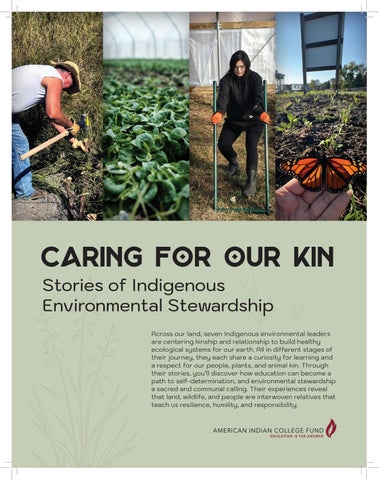
Caring for Our Kin Stories of Indigenous Environmental Stewardship

Across our land, seven Indigenous environmental leaders are centering kinship and relationship to build healthy ecological systems for our earth. All in different stages of their journey, they each share a curiosity for learning and a respect for our people, plants, and animal kin. Through their stories, you’ll discover how education can become a path to self-determination, and environmental stewardship a sacred and communal calling. Their experiences reveal that land, wildlife, and people are interwoven relatives that teach us resilience, humility, and responsibility.

Adriann Killsnight He’heenóhká’e (Blackbirdwoman)

Northern Cheyenne Nation

Bachelor’s degree in environmental studies; master’s degree in resource management

Adriann Killsnight describes herself as a daughter, mother, granddaughter, and learner. She’s a Northern Cheyenne woman who is shaped by land, language, and responsibility. Although she holds both bachelor’s and master’s degrees and works in wildlife management, she identifies herself first “as a Cheyenne woman.” That foundation guides every decision she makes, every species she studies, and every young person she hopes will one day step into roles that honor both data and ceremony.

Adriann grew up in southeastern Montana on the Northern Cheyenne Nation, where her earliest education was outdoors. She remembers days spent hunting and gathering, learning natural systems

academia didn’t always feel accessible. English wasn’t her first language, and concepts that held deep spiritual meaning often lost their essence in translation. “Cheyenne is one of my first languages, but once we translate it to English, it loses meaning.” She was timid when she started school, and unsure of where she belonged. But she slowly learned that asking for help was a form of strength. “I didn’t really know what I wanted and I was painfully shy,” she admits, “but I started reaching out to others and I didn’t give up.”

Her academic work ultimately led to a master’s project centered on a culturally important species: the swift fox. During her research, she used a noninvasive camera trapping technology that worked with the land and habitat rather than disturbing it. Because of this non-invasive technique, the elders in the community were supportive of her work. That support mattered deeply, because for Adriann, the land and animals are kin. “When I’m boots on the ground, I’m drawn to them. It’s a spiritual connection.” She approaches wildlife management as relational stewardship, aligned with the belief that animals, plants, water, and soil are relatives carrying cultural, ceremonial, and historical knowledge.

teamwork over her individual accomplishments. Her closest collaborators are impressive Indigenous women scientists who have become both colleagues and close friends.

As an Indigenous woman navigating scientific and cultural domains, Adriann notes that challenges arise on multiple fronts. Some traditional knowledge is only meant to be shared with men or is protected by family or lineage. “Me, being a woman, I’m not always privy to that information, but you have to respect it,” Adriann says. She also navigates barriers such as institutional review-board processes and assumptions that Indigenous science is anecdotal. Moreover, she’s familiar with the social and economic challenges that impact reservation communities, such as “high unemployment, drugs, alcoholism, and limited opportunity.” Adriann believes this makes cultural grounding and educational pathways even more critical.

“I carry this work for my daughter, my grandchildren, and those who will follow after.”

before she ever stepped into a classroom. “All my memories growing up were outdoors,” she recalls. Her father taught her traditional lifeways—how to move with respect, how to observe, and how to recognize the teaching role of all living beings. Later, when she briefly drifted from her cultural grounding, it was her grandmother who brought her back with a simple but enduring reminder: “Don’t forget who you are. Don’t forget where you come from.” Those words became both a compass and a promise.

Despite being in programs specifically designed for tribal contexts and eventually completing degrees in environmental studies and resource management,

After graduating, Adriann founded her own consulting company, Charging Buffalo, through which she conducted research and fieldwork across Tribal Nations. In her first professional project, she surveyed for black-footed ferrets at Crow Nation and saw one in person for the first time. She describes the moment as a beautiful, relational encounter. Her work expanded into roles involving air quality data, participation on boards, and regional Indigenous collaborations, including serving with the Buffalo Nations Grasslands Alliance. She also became part of a groundbreaking tribal-led conservation initiative, helping shape co-designed wildlife and resource plans that reflected both community and ecological needs.

Communication remains central to everything she does. “Communicating and collaborating interchangeably with my team is such an important part of the success of anything you want done.”

Her daily tasks involve data assessment, mapping, writing reports, and coordinating across multiple organizations, but she is quick to emphasize

Looking back, she wishes she’d been exposed earlier to Native-centered professional networks, such as the American Indian Science and Engineering Society and the Native American Fish and Wildlife Society, which later provided her mentorship, visibility, and community. Today, she teaches others the importance of data literacy and standard operating procedures so that future leaders are both culturally aligned and technically confident.

Ultimately, it’s love and responsibility that keep Adriann moving forward—love for her daughter, her father, her grandchildren, her team, and the animals and lands she feels spiritually connected to: “They’re tied to our ceremonies . . our lifeways.” She hopes to help build pathways for youth, creating ambassadors who can speak for species, languages, and landscapes in ways that continue the practice of Indigenous land stewardship.

Ayanna Maynard

Cheyenne River Sioux Tribe

Bachelor’s degrees in sustainable agriculture and food systems; business administration

Ayanna Maynard grounds herself in place, people, and purpose. Living and working within the Cheyenne River Sioux community, she holds space for the plants, students, and mentors who shaped her path. Her work reflects an evolving blend of ecological restoration, cultural revitalization, and community-driven education, rooted in the belief that “you are allowed to be in any spaces” where your knowledge and presence can bring healing.

Today, Ayanna serves in a role centered on handson restoration and student mentorship. Her daily work includes guiding interns in native prairie restoration, seed selection, and propagation techniques that require skill, patience, and observation. She helps students choose native

species thoughtfully, prepare seed mixes, and learn practices such as cold stratification and scarification. She often reminds them that growing indigenous seeds isn’t always instantly rewarding; it requires time, cycles, and the right conditions, mirroring her own educational path. Through collaborative projects and large campus engagement events, she shows students how restoration is lived, shared, and celebrated.

Ayanna’s college experience was uniquely designed to meet both her interests and community needs. She pursued a dual major in sustainable agriculture and food systems along with business administration, believing it was essential to know how to grow food and medicine, as well as how to

sustain, manage, and lead a project or enterprise. Her strongest academic influences came through mentorships. Working with respected plant educators gave her strong knowledge, confidence, and direction. She learned to identify each plant through three lenses—scientific name, cultural name, and purpose—and began to see that the truest understanding of a species requires both Indigenous language and botanical classification. As she reflects, “I learn the plant, the Lakota name, and the scientific name,” because meaning lives in all three.

Her non-academic learning runs equally deep. Adoption into a loving and supportive family gave her the safety and stability she needed at a crucial point in her life. She learned from the presence of adults who modeled sobriety, selfrespect, and listening without judgment and helped her understand what true mentorship is. Early gardening lessons also shaped her experience. When she realized radishes could grow from her own care and effort, it became a catalyst for possibility. Reconnecting with her Lakota identity was a personal healing and is something she continues to honor through her commitment to merging “Lakota and science together” in her work.

Ayanna’s pathway to leadership was not linear. She earned her GED in 2019 and entered college as an older student, carrying both urgency and purpose. USDA internships exposed her to large-scale agricultural projects, from seed rematriation and traditional mounded gardens to irrigation installation, pollinator research, and native grassland studies. Through this work, she discovered that traditional Indigenous practices and Western environmental science aren’t necessarily opposites. Each can reinforce, validate, and enhance the other when held side by side with respect.

Eventually, she was recruited back to her college community to manage an agricultural technology initiative funded by the National Science Foundation, where she now designs student learning experiences grounded in real skill-building, longterm ecological thinking, and measurable outcomes. In this role, she emphasizes documentation, planning, and project data so students leave with tangible evidence of their learning. As she tells them, it’s important to “have a plan you can take with you” after graduation.

Navigating non-Native systems has presented challenges for Ayanna. Working as the only Native professional in a federal office created moments where she felt pressure to mask her identity or tone. It was there she recognized that technical knowledge alone is not enough to succeed. Success also requires inclusive communication, relational awareness, and leadership skills, components she wishes were more intentionally taught within higher education. “You have to want to do it,” she tells students, though mentors, community, and structure matter too.

What drives Ayanna forward is her deep commitment to restoring access to cultural plants and medicines, species that communities can’t go buy at a store or nursery. She says medicines like sweetgrass, sage, bee balm, and other relatives may take years to grow, but they carry story, healing, and memory. Looking ahead five to ten years, she envisions a community greenhouse that can grow and distribute native prairie species, traditional foods, and medicines. Her goal is sovereignty through seeds, “sharing medicines we grow so others have access.”

“Plants are teachers. They show us patience, purpose, and how to take care of each other.”

Foster Cournoyer Hogan

Rosebud Sioux Tribe

Bachelor’s degree in Native American studies and education; master’s degree in tribal administration and governance

Foster Cournoyer Hogan defines himself as a Lakota man and a citizen of the Rosebud Sioux Tribe who was raised on his homelands. His journey has always been connected to community, responsibility, and identity, long before his career and educational paths entered the picture. Today, his work focuses on supporting and strengthening bison revitalization across Tribal Nations, organizations, and landscapes. To him, this work is a calling, one that’s rooted in relational accountability.

Foster currently serves as a bison coordinator for a new initiative that’s still in the strategic planning phase. His days are filled with research, organizational mapping, and outreach to understand who’s engaged in bison revitalization efforts

competitive colleges and universities he may not have otherwise considered. He originally went to college to pursue pre-med, but he eventually shifted to Native American studies, where he found space to explore Indigenous food sovereignty, language, and community-rooted work. He later completed an internship with the Sičháŋ ǧ u Food Sovereignty Initiative, a 10-week experience he describes as transformative. That immersion helped him recognize that healing can take many forms, and wellness is deeply connected to cultural foods, land, and self-determined systems.

His learning continued when he earned his master’s degree. Studying federal Indian law, tribal constitutions, and tribal food codes gave him practical policy tools to support future implementation work. He describes the program and cohort as “phenomenal,” especially because it showed him how language, food, and law are deeply interdependent. He’s interested in how Tribal Nations can embed food systems and sovereignty into governance frameworks for long-term sustainability.

other intentions for me,” he reflects, noting that he’s still working to heal his community, “but in our own way.” He encourages young people not to become narrow or tunnel-visioned in their approach to careers, because Indigenous environmental work requires collaboration between science, research, policy, language revitalization, and treaty rights. “It takes all of us,” he says, reminding future leaders that conservation is relational, cultural, political, and spiritual.

“The bison show us resilience. When we take care of them, they take care of us.”

and how those efforts might work in synergy with his own. He studies existing models of herd development, land acquisition, technical assistance, and apprenticeship programs, and looks for ways tribes, organizations, and partner institutions can align. The heart of his role is building meaningful partnerships grounded in Indigenous values and long-term thinking. As he says, the goal is understanding “how we can all work together for the bison,” because no single entity can lead without a collective vision.

His academic path was shaped by influential mentors who redirected his trajectory at formative moments. In school, a trusted mentor encouraged him to dream boldly and helped him apply to

Outside academia, Foster’s most formative learning came through community bison harvests. He was taught how to harvest with respect, how to help organize a harvest, and eventually how to lead one. He learned that the rhythm of the work is determined by the animals themselves: “We’re on their time.” He explains that the whole process is based on ceremony, relationship, and humility. Seeing bison as relatives changed both his mindset and his leadership approach. He believes decisions must consider what is best for those who cannot speak in the language of policy or funding.

At home, Foster and his fiancée, Carm, practice subsistence living through hunting and intentional use of harvested foods. They try to utilize every part of what they take, honoring nutritional, cultural, and ecological values while reducing dependency on outside systems. Food, for them, is a site of sovereignty, wellness, and love—a way of refusing assimilation while also strengthening family identity.

His path was not a straight line. While he once imagined himself in medicine, he now sees his work as healing through a different method. “Creator had

Within his work, he also acknowledges the emotional and structural complexity of Indigenous conservation. There are layers of historical trauma, lateral violence, and community tensions that require compassion and patience. He’s candid about the ongoing challenges of systemic racism, jurisdictional barriers, and policy conflicts that operate at state, tribal, county, and federal levels. Advocacy and education are essential components of his work, especially around asserting treaty and human rights.

Looking back, Foster wishes he had engaged even more in networking early on, something he has since embraced. He believes that “even knowing someone’s name goes a long way,” because relationship-building is foundational in Indigenousled land and food systems. Today, he continues to expand his knowledge through specialized leadership and conservation courses, viewing himself as a lifelong learner.

Foster draws strength from three core sources: his fiancée and the healthy home they are intentionally building together; a mentor-supervisor, Wizipan “Wheezy” Little Elk Garriott, who embodies spiritually grounded and policy-informed leadership; and the bison themselves. The animals represent survival, identity, and kinship, “a symbol of resilience.” He sees a future where caring for bison is a pathway forward for community strength, cultural continuity, and ecological restoration. He believes that when Indigenous communities care for the bison, “they take care of us” through ceremony, food, spirituality, and renewed hope.

Nick Hernandez

Oglala Sioux Tribe

Master’s degree in Lakota leadership and organizational management

Nick Hernandez’s identity is built on home, community, and the long-standing values he carries forward from the generations before him. Born and raised on Pine Ridge, he eventually left to pursue a Western education, only to realize that its truest value would come alive when brought back home. His work today is about restoring pathways for economic and cultural sustainability and preparing future generations to inherit something far stronger than what he started with.

Nick currently runs a community-led nonprofit working at the intersection of food systems, economic development, Indigenous leadership, and capacity building. Because the organization is still relatively small, he has a wide variety

of responsibilities: finances, human resources, internal systems, policy development, scheduling, operations, and staff support. He knows he wears a number of hats, but he says smaller Indigenous nonprofits rarely have “all the administrative and operations positions” that larger organizations rely on. He fills the gaps to maintain momentum in a system where leadership must be both visionary and hands-on.

Academics played a critical role in shaping Nick’s approach to social change. He studied at a liberal arts college where he learned to analyze systems, movements, and global justice work, and how to apply critical thinking through a sociological lens. Western intellectual frameworks paired with

Indigenous values shaped his understanding of how real transformation requires “utilizing both worlds.” He remembers realizing that Western education helped him understand broader global movements and tools, while his Lakota identity provided purpose, grounding, and cultural responsibility. Through both, he began asking: How can our people lead change, rather than be the subjects of others’ plans?

The most influential education came from Nick’s family, especially his grandparents, who owned businesses and worked as nurses, contractors, and community helpers. They modeled work ethics, service, and self-sufficiency, and taught him about leadership. His mother, who he calls his foundation, continuously supported his growth, education, and community connection. These lessons helped him learn how to lead with humility, persistence, and an emphasis on people.

Nick’s professional path was not obvious from the beginning. Through high school and even into his twenties, he didn’t know which direction his career would take. It wasn’t until his thirties when he realized that building Indigenous-led community systems around food and workforce development was his dream. He often reminds others that clarity comes from maturation.

Workforce creation is a core focus for Nick. There aren’t many food systems and agricultural roles that exist in his community, so he creates new job pathways. In his words, “We’re creating something that hasn’t been seen before,” which means most staff members come from unrelated fields, or they are self-taught. He sees this as an opportunity to build a multi-skilled local workforce grounded in values, land, and community commitment. His long-term goal is to develop a sustainable workforce that understands how to lead, innovate, and return home with purpose. “We need to develop systems so that our next generation understands that when they go off to get these degrees, they can either start something or fit into something and come back home.”

Nick navigates complex structural and political barriers on a daily basis. He acknowledges that the federal system, treaty-based jurisdiction, and reservation-specific policies can create significant

challenges, affecting everything from business development to utilities to property ownership. He notes that change requires community members to understand both their rights and their history: “We have to look back at a minimum of 150 years to understand how we got here today.” He also speaks openly about the gap between Western education and Indigenous learning, explaining that Western models are documented and institutionalized, while Indigenous knowledge is rooted in community, a place where wisdom lives, but is rarely recorded.

“We’re building a workforce and a future our kids can come home to.”

What keeps Nick moving with determination is family, future generations, and the belief that his sons, and all Lakota children, deserve infrastructure, opportunity, and homegrown leadership. He talks often about “generational abundance,” envisioning a future where Indigenous youth no longer have to choose between cultural belonging and professional advancement. His work, though demanding, remains his passion: “Change doesn’t happen by hoping for it. Change actually happens by action and getting involved.”

Shaun Grassel

Lower Brule Sioux Tribe

Bachelor’s and master’s degrees in wildlife and fisheries sciences; PhD in natural resources

Shaun Grassel grew up exploring the Lower Brule land that would eventually become both his classroom and career. As a kid, he learned by wandering river breaks, hunting, fishing, and listening to the quiet teachings of prairies and family. His story is one of deep continuity: The land raised him, shaped him, employed him, and now inspires his work to strengthen tribal conservation for future generations.

Today, Shaun leads a Native nonprofit focused on tribal grassland restoration and wildlife conservation. He now operates at a systems level, but he remains grounded in the relational values he learned as a young person on the land. Much of his work involves partnership development with

tribes, agencies, nonprofit allies, and funders. He spends his days connecting with leaders, mapping resources, elevating tribal priorities, and ensuring those connections turn into funded, implementable projects. His work also involves staff support and organizational leadership—reviewing proposals, refining program materials, and staying accessible so projects can keep moving. “Partnership building is a big part of what I do . . knowing programs and how tribes can access them,” he explains, emphasizing that visibility and access are inseparable from sovereignty.

Shaun’s path began in field biology and handson research. In college, he sought out practical experience early, working as a technician for

graduate students, the university, and the US Fish and Wildlife Service. This experience was transformative because it showed him how research, funding, and tribal application can all align. Later, when pursuing graduate work, he didn’t wait for a perfect opportunity, he built it. He wrote proposals, raised his own research funds, brought ideas to advisors, and designed both his master’s and PhD work around tribal priorities. He raised the money for his master’s, then his PhD, and created an unconventional path that positioned him as someone who could bridge academic systems with tribal needs through self-direction.

Shaun credits his family and the land as his greatest teachers. He remembers long days exploring the outdoors with his siblings, supported by their mother who encouraged their curiosity and discovery. His grandfather, the first game warden for their reservation, provided an example of responsibility and a strong work ethic. His greatuncle was a commercial trapper who practiced land-based subsistence into his centenarian years, trapping until he was 101 and living to 103. Such role models normalized a life of purpose, humility, and relationship with the land. By the time Shaun encountered the term “wildlife biologist” at age 12, the path had already been laid—he simply put a name to it and said, “That’s what I’m going to do.”

After completing his undergraduate program, he returned home to work for his tribe, then later worked continuing research and contract work for the Lower Brule. Eventually, he transitioned toward nonprofit leadership, recognizing that systems-level influence—funding, partnerships, research design, capacity building—was essential to scale impact.

Like many long-term natural resource professionals, he moved from “boots on the ground” science to strategy, infrastructure, and mentorship, believing that the next generation should inherit knowledge and the functioning systems that sustain it.

Shaun’s journey has not been without challenges. Financial hardship in college required him to work three jobs simultaneously, and he recalls overhearing discriminatory remarks about tribes in state agency spaces. He also recognizes that tribal wildlife programs often face underfunding, turnover, and capacity gaps, making it extremely difficult to maintain institutional knowledge and

long-term planning. He believes tribes must be on the same playing field as federal and state agencies to maintain stable, well-resourced teams.

Looking back, Shaun sees the importance of consistent exposure to tribal voices in higher education. Early in his studies, a professor brought in various speakers from tribal fish and wildlife departments to give students a firsthand perspective. But after that, there was a 12-year gap when no tribal speakers were invited. He believes representation is key, both to inspire Native students and educate non-Native students who may one day work in tribal jurisdictions. Today, he helps develop youth programming to close that gap, noting that new opportunities are emerging, but consistency is what will shape future conservation leaders.

“Tribal programs should be on the same playing field as state and federal agencies. That’s how we build lasting capacity.”

What sustains him is a vision where tribal programs have the staffing, expertise, financial security, and stability needed for long-term planning, where tribes are not the last to be consulted but are leading from the outset. “Everyone needs to be lifted up,” he says, reinforcing the idea that success must be shared.

Teri Harper

Cherokee Nation

Bachelor’s degree; currently pursuing a master’s degree focused on bison health

Teri’s story begins long before she stepped into conservation work. She grew up surrounded by agriculture, animals, and a family that believed deeply in responsibility and hard work. Her grandfather, a steward of buffalo during the late 1960s and 1970s restoration efforts, was one of her earliest teachers. He passed down lessons about humility, voice, and taking initiative. “Closed mouths don’t get fed,” he would say, encouraging her to ask questions and seek opportunity. Those teachings stayed with her, shaping how she moved through school, work, and eventually the conservation world.

Her early education took a few different turns. The first credential she earned was in cosmetology, followed by coursework in animal science and veterinary science. She was active in the

competitive agriculture and rodeo world, which helped build confidence and discipline. But she was still looking for the kind of work that would feel meaningful. That spark came later, when she began working on the land.

Her path shifted when she joined American Prairie. There, she worked closely with bison, fencing, and collaborative conservation projects. Being around buffalo, the same animals her grandfather had helped care for decades earlier, felt both familiar and new. At the same time, she had returned to school, and the combination of academic learning and fieldwork helped her see a different future for herself. “I started to get more confident,” she remembers. That confidence changed what she studied and how she approached her work.

Conservation became more than a job description; it became a direction.

From American Prairie, Teri moved to a role with the Smithsonian at Fort Belknap, serving as a liaison for the swift fox reintroduction project. She helped coordinate field efforts, build relationships, and bridge tribal priorities with scientific partners. These experiences rooted her in conservation practice and introduced her to a wider network of organizations, agencies, and tribal programs.

Her work eventually brought her to Aaniiih Nakoda College, where she became a coordinator and mentor for students interested in wildlife, grasslands, and buffalo. She built the college’s intern program from the ground up and became known for recruiting students into hands-on roles that kept them connected to their homelands. “I’m a big recruiter,” she says proudly, bringing students directly onto the landscapes they grew up with, helping them see themselves as future stewards of their own communities.

Teri’s daily work now revolves around students, giving them structure, ensuring they know what they are doing each day, and helping them navigate everything from coursework to life challenges. Her days often begin at six in the morning and end late at night, guided by the belief that students need guidance, presence, and someone who believes in their potential. She also works closely with the tribal buffalo program, helping plan management strategies from both ecological and business angles. And when wildlife projects require field supervision, especially overnight trapping work for swift fox or black-footed ferrets—she is there, supporting students in real time.

Her journey has included barriers. A learning disability made parts of school difficult. In some community spaces, she was told she didn’t look Indigenous enough. These experiences could have pushed her away, but instead they taught her patience and persistence. The more she lived, worked, and showed up for the community, the more trust she built. Over time, those early feelings of being on the outside shifted, and she became someone people invited in. “Now I’m always asked: let’s have Teri be part of this,” she says. That feeling of belonging came through service, not appearance.

Teri’s advice to students is grounded in lived experience: being willing to pivot, follow opportunities, and let your community guide your path. She emphasizes that Indigenous knowledge belongs in scientific spaces, and that the work she does is built on teachings that predate Western research by thousands of years. “Bringing my lifeways back into that scientific world” is how she explains her approach, honoring the knowledge her family and community passed on.

Looking forward, Teri wants stronger bridges for students transitioning from high school into trades, college, or apprenticeships. She imagines a system where home and school support are more closely connected, and where students can work and earn income while completing academic courses. She sees huge potential in partnerships with apprenticeships, trades, and TCUs to create paid, culturally grounded entry points into conservation careers.

At the heart of all of this are her students—their successes, their confidence, and their futures. Watching them graduate, get jobs, return home with new skills, or simply thank her for believing in them is what fuels her. “My students, plain and simple,” she says. “I want to make sure that I am providing an opportunity for them to change the world.” That belief in their potential keeps her going long after the sun has set.

“Closed mouths don’t get fed. Speak up, ask questions, and take every opportunity the land gives you.”

Zach Ducheneaux

Cheyenne River Sioux Tribe

Zach’s story begins on the land, in a household shaped by the farm financial crisis of the 1980s. He remembers watching his parents struggle, seeing his family lose their means of production, and feeling the weight of decisions made far beyond the reservation that nonetheless determined the fate of Native farmers. Those early years planted a question deep in him: Why do our people carry the consequences of systems we didn’t design, and how do we build systems that finally work for us?

Before he ever worked in finance or federal leadership, Zach was a kid learning from horses, family, and community. Horsemanship taught him to pay attention, to move with awareness, empathy, and presence. Working with a horse, he says, is never about domination; it’s about partnership and timing. Those lessons became the foundation of how

As he grew older, the memory of his family’s loss stayed close. It shaped the jobs he accepted and the ones he sought out. He worked in ranching, in nonprofit roles, and in community-based initiatives that tried to fill gaps left by policy failures. That steady accumulation of experience eventually led him to an unexpected turning point: a leadership position at the USDA Farm Service Agency, responsible for more than 10,000 employees. He was dropped into the role suddenly, but rather than being intimidated, he returned to the principles he learned through horsemanship: listen, observe, and lead with empathy.

Instead of treating the agency like a gatekeeper or a “lender of last resort,” he encouraged staff to see themselves as partners and problem-solvers. He focused on shifting mindsets, not just enforcing rules. Within a federal system known for its rigidity, he helped people imagine themselves as bringers of opportunity. That work was transformative not just for the agency, but for him, as it showed that large systems can move when people inside them feel understood and valued.

Education remains important to him, especially for Native youth. He often says he wishes he had read Indian Givers earlier in life because it revealed truths he had sensed but never saw written: that Indigenous people were architects of medicine, governance, engineering, law, and agriculture long before the modern world recognized those fields. That book helped him reconcile what it means to be both a tribal citizen and part of the United States, a dual identity many Native youth navigate without guidance.

“Build systems our grandchildren can inherit with pride, not debts they must survive.”

he communicates, how he raises his children, and how he leads.

School was not a straightforward path for him. He calls himself a college dropout, yet he speaks about education with deep respect. He grew up in BIA schools, learned to adapt in systems that didn’t always reflect his identity, and later encouraged young people to stay in school—reminding them that learning and teaching are not the same thing. He tells students, “You’re going to be there, you might as well learn,” and reminds teachers that “you’re there to inspire learning,” urging students to remain curious even when the structure around them feels unyielding. Looking back, he believes that more formal education might have shortened the road he eventually took, but his lived experience became its own kind of classroom.

As his leadership journey continued, Zach began focusing on an even larger question: how to rebuild financial systems so they truly serve Indigenous communities. His daily work now centers on designing investment models grounded in relationship and shared prosperity. He imagines a financial structure that feels familiar to Native people—collective, secure, reciprocal—more like a shared commitment than a loan. “We want producers to have compensation that lets them be secure in their work,” he explains, emphasizing that prosperity should be a community outcome, not an individual exception.

In this work, he often confronts misunderstandings about capitalism. People sometimes assume capitalism is the same as greed, but he reminds them that Indigenous Nations practiced forms of capitalism long before colonial economies arrived. Those systems relied on shared labor, shared benefit, and deep accountability to the land. Reviving that approach, he believes, can restore sovereignty and rebuild Native economies in ways that reflect Indigenous values.

Zach’s influences span generations. His father modeled curiosity and willpower; his mother modeled unconditional love. Horsemen like Nub Long shaped his understanding of presence and communication. His entire family inspires him by moving through the world with clarity and strength. But it is his grandson who anchors his purpose. When he looks at him, he sees both the weight of history and the possibility of something different. “That’s why I’m doing it,” he says. “We don’t need to go through what my parents went through. We can do better.”

His forward-looking philosophy is simple yet powerful: focus on good energy, and more good will follow. He believes transformation begins with attention: what we choose to see, we can build and uplift. For him, that means creating financial systems for future generations that provide opportunity, not debt, and that future generations can inherit with pride, not fear.

Tiyata Wan Unkagapi

(We Are Making a Home)

The American Indian College Fund’s Tiyata Wan Unkagapi Environmental Stewardship Program supports tribal colleges and universities in the Northern Great Plains grasslands region to build capacity in environmental science and natural resource programs, land-based research, community engagement, and collaboration. A multi-faceted approach to stewardship is what’s needed now. It is upon the individual, the family, the community, and the collective to understand our responsibilities and care for our homeplace.

A special thanks to the following tribal colleges and universities for their continued dedication to caring for the land and preparing the next generation of land stewards:

Aaniiih Nakoda College (Harlem, MT)

Chief Dull Knife College (Lame Deer, MT)

Fort Peck Community College (Poplar, MT)

Little Big Horn College (Crow Agency, MT)

Nueta Hidatsa Sahnish College (New Town, ND)

Oglala Lakota College (Kyle, SD)

Sinte Gleska University (Mission, SD)

Sitting Bull College (Fort Yates, ND)

Stone Child College (Box Elder, MT)

United Tribes Technical College (Bismarck, ND)

8333 Greenwood Blvd., Denver, CO 80221

303-426-8900 | collegefund.org

Turn static files into dynamic content formats.

Create a flipbook