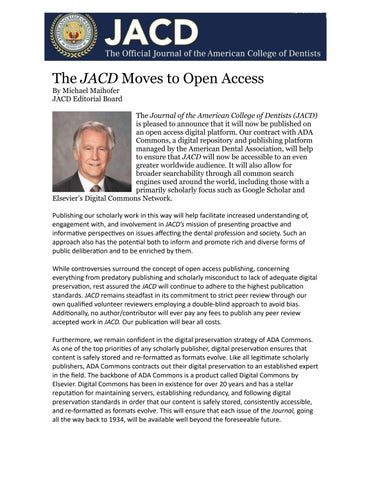

The JACD Moves to Open Access
By Michael Maihofer JACD Editorial Board

The Journal of the American College of Dentists (JACD) is pleased to announce that it will now be published on an open access digital platform. Our contract with ADA Commons, a digital repository and publishing platform managed by the American Dental Association, will help to ensure that JACD will now be accessible to an even greater worldwide audience. It will also allow for broader searchability through all common search engines used around the world, including those with a primarily scholarly focus such as Google Scholar and Elsevier’s Digital Commons Network.
Publishing our scholarly work in this way will help facilitate increased understanding of, engagement with, and involvement in JACD’s mission of presenting proactive and informative perspectives on issues affecting the dental profession and society. Such an approach also has the potential both to inform and promote rich and diverse forms of public deliberation and to be enriched by them.
While controversies surround the concept of open access publishing, concerning everything from predatory publishing and scholarly misconduct to lack of adequate digital preservation, rest assured the JACD will continue to adhere to the highest publication standards. JACD remains steadfast in its commitment to strict peer review through our own qualified volunteer reviewers employing a double-blind approach to avoid bias. Additionally, no author/contributor will ever pay any fees to publish any peer review accepted work in JACD. Our publication will bear all costs.
Furthermore, we remain confident in the digital preservation strategy of ADA Commons. As one of the top priorities of any scholarly publisher, digital preservation ensures that content is safely stored and re-formatted as formats evolve. Like all legitimate scholarly publishers, ADA Commons contracts out their digital preservation to an established expert in the field. The backbone of ADA Commons is a product called Digital Commons by Elsevier. Digital Commons has been in existence for over 20 years and has a stellar reputation for maintaining servers, establishing redundancy, and following digital preservation standards in order that our content is safely stored, consistently accessible, and re-formatted as formats evolve. This will ensure that each issue of the Journal, going all the way back to 1934, will be available well beyond the foreseeable future.
Another additional benefit to publishing through ADA commons is the feedback our Journal’s author/contributors will now receive after their papers have been published. Unlike most publishing platforms, ADA Commons will email our Journal’s published authors each month with a report detailing how many downloads their article or articles have received including the total for everything they’ve published in ADA Commons, as well as a distribution map of where those downloads took place.
We believe the Journal of the American College of Dentist’s move to this new and innovative open access digital platform will not only increase the breadth of our JACD readership but also enhance its reputation and further facilitate attracting the kind of reputable authors our publication has always supported. At a time when people and governments are questioning the authenticity of many scientific resources, the JACD remains committed to presenting the best evidence-based peer reviewed scientific truth. Digital publishing through ADA Commons will help us do that.

JACD Joins ADA Commons: Access Past Articles and Author Insight
By Alisun DeKock
ADA Commons is a new information resource from the American Dental Association that highlights dental literature and resources. Featuring membership publications from across the ADA tripartite and archival materials from the ADA collections, ADA Commons is a searchable, open-access database solely focused on dentistry and oral health.
The Journal of the American College of Dentists is now included in ADA Commons, giving members of the American College of Dentists the ability to search for past JACD articles, authors, and specific content relevant to your needs. Within the larger database, ADA Commons also gives you access to the latest journals, magazines, and newsletters of all participating ADA associations and professional dental organizations. Content also includes archives of peer-reviewed articles, clinical research, legal and HR-related news, editorials and much more.
HOW TO USE
Finding content across the JACD collection is simple. If you are searching for a particular topic, use the search bar found in the left menu to enter in a word, name, or phrase. You can search within JACD, across other ADA Commons publications, in the entire repository, or throughout all of Dentistry Commons (see below). Advanced searching allows you to narrow your search by date, author, title, etc.
Specific issues are reached directly via the dropdown menu at left under “Select an issue.” Explore the most read articles in a publication simply by clicking “Most Popular Papers” on any page. This provides a list of those items most downloaded by readers.
If you are searching for all works by a particular author across the database, you may find them listed in the “Author” section on the landing page for ADA Commons. (Please note: this database only
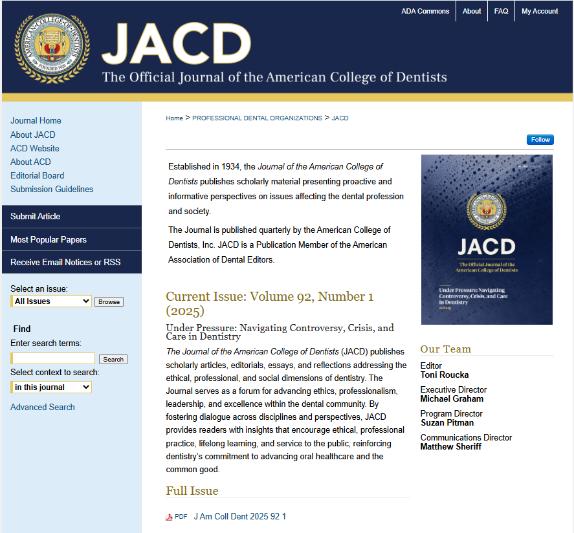
includes articles from the participating associations; article listings may not be inclusive of everything written by that author.) Additional guidance is found in the extensive FAQ section
DENTISTRY COMMONS
ADA Commons materials are also indexed by Dentistry Commons, a worldwide database of dentistry-related articles. Dentistry Commons expands the reach of content in ADA Commons to a truly global audience. Because materials are indexed by Google, Google Scholar, and other search engines, items in ADA Commons have been viewed by individuals in every state of the U.S As of November, items have been downloaded over 375,000 times across 205 different countries.
EXHIBITS
With the growing depth of archival and research materials in ADA Commons, the ADA features a number of digital exhibits featuring the archival collections held in the repository. Most recently, the ADA released a new digital exhibit showcasing the history of National Children’s Dental Health Month which accompanies exhibits on sports, pain management, and dentistry in military history. Navigate to the digital exhibits from JACD’s page by clicking “ADA Commons” at the top and then click on “Exhibits” from the ADA Commons landing page.
CONTRIBUTING YOUR INDIVIDUAL SCHOLARSHIP
The Individual Scholarship section of ADA Commons offers ADA Members the option of uploading their published, scholarly works as allowed by their publication agreement. This provides a secure, archival, long-term link to your work in an open access, sharable database. ADA Commons will continue to grow, so visit often to explore what’s new!
Alisun DeKock is the Digital Archivist and Publishing Librarian with the ADA Library & Archives. The ADA Library & Archives provides ADA members with access to dental and oral health resources and research, as well as records and publications from the ADA’s archives. Part of that research is available through ADA Commons, an open digital repository that collects, preserves and disseminates state and local dental association publications and research.

The Journal of the American College of Dentists is a scholarly publication presenting proactive and informative perspectives on issues affecting the dental profession and society. The Journal has been published since 1934, and its first editor was Dr. William John Gies. The Journal is published quarterly by the American College of Dentists, Inc., 103 North Adams Street, Rockville, Maryland 20850.
While every effort is made by the publishers and editorial board to see that no inaccurate or misleading opinions or statements appear in the Journal, they wish to make it clear that the opinions expressed in the articles, correspondence, etc. herein are the responsibility of the contributor. Accordingly, the publishers and the editorial board, and their respective employees and officers accept no liability whatsoever for the consequences of any such inaccurate or misleading opinions or statements.
For bibliographic references, the Journal is abbreviated J Am Coll Dent and this should be followed by the year, volume, number, and page. The Journal is a Publication Member of the American Association of Dental Editors and is indexed on ADA Commons.
Submission Guidelines
Submissions must include:
• The full name of each author.
• E-mail address, mailing address, and phone number for each author.
• Degrees and institutional affiliation (if appropriate) of each author.
Submissions must:
• Be between 1500 and 3000 words in length, including an abstract of no more than 250 words.
• List 3-10 keywords after the abstract. These terms represent the key topics presented in the article.
• Use inclusive language, including gender-neutral pronouns, unless referring to specific persons.
• Sufficiently de-identify any descriptions of patients and/or clinical encounters.
• Include disclosure of any conflicts of interest.
• Confirm with a statement that the work is original and that it has been authored entirely by submitting authors and their research team.
• Designate a corresponding author.
• Follow the American Medical Association Manual of Style, 11th Edition, for text and references.
Additionally, by submitting a paper, authors affirm that no portion of the document was written by artificial intelligence tools. The use of AI-based tools for grammar checking or formatting is permitted, provided it does not alter the core ideas, analysis, or authorship of the document. All submissions deemed suitable will undergo a peer review process.
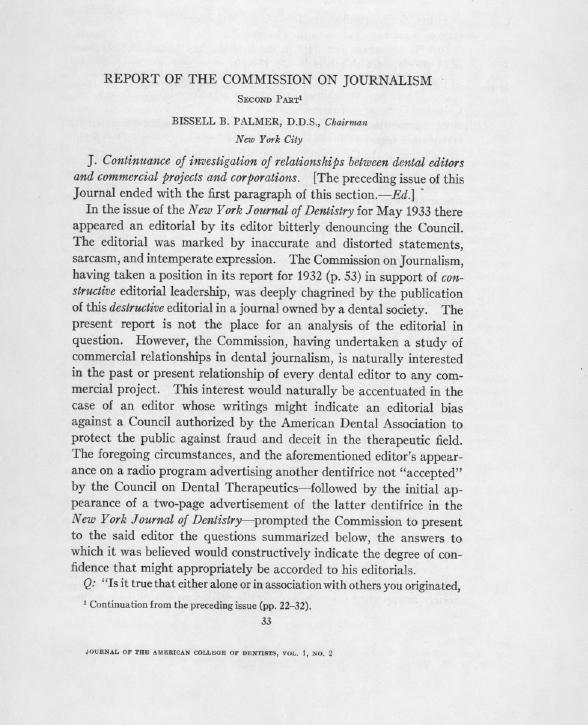
From the Journal of the American College of Dentists, volume 1, April 1934.