
![]()


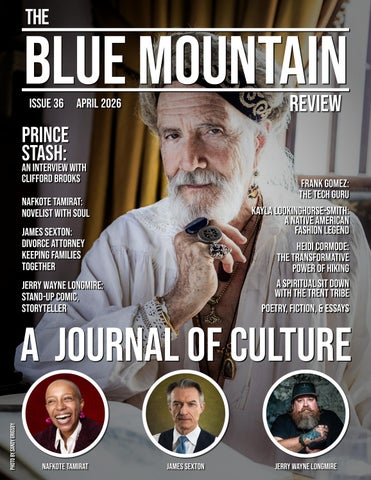
An Interview With Clifford Brooks

NAFKOTE TAMIRAT: NOVELIST WITH SOUL
JAMES SEXTON: DIVORCE ATTORNEY KEEPING FAMILIES TOGETHER
JERRY WAYNE LONGMIRE: STAND-UP COMIC, STORYTELLER

Frank Gomez: THE TECH GURU
Kayla Lookinghorse-Smith: A Native American fashion Legend HEIDI CORMODE: The Transformative Power of hiking A Spiritual Sit Down with the Trent Tribe POETRY, FICTION, & ESSAYS


Introduction by


Sitting in circles over wine and frelight, writer friends and I like to regal each other with the unsavory tactics we pulled off to get published. One offered a famous novelist a ride back to his swanky hotel after a reading but took the longest route possible. While circling about in a dark neighborhood on the outskirts of town, the poor visiting writer fnally noticed that he had been hijacked while my friend gave the pitch of his novel-in-progress and suggested that he share it with his equally famous agent. Another friend, inspired by the story of poet Robert Lowell setting up a tent on Allen Tateâs lawn for two months, booked a rental next to a well-known editorâs summer cottage. Over time, after bumping into each other at the only beachside coffee shop, they talked about their favorite authors, one which my friend just so happened to carry in her hands, which my friend knew was one of his treasured books from reading a rare interview conducted early in his career. By the end of the summer, she had a book contract. Not many of our apocryphal stories exhibited calculation. Some were simply about our verve and passion.
My friend Michael reminded me that, in graduate school, I would transcribe the entirety of my favorite books of poetry, poem after poem, every stanza, word, line break, white space, and


punctuation mark. I gave each book its own dedicated journal; I treated them like hallowed texts, like I was some monk in a scriptorium.
I had forgotten this. I donât know why. He said, âI didnât understand what you were doing and asked you why. You know what you said, Maj? You said, because you wanted to feel the power of the poems run through your body as they emerged as if directly from the authorâs hand.â He marveled then and still does; he shares the story each semester with his students whom he wishes to motivate to see writing as the sacred art that it is.
I recall that moment but shuddered that I was so serious back then, and indeed voracious, and though lately I have mourned how tempered I have become, I sometimes think about how I put so much belief into poetry, as if it were an exalted vocation for the elect who needed to put themselves through a deep monastic apprenticeship and training that was hardcore and intellectually rigorous. Donât get me wrong; I am still in love with poetry, but back then it was the sky I breathed, what gave me purpose. All I wanted was to write a poem that had the purity of sound and light like many of the poets exhibited, which meant I read everything, because I wanted to be constantly awed by eloquence.
I know now that my life was the exact opposite of that; a stuttering, blathering, inarticulate spewing of emotional pain and chaos; I thrust into poetry because my life was full of violence, which is its own language. I was a parasite. I spent so much money on books and surrounded myself with people who were equally, if not more, passionate than me. Talking in hushed tones about Matthew Arnold or Sterling Brown made me feel normal.
Where we lacked talent we had this insatiable regard, a kind of bridge, which had us also revere the great writers, both living and dead. They were goddesses and gods, foremothers and forefathers, who burned language with their own fre, made it glow in our mouths whenever we recited it. A young writer once said to me, my generation does not believe in âliving monumentsâ which made me sad because that meant they were only using poetry as an airplane for their egos rather than seeing it as a sacred conversation across time, the basis for a comparative humanity, and a possibility for adding to a growing chorus of intimacy and vulnerability. I am sure many people still experience the ritualistic dimensions of language, still have their heads knocked off, and wish to experience that feeling repeatedly. We wanted to be that good.
What my friends and I gained were examples of habits, grit, and character, once we pushed aside rank ambition. We fell silent whenever one of us shared a work-in-progress knowing they were one step closer to Parnassus. We fell silent because we knew one of us took their obsession to a heightened state of making, that place where the hours fall away, and what arrives in its place is a lyric storm. We talked often about the people who succeed as writers are those who are obsessed with assembling stories or scoring words into a grand composition. I donât care what your


proclivities are or what excites you, but exhibiting that kind of passion is daunting to others, makes people conscious of their own choices.
So thrusting ourselves in front of favorite writers was nothing; it was part of what it took. We often joked that weâd give half-a-pinkie to write a sentence as fresh as Toni Morrison. One must do the thing, as the poet Philip Levine once remarked, âput in your butt time,â must not move and sit through the discomfort of silence. But the other aspect of writing involves letting yourself be shaped by the literature of the past, and realizing that one is part of an estate that requires devotion and a deepening sense of a vocation.
This does not mean we must start clawing at each other, creating a barrel around us. To be competitive in that way refects a fundamental misunderstanding of what being a writer is all about. My friends and I celebrated each other's wins with visceral joy as though they were our own. We sat in the cut waiting for our turn, knowing it was coming. The ones who did see it as a sprint, died on the inside with envy and caused harm that spread. But mostly we mojoed, sang loudly our spirits, brought the music so that our fames burned into the next century.

âą One full-page ad in the frst 10 pages of the magazine.
âą If you do not have an advertisement, our team will design one. Since we are an online magazine, we are able to tailor your advertising to appear in the geographical area you're comfortable serving.
âą One full, feature interview in the magazine in Special Features.
âą One interview on NPR.
âą Mention you in the introduction and closing of each NPR recording. Your company and website appear in the show notes for easy reference
SOCIALS & MORE
âą Twice a week your company is promoted across our social media platforms during peak traffc times.
âą Spotlight in the monthly Southern Collective Experience newsletter of 3,045 people with a 78% open rate
âą Company name and logo on any promotional materials mentioning sponsors. (i.e. seminars, conferences, readings, performances, etc.)

The Blue Mountain Review is read by over 700,000 people internationally, with the majority in North America. The journal of culture is ten years old and captures art from all walks of life, in every voice. It is published online, every two months.

cliffordbrooks@southerncollectiveexperience.com to learn more & get started

Our podcast on Spotify, hosted by Charles Clifford Brooks III. The interview will be designed to introduce you and educate others about your business.


Interviewed by Clifford Brooks
Q. How do you deal with anxiety and depression so far from home?
The secret is that being so far from home is precisely what provides me some relief from that anxiety and depression. For a lot of reasons, I put a great deal of stock into performing the role of âgoodâ Ethiopian daughter for my family (one reason being that I truly love them) but I have found that my performance is more heartfelt the less frequently I actually spend time with most of them. Small doses rejuvenate; larger ones enervate.
But also, have you heard the good word about therapy? That shit works.
Q. Who are some of your literary heroes?
Imogen Binnieâs book Nevada changed my fucking life and helped me get through one of the most entrenched writersâ blocks Iâve had in recent memory. I love the way she writes voice on the page, but also how she writes disconnection and alienation from oneâs own body.
I love Octavia Butler and in particular, the way she juxtaposes a direct and straightforward writing style with her fantasia of world-building and visions of liberation.
Is anyone as funny as Samantha Irby on the page?
For my sins, I think David Foster Wallaceâs essays are magnifcent.


Q. If you could sit down with one of these heroes, alive or dead, what sort of conversation would you share?
You know, I think I would be most honored to have a long-standing written correspondence kind of relationship with each of them. Partly thatâs self-preservation: Iâm less likely to blurt out something dumb if I have the luxury of pen and paper. But also because I think from what Iâve read about them (and to be clear, I really donât know much about any of them as people - one of the skills that Iâm trying to cultivate is reading biographies) theyâre all fairly introverted and/or shy people, who might also prefer writing to speaking. (And trust, I appreciate the hubris inherent in that statement, that any of them would âpreferâ to be in communication with me at all.)
Q. How does being an educator feed your creative writing?
It compels me to explain why I do the things I do in my writing. On an average day, if you were to stop me on the street and ask me about a sentence I wrote (again: the hubris, itâs breathtaking) Iâd probably shrug and mutter something about âvibes.â What teaching allows me is the space to refect on choices I make in my writing and then connect them back to tools and techniques that I must then articulate. For me, being an educator makes me a better, more precise thinker.
Q. How does Paris put fire to your words?
Living here gives me access to art that helps me map out larger artistic lineages and see where and how I might intersect with them. The city itself is part of that lineage, not just the gorgeous architecture you see today but also the architectures that were destroyed to make way for it. By no means is Paris the only city where this is the case, but itâs one place where the history of whatâs there and what isnât can (if youâre so inclined) invite you onto a treasure hunt through the real, the imagined, and the invisible. And that kind of roaming exploration pushes me to want to articulate in my writing the absences and presences that form such pivotal moments in my own existence and in those of my characters.
Q. How does your Ethiopian roots plant you on the page?
Being Ethiopian is a constant exercise in remembering that nothing lasts. Iâve always been interested in how some cultures are âfuture lookingâ while others tend to live in a past-drenched present. Ethiopia is frmly in that second category, constantly reviewing historic glories, sometimes to the detriment of seeing whatâs here right now. So, that question of the ephemeral helps loosen me up: anything I write is just one more sentence in a swirling sea of sentences. But also, that nostalgia is something I feel quite often (my name means nostalgia, actually) and I think the melancholy thatâs inherent to it is part of the frame through which I see my characters and scenes.
Q. How do you define success?
The freedom and ability to learn forever, to write forever, to be in connection forever and also be able to pay rent every month.


Nafkote (she/her) is a novelist, short story writer, teacher, and translator. An Ethiopian-American who was raised in Boston and now lives in Paris, her goal as a writer and teacher is to help amplify the unique storytelling voices and styles of writers from multiple linguistic, cultural, and creative backgrounds and traditions. The right to make and experience art does not belong solely to the monetarily and historically privileged and she strives to integrate this ethos into her coaching and teaching practices.
Her frst novel, The Parking Lot Attendant, was shortlisted for the Center for Fiction First Novel Prize and named a New York Times Notable Book of the Year. Her second book, Teret Teret, will be published in 2027.


Interview by Clifford Brooks
Q. Thereâs a quote, âYou can learn writing, but you canât teach it.â How do you feel that applies to you?

All through my teens and twenties I followed this idea rigidly, bristling at the word, âcraft.â None of my literary heroes had gone to school to write, so I tried to follow suit: read, write, become a sort of amanuensis in Paris if I could manage it (I didnât). Something shifted in me when I started reading my work in public. The myth of the solitary writer had to crack before I could get anywhere interesting. Trading work with friends was what pushed me to do an MFA. Our conversations gave me different eyes; I could see where the energy was.
I went on to have fabulous teachers: Lan Samantha Chang, Paul Harding, Rebecca Makkai, Margot Livesey. They guided me as I learned to feel where story tightens and slackens, and to dive when self-preservation says duck.
Of course, you learn writing by doing it, doing it wrong, fguring it out. But others can accompany this process, make it less lonely and more thrilling, help you unlock something faster. Teaching writing is not like teaching a literature class; itâs collaborative, a form of accompaniment.
Q. How does your new MFA program with the American Academy in Paris stand out from others? Aside from being the only two-year MFA in Creative Writing in Europe? Two things: its approach to genre and its use of the city. During the frst year of the program, poets, fction writers, and creative nonfction writers take Hybrid Workshops, where they can experiment with different


genres, and blend genres to suit the story theyâre telling. Weâre able to move among forms, to think about what the study of poetry offers fction writers and so forth. Students also start their MFA with a course called The Paris Seminar, for which they produce creative and critical work in conversation with the city of Paris and the writers, translators, cultural critics, booksellers, and editors who work here, all guests of the seminar.
Q. You built this MFA partly on the deep respect of your literary achievements. What about your career inspires the program?
This program was the fruit of three years of work, long discussions with my co-founder and codirector, poet and writer, Biswamit Dwibedy. Cole Swenson, who chaired the MFA program at Brown for some years, consulted with us on the curriculum, as did poet, Lisa Robertson, and the former chair of our department of English and Comparative Literature, Cary Hollinshead-Strick. The Centre for Writers and Translators, run by Dan Gunn, gave us a starting place from which to launch the program, since it has been bringing high-profle writers, including two Nobel Laureates, to the AUP campus for many years. Last spring, Jhumpa Lahiri spoke at AUP about translating Ovidâs Metamorphoses.
Biswamit and I have very different styles of writingâwe offer the students something complementary in that respectâbut we share an interest in moving between genres and forms as well as a deep appreciation for the ways in which disciplines like philosophy, theory, music, and the visual arts nourish oneâs practice.
Q. Tell us about the books youâve under your belt and the ones on the way (including the orphan).
My current project is about a group of people trying to build a sustainable community on a fctional island in Denmark; the community is an experiment, designed to last a year. Iâm fascinated by people who are willing to sacrifce physical comfort, worldly ambition, and time for an ideal; thereâs something both fanatical and deeply ethical about it. Iâm interested in that contradiction.
My debut novel, Her Here, has been called an existential detective story, a description I like. A student in Paris obsesses over notebooks kept by a younger woman who disappeared in Thailand six years earlier. By re-writing the notebooks, the student thinks she is âsolvingâ a disappearance, but instead she comes close to dissolving her own sense of identity. She discovers, with terror and relief, that the self is neither stable nor self-contained.
The âorphanâ was published the same year as Her Here by Edinburgh University Press. Iâm still musing at how different academic and creative publishing are. In academic publishing, no one expects to get paid. You do it for the glory. Publicity is something the author can choose to do, timepermitting (time never permits). On the plus side, my expectations around publication in general were set low, so I was delighted by what praise and press the novel received. The âorphan,â then, is Beckett and Embodiment. It looks at how the body is represented throughout Samuel Beckettâs


work, arguing that the body bridges the human with what surrounds it (objects, the material environment, other bodies), locating an original ecology in Beckettâs work. Iâve since edited collections on this topic: Beckett and the Nonhuman, Beckett and the Anthropocene. The relationship between humans and the environment is also very much at play in my island novel. Finally, Iâm about to publish an essay about the experience of becoming a mother as part of The Cahier Series. This is a series Iâve long admired, so Iâm especially thrilled to be part of it. My essay combines raw, postpartum notes with a commentary I wrote two years later. I was inspired by Roland Barthesâs attempt to capture extremes of emotion in A Loverâs Discourse, so my title pays homage to his work. Accompanying the text are images by the Bulgarian photographer Ivo Danchev, who documents the rituals of the kukeri, costumed, fgures who clear away evil spirits in preparation for the coming of spring and of new life.
Q. What have you sacrificed to earn where you are today?
I had my daughter late, in my forties, and some health issues came up around that. Iâm having a lot of fun with motherhood (my daughter is two now), but itâs also as hard as everyone says it is, and it takes a lot of energy. Sometimes I wish I could transform myself into a younger mamaâand have more kids! Itâs a pure, radical kind of joy.
There have been tough choices in other areas too; at one point I sacrifced Paris, which I love, to go to Iowa, but I got Paris back (in a wonderful way I couldnât have predicted). More or less the same thing happened with my soon to be husband. I sacrifced having enough money for long periods. And an academic career. But I love writing, so being able to do that each day feels very important and puts what I donât have in perspective.
Q. What are dangerous misconceptions taught to writers by mediocre teachers that need to be squashed?
I think it can be detrimental to writers to think that you must write from a place of knowingâyou write from passionate interest, from questions, curiosity, hunger. As you work your way into a set of honest, urgent questionsâobsessively, steadily, often torturouslyâit becomes possible to say things that are true and real, to build out the possible as a kind of new knowledge. You write toward a place of knowing. My best writing has changed meâthe process of making it, I mean. I couldnât have predicted it in advance.
Q. What does music do for you?
Music is life. My frst novel has a soundtrack: https://largeheartedboy.com/blog/archive/2021/04/amanda_denniss.html
Q. Whatâs your idea of great literature?
A sentence, a paragraph, a character description that shocks you into feeling alive, into feeling fully what it is to be a human on earth who is going to die, into feeling the beauty and the anguish of


that. Maybe this will change as I get older, but I donât read to escape; I read to get deeper into living. Beckett writes this way, and so does Tolstoy, Mann, Proust, Homer, Duras. Itâs harder for me to locate this writing-into-living in contemporary fction, but itâs there in fashes in Rachel Cusk, Paul Harding, Marilynn Robinson, Solvej Balle, to give a few examples.
Q. Who do you confide in when life goes sideways?
Life is always going sideways, isnât it? My mother and sister and I form a triangle of support for one another. Weâre very close (by phone, since theyâre an ocean away).
Q. How do we keep up with you online? www.amandadennis.net
âHer Hereâ via Bookshop.org: https://bookshop.org/p/books/her-here-amanda-dennis/ 9fd1f094dc7d96ab?ean=9781942658764&next=t&next=t
âHer Hereâ on Amazon: https://www.amazon.com/dp/1942658761 MFA@AUP https://graduate.aup.edu/academics/programs/mfa-creative-writing
About Amanda Dennis
Amanda is the author of the novel, Her Here , and a work of literary criticism and philosophy, Beckett and Embodiment. Her essay, A Motherâs Discourse , is forthcoming in spring 2026 from Sylph Editions. Her fiction and essays have appeared in the Los Angeles Review of Books, the Times Literary Supplement, and Guernica, among other places. She also writes regularly for academic journals and has edited two special issues on literature and the environment. She has held fellowships at the Iowa Writersâ Workshop, Columbia and Cambridge Universities, and UC Berkeleyâs center for the humanities in Madrid. She lives in Paris, where she co-founded and now co-directs the MFA in creative writing at The American University of Paris.


Interview by Nicole Tallman

Q. Richie, what does your writing life look like? Do you have a particular schedule, habits, or process?
I love to feel compelled, furiously, to the poem; it becomes an obsession I must untangle. I canât sleep or eat or drink water until the poem lets me go. I wish I were disciplined and worked on writing bit by bit every morning, but the reality is that poems come in frantic and passionate spurts. Poetry is much more like a ferocious love affair for me than a reliable marriage.
Q. How do poems come to you? Do you have any specific muses?
Most of my poems grow out of cultural encountersâwith travel, with music, with works of visual art, with literature Iâm reading and teaching. When Iâm writing poems, in my bed or at my desk or in the bathtub, Iâm surrounded by books. Itâs like they transfer energy or creativity to me, even when closed. Since I was a kid, Iâve wanted a life immersed in artâthatâs where I fnd the spark and the way forward.
Q. Tell us about your newest book, The Bronze Arms, and what inspired you to write it.
Many writers I know write about childhood in their frst books. I never did that. My frst two collections were steeped in the present moment of erotic turmoil and anxiety, as well as in the present moment of encounters with art and history. I was guided by the senses, and my goal was to recreate the experience, sensuously, emotively for a reader.
In my new book, I wanted to turn back to childhood, to memory. When I was really young, I nearly drowned in a pool on Creteâthat place darkly famous for its sacrifice of children. The details of that
event are hazy (did it even happen?) and have taken on something, appropriately, like myth in my imagination. This new book explores that incident and all of its genealogies of desire, history, politics, and artmaking. It uses the classical world as a figure for brokenness and survival. I have to admit: I think itâs a dark book! I read the whole thing out loud in order to record the audio book last week, and I was a bit disturbed by the deathly atmosphere⊠I hope readers will be surprised and provoked by how beauty and violence linger together in it.
Q. Tell us about the role that art and beauty play in your writing.
I want to live for art! I long to be overwhelmed by beauty!
As for poetry, I truly think a writer who can make a picture in a readerâs mind of a luminous detail, who can translate an experience of profound specifcity and gorgeousness in the world into language so that another can see it, and smell it, and touch it, and taste itâthat is the aspiration.


It is my sincere wish that my poems make a heightened and erotic atmosphere with their imagery, with their sounds and silences. For me, itâs all about the details. And about techniques of rendering feeling. I am so moved that my hero Cavafy, with a few incandescent words, can make a room I can live and suffer inside my whole life.
Q. What are you working on next? Any preview you can give us regarding themes, form, or subject matter?
Iâll only say two things:
First, Iâm working on a new long poem, episodic and fragmentary, about an incident in the 18th Century. The themes are homosexuality, antiquity, and murder.
Second, Iâm experimenting with the visual and musical art of poems without traditional punctuation⊠weâll see where it leads us.
Q. In addition to writing, you also teach. Tell us how teaching fits into your life, where and what classes you teach.
Teaching is my passion. Funding cuts, AI, adjunctifcation: itâs a very diffcult career. But I still canât believe I get to speak with people about poetry and creativity. The bulk of what I teach is


undergraduate humanities; I am a lecturer in the Core at the University of Chicago, an incredible curriculum of literature from many cultures, languages, and time periods. Iâve also, since the Pandemic, taught online workshops for adult poets; the demand is so great, and the quality of writing and conversation are sustaining for me. I am tremendously honored if I can help a writer unlock any small part of his or her creative work. Usually, we read poems around a theme from literature or craft (the poems of Cavafy, the ode or the sonnet, medieval forms, for instance) and write a new draft every week, which we discuss as a group. Ideally, I like to workshop everyoneâs poem every week, and to give writers the precious experience of being read and understood by a gathering of smart readers.
Q. What are you reading right now?
Michael Bazzettâs astonishing translation of the Popul Vuh.
Q. What music are you listening to?
Mitsuko Uchidaâs recording of Beethovenâs Diabelli Variations.
Q. What does a perfect day look and feel like to you?
As ferce and penetrating as poetry writing feels to me, I am totally boring and bourgeois in my daily life. I much prefer quiet and comfort to risk and adventure. My perfect day would be something like: drinking coffee, feeling intimate with loved ones, witnessing the virtuosity of others, and going to sleep early.
Q. Where can we find you online, Richie?
I have a website, richiehofmann.com, and Iâm all-too-active on social media, @richiehof across all platforms. My favorite virtual spaces are online workshops; in winter and spring 2026, Iâm offering workshops on the poetry of Louise GlĂŒck and on the sonnetâjoin us!
ABOUT RICHIE:
Richie Hofmann is the author of three poetry collections: The Bronze Arms (2026), A Hundred Lovers (2022), and Second Empire (2015). He is a recent recipient of a Guggenheim Fellowship for poetry, as well as a literature fellowship from the National Endowment for the Arts.

Menâs Beds
I was promiscuous
With my feelings most of all.
Under stars,
I sprayed saline solution into two wineglasses
And took out my contacts.
I didnât want summer to end, but it did.
Many lives
Happened inside those walls, And for a season, I wore a designer hoodie And got iced americanos every morning.
I slept in menâs beds: They took turns breaking

Me. It felt good, but oneâs absence
Weighed on me like a death.
Late summer blurred
Feelings together
With rain.
At least I wasnât going to be lonely.
I moved around the city,
Buying paperbacks,
Putting sunscreen on my neck.
Who hasnât yearned for a stranger?
The trains were free.
I mean: No one checked your ticket.
From The Bronze Arms: Poems by Richie Hofmann


Interviewed by Clayton Jones
Q. Whatâs your story? How did you get started writing?

I was surrounded by storytellers as a child, especially my grandfather and his morning coffee cronies. He was a pharmacist who owned a drug store in Jackson, Mississippi, and would take me to work with him. Every morning there was a coterie of old men who sat on stools at the soda fountain. It was still dark outside when they started up and nearly dark on the inside except for one fuorescent light in the back of the store. They told stories while smoking cigarettes and drinking coffee before the store offcially opened for business and before they had to go to work. I would sit quietly on the farthest stool and try to make myself invisible as I listened to their stories. This was back in the late 50s and early 60s. There was a lot going on in Mississippi at the time. It was a rich environment for a youngster. There were fshing stories, sports, politics, and assorted tales of laughter, heartbreak, love, betrayal⊠the full range of life in deep south Americana. A bygone era.
When I frst learned to read, like many kids, I vividly remember discovering stories that transported me to another place (Robinson Crusoe, Captains Courageous, The Last of the Mohicans, Black Beauty, etc.). As I read more and more books, I was naturally drawn to telling stories of my own. I started writing poetry as a teenager and then short stories in college. I was encouraged to write by college professors and people like Edgar Simmons, a renowned poet in Clinton, MS, who had been a contemporary and friend of Dylan Thomas. This deepened my attraction to literature and compelled me to major in English Literature at MSU. At the time I placed with a short story in the Southern Literary Festival and had poetry that was being published locally. This provided further motivation. I went to the University of London to study literature as a foreign exchange student. While there I was encouraged to keep a journal. That was in 1976. I never stopped.


Q. How would you define your writing style? Why?
I generally use a narrative writing style to tell and encapsulate a story. I suppose it harkens back to the old men telling their stories in my grandfatherâs drug store. Within that framework, I like to develop different charactersânot too manyâusing dialogue and detailed descriptions to add richness to the story. Itâs important to keep it interesting and move things along in an active way. I also like to use humorâsometimes dark humorâto cover serious topics. If I can make readers feel like laughing and crying at the same time I have achieved the desired result. I believe stories should have characters who present different and relevant points of view and levels of awareness. They should also be entertaining. Because books of fction require a signifcant investment of a readerâs time, in a time of increasingly short attention spans, itâs the authorâs responsibility to be entertaining. Readers should get carried away for a while in stories and characters that make them feel the full range of human emotions. They can include everything from happiness to despondence, disgust, love, anger, tranquility, acceptanceâall of it. I also like for characters to use general refection and self-refection in a way that facilitates readersâ awareness so they can come to some kind of conclusion or awakening that can advance or improve aspects of their own lives.
Q. How have you changed since the beginning of your career?
I never stopped writing after college. When I graduated, I knew I wanted to be a writer but felt like I needed something interesting and âintenseâ to write about. As a consequence of that line of thinking, I joined the Marine Corps, went through basic training as an offcer, went on to Naval Flight School, and then became an attack pilot. After that âadventureâ I spent decades in the international aerospace business (also a number of years in Army Aviation and reserves), raising children, and doing what families and fathers do. Needless to say, I got the intensity I was looking for as a young man. Now that Iâm an older man and I fnally have suffcient time to refect on and to contemplate the experiences and people Iâve encountered in my life, I am able to pull together meaningful stories that readers can relate to. Fortunately, I have years of rich history and volumes of journal writing as sources to draw from.
Q. Whatâs your writing process like? Are you disciplined or inspirational?
For me, if I wait to get inspired, Iâll procrastinate and nothing will happen. Iâm also easily distracted so I need quiet isolation to be able to ponder and to limit diversions. I write most days so you could say Iâm a disciplined writer in that regard. I have found that if I stop writing for a week or two, itâs much harder to start back up. I lose momentum. Having said that, I also fnd it helpful to set a work over to the side and let it simmer for a while.
For me, writing doesnât always come easy. Iâll sit down with the intent of working on a book on a given day and it usually starts out somewhat laboriously, then slowly and gradually, and then the story and its details come to life. Normally I have an outline of the story in mind before I start and then I go to work on the different chapters individually. I fnd that once the creative door opens,


sometimes the story surges so I have to go fast. Occasionally it comes faster than I can write it down so I have to use a sort of shorthand. I know this sounds nutty but normally Iâll write the frst draft of a chapter with a yellow pad and an array of very special writing pens that make the experience as tactilely pleasing as possible (I have a pen collection for this purpose). Once the writing pump is primed and the story and words start to fow, I let it run. Then I go back and clean it up later.
For me, writing the initial story out by hand is a more creative and connected process than trying to write with a QWERTY keyboard. Iâve tried both approaches. Iâve also tried dictation and it doesnât work for me either. Iâm left-handed and somewhat right-brained so that probably has something to do with handwriting the frst draft. I also research things in detail and in context to make sure they are factually correct. Once I have the storyline hand-written in a kind of shorthand, I then go back and âtypeâ it into a digital format. I conduct an initial edit at the same time. Obviously, the digital format is much easier to proofread, correct, and move passages around to where they better belong. I also tend to write chapters out and then weave them into order later. And then I edit and edit and edit. I have to be careful not to be a perfectionist because that can be a default for me. At some point you just have to stop and go with what you have.
Q. Who are your influences? What about favorite books and writers? Can you name a few? I donât know where to begin. Of course, I was steeped in the era of English Romantic Poets (Wordsworth, Blake, Keats, Shelley, Byron, Coleridge). I was also deep in Chaucer, Donne, Shakespeare, Marlowe⊠all the writers from a classical English Literature education. I was further infuenced by Hemingway, Michener, Henry Miller, Alan Watts, Carl Jung, D.H. Lawrence, Jack London, Gerard Manley Hopkins, Pat Conroy, Winston Groom, David R. Hawkins, and too many others to count. Also, anything related to the American Civil War (Shelby Foote, Douglas Southall Freeman, Bruce Catton, Winston GroomâŠ). Itâs a period in American history that I fnd deeply interesting. Frankly, Iâm fascinated by pretty much all history. Some of my favorite books are A Farewell to Arms (Hemingway), Memories, Dreams, Refections (Carl Jung), The Wisdom of Insecurity (Alan Watts), Siddhartha (Herman Hesse), Discovery of the Presence of God (David R. Hawkins).
Q. What can you tell me about your latest novel? What was the writing process like? What can you tell me about the characters in it?
My latest novel, Driving to Michigan, is about a present-day family that is coping with the torment of addiction and the death of a family member because of it. It is a story about two âBaby Boomerâ parents riding in the same vehicle with their two âMillennialâ adult children as they drive across the country to gather up the body and memories of Lili, the other daughter that passed away, and bring her back home. It takes the serious subjects of addiction and the loss of a loved one and mixes it with funny, sorrowful, and moving dialogue and memories.
The book addresses many of the polemical ideas families are dealing with today. While in the close quarters of a truck, they are stuck with each other for the long drive from the deep South to


Michigan and back. With ongoing dialogue and refections, the story brings out many of the differing perspectives and contentious issues currently being debated among family members, mainly Boomers and Millennials. If you think about it, there is a lot of rich humor as well as heartache in the generational divide in America today. I try to capture that in this book. I believe itâs a timely and relevant book because it presents many of the absurd serious, comical, and divisive differences in American families today. There is also an underlying theme where the father is searching for answers within himself and from spiritual sources to help him process what is going on in his family and his world. In the end the father is driven toward a resolution he can live with in order to make sense of what is happening in his world.
Based on the volume and type of reader reactions to the book, we know Driving to Michigan is hitting a nerve in the general milieu of America today because of the intensity of responses. There are few neutral opinions. Boomers and Millennials, parents and their adult children, both love the book and are agitated by it. It has proven to be quite controversial. One thing is certain thoughâ everybody in that generational divide can relate to it.
The writing process for this book was interesting for me. I started writing it as a screenplay since most of the dialogue and action occurs in a truck. The dialogue came easy because itâs reminiscent of discussions Boomers and Millennials are having all over America. Some of it is outrageous. As the dialogue gained momentum, the book just took off on its own. While I knew I wanted to write about the very serious and relevant subject of addiction, I also knew I had to keep the book entertaining and engaging so it also had to be funny and refective. I also knew the death of the daughter had to have some kind of meaning. There are many parents in America who are having to cope with addiction and its consequences with their adult children and they are looking for answers.
The characters in Driving to Michigan are mainly Vic and Vera (the Boomer parents); Ben and Carrie (the Millennial adult children); and, of course, Lili, the daughter whose life the book is about. Vic is a father who is trying to cope with the death of his daughter, what led up to it, and to understand what he sees as destructive addictions and, perhaps, failings of his other children. He wants to understand âwhere he went wrongâ as a parent. He would like to see his other children change and become more ânormal and reasonableâ in their views and actions. Eventually he realizes he is unable to control or infuence their thinking or their behavior and that he must come to grips with the reality of the world as it is, not how he wants it to be. Vera, the wife and mom, is much more well-adjusted and able to cope with the loss of their daughter and the somewhat unwelcome behavior of their other children. She is the rock of the family and constantly tries to help Vic cope. Ben, the son, is caught in the trap of arguing with his father on nearly everything apparently just for the sake of argument. The result is that there is a lot of funny dialogue between the father and son. There is other serious dialogue as well. Carrie, the twin sister, is focused mainly on herself and seems oblivious to what has happened to her sister and what is happening in the world at large. All


of these dynamics combined contribute to a deeper self-refection of the father as he tries to make sense of a life that was not what he planned. It is a testament to learning to cope with a life that is far from perfect and a life that cannot be controlled by force of will.
Q. Are you a spiritual person?
I am a spiritual person but have not come by it easily. I have to work at it every hour of every day. I believe the devil is alive and well and a good part of my latest book is devoted to recognizing the destructiveness of evil and embracing the powers necessary to drive it out of our lives. Among many infuences in my life, the writings of David R. Hawkins have been a huge and uplifting factor in the progress of my own spirituality.
Q. Why are stories important?
It may be clichĂ© but stories are the stuff of life as a human. The Bible is a collection of stories. Everything on earth and in the heavens is part of a cosmic story. If you want to reach out to people and have them to relate to you, you have to have an interesting story to tell. This is something I learned in my grandfatherâs drug store as a child and it has stayed with me as an adult. What makes people interested and interesting are their stories. They are what make people fall and stay in love. Divorce too. Stories are a way to make sure people and lessons in life are not forgotten. They contribute to the conscience and consciousness of mankind. They are what make us human and connect us to each other. An animal or a rock canât tell you a story but they can sure be a part of your story. Without stories we lose ourselves. Stories are a testament to the spirit of mankind.
Iâm no Luddite and this is a subject for another time but I worry that AI can now create stories out of thin air without the in-body experience of life and death. Where is the spirit in that? I believe itâs important for writers to keep the torch of the human experience burning by telling our story, illuminating life, and holding us all together out of the darkness.
Q. What can people expect of you in 2026 and beyond?
I am currently working on another book. Itâs about an unmanned aircraft (drone) company in America in the hands of an evil genius. Itâs funny and frightening with a very real lead character who is like a wicked Forrest Gump. When I fnish that book I have other books simmering for a later time.
ABOUT Robert Brent
Robert is a former U.S. Marine Corps attack pilot and Army aviator. He studied English Literature at Mississippi State University and the University of London, earning his BA before trading the skies for the written word.


Interview by Lynne Kemen
Q. Welcome, Morrow. Please introduce yourself to our readersâwhere are you from, and what should people know about you?
I was born in New York City and spent most of my childhood on the Jersey shore, but I have lived most of my adult life in the Southeast. Iâve been in North Carolina since 2012, and Iâm currently based in Durham. Iâm a poet, editor, curator, and arts organizer. I love hiking, dancing, art museums and galleries, small bookstores, and independent coffee shops. I study herbalism and various forms of mysticism. Being a parent to my two young children is a daily source of joy and humility.
Q. When did you start writing poetry, and what drew you to the form?
I participated in a âgifted and talentedâ program in my elementary school, and the teacher introduced us to poetry writing; I must have been eight or nine, and I immediately took to it. I was compelled by poetryâs musical qualities and attention to detail, as well as its possibilities as personal expression.
Q. You worked as a physician assistant in mental health for 17 years before leaving that career in 2023. What prompted that transition, and how has your medical background shaped your poetry?
I wanted to be a writer when I grew up, but, like many young creatives, I was told I could never make a living at it. I dropped out the MFA program I began after college to pursue a more âpracticalâ career as a physician assistant. I was not prepared for the brutality of the U.S. healthcare system, which is run almost entirely now by corporations, insurance companies, and Big Pharma. After 16 years, I was burned out, and the opportunity to retire opened when my partner began traveling


regularly for work and we did not have readily available childcare. Iâm now restarting my creative writing MFA at Spalding University.
Being a PA gave me many gifts, particularly the ability to communicate effectively with and listen deeply to people from all walks of life. I became more compassionate and less inclined to stereotype and judge others. Hearing my patientsâ stories taught me so much about the human condition in general, including my own. These experiences shaped me as a person, and, therefore, a poet.
Q. I recently read your poem, âBeing Still Is Not the Same as Being Dead,â in Salvation South. What strikes me is the moral complexityâthe speaker's genuine childhood joy colliding with the realization of unknowing violence, leading to that devastating line about it being âdistinctly American, to find happiness / by someone elseâs death.â How do you approach writing poems that hold multiple, sometimes contradictory truths? I really appreciate this question. This is a dynamic that has come to characterize much of my work as a poet. I think of it as âliving in the ANDââallowing oneself to inhabit a more expansive âgray areaâ without feeling compelled towards a polarized view. When I became able to hold together seeming opposites, it catalyzed maturation in my poetry, as well as personal healing. There was a poem I wrote that remains a touchstone for me, in which I was able to describe my father both as a sexual predator and a vulnerable human being. Writing in this way requires letting go of fear of being judged for not choosing a side; that is not always easy, as Iâve been called out for it. However, I believe that this approach offers something hopeful to the ongoing poeticâand socialâconversation.
Q. You wear many editorial hatsâfounding Sunspot Literary Journal's poetry section, running the "Weave & Spin" performance series. How has editing and curating changed your relationship to your own writing?
Sunspot Literary Journal was publishing poetry before I came onboard, but I would like to think that Iâve shaped its direction over the past several years. Editor-in-chief Laine Cunningham and I have had a great working relationship, and Iâm very proud of the work the journal is doing, particularly in its focus on international voices. Reading and editing for Sunspot has given me insight into what other poets are producing, as well as improved my own submission process to journals. Running âWeave & Spinâ as well as co-curating Coalesce, an annual exhibition that pairs visual art and poetry, both since 2023, has allowed me to be a poet at work in the world beyond my desk, elevating awareness and appreciation of poetry in the local community.
Q. "Weave & Spin" specifically features historically underrepresented voices. What does creating space for marginalized artists mean to you, and how does it connect to your work teaching poetry workshops in places like the Orange Correctional Center?
I founded âWeave & Spinâ in 2023, in response to noticing that the poetry reading events in my area repeatedly featured older, white, cis, and hetero poets. Iâve been involved in various aspects of social activism throughout my life, and it seemed natural to start a series of my own that would elevate artists of BIPOC, LGBTQIA+, and other marginalized backgrounds so that the community could experience a


more diverse range of talent. We primarily feature poets, but weâve had musicians and creative nonfiction writers as well. The work that artists bring to the âWeave & Spinâ stage is often about sociopolitical struggle, personal trauma and grief, and the journey towards healing; the depth of these performances and the conversations they spark are, I think, a real gift to the audience. I see the practice of poetry as one of the finest methods for processing personal and collective trauma, and the teaching work I have done, including at the Orange Correctional Center, has always focused on this.
Q. What advice would you give to emerging poets who are writing about difficult personal experiencesâtrauma, mental health, eating disorders? How do you balance craft with emotional truth?
One of the most cathartic ways to reckon with struggle is to pour it out onto the page. However, journal-type writing should not be conflated with poetry; a poem cannot stand on content alone, no matter how passionate or sincere. For me, a successful poem must demonstrate some measure of craft, whether it is careful line breaks, use of metaphor and simile, or an element of music, such as meter, rhyme, or alliteration. Craft creates a deliberate container for the material it explores, which usually heightens the emotional impact for the reader. Read the work of successful poets extensively, as well as books that specifically focus on poetic craft, such as Paisley Rekdalâs Real Toads, Imaginary Gardens.
Q. What are you working on now? Any new collections or projects on the horizon?
I published my frst chapbook, Hardly, in November 2024 with Bottlecap Press. Itâs a short book exploring my lifelong struggle with an eating disorder. I have another chapbook, Missing Woman, which is about the process of discovering an authentic sense of gender, and a full-length book, I No Longer Want to Be Heartsick, both of which should be coming out in the next year.
Q. How can readers find your work and connect with you? You can fnd me on Instagram @morrowdowdle, where I post many new poems and events.


Interview by Kristie Frederick Daugherty
Q. Your third collection, The Hungriest Stars, hit shelves from Persea Books in Oct. 2025. It deals with the very difficult subject of infertility, among other issues, including a health scare. How did you approach writing these poems? How was the process of writing this collection different for you, if it was, then the writing of your first two books? Perhaps one day this will change, but for now, each time I start writing a book of poems itâs all a surprise. Certainly this collection was no exception, as it arrived when I was solely focusing on a critical book project that centers on poetry book compilation. I went away for a week to work on that book and then these poems started appearing and insisting.
I didnât know if I ever would or could write about the struggles I faced with fertility, gender identity, sexuality, femininity, illness. It all seemed too big and unwieldy at times. In the past when I tried to write about it, I felt I didnât have the objectivity I needed, or perhaps it was really lack of unifed perspective: the ability to see beyond myself into what was at the heart of the


poems, what I wanted to say about them, what the messages were that were important to me and also, maybe, to share with others.
The frst poem I wrote for this collection is âOde to Darnel (Ode to the Crocus),â and I read the poem out loud at an Alaska Quarterly Review reading at the KGB Bar in New York City. The audience was generous and responsive. There was an electric feel in the air when I fnished reading. It seems, still, a bit hard to describe, but the energy was an affrmation to keep going, to dig deeper. When Ron Spatz, AQRâs editor, asked for the poem for the Review after I read it, I felt more grounded and validated in exploring the terrain, like whatever I was saying to myself, I was fnally also saying to others in a way that could be meaningful.
The process of writing and editing these poems was really different than my frst two books, especially because during the editing process for THE HUNGRIEST STARS, I would revise by adding in language, elongating sentences, and stuffng the lines to their very brims. In my frst and second books, my editing work consisted largely of stripping back lines, focusing heavily on line breaks, and considering the way I managed space on the page. Those books also delved into landscapes populous with trauma but in a more direct way, I think. The poems in this book, while still excavating emotions like anger and grief, allow these feelings to coexist with ones like joy, desire, abundance, and positivity.
Q. The poems in The Hungriest Stars contain long lines, prose poems, and concrete poetry interspersed with images. What drew you to using these particular forms for the collection? Especially where it concerns the long lines, I found that employing these aided in my ability to capture the overfull nature of living, the qualifcations and requalifcations we make over our lives, over the course of even a day. I wanted them to feel excessive and extravagant. The long lines provided me with a format for giving the poems a breathless, run-on quality, and I wanted them to feel unstoppable, even if a little bit like impositions. I wanted them to take up room and not settle down or stop or be quiet but just go and go and go until they said stop. The process was maddening at the time. At times, I felt like the poems were playing little tricks on me (just getting longer and more tangled), but at the same time I was deeply in love with the process of writing them in a way I never have been before. It was overwhelming and consuming. I think the long line/fuid couplet poems really represent that.
The prose, collage, and concrete poems augment the voice and provide different registers for the book as a whole. The styles draw more directly from medical reports. The complex syntax found in other poems is often sustained but in these structures it is placed in direct tension with a more prosaic style which presents itself, visibly, as straightforward. This is actually refective of how I often found the experience of reading medical reports, especially those written by surgeons and radiologists.


In the collage sequence, I took medical reports from my endometriosis surgeries, dissected them (as the surgeons did my body), and resected them into something operational for me. These collages are each placed at the center of a page and surrounded by four poems. The form is meant to resemble a garden of paradise. The collage interior symbolizes the source of water that would often be placed at the gardenâs center. These gardens are typically structured with quadrants around this water source, and the tidy perfection of them, their visual representation of paradise, along with the tidy imperfection of me resonated. These gardens appear well organized and strictly structured. They are beautiful and well-composed. And how is that paradise? How can that be paradise?
Q. As the executive director and producer at Alice James Books, what draws you to the books you choose to publish?
Iâm very interested in books that contribute to broadening our collective understanding of what constitutes the American poetic voice in all its interpretations and forms. I know my title is âpublisher,â yet I see myself more as a steward of the press and of our art form. My position is one that inherently means I must make choices about books that get published, and I see my role as one that must focus on advocating for and speaking to the reading public. Of course, I have my own


aesthetic preferences and leanings, but I donât see my job as one that should promote that agendaâmy singular perspective. Iâm just one person, and I want to serve our collective. Iâm also far more interested in whatâs happening outside my immediate point-of-view. What draws me into any manuscript is an immediate sense of authenticity, consequence, a sense of urgency, and risk-taking. I really feel strongly that each poet has something singular to communicate and a unique way of communicating it to their readers. I want to feel that what Iâm reading is meaningful to the person who wrote it, that they felt compelled to write it, to say it to me and whoever else is reading their book. The poems should be palpably energeticâvibrating. Iâm drawn to collections that risk sentiment but are not sentimental, where the poet is allowing themselves to be vulnerable, because thatâs where I believe we ultimately fnd truth, shared or otherwise. I also really love music and when poets play with sound. I mean, I know thatâs what weâre doing (music is part of the defnition of poetry), and also Iâm still going to say Iâm highly drawn to it, especially when I can tell keen attention is being paid to a bookâs sonic impact.
Q. What and who are you reading right now?
I am always reading Carl Phillips. Always. I take his books with me everywhere. When Iâm feeling out of sorts, I reach for them for grounding. Iâm also reading Richie Hoffmanâs newest book, The Bronze Arms, Anne Marie Macariâs Amerigun, Rachel Eliza Griffthsâ The Flower Bearers, and I just, heartbreakingly, fnished North Sun: Or, the Voyage of the Whaleship Esther by Ethan Rutherford, which I absolutely adored. Iâm always crushed when I fnish a great book. Itâs like leaving a lover.
Q. What are you working on next? Any preview you can give to your readers?
What Iâm working on next is what I was working on before the poems from The Hungriest Stars interrupted me! Hah, they are such rude poems (and I love them for their rudeness).


The current work is a critical book that delves into the art of compiling poetry books, making a case for having our own language for composition and attempting to provide poets with a resource for understanding the fundamentals of poetry book compilation. I see the work of putting together a poetry book as an extension of our âone artâ of writing poems, and I would like to open up the doors for conversations to happen around the work we do of making a manuscript into a book. For that to happen, I think we need more resources.
Outside of that, I have a couple of poems bubbling up here and there. Each writer has their own process and timeline, and I really try to honor mine and not push before Iâm ready. This is especially true right after a book has come out and Iâm busy with that other kind of book work in addition to just letting myself enjoy feeling accomplished about the book. I also need time to mourn the poems if Iâm honest. I get saturated by feelings really easily, and Iâve found I need a lot of emptiness in my heart and mind to write poems that feel more like expeditions and less like thumbing through old photographs of prior work, revisiting the past. Nostalgia is comforting but itâs not conducive to being progressive. I always get there, and as I continue to grow as a writer, I feel more assured in my process, my timeline.
Q. Where can we find you online, Carey? Iâm on instagram @careylinnae and my website is careysalerno.com
About Carey Salerno
Carey is the author of three books of poetry: The Hungriest Stars, Shelter, and Tributary. Her poems have recently appeared in Poetry, The Georgia Review, American Poetry Review, and The Harvard Review. She is the recipient of a 2025 Pushcart Prize and a 2025 Individual Artist Fellowship from the New Jersey State Arts Council. Salerno serves as the executive director and publisher of Alice James Books and teaches poetry, professional writing, and publishing arts for the University of Maine.

by Sarah Carey
Careyâs second full-length poetry collection traces the arterial pathways of the poetâs past, mapping the vital currents that pulse between memory, perception, and identity. Whether investigating pigment structures, the nature of desire, or family heritage, Carey consistently contemplates language itself, asserting poetryâs essential role in witnessing lifeâs complexities. (Feb 2026)
by Ron Balthazor
Here you will find stories not just about living on a small farm in the Georgia Piedmont but about life on that small farm. Balthazorâs close observation of the inhabitants of the land, from earthworms to armadillos, honey bees to black vultures, pea seedlings to soaring oaks, nurtures curiosity and wonder that invite even closer concentration and contemplation. These meditations on the natural world ultimately point toward connection: between writers ancient and modern, humans and nonhumans, elemental forces and our beating hearts. (May 2026)

by Donna Mintz

Weaving essay, memoir, and natural history with biography, STARS AT NOON is one artistâs pilgrimage through a book and a love letter to its author, James Agee. Through seamless storytelling via her wanderings through the desert of New Mexico to the streets of Greenwich Village, Ageeâs home for most of his adult life, Mintz delivers a meditation on art and beauty, themes that have informed her visual artmaking for more than thirty yearsâand a paean to time and silence and what is found, and lost, in both. (April 2026)
by Jeffrey Meyers
Legendary literary biographer Jeffrey Meyers explains how life-writers do archival research by finding new sources, conducting interviews and establishing confidence, asking the right questions, and persuading people to reveal what they know. Here, Meyers offers expert accounts of writing twelve lives of fascinating people, including Katherine Mansfield, Ernest Hemingway, D.H. Lawrence, Humphrey Bogart, Gary Cooper, George Orwell, Somerset Maugham, and John Huston. (April 2026)

www.mupress.org
Use coupon code MUPNEWS online for 20% discount off your entire order or call 866-895-1472 toll-free âShipping charges will applyâ


Interview by Lynne Kemen
At 83, painter Judith Lamb works with an urgency born of mortality. âMy mortality is with me every second of the day. âThere is so much I want to accomplish and improve in my work, so time is of the essence.â
Q. What first drew you to painting, and when did you know it would becentral to your life?

Visual art has been in my life since kindergarten. I was always drawing, copying images from books, working in clay and papier mache, cutting and pasting.
I attended Brooklyn College in the 60's as an art major and then entered Columbia Graduate School of Art in painting. During those two years, I produced abstract work that copied the artists who were the rage in NYCat that time: Frankenthaler, Krasner, and Franz Kline, to name a few. I tried to fnd a personal approach within their style, though I never felt comfortable doing this.
Q. How has your work evolved since you began your practice?
The transformation came after I graduated. I realized that abstract painting was not for me; I wanted to be a representational painter. I loved browsing in bookstores and by accident found a book of Spanish 17th-century still life painters I never heard of: Juan Sanchez CotĂĄn, ZurbarĂĄn, Adrienne Coorte, to name a few, and absolutely fell in love with the dramatic elegance of their work. I knew instantly this was the direction I wanted to explore: representational still life. Continuing to live in Manhattan, I painted arrangements of fruits and vegetables at night while working as a substitute teacher.
Years later, my husband and I bought a farm in upstate NY. It was there that I discovered the boundless beauty found in mountains and forests. Hiking in the woods opened up a new world to me. I felt an ineffable joy in the chaos surrounding me on my hikes. The variety of plant life, moss of every shape and shade of green, chunky limbs and root systems intertwining among rocks, creating


massive sculptures. Mushrooms, so numerous and gorgeous, dazzled my eyes. I was overjoyed at the denseness and tangle around me. Here was my subject matter â the patterns in nature. I'd stuff my backpack with branches, leaves, fungi, anything that could possibly be put on canvas.
Q. Walk me through a typical day in your studio.
A lot of sitting and staring, which I guess many artists do before starting a painting and during the process. Sometimes the work is spontaneous, and very often a slow struggle.
The room I paint in is littered with drying leaves, branches, and wilted fowers. I call it my reference library. Need a stem of dried leaves, I look on the foor or bookcase. My cat loves hanging out in this room. She must think she is outside.
Q. Do you work on multiple pieces simultaneously, or focus on one painting at a time?
I used to work on several paintings at a time. Age or perhaps my new approach has reduced that to one or two pieces at a time. I no longer, for the most part, set up objects on the table. My approach is random and pretty much helter skelter. For example, depending what I have found outside, I might take a branch, and work it up suffciently till Iâm satisfed with itâs appearance. Then I have to fnd something else that works with that branch. I am building a composition as I go along so the process is slower and more cerebral than a set-up table top composition. If I am lucky, a plant laying around my studio will at once becomes just the item to intertwine in the composition. If not, I head outside and try to track down a likely suspect. And so its goes till I feel the composition is complete.
Q. What role does drawing or preliminary sketching play in your work?
I love drawing and should do it everyday, but I don't. When I do draw I use pencils, water colors and gouache. For me drawing has a spontaneity and immediacy that I lack in my painting. Drawing loosens me up.
Q. What themes or ideas are you exploring in your current body of work?
Plant life from the time it breaks ground to death. I fnd my subjects at home, on hikes or along the road. If, while driving, something grabs my eye I'll pull over and snip it (with my always present pruning shears).
Recently, I painted a lovely pink peony that grew in my garden and worked it up to a point that pleased me. But as I stepped back looking at the peony, I realized that it reminded me of the pretty fowers one saw on old fashioned Mother's Day cards we bought years ago. As beautiful as that painted peony was it became trite to me and though I struggled with leaving it I ultimately realized I had to counter its prettiness. I ended up blocking part of it with leaves.
Q. Is there a particular emotional state or mood you aim to evoke in viewers?
Joy, amazement at the beauty of something one frst thought was commonplace; having an aha moment in seeing the ordinary in a new way. I love the aging process of plants and vegetables.


Their surfaces are very complex. I'm not gratifed when a person walks up to my painting and says, â I could take that pear and eat it right off the canvasâ. I don't care about that kind of reality. I want to say something special about nature that is wonderful and unique - not just well painted. It's a tricky balance. I sent a picture of a just fnished painting of mostly dying fowers to my friend and she reacted by calling it âGlory to Decayâ. That phrase immediately resonated with me â I LOVED IT.
Q. Which mediums do you prefer to work with, and why?
Oil. I've tried to work with acrylics, but they don't have the richness and glow of oil. Oil allows me to build in layers.
Q. How important is color theory to your practice?

Humm, in all honesty, I don't know what color theory is.
Q. Which paintersâhistorical or contemporaryâhave most influenced your work?
Juan Sanchez Cotan, Zurbaran, Adrien Coorte, are my early infuences. As far as contemporary artists are concerned, Lucien Freud, and my new discovery, Ruth Asawa have had infuence on me. Asawa's lithographs and drawings astound me.
Presently, I'm having a love affair with 17th-18th century Netherland fower painters. I'm focusing on Rachel Ruysch. Her precision, depth of composition and elegant workmanship inspire me. I can only hope studying her work and others of that period allows me to fnd my own vision.
Q. Do you find inspiration outsideof visual art? Music, literature,nature?
I would be lost without music, primarily classical, though I listen to many other forms as well. It speaks to an emotional need that I fnd diffcult to fnd elsewhere. I paint with music as it takes me out of myself and into a quiet emotional place. Music allows me to cry and feel joy.
Q. What do you hope viewers take away from encountering your paintings? I want my paintings to move them as a piece of music moves me.


Q. What advice would you give to emerging painters?
Donât avoid facing the easel. Itâs so easy to make excuses to work.
Q. What are you working on now, and where can people see your work?
I am not showing anywhere currently. But I am working. And my husband is wonderfully supportive. He says, âGo paint. It's okay.â You can go paint. I'm lucky Iâm living with a man who says that.
About Judith Lamb
Judith, a New Yorker who moved to Delaware County (NY) in the early 1980s, has been painting her entire life. After experimenting with different styles of painting, she discovered that still life was the perfect vehicle for her temperament.
The paintings produced by Judith Lamb have been accurately described as ââŠmasterfully capturing the very real but usually overlooked vitality that her subjects hold. Ms. Lambâs paintings are much more than thoughtful renderings of inanimate objects; they are careful studies of what lies beneath what the eye perceives.â


Interview by Clifford Brooks
Q. How do you maintain peace in the current political climate?
I fnd peace in creation and truth. Political injustice has followed me all my life. In Croatia, my work has been silenced and ignored. When I played rock â n â roll, my songs had strong social themes, and one of my albums is even titled âZabranjena PriÄaâ (Forbidden Story) â I knew it would be forbidden.
Eighteen years ago, I decided to stop speaking and started communicating through classical guitar. I focus on what I can offer â music that inspires, calms, and connects people. I believe art has the power to overcome all divisions.
Q. Does music help you cope with it? How?
Absolutely. Music has always been my deepest form of expression and healing. Through guitar and melody, I can express even what words cannot. Itâs my journal, my release, and my peace.
Q. Youâve released a new album. What makes it different from your previous work?
My latest releases â âSodom and Gomorrahâ, âCroatian Watersâ and âCroatian Waters IIâ â combine classical guitar with deeper refections on spirituality, humanity, and the natural world around me. My listeners describe my style as âCroatian Heart and Soulâ and that truly captures the essence of these albums â love, honesty, emotion, and simplicity.


Q. What do you do in your free time to relax?
I love nature, people, and animals⊠but I always fnd the greatest peace with a guitar in my hands. Itâs both my work and my free time.
Q. How did you start your career on TikTok?
During the Plandemic in February 2020, I released a song called âLIEâ in English on YouTube. My wife shared it on social media, and someone from America told her we should try TikTok. When we downloaded the app, most of the videos were just kids dancing. It's not for us.
The year 2022 was very diffcult for us. Different friends helped us each month to pay our bills. I was desperate, but my wife Darija â who is also my manager and my everything â comforted me and told me not to worry, that God surely has a plan and has never abandoned us.


In October 2022, Darija discovered that people were playing music and earning money on TikTok. We started spontaneously, without big expectations. I just wanted to share what I do with people around the world â and a miracle happened. From the beginning, people from all continents were joining my livestreams.
Today, I have around 200,000 followers there. Itâs amazing how music can touch hearts no matter the language or borders.
Q. What is your definition of success?
Love each other! Help each other! Love the land that feeds you! Expose the truth!
Q. You donât read sheet music. How do you compose and remember so many songs?
Iâm a rock ânâ roll classical guitar player and composer.
Music comes to me intuitively. Everything I create comes from feeling, from within. When I play something, I feel it with my whole being â and thatâs how I remember it. My music isnât mathematical, itâs emotional.
Q. How can we follow you online?
You can fnd me on TikTok, Instagram, YouTube, and all music streaming platforms under my name, Dario Plevnik. I regularly share my music and thoughts there.


Dario was born in 1969 in Osijek, Croatia. He has been playing guitar and composing since the age of 10. For all his songs, he creates the music, lyrics, arrangements, and production, playing all instruments except wind instruments, with classical guitar being his frst and greatest passion.
He recorded four albums for Croatia Records: two pop-rock albums in Croatian, "DuĆĄe" (1994) and "Iskre strasti" (1998), the instrumental album "Snovi" (2000), and "English Songs" (2000) in English. He has a rich performance history and numerous music videos.
An instrumental piece from his third album "Snovi", released by the English record label Chrisanne in 2000, was included on the compilation "Chrisanne Collection IV" alongside world-renowned artists such as Oscar winner Henry Mancini, Nat King Cole, Bill Elliott, and Pedro Garcia.


In 1999, Dario was the frst in the world to combine the tamburica and electric guitar in the instrumental "Slavonian horsesâ, with which he represented Croatia at major European ethno festivals in Austria and Hungary alongside a band and tamburica players.
The instrumental piece "Mogu" (I can) was dedicated to the association"Mogu" for therapeutic horseback riding and represented the Croatian team at the 2004 Paralympic Games in Athens.
Dario Plevnik has an extensive discography of various instrumental styles and continues to create new musical works.
Since 2022, he has been active on TikTok, where he is followed by over 167,500 fans, which grow day by day.
His admirers affectionately call his musical style âCroatian Heart and Soul.â
His recent releases "Sodom & Gomorrah", "Croatian waters", and "Croatian waters II" are available on all digital music platforms, showcasing his creativity and uniqueness.
Dario Plevnikâs exceptional virtuosity on classical guitar and ability to blend diverse musical styles create a unique sound palette that deeply touches listeners. His music radiates sincerity and emotion, refecting the spirit of Croatian tradition and contemporary musical expressions. Every note tells a story, and each composition invites introspective journeys through melodies that are both sophisticated and accessible. His creativity and dedication to his art make Darioâs work a true treasure of the Croatian music scene.


AMANDA ANN PLATT AND THE HONEYCUTTERS: interview by Debbie Hennessey
Q. Youâre originally from New York, but youâve built such a deep creative life in Asheville over the years â not just as a performer but as a writer, mother, and member of the community. Whatâs kept you anchored here all these years?
I think I moved here at an opportune time, both in my life and in the growth of the city. I was really striking out on my own for the frst time, and I was a long way from home, so there was kind of a void to be flled... in 2007, Asheville was certainly on its way to becoming what it is today, but it was still relatively small and affordable. I made fast friends and musical connections, many of whom are still in my life today. I think those early days were just so sweet and easy that it made setting up a home and a life here seem like the natural thing to do.
Q. Itâs been a little over a year since the devastating hurricane Helene hit Asheville. How has the recovery progressed? Has the post-storm environment changed your writing or the way you approach shows?
We've made a lot of progress towards recovery, but there is a long way to go. Many people lost everything they had, and many areas have been forever changed. It's a strange thing to have experienced. I think that as a parent, I was just so focused on taking care of my two little ones and


getting them through each day that I didn't (and maybe haven't still) fully process the scale of the devastation. There is still the feeling that I want to write about the storm, but don't know where to start.
Q. You are a prolific songwriter. What inspires you? Tell us about your process. Do the lyrics come first, the music, or does it depend? I'm less prolifc than I used to be! These days I have to make more of a concerted effort to make time to sit down with my guitar... I am forever taking notes, snippets of conversation that seem important, rhymes that occur to me while I'm driving around, benign observations, but usually it's not until I have guitar in hand that I start putting things together. So, I guess lyrics come frst, but not necessarily in any sort of order.
Q. Your lyrics often live in that space between heartbreak and resilience â theyâre never dramatic, just quietly truthful. What draws you to that emotional restraint, and how do you know when a line has said enough?
Thank you! I guess I don't always know when a line has said enough, but I am quite lazy and don't like to edit so often, I just call something done because I want to go have a snack! I fnd that as I get older, I am less and less interested in dramatic statements. The day-to-day is fascinating enough, and behind any dramatic event or gesture, there are a hundred tiny breaths and heartbeats that make for a richer story.
Q. Youâve been performing with the Honeycutters for many years, and the band has developed a signature chemistry onstage and in the studio. When youâre writing, do you hear the band in your head â their timing, their touch â or does the arrangement take shape once everyoneâs in the room together?
I do, to some extent, though often I'll write something thinking it will never be a full band, and then I end up bringing to them, and it gets a whole new life. But I think that even when I write something and think I know what the guys will play, or what I want them to play, I am usually surprised by the ideas in the room. I feel very lucky that we have gotten to play together for so long and grown musically alongside each other.
Q. Who are some of your favorite songwriters and authors? Who are you currently listening to or reading?
For some reason, this is always a hard question for me! I love a lot of songwriters, one of my most nostalgic favorites is Stan Rogers, and we've been listening to one of his live records here at the house a lot lately. I love Todd Snider's songwriting and was so sad to hear that we lost him last week. I love Tom Petty, Warren Zevon, Chris Smither, Tift Merritt, Joni Mitchell, Lucinda Williams, Josh Ritter... that's a pretty random list, haha. There are a lot more for sure. I love Barbara Kingsolver and recently got to interview her for a podcast, her book Demon Copperhead was probably the last thing I read that I was really moved by.
Q. You changed your recording process on the last record, the ones that stay, by recording a more live studio sound. Is that something you want to continue?
Probably, yes. It was a really great experience, and I like the rawness of the approach... not striving for perfection from each note but looking at the bigger picture in terms of how a song feels.
Q. Whatâs next for you and the Honeycutters?
Hmmmmmm. Hmmm. I have a lot of new songs, and I think it is time for another record, but I'm not entirely sure when or how we'll do that. We have a few more shows this year (all regional), and then 2026 is kind of a blank slate. Could be great!
The music of Asheville, North Carolina-based outft Amanda Anne Platt & The Honeycutters is nuanced, bringing insight and wit to the stories Platt tells through songwriting. Lyrically driven, the bandâs country-roots music often inspires introspection, whether it's about life on the road, heartache, or hope.
There is an empathetic and charming wit ingrained in Plattâs songwriting. She has a knack for accessing a deep well of emotion and applying it to her storytelling, whether she is writing from her own experiences or immersing herself into the melody of emotions in another person's life.
The band has performed throughout the United States, Canada, the Netherlands, Germany, and the UK, including the Vancouver Folk Music Festival,Rochester International Jazz Festival,Folk Alliance International, AmericanaFest,MerleFest, and Mountain Stage.
Performing along with Platt, The Honeycutters are Matt Smith (pedal steel and electric guitars), Rick Cooper (bass/vocals), Evan Martin (drums/vocals), and Kevin Williams (keys/vocals).
Links:
Website: https://www.honeycutters.com
YouTube: https://www.youtube.com/@TheHoneycutters
Facebook: facebook.com/Honeycutters
Instagram: instagram.com/the_honeycutters


Trent Wagler of The Steel Wheels: Interviewed By Clayton Jones
Q. Tell me your story. How did yâall get started as a band?
It started as a group of friends making music. We had no huge aspirations originallyâstarted playing some shows locally. I mostly credit people showing up to those shows saying, âHey, thereâs an original song played tonight. Where can I get that?â And we were like, âMaybe we should record something.â
And then sort of stacking that on top of a couple of recordings, and then we took out the road and really took it seriously. Weâve been on the road for about twenty years. I tell the story that way because I think the foundation of being friends frst has really been a strength for the longevity of the band. And we continue to have a good time out on the road.
Q. How long did that process takeâfrom hanging out with friends to actually making a business out of it?
I would say the frst fve years were probably a scattered weekend-warrior type passion for the music, and varied levels of how much income or business do we consider this. And then that was about 2005. In 2010, we really hit the road and said, âLetâs see if we can make this happen. Letâs get a real booking agent. Letâs go across the country.â
And yeah, Iâd say those fve years were really fguring things out.


Q. Why the Steel Wheels?
Thatâs funny. I wish there was a better origin story for the name. But honestly, we had a gig before we had a name. And so we were crunching our ideas together. And back to 2005, we were like, the Steel Wheels seems like the least objectionable name we can come up with.
And I mean, the other aspects we liked about it was it felt pretty universal, sort of hit that bell of some kind of Americana vibe. And the little sort of insider thing that we thought was a tip of the hat to some of our backgroundsâseveral of the band grew up in the Mennonite community, and those steel wheel buggies was sort of a side angle at the name as well.
Q. Youâve said this started with friends, musical friends, but what about family? Do you come from a musical family?
Yeah, I grew up in church. And I learned a lot about music in church. My dad and his three brothers had a gospel quartet that, growing up as a kid, every Monday night we would go to church and they would have the quartet practice. And by the age of about fve or six, they were pouring some of us up on stage and weâd sing.
So, yeah, church has always been a big part of it for me. Itâs where I learned how to harmonize, how to be confdent on stage, singing. Our whole family sang. There wasnât really a question of you sangâwhich part did you sing?
Q. What about your songs? If you had to pin down one song, which one defines your style and why?
TW: Wow. Thatâs a great question. One that comes to mind that I think touches on a lot of the different things we do is a song called âTake Me to the Ending.â Itâs on our Wild as We Came Here album. That one bridges a lot of the different vibes. It has full harmony in every chorus, lots of strong vocals. It also started from our fddle player writing an instrumental, and that instrumental music is embedded into it. And then thereâs this big rock band moment when everybody comes in that has really defned the sound that weâve done over the past, especially eight or nine years when we added drums and kind of expanded our sound. If I was point to one song that just sort of expresses a lot of different mission statements of what weâre doing, itâs kind of calling back to the traditional with that fddle music. Itâs bringing those vocals up forward and also this big, full, tight band sound around it.
Q. How have things changed for you since the beginning?
Man, in so many ways. I mean, the industry has changed in a time, and so every album you record, almost every tour, you feel like youâre relearning. How do we get the word out? How do you promote an album? Is it even worth it to put out music when nobodyâs buying it?
Q. So a lot of the business side has changed. But Iâd say artistically, one of the things itâs always been important to the bandâyou know, we do have some of these traditional roots, and it can be tempting to just sort of rest on what youâve done


in the past. And I think thereâs been an internal motivation to keep evolving stylistically, keep learning, keep pursuing the things we are fnding interesting musically. And to some degree, thatâs not following what our crowd is telling us they want to hear all the time because sometimes weâll hear from our crowd like, âOh, we want to hear that a cappella song you sang,â, or âThat harmony part, thatâs amazing.â Thatâs not to say you donât respond to and youâre not in communication with your audience. We have amazing fans. But I think itâs been important for us to stay together and stay inspired that we are trying to make the music we want to make, and making a priority of not just remaking the same songs, remaking the same sound. And thatâs what makes me excited.
Q. What about your songwriting process? Has it changed and what is it like?
I write with a lot of different writers. You know, over the years Iâve had a chance to meet different people. The collaborative writing process has become something Iâve really enjoyed. Itâs still not a majority of the songs in our newest record. I think we have maybe two or three songs that are cowrites.
But that processâbringing other people, their process into the songwritingâalways learning something. And it sometimes takes longer. Youâre trying to communicate to each other. But often you get to a place where you wouldnât yourself.
I also feel like the pandemic gave a lot of time to listen to music and allow myself to write different styles and different vocabulary.
If I want to spend three weeks just playing electric guitar and trying to write on that instrument, I might do that. Or pull out the fretless gourd banjo that Iâve had in the corner for a bunch of years to see what can I do with that different voice. And you know, I do think as you are twenty years into writing songs, you are kind of competing with yourself.
Q. Do you start with lyrics or do you start with music or a concept or a narrative?
It is a little bit all the above. I think lyrics often come pretty early. Or if itâs not like the actual lyrics, some rhythmic vocalization starts. I can very much start from a couple words that I like. A grouping or a phrase or a tag. A hook. And then Iâm just rhyming with mumbles over a chord progression. Every once in a while I start with a melody line or a guitar line. And then Iâm writing to the music.
And Iâve enjoyed that process with my bandmates, Eric Brubaker, our fddle player. I mentioned that song âTake Me to the Ending.â On this new record, thereâs a song called âYou Hear That Sound,â where he had written this beautiful fddle line and it just unlocked this whole story that I wrote to it, and we collaborated on it.


Q. What about your influences? Who would you point to?
I mean, the early infuences for me, songwriting-wise, were Townes Van Zandt, Gillian Welch. I was really inspired by the capability they had to write something that sounded timeless and like it was just part of the American songbook, and yet it happened right now.
Somehow being able to write something that was from this century that could have been 200 years agoâthatâs always been something that I was attracted to.
More recently, Iâve also gotten into the band Bahamas. Their albumâIâve listened to it so many times. I just love the immediacy of some of that songwriting. And again, that would be more like funk, rock vibes. And I love The Brothers. Again, just a band that is in the pocket, writing songs that are accessible, and yet have such a hooky riff and soundâtheyâre just idiot earworms.
So I think I like to live in that music, and then when I get to my couch, to my studio, and I sit there with an instrument, I try to lose all the infuences and just write from where Iâm at. And of course they fnd their way back in.
Q. What about your latest album? What can you tell me about it?
Yeah, itâs our frst self-titled album. Probably the only self-titled album. Iâd say itâs the most complete record by The Steel Wheels. We recorded it right here in Virginia. We recorded an awful lot of it very live in the studio. Most of the side-by-side drums were all in the same room, all at the same time.
Weâve been a band for a long time, and so I think we wanted to lean into the advantages of being a band for a long time. Part of that is the ability to intake and really listen and stay tight. Even with songs we know that well, we came to the studio and every day we worked on a new song, and we took it start to fnish in that day, which was a different way of working than we usually do. Usually you kind of start the process with several songs and then youâll come back to them throughout the week. But this was like, Monday, weâre going to tackle this song. Tuesday, another song.
And we were starting from these voice memos on my phone, or very underdeveloped demos. We didnât have an idea going into the studio that morning like, itâs going to be really pared down on acoustics, or itâs going to be huge with lots of layers. We just got to live in that song each day. So there was something really immediate about that creativity.
It feels like it lives together, and I think the songs really dictated the sound we used. We truly have stuff on the record that youâll feel like is as close to pop rockâwhatever thatâs worthâand then a couple of songs where we were literally sitting on couches with a microphone around us, playing acoustic instruments. All in. Super pared down.
I feel like if I were to give people an album and say, âHereâs what The Steel Wheels represents,â thatâs partly why the self-titled album felt appropriate. It was like, this is the full picture.


Q. What about later in the year? What can we expect from The Steel Wheels?
Well, weâre kind of always on tour, so weâll be out across the country. Weâre playing festivals and excited about bringing these songs to the stage. Iâm writing right nowâyou know, these winter days where everybodyâs stuck inside are the best chance to get new material, I hope.
We hope to keep fnding opportunities to collaborate with other bands. We hope to keep recording throughout the year. So itâs going to be this new way ofâwell, in some ways newâreleasing music online, constantly enabling us to throw out little singles here and there. We can take some chances in the studio and just pop them out on streaming services. So people can keep an eye out for that.
Weâve been doing that from time to time. We did an Alice Smith cover last year, and a Paul Simon cover. So itâs kind of, again, us leaning into being a band that can put stuff together in a pretty tight package and try to keep people guessing as to where the next set of infuences are going to be.
A big climax to our year every year is Red Wing, which is our music festival in the summer. We have another great lineup, and weâre excited to be not only hosting the festivalâwe always do a big tribute set every year that weâre getting ready for. Thatâs always kept secret as to which tribute it is. But itâs always, always a lot of fun, and lots of guests.
Fantastic. Hey, Trent. One musician to another. Iâve got a secret. Youâll never guess what my wife got me for Christmas.
What is it?
Bob Dylan tickets. Whereâs the show?
Itâs in Chattanooga. Oh, wow.
Yeah.
Be curious to see what this show is like. Yeah, I think heâs playing piano these days. He does whatever the **** he wants. Well, yeah. Heâs Bob Dylan.


Interview By Clifford Brooks
CB: Tell us some of the best things that you remember in life.
PS: Ah, the best things. Well, you know, Iâm 83 years old now - or 83 years young, depending on how one feels on the day that one is talking. And so thereâs been a lot of amazing highlights in life, some extraordinary moments where one has felt a connection, a very deep connection to the totality of all that there is, especially to the divine, which permeates and percolates through everything.
CB: Tell us about your education coming up.


PS: I was born in Switzerland, so I went to various famous boarding schools, and with a measure of being a good student, an indifferent one, et cetera. And I donât think anything great would have happened, in intellectual terms, had I not had the great fortune, through circumstances that are too long to describe âbut I ended up in England having a writer, Eric Otto Siepmann, as my tutor. He was a writer. Heâd written some extraordinary books, and heâd been an adventurer, heâd been in Hollywood, heâd done lots of things in his life. He wrote two very remarkable books, one called Waterloo on Wardour Street and the other one called Confessions of a Nihilist. Not only did I learn proper English with him and everything, but he taught me the essential thing is the love of learning. And that stood me in very good stead. And I had a very classical sort of
Eric Otto Siepmann âŠtaught me the essential thing is the love of learning.


education with him and did learn things, not to pass exams, but really that form oneâs character and, as I say, the love of learning. So Iâve never stopped learning to this day, reading literature in many languages, classics and otherwise. And being an avid learner of philosophy and all sorts of other things, including scientifc endeavors and occult sciences and so on and so forth.
CB: Tell us about the Rolling Stones. You know them quite personally. What was it like during the years hanging out with them?
PS: Well, hereâs the thing. At 17, I was supposed to fnish high school at an American high school. I had been, as I just told you, with this amazing English tutor. So it was a breeze and the curriculum was not challenging at all. I was in a school in Rome and it was terribly boring. Fortunately, I was âdiscoveredâ by Luchino Visconti, whose assistant, a Polish man called Jerry Mac Zhukowski, came and managed to persuade my mother to say, âWell, why donât you go ahead and give it a chance?â And so I was able to literally drop out of school and join La Dolce Vita and have a fantastic time, leave childhood behind and fnd myself at the 13th Cannes Film Festival with Frederico Fellini at a time when La Dolce Vita won the Palme dâOr. So this was in 1960. As a result of that, I was plunged into the world of show business and even ended up in Hollywood doing all kinds of things. I went to America for the frst time in the fall of 1962, arriving in Hollywood in early â63, staying through most of the year and doing tons of fascinating things. But fnding myself back in Paris and very much at a loose end as to what to do. Now there was this rock star, a friend of mine called Vince Taylor, who was quite an extraordinary fgure. I mean thereâs documentaries about him on YouTube and all those things. And Vince Taylor was an early rock and roller who wrote a great hit, âBrand New Cadillac,â that many, many bands, at least 30 important bands, have covered over the years. And he was a very close friend and he said, "Why donât you join my band? Youâve always been into music.â And so I joined and became a percussion player. And a little bit like Sid Vicious joining the Sex Pistols, I quickly became the center of attention in the band as the second singer and the percussion player. And we didnât, as you would now term it, âopenâ for the Rolling Stones â we three were in a different position, because there were lots of bands on the same bill over Easter weekend of 1965, so we were the only band out of a bill of maybe 15 other acts who did one to a maximum of three songs. At the end of the frst half we came on and did our full set. Then there was an intermission and the Rolling Stones would have to follow â which was one of those things like Jerry Lee Lewis setting the piano on fre and telling Chuck Berry, "Follow that, boy," you know. And we had incredible success with all the young girl fans of the Rolling Stones, who in fact stood in the wings watching everything we did. And whilst Mick Jagger was asking Vince Taylor, when we did the frst show, which was incredibly successful, at the end of which he said, "Youâve been on?â and Vince Taylor never broke stride and said, âNaw, weâve been rehearsing!â

And a little bit like Sid Vicious joining the Sex Pistols, I quickly became the center of attention in the band


And Brian Jones came up to me, and we locked eyes and we became instant friends. I took everybody out that night, and in fact, Anita Pallenberg was with me that night. And in the official narrative in the documentary about her and everything, sheâs never left the official stories that she would meet Brian Jones and hook up with him in Munich several weeks later. But in fact, she had already met him and had failed to snag him. You know, we were very much sort of loose. It was âfree loveâ days and we werenât very possessive. And we were very fluid with partners and the rest of it. We didnât very much care. But he was with this other casual girlfriend of mine, Zouzou whom everybody lusted after as well. And so Anita tells her story from when she hooks up with him. Itâs an interesting anecdote. But this is when this friendship, this very intense friendship started with Brian Jones â through whom I was to meet so many people, you know, because we met when I went to England. Eventually, a couple years later, I would be hobnobbing with Jimi Hendrix and people like that who I met through Brian Jones. And so, when Brian Jones and I were arrested, unwittingly, through a plot of the English establishment âthey had been wanting to destroy the Rolling Stones, perceived to be a menace to society. They had already snagged, in a bizarre twist, Keith Richards and Mick Jagger, who had been in this very strange bust at Keith Richardsâs Redlands home, and the day Brian and I were arrested, coming back from the Cannes Film Festival, Mick and Keith were on trial at Chichester and Sussex. So they really thought that by having the three main Rolling Stones âthe founder was Brian Jones â they thought, âWell thatâs it, you know, the Stones will be destroyed and the band will dissolve.â Except that it went totally the other way. And there were these famous editorials â and in fact, everybody except Brian Jones got off on those trumped-up charges. Brian was foolishly induced by his own legal team to plead guilty. And thatâs a whole other thing â Iâve spoken at length on other forums about this and in other interviews about the details of what kind of strange psychology made him decide to do that. But that was the first nail in his coffin, and by the time he was convicted on those charges â which he should have been able to get off easily since they were totally false charges â but by pleading guilty, as I said, he put those nails in his coffin and he didnât have two years to live as this trial came to an end in late October 1967. In the process, I was suddenly at the heart of the rock world and when the news broke that Iâd been arrested along with Brian, we took refuge at the Hilton Hotel in London and Allen Klein secured a suite for us. And Paul McCartney of the Beatles rang up and said, "Iâm not calling Brian, Iâm calling you, and I want you to move to my house because theyâre bound to want to arrest you once again. If they do, they have to arrest me, and we stand by you.â And the Beatles suddenly became angels who really gathered around and supported me and allowed me to participate in the recordings and all that kind of thing, gave me songs to do and tried their best and were indeed extremely helpful, and it put me in a very special position. I think you wanted to know about other pop stars and people like that. I always say, well, I met everybody, but the only star to me was Elvis, and I got to meet Elvis in 1970 when he was at the height of his glory, during the last concert of February 1970. And that was a real privilege.

âŠeverybody except Brian Jones got oG on those trumpedup charges.


CB: Right on. What did you want to be when you were a child?
PS: Well, youâll be surprised, but I lived in a sort of fairy tale world and I was convinced that â not âI want to be this or thatâ â I was convinced, âI shall be king.â And, you know, this childish aspiration I always had wasnât being a fireman or something like that. I guess over the years I had interest in many other things but I never thought of professions as other people do, it was much more romantic notions.
CB: What are some of the favorite memories you have in life?
PS: Favorite memories to me, well, what comes to mind instantly is meeting The Goddess in 1949 on a Spanish beach on the Costa Brava â it was, for someone who was yet a six-year-old, a staggering experience. Another one was sitting with shoulders touching at an upright piano in the studio at Abbey Road with John Lennon, and John Lennon coming up with the chords to âAll You Need Is Loveâ and the only word he had was love love love â those chords, it was incredible. And then so many things, they bubble up, you know, all these great memories, bubble up to the surface as you think of it, but those two come to mind frst.
CB: Just those two, man â thatâs amazing. Tell me about your castle.
PS: My family always lived in extraordinary houses, and when my father was appointed and accepted the position to be the head of the French Academy in Rome, which is the French Academy since the emperor Napoleon Bonaparte was housed at Villa Medici. Villa Medici is now in the center of Rome, but then it was a villa â in other words, a country palace â because it was outside of the walls of the old Rome. But now itâs very much the center of the city, top of the Spanish Steps and the Pincio and all that kind of thing. And my father was there for 16 years. I had rooms there, you know, and Sharon Tate, people like that, came to see me there. Those are great extraordinary memories too, when we come to talk about fantastic times and so on. And during those years, my father had fallen in love with the person who was now my stepmother, and he decided that when his tenure would come to an end, he would like to remain in Italy and work in Italy. So he looked for a place large enough to be both a home and to have a great studio and all that kind of thing. And a friend of the family, Prince Giovanni del Drago, took him to see this extraordinary place, which the current owners didnât really want to sell, and so it would take a couple of years. And when I frst looked at it, I thought, oh my God, this is such a bleak, enormous â such a gigantic, I should say, enormous, gigantic place, you know. It was just a huge place and it was in terrible condition at the time. And it seemed to be â at the time, you know, I was very much a playboy and I loved to be at St. Tropez, and Sardinia, where all the beautiful girls would be and so on. And I had no interest in being in the country. And I had a jaundiced eye, I cast a jaundiced eye on the premises â and thought, my God, what a terrible idea! But my father knew what he was doing. Three years later, heâd waved a magic wand and it became an extraordinary, enchanting place. Eventually, when my father died in 2001, Iâd been going

âŠmeeting The Goddess in 1949 on a Spanish beach on the Costa Brava


there on occasion and enjoying it quite a lot. And my Italian friends said, "Youâre a criminal if you donât spend more time in this lovely place." So it started little by little, and now I spend more time there than I do anywhere else. In fact, I usually spend in excess of six months over there.
CB: Tell us about your passion for fashion.
PS: But what I should also say about the castle, before we switch on to that next question, is that it also has the most extraordinary frescoes, including one by Michelangeloâs friend Rosso Fiorentino, which is unique in the history of Italian art. You said passion for fashion? I donât think I ever had an actual passion for fashion. Iâve always been attracted to unusual clothes. And when in London in the early â60s, I avoided Carnaby Street and most of the fashionable shops. I dressed with originality and fastidious discernment. You know, the Kinks wrote this song, âDedicated Follower of Fashion.â I was never a dedicated follower of fashion. Quite the reverse. I was much more â I would do something unique with Brian Jones. For instance, we liked the medieval look. So we would collect antique womenâs dresses and have them reshaped into tunics and things like that, you know, try to have very unusual outfts. So Iâm associated with fashion in a peripheral manner because people always say, "Oh, heâs so fashionableâ and all that, but no, Iâve always set my own trend, and thatâs become fashionable.
CB: What are some of your hobbies?
PS: I donât know if youâd call them hobbies. I mean, I do spend time â itâs more than a hobby. I have a passion for music and exotic instruments. And I do play a number of instruments, including the harpsichord, and I like to improvise in the Baroque mode and in every other way, but I donât like to - I do not play other peopleâs music, I play strictly my own and as Eddie Cochran, the rock and roll star and great guitarist, said, I play for my own amazement. That is the key to everything. And nowadays thereâs not much of a record business, itâs practically dead. I think whatâs going on in music is fairly singular. I am making records, which eventually will be commercialized, Iâm making recordings and so on, but I am doing that to try and preserve some ideas that I have. And thatâs more than a hobby. I also collect â I donât know how youâd classify it. I donât like this word hobby because, you know, hobbies are like little things that one does to distract oneself. There are â Iâm very passionate about those types of things. As you may or may not know, Iâve written two books on Alchemy that were very successful. One, The Golden Game, is always out of print and always extremely expensive on the second-hand market. And from doing that, I developed a passion for bibliophilia. And Iâve collected rare and very expensive editions over the years. And that, in a sense, this collecting â it could be collecting of objects and rare books and so on. Artifacts is perhaps the closest thing to a hobby that you could tag as such.

Iâve written two books on Alchemy that were very successful.


CB: Smallest nuclear reactor. That is also a part of your life. Tell us about that development. PS: In 2024, a friend who has a vast property about an hour away, or 50 minutes away from my castle, confded that he was extremely worried about part of our region, not directly affecting me, but that a prominent German frm manufacturing these massive towering wind turbines had somehow gotten through to the local authorities who had granted them permission to build some 60 to 80 of these dreadful contraptions in a region where thereâs not much wind. So obviously thereâs some occult fnancial interest at play there. And this was the context in which I decided to use AI to fnd out, to explore these ideas of what alternate technologies existed. And in so doing, I researched nuclear submarines and their propulsion systems. And with AI â I trained my own AI assistant, as it were â and I researched the feld extensively in order to fnd out how you could miniaturize and alter the concept of nuclear propulsion. And came up with a design for a containersized device, which I then researched and redesigned to be a four-foot device. This all seemed like a pipe dream and was rather in my own family ridiculed by Christmas of 2024. The organization I belong to is called METAL, like Metal Rock or something like that, which in fact is an acronym for Media and Entertainment Technology Arts and Leaders, and this extraordinary group of men with an extraordinary membership led to my meeting the person who is now the CEO of my company, Allan Grosvenor. After we talked about it in a breakout room in that forum, we spent many hours together and he decided to throw in with me, incorporated the company, and that was done in April of 2025. And it grew from there at a fast pace with a lot of fascinating people joining the board. As you can see, the company is called Tam Fortis Solutions. Tam Fortis in Latin means âas strong.â There are many other projects in the modular nuclear feld, but none of them go as small, as transportable and as able to power things in very remote locations. Also, I was researching constantly, lots and lots of extraordinary solutions that can develop out of that. And if you have portable nuclear power â and itâs safe because it uses this very advanced micro-ceramic encapsulated fuel â you can actually remedy a lot of the problems of this world. You can fght plastic pollution very effciently. You can remedy oil spills. You can do a lot of emergency work. All these things that are very diffcult to do in extremely remote locations. At the moment, of course, the people who express the most interest are the military because for forward operating bases they feel that we can provide them with a solution that would save many lives. I have envisioned a whole panoply of applications beyond that (i.e. Military use). As the co-founder of this company, Iâm described as the chief visionary because my pride and pleasure in this whole thing is that these ideas, which could be defned as crazy ideas, have actually materialized with serious scientists putting them into shape and into practical applications. So I keep following through and seeing

And this was the context in which I decided to use AI to ïŹnd out, to explore these ideas of what alternate technologies existed.


how one can do this and how one can do that. And Iâve been joined by very enthusiastic people, including Chris Dawson, who ran Tesla for quite a few years, who is also a nuclear chemist.
CB: Whatâs your secret to living a good life?
PS: The secret to living a good life is, frst of all, not to take oneself seriously, not to make the horrid mistake of identifying so closely with oneâs own ego that one gets trapped into an identity, a precise cage of an identity. A lot of people do not know about what I have termed the Absolute Elsewhereness of Being, being about the fact that oneâs personality, ego, whatever you want to term it, is like a vehicle that can get you from here to there. You donât want to shoot it. But you should also be able to park it and not attempt to drive it into the bedroom. That really is the secret of it all. And at the basis of it all is this thing of not taking oneself too seriously because what one is doing is acting a part in which one has been cast in life. But one should be able to step outside of the part and not âif one is playing a serial killer, it is to be hoped that one doesnât take that home with oneself.
CB: Thatâs the best answer ever.


Interview by Clifford Brooks


Q. You are the divorce lawyer now known to ease married couples into finding a way to stay together. That stands at odds of one another. You choose to prevent pain then profit from it. Why?
After two decades of practicing divorce law it occurred to me that I had probably seen, from both sides of the equation, every form of heartbreak and relationship breakdown possible. My mother used to say: itâs hard to defne intelligence but you can spot stupid a mile away â so maybe itâs easier â in some contexts â to determine what someone is doing ârightâ by looking at what people do âwrongâ and noting the absence/ratios. If you wanted advice on how to keep your car in the best possible condition â you wouldnât go to a new car dealer: they only see new cars. You go to a mechanic â the person who sees where cars break down: where there are stress points and what routine maintenance someone might do to address the common problems in their particular make/model of vehicle. I decided to put this information down on paper and, thereafter, to share it with the largest audience possible. Itâs still nowhere near as proftable helping people stay together as it is to facilitate the demise of their marriages â but itâs really rewarding.

Itâs still nowhere near as proïŹtable helping people stay together as it is to facilitate the demise of their marriages


Q. Tell me about your tattoos.
I started getting tattoos when I turned 18. They were always tied to some milestone in life or had some spiritual signifcance. I didnât start getting heavily tattooed (my back piece and sleeves) until my 20âs. My back piece is the brush strokes for âThe Middle Wayâ (shu do) as painted by Zen Master Taisen Deshimaru from his book âThe Zen Way to Martial Artsâ down the center of my spine. The concept of âThe Middle Wayâ is essentially the same as Aristotleâs âGolden Meanâ â the center path between extremes. To the right are a variety of peaceful scenes (eg: a bird of paradise) and on the left (âthe left hand pathâ) are a variety of dark and chaotic scenes (eg: serpents). I tried, in the rest of my tattoos, to follow that theme: my left arm sleeve is the 7 deadly sins represented by 7 skulls all tied to that theme and my right arm sleeve is based on the 6 fruits of the holy spirit and a variety of Catholic themed images (from my upbringing as a Roman Catholic). Iâve got a ton of tattoos. A full âtourâ with all the stories could take up much of a book. People ask me if I regret any of them. I donât. Theyâre all like stamps in a passport: a visual representation of a milestone in my journey.

I usually go to bed thinking about cases and wake up thinking about cases. Itâs hard to turn oG my brain sometimes.
Q. What do you tend to think about at the end of the day?


I usually go to bed thinking about cases and wake up thinking about cases. Itâs hard to turn off my brain sometimes. There are weeks that feel like one long day where I changed clothes. But I like that very much. I donât fear the passing of time. I enjoy the feeling of being put to a worthy purpose.
Q. How does music fit into your daily life?
I have incredibly eclectic taste in music and what I listen to is typically tied to what emotional state Iâm trying to cultivate. On the ride to work in the morning I usually listen to audiobooks or podcasts but on the way to Court I listen to heavy metal or hard rap. Nine Inch Nails would be my favorite artist. When Iâm working in the offce I usually have on Trent Reznor and Atticus Ross soundtracks for the ambient soundscape they create so perfectly. On the weekends I tend to listen to calmer music like Iron & Wine, Ray LaMontagne, Pink Floyd or Keane. I also really love classical music. Schumann is my favorite composer and his Cello Concerto in A Minor (op 129) is one of my favorite pieces of music. I canât listen to the frst movement without getting tears in my eyes.
Q. If you could hug and have one day with someone who, not only made you who you are, but allowed you perfect quiet, who would it be?
My sons. Theyâre adults now but I fnd just being in the presence soothing. Iâm the quietest youâll ever fnd me when theyâre around. I just take joy in watching them exist and I fnd everything they have to say interesting (even when it isnât â and if someone else said it I would fnd it boring or stupid). I


think itâs just a sign of how much I love them both. Itâs also surreal having adult sons. Theyâre both over 6 foot 4 inches and highly educated â but I still fnd myself looking at them like they were little boys. My oldest son is an attorney and a very talented appellate lawyer. We have dinner every Thursday evening and he often tells me about complicated procedural issues heâs dealing with on an appeal and I fnd my mind wandering off as I think: âI taught you that the cow says moo!â
Q. Who do you wish you could apologize to that would make you sleep better?
My mother. She was bad at the job overall but once I moved out (at age 17) I was resentful and unnecessarily cold to her. I wish we could have found some way to bridge the distance between us before she passed away. I wish I had been more patient with her and given her more grace. As a younger man I was angry at her and just knew she made me feel unloved, unworthy and stupid most of the time. Her life was diffcult and her challenges were understandable â but I only see that now as an adult man with life experience.
Q. Whoâs your go-to philosopher and why?
Epictetus. The Enchiridion was always and remains my favorite. I also like quite a bit of Nietzscheâs work. If you consider Buddhism philosophy (rather than religion) I also like Alan Watts, Thich Nhat Hahn and Taisen Deshimaru. And Stephen Mitchellâs translation of the Tao Te Ching is superb.
Q. For those who wish to attain a level of law that brings so much ugliness to the table, viciousness that cannot be avoided) what can you tell them to practice that may prepare their soul?
I have resigned myself to occasional complicity with evil in order to achieve certain strategic objectives for people whose suffering is greater than my need to maintain moral purity. As Rust Cohle (Matthew McCaughnehyâs character in True Detective) said it : âThe world needs bad men. We keep the other bad men from the door.â
Q. What is your definition of success?
Peace in your heart and providing security to the people you love.
Q. Where do you get your hair cut?
Erica Fleishman at Fleischman Salon in New York City. Sheâs amazing.

Iâm grateful for the darkness I experienced in my youth. It taught me the value of discipline and control.
Q. I want to know how you were able to tackle the horrors of youthand how your childhood shaped you. Chat about your mom, and what makes you wish you could speak to her again.
Iâm grateful for the darkness I experienced in my youth. It taught me the value of discipline and control. It taught me how much I can endure. It taught me not to be afraid of loss, pain or horror but, instead, to be afraid of the weakness inside of myself.


Q. What are the flaws you note in yourself, the ones youâve faced, and facing them down allowed you to date again.
Iâm impatient. Thatâs my greatest faw. It manifests in a number of toxic forms. Iâm impatient with people in conversation â so I tend to talk too much or cut people off. Iâm impatient with myself â so I tend to push myself much harder than is healthy (physically and mentally). Itâs interesting â because Iâm actually very patient when it comes to other peopleâs faws and challenges. But Iâm impatient with myself.
Q. How does money move your life, and how it compares to the clients you serve? Money is something you need in case you donât die tomorrow. Iâve never let my life be ruled by the pursuit of money. Growing up with a great deal of economic instability I know the value of money âand Iâm grateful to have a lucrative career â but Iâm acutely aware of the limitations of money. Having represented the ultra-wealthy for many years I can tell you, without question, that money canât buy happiness (but it can upgrade the setting for your despair). There are a lot more happy people without private jets than with them.
Q. When and why youâve allowed loneliness to sway your decisions.

Iâm skeptical of the madness of crowds and tend, when Iâve been forced to be too social â to lose sight of the inner compass that best guides my decision making.
I tend not to get lonely. I enjoy my own company. I fnd solitude soothing and recharging. If anything I fnd that I make my worst decisions when, usually by professional circumstances, Iâve been deprived of âalone timeâ and surrounded by people for too many days in a row. Iâm skeptical of the madness of crowds and tend, when Iâve been forced to be too social â to lose sight of the inner compass that best guides my decision making. Thatâs why I try, whenever possible, to leave Manhattan on weekends and spend a few nights at my house in the woods in the Catskill region (about 2 hours outside NYC). Iâve got 33 acres and itâs so quiet you could hear a pin drop. I call it the âfortress of solitudeâ.
Q. Where do you find those amazing suits, and how they might serve as armor in the courtroom.
My suits are made custom by Tom James. My shirts are custom from Proper Cloth. My ties are mostly Hermes or Ferragamo. I love wearing a suit. It feels like a uniform. When I put it on â I can feel a shift inside myself and Iâm ready for battle.
Q. How God centers you.?
I believe, as Jesus said, that the âkingdom of God is within youâ and God is present in everything. I donât think itâs a coincidence that the major religious texts of so many religions have a common


theme of what is often described as âChrist consciousnessâ â the awareness that God is within everything and everything is made up of God. The opening lines of the Tao Te Ching (âThe Tao that can be named is not the eternal Taoâ) is essentially the same concept as the opening lines of the Bible (âIn the beginning was the Word, and the Word was with God and the Word was God.â). My awareness of the transient nature of existence, the truth of impermanence, the inevitability of pain and the power of forgiveness feel, to my heart, like the most powerful invitations into understanding the nature of God. So I try, in my daily life, to keep those concepts somewhere in my line of sight so my connection to God and His presence in me and everything around me can stay visible.
Q. How your father played a role in your life?
My father was a source of both chaos and stability. He worked incredibly hard and taught me a great deal about the value of dedicated effort. He was always willing to sacrifce for the good of the family and took more pleasure in seeing his children eat than eating himself. He was also a bad alcoholic and had a ton of unresolved trauma from the Vietnam War and growing up in extreme poverty. His drinking created a tremendous amount of chaos for our family and taught me a lot about why I didnât want to let my life be ruled by addictions or compulsions. Both his stability and chaos helped shape me â and Iâm grateful for both.
Q. What cases left you doubting ethics, and what about them saved your integrity. This would be a hard one to answer without betraying attorney/client privilege. I represent the client and I also represent the system. I donât always believe in the client, but itâs my job to believe in the system. So I donât let my own view of morality impact the task Iâm there to do.

I think morals are more useful than ethics â but ethics can often help inform and shape our moral sense.
Q. What you think the difference is between ethics and morals?
Ethics are rule based and morals are, in my experience, often informed and characterized by ârulesâ but frequently more infused with life experience and emotional states such as empathy and sympathy. I think morals are more useful than ethics â but ethics can often help inform and shape our moral sense.


Interview by Richard Blanco
Q. You run an interesting venture. Tell me about it.
I actually run two! I have a medical sciences degree and a background in publishing and medical communications so I own a business called Peracto Prepress Limited, providing all stages of production until print on mainly healthcare materials, but also on other subjects as well, in books, journals and pharmaceutical documents.
In addition, I run a very different business leading walks all over my home country (England). And thatâs what Iâd like to talk about today.
Q. So youâre a walk leader? What made you get into that?
For years Iâve loved travel and hiking to different places to explore hidden gems off the beaten track. Iâve learned a few routes and enjoy discovering new ones, so about 7 years ago, I started joining walking groups but as a walk leader so I could take people on beautiful hikes from 3 miles up to 12 miles. That proved a success, so I decided to start my own groups and take people out 3 or 4 times a week, in the evenings and weekends on walks locally and beyond.

Q. That must take a lot of preparation?
It does. I study routes on the map beforehand then as we say in England, I ârecceâ or practise the walk so I can assess the route for safety, good places to park, the more âscenicâ sections of the route, etc. Iâll do this multiple times before the actual group walk.
Q. What would you say are the benefits of these hikes aside from the obvious of getting some exercise?

Being outside, breathing in fresh air, seeing wildlife and nature, is wonderfully beneïŹcial for mental health and wellbeing.
Hearing feedback from the walkers in my group, it appears to be a number of things. First of all, is the social aspect. Walking and talking is such a great way to meet people rather than meeting in a restaurant for the frst time for example, where youâre sitting opposite each other struggling to think of things to say! Itâs easy to fnd things to talk about, from what made you join the group, what you do on a day-to-day basis, how you are fnding the walk, whether you walk anywhere else, places youâve been, family life, etc., while looking at the path in front of you, or at the scenery around you.
Probably jointly with this, is the mental health aspect. Being outside, breathing in fresh air, seeing wildlife and nature, is wonderfully benefcial for mental health and wellbeing.
The combination of seeing new places, getting your endorphins moving from the exercise, meeting new people, breathing in that air, gives an incredibly uplifting feeling at the end.
On a secondary note, there is also the feeling of accomplishment in terms of ftness. Not everyone feels they can walk more than 3 or 4 miles. People usually start off on the shorter walks and work their way to the longer walks until they feel these are less challenging and they can do more.
Q. How about you as a walk leader? What benefits do you feel from running these walks?
The same as the above really. Seeing new places, meeting new people, doing more and more of the longer, more challenging walks, and just seeing how happy people are at the end of these walks. It makes me feel glad to know these walks bring happiness to their lives.
I absolutely love the work I do.
Everyone has a different story. Some people have kids who have grown up and moved away, some have sadly lost partners, some are in very busy, challenging jobs or just struggle to fnd time to do much away from their desks aside from the necessary day to day. These walks beneft people in unique ways for everyone.


Q. You mentioned âlonger, more challenging walksâ⊠Whatâs a challenging walk youâve done recently?
A longer, more challenging walk might be a route with a lot of steep hills, narrow paths, steps of all different shapes and sizes and heights marking the route rather than a straightforward fat route. A recent example would be Ben Nevis, the tallest mountain in the UK. A group of us completed this hike in August this year. Itâs a challenging climb with several rocks all along the route, so a lot of stepping up on the ascent, and then stepping down on the descent, constantly watching where your feet go. Itâs a good workout for the calf muscles for sure!
Q. There must be a multitude of routes all around the country. How do you decide on which routes to lead?
I focus frst on routes that are local, and then Iâll work through familiar routes a bit further away, in my planning. I know over 50 routes, locally and beyond but Iâm learning new ones every month, so I make sure to set time aside during my evenings or weekends to learn new ones. Then itâs really a case of working through a variety over the weeks and weekends so people can experience something different each week.

âŠBen Nevis, the tallest mountain in the UK. A group of us completed this hike in August this year.
I also ask people to let me know if theyâd like me to plan a walk in a new area or if there is something in particular theyâd like to see, then Iâll drive to that area, and put a route together.
Q. In addition to the walks, does your group do any other activities?
Yes, for the Friday evening walks I combine a drinks/dinner event after, and often the Sunday walks will be followed by Sunday lunch at a venue close to the starting point of the walk. The social events are optional.
I also organize other socials without a preceding walk, so people can see each other in a social setting if they wish without walking frst, for example a meal out, a movie night, a Christmas fair, craft workshop, etc. And other outdoor activities like kayaking for example.
Q. Do you lead all the walks in your group?
I lead around 97% of the walks, and I have a few other walk leaders too who will lead on occasion, routes they know of. We will do the routes together before I take out my group, and Iâll be on hand to look after members and keep the group moving along while the other hike leader walks at the front.
Q. Will you be leading walks overseas?
Yes, I have a few plans in Europe and the US, and Iâm currently working on a few routes.


Q. So what next for the future? Youâve mentioned more routes around the country and abroad⊠Do you have any other plans in the pipeline?
Yes, many! This coming year, Iâll be targeting different groups of people of younger ages and different physical abilities to give more people a chance to âget outsideâ and experience the benefts of the great outdoors.
In addition, Iâm working on products to increase the comfort of participantsâ walks.
Watch this space while things develop!
Q. So with all these fun activities, how do we find you if we wish to join your group?
My group is âMK outdoor adventuresâ and can be found on the Meetup app. Itâs free to join Meetup as a member, and you can join the group or DM me through the app. For any other queries, you can email me at the general company email address at: admin@peractoprepress.co.uk
Heidi is a highly accomplished professional with a diverse background in biomedical sciences and publishing. She holds an honors degree in biomedical sciences from Durham University and has further enhanced her expertise with diplomas in editing, proofreading, Visual Basic programming, internet coding, social media marketing, and accounting. With several years of experience in the publishing industry, Heidi has contributed to a wide array of subjects, including law, humanities, social sciences, and science, technology, and medicine. Her work spans books, journals, and medical communications, showcasing her versatility and depth of knowledge.
In addition to her publishing career, Heidi runs a successful company providing services through groups of specialists in publishing and pre-press production. This includes consulting, project management, quality control, editing, proofreading, and design.
She also manages a business focused on hiking and other outdoor activities, overseeing groups of over 1,000 participants. Her passion for the outdoors, combined with her extensive skill set, makes her a dynamic force in both the publishing and outdoor adventure sectors.
Read here about this phenomenonal woman and hear the interviewer Presidential Inaugural Poet Richard Blanco to experience why they gel so well.


by Clifford Brooks
Q. What brings the music out of you?

I think it began as a need to be understood.
When I was young, I felt out of step with the people around me, as though my wiring had been drawn from a different set of plans than what everyone else got. I would draw and write because I believed that if I could show them the world as I saw it, they might make room for me inside it.
Much to my own disappointment, the world spent the next few decades proving to me time and again that it doesnât work that way.
The clearer I illuminated my difference, the wider the distance began to feel. Still, the same need remains, the belief that if I give shape to what lives inside me, one of these days Iâll feel like I belong to all of this.
The art comes from that reaching.
Q. What moved you to shake from corporate work to entertainment?
I spent most of my adult life working blue collar jobs, not because they called to me, but because I believed a man was supposed to earn his place the hard way. I thought if I kept my head down long enough and carried enough weight, the world might hand me something back for my troubles.
Then one night in the early 2000s, I walked onto an open mic stage. It wasnât applause that changed everything for me. It was permission.
Until that moment, it had never occurred to me that you could simply choose a different life. I had believed the safe road guaranteed stability and the risky one guaranteed ruin. Standing under those lights, looking through a smoky haze at folks hanging onto my every word, I realized neither promise was true.
The gamble wasnât any more dangerous than the cage Iâd built for myself.

Once Iâd seen that, I couldnât unsee it. It became impossible to look in the rearview mirror and imagine shrinking myself back into the smaller version of the world I had accepted. It felt like stepping into a room I hadnât known was unlocked. Once you know a door is open, itâs hard to pretend it isnât there.
Q. How do your parents inspire you?
My mother felt trapped by parts of her life, whether through Pentecostalism or simply never being given the chance to chase her own dreams. That came up often in conversations we had during my adolescence. She wanted the world for me, though we didnât always agree on what that path should look like. Iâve thought about that a lot since she passed. The itch that drove me to search for more than what I knew started in her heart.


I watched my father grind his life away in service of others and the almighty dollar, only to have the brass ring snatched from his grasp time after time. Each time, he simply started over and built something again without blaming the world. Knowing how to fail without surrendering to apathy might be one of the most important things anyone can learn. Our relationship has been a struggle, but the old man taught me how to get back up and wipe the blood off. That feels like inspiration, just not the fowery kind.
Q. Faulkner or McCarthy?
Faulkner all day, every day.
Truthfully, I donât enjoy McCarthy in the way a lot of men my age seem to. Iâve seen frsthand the darkness the world is capable of and witnessed cruel machinations at the hands of men. Iâm not dismissing his work. Art is subjective. But in Cormacâs writing I often fnd a bleak view of how the world is, with little sense of how it came to be that way.
In Faulkner, I fnd that explanation. Some readers may prefer structure, a clear voice to guide them through the dark. For me, Faulknerâs stream of consciousness feels more honest. Perspective appears not to explain, but to carry emotion.
Q. How do you escape?
I donât.


Iâve put a lot of work into building a life I donât feel the need to escape from. When the pressure of outside voices becomes overwhelming, I fnd solace in the sanctuary of home, with my people, and I donât mind turning the rest of the world off for a while.
Q. How do you find home?
I have an app on my phone called Waze. Itâs pretty great.
But truthfully, I fnd home in storytelling, in remembering not just the people who shaped me but the places that held us. Thereâs no better character in a story than place. It neither judges nor applauds. It simply bears witness.
Q. What is a real man?
Masculinity seems to be heavy in debate these days, but I fnd most of the qualifers to be superfcial. The men who inspire me to work harder at it are often just as comfortable being kind as they are strong.
Masculinity doesnât appear to me in chest thumping bravado, but in the way a truly intelligent man speaks to everyone he meets with the same respect, in the fathers who work multiple shifts and jobs to keep the wolves at bay.
A man shouldnât spend his days pursuing things to make him less frightened of the world. A man should fnd out why heâs frightened and set about making a difference in that.
Q. Whoâs you favorite band?
Of all time? Probably The Beach Boys or Blue October. Music is an ever fuctuating thing for me in the seasons of my life, I love big voices. Lately Iâve been listening to Benjamin Tod and The Lost Dog Street Band and Alabama Shakes. Benjamin has a better relationship with pain than most writers and Brittney Howardâs voice and phrasing help me to see the world more clearly. Sheâs a reluctant junkyard poet too.
Q. What canât you live without?
Being onstage is the closest I think I ever feel to normal. I tried to live without it a few years and it nearly destroyed the part of me inside that I like the most. If I lost the privilege I suspect a great deal of joy in my heart would disappear.
Or this like a superfcial question? In that case Iâd say steak, sour mash and a little bit of ice cream every now and then make the world go round.
Q. Who is God to you?
I donât believe God is a who.
Pentecostalism was beaten and shouted into me from birth through my teenage years. Itâs an apostolic faith, part borrowed from the shouting Methodists and part drawn from the sermons of a
charismatic street preacher in the 1930s. It left me with a great deal of confusion about God that I eventually had to work through on my own.
I donât believe in heaven or hell in the way I was taught, any more than I believe thereâs an omniscient being in the sky concerned with my wardrobe or word choice.
Thereâs a line in a Peter Gabriel song about praying to a big God in a big church. That resonates with me. I pray to a big God, and the journey of life has become my church.
I fnd God in the quiet moments with my wife Rachael, in the depth of love sheâs shown me that can exist between two people. I fnd God in busy airports when strangers are kind for no reason other than the opportunity to be so, when my oldest child sings loud enough to shake the room, and when my youngest comes in for a hug and reassurance.
God is in all of us, if weâll just shut our traps long enough to listen.
Jerry is a veteran stand up comic, creator of original viral content, and well known internet personality. With nearly two million followers across social platforms, Jerry is beloved for his viral series' including the witty, sometimes frighteningly insightful âTruck Astrology,â the hilarious and masterfully crafted âFaulkner-esqueâ rants, his relatable and refreshingly vulnerable podcast âThe Reckon Yard,â or from his most recent comedy special of the same name. His playful, relatable brand of storytelling and signature twang reminiscent of an East Texas junkyard upbringing effortlessly draws audiences into his side-splitting comedy show, his social media presence, and his dynamic podcast.
JerryWayneLongmireJr


Interview by Clifford Brooks
Q. Give us the skinny on Frank Gomez. I admit, I'm a perfectionist. My wife coined the phrase "technical excellence" to explain what I do. My dad was a professional who emphasized quality; that impacted every aspect of my life, including web development. One example from my personal life is that I wear a fne leather belt that I bought 28 years ago, and I expect it to last another 28 years. It is better to buy something made with highquality materials that is well designed than to buy something you'll end up throwing away.
Professionally, I realized that compliance with the Americans with Disabilities Act (ADA) is the gold standard for website usability. Usability is a major component of Search Engine Optimization (SEO). In 2017, I committed to building every website so it is as accessible as possible. This way, the sites I build are easy to use for everyone, especially for people with disabilities.
I care deeply about the environment. I clearly remember the Ad Council "Keep America Beautiful" commercial on TV when I was about 8 years old. I chose not to have children because I was concerned about the planet. I earned an Engineering degree from the Coast Guard Academy. While serving in the Coast Guard, I served as a National Marine Fisheries Service (NMFS) offcer and later as a marine inspector (inspects commercial vessels for safety & environmental protection). Today I recycle, but I'm aware that that is the LAST choice we have. The recycle logo used to have words on it: Reduce, Reuse, Recycleâin that order for a very clear reason. That order represents how you can have the most impact.
Q. You came into the tech business from a unique angle. Tell us how life steered you into your vocation.
You mean beyond when I was still in a crib? I ask because my parents handed me a transistor radio in the crib. Within a few minutes, I had completely dismantled it without using any tools.


I left the Coast Guard in 1994. I was 26, had few connections in the world outside of the military, and had a Bachelor's in Electrical Engineering. I was quickly hired by a naval architecture frm and worked on Power, Lighting, and Addressable Fire Alarm Systems. I noticed right away that some people worked on CAD (Computer Aided Design software) machines. I wanted to do that! So I took a class after work and taught myself the rest.
By 2008, I was providing graphic design and web design full time. I've been focused on WordPress since 2010. My company is WP Tech Guru; you can fnd my website at WPTechGuru.com. While my business is small, I provide premium hosting and security at a level many large agencies don't provide. Owning my own business has been rewarding and gives me a lot of freedom.
Q. What does music do to you?
Music is incredible. In recent years, I was introduced to the gong; now I own one.
If you've ever been to a gong bath, you'll know what I mean. The vibrations from the gong and other instruments can "bathe" you and give you a sense of synesthesia. The sound overwhelms your senses, bypasses your brain (or stimulates areas you aren't even aware of), so you can "see" the music (at least I can). I highly recommend a gong bath to completely de-stress.
Q. If you could meet with your heroes (dead or alive), who would they be and what would you talk about?
Bruce Lee: I'd love to talk about philosophy (and martial arts). Senator John Lewis (deceased), who fought for civil rights his entire life; I'd talk to him about courage. With Noam Chomsky, I'd talk about critical thinking. Alan Watts: Just listen.
Q. What life lessons do you know now as fact for folks looking to start a job in technology?
You have to be willing to dig deeply to solve a problem. If you are impatient in terms of solving problems, just do something else. It's not for scattered minds. It helps tremendously to be organized. Be intentional. A simple example: When you download a fle, save it where it belongs. Too many people say, "Oh, I'll organize it later" and end up with a mess.
Q. What other projects do you work on outside the daily grind?
In my spare time, I refne my skills in Wushu (Kung Fu), photography, and spend time with my wife, Anna, and our dog, Luna. I really want to get back into art. I've done several paintings with digital, acrylic, and watercolor. I'm interested in building on those skills.
Q. What do you want to be when you grow up?
A flmmaker. My frst project is to create a documentary including interviews of people in Georgia. More on that laterâŠ


Interview by Lynne Kemen

Q. Please introduce yourself to our readers. Iâm January Gill OâNeil, a poet, professor at Salem State University, and the author of four poetry collections, most recently Glitter Road. I write about family, memory, and the places that shape us.
Q. When did you start writing poetry?
I started writing poems as a teenager, mostly because I loved the feeling of putting something honest on the page. But I really didnât love poetry until I took a creative writing class with Toi Derricotte at Old Dominion University as an undergrad. Didnât know it would become my lifeâs work. I just kept going.

Mississippi left its markâthe heat, the landscape, the openness, the weight of history.
Q. Briefly tell us about your book, Glitter Road. Glitter Road grew out of my time living in Mississippi with my kids. The book looks at Southern history, Emmett Tillâs legacy, and what it means to raise a family in a place marked by beauty and trauma. Thereâs grief in the book, but also joy and resilience. And love. Canât forget about love.
Q. Letâs talk about the poetry of place. Place is a character in my work. Mississippi left its markâthe heat, the landscape, the openness, the weight of history. I try to capture how a place shapes memory and how we carry that with us long after we leave. I became part of the landscape and the landscape has become a part of me.


Q. What are some recurring themes in your poetry?
Family, identity, the natural world, race, history, and the small moments that tell bigger truths. And food. Somehow food always sneaks in.
Q. Which poets most inspire you?
I return to poets like Sharon Olds, Lucille Clifton, Natasha Trethewey, and Phil Levine. They remind me to be brave on the page.
Q. Can you share some insights into the craft elements of being a poet?
Even though I hate revision, I revise a lot. I listen for sound and rhythm. And I pay attention to images because they do more work than explanation ever will. Listening to language, to people, to the world around me is half the job.
Q. One thing you want your students to know about poetry. Poetry isnât a puzzle. You donât have to âsolveâ it. Let the poem meet you where you are.
Q. How did you come to join Blue Mountain Review?
Cliff Brooks invited me, and I said yes because I admire the community heâs built. Itâs a place where writers cheer each other on, which is rarer than youâd think.
Q. Youâre very involved in the poetry community â what are you most passionate about?
Creating spaces where writers feel welcome. I believe poetry is for everyone, and when people feel that, they show up with their best selves. I also like the idea of showing new audiences what poetry can be.
Q. What are you reading right now?
A mix of poetry and nonfction. I usually have three books going at once. Iâm currently reading House of Smoke by John T. Edge and Richard Sikenâs I do know some things.
Q. Any new projects or books coming up?
I have a new manuscript at my publisher CavanKerry Press about what glows on when the source is gone. Iâm also working on a new manuscript that looks at the lives of enslaved people in Beverly, Massachusetts, in particular Juno Larcom and her family. These poems feel like a companion to Glitter Road. And Iâm letting myself experiment a bit, which is the fun part.

Beale Street, 9 A.M.
Maybe this could still be the beginning, before the city wakes, puts on its show for the crowds of tourists, music leaking up from speakers embedded in the groundâ
Letâs Groove Tonight by Earth Wind and Fireâ as we start to dance, hips frst, then the body while fow kicks in, as if weâve earned this moment/this day/this lightness, streets still slick from sudden downpours; meanwhile, volunteers pick up the trash from the night before, a Saturday night well livedâ bottles, feathers, somebodyâs shoe.
Sparrows echo from unoccupied buildings and an occasional mockingbird calls
About January Gill OâNeil

to no one. Is it a ghost town if the ghosts are just sleeping it off?
Weâre looking for a way to kill time but really, we are counting down until we return to our separate cities. Time feels too precious. Earlier, he said fnd something youâre willing to suffer for. And I did. Itâs this. Itâs him. This moment doesnât defne forever yet I can already feel him slipping ahead. Soon, the street will pulse with strangers. A road race. Horns. For now, we pass closed cafĂ©s, walk through the city like we know where weâre going.
January is a professor at Salem State University and the author of Glitter Road (2024), Rewilding (2018), Misery Islands (2014), and Underlife (2009), all published by CavanKerry Press. Glitter Road won the 2024 Poetry by the Sea Best Book Award and the Julia Ward Howe Prize, and is a finalist for multiple awards including the Massachusetts Book Award. Her work has appeared in The New York Times Magazine, Poetry, The Nation, and American Poetry Review. She served as executive director of the Massachusetts Poetry Festival (2012â2018) and was the 2019â2020 John and RenĂ©e Grisham Writerin-Residence at the University of Mississippi. OâNeil serves on AWPâs Board of Directors and teaches graduate poetry writing in the summer program at Middlebury Collegeâs Bread Loaf School of English.


Interview by Clifford Brooks
Q. What inspired you to devote your life to the church?
I didnât grow up dreaming of church workâI just couldnât walk away from what Jesus did in my life, and the church became the place where that calling took shape. God has done a lot to shape Amanda and I through the years, a lot of that has given us a heart for His church. One example is our recovery program at our church. God has used that program to change us as individuals and in doing so has given us a heart for people from all walks of life. We truly desire to see all people connect with their creator, so we do our best to make the complicated simple and make the church more human and less like we have to be perfect in order to be part of it.
Q. From what addictions did this ministry free you?
So Amanda and I have never had any addictions (unless you count my love for chips and salsa), but thatâs not to say we havenât had our issues. We are very transparent about our struggles because God has taught us through the years that youâre only as sick as your secrets. We feel everyone should be able to approach God just the way they are, without the feeling that they have to straighten out their life before He would be willing to accept them. Iâve experienced family trauma, religious trauma and also bouts of anxiety through the years. Since weâve took a more open approach to doing life, God


has healed these areas of my life. One thing that weâve discovered is that most people are yearning for a place they can be real and not have to pretend that their life is all good.
Q. How do you incorporate your family into this divine mission?
Years ago we heard Dr. Kevin Leman (psychologist, author, radio and TV personality, and speaker.) say, raising good kids is like raising a good puppy. Put that puppy in your pocket and take it everywhere you go. So, thatâs what we did. We take our kids everywhere. They just do life with us. Family is our frst ministry. We have to model ministry at home. We live it at home frst and preach it at church second. Who we are at home and with our children is who we are.
Q. What moved you to create the brilliant social media videos that uplift so many people (me included)?
So thatâs kind of a crazy story. Amanda had created our social media pages years before we started sharing videos like we do now. Somewhere along the line I decided to start creating funny videos with my kids and those became fairly popular. But then 3 years ago we had a guy break in our church one Saturday night. He stole a few things, one of those things was the bacon we had in the fridge. We used that bacon to cook breakfast on Sunday mornings for people in our church and community. Long story short, I made a video joking about how you shouldnât ever mess with a redneckâs bacon, but also saying that we would be glad to help him and give him anything he needs if heâd just ask. That theft led to a series of videos about our bacon bandit and in that season God began to change the content of the videos to be more like they are now. No one could have ever planned something like that out and expect it to work the way it hasâŠwell, except for God. I love His sense of humor.
Q. What moment moved you to Christ?
You know, thereâs been several through the years that have moved me toward Jesus. The frst was when I was 16 and I had just started going to church some. I met Jesus for the frst time then. Since then, I can think of several different moments that were made signifcant impacts on my relationship with Jesus. Getting married to Amanda was huge for me. I grew up in a divorced home and to be honest was alive, but not living. God has used Amanda so much to speak His truth into me and to stir up that life in me. I watch her do that with our kids, our grandkids and tons of other people in our church and community. Sheâs like a burning bush thatâs always with you. Thereâs been lots of moments Iâve had, but Iâll have to say that having her has been the single most important thing when it comes to my relationship with Jesus.
Q. What new plans do you have for the future?
So we are currently in the works of negotiating some deals with some publishers to publish several books this year and hopefully well into the future. Thatâs something weâve been praying about for a few years and God just recently started opening that door for us. We also look forward to continue serving our church and community. Itâs grown a lot over the last few years and God has blessed us to
be around some amazing people now. Itâs incredible to see the variety of people that God has brought in, all to serve each other, our community and to bring glory to God and His kingdom.
Q. What advice do you give those whoâve given up hope?
If I could say it simply, Iâd say donât quit in the middle of a sentence God hasnât fnished yet. Feelings are real, but they donât have to be fnal. Iâve had a few times in my life when Iâve felt like there was no hope. One thing that has helped me is to remember the Bible never tells us to deny pain, but it constantly reminds us not to let pain be the narrator. In Lamentations Jeremiah wrote, âMy soul is downcast within me. Yet this I call to mind and therefore I have hopeâŠâ Hope comes after honesty, not before. Be real with God, because God can handle it. Actually, God wants to handle it. Jeremiah goes on to say,âBecause of the Lordâs great love we are not consumed, for his compassions never fail. They are new every morning; great is your faithfulness. I say to myself, âThe Lord is my portion; therefore I will wait for him.â The Lord is good to those whose hope is in him, to the one who seeks him;â This world, this emotion, this stress, this trauma, all of this is not my portion. The Lord is my portion. All these things are real, but only one gets to direct my life. The last thing would be to remember not to worry about tomorrow. Stop trying to take on future days that you arenât even promised. Hopelessness often comes from trying to survive an entire future all at once. Jesus consistently pulled people back to today. Manna was daily. Grace is daily. Strength is daily. You donât need hope for the rest of your lifeâjust enough for this step. Take the next step toward healing, trust God and then take the next step when youâre ready.
Brian & Amanda are best known on social media as âThe Trent Tribeâ, where they offer biblical content that they hope will be relatable, understandable and encouraging. They reside in South Carolina with the rest of their Tribe, which is their six kids, two sons-in-law and four grand children. Brian & Amanda relocated from southwestern Virginia to Hampton, SC ffteen years ago to pastor Lighthouse Church. They are passionate about family, church, entrepreneurship, community, and recovery.


Interview by Clifford Brooks
Q. I believe journalism is the unspoken, highest form of writing. You must write pieces with limited space that attract those with no formal education to those with PhDs. How do you meet the challenge?
I came into the feld as someone who wanted to write for a living. What I didnât anticipate was that being a journalist would make me a better writer across the board, from writing for newspapers and other non-fction to fction and poetry. Youâre right that in the newspaper world, there is limited space, and clarity is king. Journalism teaches you how to be an effcient writer, but effcient doesnât mean boring. You can have impactful, emotive writing that doesnât use three adjectives when one would have done the job and done it better. I look back on some of my early pieces as a young journalist, and theyâre so fowery. As a newspaper, endless time to fnish an article isnât a luxury, either. Sometimes you have to send a piece out into the world youâre not happy with, but thatâs just how the cookie crumbles some weeks. As a journalist, you develop resiliency and thick skin in the face of potential public criticism, as well as the ability to work and edit quickly. Everyone has different interests, but people are people, and an interesting story with a strong lead that is well written and researched can appeal to all demographics.

Q. When did you know this is what you wanted in life? What more do you want?
Iâve always loved reading and writing. I just renewed my library card, and it made me so nostalgic. It brought me back to those trips to the library with my mom and sister when I was little. I would check out a huge pile of books I could never fnish by the two-week deadline. One of my childhood fantasies was working at National Geographic because I loved animals, too, but I never thought about journalism or writing as an actual possibility until 8th grade. We took one of those standardized writing tests, and I got a perfect score. Iâm not saying that to brag; I just didnât realize I was decent at it until then. Itâs funny because I used a lot of creative license in that essay and fat-out made things up to make the story better, which I guess worked out in my favor.

âŠbeing a journalist is like traveling without leaving home.
I went on to study English in college and contributed to the school newspaper, and I loved it. I wrote some opinion pieces about mega Churches and malls, as well as a series for Black History Month about iconic musicians with my now-husband. I fell in love with the feld then and am still in love. I love the research. I love learning new things and being able to have an impact. I love meeting different people from different walks of life. Iâve said many times that being a journalist is like traveling without leaving home. That being said, I would love for writing and journalism to bring me to different parts of the world. I would love to freelance and do some longer-form pieces for magazines and other publications that would allow more space than newspapers do.
Q. What do you consider a well-lived life?
The answer is different for everyone in terms of what life looks like on the outside, but what underpins a life well lived is universal, I think. Iâm not sure you can have it without authenticity in thought and being your true self. It took me into adulthood to have the confdence to be myself and embrace what I like and donât like. Iâm really a simple person. I like simple, but meaningful things. Iâll keep a towel until it gets threadbare like my grandmother did because Iâm just not much of a consumer. I love the richness, beauty, and tragedy of life. Iâm inspired by the natural world and its connection to divinity. I thrive on having ideas for a project, either on my own or with creative partners, and seeing them come to fruition. My life well lived is a hodgepodge of well-worn towels, shoes that need a good cobbler, creative projects that mean something to me, being outside or cooking with the fruits of nature, and enjoying the love of my children, husband, family, and friends.
Q. What spice do you bring to the Progress?
In a newsroom, everyone has their own thing theyâre better at or more passionate about. Weâve got some contributors who love anything veteran-related. Others like sports writing. Those subjects are challenges for me because I donât speak the language. I think Iâm able to weave together ideas that might not seem to ft initially, but that end up strengthening a point or angle. I have some out-of-


the box, unorthodox ideas, and a genuine curiosity for people and life. My sense of humor is kind of weird and left-of-center, which I think helps me come up with interesting topics. I cover politics, crime, and court, but my favorites are frst-person opinion pieces or features about arts, culture, and human-interest topics.
Q. Speaking of the arts, you are president of a local arts alliance and director of a large art event in your community. What have those roles taught you about leadership and volunteerism?

You donât have to be a tyrant or loud to work with people and get projects done.
As a child, I missed out on a lot because of fear. As I got older, I think I just got tired of feeling that way and decided to do things even if I was scared. If you had told that little girl she would be president of anything, she would have laughed. About 12 or 13 years ago, someone on a board I was on told me I was too nice to be president, but I disagree with that thinking. You donât have to be a tyrant or loud to work with people and get projects done. Iâve found that people respond very well to kindness, as long as you pair that with decisiveness and frmness when itâs needed.
About Angela Reinhardt
Angela is a veteran journalist of over 18 years. Reinhardtâs work at the Pickens County Progress has earned her 14 Georgia Press Association Awards for her reporting on local issues and community life, and people. She also serves in leadership roles as President of Pickens Arts & Cultural Alliance, Director of ArtWalk Jasper, and as a board member of Sassafras Literary. She lives on a farm in west Pickens County, Ga., with her husband, two teenagers, and a bunch of cows.


To listen to âHeidiâ by Dario Plevnik Click HERE


Clifford
There is no wandering when the impending travel is planned by a native. In early fall, the journey began for me in Atlanta, where Delta Airlines made the fight across the Atlantic Ocean a breeze. While a bit nervous about my frst trip across the Atlantic, thoughts of what lay ahead created an overall sense of excitement. The fact the trip included a weekend in Paris for Heidiâs birthday put icing on the proverbial cake.

It was like stepping back through time to see old farmhouses, verdant ïŹelds, and green pastures.
After a smooth and professionally attended evening of travel, I landed at Heathrow to fnd UK native Heidi Cormode awaiting my arrival. She eased me from Heathrow to our base in Milton Keynes where I immediately noticed the differences between urban London and the more rural suburb. It was in the feel of the air, smell of the landscape, and the beauty of spacious farmland which exuded a restful peace.


After a few days of local exploration, it was time to set out for Paris. This involved waking at 3 am to meet a gentleman who drove us to the Eurostar train station. Not accustomed to train travel in the Southern United States, I was relieved to fnd that this Eurostar experience was calm and easily navigated. We even had the chance to enjoy a small breakfast before boarding.
This rail line cut through landscapes right out of a story book until we slid through the Chunnel. While the thought that we were traveling beneath the water of the English Channel was not comforting, it actually was not the least bit unnerving when you arrived in France with such ease. There, I was awestruck by sights I had only known from paintings.
It was like stepping back through time to see old farmhouses, verdant felds, and green pastures. While all this was familiar to Heidi, it still held us both mesmerized until we stepped off the train in Paris.
This grand old city lived up to her reputation as our taxi driver navigated the fascinating maze of streets to the Hotel Duo Paris. I could not absorb the historic scenes fast enough as we sped along, but our stroll once we settled in remedied all that.


The Hotel Duo, perfectly situated within a prime location in the city allowed us easy access to quaint cafes, historical sites, and of course, the Eiffel Tower that brightens the night sky starting at dusk. The staff greeted us with a warmth I fnd rare in America.
I recommend that you allow yourself time to leisurely explore all the venues where generations of artists, scoundrels, and aristocracy, lived their creative lives. Revel in meeting old and new friends.
Our frst day in Paris was spent exploring the vibrant Le Marais district, where our hotel was located. What I adore most about France is the effortless elegance woven into everyday lifeâthe rich aroma of freshly brewed coffee, the irresistible charm of patisseries, the understated sophistication of French fashion, delicate crĂȘpes made to order, and of course, the breathtaking architecture.
Le Marais is a dream to explore on foot. Each street seems to reveal something newâartisan bakeries displaying rows of perfectly crafted pastries, tucked-away cafĂ©s humming with quiet conversation, and boutiques showcasing timeless Parisian style. Itâs a place where you can wander without direction and still feel as though youâve discovered something special at every turn.
As it was my birthday weekend, visiting the Eiffel Tower was essential. Iâve been fortunate enough to see it many times, yet it never loses its magic. Experiencing it againâ this time with Clifford, who had never been to Parisâmade it all the more meaningful. Thereâs something about that frst glimpse of the tower rising above the city that feels almost surreal, no matter how often you see it.


That day, the heavens opened, and we found ourselves huddled beneath a large umbrella. But the rain only added to the romance of it all. We took a taxi across the city, determined not to miss the opportunity, and arrived to see the Eiffel Tower standing proudly against the gray Parisian sky.
We visited during the day, but I would always recommend returning in the evening if time allows. As night falls, the tower transformsâsparkling with thousands of lights, it becomes truly mesmerizing, a sight that lingers in your memory long after youâve left.
On Sunday morning, I joyfully stood in line to weep at the immortalized artwork of Notre Dame. The music and sermon, even in a language I do not speak overwhelmed
me. I walked the entirely of it, tears silently streaming down my face. I lit candles in gratitude for family, friends, and Heidi. I quietly and slowly strolled back to The Hotel Duo where the staff stood eager to hear my experience. As a nightcap we stood and discussed the day in a cozy seating area planted in the center of the hotel.
That evening, we met two fellow writers, Stuart Dischell (my poetic mentor for years) and Blue Mountain Review European Correspondent Heather Hartley at Les Chimeres. We enjoyed exceptional coffee in a warm, ambient setting before heading to SacrĂ©e Fleur Montmartre, where we shared what was undoubtedly the best beef bourguignon Iâve ever had.
The next day, we caught the Eurostar back to England, pausing only briefy before setting out for London the following weekendâa city that seemed as sharply dressed and welcoming as its people.
Heidi
Our night in London was spent at The Cavendish London, located on Jermyn Street in the heart of the West End, just moments from the vibrant lights of Piccadilly Circus. Having driven from Milton Keynes, it was important to me to stay somewhere centralâclose to the iconic sights I wanted Clifford to experienceâ while still offering convenient parking.
Clifford


The night we arrived, we quickly donned our fnest attire and saw Les Miserables at the Sondheim Theater. The experience was like no other I enjoyed in a musical. The trip there flled with historic store lights, and the theater itself flled us with awe. After a leisurely coffee we held hands ready to return and sleep deeply in the Cavendish Hotel London.

The following day, bookworms as we both are, Heidi took me by the oldest bookstore in London, Hatchards, near Regent Street where I have now decided I want my ashes spread.
Heidi
London has always been one of my favorite citiesâalive with energy, elegance, and an unmistakable rhythm that never seems to pause. I wanted Clifford to experience some of its most iconic areas, making the most of our short stay.
From Regent Street, just minutes from our hotel, we wandered toward Oxford Street, famous for its vibrant
shopping scene and endless dining options. From there, we continued on to Knightsbridge, home to the iconic Harrods department store.
Harrods is truly an experience in itself. Beyond its reputation for luxury goods, it houses exquisite food halls, an elegant art gallery, and beautifully curated collections of clothing and homeware. But what has always fascinated me most is the building itselfâits grandeur, its history, and the atmosphere within. Itâs a place Iâve always described simply as âan interesting place,â though that hardly does it justice.
From Knightsbridge, we strolled through Hyde Parkâone of Londonâs most beloved green spaces. The park offers a peaceful contrast to the cityâs energy, with tree-lined paths, open lawns, and views over the Serpentine lake, where swans glide effortlessly across the water.
We exited via Marble Arch, an iconic landmark reminiscent of Parisâs Arc de Triomphe, before making our way back along Oxford Street and eventually returning to The Cavendish, content and ready for the journey home.
Clifford


Yet, this is not a story only about city life. Soon I enjoyed a beautiful journey to Swanage, where I took an 8-mile coastal walk led by Heidi, as part of a weekend away with her walking group through nearly untouched landscape, along the seaside, save the walking trail where we stayed at a quaint bed and breakfast that treated us like family. We were lucky enough to attend at the same time as the Swanage Blues Festival, where we fell asleep to an Eric Clapton cover.

The following morning, we slowly awoke to the fresh coastal air and a breakfast ft for royalty (Heidi: Whenever I choose a place to stay, a full English breakfast is always an important criterion!). We took our time, packing, then set out on another hike from Worth Matravers (a few minutes from Swanage) to the village of Corfe Castle where a light meal eased our day before a quaint train ride back to Swanage.
Heidi Swanage is a charming seaside town on the south coast of England, in the county of Dorset, known for its traditional Victorian pier, sandy beaches, and its place along the famous Jurassic Coastâa UNESCO World Heritage Site celebrated for its dramatic cliffs and 185 million years of geological history. With its relaxed coastal atmosphere, colorful beach huts, and sweeping sea views, it offers a perfect blend of natural beauty and classic British seaside charm.
We began our walk in the nearby village of Worth Matravers, just a ten-minute drive from Swanage. From there, we followed the breathtaking coastal path, passing rolling countryside, rugged limestone cliffs, and the historic Durlston Castle, with its sweeping views over the English Channel. The route continued along clifftop trails, through open felds dotted with wildfowers, and past hidden coves and dramatic rock formations before gently descending into Swanage itself.


After our walk, we treated ourselves to a well-earned meal at The Pier Head Restaurant, renowned for its exceptional seafood and stunning views over the bay. There, I enjoyed an incredible seafood platterâfresh, beautifully presented, and the perfect reward after a day of hiking.
Afterward, the group and I took a leisurely stroll through the town, browsing its quaint bakeries flled with freshly baked treats and exploring its charming independent hiking and outdoor shops, soaking in the relaxed and welcoming atmosphere of this delightful coastal gem.
Day 2, we started our walk from Worth Matravers and took a 6-mile cross-country route to Corfe Castle. Corfe Castle may be a village, but it feels like something out of a fairytale. Rising dramatically above the landscape, the castle ruins sit proudly on a hill, offering breathtaking views across the surrounding countryside.
You can wander scenic paths around the castle, pausing to take in its history, before settling into one of the nearby cafés for a meal with an unforgettable view.
One of its most delightful surprises is the heritage steam railway stationâa rare gem where you can step back in time and take a traditional train ride to Swanage. For just a few pounds, the journey offers rolling countryside views and a wonderfully nostalgic experience, even for someone British like me.
Clifford
After all these unforgettable experiences I was off again for the United States where I must admit the scenery and feel of the city was much less appealing.
However, it was only a few weeks before I returned to the UK just in time for the Christmas holidays. This time we took an easier pace. Turns out we both needed the rest, because taking in all we could in London to soak up the dazzling lights was delightfully overwhelming.
Heidi


Malmaison: Discover Luxury Boutique Hotels & Dining
On Christmas Day, I drove Clifford into London, where we began with a six-course lunch at The Lillie Langtry pub in Fulham. From there, we made our way to Burlington Gardens near Regent Street to take in some of the cityâs most famous holiday displays.

Bond Street shimmered with elegant lights, Regent Street was adorned with its iconic illuminated angels stretching overhead, and Fortnum & Mason stood proudly with its grand façade transformed into a giant advent calendarâ each window beautifully lit, adding to the magic of the season.
Clifford
The whole city was ablaze with color. Not only did we delight in a Christmas lunch at The Lillie Langtry, we walked the streets again on a day trip Iâll never forget. Heidi knew everywhere worth seeing taking us (the main strip) to see the traditional window dressings and elaborate Christmas lights. Of course, we made a short stop for an espresso before the trek home.

Finally New Yearâs Eve where we spent the night at Malmaison hotel in the Clerkenwell area who were gracious enough to upgrade us to a suite. We not only saw the freworks on the television; we could catch glimpses out the window.
Heidi
We had afternoon tea booked at The Shardâa long-standing British tradition of delicate sandwiches, pastries, and, of course, teaâwhich is why we chose to stay nearby.
On New Yearâs Eve, we walked to Millennium Bridge, where you can take in stunning views of the River Thames and Londonâs iconic skyline, including the striking silhouette of The Shard itself.
Standing at 310 meters (1,016 feet), The Shard is the tallest building in London. Designed by renowned architect Renzo Piano, its glass façade refects the ever-changing sky, making it one of the cityâs most distinctive landmarks. Whether you visit for the views, dine in one of its restaurants, or stay overnight, it offers a truly unforgettable experience.
Our afternoon tea was held at Oblix East on the 32nd floorâa setting as impressive as the menu itself.
Clifford
On New Yearâs Day, I had my frst British tea. At The Shard, the meal welcomed in 2026 with delectable food, mocktails, and a view thatâs nothing less than legendary. We sat in a quiet ambiance and shared our memories of the trips we took that will remain between us forever.
Heidi
Walking from Putney to The Shard along the Thames Path is a journey in itself. The route offers everchanging views of Londonâs most famous bridges, including London Bridge and Tower Bridge, each revealing a different perspective of the city.
At Oblix East, foor-to-ceiling windows surround you, offering panoramic views in every direction. We arrived in the mid-afternoon and stayed into the evening, watching as the city transformed before our eyesâfrom soft daylight to golden hues, and fnally into a skyline illuminated against the night.
Itâs hard to imagine a more perfect way to end such an unforgettable journey.


Interview by Clifford Brooks
Q. Whatâs your story, Kayla? How did you go from birth to fashion icon?
Iâm a Hunkpapa Lakota woman born into a lineage that carries much responsibility, storytelling, and lived experience of survival. My family is a part of the Oceti Sakowin, and stands to protect our traditions and our Sacred Pipe.
Growing up, I watched beadwork, quillwork, ribbon skirts, and ceremony not as hobbies but as our identity. I didnât set out to be a âfashion icon.â I set out to honor my ancestors by refusing to let their beauty be forgotten.
K. LOOKINGHORSE wasnât born in a fashion school classroom, she was built in community centers, in ceremony, at my kitchen table, and through grief, motherhood, and heartbreak.
My couture exists because of community. Every collection, every opportunity, every runway moment was built with them not out of convenience, but collaboration.
This is why my designs stand out because they are not costumes, they are history turned into modern luxury.


Q. You bravely represent Indigenous flair in your incredible designs. How do you stay true to your heritage without losing the message?
I stay true by honoring where the story comes from.
K. LOOKINGHORSE isnât âIndigenous-inspired fashionâ. It is Indigenous fashion, period. My pieces arenât guided by trends or algorithms they are guided by my community, the land, the language, and the responsibility I carry.
I do not dilute culture for palatability. I present it with elegance, sovereignty, and authority. I stay rooted in our materials porcupine quill, beadwork, hides, goldwork and I do my best to uplift Lakota symbolism and storytelling without exploiting our knowledge.
The house motto is simple: Untouchable by Design. Meaning: our culture is not for consumption it is for recognition.
Q. If you couldâve chosen another vocation, what wouldâve been your pick?
I wouldâve been a nurse. Honestly, I still am. Fashion just gave me a louder stage where fabric became my healing and runways became my patient.
Q. How does music fit into your life? Music shapes my creative rhythm.
In the studio, it moves my hand through beadwork. On the runway, it builds emotional architecture. At home, it heals.


I pull inspiration from the heartbeat of the drums, the movements of my people, various genres that decorate my time, and cinematic scores. Music creates the energy I design from, it tells me how fast to breathe, how slow to thread, how bold to imagine.
Q. You tactfully removed headdresses from your designs. Tell us why and the conversation you had that changed your mind? Headdresses are sacred. They do not belong to commercial fashion.


I received guidance from tribal elders and cultural leaders who reminded me that headdresses are earned through acts of service and spiritual achievement not stitched for aesthetics.
When the conversation was put in front of me: âDo you want to be famous, or do you want to be responsible?â
I chose responsibility.
That decision became a defning moment for K. LOOKINGHORSE and a commitment to the land and people over proft so our form of identities will never turn into a decorative trend.
Q. What events or new fashion lines do you have planned for 2026?

2026 is the year of building on a dream of global expansion:
A new couture line blending 24K gold beadwork with environmental reclamation themes inspired by my homelands of the Black Hills history.
International editorial collaborations with dreams of working a similar concept of the Amazon, maybe one that will be featuring Indigenous luxury presented beside the worldâs biggest fashion houses.
A museum-quality runway showcase highlighting water protection and matriarchal storytelling.
Expansion of our menswear tailoring and heritage suit line but also womanâs streetwear which is a total new exciting opportunity of creativity for me!
Iâm hopeful to have a major partnerships in motion soon and dream of revealing something that will change Indigenous luxury forever.
Q. Whatâs got you excited?
That the world is fnally ready to see Indigenous fashion not as a niche category but as luxury, innovation, and power house that is distinctively different.
The doors that once told us ânoâ are now asking us to walk through. And Iâm excited to bring my people with me.

Q. What did you sacrifice to achieve this place in fashion?
Everything that makes a person value time. Relationships. Sleep. Stability.
Moments with family. Time with my daughters, my sons and my husband.
Financial comfort. Emotional comfort.
I sacrifced anonymity in every creation that exposes a part of who I am.
But the greatest sacrifce was silence. I refused to shrink.
I refused to be met with closed doors that drove me to kicked them down, respectfully.
Q. Who are your favorite designers? Why them?
I look to designers who build worlds: Alexander McQueen for emotional structure, Ralph Lauren for legacy branding, Iris van Herpen for innovation, Virgil Abloh for cultural disruption, Christian Dior for architectural tailoring.


Each of them built something larger than clothing they built language. That is what I aim to do.
Q. How do we keep up with you online?
Follow the movement:
Instagram: @k.lookinghorse
Website: www.klookinghorse.com
TikTok: @k.lookinghorse
And if you want to understand the heart of my work watch our runway videos, read the stories behind our beadwork, and witness how heritage walks into a society not built for us but how Iâve learned balance and the value of being proud.

Interview by Clifford Brooks


Joseph Saul migrated to the USA as a young teenager establishing residence in souther California where he spent his early formative years in education, American culture assimilation, language, and calling in life. After graduating high school and trying college as a student in accounting, he felt a calling to serve in Christian ministry. That calling took him to Baton Rouge, Louisiana to attend the Jimmy Swaggart Bible College and Seminary where he completed his Theology training, attained his ordination credentials, served as an associate pastor. He spent the following 25 years serving bivocationally as an evangelist, missionary, and Bible teacher in seven different countries and throughout the Unites States. Simultaneously, Joseph Saul developed his business career in the banking, fnances, and healthcare industries with leadership roles as business manager, director of operations, and business strategist for Fortune 500 companies. It was also during this time that he attained his post-graduate certifcation in Business Leadership from Cornell University.
Q. Tell us about you, Saul. Give us the good, the bad, and the ugly
Let's, get the bad and the ugly out of the way. Back in 1980 when I migrated from my country of origin, El Salvador, as the result of a tragic civil war, my family who had lived in the USA for almost 40 years then, moved us to California temporarily until the confict stopped. Well, the war lasted 12 years and by then I was a naturalized citizen, pursuing my college education, and feeling like any other young American man chasing his dream. El Salvador seemed very far and foreign to me. In addition, the violence continued through the introduction of organized gang violence.
What I experienced and witness during the onset of the civil war left me suffering with PTSD and I spent my initial years having troubles sleeping, suffering depression, having diffcult time ftting in my new environment, coping with constant nightmares, guilt, remorse, fear, and anger.


My faith and belief in Christ sustained me and kept me from making bad decisions, from taking the wrong turn in life, and remain focus on building a new life in my new home. It was here that I felt the call to serve others through christian ministry and hold on to a life with purpose and gratefulness.
The Good is that I returned to El Salvador 15 years later as a missionary with a team of Americans to serve the people there. We assisted hospitals, schools, churches, and the community with needed aid, and with the message of love and hope in Christ. Additionally, while in Baton Rouge, I met the love of my life, a true southern belle who has been my partner in every chapter of my life. Also, I am forever grateful to my adoptive country and the people who warmly embraced me and supported me in my years of assimilation and acculturation. As an immigrant it is invaluable to have folks that can understand how difficult it can be to adopt a new way of life but also to be adopted by those privileged to have been born here.
Q. How Does God move in your life?
Compassion. Intentional and actionable. âDo unto othersâ requires intention and action. âAs you want others do unto youâ denotes desire. I desire for people to be good to me, kind, friendly, courteous, compassionate. God always moves first, even when we do not, so must we with others. Thatâs how I know He is moving in my life. The teaching here is deeper, âdo unto others, even when they do not unto you!â
Q. How did you get into photography, and how do you define your style? They say that all men are visual creatures and it is true. However, there are some of us that are visually romantics, meaning we fnd deeper beauty in everything. In my appreciation for the visual arts, I discovered the work of a photographer back in 2019, whose images appeared to be paintings rather than photographs, mainly of people and some of landscapes. I was intrigued by how painterly his images were and at the same time curios about how he achieved such results.
I wrote to him with a simple question, how do I learn to do what he does with his camera? His reply was, âcome to one of my workshops.â So I did. Two days later, not knowing how to use a professional camera, not having a clue about what it is to be a photographer, I drove to Helen, Georgia and spent fve intensive days among top photographers from around the country. I was a total fsh out of the water. I was embarrassed by my own ignorance, I knew I had bitten more than I could chew, I was stressed, confused, and avoiding eye contact with everyone. Everyone however, embraced me, helped me, supported me, encouraged me, and even challenged me. So, at the end of those fve days I decided that I wanted to learn the skills of fne art photography no matter what. They were


diffcult fve days but also marvelous ones seeing all those professionals make magic with their cameras and the models who posed for them. I spent the next year immersed in learning everything about photography and practicing the fne art style. A year later, same location, new class, same instructor, I was there again, taking the same workshop. This time however, I knew more, so much more that my images won the best images of the class!
Two year after my first workshop experience, I had been awarded gold, silver, and bronze in European, Canadian, and American professional photo competitions in the fineArt Style. My images were in exhibition at Imaging USA, the largestAmerican Convention of professional photographers in Washington DC. I made the list of The Best100 photographers in the USA in 2021. The rest, as they say, is history.
I consider myself a Pictorialist. My style of photography is Pictorialism. It is the fne art aspect of photography that prioritizes subjective and artistic expression, storytelling, romanticism, and beauty over mere photo documentation.
Q. Speaking of style, you design your own clothing. Tell us how you perfected your suave look.
My mother was a dress designer and a seamstress and my father was a military man. I watched my mother take a yard of fabric and create a beautiful garment out of it. I watched my father wear his outfts with impeccable precision and posture. So, my mother designed clothes and my father knew how to wear it. But also, my ability to tailor my own clothing to ft me perfectly was born out of necessity. You see, I am a ft, slender, short man. I live in a country of tall and larger people. It was hard for me to fnd quality clothing in my size, Especially business suits, elegant coats or jackets, form ftting slacks, shirts, etc. Everything was bigger! So, I bough me a sewing machine and just like photography, through trial and error, I learned how to do my own clothes.

By Godâs measure of success. But before I explain let me say this, material possessions and wealth are important and worth pursuing. Money indeed helps to live a comfortable life, careers build confdence, and achievements make us more productive in society. But I donât believe we can use such as the measures for success.
Success to me is outlined in Scriptures, that is if you believe, and I do. Saint Paul said this about success to his young apprentice, "Godliness with contentment is great gain" (1 Timothy 6:6) means that combining a deep, respectful relationship with God with a satisfed, peaceful heart is more valuable than pursuing material wealth. It emphasizes fnding joy in what you have rather than constantly desiring more, recognizing that true wealth is spiritual and eternal, not earthly. Godliness does not mean holiness or sinless living. It means considering God in everything you do. If you consider God in everything, you will be successful and totally content in everything.
I donât! I donât care to be remembered. I want to be longed for. Longing for someone is deeper, more intimate, and more profound than just remembering. As a matter of fact, we long for those we remember and we remember those we long for. I hope I live a life that people will long for seeing me and being with me again.
Joseph is a Pictorialist and Digital Artist based in Rome, Georgia, whose evocative portraiture has earned international distinction as a Master of Light Photographer. His work is defned by emotional depth, narrative sensibility, and disciplined artistic execution. Each image is constructed not merely as a photograph, but as a visual meditationâwhere light sculpts form and story animates presence. His award-winning work has led to collaborations across flm, music, fne art, and education. He serves as Creative Producer with Adult Life Lab flm, sits on the Board of Directors for the Rome International flm Festival, and contributes to theAdvisory Board Committee for Georgia Highlands Collegeâs Digital Media and Communications program. His artistic brand operates under the name JosephSaulArt, a platform dedicated to painterly photographic expression.
Social Media Links:
Website: www.josephsaulart.com
Instagram: https://www.instagram.com/josephsaulart/
Facebook: https://www.facebook.com/josephsaulart/
Pinterest: https://cl.pinterest.com/JosephSaulArt/my-portrait-art/


The sunâs bursting through the windows, making me feel guilty for sleeping in. The West of Ireland in July really is tough to beat. After London, the smell of this clean, salty Galway air is almost too much for me. Hereâs Turtle now, looking likewise sleepy and hungover. Weâre going to go for a walk now, down to TrĂĄ an DĂłilĂn, the corral beach at the end of the lane. Shake off this hangover. Heâs on for a swim too.
âSin Ă©. A swim and then a ninety-nine, maybe? Lovely day for it, Turtle says, a phrase he says most days. The repetitive nature of my life here is reassuring. Grounding.
Iâve been out in Carraroe for weeks now. Staying in a little cottage with a bunch of musician friends I used to hang out with. When I knew them they did nothing but take acid and dance to psytrance, but now the cottage is alive with protesting, signs and speeches and marches and debates and fundraising. One of them is on trial currently, sheâd been arrested for driving her van through the fence at Shannon airport, an attempt to stop the US bombers refuelling there. Iâm in her room while sheâs in jail. I guess watching the genocide of two million people is enough to get you to put down your drugs and pick up your principles. Iâve been out with them, demonstrating. Nobody in my London crowd gave a shit about politics, least of all Sid.
If we arenât protesting we spend the days getting together for sessions, going from house to house with guitars and sitars and concertinas and fddles and banjos, bodhrĂĄns and uilleann pipes and whatever else is handy. Itâs lovely, the spontaneity of it, you donât know who will turn up or what theyâll bring. I swear to fuck sometimes I thought the only instrument in London was a Fender Jaguar. Connemaraâs lovely, as Turtle promised. He heard how things were going for me in London and convinced me to come out. Iâm happy to have left London and Sid and all of that mess.
Itâs not even about Sid, but fuck it Iâll tell you about him because I guess heâs a part of it. If itâs about anyone itâs about Sid. I moved to London for a new life, leaving Ireland to fnd fame as a musician. Iâd been doing alright in Dublin, but I just felt it too small a place for me. I was getting a name for myself and wanted to spread my wings. You can only play so many gigs in Whelans or Anseo before itâs time to head for greener pastures, was my thinking then anyway. I wanted Bush Hall, the Apollo. Wembley. Sid hired me as a session musician for his band and somehow we ended up in bed


together that same night. Iâd nowhere to sleep at the time, and he offered. I thought he was just being friendly. Iâd not dated in years, Iâm awful at it to be honest. Terrifed of the apps, terrifed of conversation. I, as usual, failed to pick up any signals. We got there in the end.
His dad was a rockstar, Iâll not tell you who, Iâm not into name dropping. Or rather, I am trying to stop name dropping at every possible opportunity. He was a big enough deal anyhow. Big enough that gigs and studio time and opportunities were just everywhere once my name was associated with Sidâs. With his surname anyway. Booking venues I wouldnât have a hope of getting alone. We were meeting celebrities every other day, working with superstars. I came on for the Stones in Nottingham once, as backing guitar. Only for two songs, but still.
He was wild anyway, Sid, his whole crowd was. It was a lot of socialising, a lot of being seen by the right people, in the right places. Cafe Cecilia in Hackney for dinner, then the Spiritual Bar in Camden, or else Soho, to Bar Italia or Gazâs. Waking up to vodka martinis and bumps of gear, sitting in studio spaces getting fucked up drinking red wine from the bottle. Some real talented musicians in that gang, but there wasnât a huge amount of actual music being made. They all just wanted to be like Sidâs dad, forgetting Sidâs dad put some actual work in, alongside all the partying. Weâve made it to the beach now, Turtle and I. God itâs lovely, so sunny. No better place, if youâve got the weather. Except today, Iâve been good at getting up early and reading and working and writing and playing music, really taking advantage of these long days and bright evenings. Iâm not going to move for the rest of the day now. Turtle never met Sid, but he heard about him, I gave him the SparkNotes. I couldnât imagine a better person to be staying with right now than Turtle, he couldnât be more different from Sid, and thereâs no sexual tension between us, Iâve known him so long we are basically brothers. I can be myself around him.
Sid was in the midst of a break up with some abusive, over the hill rockstar (not telling) when we met, and we spent the summer together. It never really ended, us, we didnât have a fght or anything. I mean he called me an alcoholic, I called him a junkie, both true, we accused one another of cheating, also both true, but all of that seemed to bring us closer. It was all part of the lifestyle. Things just sort of ended. As the weeks went on the messages became less and less frequent, like water through a sieve. I kept waiting for his call like a good housewife. I saw he was away at Glasto, which weâd planned to go to together. I should have just left it alone, it had run its course, but nobody likes being broken up with, especially ghosted like that. Itâs humiliating. So I, in my fragile state, lost my mind. Calling, texting, going round to his gaff. I think over three months I called him nearly a thousand times. Heâd left me with a pretty healthy cocaine dependency too, and without all the free gear at his I was fnding it hard to cope. Whatever money I was making was going straight up my nose. He never picked up or answered the door. Everywhere I went I felt Iâd just missed him, like his shadow was still lingering there; we went to all the same places, had all the same friends. I


realised that actually those were his places and his friends, and without him I hadnât much left. To me London was Sid.
I decided I could just move on, which wasnât true. I also decided I was actually straight. Also untrue. The thought of being with another man, of picking up a boy at Dalston Superstore or whatever, just seemed impossible to me then. Itâs quite hard going back to women once youâve hopped the fence, though. Thereâs no way to hide the disappointment of taking off someoneâs clothes and not fnding a penis. Itâs such a big, meaty thing. Women have an absence of penis, which is fne like Iâm not body shaming, but if youâre not used to it, well. Itâs like someone offering to buy you a pint and slapping down a non-alcoholic. Itâs just not the same. Women seemed bizarre to me, delicate little pastries in an expensive patisserie, things Iâd love to look at but wouldnât want to eat. Wouldnât know how to eat, even.
I was so stubborn, the way you are in those times, alone and depressed and sure you wonât listen to advice. Coming back to Ireland would mean Iâd have failed at my big move, my big life change. But I was crashing on an auntieâs sofa in Kensal Rise, doing nothing but taking gear and drinking those big cans of Stella, pretending I was a rock star and pretending I was straight. Watching Instagram reels of Sid being the social queen he is. He was never one for posting stories but suddenly they were everywhere and I was convinced he was doing it to spite me, when in reality I think I was really just a passing fing he no longer thought about. Iâd see him shifting one of the Fontaines, rubbing shoulders with Kneecap and the Gallagher brothers, sure it was a dig at me. Alright so, I guess Iâm still a bit of a name dropper afterall.
I mean, to be honest I get it. Iâm a musician, Iâm a wanderer, an artist. And if thatâs the kind of guy you fancy, youâd fancy the Fontaines fella a good bit more than youâd fancy me and my zero number one hits. I worried for my career though. I was so sure that Iâd fnally made it, on the ladder, stardom ahead. Being dropped by Sid was like failing a job interview. Leaving for the West of Ireland just felt like I was giving up.
But the swims, the walks, the trad, the language, the nature, the pints. Like a plant you forgot to water thatâs somehow clung to life, I clawed back from the edge and found I was still there. Itâs such a warm evening now, on this beach, back here in the present. The sun hasnât set yet, but the moon is up and my God, I wish you could see it. Huge and full and yellow and so low you could almost touch it.
Last night we went to SpidĂ©al for a gig, TrĂĄ PhĂĄidĂn, who Iâd heard of but never met were playing and we got chatting afterwards, theyâre cutting a live album in Studio Cuan, where the Waterboys cut Fishermanâs Blues. The lads needed a bass guitarist and although Iâm usually lead guitar I can play bass, so Iâve agreed to hop on for the record. Iâve got to get back there later tonight.
Itâs always the way, you are known for playing one instrument then you get famous playing another. Iâm not famous sorry that sounded so obnoxious, but you know what I mean. I think Iâm nervous


about this record. Or at least apprehensive. RĂIS, a big name in trad up in Fermanagh is going to feature on it. Apparently John Frances Flynn and a couple of the Skipperâs Alley gang too. Eoghan O'Ceannabhain, maybe. There I go, namedropping again. Chris Wong is coming down from Dublin for it. Okay thatâs the last one, sorry, Iâm done.
Iâm not saying the West has a better music scene than London, obviously, but itâs real here. Real music, real people, living in real houses trying to get by, not playing massive venues for hordes of stock brokers because your dad was once relevant. I turned up to a session here soon after I arrived, dressed like Keith Richards, and everyone else was dressed in GAA shorts and Birkenstocks. There's no performative element, which I like. I tried telling them I was at an afters in Kentish Town with Cypress Hill the week before, and they just smiled like I was a kid whoâd drawn a picture and wanted it up on the fridge.
âShall we get a ninety-nine after this, so?
Turtle breaks through my internal wanderings. He asks me this every day, and we havenât got an ice cream yet. To get to Spar where the ninety-nine machine is you have to pass An RĂ©alt, the local pub, and we stop in for a quick Guinness and end up staying. Sorry, Iâm getting distracted. Iâm going to swim while itâs still warm.
The studio session will have a live audience. I havenât played in front of people since Sid, and havenât played without being coked up to fuck since I donât know when. When I left London I really felt that would be the end of it for me. Hang up my boots, sign onto the dole and become a recluse. Or maybe Iâd sell out; get a job at Google, selling some cryptic but very important bit of tech to other sell outs. Golf and gilets and all that. Maybe Iâd get married. Maybe Iâd kill myself. Bizarre to think how little I miss London now.
I am nervous but I think it will be okay. Iâm not the same Caoilian who left the academy, left Ireland, with notions of becoming a rock star. Nor the one who left London depressed and suicidal. Iâm not the same Caoilian who was heartbroken over a girl I didnât like because Iâm gay and have been since I was fourteen.
Turtle is ahead of me, fopping his way to the water. Goggles and snorkel on already, stumbling his way across the sand in his fippers. A couple of local kids are pointing at him and laughing, saying something in Irish I canât catch. He doesnât mind. Heâs never minded that kind of thing. Iâm trying to care less what people think about me.
The sea looks stunning. You donât get that in London, with its man-made ponds you have to pay to swim in. Wild swimming. Christ.
The day is gone, just about. The grand stretch is really something out on the West but the sunâs more or less set now. The moon is otherworldly tonight. What a shite metaphor, sorry, of course itâs


otherworldly. You get what I mean. Thereâs a good few stars out now, one just shot across the sky, passing one of Musk's telescopes going the other way.
After Sid I felt like I couldnât play anymore, like Iâd lost it. But Iâm not nervous about the gig tonight, Iâve decided. I think Iâm ready; Iâm a good musician, I know that, and Iâm comfortable here, in Connemara. I am ready. Iâll play. Iâll play because I was a musician before Sid and Iâm still one now. Iâll play because our friend is in jail without bail for protesting bombs being dropped on children in Palestine, protesting because those planes stop to refuel down the road and our government lets them. Iâll play because they asked me to, and because I need money and this pays. Iâll play because I donât need Sid, or London, or fame to enjoy playing. I donât need coke. Iâll play because I want to, and thatâs reason enough.
Here comes Turtle again now, fopping awkwardly back out of the water in his fippers, snorkel still on. He pulls it off and thuds himself down onto the sand like a big child. Looks up at the sky, squinting, smiling. He looks at me.
âNice enough day. Might be time now for that ninety-nine.
About Benedict Pignatelli
Benedict is a thirty-year-old writer from Ireland, currently based in Paris. He has written for Chelsea Magazine, the Literary Review, Injection Magazine, New Sounds Press, and Distilled Post (editor). He has had short stories accepted by Ripple Effect Radio, CafeLit, 10X10, the Corvus Review, Stray Words, InkFish, Neun, TheSportScribe, Little Old Lady Magazine, and the Bull Magazine, and has been longlisted for the Bridport Prize (2021), the Masters Review Winter and Summer Short Story Awards (2024/25), and the Fish Short Story Prize (2024). He is the current Editor-in-Chief of the Menteur Magazine.


When I am seven years old, my father tells me that for every grain of rice I waste, a snake will come and eat me in Hell. I never ask anyone else if this is true, because I donât need to. When humans try to stuff the enormity of God into a little box that they can ft in their heads, that box often ends up shaped like a father. I am a child of my father and I am a child of God. I understood the latter only through the former. To disbelieve one would be to cast doubt on both.
I certainly believe him as we shovel clumps of white rice into plastic bags with our bare hands, trying not to look at the sand, dust, and grime from the train foor that inevitably makes it into our food. A passenger had spilled their lunch and left it there. Once they disembark, their sandals crushing the scattered mounds of rice underfoot, out we scamper. Me, my father, and another man who sleeps in the luggage hold with us, clothed in rags that barely cover his protruding ribcage. He seems content with scooping up a handful or two, but my father and I linger on our hands and knees. Every grain, my father said. My fngernails dig into the dirt-stained linoleum like pincers, squeezing themselves around every morsel of food scattered among the candy wrappers and muddy shoeprints. Every grain.
After dinner, I lie on a wool blanket with my bare back sweating against my fatherâs, the rice and water churning inside me in sync with the chug-chug-chug of the New Bengal Express. Once I fall asleep, I dream of punishment. I had left a grain of rice on the foor of the train. It had been too small, and I didnât see it, or it had been too dirty, and I didnât want to. The Hell I dream of is a hole in the dark. A blank and spaceless pit that I try desperately to claw out of, but out doesnât exist anymore. After an eternity of sitting and rotting, deaf and blind but my mind excruciatingly intact, I feel the snake arrive. It slithers on its belly across an invisible foor, tracing a slow and winding path through the nothingness, its tail so endlessly long that it disappears into the void. My heart thumps into my throat in sheer terror, but my bones have calcifed into rock and my eyes strain painfully against their sockets. I cannot move or scream or breathe. The snake coils around me, as silent as it is patient, its scales dry and abrasive like sandpaper. The silhouette of its head approaches mine, its jaws unclasping and opening so wide that all I feel is the humidity of its breath and all I see is a darkness blacker than my Hell.
I wake up thrashing and failing, my fatherâs name on my lips. Go back to sleep, he says.
Years later, the firebombing of Dhaka reduces its trains to charred skeletons. A surviving bridge becomes the roof over our head, and we subsist on foraging in the neighboring woods. Hushed meals of sassafras roots and birch bark ground into an almost-sweet paste by our bony, unskilled


hands. One December morning, my father returns with a limp animal whose teeth and tail I do not recognize. Its fur smells like hot paraffin as it blackens over our fire. With each swallow, my teeth dig into the inside of my cheeks, and I can almost feel the strange meat bristling and bubbling against my throat. In the flickering firelight, my father stares straight ahead, his jaw working furiously to grind the semi-cooked carcass, its colorless juices trickling into his beard. The only expression that registers on his face is disgust; not at the meat, but at me as I lurch forward and heave out my breakfast. What a waste, he mutters.
In my dreams that evening, a snake lurks in the dark and watches me gnaw on warm, smoking meat that smells like paraffin. I wake up gently chewing on my knuckles.
Two decades later, my father dies. A local imam, one of the few villagers who had kept tabs on the aging hermit, gives me the news. He says that he died the way he had lived for years: propped up in a chair, staring noiselessly at an empty wall, decomposing in place. I ask the imam whether anything in the word of God says that a snake will eat you in Hell for every grain of rice you waste. He looks at me in bewilderment.
I return home to my wife and daughter, who enjoys finger painting and playing with a baby turtle that had crawled out of a drain pipe during a rainstorm. I sit at our rickety table and watch her slurp rice, lentils, and poached eggs out of a bowl. She grins at me with yolk and daal smeared across her lips, little vegetable bits dribbling out of her mouth as she tells me about her turtle. Her appetite meets its end before her dinner does. My eyes remain glued to the remnants of her food, flecks of egg white and grains of rice swimming in yellow-green soup.
That night, I dream that a giant is eating me. When he opens his mouth, the darkness is of cosmic proportions, engulfing me in its entirety. He bites off my limbs, his mountainous jaw rumbling like thunder as he chews. He gnaws at my bones and rips every morsel of meat off my skeleton. The giant is neither malevolent nor hungry. He is scared. I can see it on his massive face, with wrinkles like sand dunes and a beard like a graying, rotting jungle. His eyes are like those of a fearful child: darting, avoidant, watery. I ask him to stop. He tells me to go back to sleep.
I wake up, and all I feel is full.
About Adeeb Chowdhury
Adeeb is a writer from Bangladesh. Recognitions he has received for his writing include the James Augustus Wilson Writing Award, the Skopp Award on the Holocaust, the Feinberg Undergraduate Research Prize, and North Star's Best Nonfction Award, as well as writing awards from The Olive Branch Review and Empyrean Literary Magazine. He currently lives in Binghamton, New York, where he works in fnancial planning.


Puffs of dust spat into the air when Shelby dropped the cardboard box into the grass. She wiped her forehead with the back of a gloved hand and heaved. Sheâd packed that one too full. Crouching, she pulled at a few of the items from inside â treasures amidst all that crap Dale had left behind. To her left were the empty shoe boxes sheâd carefully lined up around nine oâclock that morning. They sat there with open arms, awaiting content like family photos, Daddyâs things from the Navy (including those old letters he wrote to Momma), and all other kinds of odds and ends that could either be useful or, for Daleâs sonâs sake, valuable. All the way out here in WIlliamsburg County off a country highway named Baxley, Shelby sat among the felds of wildfowers and weeds and sorted through her deceased brotherâs hoarded home and wondered how â how, Dale â how he could have lived like this? It had been years since sheâd gotten into his house, and while nearby extended family members had developed suspicions, she was the frst to really get in and see it. The frst to sort through the mess. Dale had been her only sibling and now she was the only one still alive between her and Momma and Daddy and Dale, so the task of clearing things out and making arrangements had befallen her.
Shelby knew Aunt Ruby was jumping at the chance to walk through the house, for reasons beyond stepping over the trash to cluck her tongue and make remarks. Aunt Ruby wanted to carry home valuables. And for this reason, Shelby needed to get out here and take what she could while the others were at bay. These tender days following the news of Daleâs death, when Shelby herself drove up here to plan his memorial and follow all the necessary protocols, were important days. She had to capitalize on the opportunity, to remove his personal affects from the house and look for family heirlooms that Momma may have passed on to him. She wondered whether Dale had gotten Daddyâs wedding ring â the only jewelry Shelby had ever really wanted from her mother, and been denied â and if so, how she might even place it in that heaping house.
She sighed and pushed herself up from the grass. This box had a few photos of the siblings when they were real tiny. She picked one up and held it close to her face. Dale wasnât any older than three and she would have been around nine. Just a few years after Daddyâs heart attack killed him. They squinted and smiled from outside a family home and their dog, Sprout, sat panting with a lazy tongue. It was amazing these pictures were in such good condition, considering the state of the house. Shelby had been shocked when she stepped across that threshold yesterday. The frst room, a former bedroom, had three TVs and ffty or more political yard signs. An embroidered pillow with roses and blueberries. Several large empty cardboard boxes, shirts and crumpled khaki shorts. She


had tried to step around a broken AC window unit with white blinds thrown overtop but stopped because she would have fallen.
But there was much more than just that. She noted plywood with about 4â x 6â cut out of it stood upright in the middle of the room and underneath those things was a Victorian-style loveseat. There was a 4â high dresser with two vinyl tiles on top. A black beret. One piece of small dessert serveware with a plastic strawberry hot glued to the side. A sleeveless leather vest with a bald eagle was on the foor next to more shorts. Yellow kitchen colander. Empty dry cleaning bags. A purple gift bag with a roll of EZ Start tape and plastic bags from the grocer, a half-used bag of manure fertilizer, a plastic storage box with a miniature red Keurig coffee maker, and a blue coffee cup.
And it continued: one mason jar, a hairbrush, and a miniature plastic banana. Over in the corner under much of this stuff was an antique twin-sized bed. The windows were covered with a thin and delicate fabric, likely oversized handkerchiefs Mammy had made years ago, which were once pretty. Now, they were hung up with black electrical tape to keep people from peeking in. Subsequent rooms were of similar, haphazard collections that must have been accumulated through the marriage of complacency and time. Shelby couldnât fgure out a rhythm to the disorder, but clearly no one was ever supposed to see the discord as something lovely. And it was then she knew Dale, like her, had harbored something broken inside of him despite the redemption heâd found by attending the rural church across the highway.
Shelby trudged back in and stood with her rubber gloves on. Piles and piles. Cobwebs. Stale light. Trash. All of it was obscene and the task was overwhelming. She sighed and shook her head. Yesterday she had been exhausted after hauling bags of trash to the dump in Daleâs pickup truck. When Georgia called to check in on her that night, Shelby had held back tears and asked for help.
âI have never seen anything like it,â she told Georgia. When her lifelong friend didnât hesitate to drive to the country the next day, Shelby warned her. âYou wonât believe it.â But considering that the two had met in high school decades prior, Georgia had been around long enough to see the family dynamics. Shelby could trust her with all this mess. And Georgia probably did expect the worst, all things considered.
Now, Shelby held a copper planter and looked at the walls in what was once the main bedroom. Hung throughout the house were small, homey moments, decĂłr like ceramic tiles painted with dainty bamboo shoots. Kitschy art with words like faith, love, and hope, evidence of a time when this space was a home for Dale. A cold chill followed Shelby like a ghostly roommate the entire time she worked and she imagined he must have felt that kind of loneliness here, too.
When she stood in the silence of the dark house to study some wall tiles with a dull sense of dread, something caught her eye. She set the copper planter down atop a heap of clothes and walked over to a small stack of DVDs next to a closet.


The unusual stack was neatly placed. But it was the careful way an important piece of paper seemed to have been put on the DVDs that caught her eye. Shelby lifted it closer to read. She stood by the window to see it better. It was a legal document, an Order of Protection. She read it slowly. What in the world was this? She continued on and then her hands began to shake a little.
What she was reading here couldnât be right. Momma had attacked Dale with a hammer, it said. The order was issued ten years ago. A hammer, Momma? Shelby closed her eyes and tilted her face to the ceiling. A rush of violent imagination followed. She envisioned the attack, saw Dale throw his hands up to his face in protection to cower away from his own mother. Saw him run out the door to his truck and speed off, feeling lonely and crowded in its cab. She saw the mean look on her motherâs face as she towered in the doorway to watch him leave, the face Shelby knew well; the way sheâd glare and hold her mouth in a tight line before attacking. The way it felt when she smacked Shelby across the face and screamed at her.
She wondered if anyone else knew about that incident. âDale,â she whispered and shook her head. Breathed a bit through her nose.
Piles and piles. Cobwebs. Stale light. Trash. Clear obscenity.
She bowed over the paper she held in both hands. A restraining order. Even as adults, how could Shelby have ever outpaced Mommaâs angry hand?
Sheâd just talked with him on Tuesday after his band rehearsal with the guys at church up the road. Dale had been in a lot of back pain recently. So much, in fact, that heâd gone to the emergency room a few times. Sheâd known as soon as the concerned call from Aunt Ruby came through late on Saturday night to ask if sheâd heard from Dale. Felt the truth deep inside her heart. She hadnât heard from him and then, he hadnât returned her call or text. Sheâd gotten in the car and driven the hour out to the country as fast as she could. Cousin Beau had already gotten in the house through an unlocked window to discover Daleâs body. On his back in front of the couch, like heâd fallen. Nothing seemed intentional, but she hoped the autopsy would reveal something to give â
âOh, Shelby.â
She turned, then, and saw her friend.
Georgia wore an oversized shirt and jeans, tennis shoes, and a ballcap. Her eyes scanned the room and she held a palm over her mouth when she made her way through the mess. The two faced each other for a moment before Shelby leaned into the hug Georgia offered. Here, there had always been a kind of acceptance sheâd never known from her mother. Georgia could handle Shelbyâs humanity and for a moment, Shelby let her guard down and stood still to feel the weight of all this mess. Felt the tightness in her chest. The years of never being good enough to be loved. The pain of trying, of later reconciling herself to the fact that her mother couldnât love her properly. Sheâd grown up


thinking she was the problem and always tried to act right because of it. And now she knew that Dale had felt that estrangement, too. Felt it here, in this house that cried out for some kind of deliverance even though heâd locked himself away inside as a healing measure that never did its job. And now all this mess showed his heartbreak.
Shelby pulled away to hand Georgia the paper and watched as she read the document. Her face didnât show much emotion until she looked up and the two women made eye contact. Georgia handed it back to Shelby.
âWhat can I say?â She shook her head and touched the bill of her cap. âIâm not surprised, Shelby. Iâm sorry to read it, but Iâm not surprised.â Georgia stepped away from Shelby then, and continued her tour through the house.
Shelby picked the copper planter up from the foor and took it and the restraining order outside to place inside a shoe box. Small mementos.
//
Later, the friends took a break outside where it was warm. Purple and yellow blooms stretched across an acre. An azalea bush burst with fuschia fowers through which honey bees buzzed. The late-blooming camellias hugged the screened-in front porch and there were butterfies in the felds, tall ant hills, a giant live oak tree with Spanish moss that hung down low to wave.
âWhat are those beautiful yellow fowers?â Georgia asked. She sat on the ground with her legs crossed.
Shelby, next to her with arms resting atop bent knees, said, âTheyâre weeds.â She drank from a water bottle.
âThe waves they make in the felds ââ
â â look like wildfowers.â
The sky broke across the acreage in blue notes that nurtured the bees visiting those fuchsia-colored fowers. Butterfies roved around wheat shoots and delicate white sprigs burst from a shrub over ffty years old. A shrub Shelby remembered from her childhood. She breathed in deeply. The shoeboxes to her left were flled. All morning sheâd searched and hoped sheâd fnd Daddyâs wedding ring, but the longer she dug through the trash, the more certain she was that Momma wasnât lying when sheâd told Shelby sheâd never have that ring for herself. The memory of the hateful tone in Mommaâs voice that day still made her feel young and vulnerable.
She realized it would have been easy to feel alone right then, sitting next to Georgia before they continued to empty the house. She was the last of her family. It would have been easy to succumb


to melancholy, knowing the way Dale had gotten the raw end of the deal by staying so close to Momma instead of leaving like Shelby had done the minute she could. She would stay here now and clean things up properly in his honor because that was all she could offer to protect him.
But frst she stretched back out on the ground and lifted her face fully to the sunâs rays. One could almost think she and Georgia were in an Eden-like space with its foliage and gentle breeze. One could almost believe that redemption was as close as the preacher's promise. One could start again here, under the brilliant invite all around them. One could believe the house behind them didnât have plastic gallon jugs for urinals and crusted pots on the stove. One could come out here and fnd new notes to a melody and walk down the dirt road singing, could almost touch the place of healing she and Dale had sought for so long. The sun could bleach away a rotten past and she, too, could settle into new harmonies. Here, it could happen. With all her heart, Shelby hoped that Dale had felt that peace before he died.
She thought she heard her name and sat up with a start. Georgia was no longer next to her. Shelby rested her elbows on bent knees again and watched the yellow weeds sway.
âDale,â she whispered aloud, and a fock of birds burst from the live oak across the feld. Shelby watched them fy overhead, watched the shape they made together, watched the delicate way one small bird few to its new destination and rested on a lighter branch to make its call against the wind.
Laura is a writer living in North Charleston, SC who believes in the power of the way women tell nonlinear stories that drive at the heart of life's complexities. She is a mother, teacher, and small business owner who loves to share good bakes with others.


lucidhousepublishing.com

RELEASE DATE JANUARY 1, 2027

ISBN: 9781950495115
$19.99

ISBN: 9781950495313
HIKING IN HEBREWS
Marilyn Kriete
ISBN: 9781950495702 $19.99

RELEASE DATE OCTOBER 13, 2026
PARADISE ROAD
Marilyn Kriete
WINNER
15th NIEA Memoir and New Adult Non-Fiction
BEA Adventure-Non-ïŹction
FINALIST
NIEA Book Cover Design: Non-FictionâTroy King


THE BOX MUST BE EMPTY
A Memoir of Complicated Grief, Spiritual Despair, and Ultimate Healing
Marilyn Kriete
WINNER
BEA Christian Non-Fiction 18th NIEA Book Cover Design FINALIST: 18th NIEA Religion NonïŹction


PORTALS OF TRANSCENDENCE a memoir of spiritual awakening
Sue Scarborough
ISBN: 9781950495894 $19.99

MEDITATIONS ALONG THE CHATTAHOOCHEE RIVER
Reed V. Tuckson, M.D.
ISBN: 9781950495870 $150.00
RELEASE DATE SEPTEMBER 9, 2026

ISBN: 9781950495566 $18.99

ISBN: 9781950495450
THIS PENIS BUSINESS A Social Activistâs Memoir
Georganne Chapin with Echo Montgomery Garrett
GWA Author of the Year


ISBN: 9781950495498
WAITING FOR GABE A Novel
Diana Black FINALIST BEA Grief

PLEASE DONâT CUT THE BABY! A Nurseâs Memoir
Marilyn Fayre Milos with Judy Kirkwood FINALIST BEA Medical


ISBN: 9781950495412
$19.99

ISBN: 9781950495283
$15.99

ISBN: 9781950495542
$27.99

ISBN: 9781950495573
$14.99
RUSTY AND EMMAâS BIG SHOCK!
Emma Puffâs Secrets Series, Book 1
Annie Wilde
Beebe Hargrove
WINNER
IBPA Benjamin Franklin Awards FINALIST
BEA Pre-Teen Fiction
18th NIEA Childrenâs Book Cover Design


SPELLBOUND UNDER THE SPANISH MOSS
The Spellbound Series, Book 1
Connor Judson Garrett and Kevin N. Garrett
WINNER
15th NIEA Book Cover Design: FictionâJohn J. Pearson FINALIST
BEA Young Adult Fiction


SING FOR THE RED DRESS Smokey River Suspense Series
Joseph M. Marshall III
WINNER
BEA Books in a Series
IBPA Fiction/Mystery & Thriller
IBPA First Nation/Indigenous Communities


TWIRLING IN A BEAM OF LIGHT A Womanâs Life In Poetry
Judy Kirkwood FINALIST
BEA Poetry


ISBN: 9781950495597 $19.99
THE MAGIC PURPLE POTION
Emma Puffâs Secrets Series, Book 2
Annie Wilde
Beebe Hargrove FINALIST
BEA Childrenâs Inspirational/ Motivational


ISBN: 9781950495306 $19.99

ISBN: 9781950495559
$26.99

ISBN: 9781950495122
$18.99

ISBN: 9781950495900 $21.99
âTWAS HALLOWEEN NIGHT
Geoffrey Owens
Karen Hopkins Harrod FINALIST
BEA Holiday

SUSPENSION Time Binder Series Book 1
Andrea Faye Christians FINALIST
BEA Fiction: Paranormal


ISBN: 9781950495665 $19.99
HAPPENSTANCE
Time Binder Series Book 2
Andrea Faye Christians FINALIST
BEA Paranormal

LAST PRISONER OF THE LITTLE BIGHORN Smokey River Suspense Series
Joseph M. Marshall III
WINNER
BEA Books in a Series
IBPA Cover Design
CA 2025 Best Photography Annual Shortlist


A SEASON IN LIGHTS
Gregory Erich Phillips
GRAND PRIZE WINNER
2020 CIBA Contemporary and Literary Fiction WINNER
16th NIEA Book Cover Design: Contemporary FictionâTroy King
BEA Performing Arts (Film,Theatre, Dance, Music) FINALIST
16th NIEA Contemporary Fiction


ISBN: 9781950495528 $26.99

ISBN: 9781950495382
$15.99
THE WOLF AND THE CROW Smokey River Suspense Series
Joseph M. Marshall III WINNER
BEA Books in a Series

MONEY PLAIN & SIMPLE What the Institutions and the Elite Donât Want You to Know
Steven J. Spence
WINNER
BEA Finances


BORN APRIL AND DIED APRIL
Lucid House Publishing is honored that Joseph M. Marshall III, PhD, the multi-award-winning Sicangu Oglala Lakota author and historian, entrusted us with his ïŹnal works: contemporary novels in the âSmokey River Suspense Series,â which highlight issues faced by the Lakota people both on the reservation and oïŹ. Raised by his maternal grandparents in a traditional Native household on the Rosebud Indian Reservation in South Dakota, he wrote 21 ïŹction and nonïŹction books and narrated his own audio books. He was best known for âThe Lakota Way,â âThe Journey of Crazy Horse,â and âThe Day the World Ended at Li le Bighorn.â His vivid accounts of real historical ïŹgures along with the events that he experienced on the reservation and heard as a child from his grandparents and their generation of oral storytellers ïŹgured prominently in his books. His Native name, given to him at age ïŹve, is Ohitiya Otanin, which means âhis courage is known.â
Joeâs strong and unique voice commanded a ention and respect. His humility combined with his ïŹerce desire for justice made him unforge able. We are forever grateful that he chose to be part of the Lucid House family and are determined to uphold his wish that the stories of his people be shared far and wide. Joeâs Native name was perfect, because his words gave courage to all who heard him speak or read his works.
That is the legacy of Ohitiya Otanin.


âI Didnât Expect To Find Myself Here:â View from a Bridge
âThe stance from which to see Paris was any one of its bridges at the close of day,â writes Janet Flanner (1892-1978), penname GenĂȘt, in the introduction to Paris Was Yesterday, a compilation of her brilliant, astute and often humorous bi-monthly dispatches known as âLetter from Parisâ that ran in The New Yorker from 1925 to 1975 covering everything from Paris personalities to politics to pastriesâand to ponts, bridges. âThe Pont Neuf [in the early twenties] still looked as we had known it on the canvases of Sisley and Pissarro,â she continues in the penultimate paragraph of the introduction in Paris Was Yesterday.
Iâve done a lot of things in Paris over the past twenty plus years Iâve lived hereâsome things that Iâd rather not remember having doneâbut one thing that I havenât done, as incredible as it may sound in its simplicity and easy and gratis do-ability is to stand on one of the cityâs thirty-seven bridges that span the Seine at the end of the day and take in the scene. Itâs straightforward enoughâhop on the metro, walk a bit, choose a bridge.
There are so many incredible bridgesâthereâs the gorgeous Pont Alexandre III with its lustrous street lamps and copper and bronze sculptures or the Pont des Arts that was known for years as the bridge of love locks until one day in 2015, chest-heavy with love, the footbridge could no longer hold its one million love locksâso legend likes to sayâand eventually the love locks have migrated to other bridgesâbut the love bonds live on. There is the Pont Mirabeau that poet and art critic and gourmand extraordinaire Guillaume Apollinaire wrote about in his 1912 poem, âThe Mirabeau Bridgeâ whose devastating and devastatingly enigmatic refrain haunts me stillâ"Vienne la nuit sonne l'heure/ Les jours s'en vont je demeureâ The night is a clock chiming / The days go by not Iâ as Donald Revell translates it. And there is the Pont Neuf, aforementioned by GenĂȘt, called the New Bridge even though it is the oldest one in the city built between 1578 and 1607. The Pont Neuf connects the two shores of the Seine, the Left and Right Banks, and has the distinction along with just a few other bridges of being connected to the island L'Ăźle de la CitĂ© where Notre-Dame is. Henri III laid the frst stone of the Pont Neufâand stone was a novelty then, other bridges in Paris were made of wood and had habitations built on them. Back then, you couldnât stop for a breathtaking vista and a selfe while crossing the Seine because the river was not visible from the bridge due to the houses built on it and then selfes defnitely werenât yet a thing yet. (The last remaining bridge with houses and shops on it is the Ponte Vecchio in Florence completed in 1345.) And on the Pont Neuf in the sixteenth and seventeenth centuries, you had to fght your way past a motley crewâfrom men and women renting parasols to those offering the toilettage of dogs to hawkers selling goods

of all sorts to acrobats and jugglers to itinerant booksellers with rickety wicker baskets suspended from string around their necksââUn livre pour vous, messieurs-dames?â

One of the most formidable and surprising elements of the Pont Neuf are the 380 plus stone masks known as mascaronsânot to be confused with the French version of the dessert cookie macaroons, known as les macarons in French, a sweet treat to be found not too far away from the Pont Neuf at LadurĂ©e pastry shop and defnitely worth a try. (My favorite is caramel beurre salĂ©, salted butter caramel, itâs a perfect mix of salty tang and subtle sweetness but Iâm easyâoffer me a marcaron of any favor and Iâll be happy.) The word mascarons can be traced back via Italian to Latin masca, the word âmaskâ deriving from that as well as the words âmasqueradeâ and even âmascara.â The mascarons of the Pont Neuf are masks of menâ(often with beards), satyrs and other chimeric creatures and some say even gods. Mascarons were originally included on the facades of buildings or on bridges to frighten away evil spirits. So it is that mythology and magic live on in the stones of the Pont Neufâenchantment is built into its very architecture.
And in September 1985, an enchanting and unique and unprecedented event took place at and on the Pont Neufâartists Christo and his art partner and wife Jeanne-Claude wrapped the entire Pont Neuf in fabricâ450,000 square feet (41,800 square meters) of gilded, silky woven polyamide fabric the color of Parisâ iconic sandstone buildings. Taking over ten years to create and design and perfect, The Pont Neuf Wrapped was a two-week installation and welcomed over three million visitors. This was not the couplesâ frst ephemeral installation, having over the years together created a myriad of other ephemeral art works, many of their pieces wrapped like Wrapped Trees (1997-1998), Wrapped Reichstag (1971-1995) Wrapped Walkways (1977-1978) as well as L'Arc de Triomphe, Wrapped (1962-1921). In speaking of their wrapped work, Christo says that, âThe urgency to be seen is all the greater because tomorrow everything will have disappeared . . . no one can buy these works, no one can own them, no one can market them or sell tickets to see them. Our work speaks of freedom.â
Looking at images of The Pont Neuf Wrappedâits rich, golden hues, the elegance of lines created by taut silky fabric, the covered streetlamps that give off a different light refected in the fabric, thereâs a new mystery to a very old bridgeâa sense of deep freedom in what Christo and Jeanne-Claude accomplished, and there is enchantment, made all the more potent given the brief, transitory life of the artwork, that by tomorrow, âeverything will have disappeared.â
The bridges of Parisâthe simple experience of sauntering across one of themâcan be a freeing and inspiring experience. On a bridge can come a change in a point of view, literal or metaphorical or both, and one of the things that is freeing is that the bridge can be anywhere, not just in Paris, a bridge can be a place to come together, love lock or no, with mascaron or macaron or empty-handed, with friend or lover or acquaintance or colleague, distant relative or pet or your Mom or alone.
I defnitely have a soft spot for the Seine and the bridges of Paris. I grew up in a small city with a river running through it: the Kanawha River cuts through Charleston, West Virginia, and I used to cross the Southside Bridge on an almost daily basis, a large bridge connecting the more residential South Hills with the downtown area. Me and my friends used to sit down by the shore in nice weather, smoking cigarettes and sharing high school goth-gossip dreaming our punk-angsty dreams while trying to maintain our cool when what we really wanted to do was jump up and laugh and play and enjoy the river in the shadow of the bridge that brought us all hereâat least thatâs what I wanted to do. Much like I wanted to do today, on this dusk-cusp of spring, the weekend coming on, night at hand, standing on the Pont Neufâmysterious and inspiring and yes, newâand not just because it was the frst time in six months that I had stepped foot on it, but for some of its history that was new to me, and new to see in this darkening light, in these feeting, freeing moments on the bridge. Christo said, â . . . The river, with the bridges that span it, has a unique dimension. It is around the Seine that the history of Paris developed.â

In doing research for this editorial, I came across the expression faire le Pont Neuf, literally âto make or do the Pont Neuf,â a seventeenth-century saying which means to do something extraordinary, beyond your own force. And last evening, doing something very ordinaryâwalking across a bridge to take in the scene, it felt like I was experiencing something extraordinary and something extraordinarily privilegedâwalking the length of the Pont Neuf in Paris. Hier soir, jâai fait le Pont Neuf. Last night, I did the Pont Neuf.

It was raining when I went to the Pont Neuf, nothing new for Paris, but it is something that can stir me still, even after all of these years of inclement Parisian weather and today with my miniature broken umbrella, that, given its reduced size and its punctured canopy, would barely keep a small cat dry. But no matterâit wasnât a tempest, but rather fne light rain that in French has the poeticmelancholy name la bruine. I walked the length of the bridge, from the Left Bank to the Right, taking in as I walked the ornate streetlamps not yet lit and the scant crowd but what caught and kept my attention was the Seineâstriking and stunning and silent. The river was high, reaching the quays and fooding the sidewalks and its color was brown-bruine-grey, the almost indescribable color of the sandstone Haussmann buildings on shadowed side streets as night comes on in late winter, like now. I stopped at the middle of the bridge known as Place du Pont Neuf Christo et Jeanne-Claude and stood by the bronze equestrian statue of King Henry IV where a family of six in head-to-toe matching clear slickers stood as well and snapped photos. They were all smiling in their
plastic hoods, laughing and looking very happy to be by the wet and dripping King. I know that I wasâit is a privilege to live in Paris, something that I feel every day, even damp to the bones from the poor weather. After the family had moved on, I looked down over the side of the bridge at the triangular green space that is le Square Vert-Galant, its green, verdant gallantry just starting to show, the little square punctuated by one beautiful and brilliant light pink cherry blossom tree, made all the more illuminate by the dun grey landscape that surrounded it. I looked down at the bridgeâs arches and saw the mascarons keeping watch over the (over)-fowing river and as if on cue, two lovers stopped near me, lost in one anotherâs arms, embracing sans umbrellaâcarefree and looking anything but melancholyâas if to defy the weather gods.

And thinking of another impassioned couple, there is the deeply in love and profoundly literary couple Louis Aragon (1897â1982), brilliant poet and one of the founders of the Surrealist movement and his wife Elsa Triolet (1896-1970), Russian-French writer and translator and the frst woman to win the prestigious literary award le Prix Goncourt. Triolet was Aragonâs muse and appeared often in his poetry. And then there is the compelling and compellingly lyrical poem of Aragon, âSur le Pont Neuf jâai rencontrĂ© . . .â On the Pont Neuf I met . . .â with the last two stanzas in translation:
On the Pont Neuf I met one day
Sitting on some time-worn slab
The chorus I hummed yesterday
The dream whose light cannot turn drab
Oh, blind, quite blind, that passer-by
With eyes are bleak, bereft of love
Oh, all my past, left high and dry
On the Pont Neuf

But now, not to leave the past high and dry, looking back over one hundred years ago from the time that Janet Flanner published her frst âLetter from Parisâ and took a deep dive into the unknown at a new magazine in a new mediumâwriting her frst âLetter from Parisâ only seven months after The New Yorker was frst publishedâshe explains in the introduction to Paris Was Yesterday that âThis new type of journalistic foreign correspondence, I had to integrate and develop, since there was no antecedent for it.â
Pithy, witty, perceptive and often droll, her brief and skillfully composed letters cover everything over the decades from Josephine Bakerâs breathtaking and famousâinfamous thought by someâ debut on the stage at the Théùtre des Champs-ElysĂ©es in 1925 to coverage on impending World
War Two with âPeace in Our Timeâ published in 1939 followed by âWar Cloudsâ and âPreparation for Warâ later in the same year to reviews of the Anglophone literary magazines like transition and small presses like the Hours Press that bloom in Paris like exceptionally stunning fowers that can only thrive in the rarefed air of early twentieth-century Paris. She takes on the celebrated publication of Hemingwayâs The Sun Also Rises in 1926, writes with brilliance and keen insight into Sylvia Beachâs Shakespeare and Company Bookshop, shares news about the inimitable Gertrude Stein and her beloved Alice B. Toklas. Interspersed are also columns about key French political fgures and literary and artistic fgures from all over the world. And, pourquoi pas? Coco Chanel going to Hollywood in 1931 to work for Mr. Goldwyn. But for any of the supposed frothiness and lĂ©gĂšretĂ© in her pages, there is great profundity in her workâat once tony, sophisticated and polished and totally accessibleâin short, a great joy to read. They reveal GenĂȘtâs profound knowledge of Paris and an intimate, sensitive understanding to the inner workings of the city and its society as well as its machinationsâpolitical, amorous, artistic. Writing about the twenty-ffth anniversary of the death of Emile Zola in 1927, she quotes the virtuoso author of Les Rougon-Macquart novels: âThe only sweet joy of my life has been my work,ââand with the breadth of knowledge and sensitive insight that GenĂȘt offers in her Letters, we as readers share in the sweet joy of her literary discoveries and explorations, print-bound witnesses to amazing chronicles explored so thoroughly and with such passion and discipline and vigor that they ask to be read and re-readânot to be lost in piles of fading, crumbling magazines.

And the sweet joy of work and creating art will continue on the Pont Neuf in June of this year when French artist JR, in a sort of homage to Christo and Jeanne-Claudeâs The Pont Neuf Wrapped and at the same time accepting an entirely new artistic challenge, will create a trompe-lâĆil grotto, La Caverne du Pont-Neuf, the largest immersive artwork in the world. Large rock formations will be created, a grotto that will cover the entire bridge and connect the Left and Right Banks. In an interview on the https://www.paris.fr/pages/ website, JR explains that, âI want to invite visitors to get as close as possible to the bridgeâs fssures, to reveal what lies hidden beneath the surface of this historic monument.â

And it is my hope that this column âPostscript from Parisââappearing in each issue with a new installmentâwill bring the beauty and mystery of what sometimes lies hidden beneath the surface of literary Paris, and that this literary side of the city will reach you wherever you may beâtown or village or suburb or city, forest or beach or lakeside or tableside at your favorite cafĂ©. The column will explore literary history in Paris of the past as well as that in the making, share some of the cityâs legendary lightâand some of its unexpected darkness. My hope is that it will bring to you some of


the cityâs lyricism and its occasional cacophony, its laughter and chagrin and beauty, its fre as well as its water, not just the light, poetic-melancholy rain la bruine but also the matchless Seine River that, as it runs through Paris, divides the city while overarching it are bridges that make connections. Itâs my hope that this column will be like a p.s. in a letterâsharing something unexpected and surprising that will be a sort of discovery in brevity. I take my inspiration from Janet Flannerâs brilliant columns âLetter from Parisâ and append to her monumental achievement my modest p.s. I hope that you enjoy. Come on by, thereâs room on the bridge for all.
About Heather Hartley
Heather is European Editor of The Blue Mountain Review. Her poetry collections, Adult Swim and Knock Knock, are both published by Carnegie Mellon University Press. She was Paris Editor for Tin House magazine for over ffteen years. Her short fction, poems, essays and interviews have appeared in or on PBS Newshour, The Guardian, The Literary Review and other venues. For many years, she moderated author events at Shakespeare and Company Bookshop in Paris. She has taught creative writing to Masters students at the University of Kentâs (UK) Paris School of Arts and Culture and has also taught at the American University of Paris and the University of Texas El Paso MFA program. She is currently Poet-in-Residence at the WICE Association in Paris.


The Moving of the Appalachian Trail, the Oglethorpe Monument and Free-Range Chickens (1958)
In 1930, Colonel Sam Tate had just built his Tate Mountain Estates â which included his stunning Connahaynee Lodge, Lake Sequoyah, and a beautiful 18-hole golf course. That October, he gathered with state legislators, Georgiaâs Governor Hardman, and the Mayor of Atlanta, to unveil the monument dedicated to the founder of the Colony of Georgia, General James Oglethorpe, and to celebrate the changing of the name of Grassy Knob to Mount Oglethorpe.

Unveiling of the monument, Oct 1930
It also served another function: beginning that same day, the southern terminus of the Appalachian Trail began at the monument. From there, one could begin the 2,050-plus-mile trek to Mount Katahdin in Maine. And people did just that. Thousands of people arrived to start their journey. Some would travel east from Tate and then approach from the south, coming through what would later be Bent Tree Drive to the Dude Ranch (located where our 6th hole is) and then from Hendrix


Mountain to Mt. Oglethorpe. Others would travel from Jasper via Highway 136 to what then was known as Firetower Rd. (present-day Monument Rd.)
As years passed, The Georgia Appalachian Trail Club began âblazing the treesâ for markers along the way, and hikers stayed at a shelter beneath the Firetower (where the present-day Firestation on Monument Road is) that was built by our local Civilian Conservation Corps in 1934. In 1938, the GATC assembled the frst sign marking the Southern Terminus of the AT, after carrying it up in segments from the newly-abandoned Dude Ranch to Mount Oglethorpe.

However, the logging industry, vandals, and the elaborate growth of the chicken breeding industry in North Georgia ended up destroying most of the viability of the Oglethorpe section of the trail.
Note: Iâve read accounts online about moonshiners being a part of the problem, but they are not mentioned in the historical literature.
World War II had created an agricultural demand for chickens. President Roosevelt seized control over part of the chicken industry with his War Food Administration, and by the time the war was over, Americans were eating nearly three times as much chicken as before. In 1951, a Chicken of


Tomorrow contest was held in 42 states to see who could produce a broiler that would make chickens so thick you could cut them like steaks.

Charles Vantress, a farmer from California, won the contest. His chicken breeding method (crossing California Cornish males with New Hampshire females) is still employed today.

In the early 1950s, the start of the trail was overrun by 40,000 thousand free-range chickens that were being bred on the east side of Oglethorpe Rd at the 3,000-acre Vantress Poultry Experiment Farmnamed after the above-named Charles Vantress and his successful hybrid chicken. Free-range chickens allowed Vantress to test the growth, livability, and disease resistance in actual field conditions.


The only known photo of the chicken farm in the mountains of North


The chickens had left so much detritus on the ground that many hikers simply could not make it to the monument without falling in the mess. Additionally, its remote location had made the monument a partying spot for the locals who left 50,000 discarded cans of beer and other drinks littered around the area. People were known to use the monument for target practice. General Oglethorpeâs face was damaged badly. Horses had done their business on the base of it, and as a fnal, albeit logical blow, it was struck by lightning over and over.

In 1958, because of the above-mentioned problems (and because the start of the trail was on private land â meaning they couldnât force the owners to keep up the property), the start of the approach trail, instead of being through Pickens County (Bent Tree land) was now through Dawson County beginning at Amicalola State Park.
By the 1970âs, the poultry farm was long gone as were its thousands of chickens. But the spire sat next to an AT&T tower and other FCC equipment at the top of the mountain. It had become a nonimportant relic of a bygone age.


The monumentâs former location atop Mt. Oglethorpe
Finally, after 60 years of being abused atop Mount Oglethorpe, the marble spire was brought down to Jasper in 1998 and restored by a Finnish marble artist named Eino. The once front-facing face of Oglethorpe now looked to the side, and a marble ball that once stood atop the monument (missing since the 1960âs) was eventually replaced.
Today, the spire stands sentinel near the Woodbridge Inn - a poignant reminder of an age gone by, Georgia Marble and its eccentric founder.

Oglethorpe Monument today - Downtown Jasper, Georgia.


Chris is a man of many passions and talents â a father, veteran, artist, writer, researcher, poet, and composer with a deep love for history. Whether he's uncovering forgotten stories of the past or crafting his own through words and music, Chris brings a unique and thoughtful perspective to everything he creates.
In 2018, Chris made the move to the scenic hills of North Georgia alongside his daughter, Aviana, where the rich history and culture of the region continue to inspire his work.

As an amateur historian, he is driven by a genuine curiosity for the past and a desire to share its lessons with others.


This old barn boasts more lives than the wind. The decomposing door, unhinged, leans left, with an organic squarish peephole. Songs of the almanac ease through cracks of horizontal planks the hue of stormclouds at dusk. Surrounded by briers. Covered in vines. Guarded by a platoon of devil's walking stick.
Roof intact, this remnant of centuries past still shields empty cabinets and shelves. Boards bend in the far corner towards gravity. Atop the tallest shelf sits a candle, unsinged, wick still white. Doesn't seem to mind it's always night in here. Two wagon wheels.
An L-pipe. Stripes of dirty light drift through webs. Dust inches deep.

She sustains, remains a home long after human departure. Mud dauber nests and roly polies. Little tracks in sawdust maybe mice or squirrels. Centuries of centipedes under two cinderblocks. People fail to defne the end of use, of purpose.
Sometimes it's good we're too lazy to clean up after ourselves.
To be secure is to be able to rest. To breathe. To rise with young sun and leave with the hope of sustenance and discovery. Momentary control of one's own fears. Deep as belief in firm foundations and rafters and eave and fringe. When the breeze speaks, she swoons.
Soon it will be later, safe and confdent. Soon it will be the same as ever.


Vultures circle in crazy eights. Vermillion combines kick up soybean dustclouds. Around the way from a million brown corn stalks sit blocks of cotton houses, covered in tarps, spraypainted numbers, waiting for trucks. Nothing grieves around here. So long, soybeans, strawberries, ourselves.
Ocean of snow foating a foot off the ground. Glittering, glamourous as if a feld were a movie star slowly fading from fame. The aroma of old motors and burning leaves. Nervous turkeys in a wire cage. Impossible to gauge the importance of dirt and weeds.
Row of power towers like robots waiting for freedom, denied by the farmer and house with double chimneys proud to predate Edison.
Nothing easy out here, but no one's asking either. Medicine comes from the ground. Like a grass path ebbing in a horizon feld, we know what's down there without walking beyond the blade of the red and yellow woods. There is nothing to believe.
As Greg relaxes in a fort of ferns with the dogs and Ewoks, Kov and I hike down to the Grove of Titans. It's hard to write about redwoods without corny terms like 'breathtaking' and 'unbelievable.' The sign says Stay on Trail as I jump between giants for a picture of perspective. We come to one I call The Wall. 20 feet wide easy, gets even thicker

About DL Pravda

about 30 feet up. Like standing next to a planet, I can see only so far, nowhere near the top. We stop and wait for other ants to get out of the way of my camera. Steep land. Deep green. Mist kisses. The clout of clouds blocked by the canopy. One tree ecosystem. One tree universe.
I curse the limits of words. Walking back up, I join Greg for a seat in the foggy ferns, unseeable from the trail. Long, clean breaths, there is little need to move and less to say.
DL is author of the award-winning book Normal They Napalm the Cottonfelds, DL Pravda appeared on the Library of Congress podcast "The Poet and the Poemâ with Maryland laureate Grace Cavalieri in 2023. Recent poems appear in Sand Hills Literary Review, KAKALAK, Roanoke Review and MidAtlantic Review, Pravda teaches at Norfolk State University.


Back Then, I Was a Martyr in the Dark
Now, I leave a light on for myself, so I can see which house to come home to. At the grocery, pumpkin cheesecake portends autumn, and I put it in my cart. When the frozen pizza is sold out, I can go elsewhere for it or choose another food. Either way,
I win. I add up calories these days not to dig a defcit, but to hold myself accountable to my own adequacy. I no longer think each body part exists
in isolationâneck exiled from the rest of the spine, abdominal muscles from a stretched-out uterus.
The mind is not immutably stricken by trauma, nor does the soul disappear in Godâs absence.
I believe in virtue, though Iâm still not sure about forgiveness. Still, there is a force that holds everything together, like molecules of paper and their black, black ink.
Something once plucked me from the end of a plank and seized the bottle from my lips.
I believe in a mirror where there is nothing to fx. Someday Iâll write a love song that isnât a lament.


Loneliness leaned into the rocking chair and sighed.
The snow was piled as high as the sink full of dishes.
The fickering lightbulb winked regretful gold and closed its eyes.
The wind whistled silver while the door beat purple percussion in a Brubeckian beat. The county is closed, the sky is pewter, and there is a strange lack of sound.
Snow angels chorused in peppermint, one last leap.
Lynne is the author of Shoes for Lucy (SCE Press, 2023) and More Than a Handful (Woodland Arts Editions, 2020). Her work has appeared in One Art, The Ekphrastic Review, MacQueen's Quinterly, and elsewhere. She received a 2024 Pushcart Prize nomination and serves as Editor/Interviewer for The Blue Mountain Review. She is currently working on two full-length poetry volumes. Lynne lives in rural Delaware County, New York. https://lynnekemen.com/


A sequel after Maggie Smithâs âGood Bonesâ
Life is long, though I keep this from my daughters. Life is long, and Iâve stretched mine in a million ways that threatened to snap me, though Iâll keep this from my daughters. Life is long, though my eldest doesnât believe it when I tell her to put on her tutu faster. As I pull her hair into a bun she asks, âWhy are we never running early?â Pirouetting through the rooms of this new house, the girlsâ house, the one we used to only dream aboutâ life is long, but have you noticed how, here, it smells like pumpkin pie spice instead of that anger I could never quite bake nice? In every silence, I think of the old coldness, and fnd a knitted throw to wrap myself inside. In every silence, I know that just one pillar can hold up a whole home. To sell them the world, I bought the world myself. And we make this place beautiful.
Katie, a former professional poker player, is the author of âAll That Glitterâ (forthcoming with The Poetry Box, and 2025 winner of their Chapbook Prize), and âWatering Canâ (Alexandria Labs). Sheâs the co-author of âHot Pink Moon: A Crown of Haibun,â and âHave You Seen the Moon Honeyâ with her husband, Timothy Green. She loves long conversations about short poems. Katie is the creator of the top-rated podcast âThe Poetry Space_, the Haikuâ Editor for âONE ARTâ, and an editor at âRattleâ. She lives with her husband in The Woodlands, Texas, their four children, and too many books.
Elasticity
Children fy off swings power around a jungle gym hurl themselves down slides over metal right into dangers

ready to tumble without fear of falls not needing a reminder their bodies assure them they will get right back up

About Mark Danowsky
Mark is the Founder and Editor-in-Chief of ONE ART: a journal of poetry as well as Poetry Craft Essays Editor for Cleaver Magazine. His latest poetry collection is Take Care (Moon Tide Press, 2025). He writes and curates Stay Curious on Substack.


the midnight special
i hear that old insomniac story once again clouds weeping against windows someone singing shine your light shine your light through the thin lid of a pauperâs casket these pillows never stay cold on either side i dream of melatonin a cpap machine of how every birth now and always is already the prelude to a funeral i remember my mother saying donât touch the hot stove baby i remember knowing not to trust men whose vehicles had too little rust no faith in the soil of my home country i could walk forty miles in a circle saying prayers that mean nothing in hebrew or arabic or french sign my name in footsteps across the salt earth could no doubt drown down there in the belly of it all if i donât come up for air iâve been thinking of that scene in animal farm where the pigs pilfer the apples where the meat soft piggies steal up all the milk so now everybodyâs rations have to get smaller everybody with one or two or zero arms or one or three legs has to get up and work a little harder thatâs all the trainâs headlight of salvation grows dimmer no breath left in her antique whistle the great swallowhole took one of the good hearts again i knew the kid he drank up the pale ale ocean burned out every organ no kindness could save him he used to write the strangest essays in class never cared about the assignment maybe thatâs what makes somebody a good heart the not giving a damn about the assignments now heâs down there you can see where iâm pointing underneath in the dirt prison where we all end up serving time and i wish i could ask him if i am right if itâs my mother i hear singing shine your everloving light if that frail voice from below the frost line really belongs to the one who brushed my baby curls and told me i had wings
Justin is Missouri Poet Laureate, 2025-27.He is the author of five poetry books, including O Death and Drinking Guinness With the Dead, and a photography book, Midwestern. The creator of Poet Baseball Cards and founding editor of the Museum of Americana, Justin was a 2024 and 2022 Woody Guthrie Poet, 2020 Missouri Arts Council Featured Artist, and winner of the 2014 Stanley Hanks Prize. His TEDx talk, âThe American Midwest: A Story in Poems,â appears on YouTube. He is an elementary librarian in Mexico, Missouri, and shares his home with his wife, Mel, and their two daughters.
A man who has for years been sleeping alone begins to believe companionless is his chosen condition, that the warmth of the woman he remembers is an illusion, is only the memory of a recurring dream, that there never was such a woman or even such a warmth, that his thighs have been tricked, lied to and lie now to him, trick him now with the one they learned by heart.
A man who has for years been sleeping alone thinks linens were never meant to be changed, that sheets, once on the bed, are permanently thereon pressed, that pillowcases made to lap up perspiration, that the pillow silently listens as the only ear wet from his lower lipâs spittle, that the thoughts that awaken him at midnight can be shared only with other like-minded thoughts.
A man who has for years been sleeping alone wants to ask forgiveness of every woman he sees, of the woman in the library, of the woman in the supermarket, of the woman in the gas station, of the woman in the post offce, of the woman in the coffee shop, of the woman on the street corner waiting for the sign to read WALK, by all these women he wants to be forgiven.

A man who has for years been sleeping alone has too much time on his hands by himself, has too much of himself on his hands, talks to everyone he meets as though to himself, hears everyone he meets as though it is he, sleeps longer than is good for one, longer than is healthy for anyone to sleep, twice as long, drinks more than is good for one, twice as much.
A man who has for years been sleeping alone cannot tell the differences among the years, heâs a man of one mean, one end, one gray season, gray and sad, sadly colorless, colorlessly sad, cannot tell one hour from any other hour, or whether they are swift or slow, shallow or deep, forward or backward, or bound to the single speed of the pulse and pause of his wrist unrequited.
A man who has for years been sleeping alone embraces the morning, praises the golden dawn with an opposite aubade, audibly exults in the sun, the merciful god that exhausts the night and rids him of the moon, goddess of mockery, the moon, silver mirror wherein he sees himself twice. There he is, there the one with the two shadows, there the man who has for years been sleeping alone.

JR was nominated for the Eric Hoffer Book Award, twice for the National Book Award and three times for the Pulitzer Prize, J.R. Solonche is the author of more than 50 books of poetry and coauthor of another. He lives in the Hudson Valley.


Monomania
âIn 19th-century psychiatry, monomania (from Greek monos, ââoneââ, and mania, meaning âmadnessâ or âfrenzyâ) was a form of partial insanity conceived as single psychological obsession in an otherwise sound mind.â (Wikipedia)
In Platoâs Symposium, Eurydice isnât named. I paint her imprint fading on a sheer gown, the color of a snakeâs fangs before the stain of venom. Before the paint thickens, I wipe and wipe clarity away.
A man invented a shade of black that absorbs 99.9 percent of light, so vacuous that the human eye canât decipher what it is seeing. When asked, he said he wanted the world to experience a void of possibility. Lust. An underworld.
I hear, in my own every-breath, a hammering. This preoccupationâmonomania. There are other words for it. Limerence. Obsession. You.
When Orpheus looked back, could he read the details of her face before she vanished? Did he too feel loved? Or only, what he still possessed of his loss? Grief is a clasp around a ghost.
In a dream, I am told there will be a period of silence between us. Anticipatory. When it hits, I canât surprise the ache away.
I place a raven feather in a journal where light pains across the blank page. The edges are windtoothed, frayed. This is not spectacle. There is a difference between shadow and void.
In Dante's hell, the second circle is for those who lust, the bodies gnashed against rocks by wind. See: uncontrollable.
Some days I read your horoscope before fnding my own. Some days there is too much intimacy in dwelling inside my own thoughts.
Every time I cross the river of your name, am I really asking you to pull me out of the hell Iâve constructed in my own mind?
*What he still possessed of his loss is a line from Mark Strandâs poem âOrpheus Aloneâ


About Megan Merchant
Megan (she/her) is the owner of www.shiversong.com and holds an M.F.A. degree from UNLV. She is a visual artist and, most recently, the author of âA Slow Indwellingâ (Harbor Publications) and âHortensia, in winterâ (Winner of the New American Poetry Prize). You can fnd her work at meganmerchant.wixsite.com/poet

Balcony at Big Sur
Mount Olympus must not have looked like thisâ miles of white tufted ocean mountain scalloped coast redwood cliffs cascades of purple rosemary.
An aquagreen crash line with the loudest whisper ever carriedâ constant through faraway barks of harbor seals and nearby skreeks of tyrant jaysâ all of it tented in neverland blue.
And the whales.
From our curve of horizon traced balcony we watch mothers and calves making way to Alaska one spout at a timeâ unmindful of black night or weather, the path imprinted with generations of clicked-out wisdom.
This morning there was no such landscapeâonly low wandering fog through our open bedroom where the world paused briefy in repose.
The waterâvast and poundingâwas there a thousand feet below but you couldnât prove it from this vaporous height. Rocks. Shears. Surf. Redwoods. Stars. A dot of whale. Borderland of grandeur.

If Zeus had known a view like this he might never have taken up tampering.
Yet the gods have moved among us, lover. How will we fy from this height and fnd home?
About Ellen Malphrus
Ellen is author of the novel Untying the Moon (USC Press, foreword by Pat Conroy) and the poetry collection Mapmaking with Sisyphus (Mercer University Press, recent fnalist for the Marsh Hawk Press Poetry Prize). Publications include: Chariton, Atlanta Review, Weber: The Contemporary West, Poetry South, James Dickey Review, Blue Mountain Review, Natural Bridge, Southern Literary Journal, William & Mary Review, Fall Lines, Yemassee, Haight Ashbury Review, Catalyst, Without Halos, and Our Prince of Scribes. She is Writer-in-Residence at USC Beaufort and divides her time between the marshes of the South Carolina Lowcountry and the mountains of Western Montana.

By Ellen Malphrus
When Iâm released and on the other side where appaloosas graze across these hills Iâll come for youâweâll saddle up and ride.
The bars in here, like those out there abide, so Iâm obliged to braid soft mane until I get released and on the other side.
Unhinge that hurricane and come inside, Blue. And if you lose the battle of your wills Iâll comfort youâweâll saddle up and ride.
Weâll spend the wind and batten down the tidesâ weâll track our grace past truckstops, in the rills when Iâm released and on the other side.
Take aim, their blame was destined to collide. Theyâll judge and say Iâm just the Villain Elle. Theyâll come for usâbut we will up and ride beyond the outstretched gallop hearts wonât hide where your âelusive lie of wantâ is stilled. ~~
~~ If Iâm released and on the other side, Blueâdonât trust the ones that saddle up and ride.
âfor Clifford Brooks


Ellen is the writer-teacher who herds the coolcat poets featured here. Her poetry and prose has been published in dozens of literary journals, anthologies, and magazines. She is also author of the novel Untying the Moon (foreword by Pat Conroy) and the poetry collection Mapmaking with Sisyphus. When challenged by Clifford Brooks to write a villanelle that would accompany the work of her students, she cranked out this little ditty in homage to Brooksâ character Cowboy Blue Crawford, with fond remembrance of being the only horseback rider-writer on the cover of Blue Mountain Review.


By Chad Merritt
Sing your masochist song, sing nothings cast as shoulder sweat in summerâs bedroom, where he lies unwavering, limp fag at half-mast,
dead from stiff air. Heâs past dreaming, heâs past speaking or weeping or caring, in frail glee he sings masochist songs, sings nothings cast as kissed necks and wrists ached, at nineteen clasped to the torn harness of something as he reads: still unwavering, limp fag at half-mast,
dead as gibbet rope, clawed blue-fevered at the place he once planted spit seeds with his plea and sang masochist songs, sang nothings cast as nails through scalp, forgotten dates amassed by heart but he, once-lover now amputee, still unwavering, limp fag at half-mast.
Dead eyes gone from you, ejection slate is clean with apathy, snoring with his boredom's bleed, sing his masochist songs, sing nothings cast still unwavering, as a limp fag at half-mast.
About Chad Merritt
Chad is a writer from Summerville, South Carolina. He currently serves as Editor-in-Chief of University of South Carolina Beaufort's award-winning undergraduate literary journal The Pen. His poetry can be found in Chiron Review, The Orchards Poetry Journal, and South Carolina Bards Poetry Anthology.
By Rebecca Davidson
In the feld that is empty except ferns people pass and wave leaving when they stray The feld is not empty if I would turn
Filled with brown grass that fows in a pattern my ankles itch where it dances and sways in the feld that is empty except ferns
Strings pull at temples so I will not mourn but my neck locked, gripped to block my airway The feld is not empty if I would turn
Tangled hair whips in my face and it burns No freedom allowed to keep it away in the feld that is empty except ferns
Matching bracelets on wrists I canât concern gifted blankets keep me warm when cold frays the feld is not empty if I would turn
Condemned voices scream they are nearâreturn Itching ankles and gripping hands shall stay In the feld that is empty except ferns Itâs not empty? I wish I would have turned
About Rebecca Davidson
Rebecca is a writer from Leesville, South Carolina, where she has lived her whole life. She is in her Senior year of earning a degree in English with a concentration in Creative Writing, and is currently serving as the assistant editor of University of South Carolina Beaufort's awardwinning undergraduate literary journal, The Pen.


By Keith LaHue
great toil ever onward, ever forward, ubiquitous nature, leading resource, the earth cries without songs, ever southward
when the laden howls raise Zion upward, leader is found on a heavy pack horse great toil ever onward, ever forward if the sudden fall found to be downward is nary resound with sound of the source the earth cries without songs, ever southward before rising to heights by the rightward inficted disease a matter of course. great toil ever onward, ever forward. then the singing was heard from the leftward brutally takes one unseen here by force. the earth cries without songs, ever southward beginning lectures and lessons of words survived with leftovers nothing to sort great toil ever onward, ever forward, the earth cries without songs, ever southward
About Keith LaHue
Keith is a high functioning schizophrenic who lives in Hilton Head Island, SC. He is the author of his autobiographic memoir, Memorial Day Golf, and is currently studying English at USCB. In between psychotic episodes, and sometime during them, he writes poetry and fction.
By Ozzy Deel
Leroyâs a feller that doesnât love âer. âcause goodnight good boy held on behind me. I said take me away, Mr. State Trooper.
Well, he said he rocked my midnight diner then came to me in debt, I loved Madly. Leroyâs a feller that doesnât love âer.
I was down among my drunk friend stupor where city meets the night, oh so badly. I said take me away, Mr. State Trooper.
Missin' a âssissippi skyline bender play'n my music, for his highline party. Leroyâs a feller that doesnât love âer.
And to run from his fowing love feathers gone dirty in the back seat, bleeding rye. I said take me away, Mr. State Trooper.
Didnât do it judge, mean was the loner âcause I cut him, now he cries, lying lies. Leroyâs a feller that doesnât love âer. I said take me away, Mr. State Trooper.
About Ozzy Deel
Ozzy is originally from Hopkinsville, Kentucky, but he has lived the majority of his life in Seward, Alaska. Now living in South Carolina attending USCB, he is on The Pen staff, and his work is published in the last three editions. He hopes to be able to write for a living, but for now, he enjoys writing gratefully in workshops under James Dickey's workshop lineage with Ellen Malphrus.


By Ari Roberson
I'd like a corner to take up space
Often I'm nothing more than an addict I worry that I'm just another case
Let me stay and go without a trace I'm simply hiding from bearing confict
I'd like a corner to take up space
I'm sometimes viewed as being a disgrace
Suspicious that I'll again become tricked I worry that I'm just another case
Please just let me quietly stay someplace I'm afraid of all the harm I'll infict
I'd like a corner to take up space
I promise to not often show my face
Even if things are said to not be strict I worry that I'm just another case
I feel that I lack having a strong base
Despite myself I seem to contradict I worry that I'm just another case I'd like a corner to take up space
About Arianna Roberson
Arianna, from South Carolina, is a writer, poet, fanatic, editor, and aspiring author. She is currently attending the University of South Carolina in Bluffton to achieve these things. Ari has helped as a member of The Pen, an undergraduate award-winning literary journal housed at the university she attends.
My Faux
By Sergio Nava Azogue
I'm a creator, my character is someone imposing but approachable Who is capable of more than just this mimicry, persona, lies to remiss Genuinely admired, too quotable "I'm a creator, my character is..."
My loathing engulfs every line I've missed Yearn for a talent unopposable which is capable of more than just this fraudulence that's beautifed as true bliss
Words given simply to seem sociable
I'm a creator, my character is an unworthy soul foating in abyss inside a body so reproachable which is incapable of more just this
About Sergio Nava
Sergio is an aspiring writer who currently attends The University of South Carolina and is pursuing a BA in English, as well as a minor in Film Studies. Being a Bolivian-American, he is fuent in both English and Spanish, and he has begun to pursue a third language in French. While he is mainly inspired by music, movies, and television, he is also a lover of all things fctional (or non-fctional) in general, having spent his life being open to infuence from all sorts of different backgrounds, histories, and cultures.


By Spencer
I never quite know what to say to Page. Screaming to keep dreaming throughout the night. Still, she keeps me calm amid constant rage.
Our hearts beat words into visions on stage, like wings of scorched angels fghting in fight.
I never quite know what to say to Page.
Yet, I rise, surrender, and pay her wage, through tired-eyed sight beneath lamp light. Still, she keeps me calm amid constant rage.
Beyond midnight's veil where time has no age, voices in chorus babble endless spite. I never quite know what to say to Page.
Has my sanity become disengaged?
Like a maddening glimpse of mirrored sight. Still, she keeps me calm amid constant rage.
Our hearts beat words into visions on stageâ scratching ink stains until it feels just right. I never quite know what to sayâto Page? Still, she keeps me calm amid constant rage...
About Spencer
Spencer, a retired U.S. Marine Corps communication strategist and veteran of multiple combat operations, now pursues a communication degree with a minor in creative writing at USCB. His creative style explores the intersection of language, image, and impact, drawing from Stephen Kingâs psychological nuance, Stephanie Garberâs lyricism, and the cinematic bravado of Kubrick and Tarantino.
Inspired by Baldwinâs call to âlay bare the questions hidden by the answers,â Spencer blends mythic realism with lived experience to shape art that resonates, provokes, and inspiresâinfused with philosophical depth, emotional clarity, and a commitment to storytelling that bridges worlds.
By Tyion James
Itâs no secret that Iâm not at all tall. There are obstacles to climb, oftentimes. Nevertheless, I can still play basketball.
Yes, it is obvious that I am small. But like John Stockton- I be dropping dimes. Itâs no secret that Iâm not at all tall.
Never- ever do I look for a foul call. Even though it may be obvious at times. Nevertheless, I can still play basketball.
Often, I get hit a lot and take some falls. Injuries, that look like Iâve been in hate crimes. Itâs no secret that Iâm not at all tall.
Before, I have even been knocked to the wall. In fact, more than most people in their lifetimes. Nevertheless, I can still play basketball.
Surprisingly, Iâve never been in a brawl. I control myself and have no downtimes. Itâs no secret that Iâm not at all tall. Nevertheless, I can still play basketball.
Tyion is a native of Marion, South Carolina. At USCB he majors in psychology and minors in creative writing. He is a man of God, athlete, aspiring writer, motivational speaker, and therapist. Various hobbies of his includeâbut arenât limited to, playing basketball, working out, listening to music, and gaming.


By Layn Barber
Some say grief is the strongest opponent
No matter how much time passes me by I still feel you in my every moment.
Absence lives with me, my lost component
And then I see you as a butterfy
Some say grief is the strongest opponent.
The ache persists, beyond all my atonement
Sadness, I cry then lights ficker and die I still feel you in my every moment.
My nose aches for your familiar scent
Your words when the cardinal meets my eye
Some say grief is the strongest opponent.
The large feelings always seem permanent Pink presence written in the morning sky I still feel you in my every moment.
Memorize your laugh, I almost hear it
Even on days Iâm left wondering why
Some say grief is the strongest opponent
You will always be with me every moment.
About Layn Barber
Layn, from South Carolina, has always loved all things literature. She is pursuing a Bachelor's degree in English with a concentration in Creative Writing at the University of South Carolina Beaufort. She is also associated with Diversity Awareness Youth Literacy Organization (DAYLO), a pro-literacy advocacy and service organization. She has contributed content to the University of South Carolinaâs youth advocacy toolkit, Get Ready, Stay Ready. She uses her experience with advocacy and her passion for reading to create pieces that refect experiences readers can resonate with.
By Dakevion Henderson
Do not go kissing women on the road
ya know papa. Fair, but a rolling stone. Cycles of sons impressed from damsel scorns
Godly women devil touch makes you moan so tell me, sons breaking father milestones. Do not go kissing women on the road. Illness from rebellious soil planted grown, damnful Temptation befalls lust grindstones, Cycles of sons impressed from damsel scorns
Grandfather, Eveâs consort bearing wicked horns producing young ones who knows overtones. Do not go kissing women on the road.
Mother bold, glaring dying sins adorn.
Freedom Kiss, Eighteen Bliss, Golden Era Kiss blown. Cycles of sons impressed from damsels scorn. Can't postpone a rockstar fnding unknown. A saying more useless than the funny bone Do not go kissing women one the road, A cycles of sons impressed from damsel scorns.
About Dakevion Henderson
Dakevion, from Charleston, South Carolina, is Residential Assistant from the University of South Carolina Beaufort. He's pursuing a degree in English with a concentration in Creative Writing. Heâs inspired by Charleston Poet Laureate Marcus Amaker. His style of creative exploration stems in localism, collective whole, and sometimes realism.


By Jason Bradshaw
A cage kept in heavenâs fatherly gaze, What a fate to be locked away all these years.
As my voice stretches into aether haze.
The chains rattle through the sound of my praise. Kept hidden through miseryâs engineers. A cage kept in heavenâs fatherly gaze.
His holy bars have burned my fesh for days.
As I cry out for my plea to reach their ears.
As my voice stretches into aether haze.
I bleed the blood that they set ablaze. Until I live free, I hunt through their fears.
A cage kept in heavenâs fatherly gaze.
Acts unholy have kept me infrm and abrase. But they still havenât managed to kill my gears.
As my voice stretches into aether haze.
My siblings abandoned me, left me to strays, And Father lost me through all his tears.
A cage kept in heavenâs fatherly gaze.
As my voice stretches into aether haze.
Jason is a roaming writer, having lived in NY, HI, PA, GA, and SC. Heâs studying English with a concentration in Creative Writing. Music, Light Novels, and Games are his greatest sources of inspiration, but he always does his best to try and study and media he consumes.
By Georgiana Messenger
When she is among the majestic trees, Especially the willows and white oaks, She hears a folk song in the gentle breeze.
Chirping bluebirds and humming honey bees, She hears the whispers of the woodland folks, When she is among the majestic trees.
A fox lies down beside the wild geese, Near the crystal blue lake where the frog croaks, She hears a folk song in the gentle breeze.
In the distance, a cottage where time fees, A fond feeling she holds so dear evokes, When she is among the majestic trees.
Our tied minds where sun-kissed photographs frees, From the bound signs that this retreat convokes. She hears a folk song in the gentle breeze.
A handwritten note with her recipes, Keep the cherished memory of the Nokes. When she is among the majestic trees, She hears a folk song in the gentle breeze.
Georgiana was born in Savannah, Georgia, but raised on Hilton Head Island, South Carolina. She is a current undergraduate at the University of South Carolina Beaufort. She is pursuing an English degree with a concentration in Creative Writing. She is eagerly passionate about storytelling and literature, from writing poetry to reading fantasy and romance novels. In her free time, she is walking on the beach with her dogs or attempting to crochet plants.


By Matthew Lisko
still unclaimed and rocked with frost, beauty lays down where it lies, breaking into shards of soft
like a daydream lost in cloth, like it gave away it guise, still unclaimed and rocked with frost still impatient, hostage thoughts, like the wave that struck the wise, breaking into shards of soft baked within the gauded rocks, like the pain within the prize, still unclaimed and rocked with frost like the faith you haven't lost, eyes betray your every try, breaking into shards of soft broken hurts and spoken hearts, beauty maimed within the mind, still unclaimed, and rocked with frost, breaking into shards of soft
About Matthew Lisko
Matthew is a Computational Science major at USCB who is minoring in Creative Writing. He feels compelled by anything requiring creativity or deep thought and has been involved in writing poetry at USCB since his freshman year. In his free time he enjoys writing computer programs and playing chess, in addition to writing creatively.
By Ethan Wendel
it's not often that I take your hand the pause, one comma, a hesitant remark now knowing we won't speak like this again swimming sorrows in earl grey, stealing a glance you'd return it, maybe, somewhat in part since it's not often that I take your hand ears ring for a common voice, a sound, and I'd change my voicemail if I had the heart now knowing we won't speak like this again bloodied wings, former dove spits spiked commands so I write on my wrist, then scratch to unmark since it's not often that I take your hand long road, hilltop stop, Indiana's dead end words left unsaid, you dare not to impart please, I know we won't speak like this again
closed eye contact, for avoiding teenaged limbs, a sacred art but I don't want to just take your hand now knowing we won't speak like this again.
About Ethan Wendel
Ethan is a multi-media artist residing in Savannah, Georgia. His writing and visual art can be found in The Pen, University of South Carolina Beaufort's award-winning literary journal, and in the halls of USCB's Center for the Arts. He hovers a magnifying glass over the nostalgic and odd, subjects often looked at, but not seen.


âBlue


âDanteâs New Southâ and


Millions of diamonds glitter on the Bayâs surface when the sun breaks through and nips at waves. Duck families bob in circles not bothered by rotating for hours each day dunking their heads now and then to nab a passing morsel.
I grab these images in my quest for absolution when so many animalsâ habitats are dying faster than we are. That makes me complicit in this hunt for mastery our species seems hell bent on.
The ducks give me a moment of respite on this soggy day and the beasts
I run into show how following a familiar routine can be sacred a way to survive in the face of so much uncertainty.
Last night my painter friend Bill rummaged through a library, speaking Italian in loud tones, searching for a certain book.
I tell myself Einstein is dead, has nothing to do with me. Then I look at the few leaves still hanging from trees outside and think of the children heavy within me as I sit pregnant with the new year. I know that gravity is what keeps us here. Life must be stripped down like winter and contained before the new can be born
Growing up in Canada, I never understood Boxing Day. I just liked the idea of boxes and boxing as important as Christmas.
It even made sense that the British had found a respectable way to release anger. While I never saw the families I knew boxing, I thought they were just being discreet.
But when I looked at boxesâordinary shapes and shells leftover from the big day, I couldn't understand what made them worth celebrating.
I watched from the new yearâs dream while he pulled a bulging volume from a shelf and waved it under my noseâEinstein's biography, enough to keep him busy all year.
Then I grew up and recognized their merit. And I praised God for the box, the simple shape to refer back to when life's complexities become too great.


About Lily Iona MacKenzie
Lily is a Canadian-born writer who resides in the San Francisco Bay Area. She is a prolifc author, poet, and essayist with a wide range of work published in journals such as The Malahat Review, Other Voices, and The Denver Post. Her writing often combines rich imagery with explorations of identity, memory, and human experience. MacKenzie has published four novels (Fling!, Curva Peligrosa, Freefall: A Divine Comedy, and The Ripening: A Canadian Girl Grows Up, a sequel to Freefall) and two poetry collections: All This and California Dreaming. Shanti Arts Publishing released her hybrid memoir Dreaming Myself into Old Age: One Womanâs Search for Meaning.

We come knack-kneed and wanting as a boar wild-turns stream-side mud, as a spring-calf kicks green-tufted feld timothy, alfalfa, and dead-leaf clover ride over hilltop and sing like blackbird song, like fnch. We mud-ooze toes in sponge-squishy ground water rise up and food

over clink-buckle-galoshes over muck-worker boots We pull pails, crack ice and drink clear maple sap, like we been tapping trunks and knocking wood and knowing something about sweetness all our lived lives.
Branch sun-halos green Leaf-sated we forget to remember, forget and loose the strings what knot us, forget and waltz like we not us.
My Father Idolized Andretti when I was eleven and we moved from Lexington where the grass was not actually blue to winter where snow heaped blue and bright and days as short as minutes gave way to nights of wool socks and for my father, old scotch and then cheap scotch because the cost of oil rose. We waited in line for a turn at the pump and my father talked of speed. If you are in control, you are just not going fast enough. That was before Syl came back from summer camp bosomed and taller than any boy and squealed the pace car round the track, impatient engines trailing. I envied as she zipped without correction while I, still breastless, worked crew, handed wrenches to my father who rolled below the chassis on a board marked Crushproof. And before my fatherâs brother got ALS which turned his feet to fippers, slowed his tongue, and we saw his roommate at the convalescence
pop a wheelie, chair careening wall-ward, calling, as my uncle dragged his feet between two metal bars: Slip and slide, baby, slip and slide. My father slapped his brother on the back and told us how, as boys, they shot imaginary Germans from the sky and dreamed of Monaco, Daytona, his words rushed, his voice thick and rising like smoke of skidded tires, after the speedway closed.
Saturday afternoon reading Maxine Kumin
Would that I might live as Maxine did to 89âstill home, tending beans, corn, and zucchini, sleeping with horses ready to foal, swimming cold ponds bare naked as an autumn tree, spying kingfshers as they dive for dragon fies, loving unloved dogs and writing odes
Still tethered to a day jobâs clock, I keep bees in the yard, watch dahlias grow and pilfer my neighborâs plums to bake

a brisket when the kids come home, grown yet hunger rises like a babyâs when they see me. Rises primitive as a spring swampâ or I flch the fgâs leaves to wrap the sable fsh I dredge in cumin, singed and ground.
Perhaps I have been looking in all the wrong places for a mother. Mine spiteful before my birth I hurried through years not noticing till now, zoftig with age and waiting for my hip to heal, the mother gazing from the mirror. Would that she might live to 89, still climbing stairs to this hillside home.

Kathie has been published in Arts and Letters, JMWW, Big Muddy, Eastern Iowa Review, Crack the Spine, Driftwood Press, Twisted Vine Literary Arts Journal, The Writers Studio, Epiphany Magazine, Chaos Literary Review, Necessary Fiction, Pithead Chapel, and Sassafras Literary Magazine. She was awarded Longform Fiction Pick-of-the-Week by Necessary Fiction (August 2014). She studies and teaches at the Writers Studio.


Just out my window, the barren hills agitate. The boiling air is white beside my nakedness. The day, like a blast, is bright, opaque, as fast as a fst punch
The light here eraseswhite pages. Flip, fip.
Those living in the city, all separate and chirping, stay away from my country and its whole sound.
The grass, complete, seems to rise as evening comes. I go for a walk to wake. Outside the thighs of great rivers
the night is so black there are no grass blades, no bricks--just here, and here, and the leaves, black.
the leaves yellow and dropping from gluts of rain, webworms taking the trees whole. Branches cracked in dead sway, eaves split and weeping, full.
Now it is September, the lawns already littered the wasps already come, dangling maroon, who plucked away the worms, and stung.
The moon rises on the huge orb weavers, my favorite spiders, ferce and glum. Theyâll take what is left of months of wet and web. Itâs fnally fall, the dropping off of what's already dead.
Even though the one he calls âloverâ is not faithfulâonly serves her body up -- he wonât call the other, whose very restraint leaves him elastic and glossy as he imagines kneading her body under his thick palms. She would never rise to his occasion, so tonight he will take the "loverâ to his mouth and forgets the one he knows he can't consume, though for a moment he considers her the way one eyes fngernail paringsâthe gentle white curves discarded and so utterly repulsive.


Across the street from our apartment, someone has hung a pink American fag across which blue suit arms open like wings futtering under cursive font: Daddy's Home.
On the same street, before I knew you, have I told you this? A group of drunk men once swallowed me up like a phagocytic cell: spat me back out, spat on.
People like to say you canât hate from up close but I could smell the brand of beer on their breath. At a march for Palestine, you kept your gaze forward to keep from seeing any of your studentsâ faces in the crowd of counter protesters, the chorus in red, slinging slurs.
Whenever we leave, everyone wants to know why we stay. As if leaving is an option, open and easy for anyoneâs body. As if an elsewhere exists in this country where nobody is a white nationalist. As if good things donât happen here. As if this isnât where you and I both happened.
In the church you grew up in, women couldn't be preachers and there was never music, but now you spend your days singing poetry into that silence.
Iâve told every feld on the farm where I work that I am trans and that I am in love with you. The felds speak back in tones of chard and radishes and okra and tomatoes coming forth from the clay that opens to my hands, teaching my body the good tired of loving anything this hard.
This is hard, love. We are good and tired on this side of the street, on this side of the bed, but when our curtain waves in the breeze from the window it is nothing like a fag.
We are undone and spent. I want to spend my body with you and for this place everyone says happiness is in leaving. They tell us itâs all over. We can still leave our happiness all over Alabama.
In a memory of Florida, a girl washes out an oyster cut with hose water hurt so bad we had to dream our body into a feld of horses
fenced only by the young scrub pines of our growing tall as they grew tall enough to shade and hide us


there was the real self we were within the pinesâ yes you are our true voice emerged from our long mouth with a winnowing chorus when we still believed in the myth of a true wilderness the only heaven
our brackish body imagined us looking from the feld for stars we saw that night was the rest of things the wholeness the memory of God is staring into the mirror deep future we saw everything we thought we saw / could see / would have seen as I approach the girl we were already the boy she would love
To return to those early prayers
As a child I can remember asking God for a different body. I asked my mother for explanations.
I hadnât been halved yet by what I came to understand as not possible. My body limited by the language she gave me what words she had to think with to make sensible what must have seemed illogical as any childâs irreality in longing for transformation. I had wanted to be a horse before a boy. I was told what I felt was not true, not real, but not bad exactlyâ bless her.
In the backrooms of my heart, my mother is my age: dancing in Atlanta at a gay bar in the early 90s. It never occurred to her to hate me for this, but prior to being corrected my body was my whole mouth. I spoke with it without fear of mistranslation. The word boy


was a portal I climbed through to be what I was. I had no use for why what I knew to be true was not possible. Had God given what I asked for what would we have done, my mother and I, standing at the edge of explanation of that miracle in Florida in the 90âs?
Had God replied, could I have trusted that one day I would wake up to a world where I was what I felt I was already becoming?
Belated miracle: twenty years later my mother did not realize I was on T. I was only any motherâs child returning to her from far away and stranger, with a strangerâs aging face.
Acie is a writer from Florida and Georgia. A former writing fellow at the Fine Arts Work Center in Provincetown, he teaches in the Film, Theatre, and Creative Writing department at the University of Central Arkansas and as an Instructor at Interlochen Center for the Arts. His debut collection, Small Talk, was selected by Derrick Austin for the Hub City Press New Southern Voices Poetry Prize and will be published in 2026. His work is forthcoming in Quarterly West, Salamander, The Arkansas International, and Best New Poets 2025.


âCheckmate,â âTiny Voices,â and âMotherâ
Checkmate i play checkers & jump myself
even when i win i am a round black thing bending into squares even when i win i am red with blood even when i win my blackness stacks & my blood is scooted all around
Tiny Voices
i miss little voices crossing the world with the glasses of curiosity & blowing bubbles at pain.
little hands hands-ing joy & rolling it up as clay
to be a little voice in this worldâa symphony in the war-wax of my sharpened ears
Mother
i visit your tonsils & watch the toll of our teeth i try my best to bring you fowers & sweet things
to suck on while i watch prayers foat into your wet mouth
motherâif i could i would grow myself back into the earth for you watch myself (a seedling) survive this harsh winter & bloom for the sweet breadth of your sacrifces motherâmay iâcall you mother (still)?
they say you should not show your teeth. say if you do this you have to sambo-dance say if you smile the length of your hips it'll be too wideâsuck yourself in like the square of a mugshot
black & white to hold the blood
as a pop of color as a reminder of the rarity of what it looks like to move as a girl undone.


Anastacia is an award-winning writer, educator, interdisciplinary artist, TEDx Speaker and podcaster. She is the author of Side Notes from the Archivist (HarperCollins/Amistad), (v.) (Black Ocean), Forget It (Black Radish) and Here In The (Middle) of Nowhere forthcoming from HarperCollins/Amistad March 2024. Her poetry and fction have appeared in, BOMB, Prairie Schooner, Hobart, Foglifter, Auburn Avenue, Catapult, Alta, Torch, Poetry Northwest, Cascadia Magazine, The Fight and Fiddle, Ms. Magazine and others. Renee has received fellowships and residencies from Cave Canem, Hedgebrook, 4Culture, VONA, Ragdale, Mineral School, and The New Orleans Writers Residency.

from Vanitas (World Poetry Books, forthcoming)
translated from French by Aiden Farrell
Laughter, outside its respiratory context, is it still laughter? It makes no sense to condemn organs whose functions are unknown
The aforementioned servant, when she shows up, Plato describes her as âjust adorable.â But she who laughs, when shooting at the crowd, is immediately discharged
If the heart is not there, itâs counting its dead. Note that its smallness contributes to the misheard. What is poorly seen intrigues
The child is afraid & the philosopher complicates systems; for him, love, or the possibility of love, equates to instant death.
To a curious passerby who asked for his secret to staying in shape, Democritus responded that he eats honey. He closed his eyes to avoid the sight of the world but thatâs ancient history, letâs look to the future
The city walls crack and fall. Pulling this great metamorphosis from itself, it made way for the


pieces, for the repeated attacks, long-time lovers, silently balanced with the burden it carries
&, from its black skeleton, extracted from select parts of its body, holding them all, the seed amasses on the ground by a procession of ants, the smallest thing taken from it like a rag
Projected images of the city, velvet, hands interrupt the dispersion. Canât you see this miracle?
So small & abundant that in this regard one doesnât feel bound to fairness, fowers breathed a long time, we breathe them
Come, fowers, enter my fower shop, thereâs nothing here you wouldnât desire before crossing this threshold
Lands burnt & burning, produce flower parts, but of no saddening death, ornate, which revives an identity of contradictions, once oneâs eyes have grown accustomed to this manner of dusk
& in the silence that is not silence, the distribution of seeds & fruit from plants to fowers overcomes, it seems, as if man no longer existed, provisionally.


Marie de Quatrebarbes has published several books of poetry, including Voguer (P.O.L, 2019, Prix Paul Verlaine), Les vivres (P.O.L, 2021; The Vitals translated by Aiden Farrell, World Poetry Books, 2025), VanitĂ©s (Ăric Pesty Ăditeur, 2024), and Les Ă©lĂ©ments (P.O.L, 2024), as well as a novel inspired by the life of Aby Warburg, Aby (P.O.L, 2022). She is the editor of an anthology dedicated to young contemporary French women poets, Madame tout le monde (Le Corridor bleu, 2022), and is coeditor Ăditions Corti with MaĂ«l Guesdon since 2023.
Aiden Farrell is a poet, translator, and editor. Full-length translations include The Vitals by Marie de Quatrebarbes (World Poetry Books, 2025), and the forthcoming titles Vanitas by Marie de Quatrebarbes and The Sign = by Christophe Tarkos (both from World Poetry Books). Chapbooks of original poetry include control (Sputnik & Fizzle, 2026) and lilac lilac (Portable Press @ Yo-Yo Labs, 2023). Aiden's work has been supported by the Albertine Translation Fund and le Centre national du livre and has recently been featured in Changes Review, Ouroboro, and Tyger Quarterly.


âWe are all victims of victimsâ â Louise Hay
Iâm fngering dresses on a Sales rack at Aventura Mall talking to mum on the phone, her voice a trauma-list in my ear pods. She is in England. I am in Miami. The Atlantic Ocean between us for more than a decade. I tell her about the audiobook changing the way I think. âYou Can Heal Your Life.â Recite the affrmations: âI love and approve of myself. I realise stress is only fear. I release fear.â
Mum sells life insurance and works at a call center; once a Punk Rocker who dated Iggy Pop, she snuck out of her bedroom window in only fshnets and her fatherâs shirt. I imagine her now with headphones on speaking into a screen. âI know where my fear comes from,â she says. When I was 5 or so, your grandfather asked me for a glass of water. I forgot. He found me playing with my doll and beat me so hard your Nan dragged him off me.
The mall populates with early shoppers. I pose the theory: our parents are chosen by us-the best teachers for this lifeâs lesson. Mum says: âI would never have chosen my parents... I know you had it hard, yours in two countries, but you never saw violence like I did.â
Now her voice is a clap of blackbirds ascending the pencil-smudged sky beyond the glass ceiling.


Driving home, my child-mother is in the pause of each intersection. Take her out the house; bathe her in moonlight; trauma captured in the amber of traffc lights. Wash blood from her face, the carpet.
Here is the language of light: each memory, a photon. Here is the sun: a gargantuan yolk punctured at moonrise.
Nanny says
I donât want to be a nuisance. She insists on staying home. How did I get like this? That wheelchair is a damn nuisance.
She wears navy trousers printed with tiny pink and purple fowers to Sunday lunch. My cousin is grieving the loss of his girlfriend.
Amber was 26, enjoyed yoga and herbal teas. She went to make toast and tripped and broke her neck. Her legs jigsawed up the staircase.
Itâs no good this getting old business, says Nanny, a bent paper clip, a thin branch buckled in wind. Her feet scuff the stone foor, a time torn angel whose wings have become quills.
A photo of Amber on display at her Celebration of Life party kissing my cousin in a bathtub of petals; purples, yellows, and reds. Tendrils of her hair spill over the porcelain tub.
Dec 31st, 2020
The year of COVID. A year away from my motherâs country. All fights, grounded. It is New Yearâs Eve and Iâm standing waist-deep in the darkening water on Miami Beach. My Motherâs country beyond the Atlantic. Iâm caught in the indigos of visible light: clipped moons on wave tips. Photons, like souls, gleam in and out of existence.
It is startling to still be alive: Ice rinks in Madrid are morgues; 385,000 deaths in the US and rising. Makeshift hospitals constructed in record time. Alan sits in the sand before the dunes. Weâve come to watch this blood moonrise and now he watches my shoulders sink and riseâ


submerged being on hooks of bone. Salt-stings on shaved legs. He watches me unmoor an anchor from my chest. The tide is a heaving chestâ the breath it takes to keep moving.
Here are the yearâs tears; tidal ventricles hunger for this sorrow:
Nanny alone in her house, neighbors leave food at her door. Mum in hospital with spots on her lungsâcoral in bloom.
On FaceTime, she shivers on a bed without a blanket, her coat zipped to the chin.
Uncle Andy closes the doors on our familyâs restaurant after 40 years, but not without drinking all the champagne.
I want to cradle this feeling of abundant absence. The moonâs path is a column for souls to ascend:
Alanâs Uncle Dave, my friendâs dad, the old lady who shuffed by our frst foor balcony with her decrepit chihuahua.
Alan says it looks like I found my peace with God. The ocean knows how to do this: ease your weight.
His hand touches my hand and our hands reach to clasp. I pray we are nothing but arrows of light guiding each other home.
Written in 2016, during the frst âorange wave.â
Itâs quite normal for Alan to come home caked in mud, skin-brine of sweat, dirt and sunscreen browning the collars and sleeves of thread-worn shirts, shards of pottery and turtle bone in his pockets. I, like many previously normal people, have been exhibiting symptoms of anxiety and depression since November 2016âthis is the new normal. Instead of watching Alan undress, I listen to the granules of sand fall from his boots, continue reading, Large-scale worries are sabotaging our ability to cope, therapists say, and they have some tips for staying calm.1 Meaning has breached its line. It stands, respectfully, at a critical angle awaiting reentry. Saline is considered a normal balance of salt and blood. Letters and syllables are normally the minerals of meaning. But now graphs are preferred, biggly. Normal fault lines occur when rocks dislodge from one another due to tension, causing ridges. I am very concerned about the changes in our geology.
Normal is more than a setting on a washing machine. Normal and default settings are encoded, incestuous. Cyber-bullying, information-hungry, road-raged; activist t-shirts and bumper stickers are the new normal. To be normal is to be socially constructed. Rainbows. National parks. Science. Men who are feminists and know it. It is not normal for meaning to climb to the top of Trump Tower 3, and jump. But every day, the extraordinary becomes ordinary. Alan, showered, torso glistening and


fragrant, turns to me and says, if heâd been in offce, I never would have joined the Army. I pull my fngers across the muscles of his shoulder-blades. Iâm done reading, listening to anchors debate whether the president is a bigot, racist, moron or fucking moron. Normalcy is broken like bread in front of the evening news. Margaret Atwood said all the horrors in her dystopian novel The Handmaidâs Tale are taken from true events. In it, a headmistress holds a cattle prod, tells the girls that soon, this will be normal for all of you.
Chloé is a British-American poet and essayist living in Miami. She earned an MFA from Florida International University and is the author's assistant to Presidential Inaugural poet Richard Blanco. Her most recent chapbook of poems, Little Caulifower, was published in 2019 by Dancing Girl Press. She's a Pushcart Prize nominee and the recipient of the 2017 Christopher F. Kelly Award for Poetry, and the 2020 Scotti Merrill Memorial Award for Poetry. Find her poems, essays, and short stories at poets.org, SWIMM, december, Tupelo Quarterly, The Offng, among others.


Heard you was around, my brother, rambling all through the town
Heard you was around, BB, just walking, looking up and down
Nothing unusual, your regular visits, just checking around
Folks said they saw you, strolling easy, going street to street
Knocked on a few doors, went in, did your meet and greet
Black suit, black shirt, black hat, black shoes on your feet
They all said the same thing â just your long shadow ahead of you
Going in, no matter what time, just your lone shadow ahead of you
Coming out, no matter what time, behind you always two
When the year started, you paid a visit to my true-heart friend
Year just barely started, you said hello to my long-time friend
Then said hi to a couple others â wonder how this yearâs gonna end
You was there when i was born and youâve always looked out for me
Weâre closer than twins, big brother, and youâve always kept an eye out for me
Dropped me bits of wisdom but never pushy â you let me be
Well, i'm past three score and ten and a few times iâve seen you wave
Last time during a graveside singing - you sang and you sneaked a wave i sneaked one back at you, singing too, from my side of the grave
Guess weâll meet up sometime, Boney B, be it soon or be it late
Gotta meet up sometime, precious brother, wherever, however, soon or late
Have a heart to heart true conversation. Up to you. Just set the date.
Kendel is a Saint Lucian poet, playwright and director. His poetry has been published internationally in journals, anthologies and seven volumes between 1980 and 2019. His writing explores the spectrum of Standard and Caribbean English, working with traditional forms, free verse and forms infuenced by popular culture. He is the winner of the 2013 Bocas Festival Poetry Prize and has performed his work in the Caribbean, Europe and America. He has taught poetry workshops in various contexts and edited six anthologies of poetry. He has been a judge on panels for the Bocas Festival Poetry Prize and the Montreal Poetry Prize, among others.


When Jubi (Arriola-Headley) Reunites with Maureen (Seaton)
Out of this world. Who knew heaven could be so queer? As soon as Jubi transports, Maureen glides over to give him the biggest hug-laugh, ethereal and surreal, just like the idea of dying. After they catch up, Maureen promises to Jubi that sheâs quitting poetry. Jubi lets out a burst of a cackle, sees the huge pile of scribbled notebook paper crowding her clouddesk. Even up here, she canât hide, let go of her passion. On top of the world, Jubi and Maureen challenge each other to a game
of rock, paper, scissors to see who goes frst in starting their poetic collaboration. They write about cancer. Jubi is a Cancer.
He apologizes to Maureen about that, but she tells him that Libras and Cancers share strong compatibility.
At the end of the day, they decide that transitioning to another plane is just another prompt.
Jubi edits Maureenâs line breaks, Maureen steals his adjectives, both crack up, both radiate, both refuse to end.
Clayre (she / they) is a queer (bi / pan) Sephardi-Ashkenazi poet, educator, and activist. Her manuscript, Moon as Salted Lemon, was recently named an honorable mention for Miami Book Fair's 2025 Emerging Writer's Fellowship and was chosen as a winner for Driftwood Press's Editor's Pick Poetry Prize. She has been published in places including Jet Fuel Review, Libre, and SWWIM. Find more about her here: https://www.clayrebenzadon.com.


The Snow Fountain Weeping Cherry (Little White Dreams)
It was kind of like a peripheral haunting when the snow fountain started to bloomâso many little ghosts popping up just beyond the front picture window, blossoms heavy with frost. Planted in the shade, the cherry had to get on with its fowers at some point. And the neighborâs magnolia, too, starting to bud, soon will be shitting fowers all over her car, I kid you not is what she said to me when I told her I wanted one for myself. I guess if youâre into that kind of thing, she muttered slamming the screen door as she went inside for more margarita. Weâre not really friends. And inside me too, the rusty bells at the edge of my hip are clanging together, waking us with their obnoxious blaring in the middle of the night, calling me to the window, as if Iâm late to church, to see what the little apparitions of a sobbing tree are doing now, to breathe into the space like the ayurvedic masseuse taught me, pressing her palms in rhythmic circles over my abdomen, and in times like this I really wish that she wasnât so full of shit, that something actually halted hard metal on its pendulous track, the blossoms from falling on mid-size SUVs. In the nightâs long shadow, everyone else in the house sleeps deeply, even my dogs. They donât stir when I rustle out of the sheets, not even a knowing look, and who can say Iâm not just another ghost out of time, full to the brim with buds who are thirsty to be fowers? Maybe the mechanic across the street, up with his new shepherd, who is also gazing out his front window trying to catch the furthest point afeld on which to focus, employing any proffered methodology at all to subdue the desire, its lures dangling their very front of sleep, little white dreams panting against his neck, understands. Iâm not alone even when Iâm alone. And I donât think the weeping cherryâs snow fountain is billowingly glacial but rather is likewise powerless, too, to fantasize its own fantasy, cascading in a place itâs said to be between joy and sadness, a bellâs clapper frozen to its gaping mouth. Certainly, its name is a tongueful and that must get so tiring along with how it roots bore relentlessly, clawing closer to the organ meat of our house. How long can this go on?


Still, before they rust, the cherryâs fowers are so briefy immaculate, the tender pink of the very inside of them, blushing where they take hold of the branches that hang like ready switches, leaving me glamoured, while the ovary stirs in its old birdâs nest. If they were awake, my dogs would remind me nothing can ferry us back to the same feld we vanquished in our dream, a reminder I could use when concentrating on the nevercherries while the next spell of pain runs its course, the purity of pink bronzes on the old sheets of every petal, and further afeld forsythia glow like thousandfold apparitions against the persistent dark, wherein the man across the road is returned beneath his comforter blessedly, pup curled at his feet; theyâre nodding off, the havoc of the neighborâs magnolia only beginning to unfold.
At some point, we have to make peace with the bodyâs spent sweat, with whatâs tried as hard as it claims its tried its best. My body, for instance, at a standstill, refusing to heal any more than it has, the disappointment in quitters of which Iâm familiar, making peace with the peace clearly already having been made with or without my consent. And remembering how the surgeon told me Iâd be cured of my endometriosis really comes back to fuck with me. His promise cloying like those of so many pretty boys, hot in my ear at the party when our chests press together in the dank basement corner of the frat, foor awash with smashed bottle glass, or in this case, while my undressed legs dangled off the sterile steel table covered in brittle exam crepe, leading me on. And to believe in the possibility of reason is also not unlike when that fucking robin arrives at the side yard after his many months away, god knows where heâs been. At frst, Iâm back too, deeply in love with his bright orange breast, so well-fed and puffy, so dapper and founcy. Then days later Iâm hanging last yearâs photo of a 4-color hawk face at the window whereupon he wonât stop ramming his refection. Iâm not so territorial. Iâm not so hard fact. Am I? Iâm not so wedded to the idea of a thing or even to a thing itself, except for maybe hope, which is not at all the same as reason, which is how the surgeon caught me, fashing the possibility of its refection teasing. And before he said cured, I hadnât even considered the probability. And after, it was all I could think about, my crush, falling for that protracted monosyllabic language. But understand! Since teen-aged I only wanted to be what one could easily erase, doubled over in the locker room shower after each track race, overdosing on pain meds,


gagging in the bathroom across from calculus. In all that covert fght, I could never control the organâs blight, nor the way it made me disquieted. I lived too long without second guessing that, waiting for the appearance of a reason for what wouldnât have one yet. With hope in soon disappearing. And we know how that ends, just ask the boys who only recognize me in the dark. I donât think the surgeon discerned birth- from hallmark. If he did maybe he wouldnât have sworn a little surgery could coronate a goddamn matriarch. Though, like any confdence man, my guess is he would have all the same. So eager to remodel me. And maybe thatâs enough to forgive myself for imagining, knowing how little we can expect from each other, or perhaps that whatâs reasonable is only receiving more of the same, except for how much Iâd hung on his easy words. Could I forgive myself, him for that, for how I came to trust in spring the way he described it? Heâd peel all the lesions away from the surface of every smattered organ, dig them out from the ligaments, the muscles, the dirt? He wanted me to be impressed by his proposal and wanting to be impressed, I was, envisioning the time my uncle took the entire skin of a mandarin off in one piece with his ragged winter thumb, the citrus not sweet but cinder, or when my high school boyfriend tied a maraschino cherry stem into a knot with just his tongue. So charmed I was by the possibility of executable charm, of the grass greening all around the robinâs ridiculously reedy legs as he skips nearer to the subterranean window against which he bashes his head. Dear lord. How can we animals be so stupid? Weâre conned by such low tricks. Unable, even, to see ourselves in the glass beholding back, our refections warning donât fucking fuck with that. And months after surgery I was puddled in the darkwater bath, my thighs on fre, and the fowers that newly bloomed inside me still wanted their wrath, stems thick already with rot, petals brittle at the ends, the opening sticking back onto its familiar self. What then? They were the kind of fowers that make your house smell like a dirty mouth when you return home from a long night out, breaking down in the vase within which you tried your best to pose their pouts. I could barely breath, nor apprehend. The pain so blinding, so unlike anything that had been. How? And the surgeonâs vow too, so brazen, so we can still be friends, so I promise itâll never happen again. Iâll be so good youâll never go back to the printer for more hawks to tape against your glass, youâll never have to twist down your blinds at night to be rid of me, leering just beneath. Who am I kidding. Itâs me tricking me, listening


not the same at all as hearing. Every word sugarsugary, insisting any of this resembles reason when Iâm as wrecked as the deranged robin, as unwilling to negotiate the terrors of mind to body. Weâre both willing to perish for our convictionsâitâs not we attacking ourselves but our refections. There exists only exterior threat of action. And this time, we wonât be fooled.
Carey is the author of three books of poetry: The Hungriest Stars, Shelter, and Tributary. Her poems have recently appeared in Poetry, The Georgia Review, American Poetry Review, and The Harvard Review. She is the recipient of a 2025 Pushcart Prize and a 2025 Individual Artist Fellowship from the New Jersey State Arts Council. Salerno serves as the executive director and publisher of Alice James Books and teaches poetry, professional writing, and publishing arts for the University of Maine.


Lynne Kemen lives in Upstate New York. Her full-length book of poetry, Shoes for Lucy, was published by the SCE Press in 2023. Her chapbook, More Than a Handful was published in 2020. Her work is anthologized in Seeing Things (2020) and What We See on Our Journeys (2021), The Memory Palace: an ekphrastic anthology (2024), and Seeing Things, 2 (2024). Lynne has been nominated for a Pushcart Prize.
Her poetry is published in Silver Birch Press, The Ravens Perch, Fresh Words Magazine, Spillwords, Topical Poetry, Lothlorien Poetry Journal, MacQueenâs Quinterly, and Blue Mountain Review.
She is an Editor for the Blue Mountain Review and a lifetime member of The Southern Collective Experience; she is a board member of The Southern Collective Community Outreach and of The Franklin Free Library. https://lynnekemen.com
Kristie Frederick Daugherty is a poet and a professor at the University of Evansville. She holds an MFA in Poetry from Vermont College of Fine Arts. She is also a PhD candidate in Literature/Criticism at the Indiana University of Pennsylvania, where she is writing a dissertation which examines how Taylor Swiftâs lyrics intersect with contemporary poetry.
https://www. kristiefrederickdaugherty.com
Stuart Dischell is the author of Good Hope Road (Viking), a National Poetry Series Selection, Evenings & Avenues (Penguin), Dig Safe (Penguin), Backwards Days (Penguin), Children with Enemies (Chicago), and The Lookout Man (Chicago) and the chapbooks Animate Earth (Jeanne Duval) Touch Monkey (Forklift), Standing on Z (Unicorn), and the forthcoming collaborative work Andalusian Visions (Unicorn). His poems have appeared in The Alaska Quarterly, The Atlantic, Agni, The New Republic, Slate, Kenyon Review, Ploughshares, and anthologies including EssentialPoems, Hammer and Blaze, Pushcart Prize, and Good Poems. A recipient of awards from the NEA, the North Carolina Arts Council, the Ledig-Rowohlt Foundation, and the John Simon Guggenheim Foundation, he is a professor in the MFA Program in Creative Writing at the University of North Carolina Greensboro.
stuartdischellpoetry.com instagram.com/stuartdischell
Stuart Dischell on Amazon Unicorn Press


Heather Hartley is European Editor of The Blue Mountain Review. Her poetry collections, Adult Swim and Knock Knock, are both published by Carnegie Mellon University Press. She was Paris Editor for Tin House magazine for over ffteen years. Her short fction, poems, essays and interviews have appeared in or on PBS Newshour, The Guardian, The Literary Review and other venues. For many years, she moderated author events at Shakespeare and Company Bookshop in Paris. She has taught creative writing to Masters students at the University of Kentâs (UK) Paris School of Arts and Culture and has also taught at the American University of Paris and the University of Texas El Paso MFA program. She is currently Poet-inResidence at the WICE Association in Paris.
You can fnd her: Instagram @heatherhartleyink Facebook @Heather Hartley www.heatherhartleyink.com

Nicole Tallman serves as Poetry and Interviews Editor for The Blue Mountain Review. She is the author of Something Kindred & Poems for the People (The Southern Collective Experience Press) and is Poetry Ambassador for Miami-Dade County.
Find her on Twitter and Instagram @natallman and nicoletallman.com.
Debbie Hennessey was named AC40 Female Artist of the Year by New Music Weekly and scored a Top 20 Hit on their AC40 Charts. A song she co-wrote recently hit the Top 5 on Roots Music Reportâs Americana Country chart. Her songs have been honored by Great American Song Contest, International Songwriting Competition, Billboard World Song Contest, and others. Her music and videos have aired on USA/UHD Networks, NBC, GAC, Extra, and The Next GAC Star. She has over a dozen releases on her label Rustic Heart Records and is a voting GRAMMY member. In addition, Debbie was the managing editor of LA411 & NY411 for Variety and has created several magazines and directories for various industries over the years. Through her company Entertainment Editorial, she works with a diverse range of clients to meet their editorial needs. She also writes for Danteâs Old South Radio Show blog and the Blue Mountain Review.
You can fnd Debbie at: www.entertainmenteditorial.com and www.debbiehennessey.com.


Clayton Jones is a writer, singersongwriter, and professor living in Chickamauga, Georgia. His poetry and prose has appeared in many journals and magazines including The Cortland Review, Boston Literary Magazine, and American Songwriter. He has written and recorded several albums of original music. He is founder of Southwind Media (southwindmedia.net) where he offers editing and other literary services. He is a professor of English at The University of Tennessee at Chattanooga and holds an MFA in poetry from Georgia State University.
Heather M. Harris is an emerging writer of memoir, poetry, shortstories, childrenâs books, and an illustrator who lives and writes in the New Orleans area. Heather holds a Master of Arts and Teaching and a Bachelor of Arts and Sciences in Psychology both from Southeastern Louisiana University.
Kristen Arnett is the queer Floridian author of With Teeth: A Novel (Riverhead Books, 2021) which was a fnalist for the Lambda Literary Award in fction and the New York Times bestselling debut novel, Mostly Dead Things (Tin House, 2019) which was also a fnalist for the Lambda Literary Award in fction and was shortlisted for the VCU Cabell First Novelist Award. Her next novel, Stop Me If Youâve Heard This One will be published by Riverhead Books (Spring 2025), followed by the publication of an untitled collection of short stories.


Octavio is the author of the poetry collections, If I Go Missing (Slough Press, 2014), The Book of Wounded Sparrows (Texas Review Press, 2024), which has been longlisted for the National Book Award, and Las Horas Imposibles / The Impossible Hours, winner of the 2024 Ambroggio Prize given by the Academy of American Poets, forthcoming from the University of Arizona Press.
Octavio is the founder and director of the literature & arts festival, VersoFrontera, publisher of Alabrava Press, and former Poet Laureate of San Antonio, TX. His Frontextos (visual poems) have been published and exhibited widely. He teaches Literature and Creative Writing at Our Lady of the Lake University.


Nafkote (she/her) is a novelist, short story writer, teacher, and translator. An Ethiopian-American who was raised in Boston and now lives in Paris, her goal as a writer and teacher is to help amplify the unique storytelling voices and styles of writers from multiple linguistic, cultural, and creative backgrounds and traditions. The right to make and experience art does not belong solely to the monetarily and historically privileged and she strives to integrate this ethos into her coaching and teaching practices.
Her frst novel, The Parking Lot Attendant, was shortlisted for the Center for Fiction First Novel Prize and named a New York Times Notable Book of the Year. Her second book, Teret Teret, will be published in 2027.
Clifford Brooks is the CEO of the Southern Collective Experience and Editor-in-Chief of the Blue Mountain Review. He is also the journalâs content editor. Aside from these duties, Clifford is the author of The Draw of Broken Eyes & Whirling Metaphysics, Athena Departs, and Exiles of Eden. These collections of poetry can easily be found online.

