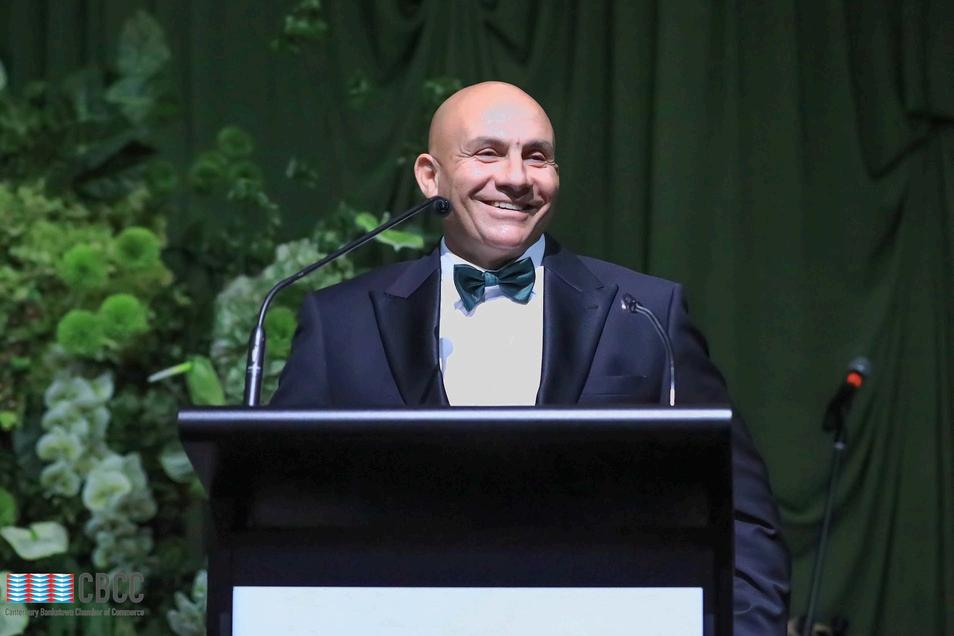



CEO Message
Corporate Partners
Upcoming Events
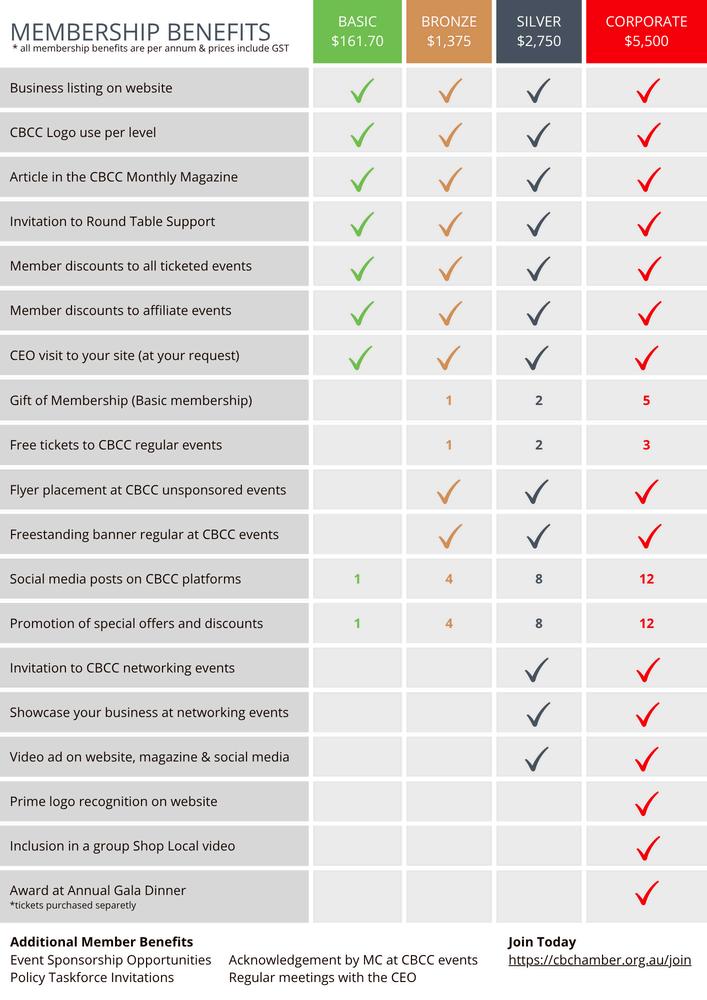
Join - Membership Benefits Advertise with us
Contact

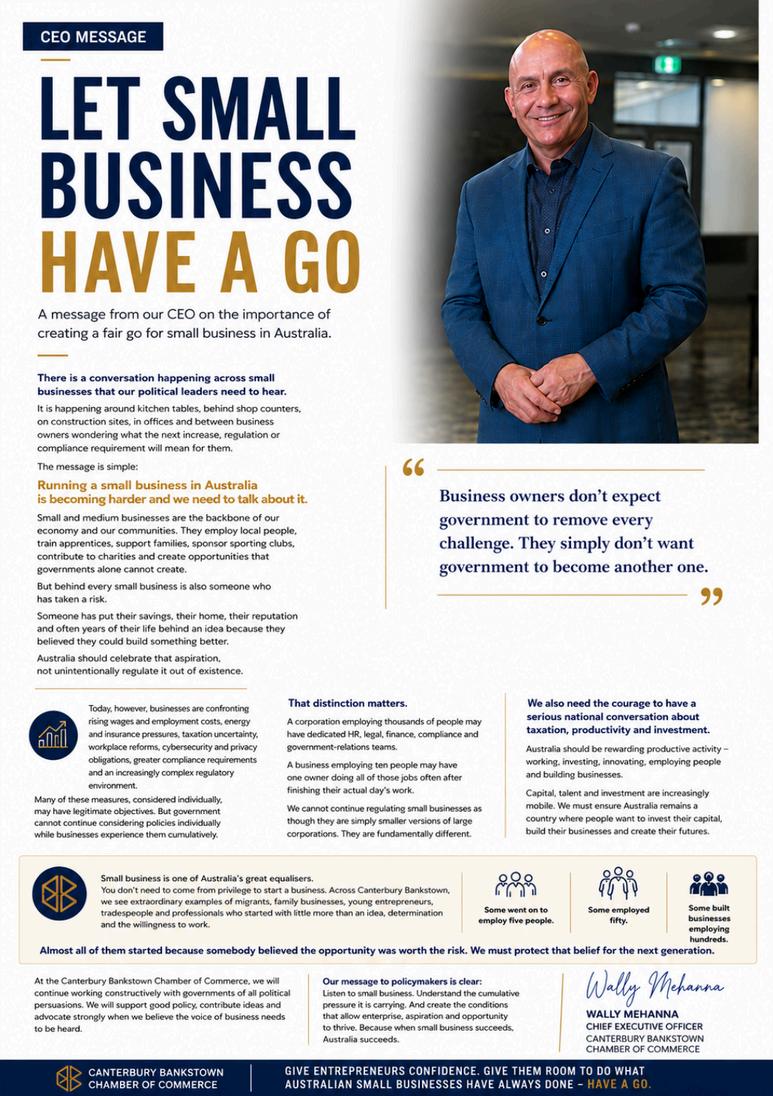
There is a conversation happening across small businesses that our political leaders need to hear.
It is happening around kitchen tables, behind shop counters, on construction sites, in offices and between business owners wondering what the next increase, regulation or compliance requirement will mean for them.
The message is simple: Running a small business in Australia is becoming harder and we need to talk about it.
Small and medium businesses are the backbone of our economy and our communities. They employ local people, train apprentices, support families, sponsor sporting clubs, contribute to charities and create opportunities that governments alone cannot create.
But behind every small business is also someone who has taken a risk.
Someone has put their savings, their home, their reputation and often years of their life behind an idea because they believed they could build something better.
Australia should celebrate that aspiration, not unintentionally regulate it out of existence.
I speak regularly with business owners across Canterbury Bankstown and South West Sydney. They are resilient people. They are not asking government to guarantee their success.
They are asking for a fair opportunity to succeed.
Today, however, businesses are confronting rising wages and employment costs, energy and insurance pressures, taxation uncertainty, workplace reforms, cybersecurity and privacy obligations, greater compliance requirements and an increasingly complex regulatory environment.
Many of these measures, considered individually, may have legitimate objectives. But government cannot continue considering policies individually while businesses experience them cumulatively.
That distinction matters.
A corporation employing thousands of people may have dedicated HR, legal, finance, compliance and government-relations teams. A business employing ten people may have one owner doing all of those jobs often after finishing their actual day’s work.
We cannot continue regulating small businesses as though they are simply smaller versions of large corporations. They are fundamentally different.
Every significant policy decision should therefore be subjected to a genuine Small Business Impact Test.
Before introducing another regulation, tax, workplace requirement or reporting obligation, policymakers should be required to ask:
What will this cost an SME?
How much additional administration will it create?
How does it interact with every other change introduced in recent years?
Will it encourage that business to employ its next person or make them think twice?
Will it encourage investment or delay it?
And ultimately, will it make Australia a better place to start and grow a business?
Because confidence matters.
When businesses have confidence, they invest. When they invest, they employ. When they employ, families prosper. And when families prosper, communities become stronger.
We also need the courage to have a serious national conversation about taxation, productivity and investment. Australia should be rewarding productive activity working, investing, innovating, employing people and building businesses.
Capital, talent and investment are increasingly mobile. We must ensure Australia remains a country where people want to invest their capital, build their businesses and create their futures.
This isn’t about left versus right. It isn’t about business versus workers. And it shouldn’t be about one government or one political party.
It is about whether Australia still wants to be a country that encourages people to have a go.
Small business is one of Australia’s great equalisers.
You don’t need to come from privilege to start a business. Across Canterbury Bankstown, we see extraordinary examples of migrants, family businesses, young entrepreneurs, tradespeople and professionals who started with little more than an idea, determination and the willingness to work.
Some went on to employ five people - Some employed fifty - Some built businesses employing hundreds. Almost all of them started because somebody believed the opportunity was worth the risk.
We must protect that belief for the next generation.
At the Canterbury Bankstown Chamber of Commerce, we will continue working constructively with governments of all political persuasions. We will support good policy, contribute ideas and advocate strongly when we believe the voice of business needs to be heard.
But we will also continue reminding policymakers of something very important:
Small business isn’t asking government to remove every challenge. Business owners understand risk.
They are asking government not to become another obstacle they have to overcome.
Give SMEs greater certainty - Give them sensible regulation - Give them an environment that rewards investment and employment - Give entrepreneurs confidence that taking a risk, working hard and building something still matters - And then give them room to do what Australian small businesses have always done:
Have a go.
Our message to policymakers is clear:
Listen to small business. Understand the cumulative pressure it is carrying. And create the conditions that allow enterprise, aspiration and opportunity to thrive. Because when small business succeeds, Australia succeeds.