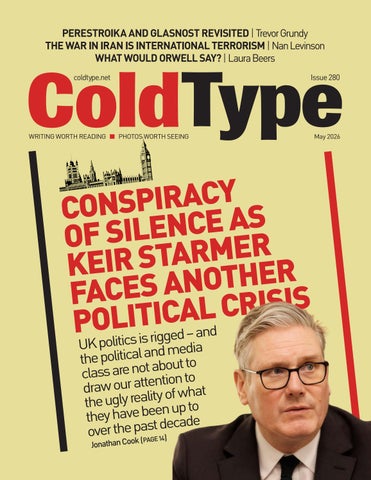
ColdType Issue 280 - May2026

Page 1


PERESTROIKA AND GLASNOST REVISITED | Trevor Grundy THE WAR IN IRAN IS INTERNATIONAL TERRORISM | Nan Levinson WHAT WOULD ORWELL SAY? | Laura Beers

CONSPIRACY OF SILENCE AS KEIR STARMER FACES ANOTHER POLITICAL CRISIS

UK politics is rigged – and the political and media class are not about to draw our attention to the ugly reality of what they have been up to over the past decade

Jonathan Cook (PAGE 14)

INSIDE

INSIGHTS

5 How US sanctions are fuelling hunger in Cuba

Medea Benjamin

7 Luck runs out as economic gloom hits New Zealand

Nigel Yates

8 War for oil? That’s why we need renewable energy Sonali Kolhatkar

8 Greed at a glance Inequality.org

9 Waste regulation turns UK into magnet for Mafia George Monbiot

10 By the Numbers Inequality.org

11 People can’t pay rent, but Trump plans golden arch Brad Reed

12 Tax the corporations that are cashing in on war Megan Schneider and Cass DiPaola 13 Reality Check

ColdType

7 Lewis Street, Georgetown, Ontario, Canada L7G 1E3

Contact: Tony Sutton editor@coldtype.net

Subscribe: For a FREE subscription e-mail editor@coldtype.net

Back Issues: www.coldtype.net/reader.html or www.issuu.com/coldtype Disclaimer:

The contents of the articles in ColdType are the sole responsibility of the author(s). ColdType is not responsible for any inaccurate or incorrect statements they may contain ©ColdType 2026.

Trump at war – Page 46

INSIGHTS

MEDEA BENJAMIN

How US sanctions are fuelling hunger in Cuba

In Cuba today, food is rotting in the fields while families go hungry.

On a recent trip to the eastern part of the island, I spoke with farmers who are watching their livelihoods slip away – not because they lack skill or dedication, but because they lack fuel, parts, and basic inputs. One farmer described fields ready to harvest but no diesel to bring the crops in. Others showed broken machinery they have no way to repair. Even those who have turned to animal traction are having problems with feed. These are not isolated stories; they reflect a system under siege.

The US fuel embargo, together with tightened sanctions under Trump, is strangling Cuba’s agricultural system from seed to table – making it harder and harder for Cubans to feed themselves.

Cuban farmers have already been operating under severe constraints imposed by US sanctions –struggling to obtain spare parts to repair tractors, access fertilisers and pesticides, or secure basic inputs like seeds. Machinery breaks down and sits idle for months because parts can’t be imported or paid for through normal banking channels.

Add to that Hurricane Melissa,

UNDER SEIGE: Farmers in Cuba are struggling to produce food under crippling sanctions imposed by the USA

INSIGHTS

which struck Cuba in October 2025, flooding fertile farmland and destroying crops. Climate change is wreaking havoc on agriculture, bringing stronger storms, longer droughts, erratic rainfall, and rising temperatures.

Into this already fragile system comes the fuel crisis, compounding every existing problem. Even the farm equipment that can be repaired can’t be used because there is no diesel to run it.

Irrigation systems go dry, planting is delayed or scaled back, and harvests are lost.

At the same time, there is not enough fuel to transport fresh produce from rural farms to urban markets. Trucks sit idle. Distribution chains break down. Food that could nourish communities never makes it to the people who need it most.

Processing food becomes impossible. Tomatoes – one of Cuba’s most abundant seasonal crops – are a painful example. Without reliable electricity, processing factories cannot operate. Mountains of ripe tomatoes, waiting to be turned into paste or sauce, are left to spoil.

Cuban farmers are certainly resilient. Across the island, they have been experimenting with agroecology, animal traction, local inputs, and cooperative models. They are finding creative ways to grow food with fewer resources. But resilience has limits. No amount of ingenuity can substitute for fuel that doesn’t arrive, machinery that can’t be repaired, or markets that can’t be reached.

This is not just an agricultural

crisis – it is a humanitarian one.

On various trips to Cuba delivering humanitarian aid, I met women across the island who are desperate to find enough food to feed their children. They spend hours in lines, piecing together meals from whatever they can find, and constantly worrying about what to put on the kitchen table tomorrow. Their struggle mirrors what is happening in the countryside: a breakdown that is squeezing both producers and consumers at once.

Families stand in long lines for basic staples. Protein is scarce. Fresh fruits and vegetables – when available – are often priced beyond the reach of ordinary people. State salaries – often the equivalent of $15 to $30 a month – have been completely overtaken by soaring food prices driven by scarcity and inflation. A few pounds of tomatoes, a carton of eggs, or a bottle of cooking oil can consume a week’s wages.

Pensioners and families living on fixed incomes are hit the hardest, forced to stretch rations, skip meals, or rely on remittances from relatives abroad – if they are lucky enough to have them.

The government has set up soup kitchens – the Sistema de Atención a la Familia (Family Care System) –to support the most vulnerable. But at the one we visited in Holguín, portions had grown smaller and less varied, and staff were forced to scavenge for wood to cook with due to gas shortages and unreliable electricity.

Rep. María Elvira Salazar, a leading voice in Congress for tightening sanctions, has openly acknowledged that the suffering of mothers and children is a price worth paying for regime change.

Perhaps she should consult with Cubans on the island – not just those in Miami – about whether this is a price worth paying.

Trump’s major proponent of squeezing Cuba is Secretary of State Marco Rubio, who argues that this pressure is necessary to force regime change and a flowering of private enterprise. But across the island, small-scale farmers and cooperatives already operate as private entrepreneurs, growing food, managing their own production, and selling to local markets–most of which have been privatised. Yet instead of supporting this sector, US sanctions are crippling it. The very people the US claims to champion are being strangled by the same policies that claim to promote them.

If the goal is to support the Cuban people, this policy is an utter failure. And for those unmoved by humanitarian concerns, think about an unstoppable wave of mass migration that may well be unleashed. In recent years, over a million Cubans – roughly one in ten – have migrated in search of a better life, most of them heading to the United States. While Trump has now closed the borders, the crisis risks fuelling a new wave of desperate Cubans.

The solution is not complicated. Lift the blockade. Allow Cuba to import fuel without threats of sanctioning the countries that provide it. Stop punishing farmers for trying to grow food – and the Cuban people simply trying to feed their families. CT

Medea Benjamin is co-founder of peace group CODEPINK, author, peace activist and wannabe salsa dancer

INSIGHTS

➤ NIGEL YATES

Luck runs out as economic gloom hits New Zealand

We are very lucky aren’t we” a friendly local mused, between enthusing over my dog and telling me of her Easter plans to read a book about Ronald Reagan. She was obviously referring to the current US/Israeli war on Iran, and in general about other unnatural disasters affecting people a very long way from this isolated South Pacific haven.

Such sentiments are common among the elderly who have probably lived through hard times and who watch TV news or read the international pages of the Otago Daily Times. We don’t know how

lucky we are was a popular song here back in the day. Such sentiments are less common among the internet generation, which can be unaware of much of what passes as real news.

A recent showed that 78 percent of New Zealanders weren’t interested in the news. Our remote location means that wars and rumours of wars are background noise which don’t affect us, so a certain complacency has developed.

We rest in peace because we have the US, UK, Canada and nearby Australia as political allies via the Five Eyes Network, and friendly relations with China and most other

countries.

However the recent Trump decision to start another oil war has certainly caused unease, especially as fuel and grocery prices are surging.

As I write, the gasoline price here in Dunedin is at least NZ$3.40 per litre, approximately double the US$4 per gallon that has rattled US citizens.

According to the government the country has 50 days of petrol and 45 days of diesel left, although a more pessimistic commentator has put it at 17 days.

Since New Zealand’s only oil refinery was shut down four years ago, all the country’s fuel comes from Asia, so we are fully exposed to the inevitable supply chain disruptions.

Some locals, when prompted, seem aghast that a demented, dictatorial, US President can so gleefully go to war and degrade the world’s economies. “He’s out the gate,” commented one neighbour, while another claimed that we are lucky to have Trump on our side “to save us from Muslims.”

A regular correspondent to the Daily Times recently accused his detractors of “Trump derangement syndrome,” an ironic take given the unhinged pronouncements emerging from the White House and Trump’s social media accounts. It just goes to show that it takes all types to make the world, or as they say where I hail from “There’s nowt as queer as folk.” CT

Nigel Yates was born in England and went to New Zealand with his family in 1966. After a career in photojournalism, he is now retired and living off-grid near Dunedin

War for oil? That’s why we need renewable energy

The war on Iran has caused the biggest oil supply disruption in history, as oil tanker traffic through the Strait of Hormuz falters.

Taken together with this year’s invasion of Venezuela, home to the world’s largest proven oil reserves, and the Trump administration’s subsequent cutting off of oil sales to Cuba – potentially its next military target – we are witnessing how the race for fossil fuel resources is compromising global peace and stability.

Oil prices have swung wildly, and impacts are being felt in the fertiliser and food sectors too. According to Andy Rowell, an editor with Oil Change International, “everything is so interlinked because we’re so dependent on fossil fuels.”

But what if we weren’t so de-

pendent on fossil fuels? Unlike oil and gas, renewable energy cannot be stockpiled. It must be used near where it is produced, making it decentralised.

“The fact that renewable energy is decentralised is probably one of the most threatening things for a sort of near-autocratic regime because you can’t control it,” says Rowell. “And the power lies with the communities and the people who are generating that electricity.”

If our electricity grids ran on renewable energy, and if vehicles transitioned from guzzling gas to running on solar and wind-powered electricity, leaders like Trump would be less able to wreak the sort of havoc we’re experiencing today. That would mean fewer wars and less economic disruption for Ameri-

cans and people all over the world.

At the same time as the global economy falters, nations are experiencing full-blown climate change, including in the United States. There are record-breaking back-toback cold fronts on the East Coast, an unprecedented heat wave on the West Coast, and catastrophic flooding in Hawaii.

A global transition to renewable energy would offer the world a chance at a different future – one without the constant fear of super-charged hurricanes, wildfires, floods, heatwaves, and blizzards.

Instead of making such an energy transition, President Donald Trump is turning back the clock on progress. For example, the White House recently offered to pay French energy giant TotalEnergies $1 billion to not develop offshore wind farms in the Atlantic Ocean. The company had purchased leases to develop wind energy under the Biden administration, but now – at Trump’s behest – it will develop gas projects in Texas instead.

“It’s completely nonsensical that you’re paying an oil and gas company a huge amount of American taxpayers’ money, that’s hardearned money,” says Rowell. Trump has essentially been enacting the oil industry’s agenda since he took office. According to Rowell, “he consults with the oil industry, and he’s funded by the oil industry and colludes with the oil industry.”

China, by contrast, has taken the logical step to transition toward renewable energy. Although it has stockpiled some oil and gas, the country’s reduced dependence on fossil fuels has made it less vulnerable to the disruptions of oil supplies caused by the US-Israel

war on Iran.

INSIGHTS

Other nations like South Korea are also moving forward on transitioning away from oil. And some smaller nations, such as Denmark and Djibouti, are on track to fully shift away from oil by 2030 and 2035, respectively.

Rowell says “it would be logical to seize this moment and to wean our economies off our fossil fuel addiction and to do a just transition to renewable energy.”

Indeed, it’s what the global cli-

mate justice movement has been calling on for decades. Not only would it be good for the planet. It would also shift power away from big global corporations and politicians and put it back in the hands of local communities. CT

Sonali Kolhatkar is host and executive producer of Rising Up With Sonali, an independent, subscriber-based syndicated TV and radio show. This op-ed was distributed by OtherWords.org

Waste deregulation turns UK into magnet for mafia

The UK is a dump. I don’t mean that metaphorically. I mean it literally. From the point of view of criminal waste gangs, it is one big potential landfill. The chances of being caught range between minimal and non-existent, and the penalties are mostly laughable. Successive governments have given criminals a li-

cence to print money.

Last month, the Commons public accounts committee reported that illegal waste dumping is “out of control.” The UK is now blighted with between 8,000 and 13,000 illegal waste sites. Most consist of a few lorry loads. Some contain tens of thousands of tonnes of waste, which might incorporate every-

thing from household products to asbestos, heavy metals and highly toxic, flammable and explosive organic chemicals. The rubbish blows through local neighbourhoods, flows into rivers and seeps into soil and groundwater. And, in most cases, nothing is done.

This is no glitch, but the inevitable result of a sustained ideological assault on regulation. Governments treat essential public protections as “red tape” that must be slashed, and regulators as “checkers and blockers” who must be vanquished. But ministers cannot simply delete protections from the statute books, for fear of provoking public fury. So instead they cut the funds for monitoring and enforcement: deregulation by stealth. The result, over the past 15 years, has been to build a whole new industrial sector almost from scratch: organised waste crime. It is perhaps our most successful growth industry.

It’s great business. Someone who wants their waste removed pays you a fee to cover transit, landfill tax and the gate charges at an official disposal site. But instead of taking it to a registered landfill, you dump it on farmland, on nature reserves, in ancient woodlands, across country lanes or even, as in Bickershaw, near Wigan, on the green space next to a primary school. You pocket the difference: about £2,500 per articulated lorry load. Anyone can play, as I discovered when I registered my deceased goldfish with the Environment Agency as an upper-tier waste dealer.

The chances of being caught are so low and the profits so high that waste dumping, as the House of Lords environment and climate change committee reports, has be-

➤ GEORGE MONBIOT
UNHEALTHY EYESORE: Illegal waste dump in Gloucestershire, England

INSIGHTS

come a “gateway” to organised crime, creating networks that then branch into drugs, guns, money laundering, fraud and modern slavery. Waste crime is changing the character of the country, socially as well as physically.

So underfunded, demoralised and utterly useless have the regulators become that, even in some of the rare cases in which they’ve begun investigations and prosecutions, the dumping has continued. This is what has happened at Bickershaw, where a 25,000-tonne illegal tip has forced closures of the primary school, filled the neighbourhood with rats and flies, damaged local people’s businesses and ruined their lives. Locals first reported the dumping in late 2024. Eventually, the Environment Agency launched what it called a “major criminal investigation.” But in mid-February this year, drone footage showed that activity at the site continued: the agency, council and police had failed to secure it.

It’s the same story almost every-

BY THE NUMBERS

where. When the first trucks began arriving on the banks of the River Cherwell, north of Oxford, in summer 2025, local anglers, neighbours and landowners reported them. The Environment Agency’s response was to issue “a cease-anddesist order.” But that was it. Not only did it fail to block the entrance, it didn’t even install a trail camera to monitor the activity and identify the culprits. Unsurprisingly, the lorries kept coming. Only months later did the Environment Agency secure the site, by which time a 20,000-tonne waste mountain, slipping into the river, had become a “critical incident.”

At Hoad’s Wood in Kent, a “strictly protected” ancient woodland, locals reported in 2020 that several acres of trees had been illegally cleared: the dumpers were preparing their site. The authorities failed to respond. Between 2020 and 2023, the gangsters deposited more than 30,000 tonnes of construction and household waste there. Local people supplied the authorities with foot-

age of the dumping and even the names of the companies involved. Nothing happened. It wasn’t until January 2024 that the Environment Agency imposed a restriction order on the site, and it was only in February 2025 that three men were arrested.

As Kent’s police and crime commissioner told a House of Lords inquiry, people “report it to the borough council, which will tell them to report it to the police, who will tell them to report it to the Environment Agency, which will tell them to report it to the council, which will tell them to report it to the police. They will just keep going round and round and round, and no one cares.” Now the cleanup operation will cost taxpayers £15m.

That’s deregulation for you. It’s yet another instance of successive governments’ bizarrely lopsided version of “fiscal discipline,” which counts the costs of action, but not the costs of inaction. On a conservative estimate, illegal dumping costs the economy in England £1bn a year. The cost of cleaning up all the criminal dumps that have accumulated over the past 15 years will, if it ever happens, amount to tens of billions. This is before we take into account the potential contamination of aquifers by toxic waste seepage, whose costs and impacts could be many times greater. And it’s all because of the cuts, saving a tiny fraction of these costs, inflicted on regulators in the name of “efficiency.”

In Aperil, the government published its “waste crime action plan.” Some of the measures are welcome, but they in no way match the scale of the crisis. It allocates an extra £15m a year for waste crime enforcement: a mere wooden sword to wield against the vast organised

INSIGHTS

crime networks that have grown in the regulatory vacuum. This also happens to be the cost of cleaning up just one of the 8,000 sites: Hoad’s Wood. Everything this plan proposes is undermined by the prime minister’s ongoing deregulation agenda, which also appears to be “out of control.”

Underfunding and deregulation, now in their fifth decade, are destroying our country. They ensure we cannot solve our problems, spreading hopelessness and passivity. They open the door to economic

mafias and to political profiteers exploiting misery and despair. There could scarcely be a more potent symbol of dysfunction and neglect than the waste piling up around us. The literal dump becomes a metaphorical one. CT

George Monbiot’s latest book, written with Peter Hutchinson, is Invisible Doctrine: The Secret History of Neoliberalism. His website is www.monbiot.com

rison Design and posted on social media by the White House’s rapid response account, show a gigantic arch that would be flanked on its corners by four gold lions and topped by a 60-foot-tall gold statue of what appears to be an angel.

According to a report in The Washington Post, some preservationists have expressed concerns that the arch, which would be more than twice the height of the Lincoln Monument, would disproportionately tower over the DC skyline, and would block views of Arlington National Cemetery.

This article first appeared in the Guardian ➤ BRAD REED

People can’t pay rent, but Trump plans golden arch

On April 10, the same day that the US Bureau of Labor Statistics showed that inflation spiked at its fastest monthly rate in four years, the Trump administration unveiled

renderings of President Donald Trump’s proposed gold-covered 250-foot-tall arch to be built at Memorial Circle in Washington, DC.

The renderings, which were produced by architecture firm Har-

Rep. Don Beyer (D-Va.) slammed the president for pushing construction of a gaudy gold-covered arch at a time when Americans are struggling due to the cost-ofliving crisis worsened by his war in Iran.

“While Americans worry about skyrocketing costs and another endless war,” he wrote in a social media post, “President Trump is focused on a taxpayer-funded vanity project that would choke traffic, block our skyline, and tower over sacred ground where those who served our nation are buried, including my own parents and sister.”

Beyer added that the arch is “about Donald Trump’s ego,” and vowed, “we’re going to stop it.”

Rep. Katherine Clark (D-Mass.) responded to the renderings by reminding the White House that “Americans can’t afford groceries.”

Progressive activist Nina Turner had a similar reaction to Clark, posting that “people can’t afford rent” in response to the renderings.

Podcaster Brian Taylor Cohen contrasted the renderings of the

TRUMP’S TRIUMPH: Architect’s drawing of proposed Trump Tower in Washington

INSIGHTS

arch with a statement Trump made earlier this month when he said “it’s not possible” for the federal government “to take care of daycare, Medicaid, Medicare, all these individual things,” because it needs to fund wars instead.

University of Missouri English professor Karen Piper also remarked on the opportunity cost of building the arch, along with other assorted Trump projects.

“This is why they’re going to take away your Social Security, saying we can’t afford it,” she wrote. “Ballrooms, arches, and Don Jr. draining the Treasury.”

California Gov. Gavin Newsom, who has been named as a contender for the Democratic Party’s 2028 presidential nomination, responded

to the arch renderings by accusing Trump of “doing everything he can to wreck this country – this time with our nation’s capital.”

Rep. Jared Huffman (D-Calif.) took issue with the decision to inscribe the phrase “one nation under God” at the top of the arch.

“That phrase came from Cold War propaganda, not our Founders,” observed Huffman. “Trump stamping it on his vanity arch tells you everything about what this project is: a Christian nationalist monument, paid for with your tax dollars.” CT

Brad Reed is a staff writer for Common Dreams –www.commondreams.org – where this article was first published

Tax the corporations that are cashing in on war

Our dependence on fossil fuels does more than pollute our air. It destabilises the world and empowers the ultra-wealthy to profit off of that volatility, leaving working families to pay the price.

This dynamic has been on full display since President Trump’s attack on Iran.

Trump’s invasion of one of the world’s most oil-rich regions jolted energy markets, sending gas prices soaring to the highest level in either of his terms. In 2024 he campaigned on cutting them in half. Instead, Americans are now on track to pay roughly $720

more for gasoline this year. The full cost to working families will be much steeper as high gas prices drive up prices on consumer goods across the board. We’re already seeing that ripple effect take hold, as the US Postal Service has proposed a temporary 8 percent fuel surcharge on package deliveries to offset rising transportation costs tied directly to the war-driven spike in oil prices.

At the same time, the oil and gas companies that invested at least $75 million in Trump’s reelection are cashing in on this instability. A recent Financial Times analysis estimates that US oil companies could collect an additional $63 billion in revenue this year if crude prices remain at these wartime levels. In March alone, the industry is expected to generate $5 billion in extra cash flow.

This type of windfall isn’t a fluke. We’ve seen this pattern for decades. Oil has a way of appearing in the background of every chapter of US military intervention in the Middle East and beyond. Iran nationalized its oil industry in the 1950s and a CIA-backed coup followed. Iraq, sitting on some of the world’s largest reserves, was invaded in 2003. And earlier this year, the US invaded Venezuela and immediately began plans for a taxpayer-backed oil industry takeover.

Dependence on fossil fuels keeps us trapped in this cycle. Oil executives have spent billions to maintain this status quo, backing politicians like Trump who will protect their profits.

INSIGHTS

As the oil industry rakes in eyepopping profits, it gains more power to elect leaders who prioritise policies that ensure Americans remain reliant on fossil fuels.

Following Russia’s invasion of Ukraine, Congress considered a windfall profits tax on large oil companies that would capture the excess profits generated by the crisis – and return the money to American households. Roughly 80 percent of Americans supported the idea.

Failure to advance that legislation cost us. Researchers calculated that if the US had redistributed the portion of fossil fuel profits that exceeded 2021 returns, every American household could have received $1,715.

As oil executives profit off the war in Iran, Congress must push for a windfall profits tax on oil companies. This isn’t an outlandish idea. Other countries have already done it. After the 2022 energy shock, the United Kingdom enacted a windfall tax on oil and gas companies, raising about $3.3 billion in its first year and roughly $4.5 billion the next – money used to help households pay their energy bills.

The current situation in Iran underscores how unchecked extreme wealth fuels corporate control, leaving working families vulnerable.

New data from Impact Research for Tax the Greedy Billionaires shows that voters blame billionaires for the affordability crisis and want leaders to do more to address this. In fact, 77 percent of voters nationwide – including 65 percent of Republicans, 75 percent of Independents, and 91 percent of Democrats – support raising taxes on billionaires.

Under the Trump administration,

war profiteering has reached new extremes. Confronting corporate power and taxing the ultra-wealthy isn’t just about economic fairness –it’s a national security imperative.

To reclaim our foreign policy from those who see a global crisis as a line-item on an earnings call, we must break the billionaire grip on our energy system, economy, and democracy writ large. If we

want a democracy that works for the people, we must stop letting it be sold to the highest bidder.

Meghan Schneider is the communications director for Tax the Greedy Billionaires. Cass DiPaola is the communications director for the Make Polluters Pay Campaign. This op-ed was distributed by OtherWords.org CT

➤ REALITY CHECK FROM THE INTERNET
➤ JONATHAN COOK

Conspiracy of silence as Starmer faces another crisis

UK politics is rigged – and the political and media class are not about to draw our attention to the ugly reality of what they have been up to over the past decade

had been denied clearance.

Robbins, in turn, told a committee of MPs on April 21 that by the time he took up his post the deal on Mandelson was done. Starmer’s office put “constant pressure” on his department to retroactively approve Mandelson’s appointment.

His testimony to a parliamentary committee suggests that, given the febrile climate in Westminster at the time, he may have been misled over what the vetting process had discovered in a bid to smooth Mandelson’s path to Washington.

hese claims and counter-claims serve chiefly to obscure the central fact that Starmer is either a liar or

Mandelson had to resign from the post of ambassador last September over his ties to Epstein. Either Starmer failed to check on the politically explosive matter of Mandelson’s security clearance in the meantime or, more likely, he did and has been “misleading” – that is, lying to – the media and parliament

UNDER FIRE: British Prime Minister Keir Starmer slammed over decision to appoint disgraced politician Peter Mandelson as US ambassador

ever since.

As Starmer himself admitted to the House of Commons last month –to raucous laughter – the whole story sounds “incredible.”

In truth, everything about Starmer’s rise to power – and the media’s permanent incuriosity about how that rise was engineered – is incredible.

The deeply troubling back story to Starmer’s political evolution is yet to be told by the establishment media. As critical as they currently are of his treatment of Mandelson, the me dia are telling only half the story –the surface part.

The prime minister’s political subservience and vulnerability to Mandelson – why Starmer was determined to promote him to the post of ambassador despite the all-too-conspicuous dangers – have gone largely unexamined by the media.

The answers are available elsewhere, such as in in vestigative journalist Paul Holden’s recent book The Fraud, an examination of Starmer’s rise to power, which has still not been reviewed by a single mainstream publication.

who propelled Starmer to high office. He was forced to quit as the the prime minister’s chief of staff over his involvement in Mandelson’s appointment.

Around the same time, Josh Simons, then a minister in the Cabinet Office and a Starmer loyalist, was in-

At the very least, the real story should have come to light when Mandelson, the grand old man of the Labour right, was arrested in February on suspicion of “misconduct in public office.” He is accused of passing on confidential market information, in his role as business secretary, to Epstein.

That followed the resignation weeks earlier of Morgan McSweeney, Mandelson’s protégé

vestigated – by the Cabinet Office – over revelations that he funded a covert smear campaign on journalists critical of Starmer. Simons has since stepped down from the government.

There is a thread connecting all three figures – a thread that ties them intimately to Starmer and the current furore.

They were each essential to the operations of a shadowy think tank called Labour Together. It was founded in 2015 in the immediate wake of Jeremy Corbyn’s election as

Labour leader.

The group quickly strayed from its ostensible remit of uniting a party divided by Corbyn’s election between, on the one hand, hostile MPs and a hostile party bureaucracy and, on the other, the Labour membership. Labour Together’s real, covert task was to deepen those divisions.

With the help of rich donors, Labour Together created a secret slush fund worth at least £730,000 to wage a public relations war against Corbyn and the left – a campaign that was enthusiastically supported by the establishment media.

With Corbyn finally ousted, Labour Together then mounted a new operation, using those same funds, to deceive party members into crowning Starmer as leader on the

Peter Mandelson (above), Morgan McSweeney (left), and Olly Robbins (below left)

basis he would continue Corbyn’s policies.

Following his election, Starmer immediately set about purging Labour of its left wing, driving down the record membership numbers brought in by Corbyn and relying instead on rich business donors.

Labour under Starmer became another party entirely captured by the business class. The Conservative and Reform parties were thereby given permission to hew even further to the right, to distinguish themselves from Labour.

For the past decade, Labour politics has been a charade – and one that not only betrayed the values it publicly claimed to espouse but skated constantly close to illegality. The Electoral Commission fined Labour Together for unlawful conduct after McSweeney repeatedly failed to abide by its warnings to declare the money wealthy benefactors were pouring into his slush fund.

This was not an oversight. It was

verting the democratic process by using Big Money – to become public knowledge. The very nature of Labour Together’s anti-democratic agenda necessitated operating in the shadows.

It was for that reason that Corbyn called in February for an independent public inquiry into what he termed the “sinister operations” of Labour Together. The government responded dismissively. But that is because, were the threads to unravel further, they would almost certainly lead directly to Starmer’s door.

Mandelson was one of the driving forces behind Labour Together, famously alluding to his role in a 2017 comment that “every day, I try to do something to save the Labour Party from his [Corbyn’s] leadership.”

That same year McSweeney took over the reins of Labour Together, using the undeclared funds to covertly character-assassinate Corbyn and then dupe Labour members into voting for his and Mandelson’s preferred candidate, Starmer.

n late 2023, a year after taking over Labour Together, Simons turned to the same character-assassination playbook developed by McSweeney.

This time, instead of smearing the Corbyn-supporting Labour left, he targeted a handful of journalists who had started to dig into the covert, and unlawful, operations behind Starmer’s rise to power.

Simons commissioned a report, codenamed Operation Cannon, into the journalists’ “backgrounds and motivations.” It helpfully claimed, without evidence, that these journalists had colluded in a supposed Kremlin-backed hack of the Electoral Commission.

Simons went so far as to pass on this disinformation about the journalists to the National Cyber Se-

curity Centre, a division of GCHQ, presumably so they could be investigated for breaching national security. Tellingly, the centre refused to get involved.

What Simons was up to is not hard to fathom. Labour Together was trying to create a British version of the US Democratic party’s years-long, fruitless efforts to promote a “Russiagate” conspiracy theory that Donald Trump had colluded with the Kremlin to get elected.

The Democrats hoped to foreclose any examination of their incompetence and institutional corruption in losing the 2016 presidential election by attributing any such discussion to Russian disinformation.

Labour Together, meanwhile, wanted to shut down any examination by journalists of its own misdeeds by attributing them to Russian disinformation. The aim was to scare these journalists away from scrutinising Labour Together’s activities.

But the truth is the establishment media continue to have little appetite for the bigger Labour Together story, even though its journalists have known about the group’s illicit activities since at least 2021, when the Electoral Commission issued its

Jeremy Corbyn was kicked out of Labour after antisemitism smears

fine for 20 breaches of electoral law.

More likely, some in the media knew what was going on even earlier, when McSweeney and others close to Starmer were ignoring Electoral Commission demands that the slush fund money be declared.

The media are still resolutely refusing to join the dots – and continue to allow Labour Together to hide in the shadows, even though it has a starring role in this and the Mandelson story.

The reporting of McSweeney’s fall solely concerns his poor judgement in promoting Mandelson to the US ambassadorship, not about his unlawful behaviour as head of Labour Together.

The reporting of Mandelson’s fall is about his alleged insider trading with Epstein, not about his conniving with Labour Together to undermine the democratic process.

The investigation of Simons is attributed personally to his poor judgment in financing a report against journalists, rather than the fact that this smear campaign was entirely of a piece with Labour Together’s activities over many years.

In an uncritical BBC report last month Simons claimed only that he had been “naïve” in colluding in the smearing of the journalists rather than concede that it was Labour Together’s modus operandi.

Insofar as Labour Together has been mentioned in this story, it is only because it provided the pot of money Simons used to target journalists who had fallen foul of Starmer.

Tellingly, Simons alludes to his and Labour Together’s real agenda in the BBC account, telling the state broadcaster that he acted – to damage the reputation of journalists – out of fear that their reporting “might be used to retell the story of the antisemitism crisis that happened under [Labour] and to downplay it.”

In truth, this decade-long campaign desperately needs retelling – in a way that makes clear how

Labour Together emerged as an exercise in democracy subversion to stop a socialist gaining political power in the UK

FRONT PAGE NEWS: Britain’s tabloid press finally gets to grips with the scandal erupting around Keir Starmer

the Labour right, backed by es tablishment media like the BBC, weaponised antisemitism to oust Corbyn.

Not suprisingly, outlets like the BBC are not likely to dig deeper to reveal what really took place.

Instead, the media are treating these episodes as individual failings rather than evidence of institutional capture of the Labour party by the Epstein class and its hangers-on.

Labour Together emerged as an exercise in democracy subversion to stop a socialist gaining power. And it then continued as an exercise in democracy subversion to install permanent guardrails against the Labour party ever being led by anyone other than a placeman, like Starmer, for the billionaires.

The point was to make British politics a simulacrum of US politics: two main parties representing –and ensuring the permanent rule of – the super-rich, and mirroring minor internal differences in their per-

ceptions of how to best safeguard their class interests.

All of this happened in full view over the past decade. But it was impossible to get it into the mainstream. Even at this stage, the real story is not being allowed to break through. Because it would expose not just corruption at the heart of the British political system but at the heart of the British media system too.

The state and billionaire-owned media was happy to see democracy covertly subverted if it ensured Corbyn would be prevented from winning power. And the media was equally pleased to promote the Starmer cabal as gatekeepers over who would be allowed to lead the Labour party. There was a shared interest in entrenching how the system was rigged.

Anyone who doubts that the media has been deepy complicit in the cover-up of Labour Together’s activities should recall that there were journalists – and others – reporting on Labour’s dismantling of internal democracy to preclude the emergence of any kind of meaningful political choice. However, they were denied mainstream attention.

The internal plotting against Corbyn was first highlighted in 2017 by Al Jazeera’s three-part undercover investigation The Israel Lobby, which showed how an Israeli embassy official, Shai Masot, was covertly working with the rightwing Labour factions to use antisemitism to destroy the party leader.

Three years later, as Corbyn stepped down, a cache of internal Labour party documents was leaked showing that the party bureaucracy – loyal to the Mandelson wing –conspired to bring about Corbyn’s downfall. It even prioritised his destruction over winning the closely-

The internal plotting against Corbyn was first highlighted in 2017 by Al Jazeera’s three-part undercover investigation, The Israel Lobby

fought 2017 general election.

Starmer appointed a KC, Martin Forde, to investigate the leak –chiefly, it seems to identify who was responsible and punish them.

Forde would later admit that Starmer’s team had obstructed his work and tried to endlessly delay the report. But when it was finally published in summer 2022, Forde confirmed what was already obvious: that the Labour right had waged a dirty factional war against Corbyn and the left of the party, weaponising antisemitism to tar them.

Months later, Al Jazeera would air a second, four-part investigation, The Labour Files, showing how the party’s right wing – loyal to Mandelson and McSweeney – purged the party’s left wing based in most cases on false accusations, fabrications, misrepresentations and smears. The documentary fully justified one victim of those purges describing the past few years in Labour as a “criminal conspiracy against its members.”

All of this happened unreported by the media.

The revelation in The Israel Lobby documentary that Labour had been infiltrated by an Israeli spy with the active collusion of sections of its members and MPs to take down a potential prime minister provoked no political or media debate.

The follow-up disclosures in the leaked Labour internal review, the Forde Report and The Labour Files have similarly dropped off the radar, even as the story they tell is the

only way to make sense of the serial falls of McSweeney, Mandelson, Simons and, soon, Starmer.

Similarly, Paul Holden’s book The Fraud, which brings the unlawful activities of Labour Together sharply into focus, is being ignored rather than mined for details of what has really happening in British politics over the past decade.

These resources have all been buried, even as the Mandelson furore fully justifies their vigorous excavation.

There is good reason. Because the plan is to roll out the same, antidemocratic playbook against the Green Party and its leader Zack Polanski, because he is seen as another Corbyn-like figure who refuses to bow down before the Epstein class and rejects the warmongering, money-laundering, resource-grabbing exploits of the western war machine posturing as a Nato “defence” alliance.

Polanski is Jewish, but the signs are already there that this will not stop the same charlatans who defamed Corbyn from “outing” Polanski as an “antisemite.”

It can happen again because the same media that colluded in Starmer’s rise by engineering Corbyn’s downfall will once again do their duty and defend the interests of the billionaire class.

The system is rigged – and the people rigging it are not about to draw our attention to the reality of what they have been up to. CT

Jonathan Cook’s latest books are Israel and the Clash of Civilizations: Iraq, Iran, and the Plan to Remake the Middle East (Pluto Press) and Disappearing Palestine: Israel’s Experiments in Human Despair (Zed Books). His website is www.jonathan-cook.net

➤ EDWARD CURTIN

Surveilling swine

Mainstream news needs to pay attention to 70-year-old research into astonishing similarity between porkers and politicians

As a professor of linguistics at one of the United States’ most elite universities, my lifelong best friend, fearful of the consequences of publishing what follows in his own name because of the political climate created by President Donald Trump, and POTUS’s vindictive nature, asked me to publish it under mine. He admits it is not courageous of him, but sometimes caution is advisable, and the research he reports on has long been repressed and censored despite its monumental importance, and despite my previous efforts to help him reach a public increasingly prone to dismiss  its serious consequences. This is especially true since Donald Trump took office. I am proud to present what follows under my name but can take no credit or responsibility for it. And for my friend and myself, I apologise during a time when terrible events are about to get far ghastlier still – to the point of unbelievability. But even in the darkest time, the eye begins . . .

Tseem unimportant, but I can assure you they are not, for extensive scientific research over seventy years has concluded that swine that stink and grow larger as they age have small eyes and tend to stare at people. As you may know, academic research that seems ridiculous like this often has very serious consequences; so much is done behind our backs and may seem ass backwards but receives extensive government funding for treacherous reasons. I have previously reported on these startling studies, but they have been

days about “fake news,” omitting important news is perhaps as widespread and egregiously harmful to an informed, public. This is especially true now when news and data overwhelm the public’s ability to digest it.

Sometimes it is helpful to gain a bit of a perspective by taking a different approach, and looking at scientific research that has been for years ignored by the media, may help us see our current situation clearer. Little things mean a lot.

The following report tries to remedy the way the mainstream media

have for years ignored one of the oddest but more important news stories of the last seventy years.

Its implications are momentous, especially in the light of the exponential growth of spying and the loss of privacy and freedom that have resulted from the extraordinary measures the US government has taken to shut down society while spying on us, creating chaos, and waging wars of aggression.

There are eyes everywhere these days. That we are being watched is beyond dispute; but by whom and why?  This is the real story that the mainstream media have failed to address. Their failure to do so is truly laughable I beseech readers not to dismiss the significance of the profound nature of the following studies, which may at first glance not seem pertinent in a world gone mad politically.

Extensive scientific research over more than seventy years has concluded that pigs that stink and grow larger as they age have small eyes and tend to stare at people. I have previously reported on these startling studies, but they have been met with a blind eye, as I said before.

That is true even at my own university, one of the most famous research institutions in the world. Yet intrepid researchers across the world continue to replicate and confirm the findings of the original research done in 1953 in Kansas by Dr. Wilfred Jeffred Eftie. Additionally, the mainstream media, as usual, keep failing to report these extraordinary studies or slight them as worse than fake news.

Averting one’s gaze from their import won’t make them disappear. Surveilling pigs may not be obvious, but the fact that they’re not, makes them quadrupedally dangerous, especially in times like these.

Surveilling pigs may not be obvious, but the fact that they’re not, makes them quadrupedally dangerous, especially in times like these

While seemingly insignificant on the face of it, these replicated studies in abnormal autology have led to new insights into our osmological understanding of the place of egoism in political life. The epistemology of egoism has long perplexed scientists, but Eftie’s brilliant counterintuitive insights have led to some major breakthroughs.

However, the story of Eftie’s original discovery, ignored for years, deserves renewed attention. But I will get to that in due course. It is best to proceed backwards. Looking back will allow us to see if we have learned anything from the past and if something is gaining on us, or are we just slowing down.

So let’s first take a look at a few of the significant follow-up studies that have added so much to our understanding of human animal behaviour. It’s surely an understatement to say that in the world of science we stand on the shoulders of giants such as Eftie. It allows us to see so far if we are willing to get up there.

One study that has been replicated 789 times found that small eyes in humans tended to result in marked elevations of dopamine and diminished activity in the frontal cortex, the same results that were found in pigs.

When translated into the political arena, researchers found that politicians with small eyes tend to stare at people as a power tactic, and such body language is correlated with a tendency for them to grow larger as they age – i.e. get fat. Their smalleyed stares seem to intensify the

power differential between them and those stared at, but this has not yet been conclusively proven and remains a correlation. Further studies are under way.

Unlike the pig studies from which this research emanated, no correlation was found to body odour, despite the current promotion of full body deodorant. However, one eminent New York City based researcher, Dr. Wilbur Shoat, made the startling discovery that smell is very subjective, and therefore in the human samples an intervening variable, such as the number and consistency of nose hairs, may be a factor, or that another intervening variable, such as deodorant, may be a factor. Perfume and aftershave are also suspected.

However, Shoat did find a possible link that demands further study: In the politicians and celebrities that comprised his sample – seemingly different from the original pigs – there was a significant probability that the sulphuric whiff they gave off, came from their mouths when they talked, unlike the small-eyed fat pigs that stank all over.

But Dr. Shoat, coming from a long line of swine scientists, had presciently hypothesised that finding, though common sense would have us expect the exact opposite. But then again, common sense often over-exaggerates its ability to grasp the nuances of science and understand its processes. Perhaps this is because so much science reporting is written in jargon-filled prose and not clear, non-redundant language understandable to the average normal person. Unlike today, reporters and doctors once wrote clearly, as the following quote from one of Dr. Eftie’s follow-up studies exemplifies:

“Without resorting to value judgements, it is the intent of this research

project to substantiate an empirical relationship between the small size of the medium swine eye (as intensified through the pig smell/eyelid blink factor) on the one hand, and resulting intrafamily behavioural oddness on the other…. Animals in the control group progressed, without exception, from small to large size as they matured, thus creating the impression that they could both see more and take increasingly decisive action in response to visual stimuli.”

An ingenious researcher, Dr. Edward Edwards, an ethno-methodologist known for his determinist determining twin studies, recently took the small-eyed pig studies and applied their methodology to selfpromotion among well-known people – i.e. celebrities and politicians. He reviewed thirty-five books they had written, including autobiographies and political memoirs, and concluded that those with the smallest eyes (based on optical scans of book jacket photos) tended to have the largest egos. While his sample size was admittedly small, so were their eyes, and he thought intensity of gaze was more important than size. He reported that in a eureka moment he realised that they all seemed to be looking intensely at him.

What his subjects had in common – aside from money and many having been mentioned in the Epstein files – was that they considered themselves to be “somebodies” (his term). As a good researcher does, he operationalised the term “somebody” to mean “not nobody,” making sure to be precise. What else, if anything, a “somebody” is he left hanging until his follow-up study when he plans to interview the thirty-five and ask them.  He expects they will gladly answer, and that those answers will buttress his em-

Sadly, the first pigs observed by Dr. Eftie are long deceased. They stare no more. Absurd as it may sound, we owe them a great deal

pirical findings.

One of the most intriguing aspects of all this ground-breaking research is how it sheds light on the need to replicate studies and repeat inconvenient truths that people wish to avoid. Repetition, repetition, repetition – that’s the key – a sine qua non of the scientific method and the best news fit to print, as Edward Bernays, Sigmund Freud’s nephew and mentor to certain German leaders, instructed our finest opinion leaders.

However, those leaders tend to repeat statistics that so often confuse people rather than clarify what’s really happening. Our current headlines about our wars around the world are a case in point where large numbers don’t help the public’s understanding.

Better to simply say we are suffering from stupidity and blood lust. That may be unsettling, but it’s simple and serious and shows they aren’t joking around. Of course the news of Dr. Eftie’s important work can’t be repeated by the mainstream media since they have never reported it. Their focus on fake news reporting has diverted our attention from this censorship by omission.

One might reasonably conclude they have no interest in autology or pig gazing, and that is a god-damned shame. You can see I’m getting emotional, but the findings about pigs reported here need wide and ceaseless publicity, and we depend on our mainstream media to do that. Keep hammering the same point; that way truth will emerge. People need

to hear things repeated before they sink in.

Sadly, the first pigs observed by Dr. Eftie are long deceased. They stare no more. Absurd as it may sound, we owe them a great debt. Since a pig’s life is a brief prologue to bacon in a country devoted to devouring the evidence of its crimes, most researchers have had to study the children and grandchildren of Eftie’s pigs. But their offspring have flourished – thank God for that. Pigs seem to reproduce rapidly and in great numbers, and researchers today have a wide assortment to choose from – across species.

But it’s important to emphasise the need to focus on not just the research into political pigs with small eyes and big egos, but what they say, and what we say about what they say, and what the media repeats about what they think about what they say.

We need the straight truth, and I think that if we compulsively repeat ourselves, we will certainly be marching toward the light. But it takes perseverance. If we stick to our guns, remain humble, and keep repeating ourselves, this writer believes we will perhaps discover that even pigs with large eyes stare at people. That should wake people up.

After all, Dr. Eftie’s dazzling insights had humble beginnings, but he kept after it. The roots of his genius lie in his childhood, as his first observational study makes clear.  He was a brilliant and precocious child. When he was seven years old and just starting the second grade, his teacher, Mrs. Schmidt, had the novel idea of having her students write about what they did on their summer vacation. Wilfred’s scholarly career began with that essay which became the basis of his lifelong research. He went on to earn

two PhD’s and to occupy the prestigious Dulles Chair in Linguistics at the University of Grynchester.  Here it is:

Wilfred E   2A     My Sumer Vacashin

I spent too to weeks all sumer at my Granpa Efties on a farm in Conzu Canz Canzus. i saw many pigs their. Sum of the pigs saw me too two. With there tiny eeis eyes. The Big pigs were very big. Sum little pigs got born wile i was their. They were litler. My granpa Eftie gos out and feeds the pigs evrry day. i think that is what maiks the pigs smell like  my granpa Eftie evrry day.

While this childish writing is humorous, it became the inspiration for Dr. Eftie’s scientific breakthrough years later.  In 1973, the writer Tom Koch wrote a fascinating article describing Eftie’s step-by-step maturation on his way to his PhDs. It reads like a case study of Piaget’s four

It is hoped that this update will convince the sceptical that there is more truth in a pig’s eye than seems to be the case

stages of cognitive development or Dr. Kubler-Ross’s five stages of grief – Denial, Anger, Bargaining, Depression, Acceptance (DABDA); I forget which.  Scholars from across the disciplines should study it since they tend to like stages.

But little news since has been devoted to the advances made by Doctors Shoat and Edwards in their follow-up studies. After all, studies replicated so many times demand attention, especially considering their findings. It is hoped that this update will convince the sceptical that there is more truth in a pig’s eye than seems to be the case.

News like this is often overlooked by the mainstream media that prefer what they call “real news,” sensational stories. But it behooves us to stand with Dr. Eftie and the importance of his insights into pigs, especially those with small eyes, since they are looking at us, and we at them. The surveillance state has arrived and we have arrived at a terminal stage.

“Here’s looking at you, kid.”

* Dr. Eftie’s lifetime work, including “My Sumer Vacation,” is comprehensively covered by Tom Koch in the April 1973 issue of Mad magazine, perhaps for many years this country’s finest research journal, now defunct. CT

Edward Curtin is a sociologist, researcher, poet, essayist, journalist, and novelist. His latest book is At The Lost And Found: Personal & Political Dispatches of Resistance and Hope (Clarity Press).

Electric motorbike has key role in Africa’s future

It can be built locally and powered by solar – our 6,000km ride shows how

Across much of Africa, motorcycles are not leisure vehicles. They are workhorses. They carry commuters, schoolchildren, goods, medicines and deliveries. For millions of people, they provide the most affordable and accessible form of transport, while also creating livelihoods for riders and small businesses.

In many places, they fill the gap left by limited public transport. Kenya alone has about 1.5 million riders.

But, of the 27 million motorbikes in sub-Saharan Africa, only about 0.1 percent are electric, running on clean and low-cost energy. As part of a team of electrical and industrial engineers at Stellenbosch University in South Africa, I work (and go on adventures!) to see if that share can be increased.

When our team rode a locally manufactured electric motorbike from Kenya to South Africa in 2024, charging it with only solar power and battery storage along the way, we were not only testing a vehicle. We were testing whether Africa could build and power its own electric mobility future.

The journey covered roughly 6,000 km via cities, rural roads and border posts, showing that electric two-wheelers are not a distant dream for sub-Saharan Africa. They are already practical, and they point to a much bigger opportunity.

Electric motorcycles with battery swapping fit the realities of mobility demand in Africa: relatively short daily trips, constant use, tight operating margins and the need for low-cost transport. It’s already been estimated that electrifying this segment will reduce total cost of ownership for riders by 35-40 percent, improve urban air quality, cut greenhouse gas emissions and lower dependence on imported fuel.

Our research suggests this transition is both technically and economically feasible:

l We found that electrifying Nairobi’s boda bodas could cut carbon emissions by about 85 percent, and that solar-powered systems would be better suited to battery swapping than home charging.

l Our modelling of 39,005 delivery trips in Cape Town showed that electrification works even better when fleets are right-sized and charging aligned with solar cycles.

Together, these findings suggest that electric micromobility in Africa is not only technically viable, but can be paired with local solar systems in ways that improve affordability, resilience and access.

Africa should not simply become a market for electric vehicles designed and manufactured elsewhere, but should become a place where

they are built, adapted and improved for African conditions. The continent’s mobility needs are specific: vehicles must cope with rough roads, heavier loads, long operating hours and uneven access to charging. A motorcycle designed for Europe or Asia is not always right for a boda-boda rider in Kenya or a deliv ery rider in South Africa.

Local production would also cre ate local jobs. It can create opportu nities in assembly, fabrication, battery integration, electronics, soft ware, data analytics, servicing and charging infrastructure. It would give young engineers, technicians and entrepreneurs a foothold in an industry that is already growing quickly.

But that growth will not happen on its own.

It needs policy sup port. Ethio pia banned im ports of internal combustion engine ve hicles in 2024. This rapidly accelerated EV adoption and altered the eco nomics of vehicle imports. South Africa’s belated 150 percent tax incentive for local

electric vehicle production is also a step in the right direction.

Sub-Saharan Africa has some of the best solar resources in the world. At the same time, many communities still face unreliable grid electricity or no access at all. That may sound like a barrier to electrified transport, but it is also an opportunity. Compared with large cars or buses, small vehicle batteries are far easier to charge from decentralised solar systems. Solar-powered charging points, battery swap stations, mini-grids and storage systems can all support electric motorcycles where conventional infrastructure is weak.

Charging has already been demonstrated on solar-hybrid minigrids, particularly for rural electric two-wheelers, with documented cases in Nigeria and operator-led

electric motorbikes achieved payback periods of under five years in favourable cases and improved supply reliability for external users by about 60 percent.

This matters especially in rural and peri-urban areas, where mobility poverty is often most severe. A locally manufactured electric motorcycle charged with solar power is more than a cleaner vehicle. It is a tool for inclusion. It can improve access to jobs, education, healthcare and markets while reducing exposure to fuel price shocks.

That is why this transition should not be framed only as a climate issue. It is a development issue.

AOur research has found that decentralised solar can help power this transition: a schoolcentred solar trading model ser-

frican governments must also make it easier to produce and sell electric vehicles locally. At present, many local manufacturers face the strange situation where importing a finished vehicle is cheaper and simpler than building one domestically. High duties on components, inconsistent regulations, costly certification, weak access to finance and uncertain policy signals all work against local industry.

If governments are serious about industrial development, electric micromobility is a practical place to start. Support could include lower tariffs on components for local assembly, tax incentives for domestic manufacturing, development finance, clear technical standards and public procurement policies that create dependable demand. The aim should not be permanent protection, but smart support that helps African firms scale and compete.

Governments must support crossborder collaboration. Africa’s challenges are shared, but our responses are often fragmented.

Many African borders were imposed in colonial times. They do not reflect the deeper connections

between economies, people or problems. Fuel insecurity, unemployment, poor public transport, congestion and unreliable electricity are not isolated national problems. They are regional realities. The response should therefore also be regional.

That means harmonised standards, easier trade in locally made vehicles and components, shared research platforms and coordinated industrial policy.

A larger, more integrated African market would help manufacturers scale up, reduce costs and justify investment in skills and supply chains. It would also allow innovations developed in one country to spread more quickly across the continent.

Electric mobility policy must be linked to energy policy, especially solar energy.

Our journey from Nairobi to Stellenbosch, now told in our sevenepisode documentary series, Recharging Hope, was not a publicity stunt. It was a practical demonstration that locally-made electric motorbikes, powered by solar energy, can work across African roads and real African conditions. The question is no longer whether this future is possible. It is whether policy and investment will help Africa build it for itself.

With the right policies, partnerships and investment, electric micromobility can help the region move people more affordably, build local industry more confidently and use the power of the African sun more fully.

Africa’s mobility future should be built in Africa and powered by its own abundant renewable energy. CT

MJ (Thinus) Booysen is Professor in Engineering, at South Africa’s Stellenbosch University. This article was first published at www.theconversation.com

Electric bike on the road in Kenya
Photo: Lewis Seymour

TREVOR GRUNDY was invited to visit the Soviet Union in August 1987. It was an unusual invitation because this naturalised Zimbabwean based in Harare was a government-approved correspondent for a number of media outlets, including Beeld in Johannesburg and Radio Today, then part of the South African Broadcasting Corporation (SABC), both of which were fiercely opposed to the USSR

Back in the USSR: Perestroika and glasnost revisited

Harare, Zimbabwe June 1986

June 16, 1986 was the tenth anniversary of the Soweto Uprising. That night I drove to a reception at the Soviet Embassy in Harare. It wasn’t long before a young overweight man called Sergei Borosov introduced himself as the Regional Representative of the Novosti Press Agency in Moscow.

I told him I was English and he said, “Yes, I know. But I also know that you are now a Zimbabwean citizen who travels to South Africa, writes for the government newspaper Beeld and broadcasts almost every day to Radio Today part of the South African Broadcasting Corporation. All done from Harare with the permission of the Zimbabwean Government. In Russia we’d call you a special case.”

“Or Useful Idiot,” I responded.

We laughed and he asked if I would like to visit the Soviet Union and perhaps do some broadcasts from Moscow to Johannesburg.” Quickly adding, “With the permission of the Zimbabwean government, of course.”

The next morning, I went to see the Zimbabwean Director of Information, Justin Nyoka, the former BBC Africa correspondent who was now the ruling party watchdog over the journalists he once worked alongside. He said, as a Zimbabwean, I should make no plan until the minister returned from a meeting at the OAU headquarters.

During the Rhodesian war, the Soviet Union had supported Joshua Nkomo, leader of the Zimbabwe African

People’s Union (ZAPU) and not the now-ruling Zimbabwe African National Union (ZANU), led by Robert Mugabe.

Harare, Lusaka, Budapest, Moscow, August 3, 1987

On August 3, 1987 I stood in a queue at Harare Airport behind veteran London Sunday Times journalist, Eric Marsden, whom I knew from an 18 months’ stint in Nairobi. We were both awaiting a plane to Lusaka.

“Where then?” he asked.

“Moscow, via Budapest.”

“Got your bucket and spade?”

I stubbed a cigarette before moving toward the departure gate.

“Moscow, eh? Place you should be is Senegal. You know that the Afrikaners and the ANC are smoking peace pipes in Dakar?”

I knew nothing about that. I said, “I’m told that passengers can’t get an alcoholic drink on Aeroflot?”

He replied, “That’s right. Only the pilots.”

In Lusaka, passengers for Moscow were told they would have to stand next to their suitcase before they boarded the plane. But that would be later in the afternoon so there was plenty of time for lunch. Sitting at a table on his own was Peter Biles, my first editor at the SABC’s Radio Today, who was now an international affairs correspondent with the BBC in London. He was in Lusaka trying to get hold of Oliver Tambo, head of the African National Congress while Nelson Mandela was in prison. Rumour had it that Mandela was talking to

the South African Government behind the backs of the ANC leaders in exile, who were based in Zambia.

“And you? Why are you going to Russia?”

I told him I’d been invited by Novosti Press Agency. He raised his eyebrows and wished me a safe stay in a country that claimed to be a world leader in the fight against apartheid.

Moscow, August 1987

Sergei Borosov met me at Moscow Airport. He told me that I was in the Soviet Union at a historic moment –the 70th anniversary of the Russian Revolution, “You will be staying at the famous Rossi Hotel. From there

Left: The bronze sculpture of Josef Kaminskij, a survivor of the Nazi invasion of Belarus with his dead son. Josef Stalin (above, left), who ruled the USSR for so long, and (right) Mikhail Gorbachev the man post-Stalin Russians were encouraged to call ‘Gorby’

you will have a good view of the KGB headquarters and in the distance the famous Kremlin. This afternoon we will have lunch and then go to the famous Gorky Park where we have a poet who reads in English for visitors poems by Pushkin, who was half African. And then tonight, a musical extravaganza featuring our famous Time Machine, the Russian Beatles.”

That afternoon, we walked to Gorky Park, stopping several times to make way for newlyweds moving towards one of the city’s eternal flames that honoured the dead of the war against Hitler.

I said to Sergei, “This is so beautiful. It reminds me of Pasternack’s poem at the end of Dr Zhivago. The one where the poet says that life’s just a wedding bursting in through the open windows, Just a ditty, just a dream, A flock of gray-blue pigeons.”

“Pasternack!” He spat out. “Any decent young Russian knows that life is a clash of class interests and not a flight of brainless grey-blue pigeons.”

We walked to the Arbat where Russia’s richest people once owned houses. Sergei told me the area was now home for young artists – and if a painter saw a beautiful girl then he would ask to paint her. If she agreed, he would offer her the painting.

That night we went to hear the Time Machine. Sitting next to me in the third row of the hall was a woman who introduced herself as Tandy, correspondent for the San Francisco Chronicle. She asked if I spoke Russian and seemed relieved when I said “No.”

At the end of the concert, teenage girls in flowery dresses put down their opera glasses and clapped. It was more like Queen Charlotte’s Ball than a rock concert. On stage, lead singer Andrei Makarevicth bowed as a woman presented him with a bunch of flowers. I told Tandy – “Not yet the Rolling Stones.”

At around 1 am the following morning, there was a gentle knock on the door of my hotel room. A voice urged, “Open up! It’s the KGB. We’re coming to take you away.” I sat up, banging my head against a wooden shelf above my bed. The voice came again but this time with a hint of laughter. “Only kidding. It’s Tandy. I’ve got some pictures for you. The Time Machine. Open up. I’m not going to eat you.”

I put on my trousers and moved toward the door but, before I unlocked it, I looked up at the ceiling and then the wall, and stood still. Eric Marsen had warned that if I was daft enough to have sex in Moscow I’d be filmed and that would be me finished. So, I tiptoed back to bed, and placed a pillow over my head. The knocking ceased and I heard a shuffle of footsteps and the jingle-jangle of keys fading away.

After breakfast, we set off for the first of a week of journalistic sightseeing – the Kremlin, Red Square, Lenin’s Mausoleum, the Izmailova Flea Market, the Tretyakov Art Gallery, Pushkin’s State Museum of Fine Art, the Tsaritsino Palace, a Russian Doll Workshop, and an interview with team members of a unit set up to deal with the AIDS epidemic in Russia. I told Sergei I wanted to go inside churches and synagogues in Moscow. When I asked why all the churches had scaffolding round them and were closed to the public he said, “The Germans destroyed so much in the war. It takes time to restore what has been destroyed. You will see when we get to Minsk.”

Sunday August 16

of the North, as well-groomed Russian teenagers sang folk songs and recited poems, I pretended to be young again and clapped and whistled when a band called Nautilus Pompilius stopped playing.

Later, back in my hotel, Sergei went through the itinerary. Apart from a visit to the room Lenin worked in while on the run from the police, his list involved guided tours of renovated cultural sites from days of yore: jewels once embedded in a Tsarist crown, the Hermitage, the Winter Palace, Petrodovets – Russia’s answer to Versailles – built by Peter the Great, the Peter and Paul Fortress, Nevinsky Avenue, the Bronze Horseman statue of Peter the Great in full flight.

Days flicked by as we waited to hear from Intourist where and when next. Then, exhausted at 3am after more excursions, there was a knock on my door. This time, it was Sergei, who told me to hurry, wash, dress and pack, because at 6 am we would fly to Minsk, rather than our planned flight to Odessa. As the plane took off, he passed a brochure which informed me that, “The main attractions of Minsk are magnificent Stalinist buildings built so soon after the Nazi holocaust and the many monuments to the heroic fighters of the war against Nazism.”

We boarded the midnight train to Leningrad – seven hours to cover 400 miles. Sergei pulled out a map and told me the story of Leningrad and how its heroic population had withstood a Nazi onslaught for almost 900 days that resulted in about a million Russian civilians dying from starvation and disease.

It was warm and raining when we arrived in Leningrad. Old, bent, and weary ex-servicemen with medals on their coats and badges on their jackets boarded. Noone asked them to pay. Passengers stood up, bowed or saluted them. One was the most beautiful girl I’d ever seen, like a young Meryl Streep. I said to Sergei – “If that girl appeared in Arbat, the artists would be fighting to get to her.” He laughed and said that I’d been struck by the Baltic Bullet. “We have the most beautiful girls in the world,” he confided.

That night, in what has been described as the Venice

There were pictures of Lenin and a monument to the AT-34 tank and a bust of Marshal Zhukov, and a fullpage picture of an iron statue of a weeping man carrying a dead child. Waiting for us at the arrival gate was Vera Pollo from the Novosti news agency. Sergei said her grandmother had been a famous actress, then gave me a rare smile and said having talent as an actor did you no harm if you were a journalist in Russia. He told me I would be in the hands of Vera for the rest of the day and evening because he had work to do elsewhere.

Later, as we toured parts of Minsk in a government car driven by a man who played Tchaikovsky’s ‘1812’ at full blast, I said, “Everything looks the same – modern council flats, nothing else.”Vera said I must understand what a flat meant to a Russian family in 1945. She promised to show me the other part of Minsk in the morning – Gorky Park, Victory Square, the Belarusian National History and Culture Museum and we would go to the Rynak Market where I could buy presents to take home.

I asked Vera how many Jews were killed during the German invasion. She said the people killed were Russians and there were no separate figures for different ethnic groups. Then I asked why there was a monument

The author’s travel document

to dead Russians in Belarus when so many knew that Russians killed more than 22,000 Polish army officers and intellectuals at that place. The driver turned and said something and Vera translated – “That was the K-a-t-y-n in Poland not K-h-a-t-y-n in Belarus. The Germans committed that atrocity in Poland and the world would not have known about it had it not been for the eternal vigilance of our heroic NKVD officers.”

We ate at a traditional Belarus restaurant in the countryside, thirty miles outside Minsk. Then, as the drinks went down, Vera told me she had a teenage daughter who had friends at school in Pripyat, just across the Belarus border with Ukraine, close to Chernobyl. The nuclear disaster took place on April 26 the year before and the children were told it had only been a big bang.

She said that what happened at Chernobyl was causing a rise in nationalist sentiment throughout the Ukraine. She shrugged and half turned to see who was at the next table. I said people in Britain and America did not immediately know what happened until a wave of radiation covered Scandinavia. “News about accidents in Russia comes slowly,” she declared.

Vera asked about life in Zimbabwe and was amazed when I told here that white people had servants, took holidays in Europe or America and were allowed to travel anywhere they liked. She said she knew little about Africa but when she was at university studying international politics, students were told about two men – Nelson Mandela and Joshua Nkomo.

That evening, I laid on a rock-hard bed after searching the wall for spy-holes and heard the now familiar sound of keys jangling outside my hotel room door.

August 19, 1987 Minsk, Belarus

Two days later, Sergei rang at 6.30 and told me we would leave at 8 am sharp. First, we would visit the Minsk Museum where the Social Democratic Workers’ Party that later became the Bolshevik Party was founded in 1898. There I could examine and take a photograph of the very first copy of the Communist Manifesto.

I asked if Vera would be joining US He said she had a sick relative in Moscow and would be there for the next few days but that she wished me a pleasant journey back to Zimbabwe. He added: “Maybe she will visit you one day in Zimbabwe after her holiday in Greece.”

That evening
I laid on a rock-hard bed after searching the wall for spy-holes and heard the now familiar sound of keys jangling outside my hotel room door

We ate and drank. She told me she was born in Kiev in Ukraine and, while in her early twenties, had applied to travel to France and train as an interpreter, but her application was refused because her grandmother had made some derogatory remark about Stalin causing a famine in Ukraine in the 1930s.

“Of course, there was never a famine,” she declared.

She asked me if I was married, and I told her, “Yes, with two sons, a house, a mortgage. What Zorba called the full catastrophe.” She clicked her fingers. “Zorba. Zorba the Greek. Nikos Kazantzakis. Anthony Quinn, Alan Bates. Oh how I wish I could one day go to Greece.” She smiled but her eyes were full of tears. I gave her my handkerchief and she apologised and said, “I feel like a Matryoshka doll. A woman in a sarafan but inside her other smaller images of herself – one for old people, two for the family, three for children and the last one, the search for meaning.”

In the car he handed me our itinerary – first, a visit to the museum, then by car to the Mound of Glory and the Khatyn Memorial. After that, a traditional lunch with members of the Minsk Branch of the Artists Union of the USSR and a meeting with its most famous and best-respected member, the Belarus artist, Leonid Schemelev.

On the way towards the most hallowed memorials to the fallen dead, Sergei said so many Westerners in Moscow spent their days and nights trying to get to see UK spies Burgess, Maclean, Philby and Blake, but few of them knew that Lee Harvey Oswald had lived in Minsk for three years where he married a 19-year-old Russian girl called Marina Pruksakova, before he, his wife and child, left for America, where he assassinated JFK at Dallas in 1963.

Driving along the Minsk to Moscow Highway, I asked for the real reason we would not visit Kiev and travel around the Ukraine. Silence. I asked Sergei why I had been chosen to travel to Russia. After all, there were top-flight journalists in South Africa, people much more capable and experienced than myself. He explained. “Officially, we do not have contact with South Africa. You are a Zimbabwean with close connections to the SABC and the newspapers that are vital to future change, all of them Afrikaners papers and magazines. Talking to the English language press in South Africa is, as they say, like Muhammad talking to the converted. We abide by UN regulations and have no direct cultural or political contact with that apartheid regime in South Africa.”

I asked if I could quote him saying that. “You may quote what I said, but not who said it. You journalists

write stories that never give the names of people – just well-informed sources. So do likewise, please,”

“And my passport?”

“You will get that when we say goodbye on Sunday morning.”

It was impossible to miss the dramatic bayonetshaped obelisks towering over the road, not far from Minsk. The Mound of Glory memorial honoured the hundreds of thousands of people who died in Belarus during World War II. Sergei said it was a tribute to an important victory in Soviet history, Operation Bagration, which liberated the region from Nazi occupiers in 1944. The memorial – bayonets next to a ring of stern, strong Soviet faces eternalised in granite – was built in 1979 to mark the 25th anniversary of Belarus’s liberation. The 230ft-high mound was built on earth taken from “hero cities,” places that showed great courage during the war. Every thirty seconds a bell rang and Russian drifted over a vast area of remembrance. At the end of the village was a six-metre bronze sculpture depicting Josef Kaminskij, one of the few survivors of the mass slaughter, carrying his dead son in his arms. Behind the statue was a reproduction of a village barn where villagers had been herded before German soldiers set it alight.

“The names of 433 Belarusian villages, burned like Khatyn but re-built after the war are immortal,” said Sergei, “like branches on these Trees of Life. In the Logoisk district alone, 21 villages and their people were burned down. In this memorial wall there are these copper plates with the names of the dead and destroyed villages – hundreds of them. The path along the wall over there commemorates over 260 camps and mass extermination sites of the German SS, the Ordnungspolizel and the Wermacht. And then here,” he pointed down and his voice started to break, “the Eternal Flame burns in a large black granite stone block on which three birch trees grow. This symbolises that about a quarter of all Belarusian inhabitants were slaughtered by the invaders during our Great Patriotic War, our sacrifice that freed the world from Hitler and his beasts of slaughter.” Soon, he said, I would meet some of the men who survived the beasts of slaughter.

about to meet – the painter Leonid Schemelev and art critic, Boris Krepak. “And tomorrow, we will make another visit to your favourite beauty spot, the Arbat, and before you fly home on Sunday we’ll have a short visit to a Christian church and a Jewish synagogue. That’s what you want most, isn’t it? Are you Jewish? You don’t look like one. You are too tall and you eat a lot of pork.”

“Ahem,” muttered Leonid Schemelev in broken English, “What will the Englishman drink?” Sergei told me Leonid had been so severely fighting the Germans at the age of 19 that he was presumed dead, but he recovered and went on to become the most famous artist in Belarus After the War he entered the Minsk Art School, then studied at the Belarussian Theatre and Art Institute.

Sergei said, “You have been greatly honoured. This man is a legend and he has given time to meet you.”

Throughout the meaI, I spoke to him via Sergei Borosov and then through the art critic Boris Krepak. Then the atmosphere changed and it became more like a party with me as honoured guest. Schemelev leaned across the table, still laden with plates of local delicacies, accompanied by jugs of red wine, bottles of local vodka, and a solitary litre bottle of Johnnie Walker whisky, which no-one touched until the very end of the meal when serious drinking started.

He slapped me across the shoulder and asked, “What would the silent Englishman want to drink?” I pointed at the unopened bottle of Scotch and everyone clapped. Someone poured me a tot which filled a glass and that sparked off another round of clapping.

Schemelev was born in 1923 in Vitebsc, 300 kms north of Minsk, the fourth largest city in Belarus and famous for its churches and for being the birthplace of Marc Chagall. He said Minsk was occupied by the Germans in June 1941. Most of the city was destroyed after Hitler launched a new version of Bandenbekampfung, or bandit hunting which originated during the Thirty Years War in Europe. In October 1941 orders were given to round up the occupants of a ghetto created by the Nazis. Over 16,000 men, women and children were shot and their bodies dumped into the nearby Vitba River.

“All of them Jews?” I asked.

Sergei told me that two flats had been turned into a much larger flat to give space for members of the Union of Artists of the USSR. The Union had 15,000 members. He cracked a rare joke. “They don’t all meet at the same time.” He said I could ask questions of the men I was

“All of them Russians,” he replied.

At 8pm the telephone rang. Sergei said he would pick me up in half an hour because in the morning we had an early start as the plane to Moscow left Minsk at 3am. He handed me some postcards showing pictures of

Restoring a Moscow church

high-rise buildings and the inside of flats: “This is a gift from Leonid. He was trained by Yehuda Pen, the man who taught Chagall? But before your friend arrives, he wants to ask you a question. He says you should always be honest with people you will never meet again. He says you are not a happy man. He sees that in your face, the way you look at people with suspicion, and the way you drink. He asks you to tell him the names of the painters and musicians you most like now.”

I said, “My favourite painter? I don’t know. I guess it must be Rembrandt. Composer? There are so many –Mozart, Haydn, Purcell, Bach.” He translated what I’d said. Leonid smiled, lit a cigar and drank what was left in the whisky bottle. “And when you were young? He wants to know who then?” What sort of after-drink game was this, I asked myself? I said: “The painter I most admired, even loved, was Vincent van Gogh. The musician . . . so many, the Romantics, I suppose . . . Chopin, Liszt, RimskyKorsakov, Tchaikovsky. You know, all the young love stuff you grow out of when you enter the real world.”

He stood up and so did I. We shook hands and he spoke again. For a while Sergei was silent as if he was embarrassed about what he was about to repeat, then said, “He says Goodbye and . . . well, that you should stop running in the wrong direction and go back to where you came from and that is not Africa. He says the Russians know that all a man can do is fight to change his own country.”

August 17, 1987, Moscow, Russia

shook his head and handed me a Yarmulke.

Sergei knocked on my door at 8pm and said I should wear a jacket and tie because several important people would like to meet me before I left. Behind him stood a woman with keys in her hand. I asked, “Should I give her something before I leave?” He said she would be deeply insulted.

“You have seen so much. Tell me, what impressed you most – Lenin’s tomb, Leningrad, some of our factories or farms, our great works of restoration –palaces, churches?”

We had a late breakfast – cheese with onions and hard brown rye rolls, a glass of fresh orange juice and a cup of boiling water with a Russian coffee bag on a plate. We walked to a Hasidic Study Centre and Sergei said, “This is what you wanted to see. A synagogue. There were hundreds of them before the war. Hitler destroyed them. He didn’t care if he won or lost the war as along as he could wipe out as many Jews as possible and most of them were in Poland and Belarus. Now they’re here again and Jews are free with their own theatres and newspapers in languages that no-one else can understand. They all want to go to Israel. Let them. Russia will be better without Jews. Without Zionists, I mean.”

A small man in a dark suit stopped us entering the synagogue and handed Sergei a cloth from a plastic bag, indicating that he must put it over his head. Sergei refused, saying his head wasn’t cold. The man at the door,

We drove to the headquarters of Novosti, where I shook hand with Yuri Viktovovitch Toumanov, a journalist with Agence de Presses Novosti (APN). But the man who stayed longest was Ivanovich Gerasimov, editor-in-chief of Moscow News, Russia’s oldest English-language newspaper. He said he had the grand title of editor-in-chief but the man who did all the work was Bob Mayerson, an American journalist. I had read a little about Moscow News during a trip to Johannesburg and knew that two of its editors and several members of its editorial staff had been picked up by the NKVD and shot. I didn’t mention that fact, but Toumanov did, almost as if he could read what was in my head. He told me that when Stalin ruled the USSR there was no freedom of expression. But I should remember the age and the time when he lived. “So, we must look and learn, study and revise and always remember what Lenin said (he produced a piece of paper from his top pocket and read), ‘All revolutionary parties that have perished until now, perished because they became selfsatisfied. They could no longer see the sources of their strength and were afraid to talk about their weaknesses. But we will not perish, because we are not afraid to talk about our weaknesses and we will learn to overcome them.’ ”

He added – “We once hated South Africa but things are changing there so we will adjust. We no longer supply weapons to the armed wing of the ANC and we no longer fund either the ANC or the armed wing of that movement – though we support their cause, naturally. The people who run things in South Africa must be told this time and time again. Perhaps you could help?”

We clinked glasses.

He said: “Perestroika for us! Pretoriastroika for you!”

He rose to go and said – “You have seen so much. Tell me, what impressed you most – Lenin’s tomb, Leningrad, some of our factories or farms, our great works of restoration . . . palaces, churches . . .?”

I said, “It was something a man said to me in Minsk.” CT

COINING IT: George Orwell is commemorated on a British £2 coin

➤ LAURA BEERS

What would Orwell say?

The Royal Mint

AThousands of AI-written, edited or ‘polished’ books are being sold – an eerie echo of Orwell’s ‘novel-writing machines’

t some point in the next few months, I hope to receive a modest check as a member of the class covered in the class-action settlement Bartz v. Anthropic.

In 2025, the artificial intelligence company Anthropic, best known for creating the chatbot Claude, agreed to pay up to US $1.5 billion to thousands of authors after a judge ruled that the company had infringed upon their copyrights.

When I first learned about the settlement, I assumed Anthropic was interested in teaching Claude about the subject of my stolen work, former socialist activist, British Labour politician and feminist Ellen Wilkinson. It did not initially occur to me that Claude might also be learning about how I, Laura Beers, political historian, craft my sentences and translate

my voice to the page.

Yet there is increasing evidence that chatbots like Claude can be trained not only to regurgitate an author’s content, but also to mimic their voice. In March 2026, journalist Julia Angwin filed a class action suit against the owners of Grammarly, alleging that the company misappropriated her and other writers’ identities to build its “Expert Review” AI tool, which offers to give editorial feedback in the voices of various authors, living and dead.

That a machine might use my writing not only to learn about my subject matter, but also to analyse and ultimately mimic my authorial voice, points to a future that George Orwell envisioned with eerie prescience. In his 1949 dystopian novel 1984, Orwell imagined “novel-writing machines” capable of mass-pro-

ducing literature, employing programmed mechanical “kaleidoscopes” as substitutes for individual artistic process.

To what extent, I wondered, could Claude mimic my own voice?

I prompted the chatbot to write an essay “in the style of Laura Beers” about an early 20th-century politician. I struggled to recognise myself in the resulting prose. But maybe Claude, having only consumed one of my books, didn’t have enough to go on to really nail my tone.

I decided to try again. This time, I would ask it to write a brief essay in the style of Orwell. The subject of my book Orwell’s Ghosts: Wisdom and Warnings for the Twenty-First Century, Orwell is one of the most distinctive literary essayists and prose stylists of the 20th century. Most of Orwell’s work is in the pub -

lic domain, meaning it could have legally been used to train Claude.

I prompted Claude to write an essay “in the style of George Orwell about the threat to individual identity and freedom of thought posed by AI and particularly by the ability of ‘novel writing machines’ to produce literature.”

Primed with ample source material, the AI did a passable job:

“Here is a type of comfort, familiar to anyone who has ever been slowly dispossessed of something, that consists not in denying the loss but in not yet noticing it. The frog does not leap from the gradually heated water. The citizen does not protest the gradual narrowing of the permitted thought. And the reader, it seems, does not mourn the novel until the novel has already been replaced by something that resembles it in every outward particular – same chapters, same characters, same approximate sequence of feeling – yet contains, in place of a human mind, a statistical average of all the human minds that came before it.”

The final sentence about the statistical average rings false. But Orwell would, I suspect, have liked the image of the slowly boiling frog. “Here is a type of comfort” is also a phrase that Orwell might well have written.

I am sceptical that anyone would classify Claude’s efforts as indistinguishable from Orwell’s prose. But when it comes to machine-produced “literature,” perhaps it doesn’t really matter whether it can fully approximate original art, as long as it’s good enough to function as entertainment and distraction for the masses.

Jam, bootlaces and books! This was Orwell’s own dispirited suggestion in 1984.

With the help of “novel-writing machines,” the employees of the Ministry of Truth – the government

To Julia, Winston’s nymphomaniac, antiintellectual lover, “Books were just a commodity that had to be produced, like jam or bootlaces”

department responsible for controlling information and rewriting history – are able to mass-produce not only novels, but also “newspapers, films, textbooks, telescreen programmes [and] plays.” They churn out “rubbishy newspapers containing almost nothing except sport, crime and astrology, sensational five-cent novelettes” and “films oozing with sex,” along with cheap pornography intended for the “proles,” as the uneducated working classes of Big Brother’s Oceania were known.

The technology disgusts Orwell’s protagonist, Winston Smith, who pointedly decides to buy a diary and pen to write down his own independent thoughts. But to Julia, Winston’s nymphomaniac, anti-intellectual lover who works as a mechanic servicing the machines, “Books were just a commodity that had to be produced, like jam or bootlaces.”

According to estimates, thousands of books for sale on Amazon have been written in whole or in part using AI. In other words, today’s AI is also being used to mass-produce literature like jam or bootlaces.

Many of these works are not fully machine-written. Instead, they’ve been, as the AI writing tool Sudowrite advertises, “polished by AI.” With its “Rewrite” function, the company promises to give users an opportunity to “refine your prose while staying true to your style, with multiple AI-suggested revi-

sions to choose from.” The service is akin to the “touching up” provided by the Ministry of Truth’s Rewrite Squad in 1984.

Other books for sale on Amazon are, however, entirely machine-generated. The AI writing tool Squibler promises that if you give it an overarching prompt, it can produce “Full-Length Novels in Seconds.”

The potential of AI-generated “literature” to turn a quick-and-easy profit ensures that readers will continue to encounter more of this content in the future, especially as AI’s large language models become more refined. Already, studies have shown that readers cannot easily distinguish AI-generated forgeries from original prose.

Last year, I had lunch with a screenwriter friend in Los Angeles. He told me his colleagues are particularly nervous about the use of AI to produce sequels. Once you have an established cast of characters for a movie franchise like, say, Fast & Furious, audiences will likely see the next instalment whether it’s written by man or machine.

Yet my own brief experiments with Claude give me at least some hope for the future of literary art. A chatbot like Claude might be able to absorb and analyse “a statistical average of all the human minds that came before it,” but without the input of actual human experience and sensibility, it is hard to envisage them ever producing true art.

Whether AI can produce the next George Orwell novel or essay remains to be seen. That it can and will churn out an increasing volume of popular fiction and screenplays like Fast & Furious 25 seems less in doubt. CT

Laura Beers is Professor of History, American University, Washington, DC. This article was first published at www.theconversation.com

Trump the God

The US president’s portrayal of himself as Jesus, or anointed by Jesus, is typical of cult leaders

During the two years I spent writing American Fascists: The Christian Right and the War on America, I encountered numerous mini-Trumps. These selfproclaimed pastors – very few had any formal religious training –preyed on the despair of their congregants. They were surrounded by sycophants and could not be questioned. They merged fact with fiction, peddled magical thinking and enriched themselves at the expense of their followers. They claimed their wealth and ostentatious lifestyle, including mansions and private jets, was a sign of being blessed. They insisted they were divinely inspired and anointed by God. They were, within their hermetic circles of their megachurches, omnipotent.

These cult pastors promised to use their omnipotence to crush the demonic forces that had created misery in the lives of their followers – unemployment and underemployment, evictions, bankruptcies, poverty, addiction, sexual and domestic abuse, and crippling despair.

The more power the cult leaders possess – according to their followers – the more certain is a promised paradise. Cult leaders stand above the law. Those who desperately place their faith in them want them to be above the law.

Cult leaders are narcissists. They demand obsequious adulation and

total obedience. Health and Human Services Secretary Robert F. Kennedy Jr.’s claim that Donald Trump is able to draw a “perfect map” of the Middle East, or White House Press Secretary Karoline Leavitt’s statement that Trump is always the “most well-read person in the room,” are two of innumerable examples of the abject fawning required by those in a cult leader’s inner circle. Blind loyalty matters more than competence.

Cult leaders are immune from rational and fact-based critiques amongst those who invest hope in them. This is why Trump’s hardcore followers have not abandoned him and will not abandon him. All the chatter about fissures in the MAGA universe misreads Trump cultists.

All cults are personality cults. They are extensions of the prejudices, worldview, personal style and ideas of the cult leader. Trump, with his faux “Trump crest,” revels in Louis XVI-inspired tasteless kitsch awash in gold Rococo and glittering chandeliers.

The women in Trump’s court have “Mar-a-Lago Faces” – overinflated lips, taut, wrinkle-free skin, silicone gel-filled breast implants and chiselled cheekbones, capped off by gobs of make-up. They wear stiletto heels and garish outfits that Trump finds

appealing.

Trump’s men, who in his eyes must be telegenic and from “Central casting,” dress like 1950s advertising executives. They sport Trumpgifted Florsheim black shoes, specifically $145 Lexington Cap Toe Oxford.

Cults impose dress codes that mirror the style and taste of the cult leader.

The followers of the Indian guru Bhagwan Shree Rajneesh, also known as Osho, dressed in red and orange robes, often combined with

a turtleneck and beads. Heaven’s Gate members wore Nike Decade trainers and black jogging bottoms. Men in the Unification Church, known as Moonies, wore crisp white shirts and pressed slacks. Women wore dresses. They looked as if they were on their way to Sunday School.

Like Jim Jones, who convinced or forced over 900 of his followers – including 304 children aged 17 and younger – to die by ingesting a cyanide-laced drink, Trump is aggressively courting

our collective suicide.

Trump dismisses the climate crisis as a hoax. He unilaterally withdraws from nuclear arms agreements and treaties. He antagonises nuclear powers, such as Russia and China. He impetuously launches wars. He alienates and insults US allies. He dreams of annexing Greenland and Cuba. He embraces holy crusade against Muslims. He attacks his political opponents as enemies and traitors, belittling them with crude insults. He slashes social programs designed to sustain

Mr Fish

the vulnerable. He expands an internal security apparatus – masked Immigration and Customs Enforcement (ICE) goons – to terrorise the public. Cults do not nurture and protect. They subjugate, annihilate and destroy.

Trump employs the US military without oversight or constraint. He presides, for this reason, over what the psychiatrist Robert Jay Lifton called a “world-destroying cult.” Lifton lists eight characteristics of “world-destroying cults” that implant what he calls “totalistic environments.”

These eight characteristics are:

1. Milieu control. The total control of communication within the group.

2. Loading the language. Using “groupspeak” to censor, edit and shut down criticism or opposing ideas. Followers must mouth the mindless Trump-approved clichés and cult jargon.

3. Demand for purity. An us-versus-them view of the world. Those who oppose the group are wrong, unenlightened and evil. They are irredeemable. They are contaminants. They must be eradicated. Any action is justified to protect this purity. The goal of all cult leaders is to widen and make irreconcilable social divisions.

4. Confession: The public confession of past wrongs. In the case of Trump supporters, this includes the disavowal, as US Vice President JD Vance and others have done, of past criticism of Trump, with public admission of their former wrong-thinking.

5. Mystical manipulation. The belief that those in the group are specially chosen with a higher purpose. Those in Trump’s orbit act as though they are divinely elected. They convince themselves that they

are not coerced to embrace Trump’s lies and vulgarities – or repeat cult jargon – but do so voluntarily.

6. Doctrine over person. The rewriting and fabrication of personal history to conform to Trump’s interpretation of reality.

7. Sacred Science. Trump’s absurdities – global temperatures are declining rather than rising, the noise from wind turbines causes cancer and ingesting disinfectants such as Lysol is an effective treatment for the coronavirus – are presented as grounded in science. This scientific patina means Trump’s ideas apply to everyone. Those who disagree are unscientific.

8. Dispensing of existence. Nonmembers are “lesser or unworthy beings.” Meaningful existence means being part of the Trump cult. Those outside the cult are worthless. They do not deserve moral consideration.

Trump is no different from past cult leaders, including Marshall Herff Applewhite and Bonnie Lu Nettles – the founders of the Heaven’s Gate cult – the Rev. Sun Myung Moon – who led the Unification Church – Credonia Mwerinde –who led the Movement for the Restoration of the Ten Commandments of God in Uganda – Li Hongzhi – the founder of Falun Gong, and David Koresh, who led the Branch Davidian cult in Waco, Texas.

Cult leaders are deeply insecure, which is why they lash out with fury at the slightest criticism. They mask this insecurity with cruelty, hypermasculinity and bombastic grandiosity. They are paranoid, amoral, emotionally crippled and physically abusive. Those around them, including children, are objects to be manipulated for their enrichment, enjoyment and often sadistic entertainment.

The cult leader does not take his or her statements seriously. They often deny ever making them, although they are documented

Cults are characterised by paedophilia and sexual abuse. Those, including Trump, who were frequently in the orbit of paedophile Jeffrey Epstein, replicated the abuse endemic in cults.

“People’s Temple children were frequently sexually abused,” writes Margaret Singer in Cults In Our Midst: The Continuing Fight Against Their Hidden Menace. “While the group was still in California, teenage girls as young as fifteen had to provide sex for influential people courted by Jones. A supervisor of children at Jonestown had a history of child sexual abuse, and Jones himself assaulted some of the children. If husbands and wives were caught talking privately during a meeting, their daughters were forced to masturbate publicly or to have sex with someone the family didn’t like before the entire Jonestown population, children as well as adults.”

Cults, Singer writes, are “a mirror of what is inside the cult leader.”

“He has no restraints on him,” she writes of the cult leader:

“He can make his fantasies and desires come alive in the world he creates around him. He can lead people to do his bidding. He can make the surrounding world really his world. What most cult leaders achieve is akin to the fantasies of a child at play, creating a world with toys and utensils. In that play world, the child feels omnipotent and creates a realm of his own for a few minutes or a few hours. He moves the toy dolls about. They do

his bidding. They speak his words back to him. He punishes them any way he wants. He is all-powerful and makes his fantasy come alive. When I see the sand tables and the collections of toys some child therapists have in their offices, I think that a cult leader must look about and place people in his created world much as the child creates on the sand table a world that reflects his or her desires and fantasies. The difference is that the cult leader has actual humans doing his bidding as he makes a world around him that springs from inside his own head.”

The language of the cult leader is rooted in verbal confusion. Lies, conspiracy theories, outlandish ideas and contradictory statements, often made in the same statement or only minutes apart, paralysing those attempting to read the cult leader rationally. Absurdism is the point. The cult leader does not take his or her statements seriously. They often deny ever making them, although they are documented. Lies and truth are irrelevant. The cult leader is not seeking to impart information or truth. The cult leader is seeking to appeal to the emotional needs of cult members.

“Hitler kept his enemies in a state of constant confusion and diplomatic upheaval,” Joost A.M. Meerloo wrote in The Rape of the Mind: The Psychology of Thought Control and Menticide. “They never knew what this unpredictable madman was going to do next. Hitler was never logical, because he knew that that was what he was expected to be. Logic can be met with logic, while illogic cannot – it confuses those who think straight. The Big Lie and monotonously repeated nonsense have more emotional appeal in a cold war than logic and reason. While the enemy is still searching for a reasonable counter-argument to the first lie, the totalitarians can assault him

with another.”

It does not matter how many lies uttered by Trump are meticulously documented. It does not matter that Trump has used the presidency to enrich himself by an estimated $1.4 billion over the last year, according to Forbes. It does not matter that he is inept, lazy and ignorant. It does not matter that he stumbles from one disaster to the next, from tariffs, to the war on Iran.

The traditional establishment, whose credibility has been destroyed because of its betrayal of the working class and subservience to the billionaire class and corporations, has little power over Trump’s supporters. Their vitriol only increases his popularity. Political cults are the bastard children of a failed liberalism. Trump’s approval

rating may be at around 40 percent, as of April 20 – according to an average of multiple polls collated by the New York Times – but his base remains unmovable.

The Democratic Party, rather than pivot to address the social inequality and abandonment of the working class – which it helped orchestrate – has hit upon tax cuts as a road to regaining power. It will, once again, reduce our social, economic and political crisis to the personality of Trump. It will offer no reforms to rectify our failed democracy. This

is a gift to Trump and his followers. By refusing to acknowledge responsibility for inequality and proposing programs to ameliorate the suffering it has caused, Democrats engage in the same kind of magical thinking as Trump cultists.

There is no way out of this political dysfunction unless popular movements rise to cripple the machinery of government and commerce on behalf of a betrayed public. But time is running out. Trump and his goons are serious about invaliding or cancelling the midterm elections if they perceive defeat. If that happens, the cult of Trump will be unassailable. CT

Chris Hedges is an award-winning journalist who was a foreign correspondent for 15 years for the New York Times. He hosts the Chris Hedges Report podcast at www.chrishedges.substack.com

Headline in here in

“This book scrutinizes how the behaviour of many Democrats assisted Trump’s electoral triumphs. That scrutiny is important not only for clarity about the past. It also makes possible a focus on ways that such failures can be avoided in the future.”

Subhead

THE BLUE ROAD TO TRUMP HELL

Colonial repression in the US empire

Steve Howell’s Cold War Puerto Rico: Anti-Communism in Washington’s Caribbean Colony provides a timely insight into an earlier phase of US imperial mania

The small Caribbean island and archipelago of Puerto Rico is not often considered in the context of US imperial power. But the island is of significant military importance to the US, as it serves as a strategic bridge between North and South America. This importance has become more pronounced with the US’s escalating aggressive designs in the region. The garrison of Fort Buchanan serves as a pivotal hub for the US military, with the US having increased its military presence there and at four other locations on the territory since 2024.

Occupied by the US in 1898, Puerto Rico has a history of struggle for democratic rights and independence. Steve Howell’s Cold War Puerto Rico arrives as an important corrective to the historiography of US anti-communism, a literature that has long treated Puerto Rico as a footnote despite the island being, by any measurable index, a primary theatre of political repression.

Howell’s central argument is straightforward and compelling: the juridical apparatus of the so-called ‘McCarthyite’ period was deployed in Puerto Rico less as an extension of domestic Cold War anxieties but as an instrument of colonial management. This apparatus included FBI surveillance, the 1940 Smith Act,

COLD WAR PUERTO RICO

Published by the University of Massachusetts Press $99 hardcover, US34.95 paperback

which made it a criminal offence to advocate the violent overthrow of the government and required the registration of all foreigners; the House Un-American Activities Committee (HUAC); and ultimately the FBI’s covert counter-intelligence programme (COINTELPRO). The distinction is not merely academic. The US state is correctly identified for what it is: not a neutral arbiter of civil liberties that temporarily lost its bearings amidst Cold War par-

anoia, but a coercive apparatus in the service of capital and imperial accumulation.

The book is part political history, part family memoir, structured around Howell’s American father, Brandon Howell, a radical cartoonist who lived in San Juan in the 1940s and fell under FBI surveillance for his work with the Puerto Rican left.

Howell demonstrates that the island’s strategic value – as a naval base, bombing range, and a linchpin of US Caribbean dominance – was the main driver of Washington’s determination to deny independence. The rhetoric of anti-communism, as Howell shows, was the ideological form taken by what was a militaryeconomic imperative.

The chapters A Movement Divided and ‘Gagged’ and The Not-SoFree Association together constitute the book’s most analytically rich pairing. They trace how Luis Muñoz Marín, Puerto Rico’s first elected governor and architect of the “commonwealth” compact of 1952, served as Washington’s local instrument of colonial stabilisation. Muñoz Marín’s Gag Law (Ley de la Mordaza), modelled on the Smith Act and passed in May 1948, criminalised advocacy for independence.

Other chapters follow Brandon Howell out of Puerto Rico through California and into British exile, tracking the FBI’s transnational reach. These chapters risk diluting the book’s focus, but illuminate the fact that the American state’s surveillance apparatus did not recognise borders when it came to managing political dissent. The international scope of Hoover’s operations reveals the coercive infrastructure of US hegemony as a global, not merely domestic, phenomenon.

Enforcing the New Monroe Doctrine and Plan B: Enter the Smith Act turn to the direct application of Smith Act indictments in Puerto Rico following the 1954 armed attack by Puerto Rican freedom fighters on the US Congress. Hoover used the incident as a pretext to arrest communist leaders who had no connection to it whatsoever.

HUAC Humiliated in San Juan is one of the book’s finest chapters. In November 1959, the House Un-American Activities Committee held three days of hearings in San Juan and encountered, in the words of civil rights advocate Clark Foreman, “the most unified and absolute resistance” in the committee’s history. Lawyers, politicians, and citizens across the political spectrum argued that HUAC lacked jurisdiction in Puerto Rico – an argument that, as Howell notes, inadvertently exposed the contradictions of “commonwealth” status more clearly than any independence activist could have done. The committee left the island humiliated. This chapter reads as an instructive account of successful mass resistance to state coercion, conducted not through armed insurrection but through collective political and legal defiance.

The chapter From Contempt to COINTEL-PRO covers Hoover’s turn to covert action after the failure of legal instruments. Puerto Rico became the second target of

Puerto Rico’s fate is still decided in Washington, by a Congress in which Puerto Ricans have no voting representation

COINTELPRO – a fact most histories of the programme omit. This essential reading for anyone interested in how the state, when it cannot win in open legal or political contest, shifts to the terrain of provocation, slander, and sabotage.

Howell’s book is a valuable contribution precisely because it refuses to quarantine “McCarthyism” as an episode of domestic American liberal pathology. The colonial dimension he restores to the story demands a structural rather than contingent explanation: why did the world’s self-proclaimed democracy invest such sustained energy in suppressing Puerto Rican independence? The answer Howell accumulates, chapter by chapter, is material. Puerto Rico was a military fortress, a strategic asset in the arc of American imperial power from the Caribbean to the Pacific. Its independence would have threatened not merely the feelings of American exceptionalism but a concrete geopolitical and military infrastructure. Anti-communism was the ideological lubricant applied to this colonial machinery.

The book addresses Puerto Rico’s current situation primarily through its Introduction and Conclusion, and the picture Howell paints is one of a colonial relationship that has changed its juridical costume without altering its fundamental structure.

Howell also identifies a persistent ideological legacy of white suprem-

acy in the discourse around Puerto Rico’s relationship to the United States. He traces this from the 1902 Supreme Court ruling – which treated Puerto Ricans as unfit for political equality because only ‘Anglo-Saxons’ had been prepared for it – through to what he describes as a contemporary ‘white man’s burden’ narrative around federal subsidies to the island, as though 128 years of colonial value extraction, military use, and the suppression of economic alternatives count for nothing in the ledger. This framing of Puerto Rico as a dependent recipient of American generosity, rather than as a territory whose economic underdevelopment is a product of colonial integration, remains a live ideological obstacle to any serious reckoning with the island’s status.

The question of Puerto Rico’s sovereignty remains unresolved and, in Howell’s view, structurally deferred. He notes that 85 years after the Atlantic Charter – whose third clause proclaimed the right of all peoples to choose their own form of government – Puerto Rico’s fate is still decided in Washington, by a Congress in which Puerto Ricans have no voting representation.

Cold War Puerto Rico is a scrupulously researched, lucidly written and politically astute work that names colonialism plainly and places the Puerto Rican experience at the centre of American Cold War history where it belongs. It is indispensable reading for anyone concerned with imperialism, the repressive functions of the liberal state, or the long and unfinished history of Caribbean anti-colonialism. Washington’s Caribbean colony is still waiting for its freedom. CT

Mark Waller is a UK-Finnish national who lives in Pretoria, South Africa and works as a freelance journalist, translator and editor

America’s war in Iran is international terrorism

Donald Trump seems to be at war with the world? If you’re a reporter, how do you cover that?

Acouple of wars ago, when I gave readings from my book War Is Not a Game, I sometimes tried to liven things up by asking the audience to guess which of the names I mentioned were for video games and which were for actual US military campaigns. It didn’t work when there were veterans in the audience – they were too familiar with both – but it did vividly point up the kinship of war and entertainment in our world.

Now, welcome to Operation Epic Fury, the perfect name for an adolescent-id-on-steroids-style war. That name was, of course, chosen by Donald (“How do you like the performance?”) Trump for his campaign against Iran, while his White House social-media team created actual mash-ups of games and reality to match.

For example, on X.com, Undefeated alternates cartoon characters scoring points in an array of sports with images of bombs hitting their targets, and Instagram features a loop of baseball batters getting strikes interwoven with, yep, bomb strikes. So, I guess I was wrong. These days, war is a game, even if the only way to win it is to keep moving the goalposts.

The US military has frequently promoted the game-like aspects of

war. The title of my book, in fact, came from an action that a group of veterans affiliated with what was then Iraq Veterans Against the War (now About Face) staged in front of an Army recruiting booth at a jobs fair, where job-seekers were being enticed to play a war-simulation game.

More recently, the Army’s “What’s Your Warrior?” recruitment campaign, while de-emphasising direct combat, includes videos that feature luminescent soldiers who resemble superheroes and characters in video games.

However, this does seem like the first time that a White House has joined quite so enthusiastically in the fun. Past presidents may have been cheerleaders for their wars, but they still retained a certain gravitas and respect for the grimness of combat. That was then – like, the last 250 years – while now, it’s game time for

You can check and recheck every fact and still get the story wrong, since this story keeps lurching all over the place

Donald Trump and his administration, who take contemptuous pride in smashing political norms, the more crass, careless, and callous, the merrier.

But suppose war doesn’t put you in a playful mood? Suppose your role in wartime is to inform the American public about what’s going on? Suppose you’re an American journalist? How the hell do you do your job?

You report the facts, of course: when the war began, how many countries are involved, how many people have been killed (especially American troops), how much oil is or isn’t passing through the strategically essential Strait of Hormuz, and why the International Energy Agency deemed blocking it “the biggest crude supply disruption in oil market history.”

But you can check and recheck every fact and still get the story wrong, since this story – thank you, Donald Trump and crew – keeps lurching all over the place,

For starters, there have been the regularly shifting rationales for launching and continuing the war (which the president has deemed just “a little excursion”) and the even more elusive goals that could signify when whatever it’s called will end.

In early March, The Atlantic mag-

azine did a running tally of the reasons Trump has offered for going to war. The primary ones were preventing “imminent threats” to the US and its allies, denying Iran nuclear weapons, ending its support for terrorism in the region, liberating Iranians from a repressive government, giving up on failed negotiations, and (as he proclaimed in his usual CAPS on Truth Social), PEACE THROUGHOUT THE MIDDLE EAST AND, INDEED, THE WORLD! – which, of course, is best achieved by bombing a country to smithereens and slaughtering the people you’re liberating.

Secretary of War (forget about Defense!) Pete Hegseth, when he’s not worrying about unflattering photos of himself, seems to go in more for vengeance and dominance, but echoed his boss with the

Orwellian declaration, “[W]ar, in this context and in pursuit of peace, is necessary.”

I think, however, that my – if I can even use the word – favourite, reason for the war, seems to have come from a combat-unit commander who announced in a briefing that Donald Trump was “anointed by Jesus to light the signal fire in Iran to cause Armageddon and mark his return to Earth.”

That exhortation is unverified, but as of early March, the Military Religious Freedom Foundation reported receiving more than 200 complaints from all branches of the military about similar comments, and a little while later, Hegseth, in his official capacity, told Americans to pray for victory over Iran “in the name of Jesus Christ.”

As for when the hostilities would

end, Trump has vacillated between asserting that the conflict will be brief and that it could go on for months, that Iran is about to surrender or negotiate and that he will accept nothing short of “UNCONDITIONAL SURRENDER!” In a phone call to the Brian Kilmeade Show, he insisted that he’ll know it’s over “[w] hen I feel it, OK, feel it in my bones.”

There is, perhaps, a tactical advantage to never truly pinning down the purpose or endgame of the war because, whatever happens, whenever Trump “feels it,” he can declare victory, take his warships and go home, while whining that his actions represent another reason he’s owed a Nobel Peace Prize.

The term polycrisis is a fancy

HURWITT’S EYE / Mark Hurwitt

name for the clusterfuck that results when several, separate crises interact to create a grand, all-inclusive crisis. The ongoing Iran war polycrisis includes so many vectors that journalists on nearly every beat have, it seems, skin in the game.

There are the military manoeuvres in the region, at least the ones the Pentagon has owned up to, and a crash course in drones and other modern munitions.

There are the ever-mounting costs to American taxpayers (one running estimate puts it at $34.8 billion and counting 30 days into the war); to the environment (check out “black rain”); to service members and their families (traumatic brain injury is the prevalent injury); to the Iranian people; to all of us, thanks to the soaring price of oil (rising at times to over $100 a barrel) with its domino effect on American wallets; to the stock market and the world economy; and to whatever hope of coexistence there ever was in the Middle East before the bombing began.

Then, there are all the politics: in Iran, with its uncertain leadership; in countries not directly involved in the war, but affected by it like lucky Russia and unlucky Ukraine; in the US, with all the constitutional and legal questions raised and still unanswered; and internationally, as my country flouts any version of the rules of war and begs its supposed allies for help (or denounces them for not coming to its rescue).

There are, of course, inevitable comparisons with the 2003 US invasion of Iraq and its long, disastrous aftermath; horse-race reporting on what all this means for the fall midterm elections; and polls taking the American pulse on the war.

Even sports couldn’t remain completely on the sidelines when President Trump suggested that Iran bow out of this summer’s World Cup matches in the US.

Donald Trump is adept at playing the media, distracting and shifting the focus away from things he doesn’t want to talk about

Phew!  I’m already out of breath!

And that’s not even including the rapid changes that can make a news story outdated within hours of being filed.

It’s complicated enough to report on a multifaceted polycrisis, but reporting on Iran, where there has been a near-total news blackout since the start of the war, presents particular difficulties.

To put it mildly, that country has not been a friendly place for American reporters, or for that matter, for its own journalists. Reporters without Borders ranks it fifth from last of 180 countries in its 2025 press freedom index, while the Committee to Protect Journalists counts at least 15 members of the press in Iranian prisons now.

All journalists there must register with the Culture Ministry and news outlets can be suspended or summarily closed for an array of vague offenses. Add to that the American and Israeli air strikes, which killed an Iranian journalist and damaged several media outlets.

Only one Western network reporter, Frederik Pleitgen of CNN, was given a visa to enter Iran when the war began. He ended each broadcast with this disclaimer: “CNN is able to report in Iran only with the Iranian government’s permission.”

Everyone else must work from afar, reading between the lines of Iran’s state-aligned outlets, trying to gather reliable information through regional bureaus or human rights organisations on the ground, and verifying the often suspect so-

cial-media feeds that make it out of the country.

The US government hasn’t been particularly helpful either. Last fall, when the Defense Department demanded that journalists sign a restrictive pledge or lose their credentials to report from inside the Pentagon, dozens of respected and seasoned reporters walked out, resulting in limited reporting about the war. (The situation of those Pentagon reporters is also changing daily.) More recently, the Department of War (formerly Defense) decided to “modernize” the previously independent newspaper Stars and Stripes, which will mean far greater editorial control by the Pentagon.

Information into and out of Iran has also been curtailed by Kari Lake, the (apparently illegal) head of the US Agency for Global Media, who eviscerated Radio Free Asia and, during the recent protests in Iran, denied Radio Fardo, the Persian-language service, access to the transmission facilities it needed to broadcast into that country.

And after Trump had a hissy fit over unfavourable coverage of the war, Federal Communications Commission Chairman Brendan Carr continued his slippery slide toward censorship by threatening to revoke the licenses of broadcasters “running hoaxes and news distortions.” Meanwhile, in February, the Washington Post laid off its Middle East reporters and editors.

War, for all its messiness, makes good news (at least for the news media). It’s exciting, immediate, nonstop, consequential – and it certainly is, however grimly, a spectacle, lit up with drama and horror that can bring out the best in journalism. Yet the established news media have taken a while to figure out how to report

on Donald Trump’s war. Inevitably, there is much that they miss.

Donald Trump is, of course, adept in his own strange fashion at playing the media, distracting and shifting the focus away from things he doesn’t want to talk about.

This time around, he has exchanged his usual government by Truth Social for phone chats with individual reporters. In case you’ve lost track of how many such calls he’s taken since the war began, the  Columbia Journalism Review/ CJR conveniently offered a non-exhaustive list of 13 reporters from nine outlets he talked with, some multiple times, in the first weeks of the war.

For a journalist, getting the president to take your call or answer multiple questions is a big win. That’s especially true when Trump, in full babble, reveals more than he probably meant to. For instance, in a press gaggle on Air Force One 16 days into the war, as he was arguing that NATO allies owed it to the US to send ships to guard the Strait of Hormuz, he added, “You could make the case that maybe we shouldn’t even be there at all, because we don’t need it. We have a lot of oil.” (Ever notice that when something he’s responsible for goes wrong, he says, “we,” and when something is accomplished, whether thanks to him or not, he says, “I”? )

But as CJR noted, the problem isn’t reporters taking advantage of access to the president, but their treating his utterances, no matter how nonsensical or incoherent, as breaking news (often without even vetting them for veracity).

Remember “the president of peace“? Journalists have certainly reminded us of Trump’s campaign promises not to start wars, but even that inconsistency plays into his game of distraction. And his cynical tactic has worked. The still-unspooling Epstein scandal, the in-

The problem isn’t reporters treating Trump’s utterances, no matter how nonsensical or incoherent, as breaking news

humane immigrant round-ups, and whatever we’ve been doing in Latin America or the Caribbean Sea have been largely relegated to some other world. Even the inconvenient affordability issue was elided until the war sent the price of oil soaring.

Also missing from much reporting has been context. In an excellent compilation on how to cover the Iran crisis, the Association of Foreign Press Correspondents USA suggested that journalists “remember that Iran is not only a theatre of conflict. It is also a society.”

Journalism, by its nature, doesn’t lend itself to deep, contextual analysis, but when it comes to Iran, it would be useful to supply some background for many Americans who know all too little about that country, including that it’s a large, complex nation with a rich culture and a long, illustrious history, only a relatively short part of which has been interwoven with the United States. Explaining that might help us all resist the reductive good/evil framing championed by a government at war.

Not that there hasn’t been thoughtful analysis from newsroom columnists and alternative platforms. Substacks like Margaret Sullivan’s American Crisis and newsletters like the Equator have brought depth to such war coverage. The dominant media have done some not-so-subtle pushback, too, labelling it “Trump’s war” – the BBC’s Jeremy Bowen called it the “third Gulf war” – and

also using the dreaded word “quagmire,” even if only as a possibility.

And as Trump would surely agree, nobody likes a loser, so as his excursion into war in the Middle East has been transformed into a giant losing proposition, the criticism has become more pointed and direct.

What I am missing most in the reporting, though, is any mention of peace. By peace, I don’t mean the cheap rebranding of the US Institute of Peace with Trump’s name, or the parody known as Trump’s Board of Peace (stocked with countries that have been cited for human rights abuses). Nor do I mean just the cessation of bombs and missiles dropping on Iran and Lebanon, though that would be a good start, or even antiwar demonstrations, though such events can draw much-needed media attention.

When your job is to report on war, what you see is war in all its ramifications. But if your job were to report on peace, you would see the conditions for a positive, durable peace and report on them as realistic, attainable, and as potentially heroic as marching off to battle.

It may seem counterintuitive, silly even, to ask for that kind of reporting in the throes of this ill-begotten war, but that’s when we need it most. War – even a “good” or “just” one –is brutal, pitiless, and destructive. Trump’s war is international terrorism at its most extreme and, if it were a game, it would be one where everyone loses something.

But in our better natures, we know that war really isn’t a game. Don’t we? CT

Nan Levinson’s most recent book is War Is Not a Game: The New Antiwar Soldiers and the Movement They Built. She taught journalism and fiction writing at Tufts University. This article was first published at www.tomdispatch.com

America Last! War abroad and tranny at home

The greatest threat to freedom is not a foreign enemy. It is a government that no longer fears, values or serves its people

“We’re fighting wars, we can’t take care of … daycare, Medicaid, Medicare, all these individual things… We have to take care of one thing: military protection.”

– President Donald J. Trump

“Every gun that is made, every warship launched, every rocket fired signifies, in the final sense, a theft from those who hunger and are not fed, those who are cold and are not clothed.” – President Dwight D. Eisenhower

Every bomb that is dropped abroad is a bill sent home.

Every war waged in the name of “security” is paid for by Americans who go without – without affordable healthcare, without stable housing, without a government that prioritises their well-being.

As the US pours trillions into endless wars and military expansion, Americans are left paying the price – not just in dollars, but in lost freedoms and eroded constitutional protections.

This is not national defence.

This is organised theft.

While Americans struggle with rising gas prices, soaring grocery bills, and mounting debt – fuelled in part by reckless tariffs and preemptive wars – the federal government

is spending money it doesn’t have on military expansion, foreign conflicts, and presidential excess.

This is not America First.

If anything, it is becoming painfully clear that Donald Trump’s “America First” approach to governing puts America last every time.

Trump has not made it a priority to rebuild America’s crumbling infrastructure. He has not made it a priority to invest in innovation or ensure that the nation remains competitive in a rapidly advancing technological world. Nor has he shown much concern for caring for veterans, the elderly, or the young.

Instead, the government is cutting back on programmes that make Americans healthier, smarter, and more secure – while the president builds monuments to himself and indulges in a taxpayer-funded lifestyle of staggering excess.

Despite once claiming he would be too busy to play golf, Trump is on track to leave taxpayers with a bill exceeding $300 million in travel and security expenses – much of it tied to frequent trips to his Florida properties. Each visit to Mar-a-Lago costs an estimated $3.4 million.

Meanwhile, taxpayers are shelling out $273,063 per hour to keep

Air Force One in the air.

And while millions of Americans struggle to afford basic necessities, Trump is demanding $377 million –an 866 percent increase – to renovate the White House residence.

But these excesses, outrageous as they are, pale in comparison to the true cost of this administration’s priorities: war.

The Trump administration has requested $1.5 trillion for its FY 2027 military budget – separate from an additional $200 billion in emergency funding for the war in Iran.

The sitting president of the United States is spending money that is not his to spend in order to fight endless wars unauthorised by Congress that do nothing to protect the American people or our interests, while insisting that the federal government’s only priority should be the military industrial complex.

The president’s fiscal priorities include:

l $65.8 billion for Navy shipbuilding, including a new “Trump-class” Golden Fleet battleship.

l Pay raises for military troops, while freezing pay raises for civilian federal workers.

l $152 million to start rebuilding Alcatraz as a working federal prison.

l $10 billion for beautification projects in Washington, DC.

In addition to increasing the budget for the military, prisons, nuclear weapons, and a weaponised Justice Department, the Trump administration has also proposed budget cuts of $73 billion to nonmilitary programmes – slashing funding for medical research, public schools, and low-income heating assistance, as well as cuts to affordable housing, job training, small-business lending, anti-poverty programmes, agriculture, NASA, research in social sciences and economics, humanitarian assistance and global health programmes, among others.

As Dominik Lett writes for Cato, “Shifting dollars from domestic programmes to the Pentagon is shuffling deck chairs on the Titanic given our mounting fiscal crisis.”

This is how empires fall.

The Constitution does not permit a president to wage war on a whim.

The founders were clear: the power to declare war rests with Congress, not the executive. The president, as Commander in Chief, was meant to oversee the military – not unleash it unchecked.

And yet, once again, we find ourselves embroiled in an unauthorised war – funded by taxpayers, justified with shifting narratives, and carried out without meaningful oversight.

With Congress unwilling to act as a check on executive overreach, and the courts increasingly sidelined, the constitutional safeguards meant

to prevent this very scenario have all but collapsed.

War is no longer a last resort. It has become a business model.

The man who campaigned on a pledge of “no new wars” has instead propelled the nation into endless military conflicts that promise to become endless wars that enrich defence contractors, reward political allies, and deepen the financial burden on the American people.

Reports of insider profiteering tied to shifting policy decisions only reinforce what many Americans already suspect: that war, in the Trump era, is as much about profit as it is about power.

Historian Timothy Snyder, who has written extensively on authoritarian regimes, sees the administration’s expanded war budget through

a darker and more troubling lens –by which military spending functions as a way to bribe the military into supporting a Trump-led government takeover.

Translation: the Trump administration could be laying the groundwork for a false flag terrorist attack that would allow Trump to declare martial law, cancel or nullify the midterm elections and shift the nation further towards a dictatorship.

There is precedent for it, not only with Trump’s own actions in January 2020, but also by the man he most admires – Vladimir Putin, who masterminded his own false flag terrorist attacks in Russia in 1999 as a means of entrenching his own power. In that light, the obscene escalation of military funding raises the spectre of a government preparing not just for foreign conflict – but for domestic control.

This tracks closely with the Pentagon’s chilling Megacities training video, which predicts that by 2030, armed forces would be used against civilian populations to solve domestic political and social problems.

The danger is not theoretical.

History has shown, time and again, that leaders who accumulate unchecked power, surround themselves with loyalists, and normalise perpetual war often turn those powers inward.

But what happens when that unchecked power is placed in the hands of someone who appears increasingly erratic and unmoored from reality?

Trump has recently issued profanity-laced threats on social media targeting civilian infrastructure in Iran – actions that would constitute war crimes under international law.

On Easter Sunday, when Christians the world over were celebrat-

What happens when that unchecked power is placed in the hands of someone who appears increasingly erratic and unmoored from reality?

ing the hope and resurrection of Jesus Christ, Trump shared a profanity-laden post to his Truth Social account, threatening to target civilian infrastructure in Iran – war crimes under the Geneva Convention. “Tuesday will be Power Plant Day, and Bridge Day, all wrapped up in one, in Iran. There will be nothing like it!!! Open the Fuckin’ Strait, you crazy bastards, or you’ll be living in Hell – JUST WATCH! Praise be to Allah. President DONALD J. TRUMP.”

He has used public appearances to rant about political enemies, threaten foreign nations, and boast about military actions with little regard for accuracy or consequence.

In front of an audience of children gathered for the White House’s annual Easter Egg Roll, Trump ranted about Biden’s autopen, expounded on the war in Iran, referred to Kamala Harris as a “low IQ person,” described the Biden administration as not knowing “what the hell they were doing,” and once again threatened to obliterate Iran’s power plants and bridges, which constitute a war crime.

He has suggested he could start charging “tolls” on global shipping through the Strait of Hormuz, claimed victory in the war with Iran even while American forces and Middle Eastern allies continue to come under fire, and floated fantastical political ambitions untethered from constitutional limits, including the idea that he could quickly learn Spanish in order to run for presi-

dent of Venezuela and win.

This pattern of behaviour – reckless, inflammatory, and detached from reality – has prompted a growing number of voices, across the political spectrum, to question whether the president should be removed from office under the 25th Amendment.

Not surprisingly, the very same individuals who loudly called to invoke the 25th Amendment against Joe Biden have fallen silent in the face of Trump’s increasingly erratic behaviour.

The standard, it seems, is not constitutional – it is political.

Which brings us back to the war in Iran – a costly, dangerous, and deeply suspect conflict that raises more questions than answers and provides a conveniently timed distraction from Trump’s presence within the Epstein files.

Despite President Trump and Pete Hegseth’s incessant claims of lethality and success, victory is not a foregone conclusion. And the price we are paying is high indeed, in treasure and life.

Credible concerns point to the fact that key details about the true cost of this war – which “we the people” are entitled to know – are being withheld from the public.

An investigative report by The Intercept suggests that “US Central Command, or CENTCOM, which oversees military operations in the Middle East, appears to be engaged in what a defense official called a ‘casualty cover-up,’ offering The Intercept low-ball and outdated figures and failing to provide clarifications on military deaths and injuries.”

Far from providing a true accounting of the human and financial burden to be borne by the American people, the Trump ad-

ministration has apparently continued to stonewall and slow-walk information about the numbers of troops injured and killed, and the number of US bases attacked. Indeed, US troops throughout the Middle East have reportedly been forced to abandon their bases and retreat to hotels and office buildings, which are ill-equipped to provide defensive cover.

Even the administration’s account of a dramatic rescue mission of a downed weapons system officer – one involving massive resources and the destruction of US aircraft – is coming under scrutiny, with some suggesting it may have been something far more ambitious and far less successful than advertised.

Although Trump has insisted that he directed the military to send in more than 150 aircraft – including 64 fighter jets, four bombers, 48 refuellers, 13 rescue aircraft and 26 intelligence and jamming aircraft, hundreds of troops, munitions, and multiple aircraft (two of which were reportedly destroyed by US forces to avoid them falling into enemy hands) to rescue this one airman, there is a growing groundswell of voices suggesting that the administration’s rescue mission was, in fact, a failed ground invasion to seize Iran’s enriched uranium – a prospect Trump has teased for weeks.

As the Financial Review concluded, “Trump’s daring special ops rescue comes at a hefty price. Some 100 special operations forces were involved in the high-stakes mission while several multimillion-dollar US aircraft were destroyed to secure the airman.”

Which begs the questions:

l Can we trust the US government to tell us the truth?

l Can we trust a government that has historically engaged in coverups – medical, military, political,

This is a government that lies, cheats, steals, spies, kills, and overreaches its authority at almost every turn

and environmental?

l Can we trust a government that treats its citizens as data points to be tracked, monitored, and manipulated?

l Can we trust a government that wages wars for profit, jails its own people for profit, and shields those in power from accountability?

This is a government that lies, cheats, steals, spies, kills, and overreaches its authority at almost every turn.

It treats human beings as expendable – resources to be used, controlled, and discarded.

It is not guided by morality, restraint, or constitutional principle. It is power unbound – corrupt, unaccountable, and increasingly indifferent to the freedoms it was meant to protect. This is a government that wages wars for profit and turns a blind eye while its agents abuse their power.

Increasingly, the wars being waged are not just overseas. Those wars are also here at home:

l Through mass surveillance programmes that track every movement and communication.

l Through militarized policing and the deployment of National Guard units against civilian populations.

l Through federal agencies empowered to detain, deport, and disappear individuals with little regard for due process.

l Through policies that attempt to

redefine who is entitled to the protections of citizenship – and who can be stripped of them.

This is what it looks like when the machinery of war – built for foreign battlefields – is turned inward.

This is what it looks like when “we the people” become the enemy.

And in this moment, we find ourselves brought full circle.

Nearly 250 years after the American colonists rose up against a distant ruler for waging war against his own people – through standing armies, arbitrary rule, and the stripping away of rights – we are once again confronting a government that views its citizens not as sovereign individuals, but as subjects to be controlled.

As I make clear in Battlefield America: The War on the American People and in its fictional counterpart The Erik Blair Diaries, the government was never meant to be trusted. It was meant to be restrained by the chains of the Constitution.

The greatest threat to freedom is not a foreign enemy.

The greatest threat to freedom is a government that no longer fears, values or serves its people.

Don’t fall for the lie. CT

John W. Whitehead is a constitutional attorney and founder and president of The Rutherford Institute. His most recent books are the best-selling Battlefield America: The War on the American People, the awardwinning A Government of Wolves: The Emerging American Police State, and a dystopian fiction novel, The Erik Blair Diaries. Whitehead can be contacted at staff@rutherford.org. Nisha Whitehead is the Executive Director of The Rutherford Institute. Information about The Rutherford Institute is available at www.rutherford.org

Negotiating with bombs

Thanks

to Trump, the United States has become a thug nation.

Can the rest of the world somehow

preserve the art of diplomacy

Before he became one of the great diplomats of the twentieth century, Henry Kissinger wrote his dissertation about the Austrian statesman Klemens von Metternich. Kissinger closely studied how European diplomats like Metternich constructed a new regional order after the defeat of Napoleon. Metternich was an early expert in the art of herding cats, with the felines being powerful European leaders.

Drawing on those insights during his stint as national security advisor under Richard Nixon, Kissinger famously orchestrated the US détente with China and a raft of arms control treaties with the Soviet Union. He also introduced “shuttle diplomacy” in his successful efforts to reduce animosities in the Middle East. He shared a Nobel Peace Prize for his part in the negotiations to end the Vietnam War.

Kissinger was no peacenik. He was involved in any number of military interventions and morally indefensible actions, such as destabilising Chile under socialist Salvador Allende and supporting Pakistan in its genocidal campaign against Bengalis.

In the case of the Vietnam War, he was a key architect of the secret bombing campaign in Cambo -

dia and Laos, an involvement that calls into question the legitimacy of his Nobel Peace Prize. He was both a master diplomat and a war criminal.

The United States has long operated in these two registers: deploying overwhelming military force and using its diplomatic skills to broker peace deals. The two strategies have often gone hand in hand, as they did with Kissinger.

But what was once a matter of some sophistication – if often wrapped in secret violence – has now simply become heavy-handed and transparently brutal.

The Trump administration has touted a series of peace deals that, at least in their sheer quantity, rival the successes of Henry Kissinger. Examined more carefully, however, those deals are either premature, non-existent, or largely a function of showmanship. The “peace deal” in Gaza, for instance, was hastily assembled and poorly thoughtthrough; it’s no wonder that it hasn’t got to its second stage.

At the same time, Trump and company have embarked on a series of military campaigns that have culminated in the current Operation Epic Fury against Iran. Here, too,

Trump toggles back and forth between war and peace, sometimes in the same remarks to the press. He promises an end to the war, whether Iran agrees to a deal or not, and then threatens to blast “Iran into oblivion or, as they say, back to the Stone Ages!!!”

Ophir Falk, foreign policy adviser to Benjamin Netanyahu, put the matter succinctly when answering a question from National Public Radio about whether the Israeli prime minister supported Trump’s peace overtures to Iran.

“We’re negotiating with bombs,” Falk said.

The utter absurdity of this statement didn’t give him pause or elicit any reaction from the NPR interviewer. In its way, though, the brief statement encapsulates the approach of both Netanyahu and Trump. They are not interested in diplomacy, even when they talk about the value of talks. Negotiations, which require time and a certain amount of delicacy, are a waste of energy.

They prefer to change facts on the ground through sheer force.

Israel has never claimed the mantle of master negotiator or nimble mediator. But the United States has long claimed to have the experience, the relationships, and the economic and military leverage to make

NEGOTIATING? A Tomahawk long-range cruise missile is launched from the battleship USS Missouri

deals. The United States has played key roles in resolving conflicts in Northern Ireland, in the former Yugoslavia, between Egypt and Israel, and so on.

Superficially, Trump promises to continue that tradition. He is, of course, the self-proclaimed master of the “art of the deal.”

The truth is, however, that Trump was never a great dealmaker. He was famous for ripping off his business partners. His career is littered with failed businesses like Trump Airlines, Trump University, and Trump magazine. Many of his biggest deals – the West Side of Manhattan, Trump Tower Tampa – fell through. He famously endured six bankruptcies.

It’s not just that Trump’s diplomatic deals are similarly fake. Rather, he is threatening to put US diplomacy as a whole into receivership.

After his decision to attack Iran in

the middle of negotiations with the country – not just once but twice! – there is no good reason for any country to trust what US diplomats say to them. Diplomacy, after all, is all about trust. In this way, Trump has squandered what remains of US diplomatic capital.

Looking to the future, Trump has also eviscerated the cadre of diplomats that could bring about some return to the previous status quo. Last July, the administration fired 1,300 State Department workers, including nearly 250 foreign service officers.

That included staffers focused on the Middle East who were responsible for working out scenarios if the Strait of Hormuz were closed. US overseas aid has been effectively dismantled. The latest budget would reduce State Department and foreign operations by another 22 percent.

Alongside these reductions, Trump increased military spending to $1 trillion and has requested another 50 percent hike to $1.5 trillion. This is the fiscal equivalent of “negotiating with bombs.” After all the staff and budget cuts at the State Department, practically the only thing left that the United States possesses with which to do diplomacy are bombs.

The evisceration of US diplomacy is not exactly a tragedy. US diplomatic activities have always reflected naked self-interest. And other countries, such as the European Union, China, Oma, can certainly step in as mediators.

The tragedy lies elsewhere. As long as the United States is no longer pursuing real diplomatic options – in contrast to the Three Stooges method of conflict resolution where Trump bangs together the heads of the primary combatants – it will continue to rely on force as the first resort.

Washington will talk in the future almost exclusively with bombs. It will be Kissinger without the diplomatic knowledge. It will be all sticks, no carrots.

Thanks to Trump, the United States has become a thug nation. The only remaining question is whether the rest of the world can somehow preserve the art of diplomacy – as Pakistan has done to avert the latest threats of escalation in the Iran War – and reverse the current trend of using bombs to negotiate. CT

John Feffer is the director of Foreign Policy In Focus. His latest book is Right Across the World: The Global Networking of the Far-Right and the Left Response. This article was first published in Hankyoreh

They attack. We defend. How the media toe the line on Iran

Unlike when covering Russia’s war on Ukraine, British journalists rarely highlight the illegality of the US-Israeli attack on Iran

The UK media’s take on the use of “hard power” depends entirely on who’s exercising it. The labelling of Russia’s war in Ukraine in February 2022 was clear from the start. According to the Nexis database, 12,700 stories across the UK media in the first week of the war were focused on what was unequivocally referred to as Russia’s “invasion of Ukraine.”

Clive Myrie, presenting an extended BBC News at Ten on the first night of the war spoke of a “huge Russian military offensive” next to a strapline of “Russia invades Ukraine” that remained on screen throughout the headlines.

Tom Bradby, presenting ITV’s News at Ten, spoke of “a day of infamy for the Russian government and terror for millions of Ukranians.” Echoing the statement by then foreign secretary Liz Truss that this was “an unprovoked, premeditated attack against a sovereign democratic state,” he asserted that Putin had “invaded a democratic, sovereign neighbour in a war of imperial conquest.”

In the wall-to-wall coverage of the US-Israel pre-emptive attack on Iran on 28 February 2026, no broadcast journalists spoke of “imperial conquest” nor did they mention the issue of Iranian sovereignty.

And while coverage of the Russian invasion was consistently described as “unprovoked” – with 2336 stories in the first week – only 390 stories referred to claims that the US/Israel assault on Iran was “unprovoked” in the same period.

This is despite evidence that NATO expansion contributed to Putin’s decision to invade while “significant progress” was claimed in talks between the US and Iran over the future of the latter’s nuclear programme before the bombing started.

As opposed to the single “invasion” strapline used to illustrate Russia’s aggression, the BBC’s main TV news bulletin used multiple straplines including “US-Israel attack Iran,” “Iran strikes back” and ‘Fears for Middle East war.”

In contrast to the outpouring of condemnation of Russia’s actions, there were only 1,785 stories in the first week that were specifically focused on the “attack on Iran,” just 14 percent of the number that spoke of a “Russian invasion” four years previously.

No broadcast journalists spoke of “imperial conquest” nor did they mention the issue of Iranian sovereignty

While 251 stories referred to Russia’s “illegal invasion” in its first week, there were just 82 stories in UK media that addressed Israel and America’s bombing of Iran as an “illegal attack” in the week after February 28. Many of these simply reported comments made by Green and Liberal Democrat MPs in Parliament as opposed to asking their own questions about the legality of the attacks.

Laura Kuenssberg did press the Israeli president Isaac Herzog on this point in her Sunday morning BBC programme on March 8 (and was dismissed by Herzog as asking “unbelievable questions”).

The issue of legality was also addressed in a debate organised by Channel 4 News and in individual pieces by the Guardian, Reuters and Sky (though that was in an interview with the Russian ambassador).

These interventions no doubt expressed genuine tensions within Labour – anxious not to reopen the debate about the legality of the 2003 invasion of Iraq – about whether the US/Israeli attacks could be justified under international law.

Yet, at the time of writing, only two out of the 152 stories on the BBC’s “Iran War” online pages (1.3 percent) and just one of the 257 stories (0.39 percent) on Sky News’s

DEFENSIVE STRIKE! A close-up of a US Air Force B-52H Stratofortress strategic bomber departing RAF Fairford in England fully loaded with 2,000 lb bombs for use in the US-Israel war on Iran

Iran pages – a clip of Keir Starmer insisting that he wouldn’t join a war without a “lawful basis” –come close to considering the crucial question of whether the attacks were legal or not. (For some reason, Sky’s interview with the Russian ambassador isn’t listed here).

Analyses of whether devastating pre-emptive strikes by Israel and the US comply with international law have been overshadowed by the spectacle of the attacks themselves and the notion that, as the Sun posed it on March 2, Iran presents a “VERY real threat to normal Brits.”

As John Irvine, ITV’s senior political correspondent, put in on the Weekend News bulletin the evening before: “I think it’s pretty obvious by now that the greatest threat to this entire region comes from Iran’s missile arsenal.”

In particular, journalists have emphasised the “defensive” nature of the UK’s role with some 715 stories on “defensive strikes” in the first

week of the coverage.

Mainstream journalists have, however, failed systematically to investigate the impact of Starmer’s agreement to facilitate “specific and limited defensive action against missile facilities in Iran.”

All too often, the tendency has been to take the claim that the UK is engaging in legitimate self-defence at face value.

On the first night of the bombing on 28 February, ITV News’ correspondent, Jasmine Cameron-Chileshe, simply repeated Keir Starmer’s claim that “British planes are in the sky today as part of coordinated regional defensive operations to pro-

Journalists have emphasised the “defensive” nature of the UK’s role with 715 stories on “defensive strikes” in the first week

tect our people, our interests and our allies.”

Over on the BBC’s main weekend bulletin, political correspondent Chris Mason parroted Starmer’s line word for word: “Yes, British planes have been in the sky in the region in a defensive capability and he emphasises within international law so protecting allies.”

No alternative explanation was offered in either case. Instead, there has been extensive discussion of the hollowed state of the military and of the delays in sending HMS Dragon to the eastern Mediterranean to, as the BBC put it, “join the UK’s defensive operations in the region.”

There have been breathless accounts of UK jets shooting down Iranian drones and late-night discussions on the BBC News Channel with security analyst Mikey Kay assessing the technical capacities of UK military hardware.

What there has not been is detailed investigation by defence cor-

Lee Hathaway,via Twitter

respondents of the implications of providing “safe passage” for US planes through UK bases and of the difficulties in assessing whether it’s possible to distinguish in reality between “offensive” and “defensive” bombing.

Meanwhile, Gaza – whose residents are still being attacked by Israeli forces – has slipped out of the headlines as journalists focus their attention elsewhere.

This has allowed Israel to step up its settlement activity in the West Bank and to present its military activity in Lebanon, where its bombs have killed 570 people, as another example of defensive activity.

UK media have helped to normalise this by, more often than not, describing the movement of Israeli troops into southern Lebanon as an “incursion” rather than an actual

ground invasion.

While there were 242 stories in the first week of the war to Israel’s “incursion” into Lebanon (including 21 on BBC World), only 41 stories referred to an “invasion of Lebanon.” This included six stories on BBC World of which only three were actually about the current situation.

The UK media’s compliant coverage and its failure to challenge the current foreign policy consensus is completely at odds with the UK

public. 59 percent of those polled by YouGov oppose US military against Iran with only 25 percent in support.

50 percent are opposed to Starmer’s decision to allow the US to use UK airbases for military action against Iran with only 32 percent in support.

Rather than reflecting this constituency, mainstream news are acting as loyal lieutenants in an illegitimate and profoundly destabilising war. CT

Des Freedman is a Professor of Media & Communications at Goldsmiths, University of London and a founding member of the Media Reform Coalition. This article was first published by Declassified UK at www.declassifieduk.org

LAST WORDS | CAITLIN JOHNSTONE

We should not fear the tyrants. They should fear us

If there were 1,000 people living on an island, and one of them began making life miserable for everyone else, there would soon be 999 people living on the island.

How strange, then, that a few oligarchs and empire managers get to push around an entire planet full of humans.

I mean, right now we’re all sitting around hoping a few sociopaths in Washington and Tel Aviv don’t collapse the global economy with their reckless warmongering against Iran. There are so many of us and so few of them, and yet everyone’s sitting around going “Golly gosh I sure hope I’ll be able to afford food in the next few months; hopefully the orange guy acts sane and normal for a while so my family gets to eat.”

The are not gods sitting on Mount Olympus exerting omnipotent control over our fate from on high. These are ordinary men with ordinary flesh and bone bodies, walking upon the same earth we walk on. They have soft skin and internal organs. Their heads must remain firmly attached to their necks if they’re to continue to draw breath.

And yet they are permitted to terrorise the people with whom they share a planet.

I am reminded of a quote from Scientific American about an Inuit tribe’s perspective on the problem of psychopathy:

“In a 1976 study anthropologist Jane M. Murphy, then at Harvard University, found that an isolated group of Yupik-speaking Inuits near the Bering Strait had a term (kunlangeta) they used to describe ‘a man who … repeatedly lies and cheats and steals things and … takes sexual advantage of many women – someone who does not pay attention to reprimands and who is always being brought to the elders for punishment.’ When Murphy asked an Inuit what the group would typically do with a kunlangeta, he replied, ‘Somebody would have pushed him off the ice when nobody else was looking.’”

In our society, we do not push psychopaths off the ice when nobody is looking. In our society, we let

them rule the world.

We’ve set up systems which elevate those who are willing to do whatever it takes to get to the top, and which protect them once they get there. The ones with the most wealth are the ones who crushed their competitors and exploited the working class the most ruthlessly. The ones who get elected to office are the ones who agree to protect the interests of the rich and powerful no matter how underhanded they have to be. The ones who get promoted to leadership in the military and spy agencies are the ones who’ve demonstrated unwavering loyalty to the bloodthirsty empire they serve.

These systems shield people from the natural consequences of their actions. If you have a lot of money your survival doesn’t depend on getting along with the other members of your tribe; you can just buy whatever services you need, and you can treat the people providing those services like garbage if you pay them enough. If you get elected to office your survival doesn’t depend on advancing the interests of the electorate; you can be as horrible as you like and rely on your security services to protect you.

This is a perversion of the natural order of things. The rich and the powerful should not be allowed to do whatever they want to us and get away with it. They are massively outnumbered. Everything they have, they only have because of us

Their wealth is dependent on workers and consumers. Their power is dependent on our collectively agreeing to treat made-up rules about government and law like real things. Their lives are dependent on our collectively agreeing not to turn against them in massive numbers and tear them to pieces.

We can have revolutionary change whenever we want to. We already have the numbers. All we need is the will. CT

Caitlin Johnstone is an Australian independent journalist. This article was first published at her web site, www.caitlinjohnstone.com.au

Turn static files into dynamic content formats.

Create a flipbook
ColdType Issue 280 - May2026 by ColdType - Issuu