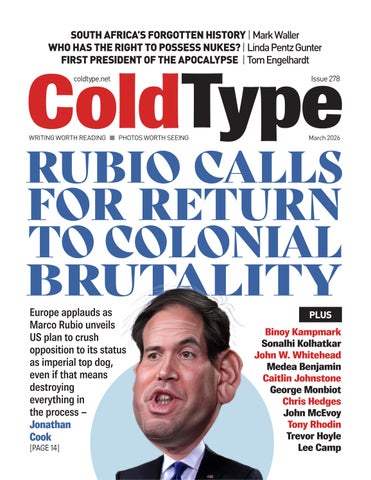
RUBIO CALLS FOR RETURN TO COLONIAL BRUTALITY
Europe applauds as Marco Rubio unveils US plan to crush opposition to its status as imperial top dog, even if that means destroying everything in the process –Jonathan Cook
[PAGE 14]


![]()
Europe applauds as Marco Rubio unveils US plan to crush opposition to its status as imperial top dog, even if that means destroying everything in the process –Jonathan Cook
[PAGE 14]


5 Suffocating an island Medea Benjamin
7 Who has the right to possess nuclear weapons?
Linda Pentz Gunter
8 Greed at a glance Inequality.org
9 Super Bowl ad showed us horrible future of America Lee Camp
10 Starmer v Trump: opposites in distraction Trevor Hoyle
10 By the numbers Inequality.org
11 Epstein class are the elites they pretend to hate Sonali Kolhatkar
12 We deserve better war propaganda than this Caitlin Johnson
13 Hurwitt’s Eye Mark Hurwitt
7 Lewis Street, Georgetown, Ontario, Canada L7G 1E3
Contact: Tony Sutton editor@coldtype.net
Subscribe: For a FREE subscription e-mail editor@coldtype.net
Back Issues: www.coldtype.net/reader.html or www.issuu.com/coldtype
Disclaimer:
The contents of the articles in ColdType are the sole responsibility of the author(s). ColdType is not responsible for any inaccurate or incorrect statements they may contain
2026


➤ MEDEA BENJAMIN
Marta Jiménez, a hairdresser in Cuba’s eastern city of Holguín, covered her face with her hands and broke down crying when I asked her about Trump’s blockade of the island – especially now that the US is choking off oil shipments.
“You can’t imagine how it touches every part of our lives,” she sobbed. “It’s a vicious, all-encompassing spiral downward. With no gasoline, buses don’t run, so we can’t get to work. We have electricity only three to six hours a day. There’s no gas for cooking, so we’re burning wood and charcoal in our
What Trump’s latest US blockade Is doing to Cuba
apartments. It’s like going back 100 years. The blockade is suffocating us – especially single mothers,” she said crying into her hands, “and no one is stopping these demons: Trump and Marco Rubio.”
We came to Holguín to deliver 2,500 pounds of lentils, thanks to fundraising by CODEPINK and the Cuban-American group Puentes de
Amor. On our last trip, we brought 50-pound bags of powdered milk to the children’s hospital. With Trump now imposing a brutal, medieval-style siege on the island, this humanitarian aid is more critical than ever. But lentils and milk cannot power a country. What Cubans really need is oil.
There were no taxis at the airport. We hitchhiked into town on the truck that came to pick up the donations. The road was eerily empty. In the city, there were few gas-powered cars and no buses running, but the streets were full of bicycles, electric motorcycles,
and three-wheeled electric vehicles used to transport people and goods. Most of the motorcycles – Chinese, Japanese, Korean – are shipped in from Panama. With a price tag near $2,000, only those with family abroad sending remittances can afford them.
Thirty-five-year-old Javier Silva gazed longingly at a Yamaha parked on the street. “I could never buy one of those on my salary of 4,000 pesos a month,” he said. With inflation soaring, the dollar now fetches about 480 pesos, making his monthly income worth less than ten dollars.
Cubans don’t pay rent or have mortgages; they own their homes. And while healthcare has deteriorated badly in recent years because of shortages of medicines and equipment, it remains free – a system gasping but not abandoned.
The biggest expense is food. Markets are stocked, but prices are out of reach –especially for coveted items like pork, chicken, and milk. Even tomatoes are now unaffordable for many families.
up their state jobs because wages are so low. Jorge, whom I met selling bologna in the market, used to be an engineer at a state enterprise. Verónica, once a teacher, now sells sweets she bakes at home – when the power is on. Ironically, while Marco Rubio claims he wants to bring capitalism to Cuba, US sanctions are crushing the very private sector that most Cubans now depend on to survive.
I talked to people on the street who blame the Cuban government for the crisis and openly say they can’t wait for the fall of communism. Young people told me that
the Cuban people.”
Others put the blame squarely on the United States. They point to the dramatic improvement in their lives after Presidents Obama and Raúl Castro reached an agreement and Washington eased many sanctions in 2014–2016. “It was the same Cuban government we have now,” one man told me. “But when the US loosened the rope around our necks, we could breathe. If they just left us alone, we could find our own solutions.”
The only way Cubans are surviving this siege is because they help one another. They trade rice for coffee with neighbours. They improvise –no hay, pero se resuelve (we don’t have much, but we make it work). The government provides daily meals for the most vulnerable – the elderly, the disabled, mothers with no income – but each day it becomes harder as the state has less food to distribute and less fuel to cook with.

Holguín was once known as the breadbasket of Cuba because of its rich agricultural land. That reputation took a severe hit when Hurricane Melissa tore through the province, destroying vast areas of crops. Replanting and repairing the damage without gasoline for tractors or electricity for irrigation is nearly impossible. Less food means higher prices.
Production across the economy is grinding to a halt. Factories can’t function without electricity, and many skilled workers have given
their goal is to leave the island and live somewhere they can make a decent living. But I didn’t meet a single person who supported the blockade or a US invasion.
“This government is terrible,” said a thin man who changes money on the street – an illegal but tolerated activity. But when I showed him a photo of Marco Rubio, he didn’t hesitate. “That man is the devil. A self-serving, slimy politician who doesn’t give a damn about
At one feeding centre, an elderly volunteer told us he spends hours every day scavenging for firewood. He proudly showed us a chunk of a wooden pallet, nails and all. “This guarantees tomorrow’s meal,” he said – his face caught between pride and sorrow.
So how long can Cubans hold on as conditions worsen? And what is the endgame?
When I asked people where this is leading, they had no idea. Rubio wants regime change, but no one can explain how that would happen or who would replace the current government. Some speculate a deal
could be struck with Trump. “Make Trump the minister of tourism,” a hotel clerk joked, only half joking. “Give him a hotel and a golf course – a Mar-a-Lago in Varadero – and maybe he’d leave us alone.”
Who will win this demonic game Trump and Rubio are playing with the lives of eleven million Cubans?
Ernesto, who fixes refrigerators when the power is on, places his bet on the Cuban people. “We’re rebels,” he told me. “We defeated Batista in 1959. We survived the Bay of Pigs. We endured the Special Period when the Soviet Union collapsed and we were left with noth-
➤ LINDA PENTZ GUNTER
ing. We’ll survive this too.”
He summed it up with a line Cubans know by heart, from the great songwriter Silvio Rodríguez: El tiempo está a favor de los pequenos, de los desnudos, de los olvidados – time belongs to the small, the exposed, the forgotten.
In the long sweep of time, endurance outlasts domination. CT
Medea Benjamin is a peace activist, co-founder of peace group CODEPINK and author. This article, written during a February visit to Cuba, was first published at www.medeabenjamin.substack.com
No country should have nuclear weapons, but the ones that do should disarm first before telling others they can’t have them.
The trouble with telling Iran it can’t have nuclear weapons is, look who’s doing the talking. The United States, which, with more than 5,000 nuclear weapons, has the second largest inventory in the world behind Russia. And Israel, an undeclared nuclear weapons nation with anywhere from 80 to 200 bombs. Israel is actually allowed to maintain the disingenuous position of “nuclear opacity” within the UN, neither confirming nor denying its nuclear arsenal.
This is despite the fact that the UN General Assembly adopts a resolution every year calling on Israel
to renounce possession of nuclear weapons and to place its nuclear facilities under international supervision, something the Jerusalem Center for Security and Foreign Affairs, equally disingenuously describes as “the annual three-month ‘Israel-bashing’ festival”.
Since we know that US President Trump doesn’t actually care whether or not the Iran government is shooting demonstrators in the streets, especially given he is quite happy for his own Homeland Security to do it here —albeit in not nearly as high numbers, or not yet — we must reckon with the other motivations for continuing to threaten Iran. And one of those is absolutely about stopping Iran from developing the bomb.
There is further irony here, be-
cause, unlike nuclear-armed Israel, non-nuclear armed Iran is a signatory to the nuclear Non-Proliferation Treaty (NPT). And unlike the US, Iran so far appears to have abided by its terms. Article IV — one of the major flaws of the treaty as Iran perfectly exemplifies — gives signatories the “inalienable right” to develop nuclear power as long as they don’t transition to nuclear weapons development. Article VI demands that the nuclear-armed nations pursue negotiations in good faith on effective measures relating to cessation of the nuclear arms race at an early date and to nuclear disarmament.
Iran could argue that it is abiding by Article IV. The US clearly cannot make the case that it is abiding in any way by Article VI. On the contrary, with the collapse last week of the New START Treaty, the last surviving nuclear arms reduction treaty between the US and Russia, both countries could now significantly ramp up their respective arsenals.
According to a statement put out last week by International Physicians for the Prevention of Nuclear War, which won the Nobel Peace Prize back in 1985, these increases could happen by uploading additional warheads on each country’s existing long-range missiles. This would mark the first increase in the sizes of their deployed nuclear arsenals in more than 35 years. According to independent estimates, Moscow and Washington could double the number of strategic deployed warheads without New START. Iran’s nuclear facilities were seemingly pulverized by the pro-
vocative bombing raids carried out by Israel and the US last June. But they were no means completely “obliterated”, as Trump claimed. New satellite imagery suggests there is currently considerable activity at the Iranian nuclear sites, but some of these appear to be simple repairs such as the rebuilding of roofs and other structures destroyed in the attacks. There is more activity, according to analysis of the satellite images by the New York Times, at conventional missile sites, presumably in anticipation of another attack by Israel and/ or the US.
Iran has and may well continue to insist it is developing its uranium enrichment capabilities for a civil nuclear program. And that could be true. Or not. The level to which it has lately been enriching uranium — to at least 60 percent and possible higher — before first Israel and then the US bombed its nuclear facilities, puts it in that gray area of weapons-usable rather than weapons-grade uranium enrichment. All this points once again the flaw

in the NPT that continues to hand back the keys to the nuclear weapons lab by encouraging the development of nuclear power.
A delegation from the White House went to Oman last Friday to negotiate a new nuclear deal with Iran, even though it was Trump’s own regime back in 2018 that destroyed the perfectly workable Iran

nuclear deal — known as the Joint Comprehensive Plan of Action — that had been in place up until then. The negotiating team was led by Steve Witkoff and Jared Kushner. Witkoff is Trump’s Middle East Envoy but Kushner has no official position within the US government and no actual qualifications, other than an unsavoury and predatory zeal about beachfront property — Iran has 5,800 km of coastline along the Caspian Sea, the Persian Gulf and Sea of Oman.
Should Iran have nuclear weapons? Of course not. But that also goes for the nine nations who do. And they should be the first to disarm before any demands are made elsewhere. CT
Linda Pentz Gunter is the founder of Beyond Nuclear and serves as its international specialist. Her book, No To Nuclear. Why Nuclear Power Destroys Lives, Derails Climate Progress and Provokes War, can be pre-ordered now from Pluto Press
➤ LEE CAMP
That didn’t take long. Turns out we were right. Amazon’s Ring cameras will not just be used for dogs and will instead surveil all of us and feed that information to police departments. Here’s the proof.
When the Super Bowl was played on February 8, Amazon aired a commercial for their new Super Ring Cam Lost Doggie Puppy Finder™, which pissed off 78 percent of Americans. (65 percent because they realized it could be used to create a horrible dystopian surveillance state; and 13 percent because they felt Amazon was distributing lost dogs around the US simply to prove they could find them.)
I put out a viral column about the dystopia propaganda. It’s been read by around 6.2 million people on Facebook and other platforms. Then less than a week later, Amazon’s Ring responded to the nationwide panties-in-a-twist moment (both male and female panties) by cancelling their contract with Flock Security, a company that records every license plate of every vehicle wherever Flock is legally operating (and sometimes illegally operating) –tracking some drivers more than 500 times in a month.
Basically Amazon’s Ring said, “We see that you’re upset our Ring cams could possibly totally be used for a horrifying surveillance state, and we’re therefore cancelling a contract that doesn’t undo almost any of that.”
At the core of this hubbub is the fear that Ring’s new “Search Party” feature could be used to search for things other than dogs. It could be used to search for humans. It could be used to watch women walk down the street. It could be used to
Well, we just found out that behind closed doors the people at Ring plan to use “Search Party” for things other than dogs and cats. (Consider me shocked.)
04 Media obtained an internal email from Ring’s founder-and-lover-of-all-police-agencies Jamie Siminoff saying Ring’s search feature would be used to “zero out crime in neighbourhoods.”
I kinda doubt he means only crime committed by dogs and cats. He wrote to all Ring employees, “This is by far the most innovation that we have launched in the history of Ring. … I believe that the foundation we created with Search Party, first for finding dogs, will end up becoming one of the most important pieces of tech and innovation to truly unlock the impact of our mission. You can now see a future where we are able to zero out crime in neighbourhoods.”

monitor completely-legal-yet-ungodly-behaviour like sexcapades prior to marriage or drinking alcohol on a Sunday or smoking weed in a state where it’s legal to smoke weed.
Amazon’s Ring publicly claims the “Search Party” feature would NEVER be used for anything like that. It’s only for dogs and cats –when they get lost or smoke weed underage. End of story.
I hope it doesn’t need saying, but in order to end “crime in neighbourhoods,” Ring would have to watch all neighbourhood streets, driveways, yards, porches, and tree houses at all times. It would then need to feed all that information to police departments upon request. Essentially, we Americans will have placed ourselves in a 24/7 panopticon dystopian hellhole. …All because a Super Bowl ad had a cute doggie in it. Besides the cringe-worthy invasion of privacy this entails, we would do well to remember that “crime” is only prosecuted against those without enough money and/or power to fight such state predation.
As Amazon Ring monitors everything, the Jeffrey Epsteins of the world will continue to go untouched. Predators like Donald Trump, Bill Clinton, Elon Musk and Bill Gates will have nothing to worry about.
In this manner, Amazon’s Ring Panopticon™ serves as yet another powerful weapon in a class war perpetrated by the rich. The people at Ring know full-well they’re creating the technological infrastructure to monitor every square foot of every US neighbourhood. They’re even admitting that internally.
When I was little parents often warned children, “Don’t ever get in a car with a man who says he needs help looking for a lost puppy.” Well, Amazon’s Ring is now telling us they need help looking for a lost puppy. …We shouldn’t get in the car with them. CT
Lee Camp is a stand-up comedian and host of the Unredacted Tonight webcast at www.realleecamp.substack.com
➤ TREVOR HOYLE


It’s instructive and revealing to compare US President Trump with UK Prime Minister Keir Starmer because they are complete and total opposites.
Whereas Trump inhabits his own universe, oblivious to anything outside, simply ignoring or dismissing any external factor which contradicts his own constructed vision (hence he dubs such offensive data as “fake news”), Starmer is painfully, even brutally, aware of the world outside.
On top of which he has no idea how to engage with it and is agonisingly cogniscent of his own inadequacy. Starmer knows he is hopelessly out of his depth as prime minister, but hey! – that’s what he fought for and achieved, and now he’s stuck with it – well, for the time being that is.
Starmer must wake up every morning and survey with dread the mountains of global and homegrown problems facing him – to which he has no solutions.
Lacking any ethical principles and with no moral centre, he has nothing to guide him or point him in the right direction. All he can look to are his inner circle, primarily his own backbenchers, the approval of the corporate media and public reaction at large. But this reliance on outside sources is fraught with danger, because even if he tries to correct unpopular decisions he and the government have made, he still loses because he is then accused of in-
consistency, of being weak, of making endless U-turns (13 so far in this parliament).
So Starmer is in a triple bind. If he sticks to unpopular decisions (cutting the winter fuel payment for pensioners, stopping two-child benefit payments and so on) he gets a roasting from his own side and threatened with rebellion. But then when he backtracks and relents he gets little thanks from them – plus an almighty battering from the right-wing media.
Trump, of course, is the diametric opposite. Inhabiting his own world, he is relaxed and can even make a joke or two and snigger at his own weak and tasteless sense of humour. He’s actually enjoying himself. Poor Starmer daren’t do that. He hasn’t the nerve. If he permitted even a tiny fraction or splinter of emotion or human feeling to break through, the plaster facade of his face would crack and disintegrate before our eyes. That’s why he’s so useless in interviews and public gatherings. He is a hollow, frightened man, scared of his own shadow.
As someone cogently observed, Starmer has all the personality and charisma of a speak-yourweight machine. The poor chap is drowning in his own mediocrity and can’t see a way out.
As for Trump, the president with growing dementia, facing imminent mental collapse, the final word has to be that the only circumstance that will rescue his legacy is a major medical (not mental) emergency – a stroke or heart failure. When this happens (when, not if) sometime in this presidency, he will be relieved of office and placed somewhere safe and warm to drool away his remaining days. It
will be a sort of semi-dignified exit, sparing us the sight of him standing before a microphone babbling incoherently. But it’s touch and go –he’s not far from that now.
PS: We have known from the very beginning that Starmer was a treacherous betrayer, an empty vessel of ethics and principles and moral values. As Director of Public Prosecutions he was responsible for the vicious and vindictive pursuit and persecution of Julian Assange which led to his illegal imprisonment in Bellmarsh. Never forget that when the Swedish authorities,
➤ SONALI KOLHATKAR
lacking any evidence to prosecute Assange, indicated they wanted to drop the case, Starmer sent them this message: “Don’t you dare get cold feet!”
We knew then what kind of man he was, and still is. CT
Trevor Hoyle is a novelist and writer of award-winning short stories and radio drama, based in Lancashire, UK. He is currently working on The Rock ’n’ Roll Diaries, a fictional memoir set in the Fifties about the discovery of Elvis, Billy Fury, and sex. In that order
Epstein class are the elites they pretend to hate
Attorney General Pam Bondi’s contentious House hearing about the Justice Department’s handling of the Epstein files offered a clear message to the nation: sex trafficking of women and minors is perfectly acceptable as long as wealthy white men do it.
Jeffrey Epstein, the disgraced late sex trafficker, fixer, and political networker, was found to have ties to huge number of the world’s elites on both sides of the political aisle – including Elon Musk, Peter Thiel, Ehud Barak, Bill Gates, Steve Bannon, Larry Summers, Bill Clinton, and of course, Donald Trump.
For years, Trump’s conservative backers have attacked LGBTQ+ people, drag queens, immigrants, and others, claiming a desire to protect women and children from
rapists and groomers. Trump even boasted that “whether the women liked it or not,” he would “protect” them from migrants, whom he slandered as “monsters” who “kidnap and kill our children.”
But when given the opportunity to seek justice for countless women and children who were trafficked, abused, and exploited by the world’s wealthiest, most powerful people, the MAGA movement and its leaders have shown a startling disinterest in accountability. During her hearing Bondi tried desperately to deflect attention, claiming that the stock market was more deserving of public attention than Epstein’s victims.
Even the Republican rank and file is now mysteriously detached from the Epstein files.
Polls show that in summer 2025,
40 percent of GOP voters disapproved of the federal government’s handling of the Epstein files. But by January 2026, only about half that percentage disapproved – even after the Trump administration missed its deadline to release millions of files and then released them in a way that exposed the victims while protecting the perpetrators.
While some European leaders are facing harsh consequences for associating with Epstein, no Americans outside of Epstein and his closest associate Ghislaine Maxwell have faced any consequences, legal or otherwise.
That’s despite very concrete ties between the Trump administration and the sex trafficker. Not only did Trump’s Commerce Secretary Howard Lutnick admit to visiting Epstein island after lying about it (and has so far faced no consequences), but Trump himself is named more than a million times in the files, according to lawmakers with access to the unredacted documents. Several victims identify Trump by name, alleging he raped and assaulted them.
And it’s not just Trump. Epstein was an equal opportunity fixer. He was just as friendly with liberals as he was with conservatives, including Summers, Clinton, and, disconcertingly for the American left, Noam Chomsky. For elites like Epstein, ideological differences were superficial. The real distinction was money, power, and connections.
Epstein was a glorified drug dealer and his drugs of choice were the vulnerable bodies of women and children, offered up to his friends and allies as the forbidden currency he traded in. A useful moniker has emerged to describe the global network of elites whose power and
privilege continues to protect them from accountability: the Epstein Class.
Georgia Senator John Ossoff, who faces reelection in 2026, is deploying this label, understanding that voters – at least those who haven’t bought into the MAGA cult – are increasingly aware of the double standards that wealthy power players are held to.
“This is the Epstein class, ruling our country,” said Ossoff in reference to those who make up the Trump administration. “They are the elites they pretend to hate.”
He’s right. And if the Trump administration won’t hold them to account, Americans should demand leaders who will. CT
Sonali Kolhatkar is host and executive producer of Rising Up With Sonali, an independent syndicated TV and radio show. She’s an award winning journalist and author of Talking About Abolition: A Police Free World is Possible, and Rising Up: The Power of Narrative in Pursuing Racial Justice. This article was distributed by OtherWords.org

Scraping the propaganda barrel at the New York Post
➤ CAITLIN JOHNSTONE
We deserve better war propaganda than this
US middle east envoy
Steve Witkoff told Fox News on February 21 that Iran is “probably a week away” from having the materials necessary to make a nuclear bomb – a line that Iran hawks have been falsely repeating for over three decades.
It’s such a transparently bogus claim that even the Jerusalem Post dunked on Witkoff for making it, quipping that “The US envoy left out that Iran currently has no access to its material, no machines to enrich it, and no weapons program to use it for any operational purpose.”
This is the guy supposedly assigned by the White House to the task of establishing peace in the middle east, churning out the most fuzz-brained justifications for war with Iran you could ever imagine.
The New York Post has an article going viral right now with the flamboyantly propagandistic headline “Iranian forces hack out wombs of female protesters to hide horrific sexual abuse,” which would sound absurd at a glance even you didn’t know anything about atrocity propaganda. Like they said, “Let’s mutilate these women’s reproductive organs so that nobody thinks we horrifically abused them!” How does that even make sense?
The article is, of course, based on no evidence whatsoever, citing nothing but a NewsNation report full of anonymously sourced assertions. The central claim of the Post headline is attributed solely to “An Iranian refugee who spoke to NewsNation under a condition of anonymity.”
In a post-Iraq invasion world, these sorts of reports deserve nothing but a scoff and a dismissal. After all the lies we’ve been told about every US war of aggression over the years, any claims made about a government that Washington wants to topple need to be flatly rejected unless they are backed by rock-solid, independently verifiable proof. That proof never arrives. US wars are always justified by lies, psyops, and misinformation.
But these aren’t the usual calibre of lies. We normally get betterquality war propaganda than this. This slop is designed to appeal to the dumbest people in the dumbest parts of the United States, and to people who already want to go to war with Iran.

Consent for the Iraq invasion was manufactured by many months of high-energy media saturation designed to harness the power of post9/11 hysteria about the possibility of foreign attacks on American soil. This is just a few propaganda rags and government officials farting into a microphone and calling us idiots.
And yet the war machinery is rolling out anyway. They’re preparing to unleash a horrific war of immense consequence which Americans overwhelmingly oppose, and they don’t even have the decency to tell believable lies about it.
It can’t say good things about the future that they’re not even pretending to care what the American people want anymore. The US empire is getting more and more bold about exposing its true tyrannical nature, feeling less and less need to manufacture consent before engaging in mass military slaughter.
I guess we can still have hope that this will help open some eyes to the dire need for revolution in the heart of the empire. CT
Caitlin Johnstone is an Australian independent journalist. This article was first published at her web site, www.caitlinjohnstone.com.au

➤ JONATHAN COOK
Europe applauds as Marco Rubio unveils US plan to crush opposition to its status as imperial top dog, even if that means destroying everything in the process
US Secretary of State
Marco Rubio’s speech at the Munich Security Conference last month was another troubling declaration of intent by the Trump administration.
The explicit goal of US foreign policy, according to Rubio, is to resurrect the western colonial order that persisted for some five centuries until the Second World War. Oldschool, white-man’s-burden colonialism is unapologetically back.
In Rubio’s preposterous retelling, Europe’s colonisation of much of the planet, and the rape and pillage of its resources, was a glorious era of western exploration, innovation and creativity. The West brought a “superior” civilisation to backward peoples while maintaining global order.
Reflecting on the era before 1945, he observed: “The West had been expanding – its missionaries, its pilgrims, its soldiers, its explorers pouring out from its shores to cross oceans, settle new continents, build vast empires extending out across the globe.”
That course went into reverse 80 years ago: “The great western empires had entered into terminal decline, accelerated by godless communist revolutions and by anti-colonial uprisings that would transform the world and drape the red hammer and sickle across vast
swaths of the map in the years to come.”
According to Rubio, that decline was accelerated by what he dismissed as the “abstractions of international law”, established by the United Nations in the immediate postwar period. In the pursuit of what he derisively termed “a perfect world,” these new universal laws – ones that treated all humans as equal – served only to hamstring western colonialism.
Rubio neglected to mention that the purpose of international law was to prevent a return to the horrors of the Second World War: the extermination of civilians in death camps and the firebombing of European and Japanese cities.
During his speech, Rubio offered Europe the chance to join the Trump administration in reviving “the West’s age of dominance” to “renew the greatest civilisation in human history.”
“What we want is a reinvigorated alliance that recognises that what has ailed our societies is not just a set of bad policies but a malaise of hopelessness and complacency. An alliance – the alliance that we want is one that is not paralysed into inaction by fear – fear of climate change, fear of war, fear of
technology,” he said.
Quite astonishingly, Rubio was greeted with en thusiastic applause dur ing his speech from an audience comprising heads of state, politicians, diplomats and military officials. He is reported to have received a standing ovation from half of the attendees.
They seemed swept up in Rubio’s triumphalist account of empire, one utterly oblivious to the well-documented realities of “western domination” – not least its brutal colonial tyran nies, its industrial-scale geno cides and the mass enslavement of native populations.
These were not unfortu nate episodes or mistakes in the West’s imperial past. They were integral to it. They were the coercive means by which colonised peoples were stripped of their assets and labour to fi nance empire.
He also appeared blind to anoth er downside of the colonial West, which was all too evident over those five centuries. Ruthless competition between European states, vying to be first to pillage resources in the
MARCO RUBIO: Reinventing the story of European domination of much of planet Donkeyhotey / Flickr.com

Global South, led to endless wars in which Europeans, as well as the people they colonised, were killed.
Empire did not ensure order, let alone peace. Colonialism was about systematised theft – and, as the saying goes, there is rarely honour among thieves.
In the dog-eat-dog world that pre-
Authoritarian states blow out, one by one, the long row of candles until we find ourselves in the dark, powerless and alone

alist leaders and installing weak, obedient clients in their stead.
It also seeded the globe with hundreds of US military bases to project hard power, while exploiting new globalising technologies to project soft power. Economic carrots and sticks, wielded largely out of view through the World Bank and International Monetary Fund, incentivised submission to its diktats by non-western leaders.
Washington’s freedom of manoeuvre was limited chiefly by a rival power in the form of the Soviet Union, which armed and subsidised its own clients. The Cold War kept the US empire in relative check. That was not “decline”, as Rubio claims. It was simple pragmatism: avoiding confrontation in a nuclear age that could, through a misstep, lead to global annihilation.
Over the past 30 years, since the fall of the Soviet Union, the US has flexed its imperial muscles ever more aggressively: in the former Yugoslavia, in Iraq, in Afghanistan, in Iraq again, in Libya, in Syria, and now – assisted by its ultimate client state, Israel – more widely across the oil-rich Middle East, in Palestine, Lebanon and Iran.
Long before Trump’s first term as president, Washington’s core bipartisan foreign policy aims involved boxing in Russia, chiefly through creeping colonisation of former Soviet states, and threatening China over Taiwan.
In typical Trumpian fashion, Rubio has simply made explicit what was already implicit. The US has been an imperial superpower since the 1940s and has become an ever more confrontational one in a world of diminishing resources, where it enjoys the advantage of being the sole military superpower.
Rubio is simply more honest than his predecessors about the decadeslong trajectory of US foreign policy. There is a good reason why “god-
less communists“ and their God-obsessed successors waged “anti-colonial uprisings” that ultimately could not be contained by western empire.
The West’s ruling colonial elite had spent centuries making life in the Global South a horror show, whether through brutal tyranny, massacres or the slave trade.
Native populations were desperate for liberation from western-imposed “order”, which is why, after World War Two, so many turned to a communist Soviet Union rather than the US for support.
In the West’s last settler-colonial client outposts – apartheid South Africa until 1994, and apartheid Israel today – there were sustained mass revolts by those they oppressed.
Living under white-minority rule in South Africa was dangerous and soul-crushing if you were not white, just as living under a system of Jewish supremacy in Israel and occupied Palestine is dangerous and soul-crushing if you are not Jewish.
Note too that both of these apartheid regimes spawned global solidarity movements.
Most people – even westerners –understand that oppressing another people, denying their humanity and their right to equality, is profoundly unjust and immoral. That is not going to change because Washington has a misty-eyed view of colonialism and apartheid.
The lesson from history is that any intensification of US imperialism by the Trump administration will provoke intensified resistance. That should already be clear to anyone who has not been dozing through the past 20 years.
Russian President Vladimir Putin was excoriated in the West when he set out the geostrategic rationale for his invasion of Ukraine in early 2022. The Slovenian philosopher
The genocidal erasure of Gaza is the new normal, as is the kidnapping of world leaders such as Venezuela’s Nicolas Maduro
Slavoj Zizek, for example, accused Putin of imagining himself as Peter the Great and trying to restore Russia’s imperial past.
Zizek cited as proof a speech delivered by Putin to a group of young entrepreneurs in Moscow in June 2022, a few months after the invasion. Putin stated: “Any country, any people, any ethnic group should ensure their sovereignty. Because there is no in-between, no intermediate state: either a country is sovereign, or it is a colony, no matter what the colonies are called.”
Putin’s meaning should have been obvious at the time, given that for more than two decades a series of administrations in Washington had co-opted former Soviet states into Nato – the US empire’s military alliance – and located military bases ever closer to Moscow.
The promise made in 2008 by Nato to allow Ukraine to join the alliance at some point in the future could be interpreted by the Russian leadership in only one way: as a threat. If realised, Nato’s nuclear warheads would be minutes from the Kremlin.
Putin was determined to maintain Russian sovereignty and avoid becoming yet another “in-between” colony of the US empire, as it so nearly did under his drunken predecessor, Boris Yeltsin. The Russian leader rejected Europe’s model of handing Washington the keys to its resources, economy and defence systems.
Doubtless, Putin noted with smug satisfaction Trump’s extortion of Ukraine last year, when President
Volodymyr Zelensky was made to sign away his country’s mineral wealth in return for US protection. It was a perfect illustration of Putin’s point that there are no “intermediate” states in a world of ugly power politics: you are either sovereign or a colony of a stronger power.
It was that very logic that prompted Russia’s decision to invade Ukraine. If that was difficult to make sense of at the time, it should be easier to comprehend now in the light of Rubio’s speech.
Given Washington’s imperial ambitions, Ukraine was going to fall into the geostrategic orbit of the US, becoming another colonial outpost for its war machine, unless Russia compelled its neighbour into its own geostrategic orbit first.
The Trump administration is making its realpolitik clear: the genocidal erasure of Gaza is the new normal, as is the kidnapping of world leaders such as Venezuela’s Nicolas Maduro.
European states are increasingly nervous about Trump’s unapologetic imperialism and what it might mean for them. The threat to seize Greenland from Denmark was a wake-up call; it reportedly dominated discussions at the Munich conference.
In line with Putin’s warning four years ago, European leaders are scrambling to consider how they might regain a degree of sovereignty to stop their irreversible colonisation by the US.
Rubio tried to placate them by inviting Europe to join Washington in resurrecting western empire. The offer was pure deception.
This is no joint project, as they should have understood when Trump introduced tariffs as a stick to beat them into greater servitude; when he ditched support for Ukraine, their proclaimed rampart against “Russian imperialism”; and when he demanded ownership of
Greenland.
Those “betrayals” were the stimulus for a speech by Canadian Prime Minister Mark Carney at the Davos World Economic Forum last month.
There, he warned that the 80-year-old rules-based order was a “pleasant fiction”, a cover story that allowed US allies to benefit from American hegemony “with public goods, open sea lanes, a stable financial system, collective security and support for frameworks for resolving disputes”.
And for that reason, Washington’s allies had colluded in the deception: “We knew the story of the international rules-based order was partially false, that the strongest would exempt themselves when convenient, that trade rules were enforced asymmetrically. And we knew that international law applied with varying rigour depending on the identity of the accused or the victim.”
It was, said Carney, time to stop “living within a lie”.
Many assumed that the Canadian leader was voicing, on behalf of technocratic allies in Europe such as Britain’s Keir Starmer and France’s Emmanuel Macron, a new commitment to transparency and honesty as a counterweight to US law-breaking abroad.
Nothing could be further from the truth, as highlighted by Carney, Starmer and Macron’s continuing complicity in the Gaza genocide and their silence over Trump’s threats to launch a war of aggression against Iran.
The purpose of Carney’s Davos speech was something else entirely. Trump’s own honesty – his open contempt for international law and enthusiasm for old-school imperialism – threatens to expose their hypocrisy in riding on US coattails.
They have not changed their ways. They simply want Trump to stop blowing up the facade they constructed to conceal and prettify
Ursula von der Leyen, the European Commission’s technocrat-in-chief, felt “very much reassured” by Rubio’s speech
their collusion in US colonialism.
Rubio detonated those lies once again at Munich. When he declared a return to avowed might-is-right imperialism, the conference broke into applause.
Ursula von der Leyen, the European Commission’s technocrat-inchief, said she felt “very much reassured” by Rubio’s speech, calling him a “good friend.”
The biggest misdirection in Rubio’s remarks was his omission of the real reason the West abandoned overt colonialism after the Second World War and built international institutions such as the United Nations. It was not an acceptance of defeat or decline by the US, but rather a recognition that, with the rapid development of nuclear arsenals by the superpowers in the wake of the war, a system capable of mediating the worst excesses of power had be come a necessity.
It was the only hope of prevent ing reckless colonial competition and confrontation that could trigger a Third World War likely to spiral quickly into nuclear armageddon.
Nothing has changed over the past eight decades.
Russia and China still have large nuclear arsenals, and Moscow now has hypersonic missiles capable of carrying these warheads at unprec edented speeds.
There is still no failsafe mecha nism to prevent misunderstandings
from rapidly escalating into mutual attack. Human nature has not changed since the 1940s - only the arrogance of a superpower determined to prevent great powers like China or Russia from ever ousting it from its imperial perch.
The threat of nuclear annihilation has not diminished. It has grown exponentially as limitations on global resources – those needed to sustain western consumption and endless “economic growth” – put ever greater pressure on the US to discard its mask as the guardian of superior values.
Rubio used the Munich conference to lay bare the new reality: Washington will no longer pay lip service to being the nice guy or abiding by any red lines.
The US is determined to crush all opposition to its permanent status as imperial top dog – even if it means destroying everything, and all of us, in the process. CT
Jonathan Cook’s latest books are Israel and the Clash of Civilizations: Iraq, Iran, and the Plan to Remake the Middle East (Pluto Press) and Disappearing Palestine: Israel’s Experiments in Human Despair (Zed Books). His website is www.jonathan-cook.net

➤ GEORGE MONBIOT
There is a lot of convenient amnesia about fallen minister’s New Labour days. It’s time to jog some memories
History is being rewritten. The story we are told is that an evil man called Peter Mandelson, pursuing his own interests, went rogue to collaborate with a serial abuser of girls and women, undermining the good work of people seeking to defend the public interest. All this is true. But – and I fear many will find this hard to accept – it is only half the story.
The much harder truth is that Mandelson’s disgraceful dealings with Jeffrey Epstein were less a betrayal of his brief than an unauthorised extension of it. In 2009 – just as, we now know, Mandelson was passing sensitive information to Epstein – I argued that the government department he ran, called Business, Enterprise and Regulatory Reform (BERR), “functions as a fifth column within government, working for corporations to undermine democracy and the public interest”.
BERR was a smaller and less chaotic version of Elon Musk’s “department of government efficiency” (DOGE). Its purpose, I suggested, was to bypass the House of Commons on behalf of capital. It allowed Gordon Brown’s government to create the impression that it was defending the public interest while simultaneously, but more quietly,

WRONG IMPRESSION: Former UK PM Gordon Brown claimed to be defending the public interest, while he was “appeasing powerful lobbyists”
appeasing powerful lobbyists. In contrast to other government departments, BERR was largely run by unelected lords, who had either been corporate executives, corporate lobbyists or, like Mandelson, members of a concierge class operating on their behalf. I wrote that these ministers, appointed by Brown, “appear to have formed their own lobby group within government.”
BERR sought to part-privatise Royal Mail, breaking a manifesto commitment. It succeeded. It tried to block the EU working time direc-

tive: UK government filibusters delayed and weakened it. It attempt ed, less successfully, to undermine the equality bill, whose aim was to en sure equal pay for women (Mandelson’s simultane ous dealings with Epstein were not the only respect in which he spat on women’s rights). It undermined envi ronmental legislation. It was “quietly building a bonfire of the measures that protect us from predatory corporate behaviour.”
So when Brown, who was prime minister at the time, expresses his shock and betrayal, please forgive me a small gasp of frustration. In his interview on the BBC’s Today programme, Brown claimed that in 2009: “We were solving a major financial crisis … all my thoughts were on how we could save people’s jobs and savings and their livelihoods.” But not only did he allow Mandelson to attack the public interest on behalf of business, he greatly increased BERR’s budget. This was despite the fact that, as I noted at the time, Mandelson “was partly responsible, both in Blair’s government and as European trade commissioner, for promoting the culture of deregulation that catalysed the economic crisis.” On one hand,

WHOOPS: Mandelson on the cover of The Times newspaper’s weekend magazine just days after news broke over likely criminal charges over his involvement with Jeffrey Epstein. (He was charged on Feb 23)
trayed the national interest. But this is what, by other means, he was appointed to do. His treachery, while it went way beyond his official mandate, was not a bug, but a feature. The corrosion of democratic values was institutional. And this spirit has prevailed ever since. Keir Starmer’s government of all the lobbyists is no exception.
Brown, in proposing remedies for the secretive machinations Mandelson conducted, writes: “Conventions about commercial confidentiality should no longer prevent public service contracts delivered by private companies being subject to reasonable freedom of information requests.”
the state: one of the reasons why they are now in so much trouble. Almost everyone appears to have forgotten his crucial role in the Iraq war: standing with Tony Blair and financing it. He rightly called for Vladimir Putin and his “enablers” to face justice for their crime of aggression in Ukraine. Yet it’s the same crime that Blair and his enablers (including one G Brown) committed in Iraq.
trying to solve it. On the other, at the behest of corporate lobbyists, he was setting up the next one.
Brown also told the BBC, in justifying his appointment of Lord Mandelson, that the man had “an unblemished record as the [European] trade commissioner”. An unblemished record of what, exactly? Neocolonialism, perhaps. While Mandelson was in that post, he sought to impose draconian trade provisions on some of the poorest countries on Earth. He put pressure on them to let EU corporations muscle out local firms and make privatisation legally irreversible, threatening people’s access to health, education and water. He sought to force African countries to hand over crucial resources at the risk of widespread hunger.
Yes, when Mandelson was a minister in Brown’s government, he be-
I could scarcely breathe when I read that. It is exactly the demand some of us made when Brown rolled out the private finance initiative (PFI) across the public sector, enabling businesses to get their hooks into every aspect of state provisioning. When we tried to see the contracts, to understand what was being done in our name, Brown’s Treasury repeatedly blocked our information requests on the grounds of “commercial confidentiality.”
The sense of betrayal that Brown quite rightly feels is the same sense of betrayal some of us felt towards the governments in which he served. Yes, Brown had and retains some great qualities, and did much good. But he is also a remarkable escapologist. Almost everyone appears to have forgotten how his PFI programme planted a timebomb in public services, enabling corporations to take the profits while leaving the risks with
But it is not just Brown who is rewriting history. The media are 50 percent of any problem, and the story most of it loves to tell is of one bad apple. Heaven forfend that we see the systemic problems. There is a reason why Mandelson kept returning to government, despite sackings for his over-enthusiastic relationships with plutocrats. He was brought in to do the dirty work. The governments in which he served could loudly claim to be doing something, while subtly and simultaneously undoing it.
Mandelson’s treachery is an extreme instance of the dominant mode of UK politics over the past 45 years: the subordination of democracy to the demands of the ultra-rich. Abuse and exploitation – of women and children, of poorer countries and their people, of workers and contractors, renters and customers – are baked into the system.
If you cannot diagnose a problem, you cannot fix it. We urgently need to see this for what it is. Mandelson’s grovelling to the sinister rich is disgraceful, disgusting, deceitful, a crushing of women’s rights and of democracy. But it is not a deviation from the system. It is a manifestation of it. CT
George Monbiot’s latest book, written with Peter Hutchinson, is Invisible Doctrine: The Secret History of Neoliberalism. His website is www.monbiot.com This article first appeared in The Guardian
MARK WALLER
peaking in early February at the 50th anniversary memorial of the death of the South African Communist Party (SACP) and African National Congress (ANC) activist Dawood Seedat, Yunus Carrim lamented the withering of historical awareness throughout South African society:
“A country that loses its past does not understand its present and is unable to shape its future effectively. Our country is in danger of this. People are far too unaware of our history and care even less. This applies to the contribution of Dawood and [his partner] Fatima Seedat, who played a significant role in the Communist Party and ANC. Far too little is being done to educate people about our history.”
Look through any of the textbooks that primary and secondary schools provide learners and you’ll see what he means. History, particularly South African history, is skimmed over. There are brief sentimentalised accounts of the early life of Nelson Mandela, fast-forwarded to “his struggle for justice” and becoming president.
But there’s hardly any context. Little to suggest that South Africa endured hundreds of years of European colonisation or that its people spent most of the 20th century in fierce struggle against white domination and the race-based oligarchy of apartheid.
Hardly a word about what this struggle entailed or how it unfolded and intensified. Nothing about the decisive roles in this struggle of the
the story of the ANC’s Special Operations Unit in the country’s struggle
ANC and its ally, the SACP. History is taught in schools, alongside geography, as a subtheme of “social sciences.” It’s astonishing that in a country riven by raw historical legacies the subject isn’t prominent in the curriculum. The memory and knowledge of all that led up to the 1994 democratic breakthrough are fading. Historical

By Yunus Carrim Penguin Random House South Africa, 2025
amnesia nullifies our understanding of the present, of how and why we got to where we are.
This is one of the threads running through Yunus Carrim’s Attacking the Heart of Apartheid, a book, he writes, that “aims, above all, to inform the youth about an aspect of our history, and in some small way convey to them that this democracy didn’t fall from the skies. And that it needs to be cherished, nurtured and advanced, especially by the younger generation, as the struggle generations move on.”
Those generations had been part of the armed struggle launched by the ANC on December 16, 1961, following its banning the year before. Initially, the ANC’s military wing, Umkhonto we Sizwe (Spear of the Nation), abbreviated to MK, conducted sabotage operations: blowing up power pylons and other infrastructure and burning crops. Ambitious plans to expand MK’s training and clout were stymied by the arrest of Mandela and other

MK leaders in 1962 and 1963. At the Rivonia Trial, named after the farm that served as their main base, the state accused them of carrying out a total of 193 acts of sabotage.
Thereafter, MK activity waned. Most of its leadership were either imprisoned or in exile. Despite some exceptions – including a joint operation with the Zimbabwe People’s Liberation Army inside Zimbabwe and efforts by MK leader Chris Hani to revive MK in South Africa – the 12 years after the end of the Rivonia Trial were a low point for MK and the ANC.
This all changed with the 1976 student uprisings in Soweto and across the country, during which the apart-
heid police and army killed hundreds of young people.
As Carrim writes, “Several thousand youths streamed into the neighbouring countries, most in search of arms and training to return home to fight. The majority of them reached the ANC.”
The terrain was also shifting in other respects. Angola and Mo-
A breakthrough in the armed propaganda war was needed, something that would blow the minds of the white supremacists
zambique threw off colonial rule in 1975, followed by Zimbabwe in 1980. South Africa’s liberation movement now had forward bases of support. The apartheid regime was effectively hemmed in and subject to escalating sanctions and condemnation thanks to the global anti-apartheid movement.
What was needed was a breakthrough in the armed propaganda war against the regime, something that would blow the minds of the white supremacists and resonate with the burgeoning mass struggles taking place on the ground. Enter the ANC’s MK Special Operations Unit.
Following much internal debate in
the ANC on the relationship between political and armed strategies and tactics, MK and SACP leader Joe Slovo approached ANC President Oliver Tambo to suggest the creation of a special operations MK unit.
This would, Carrim writes, “carry out high-impact, high-visibility attacks against strategic economic and military targets. It would undermine the economy, shake the morale of those supporting apartheid, inspire the masses and bolster mass struggles.” The unit would be commanded by Slovo and answerable directly to Tambo.
Over the next eight years MK’s Special Ops teams carried out attacks on 72 targets. The most spectacular and, from the perspective of the apartheid regime, devastating were the bombings of the Sasol Coal liquefaction plants at Sasolburg and Secunda in 1980 and the Arnot power station in Ermelo in 1981, the rocket attack the same year on the main South African Defence Force base near Pretoria, and the bombing of the Koeberg nuclear power station in Cape Town in 1982, the latter two weeks before the plant was due to start operating.
Other attacks hit military and other state installations, including the Air Force headquarters in Pretoria, government departments, magistrates’ courts, police stations, fuel depots, railway lines, and water and power facilities.
Several attacks, particularly those targeting military personnel, resulted in civilian casualties, but it is clear from Carrim’s account that the Special Ops combatants and leaders tried to avoid them. He writes: “Apartheid was a system of structural violence against black, particularly African people. That the ANC exercised the restraint it did in the armed struggle overall is quite remarkable.” The ANC’s Special Ops campaign took off at a time when apartheid’s violent repression was at

ANTI-APARTHEID
STRIKE: The aftermath of the attack on the South African Air Force offices on Church Street, Pretoria, on May 20, 1983
its most intense. Daring and innovative, it showed the regime that it was no longer impregnable and forced it to recognise that the ANC was capable of sophisticated armed action and astute tactical planning.
The attack on the Koeberg nuclear plant was so professional that the stunned regime couldn’t accept that it had been carried out by the ANC. The German anarchist Baader-Meinhof Gang was responsible, declared a senior manager at the state power utility Eskom.
So why is it only now, some 32 years after the demise of apartheid and the start of democracy, that a history of the ANC’s Special Ops has appeared? And why is this the only one? Though some aspects of the struggle years have been spotlight-
This is not an official history of the ANC’s Special Ops but it is hard to see how it could be bettered if one were to emerge
ed in the histories and biographies published since the unbanning of the ANC, a vast amount of historical detail has faded from memory.
Many of those who were involved or who bore witness to watershed events have died. Carrim spent a decade searching out the men and women who were involved in Special Ops. Some were from other countries, motivated by the internationalism of the anti-apartheid struggle.
The book is an oral history that centres on the recollections of the 48 people recorded in 103 interviews, which amount to 162 hours of recordings (all of which will be available online at some point). The often hair-raising details of the armed missions, the zig-zag fortunes of planning and getaway, are told from the point of view of the participants, with only the bare essentials of narrative to join them together.
There is, though, plenty of analysis of the place of armed struggle within the overarching political framework of ANC strategy and mass struggle, and a thoughtful assessment of the significance of Special Ops.
This is not an official history of its
Special Ops but it is hard to see how it could be bettered if one were to emerge. We’re unlikely to hear from such a large number of combatants again; roughly half of those who were involved and who are no longer with us. Some died in battle, others have since passed away or could not be traced.
Fortunately, the star protagonist of Special Ops, its commander Aboobaker Ismail (MK name Rashid), is very much with us, and throughout the book his comments on many of the operations contain valuable, if tantalisingly fragmentary, insights into how Special Ops were managed.
As with many oral histories, the people Carrim interviewed were keen to tell their stories, to unburden themselves at a time when the contribution to South Africa’s democracy by former MK members remains unacknowledged and, thanks
“Their willingness to talk so freely has to do with the alienation and marginalisation they feel”
to the memory hole of South Africa’s school curriculum, forgotten:
“Their willingness to talk may have to do with the extremely challenging, even traumatic, period the ANC has been going through in recent years. Maybe they felt the need to recall how much it took to get to our democracy, to suggest how sad and bad it is that we have come to where we are now. […]
“Their willingness to talk so freely also has to do with the alienation and marginalisation they feel, given how they’ve been treated by the
ANC and our democracy. As they were soldiers who consciously made the choice to enter directly into battle and give their lives, if necessary, their pain and frustrations run deep.”
There is also a broader scope to this, one that pervades South African society. For no matter how legitimate the armed struggle of a liberation movement is, it impacts all those involved, enemy or comrade.
“This is so in our country,” writes Carrim, “It’s reflected partly in the high levels of violence today.” It may also, in some way, suggest that the scanty history curriculum of South Africa’s schools has a deeper, as yet unrecognised, cause. CT
Mark Waller is a UK-Finnish national who lives in Pretoria, South Africa and works as a freelance journalist, translator and editor


An excerpt from ATTACKING THE HEART OF APARTHEID
“Guards at Sasol 1 saw a hole in the fence. While they were investigating, the first explosion ripped through the butadiene tank containing liquid and gas. It was completely destroyed and set off one big and three smaller fuel tanks”

This excerpt from Attacking the Heart of Apartheid: the ANC’s MK Special Operations Unit relates the attack on the Sasol coal liquefaction plants at Sasolburg and Secunda, the mix of madcap bravado and professionalism of those who took part, and their escape via Swaziland to Mozambique, where they met up with their commanders –Rashid, Joe Slovo and ANC President OR Tambo
It was bitterly cold. So, astonishingly, Molokoane’s unit went to a police station, said they were looking for work in the area, handed over their forged pass books – an identity document that Africans had to carry at all times on pain of arrest – and asked for an empty cell to sleep in. The police agreed – little knowing what their guests would be up to the next day.
The cadres carried out a final reconnaissance and retrieved their hidden limpet mines.
Late on the night of 31 May (Republic Day), they parked their car near Sasol. They split into two groups to hit Sasol 1 and Natter. They cut the outer perimeter fence with wire cutters and slipped into the plants. One cadre guarded the entry point. They were in Sasol overalls and makarapas (hard hats) and had false access cards. Hidden in their clothes were the limpet mines. At Sasol 1, they headed for the fractionating towers. But there were too many workers there. So, they planted the limpet mines on the fuel tank farms.
Just before 23:40, guards at Sasol 1 saw a hole in the fence. While they were investigating, the first explosion ripped through the butadiene tank containing liquid and gas. It was completely destroyed and set off one big and three smaller fuel tanks.
At Natref, Robert Nthembulaseni, a Sasol security guard, was patrolling on a bicycle he saw a hole in the fence. When he got off his bicycle, he was confronted by a man wearing a dark balaclava and a dark jacket –Jackie – who shot him in the left shoulder.
Just then, the other cadres got to the fence. They made a quick getaway. At Natref, the first blast was under a tank containing semi-refined fuel for future refining into aviation fuel. Two aviation fuel tanks exploded shortly afterwards. In all, at least eight huge fuel tanks were ablaze, Johannes Stegmann, Sasol’s managing director, confirmed. They carried jet fuel, gas, diesel and chemical products.
Seven tanks were still burning two days later. By that evening, the fires began to be brought under control, though the flames didn’t die for another day.

PERFECT TIMING: The attack on Sasol 2, located in Secunda, 196 kilometres from Sasol 1, took place shortly after midnight on June 1, 1980
A white mist shrouded Sasol 1.
The cadres hid in Soweto for about two weeks before crossing the border into Swaziland.
[Another team planted limpet mines at Sasol 2]
Mabena was waiting in the car. Moisi continues:
“We drove off, flying to safety. But on the road, every time Victor sees police station, he says, ‘Guys, let’s attack them, let’s finish off the materiel’ [laughter]. We say, but Victor we didn’t come for that [laughter]. That will leave a trail, and the police will follow this and it could cause problems for us.”
They drove through the border fence.
“You cut the fence at the right lines, then you’re able to lift it up and drive the car through. And then we met Obadi and Rashid, and off we drove to Maputo. We were listening to the news, of course, on the way and when we arrived at the Swaziland-Mozambique border, we heard on the BBC that ANC nationalist guerrillas just bombed Sasol. I almost felt like singing [laughter].”
Obadi laughed with joy, saying, “We did it!”
“And we arrived at the border,” Moisi recounts, “it was about half six and it was cold, but we had to wait in the car. As soon as they opened, we went to Maputo. So, when more news about the bombings came through,
including the roadblocks in South Africa, we were already there.”
The morning after the operation, Rashid and Obadi met a very excited Joe Slovo, who said he’d been standing on the balcony of his Maputo flat looking out in a southerly direction to check if he could see the Sasol 2 explosion.
The Sasol 1 Special Ops unit came back a week later. Fake “stayed at his mother’s place and she held him up,” says Moisi.
“She said, ‘Oh, my child, you can’t go now.’ She reconnoitred the place, saw the roadblocks and told Faku to lie low.
“We only celebrated when Faku came back. We explained to OR [Tambo] at the Swedish ambassador’s house in Maputo what happened. OR prefers listening, especially to people who were from the front. Obadi tried to explain, but Tambo said, no, let them explain.
“OR wanted us to know how important what we did was. We didn’t know why we were chosen for such an important and historical mission. But he said we want to turn you into jacks of all trades and masters of all. OR’s speech was inspirational, and he was in a celebratory but dignified mood. You know OR, he’s not overwhelmed by excitement.” CT
➤ TONY RHODIN
A misguided five-year quest to understand my father’s early history as a border baby goes from COVID-era curiosity to a surprise ceremony
As I wrapped up writing my father’s obituary in February 2003, I wandered into the back bedroom of his apartment overlooking the Delaware River in Easton, Pennsylvania. The landline with the huge numbers – Pop had very poor eyesight in his later years – sat on a nearby table and for just a second I reached for it. Because, when I wrote something of which I was particularly proud, I’d call him, tell him about it and seek his direction, he being a far better writer than I ever would.
Only, this time, there could be no answer.
I told that story first when inviting friends and neighbours to my father’s memorial service. During the following two decades, I’ve had many important questions for the old man.
Among them, for the past five years I’ve wondered if he was Canadian.
And by relation, if I am too.
Eric Nolan Rhodin entered the world on Jan. 1, 1916, in a hospital in Niagara Falls, New York, as a newly-minted birthright American citizen. A room had been arranged by Great Uncle Johnny, who was somehow connected in the Buffalo area.
So my grandmother, who was born in Canada and still lived in Ontario in 1916, crossed the border for a safer birth in a US hospital, the nearest
medical facility to their home. Such a common occurrence that the new arrivals would be known as border babies.
For the next three years, the family – my Swedish grandfather who was a naturalised citizen of the realm; my grandmother, my father, and my aunt, who arrived a year after Pop, but this time at home – lived north of the border, moving to the United States in the spring of 1919.
Early in the pandemic year of 2020 – with crime nearly non-existent and my job as a reporter covering such things all but dried up because even the bad guys didn’t want to venture out, get sick and die – I needed other stories to tell. So, I began to investigate my Canadian possibilities.
Initial conversations with immigration folks and web searches indicated that my father couldn’t be Canadian because he wasn’t born in Canada. That’s not really true. because in 1916, there was no actual Canadian citizenship. Folks there were subjects of the British Crown, with specific Canadian rights and responsibilities, I’d read. And if my grandparents registered my father once returning home in 1916, he would have had such status – likely being converted when Canadian citizenship became a thing in 1947.
But I can’t call him to ask. And
the recent wait time for such information from Canada itself was 13 months at a cost of $75.
One thing that was certain – due to a law from 2009 – his possible citizenship couldn’t pass on to future generations of his family not born in Canada, authorities said. But, in more recent years, a judge ruled that the legislature must get rid of the denial of foreign-born Canadian succession, officials told me. The politicians, however, weren’t in any hurry to get the job done.
Full of curiosity – and equally afraid to go outside in 2020 – I documented my grandparents’ Canadian-ness and applied for proof of my citizenship. At the time the waiting list for proof was a few months. A quick and easy story.
That was before the COVID delays.
Nine months into the wait for my proof, Canadian immigration told me the selfie photo I mailed them didn’t meet Canada’s standards. So I’d have to get a better photo and apply again. My friend Saed Hindash, an outstanding photojournalist, made short work of the simple assignment, the paperwork was resent and the wait resumed.
Along the way, I retired, travelled the world and got to better know my grandchildren. Every now and again I’d check in with Canadian authorities and they’d gently tell me to keep waiting.

Then, in the summer of 2025. I got a notice from immigra tion telling me that since there wasn’t yet a new law in effect, my application would be rejected. Unless I wanted to with draw it and instead explain to them what an exceptional Canadian I’d make, under subsection 5(4) of the Citizenship Act. Which, in the snarkiest of terms, I did, still believing that my father wasn’t truly Canadian, even though the letter referenced me being the child of a Canadian who was born outside of Canada.
But I did get salute my father in a letter to immigration with words he would have enjoyed: “He turned out in his 87 years to be quite an extraordinary American. Given the chance, his services to Canada would have been of exceptional value, his having written seven books and taught generations of college students the basics of journalism and the complexities of James Joyce. Not to mention helping raise eight children who all became upstanding and prosperous Americans.”
If I sent them such a declaration – and the rest of my documentation (for the third or fourth time) – the official said they could rule in-house on my quest.
In early October, my wife Maggie and I sat down in a Madrid restaurant after an evening stroll through the stunning El Retiro Park in Madrid. Checking my email, I spotted a note from Canadian immigration. I figured they were finally saying no. “Good day,” it began. “Immigration, Refugees and Citizenship finally
LEFT: Eric Rhodin in 1981 as he prepared to retire from Moravian College, where he “taught college students the basics of journalism and the complexities of James Joyce”

ABOVE: Tony Rhodin after the ceremony in which he became a Canadian citizen.
Canada2(IRCC) is pleased to invite you to take the Oath of Citizenship. …”
There was a time and a date and a Zoom session planned. I smiled, muttering something like, “Oh jeez, I’m a Canadian.” Maggie laughed, then we sat in stunned disbelief.
I was No. 143 out of 147 folks of all sorts in the newest class of Canadian citizens. The ceremony, as I sat at the kitchen table in our month-long rental in Marbella, was embracing and lovely. Everything our current American administration hates – diversity, equity, inclusion, and a beautiful video on the wonders of the original peoples. We repeated our oaths to king and country and sang the Canadian national anthem
in English and in French.
Applying for a dual passport meant beachside phone calls to line up a guarantor – District Judge Richard Yetter III, who lent me part of an afternoon to assist with my paperwork – and two witnesses.
Now, as well as being the proud, questioning American my proud, questioning American father raised me to be, I’m quite pleased, five years later, to be a kinder and gentler at least fourth-generation Canadian as well. The passport itself awaits my springtime return from Australia. The Canadians will hold it in safe keeping until then, they said. Of course I believe they will do just that. How can you not trust a fellow Canadian?
While all this was wrapping up, the new law passed, my sister told me, making the path clearer for my siblings to directly proclaim their desire for a second home country, as some have begun doing.
So, what will I do with my Canadian citizenship, friends ask, other than write this story? I still have my powerful US passport, so it’s not a travel thing. It’s more a peace of mind experience, a pathway toward shared beliefs. (And to act on an inexplicable desire to see a Major League Baseball game in Toronto, Montreal having been checked off the list in 2003 not long before the Expos evaporated.)
Perhaps my father would have some thoughts on the subject of citizenship, something he never talked about with me. And if he could indeed answer I’d treasure his perspective on my enlightening journey as I try to honour his legacy. CT
Tony Rhodin worked 43 years in local journalism covering eastern Pennsylvania and western New Jersey. He stuck it out after his father told him he can do this or sell used cars, “And you’re not good at selling stuff”
➤ MARTIN PARR
British photographer Martin Parr’s pioneering first book
The Last Resort is being published in association with the Martin Parr Foundation to coincide with an exhibition being shown at the Foundation’s Bristol-based gallery to honour Martin Parr following his death in December. Shot around the English seaside town of New Brighton between 1983 and 1985, The Last Resort was one of the pioneering bodies of work driving British colour documentary photography
and established Parr as one of Britain’s most influential photographers.
The book includes a selection of images from the iconic Last Resort series, as well as extensive archive material including photographs, contact
MAIN PHOTO: Holidaymakers pack into the crush at a New Brighton swimming pool
Below: Changing time
From ‘The Last Resort’ © Martin Parr / Magnum Photos


“The litter was quite terrible, but they just weren’t used to it, so it was almost like it was my fault that the place looked so scruffy” – Martin Parr

sheets and items of ephemera from Martin’s personal collection.
In the book’s introductory essay, Isaac Blease, archivist at the Foundation, explores the background to the project, the influences that led Parr to move from black and white photography to colour, and the initial exhibition of the work in Liverpool and then at the Serpentine Gallery in London.
Peter Brawne, designer of the original 1986 book discusses how the design process was developed as well as the experience of working with Martin.
Finally there is a short text by Susie Parr, Martin’s wife, in which she gives her perspective of New Brighton and of the first exhibition of the work at Liverpool’s Open Eye Gallery in 1985. CT


ABOVE: Youngsters enjoy ice cream in the sunshine at New Brighton, 1985
From ‘The Last Resort’ © Martin Parr / Magnum Photos
LEFT: Invitation for the opening of The Last Resort exhibition at the Serpentine Gallery
©The Martin Parr Foundation
RIGHT Martin Parr at Butlin’s, Filey, England, 1972
©The Martin Parr Foundation


Martin Parr
➤ TOM ENGELHARDT
Donald Trump is the personification of an imperial power (and planet) flailing about in its years of rapid decline
Once upon a time, if you had described Donald Trump’s America to me (the second time around), I would have thought you mad as Alice in Wonderland‘s proverbial hatter – or, if you were a fiction writer, I would have considered your plot so ludicrous that, after reading a few pages, I would undoubtedly have tossed your book in the trash.
And yet here we are, not once (yes, all of us can make a mistake once, can’t we?) but twice!
And the one thing you should take for granted is that Donald Trump in the White House a second time around is the all-too-literal personification of imperial decline. In fact, decline is hardly an adequate word for it. We just don’t happen to have another word or phrase that would describe him and his crew aptly enough in all their eerie strangeness. Yes, this country, even in the best of (imperial) times, certainly had its problems. (Remember the Vietnam War, for instance, or President “Tricky Dick” Nixon and the Watergate scandal.) Still, nothing was ever quite like this, was it? Never.
A literal Mad Hatter in command in Washington, DC. Once upon a time, who would have believed it? In fact, if we could indeed travel into
the past and I were able to take you back to 1991 when the Soviet Union collapsed, ending the Cold War, while China had not yet faintly “risen,” the world of that moment might essentially have been considered American property, lock, stock, and proverbial barrel.
This planet could have been thought of then as the property of just one great power – my country, of course – that, in imperial terms, had essentially been left alone on planet Earth in a fashion that might never have happened before in the history of humanity. And if I had then been able to see into our future and had tried to fill you in on the Trumpian world we’re now living through a mere three decades later, you would have quite literally laughed me off the planet (and, believe me, that’s putting it politely).
Truly, who could have ever (ever!) imagined this bizarre Trumpian era of ours in which the joker (in the worst sense of the term) in the ultimate deck of cards is indeed sitting in the White House. Yes, unbelievably enough, he was elected a second time in 2024 by a “sweeping,” “landslide,” “historic” 49.7 percent of American voters. It’s true, not even 50 percent of us voted to make him the first
American king a second time around.
And if that made you chuckle just a little, well, stop doing so right now! Yes, what happened to us in Trumpian terms was and remains genuinely absurd. Still, given this deeply endangered world of ours, it should be anything but funny. Just imagine for a moment, a president who, before entering the White House, was essentially known for only one thing: being the host of the TV show The Apprentice (“You’re fired!”). Once upon a time, if you had described the (ir)reality we’re now living through, you would have been laughed not just out of the room but off this planet. You would, in short, have been fired.
In fact, if what we’re now experiencing were a novel, it would be considered to have the most ludicrous plot imaginable and, a few pages in, you would undoubtedly have tossed it into – yes, again! – the trash. (Unfortunately, it’s not just you or me but this planet itself that Donald Trump now threatens to toss into that garbage pail.)
So here we are in March 2026 and, like it or not, we’re all apprentices to one Donald J. Trump – oops, sorry, one President Donald J. Trump. And the ongoing TV show he emcees these days from the White House is undoubtedly the wackiest one in our history, as he fires not just eve-

ryone but everything that rubs him the wrong way from the Kennedy Center (gone!) to the East Wing of the White House (now rubble) to the US. Agency for International Development (once upon a time…).
One way to think about all of this is to go back in time and imagine that, long, long ago, Isaac Asimov or Ray Bradbury wrote a science fiction novel with a distinctly bizarre premise: that, at some future moment, thanks to the endless burning of fossil fuels, we humans would essentially threaten to burn ourselves off planet Earth. And when the voters of the world’s largest democracy heard that such a thing might, sooner or later, actually happen to us,
they would respond by freely electing a genuine madman – who ran his second candidacy in 2024 on the all-too-bluntly apocalyptic slogan “drill, baby, drill” – to “lead” us into a literal hell on earth.
Now, of course, that “president” is insisting that he be given the largest iced island on this planet, Greenland, that, were all its ice to melt (as indeed is already beginning to happen), could send global sea levels up by 23 feet and quite literally drown this world’s coastal cities. Imagine that!
And now, try to imagine this: in 2026, such terrible fiction is, in fact, our reality and one thing is guaranteed (excuse the colons inside colons
but this is a strange, strange world to try to sum up): it’s only going to get worse in the three years to come before Donald Trump’s presidency is officially ended, if, of course, it ever does end. (As he typically said at one point last year, “Based on what I read, I guess I’m not allowed to run. So we’ll see what happens,” and he’s now talking about “nationalizing” – think “Trumpifying” –our elections!)
Given him and everything that’s gone on so far in his second term in office, including the way he recently had Director of National Intelligence Tulsi Gabbard accompany FBI agents to an election voting hub in Fulton County, Georgia, where they “seized hundreds of boxes containing ballots and other documents related to the 2020 election,” I wouldn’t count on anything Trumpian ending according to plan. Whew! That was one long sentence! When I launched TomDispatch (or perhaps it launched me) in November 2001 in the wake of the 9/11 attacks on this country, if you had told me that almost a quarter of a century later, our all-American world would not only be in significantly worse shape but unimaginably (as in Trumpianly) so, I would, of course, have laughed you out of the room.
Donald Trump, president of the United States, not once but twice? Back then, it wouldn’t have worked even as a terrible science fiction story or a truly bad joke. Yes, along with George Washington, Abraham Lincoln, Franklin Delano Roosevelt, and John F. Kennedy, we certainly had some lousy presidents. But in the hundreds of years since 1789, nothing – not a single president – faintly like him (and, yes, in such a context, he does need to be italicised).
And yet here we indeed are. I can’t tell you how sad it makes me feel to be on nothing better than
Donald Trump’s version of planet Earth and to be handing this deeply unsettled, not to say embattled, world of ours off to my children and grandchildren.
I mean, honestly, how could we have elected a president (twice!) who, among other nightmares, is doing everything he can to literally burn this planet down by endlessly promoting fossil fuels (including, of course, Venezuelan oil), while doing his damnedest to wipe out wind power or really any version of clean energy that might in any way come to our rescue. (Thank heavens, he doesn’t control the whole planet and so, for the first time last year, wind and solar power generated more electricity in the European Union than did fossil fuels.)
It’s true, of course, that, in our history on this planet, we humans have had some genuine monsters as leaders, whether you’re thinking about Attila the Hun, Roman Emperor Caligula, Nazi horror Adolf Hitler, or the Soviet Union’s Joseph Stalin. But whatever else they did – and they were all true monsters – their goal was never to literally destroy this planet itself.
Donald Trump’s way of joining humanity’s worst characters in our future history books (if, in that all too ominous future, they even exist) is, it seems, to lend a distinct hand in creating a literal global holocaust, even if in slow motion.
He is, in short, nothing less than the personification of an imperial power, once possibly the greatest of all time, and a planet, once possibly the most livable in our universe, both in grim and rapid decline. And imagine this, to put him in a strange perspective: the American people elected as president, twice, a man who, as a businessman, had either four or more likely six bankruptcies to his name, depending on how you care to count them. And count on this as well: by the time he’s done as
How could we have elected a president (twice!) who, among other nightmares, is doing all he can to burn this planet down
president this second time around, he could well have (again depending on how you count) either five or seven of them on his record.
After all, he hasn’t hesitated to call global warming a “con,” “scam,” and “hoax,” claiming that “If you don’t get away from the green energy scam your country is going to fail.”
In the process, he’s done just about everything in his power to promote fossil fuels, while trying to dismantle the creation of green energy, genuinely threatening (in his own strange fashion) to bankrupt not just this country but this planet. (Thank heavens, the courts so far have stopped him from destroying coastal wind power projects, though we don’t yet know how [his] Supreme Court will deal with such cases.)
It’s honestly strange (at least to me) that, while all of this is indeed reported in our media and Donald Trump is the eternal centre of news attention, so little attention is paid to what he’s likely to mean for the future of humanity on this planet. Climate change, of course, seldom makes the sort of headlines and news that he creates day by day, hour by hour, no matter what he happens to be doing. And that’s doubly strange, because if he were a Stalinor a Hitler-equivalent in another country, promoting the extinction of parts of humanity, it would certainly be headline news.
But while his words and acts, when it comes to turning this planet into a major heat zone, are certainly reported, they’re seldom the top of the news. They’re just another passing strangeness in the world of You Know Who. And that, under the circumstances, should seem strange indeed – or rather stranger than so much else that takes up our time these days.
Once upon a time, in another life and another world, if someone had told me about the planet I now inhabit (along with the rest of you), I don’t think I would have believed them. Donald Trump as president of the United States? You must be kidding (and it’s not even a good joke)! Our planet is melting in a climate broiler that we control and we’re not only not turning down the heat fast enough, but we Americans elected someone (twice!) determined to turn it up ever higher. Honestly, who would have believed any of that once upon a time?
Not me, I can tell you that. Even without climate change, Donald Trump’s presidency would have been an eye-poppingly strange experience. With climate change, however, he’s a nightmare beyond words – though, in a sense, he’s never beyond words. There isn’t a moment when he doesn’t want to say something to the rest of us, his apprentices, and be the center of attention for time immemorial. Yikes, I’m sweating! CT
Tom Engelhardt created and runs the website TomDispatch.com. He is also a co-founder of the American Empire Project and the author of a highly praised history of American triumphalism in the Cold War, The End of Victory Culture. A fellow of the Type Media Center, his sixth book is A Nation Unmade by War. This article was first published at www.tomdispatch.com
“This book scrutinizes how the behaviour of many Democrats assisted Trump’s electoral triumphs. That scrutiny is important not only for clarity about the past. It also makes possible a focus on ways that such failures can be avoided in the future.”
By NORMAN SOLOMON

sordid and tragic truth of how the Democratic Party enabled the Trump cult to seize control of the US
➤ JOHN W. & NISHA WHITEHEAD
“No doubt concentration camps were a means, a menace used to keep order.” – Albert Speer, Nuremberg Trials
In 2021, amid a global pandemic, warnings that the federal government might repurpose warehouses into detention facilities on American soil were dismissed as speculative, alarmist, even conspiratorial.
Five years later, what was specu-
investigative reports, the Department of Homeland Security and Immigration and Customs Enforcement are buying warehouses, factories and industrial buildings across the country for use as detention centres – often with little public notice, minimal oversight, and virtually no accountability.
This is no longer a warning.
It is a five-alarm fire.

Kristi Noem, Secretary of Homeland Security Donkeyhotey / Flickr.com
With the Trump administration moving forward with plans to rapidly acquire warehouses for what could become a nationwide mass detention network, it’s no longer a question of whether the government will expand mass detention to lock up Americans for defying its mandates but when.
This is how it begins.
The government already has the means, the muscle and the motivation. It has spent decades building a vast archipelago of prisons, detention centres, and emergency facilities capable of imprisoning large numbers of people.
Almost 70,000 people are currently being held by ICE. With $45 billion burning a hole in its budget, the Department of Homeland Security is spending big on its concentration camps in order to hold more people, for longer periods,
with fewer constraints.
While the Trump administration insists that it is only targeting the “worst of the worst” – murderers, rapists, gang members, paedophiles and terrorists – most of those being rounded up have no criminal record. Being undocumented is a civil violation, not a crime.
This is where we have to tread cautiously, because authoritarian regimes love to play Orwellian word games, and the current administration is no exception.
Case in point: DHS Secretary Kristi Noem claims that every single individual arrested or detained has committed a crime, but being charged with or even suspected of a crime is very different from being convicted of a crime.
When the Secretary of Homeland Security equates an arrest with a crime, she isn’t just playing word games – she is effectively nullifying the Fifth and Fourteenth Amendments’ guarantee of due process and the presumption of innocence.
If the bar for being arrested is merely committing a crime, we’d all be locked up.
It may come to that eventually.
Given the over-criminalisation of the American legal code, which contains over 5,000 federal crimi-

nal statutes and hundreds of thousands of regulations – translation: every single American unknowingly commits at least three crimes a day – every American can be rendered a “criminal” at the government’s whim.
When you have a government in the business of rounding people up in order to fill warehouses and play to the optics of being tough on crime, it won’t just be undocumented immigrants getting rounded up.
In The Origins of Totalitarianism, political theorist Hannah Arendt warned that concentration camps were not built primarily for criminals. They were built to im-
prison the innocent – people rendered “criminal” by the state simply for who they were or what they believed.
These camps functioned as laboratories for total domination, where guilt was irrelevant and innocence offered no protection. Individuals were stripped of rights, reduced to categories, and rendered expendable.
That is the danger we are facing now: rightlessness in an age of rights.
When detention quotas replace due process, when people are locked up not for what they have done but for who the government decides
they are, the machinery of authoritarianism is already in motion.
Reports of ICE smashing car windows, grabbing people off the streets, and detaining American citizens despite proof of legal status offer a preview of what lies ahead.
We’re not supposed to live in a “papers, please” society, and yet under Trump’s leadership, America is rapidly becoming one.
History has a name for what happens when governments abandon due process and begin locking people up for who they are rather than what
they have done.
The next step is always logistical. Once the decision is made to detain people en masse, the state must find places to hold them – out of sight, out of reach, and outside the law.
That is where the warehouses come in.
Make no mistake: these are concentration camps in their earliest form, rebranded and revived for a new age.
“We need to get better at treating this like a business,” ICE director Todd M. Lyons said of deportations. “Like [Amazon] Prime, but with human beings.”
This language has been used before.
Concentration camps were not initially designed as extermination centres. They were built to intimidate, isolate, and neutralise those deemed undesirable – political dissidents, religious minorities, social outcasts, and anyone perceived as a threat to the regime.
As the US Holocaust Memorial Museum explains, “The term concentration camp refers to a camp in which people are detained or confined, usually under harsh conditions and without regard to legal norms of arrest and imprisonment that are acceptable in a constitutional democracy.”
That is the point.
This is not about immigration.
It is about what happens when any government claims the power to decide who belongs, who poses a threat, and who can be disappeared for the sake of order.
The legal framework already exists.
Under the National Defense Authorization Act (NDAA), the President and the military are authorised to detain individuals – including US citizens – without access to family, legal counsel, or the courts if the government labels them terrorists.
That label can now be applied so
The groundwork has been laid. The infrastructure for domestic concentration in the US camps has existed for decades
interchangeably with the terms anti-government and extremist that it doesn’t take much to be considered a terrorist anymore.
The Department of Homeland Security, for example, broadly defines extremists as individuals and groups that are “mainly antigovernment,” reject federal authority, or question the legitimacy of government power. Military veterans have been flagged as potential extremist threats simply for being disgruntled or disillusioned. Ordinary Americans exercising their constitutional rights – speaking freely, protesting, criticising the government, owning firearms, or demanding warrants – can find themselves on a government watch list.
As a New York Times editorial once warned, you may be viewed as an anti-government extremist (aka domestic terrorist) if you are afraid that the government is plotting to confiscate your firearms, believe the economy is about to collapse, suspect the government will soon declare martial law, or display too many political bumper stickers on your car.
According to the FBI, espousing conspiracy theories or holding views that are contrary to the government’s can also qualify someone as a domestic terrorism concern. This is what happens when you put the power to determine who is a potential danger in the hands of government agencies, courts, and police, but also give those agencies
sweeping authority to detain individuals and lock them up for perceived wrongs without due process.
It is a system begging to be abused. And it has happened here before.
In the 1940s, Japanese-Americans were rounded up and imprisoned in concentration camps based solely on their ancestry. The Supreme Court upheld the policy in Korematsu v. United States (1944), concluding that national security concerns outweighed individual liberty.
Courts have a habit of recognizing injustice only after the fact, and the government has a tendency to sidestep the rule of law when it suits its purposes. As Justice Scalia once warned, “In times of war, the laws fall silent.”
The groundwork has been laid.
The infrastructure for domestic concentration camps has existed for decades.
FEMA – the Federal Emergency Management Agency – has long been tasked with emergency planning that includes large-scale detention capabilities.
Created by executive order in the 1970s, FEMA’s mandate expanded quietly. By the 1980s, it was involved in classified military-type training exercises carried out in conjunction with the Department of Defense. Code named Rex-84, federal agencies, including the CIA and the Secret Service, were trained on how to respond to domestic unrest and carry out mass round-ups.
FEMA’s role in planning for domestic internment and mass detention is well-documented.
Now if you’re going to have internment camps on American soil, someone has to build them – or repurpose existing structures to serve that function – and then staff them – and eventually fill them.
In 2006, the government awarded a Halliburton subsidiary a $385 million contract to build American
detention facilities for use during “emergencies,” including mass immigration, “natural disasters,” or to support the rapid development of new programs in the event of other emergencies.
That rationale has now been updated for a new era. Today, DHS and ICE are buying up and converting warehouses, factories, and industrial spaces across the country into detention facilities. These buildings – designed for storage and logistics, not human beings – are being outfitted with fencing, surveillance systems, holding areas, and makeshift sleeping quarters. Many operate outside the standards that apply to traditional correctional facilities, with fewer inspections, limited oversight, and little public visibility.
The government insists these warehouse detention sites are necessary to handle prisoner overflow, respond to emergencies, and maintain flexibility.
History tells a different story. What begins as temporary becomes permanent. What is justified as exceptional becomes routine. And what is done to non-citizens has an uncanny way of expanding – especially when dissent, protest, or noncompliance are rebranded as threats to national security.
Once again, the language of emergency is being used to normalise extraordinary abuses of power.
Now, detention camps require not only buildings but lists of potential detainees, and here, too, the government is prepared.
For decades, the government has acquired and maintained, without warrant or court order, databases of individuals considered threats to national security. One such database contains millions of names and is intended for use during national emergencies to locate and detain
Detention camps require not only buildings but lists of potential detainees, and here, too, the government is prepared
perceived enemies of the state.
As Salon reports, this database, reportedly dubbed “Main Core,” is to be used by the Army and FEMA in times of national emergency or under martial law to locate and round up Americans seen as threats to national security.
In 2026, the static lists of the past have been replaced by “living” databases.
Fuelled by agentic AI and mass data-scraping, the government’s surveillance architecture no longer relies on manual updates. These AI systems autonomously crawl social media, financial records, and geolocation data in real-time, creating high-accuracy “threat profiles” that are virtually impossible to escape.
Once you are flagged by an algorithm that operates without human oversight, you aren’t just a name on a list – you are a permanent node in a digital dragnet that follows you from your keyboard to the warehouse door.
This AI-driven dragnet is on the hunt using a specific, long-established ideological map. The technology has simply caught up to the government’s decades-old desire to categorise dissent as a national security threat.
Remember back in 2009, the Department of Homeland Security (DHS) released two reports, one on “Rightwing Extremism,” which broadly defines rightwing extremists as individuals and groups “that are mainly antigovernment, rejecting federal authority in favour of state or local authority, or reject-
ing government authority entirely,” and one on “Leftwing Extremism,” which labelled environmental and animal rights activist groups as extremists.
Incredibly, both reports used the words terrorist and extremist interchangeably.
That same year, the DHS launched Operation Vigilant Eagle, which calls for surveillance of military veterans returning from Iraq, Afghanistan and other far-flung places, characterising them as extremists and potential domestic terrorist threats because they may be “disgruntled, disillusioned or suffering from the psychological effects of war.”
These reports indicated that for the government, so-called extremism is not a partisan matter. Anyone seen as opposing the government –whether they’re Left, Right or somewhere in between – is a target.
Which brings us to the inevitable conclusion: when the government claims the authority to broadly define who is a threat, uses taxpayer funds to erect a network of concentration camps across the country, and methodically builds databases identifying anyone seen as opposing the government as an extremist, the question is not if that power will be abused – but when and how often.
If the price for fighting illegal immigration is the complete abdication of our constitutional republic, that price is too high.
The means do not justify the ends.
The police state’s solutions to our so-called problems pose the greatest threat to our freedoms. CT
John W. Whitehead is a constitutional lawyer and founder and president of the Rutherford Institute. Nisha Whitehead is the Executive Director of The Rutherford Institute – More information at www.rutherford.org
➤ BINOY KAMPMARK
The plight of the indigenous population of the Chagos Islands has been horrendous. Treated with brutish contempt by Britain and United States, they have banished from their homelands in the name of strategic interest
When remote islands start to interest chatterboxes in think tanks and bureaucrats in foreign ministries, we can only assume that some matters will be exaggerated over others.
With the Chagos Islands, there is one matter that is hard to exaggerate. The plight of its indigenous population has been horrendous, treated with brutish contempt by the British and United States, banished from their homelands in the name of strategic interests. As Britain and its strategic footprint passed into the shade of US power, it became vital that Britannia perform the vital role of servitor, always assured that it would be a partner in the venture.
In 1965, the UK effectively prised Mauritian control over the Chagos Islands, officially known as the British Indian Ocean Territory, for £3 million.
Mauritius has long argued that the parting of this territory was the unnecessary cost of securing its own independence. Acting in a manner typical of a power claiming to follow the rule of law, 3,000 islanders were subsequently evicted to Mauritius and the Seychelles over a period of time lasting till 1973.
“The object of the exercise,” remarked Colonial Office head Denis

Greenhill (later Lord Greenhill of Harrow) in 1967, “was to get some rocks which will remain ours; there will be no indigenous population except seagulls who have not yet got a Committee (the Status of Women does not cover the rights of Birds).”
Over the decades, the UK Foreign Office repeatedly thwarted valiant efforts by the Chagossians to return to their islands. Various international bodies took issue with such stalling conduct, including the Permanent Court of Arbitration and
the International Court of Justice.
In October 2024, a joint statement from London and Port Louis announced that all but one of the Chagos Islands would be relinquished to Mauritian control.
“Following two years of negotiation, this is a seminal moment in our relationship and a demonstration of our enduring commitment to the peaceful resolution of disputes and the rule of law.”
While it was promoted as a glittering feat of decolonisation, the agreement suffered from two ailing flaws. The first was the conspicuous absence of Chagossian consultation and any putative claims the islanders might have. The second was the qualified transfer of sovereignty, centred on the largest island, Diego Garcia, home to a US strategic military base of outsized importance to the aims of Washington.
“Under the terms of this treaty,” the statement goes on to mention, “the United Kingdom will agree that Mauritius is sovereign over the Chagos Archipelago, including Diego Garcia.”
But the base retained its “vital role in regional and global security” and the UK would effectively be exercising the sovereign rights of the Mauritian authorities for 99 years as part of a lease “to ensure the continued operation of the base well

READY FOR ACTION: B-2 bomber take off, as B-52 bombers wait their turn on Diego Garcia in 2003
into the next century.” To palliate the bruising concession by Mauritius, Britain promised it “a package of financial support.”
The agreement had initial approval from US President Donald Trump, saying in February last year in discussions with Prime Minister Sir Keir Starmer that the lease arrangements was to his liking, and that he would be “inclined to go along with your country.” There were also glowing words from US Secretary of State, Marco Rubio, who called it a “monumental achievement.”
The Starmer government, however, indicated one significant,
and potentially crucial caveat. As UK Foreign Secretary David Lammy alluded to on ITV’s Peston programme, the agreement would fail without Trump’s approval “because we have a shared military and intelligence interest with the United States and of course they’ve got to be happy with the deal.”
But Trump’s new iteration as war maker and bugle of menacing threats, directed at adversaries and allies alike, places the arrangement at risk.
Approving abductions of heads of state (Venezuela’s Nicolas Maduro), monstering the Kingdom of Denmark and Greenland over claimed strategic necessities that would require the island to be added to the
US imperium, and now threatening Iran with military strikes, suggest that all bets are off.
In such a festering mood, Trump scorned the UK-Mauritius deal on Truth Social in a January 20 post. Stretching the truth, as is his wont, Trump huffed that “our ‘brilliant’ NATO Ally, the United Kingdom, is currently planning to give away the Island of Diego Garcia, the site of a vital US Military Base, to Mauritius, and to do so FOR NO REASON WHATSOEVER.”
China and Russia, he went on to say, would have noticed. As they were powers that only believed in strength, the decision to give away such territory was one of “great stupidity” and explained the rea-
Nigel Farage, dedicated Trump fan and leader of the populist-right Reform UK party, has been making representations to Washington that the deal ought to be sunk
son why (yet another strained link) Greenland needed to be acquired
This has caused a flutter of panic in Downing Street, leading to conversations between UK and US officials about allaying concerns on Washington’s side.
On January 28, Geraint Ellis, a spokesman for Starmer, suggested a picture of placid calm in the discussions. “The UK and US have worked closely together in developing the treaty, which will secure the joint base on Diego Garcia that’s vital to our national security.”
The British government continued “to work closely with the US to ensure that the necessary arrangements are in place for the future operations of the base.”
This highly civil picture belies the broader forces at work, including British opposition politicians who have been feeding the Trump administration nuggets of dissent. Nigel Farage, dedicated Trump fan and leader of the populist-right Reform UK party, has been making representations to Washington that the deal ought to be sunk. A number of British Conservatives, including former Boris Johnson aide Ross Kempsell, have also rallied against the agreement. Kempsell, in a penned blog post for the political forum Politeia, shifted the focus to those Chagos-

KEY POSITION: Diego Garcia, the largest of the Chagos Islands, is home to a US strategic military base of outsized importance to the aims of Washington
sian voices neglected in the negotiations. Mention is made of Misley Mandarin, the newly appointed first minister of the Chagossian government in exile, who called the deal “an insult.”
Mandarin was “one of the many, many Chagossian voices who strongly oppose this dreadful deal. He is backed by the majority of Brits polled, as well as MPs and peers across Parliament – a rare cause uniting everyone from Reform to the Liberal Democrats.”
In a curious, near perverse convergence of circumstances, opposition to the UK-Mauritius treaty has congealed on both sides of the Atlan-
tic for somewhat different reasons. Trump cites the rationale of might, China and Russia, and shows little awareness of the expelled islanders. The little Englanders from the conservative and populist side nurse dreams of Britannic relevance while citing a counterfeit concern for Chagossian welfare. The neocolonial overlooking of the Chagossians in the treaty adds that final note of repugnance to the whole affair. CT Binoy Kampmark was a Commonwealth Scholar at Selwyn College, Cambridge. He currently lectures at RMIT University. Email: bkampmark@gmail.com

➤ NICHOLAS MARCELLI
In an age of inequality and exploitation, a 1906 novel that exposed hazardous working conditions and unsanitary practices in Chicago’s meatpacking plants at the turn of the 20th century still pops up in discussions about unjust labour.
A 2025 Current Affairs story about health problems for workers in poultry and pork processing plants reported on by the US Department of Agriculture suggests “we never left Upton Sinclair’s Jungle.”
A 2024 book , Barons: Money, Power, and the Corruption of America’s Food Industry explains how the Department of Labor’s discovery, in 2022, that “a contractor hired … to clean slaughterhouses employed over a hundred children in ‘hazardous occupations’ seems as if it came “straight out of The Jungle.”
What is it about Upton Sinclair’s 120year-old novel that endures?
In 1904, Sinclair was commissioned by
an editor of the socialist newspaper Appeal to Reason to write a novel about wage slavery. Sinclair reveals in his autobiography that he chose the Chicago stockyards as its setting because of a recent failed strike led by the Amalgamated Meat Cutters and Butcher Workmen of North America.
Beginning in October 1904, Sinclair lived for seven weeks among those he described as the “wage slaves of the Beef Trust” and went undercover in the plants by posing as an employee.
He began writing on Christmas Day 1904, and three months later, the book was complete. The Jungle appeared serially in Appeal to Reason from February to


Wikimedia
November 1905 before being published as a full-length novel by Doubleday, Page & Co. in February 1906.
The book tells the story of Jurgis Rudkus, who is drawn to the stockyards by the promise of wealth after immigrating with his family from Lithuania to Chicago’s Packingtown neighbourhood. When family members, including the children, find work in the plants, they experience harrowing conditions.
As tragedy befalls them, the novel becomes a condemnation of early 20th-century capitalism, ultimately celebrating the virtues of socialism.
AUNDERCOVER:
Upton Sinclair posed as an employee in a meat-packing plant before writing The Jungle
lthough Sinclair’s novel is not without its flaws – for example, an unnamed critic in the March 3, 1906 edition of the New York Times wrote Sinclair’s “art is too obvious, his devices too trite” and “there is nothing spontaneous in the book save his imaginative descriptions of human misery” – the book portrayed vivid scenes.
Notably, The Jungle depicted child

labourers, primarily Stanislovas Lukoszaite, a 14-year-old member of the family who is sent to work in a lard-canning factory.
While The Jungle was a novel, it simultaneously continues to be regarded as one of the most significant pieces of muckraking journalism – pre-First World War writing concerned with exposing hardships or corruption and promoting social and political reform.
In his book, Journalism and the American Experience, the historian Bruce J. Evensen describes how Sinclair had hoped that when the novel was published, “it would expose the deplorable working conditions of killing and cutting gangs. Instead, it was his frightful description of food processing that provoked public outrage.”
This misplaced attention famously led Sinclair to declare in his autobiography: “I aimed at the public’s heart, and by accident I hit it in the stomach.”
All but one of Sinclair’s claims were proven true in a special investigation into the Chicago stock-

EXPOSED: Upton Sinclair’s 1906 novel
The Jungle still has strong warnings about the exploitation of marginalised groups today
yards conducted in June 1906 at the request of President Theodore Roosevelt. Investigators confirmed the unsanitary working conditions in the meat-packing plants, but made no reference to child labourers.
In author Jack London’s review of The Jungle for Wilshire’s Magazine, he called the book “the Uncle Tom’s Cabin of wage slavery,” a reference to Harriet Beecher Stowe’s 1852 novel, first serialised in an abolitionist newspaper.
London described how Sinclair “painted a horrifying picture of the industry, which still haunts the American imagination.”
Icontend that the endurance of The Jungle in the current popular imagination stems from its representation of children’s work in the meat-packing industry, particularly at a time, as Sinclair writes in the novel, when packers “worked all but the babies.”
Children were seen as essential because, as described by a character in the novel, Grandmother Majauszkiene, “there was always some new machine, by which the packers could get as much work out of a child as they had been able to get out of a man, and for a third of the pay.”
When Sinclair was writing, there
may have been anywhere between 700 and 1,600 children under 16 years old working in the plants.
Economist Edith Abbott, drawing from the 1905 Census of Manufacturers, writes that out of 74,134 employees nationwide, 974, or two per cent, were children.
In my doctoral research, I have found there are few statistics on the number of children working in meat-packing plants during the late 19th and early 20th centuries, either due to the lack of reporting or efforts by employers and families to avoid child labour laws.
This view is reaffirmed by Sinclair’s contemporary, Algie Martin Simons, in his 1906 pamphlet, Packingtown.
Because of the scant statistics and lack of accurate reporting or testimony from child workers in the meatpacking plants of the early 20th century, The Jungle, as a literary
There
a decrease in labour law protection – not just in meatpacking and agriculture, but in industries in the US
work, is an important piece of evidence that children worked in these plants at all.
Today, advocacy groups like the Economic Policy Institute and The Child Labor Coalition and journalists who include Alice Driver and Hannah Dreier have been documenting the ongoing, simultaneous rise in child labour law violations. There has been a decrease in labour law protections – not just in meatpacking and agriculture, but in industries throughout the US.
The continuous necessity of reporting on child labour law violations reaffirms the view that we never left The Jungle
Ultimately, while The Jungle has maintained a 120-year legacy as a buzzword for child labour and exploitative labour practices more broadly – in addition to its exposé of early 20th century meatpacking –my interest in the text stems from Sinclair’s work as author and mediator who represents exploitative labour to the public.
How does he, as someone who only lived in Packingtown for seven weeks, portray the workers and the community they belong to, or depict the abuse of workers? What issues are raised around fact-based reporting and fictionalisation?
The same questions, of course, are relevant for all reporting and narratives, especially about exploited and marginalised groups. CT
Nicholas Marcelli is a PhD Candidate in English Literature and Creative Writing at Queen’s University, Ontario. This article first appeared at www.theconversation.com


➤ CHRIS HEDGES
The presidential election in 2024 may be the last free vote taken in the United States. Dictatorships only hold elections with predetermined outcomes or do not hold them at all. Trump is no exception
Donald Trump’s threat to cancel the midterm elections is not a feign. He attempted to overturn the results of the 2020 election and said he would not accept the outcome of the 2024 election if he lost. He ruminates about defying the Constitution to serve a third term. He is determined to retain absolute control – buttressed by an obsequious Republican majority – in Congress.
He fears, if he loses control of Congress, impeachment. He fears impediments to the rapid reconfiguration of America as an authoritarian state.
He fears losing the monuments he is building to himself –his name emblazoned on federal buildings, including the Kennedy Center, his scrapping of free entry to National Parks on Martin Luther King Jr. Day and replacing it with his own birthday, his seizure of Greenland and who knows, maybe Canada, his ability to put cities,
such as Minneapolis, under siege and snatch legal residents off the streets.
Dictators love elections as long as they are fixed. The dictatorships I covered in Latin Ameri-

ca, the Middle East, Africa, and the Balkans staged highly choreographed election spectacles. These spectacles were a cynical prop whose outcome was preordained.
They were used to legitimise iron control over a captive population, mask the enrichment of the dictator, his family and his inner circle, criminalise all dissent and ban opposition political parties in the name of “the will of the people.”
When Saddam Hussein held a presidential referendum in October 1995, the only question on the ballot was “Do you approve of President Saddam Hussein being the President of the Republic?” Voters marked “yes” or “no.” The official results saw Hussein win 99.96 percent of some 8.4 million votes cast. Turnout was reported at 99.47 percent.
His counterpart in Egypt, the former general Hosni Mubarak, in 2005 was re-elected for a fifth consecutive sixyear term with a more modest mandate of 88.6 percent of the vote.
My less than reverential coverage of the elections held in Syria in 1991, where there was only one candidate on the ballot, President Hafez al-Assad, who reportedly
got 99.9 percent of the vote, saw me banned from the country.
These spectacles are the model, I expect, for what comes next, unless Trump gets his deepest wish, which is to emulate Crown Prince Mohammed bin Salman of Saudi Arabia – whose security detail assassinated my colleague and friend Jamal Khashoggi in 2018 in the Saudi consulate in Istanbul –and hold no elections at all.
Wannabe president - for - life Trump floats the idea of cancelling the 2026 midterm elections, telling Reuters that, “when you think of it, we shouldn’t even have an election.” When President Volodymyr Zelensky informed Trump elections were not held in Ukraine because of the war, Trump gushed, “So you mean if we happen to be in a war with somebody, no more elections? Oh, that’s good.”
Trump told the New York Times he regrets not directing the National Guard to seize voting machines after the 2020 election. He wants to abolish mail-in voting, along with voting machines and tabulators, which allow boards of elections to post results on election night. Better to slow the process down and like the Chicago political machine under Mayor Richard J. Daley, stuff boxes with ballots after the polls close to ensure victory.
Trump’s administration is prohibiting voter registration drives at naturalisation centres. It is imposing nation-wide restrictive voter ID laws.
It is reducing the hours that federal employees have to leave work and vote. In Texas, the new redistricting map blatantly disenfranchises Black and Latino voters, a move upheld by the Supreme Court. It is expected
Trump told the New York Times he regrets not directing the National Guard to seize voting machines after the 2020 election
to eradicate five Congressional Democratic seats.
Our money-drenched elections, coupled with aggressive gerrymandering, mean few races for Congress are competitive. Recent redistricting has, so far, all but guaranteed the Republicans another nine seats in Texas, Missouri, North Carolina, and Ohio and six for the Democrats, five in California and one in Utah.
Republicans intend to carry out more redistricting in Florida and Democrats plan a redistricting ballot initiative in Virginia.
If the Supreme Court continues to gut the Voting Rights Act, then Republican redistricting will explode, possibly cementing into place a Republican victory whether the majority of voters want it or not.
No one can call redistricting democratic. The Supreme Court’s ruling in Citizens United took from us any real input into elections. Citizens United permitted unlimited money from corporations and wealthy individuals to rig the election process in the name of protected speech under the First Amendment. It ruled that heavily financed and organised lobbying by large corporations is an application of the people’s right to petition their government.
Our most basic rights, including the freedom from wholesale government surveillance, have been steadily revoked by judicial and legislative fiat.
The “consent of the governed”
is a cruel joke.
There are few substantial differences between the Democrats and Republicans. They exist to provide the illusion of representative democracy. The Democrats and their liberal apologists adopt tolerant positions on issues regarding race, religion, immigration, women’s rights and sexual identity, and pretend this is politics. The right wing uses those on the margins of society – especially immigrants and the phantom “radical left” – as scapegoats. But on all the major issues –war, trade deals, austerity, militarised police, the vast carcera l state and deindustrialisation –they are in lockstep.
“One cannot point to any national institution[s] that can accurately be described as democratic,” the political philosopher Sheldon Wolin noted in his book Democracy Incorporated, “surely not in the highly managed, money-saturated elections, the lobbyinfested Congress, the imperial presidency, the class-biased judicial and penal system, or, least of all, the media.”
Wolin called our system of governance “inverted totalitarianism.” It paid outward fealty to the façade of electoral politics, the Constitution, civil liberties, freedom of the press, the independence of the judiciary, and the iconography, traditions and language of American patriotism, while it allowed corporations and oligarchs to effectively seize all of the mechanisms of power to render the citizen impotent.
The emptiness of the political landscape under “inverted totalitarianism” saw politics merge with entertainment. It fostered a ceaseless
political burlesque, a politics without politics. The subject of empire, along with unregulated corporate power, endless war, poverty and social inequality, became taboo.
These political spectacles create manufactured political personalities, Trump’s fictitious persona, a product of “The Apprentice.”
They thrive on empty rhetoric, sophisticated public relations, slick advertising, propaganda and the constant use of focus groups and opinion polls to loop back to voters what they want to hear. The vapid, issueless and celebrity-driven presidential campaign of Kamala Harris was a sterling example of this political performance art.
The assault on democracy, carried out by the two ruling parties, set the stage for Trump. They emasculated our democratic institutions, stripped us of our most basic rights and cemented into place the machinery of authoritarian control, including the imperial presidency. All Trump had to do was flick the switch.
The indiscriminate police violence familiar in poor urban communities, where militarised police serve as judge, jury and executioner, long ago handed the state the power to “legally” harass and kill citizens with impunity. It spawned the largest prison population in the world. This evisceration of civil liberties and due process has now been turned on the rest of us. Trump did not initiate it. He expanded it. Terror is the point.
Trump, like all dictators, is intoxicated by militarism. He is calling for the Pentagon’s budget to be raised from $1 trillion to $1.5 trillion. Congress, in passing Trump’s One Big Beauti-
Trump and his minions are energetically closing the last exit built into the system that prevents absolute dictatorship
ful Act, has allocated more than $170 billion for border and interior enforcement, including $75 billion for ICE over the next four years.
That is more than the yearly budget for all local and state law enforcement agencies combined.
“When a constitutionally limited government utilises weapons of horrendous destructive power, subsidises their development, and becomes the world’s largest arms dealer,” Wolin writes, “the Constitution is conscripted to serve as power’s apprentice rather than its conscience.”
He goes on: “That the patriotic citizen unswervingly supports the military and its huge budget means that conservatives have succeeded in persuading the public that the military is distinct from government.
“Thus, the most substantial element of state power is removed from public debate. Similarly, in his/her new status as imperial citizen the believer remains contemptuous of bureaucracy yet does not hesitate to obey the directives issued by the Department of Homeland Security, the largest and most intrusive governmental department in the history of the nation.
“Identification with militarism and patriotism, along with the images of American might projected by the media, serves to make the individual citizen feel stronger, thereby compensating for the feelings of weakness visit-
ed by the economy upon an overworked, exhausted, and insecure labour force.”
The Democrats in the next election – if there is one – will offer up least-worst alternatives while doing little or nothing to thwart the march toward authoritarianism. They will remain hostage to the demands of corporate lobbyists and oligarchs. The party, which stands for nothing and fights for nothing, could well hand Trump a victory in the midterms. But Trump does not want to take that chance.
Trump and his minions are energetically closing the last exit built into the system that prevents absolute dictatorship. They intend to orchestrate the sham elections familiar in all dictatorships, or abolish them. They are not joking. This will be the death blow to the American experiment. There will be no going back.
We will become a police state. Our freedoms, already under heavy assault, will be extinguished. At that point, only mass mobilisations and strikes will thwart the solidification of the dictatorship. And such actions, as we see in Minneapolis, will be greeted with lethal state repression.
The subverting of the next elections will offer two stark choices to Trump’s most vocal opponents. Exile or arrest and imprisonment at the hands of ICE thugs.
Resistance to the beast, as in all dictatorships, will come at a very high cost. CT
Chris Hedges is a Pulitzer Prize–winning journalist who was a foreign correspondent for 15 years for the New York Times. He is the host of the Chris Hedges Report podcast at www.chrishedges.substack.com
JOHN M c EVOY
£10 million deal signed with company linked to Israel’s minister of finance
Bezalel Smotrich, who has been sanctioned by Britain since last year
Britain’s defence ministry awarded a £10 million contract to an Israeli-owned arms firm which operates under the authority of sanctioned minister Bezalel Smotrich.
Based in Newcastle, Pearson Engineering was acquired by Israel’s state-owned arms giant Rafael in 2022 and manufactures “mobility equipment to armed forces around the world.”
Financial records show the Government Companies Authority within Israel’s finance ministry has “significant control” over Pearson Engineering.

Bezalel Smotrich, Israel’s minister of finance, with US ambassador David M. Friedman during a visit to Hesder Yeshiva of Sderot, October 2017
Smotrich, Israel’s minister of finance since 2022, was sanctioned by Britain last year in response to “repeated incitements of violence against Palestinian communities.”
Last month Smotrich said Israel is “burying the idea of a Palestinian state.”
Yet in August 2025, two months after Smotrich was sanctioned, Britain’s Ministry of Defence (MoD) signed a contract with Pearson worth over £10m for “26 Track Width Mine Ploughs.”
The contract, which was awarded without any competition “for tech-
nical reasons,” allows the British army to replenish equipment used to remove land mines which had been gifted to Ukraine.
The revelation raises serious concerns about the scope and impact of Britain’s sanctions regime against Israeli officials.
The Foreign Office previously admitted that the sanctions on Smotrich and national security minister Ben Gvir were “carefully designed to minimise unintended consequences.”
Those sanctions were thus applied
“in their personal capacities, and not to their ministries, departments or businesses owned or partially owned by the State of Israel.”
Jason Hussein, vice chair of Newcastle Palestine Solidarity Campaign, told me: “While much of the world is distracted, Palestinians continue to be slaughtered in Gaza, despite an alleged ceasefire.
“Awarding a £10 million contract to a subsidiary of the Israeli state-owned Rafael is morally bankrupt, shameful, and undermines the UK’s sanctions on Smotrich.
“Civil society has made it clear for over two years: an arms embargo and enforceable sanctions are the only way to stop this rogue and genocidal state from carrying out further bloodshed.”
A spokesperson for the MoD commented: “We have robust processes in place to ensure all contracts are awarded fairly and transparently. All suppliers are subject to rigorous due diligence and must deliver value for money while complying with our security and legal obligations.”
The revelation comes after Britain’s health secretary Wes Street-
ing published his private WhatsApp chats with the disgraced former diplomat Peter Mandelson.
In a message from last July, Streeting accused Israel of “rogue state behaviour.”
Streeting added: “Let them pay the price as pariahs with sanctions applied to the state, not just a few ministers.”
Despite the sanctions, Smotrich has continued to promote the illegal occupation of Palestinian land by Jewish settlers and incite genocide against Palestinians.
“We are deepening our roots in all parts of the Land of Israel and burying the idea of a Palestinian state,” Smotrich said in a statement last month.
He has previously declared: “Those around the world trying to recognise a Palestinian state will get our answer on the ground… Facts of homes, neighbourhoods, roads and Jewish families building their lives.”
Smotrich has also justified the starvation of two million Palestinians in Gaza, saying in August 2024 that “it may be just and moral” but “no one in the world would let us.”
Israel’s goal in Gaza, Smotrich claimed, was to “conquer, clear, and stay [there].”
Pearson’s directors include Nick Pope, the former deputy chief of the British army’s general staff, and Yoram Aron, Rafael’s managing director in the UK.
Another Pearson director, Lord John Hutton, was defence and trade secretary under New Labour. He was appointed as Pearson’s chair and non-executive director in 2022.
Hutton’s appointment came just weeks after Pearson had been taken over by Rafael as part of what the Israeli arms firm has called its “strategic expansion into the United
Kingdom.”
Rafael was founded in 1948 under the Israel Defence Forces’ (IDF) Military Science Corps, and makes many of the missiles and drones that Israel is using to bomb Gaza.
Pearson Engineering has been targeted with several protests over the past two years due to its relationship with the Israeli state.
Declassifieduk.org previously revealed that Northumbria police had spent £209,755 policing pro-Palestine protests at its factory as well as at the University of Newcastle between October 2023 and February 2025.
Hussein from Newcastle Palestine Solidarity Campaign said: “Just as Northumbria police have acted as Rafael’s private security during protests outside the factory, the British government’s uncontested arms sales are directly facilitating Israel’s ongoing genocide.”
A spokesperson for Pearson Engineering told Declassified: “Pearson Engineering is a long-established UK company, and this contract supplied de-mining equipment to support regions affected by conflict.

“Our track width mine plough helps protect civilians and Allied Forces and is manufactured in Newcastle-upon-Tyne, creating skilled jobs and long-term careers in North East England. As a UK exporter, all Pearson Engineering products are fully licensed and regulated by the UK Government.”
CT
John McEvoy is chief reporter for Declassified UK. John is an historian and filmmaker whose work focuses on British foreign policy and Latin America. His PhD was on Britain’s Secret Wars in Colombia between 1948 and 2009, and he is currently working on a documentary about Britain’s role in the rise of Augusto Pinochet. This article was first published at www.declassifieduk.org
