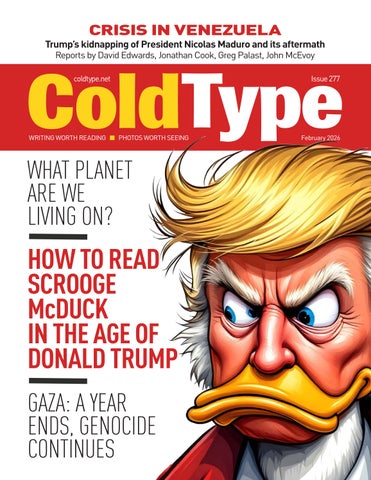
CRISIS IN VENEZUELA
Trump’s kidnapping of President Nicolas Maduro and its aftermath
Reports by David Edwards, Jonathan Cook, Greg Palast, John McEvoy
![]()
Trump’s kidnapping of President Nicolas Maduro and its aftermath
Reports by David Edwards, Jonathan Cook, Greg Palast, John McEvoy


4 Never forget Rafaat Al Areer
5 Peace rebranded! Manja McCabe
7 Nigel Farage is UK’s foot soldier in Trump’s oil war Sam Bright
8 The US Justice Department, fake cartels, and Madura Binoy Kampmark
9 Greed at a Glance Inequality.org
10 Why must politicians surrender to the super-rich?
George Monbiot
12 Trump ramps up false claims of genocide of SA farmers
Mark Waller
13 Hurwitt’s Eye
Mark Hurwitt
7 Lewis Street, Georgetown, Ontario, Canada L7G 1E3
Contact: Tony Sutton editor@coldtype.net
Subscribe: For a FREE subscription e-mail editor@coldtype.net
Back Issues: www.coldtype.net/reader.html or www.issuu.com/coldtype
Disclaimer:
The contents of the articles in ColdType are the sole responsibility of the author(s). ColdType is not responsible for any inaccurate or incorrect statements they may contain ©ColdType 2025


44-year-old Palestinian poet and academic Rafaat Al Areer was killed on December 6, 2023, along with six members of his family in an Israeli air strike on Gaza City. A book of his essays and poems, If I Must Die: Poetry and Prose, was published in 2024
➤ MANJA M c CADE
Julian Assange warned that the Nobel Peace Prize was being weaponised. The Oval Office proved him right
On 15 January, Venezuelan opposition leader María Corina Machado met President Donald J. Trump at the White House. An official photograph, shared by the White House on X the next day, shows President Trump smiling as he holds a large, ornate gold frame containing the 2025 Nobel Peace Prize medal. A plaque beneath it thanks him for his “extraordinary advocacy promoting liberty and prosperity,” citing his “Venezuelan Freedom Project” and his “principled and decisive action to secure a free Venezuela”. Machado stands beside him, composed and resolute.
President Trump later wrote on Truth Social: “It was my Great Honour to meet María Corina Machado… María presented me with her Nobel Peace Prize for the work I have done. Such a wonderful gesture of mutual respect.”
The symbolism is unmistakable –and deeply unsettling.
Alfred Nobel’s will established the Peace Prize to honour those who ad-

vance “fraternity between nations” and work towards “the abolition or reduction of standing armies.” Yet here, the medal was repurposed as a gesture of gratitude for a US-backed military op -
THE EGO HAS LANDED: Donald Trump grins as he accepts the Nobel Peace medal from Venezuela’s Maria Corina Machado
eration: the capture of Venezuela’s President Nicolás Maduro by special forces in early January 2026, an operation that removed a sitting head of state amid long-standing geopolitical tensions.
The Norwegian Nobel Committee was quick to reiterate that the Peace Prize “cannot be revoked, shared, or transferred.” Formally correct – and politically beside the point – the act itself speaks volumes.
This moment did not arise in isolation. It came just weeks after Julian Assange filed a criminal complaint in Sweden in December 2025 against 30 officials of the Nobel Foundation, including its chair and executive director. The complaint alleged gross misappropriation of funds and accused the Foundation of facilitating war crimes, crimes against humanity, and the financing of aggression by awarding the 2025 Peace Prize to María Corina Machado.
Julian argued that Machado’s open support for aggressive US policies – including military escalation, intervention, and alignment with President Trump’s hard-line approach – stood in direct contradiction to Nobel’s stated intent. He sought an immediate freeze on the prize money (11 million Swedish kronor, approximately US$1.18 million) and warned that the award had transformed “an instrument of peace into an instrument of war.” This was not an isolated protest. It was the continuation of his decades-long effort to expose how powerful institutions rebrand geopolitical violence as moral leadership. Through WikiLeaks, he revealed
the concealed realities of foreign intervention at immense personal cost – years confined in the Ecuadorian Embassy, followed by imprisonment in Belmarsh.
The Oval Office ceremony illustrated his warning with striking clarity.
Behind President Trump, the Declaration of Independence loomed – a text forged in opposition to tyranny – while a peace prize was used to celebrate actions widely understood as regime change by force. Machado has publicly praised

Trump’s role in Venezuela’s upheaval, even as fundamental questions remain unresolved: interim governance, elections, and control of national resources.
Symbolic though it may be, the handover demonstrates how readily prestigious awards can be reinterpreted to legitimise power.
What followed in the media was equally revealing.
Major mainstream outlets – including the BBC, the New York Times, CNN, Reuters, the Washington Post, and PBS – reported extensively on the handover, the incredulity in Norway, and the Nobel Committee’s clarification. They noted President Trump’s long-standing
desire for the prize and analysed the geopolitical implications.
Almost none mentioned Julian Assange’s complaint filed only weeks earlier. No connection was drawn between his warning and the events that followed.
Independent outlets – including WikiLeaks, Al Jazeera, and France 24 – had reported on the complaint in December, highlighting both its legal and moral significance. Even Wikipedia records both events on the same page. Yet mainstream reporting largely declined to bridge the gap.
That silence is telling.
Julian is vindicated not only in substance, but in outcome. He was totally right to challenge the award. The failure of much of the press to provide context exposes a deeper reluctance to scrutinise how symbols of peace are co-opted by power.
Julian Assange’s warning and this ceremonial gesture are inseparable. Both challenge us to defend integrity within global institutions. Both force the same question: when peace prizes honour support for military action, what becomes of genuine fraternity between nations?
And when context is quietly omitted, who is left to hold power to account?
The Assange Archive exists to ensure these questions remain accessible – for researchers, students, activists, and future generations. The struggle for transparency and accountability is ongoing, and it must be preserved.
For the Julian Assange Archive, this moment is not merely news – it is continuity.
The Archive preserves thousands of letters sent in solidarity during
Julian’s isolation, protest banners carried through streets across the world, artworks of resistance, and personal belongings entrusted by Julian Assange and his team. Together, they document grassroots power: vigils held in the cold, sustained campaigns, and the enduring belief that truth matters.
As preparations continue for the Archive’s exhibition in Dessau, Germany,opening in 2026, it will become a living resource – physical, digital, and exhibition-based. Visitors will encounter history directly: letters that crossed borders, banners that filled public squares, and objects bearing the weight of sacrifice.
Events such as the 15 January handover belong within this record – documented, contextualised, and open to examination. They reveal
patterns: how honours are repurposed, how narratives are shaped, and why independent scrutiny remains essential.
Headlines fade quickly, but the questions endure. If you hold materials, stories, or reflections from the global movement supporting Julian Assange, we invite you to contribute. Every piece helps ensure that moments of clarity are not lost to time. CT
Manja McCade is chairperson of the Julian Assange Archive. Previously, she was he is the creative force behind the acclaimed Belmarsh Live project, which toured across Europe for two years, raising awareness of Assange’s story and the fight for press freedom. get more information about the project at ➤ SAM BRIGHT
Alittle over a year ago, on 17 December 2024, the UK’s Reform Party leader Nigel Farage delivered a speech in his natural habitat – a private members’ club in Mayfair, London.
Farage was addressing the UK launch of a Chicago-based, proTrump group – the Heartland Institute.
You may not know the Heartland Institute, but I’m pretty sure you’ll recognise its agenda. The group is proudly one of the world’s leading climate science denial groups –casting doubt on the contribution

of humans to global warming and instead vocally advocating for more fossil fuel extraction.
It contributed to Trump’s first administration, helped to write Project 2025 – the blueprint for his second term – and claims to have close ties to Trump’s top team. Its influence is epitomised by the fact that, when Trump announced in June 2017 that he was withdrawing the US from the Paris climate agreement, Heartland’s CEO was in the front row.
And, over the past year – thanks to the help of Nigel Farage – the group has been expanding its tentacles into the UK and Europe.
This matters not least because Trump launched a coup in Venezuela – abducting its leader Nicolás Maduro – with the aim of allowing the country’s vast oil reserves to be exploited by American petro giants.
Trump has been explicit about this fact – confirming that he discussed the Venezuela coup with oil executives “before and after” the operation.
“We’re going to have our very large United States oil companies –the biggest anywhere in the world – go in, spend billions of dollars, fix the badly broken infrastructure and start making money for the country,” he added.
This is the natural end point of Trump’s “drill baby drill” agenda –which has been drafted in no small part by the Heartland Institute.
While the US is a massive fossil fuel producer, it imports the heavy crude oil that feeds its refineries. And guess which country has some of the largest supplies of this heavy crude? Yep, Venezuela.
Farage has been lobbying hard for this pro-oil agenda to spread
to the UK, and has been working in alliance with the Heartland Institute to copy Trump’s playbook. Indeed, the Reform leader first raised the idea of a Heartland UK branch in September 2024. Speaking at the institute’s 40th anniversary fundraiser in Chicago (alongside a far-right Austrian politician), Farage said: “Give us your wisdom, give us your guidance, give us your discipline. I’d love to see Heartland on the other side of the pond.”
Lo and behold, just a few months later, Heartland set up shop in London – its UK-EU office led by Lois Perry, who’s a Reform supporter, a close ally of Farage, and a former leader of UKIP.
Heartland is actively advising Reform on the party’s energy and climate policies (in fact Perry claims she’s the reason the party has such an aggressive, anticlimate agenda), and hosted a keynote panel event at the party’s annual conference in September.
Using London as a launchpad and Farage as a proxy, the Heartland Institute has also been trying to carry out Trump’s wishes by interfering in politics throughout Europe. As I’ve documented for DeSmog and the Guardian, the group has been attempting to use far-right politicians to immobilise the EU’s clean energy agenda.
This all fits into Trump’s plan – as revealed by his new national security strategy – to “help Europe correct its current trajectory,” primarily by encouraging a revival of the far-right.
Unsurprisingly, the document also states: “We reject the disastrous ‘climate change’ and ‘Net Zero’ ideologies that have so greatly harmed Europe, threaten
the United States, and subsidise our adversaries.”
Ergo, Trump’s decision to topple Maduro is part of an international, oil-guzzling agenda that includes the systematic subversion of Europe’s progressive, clean energy policies – a campaign Farage has been all too happy to assist.
Given the level of loathing for Trump in the UK and across Europe, you do wonder how voter
➤ BINOY KAMPMARK
voters would react if they were more aware of these facts. CT
Sam Bright has written for the New York Times, the Guardian, the BBC, The Mirror, Led By Donkeys, and a host of other outlets. He is the author of two books: Fortress London, and Bullingdon Club Britain. This, and more of his articles, may also be read at www.writesbright.substack.com
The Trump administration is increasingly resembling a government previously abominated by the current US president as entangling, bumbling, and prone to fantasies.
President George W. Bush was well versed in baseless existential threats stemming from Mesopotamia, supposedly directed by the Iraqi dictator Saddam Hussein. There was a critical problem in this assessment: Bush was criminally wrong, proposing a doctrine in response to the attack by alQaeda on the United States on September 11, 2001 heavy on violence and slim on evidence.
The patchy formulation came to be known as the Bush Doctrine, permitting the United States to unilaterally and pre-emptively attack any country allegedly posing
a threat to its security despite never evincing any genuine means of doing so. There would also be, Bush stated in his address to the nation, “no distinction between the terrorists who committed these acts [of 9/11] and those who harbor them.”
Such streaky reasoning eventually fastened upon Iraq’s alleged Weapons of Mass Destruction (WMDs), apparently at the ready to strike the US and its allies. If not Baghdad, then certainly an opportunistic terrorist proxy would be more than willing to deploy them.
In his 2003 State of the Union Address, Bush solemnly stated that “the gravest danger facing America and the world, is outlaw regimes that seek and possess nuclear,
chemical, and biological weapons.” Such weapons might be used “for blackmail, terror, and mass murder” or provided or sold “to terrorist allies, who would use them without the least hesitation.”
As the 2003 US-led invasion of Iraq proceeded with its increasingly bloody bill of sale, there were no WMDs to be found. Saddam, foolishly as things would have it, destroyed or disarmed those weapons he had made free use of in the Iran-Iraq War. This hardly mattered. There was shoddy intelligence aplenty, including false claims that Iraq had tried to purchase 500 tons of yellowcake uranium powder from Niger, and cloudy lines of cooperation between Baghdad and al-Qaeda. With schoolboyish enthusiasm being shown by the evangelical UK Prime Minister, Tony Blair, the Saddam threat ballooned for Bush. Neoconservatives rejoiced at this chance of cratering, erasing and reforming the Middle East.
The Donroe Doctrine, childishly envisaged and clumsily applied, has an unmistakable analogue with that of Bush.
In repurposing the Monroe Doctrine for the Western Hemisphere, excluding threatening foreign interests in Latin America and extinguishing governments adversarial or unsympathetic to the United States, Trump scorns the evidence. A fundamental reason for abducting President Nicolás Maduro of Venezuela, by way of example, was accusing him of being a narco-terrorist amenable to nasty foreign interests. Elevating his stature as a threat, he was accused of being a figure of the Cartel de los Soles (Cartel of the Suns).
This pattern stretches back to the

first Trump administration, when a grand jury indictment alleged that Maduro, along with other officials, “participated in a corrupt and violent narco-terrorism conspiracy between the Venezuelan Cártel de Los Soles and the Fuerzas Armadas Revolucionarias de Colombia.” Five years later, when the Treasury Department retrieved the initial text, the Cartel was designated
a “terrorist organisation.” Come November 2025, US Secretary of State Marco Rubio directed the State Department to do the same. With an eerie sense of the past cantering into the present, we find the US Justice Department conceding that there was no link between Maduro and this sinister cartel. This stands to reason, given that the group does not exist as a tangible organisation. The allegation has long been contentious, but those close to Trump were not willing to be swayed by that dullest compendium of subject matter unfashionably called “the facts.”
Believers in virgin births, tooth fairies and Sky Gods sometimes intrude into the making of American foreign policy, and Rubio, in justifying extrajudicial killings of those on board alleged narcovessels in the Caribbean Sea by US military forces had this to say: “We will continue to reserve the right to take strikes against drug boats that are bringing drugs toward the United States that are being

operated by transnational criminal organisations, including the Cartel de los Soles.”
The 2020 indictment mentioned the cartel no fewer than 32 times. The new indictment makes a mere two references to a term that has ceased to be an entity and become a concept, revised as a “patronage system run by those at the top.” It does not feature as an organisation along with the list of alleged “narco-terrorists” outlined in the fourth paragraph.
Those versed in the slippery argot of drug trafficking in Latin America have concluded that the Cartel de los Soles is a colloquialism minted by Venezuelan media to out despoiled officials sporting the sun insignia on their uniforms. It became a matter of usage in the 1990s, making it less a description of organisational reality than identifying a broader system of corruption.
From the outset, Venezuelan figures such as interior and justice minister Diosdado Cabello dismissed the cartel as the product of a fevered imagination. In August last year, he coolly remarked that US officials, when bothered, would name the target of their indignation “the head of the Cartel de los Soles.” The organisation makes no appearance in the United Nations’ annual World Drug Report, preferring to reference Mexico’s Sinaloa Cartel, and Brazil’s Primeiro Comando Capital (PPC) and Comando Vermelho (CV). The US Drug Enforcement Agency’s annual National Drug Threat Assessment makes reference to the Venezuelan Tren de Aragua, “a violent criminal organization founded between 2012 and 2013” that “mainly operates within
Venezuelan migrant communities” in the United States. No favours are done naming the Cartel de los Soles, however.
The rewritten indictment against Maduro reveals how presidential doctrines can be used to force evidence upon a Procrustean bed, sawing or extending it to fit the set dimensions of a dogma. The crime of aggression against Iraq
➤ GEORGE MONBIOT
in 2003 was based upon forged evidence, implausible links and flimsy assumptions. The crime of aggression against Venezuela on January 3 reprised the performance. Instead of a uranium hoax, we got the Cartel of the Suns. CT
Binoy Kampmark lectures at RMIT University, Melbourne, Australia

There is one political problem from which all others follow. It is the major cause of Donald Trump, of Nigel Farage, of the shocking weakness of their opponents, of the polarisation tearing societies apart, of the devastation of the living world. It is simply stated: the extreme wealth of a small number of people.
It can also be quantified. The World Inequality Report (WIR)
2026 shows that about 56,000 people – 0.001 percent of the global population – corral three times more wealth than the poorest half of humanity.
They afflict almost every country. In the UK, for example, 50 families hold more wealth than 50 percent of the population combined.
You can watch their fortunes grow. In 2024, Oxfam’s figures show, the wealth of the world’s 2,769 billionaires grew by $2tn, or $2,000bn. The total global spending on international aid last year was projected to be, at most, $186bn, less than a tenth of the increment in their wealth. Governments tell us they “can’t afford” more. In the UK, billionaires, on average, have become more than 1,000 percent richer since 1990.
Most of their wealth derives from property, inheritance and finance. They have become so rich, in other words, at our expense. The issue affects every aspect of policy. Trump is not seizing Venezuela’s
oil wealth for the sake of the US poor. He couldn’t give a damn about them, as his “big, beautiful bill” –robbing the poor to give to the rich – revealed. He covets Greenland on behalf of the same elite interests, of which he is the avatar.
When the world’s richest man, Elon Musk, helped destroy the lives of the world’s poorest by tearing down USAID, he did so on behalf of his class.
The same goes for Trump’s assaults on democracy, and his war on the living world. It is the ultrarich who benefit most from destruction, in making money and in spending it.
The WIR shows that the richest 1 percent of the world’s population account for 41 percent of greenhouse gas emissions arising from private capital ownership: almost twice that of the bottom 90 percent. And through their consumption, another study shows, the 1 percent produce as many greenhouse gases as the poorest two-thirds.
Inequality damages every aspect of our lives. Decades of research by Kate Pickett and Richard Wilkinson shows that higher inequality, regardless of absolute levels of wealth, is associated with higher crime, worse public health, higher addiction, lower educational attainment, worse status anxiety (leading to higher consumption of positional goods), worse pollution and destruction, and a host of other ills.
Extreme inequality creates an “Epstein class” of global predators, exploiting the rest financially – and in other ways. It creates an ethos that no longer recognises our common humanity, that sees other people, as Musk puts it, as “non-player characters,” and believes that, “the
fundamental weakness of western civilisation is empathy.”
This is the metric by which you can tell who in politics are your allies and who are your enemies: whether they support or oppose the extreme concentration of wealth. In fact, the matter should be definitional.
Those who support it (let’s call them Group 1) are the right. Those who oppose it (Group 2) are the left.

Immigrants, asylum seekers, Muslims, women, transgender people, disabled people, students, protesters: anyone and everyone must be blamed for our dysfunctions, except those causing them
As soon as you understand politics in this light, you notice something extraordinary. Almost the entire population is in Group 2. Polling across 36 nations by the Pew Research Center found that 84 percent see economic inequality as a big problem, and 86 percent see the political influence of the rich as a major cause of it. In 33 of these nations, a majority believe their country’s economic system needs either “major changes” or “complete reform.”
In the UK, a YouGov poll revealed, 75 percent support a wealth tax on fortunes above £10m, while only 13 percent oppose it. But – and
here’s the astonishing thing – almost the entire political class is in Group 1. You can search the manifestos of major parties that once belonged to the left, and find no call to make billionaires history.
Quite the opposite in fact. Even when politicians are forced to respond to calls for a wealth tax, they dismiss it, as UK ministers have done, with two excuses.
The first is that it won’t raise much revenue. Maybe, maybe not: there’s a wide range of evidence on this matter. But revenue-raising is the least of its benefits. Far more important are two other issues. One is fairness.
As the WIR reports, “Effective income tax rates climb steadily for most of the population but fall sharply for billionaires and centi-millionaires.”
This undermines trust in the tax system and politics in general. The other is reducing the power of the ultra-rich over our lives. To restore democracy and create a fairer, safer, greener world, we must bring the ultra-rich to heel, cutting their fortunes until they can no longer bludgeon us.
The second excuse is that the uber-rich will flee the country. There are three possible responses to this claim. The first is that there’s no evidence to support it. The second is, if true, good riddance: they do us more harm than good. The third is to say: then the obvious solution is a global tax-avoidance measure. So guess what?
While 125 nations supported this approach, Keir Starmer’s government was one of nine that opposed it. Our government doesn’t tax the ultra-rich enough not because it can’t, but because it doesn’t want to.
It’s not just politicians. Almost all the media belongs to Group 1. As the wealth and power of the proprietor class becomes ever greater and harder to justify, the views expressed in their outlets become ever crazier.
Immigrants, asylum seekers, Muslims, women, transgender people, disabled people, students, protesters: anyone and everyone must be blamed for our dysfunctions, except those causing them. Ever more extreme ‘culture wars’ (a euphemism for divide-and-rule) must be waged.
It’s also why imaginary threats (Venezuela, ‘cultural Marxists,’ ‘domestic terrorists”) must constantly be drummed up. You cannot have both a free market in media ownership and a free market
in information and ideas. The oligarchs who dominate the sector stifle inconvenient thoughts and promote the policies that protect their fortunes.
No one would claim that taking on extreme wealth is easy. But the battle begins with political parties spelling out this aim, clearly and unequivocally. Either they represent the great majority, or they represent the tiny minority: they cannot do both. So where, we might ask, are our representatives? CT
George Monbiot’s latest book, written with Peter Hutchinson, is Invisible Doctrine: The Secret History of Neoliberalism. His website is www.monbiot.com. This article first appeared in The Guardian
Afew days after the abduction by the US of Venezuelan president Nicolás Maduro and his wife, Cilia Flores, South African president Cyril Ramaphosa was asked by journalists if he thought the Trump administration would also attack South Africa. “Not at all… We have always believed that any differences with whichever country, including the US, need to be discussed. We need to sit down and find solutions.”
Amid the weird twists and turns of the Trump doctrine,

Ramaphosa’s calm, rational assurances seem increasingly old school. Jitters about a potential US military attack against South Africa have been confined to social media yapping. But worries about what the US has in store for the country are real enough. The country is vulnerable and US behaviour unpredictable.
We saw this at the recent World Economic Forum in Davos, Switzerland. South Africa’s Minister of Electricity and Energy, Kgosientsho Ramokgopa, was on the six-member ‘Team South Africa’ delegation. Interviewed by South African radio, he expressed satisfaction that South Africa didn’t feature in Trump’s special address to the forum and didn’t reiterate his false claims of a ‘white genocide’: “It helps that someone has forgotten about us… there is a big relief.”
He spoke too soon. Trump blasted South Africa when he spoke to reporters on the sidelines of the forum: “What’s happening in South Africa is terrible. It’s a terrible situation. What they’re doing to people, a certain group of people, is unbelievable. You wouldn’t think it could happen today… we have seen the numbers, we’ve seen the records, and it is taking place and it’s gotta be stopped.”
The white genocide allegations have been repeatedly debunked, but they’re a convenient line of attack for Trump, topping a list of other charges against the Ramaphosa government.
They also align with Trump’s racist views on Africans, which were evident in his speech at Davos (“Somalis have low IQs…”)
and his earlier “civilisational erasure” comments about migrants from the global South in Europe.
The US’s antagonism towards South Africa is based on several grievances.
It doesn’t like South Africa’s membership of BRICS and the effort to pluralise global trade relations. It’s incensed that South Africa dared to haul Israel, dependent on US military support for its erasure of Palestine, before the International Court of Justice on charges of genocide. It accuses South Africa of boosting efforts to develop commercial, military, and nuclear arrangements with Iran. It alleges that South African officials illegally raided a Johannesburg centre processing applications for South Africans wishing to take up ‘refugee’ status in the US.
This last point relates to an incident last December, when the US brought in people from Kenya on tourist visas to work at the processing centre, contrary to South African immigration law.
South Africa has modest trade relations with Iran. The involvement of Iran in a BRICS naval drill, led by China, off the South African coast in January, prompted the US to allege a threat to regional security.
Ramaphosa said that Iran’s participation, taking place during the heavy clampdown on protests in Iran, would only be as an observer.
Trump has said that he’ll impose 25 percent tariffs on any country trading with Iran. Last August, the US slapped South Africa with a 30 percent tariff on ex-
ports to the US, though with exemptions on platinum, titanium, fresh food products and certain fertilisers.
Whether or when the threatened new tariffs will be imposed is unclear.
What is clear is that a belligerent US still has South Africa in its crosshairs. Even more so now. It’s an easy target. Militarily weak, massively dependent on outside investment and export revenues and hamstrung by its own neoliberal economic policies that only exacerbate crisis levels of poverty among the majority black population, the country is easy prey to Trump’s bullying.
And this is being pumped by renewed nonsense about a ‘genocide’ targeting South Africa’s Afrikaners and other whites. This section of society continues to flourish in post-apartheid
South Africa, earning per household four times more than Black households. But no amount of solid evidence will persuade the White House otherwise.
Trump’s ominous “it’s gotta be stopped” remark at Davos suggests that the rhetoric will turn to sanctions.
These could include excluding South Africa from the extension of the African Growth and Opportunity Act (AGOA), which exempts African countries from a wide range of tariffs. US Trade Representative Jamieson Greer has said that he’d be “happy” to cut South Africa out of AGOA, “because I think they are a unique problem.” CT
Mark Waller is a UK-Finnish national who lives in Pretoria, South Africa and works as a freelance journalist, translator and editor

➤ CHRIS HEDGES
The Trump administration is consolidating the familiar machinery of terror of all authoritarian states. We must resist now. If we wait, it will be too late
Ihave seen the masked goons who terrorise our streets before. I saw them during the “Dirty War” in Argentina, where 30,000 men, women and children were “disappeared” by the military junta. Victims were held in secret prisons, savagely tortured and murdered. To this day, many families do not know the fate of their loved ones.
I saw them in El Salvador, when death squads were killing 800 people a month. I saw them in Guatemala under the dictatorship of José Efraín Ríos Montt. I saw them in Augusto Pinochet’s Chile and in Saddam Hussein’s Iraq. I saw them in Iran under the rule of the ayatollahs where I was arrested and jailed twice and once deported in handcuffs. I saw them in Hafez al-Assad’s Syria. I saw them in Bosnia, where Muslims were herded into concentration camps, executed and buried in mass graves.
I know these goons. I have been a prisoner in their jails and spent hours in their interrogation rooms. I have been beaten by them. I have been deported, and in several cases banned, from their countries. I know what is coming.
Terror is the engine that empowers dictatorships. It eliminates dissi-
dents. It silences critics. It dismantles the law. It creates a society of timid and frightened collaborators, those who look away when people are snatched off streets or gunned down, those who inform to save themselves, those who retreat into their tiny rabbit holes, pulling down the blinds, desperately praying to be left in peace.
The iron doors have not yet shut. There are still protests. The media is still able to document state atrocities, including the January 7 murder of Renee Nicole Good in Minneapolis by Immigration and Customs Enforcement (ICE) agent Jonathan Ross. But the doors are closing fast. ICE has deported over 300,000 people and detained nearly 69,000 others – as well as been involved in 16 shootings, including four killings –since Trump began his campaign against immigrants.
ICE, our Americanised Gestapo, is being birthed.
Resistance must be collective. We must assert not only our individual rights, but economic, social and political rights – without them we are powerless. Resistance means organising to disrupt the machin-


Mr Fish
ery of commerce and government. It means preventing arrests by patrolling neighbourhoods to warn of impending ICE raids. It means protesting outside detention facilities. It means strikes. It means blocking streets and highways and occupying buildings. It means providing photographic evidence. It means sustained pressure on local politicians and police to refuse to cooperate with ICE. It means providing legal representation, food and financial assistance to families with members detained. It means a willingness to be arrested. It means a nationwide campaign to defy the state’s inhumanity.
If we fail, the dimming flames of our open society will be snuffed out.
Authoritarian states are constructed incrementally. No dictatorship advertises its plan to extinguish civil liberties. It pays lip service to liberty and justice as it dismantles the institutions and laws that make liberty and justice possible. Opponents of the regime, including those within the establishment, make sporadic attempts to resist. They throw up temporary roadblocks, but they are soon purged.
Alexander Solzhenitsyn in The Gulag Archipelago notes that the consolidation of Soviet tyranny “was stretched out over many years because it was of primary importance that it be stealthy and unnoticed.” He called the process “a grandiose silent game of solitaire, whose rules were totally incomprehensible to its contemporaries, and whose outlines we can appreciate only now.”
“What would things have been like if every Security operative, when he went out at night to make an arrest, had been uncertain whether he would return alive and had to say good-bye to his family?” Solzhenitsyn asks. “Or if, during periods of mass arrests, as for ex-
ample in Leningrad, when they arrested a quarter of the entire city, people had not simply sat there in their lairs, paling with terror at every bang of the downstairs door and at every step on the staircase, but had understood they had nothing left to lose and had boldly set up in the downstairs hall an ambush of half a dozen people with axes, hammers, pokers, or whatever else was at hand? After all, you knew ahead of time those bluecaps were out at night for no good purpose. And you could be sure ahead of time that you’d be cracking the skull of a cutthroat. Or what about the Black Maria sitting out there on the street with one lonely chauffeur – what if it had been driven off or its tires spiked? The Organs would very quickly have suffered a shortage of officers and transport and, notwithstanding all of Stalin’s thirst, the cursed machine would have ground to a halt!”
Czesław Miłosz, in The Captive Mind, also documents the creep of tyranny, how it advances stealthily, until intellectuals are not only forced to repeat the regime’s selfadulating slogans but, as our leading universities did when they caved to false allegations of being bastions of antisemitism, embrace its absurdism.
Manufactured fear engenders self-doubt. It makes a population –often unconsciously – conform outwardly and inwardly. It conditions citizens to relate to those around them with suspicion and distrust. It destroys the solidarity vital to organising, community and dissent.
The historian Robert Gellately, in his book Backing Hitler: Consent and Coercion in Nazi Germany, argues that state terror in Nazi Germany was effective not because of omnipresent state surveillance, but because it fostered a “culture of denunciation.”
Rat out your neighbours and co-

workers and survive. If you see something, say something.
The worse it gets, the more established institutions, desperate to survive, silence those who warn us.
“Before societies fall, just such a stratum of wise, thinking people emerges, people who are that and nothing more,” Solzhenitsyn writes of those who see what is coming. “And how they were laughed at! How they were mocked!”
The Austrian writer Joseph Roth, whose early warnings about the rise of fascism were largely dismissed, and who told fellow intellectuals to stop naively appealing to “the remains of a European conscience,” saw his books tossed into the bonfires in the spring of 1933 during the Nazi book burnings. So far, we have not burned books in the US, but we have banned nearly 23,000 titles in public schools since 2021.
The authoritarian state cannibalises the institutions that foolishly aid and abet the witch hunts. It replaces them with pseudo-institutions populated with pseudolegislators, pseudo-courts, pseu-
do-journalists, pseudo-intellectuals and pseudo-citizens. Columbia University is a shining example of this wilful self-immolation. Nothing is as it is presented.
There are increasing numbers of violent kidnappings by masked ICE agents in unmarked cars on our city streets. People are ripped from their vehicles and beaten. They are arrested outside schools and day care centres. They are raided at work, thrown onto the floor, handcuffed, driven away in vans and shipped off to concentration camps in countries such as El Salvador. They are seized when they appear at court for a green card application or interview to finalise a visa.
Once detained, they disappear into the labyrinth of over 200 detention centres, where they are moved from one facility to the next to hide them from family, lawyers and the courts. Due process, once a constitutional right afforded to everyone in the United States, no longer exists.
“Laws that are not equal for all revert to rights and privileges, something contradictory to the very nature of nation-states,” Hannah Arendt writes in The Origins of
Totalitarianism. “The clearer the proof of their inability to treat stateless people as legal persons and the greater the extension of arbitrary rule by police decree, the more difficult it is for states to resist the temptation to deprive all citizens of legal status and rule them with an omnipotent police.”
The FBI, in an example of how justice is perverted, refuses to cooperate with local law enforcement agencies in Minneapolis, blocking access to any evidence that would allow them to file criminal charges against Jonathan Ross.
Killing of unarmed citizens by the state is carried out with impunity.
ICE has more than doubled the size of its force since early 2025 – to 22,000 agents – hiring 12,000 new officers in four months from a pool of 220,000 applicants. It plans to spend $100 million over a one-year period to hire even more recruits, part of the $170 billion for border and interior enforcement, including $75 billion for ICE, to be spent over four years. Salaries for these new recruits, poorly trained and often haphazardly vetted, will range from $49,739 to $89,528 a year, along with a $50,000 signing bonus – split over three years – and up to $60,000 in student loan repayments.
ICE is building new detention centres nationwide in 23 towns and cities. It promises that once it is fully operational, it will go door-to-door as part of the largest deportation effort in American history.
ICE agents, intoxicated by the licence to kick down doors while wearing body armour and firing automatic weapons at terrified women and children, are not warriors as they imagine, but thugs. They have few skills, other than weapons training, cruelty and brutality. They intend to remain employed by the state. The state intends to keep them employed.
None of this should surprise us.
Authoritarian states blow out, one by one, the long row of candles until we find ourselves in the dark, powerless and alone
The repressive techniques used by ICE and our militarised police were perfected overseas in Iraq, Afghanistan, Syria, Libya and Occupied Palestine, and earlier in Vietnam. The ICE agent who murdered Good was a machinegunner in Iraq. A night raid in Chicago, with agents rappelling from a helicopter to storm an apartment complex filled with terrified families, does not look any different from a night raid in Fallujah.
Aimé Césaire, the Martinician playwright and politician, in Discourse on Colonialism writes that the savage tools of imperialism and colonialism eventually migrate back to the home country. It is known as imperial boomerang.
Césaire writes: “And then one fine day the bourgeoisie is awakened by a terrific boomerang effect: the gestapos are busy, the prisons fill up, the torturers standing around the racks invent, refine, discuss.
“People are surprised, they become indignant. They say: “How strange! But never mind – it’s Nazism, it will pass!” And they wait, and they hope; and they hide the truth from themselves, that it is barbarism, the supreme barbarism, the crowning barbarism that sums up all the daily barbarisms; that it is Nazism, yes, but that before they were its victims, they were its accomplices; that they tolerated that Nazism before it was inflicted on them, that they absolved it, shut their eyes to it, legitimized
it, because, until then, it had been applied only to non-European peoples; that they have cultivated that Nazism, that they are responsible for it, and that before engulfing the whole edifice of Western, Christian civilization in its reddened waters, it oozes, seeps, and trickles from every crack.”
During the interregnum between the last gasps of a democracy and the emergence of a dictatorship, the nation is gaslighted. It is told the rule of law is respected. It is told democratic rule is inviolate. These lies mollify those being frog-marched into their own enslavement.
“The majority sit quietly and dare to hope,” Solzhenitsyn writes. “Since you aren’t guilty, then how can they arrest you? It’s a mistake!”
Maybe, the fearful say, Trump and his minions are only being bombastic. Maybe they don’t mean it. Maybe they are incompetent. Maybe the courts will save us. Maybe the next elections will end this nightmare. Maybe there are limits to extremism. Maybe the worst is over.
These self-delusions prevent us from resisting while the gallows are being constructed in front of us.
Authoritarian states start by targeting the most vulnerable, those most easily demonised – the undocumented, students on college campuses who protest genocide, antifa, the so-called “radical left,” Muslims, poor people of colour, intellectuals and liberals. They strike down one group after the next. They blow out, one by one, the long row of candles until we find ourselves in the dark, powerless and alone. CT
Chris Hedges is a Pulitzer Prize–winning journalist who was a foreign correspondent for 15 years for the New York Times. He is the host of the Chris Hedges Report podcast at www.chrishedges.substack.com
➤ ALFRED M c COY
Writers often try to gild their tawdry times or dignify their flawed leaders with lofty literary analogies – notably, America as the New Jerusalem; Lincoln as Moses leading his people through the wilderness of the Civil War; the Kennedy White House as an incarnation of King Arthur’s ‘Camelot,’ or Lyndon Johnson living his last years as a latter-day King Lear, cast off by his ungrateful children into the moors of south Texas.
But what are we going to do with Donald Trump? Wouldn’t his vanity, his vulgarity, and his relentless pursuit of money and minerals in every corner of the globe turn any literary analogies into soggy clichés? Like the showman P.T. Barnum, Trump is an American original, whose true metaphors can be found only in comic books (America’s one true art form), not literature. As Ariel Dorfman reminded us once upon a time in How to Read Donald Duck, that classic guide to US cultural imperialism in Latin America, there was always more to a Disney comic book than gags.
To understand Trump’s America, we need our own comic guidebook to his global misadventures, which might be titled something like “How to Read Scrooge McDuck.” After all,
in case you never had the pleasure of his acquaintance, Scrooge McDuck was the predatory billionaire in Disney comics, who was amazingly popular among teenagers in Cold War America. In that era when American corporations scampered around the global economy extracting profits wherever they saw fit, Scrooge McDuck put a friendly face on US imperialism, making covert intervention and commercial exploitation look benign, even comic.
From 1952 to 1988, a period coinciding almost precisely with the Cold War, the comic’s creator, illustrator Carl Barks, filled the country’s magazine racks with more than 220 comic books celebrating Scrooge’s schemes to accumulate ever more billions by dispatching Donald Duck and his triplet nephews (Huey, Dewey, and Louie) to scour the world for riches – gems, minerals, oil, and lost treasure. No place on the planet was too remote, not even the Arctic or the Amazon, and no people too poor or obscure, not even Hondurans and Tibetans, to escape his tight-fisted grasp. And yet in that innocent world of the comic book, every adventure, no matter how twisted the plot, always ended with a light laugh for those duckling heroes and the di-
verse peoples they encountered on their global travels.
Let’s visit a few of my favourite com ic books from my Cold War child hood, starting with the 1954 story The Sev en Cities of Cibola. Its initial panels show a butler showering the billionaire duck with coins while he swims around in his Money Bin’s “three cu acres” of cash. At first, Scrooge McDuck seems content as he gloats about making mon ey from “about eve ry business there is on Earth” (from “oil wells, railroads, gold mines, farms, factories”).
Suddenly, however, sad dened by the realisation that he’s exhausted every possible domestic path to profit, Scrooge decides to lead his nephew Don ald and the triplets into the desert borderlands be

tween Mexico and the US. There, they come upon a lost Eldorado, a towering, multitiered city with gold-paved streets and a cistern filled with opals and sapphires. But caution intrudes when Huey, Dewey, and Louie discover that the whole edifice is poised dangerously atop a spindly stone pillar. Then, at their moment of near triumph, the ducks are denied any treasure by Scrooge’s recurring nemesis, the comically criminal Beagle Boys, who break in and grab the city’s bejewelled idol, triggering a hidden mechanism that fractures the pillar. As those fabled cities
collapse into a heap of rubble, our duckling heroes escape unharmed, ready for their next adventure.
The first panel in a 1956 comic book, the Secret of Hondorica, shows Scrooge McDuck pointing to a map of the Caribbean as he dispatches Donald Duck and his three nephews deep into tropical jungles near – yes, how sadly appropriate almost seven decades later – Venezuela to recover his lost deeds to the region’s rich oil wells. After crossing steep mountains and crocodileinfested creeks, the Ducks happen upon a Mayan temple filled with spear-carrying ‘savages’ arrayed around their idol. By translating the ‘picture writing’ on the temple walls with the help of their handy encyclounior Woodchuck Guidethe nephews deceive the natives with incantations in their own language and escape with the idol’s crown of gold.

President Donald Trump is, of course, our real-life Scrooge McDuck. Mar-a-Lago is his Money Bin. And the world is his playground for schemes to add another billion or two to his and his family’s growing fortune. Just as Scrooge McDuck scoured the world in a relentless, even ruthless search for wealth, so our real-life Donald has made mineral deals everywhere on the planet his top presidential priority – rare earths from Ukraine, oil from the Middle East, and (someday perhaps) a frozen
treasure trove of minerals in Greenland. And just as Scrooge dispatched Donald Duck on a mission to recover his lost oil wells from the jungles of “Hondorica,” so our real Donald did indeed send US special forces to capture President Nicolás Maduro and win yet more of Venezuela’s oil fields for American companies.
Alas, my innocent childhood is long gone. The world is no backdrop for comic book adventures and imaginary heroes don’t flit from frame to frame to amusing endings. In the real world of 2026, we are already deep into a ‘new Cold War’ against nuclear-armed powers, and President Donald J. Trump’s comedic foreign policy is dragging us toward a dismal defeat.
First, let’s snap back to reality by taking stock of the world we’ve actually been living through all these years and review how we got here. During the real Cold War, the global conflict that lasted from 1947 to 1991 (when the Soviet Union collapsed), the one I describe in my new book, Cold War on Five Continents, Washington’s geopolitical strategy was brilliantly ruthless in its basic design. After fighting quite a different global conflict, World War II, for four years with the aim of defeating the Axis powers (Germany, Italy, and Japan) entrenched at both ends of Eurasia, America’s leaders of General (and future president) Dwight D. Eisenhower’s generation knew instinctively that geopolitical control over that vast continent was indeed the key to global power.
Guided by that fundamental strategic principle (which had, in fact, held true for the last thousand years or so), Washington’s early Cold War leaders worked hard to ‘contain’ the Sino-Soviet communist bloc behind an “Iron Curtain” that stretched for 5,000 miles around the rim of Eur-
asia. With the armed forces of its NATO alliance securing that continent’s Western frontier and five bilateral military pacts ranging along the Pacific littoral from Japan to Australia for its eastern border, Washington bottled up the communist superpowers. That strategy freed the US to make the rest of the planet into its very own “free world.” In exchange for open access to the markets and minerals of the countries in much of that free world, the US distributed a few development dollars of aid to the emerging nations of Asia, Africa, and Latin America, which often served to fatten up the bank accounts of their nominally ‘democratic’ dictators.
After two decades of being locked up inside Eurasia, however, Beijing and Moscow tried to break out of their geopolitical isolation by arming allies for revolutionary warfare on Cold War battlegrounds stretching from South Vietnam across the Middle East and through southern Africa, all the way to Central America.
To counter that gambit and push those communist powers back behind the Iron Curtain, the US sometimes sent in its own troops, whether successfully to the Dominican Republic in 1965, or disastrously to South Vietnam from 1965 to 1973. But most of the time, Washington dispatched individual CIA operatives armed with impunity to do whatever – and I do mean whatever – they wanted to deflect Moscow’s and Beijing’s gambits and secure contested terrain.
Usually misfits, even oddballs at home, those surprisingly significant historical actors, whom I’ve come to call “men on the spot,” often proved quite successful abroad. Using the cruellest instruments in the toolkit of modern statecraft – assassinations, coups, surrogate troops, torture, and psychological warfare –those covert operatives fought for
After two decades of being locked up inside Eurasia, however, Beijing and Moscow tried to break out of their geopolitical isolation
control of foreign capitals as diverse as Kinshasha, Luanda, Saigon, Santiago, San Salvador, Tegucigalpa, and Vientiane. And then, with the Soviet Union significantly ‘contained’ geopolitically within its borderlands, Washington could just sit back and wait for Moscow to make a strategic blunder.
That blunder came in 1979 in one of those classic military misadventures that often hasten the deaths of empires in decline. When Moscow sent 100,000 troops to occupy Afghanistan, Washington sent just one CIA operative, Howard Hart, to defeat that occupation. Acting as Washington’s ‘man on the spot,’ he used the agency’s millions of dollars to form a guerrilla army of 250,000 Afghan fighters.
By the time the Red Army was bled dry and left Afghanistan a decade later, defeated and demoralized, Moscow’s satellite states in Eastern Europe were erupting in mass, anticommunist protests. With the Red Army generally unable or unwilling to intervene, the Soviet bloc broke apart as the Soviet Union broke up, ending the Cold War with an unqualified US victory.
If Washington’s strategy for waging the Cold War was a successful exercise in geopolitics, its use of ‘unipolar power in the decades to come was, as I also argue in Cold War on Five Continents, much less so. After the collapse of the Soviet Union in 1991, Washington stood astride the globe like a Titan of Greek legend – the sole superpower on earth, at least theoretically capable
of remaking the world as it wished. Convinced that ‘the end of history’ would make its free-market democracy the future of all mankind, America’s leaders, ‘drunk with power,’ advanced sweeping plans for a new world order, grounded in a globalised economy that served their short-term interests but would have deleterious long-term consequences for their global hegemony.
Only a decade after the Cold War ended, Washington started facing serious strategic challenges across the Eurasian continent, which, then and now, has been the epicentre of geopolitical power. In the heady aftermath of its Cold War victory, the US attempted some bold strategic gambits that would soon prove to be distinctly ill-advised.
Above all, Washington’s leaders believed that they could co-opt Beijing’s rising power by recognising China as an equal trading partner. In a parallel attempt to curb any of Moscow’s future imperial ambitions, the US also presided over NATO’s expansion until that alliance surrounded Russia’s western borders, sparking security concerns in Moscow.
Such ill-fated initiatives, combined with ill-considered military interventions in Afghanistan and also Iraq, created conditions for the revival of a great-power rivalry that, since Russia’s annexation of Crimea in 2014, many observers have called “the new Cold War.”
After the collapse of the Soviet Union and its socialist economy in 1991, Washington seemed to feel its post-Cold-War globalisation would both promote democracy there and integrate that country into an emerging American world order, perhaps as a secondary power supplying cheap commodities, including oil, to the global economy. For the Russians,
however, such globalisation produced the dismal decade of the 1990s that would be marked by what economist Jeffrey Sachs has called a “serious economic and financial crisis” and a privatisation of state enterprises “rife with unfairness and corruption,” creating a coterie of predatory Russian oligarchs.
When Vladimir Putin became prime minister amid the post-Soviet malaise of the late 1990s, he reverted to Russia’s centuries-old imperial mode. He found his vision for the country’s revival as a “great power” in the sort of geostrategic thinking that Washington’s leaders seemed to have forgotten in the afterglow of their great Cold War victory. Following a 2005 address calling the collapse of the Soviet Union the “greatest geopolitical catastrophe of the century,” Putin set about systematically reclaiming much of the old Soviet sphere – invading Georgia in 2008 when it began flirting with NATO membership; deploying troops in 2020-2021 to resolve an Armenia-Azerbaijan conflict in favour of a pro-Moscow regime in Baku; and dispatching thousands of Russian special forces to Kazakhstan in 2022 to gun down pro-democracy protesters challenging a loyal Russian ally.
Concerned above all with securing his western frontier with Europe, Putin pressed relentlessly against Ukraine after his loyal surrogate leader there was ousted in the 2014 Maidan ‘colour revolution.’ First seizing Crimea, next arming separatist rebels in Ukraine’s eastern Donbas region adjacent to Russia, and finally invading Ukraine in 2022 with nearly 200,000 troops, he would spark a protracted war that has yet to end.
At first, as Kyiv fought the Russians off, Washington and the West reacted with a striking unanimity by imposing serious sanctions on Moscow, dispatching armaments
When Vladimir Putin became prime minister amid the post-Soviet malaise of the late 1990s, he reverted to Russia’s former imperial mode
to Ukraine, and expanding NATO to include all of Scandinavia. Moreover, Ukraine showed a formidable flair for unconventional operations – clearing Russian ships from the Black Sea with naval drones and sabotaging that country’s massive gas pipeline under the Baltic Sea.
As Russia’s war on Ukraine reverberated across Eurasia and beyond, geopolitical tensions also rose in the Western Pacific, sparking a renewed great power rivalry that became worthy of the phrase ‘the new Cold War.’
In a striking parallel with the 1950s, in February 2022, just before the Russian invasion of Ukraine, Beijing and Moscow forged a multi-faceted economic and strategic alliance that they claimed had “no limits.” In an eerie reprisal of the early Cold War years, Russia and China were in that way united against a Western alliance, once again led by Washington with its military forces still deployed in Western Europe and East Asia.
After two years of continuous combat in Ukraine, however, cracks began to appear in the West’s anti-Russian coalition. Most critically, American domestic support for Ukraine started to falter under partisan political pressures, amplified by a rising populist opposition in both the US and Europe to the globalised economy and its military alliances.
After successfully rallying NATO to stand with Ukraine, President Jo-
seph Biden opened America’s arsenal to Kyiv until Republican legislators, at Donald Trump’s behest, delayed military aid throughout much of 2024.
Following his second inauguration in January 2025, President Trump’s initial foreign policy initiative was a unilateral attempt to negotiate an end to the Russia-Ukraine war –an effort that would be complicated by his underlying hostility toward NATO and his sympathy for Russian President Putin. On February 12th, Trump launched peace talks through a “lengthy and highly productive” phone call with the Russian president, agreeing that “our respective teams start negotiations immediately.” Within days, Defense Secretary (or do I mean Secretary of War?) Pete Hegseth announced that “returning to Ukraine’s pre-2014 borders is an unrealistic objective,” and Trump added that NATO membership for Kyiv was no less unrealistic – in effect, making what a senior Swedish diplomat called “very major concessions” to Moscow before any talks even began.
At month’s end, those tensions culminated in a televised Oval Office meeting in which Trump berated Ukrainian President Volodymyr Zelenskyy, saying, “You’re either going to make a deal or we’re out, and if we’re out, you’ll fight it out. I don’t think it’s going to be pretty.” That unilateral approach not only weakened Ukraine’s ability to defend itself, but also degraded NATO, which had, for the previous three years, supported Ukraine’s resistance to Russia. Recoiling from the ‘initial shock’ of that utterly unprecedented breach, Europeans quickly appropriated $160 billion to build up their own arms industry in collaboration with both Canada and Ukraine, thereby reducing their dependence on US weaponry.
For the rest of the year, Putin continued to work on Trump. He
even scored a state visit and meeting with the American president in Alaska, without making any concessions whatsoever. In the process, he reduced US envoys to messenger boys for his unyielding demands, while using disinformation to drive a wedge between Washington and Kyiv. Even if the Trump administration does not formally withdraw from NATO in the years to come, the president’s repeated hostility towards it, particularly its crucial mutual-defence clause, may yet serve to weaken, if not eviscerate the alliance.
Amid a torrent of confusing, often contradictory foreign policy pronouncements from the White House, the design of Trump’s de facto geopolitical strategy soon took shape. Instead of focusing on mutual-security alliances like NATO in Europe or NORAD with Canada, Trump seems to prefer a globe divided into three major regional blocs, each headed by an empowered leader like himself – with Russia dominating its European periphery, China paramount in Asia, and the United States controlling the Americas. That aspiration to hemispheric hegemony lent a certain geopolitical logic to Trump’s otherwise quixotic strikes on Venezuela (and his capture of its president and his wife), as well as his overtures to claim Greenland, reclaim the Panama Canal, and even to make Canada the 51st state.
Last November, formalising that approach, the White House released its new National Security Strategy, which proclaimed a “Trump Corollary to the Monroe Doctrine” aimed at achieving an unchallenged “American preeminence in the Western Hemisphere.” Think, of course, the Donroe Doctrine. To that end, the US will reduce its “global military presence to address
Not only has Trump reverted to the gunboat diplomacy of Teddy Roosevelt and Woodrow Wilson, but he’s done so with a caricatured cruelty
urgent threats in our Hemisphere,” deploy the US Navy to “control sea lanes,” and use “tariffs and reciprocal trade agreements as powerful tools” to make the Western Hemisphere “an increasingly attractive market for American commerce.” In essence, “the United States must be preeminent in the Western Hemisphere as a condition of our security and prosperity.”
For over a century, the Caribbean region had consistently experienced the most brutal, least benign aspects of US foreign policy and now that reality has only worsened. Not only has Trump reverted to the gunboat diplomacy of Teddy Roosevelt and Woodrow Wilson, but he’s done so with a caricatured cruelty –sinking boats in the Caribbean in the name of drug interdiction and sending troops to invade Venezuela, a sovereign state.
Just as Theodore Roosevelt used the Navy to seize land from Colombia for the Panama Canal, so Trump sent Special Forces into Venezuela to gain control over its oil. “We’re going to have our very large United States oil companies… go in, spend billions of dollars, fix the badly broken infrastructure, the oil infrastructure, and start making money for the country,” Trump said at a January 3 press conference just hours after President Maduro’s capture. “We’re gonna rebuild the oil infrastructure, which will cost billions of dollars. It will cost us nothing. It’ll be paid for by the oil companies directly.” Such a caricatured assertion of economic interest is likely to in-
flame resentment in a region where anti-imperialist sensibilities remain strong.
Although it has little chance of success, Trump’s attempt at a tricontinental grand strategy will likely leave a residue of ruin – alienating allies in Latin America, weakening NATO’s position in Western Europe, and ultimately corroding Washington’s global power.
From a strategic perspective, a staged US retreat from its military bastion in Western Europe would end its long-standing influence over Eurasia, which remains the epicentre of geopolitical power in this new Cold War era, just as it was in the old one.
Such a retreat, at the very moment when Russia and China are expanding their influence over that strategic continent, would be tantamount to a self-inflicted defeat in this era of a new and intensifying Cold War.
To return to those Donald Duck comic books for an appropriate analogy: just as that bungled grab for a bejewelled idol collapsed the spindly stone pillar holding up the “Seven Cities of Cibola,” so the Trump administration’s inept foreign policy is potentially destabilising a fragile world order with dangerously unpredictable consequences for us all. And count on one thing, unlike in the comic books, it won’t be even a little bit funny. CT
Alfred W. McCoy is the Harrington professor of history at the University of Wisconsin-Madison. He is the author of In the Shadows of the American Century: The Rise and Decline of US Global Power. His most recent book is To Govern the Globe: World Orders and Catastrophic Change (Dispatch Books). His new book, just published, is Cold War on Five Continents: The Geopolitics of Empire & Espionage. This article was first published at www.tomdispatch.com

➤ LEE CAMP
Behind the scenes at the New York Times as it uses finely-written propaganda to disguise the ugly truth about genocide in the Middle East
The other day the New York Times gave us a blueprint for whitewashing Western imperial crimes across the Middle East. It’s a beautiful and touching portrait of a fake world in which we all stop focusing on the bloodbath created by Israel and the US, and instead turn our gaze to a wonderful and loving future dominated by Israel and the US.
The first sentence read: “From the rubble and the ruin, the torture and the terror, the dust and the debris, something is stirring in the Middle East, a spirit that says no to endless cycles of violence and values a future for the region’s children above past feuds.”
Oh wow. They’ve started with a banger. Perhaps nothing has done more for US/Israeli crimes than the vague, passive, sometimes poetic voice within an article. A journalist who actually wanted to educate readers could write “After the US and Israel caused rubble, ruin, torture and terror…” But instead we get “From the rubble and the ruin, the torture and the terror…”
Hmmm, who caused those things? Was it the 78-year-old shopkeeper in Hebron? Was it the 3-year-old Syrian child? Was it the 7-year-old buried under rub -
ble in Gaza? Was it Vecna in the Upside Down? Who knows? The Times is still searching for the answer. They’ll let you know if they find anything.
In fact, articles like these are a key piece of the rewriting of history to help cover the tracks of war criminals and bloodthirsty sociopathic oligarchs.
Once the genocide has been committed (Gaza) or the bloody regime change has succeeded (Syria) or the terror attacks have been perpetrated (Lebanon) or another genocide has been committed (Yemen), then it’s time for imperial outlets like the Times to say, “You know what? Let’s look past all this ugly bloodshed and create a better world – one in which no one screams about past war crimes and none of the psychopaths are prosecuted and none of the ill-gotten gains from genocide are bickered about. Let’s just move on.”
The Times’s artisans of bullshit (bullshartisans?) continued:
“This sentiment is tenuous, contested and vulnerable. But with more than a half-million killed in Syria’s 13-year civil war and 70,000 Palestinians killed in the two-year Gaza war, alongside
close to 2,000 Israelis, exhaustion is widespread. Shun retribution, murmur the war-weary, and think again.”
Uggggh. Sometimes reading a single sentence from the clowns at the Times is exhausting because you know it will take at least 14 sentences to unravel the stinking swill. (Can swill be unravelled or even ravelled for that matter?)
I’ll use bullet points to make it easier:
l First, they make this mysterious group of Middle Easterners claiming we should ignore who perpetrated the genocide sound like a kaleidoscope of butterflies who need careful tending to. They are tenuous. Vulnerable. Let’s love them and caress them and snuggle them.
l Next, they detail some of the horrific death tolls in these ‘wars’ while whitewashing who committed the killing. They call Syria’s regime-change dirty war a ‘civil war’ when in fact it was funded, armed, and blueprinted by the US and UK. It was a ‘civil war’ as much as Muammar Gaddafi was killed in a ‘civil war’ in Libya.
l They call Israel’s genocide in Gaza a ‘war’ without naming any perpetrator or even saying the word ‘Israel.’ They state 70,000 Palestinians were killed
in Gaza, even though we know the number is hundreds of thousands. They claim 2,000 Israelis were killed, which obviously includes the 1,200 on October 7. But we know that many hundreds of those 1,200 were actually killed by Israel on that day.
l They conclude this diarrheal ground zero of a paragraph by saying some exhausted folks in the region want to shun retribution and move on. As if it’s only about vengeance rather than simply about finding a way to survive. The people right now in the 42 percent of Gaza that hasn’t been stolen by Israel want things like food, clean water, medical supplies and a stable roof over their heads. Is that vengeance? Is that retribution? Of course not. It’s simple survival. But the propagandists at the Times want you to think it’s time to move on. Let’s ignore all those pesky problems (created by Israel’s genocide or America’s bombs or America’s economic wars or Israel’s exploding pager terror attacks that kill doctors and children, etc.) and turn the page.
“Still, the region remains combustible. The United States responded to the recent killing of two US soldiers and an American interpreter by hitting the Islamic State in Syria with punishing airstrikes that Defense Secretary Pete Hegseth called ‘a declaration of vengeance.’”
Ummm, god forbid the Times ask why the US has soldiers in that region to begin with. Do we own it? Is it ours? Are Syrians standing atop our oil? Perhaps posing such a question could get to the heart of what imperialism is all about. And we all know the Times has no interest in doing that.
And why exactly is the region ‘combustible’?
l Could it be because the settler colonial apartheid ethnostate of Israel was created by a 1947 UN vote of 33 nations?
l Could it be because the US invaded, obliterated, and crushed Iraq in 2003, killing a million people?
l Could it be because the US invaded, obliterated, and crushed Afghanistan for 20 years?
l Could it be because the US invaded, obliterated, and crushed Libya in 2011?
l Could it be because the US invaded, obliterated, and crushed Syria starting in 2011?
l Could it be because the US and Israel assassinated countless Iranian officials and scientists, including their top general Qasem Soleimani and possibly their president?
l Could it be because the US and Israel perpetrated a 2-yearlong genocide (according to 25 highly respected humanitarian organizations) against Gaza that continues to this day?
l Could it be because Israel holds roughly 10,000 Palestinian hostages right this very minute?
No, it can’t be any of those things. To understand this stuff, one would have to look back, but the NY Times wants to make sure you only look forward. Ignore the history. Ignore the reality. Ignore the foundation of this reality we find ourselves in.
Just move on.
The Times authors then quote Gershom Gorenberg, an Israeli author and historian:
“There is complete exhaustion in Israel, the military is exhausted and there’s been entirely too much reserve duty. These factors weigh against renewed fighting.” Damn, committing genocide is
so exhausting. Let us here at the Times details how tough it is to commit genocide. The perpetrators are downright pooped. The people being genocided rarely just throw up their hands and allow it to happen. This means it’s real rough going for the genociders. Have some sympathy, world. Sheesh.
“Hamas in Gaza is defiant but also on the defensive, its leaders eliminated by Israel. The group’s weakness may allow devastated Gazans to seek a different future.”
Translation: Israel’s war crimes while carrying out genocide are actually a good thing because it allows the (surviving) Gazans a chance to become a different kind of victim. Instead of being bombed to death, they can be starved to death. Or if they’re really lucky, they can just ethnically cleanse themselves to another country – as Israel wants.
In fact, Israel has even moved to create a brand new country – Somaliland – where they can send the survivors of their genocide war. How’s that for stick-to-itiveness? What do you do when no country wants to facilitate your ethnic cleansing? Create a new country that will!
Anyway, you get the point. The New York Times has its propaganda blueprint down to an art. (They are bullshartisans after all.) They tell their readers to ignore the reality created by the US/Israeli imperial war machine and move forward. They use a mixture of poetic language, straight-up lies and lies by omission to create a new reality. Then they tell everyone it’s the peaceful thing to believe. Don’t you want peace? CT
Lee Camp is a standup comedian and host of the Unredacted Tonight webcast at www.realleecamp.substack.com
➤ DAVID EDWARDS
In classic totalitarian style, Vice President JD Vance clarified after kidnapping Maduro that the US was, in fact, the victim and had acted in self-defence
After declaring his second presidential victory on November 6, 2024, Donald Trump said of his first term: “You know, we had no wars for four years. We had no wars. Except we defeated ISIS, we defeated ISIS in record time. But we had no wars. They said, ‘He will start a war.’ I’m not going to start a war. I’m going to stop wars.”
On New Year’s Eve, 2025, with Gaza in ruins, Trump’s anti-war fervour still burned bright. A journalist asked him:
“Mr. President, do you have a New Year’s resolution?”
Trump replied: “Peace. Peace on Earth.”
Three days later, Trump launched 150 bombers, fighter bombers and attack helicopters in an illegal and unprovoked war of aggression, ‘the supreme international crime,’ on Venezuela, killing around 100 people, including two civilians. Protected by intense bombing of the capital, Caracas, US troops kidnapped the Venezuelan president Nicolás Maduro and his wife, Cilia Flores.
In classic totalitarian style, JD Vance, the US vice-president, clarified that the US was, in fact, the victim and had acted in self-defence: “I understand the anxiety over the use of military force, but are we just supposed to allow a communist to steal our stuff in our hemisphere

KIDNAPPED: Venezuelan President Nicolás Maduro in shackles following being arrested by the US military
and do nothing? Great powers don’t act like that.”
The stolen ‘stuff’ being Venezuelan oil. Part of Vance’s claim to victimhood rests on the assertion that Maduro refused to negoti-
Government
ate and take ‘the off ramp,’ Standing beside Trump, US Secretary of State Marco Rubio said: “Nicolas Maduro had multiple opportunities to avoid this. He was provided multiple very, very, very generous offers, and chose instead to act like a wild man.”
Earlier that same day, Trump had told Fox News: “You know, he [Maduro] wanted to negotiate at the end and I didn’t want to negotiate. I said, nope.”
The 100-death toll may come as a surprise to consumers of mainstream media, which have shown zero interest in the people killed and maimed. If US soldiers had died, we would know their names, faces, army units, back stories, with spouses and parents expressing their grief in heart-rending interviews.
For mainstream politics and media, the latest killing spree is just another Groundhog Day. Maduro is not perceived as a particular individual; he is perceived as the latest incarnation of the generic ‘Bad Guy’: Milosevic, bin Laden, Saddam Hussein, Gaddafi, Assad, Nasrallah and Sinwar. The Venezuelans are another anonymous crowd of (mostly) brown-skinned people indistinguishable from Iraqis, Iranians, Libyans, Syrians and Palestinians. How did the BBC respond to this clear example of Great Power crim-

inality? One front-page news report was illustrated by an image of a smiling woman waving both the Venezuelan and US flags. Another headline featured a woman draped in a Venezuelan flag holding a sign that read: ‘Thank you TRUMP!’
The consistent focus on women in pro-regime change propaganda is no accident, but a cynical attempt to co-opt #MeToo movement sympathies.
Mainstream outlets were happy to republish humiliating pictures originally posted by Trump on social media of the abducted Maduro handcuffed and blindfolded. Article 13 of the Third Geneva Convention (1949) states:
“… prisoners of war must at all times be protected, particularly against acts of violence or intimidation and against insults and public curiosity.”
According to the Internation-
al Committee of the Red Cross and other human rights organisations, posting and broadcasting identifiable images of prisoners of war on social media violates this article.
While opinion pieces were sometimes more honest, virtually all mainstream news reports used the word ‘captured,’ ‘seized,’ ‘taken,’ or even ‘arrested,’ with Maduro said to be ‘held in custody,’ as if subject to an international law enforcement operation.
If that ‘other country’ had been an Official Enemy, the attack would have been denounced as terrorism
In the Guardian, Aditya Chakrabortty, did at least use ‘kidnap’ and ‘abduction’ to describe the event. He added: “Any other country that did this wouldn’t receive indulgent opeds about its ‘gunboat diplomacy’ – it would rightly be condemned as a rogue state, and its oligarchs’ foreign assets impounded.”
In fact, if that ‘other country’ had been an Official Enemy, the attack would have been denounced as terrorism. Instead, it was an ‘illegal military intervention’ for the Guardian. Elsewhere, the Guardian commented: “Trump began his fivemonth campaign of military pressure in August.”
Again, a better term for a ‘campaign of military pressure’ is terrorism. Trump has quite obviously been using the threat and commission of violence to terrorise the Venezuelan government and people, and
other countries, into submission.
ABC News described the attack as ‘DARING,’ The New York Times described it as ‘virtually flawless,’ Former BBC journalist Jon Sopel, now hosting the podcast, The News Agents, wrote: “There is no doubt that this has been an effective operation, brilliantly executed.
“But what comes next?”
What Sopel would not have said if a foreign power had bombed London and kidnapped Sir Keir Starmer, or if Russia had ‘captured’ Zelensky, and what he did not say in the aftermath of 11 September 2001: “There is no doubt that this has been an effective operation, brilliantly executed.”
Ione Wells’ piece for the BBC contained some darkly amusing cognitive dissonance: “The US may want many of its foes gone from power. It doesn’t usually send in the military and physically remove them.”
True enough, if we can somehow ignore recent, salient examples like Serbia, Afghanistan, Iraq, Libya and Syria. Wells then flatly contradicted herself: “Even some who dislike Maduro and want to see him gone are wary of US intervention being the means – remembering decades of US-backed coups and regime change in Latin America in the 20th century.”
These being ‘decades of USbacked coups’ targeting foes when the world’s superpower did ‘send in the military and physically remove them.”
Ordinarily highly critical of Trump, the Washington Post editorial board praised the assault as a ‘major victory for American interests’ in an article with the Orwellian title ‘Justice in Venezuela,’ The Post commented: “Trump had telegraphed for months that Maduro could not remain in power, yet Venezuela’s arrogantly illegitimate leader clung on. What are Iranian leaders thinking now as they consider how to respond to widespread anti-
“Operation Absolute Resolve was about exercising raw power to dominate a sovereign nation, and controlling future oil production”
government protests? Are the communists in Cuba sleeping well?”
It is ‘arrogant’ for a leader of a foreign minnow to cling to power in the face of US disapproval, on the understanding that might makes right (‘justice’). It is also fine to celebrate an extension of the US terror campaign to Cuba.
At the far margins of US dissent, former Fox News host Tucker Carlson said he was “grateful for the wisdom of [Trump] not taking out the entire government. Not because I support the government, but because we have clear models in Iraq and Libya and a lot of Syria: it can be very hard to put those things back together again.” Carlson said it “seems like a much wiser approach” to keep the government structure in place but “making sure it’s pro-American.”
Carlson, a vocal Christian, added: “To spend all your time worrying about Cuba? I love the Cubans here. Love them. But how much money do you want to spend out of your kid’s college fund on regime change in Cuba?”
As ever, principled dissent stretches all the way to concern for the cost to ‘us,’ Tolstoy, also a Christian, would have reviled this as cruel and unchristian.
Where once leaders like George Bush, Tony Blair and David Cameron spinned complex lies to camouflage their efforts to steal Iraqi and Libyan oil, Trump hardly bothers. On January 3, he stated openly
that the US would ‘run’ Venezuela and take control of its oil industry: “We’re going to have our very large United States oil companies... go in, spend billions of dollars, fix the badly broken infrastructure... and start making money for the country... and it goes also to the United States of America in the form of reimbursement for the damages caused us.”
On December 17, 2025, Trump said of Venezuela: “They took our oil rights – we had a lot of oil there. As you know they threw our companies out, and we want it back.”
In June 2023, Trump lamented a missed opportunity: “When I left, Venezuela was about to collapse. We would have taken it over; we would have kept all that oil; it would have been right next door.” Any doubt about the US motivation was removed by Trump’s brazen hosting of senior oil executives at the White House in January. The US would decide which companies could extract oil in Venezuela, Trump declared, with Venezuela ‘turning over’ up to 50 million barrels of oil to the US.
It has been taboo for the likes of the BBC and Guardian to mention oil as a motivation for war on Iraq, Libya and Syria. With that wilful blindness made absurd by Trump’s sociopathic ‘honesty,’ even the Guardian has mentioned the threeletter O-word: “Operation Absolute Resolve was about exercising raw power to dominate a sovereign nation, and controlling Venezuela’s future oil production.”
Before his abduction, Maduro dismissed the alleged motives for invasion: “Since they can’t accuse me or accuse Venezuela of having weapons of mass destruction … since they can’t accuse us of having nuclear missiles … or chemical weapons … they have invented a claim that the US knows is as false as the claim about weapons of mass destruction that led them into a forever war. I believe that we need to set all this
aside and start serious talks.”
If Maduro cannot be targeted as a ‘new Hitler’ for these reasons, Western commentators can always condemn his economic and democratic failings from their imaginary moral high ground.
A January 4 Guardian editorial made the point: “Venezuelans have endured a repressive, kleptocratic and incompetent regime under Mr Maduro, widely believed to have stolen the last election.”
That might also be said of the US and UK governments, and certainly of their long list of tyrannical, indeed genocidal, allies. The concern for a stolen election might seem bitterly ironic given that, according to Trump, the whole country has now been stolen. Keeping Venezuela ‘pro-American’ naturally rules out any prospect of genuine democracy. Tragicomically, the Telegraph reported: “The US ruled out immediate elections in Venezuela yesterday. Marco Rubio, the US secretary of state, said talk of a vote was ‘premature,’ adding that America would run Venezuelan policy through the parts of the regime still in power.”
Rubio has been nicknamed the ‘viceroy of Venezuela’ after Trump appointed him and others to ‘run’ the country – as a ‘democracy,’ of course.
On January 12, Trump posted his image over the words: “Acting President of Venezuela.”
Missing from the heartfelt lamentations on the state of Venezuela’s economy is the kind of context supplied in 2019 by economist Jeffrey Sachs of Columbia University:
“Well, it’s not an economic standstill. It’s a complete economic collapse, a catastrophe, in Venezuela. There was a crisis, for sure, before Trump came to office, but the idea of the Trump administration, from the start, has been to overthrow Madu-
“The US supported the installation of Guaidó as ‘interim president’ in an international farce that collapsed under the weight of its own fiction
ro. That’s not a hypothesis. Trump was very explicit in discussions with presidents of Latin America, where he asked them, ‘Why shouldn’t the US just invade?’ He said that already in 2017. So the idea of the Trump administration has been to overthrow Maduro from the start. Well, the Latin leaders said, ‘No, no, that’s not a good idea. We don’t want military action.’ So the US government has been trying to strangle the Venezuelan economy.
“It started with sanctions in 2017 that prevented, essentially, the country from accessing international capital markets and the oil company from restructuring its loans. That put Venezuela into a hyperinflation. That was the utter collapse. Oil earnings plummeted. The earnings that are used to buy food and medicine collapsed. That’s when the social, humanitarian crisis went spiralling out of control. And then, in this year, with this idea, very naive, very stupid, in my view, that there would be this self-proclaimed president [Juan Guaidó], which was all choreographed with the United States very, very closely, another round of even tighter sanctions, essentially confiscating the earnings and the assets of the Venezuelan government, took place…. What the US – what Trump just doesn’t understand and what Bolton, of all, of course, never agrees to, is the idea of negotiations. This is an attempt at an overthrow. It’s very crude. It’s not working. And it’s very cruel, because it’s punishing 30 million people.”
Political analyst James Schneider supplied some missing military context: “But if you want the political base, you must look… to a long history of coercion dressed up as “freedom”: efforts to break Venezuelan resource sovereignty, dismantle Bolivarian socialism and roll back an explicitly anti-imperial project of regional integration. In 2002, Washington backed a coup that briefly removed Hugo Chávez before a mass popular mobilisation reversed it. In 2019, the United States supported the installation of Juan Guaidó as “interim president” in an international farce that collapsed under the weight of its own fiction. There have been mercenary incursions, paramilitary plots and repeated efforts to fracture Venezuela’s armed forces. Each failed…”
On BBC Radio 5 Live, Nicky Campbell asked Schneider: “Let’s just establish one thing: are you pleased – take away what’s happened - are you pleased that Maduro, a corrupt man, a brutal despot, are you pleased that he’s no longer the president?”
This is the question asked of every critic of US-UK-Israeli foreign policy and is intended to present criticism of Western crimes as apologism for crimes, real and imagined, of whoever happens to be the latest Official Enemy.
Maduro is consistently damned on the grounds that the presidential elections of July 28, 2024 were unfair. In July 2024, The Carter Center commented on the election: “Venezuela’s electoral process did not meet international standards of electoral integrity at any of its stages and violated numerous provisions of its own national laws. The election took place in an environment of restricted freedoms for political actors, civil society organiza-
tions, and the media. Throughout the electoral process, the CNE [the National Electoral Council] demonstrated a clear bias in favour of the incumbent.
“Voter registration was hurt by short deadlines, relatively few places of registration, and minimal public information… The registration of parties and candidates also did not meet international standards. Over the past few years, several opposition parties have had their registrations changed to leaders who favour the government. This influenced the nomination of some opposition candidates.”
Such failings are deemed despotic, intolerable, defining Maduro as an ‘arrogantly illegitimate leader,’ But how would Britain’s famed democracy respond to a 25-year campaign by an overwhelmingly superior foreign power to violently overthrow the government and steal its natural resources?
In the 1930s and 1940s, Britain was menaced by Nazi Germany, a major threat to be sure, but one which constituted a far lesser threat than that offered by the nuclear-armed US global superpower attacking tiny Venezuela. In response, the UK Emergency Powers (Defence) Act of 1939 granted the government the authority to rule by decree through Defence Regulations. As a result, British democracy was simply suspended. The general election scheduled for 1940 was cancelled and there were no local or general elections at all held between 1935 and 1945.
Habeas Corpus was also suspended, with Defence Regulation 18B allowing the Home Secretary to intern people indefinitely without trial. Under Regulation 2D, the government could suppress newspapers without warning if they published material
How would Britain respond to a 25-year campaign by a foreign power to violently overthrow the state and steal its resources?
‘calculated to foment opposition to the prosecution of the war.’ The Daily Worker newspaper, for example, was banned.
BBC broadcasts were also vetted, with thousands of people employed to read private letters and telegraph messages. Even the spreading of ‘alarm or despondency’ became a criminal offence. People making pessimistic remarks about the war’s outcome in pubs or on street corners were prosecuted. The ‘Silent Column’ campaign encouraged citizens to report neighbours who engaged in ‘defeatist talk.”
More recently, Chelsea Manning, Julian Assange and Edward Snowden have been variously imprisoned, tortured and persecuted for leaking or publishing state secrets. Imagine the grim fate that would await a high-profile US opposition leader, the equivalent of Venezuela’s Maria Corina Machado, who helped lead failed military coups and violent street riots, and who openly supported foreign military intervention.
Whenever governments in Venezuela, Iraq, Libya, Syria and Iran face the existential threat of the Western war machine, ‘independent,’ ‘objective’ Western journalists simply ignore the fact that normal democratic freedoms will be ruthlessly exploited by extremely violent Western interests bent on regime change.
In 1953, US-supplied armoured cars took to the streets of Iran to help depose the democratically elected nationalist Mohammad Mo-
saddegh, replacing him with the tyrannical Shah. The motivation? Oil. According to then CIA agent Richard Cottam:
“... that mob that came into north Teheran and was decisive in the overthrow was a mercenary mob. It had no ideology. That mob was paid for by American dollars and the amount of money that was used has to have been very large,’ (Quoted, Mark Curtis, The Ambiguities of Power - British Foreign Policy Since 1945, Zed Books, 1995, p.93)
On December 29, as hundreds of people were being killed in Iran’s ongoing protests, the Jerusalem Post reported: “On Monday, the Mossad [Israeli secret service] used its Twitter account in Farsi to encourage Iranians to protest against the Iranian regime, telling them that it will join them during the demonstrations.
“‘Go out together into the streets. The time has come,’” the Mossad wrote.
“It continued, ‘We are with you. Not only from a distance and verbally. We are with you in the field.’”
Mike Pompeo, former director of the CIA and former Secretary of State, posted on X: “Happy New Year to every Iranian in the streets. Also to every Mossad agent walking beside them...”
These brutal realities are omitted from virtually all mainstream coverage. Targets of the Western Perpetual War machine do not have the luxury of pretending they do not exist. CT
David Edwards, the co-editor of Medialens, is the author of the forthcoming political science fiction novel, ‘The Man with No Face,’ to be published by Roundfire Books in 2026.This article was first published at www.medialens.org
➤ JONATHAN COOK
Difficult as it is for westerners to hear, we don’t need a stronger West, we need a weaker one. Harder still, Trump is showing the concept of ‘the West’ is an illusion
Four observations on the Trump administration’s flagrant lawbreaking in abducting Venezuela’s president, Nicolas Maduro, from Caracas and bringing him to New York to “stand trial” on “narcoterrorism” and firearms charges:
1It is a sign of quite how much of a rogue state the US has be come that Washington isn’t even trying to come up with a plausi ble reason for kidnapping the Venezuelan president.
In invading Afghani stan, the US said it had to ‘smoke out’ al-Qaeda leader Osama bin Laden from his mountain lair after the 9/11 attacks. In invading Iraq, the US said it was going to destroy Saddam Hussein’s ‘weapons of mass destruction’ that threat ened Europe. In bombing Libya, the US claimed it was preventing Muammar Gaddafi’s troops from going on a Viagra-fuelled campaign of rape.
least had to pretend their actions were driven by humanitarian considerations and the need to maintain international order.
The charges against Maduro are so patently ridiculous you need to be a Trump fanboy, an old-school imperialist or deeply misinformed to buy any of them. No serious monitoring organisation thinks Venezue-
so preposterous it’s difficult to understand what they even mean.
2Unlike his predecessors, President Trump has been honest about what the US really wants: control of oil. This is an old-fashioned, colonial resource grab. So why are the media even pretending that there is some kind of ‘law enforcement’ process going on in New York? A head of state has been abducted – that’s the story. Nothing else.

Each of these justifications was a transparent falsehood. The Taliban had offered to hand over bin Laden for trial. There were no WMD in Iraq. And the Viagra story was a work of unadulterated fiction.
But earlier US administrations at
la is a major trafficker of drugs into the US, or that Maduro is personally responsible for drug-trafficking. Meanwhile, the firearm charges are
Instead we’re being subjected to ridiculous debates about whether Maduro is ‘a bad man,’ or whether he mismanaged the Venezuelan economy. Sky News used an interview with Britain’s former Labour party leader, Jeremy Corbyn, to harangue him, demanding he condemn Maduro. Why? Precisely to deflect viewers from the actual story: that in invading Venezuela, the US committed what the Nuremberg trials after the Second Word War judged to be the supreme international crime of aggression against another state. Where have you seen any establishment media outlet highlight this point in its coverage?
If Sky and other media are so worried about ‘bad men’ running countries – so concerned that they think international law can be flouted –why are they not haranguing Keir Starmer and Yvette Cooper over Israel’s Benjamin Netanyahu, who is wanted by the International Criminal Court for crimes against humanity? Doesn’t that make him a very ‘bad man,’ far worse than anything Maduro is accused of? Why are they not demanding that Starmer and Cooper condemn him before they are allowed to talk about the Middle East?
When Russia invaded Ukraine, the western media did not weigh the justifications for Moscow’s invasion, or offer context, as they are now doing over the lawless attack on Venezuela.
They responded with shock and outrage. They were not calm, judicious and analytical. They were indignant. They warned of ‘Russian expansionism.’ They warned of Putin’s ‘megalomania.’ They warned of the threat to international law. They emphasised the right of Ukraine to resist Russia. In many cases, they led the politicians in demanding a stronger response. None of that is visible in the coverage of Maduro’s abduction, or Trump’s lawbreaking.
3The left is often censured for being slow to denounce nonwestern powers like China or Russia, or being too wary of military action against them. This is to misunderstand the left’s position. It opposes a unipolar world precisely because that inevitably leads to the kind of destabilising gangsterism just demonstrated by Trump’s attack on Venezuela. It creates a feudal system of one lord, many serfs –but on the global stage.
That is exactly what we see happening now as Trump and Marco Rubio, his secretary of state, mouth off about which country – Colom-
Harder still, westerners need to understand that the very concept of ‘the West’ is an illusion
bia, Cuba, Greenland, Mexico – is going to be attacked next. It is exactly why every European leader, from Keir Starmer to EU foreign policy chief Kaja Kallas, sucks up to Trump, however monstrous his latest act. It is exactly why the United Nations secretary general, Antonio Guterres, speaks so limply about the general importance of ‘the rule of law’ rather than articulating a clear denunciation of the crimes the US has just committed.
Hard as it is for westerners to acknowledge, we don’t need a stronger West, we need a weaker one.
But harder still, westerners need to understand that the very concept of ‘the West’ is an illusion. For decades, Europe has been simply hanging on to the coat-tails of a US military behemoth, in the hope that it would protect us. But in a world of diminishing resources, the US is showing quite how ready it is to turn on anyone, including its supposed allies, for a bigger share of global wealth. Just ask Greenland and Denmark.
European states’ true interests lie, not in prostrating themselves before a global overlord, but in a multipolar world, where coalitions of interests need to be forged, where compromises must be reached, not diktats imposed.
That requires a foreign policy of transparency and compassion, not conceit and arrogance. Without such a change, in an era of burgeoning nuclear tripwires and growing climate chaos, we are all finished.
4Washington’s goal is to make Venezuela once again a haven for private US capital. If the new acting president, Delcy Rodriguez, refuses, then Trump has made it clear Venezuela will be kept as an economic basket-case, through continuing sanctions and a US naval blockade, until someone else can be installed who will do US bidding.
Venezuela’s crime – one for which it has been punished for decades – is trying to offer a different economic and social model to America’s rampant, planet-destroying, neoliberal capitalism. The deepest fear of the West’s political and media class is that western publics, subjected to permanent austerity as billionaires grow ever richer off the back of ordinary people’s immiseration, may rise up if they see a different system that looks after its citizens rather than its wealthy elite.
Venezuela, with its huge oil reserves, could be precisely such a model – had it not been long strangled by US-imposed sanctions. A quarter of a century ago, Maduro’s predecessor, Hugo Chavez, launched a socialist-style ‘Bolivarian revolution’ of popular democracy, economic independence, equitable distribution of revenues, and an end to political corruption. It reduced extreme poverty by more than 70 per cent, halved unemployment, quadrupled the number of people receiving a state pension and schooled the population to reach literacy rates of 100 per cent. Venezuela became the most equal society in Latin America – one reason why millions still turn out to defend Maduro.
Chavez did so by taking the country’s natural resources – its oil and metal ores – out of the hands of a tiny domestic elite that had ruined the country by extracting the national wealth and mostly hoarding or investing it abroad, often in the US. He nationalised major industries, from oil and steel to electric-
ity. Those are the very industries that Maria Corina Machado, the Venezuelan opposition leader feted by the West, wants returned to the parasitic families, like her own, that once ran them privately.
Seeing the way Venezuela has been treated for the past two decades or more should make it clear why European leaders – obedient at all costs to Washington and the corporate elites that rule the West – are so reluctant to even consider nationalising their own public industries, however popular such policies are with electorates.
Britain’s Keir Starmer, who only
A unipolar world leaves all of us prey to a rapacious, destructive, US corporate capitalism, which, bit by bit, is destroying our world
won the Labour leadership election by promising to nationalise major utilities, ditched his pledge the moment he was elected. None of the traditional main UK parties is offering to renationalise water, rail, energy and mail services, even though surveys regularly show at least threequarters of the British public support such a move.
The fact is that a unipolar world leaves all of us prey to a rapacious, destructive, US corporate capitalism, which, bit by bit, is destroying our world. The issue isn’t whether Maduro was a good or bad leader of Venezuela – the matter the western establishment media wants us concentrating on. It is how do we put the US back in the box before it is too late for humanity. CT
Jonathan Cook’s latest books are Israel and the Clash of Civilizations: Iraq, Iran, and the Plan to Remake the Middle East (Pluto Press) and Disappearing Palestine: Israel’s Experiments in Human Despair (Zed Books). His website is www.jonathan-cook.net

➤ GREG PALAST
Donald Trump aims to drop oil the cost of oil to $50 a barrel. Is he aware that Hugo Chavez offered that years ago
The US press is confused. Nothing new there. They are confused about the Acting President of Venezuela, Delcy Rodriguez.
The New York Times says Rodriguez “Went From Revolutionary to Trump’s Orbit”
Oh no, she didn’t.
Rodriguez still attacks Trump as an outlaw kidnapper and imperialist invader. But, at the same time, she says she’s seeking the restoration of diplomatic relations with the US and offers tens of millions of barrels of oil to Trump.
I’ve known Rodriguez for years. Is she a militant Leftist or a moderate pragmatist?
The answer is, ‘Yes.” I’d call Rodriguez a ‘radical pragmatist.’
Trump is wise to keep Rodriguez in the Presidential office. Did I just associate ‘Trump’ and ‘wise?’ Yes, but it seems Trump’s wisdom may be accidental. He is reported to be furious at the leader of the Venezuelan opposition, Maria Corina Machado, for accepting the Nobel Peace Prize instead of leaving it to Trump. And the result is that he has vetoed installing her in power.
Notably, oil and finance interests want the “Leftist” Rodriguez to stay – even the CIA wants her to stay. But Sec. of State Marco Rubio and an outlaw US billionaire wants her
out. Who wins? I’ll handicap the race below.
Trump wants Venezuelan oil –that we already had Rodriguez and Trump desire the same thing: to send Venezuelan oil to the US. But Donald, we already had Venezuelan oil…until YOU embargoed imports of their crude.
Venezuela’s socialist President Hugo Chavez use to enjoy taunting George W. Bush. I remember when Chavez spoke at the UN General Assembly right after Bush left the podium. Chavez began, “There is a distinct smell of sulphur there.” Bush went after Chavez. If was a bit less subtle than Chavez’ comment. Bush backed the kidnapping of Chavez in 2002. Unlike Trump, Bush’s scheme face-planted and Chavez was returned by his kidnappers more popular than ever.
But despite the barbs and kidnapping, Bush, with Chavez’ encouragement, kept Venezuelan oil flowing to the US, more than a million barrels a day.
Trump is crowing that, “we’re going to be taking oil” from Venezuela. Mr. President, we were taking Venezuela’s oil until you stopped the flow with an embargo.
Now, it will be nearly impossi-
ble, and cost a prohibitive amount, to crank up Venezuela’s production to get back up to the flow quantities we had before Trump’s embargo. Because, when the extraction of super-heavy oil of Venezuela stopped, it congealed into tar and then into asphalt. Refineries and pipes are choked and destroyed, a destruction Trump engineered through blocking Venezuela from paying for equipment to maintain the lines. Now, Trump is trying to bully US oil companies to invest as much as $100 billion to restore the oil infrastructure that Trump himself destroyed. Trump wants praise for (expensively) rebuilding what he demolished. He’s like an arsonist who wants praise for calling the fire department.
US voters have decided that price inflation is a real bummer. So, Trump has decided, correctly, that unleashing Venezuela’s oil is the way to go. Trump states bluntly that he wants to open Venezuela’s oil spigots to bring down the price of crude to $50 a barrel. Today, crude sells for just under $60/bbl.
But Venezuela already offered to cap the price of its oil at $50/bbl years ago. In one of my interviews with Chavez for BBC Television, he said he would agree to cap oil at $50 if the US would guarantee that oil would not slip below $30/bbl. Ven-

IN CHARGE: Venezuela’s Acting President Delcy Rodríguez was the country’s Foreign Minister when this photo was taken at a meeting of foreign ministers from CELAC member countries in San Salvador in 2017
ezuela, unlike Saudi Arabia, could not afford another crash to $10 a barrel, as happened in 1998, which bankrupted South American OPEC members. So, Chavez enthusiastically endorsed this idea of a ‘band’ –you give us a bottom and we’ll give you a top – which was first suggested, notably, by industry consultant Henry Kissinger.
Chavez told me he got along well with Kissinger and George Bush Sr., a fellow oil man. And, as Chavez told, he was “a good chess player,” a pro at realpolitik, a skill he passed to his protégé Rodriguez.
In other words, Trump killed a hundred people in his coup (and thousands may yet die) to get something by force that he could have gotten by contract.
The first strike against right-wing fave Machado is her avowed desire to sell off Venezuela’s state oil com-
pany, Petroleos de Venezuela, SA (PdVSA, pronounced, Pay-day-VAYsah). What Machado, a neophyte to petroleum economics, does not understand is that full privatisation is a direct threat to the oil majors and OPEC.
I’ve seen this movie before. Leading up to the invasion of Iraq, neocons within the Bush Administration wanted to privatise Iraq’s state oil companies, selling the fields to American and European majors who would then, the neo-con plan went, compete to maximise output, crash the price of crude and bring OPEC to its knees. Ari Cohen of the Heritage Foundation told me this scheme was a ‘no-brainer.’
But then I spoke with Philip Carrol, past President of Royal Dutch
Shell USA who said, “Anyone who thinks pulling out of OPEC is a ‘no brainer’ has no brains.” Oil companies are not in the business of getting oil; they are in the business of making money. A crash in the price of crude could indeed end OPEC’s price-setting power and no US oil company wants to see their revenues collapse.
There’s also a legal issue. There is no way for Venezuela to stay in OPEC if its state oil company is sold to US interests because US law makes it a crime to participate in a price-fixing cartel. But our government has carved out a convenient exception for state-owned oil companies allowing Exxon and Chevron and their buds to surf on the high prices set by the OPEC monopoly. Rodriguez is not only Acting President, she remains the Minister of Petroleum and Hydrocarbons.
She has a detailed knowledge of the hard realities of oil production. But, she’s a patriot, too. She will not allow the theft or seizure of Venezuela’s oil, but she sure as hell wants to sell us oil again. Chevron, which has worked closely with Rodriguez, couldn’t be happier. Oil companies don’t want to own oil fields. That’s not how the industry operates. They don’t want the real estate; they want profit. They work with OPEC nations through PSA’s, Profit Sharing Agreements. The issue is always the split of the revenues, not ownership; with the state’s share paid as a ‘royalty’ for US tax purposes.
The last thing the oil companies need is Machado, a free-market fanatic, creating a civil war over ownership of fields that the majors want to drill, not own.
And there’s a practical problem. At $50/bbl, no one is going to drill in the Orinoco Basin, where most of the oil is, because it’s just not profitable to try and pull up the sulphurous gunk there. As petroleum engineer Beck would say, “It’s a loser, baby.” That’s why Trump was so frustrated with the oil big wigs who just met with him at the White House. He’s telling them to dump tens of billions into a money pit, rebuilding what Trump destroyed.
Rodriguez well understands the practical limits of control. Chavez was known for hiking oil royalties on Exxon, Chevron and France’s Total but his then-minister for oil told me, quietly, “That if they invest in our country, then we forgive the new royalty.”
So who would want to privatize PdVSA? The Vulture, that’s who. I’ve been tracking this bird, Paul Elliott Singer, for nearly two decades, first for the BBC. Bloomberg low-balls his net worth at $6.7 billion. (He’s been known as The Vulture since I gave


him the name. You could say he’s no fan and tried to get the network to fire me.)
Singer is an international repo man, buying up the debts of nations busted by wars, famines and cholera. An Obama official called him an ‘extortionist’ after Singer got away with ripping off the US taxpayer for billions.
Singer’s trick is to buy up defaulted debts of desperate nations and distressed companies. Then he’ll sue for ten times, or even a hundred times, what he paid for these debt securities, a brutal business outlawed in several nations. You may remember the signs from Argentine fans at the 2014 World Cup, IFuera Buitres! (Vultures Out!), referring to a Singer-led re-po attack that brought Ar-
gentina to its knees.
In 2018, a Maryland court approved Singer’s Elliott Management’s purchase of PdVSA’s US subsidiary, CITGO. Singer plans to pay peanuts – just $5.9 billion for Venezuela’s US property which is valued at $11 billion to $18 billion. As you can imagine, Venezuela objects.
The low price for CITGO is based on its devaluation because of the Trump embargo. But since Maduro’s kidnapping, it’s all but certain that the embargo will end. If Singer can close the sale, he could cash in and quickly flip these assets for an easy $6+ billion profit.
But, Rodriguez wants CITGO back. Her nation paid for those refineries and gas stations and it’s hard to see how she’d let Singer waltz off with her peoples’ property.
The judge understands that CITGO’s valuation is changing, probably tripling in value because the US is negotiating the restoration of diplomatic ties. So, the judge asked the US State Department to file a statement with the court on how the change of government in Venezuela changes the commercial value of CITGO. The comment was due from the State Department on January 8. But the court got nothing – nada, zero.
How come the State Department didn’t respond to the court, leaving Singer’s windfall uncontested? How could Singer get away with this? It should be ‘who’ is letting Singer get away with this?
Singer was the overwhelming, Number One donor to the Presidential campaign of Marco Rubio, now our Secretary of State and National Security Advisor. Trump used to attack the ‘Never-Trump’ Singer – until Singer made a million-dollar donation to Trump’s inaugural committee.
Singer is also funding a primary against Rep. Thomas Massie, the Republican Congressman who de-
manded the release of the Epstein files.
Rubio was huffing-and-puffing to get Trump to install Machado whose affection for privatization would have helped Singer to cash in. Whether Singer’s creepy greed, Rubio’s silence, and Machado’s willingness to give up her nation’s crown jewels are related, ¿Quién sabe? Unlike Pete Hegseth, Rubio doesn’t invite journalists on his conference calls.
But while the State Department did not respond to the judge, Trump went over Rubio’s head and issued an Executive Order using his power under the Constitution to stop any court action that impedes the Executive Branch’s sole authority to conduct foreign affairs. In a stunning move, Trump barred US oil majors and other creditors from grabbing Venezuela’s cash reserves still held in US banks. Trump’s order is a bit of a mess (no news there), but it is a clear and present danger to The Vulture’s smash and grab of CITGO. Indeed, Trump told oil companies to stick it. In their confab with Trump, ConocoPhillips bitched that it was owed $12 billion and Trump blamed the company for its loss, “We’re not going to look at what people lost in the past because that was their fault.” (Which it was.)
Trump’s even suggesting he’ll bar ExxonMobil from returning to Venezuela because they are demanding compensation for properties the company abandoned. (When Exxon left Venezuela it was an attempt to pressure Chavez into dropping his royalty demands. That failed. Now, I suspect, Exxon is miffed that Chevron will cash in big-time under Rodriguez. Exxon is like the guy who gives up a girlfriend then gets jealous when she cuddles up to a rival.)
A week after the attack on Venezuela, Pope Leo went full Pontifffor-Peace on Trump, decrying “diplomacy based on force.” Take that,
Stephen Miller!
Singer is not normal. Not every financier wants to chew on Venezuela’s corpse. Hans Humes of Greylock Capital Management, whom one of my colleagues calls, “the ‘good’ vulture,” likes to cut deals with foreign governments that won’t bankrupt their nations nor cart off their resources. I know Humes. He fears civil war in Venezuela or “any kind of breakdown of social order” which would make his bonds worthless.
Ican tell you that both sides in Venezuela are armed to the teeth. If Rubio succeeds in getting Trump to reverse his position and shove Machado down Venezuelans’ throat, it will be Iraq 2.0. Then no one gets the oil, no debts get paid. The Wall Street Journal quotes Eric Fine, whose firm also owns Venezuelan bonds, “The last thing you want to see is a ‘Call of Duty’ scenario with a bunch of soldiers in the streets.”
Trump has been down this dark alley before. In 2018, he went along with then-Senator Marco Rubio’s hare-brained scheme to declare Juan Guaido as President of Venezuela. Guaido is a white guy who lived in Washington, not Venezuela, and never even ran for President. Trump has made clear he’d been burned with Guaidó, and dismissed him as a loser. Trump has said he thinks of Machado as another Guiado. He said, “She doesn’t have the support within, or the respect within, the country. She’s a very nice woman, but she doesn’t have the respect.” Ouch
That’s also the position of CIA. In a leaked memo, the Agency said that Rodriguez was more likely to hold the country together during a transition. Also, while she he gave a thundering speech against Trump’s gunboat diplomacy – “Never again will we be slaves, never again will
we be a colony of any empire” – she also said, “We are open to energy relationships where all parties benefit, where cooperation is clearly defined in a commercial agreement.”
That had to be music to Trump’s ears, though not Rubio’s. Rodriguez, the 56-year-old Sorbonne-trained lawyer and former diplomat in London, is expert at the Art of the Deal. And, unlike the former bus-driver Maduro, she can make her case convincingly in flawless English, French and erudite Castilian.
Acting President Rodriguez knows it’s about the oil. Always the oil. She said, “All the lies about ‘drug trafficking,’ ‘democracy,’ ‘human rights.’ They were the excuses. It was always about the oil.” And Minister for Petroleum Rodriguez, the radical pragmatist, knows that is how she will artfully cut her deal. Because she knows that Venezuela can’t drink their oil; that her nation needs American majors to buy her nation’s output and for the industry to rebuild their former production lines. Darren Woods, the cranky CEO of ExxonMobil told Trump that Venezuela would be “uninvestible” unless there is political stability. Rodriguez can provide that.
But while the oil boys were talking about the need for stability in Venezuela, there was a sly message directed at Trump. Given our president’s quixotic policies – from tariffs to taxes to military adventures – that the majors don’t want to gamble billions unless there is a stable government in the USA. CT
Greg Palast (Rolling Stone, Guardian, BBC) is the author of the New York Times bestsellers, Armed Madhouse, Billionaires & Ballot Bandits and the book and documentary, The Best Democracy Money Can Buy His latest film is Vigilantes Inc: America’s New Vote Suppression Hitmen
➤ JOHN M c EVOY
Keir Starmer says the UK was ‘not involved’ in the kidnapping of Nicolás Maduro. But Britain has been supporting regime change in Venezuela for years
During the early hours of January 3, US forces bombed Venezuela and kidnapped its president, Nicolás Maduro.
This was a clear breach of international law, violating the terms of the UN charter which prohibit interference in and the use of force against sovereign states.
Yet Keir Starmer, a former human rights lawyer, has refused to condemn the attack or even acknowledge its brazen illegality.
“I want to get all the material facts together and we simply haven’t got the full picture at the moment”, the prime minister told the BBC.
Starmer then wrote on social media that Britain “regarded Maduro as an illegitimate President and we shed no tears about the end of his regime.”
By contrast, it took him less than 24 hours to call Vladimir Putin’s invasion of Ukraine a “war of aggression.”
Former British ambassador Sir Richard Dalton told Declassified the government has failed to stand up against “the law of the jungle” with its “cynical” stance on Venezuela.
While refusing to condemn Trump’s actions, Starmer insisted there “was no UK involvement in this operation.”
Royal Navy personnel have none-
theless been embedded in the US armada surrounding Venezuela over recent weeks, with the Ministry of Defence refusing to clarify whether they were present during the attack.
Defence secretary John Healey apparently ordered them not to take part in strikes on Venezuela and US-UK intelligence sharing was reportedly frozen in the Caribbean in order to avoid British complicity in breaches of international law.
This is in sharp contrast with the government’s current position that it cannot adjudicate on the legality of Trump’s actions.
But even if British forces did not directly participate in the military operation, the UK government has been quietly backing Washington’s destabilisation efforts in Venezuela for years.
Since 2019, Britain has frozen over $2 billion of Venezuelan gold in the Bank of England, sponsored antigovernment initiatives, and even set up a secret “Venezuela Reconstruction Unit” to plan for the day after Maduro’s overthrow.
Starmer is therefore not speaking in abstract terms when he says “the UK has long supported a transition of power in Venezuela.”
Seven years ago, the UK govern-
ment made the bold decision to recognise a politician named Juan Guaidó as Venezuela’s president.
Guaidó had never run for presidential office. Yet on 23 January 2019, he swore himself in as Venezuela’s ‘interim president,’ using Article 233 of the Venezuelan constitution to declare that Maduro had abandoned his post and thereby left an “absolute vacuum of power.” This vacuum, claimed Guaidó, would need to be filled by the president of Venezuela’s National Assembly – a post occupied by Guaidó.
Without the support of the US government, Guaidó’s legal gymnastics would probably not have gotten him very far. However, the Trump administration moved quickly to recognise Guaidó, and began pressuring the so-called “international community” to follow suit.
On January 24, Britain’s then foreign secretary Jeremy Hunt visited Washington, attending a “mid-morning meeting with [US secretary of state] Mike Pompeo, and then Vice-pres Mike Pence.”
During this meeting, Hunt surprised everyone by “suddenly saying that we will consider recognising Guaidó,” according to former foreign minister Alan Duncan.
Duncan’s published diaries note how, the next day, Hunt said “we need to use Venezuela as an issue

on which we can be as fully in line with the US as possible, because [Hunt] is out of line on a number of issues such as Syria.” Weeks earlier, Hunt had vocally disagreed with Trump’s plans to pull US troops out of Syria.
Duncan’s diary entry continued: “It’s one of those trade-off moments which we need if we are to handle the Trump administration cleverly.”
Apparently quoting Hunt, Duncan added: “Venezuela is in their back yard, and it’s probably the only foreign adventure they might just pursue.”
Hunt thus seemingly viewed recognising Guaidó as a means of currying favour with Trump, but Britain also has longstanding interests
in the region’s oil reserves.
“The revival of the oil industry [in Venezuela] will be an essential element in any [economic] recovery, and I can imagine that British companies like Shell and BP will want to be part of it,” Duncan had declared in 2018.
British firms are also interested in neighbouring Guyana, which has an ongoing border dispute with Venezuela over the oil-rich Essequibo region.
In January 2019, Guaidó’s representative in London, Vanessa Neumann, was recorded saying the “number one issue identified by the
Foreign and Commonwealth Office is that they won’t support us while we continue with the official line, that we want to take back the Essequibo from Guyana.”
Neumann thus instructed her fellow adviser to “drop the topic” of Venezuela’s claim to the region in exchange for Britain’s support for the coup.
Britain’s recognition of Guaidó was a key prerequisite for the Bank of England’s decision to freeze Venezuela’s gold in 2019 – a major British contribution to Washington’s coup efforts.
According to the former US national security adviser John Bolton, Hunt was “delighted” to help with Washington’s destabilisation cam-
paign, “for example freezing Venezuelan gold deposits in the Bank of England.”
The Bank’s directors were uneasy about the legal implications of freezing a foreign state’s assets, but the Foreign Office worked to ease their nerves.
On January 25, 2019, Duncan wrote in his diary that he held a phone call with Mark Carney, then the Governor of the Bank of England, about Venezuela’s gold:
“I tell Carney that I fully appreciate that, although it’s a decision for the Bank, he needs a measure of political air cover from us. I tell him I will write him the most robust letter I can get through the FCO lawyers, and it will outline the growing doubts over Maduro’s legitimacy and explain that many countries no longer consider him to be the country’s President.”
In other words, the Bank of England required a robust legal rationale for keeping Venezuela’s gold frozen, and the Foreign Office was happy to provide it with one.
In May 2020, the Maduro government sued the Bank of England over its refusal to release the gold.
When the issue moved to the courts, the UK government supported Guaidó by re-emphasising its recognition of him, with the Foreign Office even spending £80,697 to promote his legal campaign.
This was despite repeated condemnations from UN special rapporteur Alena Douhan on the negative impact of unilateral sanctions on Venezuela.
In 2021, for instance, Douhan noted the “repeated refusals of banks in the… United Kingdom… to release Venezuelan assets even for buying medicine, vaccines and protective kits” during the Covid-19 pandemic.
With each hearing, Guaidó and his representatives also incurred substantial costs, with published


accounts suggesting Guaidó’s team spent over $8.5m on legal fees –roughly £7m.
Remarkably, Guaidó’s UK legal fees were paid with money which was originally appropriated from the Venezuelan state in the US.
After freezing Venezuela’s gold, the UK government set up a secretive “Venezuela Reconstruction Unit [VRU]” in Autumn 2019.
The VRU was located in the Foreign Office and directed by diplomat John Saville, with three other members of staff attached to it, one of whom was an “external consultant.”
Apparently tasked with planning for the day after Maduro’s overthrow, the VRU met with Guaidó in London in January 2020 and “had
contact” with other members of his team, including Neumann.
After the VRU was exposed, the Foreign Office claimed the team had been established to “coordinate the UK approach to the international response to the dire economic and humanitarian situation in Venezuela.”
But documents obtained by Declassified exposed Saville holding meetings in Caracas to plan for UK involvement in Venezuela’s energy sector.
A whole day of meetings was scheduled for the topic of “UK involvement in the energy sector” of Venezuela, though the full agenda remains classified for reasons of “national security.”
Meanwhile, the Foreign Office funded an “anti-corruption” coalition in Venezuela to the tune of £450,000, with the money drawn from the controversial Conflict, Stability and Security Fund.
Following this reporting, the British embassy in Caracas complained internally that: “Articles on our programmes/operations here (particularly from McEvoy) are particularly sensitive.”
The Foreign Office is now refusing to disclose which non-governmental organisations it has been funding in Venezuela over recent years.
It justified this by saying information which “would be likely to prejudice relations between the United Kingdom and [an]other state” needs to remain confidential.
John McEvoy, Chief Reporter for Declassified UK, is an historian and filmmaker whose work focuses on British foreign policy and Latin America. His PhD was on Britain’s Secret Wars in Colombia between 1948 and 2009, and he is currently working on a documentary about Britain’s role in the rise of Augusto Pinochet. This article first appeared at www.declassifieduk.org
“This book scrutinizes how the behaviour of many Democrats assisted Trump’s electoral triumphs. That scrutiny is important not only for clarity about the past. It also makes possible a focus on ways that such failures can be avoided in the future.”
By NORMAN SOLOMON

sordid and tragic truth of how the Democratic Party enabled the Trump cult to seize control of the US government.
➤ JOHN ROTHWELL
For millions of Americans, the past year has not merely been a cycle of policy debates, court filings, rallies, and cable-news panels, but has been something far more intimate and far more exhausting: a daily emotional negotiation with fear, memory, anger, and survival.
For those of us living with Complex Post-Traumatic Stress Disorder (C-PTSD), the return of Donald Trump to the centre of American life has not felt like politics as usual. It has felt like being trapped under a familiar roof again, one ruled by a narcissistic tyrant, enabled by those who know better and look away.
Mental health professionals have been careful and precise in how they describe this phenomenon. Exposure to Donald Trump’s public behaviour – his insults, threats, bullying, and relentless chaos does not cause C-PTSD.
The disorder typically develops through prolonged, repeated trauma, often in childhood, abusive households, or situations involving control and captivity. But public exposure to triggering content can and does activate symptoms for those who already carry that history. Trump is not the origin of the wound; he is the finger pressed repeatedly into that wound.
For people like me – bullied relentlessly in youth, shaped by power used as humiliation, by authority expressed as cruelty – Trump’s presence is not abstract. It is visceral. His language mirrors the taunts.
His posture mirrors the threat. His delight in domination mirrors the dynamics that taught so many of us that safety was conditional and dignity was negotiable.
Trump’s bullying behaviour is unnerving not simply because it is rude or undignified, but because it is normalised.
When he tells an auto worker, “You called him a paedophile protector – fuck you, fuck you,” flipping the man off, it is broadcast as bravado.
When he mocks, belittles, or humiliates reporters, immigrants, judges, or political opponents, it is treated as entertainment. The message is unmistakable: cruelty is strength if you have the right audience.
And yet, when ordinary citizens respond with frustration when someone flips off a Cybertruck as a symbol of excess or power they are threatened, scolded, or policed. The imbalance is the point. Power gets to be obscene. Power gets to be dangerous. Everyone else must behave.
Trump behaves like the kid from a block away who threatens to beat your ass, but only if you stand still long enough for him to catch you. The rules never apply to him, only to you. And that dynamic – arbitrary power enforced through fear – is the core trigger for those of us with trauma histories.
Yes, Trump is a major trigger for
many who grew up under narcissistic, tyrannical father figures. It is like being under their roof again, except this time there are millions of enablers instead of one or two. People who laugh it off. People who excuse it. People who say, “That’s just how he is,” as if personality absolves harm.
Every day brings a new question: what will it be today?
Will it be another video clip, another rally rant, another insult that ricochets across social media before breakfast? Will it be a threat dressed up as a joke, a joke sharpened into policy? The uncertainty itself is destabilising. For people with C-PTSD, unpredictability is not thrilling – it is dangerous. It sends the nervous system into overdrive, scanning constantly for the next impact.
Anxiety, depression, and panic attacks do not announce themselves politely. They arrive suddenly, triggered by a headline, a clip, a comment overheard in line at the grocery store. You do not choose them. Your body remembers before your mind can intervene.
Is it the killing by ICE of an American citizen, followed by an attempt to justify it away as procedural necessity? Is it the casual erosion of accountability, the way human life becomes collateral damage in a press release? Is it the normalisation of state violence, paired with a demand that we not feel too much about it?
Is it watching LGBTQ+ friends
quietly retreat back into the closet, not because they want to, but because fear has returned to the room? Fear of harassment. Fear of job loss. Fear of being targeted by laws written to erase them. Shame is not something these communities chose. It is something history keeps trying to reassign, and Trump’s rhetoric has made that reassignment feel dangerously possible again.
Is it the spectacle of threatening to attack Greenland, or joking about making Canada the 51st state –comments laughed off as bluster but heard by the rest of the world as instability? For those of us already bracing daily, the casual flirting with international chaos is not amusing. It is another reminder that restraint is no longer a governing value.
Is it the stopping of immigrants who are here trying to better their lives families who work, pay taxes, raise children, and hope for safety –turned into political props? Is it the sight of parents picked up for nothing more than driving their child to school, ripped from routines that once made life feel normal? For trauma survivors, witnessing the sudden destruction of someone else’s stability is not distant. It echoes too closely.
Aand downwardly enforced.
This is not analysis from a think tank. It is lived experience from a nervous system under siege.
Cuts to human services programmes that keep people housed, fed, treated, and alive – are framed as fiscal responsibility, even as tax cuts flow upward to serve the few. For those who rely on these services, or who have relied on them before, the message is clear: your survival is negotiable. Your pain is budgetary.
Then there are the smaller mo-
Every day is a new trigger.
For those untouched by trauma, this may sound exaggerated. For those who have lived with C-PTSD, it is painfully precise. Trauma does not care whether the threat is personal or political. It responds to patterns: domination, unpredictability, humiliation, and the absence of protection.
This is not about disagreement over tax policy or trade. It is about the emotional climate of a nation, and who that climate harms most. Trump’s behaviour has reintroduced the logic of the bully into public life: there are winners and losers, and the point is to make sure someone knows they lost.

The cost of this is not abstract. It is measured in panic attacks, in people avoiding the news to protect their sanity, in communities retreating into fear instead of flourishing. It is measured in the quiet exhaustion of those who wake up every day braced for impact, wondering what will happen next, and whether they have the strength to absorb it.
merica, in this telling, is being trolled by a loud minority – often rural, often white, often among the poorest of the poor – who have been convinced that their suffering is caused not by concentrated wealth or political neglect, but by imagined enemies. They are told to bite off their own hands to spite the Democrats, and many do.
The cruelty is upwardly protected
ments, the ones that rarely make headlines but accumulate like bruises. A fellow reporter called a “piggy” on a plane. No one stands up for her. No one says, “That’s not acceptable.” Silence becomes complicity, and for trauma survivors, silence is never neutral. It is the sound of abandonment.
An ongoing feud with a late-night television host becomes news, while actual governance recedes into spectacle. The presidency becomes a reality show again, and the country becomes an unwilling audience, forced to absorb each episode whether it wants to or not.
Living under Trump for the past year has not been about politics alone. It has been about memory, nervous systems, and the fragile work of healing under constant threat. For many of us, it has meant learning how to survive a country that feels, once again, like an unsafe home.
And tomorrow, as always, brings the same question: What will it be today? CT
John Rothwell is a multi-media freelance journalist and substitute teacher based in Grand Rapids, Michigan. In September 2022, he survived a life-altering cardiac arrest caused by long-term Covid complications and was clinically dead for four-and-a-half minutes
➤ TOM ENGELHARDT
How did I end up living in Donald Trump’s suicidal America?
As 2026 begins, what a strange planet we find ourselves on. The two great empires of my youth, the Soviet Union (now Russia) and my own country, are clearly experiencing some version of imperial decline, even if Vladimir Putin is acting otherwise in Ukraine (as is Donald Trump in his own strange fashion in the Caribbean Sea and Venezuela).
No less curiously, the country visibly on the rise, China, is distinctly not acting like a typical imperial power of history (at least the history I’ve known). In a world where the United States still has 750 or so military bases around the world, China, as far as I can tell, has at most just one (in Djibouti, Africa).
While its economy has become significant globally (imperially significant, you might say), unlike essentially every imperial power from the Portuguese and Spanish in the 15th and 16th centuries on, it has no colonies and only the most minimal military presence abroad, though it does continue to build up its military power (and its nuclear arsenal) at home.
Of course, it’s worth remembering that we are distinctly on a different planet than the one any of those older powers inhabited. And even if America’s great man (my joke!),
President Donald J. Trump, doesn’t seem to know it, China’s leader, Xi Jinping, certainly does.
Vladimir Putin’s version of imperial aggression is, at present, aimed at Ukraine in a war that will in the –and yes, I can hardly avoid the word! – and undoubtedly prove a disaster, not just for Ukraine but for Russia and the rest of the planet, too.
Meanwhile, Donald Trump’s version of imperial aggression, which is likely (again, in the end) to prove disastrous, is for the time being (and, with him, you always have to add a qualifier) aimed at the Caribbean Sea, the Eastern Pacific Ocean, and Venezuela (which he now seems intent on turning into an oil colony), even as he prepares to build his own ‘golden fleet,’ including ‘Trumpclass’ (old-fashioned) battleships.
On the other hand, China’s major ‘aggression’ (and indeed, that word does have to be put in quotation marks!) is aimed – setting aside the island of Taiwan (which it claims not as a colony but as a part of China itself) – at the conquest of the future global green economy.
Or put another way, to give credit where it’s due, despite the fact that China continues to open coal plants in an unnerving fashion, its greatpower desires are at least aimed at something – in fact, the thing –that truly matters on this distinctly

beleaguered planet of ours. It is intent on becoming the Earth’s global powerhouse when it comes to the sale of green energy and the ways to produce it. Consider that its imperial target, one unlike any other in history (though perhaps a comparison could be made to the industrialisation of what became imperial Great Britain in the 19th century). Moreover, it’s already selling and delivering green energy production units to countries globally, while far outpacing anyplace else on this planet in producing electric vehicles (EVs).
Last year, China installed more wind turbines and solar panels than any other country, indeed more than

the rest of the planet combined. And as the New York Times reported in 2025, “Not only does China already dominate global manufacturing of solar panels, wind turbines, batteries, EVs, and many other clean energy industries, but with each passing month it is widening its technological lead.”
While Donald Trump’s America is putting so much of its energy (so to speak) and money into coal, oil, and natural gas production, China’s government has been giving hundreds of billions of dollars in subsidies to wind, solar, and electric car manufacturers. And it is now hard at work spreading the products for producing wind and solar power globally. As the Times also reported, “Chinese firms are building wind turbines in Brazil and elec-
tric vehicles in Indonesia. In northern Kenya, Chinese developers have erected Africa’s biggest wind farm. And across the continent, in countries rich with minerals needed for clean energy technologies, such as Zambia, Chinese financing for all sorts of projects has left some governments deeply in debt to Chinese banks.”
And of course, China is unequalled in the production of electric vehicles. There are now at least 129 brands selling such vehicles in China and they are exporting more than one-fifth of their products globally, while Chinese companies continue to out-innovate those elsewhere on this planet.
On the other hand, Vladimir Putin, who once joked that global warming might be good for Rus-
sians because they could then “spend less on fur coats,” at least now acknowledges its reality. Nonetheless, he only recently signed a decree that would allow his country, already heating up 2.5 times faster than the global average, to increase its emissions of greenhouse gases 20 percent by 2035. And of course the United States is now led by a president who all too bluntly ran for office the second time around on the campaign slogan “drill, baby, drill” and is making policy based on “ending the green new scam.”
Only recently, in fact, his administration ‘paused’ the leases on and halted the building of five major wind projects under construction off
the east coast of the United States, supposedly due to ‘national security risks.’ In essence, Donald Trump and crew have been doing their best to dismantle or get rid of anything in this country that might effectively impede climate change and the future broiling of Planet Earth. That is, in fact, the definition of his America, which is also the definition of decline on a scale that once would have been unimaginable.
And remember, I’m talking about the same president who, last fall, told delegates from nations around the world at the United Nations that climate change was “the greatest con job ever perpetrated on the world,” while insisting that, “If you don’t get away from this green scam, your country is going to fail.”
In the bluntest terms, the greatest imperial power of the past century, the United States, is now in the Trumpian process of sending itself into a steep imperial decline on a distinctly beleaguered planet itself undoubtedly in decline. And part of the reason for that, Trump aside for a moment, is that we humans just can’t seem to stop making war on ourselves. After all, in addition to killing and wounding staggering numbers of us and doing untold damage to (even destroying) whole regions of the planet, wars also release stunning amounts of carbon dioxide into the atmosphere, as do what still pass for ‘peacetime’ armies. In fact, the US military, even when not at war, still releases more greenhouse gases than whole countries like Sweden or Norway. As it happens, it may be the single largest institutional emitter of such gases on planet Earth.
And worse yet, at such an increasingly dangerous moment in history, there are at least three significant wars underway on this planet of ours. In this distinctly post-modern age, there should be a term for such wars and the way – in addition
It shouldn’t really be a surprise that, on a planet changing before our eyes, the meaning of the very word ‘imperial’ would change
to the hell on earth they have created since time immemorial – they are now helping produce an environmental hell through the release of greenhouse gases in vast quantities into the atmosphere. There is, of course, the never-ending war in Ukraine, the one (in partial – but only partial – remission) in the Middle East, and the brutal ongoing one in Africa. I’m thinking of Sudan, of course. (And don’t forget the more minor but still brutal one underway in the Congo.)
And when it comes to one conflict for which we have some figures on greenhouse gas emissions, the Guardian reported that, in the first 15 months of Israel’s war in Gaza, those emissions were “greater than the annual planet-warming emissions of a hundred individual countries.” It similarly reported that “the climate cost of the first two years of Russia’s war on Ukraine was greater than the annual greenhouse gas emissions generated individually by 175 countries.”
So, at a time (and what a time!) when we’re experiencing one record hot year after another, ever fiercer forest fires, ever more horrific floods, ever more severe droughts, and so on (and on and on) – at a moment, in other words, when it increasingly seems as if humanity is ever more at war with this planet, the old form of imperial power, the one involving wars, colonies around the world, and global military bases, seems increasingly
passé, even if the leaders of neither the US , nor Russia seem capable of recognising that reality.
And in that context, those two imperial powers of the last century aren’t simply following the pathways of other imperial powers whose time was up. Yes, they are both distinctly heading downhill, but both of them, in an eerily purposeful fashion, seem (in climatechange terms) to be intent on taking down much of the rest of the planet with them.
And none more purposefully (or so it seems) than Donald Trump’s America, which is distinctly focused on ensuring that, at least in the United States, wind power projects will be cancelled, solar energy projects avoided or wiped out, and ever larger areas from Alaska to more than a billion acres of ocean waters opened to the production of yet more fossil fuels. If you need a longterm definition of ‘suicidal’ at both a national and a planetary level, that obviously should be it.
And it’s in just such a world that China, the rising power on this planet, is neither spreading its military might globally, nor creating military bases and seizing colonies around the world. Instead, its leaders are doing their damnedest to take control of the universe of green energy and so ploughing new imperial ground by potentially becoming the unparalleled green-energy power on planet Earth.
Of course, it shouldn’t really be a surprise that, on a planet changing before our eyes in the most basic fashion, the meaning of the very word ‘imperial’ would change or that the old war-making, colonising version of it would be left to the history books (and to the increasingly ancient and outdated great powers whose leaders can no longer seem to imagine the actual nature of our future).
And this brings me to myself. In
some ways, in my 82nd year on this planet, I just can’t believe the world I’m in, nor could I ever have guessed that it would be quite this way. Donald Trump, president of the United States… really? At a moment when it should have been all too obvious that humanity was in danger of creating an all-too-literal hell on earth, a near majority of my compatriots elected (for a second time!) a man who not only refuses to faintly grasp what’s happening but has made a clear and conscious decision to worsen our situation by promoting the further use of fossil fuels in every imaginable way.
All too sadly, though it’s not normally used that way, the word ‘suicidal’ seems a reasonable description of his policies. I mean, what needed to be done really shouldn’t have been all that complicated – not on a planet where the most recent years have been the hottest in hu-
President Trump is literally turning this world, economically and ecologically, over to China, lock, stock, and rain barrel
man history, the last 10 the hottest decade, 2024 the hottest year ever (and unsurprisingly, when the final figures are in, 2025 will undoubtedly be right up there, too); not on a planet where Arctic ice is melting, sea levels rising, and the weather (from storms to droughts) is growing ever more extreme by the year.
And yet, obvious as all that may be, Trump and crew have decided to actively intensify the ongoing disaster. And if that isn’t the definition of a once great imperial power going down (and attempting to take the rest of us with it), what is? To the extent that great power global politics even matter anymore, Presi-
dent Trump is literally turning this world, economically and ecologically, over to China, lock, stock, and rain barrel.
And all of that makes me wonder: How did I – how did any of us – end up here?
Yes, we’re clearly entering a new imperial age with China potentially at the helm of a planet that, in weather (and human) terms, will be going down, down, down.
It may be hard to believe, but that’s our reality – and I must admit that I find it painful to leave such a planet to my children and grandchildren. They truly deserved better. CT
Tom Engelhardt created and runs the website TomDispatch.com –where this article first appeared. He is also a co-founder of the American Empire Project and the author of a highly praised history of American triumphalism in the Cold War, The End of Victory Culture. His sixth book is A Nation Unmade by War


➤ JOHN & NISHA WHITEHEAD
NYT: “Do you see any checks on your power on the world stage? Is there anything that could stop you if you wanted to?”
President Trump: “Yeah, there is one thing. My own morality. My own mind. It’s the only thing that can stop me, and that’s very good”
In January 1776, Thomas Paine published Common Sense, a pamphlet that gave voice to the discontent of a nation struggling to free itself from a tyrannical ruler who believed power flowed from his own will rather than the consent of the governed.
Paine’s warning was not theoretical. Two hundred and fifty years later, we find ourselves confronting the same dilemma – this time from inside the White House: can a people remain free if they place their faith in the virtue (or vice) of one man?
When asked by the New York Times what might restrain his power grabs, Donald Trump did not point to the Constitution, the courts, Congress, or the rule of law – as his oath of office and our constitutional republic require. He pointed to himself.
According to Trump, the only thing standing between America and unchecked power is his own morality.
Now America’s founders believed in faith and morality. As John Adams warned in 1798, “Avarice,
Ambition and Revenge or Gallantry, would break the strongest Cords of our Constitution as a Whale goes through a Net. Our Constitution was made only for a moral and religious People. It is wholly inadequate to the government of any other.”
Adams was not advocating for a theocracy. Rather, he was emphasising that a government of liars, thugs, and thieves will not be bound by constitutional limits. It will treat them as inconveniences.
A constitutional government survives only when both the people and their leaders are willing to be bound by it.
If our freedoms depend on Donald Trump’s self-proclaimed morality, we are in dangerous territory.
Over the course of his nearly 80 years, Trump has been a serial adulterer, philanderer, liar, and convicted felon. He has cheated, stolen, lied, plundered, pillaged, and enriched himself at the expense of others. He is vengeful, petty, unforgiving, foulmouthed, and crass. His associates include felons, rapists, paedophiles, drug traffickers, sex traffickers, and thieves. He disrespects the law, disregards human life, is ignorant of the Bible, illiterate about the Constitution, takes pleasure in others’ pain and misfortune, and is utterly lacking in mercy, forgiveness, or compassion.
Christian nationalists have tried to whitewash Trump’s behaviour
by wrapping religion in the national flag and urging Americans to submit to authoritarianism – an appeal that flies in the face of everything the founders risked their lives to establish.
That whitewashing effort matters, because it asks Americans to abandon the very safeguards the Founders put in place to protect them from men like Trump.
Trump speaks in a language of kings, strongmen, and would-be emperors advocating for personal rule over constitutional government. America’s founders rejected that logic, revolted against tyranny, and built for themselves a system of constitutional restraints – checks and balances, divided authority through a separation of powers, and an informed, vigilant populace.
“If men were angels, no government would be necessary,” James Madison argued in Federalist 51. Because men are not angels and because power corrupts, Thomas Jefferson concluded: “In questions of power then, let no more be heard of confidence in man, but bind him down from mischief by the chains of the Constitution.”
All of their hard work is being undone. Not by accident, and not overnight.
The erosion follows a familiar pattern to any who have studied the rise of authoritarian regimes.
Trump and his army of enablers

in 1776, Thomas Paine gave voice in his pamphlet Common Sense to the discontent of a nation struggling to free itself from a tyrannical ruler. Under the rule of Donald Trump, his warnings seem as relevant today as they were 150 years ago
and enforcers may have co-opted the language of patriotism, but they are channelling the tactics of despots.
This is not about left versus right, or even about whether Trump is a saviour or a villain. It is about the danger of concentrating unchecked power in any one individual, regardless of party or personality.
This should be a flashing red warning sign for any who truly care about freedom, regardless of partisan politics.
The ends do not justify the means.
Power that can be used “for the right reasons” today will be used for the wrong reasons tomorrow.
History shows that once the ma-
chinery of oppression is built – surveillance systems, militarised enforcement, emergency authorities – it does not care who operates the controls. The only question is who will be targeted next.
All presidents in recent years have contributed to the rise of the American police state with executive overreach, standing armies, militarised policing, war without consent, mass surveillance, and concentrated power.
But Trump 2.0 has done more to dismantle the nation’s constitutional guardrails than at any other time in history.
Rather than adhering to the script
provided by America’s founders, it’s as if the Trump administration took the grievances levelled against King George III in the Declaration of Independence and adopted them as a governing playbook.
These are not hypotheticals or worst-case projections. They are unfolding now through emergency declarations, warrantless raids, speech-based detentions, unaccountable surveillance, and military actions launched without consent or constitutional authority.
It is the same sequence every despot follows:
1. Power is centralised. – Trump has ruled by executive decree rather than law, sidelining Congress through emergency declarations and unilateral orders.
He has obstructed laws necessary for the public good, refusing to enforce statutes that limit his authority.
He has conditioned governance on loyalty, withholding protection, relief, or aid from those who oppose him.
2. Accountability is dismantled. – Trump has obstructed the administration of justice, interfering with investigations and shielding allies from prosecution.
He has politicised the judiciary, rewarding loyalty over independence and attacking courts that resist him.
He has undermined due process, expanding detention, administrative punishment, and coercive enforcement.
3. Once law no longer restrains power, force takes its place. –Trump has deployed militarised federal agents among the civilian population without meaningful oversight.
He has blurred the line between civilian authority and military pow-
er, treating force as governance.
He has protected agents from accountability, excusing abuse, violence, and killing by law enforcement.
If this is how Trump intends to celebrate the country’s 250th birthday, by reenacting the abuses that drove Americans to revolt in 1776, someone might need to clue him in to the fact that it ends with Americans rejecting “absolute tyranny.”
With every passing day, the American police state with Trump at its helm gets more unhinged.
Once force replaces law at home, it is only a matter of time before it is unleashed abroad.
With Trump’s blessing, the military carried out strikes on Nigeria on Christmas Day.
Without congressional authorisation, without constitutional authority, and without any grounding in international law, Trump directed US forces to invade a foreign country, abduct its president and his wife – and then Trump declared himself the new head of Venezuela.
Consumed with visions of global conquest and military expansion, Trump has treated sovereignty as negotiable and international law as an inconvenience. He has threatened, coerced, or destabilised nations including Venezuela, Greenland, Cuba, Nigeria, Iran, and others – not through diplomacy or lawful process, but through dominance, spectacle, and unilateral force.
Trump’s push to boost the military budget to $1.5 trillion speaks less to national defence than to imperial ambition.
This is not leadership. It is lawlessness carried out by mercenaries and thugs on the government payroll.
Not content to wage war abroad, the government has systematically
This is the reality of Trump’s America … Due process has become optional. Restraint has vanished. Violence has been normalised
worked to transform America into a battlefield, setting its sights on the American people.
That transformation is almost complete.
In Minneapolis, a federal ICE agent shot and killed 37-year-old Renee Good in the head, while she was behind the wheel of her car. In the immediate aftermath of the shooting, the Trump administration rushed to paint Good as an agitator and domestic terrorist, justifying the cold-blooded assassination of an American citizen by a masked gunman as an act of self-defence.
Video footage, including from the ICE agent who can be heard remarking, “Fucking bitch,” reflects poorly on the government’s claims.
Rather than de-escalating a situation that they created, the Trump administration has continued to add fuel to the fire, deploying more militarised agents, more force, more intimidation.
ICE agents have been battering down doors, ramming into private homes, and carrying out warrantless militarised raids that treat constitutional protections as inconveniences and human beings as expendable obstacles.
This is the reality of Trump’s America: moral collapse, thuggery, violence, greed, and dehumanisation. Due process has become optional. Restraint has vanished. Violence has been normalised.
A government that recognises no moral limits will recognise no legal limits. And a nation that places its faith in the “morality” of unre-
strained power will soon discover that morality – like liberty – cannot survive where law no longer rules.
Unchecked power does not protect its supporters – it eventually turns on them, too. This is what happens when the rule of law gives way to rule by force.
Looming over all of this is a question that can no longer be ignored: who is pulling the strings?
Nothing about Trump’s behaviour is rational or sane, even by his own standards: he’s bulldozing the White House, blitz-bombing boats, threatening to seize foreign lands by force, and plastering his name and face on every available surface.
As diabolical as these distractions are, they are a sideshow to keep us from seeing the long-term plans to lock down the country being put in place by an unaccountable shadow apparatus operating behind the scenes for whom the Constitution means nothing.
We ignore them at our own peril. What we are witnessing is not merely presidential overreach, but the consolidation of power within an unaccountable executive-security apparatus – one that operates beyond meaningful public oversight and treats constitutional limits as obstacles rather than obligations.
A ruler who sees himself as indispensable soon comes to believe the law is expendable. A government that elevates personal ambition over public accountability begins to treat constitutional restraints as obstacles rather than safeguards. And a nation that confuses brute force with authority inevitably finds itself governed by fear rather than consent.
When a president surrounds himself with military parades, inflates defence budgets to obscene levels, deploys federal forces against the
civilian population, and insists that his personal morality is the only safeguard against abuse, the republic is no longer drifting towards tyranny – it is sliding fast.
And when ego becomes policy, the results are predictable: perpetual war, endless surveillance, normalised violence, the criminalisation of dissent, and a public conditioned to accept abuses in the name of security and patriotism.
This is how republics fall.
Not all at once. Not with a single coup or declaration. But gradually, through the steady erosion of norms, the hollowing out of institutions, and the quiet surrender of moral responsibility.
Paine warned that “a long habit of not thinking a thing wrong gives it a superficial appearance of being right.” That warning resonates with terrifying clarity today.
Americans are being trained to accept what would have once been unthinkable: law enforcement that kills without consequence, presidents who operate above the law, wars launched without consent, and power exercised without accountability. That normalisation is the true danger.
Which brings us to the question that Common Sense forced Americans to confront in 1776 – and that we must confront again now: Are we a nation governed by laws, or by the will of a man?
If the answer is the latter, then no election, no court, no ritual invocation of patriotism can save us.
The founders did not risk everything to replace one tyrant with another. They did not reject monarchy only to embrace executive supremacy. They did not enshrine checks and balances so that future generations could shrug and hope that those in power would restrain themselves.
They understood that freedom requires moral courage, not blind loy-
When the law itself is perverted for corrupt ends, the burden of resistance does not disappear. It shifts
alty; that resistance to tyranny is not treason, but duty; and that the price of liberty is eternal vigilance –not eternal trust.
But when the law itself is perverted for corrupt ends, the burden of resistance does not disappear. It shifts.
The founders also understood something else – something history has confirmed again and again: when government descends into lawlessness, people of conscience, faith and deep moral beliefs are tested. And they either rise to confront injustice, or become complicit in its abuses.
The Franklin Grahams of this world, who have exchanged moral authority for a seat at Trump’s table, would have us believe the lawful response is simply to comply with those in power.
But scripture does not command blind obedience to power. The same Bible invoked to demand submission also records prophets confronting kings, apostles defying unjust rulers, and Jesus himself executed for refusing to submit to an immoral state.
As Martin Luther King Jr. pointed out, “One has not only a legal but a moral responsibility to obey just laws. Conversely, one has a moral responsibility to disobey unjust laws.”
That resistance has historic roots.
During the years leading up to the American Revolution, it was the so-called Black Robed Regiment –a derisive term used by the British to describe colonial clergy – who
spoke most forcefully against tyranny. From pulpits across the colonies, pastors preached sermons condemning unchecked power, defending liberty of conscience, and warning that obedience to unjust authority was itself a form of moral corruption.
Those ministers did not preach submission to power. They preached resistance to it.
In Nazi Germany, theologian Dietrich Bonhoeffer watched as the church gradually surrendered its independence and aligned itself with state power. Bonhoeffer warned that when the church becomes silent in the face of evil – or worse, when it cloaks injustice in religious language – it ceases to be the church at all. Silence, he argued, was not neutrality; it was collaboration.
Bonhoeffer paid for that conviction with his life.
These pastors understood that the church’s role is not to sanctify empire, but to confront it.
The same themes running through Paine’s Common Sense and the later American Crisis are just as relevant now as they were 250 years ago: no ruler is above the law, no government is entitled to unchecked power, and no people remain free who surrender their conscience to the ambitions of the powerful.
And as I makesclear in Battlefield America: The War on the American People and in its fictional counterpart The Erik Blair Diaries, history has already told us what happens next: when government becomes destructive of liberty, it is not only the right of the people to resist – it is their duty. CT
John W. Whitehead is a constitutional lawyer and founder and president of the Rutherford Institute. Nisha Whitehead is the Executive Director of The Rutherford Institute – More information at www.rutherford.org
➤ DWAYNE BOOTH
‘You measure a democracy by the freedom it gives its dissidents, not the freedom it gives its assimilated conformists’ – Abbie Hoffman
Abbie Hoffman, the wildhaired personification of both the noun and adjective form of the word ‘riot’ in the 1960s, nostalgically revered by the current liberal Democratic wing of the Establishment Party as the Tourette’s of the Anti-Establishmentarian Movement and the joy-buzzing co-confounder of the Yippies, his significance neutered by his infamy, his legacy no more useful to contemporary radical politics than the miniskirt or the lava lamp, famously said, “You measure democracy by the freedom it gives its dissidents, not the freedom it gives its assimilated conformists.” This was in 1989, when Hoffman was just 52, the same year that he killed himself, making everyone wonder if freedom wasn’t really just another word for nothing left to lose. His body was found in a converted turkey coop near New Hope, Pa., where I found myself in the middle of summer in 2012, seated behind a small lopsided table on the sidewalk outside of Farley’s Bookshop, trying to sell my first book of cartoons and essays about how we’re all doomed to tourists and retirees in white linen shorts, crisp running shoes, and ‘God Bless America!’ T-shirts.
Roasting beneath the spectacular rage of the mid-July sun while the delicious scent of Abbie Hoffman’s martyred ghost swirled around my starvation for attention like a home-
cooked meal, I started to imagine that if only my book were loaded with chocolate chips and cut into bite-sized pieces and I were wearing an apron I might gain some acknowledgement from the public.
A week earlier I was at the Greenlight Bookstore in Brooklyn, drinking red wine from a plastic tumbler and standing before a microphone while the immense rain-soaked windows behind me fogged and per-
The 2026 tournament reflects a different kind of world, shaped less by rising political ambition than by fragmentation and strain
spired, the body heat and carbon dioxide from the overflow crowd overpowering the air conditioning like Bolshevism. The event had been organised by my publisher, Akashic Books, and featured short readings and presentations by a handful of the house’s writers and felt not unlike what I imagined poetry readings at the Six Gallery in San Francisco must’ve been like in the 1950s, more like an Irish wake for the written word than a subdued Lutheran funeral.
Following closely behind a short presentation by Adam Mansbach, author of Go the F**k to Sleep, that
year’s Chicken Soup for the Soul, I couldn’t resist saying to the audience, in mock disgust, “Before I begin, let me just say that I’ve spent my entire artistic career saying ‘fuck’ to the most despicable politicians and the most ruthless warmongering men and women of industry and high finance, never realizing that if only I’d said it to sleepless children I’d be on the New York Times bestseller list and not counting nickels to buy my toilet paper.” It was a party.
Iremember back when I first saw Dick Lester’s deeply significant 1964 film masterpiece, A Hard Day’s Night, and how the scene at the discotheque changed my life forever. It was the part of the movie where we find our lovable heroes, the Beatles, tired of being quarantined in their hotel room between public appearances and they decide to sneak out and go to a club to dance and meet girls.
Most remarkable to me, and I was probably 12 at the time, was how cool John Lennon looked by not dancing as the other three were, choosing instead to sit and drink and talk –to philosophise, I guessed, judging by the attentiveness of his listeners and the soigné manner in which he held his cigarette! – with those around him. It seemed antithetical to all that I had been led to believe

by the dominant culture about what grooviness and hipness were supposed to look like.
What was hipness, particularly for a boy, supposed to look like? Well, the way I understood it was that hipness was largely determined by how well a fella could throw and catch a ball, how handy he was with tools and how gracefully he was able to communicate nonverbally with the
opposite sex, whether through dancing, kissing or snubbing. Yet here was Lennon, in a black turtleneck and surrounded by beautiful women, appearing absolutely at home in his own skin, no ball or hammer or ChapStick anywhere in sight, just straight confabulation, pure and simple. The idea that one could appear gorgeous merely by having a conversation was somehow wonder-
Fish
ful to me, and I decided to make it my life’s ambition to define my own grooviness by engaging in a neverending dialogue with as many people as I could. What would be the point, I suddenly realised, of wasting my time trying to emulate the wordless and episodic pantomime that I saw everybody else engaging in with one person at a time?
Did you make this book yourself?” asked a sapid old lady in half glasses and a pair of powder blue Bermuda shorts approximating the size of the landmass they were named after. She was standing at my sidewalk table, having come from nowhere, caressing the cover of my book like she was hoping to provoke a purr, a needle-thin crucifix hanging from her neck on a chain the width of a thread.
Yes,” I said, smiling up at her in my black horn-rimmed glasses, fresh haircut and three-button blazer, the perfect picture of benign Christianity and cherry-cheeked Americanism. Then she opened the book and concentrated on a random page, mumbling silently to herself the gag line to one of my cartoons. In an instant the sweetness drained from her face and she closed the book and slowly returned it back to its stack, her eyes tearing as if she’d just uncapped a casket full of eels and bourbon. “Well?” I asked her.
“You should be ashamed of yourself,” she spat, turning away and marching off in the direction of a live klezmer band playing the theme to Rocky. What struck me as peculiar was how this woman, who no doubt had lived through the Great Depression, who had seen the bombing of Pearl Harbor and the My Lai Massacre and 9/11, who had witnessed the mind-numbing tragedy of the Holocaust and experienced the devastation of environmental decay and “ Mr
worldwide unrest and famine and public assassination, could react to something I’d drawn as if a new benchmark for unspeakable horror had been set.
“What is Go Fish: How to Win Contempt and Influence People about?” I’d said at the Greenlight, referring to the book that I held in my hand, just as the light changed at a nearby intersection and a serpentine line of Brooklyn traffic slowly panned its headlights across my back and sent an elegant succession of shadows pirouetting around the bookstore like joyous slaves.
“Let me answer that question by telling you about a young man who wanted nothing more in his life than to be a famous artist,” I said.
“He hated school, used to get in trouble for daydreaming all the time. He would lose entire afternoons meditating on the beauty of objects, on the aesthetics of light and shadow, his fingers forever smudged with oil paint, his clothes smelling of turpentine, his heart and mind awash in hope and optimism.” I paused, afraid of choking up.
“For him,” I continued, “there was no higher calling than to be a painter who created beautiful images for the public and who lived his life in service of his craft, his canvases designed for the singular purpose of inspiring people’s souls to grow.
That young artist’s name …”
I stopped, looked around the room, then back at the book in my hand –“… was Adolf Hitler. The moral of the story being that if only we lived in a world less inclined to discourage lousy artists from continuing to create shitty art and more inclined to discourage lousy politicians from becoming monsters hell-bent on conquering the planet we’d be a lot better off.”
“True,” I said, “if Hitler’s artistic career had been allowed to continue and not been cut short there would be many more crappy oils of quaint churches at dusk and abandoned hay wagons at midday and misty covered bridges at dawn to clutter up the world, but at least there’d also be millions more Jewish doctors, dentists and psychiatrists to absorb all that mediocrity into gaudy frames in their waiting rooms.”
“What’s your book about,” asked a DNC canvasser with a clipboard and a blue T-shirt bearing the Obama
logo just as the Pennsylvania sun was dipping behind the trees. He was watching me stack all my unsold books on my tiny table in preparation for returning them to the bookstore manager inside.
“Huh?” I said.
“Your book there,” he said. “What’s it about?”
“It’s a coming-of-rage book,” I said. He didn’t answer me. “It’s about how constructive nihilism can be when kept on the tip of a pencil and off the point of a fucking bayonet.” It had been a long day.
“You registered to vote?” he asked.
“Yeah,” I said.
“You supporting Obama?” he said.
“Why?” I said.
“I just want to know.”
“No,” I said, “I mean why should I support him?”
“Forget it,” he sighed, like somebody suddenly too tired to sing the entire jingle to a well-known deodorant commercial that promises to mask the stench of unadorned honesty, which cruelly attempts to renew itself every single day. CT
Dwayne Booth (Mr. Fish) lives in Philadelphia, PA. Occasionally, he laughs his head off. His mother has no idea what he’s up to. She cries easily. Fish blogs at The Independent Ink– www. theindependentink.substack.com
There’s more blood in the streets of Minneapolis; will America finally wake up to the real cause
Two headlines caught my eye in my email media stream this morning (January 26):
From the New York Times: “How the Trump Administration Rushed to Judgment in Minneapolis Shooting.”
There was no “judgment” displayed in January 24 execution of Alex Pretti, a 37-yearold American intensive care nurse for the United States Department of Veterans Affairs. The Trump administration blatantly, maliciously, and viciously lied about what happened. Video evidence incontrovertibly shows that the Trump administration lied. Period.

Trump officials simply didn’t and don’t care about the truth. About justice. About the life of a US citizen. They only care about their own petty lives and violent narratives. Anyone who gets in their way is a potential “domestic terrorist.”
They’re sending a loud message clearly: resist us and you’ll end up bloodied in the streets – and maybe dead. All governments lie, as I.F. Stone famously reminded us. But rarely can I remember lies of such obvious viciousness about regular people whose only real crime is exercising their right to dissent in democracy.
The other headline was this one from the Boston Globe: “Maine and Minnesota: A tricky tale of ICE surges in two states.”
Maine and Minnesota: a tricky tale of ICE surges in two states
What had been a careful, rhetorical balancing act has begun turning to increasing anger after the shooting of AlexPretti.
There’s that word again: Surge. Remember the US military “surges” in Iraq and Afghanistan? Remember how those “surges” in troops and violence were supposed to win those wars for America? How did that work out for us?
We know how. Both surges failed, but they did succeed in producing a lot of dead Iraqis and Afghans (“foreign terrorists”) along with US troops killed and wounded in action.
“Surges” are not how you win wars, whether overseas or here at home. In fact, surges in Iraq and Afghanistan were admissions of a sort that the wars were already lost; their main purpose was to show resolve and to provide political cover for dishonest leaders like George W. Bush, Dick Cheney, and Barack Obama.
But government officials have an amazing capacity not to learn. Their “solution” is always to show resolve through military and/or police action. Nothing is “won,” nothing is achieved, and the main product is more blood in the streets.
Isn’t it nice to know that your government reflexively views you as a “domestic terrorist” if you exercise your right to assemble and protest? Especially if you inconveniently get shot and killed by an ICE agent? CT
William J. Astore is a retired lieutenant colonel (USAF), professor of history, and a senior fellow at the Eisenhower Media Network (EMN), an organisation of critical veteran military and national security professionals. His website is www.bracingviews. com
