




















































































God’s Word was written for real life—including yours. Abingdon Women Bible studies, devotionals, and inspirational books recognize that essential truth. Rooted in the belief that Scripture is both profoundly relevant and richly practical, Abingdon Women meets women in the middle of busy, imperfect, often complicated lives, and invites them to go deeper in faith, in community, and in the Word itself.
The heart of Abingdon Women is grace: the stubborn, practical kind. The kind that doesn’t ask you to clean yourself up before it gets to work. These studies return to it again and again, because women need to be reminded of it again and again.
The authors who bring these studies to life have met that grace somewhere along the way. They’ve spent years in Scripture and in front of women just like you—and they write and teach like it. Their studies are built for the women who gather around a table together, because some truths land differently when you’re not alone.
Explore abingdonwomen.com | Study video sessions on Amplify Media.
Perfectly Flawed | Lisa Toney A 6-Week Study of Peter................................................................................................ 4
Acts | Melissa Spoelstra A 6-Week Study on Awakening................................................................................... 18
Surrendered | Barb Roose
Letting Go and Living Like Jesus .................................................................................38
Thrive | Jennifer Cowart A 6-Week Study on the Book of James ..................................................................... 74
Determined | Heather M. Dixon
Living Like Jesus ..............................................................................................................96
Copyright © Abingdon Press. All rights reserved.
You’re not just looking for inspiration. You’re looking for something that holds up on a hard Tuesday, when the net is empty, the bank account is low, or the kitchen floor is the closest thing to a prayer closet you’ve got. These five studies were written for exactly that moment, by authors who have been there.
Real Scripture. Real life. Grace that doesn’t require you to have it together first—and doesn’t look away from your flaws, but works right through them.
Flawed God Transforms Our Weaknesses into Strengths | Lisa Toney
If you’ve ever wondered why God would choose you—with your history, your failures, your tendency to say the wrong thing at the wrong moment—Peter is your person. Lisa Toney brings her signature warmth and love of a good pun to this six-week journey through the life of the fisherman who became a rock. Week by week, readers discover that Jesus never let Peter’s worst moments define his potential—and He doesn’t let ours define ours either. Coming soon: Lisa’s next study, Not One Moment Late (May 2026).
Awakening
Most of us know what it’s like to go through the motions—to believe the right things on paper while living a very different reality. Melissa Spoelstra’s study of Acts is an invitation to close that gap. Drawing on Luke’s account of the early church, Melissa walks readers through what it looks like to actually receive the power of the Holy Spirit and let it change the way we show up in our families, our friendships, and our faith communities. Practical, probing, and full of hope.
Surrendered Letting Go and Living Like Jesus | Barb Roose
Sometimes the most faithful thing you can do is stop trying to fix it. Barb Roose knows what it is to lie facedown on the kitchen floor, demanding her old life back—and she writes from that place with honesty and hard-won hope. This six-week study follows Jesus into the wilderness and the Israelites through theirs, offering a practical framework for releasing control and trusting that God can handle what we cannot. For anyone exhausted from trying to manage outcomes that were never theirs to manage. Coming soon: Barb’s next study, Beautiful Already (August 2027).
James, the half-brother of Jesus, didn’t believe—until he did. And then he led. Jennifer Cowart’s study of the book of James is a six-week deep dive into what it actually looks like to live out faith when the conditions aren’t favorable. Endurance, wisdom, action, humility, prayer—these aren’t abstract virtues here. They’re daily habits, accessible and hard-won, for women who want to do more than survive their circumstances. Coming soon: Jennifer’s next study, The Twelve (January 2027).
What would it look like to live every single day with intention—not perfectly, but purposefully? Heather M. Dixon anchors this six-week study in the Gospel of Luke, tracing the choices Jesus made on His way to the cross. From Anna’s habit of worship to Jesus’ steady obedience in the wilderness, Jennifer builds a sustainable template for determined living: worship, Word, pray, obey. Accessible, encouraging, and grounded in the conviction that ordinary faithfulness is exactly what God is looking for.









But you are a chosen people, a royal priesthood, a holy nation, God’s special possession, that you may declare the praises of him who called you out of darkness into his wonderful light.
(1 Peter 2:9)








Shalom, friends, and welcome. Simon here; you probably know me as Peter. I was given this name by the best person I’ve ever known, who was actually more than just a regular person. I will tell you all about Him during our time together, and honestly, I can’t wait.
Jesus was . . . well, so many things. He was the one that my people (the Jews) had been waiting for so long. Jesus was wise. He was kind. He was funny. He was miraculous. He changed my life. He made me a better person. He accepted me with all my flaws. I still don’t know why he chose me, but I am so glad he did. I thought I was just a regular guy, nobody special. I could not believe it when Jesus asked me to join His disciples. It was crazy. None of the other rabbis invited fishermen to join them. But Jesus was not like all the other rabbis. He was like no one I had ever seen or heard before. Well, I’ll get into all of that in the days ahead. You are going to have your mind blown. I know I certainly did.


I grew up in northern Galilee in Israel. A little fishing town called Bethsaidawas my home. It is on the western side of the Sea of Galilee. Kinneret is its Hebrew name. The sea also became known as the Sea of Tiberias when the city of Tiberias was established on the west shore in honor of the Roman emperor Tiberias.
I am from a family of fishermen. I knew those waters well. We caught mostly tilapia. They fed my family and provided a modest income as my business. A good day on the water was a daily wage, but a bad day on the water, well, let’s not talk about that. I hated failure. I hated how it made me feel and how it made me look. I hated what it did to those around me who depended upon me. Ironically, Jesus was not afraid to talk about my failures and even still looked me in the eye when I failed. He never let my failures change the potential He saw in me and the influence He had planned for me. He seemed to do that with everyone, which is why Jesus was the most amazing person ever to walk this earth. That’s how Jesus was during His ministry and how He was for believers throughout time. He never changes. You’ll see. All that He did then continues.

Here are a few things you should know about me as we begin our journey together. I was married, and my younger brother Andrew was the one who introduced me to Jesus. He also became a disciple of Jesus, just like me. I was the son of Jonah (or some called him John), who taught me everything I knew about fishing, boats, and the sea. Andrew, Abba, and I were part of the family fishing business. We were big-hearted, hard-headed, passion-fi lled, God-honoring Jewish men who worked hard to provide for our families.

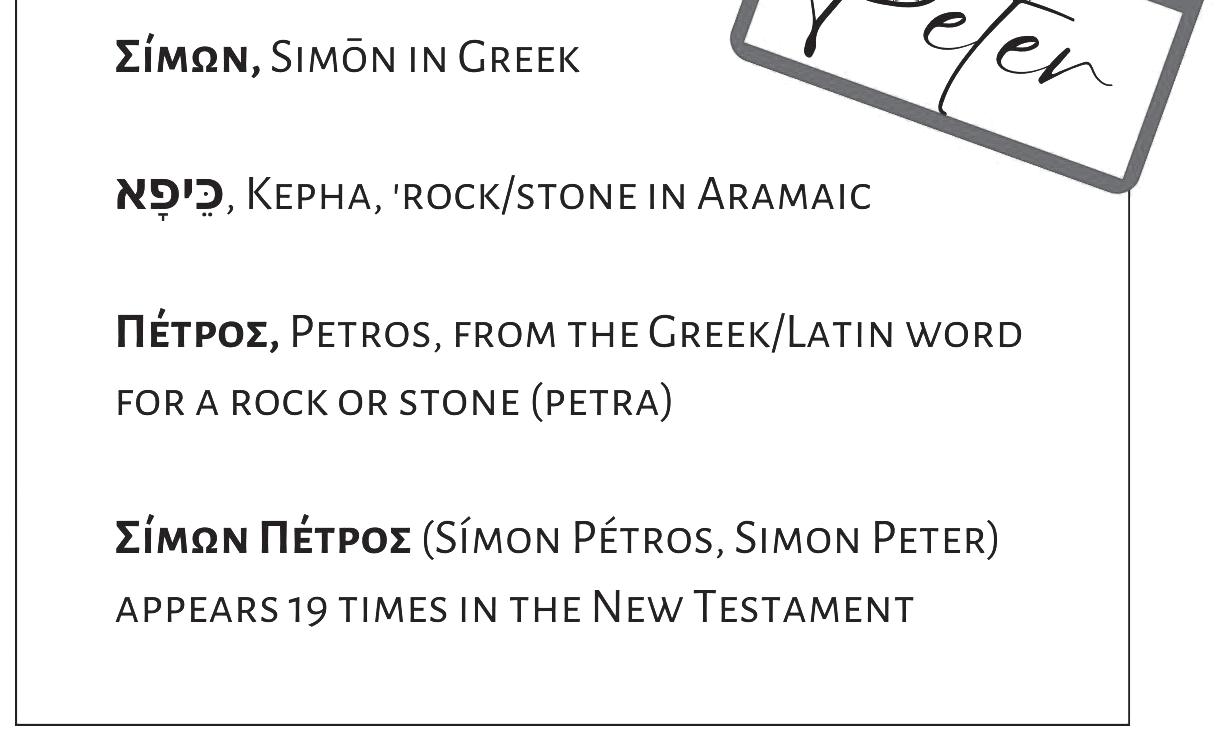
My given name was Simon, from the Hebrew word ןוֹעְמׂשׁ (Šim‘ôn), meaning “to listen” or “to hear.” It was a pretty common name around here. Nothing special, really. It was meant to remind me to take in any knowledge I was given along life’s journey. I didn’t always do that. I did try, but I confess I was not much known for my patience. I made quick decisions about some things . . . okay, maybe most things. I met Jesus, and He changed my life. Despite all my mistakes and failures, Jesus wanted me with Him. He still chose me and allowed me the honor of serving alongside Him. I’m still in awe of that. I never thought this fisherman would leave his boat to follow a man like Jesus. He made me bold in ways I never expected.
Jesus has a way of transforming weaknesses into surprising strengths for His glory. He did it for me, and He can do it for you.
Shalom, Simon Peter
Awkward. Sometimes, meeting people can be awkward. I love meeting new people and hearing their stories. Our stories are what connect us. But every once in a while, there is just an awkward moment. Have you ever gone to shake someone’s hand, and they went in for the hug? Or the other way around? You went for the hug, and they offered the handshake. Awkward.
Listening to a morning news podcast, I heard about a man who got locked out of his hotel room and had to go down to the front desk to get a new room key. Naked. He thought he was walking into the bathroom, but instead, he walked out into the hallway, and the door shut behind him. I bet that was an introduction the reception desk worker won’t forget. Awkward.
Introductions can be robotic and forgetful or . . . a gateway to a life change. I met my husband in a Greek class at Fuller Seminary. He likes to tell people I asked for his phone number first. Which I did . . . t hen I asked for the phone numbers of the rest of our small group too. I had no idea when I first met him that we would end up married!
What introduction do you remember as being very meaningful (or just kinda crazy like Greek class) in your life?
Today, we begin our introduction to Peter. He was called by Jesus to be one of His twelve disciples. The disciples were the students of Jesus who later became His representatives, challenged to spread the word of His life and ministry.
Look up John 1:41-42. Who introduced Peter to Jesus? What did Peter’s brother believe to be true about Jesus?
What did Jesus know about Peter as soon as he saw him?
What name did Jesus give to Peter?
Cephas is Aramaic, and Peter is Greek—both mean rock. Peter is the rock star disciple. See what I did there? Fair warning: I love puns.
In Peter’s time, a rabbi was not a formal leader of a synagogue or even a religious community. Rather, rabbis taught people how to live Torah (the first five books of the Old Testament). Rabbi was more of an honorary title. Rabbis would teach the Scriptures, interpret them, and invite students to follow and learn their ways. A student, or disciple, would follow the rabbi and learn his particular way of teaching and interpreting Scripture.
The Pharisees and Sadducees were both religious groups within Judaism during the time of Jesus. Both groups loved the law but interpreted it differently. The Sadducees were more wealthy, aristocratic, conservative, literal in their interpretations of the law, closely connected to the temple, and controlled the majority of the seats in the Sanhedrin. The Pharisees gave oral tradition equal authority to the written law, controlled the synagogues, and were more representative of and respected by the working people. The Sanhedrin was the seventy-member ruling court of Israel that comprised both Sadducees and Pharisees. The Pharisees were considered rabbis. Sadducees were not. Most Sadducees were priests in the temple, but not all of them. Rabbis were religious teachers who served in synagogues. Priests were descendants of Aaron and worked in the temple in Jerusalem.
The Mishna is a reliable historical source that describes the educational process for a Jewish boy in the time of Jesus. The Mishna is filled with the rabbinic interpretations of Scripture written during the second century AD. Jewish scholars believe it contains the oral tradition used from the first century BC to the first century AD. Thus, it gives us helpful insight into what happened during Jesus’s lifetime.
At five years old [one is fit] for the Scripture; at ten years, the Mishna (oral Torah, interpretations) at thirteen for the fulfilling of the commandments; at fifteen, the Talmud (making Rabbinic interpretations) at eighteen, the bride-chamber, at twenty pursuing a vocation, at thirty for authority (able to teach others).1
Jesus began his ministry when He turned thirty and began to call disciples. The vocation of a rabbi was to be a spiritual leader. Jesus grew up with his earthly father, Joseph, as a carpenter. Likely, He followed in his footsteps and
learned that trade. When He began his public ministry, it surprised those who had known his family while Jesus grew up in Nazareth. Jesus became a wandering itinerant rabbi who had not gone the traditional route of becoming a rabbi. Rabbis were deeply respected, and it was considered a tremendous honor to be a student of a famous rabbi. Jesus was not famous when he called His disciples. He was not known at all.
Read John 1:35-42.
Read Mark 1:29-31. Who is mentioned as being related to Peter?
Whom does that imply was also in Peter’s life, although not specifically mentioned?
We don’t know if Peter’s wife was still alive during the writing of the Gospels or if Peter was widowed, but there was definitely a Mrs. Peter at some point. There may have also been some mini-mes, but we don’t have a record of the births of the tiny humans. All the other disciples, as far as we know, were single. Simon Peter was the only disciple we know was married.
Let’s look at some more of Peter’s family, starting with his brother Andrew.
Reread John 1:35-42.
What are the two things Andrew did after he met Jesus? 1. 2.
Everything changed for Peter when he was introduced to Jesus. That is the power of the presence of Jesus. Copyright © by Abingdon Press. All rights reserved.
Just like Andrew brought Simon Peter to Jesus, we will spend time in this study with Peter and let him bring us to Jesus. Everything changed for Peter when he was introduced to Jesus. That is the power of the presence of Jesus. That is the power we are invited into. The power of Jesus can heal, restore, and resurrect dead things. It is an unparalleled power that can refresh, renew, and re-engage our hearts. A power that can give us a fresh perspective, identity, hope, and purpose. Sound good? Oh yeah.
What do you need from the power of the presence of Jesus right now?
Look up these passages about being in God’s presence.
• E xodus 33:14
• Psalm 16:11
• Psalm 89:15
• Psalm 140:30
• Acts 30:20-21
Write out the one that speaks to you most right now. What is the Holy Spirit prompting in your heart?
What do these passages promise and teach us about being in God’s presence?
Like an embrace that leaves you smelling like a powerful perfume that you did not apply, the people we hang around rub off on us. They can leave a delicious aroma you adore or stink worse than abandoned fish rotting in the sun. The people you let fill your brain and heart shape you.
People sometimes influence us in surprising ways. Whenever we choose a podcast to play, a show to watch, a movie to see, a book to read, a sermon to listen to, or a class to take, we absorb what they are saying and doing like a sponge in the water. We process and filter that information. Sifting through it, we select what we like. We adopt words, mannerisms, and ideas.
One of the greatest faith habits you can cultivate is that of discernment, so that you can make wise choices about who can and should speak into your life. Even the most fruit-filled (Galatians 5:22-23) spiritual superhuman will never get it right 100 percent of the time. Only Jesus can—which is why we want more of Him for every need, hurt, and emotion that leaves us spinning out, wondering what is right-side-up. For this, we have Jesus, my friends. We will journey with Peter each day and watch Jesus transform his weaknesses into strengths—knowing that He can do the same for us. Copyright
Worship with Chris Tomlin as he sings “Jesus.”

Peter had the best introduction ever to Jesus. He had often unfurled the sails on his boat to start a new day, but now the sails were unfurled for a new adventure with Jesus.
Worship the one Peter met as we set sail on our journey with him. Open the camera app on your phone and hover over this QR code. When the link pops up, click it.
Try filling in the blanks to help you learn the verse. You can look back if you need some help. Practice each day, and pretty soon you will have it. The Holy Spirit will activate it in your head and heart right when you need to hear from God most.
But you are a people, a priesthood, a nation, God’s special , that you may the of him who you out of into his wonderful . (1 Peter 2:9)
It was epic. I was leaving. Adventuring. Making a change. Rolling out. The tide was turning.
Moving across the country from Michigan to California was exciting and scary, all rolled into one big bag of adventure. One of the fun parts was staying with different friends along my route to Fuller Seminary in Pasadena, California. The scary part was that I had only enough money for one semester of school. It was a big faith move. When my traveling buddy had to fly home when we reached Colorado, I had to drive solo the rest of the way. I was out of friends to stay with too.
I rolled into Las Vegas as evening came. Everyone had told me to stay in Vegas because it was so cheap. That was exactly my budget. After leaving one huge casino that was anything but cheap, I ended up staring at a motel with a flashing vacancy sign. The price matched my wallet, so I stayed. It was sketchy at best.
I promptly moved all the room furniture that I could shove in front of the door for extra security. Sleeping with one eye open, I was up before the sun.
As I got to my Blazer, I discovered some sneaky ninjas had lightened my load and stolen my car top carrier filled with my treasures. Spending the morning in the Vegas police station was not part of my schedule for the day. Well, you know what they say . . . what drives into Vegas stays in Vegas. Or something like that. Leaving Sin City, I drove the rest of the way to California, a little emptier than expected.
Have you ever stared at an empty bank account, an empty gas tank, or an empty refrigerator and wondered how to fill it back up?
Empty. That is how Peter felt the day that Jesus changed his life. His boat was empty. He expected one thing (a full boat of fish) and got another. This was devastating for a man whose profession and livelihood depended on a good catch.
Read Luke 5:1-5. What was Peter doing when Jesus came to his boat?
How many boats were there?
1 2 3 4 5 6
How long had Peter been out fishing?
One hour Four hours All morning All night
How many fish had Peter caught?
Peter was running on empty.
One of the most difficult parts of being human is to live with our hearts at peace. No matter how hard we try, relationships and situations around us spiral out of control. This leaves us feeling unbalanced and exhausted. We can start to feel restless and disappointed. Life rarely turns out the way we had once envisioned.
What are some expectations you had for your life that have not turned out to be your reality?
One of the most difficult parts of being human is to live with our hearts at peace.
Sometimes, we can laugh at those things and say, “Thank God that never happened.” For example, I was sure I would marry my high school boyfriend, which did not happen. Thankfully, God had a different and better plan, I mean man, for me.
Other times, we still feel a sense of loss that things turned out differently than we had hoped. A few years ago, we lost my dad to a very aggressive cancer that only gave us nine short weeks with him after we found out. I didn’t think I would lose a parent that way. It was hard, painful, so sad, and completely not expected, planned for, or desired.
Read Psalm 27:13-14. What encourages you about this verse?
Emptiness comes in lots of different forms. All of it is hard. Emptiness comes from the inability to have what we expected could, should, and would be. We are not enough. Our weaknesses glare. Our flaws stare us down. Emptiness is the emotion or feeling that is the warning light to go to God. It is our wake-up call that we need something from God. He is the only one who can fill empty things and empty people.
Where are some places that you feel empty in your life right now?
Maybe you have an empty nest at home, an empty bank account, or an empty sense of purpose in your life as you read this. Emptiness goes right to the bottom of the barrel and deeply impacts our emotions and outlook. When Jesus met Peter, He brought a fullness that Peter never expected.
Read 1 Peter 1:18-19 below. Circle the four words below that Peter wrote you were redeemed from. Cross out the two words Peter gives as examples of things that perish. Underline what you are redeemed with.
For you know that it was not with perishable things such as silver or gold that you were redeemed from the empty way of life handed down to you from your ancestors, but with the precious blood of Christ, a lamb without blemish or defect.
Copyright © by Abingdon Press. All rights reserved.
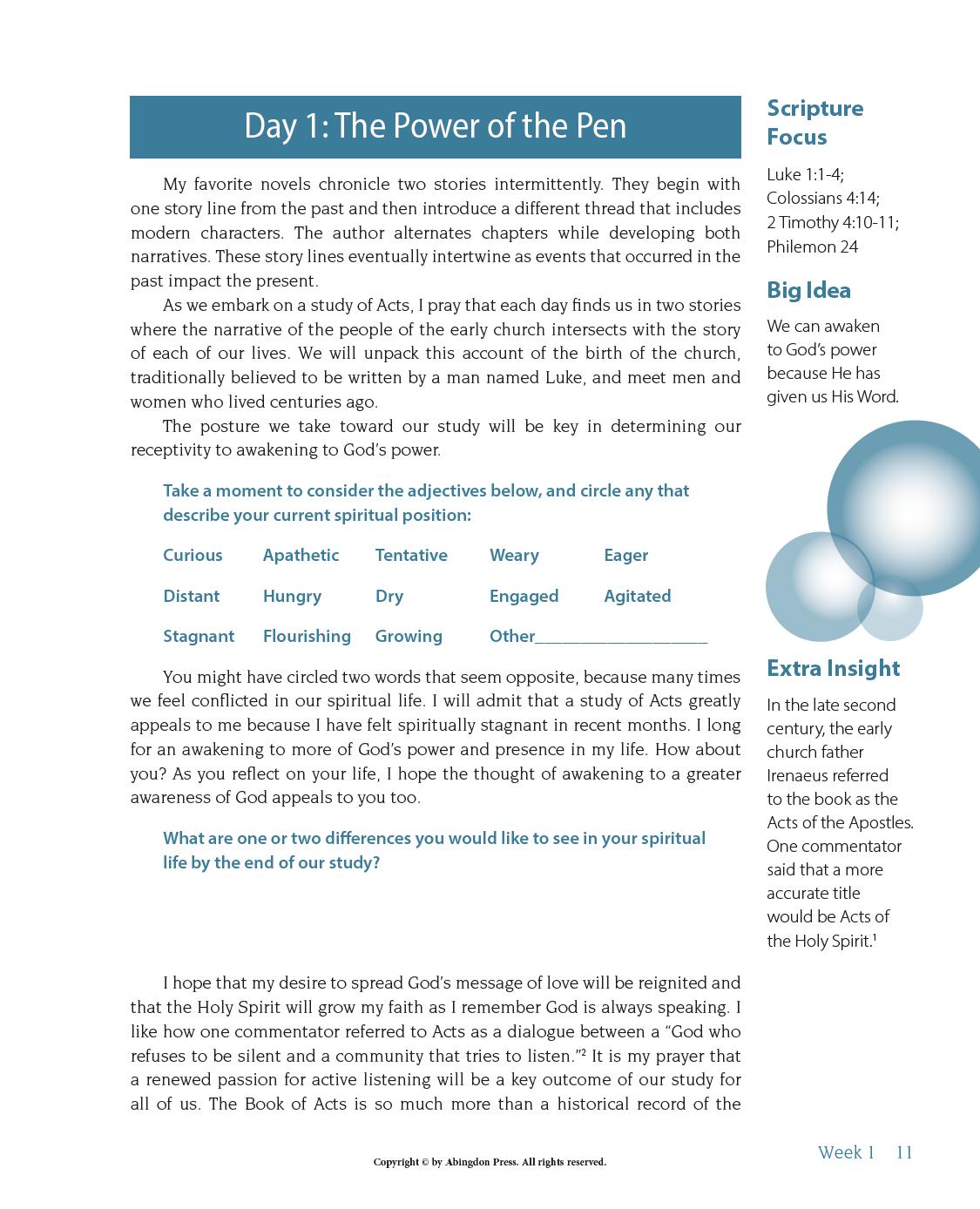
Theologians debate the genre and purpose of Acts, but the majority describe the book with the word kerygma, which means “proclamation.”
The Book of Acts proclaims the works of God using historical narrative.3
church’s beginnings. We want our study of Acts to permeate our lives as we listen carefully to the inspired words of God’s Spirit.
We will cover one chapter of Acts each day, but before we dig into the text, I believe some background information on the author will enhance our reading of God’s Word. Some of you are sharpening your pencils while others of you are inwardly groaning. If you are in the latter group, hang in there because understanding this background will prove helpful before we immerse ourselves in twenty-eight chapters covering approximately thirty years that changed the world!
According to church tradition, Acts was written by a man named Luke (author of the Gospel of Luke) under the inspiration of the Holy Spirit. Before we open his manuscript, we are going to get to know the author himself. Knowing the person on the other side of the pen can enhance our understanding of what we are reading.
Who are some of your favorite authors and why? What have you enjoyed learning about them, or what would you like to know about them?
Perhaps you have enjoyed learning the background of a nonfiction author who challenges your thinking, or perhaps you would like to know the influences of a novelist who draws you into the story. I have enjoyed learning that Jane Austen first published my favorite novel, Pride and Prejudice, anonymously because women weren’t allowed to have any other roles than wife and mother in society. Her name never appeared on any of her books during her lifetime. Just as it can be helpful to learn about our favorite authors, knowing about a biblical author can give us great insight into the text.
Are there things you already know about the author Luke? If so, write them below:




If you didn’t write anything, that’s okay! Here are four key facts about Luke that enrich our study of Acts. He was:
• an investigator (who listened to firsthand accounts and compiled and condensed information),
• a Gentile (which provided him a unique perspective from the other New Testament writers, who were of Jewish heritage),
• an educated doctor (who humbly elevated others’ stories rather than his own), and
• a ministry partner of Paul (with firsthand knowledge of many of the events recorded in Acts).
Luke was not one of Jesus’s twelve disciples, so he relied on eyewitnesses and investigation as he prepared his account—which originally was written as a two-volume work4 and later was separated into Luke and Acts (when the four Gospels were ordered according to when they were thought to have been written). In a sense, we might say that the Gospel of Luke serves as an introduction to Acts.
Read Luke 1:1-4 and answer the following questions:
What did people use as sources to write accounts of Jesus and the early church? (v. 2)
What words describe Luke’s preparation to write his own account? (v. 3)
To whom did he address his two-volume work of Luke and Acts? (v. 3)
Why did he record his two-volume account of events? (v. 4)
We will see Luke’s investigative abilities, referenced in these verses, come into play throughout the Book of Acts as we discover the narratives, events, miracles, and speeches he recorded. Some of these he personally observed, but others required interviews with witnesses. Luke also highlighted the significance of the historical narrative both to the early church and to us today.
What have you investigated lately? Think of the last thing you researched on the Internet.
Recently I was considering which novels to take with me on a trip. I asked friends, checked to see if any of my favorite authors had something new, and also did some internet browsing. If we take time to research books, recipes, or DIY projects, imagine how seriously Luke took his task of writing an account of the birth of the church in his unique voice and style.





Luke’s writings make up almost one-third of the New Testament. His Gospel is the longest New Testament book, with Acts coming in third in length. Luke’s writing puts him on par with the apostle Paul for his breadth of vocabulary. However, their writings vary greatly when it comes to content.
Paul was a Jew, and while a few commentators disagree, most believe that Luke was a Gentile. His Greek name and use of the Septuagint (the Greek version of the Old Testament), as well as his vocabulary and style, reflect a Greek rather than Hebrew heritage. In addition, the fact that Paul greets Luke separately from the Jewish believers in Colossians 4:14 supports the idea that Luke was a Gentile.
Knowing that Luke likely was not a Jew gives us insight into his unique perspective of the gospel message and its spread from Jerusalem to the ends of the earth.
The New Testament includes four Gospel accounts by four different people: Matthew, Mark, Luke, and John. How do you think Luke’s heritage as a Gentile provides a different point of view from the other three Gospels written by Jews?
Why do you think it is important to have a variety of perspectives when exploring any topic?
When I order commentaries, I include authors of different denominations and theological perspectives. I may not agree with all of their ideas, but I believe hearing varied voices brings balance. As we read through Acts in the coming weeks, we want to remember that a plurality of viewpoints can be good. We want to be stretched spiritually so that we may discover God in fresh ways.
Luke was an investigator, a Gentile, and an educated man who used his intellectual abilities to serve God. Though we know he was a doctor (Colossians 4:14), we find little mention of his personal narrative in the Scriptures. We will not get to know Luke through our study of Acts, but his account will give us a better understanding of his heroes, such as the apostles Peter and Paul. Luke’s humility is evidenced through his emphasis on Christ, the Spirit, and the work of the apostles. He wrote to tell about others, not himself.
Read Luke 24:50-53 and Acts 1:1-3 and describe the continuity between Luke’s two volumes. On whose story does Luke focus?
Luke wrote much about Jesus, yet he went further than any other Gospel writer in preparing an account of what happened after Jesus ascended. Warren Wiersbe wrote, “Imagine how confused you would be if, in reading your New Testament, you turned the last page of the gospel of John and discovered— Romans! ‘How did the church get to Rome?’ you would ask yourself; the answer is found in the book of Acts.”5 Luke was qualified to write this chronicle because he watched the church’s missionary work firsthand.
Though he is rarely mentioned in the New Testament, we do find a few other clues about Luke in Paul’s writings.
Read 2 Timothy 4:10-11 and Philemon 23-24 in the margin, and write below any additional information you glean about Luke:
Luke stayed with Paul when others left him. He was a faithful coworker in ministry. He didn’t just write about spreading the gospel; he participated in it.
What new insights about the author of Acts have you learned today?
As we interact with the text of Acts each day in the coming weeks, I pray you will keep in mind that the author possessed investigative skills, a unique perspective as a Gentile, an educated yet humble approach, and faithful ministry experience. Acts is the living Word of God. May we approach it with an open mind and a willing heart.
Each day we will look for God’s initiatives and the early church’s responses, reflecting on the same two questions:
• What is one way you noticed God at work in the chapter?
• How did the believers respond?
Some days God’s work will be easily identifiable, such as when we read about healings, miracles, or other divine interventions. Other times, we will find
Demas has deserted me because he loves the things of this life and has gone to Thessalonica. Crescens has gone to Galatia, and Titus has gone to Dalmatia. Only Luke is with me. Bring Mark with you when you come, for he will be helpful to me in my ministry.
(2 Timothy 4:10-11)
Epaphras, my fellow prisoner in Christ Jesus, sends you his greetings. So do Mark, Aristarchus, Demas, and Luke, my co-workers.
(Philemon 23-24)
the Lord working behind the scenes. Because our study of Acts begins tomorrow, we will modify these questions for the author Luke today.
What is one way you noticed God at work in Luke’s life as the author of Acts?
How did Luke respond to God’s call?
God moved Luke to investigate and record the birth of the church after Jesus’s ascension. Luke responded by doing diligent work so that we now have the opportunity to study Acts. Those who read Acts can fulfill Luke’s intent, which is that people might be certain of the truth (Luke 1:4). Today we focused on this truth: we can awaken to God’s power because He has given us His Word
How would you summarize your personal takeaway from today’s lesson?
Acts has the power to awaken us to truths we’ve known and new teachings we may have never heard before. Now, let’s consider how we want God to awaken us through Luke’s writings.
Take a moment to write a prayer below, asking the Lord to prepare your heart to receive all He has for you in this study.
Acts is a true story. A good story. I pray the Holy Spirit will use this story to intersect with your story and awaken you to see Him at work today!
Lord, I need Your Holy Spirit to guide me as I study Acts. Help me to learn what it means to sit at Your feet and listen. Help me to apply these ancient truths in my modern context. I can’t do it without You. Amen.
Read the Memory Verse on page 10 several times, and then fill in the blanks below as you recite it:
“But you will receive __________ when the Holy Spirit comes upon you. And you will be my _________________, telling people about me everywhere—in __________________, throughout Judea, in Samaria, and to the ends of the __________.”
(Acts 1:8)
After three hours on a school bus, we arrived at the waterpark for a youth retreat weekend. I’ll admit I needed an attitude adjustment. Listening to the students in my group complain about not having their phones for two days was grating on my nerves. Once we got to our rooms, disagreement broke out about who had to sleep on the pull-out couches rather than the beds. My irritation level rose. I wanted to remind them how grateful they should be for a weekend away to stay in beautiful rooms, eat food prepared for them, hear amazing speakers, connect with a thousand other teenagers, and enjoy the waterpark. I knew my ranting wouldn’t set a good tone, and I hustled the girls down to the first session.
As the worship began, I knew something needed to change in my heart. I confessed to the Lord my bad attitude. I complained about the ungrateful students. Then I asked Him to awaken in me a love for these girls. I prayed for them by name and asked Jesus to help me see them the way He does.
I can’t explain what began to happen. Something inside me shifted. While I still had to deal with some difficult personalities, general immaturity, and more complaints about phones, I also was able to share my faith with these girls. On the last night, one of them asked if she could speak with me in private. With tears in her eyes, she asked if she could receive Christ personally in her life. I had the privilege of praying with her and sharing an eternal moment.
It was on that weekend retreat that I sensed from the Lord that the theme of this study should revolve around awakening to God in everyday life. He
Scripture Focus
Acts 1 Big Idea
We can awaken to God’s power in waiting seasons because God keeps His promises.
The name
Theophilus means “dear of God.” Some have suggested it as a symbolic representation of the kind of person Luke was addressing, but most commentators agree it was the real name of a real person.6
reminded me again that I can’t serve Him in my human strength. His Spirit is necessary for spiritual life—mine and yours.
Can you remember a time in your life when God awakened you to see a person or situation through a new lens? If so, briefly share about it below:
Today as we open the pages of Acts, we will find the followers of Jesus in a significant pause as they wait for the gift that Jesus promised them. They were not to jump into activity without first waiting for God’s promised Spirit.
Read Acts 1:1-11 and record what we learn about the Holy Spirit from Jesus:
These verses describe the period between Jesus’s ascension into heaven and the coming of the Holy Spirit. We notice that:
• Jesus gave instructions to His disciples through the Holy Spirit,
• the Father would be the One sending the gift of the Spirit,
• Jesus said a baptism of the Holy Spirit was imminent, and
• power from the Holy Spirit would enable believers to be witnesses to the world.
I’m sure the disciples didn’t know exactly what spiritual baptism and power would look like, but they gathered and waited for the promise to be fulfilled. I can imagine that after Jesus died, rose again, and then appeared to them over a forty-day period, they would have been antsy to start telling others about all that had happened. Yet Jesus told them to stay in Jerusalem and wait.
We can grow impatient and experience anxiety when God pushes the pause button in our lives. Sometimes we get ahead of Him by failing to wait for His leading.
What does waiting on the Holy Spirit look like in your life right now?
I often have thoughts and ideas that cause me to question whether they are my own or from the Spirit. When this happens, I pray, journal, sit quietly, and sometimes talk with godly friends before moving forward. I don’t want to move without the Spirit’s guidance, but I also don’t want to lag behind because I’m distracted or apathetic. I know He wants to work in my life and yours. Here’s some good news: we can awaken to God’s power in waiting seasons because God keeps His promises
In Acts 1, we see that while the disciples waited for the promise of the Spirit to be fulfilled, they asked questions, prepared, and prayed. These are three postures we can take when we experience significant pauses in our own lives.
The concept of Holy Spirit baptism has caused much debate among followers of Jesus. Various groups believe differently about what it is and what it means. The word baptized in Acts 1:5 comes from the Greek word baptizo, which means “to dip repeatedly, to immerse, to submerge (of vessels sunk); to cleanse by dipping or submerging, to wash, to make clean with water, to wash one’s self, bathe; to overwhelm.”7 While John the Baptist taught a baptism of repentance, Jesus commanded His disciples to go into all the world teaching and baptizing (Matthew 28:18-20). This practice usually involved immersing people in water as an outward expression of an inward change. When we consider what baptism of the Holy Spirit might look like, we can surmise that it hints toward a deep connection where we are fully submerged in His presence. What that looks like outwardly in our lives may vary.
When we aren’t sure what a passage of Scripture means or how we should handle a situation in our lives, we can ask questions.
Look back at Acts 1:6. What question were the disciples asking?
This was likely the question on everyone’s mind. They had spent forty days with the resurrected Christ and knew that He had all authority and power. They wanted to see Him use it to right some wrongs! I can relate.
What wrongs would you love to see Jesus come and straighten out here on earth this week?
I can make a big list. We get pretty caught up with the matters of earth because we live here.
How did Jesus respond to their question in verse 7?
This is such a good reminder for me that God doesn’t run everything by us. The Father sets the dates and times because He alone has that authority. He awakens us to trust Him with the divine calendar. Asking questions may not lead us to immediate answers, but it will help us align with God’s bigger perspective. Questioning can lead us to deeper truths. God is not put off by our questions but invites us to ask and explore as we wrestle in our faith. The Lord loves us and remains in relationship with us through our questioning. He gives insight and also helps us learn to embrace mystery as some of our questions may never be answered.
2. Prepare
Jesus didn’t directly answer the disciples’ question but gave them a glimpse into what was coming so that they could prepare their minds and hearts.
Read verse 8 and fill in the blanks below:
They would receive _______________.
So that they could be _____________________.





We are going to find the word witness used in some form over thirty-nine times in the Book of Acts, making it a prominent theme.8
In Jerusalem, Judea, Samaria, and ______________________________ ___________________________________________________________.
This power was not given for worldly conquest or recompense for previous oppression. It would be provided so that they could be witnesses and tell others about Jesus—everywhere. Just as witnesses in court share with others what they saw and heard, witnesses for Jesus share with others what they’ve experienced personally with Jesus. Witnessing doesn’t have to be a daunting practice where we shove Jesus down people’s throats; it simply means telling others about Him.
Whether we are talking about Jesus with family, friends, coworkers, neighbors, or people we’ve just met, God says He will empower us through His Spirit. When I grow apathetic about the spiritual condition of those around me, it’s like an indicator light on my spiritual dashboard telling me that I need a fresh awakening. It’s not that I no longer care about people, but sometimes my own problems, enjoyment, and responsibilities can weaken my passion for those
who are lost and hurting. Knowing that the Lord will give us the power we need, we can prepare our hearts and minds to share our story of faith with others.
As I experienced that weekend on the youth retreat, one of the most effective ways for God to awaken me when I lack power or passion is through prayer. When I come to Him admitting my inabilities, that’s when I see His strength in my weakness.
Read Acts 1:12-26, and write below what we find Jesus’s followers doing in verse 14:
We see that they were meeting together and constantly praying. I love that Luke mentions the women were part of this prayer meeting. One commentator notes, “The inclusion of women in the roster of the community would not have been missed by a second-century reader, as an indication that already we have a group which breaks barriers.”10 Prayer united them and prepared them as they waited for the promised Holy Spirit.
As believers, we already have the gift of the Holy Spirit, who lives inside us, but we must lean into His power and awaken to His promptings. Prayer reminds us that we need the power of the Holy Spirit and the help and encouragement of others to fulfill the God-sized tasks of sharing our faith and living holy lives in a difficult world.
Through prayer, we receive the Holy Spirit’s power. Through prayer, we are able to share with others about Jesus. Through prayer, we unite with others.
What does your current prayer life look like? What helps you to connect with God?
Insight
“If one counts all possible references to the Spirit in Acts (fifty-nine), these constitute nearly a quarter of New Testament references to the Spirit; no other New Testament book has even half as many.”9
What differences would you like to see in your connection and communication with God by the end of this study?





This is an area where I continually want to grow. I’m asking God to awaken me to deeper connection and communication with Him. I hope you are as well.
Consider the three responses of the disciples in Acts 1 and write any practical steps that you can take in these areas. (I have provided my own example for each.)
1. Ask Questions: What questions do you have right now?
Example: I’m asking God how I should focus my time in this season and what Holy Spirit baptism might look like in my life.
2. Prepare: How can you prepare for the work God is calling you to do?
Example: I’m taking foster care licensing classes in anticipation of what my husband and I sense God leading us to do.
3. Pray: What do you need to pray about right now?
Example: I’m praying that God would awaken me to Him in ways I can’t even imagine.
A season of questioning, preparing, and praying preceded the action in the Book of Acts. As we awaken to the Lord in our everyday lives, we also encounter seasons of anticipation and preparation. If we want to see more spiritual action, we can implement these practices while we wait on God’s perfect timing for movement in our lives.
What is one way you noticed God at work in Acts 1?
How did the believers respond?
While it must have been deflating that Jesus was no longer with His disciples in physical form, He ascended to heaven with a promise to send the third person of the Trinity, the Holy Spirit. God’s people responded to His instructions by asking questions, preparing, and praying. We learn from them to awaken to God’s power even during waiting seasons.
Today we focused on this truth: we can awaken to God’s power in waiting seasons because God keeps His promises
How would you summarize your personal takeaway from today’s lesson?
I’m so glad the Lord awakened me to His love for the students on that youth group trip. As a result of that experience, I want to learn to lean into God’s power instead of attempting to conjure up my own. Even in waiting seasons, we can ask questions, prepare, and pray knowing that God will supply the power to accomplish His purposes in every situation.
Lord, help me to learn from the early Christians to wait well. I don’t want to get ahead of Your Spirit’s work, but I also don’t want to lag behind. Show me where I can ask questions, prepare, and be more devoted in prayer when You hit the pause button in my life. Amen.
Read the Memory Verse on page 10 several times, and then fill in the blanks below as you recite it:
“But ______ will receive __________ when the ________ __________ comes upon you. And ______ will be my __________________, telling people about me everywhere—in __________________, throughout __________, in Samaria, and to the ends of the __________.” (Acts 1:8)
In the late 1990s, our culture became fascinated with watching television shows featuring real people experiencing real life. From scenarios involving deserted islands to dating life, reality television doesn’t fully live up to its name because we never really know how much of the relationships and experiences


Scripture Focus Acts 2



We can awaken to God because He sent His Spirit to empower us.
we are witnessing are staged. Although no one is likely filming us on a regular basis, we too can live an edited version of the Christian life. What I mean is that sometimes we live like what is real isn’t actually real. For example,
• We know Jesus paid for our sin on the cross, but sometimes we live in shame.
• We know God has given us power through the Holy Spirit, but often we live defeated lives.
• We know God is with us, but we feel completely alone.
Have you felt a disconnect from the promises of God and your daily life recently or in the past? If so, describe your experience below:

I’m constantly seeking to reconcile my theology and my reality. I want to live the truths about God that I know from Scripture, but I struggle. I don’t believe I’m the only one. We Christians don’t seem to be enjoying peace and unity these days. When I scroll through social media, I wonder what the world thinks of us as a result of our online presence. I’m asking God to awaken me to experience the power I already have through His Spirit, and I hope you are as well. Today we will focus on this truth: we can awaken to God because He sent His Spirit to empower us. God’s power can transform our lives and unify us as believers. In Genesis 11, we read about the Tower of Babel where the Lord confused the people’s language and dispersed them over the earth. After that event, we find references in the Old Testament to a coming day when God’s people would again be united through His Spirit (Ezekiel 36:26-32). God progressively revealed His plan in shadows and hints that came together on the day of Pentecost when, as many scholars suggest, languages unified rather than separated people.11
Read Acts 2:1-13 and summarize what happened in your own words below (write a few sentences or use bullet points):



By the first century, Pentecost had become a time to commemorate the giving of the commandments on Mount Sinai.12 How fitting that the Lord
chose to pour out His Spirit on the day when Judaism celebrated the giving of the law. Many scholars believe this fulfilled His promise to bring God’s people back together after the years of confusion and dispersion. When the Holy Spirit controls the lives of believers, we see His fruit growing in “love, joy, peace, patience, kindness, goodness, faithfulness, gentleness, and self-control” (Galatians 5:22-23).
How have you experienced God’s supernatural fruit found in Galatians 5:22-23 in your relationships?
Just this week, the Spirit gave me self-control to hold my tongue in a conversation. The Holy Spirit awakens responses in us that run contrary to our selfish natures. When this happens, He is unleashed to heal the fractures in our families, friendships, local church bodies, and online conversations. Sometimes He uses subtle nudges, but in Acts 2 we see obvious displays of power.
What are some audible and visible evidences of the Holy Spirit in Acts 2:2-4?
In these verses, we discover three signs of God’s presence found in the Old Testament now combined in the Holy Spirit’s coming. Wind (Ezekiel 37:9-14), fire (Exodus 3:2-5), and inspired speech (Numbers 11:26-29) confirmed the validity of the Spirit’s miraculous work.13 Just as Jesus performed miracles to get people’s attention and authenticate His ministry, so the coming of the Holy Spirit was marked by supernatural events that the Israelites would have associated with their spiritual history. You would think that after such an incredible display, surely everyone would believe that God was at work.
What two reactions of the witnesses are recorded in Acts 2:12-13? 1. 2.

While I’ve often wished for God to awaken us to His presence through visible displays such as this one at Pentecost, I know that even if He did, some would not listen. Throughout the Book of Acts, we will find that the Lord chooses to use His people to share His message. Through the power of the Holy Spirit living inside us, we can share the news about Christ’s death and resurrection with a hurting world. The fruit of God’s Spirit pouring forth from our lives provides a witness of God’s love and grace to those around us. Often it is our lives as much as or more than our words that attracts others to God.
What initially drew you to desire a relationship with God?
I’m guessing that it likely didn’t involve seeing wind, fire, or people speaking in other languages but had something to do with another person. Maybe a parent, friend, or preacher shared a message that awakened your connection with your Creator. In the next half of chapter 2, we will find the apostle Peter boldly explaining from the Old Testament Scriptures the promises God made regarding the Holy Spirit. In yesterday’s lesson the disciples asked questions, prepared for action, and prayed. Now, the time has come for action.
Read Acts 2:14-41 and number the events below from 1–5 as they occur in the passage:
_______ A. About three thousand believed what Peter said and were baptized.
_______ B. Peter quoted King David and told the crowd that Jesus is now seated at God’s right hand in the highest heaven.




_______ C. Peter ’s words pierced their hearts, and they asked, “What should we do?”
_______ D. Peter shouted to the crowd that no one was drunk, but that the words of the prophet Joel were being fulfilled with the pouring out of God’s Spirit.
_______ E. Peter told each person that they should repent of their sins, turn to God, and be baptized and then they would receive the Holy Spirit.
The gift of tongues in Acts 2 has been a source of contention among believers. The Spirit brought unity, but the enemy continually seeks to divide. While we may disagree on nuances, we can respectfully discuss these issues while still maintaining Christian unity. Here are three definitions that broadly describe the different views:
Cessationalism: Those who hold this view see the gift of tongues as having ceased. Like the circumstances of Acts 2 when people heard the gospel in their own languages, they see the spiritual gift of tongues as rational languages rather than ecstatic utterances (unintelligible sounds not associated with an actual language).
Charismaticism: According to this view, tongues are a high-profile gift associated with a baptism of the Holy Spirit. Spiritual maturity and speaking in tongues go hand in hand for those holding this opinion.
Continuationism: Those holding this view believe that all gifts continue to be in use today but that Christians should be careful to practice them according to the Scriptures.
You may find yourself in one of these camps, somewhere in between, or totally unsure where you stand. No matter how we understand the disputable details regarding tongues, we can maintain unity by discussing these ideas with humility.
The apostle Peter used the writings of the prophet Joel and King David to explain the fulfillment of God’s promise of the Holy Spirit. The message pierced the hearts of the people, and they asked this question in response, “Brothers, what should we do?” (Acts 2:37). This question resonates with me. I wonder if it does with you as well.
We no longer live in confusion and isolation. God has filled us with His Spirit if we have believed and received His gospel personally. Yet the “confusion” we read about at the Tower of Babel still seems to permeate the church. We fight on social media, form factions against our leaders, and lack the unity we should enjoy through God’s Spirit. Sisters, what should we do?
Peter was intentional to say in his reply to the crowd in Acts 2 that his answer was not only for the original audience but also for those “far away” or those yet to be born. That’s us! Like them, we must turn from our sins to God and receive the Holy Spirit (Acts 2:38). This word receive is the verb lambano in Greek, which means “to take; to take with the hand, lay hold of, any person or thing in order to use it; to take up a thing to be carried; to take upon one’s self.”14
While God freely gave the gifts of His Son and His Spirit, we must actively receive them. You may wonder what this looks like. Let’s see how some of the people responded to the Spirit’s leading.





Read Acts 2:42-47 and circle any of the words below that describe their behavior:
teaching being apathetic enjoying fellowship
praying watching TV practicing generosity
praising God shopping onlinesharing meals
being anxious experiencing awe criticizing others
worshipping at the Temple meeting together in homes arguing over minor issues
enjoying goodwill sharing with those in need performing signs and wonders
These are some of the ways receiving God’s Spirit evidenced itself in the believers’ lives. Perhaps awakening to the power of God’s Spirit might increase these practices in our lives as well, so that our spiritual communities will more closely align to the infant church we read about in Acts 2. That would be the best reality show for the watching world! The problem of disunity among us still lingers, but the antidote remains the same—receiving God’s Spirit and allowing Him to change the reality of our lives.
What is one way you noticed God at work in Acts 2?
How did the believers respond?
God sent the Holy Spirit with wind, fire, and inspired speech. His disciples preached from Scripture, and many responded to the miracles with belief and baptism. They devoted themselves to teaching, fellowship, and prayer. Today we focused on this truth: we can awaken to God because He sent His Spirit to empower us
How would you summarize your personal takeaway from today’s lesson?
I was convicted and challenged at how much the early church gathered, shared, and prayed together. This week I’m going to invite another family over and focus that time on uplifting conversation rather than complaining about all that is happening in the world. Perhaps you had a very different takeaway. I love that the Holy Spirit works with each of us in unique ways. One thing we all can do as followers of Jesus is to pray for unity among believers through God’s Holy Spirit, asking Him to awaken us to His presence in our midst.
Lord, Your church is a hot mess sometimes. We fight and slander one another. Help us to live in the reality of Your Holy Spirit and rediscover the unity of the early church. I invite You, Holy Spirit—fully and passionately—to let transformation start with me today. Amen.
Read the Memory Verse on page 10 several times, and then fill in the blanks below as you recite it:
“But ______ will ______________ __________ when the ________ __________ comes upon you. And ______ ________ be my __________________, telling __________ about me everywhere—in __________________, throughout __________, in ______________, and to the ends of the __________.”
(Acts 1:8)
Several years ago, I visited Nashville with a group of girlfriends. One of the gals in our group texted a friend who owned several restaurants downtown to ask for a recommendation. Her friend directed us to a place and said to mention her name at the door. To our surprise, when we gave her name we were ushered into a special section with VIP treatment. Servers brought out complimentary platters of food and told of us about the famous musicians who had occupied our seats the night before. I sat in awe of the unexpected blessings we received just by dropping a name.
Scripture Focus Acts 3 Big Idea
We can awaken to God because there is power in the name of Jesus.













(Matthew 4:1; Mark 1:12-13; Luke 4:1)



2Consider it pure joy, my brothers and sisters, whenever you face trials of many kinds, 3because you know that the testing of your faith produces perseverance.
(James 1:2-3)

My limp, exhausted body stretched out across my cold kitchen floor. My slippery, wet cheek pressed against the slightly sticky vinyl tile floor as tears puddled around my chin.
Moments before I was on the phone with the insurance company, begging them to cover the cost of a screening test that one of my children needed, but I couldn’t afford. A company representative listened to my pleas, but ended the call after politely but firmly stating that there was no coverage for the medical test.
For several years I had feared some developmental problems and as a good mama, I wanted to find answers and someone to help me fix the problem. Instead of answers, a heavy weight of anxiety, desperation, and frustration pressed me to the floor. I hung up the phone and realized that I had no other levers to pull, no moves to make, or chips to play in trying to meet an important need in my child’s life.
In addition to the fears over my daughter’s development issues, I had other problems. So many problems! It seemed like changes and challenges attacked me from all sides of life. What happened to me? Only a few years back, my life felt like I’d won one of those golden tickets from Charlie and the Chocolate Factory. Easy years flowed around career successes, flourishing relationships, and financial security. Then, like a series of fastfalling dominoes, everything that flourished seemed to fall down or fall apart. I didn’t notice at first. But as those sources of security and happiness began to disappear, I began to feel desperate and discouraged.
As I lay on my kitchen floor that day, I felt like my life was at a low as my heart fell to the ground. How did I get here? How do I get out? That day, I looked up and demanded, “God, I want my old life back!”
While I wanted to return to what I knew, God was moving my life toward His best for my life. But it meant that I’d have to let go of my plans.
One day you feel like you’re on the top of the world. The next day it feels like the world has fallen on top of you.
No one’s life is perfect. But there are times when it seems like the wind is at your back and everything is falling into place. Perhaps after years of hard work, you finally bought


the house, landed the dream job, emptied the nest, or said “I do.” Then, just when you finally felt like exhaling, something unexpected and shocking took your breath away. Perhaps it was a dramatic moment like finding drugs in your child’s backpack, losing a job, or discovering a spouse’s dishonesty.
If you’ve ever felt like your old life has disappeared and you’re desperate to go and get it back, I’m glad that you’re here.
We’ll begin our study adventure by following Jesus from a spiritual mountaintop experience in His life into a period of suffering in a stark wilderness.
In His first public appearance, Jesus goes into the wilderness area where John the Baptist is preaching and asks to be baptized (Matthew 3:13). At first, John tries to talk Him out of it, but Jesus submits to baptism to set the example for His later command that believers be baptized (see Matthew 28:19-20).
Read Matthew 3:16-17. Draw a line to match each word on the left with the appropriate word(s) on the right.
Jesus Descending like a dove
God Baptized
Holy Spirit Spoke from heaven
Consider the power of that moment! I don’t know about you, but I would have loved to witness Jesus’ baptism. During the years I served on staff at my local church, I watched thousands of baptisms, and each one moved my heart. But watching Jesus get baptized? That would be more than my mind could handle!
On top of that, imagine seeing the Spirit of God descend like a dove, landing on Jesus’ head. Another holy moment! To top it all off, what would it have been like to hear God’s voice from heaven express His delight in Jesus?
In this moment, it seemed like everything in Jesus’ life had come together. He’d taken a faithful step of obedience and experienced the immediate presence and loving affirmation of God.

Spiritual mountaintop moments aren’t the proof of God’s love or favor, but they are memorable moments that remind us of a time when we felt a special connection to God.
Can you recall a spiritual mountaintop moment in your life? If you can’t think of a spiritual moment, list one or two favorite moments in your life.

Some of my spiritual mountaintop moments include a powerful church camp experience in junior high when I really felt connected to God, repenting in college after a season of straying far from God, and watching my girls get baptized at different times in their childhood.
There’s a reason why we refer to them as mountaintop moments because they are special moments for us to remember, but no one lives in mountaintop moments. In fact, Jesus is about to experience a dramatic change in circumstances.
In screenwriting terms, Jesus is about to experience what’s called a “smash cut” where one scene transitions suddenly to another.1
Look up Matthew 4:1 and write out the verse below:
Read Mark 1:12-13 and Luke 4:1 in the margin. Record any additional details not mentioned in Matthew 4:1.
• Feeling a connection to God for the first time
• Realizing God loves you unconditionally
• Accepting Jesus into your heart
• Forgiving a longstanding hurt or offense
• Experiencing victor y over a sin or struggle
• Seeing the answer to a prayer or witnessing a miracle
Now that’s a dramatic change!
While it’s hard to pinpoint exactly where Jesus was in the wilderness, scholars believe that Jesus was in the Wilderness of Judea. This hilly area in Judah bordered the Dead Sea.2
Most translations of Matthew 4:1 use the word wilderness to describe Jesus’ surroundings, but occasionally the word desert is used.3 The writer Mark covers Jesus’ sojourn into the wilderness in two verses. However, Mark is the only Gospel writer who makes reference to wild animals wandering around the wilderness with Jesus. Older translations refer to the animals as “wild beasts.”
Scholars speculate these beasts may have been animals such as bears, wolves, panthers, or even a lion.4 While the wild animals may have represented a visible threat to Jesus, they kept to themselves.
Based on what we read in the text, the wilderness was an isolated, rugged environment away from the comforts of home. Picture a camping trip, but without any of the equipment. Camping this way is possible, but definitely not comfortable. The wilderness is described as “land not suitable for farming.”5 However, wilderness conditions did offer enough vegetation for wild animals to graze.
12The Spirit immediately drove him out into the wilderness. 13And he was in the wilderness forty days, being tempted by Satan. And he was with the wild animals, and the angels were ministering to him.
(Mark 1:12-13 ESV)
And Jesus, full of the Holy Spirit, returned from the Jordan and was led by the Spirit in the wilderness.
(Luke 4:1 ESV)
Based on what you read about the wilderness, describe or draw a picture of what Jesus might have seen around Him.
The wilderness is a symbol of hardship and difficulty. In our study, you’ll learn about a number of people who endured wilderness seasons such as the Israelites, Moses, Elijah, and Paul. You may have heard someone refer to a “wilderness season” or a period of time when life is hard or heartbreaking. Below I have defined some general characteristics of a spiritual wilderness. I don’t know where you’re at today, but if you know or realize that you’re in a wilderness season, my heart is with you. As I write this study, I’ve been in a long wilderness season, so I’m honored to be walking alongside you!
A spiritual wilderness can be characterized as:
1. a long-lasting situation that seems to hit the “pause” button in your life,
2. a high-stakes situation where someone’s or something’s future is at risk,
3. a time when there are no quick fixes and you have little control over the timing or outcome,
4. an experience of losing satisfaction or pleasure in once pleasurable things, or
5. a season when a circumstance is causing either emotional or spiritual confusion, or both.
Is there or has there been a time period in your life that fits the definition of a spiritual wilderness? If so, what were some of the circumstances that defined your wilderness season?
Wilderness seasons are triggered by change. Do you like change? I do, but only if I’m the one in charge of making the change. When change isn’t my idea, then I’m going to go kicking and screaming.

Read Matthew 4:1 again. Who led Jesus into the wilderness? Why?

What stands out to me in Matthew 4:1 is that the Spirit led Jesus to the wilderness. I don’t know about you, but I don’t like change if it’s going to make my life harder. In fact, I’ll fight any change that might lead to hardship or heartache. Yet Jesus went willingly. He went for a purpose so that you and I could learn how to find hope and help in our wilderness seasons.
How do you feel about change?


In both major wilderness seasons in my adult life, the tidal wave of change has overwhelmed me. Whether I struggled against adjustments in career, shifts in personal relationships, or a transition in how I saw my personal identity, my early wilderness prayers tended to beg God to put my life back to what was familiar and comfortable.
One thing I like to remember is that when the Holy Spirit led Jesus into the wilderness, Jesus didn’t go alone. Whatever it is you are facing today, you aren’t facing it alone. Even if you feel abandoned right now, God is close by. Even when you feel like the weight of your fears, problems, or pain is beyond your ability to bear it, God sees you and He hasn’t left you alone!
At the end of Day 1 each week, you will have an opportunity to reflect on the week’s Memory Verse. (For simplicity we’re calling it Memory Verse, though sometimes there are one or more verses.) I have selected verses that reflect the theme of each week of study and that will uplift and encourage your heart. Here is this week’s Memory Verse:
2-4Consider it a sheer gift, friends, when tests and challenges come at you from all sides. You know that under pressure, your faith-life is forced into the open and shows its true colors. So don’t try to get out of anything prematurely. Let it do its work so you become mature and well-developed, not deficient in any way.
(James 1:2-4 MSG)
The Book of James is traditionally attributed to Jesus’ brother James, who wasn’t a disciple until after Jesus’ resurrection. James was a leader in the Jerusalem church (see Acts 15:4-21).
What happens to our faith when we experience pressure from challenges and troubles?
What is the blessing that comes from being spiritually mature and well-developed (or more like Christ)?
Going through hard seasons is tough! However, this week’s Memory Verse highlights an important lesson for us to remember about how God doesn’t waste any experience in our lives. Now, let’s make it more personal.
Fill in the first blank with your name and the second blank with whatever you are facing:
2Consider it pure joy, _________________________________, whenever you face ___________________________________________________, 3because you know that the testing of your faith produces perseverance.
(James 1:2-3)
Dear God, You know that I’m facing a variety of challenges in life. Today I choose to trust that You are with me through each and every one of those challenges and that You will use them to make me more faithful and trusting of You. Amen.
A few years ago I asked a group of people in my office to do trust falls with one another. A trust fall is where you stand with your back to another person and fall backward with the expectation that he or she will catch you. When I did this with my coworkers, there were some interesting results.
A few people, including me, managed to fall back. It felt uncomfortable to voluntarily give up control, but it was exhilarating to experience the sensation of being caught by another person. Only one person absolutely refused to participate. I appreciate this person’s honest response: “Nope, I do not trust any of you to catch me.”
While that response may seem harsh, there are times when I have the same attitude toward God as I’m working hard to try to fix a situation. When I’m
running around trying to do everything on my own, I’m challenged to ask myself if I have trust issues with God. Why do I struggle to let go and let God deal with things?
Can you relate?
My definition of trust is having confidence that someone or something is reliable and will not fail us. When my girls ask me for help, I want them to have confidence that they can trust me and that I will do what I promised them I would do.
Do you have the confidence that God is reliable and won’t fail you or those you love? This is a vital question that we wrestle with in wilderness seasons. As much as you might want to say that you trust God in hard times, you’re not alone if you’ve secretly questioned God’s heart toward you. As a wise friend bravely admitted, “I pray and I want to trust God, but in the back of my mind I wonder if He might end up giving me a whammy instead of a blessing.”
When life looks and feels good, we might put aside some of our hard questions about God. But wilderness seasons put pressure on what we believe and how we live. The emotional force of long-term unemployment, a major health diagnosis, or an explosive marriage crisis pushes our belief buttons, exposing the places where we’re not sure if we really believe that God is with us or for us.
When you’re facing a wilderness or hard season, how do you see God? Check all that apply.
____ I see God as compassionate, helpful, and loving toward me.
I know that God loves me, but I often question whether or not He will give me the deepest desire of my heart.
____ I want to believe that God loves me, but a lot of things have happened to make me feel otherwise.
____ I’m afraid that God will punish me for the mistakes I’ve made, so I don’t even expect God will want to bless me.
Other:
What are the situations when you tend to struggle to trust God?
Thousands of years before Christ, the Israelites left Egypt and entered the wilderness, now known as the Sinai Peninsula. After over four hundred years of slavery, the Israelites were freed in a spectacular escape through the Red Sea before entering the wilderness on a journey toward Canaan, the land God promised to them. Jesus’ forty days in the wilderness mirrors the Israelites’ wilderness wandering years. As we study accounts from both the Old and New Testaments over the next six weeks, we’ll learn not only from Jesus’ faithful example but also from some of the missteps that the Israelites made in their struggle to trust God in the wilderness. Rather than pity or even scoff at their mistakes, let’s allow their experience to guide us toward faithful rather than fearful living.
Today we’ll consider three insights we can gain from the Israelites’ early experience in the wilderness that will help us remember God’s heart toward us when life takes a turn into a wilderness season.
Read Exodus 16:1-4 and answer the following questions.
How long had the Israelites been in the wilderness?
What were the people complaining about?
Even though the Israelites spent over four hundred years in slavery, they were ready to go back to their harsh living conditions after less than two months in the wilderness. Coincidentally, the Israelites were in an area known as the Wilderness of Sin. Hunger made them forget that God had freed them from Pharaoh, had their Egyptian neighbors give them all kinds of parting gifts, and had made possible a dramatic exit through the Red Sea. All of that was forgotten once the people got hungry, grumpy, and afraid. Suddenly, Egypt didn’t seem so bad.
The people had forgotten that back in Egypt, Pharaoh had worked them mercilessly (Exodus 5:10-14) and they cried out for help (Exodus 3:7). Now they were free—though unhappy and grumpy. Yet God already had a plan to take care of them.
Read Exodus 16:4-5. How did God say that He would provide food for the Israelites? (v. 4)
How much were the people to gather on the sixth day?
You may be familiar with God’s provision of manna for the Israelites. In fact, God provided manna from heaven for the entire forty-year journey (Exodus 16:35), even providing for His people in the midst of their faithlessness, rebellion, and fear. This leads us to an important insight into God’s heart when we find ourselves in a wilderness season.
Wilderness Insight #1: God takes care of His children at all times, including hard times.
“The people of Israel called the bread manna. It was white like coriander seed and tasted like wafers made with honey.” (Exodus 16:31)
God created a perfect world, but our sin has caused brokenness and pain. As Romans 3:23 reminds us, all of us have fallen short of God’s perfect standard at one time or another. In our world, good people sin and bad things sometimes happen to good people. Wilderness seasons of hardship and heartache are a natural consequence of our fallen and sinful world.
God isn’t powerless in our pain. He restores, redeems, provides, and empowers us to live through, above, and beyond our circumstances. We’ll see how this unfolds as we continue to explore the Israelites’ journey in the wilderness. Best of all, God’s faithfulness doesn’t depend on us.
While it might seem that God is rewarding the Israelites for complaining by sending manna, He’s actually fulfilling the promise that He made to take care of them. God promises to take care of us, too, but how often do we get anxious because we don’t trust God’s heart toward us?
Jesus addresses this issue in the Sermon on the Mount.
Read Matthew 6:25-32.
What are we told not to worry about? (v. 25)
How can we know that we can trust God? (v. 26)
Why does Jesus say that only pagans (nonbelievers) worry about what they will eat and drink? (vv. 31-32)
No matter what season of life you are in, how has God been taking care of and providing for you?
How does Jesus’ teaching challenge your questions about whether or not God will provide for you or a loved one in a challenging situation?
When we’re not sure if we can trust God, that’s when we tend to take matters into our own hands. If we don’t trust that God can rescue our children or loved ones, we’re likely to twist ourselves inside out to try to save them from bad decisions or shape them into our image of who we think they should be. I spent many years of my own daughters’ lives as a helicopter parent, swooping down to try to save them from bad choices or decisions.
However, there’s an important lesson we can learn from the Israelites when we face hard times and insist on living our way rather than following God’s way.
Read Exodus 16:16-20, and answer T (True) or F (False):
______ 1. God instructed the people to gather three omers per person. (v. 16)
______ 2. The Israelites followed God’s directions in gathering the manna (v. 17)
______ 3. Moses instructed the people not to keep the manna overnight. (v. 19)
______ 4. Leftover manna ended up with maggots the next morning. (v. 20)
God provided manna for each day; not only that, but God also provided enough for everyone. The people didn’t have to stand in the grocery store line or even pay for the food. They collected what they needed each morning for the day. This is reminiscent of Jesus’ words in Matthew 6:11 when he prays, “Give us today our daily bread.”
Yet there were some who didn’t trust that God would provide the next day. Or maybe they figured that they would collect a little extra in case they wanted a midnight snack or God wouldn’t provide enough in the future. We can have that mindset as well. This leads to the next wilderness insight.
: 1. F 2.T 3. T 4. T
Wilderness Insight #2: God provides what you need for today.
Here’s the thing: Our attempts to fix the future often go badly. There’s nothing wrong with saving for the future, unless the reason for saving is a question or fear that God won’t provide.
There was a time when my obsession with planning ahead led to a lot of stockpiling and buying extra. However, a lot of waste also happened because we couldn’t use all that I was buying. Then, in a wilderness season a few decades ago, I began practicing what I still call “My Principle of Daily Bread,” which is, I have enough for today. God will take care of what I need tomorrow.
As a former obsessive planner, that wilderness season forced me to let go of trying to stockpile for the future out of fear or needing to make sure that I was comfortable. Instead, I discovered that God was a much better supplier than the grocery store—and best of all, God doesn’t waste!
I love how Jesus sums this up for us:
Look up Matthew 6:34, and write it below:
Again, there’s nothing wrong with having life insurance, savings accounts, or retirement funds. However, Jesus doesn’t want us obsessing about what God has promised to provide.
What are some of the bad outcomes or fears about tomorrow that you should stop worrying about?
Have some of your efforts been “spoiled” in the form of strained relationships or weakened health from stress or high anxiety?
Look again at Matthew 6:34. Why does Jesus say that worry about tomorrow isn’t productive?
Throughout the Bible, there are many times when God instructs His people to either build memorials or keep mementos of His faithfulness to tell the story to future generations. God instructs Moses to collect a container of manna for a specific reason. Copyright© by Abingdon Press. All rights reserved.
Read Exodus 16:32. Why does God want Moses to collect a jar of manna?
Our memories are short! God knows that when hard times are over, we tend to forget how He got us through them. Not only would God supernaturally preserve the manna; that jar of supernatural food would be pulled out and talked about so that future generations would know God took care of His people, even though they didn’t always follow Him faithfully.
Manna is a symbol and a promise of supernatural provision that we have nothing to do with. Just like the Israelites woke up each day and God provided food, so there are many places in our lives where God has provided. The question is whether or not we’ve been taking credit for it. Did God supernaturally provide a job at just the right time? Did you meet someone and that connection led to an unexpected blessing in your life? This leads us to today’s final wilderness insight.
Wilderness Insight #3: The more you remember God’s promises and provision, the less afraid you need to be in the wilderness.
Read the following verses, and match each verse to the correct description of God’s character, heart, or action toward you.
Jeremiah 29:11 God will supply all of your needs.
Jeremiah 31:1 God gives you everything you need to live for Him.
Philippians 4:19
God’s plans for you are good, not evil.
2 Peter 1:3 God is love.
1 John 4:8
God will always love you.
What are one or two takeaways from today’s study about God’s heart toward you and whatever you’re facing today?
God, thank You for all the times You’ve taken care of me during difficult seasons. As I’m thinking about all the people You’ve placed in my life during those times, I pray that I
Copyright© by Abingdon Press. All rights reserved.
am also a person who helps others during their hard times. Please use me to bless and encourage someone going through a hard time today. In Jesus’ name. Amen.
As a kid, I looked forward to Sunday school because each week our teacher made the stories in the Bible come alive. Since we were kids, we didn’t always understand what we were reading; but as we sat on those little plastic chairs in the basement of our church, our teacher used flannel board cutouts and creativity to teach us about David and Goliath, Daniel in the lions’ den, and other stories. That Bible teacher was my mom. I’ll never forget the day she grabbed a chair and taught us Hebrews 11:1 (KJV): “Now faith is the substance of things hoped for, the evidence of things not seen.”
Mom pushed the chair before us and explained that faith is a belief or confidence we have inside when we have experience with something.
“Kids, do you believe that this chair will hold me?”
“Yes,” we replied in unison.
“How do you know that this chair will hold me?”
One kid yelled: “Because we’ve sat in chairs before!”
While this was a very simple lesson, I’ve held on to what my mom taught that day—and many times afterward. She wanted us to know that we develop faith when we have experiences with God. As we get to know God better, our faith gets stronger.
The wilderness is often the perfect opportunity to get to know God better, if we’re willing. We could be like the Israelites and start screaming for somebody to send us back to our old ways of thinking and living. However, if we trust God’s heart toward us, perhaps we’re willing to embrace this week’s Memory Verse and allow the stark, simple struggle of the wilderness to expose our faith-life so that God can lead us in a new direction toward experiencing more of His promises in our lives.
Today we’re going to look at five kinds of trials we face in the wilderness and three lessons or promises of God to us in those struggles. To examine these trials, we’re going to look at one of the most well-known stories of hardship and heartache in the Bible, and we’ll conclude by embracing Jesus’ powerful promise for us that brings hope and life to our hearts no matter what kind of trial we’re facing.
Read Job 1:1-12 and answer True (T) or False (F):
_____ Job was described as blameless and upright. (v. 1)
_____ He had twelve sons and eight daughters. (v. 2)
_____ Job owned a lot of animals and was the most prosperous in the East. (v. 3)
_____ Satan wondered why God treated Job so badly. (v. 10)
_____ God gave Satan permission to interfere in Job’s life. (v. 12)
_____ Satan was allowed to kill Job. (v. 12)
In the first verse of the Book of Job, Job is described as “blameless—a man of complete integrity. He feared God and stayed away from evil” (NLT). I think we all wish that we were more like Job. However, this description of Job’s life and faith is helpful because it reminds us that hardship and heartache happen to everyone, including people of faith. You may be facing a trial that comes through no fault of your own. We all face hard times, and we don’t need to assign blame or fault.
In verses 9-11, Satan tells God that Job has faith only because God never lets anything bad happen to him. Satan proposes that Job would curse God’s face if all that he loved and protected was taken away from him.
As we read in verse 12, God gives Satan permission to test Job with the only restriction being not to harm him physically. Job receives heartbreaking news from many messengers. It’s within their messages that we can see the different kinds of trials we all face in life.
Read Job 1:14-15. What does Job hear from messenger #1?
This messenger brings news that I’ve labeled the Trial of Trouble, which is upsetting or inconvenient problems in life that you can’t fix.
Read Job 1:16-17. What does Job hear from messengers #2 and #3??
I’ve labeled the news from these messengers the Trial of Tragedy, which is painful circumstances arising from sudden loss, death, disaster, or evil deeds.
Read Job 1:19. What does Job hear from messenger #4?
Satan caused a great wind to come in from the wilderness and kill all of Job’s children at once. That kind of loss is beyond comprehension. You may know what it’s like to experience what I have labeled Tornado Trial, which is the emotional, relational, or financial collapse and devastation of the life that you once knew.
After the dust settled, Job had to choose how he would live and deal with the swirl of thoughts and emotions inside him. This happens for us, too. Every wilderness season includes a battle in which we must deal with chaotic thoughts and emotions. I have labeled this the Trial of Turmoil, which is our inner struggle for faith after suffering great pain and loss.
These are the four trials that happened to Job and that happen to us as well. There’s one more trial, the Trial of Temptation, that we’ll study tomorrow.
Which of these trials fits your life right now?
So, what does Job do? Imagine stopping by Job’s house on that awful day and watching as Job responds to the devastating news.
Read Job 1:20-21. How does Job respond?
Write verse 21 below:
Job tears off his clothes and grabs the ancient version of a razor to shave his head. He isn’t afraid to show his grief in the face of devastating suffering. The author of The Gospel of Job offers this observation:
5Trust in the Lord with all your heart and lean not on your own understanding;
6in all your ways submit to him, and he will make your paths straight.
(Proverbs 3:5-6)
The heart is deceitful above all things, and desperately sick; who can understand it?
Here we have a man who weeps publicly, who squirms, groans, shouts, beats his breast, a man in crippling pain who nevertheless summons the presence of mind to engage in serious conversation. Just think for a moment about this sort of behavior, and then consider the question, What sort of faith does such a man have? Regardless of what he says, regardless of all the doubts and confusion and anger that he gives vent to in words, what is it that his actions indicate?6
Perhaps Job’s response can become an encouragement and inspiration for us, that we can praise God for what He’s given us and still give thanks when what we had goes away. While God isn’t the cause of our heartache, we can trust that He is the only one who knows how to bring good from our pain.
I don’t know about you, but I never want to miss an opportunity for God to teach me a lesson or show me how to live with more strength and courage in challenging circumstances. While there are different kinds of trials, all trials can teach us three important lessons and we’re going to explore those lessons now:
1. Trials teach us to WORSHIP GOD MORE.
When life is easy, our hearts may not beat as strongly for God because we may not feel as much need for Him. Uncomfortable circumstances motivate us to seek and worship God more.
Read Proverbs 3:5-6 in the margin. How much of our hearts should trust God?
2. Trials can teach us to DEPEND ON OURSELVES LESS.
Trials reveal what’s happening in our faith life and how often we try to live apart from God. In hard times we often realize just how much we need God.
Read Jeremiah 17:9 in the margin. What is the truth about our hearts apart from God?
3. Trials can teach us to BECOME MORE LIKE CHRIST.
Finally, trials can help us to become more like Christ. This is something that we cannot do on our own. You can want to be like Christ, but God’s power is necessary to transform the selfish motives and directions of your heart.
(Jeremiah 17:9 ESV) Copyright©
This means that God has to remove what no longer serves a healthy or helpful purpose in our lives.
Read Romans 12:2 in the margin. What must we allow God to do in our lives?
What are some of the persistent spiritual battles or doubts about God that you’ve been fighting?
Do not conform to the pattern of this world, but be transformed by the renewing of your mind. Then you will be able to test and approve what God’s will is— his good, pleasing and perfect will.
(Romans 12:2)
When I reflect on times of trial in my life, I realize that many of them have shined a light on fears about God’s provision, my identity, or my character as a leader. God allowed circumstances to force me to uncomfortable corners where, ultimately, He brought me to a place of honesty about the gap between what I proclaimed to others about God and the fears in my own heart and mind—fears that got in the way of living out what I believed.
As this study continues, I’ll share many stories about the different wilderness seasons that I’ve faced in life. You’ll also learn about the wilderness season that I’ve been in while writing this study. My heart’s desire is that I will continue to learn from my trials and allow God to use them to make me more and more like Jesus.
In addition to this week’s Memory Verse, there are other verses that paint a powerful picture of what wilderness trials can do in our faith-life to bless us— now and in the future.
Read Romans 5:3-5 below, and underline the qualities that hard times produce in our lives.
3Not only so, but we also glory in our sufferings, because we know that suffering produces perseverance; 4perseverance, character; and character, hope. 5And hope does not put us to shame, because God’s love has been poured out into our hearts through the Holy Spirit, who has been given to us.
(Romans 5:3-5)
As you reflect on the three ways that God can use trials in your life for good, do any of those lessons stand out today? If so, write about it briefly:
Let’s close our lesson today with Jesus’ words—words we can believe because He has already accomplished through His death and resurrection what He proclaimed. So, we can stand in confidence that whatever we’re facing today won’t beat us. We already have victory!
Write John 16:33 below, and circle the word indicating what Jesus promises us.
Jesus acknowledges that you’re going to have hard times because our world is broken. Yet He wants you to have peace, a sense of calm, and an assurance that whatever you’re facing today, you aren’t facing it alone. You can have peace in Him and know that He is with you and for you. Most of all, Jesus’ victory over every trial is your victory. You may not feel victorious today, but victory is yours when you put your hand in His and walk through your wilderness with Him.
God, I am grateful that You never waste any of the good or bad experiences in my life. As I reflect on how You use my trials to help me see You clearer, depend on myself less, and learn to be more like Christ, I pray I always remember that You love, care for, and prepare me every step of the way. In Jesus’ name. Amen.
There are some powerful comparisons and contrasts between how Jesus and the Israelites handled their wilderness experience. Both Jesus and the Israelites experienced dramatic God-moments before entering the stark unknown of the wilderness. As we’ve seen, the Israelites began complaining and talking about going back to Egypt while Jesus humbly submitted to the Holy Spirit’s leading.
Copyright© by Abingdon Press. All rights reserved.
As we learn from this week’s Memory Verse, challenges expose our faithlife. Yesterday we studied the first four wilderness trials, and our study today is devoted to the fifth trial: temptation.
Can you imagine having to deal face-to-face with Satan for one minute or even one second? Not only did Jesus encounter Satan; the tempter brought his A game. He wanted to trip Jesus up, no doubt hoping to derail Jesus’ purpose for coming to earth, which was to seek and save the lost. Jesus knew that we’d face temptation. So, Jesus wanted to show us that the power of God living within us equips us to overcome our human desires, which can get out of control.
We all face temptation. I read an article about some research conducted by a well-known company related to the top five self-reported temptations in America.7 According to the findings, they are the temptation to:
1. over-indulge in fear and worry,
2. procrastinate,
3. eat too much,
4. overuse electronics or social media, and
5. be lazy.
The article indicates that some temptations were reported at higher or lower rates depending on age or gender. But the author points out the bottom line of temptation, which gets at the heart of it all: “Most of the time temptation begins with something good: food, rest, God-approved sex, the need to be loved and accepted.”8
It’s not a sin to be tempted. Temptation comes in all shapes, forms, and sizes. However, the one thing we must remember is that temptation does not come from God (see James 1:3). Unfortunately, many of us have been shamed and silenced for feeling tempted. Jesus faced temptation, and He shows us the way to freedom when temptation tries to ensnare us.
Not many people love to sit around the dinner table and talk about the temptations they’re facing. I’d venture to guess that you aren’t excited about discussing what’s wooing you away from loving God and others with the other women in your group. But we need to talk about temptation. It’s real. It’s powerful. And we all are dealing with temptation in one form or another.
Here’s how I define temptation:
Temptation – An invitation that would distract or derail our pursuit of God.
Today we’re going to look at temptation. Jesus faced temptation in the wilderness because He knew that we’d face it in our lives.
5In your relationships with one another, have the same mindset as Christ Jesus: 6Who, being in very nature God, did not consider equality with God something to be used to his own advantage; 7rather, he made himself nothing by taking the very nature of a servant, being made in human likeness.
(Philippians 2:5-7)
For we do not have a high priest who is unable to empathize with our weaknesses, but we have one who has been tempted in every way, just as we are—yet he did not sin.
(Hebrews 4:15)
Read Philippians 2:5-7 and Hebrews 4:15 in the margin. What do you learn about why it was necessary for Jesus to experience temptation?
Here’s what one scholar wrote about why God’s Holy Spirit led Jesus into the wilderness: “Jesus was tempted so that every creature in heaven, on earth, and under the earth might know that Jesus Christ is the Conqueror.”9
In difficult times, it’s easy to think thoughts such as, No one could possibly understand how I feel, or It’s not fair that I have to go through this. Maybe you don’t know of anyone in your life who is facing similar circumstances as you, but Jesus understands. Not only does Jesus empathize with our weaknesses, but according to Hebrews 4:15, He also was tempted in every way, as we are; but he did not sin. Before Christ, the Israelites relied upon high priests to offer sacrifices to God on their behalf for the forgiveness of sin. However, the high priest couldn’t make sacrifices for the people until he’d made an atoning sacrifice for his own sin (Hebrews 5:3). Jesus was and is the perfect high priest because He did not sin but sacrificed Himself for our sin.
It has been said that Jesus came to earth to show us what God was like. Jesus humbly took on our human bodies and limitations (Philippians 2:5-7) so that we could see how the power of God living within us can help us overcome temptation—keeping our human desires from getting out of control.
In the first book of the Bible, we see what happened when human desire met temptation. Our world has never been the same since.
Read Genesis 2:16-17. From what tree did God tell Adam not to eat?
What would happen if he did?
God’s instructions were pretty straightforward. Since God had proclaimed that everything He created was very good, there were amazing options all around Adam. If I’d been in Adam’s position, I would have eaten all the avocados my stomach could hold! God blessed Adam with abundance and gave him boundaries for his protection. Yet it wasn’t enough.
To clarify, the Tree of the Knowledge of Good and Evil wasn’t evil. There was nothing wrong with that tree. However, that tree was an invitation for Adam and Eve to trust God. God wanted Adam and Eve to trust that He had the knowledge of good and evil and they didn’t need to know it.
Read Genesis 3:1. What question does the serpent ask Eve?
Read Genesis 3:2-4 and answer the following:
How does Eve’s response differ from God’s instructions to Adam in Genesis 2:16-17?
How does the serpent contradict God’s instructions? (v. 4)
Much of our focus on temptation is external. We categorize people, things, or places as temptations. But the reality is that all forms of temptation begin when we question God’s heart and whether or not He cares about our happiness and security.
Notice how Eve mixed and mashed up God’s instructions. God told Adam not to eat from the tree. Eve embellished and added that God told them not to touch it. While the addition of another requirement is subtle, warping God’s instructions often opens the door to warping our perception of God’s heart.
Once our perception of God’s love for us is warped, we fall prey to tempting enticements that promise to give us what we think God will not.
Read Genesis 3:5-6. How does the serpent contradict God’s proclamation?
Verse 6 describes what happens next. What is the shift in Eve’s mindset?
I shudder at these words in verse 6 (NLT): “The woman was convinced.” What did Eve question about God’s heart that sent her down the slippery slope of believing the serpent’s lie? I must turn this question on myself. How many times have I been convinced that God didn’t want what I really wanted, so I stretched my hands out, forcing or finding my own solutions?
It’s not a sin to be tempted, so you don’t have to beat yourself up for feeling the pull or pressure toward someone or something that is less than God’s best for you. Here’s a provocative question: what if your temptation is trying to expose you to areas where you’re struggling to trust God’s heart for you? Here are three insights about temptation that may depressurize or demagnetize temptation’s effect on you so that you can break free and run back toward God’s best for you and others.
Temptation Insight #1: Temptation starts with our minds, not our actions.
What’s so hard about temptation for us? What are some of the lies we can believe about a temptation?
The crazy thing is that the serpent never forced the fruit into Adam and Eve’s hands but only suggested they eat it. When I think about the cookies that sit on my kitchen counter, I realize they aren’t bothering anybody. The object of our temptation isn’t our problem. Our trust issues toward God are the problem.
Temptation Insight #2: We’re often tempted by what we think God won’t give us another way.
Look at the top five temptations at the beginning of today’s study (page 33). Do any of those temptations ever pop up in your life? If so, write about it briefly:
How often do our fears and worries about our relationships tempt us to fix or force solutions that either manipulate others or cheat us out of God’s best for us? Adam and Eve grabbed on to their temptation and, in one bite, they wrecked their mortal souls.
As devastating as Adam and Eve’s sin is, God reveals His compassionate heart toward His fallen creation—even though there would be consequences that would continue through all generations. Copyright© by Abingdon
Read Genesis 3:16. What are the two punishments that God gives to Eve?
1. 2.
This leads us to our next temptation insight.
Temptation Insight #3: If you’ve felt a strong pull to fix or have things your own way, there’s a spiritual root for that tendency.
What are some of the people, places, or things that you try to fix, force, or control?
Control-loving behaviors attempt to fix the future or force behaviors.
I’ve summed up those control-loving behaviors in the SHINE acronym:
Stonewalling (being silent or running away),
Helicopter (micromanaging or overprotecting),
Interrupting, Nagging, and
Excessive stockpiling or planning.
Okay, if you’ve gone through childbirth, you might be feeling a little salty toward Eve right now. Though we have the option of pain-numbing medicines to offset the pain of childbirth, if we want that option, unfortunately, there’s no medication that keeps us from desiring to push for power over authority.
I don’t know what you know about this second consequence, but it’s something that I think about often. There’s a desire inside me that I can’t explain, but it’s a little voice that often sounds like “I can fix this” or “I can fix them.” Even if your tendency is not to control, we all struggle in one way or another with the desire for things to go our way.
Again, we all deal with temptation. For years I’ve battled the temptation to use comfort food as a soothing substitute instead of turning to God in times of sadness. Other times I’ve battled the temptation to pursue career success instead of finding my significance in God. While I love social media, I’ve had to battle the temptation to keep it from stealing my Bible study or prayer time with God.
Temptation is real. It can feel like a gravitational pull that sometimes we’re not completely sure we want to fight. We can feel it, but we’re not defenseless against it.
No temptation has overtaken you except what is common to mankind. And God is faithful; he will not let you be tempted beyond what you can bear. But when you are tempted, he will also provide a way out so that you can endure.
(1 Corinthians 10:13)
Read 1 Corinthians 10:13 in the margin. When you’re tempted, what does God do for you?
How has God provided a way out for you when you’ve been tempted?
Therefore confess your sins to each other and pray for each other so that you may be healed. The prayer of a righteous person is powerful and effective.
(James 5:16)
One of the best defenses against temptation is to avoid it before it can tempt you. Is there something or someone in your life that tempts you away from God’s best for you? What are some ways that you can put boundaries into your life to keep yourself far away from temptation?
In Christian circles, whenever we talk about temptation, topics around sex and pornography usually pop up. However, there are related emotional temptations that need to be addressed as well.
For example, I worked on staff at my local church for many years; and early in my career, our founding senior pastor introduced a set of ten guidelines for staff interactions. In our context, men and women who were not married to each other were advised against sharing intimate marriage details with each other. I also chose to refrain from meeting one-on-one with a married man in a private space. While I wasn’t concerned about getting involved in an inappropriate relationship, I wanted to protect myself from the trappings of temptation because it often occurs when we least expect it. Similar emotional temptations can occur in almost every area of our lives.
Read James 5:16 in the margin. What happens when you talk about your struggles?
The truth of this verse is so powerful because confession actually brings healing. We can be confident that when we confess our sins, God will forgive us (1 John 1:9), but it is in sharing our sins and struggles with one another that we find healing. I am so grateful for my Christian counselors, Bible study
groups, spiritual sisters, and accountability partner. With so many people in my life to share my struggles with, I have experienced healing in so many ways! The inverse is also true: when we hide our problems, we end up bringing more pain into our lives. Over the years I’ve found that one of the best ways to get to the heart of the matter and short-circuit the pull of temptation is to talk with a trusted Christian friend.
Is there a truth or a verse from our study today that is resonating strongly in your heart right now? If so, write it below.
Is there a situation or area where you aren’t sure that God will do what’s best for you? Is there someone or something that promises to “fill in” where you are worried that God will let you down?
I don’t know what you’re dealing with today, but if you are facing temptation on a big or small scale, there’s hope! Whether you are tempted to reply to those flirty texts from the attractive married person in your office, are binge eating, or are not reporting the undeserved extra money in your retirement check, today is the last day that you need to allow temptation to draw you farther away from God’s best in your life. Pray today and ask God for help! Remember the promise found in 1 Corinthians 10:13, because God will provide a way out for you.
Dear God, thank You for Your heart of love and good plans for me. As I reflect on the temptations in my life, help me to turn my eyes away from those temptations and choose to trust Your love and heart toward me. During tough times, it’s hard to keep that perspective, but I choose to believe this today. In Jesus’ name. Amen.
Years ago I participated in an arm wrestling contest. Not because I had a dream of being a professional arm wrestler or anything like that. In fact, it was Children’s Day in Honduras, and the church hosting our missions team planned a fun day of family activities, including “mom arm wrestling.”
I sat down opposite my Honduran friend, Patti. Her then-teenaged daughter stood cheering in the background. My daughters were back in the US, so a few of the Honduran kids pretended that I was their mom and cheered for me.
Patti and I propped our elbows on the white folding table and giggled while clasping hands. The last time that I arm wrestled was . . . never. But dozens of kids, missions team members, and others stood around us, waiting for the referee to start the match.
I threw all of my energy into that one arm. So did Patti! Our forearms quivered, but there was no significant movement in one direction or the other. This went on for about a minute, and I started to feel really tired. I liked Patti. We shouldn’t have been arm wrestling each other; we should have been off somewhere sharing a slice of cake. Someone captured a picture of my wrestling match with Patti about a minute into our match. The wide-eyed look on my face could have been translated, “I can’t keep holding this; I sure hope it’s over soon!”
Does my arm wrestling match remind you of any situation you’re in right now? Are you trying to wrestle a situation at home, at work, or in a relationship that you can’t seem to fix? When we face problems but we’re unable to protect, fix, or get something back on track, it’s easy for us to feel overwhelmed or discouraged.
Today we’re going to go backward in the story of the Israelites and learn some insights from what happened when God first called Moses to lead them out of slavery into the wilderness. Moses didn’t have the confidence that he could do what God called him to do, but God spoke assurances and promises that can uplift and encourage our hearts, as well. Whatever you’re facing today isn’t on your shoulders to solve. As Moses discovered, God’s power is all you need!
Read Exodus 3:1-2. Where was Moses when he saw the blazing bush?
Before he led the Israelites, Moses spent forty years in the wilderness as a shepherd. It’s interesting that God chose him to be their leader since Moses would have been familiar with the wilderness living conditions.
Moses sees the burning bush that does not burn up, and so he approaches it. Then he hears God speaking to him.
Read Exodus 1:7-8, and complete the following statements:
God tells Moses that He has heard the Israelites’ ___________________________. (v. 7)
God says that He will ___________________________ the Israelites from the Egyptians. (v. 8)
God plans to bring the people of Israel to a land flowing with ____________________ and ________________________. (v. 9)
As you read earlier this week, the Egyptians enslaved the Israelites and treated them horribly. The Israelites were trapped in a situation in which they had no control, and God heard their cries for help. God not only laid out a plan to rescue the Israelites, but He promised to resettle the people in a place where the phrase “flowing with milk and honey” would be a symbol of God’s generosity.10
When God spoke to Moses, the people of Israel were still suffering and in slavery, yet God declared His promises over their lives. This is important to us because whenever we’re in a wilderness season marked by any one of the trials that we studied earlier this week, God promises to do what He says He will do, even though we have to trust His timing. We can trust God to keep His promises because He cannot lie (see Hebrews 10:23). However, it’s important to remember that not all of God’s promises will be fulfilled in our time here on earth.
Look up these promises from God and summarize each one:
Deuteronomy 31:8
Psalm 34:17
Isaiah 43:2
John 8:36
Revelation 21:4
Which one or more of these promises do you need today? Why?
There are thousands of promises made by God in the Bible. The reason I chose to highlight these promises is because wilderness seasons can make us forget God’s faithfulness, and we need to remember that God has a future for us. When the Israelites were in slavery and unable to change or control their circumstances, they cried out to God for help and held on to the hope that He would show up in their circumstances. Eventually, He did! God called Moses. However, Moses struggled with the role that God called him to play.
Read Exodus 3:11-15. What are Moses’ objections to God’ s instructions?
What holy name does God tell Moses to give the people when they ask who sent him?
Moses protested because he didn’t feel qualified to lead, represent God, or communicate well. Yet the success of God’s plan didn’t rely on Moses’ capacity or capabilities. God didn’t ask Moses to do anything other than show up in the places where God sent him and share the message that God gave him to share. God proclaimed that it would be His power that would do the work to free the Israelite people.
Read Exodus 3:19-21. God tells Moses that the king of Egypt won’t let the Israelites go unless what happens?
As a bonus, what will God cause the Egyptians to give the Israelites as they leave? (v. 21)
In verse 19, God explains that nothing can free the Israelites from slavery unless a mighty hand forces the king of Egypt to let them go. It would not be Moses who would force the king to free God’s people; it would be God doing the work. Even as Moses questioned his ability to show up and do a good job, God wasn’t worried. As one writer describes it, “When we tell God our weaknesses, we aren’t sharing anything He doesn’t already know. The will of God will never lead you where the power of God can’t enable you, so walk by faith in His promises.”11 Copyright© by
Is there a situation you’ve been trying to fix but nothing has worked?
If so, describe it briefly:
How has the constant stress of the situation impacted your life?
During trials and wilderness seasons, we often spend a lot of mental energy trying to stay in whatever fight is most important to us—the fight for financial security, our marriage, our child’s survival, our jobs, or our faith. However, fighting in a situation that you can’t change, control, or conquer will wear you down and eventually wear you out. At a certain point, we’ll choose one of three responses. Here are the first two:
1. Giving up is losing hope.
2. Giving in is caving in to another’s agenda.
Are there any places in your heart or mind where you feel like giving up or giving in?
Perhaps you’re at the point where you’ve given up or are considering it. You’re exhausted from trying to push all of the buttons, pull all of the levers, and fix all of the problems. Maybe you’ve given in to the unhealthy requests and demands of others because you’re afraid or you don’t know what else to do. Like Moses, you’ve got lots of excuses even though you know what God is calling you to do.
But hold on. There’s a third option that can lift the weight of problems from your heart and position you to experience God’s power working in and through your life. That option is not giving up or giving in but, rather, letting go.
3. Letting go is not trying to fix or force a solution but living in faith that God will do what is best.
Another word for letting go is surrender. Letting go, or surrendering, is a prayer, a plan, and a process. There are some situations where we’ll be able to Copyright© by Abingdon Press. All rights reserved.
let go more easily than others. There also are times when we realize that we can let go in the moment, but then we move back into trying to control when we don’t feel that God is moving fast enough. Over time, as we practice letting go and living like Jesus, we discover what it looks and feels like to completely surrender others and outcomes to God, leaving them totally in His hands. Here’s a visual of what I think the letting go process looks like. Again, it’s not a step-by-step process but rather an ongoing process of asking questions that can help us move away from being a remote control for others or outcomes and move toward learning how to open our hands to invite God into whatever we’re facing.
Here are the questions that you can ask in the Letting Go Loop:
Awareness—Am I trying to control others or outcomes right now?
Arrest—What do I need to stop trying to protect, fix, or force to make happen?
Acceptance—Where do I need to acknowledge the reality that I do not have control but God can and will handle it?
FaithFULL Action—How can I show faith, unconditional love, and wisdom without control-loving behaviors?
4We use God’s mighty weapons, not worldly weapons, to knock down the strongholds of human reasoning and to destroy false arguments.
(2 Corinthians 10:4 NLT)
You might not feel like you can let go yet, and that’s okay. We’re going to spend the coming weeks together learning how to let go and live like Jesus. But I want to share two important verses that encourage me when my control-loving whispers seem too loud to ignore and I get so discouraged or frustrated that I want to give up.
Read 2 Corinthians 10:4 in the margin. According to this verse, what weapons do you have available to you to help you fight back against control-loving mindsets and behaviors?
Now read Galatians 6:9 in the margin. Why does Paul encourage us to keep going and not give up trusting God?
The word good in Galatians 6:9 is the Greek word kalos, meaning “an outward sign of the inward good, noble, honorable character.”12 This means that while we may face circumstances and outcomes beyond our control, we don’t have to give up on making the daily decisions that reflect our trust in God.
Moses gives God a lot of excuses as to why he isn’t the right person for the job. He wants to give up before he ever gets started. However, he does follow God’s call in obedience, and he has faith that God will fulfill His promises— even though he protests a lot and doesn’t feel very confident.
On the first day of this week’s study, I shared a story about being facedown on my kitchen floor. On that day, I felt like giving up on my faith because that season of testing had pushed me to the limits. Even though I’d grown up in the church and, at the time, worked part-time for my church, I was ready to throw in the towel. I never thought there would be a day when I’d be tempted to walk away from my faith, but I was so disappointed with God and disgusted with myself that I’d lost hope life could be better.
As I sat up and leaned my back against the lower cupboards, I thought about what my life would be like if God was no longer a part of it. It didn’t take long for me to realize that I would be on my own. As I considered that I needed God because I couldn’t handle my unmanageable life on my own, I was challenged in that moment to stop trying to manage my life and allow God to do His job.
At that point, nothing had changed but God used that desperate difficult moment to begin transforming my beliefs. It was at that point when I decided that I would stop trying to do God’s job for him. From my kitchen floor I declared the following: God, if it’s gonna get done, you’re going to have to do it!
Now, it’s your turn. Are you ready to make a declaration in your life? Here are a few questions for you:
• Are you tired of trying to fix problems that aren’t in your control?
• Are you tired of trying to help people who don’t want to do what’s healthy or helpful for themselves?
• Are you tired of playing God?
Each week I will be introducing a Surrender Principle, which is a short saying that you can repeat to yourself in moments when you’re tempted to pull out one of those SHINE control-loving behaviors in order to get what you want. Here’s our first one:
So let’s not get tired of doing what is good. At just the right time we will reap a harvest of blessing if we don’t give up.
(Galatians 6:9 NLT)
I am not in control of others or outcomes.
You know that this is true, but sometimes, it’s helpful to have a short sentence to repeat as a reminder. Now, I’m going to invite you to take a tangible first step toward letting go and making a declaration of surrender to God. You can do this by filling in the blanks below:
My Declaration of Surrender
Dear God, I am tired of trying to fix/solve _________________________________________________.
In the past I have tried to ____________________________ _________________________________________________,
and I have felt discouraged and defeated because this situation is out of my control.
But God, You can handle this situation. So today I surrender myself and my situation to You. Over the next few weeks of this study, I commit to learning what it means to walk in surrender. But for today, I declare that I am willing to let go of this situation and give it to You.
I surrender.
Signed: ___________________________________________
Date: _____________________________________________
Prayer
Thank You, God, for being God. There are situations in my life that I cannot handle, and I am grateful that You can. So, as I’ve written in my declaration, I’m giving those situations over to You. Thank You for taking care of me and what I cannot control. In Jesus’ name. Amen.
Copyright© by Abingdon Press. All rights reserved.

S H I N



E____________________ ____________________ or Overstocking
A: (You are) ____________________ loved.
B: ____________________that God is for you.
Exodus 3:7-8
Exodus 16:1-4
God takes care of His children at _______________ times, especially _____________________ times.
Matthew 6:11
Matthew 6:34
Joshua 1:9
C: __________________ yourself to trust God and let go.
Surrender Principle #1
I am not in control of _______________ or_______________.




Dear brothers and sisters, when troubles of any kind come your way, consider it an opportunity for great joy. For you know that when your faith is tested, your endurance has a chance to grow.
James 1:2-3




Spend a few moments quietly before the Lord. Take a deep breath in and then slowly exhale. As you sit in the silence, ask God to use the time you spend with Him over the next six weeks to help you know Him in new and exciting ways.
This letter is from James, a slave of God and of the Lord Jesus Christ. I am writing to the “twelve tribes”—Jewish believers scattered abroad. Greetings!
(James 1:1)
When Jesus had finished these parables, he moved on from there. Coming to his hometown, he began teaching the people in their synagogue, and they were amazed. “Where did this man get this wisdom and these miraculous powers?” they asked. “Isn’t this the carpenter’s son? Isn’t his mother’s name Mary, and aren’t his brothers James, Joseph, Simon and Judas? Aren’t all his sisters with us? Where then did this man get all these things?” And they took offense at him.
But Jesus said to them, “A prophet is not without honor except in his own town and in his own home.”
And he did not do many miracles there because of their lack of faith.
(Matthew 13:53-58 NIV)
“Is not this the carpenter, the son of Mary and brother of James and Joses and Judas and Simon? And are not his sisters here with us?” And they took offense at him.
(Mark 6:3 ESV)
After this, Jesus traveled around Galilee. He wanted to stay out of Judea, where the Jewish leaders were plotting his death. But soon it was time for the Jewish Festival of Shelters, and Jesus’ brothers said to him, “Leave here and go to Judea, where your followers can see your miracles! You can’t

become famous if you hide like this! If you can do such wonderful things, show yourself to the world!” For even his brothers didn’t believe in him.
(John 7:1-5)
This week as we begin our thematic journey through the New Testament Book of James, we will be camping out in the first four verses of the letter and considering the habit of endurance. But before we dive into our first theme, let’s take a look at the first verse and consider the author.
According to James 1:1 (page 11), who wrote this letter?
The letter tells us that James himself wrote it. But which James? There are three notable men who share this name mentioned in the New Testament. So, let’s take a quick look at who they are and identify our writer.
First, we see James the brother of John and son of Zebedee, who was among the first disciples Jesus called to follow him. Also known as the Sons of Thunder, this James and his brother, John, were fishermen and major players in the Gospel stories. Among the disciples, this James was part of the inner circle of those closest to Jesus, which also included his brother, John, and Peter. Another notable fact concerning this disciple James is that he was the first of the apostles martyred for his faith.




Next, we see James the son of Alpheus, also one of the original twelve disciples, who is sometimes referred to as James the Less. Although he was present at the major events of Jesus’s ministry— such as the feeding of the five thousand, Jesus walking on the water, many healing miracles, and even the ascension of the Lord—we don’t actually see him singled out in any particular situation.
Lastly, there is James the brother of Jesus—or, to be more precise, the half-brother, since they were begotten by different fathers (Holy Spirit for Jesus and Joseph for

James). So, which James wrote this letter that was widely circulated to the first-century church?
Although there is some debate among scholars, traditionally the authorship of this book has been credited to James the half-brother of Jesus. As the second-born son to Mary,1 James grew up in the same household as Jesus. They would have known each other intimately. Surely as boys Jesus and James played together and did chores alongside each other. They must have shared meals at the same table and likely slept in the same room. They were the two oldest children of the household, so it would have been their responsibility to set the example for their siblings.
James knew Jesus well. They were family. Yet, as we’ve read today, it is clear that Jesus’s brothers did not believe He was the Son of God, at least not at first.
My son Josh had the opportunity to lead a Bible study while in college. He invited a random crowd of peers to his apartment and ended up hosting a group of students who, by and large, had grown up in church. Most of them knew the Bible stories and had been to vacation Bible school, but they did not seem to have a personal relationship with Christ. So, Josh chose to lead them through the Book of James. When I asked him why he chose that book, he said this:
Well, a couple of reasons. One, it’s practical and straightforward. There is a lot of life application in there. But mainly, I figured if James grew up surrounded by Jesus and His teachings and still didn’t get it, maybe my formerly churched friends could relate to him. I think most of them grew up hearing about Jesus and His teachings too, but they don’t believe He is the Son of God. Maybe they need what James needed—to meet the resurrected Christ. Maybe understanding James will lead to the discussion of the need for a personal relationship with Jesus as Lord.
That conversation was profound to me. I wondered how many people have heard about Jesus, done the church thing, and still have never known Jesus as Savior and Lord of their lives in a personal, life-changing way. Many, I would guess.

How many people have heard about Jesus, done the church thing, and still have never known Jesus as Savior and Lord of their lives in a personal, life-changing way?
When you were growing up, what was your understanding of who Jesus is?
Who introduced you to Jesus for the first time?
Review Matthew 13:53-58; Mark 6:3; and John 7:1-5 (pages 11–12). What do you think it would have been like to be one of Jesus’s siblings?
James, the unbelieving brother of Jesus, later became the leader of the first-century church in Jerusalem. What a drastic change! How does that kind of life change happen? It happens when a person meets the resurrected Christ in a personal way. Just knowing about the historical figure of Jesus of Nazareth or learning a Sunday school story or even growing up with him isn’t enough. To have real life change like James experienced, you have to come to know Jesus as your personal Savior—God’s Son, the One who takes away the sins of the world. Surely this is what must have happened to James.
In the first four books of the New Testament, we read many accounts of the life of Jesus, and there is little mention of his family. But what we do read gives us a clear picture that they did not see him as the Son of God. I often have wondered what they thought of Him.
C. S. Lewis, a great writer and theologian, wrote in his classic book Mere Christianity, “A man who was merely a man and said the sort of things Jesus said would not be a great moral teacher. He would either be a lunatic—on the level with the man who says he is a poached egg—or else he would be the Devil of Hell. You must make your choice.”2 Perhaps these were the
choices Jesus’s siblings considered. By rejecting him as Lord, they might have regarded him as either a lunatic or a liar, as Lewis stated, or as a con artist or someone who had delusional thoughts. But as we journey further into the New Testament, we see in Acts that James has had a radical change of heart. He has gone from skeptic to believer.
Though we don’t know if Jesus’s other siblings had a change of heart, for James there was a drastic turn of faith. This former doubter and skeptic became a leader in the first-century church—in Jerusalem and beyond. The early community of Christians, known as followers of the Way, looked to him for direction, correction, and encouragement.
Read 1 Corinthians 15:3-7. Note those to whom Paul says the risen Jesus appeared.
What do you think James must have felt upon seeing Jesus post-resurrection?
Read Galatians 2:9. What name does Paul, the writer of Ephesians, give to the big three he lists here?

James overcame his doubts regarding who Jesus was. What doubts have you struggled with in your own faith journey?


As James emerged in leadership, the early church faced very challenging times. Persecution had broken out throughout the Roman Empire. Men, women, and even children were hunted and killed for their faith. It was a scary time to be a follower of Christ. So, as a leader of the early church, James wrote this letter to give them guidance and encouragement that would strengthen their faith.
This is a short letter by biblical standards—only 108 verses in five chapters—but it is rich with practical teaching. Contained within this letter is great wisdom for everyday life. Much of it is simple, but as you will soon see, simple does not always mean easy.
If you have not already read through the entirety of James, I encourage you to do so. It won’t take you long, and this will give you an overview for our thematic journey through these Scriptures. As we unpack selected verses together over the next six weeks, I hope you will find the words of James to be life-giving. His instructions are not only wise but also filled with encouragement to help you live well—and more than that, to thrive!

As we begin this study together, ask God to give you a fresh desire to know Him. Ask Him to show you new dimensions of who He is and to give you a passion to seek Him as the greatest love of your life as never before.



As you begin your time with the Lord today, put yourself in a different physical position. You may want to kneel, place your hands over your face, lie on the floor, or stand with outstretched arms. Try a new posture before the Lord and ask Him to meet you in a new way during your time together today.
Dear brothers and sisters, when troubles of any kind come your way, consider it an opportunity for great joy. For you know that when your faith is tested, your endurance has a chance to grow.
(James 1:2)
Not only that, but we rejoice in our sufferings, knowing that suffering produces endurance, and endurance produces character, and character produces hope, and hope does not put us to shame, because God’s love has been poured into our hearts through the Holy Spirit who has been given to us.
(Romans 5:3-5 ESV)
And we know that for those who love God all things work together for good, for those who are called according to his purpose.
(Romans 8:28 ESV)
It is summer as I’m writing this, and my husband, Jim, and I have planted some tomatoes. In the past we haven’t had much luck with vegetables, but Jim loves a ripe tomato sandwich, so we thought we’d give it another try. At the end of the first week, our little plants had doubled in size. Now just

two weeks after planting, there are signs of flowering buds where juicy red tomatoes will soon be. Those little plants are thriving!
I love to watch things grow. Whether it’s children, plants, friendships, churches, stocks, or something else—growth is exciting. It usually indicates health. It’s what I want for my life, and it’s what I pray for yours—that you would thrive! But what does that mean? Let’s define it.
In the context of this study, thriving is living in the sweet spot of God’s will. It is being in a right relationship with God so that, no matter the circumstances, we can grow more and more into the likeness of Christ.
Thriving when things are going well is easily doable. For my tomatoes, there has been a good bit of rain and lots of sun in the first two weeks, and as a result there is a lot of growth.
Think back to a time of life when you felt like you were thriving. What were the conditions of your circumstances, and how did they affect you?
With sun and rain, my tomato plants are thriving, but what will happen to them if conditions aren’t so favorable? Will they be able to thrive then? And what about us? How can we thrive when conditions are not favorable— when troubles come?
Our memory verse for this week is James 1:2: “Dear brothers and sisters, when troubles of any kind come your way, consider it an opportunity for great joy.”
What? Pure joy? Is that how you feel when troubles come your way? Probably not, because if you’re like me, my first reaction to problems could rarely be described as joy—and when I say rarely, I mean almost never. When
troubles come my way, I don’t like it. Do you? If you do, you’re either a little weird or vastly more spiritual than I!
When have you experienced a difficult season of life, and what was your first reaction to it?


Let’s circle back to the author of the book we’re studying, James. As we learned yesterday, James had a dramatic faith shift after meeting Jesus post-resurrection (1 Corinthians 15:7). James personally saw his resurrected older brother, and the proof was overwhelming. His fears were resolved. James came to know Jesus not only as a sibling but also as Lord, the Son of God, his own personal Savior. Personally, meeting the resurrected Christ has a way of easing doubts and fortifying faith. James became a believer. In fact, as we’ve seen, he emerged as a leader of this new faith movement known as The Way.
In Acts 1–12 we see that Peter, one the of the three disciples closest to Jesus, took on the initial role of leader in the new and rapidly expanding Christian movement. But after Peter’s imprisonment and angelic jailbreak, which we read about in Acts 12, the Roman guard began to search for Peter and couldn’t find him. We hear little from Peter from this point on in the book of Acts, though we know he continued to carry on ministry as we read about in the letters 1 and 2 Peter. It was under these conditions that a new leader was needed. James the brother of Jesus emerged as the head of the church in Jerusalem.
It was around this same time that persecution began, with sporadic and locally intense persecution of Christians spreading throughout the Roman Empire. Emperor Nero declared Christianity altogether illegal by AD 64,3 and most believers lived out their faith quietly. It was a scary time to be a follower of Christ. In Acts 12 we see the first of the original disciples martyred: James the brother of John (not Jesus’s brother). When Herod saw how the crowds
were pleased at the disciple James’s death, he had Peter arrested as well, as we’ve noted. After that, full-scale persecution followed.
Read Acts 12. In this power-packed chapter, a great deal happens that affects the Christian movement. Note the significant events here:
It was in this environment of persecution that James took time to write this letter in hopes that it would give strength and direction to the followers of Christ. It is a letter that starts and finishes strong. Few words are wasted. James was intent to get right to the heart of the matter.
Let’s break down his opening comments. He begins, “Dear brothers and sisters” (James 1:1). In other words, “To those of you who share my love for Christ.” He continues, “When troubles of any kind come your way” (James 1:2).
Now, let’s stop right there. Wouldn’t it be nice if we could replace the word whenever with if? But James doesn’t say, “If troubles come our way.” He uses the word whenever because it is not a matter of if but when. Every living person experiences difficulties. There is no escaping struggles in the human condition. Instead of hoping that we never experience troubles, we would better spend our time preparing for when they come our way.
Picking up again with verse 2, James writes, “When troubles of any kind come your way, consider it an opportunity for great joy.”
It is a mature person who can be in a difficult circumstance and recognize the opportunity it presents for growth. And it’s an advanced maneuver of a mature person to actually feel joy while in the struggle, knowing that God will do something amazing despite the pain if you turn to him.
Looking back on some of the more stressful times in my life, I can see in hindsight the work God was doing to stretch and grow me. At the time, however, it was just hard, often painful. At the time there were tears. There
was anxiety. But in my pain, God was at work. Although He did not cause the stressful situations I’ve endured, He has been at work in them; and now I can see that God has used so many of my past struggles to develop my faith and strengthen my character.
Romans 5:3-5 (ESV) tells us that we can “rejoice in our sufferings, knowing that suffering produces endurance, and endurance produces character, and character produces hope, and hope does not put us to shame, because God’s love has been poured into our hearts through the Holy Spirit who has been given to us.”
James knew this passage to be true. The difficult circumstances for first-century believers presented the opportunity for them to draw close to the Lord, lean on one another, and allow their newfound faith to be strengthened. But they had to permit God to work in them in those moments, and in order to do that, they had to endure the troubles with faith.
We face crises of our own, and as we will see later this week, these moments give us the opportunity to allow our character to be refined. The key is to turn to Jesus in our troubles. Our troubles present a unique circumstance conducive to growth, one in which we can move past our fears and doubts and embrace Him in the pain.
Think again of the difficult time you named earlier. As you look back on it now, what did you learn from it?

Has there been a difficult season when you turned to the Lord for peace and help? If so, how did that time affect your faith?


As you endure your tough seasons with faith, there is often a deep peace and sweet fruit that will be produced through that perseverance.
Back to my tomato plants. Due to the perfect conditions of sun and rain in these first two weeks, our tomatoes have had a good start. But what will be even more impressive is if they endure the times when there isn’t enough rain, and the Georgia summer sun is beating down on them. If they can thrive in those conditions, with a little help from us, well, that will be even more exciting. Because thriving in the face of obstacles shows fortitude. And if those tomatoes thrive through a tough summer, they may just taste sweeter when they’re ripe.
The same thing can happen for us. As you endure your tough seasons with faith, there is often a deep peace and sweet fruit that will be produced through that perseverance. Press on, friends, so that you can thrive!
As you pray, reflect again on Romans 8:28 (ESV):
And we know that for those who love God all things work together for good, for those who are called according to his purpose.
Lord, thank You for being with me in my struggles. Help me to see them as opportunities to lean on You and seek You in new ways. As others watch my life, may I be a light of joy despite whatever circumstances I may be facing. Thank You, Lord, for peace in the storm and Your presence in my pain. Amen.


Listen to a song that brings you peace as you quiet your heart today. It may be a song from childhood or a hymn or worship song that has come to have special meaning to you. Allow the words to wash over you and bring you a sense of calm before the Lord as you seek Him.
Dear brothers and sisters, when troubles of any kind come your way, consider it an opportunity for great joy. For you know that when your faith is tested, your endurance has a chance to grow. So let it grow, for when your endurance is fully developed, you will be perfect and complete, needing nothing.
(James 1:2-3)
Praise be to the God and Father of our Lord Jesus Christ, the Father of compassion and the God of all comfort, who comforts us in all our troubles, so that we can comfort those in any trouble with the comfort we ourselves receive from God. For just as we share abundantly in the sufferings of Christ, so also our comfort abounds through Christ. If we are distressed, it is for your comfort and salvation; if we are comforted, it is for your comfort, which produces in you patient endurance of the same sufferings we suffer. And our hope for you is firm, because we know that just as you share in our sufferings, so also you share in our comfort.
(2 Corinthians 1:3-7 NIV)
Friends, when life gets really difficult, don’t jump to the conclusion that God isn’t on the job. Instead, be glad that you are in the very thick of what Christ experienced. This is a spiritual refining process, with glory just around the corner.
(1 Peter 4:12-13 MSG)


Life is full of unexpected moments.
In talking with my son’s fiancée, Hannah, a few weeks before their wedding, I encouraged her not to be too disappointed when—not if— something went wrong the weekend of the big event. “Something always happens,” I told her. “But don’t worry. As long as you two are there and you have the pastor [who happened to be my husband!] and the license, all will be fine! So again, not if but when something happens, let’s all just smile and make the best of it.”
Fast-forward to the weekend of their wedding. It was a beach destination ceremony. We arrived early, and the entire family and bridal party were staying in a house together. Then it happened—the thing none of us expected that threw a wrench into the festivities. And it was me!
After remaining COVID-19 negative for two years throughout the pandemic, I woke up at 4:00 a.m. on the day of the rehearsal dinner with the symptoms. After two years of masking and washing my hands, two years of caring for others but never being sick myself, it was my turn. A quick test confirmed my fear: I was the wrench. It was not what we expected or wanted, and all being in a house together with nowhere to go made being sick and staying isolated challenging. What would we do?

As I lay there at 4:00 a.m. exploring my options, I realized that I was about to miss most, if not all, of my son’s special weekend. The sadness came like a wave. The anxiety like a typhoon. Who would handle things? What all would I miss? The questions kept coming.
As I lay there overwhelmed with what this would mean for us, I began to cry out to the Lord. And, friend, I’m going to get honest with you: I was upset. I asked the Lord, “What did I do? Is this a punishment? Do you see me? Are you paying attention? Is this my fault? Please, God, not now!” My emotions were everywhere—and so were my questions.
But then, there was peace.
Now don’t misunderstand me, in the peace there were still questions. The night before I realized I was sick, I had been with my parents. Had I infected them? What about the bride and groom? Were they okay? I’d been
all over the place the last few days. Who might I have infected? A few hours later when Jim started coughing, I knew I was not the only wrench.
It wasn’t what we wanted for our son’s special day. But there was nothing I could do to change the circumstances. In those early-morning moments, as I lay there waiting to send a text that would shake my family, God spoke to me. He said, “Look out the window. You have the perfect view of where the ceremony will be. You won’t miss much.” And then He said, “Jen, you may miss some things this weekend, but they love you. You may miss some of the wedding, but you will be present to watch the marriage, and that’s where the real magic happens.” Then there was peace in my little storm.
The advice I’d given to sweet Hannah was advice that I now had to embrace. So, despite feeling terrible, I stood on a balcony and waved to my son with a smile plastered on my face. This wasn’t what we wanted, but we would get through it.
The entire weekend was bittersweet. I was disappointed, my son was stressed, and my husband was sick; and when my dad began to cough, I was concerned at a new level. But God was present. He kept reminding me, “Life is messy. Don’t get bitter. Keep smiling, it’s going to be okay.” We all recovered, by the way, and the pictures are beautiful.
I intentionally had to remind myself that sometimes life just happens. Even when it’s not what we want, God is still on the job. He hasn’t abandoned us. In fact, the only place to find peace in those moments is in Him.
When has life not turned out as you dreamed?
When that happened, what was your first response?
What would you like your first response to adversity to be?
As you’ve faced problems in life, what questions have you had for God?
When life is hard, remember God hurts with you and wants to be your comforter.
Yesterday we dug into the first few verses of James. Today we will revisit those verses and add to them these powerful words from the apostle Peter: Friends, when life gets really difficult, don’t jump to the conclusion that God isn’t on the job. Instead, be glad that you are in the very thick of what Christ experienced. This is a spiritual refining process, with glory just around the corner.
(1 Peter 4:12-13 MSG)
James does not say that we must rejoice for the problems in our lives, but that we can choose to rejoice in them. There is a huge difference. Honestly, when I’m talking with someone who is facing a tragedy such as the death of a spouse, a miscarriage, or something horrific like rape, the idea of telling them to rejoice in the opportunity for growth seems completely inappropriate. Finding any joy in moments like that is so very hard to do. However, there is something so precious about leaning heavily into God’s presence in our pain and then allowing His comforting peace to flood over us.
Reread 2 Corinthians 1:3-7 (page 23). What does this passage tell us to do in times of trouble?
What are some ways God has comforted you during difficult seasons?
How has that prepared you to comfort others?
Today we have read passages from James, Peter, and Paul, three of the greatest leaders of the early church. A common theme from each of these passages, as well as throughout the New Testament, is that troubles are a part of life. The faith of first-century Christians left them under constant threat of death. James, Peter, and Paul wrote to encourage believers then and now. Their instruction is to take courage during times of suffering and look for God to make Himself known in the pain.
When life is hard, remember God hurts with you and wants to be your comforter. If you will turn to Him in your pain, He can use that hurt to develop your character and produce in you a deeper level of spiritual maturity. Friend, know that God is present and wants to help you thrive, even in the hardest times of life.
I don’t know what pain you’ve been through, but I do know that God loves you, and if you will allow it, He can use those times of pain to strengthen your faith. Know this today: You are loved; the God of the universe smiles upon you and wants the best for your life!
Dear God, You know my hurts. You know the pain I continue to carry. Would You heal me and grow me into the person You created me to be? I love You, and I need You! Amen.





Stand up and take a deep breath in. As you exhale, release the troubles you’ve been carrying. Now, do it again. At least for the duration of this time with the Lord, lay those troubles to the side and give God your full attention. (It may just be that you choose not to pick up those burdens as you close today, too!)
Consider it a sheer gift, friends, when tests and challenges come at you from all sides. You know that under pressure, your faith-life is forced into the open and shows its true colors. So don’t try to get out of anything prematurely. Let it do its work so you become mature and well-developed, not deficient in any way.
(James 1:2-4 MSG)
You have tested us, O God; you have purified us like silver.
(Psalm 66:10)
I have refined you, but not as silver is refined. Rather, I have refined you in the furnace of suffering.
(Isaiah 48:10)
“It will come about in all the land,” Declares the Lord, “That two parts in it will be cut off and perish; But the third will be left in it. And I will bring the third part through the fire, Refine them as silver is refined, And test them as gold is tested.
Abingdon
They will call on My name, And I will answer them; I will say, ‘They are My people,’ And they will say, ‘The Lord is my God.’”
(Zechariah 13:8-9 NASB)
Early in our marriage, my father-in-law gave my husband, Jim, and me some valuable advice. He said, “You two are going to need to toughen up. You can’t bleed every time you get cut in life. You need to develop some spiritual calluses. Every time you get cut, you don’t have to bleed out.”


We were young and tender. The idea of someone not liking us or talking poorly about us, especially in ministry, left us wounded. It hurt, leaving us disillusioned; and as a result, we would shut down. But shutting down when we faced hard times, or worse, playing victim, didn’t do anyone any good. We needed spiritual calluses. We needed maturity. We had to toughen up so that we could face difficult times and endure them with integrity and grace. So, Jim and I asked God to help us find a spiritual and emotional maturity in how we faced obstacles. And do you know how God accomplished that? It was by putting more obstacles in our path. Ugh! Be careful what you pray for, right?
It was a process that refined us. With each problem, we turned to God, asking Him to stretch us and teach us and not let us miss the opportunity for growth. One of the tragedies of life is wasted opportunities. If we had to endure problems anyway, we wanted God to use them in some way. We didn’t want to waste a hurt.
What is something that wounded you in the past?

Determined to Demonstrate a New Way (Luke 4–6) Week 3: The Rescuer:
Determined to Save Humankind (Luke 7–9)
Determined to Love the World (Luke 9–10) Week 5: The Friend:
Determined to Persevere (Luke 12; 13;15;18) Week 6: The Victor:
to Live with Courage (Luke 19; 20; 22–24)

I have not always been an early riser. I have clear memories of waking to the constant shrill of my alarm clock, fingers scrambling to find the button that would halt the noisy interrupter so I could continue my lazy morning dreams. Youth is blissfully ignorant of to-do lists and adult responsibilities, so I often indulged in the luxury of sleeping in when I was younger.
But family and jobs and laundry have a way of pulling us out of bed, do they not? There are people to love and work to do, and lazy morning dreams won’t help us accomplish either. And so, my habit of sipping an early morning cup of coffee began out of necessity—with whipped cream, of course, and always before anyone else in the house was up.
As youth faded away, a steady routine began to form: stumble out of bed before the sunrise, press start on the miraculous coffee machine, brush teeth, pour coffee, and make my way to the back porch with my Bible in hand. I never wanted to get out of bed so early; but I knew that if I didn’t, the rest of my day would feel unsettled. I needed the focus of my morning habit to set the intention for my day.
But what started as a necessity turned into a blessing. The quiet morning when no one else was awake gave way to peacefulness in my heart. The beauty of the sunrise, each one unique and never the same, was a faithful reminder of God’s glory and provision. The sweet birdsongs as they greeted the new day became my own private symphony. And the memories I’ve collected spending one-on-one time with Jesus in those wee morning hours are some of the most precious that I know.
I don’t know if you are an early riser or not. The answer doesn’t matter much to the goal for our study. What does matter is our willingness to develop a habit of showing up. You and I are committing to six weeks of intimately connecting with a Savior who was determined to love us. What does He ask of us in return?
Show up.
Early morning? Lunch break? Right before bedtime? Pick the time that works for you and show up to meet Him in the pages of Luke. Some days it will feel like a necessity. Some days it will feel like a luxury. But I can guarantee you that pursuing a habit of meeting with Jesus will become one of your richest blessings.
In this inaugural week of our study, we’re about to find that we are not the first to develop habits for success. Jesus is going to pave the way for us by His example, and I can’t wait to dive into this first week with you. I am praying for your time in the Word, that in every moment you show up to meet with Jesus, He would nourish your heart with truth and wisdom.
Read Luke 1–4:30 this week.
Throughout our study we will be following in the footsteps of Jesus as we examine the choices He made on His way to the cross. Every day when we meet here together, we’ll consider His words and actions—what He did and sometimes what He didn’t do. Along the way, we’ll apply His example for determined living so that we might emulate it and find the abundant life He has promised. For each day of our homework, we will focus our study solely on the miraculous life of Jesus. Except today.
The baby Jesus is just eight days old when we meet Him in the second chapter of Luke, and He certainly has something to teach us here. But there is someone else I’d like to introduce you to as we embark on our path toward determined living—someone we will meet in the Court of Women outside the Temple. I think you’ll understand in a moment why we are starting with this woman. This week we are developing habits for success toward determined living, and today’s heroine—or rather, today’s witness—displays a habit that will be critical to our mission.
Read Luke 2:21-39, and put a placeholder there for future reference.
There are a lot of moving pieces, parts, and people in the Gospel of Luke. To help solidify them in our minds, we’ll begin each day by briefly summarizing what we have just read before we dig deeper. This will get us into the habit of looking for narrative details as we read, paying attention to setting and character information as well. We’ll call this section The Quick Three, and you’ll see it just below the reading assignment for each day.
The Quick Three
What happened?
Where did it happen?
What characters are mentioned in this reading?
Determined living. It’s what we are after in these six weeks together. Here’s something you probably already know: determined living won’t happen by accident. It will take a focused and intentional heart to move past the things that hinder us from living like Jesus. But by the end of our study together, we’ll find that determined living is easier than we might think. The first step is always
the hardest, and you’ve done that by opening this study. You’re already on your way.
Take a moment now to jot down a few examples from your life of things that have kept or might be keeping you from determined living. You might also want to add a description of what determined living means to you today. There isn’t a right or wrong answer here. We’re just opening our hearts to set the tone for our time together.
Now, let’s set the scene for today as we see Jesus in His infancy, and then we’ll settle in with what our heroine witness has to teach us. When we meet the Holy Family in this second chapter of Luke, we find them participating in two traditional Jewish ceremonies.
Read Genesis 17:12. What does this verse tell us about the first of these ceremonies?
What additional information about the child are we told in Luke 2:21?
After Jesus’ circumcision, the family would travel to Jerusalem for the second ceremony because this ceremony had to take place in the Temple.
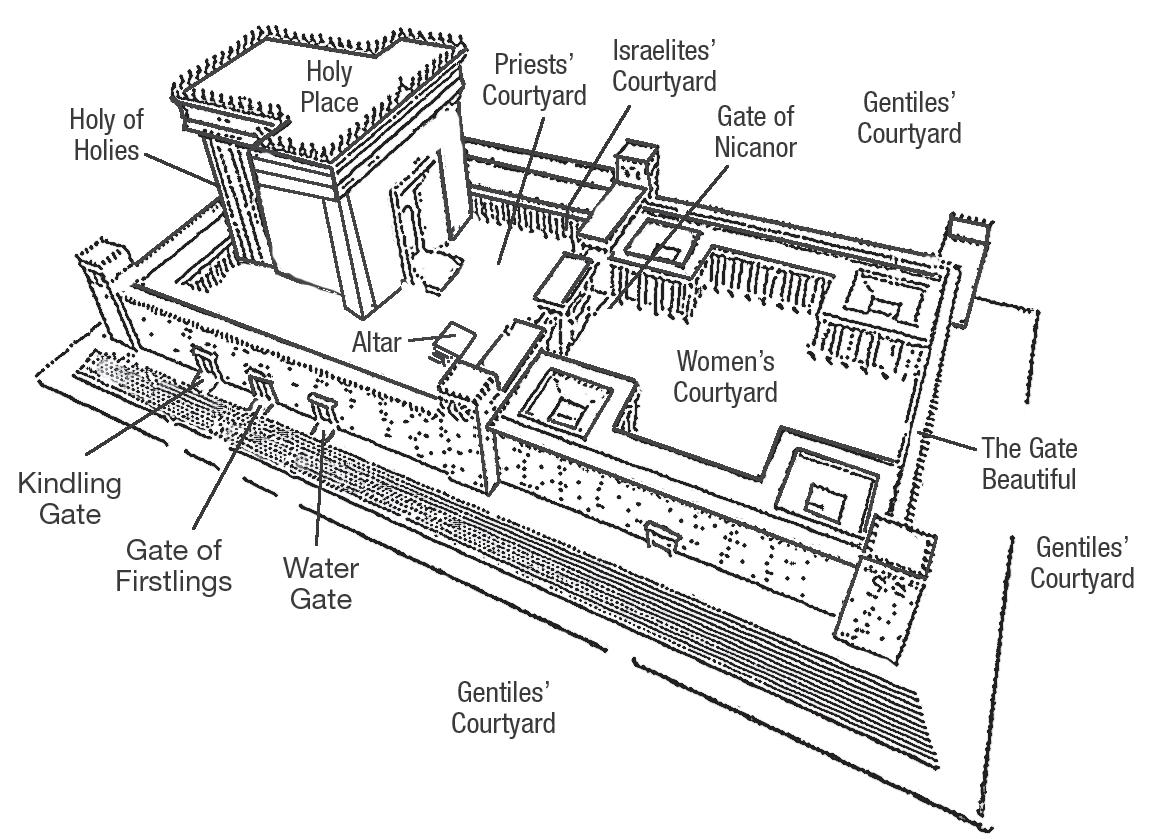
Just outside the four walls housing the Holy of Holies, into the open-aired Court of Israel and through the Gate of Nicanor, a curved staircase descended into what was known in firstcentury Jerusalem as the Court of Women. The Court of Women was not necessarily labeled as such because it was where women gathered, but rather because it marked the boundary into the Temple where women were not allowed to pass.1
This second Temple was rebuilt after the Babylonian exile and later refurbished by Herod the Great.
“Consecrate to me every firstborn male. The first offspring of every womb among the Israelites belongs to me, whether human or animal.”
(Exodus 13:2)
Read Exodus 13:2 in the margin. What does it reveal about what is unfolding in this ceremony in the Temple?
Mary and Joseph’s sacrifice at the Temple fulfilled the requirements of a mother’s purification after childbirth and a firstborn male’s dedication to the Lord (Leviticus 12:1-8, Exodus 13:1-13). They were likely too poor to afford the standard offering of a lamb, so they brought the two turtledoves or pigeons deemed acceptable as a substitute. All the while, they have brought the Lamb Himself, who would become the sacrificial offering for sins of the entire world!
(1 Peter 1:18-19).2
These two ceremonies represented long-standing Jewish observances that were set in place centuries before Jesus was born. Why do you think it was important for Jesus’ parents to fulfill these traditional rituals after His birth?
The Savior of the world had finally come, yet He would still have to abide by the sacred habits established by His heavenly Father. From the start of His life on earth, Jesus set the precedent that divine rules still applied, even for the one true King. There were no exemptions. There were no hallway passes out of what God had ordained as necessary and required for His people. As Warren Wiersbe explains, Jesus would obey His Father’s wishes “perfectly.”3 And so, a circumcision was in order, along with a dedication ceremony where He would be set apart for God. Then we find Jesus and His family in the Court of Women, just outside the Holy of Holies in the Temple of the Lord (see the Temple diagram).
The scene that Mary and Joseph would have observed in the Court of Women would be similar to what is portrayed in Acts 2:46a and 3:1-2.
Read this passage in the margin on page 15 and describe the activity in your own words:
Write the name of the gate mentioned in verse 2 here:
It was through the Beautiful Gate that the Jewish people would enter the Court of Women. The reason? As we just read in Acts 2:46, they were coming to the Temple to worship God. A rather aptly named gate, is it not? We are our most beautiful when our faces are turned toward the heavens in praise of who God is and all that He has done for us.
It’s not easy to concisely define what worship means to me personally. So complex is the act of praising our Creator that even the original biblical languages of Hebrew, Aramaic, and Greek employ many different words to describe it.
Read these verses that express God’s vision for our worship, and put a check mark beside the ones that resonate most strongly with you today.
Sing to the Lord, for he has done glorious things; let this be known to all the world.
(Isaiah 12:5)
Ascribe to the Lord the glory due his name; worship the Lord in the splendor of his holiness.
(Psalm 29:2)
6Come, let us bow down in worship, let us kneel before the Lord our Maker; 7for he is our God and we are the people of his pasture, the flock under his care.
(Psalm 95:6-7a)
Therefore, I urge you, brothers and sisters, in view of God’s mercy, to offer your bodies as a living sacrifice, holy and pleasing to God—this is your true and proper worship.
(Romans 12:1)
15Let the peace of Christ rule in your hearts, since as members of one body you were called to peace. And be thankful. 16Let the message of Christ dwell among you richly as you teach and admonish one another with all wisdom through psalms, hymns, and songs from the Spirit, singing to God with gratitude in your hearts. 17And whatever you do, whether in word or deed, do it all in the name of the Lord Jesus, giving thanks to God the Father through him.
(Colossians 3:15-17)
Feel free to jot your favorite verse on worship in the margin if it’s not listed above. Based on this selection of verses, how would you define God’s vision for worship?
46They worshiped together at the Temple each day . . .
31Peter and John went to the Temple one afternoon to take part in the three o’clock prayer service. 2As they approached the Temple, a man lame from birth was being carried in. Each day he was put beside the Temple gate, the one called the Beautiful Gate, so he could beg from the people going into the Temple.
(Acts 2:46a; 3:1-2 NLT)
Do you have a habit of worship? If so, describe it here. If not, consider what a habit of worship might look like based on the verses above.
One witness is not enough to convict anyone accused of any crime or offense they may have committed. A matter must be established by the testimony of two or three witnesses.
(Deuteronomy 19:15 NIV)
How have you seen the act of worship positively change your life? If you can’t think of any examples, how might a consistent habit of worship impact your day-to-day attitude?
Our heroine for today knew the value of worship. In fact, she determined to dedicate her life’s work to praising God. It’s time that we meet her. Other than Mary, Joseph, and the baby Jesus, there are two additional characters mentioned in our reading for today.
Write their names here (see Luke 2:25, 36): ____________________
As one scholar notes, Luke often places both a male and female character in specific situations in his writings to serve as dual witnesses.4 Deuteronomy 19:15 might explain the reasoning behind this: two witnesses helped validate a testimony (see margin). The voices of Simeon and Anna together help to validate the birth of the Savior in a time when not everyone would readily recognize Him. It’s Anna’s voice that I want us to hear. Although Luke doesn’t record her actual words, her actions are more than enough to boldly proclaim the message that is on her heart.
Based on Luke 2:36-38, what do we know about Anna?
About how old was she?
Was she married?
How does Luke describe her occupation?
I really adore the way Luke introduces Anna’s story in the New American Standard Bible translation: “And there was a prophetess, Anna the daughter of Phanuel, of the tribe of Asher” (Luke 2:36a). And there was a prophetess. Anna was
no ordinary worshiper. She was God’s spokesperson. A prophetess was simply a female prophet, one who “had a special gift of declaring and interpreting God’s message.”5
As a widowed woman in first-century Jerusalem, Anna didn’t find herself daily praising God in the Court of Women by accident. In fact, societal trends of that time reveal that she was likely a minority in her decision to abandon all that she knew and commit the rest of her life to the Lord. The Apostle Paul gives us a glimpse of what would have been expected of widows.
Read 1 Timothy 5:3-16. Based on what verse 14 says, what would Anna have been strongly encouraged to do after her husband died?
We don’t know what prompted Anna to make her home at the Temple after the death of her husband, but we can tell from her actions that she professed a deep devotion to her Lord.
Turn again to Luke 2:36-38 and answer the following questions:
How did Anna spend her days at the Temple?
Did she recognize Jesus as the Savior of the world, or did she treat Him as just an adorable baby in the courtyard?
Why do you think she recognized His identity so easily?
What was her response to seeing the baby Jesus?
We can tell from Anna’s story that she was determined to worship her King against all odds. Societal customs for widowed women could not keep her from devoting her life to God. Because worshiping God was a priority for Anna, she is an example of a believer we want to emulate. And that’s why we are beginning our journey to determined living with her: she was a witness who was determined to worship.
Can you recall a time when the choice to worship God conflicted with what was expected of you? If so, how did you respond?
There are other prophetesses mentioned in the Bible. You can find them in Exodus 15:20; Judges 4:4; 2 Kings 22:14; Isaiah 8:1-4; and Acts 21:9.
A
worshipful heart prepares us for what we may meet in the coming day.
I asked you earlier how the act of worship has positively changed your life. For me, I am never more starkly aware of worship’s value than when it is absent from my daily habits. A day without a few moments spent worshiping my heavenly Father guarantees that I will be reactive instead of ready to face the day. My schedule doesn’t go as planned? A phone call brings bad news? A last-minute e-mail arrives that must be handled above all other tasks? My son’s homework assignment requires more time when I should be cooking dinner? My husband needs a listening ear and supportive advice? Without worship, my response to all of these things will likely include a grumpy attitude because I’ve failed to focus my perspective on what matters most. Worship centers our hearts on God and helps us remember His plan over our expectations. A worshipful heart prepares us for what we may meet in the coming day.
I think Anna knew this. I think that’s why she walked through the Beautiful Gate and never looked back. Let’s do the same, sister. Imagine Luke were to write a story about our lives today; let’s have it start with—“And there was a woman determined to worship God.”
Take a moment to fill in your name below as a commitment to the habit of worship:
And there was a woman named ________________________________ who was determined to worship God.
Close your time today by jotting down ways in which you might embrace a worshipful heart. Then spend some time doing just that: ascribe to the Lord the glory due His name. We are never more beautiful than when we are praising Him. Let’s start today!
Ways I might embrace a worshipful heart:
Look closely at the cover of this book. It’s filled with beautiful things: flowers and feathers and berries and branches. All lovely items meant to represent the
beauty of the One we are here to learn from. What you see on the cover is not unlike how He is depicted in Isaiah 4:2:
In that day the Branch of the Lord will be beautiful and glorious, and the fruit of the land will be the pride and glory of the survivors in Israel.
If you’ll trace your finger along these lovely details on the cover, you’ll find that you are tracing the shape of a circle. Some might call it a wreath, or perhaps more accurately for our assignment today and beyond: a crown.
You can find the image of a crown peppered throughout the Bible. It might designate, as one source explains, “[someone] set apart for a particular task high priest or king [or simply someone in an] exalted position.”1 A crown might bestow a special honor upon the wearer, a blessing of character, riches, or good harvest. Often in the New Testament, the crown represented a prize to the victor, a lavish garland placed on the winner of a race.2
But sometimes the image of a crown represents a slightly different attribute, one that we will seek together today.
Read Luke 2:41-52, and put a placeholder there for future reference.
The Quick Three
What happened?
Where did it happen?
What characters are mentioned in this reading?
Twelve years have passed since we last saw Mary, Joseph, and Jesus in the Court of Women with Anna, the determined. The baby Jesus is now a youthful boy, having grown into adolescence in His hometown of Nazareth (Luke 2:39). Like most Jewish families of the day, Mary and Joseph are traveling again to Jerusalem for a specific purpose.
What does Luke 2:41 tell us about why they were journeying to Jerusalem?
The Passover, followed immediately by the Feast of Unleavened Bread, was one of three annual festivals celebrated by the Jews: the Passover and
According to Jewish custom, biblical manhood began at age thirteen. In today’s reading, Jesus was just shy of that by one year. By the age of thirteen, He would be expected to assume adult responsibilities and to know and “follow the Law of Moses.”3 As Numbers 4:46-47 tells us, the traditional age of full manhood would be reached at age thirty, which is the age Jesus was when He began His earthly ministry.
Feast of Unleavened Bread, the Feast of Weeks, and the Feast of Tabernacles or Booths. Each of these festivals required male Jews to travel to Jerusalem, commemorating significant moments of God’s provision for the Israelite nation. And often their families would travel with them.
Exodus 12:24-28 and Deuteronomy 16:1-17 explain the law prompting the Holy Family to travel to Jerusalem for these three feasts. What details do these passages give us about these annual pilgrimages? Make a few notes below:
The Passover and Feast of Unleavened Bread
The Feast of Weeks
The Feast of Tabernacles or Booths
Imagine a sixty-mile road trip that you embark upon with several hundred of your closest friends and relatives. Now imagine that you are making this road trip via donkey and wagon, with several of you traveling on foot. It would have taken three or four days for the Holy Family to reach Jerusalem in this way. Once there they celebrate the Lord’s great mercy for sparing their people in the first Passover over fourteen hundred years ago, and then they begin the arduous journey back home. But something peculiar happens along the way.
Summarize Luke 2:43-44 below:
How could Mary and Joseph not know Jesus was with them? Biblical scholar Warren Wiersbe offers this insight, which might help provide an explanation:
People traveled to the feasts in caravans, the women and children leading the way and setting the pace, and the men and young men following behind. Relatives and whole villages often traveled together and kept an eye on each other’s children. At the age of twelve, Jesus could easily have gone from one group to another and not been missed. Joseph would think Jesus was with Mary and the other children, while Mary would suppose He was with Joseph and the men, or perhaps with one of their relatives.4 Copyright© by Abingdon Press. All
After returning to Jerusalem—frantic, I am sure—where do Mary and Joseph find Jesus? (See Luke 2:46.)
And so, we are back to the Temple courts once more. Not far from where Simeon and Anna held Him and rejoiced at His birth, Jesus sat with the religious teachers having deep discussions in the Temple.
Can you remember a time when God spoke something so clearly that it was impossible to doubt His voice? Perhaps it was a verse that leaped off the pages of the Bible, an answer to a heartfelt prayer, or a gut-conviction that you needed to do something specific in order to obey God. Take a moment to describe what He told you here:
Glance ahead at Luke 20:1-8, 19 and consider that some of the teachers amazed at twelve-year-old Jesus might be the same ones who will want to kill Him later.
Fast forward a few days, months, or maybe even years. How long did you remember what God told you? Why do you think this was so?
There is a page in my journal where I’ve recorded several of God’s promises in Scripture. Some of the promises I have seen come to pass; some are still yet to happen. Even though I know that God is a keeper of promises, I still have to turn to it often to remind myself of its truth. I easily forget what God has guaranteed.
Why do you think we have a hard time remembering what God has told us?
We have the luxury of reading these two Temple stories recounted in Luke 2:21-39 and Luke 2:41-52 back to back. But twelve years had passed since Mary and Joseph had heard Simeon’s prophecy and Anna’s praise, and it seems they have forgotten the divine truth uttered in those encounters.
How does Jesus’ reply to His parents in Luke 2:49 echo the divine truth shared by Simeon and Anna?
If only Mary and Joseph had remembered! It’s easy to hold their memoryretaining ability to a higher standard, but there are more times than I’d like to admit when I have forgotten God’s promises and the sound of His voice. If we want to retain what God speaks, we’ll have to determine to keep returning to Him. Hold that thought while we take a closer look at Jesus’ conversation with the religious leaders.
As I am writing this, my son is eleven years old. By the time you hold this study in your hands, he will be twelve, the same age as Jesus in our reading for today. The topics of discussion my son is mostly obsessed with these days are, in no particular order, monkeys, hockey, food, and bathroom visits. Ahem. I would be quite speechless if he came home from school one day and capably discussed, as one source puts it, “the interpretation of the [Old Testament] law and its implications for both theology and ethics,”5 but that’s exactly the topic of conversation Jesus is having at the Temple with the astonished Jewish teachers. His reply to His parents gives us an important glimpse into the heart of our Savior.
Rewrite Jesus’ reply in Luke 2:49 word for word here:
In two rather profound sentences, Jesus’ first recorded spoken words establish two things: (1) that He was the Son of God; and (2) that He came to do His Father’s work.
What do these two things reveal about Jesus’ priorities, even as a twelveyear-old boy?
Compare the words of Jesus in Luke 2:49 with His words in Luke 4:43; Luke 9:22; and John 3:14. What does Jesus’ use of the word must in these verses tell us about His commitment to pursuing God’s will?
According to Luke 2:52 (NIV), how did Jesus grow as He matured?
Jesus grew in _________________ and__________________, and in _______________with God and man.
It’s the first of these attributes, wisdom, that I want us to focus on today.
When examining the biblical topic of wisdom, the Book of Proverbs offers relevant teaching.
In particular, Proverbs 4:1-13 details the value of wisdom and why we should seek it. Take a few minutes to read these verses and list some of the benefits of gleaning wisdom that are mentioned:
Note the specific benefit mentioned in verse 9 (NIV):
“She will give you a garland to grace your head and present you with a_______________ _______________.”
Jesus understood that He was put on this earth to do His Father’s will. As we walk through this study together, we’ll witness Jesus in many necessary encounters before He reached the cross. We should not consider it an accident that the first of these recorded encounters—Jesus in the Temple at age twelve— is a conversation about Old Testament law and Scripture and its implications for godly living.
Note what the following passages tell us about the Hebrew Bible that Jesus would have been familiar with at age twelve:
Luke 24:44
2 Timothy 3:14-15
What does John 1:14 tell us about Jesus and the Word of God?
Written in Greek and produced in the third and second centuries BC, the Septuagint was “the oldest written translation of the Bible.”6
The Hebrew Scriptures were Jesus’ Bible. He knew them, studied them, valued them, and recited them. What’s more, we know from John 1:14 that Jesus was the very Word of God Himself. He understood that knowing the Word of God would be critical in fulfilling the will of God.
Sister, we are diving into the Gospel of Luke together to seek wisdom. There is a very specific path both of us must walk to bring about the plans God has set in motion. You and I have a job to do, and we’ll need to retain His Word to see it through. By prioritizing the pursuit of wisdom, we’ll take the first step toward accomplishing God’s will for our lives.
How do we grow in wisdom?
By prioritizing the pursuit of wisdom, we’ll take the first step toward accomplishing God’s will for our lives.
1. Choose three verses below to read carefully.
2. Circle the one that resonates most with you today.
3. Rewrite it in your own words in the space below.
Deuteronomy 11:18-23
Joshua 1:8
Psalm 1:2
Psalm 119:11
Proverbs 3:1-2
My paraphrase:
John 1:1
Ephesians 6:11-17
2 Timothy 3:16-17
James 1:22
Are you ready for a high-five? You’ve already taken the first step. The study of God’s Word will shine a bright light on the next step God needs you to take. There is a direct correlation between what we know of God’s Word and how well we accomplish God’s will. And I’m so glad we are here doing this thing together. Trace your fingers along the cover of this book once more. Close your eyes and imagine your heavenly Father placing a crown of wisdom upon your head today. And then spend some time in prayer, asking God to flood you with the wisdom of His Word.
If any of you lacks wisdom, you should ask God, who gives generously to all without finding fault, and it will be given to you.
(James 1:5)
Have you ever had a particular moment when everything changed—when there would be no going back, no do-overs or second chances? There would simply be a new normal with new rules. I have had this experience a few times in my life.
If I were to compare my short list of such moments, the one thing they have in common is that they all marked the definite end of something. The end of a job, the end of a loved one’s life, the end of an awareness of something that no longer holds true. And then, change. The end of something is always followed by striking change, and that change is often accompanied by chaos.
Think back to a moment in your life when everything changed. Consider these questions as you describe it below: What ended? Did something begin in its place? What were the new rules? How did
you respond to the change? Was there chaos? Was God a part of your response? Was prayer?
I imagine that some of us can look back on our seasons of change and see God’s perfect timing in it all. Or maybe your season of change has brought so much disorder and confusion that you can’t see the movement of God in it just yet. That’s okay. We’re here to find Him together.
Today we are going to step into a time in history when there was no scarcity of chaos. Everything was about to change. And as always, even though it looked like things were in an uproar, God’s timing in the middle of it all was perfect. These verses summarize this time of change:
4When the set time had fully come, God sent his Son, born of a woman, born under the law, 5to redeem those under the law, that we might receive adoption to sonship.
(Galatians 4:4-5)
With this backdrop, we’re ready to jump into our passage for today.
Read Luke 3:1-23, and put a placeholder there for future reference.
What happened?
Where did it happen?
What characters are mentioned in this reading?
I don’t know if you noticed, but Luke throws a lot of characters at us in the first two verses of our reading. That’s intentional. If you’ll glance back at Luke 3:1-4 to see Luke’s objective in writing this Gospel, you’ll see that he wants his reader to understand the world he is describing in detail. So before we continue any further, let’s try to make sense of the five rulers and two high priests Luke mentions.
Reread Luke 3:1-2 and fill in the blank boxes in the chart.1
Emperor of the Roman Empire
Pontius Pilate
Tetrarch* of Galilee and Perea
Philip
Tetrarch of Abilene
AD 14–37
AD 26–36
Annas
Caiaphas
*Tetrarch = “the governor of a region”2
4 BC–AD 39
Succeeded Octavian Augustus Caesar
Will appear later in Luke 23 during Jesus’ trial and crucifixion.
Son of Herod the Great; See Luke 1:5
4 BC–AD 34Son of Herod the Great
Specific dates unknown, but during the reign of Tiberius Caesar
AD 6–15
Abilene was north of Mount Hermon
Caiaphus’s father-in -law; See Acts 4:6
AD 18–36Annas’s son-in-law
The third chapter of Luke takes us to around AD 28–29, and although the Greek Empire had conquered much of the world a few centuries prior, the Roman Empire was now in control of Palestine. Between the mingling of Greek and Roman cultures, along with a myriad of different groups of Jews, we can rightly imagine a vibrant melting pot of languages, beliefs, and priorities as leaders within these factions challenged one another for political prominence.3
There are two words that come to mind when considering each of the political leaders we’ve just charted together: soap opera. I’m not joking. Understanding their roles and responsibilities is one feat; understanding their behavior choices is another challenge altogether. As Charles Swindoll has observed, just among the seven characters named above there is murder, adultery, jealousy, insatiable greed, incest, exile, and cruelty.4 He writes of this bleak time in history: “John began his ministry during a time of political fracturing in Israel. While priests and procurators vied for power, the people desperately longed for a leader.”5
Sounds like chaos, right? And into this divided political climate entered John the Baptist, who was the son of Zechariah, cousin of Jesus, prophet of God, and undoubtedly a societal misfit living in the wilderness. We’ve considered the political climate at this time, but what about general society?
Based on the questions the crowd asks of John and his responses in Luke 3:7-14, how would you describe the cultural climate of the day? How do you think the people of first-century Israel treated one another?
And into this swirling cultural climate entered the Son of God.
The first-century world was about to change, and the crowds in the wilderness that day knew it. Let’s find out why.
Take a look at Luke 3:21-22. What was Jesus doing, and what happened as He did this?
Read the words of the Old Testament prophet Ezekiel in Ezekiel 1:1. What happened after the heavens were opened?
I have several notification sounds programmed into my smart phone. One sound notifies me of updates within certain apps, one signals an approaching thunderstorm, and one tells me that my phone battery is about to die. They all sound different, but the notification that sounds like a bell tells me that I have a new incoming text message. I know when I hear that particular bell that someone is trying to communicate with me.
The opening of heaven described by both Luke and the prophet Ezekiel served in a similar way as a notification. In each instance, divine communication followed. The opened heavens were God’s way of saying, “Listen up! Pay attention! I am about to speak!” This moment described in Luke 3:21 was an especially unique circumstance considering that the Israelites had not received direct communication from God in about four hundred years.7 Everything was about to change
You’ll recall that Jesus was praying as heaven was opened. Three other things happened as Jesus was praying.
Review Luke 3:21-22 and fill in the blanks that follow:
Jesus prayed and . . . heaven opened.
John taught a “baptism of repentance for the forgiveness of sins” (Luke 3:3). If Jesus was the faultless Son of God, why was His baptism necessary? Scholars have varying opinions on this, but Jesus gave his answer in Matthew 3:14-15.
If you compare the Gospel of Luke with the Gospels of Matthew, Mark, and John, you’ll find that Luke portrays Jesus in prayer more often than any other Gospel author.6 You can also find Jesus at prayer in Luke 5:16, 6:12, 9:18, 9:28-29, 11:1, 22:4144, 23:34, and 23:46.
Luke 3:21-22 records the appearance of the Trinity together: the Father, the Son, and the Holy Spirit.
the _______________ _______________ descended. a _______________ came from heaven (the voice of God Himself).
Jesus was declared as God’s __________.
Do you think it was a coincidence that these things happened as Jesus was praying? Why or why not?
After all these remarkable things happened as Jesus prayed, something just as remarkable was about to begin.
Luke 3:23 records the start of something that changed everything. What was it?
As we continue through our study of Luke, we’ll see Jesus at prayer regularly; but this first observance of Him in communication with His Father is not a minor one. Big things happened after Jesus prayed here. It marked the end of a silent era for the people of God and the beginning of His ministry to the entire world. Jesus’ prayer paved the way for the movement of God. As I think of the Savior of the world on His knees before the start of something that changed everything, I have to ask myself if I am as committed to prayer as He was.
Do you have a habit of prayer? Is it consistent? Sporadic? Heartfelt? Needbased? Jot a few words below to describe your current prayer life.
If what you just described didn’t include words such as consistent, rewarding, or regular, let me ask you this: what would it take for you to start defining prayer as required? Not in the sense of an expectation or obligation but in the sense of a necessity for daily life. What perspective shift do you need in order to move the habit of prayer from a rote behavior you are simply checking off the list to an absolute necessity for your potential to thrive as a follower of Jesus?
Last year my husband and I committed to daily prayer together over our son’s schooling choices. We thought we might be praying over this decision for a few weeks, but God had another time line in mind. A few months later, as we were still praying over the decision, the rich rewards of our commitment became evident:
1. Daily prayer is a constant reminder that God is in control. Even though we are walking into the unknown, the habit of continually bringing our hearts to God soothes anxiety and worry that might threaten to creep in. Comfort is found in our daily pause to acknowledge that God’s ways are higher than ours.
2. A prayerful heart is a thankful heart. What began as a request for answers turned into an outpouring of gratitude. As Tom and I waited for God to reveal Himself, God grew an attitude of thankfulness in us both. The language of our prayers shifted from “God we need this answer please” to “God you have blessed us so.”
3. Prayer gives birth to emotional intimacy. Prayer connects us to the people with whom we are praying. I look forward to my prayer time with Tom because I know it will be precious time spent together. If you want to build a closer bond with someone, praying together is a wonderful way to start.
It’s this last reward that echoes in my mind as I read of Jesus’ prayer and the heavens opening in Luke 3. Prayer draws us close to our heavenly Father because it’s how we communicate with Him. A commitment to prayer increases intimacy with our heavenly Father.
Like the divine communication following the opening of the heavens, we can know that the deepening of our relationship with God will follow the bowing of our heads in prayer. And that changes everything.
Spend some time in prayer as we close out this day, perhaps writing your thoughts in the margin as you pray. Ask Jesus to give you a heart that yearns for prayer because you yearn for Him.
There is a purpose to my pain. I often whisper this to myself in seasons of hardship, whether I believe it in the moment or not. When we’re in the middle of such a moment, in a place that feels like either a test or a temptation, it’s difficult to imagine that anything good might follow. Our eyes can only see what’s right in front of us, and maintaining the awareness that there is value in hardship requires patience and a perspective we don’t readily choose. We are human, after all.
But again and again, God’s Word reminds us that the pain we experience today can be used to prepare us for our godly designed purpose. So the question remains: How do we bridge the gap between what we see and what lies ahead— between the pain of today and the hope found in tomorrow? The moments
A commitment to prayer increases intimacy with our heavenly Father.
between these two are where our faith is built; and if we want to please God, we’ll have to hold them with reverent hands.
We’ll find the way to do that today by looking to the One who was both fully divine and fully human. He understands our pain and knows that the path to finding our purpose is marked with obedience.
I will hasten and not delay to obey your commands.
(Psalm 119:60)
Read Luke 4:1-13, and put a placeholder there for future reference.
What happened?
Where did it happen?
What characters are mentioned in this reading?
As you’ll recall from Luke 3:23, which we read yesterday, Jesus was about to launch His ministry. Think for a moment about the launch of a new business, a new product, a new church, or a new campaign. If you were managing such a launch, you would want the public to know. There would be announcements. Advertisements. Brochures to send to interested individuals. Parties, even. As we consider that this is the beginning of Jesus’ earthly ministry, we might assume this would be the perfect time for Him to go public. Instead we find Him going into the wilderness.
What does Luke 4:1-2 tell us about His experience in the wilderness?
Carefully consider Hebrews 2:14-18. Based on what this tells us, why might the Spirit have led Jesus into this encounter? ‘
There is a purpose to Jesus’ pain in the wilderness. Here God is preparing Him to come to our aid when we need it the most. Not unlike those who undergo
first aid training to assist someone in medical crisis, Jesus undergoes humanity training in the wilderness to assist us in a spiritual crisis. His experience here enables Him to understand our plight and proclaims that He is worthy to redeem it:
We do not have a high priest who is unable to empathize with our weaknesses, but we have one who has been tempted in every way, just as we are—yet he did not sin. (Hebrews 4:15)
But there is more to this scene that is unfolding. As we see Jesus fasting, hungry, and alone, Luke sets forth the entire premise of Jesus’ ministry. Charles Swindoll writes that our passage for today “sets the tone for the rest of Luke’s Gospel, which is essentially an account of the war between the Son of God and Satan.”1 There is a battle waging between good and evil, and Jesus has come to end it.
Luke tells us in verse 13 of chapter 4 that the devil tempted Jesus in every possible way, but he describes three of them in detail. Let’s consider them together.
How is Jesus tempted in Luke 4:3-4?
Circle the phrase that describes this temptation:
To doubt God’s provision
To desire God’s power
To embrace selfish pride
The devil knows that Jesus is hungry, and he tempts Jesus to doubt that God will provide for His physical needs.
Can you think of a moment of hardship when you were afraid your needs would not be met? How did you react or communicate with God in that moment?
The word choices and narrative details in Luke’s telling of Jesus’ encounter with the devil in the wilderness echo the Israelites’ experience in the wilderness, as told in the book of Exodus.2
How did Jesus respond to the devil?
How is Jesus tempted in Luke 4:5-8?
Circle the phrase that describes this temptation:
To doubt God’s provision
To desire God’s power
To embrace selfish pride
The devil is the prince of the world (John 12:31), and he tempts Jesus with the lie that what the world offers is greater than what God offers.
Can you think of a moment of hardship when you were tempted to put something worldly before God? How did you react or communicate with God in that moment?
How did Jesus respond to the devil?
How is Jesus tempted in Luke 4:9-12?
Circle the phrase that describes this temptation:
To doubt God’s provision
To desire God’s power
To embrace selfish pride
The devil recognizes Jesus as the Son of God, fully divine and capable of saving Himself, and he tempts Jesus with the prideful lie that He doesn’t need God.
Can you think of a moment of hardship when you were tempted to believe that you could do it all on your own? How did you react or communicate with God in that moment?
How did Jesus respond to the devil?
In each of these temptations, Jesus responds with wisdom from Scripture, saying “It is written .”
If you were to tell how Jesus responded to the devil in all of these temptations with a summary of just a few words, what would you say?
I like to think on the following words when referring to the example Jesus sets for us here: Jesus obeyed His Father. In the throes of hunger, Jesus obeyed. When enticed with worldly power, Jesus obeyed. When seduced to engage his ego, Jesus obeyed. When we are in a place of hardship that feels like either a test or a temptation, we can remember that Jesus has shown us the way out. The way to bridge the gap between what we see and what lies ahead is found in the simple act of obeying our heavenly Father.
Consider for a moment the thought patterns running through your head during seasons of hardship. Not the ones you tell your best friend. The ones you keep to yourself. The thoughts you’re afraid to say out loud. The patterns you might not even be able to articulate clearly.
Do any of them resemble the following statements?
• God won’t take care of my needs.
• This thing that the world offers is better than what God offers.
• I can do this on my own. I don’t need Jesus to save me.
If so, take a moment to confess these thoughts to the Lord. Write a brief prayer in the margin, if you want:
I’ve experienced each of these thought patterns during my faith journey. When I was finally able to apply some hindsight to the fallacy of these lies, what hurt the most wasn’t that I had believed them. It was that I had let them separate me from God.
Look closer at the enemy’s end goal. While it may seem that the devil’s sole aim is to entice Jesus into disobeying God’s written commands, what he is
The devil subtlety misquotes Scripture in Luke 4:10. Compare this verse with Psalm 91:11 to see what he left out.
All three of Jesus’ responses to the devil are taken from Deuteronomy 6–8, where Moses reminded the nation of Israel what they had learned by wandering through the wilderness.
really after is to alter Jesus’ perfect relationship with His heavenly Father. And Jesus will have no part in it because the Father and the Son are not meant to be separated. Instead, He shows us that the way to preserve our relationship with God is to obey His will for our lives. This isn’t about works over faith. This is about doing what God tells us to do because He loves us as His children and we are meant to be in relationship with Him.
Twice the devil refers to Jesus as the Son of God, not only acknowledging Jesus’ divinity but also showing that He is beloved family to God Himself. Only Jesus can emerge from temptation unscathed and still holy. Biblical commentator R. T. France suggests that this is Luke’s primary purpose in sharing this encounter: to prove that Jesus is the holy and righteous Son of God.3
Our faith walk will require consistent requests for forgiveness, even as we are made more and more like Jesus. We will not be perfected until we see Him face to face. But, sister, we are part of that same family. In Romans 8 we read, “If we are children, then we are heirs—heirs of God and co-heirs with Christ, if indeed we share in his sufferings in order that we may also share in his glory” (v. 17). We are the daughters of the Creator of the universe. Our response to both tests and temptations should be just like that of Jesus. We overcome the enemy’s attempts to separate us from God when we determine to obey God’s will.
Just as this experience helped to prepare Jesus for His earthly ministry, so seasons of hardship can prepare us to move forward in God’s will for our lives. How do we determine to obey?
1. Remember that just as the devil pursued Jesus when he was hungry and alone, we can expect to be tempted when we are weak and isolated.
2. Be ready to respond with truth from the Word. We cannot be obedient to what we do not know.
3. Don’t give up. Keep applying God’s truth to our hard places, being determined to obey God over and over again.
We
overcome the enemy’s attempts to separate us from God when we determine to obey God’s will.
Let’s close by penning a prayer to Jesus. I’ll get us started and you can continue it with your own words as you are led. If you are walking through a season of hardship right now, write it in the blank below and allow God’s grace to wash over you as you pray these words:
Jesus, I know You understand what it feels like to be led into the wilderness. I know You understand what it feels like to be tempted in every way. Thank You for walking through these moments of hardship so that You can guide me through mine. There can be purpose in my
________________________, because You can use it prepare me for what is to come. Help me trust in You as I walk through this season.
In 1517, a local professor of biblical studies walked up to the Wittenberg church in Germany and hung a document on its door. His name? Martin Luther. His document, known as the “Ninety-Five Theses,” would be translated into German and published for the general public, where it would become the foundation of one of the largest revolutions known to church history. We know it as the Protestant Reformation.1
The humble document posted to the Wittenberg church door was Luther’s manifesto, a public declaration proclaiming why he believed what he believed and what he was going to do about it.
It wasn’t the first time a religious leader publicly declared his mission to the world.
In an ordinary Nazarene synagogue, surrounded by those who had watched Him grow in wisdom and stature and in favor with God and men, our Savior did the same.
Read Luke 4:14-30, and put a placeholder there for future reference. The Quick Three What happened?
Where did it happen?
What characters are mentioned in this reading?
When we read of Jesus returning to Galilee, His ministry has already begun. His early actions are recorded in John 1:19–4:45, but Luke wants his readers to begin here, in Jesus’ hometown of Nazareth. Like any faithful Jewish worshiper of the day, Jesus attends regular services at the synagogue on the Sabbath.
One source explains that a typical first-century synagogue service would have looked like this:
1. Invocation for God’s blessing
2. Recitation of the traditional Hebrew confession of faith, found in Deuteronomy 6:4-9 and Deuteronomy 11:13-21
3. Prayer
4. Readings from the Law and from the Prophets
5. Brief sermon
6. Closing benediction, if a priest was present. If not, a layman would pray and dismiss the meeting.2
Recall from Day 3 of our study this week that Jesus is beginning His ministry during a time of political turmoil for Israel. Like Anna and Simeon, whom we met earlier in the Jerusalem Temple, some Jewish listeners still hear the Minor Prophets of the Old Testament echoing in their minds and are eagerly anticipating the coming Messiah. One source notes that others are hungry for a charismatic leader who might overthrow the Roman empire.3
Another commentator notes that many in Nazareth would remember the destruction of the nearby city of Sepphoris by the Roman army in response to a Jewish rebel uprising. Tensions were high. Messianic announcements and anything pertaining to the plight of the Jewish nation were not received with indifference.4
And so enters the Messiah Himself as the designated speaker for the synagogue service on this particular day.
According to Luke 4:17, what scroll of the Hebrew Scriptures was handed to Jesus?
We don’t know whether this particular passage was chosen because it was from a predetermined schedule of Scripture readings in the synagogue for that day or because Jesus selected it Himself.5 But Jesus reads the words recorded in Isaiah 61:1-2, which were spoken about the coming Messiah. The Messiah had indeed come, and He wanted to make clear His purpose. We can never accuse Jesus of being ambivalent or unintentional. In fact, from the onset of His ministry, Jesus is quite determined about His mission.
What was His specific mission? Let’s explore it together.
Read Luke 4:18-19 (NIV if possible), and fill in the blanks to indicate what five things the Spirit of the Lord anointed Jesus to do:
To proclaim _______________ _______________ to the poor
To proclaim _______________ for the prisoners
To proclaim _______________ of _______________ for the blind
To set the ____________________ free
To proclaim the year of the _______________ _______________
These two verses hold Jesus’ manifesto. Everything that He would accomplish in His earthly ministry would be done with these five things in mind. He was determined to fulfill His purpose from the start, and let’s not gloss over the fact that even then He had His mind set on you
Of the five intentions Jesus mentioned, which one resonates most with you today? Why?
Describe the initial response of Jesus’ hometown listeners in Luke 4:22.
Now describe their later response in Luke 4:28.
What caused the reversal in their response? The clues are found in the stories Jesus tells in Luke 4:25-27, which are recorded in full in 1 Kings 17:7-24 and 2 Kings 5:1-14. Read the Scriptures and complete the chart below.
What prophet is mentioned in this passage?
Who does he minister to?
How was the favor of the Lord given?
From where is the person who received the Lord’s favor?
1 Kings 17:7-24
2 Kings 5:1-14
Luke 4:23 makes mention of acts that Jesus had already done in Capernaum. These “events recorded in John 1:19–4:45 took place at this time, but Matthew, Mark, and Luke did not record them.”6
(Luke 4:26) (Luke 4:27)
Of all the stories from the past that Jesus could tell that day, He chose these two for a reason. As one source notes, ”Both Sidon and Syria were traditional enemies of Israel.”7 This means that both Zarephath and Naaman were Gentiles. As He preached to the crowd of hometown listeners, Jesus was not painting a picture of God’s privileged favor upon the nation of Israel. Jesus’ mission was radical: He had come to save the entire world. Both Jews and Gentiles were invited to be part of the kingdom of God, but this was not what the people of
A Gentile was any person not in the Jewish nation or faith. As one writer notes, “The Messiah didn’t come to rescue only one particular race; He came to save those who wanted a Savior. His domain is the whole world, and His subjects are all those who call Him King.”9
Nazareth wanted to hear. One commentary notes that Jesus’ listeners expected to be saved because of their ancestry, not their faith, and they preferred exclusivity over the acceptance of Gentiles.8
How do the synagogue listeners act upon their anger in Luke 4:29?
Scripture doesn’t tell us how Jesus evaded His first murder attempt. Luke just tells us that He moves on, determined to fulfill the mission He so clearly articulated to the crowd that now wants to kill him.
Read Luke 4:30 and describe how Jesus might have been feeling.
Jesus, I don’t want to waste my time on earth. Teach me to choose determined living so that I can make a difference for your Kingdom with the days that remain.
This was my prayer after receiving a diagnosis of Vascular Ehlers-Danlos Syndrome. Living with a condition that threatens the spontaneous rupture of blood vessels, arteries, and organs has taught me that life is precious. Every choice matters. A yes to one thing now means a no to something else later. And none of our yeses will make any difference at all if they are not grounded in God’s will for our life.
What we are studying together is the central truth God taught me about determined living: Jesus did it first. His is the only example we need to follow. One of the questions I asked of God as I considered the choices that Jesus made on His way to the cross was this: Is there a sustainable template for daily living that would produce the maximum impact for His kingdom? In these first few chapters of Luke, I think we’ve found it.
Glance back at your homework from this week and summarize in your own words what we’ve learned so far:
Day 1: Anna was determined to worship.
Day 2: We can find the wisdom of Jesus in God’s Word.
Day 3: A commitment to prayer increases intimacy with our heavenly Father.
Day 4: Jesus thwarts the enemy’s attempts to separate Him from God by obeying God’s will.
Worship. Word. Pray. Obey. These are our habits for success. This is our sustainable template for daily, determined living. If we want to live like Jesus, we will seek to engage in these actions every day.
We have seen Jesus display His manifesto in today’s reading. But what about ours?
If you know your God-given purpose in life, describe it here:
A year ago, I would have responded to that question by telling you that God has called me to women’s ministry as a Bible study writer and teacher. But I am telling you today that my response isn’t exactly accurate. What God has called me to is this: to glorify His name by spending time with Him, reading His Word, talking to Him in prayer, and worshiping His faithfulness. And out of the overflow of that obedience comes the fulfillment of God’s will for my life. The details may vary from season to season, but the ultimate goal of glorifying God remains. The same is true for you.
Read these verses and describe in your own words what each says or implies about our God-given purpose:
Proverbs 16:9
Isaiah 43:7
Ephesians 2:10
We will fulfill our purpose on earth when we routinely display patterns of determined faithfulness.
God isn’t looking for perfect people who know how to do everything right. He’s looking for people who are willing to choose habits of faithfulness. He will direct the outpouring of our time spent with Him to spill over where it needs to. This is our manifesto as emulators of Jesus: Worship. Word. Pray. Obey. We will fulfill our purpose on earth when we routinely display these patterns of determined faithfulness.
Let’s close out this week by acknowledging the ways in which we already do this and noting areas where we can deepen our determination. In every day, how do you or how can you:
Worship God?
Study His Word?
Pray to Him?
Obey what He says?
Sister, I am so proud of you! More important, so is your heavenly Father. You are displaying patterns of faithfulness right now and are well on your way to determined living. Next week Jesus has much to teach us about God’s kingdom. Until then, let’s live like Jesus in every day: worship, word, pray, and obey.
Luke 1:67-79
Luke 2:14
Because Jesus was determined to choose life for us, we can ____________________ ____________ with Him even when we are walking through darkness.
John 10:10
The path of peace is not found by ___________________ __________________.
We are changed by the __________________ we make and only Jesus can help us make the right ones.
Luke 1:37


Copyright © Abingdon Press. All rights reserved.