COECT EXCLUSIVE MAGAZINE
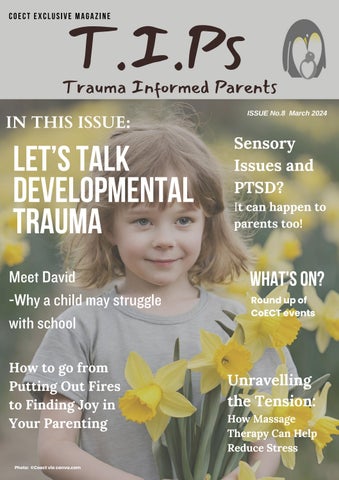
T.I.Ps
Trauma Informed Parents IN THIS ISSUE:
Let’s talk Developmental trauma Meet David -Why a child may struggle with school How to go from Putting Out Fires to Finding Joy in Your Parenting Photo: ©Coect via canva.com
ISSUE No.8 March 2024
Sensory Issues and PTSD? It can happen to parents too!
WHAT'S ON? Round up of CoECT events
Unravelling the Tension: How Massage Therapy Can Help Reduce Stress
In this issue CoECT News
Page 1
Editor's Note
Page 2
Meet the Team!
Page 3
How to go from Putting Out Fires to Finding Joy in Your Parenting.
Page 4
The Simple Guide to Developmental Trauma
Page 6
Sensory Issues and PTSD? It can happen to parents too!
Page 8
Unravelling the Tension: How Massage Therapy Can Help Reduce Stress and Improve Well-being
Page 9
What's on Where? – Events and Connections
Page 11
Relieve the symptoms of compassion fatigue, including burnout.
Page 16
Ask the Experts
Page 17
Meet David - Why a child may struggle with school
Page 18
Trauma-Informed Qualifications
Page 19
NATP Viewpoint
Page 20
www.coect.co.uk
To advertise with us contact: tips@coect.co.uk ISSUE 8
T.I.P'S MAGAZINE
Fostering News
COECT NEWS 2024 Conference News We are delighted to announce that our Annual Conference for 2024 will be held on Thursday 20 June. The theme of this year's conference is going back to the basics of Therapeutic Parenting and is called “The Essential Tools of Therapeutic Parenting". As it will be a virtual conference this year, you can join us from the comfort of your own sofa. So, grab a warm drink and join us for an exciting and informative event. You can find more information by clicking on the link or scanning the QR code https://tinyurl.com/yaewvn2s
Therapeutic Parenting Awareness Day
Wow, what a wonderful day it was! On Wednesday 6th March, we celebrated our first ever Therapeutic Parenting Awareness Day and The National Association of Therapeutic Parents’ 7th Birthday! We were so happy to share this special occasion with over 100 people who joined us for our live-streaming event. It was amazing to see so much interest and support for therapeutic parenting. As a special birthday treat, we revealed our new NATP Training service, which will offer members more opportunities to learn and grow as therapeutic parents. Read on to find out more about this exciting news...
Groundbreaking News for SAfER Fostering! SAfER Fostering are pleased to announce that, in a groundbreaking move, they are going to be providing private health care for the children and foster parents in their agency. They are also welcoming in Springtime with the re-opening of their caravan, which foster families in the agency have the opportunity to use for weekend and holiday breaks.
Keynote and Training Our trainers have been all over the country in the past few weeks delivering training including: Healing Children Through Therapeutic Parenting Sarah Naish and Sarah Dillon have been in Hull training an organisation in Healing Children through Therapeutic Parenting, and they are looking forward to their Conference in the upcoming months. Trauma-informed Teaching - Head Teachers conference Portsmouth Sarah Naish and Sair Penna had the pleasure of speaking at the Portsmouth Head Teachers Conference delivering an overview of Trauma-Informed Teaching and how it can be implemented into educational settings.
NATP Training Are you ready to learn how to support children and young people who have experienced trauma? NATP is excited to announce its new training service, which offers trauma-informed training to organisations, parents and professionals. Whether you work in education, health, social care or any other sector, you can benefit from this service and gain valuable skills and knowledge. Don't miss this opportunity to make a difference in the lives of those who need it most. To find out more on this new service turn to page 20. ISSUE 8
T.I.P'S MAGAZINE
1
Editor’s Note Greetings to All, This month, NATP celebrated its 7th anniversary, and time seems to have flown by. Over these 7 years, NATP has provided invaluable support to numerous families facing significant challenges. This success is largely attributed to our dedicated team of volunteers who offer peer support through hosting Listening Circles and providing empathetic ears. Happy Birthday NATP! In this edition, we welcome back Jessica Spenceley, a Therapeutic Social Worker who will delve into transitioning from managing crises to discovering joy in your parenting journey. She will share strategies to enhance the bond and understanding between parent and child. Sarah discusses ‘The Simple Guide to Developmental Trauma’, emphasising the necessity for all involved in a child's life to communicate and collaborate effectively. How addressing underlying issues before tackling more complex matters can prevent conflicts and challenges, leading to improved outcomes for the child. Sarah also sheds light on her personal experiences in the article titled ‘Sensory Issues and PTSD’. In our wellbeing segment, Nicola Crabb, a skilled massage therapist, elaborates on how massage therapy can alleviate chronic stress. She explores how using professional massage techniques and aromatherapy oils, we can release pent-up stress and effectively manage our stress levels. Gareth Thomas, a seasoned therapeutic foster parent, offers insight into the reasons behind a child displaying challenging behaviour at school and stresses the significance of educators understanding the root causes of such behaviours. We also recap COECT events and training opportunities, featuring a special piece from NATP introducing their new training service. As Easter approaches, we wish you a calm and positive start to Spring and the Easter holidays. Take Care,
Sair, Sarah, and The Team at The Centre of Excellence in Child Trauma ISSUE 8
T.I.P'S MAGAZINE
2
Meet the Team! The Centre of Excellence in Child Trauma is made up of a team of experts who have essential real-life experience. We are Adopters, Foster Parents and Bio parents of neuro diverse children, and also work as professionals in the field.
Executive Editor - Sarah Naish
Executive Editor - Sair Penna
Sarah is a Therapeutic Parent, an Adopter of five siblings, former Foster Parent, retired Social Worker, Best selling international Author, Keynote Speaker and founder of three Independent Therapeutic Fostering Agencies.
Sair (Sarah) is a Therapeutic Parent, Trainer, and Therapeutic Parenting Coach. Director of NATP, The Haven Parenting and Wellbeing Centre and Inspire Training Group and works across CoECT supporting families.
Managing Editor - Kathryn Talbot
Contributor - Emma Edwards
Kathryn works across CoECT, specialising in communications and public relations.
Contributor - Sarah Dillon
Sarah is a Therapeutic Parent, an Attachment Therapist, Keynote speaker, former child in care, Author (Therapeutic Parenting) Head of Therapeutic Services (Fostering).
Contributor - Jessica Spenceley
Jessica is a therapeutic social worker with over 20 years experience of helping adoptive parents navigate their parenting journeys using the attachmentbased trauma informed parenting approach of TBRI®.
ISSUE 8
Emma is a Therapeutic Parent, Adopter, Director of NATP and The Haven Parenting and Wellbeing Centre.
Contributor - Nicola Crabb
Nicola is a holistic massage therapist with over 10 years experience. Focusing her efforts on women's health and well being Nicola has developed a unique method using a combination of tried and tested techniques to offer a tailored service to her clients including relieving the symptoms of stress and compassion fatigue.
Contributor - Gareth Thomas
Gareth has been a single foster parent to three children for seven years, and has volunteered with children for fourteen years. He is currently studying for a degree in psychology, with a view to becoming an educational psychologist.
T.I.P'S MAGAZINE
3
How to go from Putting Out Fires to Finding Joy in Your Parenting Written by Jessica Spenceley
P
arenting a child who has experienced early adversity and trauma can be tough. It can feel like you’re grasping for ideas and strategies that can help, but
not getting the actual help you need. It can feel like most of your time is spent putting out fires and doing damage control. The joy you hoped to feel as a parent only comes in small glimpses that are hard to hold onto. However, it doesn’t have to be this way. The therapeutic parenting approach of Trust-Based Relational Intervention® (TBRI®) can help you to create helpful shifts in your family so that you can feel more joy. There are many ways that TBRI® can support you Photo: ©Coect via canva.com to do this, and a great place to start is with the Connection Principles. The Connection across. So, even if your child is a teen and doesn’t want to play, you can Principles offer you many strategies, and still approach them playfully. my go to ones are Playful Engagement, Behaviour Matching, and Healthy Touch. Behaviour Matching Behaviour matching is a really easy Playful Engagement way to connect with your child. If So many of the challenges faced by the your child is sitting on the floor with parents I work with are around how to their legs crossed, you would sit on manage their child’s trauma-based the floor with your legs crossed. If responses. As a starting point, we always begin with playful engagement because it your child is talking to you about helps children to increase trust and reduce something with a serious tone, you fear-based responses. It’s also very easy to would respond using the same kind of tone. See, you’re matching them. implement. All you need to do is get down on the floor and play with your child, or play Behaviour matching might seem overly simple, but the messages a game like Go Fish or Monopoly, or bring behind it are significant. Behaviour out the arts and crafts, or kick around a football in the garden. Playful engagement matching conveys to your child that you see them, that they exist, and is also about your general approach, and that they belong. When you’ve being mindful of how you are coming ISSUE 8
gotten into a challenging pattern with your child, the messaging that behaviour matching offers can help you to reset and get back on track. Healthy Touch When things get difficult in parenting relationships, touch is often one of the things that lessens (or even stops), and you may not be aware of it. Touch helps you and your child to feel connected to one another, and touch can be a significant way for your child to feel safe and regulated. There are a lot of ways that you can connect with your child in a meaningful way, not just through hugs and cuddles. You might give your child a high-5, a fist bump, or create a special handshake. You T.I.P'S MAGAZINE
4
could affectionately bump shoulders. As you’re talking to your child, you might sweep their hair out of their face, or lightly touch their cheek. If touch is really difficult for your child, you might just be in physical proximity to them, without making contact. The strategies in the Connection Principles may seem small, but they can have a big impact on your family. When you find yourself in a pattern where parenting is hard or where things may even feel stuck, remind yourself to go back to the heart of parenting – connection.
Photo: ©Coect via canva.com
Connection builds trust, helps to disarm fear, and reduces challenging behaviours. The bonus is that when you increase your connection with your child, you feel more positivity and joy in your parenting. It’s a win-win. Start small, and use the connection strategies often. If you would like to find out more about TBRI® and the Connection Principles, be sure to read The Connected Child by Karyn Purvis, David Cross, and Wendy Lyons Sunshine. If you would like to experience how TBRI® can help you move forward in your parenting, I would love to welcome you to one of my upcoming courses. Find out how TBRI® could bring additional hope and healing to your family today by visiting https://nurturedbelonging.com/.
Through her company, Nurtured Belonging, Jessica helps adopters create a strong parenting base for their children so that they can heal from early adversity and trauma. Visit her website to learn how you, too, can gain additional insights and skill sets to empower your parenting. Jessica is also an Associate with The Haven Parenting & Wellbeing Centre
TIPS MAGAZINE SUBSCRIPTION If you have been enjoying our magazine and would like to receive each edition, please email tips@coect.co.uk to set up a subscription Paper subscription - £23.99/year Electronic subscription - free Paper Subscriptions and past editions are also available through the NATP shop: www.naotp.com/shop
ISSUE 8
T.I.P'S MAGAZINE
5
The Simple Guide to Developmental Trauma Written by Sarah Naish
D
evelopmental trauma is a complex and often misunderstood issue that has its roots in early childhood experiences. It can be difficult to accept that a child who has been removed at birth may suffer from developmental trauma, but it's important to recognise the impact of what happened both in the womb, as well as after the child was born. During pregnancy, a child is incredibly sensitive to the environment around them. Exposure to stress, violence, and substance abuse can have a profound impact on their developing brain and nervous system. This can lead to long-term effects on their ability to regulate emotions, link cause and effect, form healthy relationships, and navigate the world around them.
ISSUE 8
One of the key factors in developmental trauma is unmet need. When a child's basic needs for safety, security, and love are not met, (or met sporadically and unreliably), it can lead to a sense of fear partnered with a constant need to seek out safety. For example, if a child was left alone for long periods of time the underlying fear is one of being forgotten about, or being left to go hungry. The behaviours that partner up with this are what some might call ‘attention seeking behaviours’. Actually, they are ‘attachment seeking behaviours’ as the child is driven by fear to keep your focus on them. As therapeutic parents, it is our responsibility to help these children feel safe and secure, and to understand the root of their behaviours.
It's important to recognise that the effects of developmental trauma may not be immediately obvious, but they can become much more obvious later in life. Sometimes, therapeutic parents can be a bit overly optimistic in the early years, believing there are no effects of developmental trauma, only to find that this surfaces as the child grows. Dr Bessel Van Der Kolk identified seven different areas which are severely impacted by Developmental Trauma. The diagram below shows the seven different aspects which are affected on the left. In the middle, the different areas affected in the brain are identified, and on the right, there are some examples of what we might see in our children. Dr Bruce Perry also identified that the Neuro- Sequential model of intervention was important
T.I.P'S MAGAZINE
6
to use with children suffering from developmental trauma. Each aspect of the trauma needs to be treated in sequence. For example, we cannot begin to start working on the child’s behaviours in aspect 4, without first addressing the survival behaviours linked to fight/flight in aspect 1. Difficulty and conflict arise when different people in the child’s lives have unrealistic expectations and work on higher aspects when the lower ones are unresolved. It is vital that the team working with the child understand; 1)Where the child is in their emotional development
2)The extent and impact of their developmental trauma 3)The approach taken by immediate caregivers, IE Therapeutic Parenting . 4)The importance of engaging in a whole team approach 5)The emotional age of the child, IE the developmental stage they are functioning at 6)The overall impact of impulsivity, lack of cause and effect thinking, and the absence of empathy and remorse due to delayed development.
In conclusion, it is important for those involved in a child's life to communicate and work together to ensure that expectations are realistic and any underlying issues are addressed before focusing on higher-level matters. This can help prevent conflicts and difficulties from arising, and ultimately lead to better outcomes for the child.
Want to know more on how to support a child developmental trauma? Check out the COeCT podcast “How to identify Developmental Trauma Disorder in your child” by clicking on this link https://tinyurl.com/bddfm7vt
The Haven Parenting & Wellbeing Centre focuses on providing support to families during challenging times. Specialising in addressing child-to-parent violence and alleviating symptoms of compassion fatigue. Visit www.thehavencentre.co.uk for more information.
ISSUE 8
T.I.P'S MAGAZINE
7
Sensory Issues and PTSD? It can happen to parents too! Written By Sarah Naish
W
hen I was diagnosed with PTSD a few years ago now, I was very surprised. I spoke to my friends about it. They all work in the field of child trauma and they looked at me as if I had become quite stupid.
Now I'm not saying that the level of trauma I have is anything like my children's. I am lucky that i had a secure childhood. But I never realised that if I adopted children who had had a very difficult start in life that I would kind of ‘catch’ some of their stuff! It's quite insidious at first to be honest. It's only looking back now that I realise that I never used to jump when other people jumped. I didn't used to overreact to loud noises in cafes or people laughing. But I do now. I think it was because I spent so long anticipating noises and events that might make my children react, that they started having an impact on me! Often if I used to walk too close to my youngest daughter, or enter a room, she would jump and sometimes throw herself on the floor exclaiming, “Ahh you made me jump,” or something similar. This happened quite a few times with quite a lot of the children. What I didn't know is that the way the amygdala perceives threat is from the environment and through the actions of others. So when our children's amygdala's are triggered and they are overreacting there's a signal that goes to our amygdala ISSUE 8
Photo: ©Coect via canva.com
“Of course you have PTSD ! How can you not have after everything you experienced while raising your children”?
alerting us to danger. It's not very long before we start feeling very irritated and we may find ourselves exclaiming loudly, “Oh for goodness sake!!” Recently I visited the town where I raised my children. I hadn't been there for some years. As I walked round the streets, I remembered lots of events happening. That's where this child got arrested for shoplifting That's the police station I spent a lot of time in That's the pub we had to scrape that child up from after they got drunk That's the place where this child got taken into hospital and we were at the side of the road with the paramedics As I continued round I just felt more and more unwell. My stomach was churning and I had a bad headache. I soldiered on determined to ignore the feelings. I
clothes for example. I remember thinking that I knew why this was happening. I knew there were trauma triggers all over the place. I wondered how this might feel if I were a child? I would have the same feelings in my body but I would have no idea about why it was happening. I thought, “If I was experiencing this and I didn't know why, I would probably lie down on the floor and scream”. I told my husband how I was feeling and we left the town. This experience gave me a very valuable reminder about how difficult life is for our children. I can manage my low level PTSD and trauma triggers because I'm very trauma aware. The important thing is to be kind to yourself and to listen to what your body is telling you. If your body tells you to take a break or move away from something then do it. We don’t have to struggle on regardless. T.I.P'S MAGAZINE
8
T.I.P.s ENJOYING TIPS MAGAZINE? Continue reading with a TIPs Magazine subscription You've reached the end of the free preview. If you've enjoyed this issue, you can get every issue of TIPs Magazine throughout the year.
DIGITAL — £15 per year 6 issues + full digital archive Read TIPs Magazine wherever you are, on your computer, tablet or phone. www.coect.co.uk/shop PRINT — £30 per year 6 printed issues delivered to your door Prefer a physical magazine? Subscribe to receive every issue throughout the year. www.coect.co.uk/shop
Looking for more support? TIPs Magazine is also included as part of TIPs Hub membership. Join the TIPs Hub for access to the magazine alongside our wider range of support, resources, learning and community. www.coect.co.uk/join
Keep reading. Keep connected. TIPs Magazine — £15 digital | £30 print TIPs Hub — magazine + support + resources + learning + community