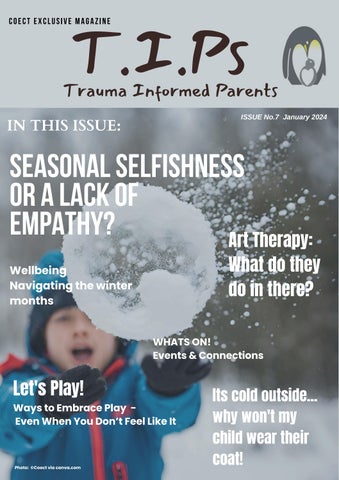
COECT EXCLUSIVE MAGAZINE
T.I.Ps
Trauma Informed Parents ISSUE No.7 January 2024
IN THIS ISSUE:
Seasonal Selfishness or a lack of Empathy? Art Therapy:
What do they do in there?
Wellbeing Navigating the winter months
WHAT'S ON?
WHATS ON! Events & Connections
Let's Play!
Ways to Embrace Play Even When You Don’t Feel Like It
Photo: ©Coect via canva.com
Its cold outside... why won't my child wear their coat!
In this issue CoECT News
Page 1
Editor's Note
Page 2
Meet the Team!
Page 3
Let's Play! Ways to Embrace Play - Even When You Don’t Feel Like It
Page 4
Seasonal Selfishness or lack of empathy?
Page 7
Art Therapy: What do they do in there?
Page 8
What's on Where? – Events and Connections
Page 10
Ask the Experts
Page 15
Its cold outside... and my child won't wear their coat!
Page 16
Wellbeing: Navigating the winter months
Page 18
A ground-breaking qualification to support new and existing foster parents: Therapeutic Fostering Qualification
Page 19
Trauma-Informed Qualifications
Page 20
NATP Volunteer Viewpoint
Page 21
www.coect.co.uk
To advertise with us contact: tips@coect.co.uk ISSUE 7
T.I.P'S MAGAZINE
COECT NEWS Happy 1st Birthday to TIPS!
Photo: ©Coect via Canva
We are now on Issue 7 and celebrating a year of the TIPs magazine. Over the last year the magazine has grown tremendously. We appreciate your support and kind feedback on how the magazine has helped families and supporting professionals. We are looking forward to the coming year! To subscribe to our free digital version of the magazine email tips@coect.co.uk
2024 Conference News.
We are delighted to announce that our Annual Conference for 2024 will be held on Thursday 20 June. The theme of this year's conference is going back to the basics of Therapeutic Parenting and is called “The Essential Tools of Therapeutic Parenting". As it will be a virtual conference this year, you can join us from the comfort of your own sofa. So, grab a warm drink and join us for an exciting and informative event. Tickets will be available at the end of January from the Inspire Training Group website. https://www.inspiretraininggroup.com/upcomingevents
NATP January Sale! Get a 15 % discount off all annual plan subscriptions for NATP membership, use the code JanuarySave15 at the checkout. Discount ends 31st January 2024 www.naotp.com
Therapeutic Parenting Awareness Day, Wednesday 6th March 2024 We are excited to announce the launch of a new event this year - the Therapeutic Parenting Awareness Day! This event aims to raise awareness about the importance of therapeutic parenting and its positive impacts on children's mental health and well-being and will consist of promotion across our social media platforms as well as in person listening circles run nationally. The event is scheduled to take place on Wednesday 6 March, and will be a great opportunity for parents, caregivers, educators, and anyone interested in parenting to learn more about the benefits of therapeutic parenting and how it can improve the lives of children. We hope that this event will help to promote understanding and support for parents who are adopting or fostering children who may have experienced trauma or other challenges in their lives. So mark your calendars and stay tuned for more updates about this exciting new event! ISSUE 7
T.I.P'S MAGAZINE
1
Editor’s Note Welcome to January at 2024, Wishing our readers a happy new year, we hope that the transition to the year 2024 has been a smooth experience for you and your loved ones. In this issue, Sarah discusses the "post-season blues" after Christmas, exploring relatable feelings that parents may experience. We are thrilled to present Laura Haver, an experienced play specialist, accomplished author, and coach. In her insightful article, she delves into the importance of play in our lives and shares valuable tips on how to incorporate it into our routine, even during times when we don't feel motivated. As the chilly winter season approaches, it's not uncommon for parents to face the dilemma of convincing their child to wear a coat. It can be a tricky scenario that requires careful consideration and understanding of the possible reasons behind your child's reluctance. In this article, we delve into the underlying causes of this behaviour and offer useful advice for parents on supporting their children through this challenge. We are delighted to have Lydia Pask on board for this issue, who will be sharing her expertise on art therapy. Lydia will be delving into the intricacies of art therapy and how it can provide a safe and supportive outlet for children who struggle to articulate their emotions in words. Through her insights, we hope to offer a deeper understanding of art therapy’s role in promoting emotional wellbeing and healing. In this edition, we have a comprehensive list of events happening in CoECT, including NATP listening circles and Inspire Training webinars. These events are free with combined membership to NATP and Trauma Revolution. Also, keep an eye out for discounts in the January sale across CoECT. Note that these discounts will end on 31st January. If you would like to contribute to our next issue in any way, please contact us via tips@coect.co.uk. Best wishes
Sair, Sarah and the team at The Centre of Excellence in Child Trauma ISSUE 7
T.I.P'S MAGAZINE
2
Meet the Team! The Centre of Excellence in Child Trauma is made up of a team of experts who have essential real-life experience. We are Adopters, Foster Parents and Bio parents of neuro diverse children, and also work as professionals in the field.
ISSUE 7
Executive Editor - Sarah Naish Sarah is a Therapeutic Parent, an Adopter of five siblings, former Foster Parent, retired Social Worker, Best selling international Author, Keynote Speaker and founder of three Independent Therapeutic Fostering Agencies.
Executive Editor - Sair Penna Sair (Sarah) is a Therapeutic Parent, Trainer, and Therapeutic Parenting Coach. Director of NATP, The Haven Parenting and Wellbeing Centre and Inspire Training Group and works across CoECT supporting families.
Managing Editor - Kathryn Talbot Kathryn works across CoECT, specialising in communications and public relations.
Contributor - Emma Edwards Emma is a Therapeutic Parent, Adopter, Director of NATP and The Haven Parenting and Wellbeing Centre.
Contributor - Sarah Dillon Sarah is a Therapeutic Parent, an Attachment Therapist, Keynote speaker, former child in care, Author (Therapeutic Parenting) Head of Therapeutic Services (Fostering).
Contributor - Jane Mitchell Jane is a Therapeutic Parent, Adopter and Keynote Speaker, Author and Head of Family Stability in two Therapeutic Fostering Agencies .
Contributor - Laura Haver Laura Haver is an expert in play, communication and happiness. She is on a mission to inspire people of all ages around the world to live more playful, vibrant and fulfilling lives. She joyfully shares her expertise as an author, speaker, life coach and mum. Laura has been featured on the Today Show, Fox, CBS, Parents, Shape and more.
Contributor - Jessica Spenceley Lydia is a qualified Art Therapist and Certified Havening Techniques® Practitioner who has worked both in the UK and in New Zealand with Children and Young People who have experienced Adverse Childhood Experiences. (ACEs) Lydia is also skilled in using Therapeutic Parenting strategies throughout her therapy, T.I.P'S MAGAZINE
3
Let's Play! Ways to Embrace Play - Even When You Don’t Feel Like It Written by Laura Haver
W
ant to play?” It sounds like an innocent enough question. And though you feel like you SHOULD say yes, you really don’t want to play any of the
Photo: ©Coect via canva.com
things you think your child would want to play with you. In fact, come to think of it, you might not really feel like doing much of anything, including making dinner, putting away laundry, paying bills, you know, all that life stuff. But what if play was exactly what you needed? What if play was the missing ingredient for more energy, connection, laughter and light in your life? What if play was just the thing to help bring you closer to your child, to your friends, to your students, to your students/clients, even to yourself?
boosts your creativity and innovation ignites (or re-ignites) your spark for life enhances your ability to learn helps you solve problems builds a healthier body and mind
1: Choose to play something you enjoy (or used to enjoy) with your family or friends. Think back to your life before becoming a parent, caregiver, teacher, therapist, etc. What did you like to do for fun? What brought you joy? What did you do for no other reason than you liked to do it? Did you like to listen to music? Write or sketch in your journal? Hang out with friends? Build things? Dig in the dirt? Make jewellery? The options are endless- the key here is to jog your memory and create a mental (or actual) list of things you enjoyed.
1-Choose to play something you enjoy (or used to enjoy) with your family or friends 2-Start small 3-Make time to play for yourself too
Then, look for things on that list that you might enjoy doing now with your family or friends! For example, when I was a kid, I loved writing stories; so now my boys and I like to
Though you might find it hard to believe, play is crucial in living a healthy life at all ages. I’ve personally seen its transformative effect again and again for myself, my family, my clients and my readers. And for Wow, play does all that? That does those of you who are scientifically minded, sound pretty good… But what if you I’ve also seen it in the research. That’s why I don’t feel like playing? What do you am so passionate about sharing the value do then? How can you play, when of play for people of all ages. So let’s dig in, playing is the last thing you feel like doing?! Here are three ways to open starting with the benefits of play. yourself up to play: Play… decreases stress and anxiety strengthens your relationships with others increases your ability to communicate and cooperate ISSUE 7
T.I.P'S MAGAZINE
4
sit around the kitchen table writing. Sometimes they write, and other times they draw comics or tell stories through art (or even building mini worlds with blocks, figures, etc.) I also loved playing tennis, so I’ve been taking my boys to play tennis since they were so little the tennis racquets were practically bigger than they were! It doesn’t matter WHAT you choose. All that matters is you choose something of interest to YOU! (One key factor of play is that it is self-led. In other words, you do it because you want to, not because you have to/need to/should do it. Although you can find play in things you have to do, but that’s another article.) And, if you’d like more options for fun, easy and fast ways to play together at home, check out my book, Play Together: Games & Activities for the Whole Family to Boost Creativity, Connection & Mindfulness. It features over 60 games in five categories (movement, kindness, connection, creativity and mindfulness) that you can play at home with materials you already have! https://www.penguinrandomhouse.com/boo ks/720799/play-together-by-laurahaver/9781578269747/
2: Start small. Even though you may now have an idea of what you could play, if you haven’t done much playing lately, it could feel a bit odd or even uncomfortable. You might even think it’s a waste of time, especially with all that’s on your plate. But bear with me (and re-read the benefits above if you need to!) If that’s the case for you, no worries! I’ve got you and that’s why my second tip is that you start small! Play for five minutes! Perhaps a quick card game, walk around the block, dance to one song, have a smiling contest, or even just lay on the grass and look at the clouds floating across the sky together. In fact, the more senses you engage in your play the better, as they’ll help you get more present, out of your head and back into your body. Then, and this is important, once you finish your short play break (one hand or cards, etc.), congratulate yourself. I’m not joking! Pat yourself on the back, give
ISSUE 7
Photo: ©Coect via canva.com
yourself a mental or physical high five, whatever it takes. The point is to acknowledge the fact that you paused to play, that you carved out time to connect with your child, student or friend! When you reward your behaviour, you are more likely to do it again! That’s part of why starting small is so useful, as it helps build your momentum in creating new and lasting healthy behaviours. Of course, if you find yourself having fun and want to go beyond the five minutes, great! But if that’s all you have for now, that’s great too! Think of play like a muscle. Each time you play you have the opportunity to grow in your ability to have fun and ultimately live a healthier and more vibrant life! Finally, notice how you feel and what impact play is having in your life, health and relationships. 3: Make time to play for yourself! Now that you have some ideas and are starting small, it’s time to make time to play for yourself! As I mentioned, play is a crucial part of our lives as noted above. Renowned expert Dr. Stuart Brown says, “When we lack that feeling of lightness in
what we do it should be taken as a warning sign. It should be as alarming as chest pain or shortness of breath when we climb the stairs, a high blood sugar reading or anemia.”1 So, in addition to playing with others, I also always highly recommend that you make time to play for yourself as well! Whereas you might play certain things with your family and friends, there may be other areas you are also drawn to. These are what make you, you, and help you ignite your own unique spark for life! Certain things may come to mind right away for you, like maybe you used to love tap dancing or collecting baseball cards… If you’re not sure where to start, though, go back to your list from Step 1. What did you like to do? And if you’re still feeling stuck or would like to go deeper, you can download my free signature Playlist Planner. I designed it to help people create their own unique “playlist” of fun activities and then plan them in so they actually make them happen T.I.P'S MAGAZINE
5
(aka, the planner part). You can access it here. https://laurahaver.com/playlist/ If you’re unsure, you can also start with movement (like the example I included above of walking around the block.) Getting your body moving (again, even if just for five minutes) can help you feel better and build more energy to play and connect.
I also want to add that no matter what’s going on in your world, I know you’ve got a big heart and that you’re doing the best you can. Even the fact that you are taking time to read this article about play shows that you are ready to start enjoying your own life again and connecting with the people in your life.
Photo: ©LauraHaver.com
Plan time to play in your calendar where you can do whatever YOU’D like during that time. (Sounds good, right?) Even simply daydreaming about what you might like to do in the future counts! And again, even if you’re crunched for time, remember Step 2 and start with just five minutes.
To wrap up, I invite you to PLAY: to choose something you enjoy (or used to enjoy) to do with your family or friends, to start small and to take time to play for yourself! You’ve got this! Play on.
Citation Brown, Stuart, and Christopher Vaughan. Essay. In Play: How It Shapes the Brain, Opens the Imagination, and Invigorates the Soul, 150. New York, NY: Avery, 2010.
Now available to listen to on spotify. http://tinyurl.com/38rwtnfe
ISSUE 7
T.I.P'S MAGAZINE
6
Seasonal Selfishness or a lack of Empathy? Written by Sarah Naish
A
s we have navigated through the Christmas season, and (happily) reach the end, it's important to acknowledge the challenges that come with raising children who struggle with empathy. This is highlighted during the Christmas season and can leave us Therapeutic Parents with ‘post season blues’. It can be disheartening to see the apparent increase in selfishness and lack of gratitude, especially after putting in so much effort to find the perfect gifts. I have experienced the disappointment of unappreciated presents and the lack of thought behind the gifts (if any) I received, although of course, when the children were young, nothing was ever expected! Of course we hope that as our children grow older, they will develop a deeper sense of empathy and appreciation. However, the reality is that this doesn't always happen as quickly or easily as we'd like. The overwhelming focus on material possessions only serves to satisfy our children temporarily before they move on to the next thing they feel they really must have. We must remind ourselves that our children are not intentionally being selfish, and that empathy will come with time. We know that children who have suffered trauma are very focused on their own survival, and at Christmas when everything changes, of course they become more focused on survival. This might mean they are making sure they get a bigger share of the food and looking like they’re being very greedy. All of those things can be very triggering for us. ISSUE 7
Photo: ©Coect via canva
You may have put hours into buying the special present for your child, only now to see that that is discarded and without purpose. Remember that although this feels like the child has a lack of empathy for you and for all the care you put into buying this gift for them, actually it comes down to their need to self sabotage. Their internal working model simply doesn’t feel they are worthy. In other words, there is not even empathy there for themselves at present! While we patiently wait for our children to develop a greater sense of empathy and self esteem, it's important to remember to take care of ourselves as well. Giving ourselves a break and treating ourselves to something
special can help to alleviate the frustration and disappointment we might feel. It's not selfish to prioritise our own well-being, especially during a time when we are constantly giving to others, or just following this busy time which can leave us feeling drained. So, as we look back at ‘the season to be jolly’, let's be patient with our children and with ourselves. Happier Christmases may well be on the horizon, and with time, empathy and self esteem will blossom in our children. In the meantime, let's remember to give ourselves a little extra love and care. After all, we deserve it too.
T.I.P'S MAGAZINE
7
Art Therapy: What do they do in there? Written by Lydia Pask
W
hen I am asked ‘what is Art Therapy’, the formal definition I could give goes something like this:
It is a form of psychotherapy which uses art making as the primary form of communication: In that the client is offered the use of a variety of art materials with which to make art and the process and the resulting product are considered as communication in terms of thoughts, feelings and life experiences. Verbal communication helps to bring these interpretations together but is not essential; and the client might chose to talk through the art they have made as if it is talking for them. But what does that mean? It is really hard to say exactly what art therapy is, because it depends on what the child and their supporting adults need it to be. I believe any form of therapeutic intervention is client dependent, in that the focus is on what they want to bring to the room, and the therapist meeting them at their emotional, physical and social understanding (as far as is feasible for the therapist). The therapy relationship is not just with the child or young person I have been asked to see for 50 minute sessions once a week; it is also important for me to build a relationship with the significant people around the child such as parents, caregivers, grandparents, foster carers, teachers, support workers, social workers, family workers, Senco’s and other professionals who are involved in supporting the client – both in and out of the therapy space itself. I believe that in order for progress on the referral aims to happen there must be interactions between other ISSUE 7
Photo: ©Journeysarttherapy
adults involved with the child, so that any processing that is happening in the session can be supported throughout the rest of the week, as much as possible. This might be in the form of something that I have observed is beneficial for the child, such as a quiet space in or out of the classroom; or an activity outside of school that the child might benefit from; or a recommendation for an alternative provision for the child such as a psychological assessment. Building the relationship between the client and the therapist within the session is important. It builds trust and a security for the client. It is a confusing concept to be faced with initially as the therapist’s role is different to any other relationship a child might have had with an adult. I am not a teacher, not a parent, not a friend. I am an adult with different boundaries. An adult who is focused on following their
lead in playing and art making and hearing their story. I am led by the child and their interests, wishes and emotions. Boundaries of time, place and confidentiality are set out at the start. But there is only direction based on what is manageable and required by the individual child’s needs. I provide various art materials for the client to choose from, and direction can be offered if they feel unsure of what to do initially. Mess making is common when the client is working through unsettled emotions which are deep rooted and painful. As the intervention continues; sometimes this will take years, the mess becomes more controlled and manageable, to coincide with the child’s ability to gain greater self-control of these feelings. There are also times when the client is avoidant of art making or T.I.P'S MAGAZINE
8
of exploring meaning in what they make. Through regular and consistent sessions, the client builds confidence in the therapist as a safe and trustworthy adult who will keep the parts of them that they choose to share in the room safe each week and to come back the next week. I encourage them to allow me to keep the art work they make with me in their folder or box until the next week; but for some this is too difficult and they need to keep it with them or to throw it away.
Photo: ©Journeysarttherapy
The therapy time becomes a special, protected place for the child or young person. Although I have said to them that they are free to share the content of the session with whoever they wish, I have found that they often choose not to share this with anyone outside of the session. For the most part, this isn’t because they are saying or doing anything worrying; (if this is the case
then I will have let them know that I have to share what they have said with the relevant adult) It is usually because they are seeking some form of control in their otherwise confusing and unpredictable world.
Photo: ©Journeysarttherapy
relationship you build with the therapist provides an experience of sharing the good and the bad and a safety in the knowledge of being able to trust that person with these parts of yourself.”
And so, when asked “What is Art Therapy?” I could also say: “It is a place to say without words, the things you want to say or didn’t know that you needed to say, but where you can express, explore and experience without judgement. The process is as important as the product because the steps to getting to where you need to go are often about trying and failing and learning from your mistakes. The
You can find more information on Lydia’s Art Therapy via The Haven Parenting and Wellbeing Centre www.thehavencentre.co.uk
CoECT Podcasts
Are you a parent, special guardian, or kinship carer who is deeply concerned about the well-being of the children in your care? Maybe you are a professional who supports traumatised children and struggling families and are looking for ways to help them. We believe that our podcast could be a lifeline for you if you are feeling lost and have no idea where to turn. www.coect.co.uk/podcasts ISSUE 7
T.I.P'S MAGAZINE
9
T.I.P.s ENJOYING TIPS MAGAZINE? Continue reading with a TIPs Magazine subscription You've reached the end of the free preview. If you've enjoyed this issue, you can get every issue of TIPs Magazine throughout the year.
DIGITAL — £15 per year 6 issues + full digital archive Read TIPs Magazine wherever you are, on your computer, tablet or phone. www.coect.co.uk/shop PRINT — £30 per year 6 printed issues delivered to your door Prefer a physical magazine? Subscribe to receive every issue throughout the year. www.coect.co.uk/shop
Looking for more support? TIPs Magazine is also included as part of TIPs Hub membership. Join the TIPs Hub for access to the magazine alongside our wider range of support, resources, learning and community. www.coect.co.uk/join
Keep reading. Keep connected. TIPs Magazine — £15 digital | £30 print TIPs Hub — magazine + support + resources + learning + community