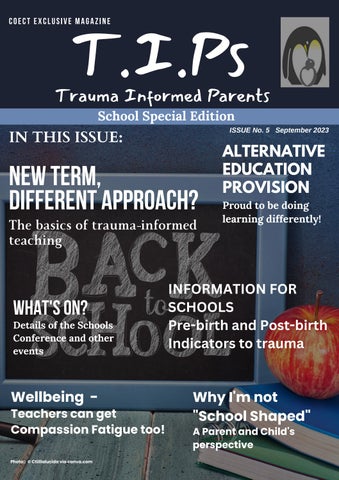
COECT EXCLUSIVE MAGAZINE
T.I.Ps
Trauma Informed Parents School Special Edition ISSUE No. 5 September 2023
IN THIS ISSUE:
New term, different approach? The basics of trauma-informed teaching
WHAT'S ON?
Details of the Schools Conference and other events
Wellbeing -
Teachers can get Compassion Fatigue too! Photo:: © Ctillialucida via canva.com
ALTERNATIVE EDUCATION PROVISION Proud to be doing learning differently!
INFORMATION FOR SCHOOLS Pre-birth and Post-birth Indicators to trauma
Why I'm not "School Shaped" A Parent and Child's perspective
In this issue CoECT News
Page 1
Editor's Note
Page 2
Meet the Team!
Page 3
Alternative Education Provision - Proud to be doing learning differently!
Page 4
An Overview of the A-Z in Trauma- Informed Teaching.
Page 6
Outstanding Achievement! - News from True Fostering.
Page 8
Teachers can get Compassion Fatigue too!
Page 9
Ask The Experts.
Page 11
Information for schools - Pre-birth and birth Indicators to Early Trauma.
Page 13
What's on Where? – Events and Connections
Page 16
Listening Circle Viewpoint
Page 18
Trauma-Informed Qualifications
Page 19
Why I'm not "School Shaped" - A Parent & Child's Perspective.
Page 20
www.coect.co.uk To advertise with us contact: tips@coect.co.uk ISSUE 5
T.I.P'S MAGAZINE
COECT News Update True Fostering Congratulations to True Fostering, who were graded Outstanding in their recent Ofsted Inspection held in July. The agency were praised for the ground-breaking support and innovation provided to their foster families. You can find out more on this on page 8 in this issue.
SAfER Fostering Due to continued growth, Safer has recruited a new Therapeutic Social Worker for South East Wales. She is currently undergoing checks and references and is hoping to start in September. The agency is also looking for a further administrator to join the team in Cardiff. It has been a really successful summer so far with the newly purchased Haven caravan being in use continually by our foster families. Feedback has been really positive with families appreciating the free holiday with activities and entertainment, provided by Safer.
CoECT Annual Conference Thursday 19th October, Coventry The CoECT Schools Team are excited to announce that their new book 'The A-Z of Trauma Informed Teaching' is out now. Topics from the book form the structure of our conference this year. You can find out more about the conference by scanning the QR code opposite. ISSUE 5
Inspire Training Kinship and Connected Care Assessment Launch
At the end of August Sarah & Sair started the pilot of the Trauma-Informed Parenting Assessment for Kinship and Connected Care (TIPPAKC) with a Local Authority in the South East of England. The assessment aims to simplify and enhance the kinship care process, providing training and support to family members throughout their journey.
Launch of the Therapeutic Parenting Roadshow Lately we have been inundated either requests from parents to hold TraumaInformed/ Therapeutic Parenting training around the country. From 2024 the training team led by Sarah Naish and Sarah Dillon will be starting a roadshow around the country. More information on this can be found on page of 13 this issue.
We are looking for Volunteers! NATP are on the search for volunteers to join us in running listening circles in thd UK, particularly in the South West and North East of England, and Scotland and Wales. To find out more contact natp@coect.co.uk Book a call! Did you know NATP offers a 20-minute chat service to signpost you to the services you need, or just talk things through with someone.
The Haven Parenting & Wellbeing Centre Ltd The Haven Parenting and Wellbeing Centre have launched their wellbeing platform. It is packed with programs, resources and virtual support & relaxation groups. More information can be found on their website www.thehavencentre.co.uk T.I.P'S MAGAZINE
1
Editor’s Note Welcome Everyone, As summer ends, families and teaching staff prepare for the new school term. Our Schools Special Issue celebrates the launch of "The A-Z of Trauma-Informed Teaching," a new book by our CoECT Schools Team. In this issue, Daniel and Anne discuss trauma-informed teaching, while Hannah shares how her alternative education centre, Wickselm House Learning Centre CIC, supports children's emotional and social needs to help them reintegrate into school. Sair explores compassion fatigue in teaching, provides a recap on the signs and symptoms to look out for and strategies to prevent teachers from slipping into compassion fatigue. We also have an NATP resource that identifies the pre-birth and post-birth indicators of early trauma and how to support children with early life in the school environment, and Emma discusses why some children cannot fit into the traditional school system with the help of some children who have been unable to attend for significant reasons.. We are all looking forward to sharing our topics from the book with you at our upcoming conference, which is being held on Thursday 19th October, in Coventry. More information about the conference and how to book tickets can be found on the Inspire Training group website at www.inspiretraininggroup.com/upcomingevents We hope you enjoy this issue. If you have any questions for Ask the Experts or would like to be featured in the next issue, please email us at tips@coect.co.uk. We wish you all a smooth transition into the start of the academic year and thank you for your continued support. Best wishes
Sair, Sarah and the team at The Centre of Excellence in Child Trauma ISSUE 5
T.I.P'S MAGAZINE
2
Meet the Team! The Centre of Excellence in Child Trauma is made up of a team of experts who have essential real-life experience. We are Adopters, Foster Parents and Bio parents of neuro diverse children, and also work as professionals in the field.
ISSUE 4
Executive Editor - Sarah Naish Sarah is a Therapeutic Parent, an Adopter of five siblings, former Foster Parent, retired Social Worker, Best selling international Author, Keynote Speaker and founder of three Independent Therapeutic Fostering Agencies.
Executive Editor - Sair Penna Sair (Sarah) is a Therapeutic Parent, Trainer, and Therapeutic Parenting Coach. Director of NATP, Wickselm House Learning Centre CIC and Independent Panel Chair for two Therapeutic Fostering Agencies.
Managing Editor - Kathryn Talbot Kathryn works across CoECT, specialising in communications and public relations.
Contributor - Emma Edwards Emma is a Therapeutic Parent, Adopter, Director of NATP and The Haven Parenting and Wellbeing Centre.
Contributor - Sarah Dillon Sarah is a Therapeutic Parent, an Attachment Therapist, Keynote speaker, former child in care, Author (Therapeutic Parenting) Head of Therapeutic Services (Fostering).
Contributor - Hannah O'Brien Hannah has over 20 years’ experience in childcare and alternative education. Hannah is CEO of Wickselm House Alternative Learning Centre, providing social, emotional and educational opportunities for children with social and emotion mental health and attachment challenges.
Contributor - Daniel Thrower Daniel Thrower is CEO of The Wensum Trust in Norwich and former Headteacher of an ‘outstanding’ infant and nursery school. Over Daniel’s 25 years of teaching he has worked with a host of experts to provide a better understanding within education of the needs of children who have difficulties with their mental health and those who have suffered early life trauma.
Contributor - Anne Oakley Anne Oakley has worked in a mainstream infant and nursery School for over 20 years. During this time she has supported children who have experienced early life trauma and children with autism. She led a successful outreach service to mainstream schools for children who had suffered developmental trauma.
T.I.P'S MAGAZINE
3
Wickselm House Learning Centre Proud to be doing learning differently! Written by Hannah O'Brien, Founder and CEO of Wickselm House Learning Centre CIC
Photo: ©Wickselm House Learning Centre CIC
I
n September 2021 I was given the opportunity to collaborate with an inspiring group of likeminded professionals who held a shared vision to create a
unique and entirely new learning environment. We were brought together by our individual experiences of mainstream educational settings which, despite the best efforts of dedicated staff were unable to meet the needs of young people with complex SEMH needs. Through our outdoor ethos, on-site farm and over 15 acres of space, we provide a therapeutic environment where children can feel safe, heard, and valued, connecting with animals and nature while ISSUE 5
accessing a full academic curriculum at their own pace, with equal emphasis on social, emotional, spiritual, and physical development. Our staff team work closely to use a common language and approach to enable those we care for to experience a connected and predictable safe space. We work in partnership with parents, carers, and mainstream schools to provide holistic support for children. A therapeutic, trauma-informed approach underpins our practice in which every child is valued and celebrated for their individual uniqueness. We never use shaming as a classroom practice or reward-based systems, but instead celebrate children's progress through authentic
praise and wonder. Our aim is to offer them a pathway into full-time education and vocational training, enabling them to lead fulfilling adult lives and contribute positively to our global society. I believe a huge contributor to our success is the creative freedom and lack of target-based pressure our staff are afforded because we are an ‘alternative provision’ we write our own curriculum and track what we think progress looks like in our own way. The team of teachers, therapists and support staff at Wickselm House are passionate, joyful, and utterly child centered in all they do, and our children are thriving.
T.I.P'S MAGAZINE
4
Our children all enter the setting in their own way each morning, some banging loudly on the door five minutes before we open and others needing a quiet helping paw and hello from a furry friend to leave the safety of their car. The challenges our young people face are varied and complex ranging from anxiety which makes leaving the house almost impossible to fearful violent, controlling behaviour which has created an insurmountable barrier to learning and social interactions. It has been a great privilege to join these children on their Wickselm journey and watch how space, patience, kindness and authentic skilled pracpractitioner's understanding has enabled them to make inspiring progress both in setting and in their wider lives.
Photo: ©Wickselm House Learning Centre CIC
I am going to sign off by handing over to the children. In their own honest and unedited words here is why the children choose to spend time at Wickselm House;
Q: What do you like about Wickselm? A: (1st Child) I love Wickselm. My favourite thing is going to the woods. A: (2nd Child) Everything! Q: What do you find tricky at Wickselm? A: (1st Child) I don’t like people being mean to me but the grown ups help me to ignore them and do something fun with my friends instead. A: (2nd Child) The old chef’s mac and cheese was yuck! Chef Helen’s is nice though. Q: What have you been learning at Wickselm? A: (1st Child) I have been learning new words and how to do handstands. A: (2nd child) Last year I learned to ride a bike and how to read!
ISSUE 5
The A-Z TraumaInformed Teaching is Out Now! The CoECT schools team are excited to announce that their new book 'The A-Z of Trauma Informed Teaching' is now available on Amazon and through other good book stores. The book can be ordered on Amazon using this link tinyurl.com/y6zy6krz
T.I.P'S MAGAZINE
5
©John Foxx from Photo Images via www.canva.com
An overview of the A-Z in TraumaInformed Teaching Written By Anne Oakley and Daniel Thrower
W
e were thrilled when Sarah Naish approached us to write The A-Z of Trauma Informed Teaching, based on the original format for
her best-selling A-Z of Therapeutic Parenting. We wanted this book to be a resource that teaching staff could quickly reach for in times of stress and much needed inspiration, as well as a book they could come back to in more detail, when time allows. We know the timing of this book could not be better. We have also heard that many parents and carers are planning to either purchase or recommend the book for their child’s education setting. In education settings, over recent years, there has been a growing interest in adverse childhood experiences and childhood trauma. Many settings will now have staff who have completed training around this subject, which has undoubtedly led to a greater awareness of trauma informed approaches, the importance of relationships and an understanding of how early child development is impacted. Training however tends to be generic. It is not easily translated into different age ranges, and does not take into account the huge spectrum of different needs. It also typically offers very little guidance to teaching staff in terms of the practical application ISSUE 5
needed for the interactions and day-to-day care of children who feel overwhelmed within our busy settings. Our primary schools have more recently met with a tsunami of needs; staff shortages, financial limitations, overwhelmed teaching teams, together with children whose confusing responses often mask huge levels of fear and undeveloped skills. Indeed, an increasing number of children, whether they have experienced childhood trauma, or they are neurodivergent are struggling to flourish in our busy settings. They need support to manage developing or different learning styles, sensory systems, nervous systems, emotions, actions and responses. Unfortunately, the need for our settings to focus on academic outcomes and to promote positive behaviour makes it difficult for some schools to move away from purely managing behaviour, towards understanding it.
The development of foundational self-regulation skills, which all children need for emotional wellbeing and learning, are not fully understood or prioritised. Very sadly, parents and carers of our children, all too often feel judged, frustrated and marginalised from the very beginning of their child’s education. A key aspect of social and emotional learning is trying to understand different perspectives; without which, we cannot be truly empathetic. The hidden beauty of trauma informed approaches is that if we can always be curious and empathetic towards every child whose responses challenge ‘school shaped’ mind-sets, if we can truly climb into their world, then using this same philosophy, we will begin to understand and
T.I.P'S MAGAZINE
6
accept the needs of every child, every possibilities of triangulation and compartmentalising. Our children family and every colleague. can and do respond surprisingly differently with different adults and Our parents and carers are our in different settings, which causes children’s biggest experts and advocates and therefore an essential confusion, stress and pain on all levels. Being aware and open to part of the team. By authentically discussions around this possibility embracing this relationship, always prevents feelings of blame, keeping them in mind, sharing frustration and opposition. ongoing experiences, strategies and early life stories, we gain a better understanding of the needs of our children and the needs of our parents and carers too. Children need to know that their parents and carers trust us, and that we trust them; that we are working ‘shoulder to shoulder’ as part of one team. Often, they see their two worlds – education and home as being completely unconnected. They need to know therefore that we share celebrations and tribulations! This also helps everyone to be open to the
Crucially, this relationship also
anything we can do to help you right now?’ In The A-Z of Trauma-Informed Teaching we talk more about ‘gate shaming’, after-school restraint collapse, triangulation and compassion fatigue which is a devastating condition for parents and teaching staff alike and yet, not commonly recognised in schools.
allows parents and carers to explain how it feels to receive relentless Sometimes, it takes courage to negative feedback at the end of the share and accept worries and day, or admit how difficult things are difficulties without feeling for them at home. They need to defensive, but if our teaching staff, know they can safely say when parents and carers, accept they compassion fatigue has taken them can learn from each other; to the end of their tether. problem solve and compromise If a parent or carer has found the courage to admit this, then we need to embrace them with genuinely empathetic arms and ask – ‘Is there
together, we build and maintain a mutually trusting relationship, which ultimately benefits their child’s education and everyone’s emotional wellbeing.
Working With Schools Webinar Series
Listen to Season 2, Episode 5 of the CoECT podcast here
This webinar series looks at some of the potential difficulties which parents face with their child's school, and how they can overcome them to create an effective parent -teacher working partnership. https://tinyurl.com/ycfmrrs7subheading
ISSUE 5
T.I.P'S MAGAZINE
7
Outstanding Achievement! It is now official, TRUE Fostering is an ‘Outstanding’ fostering agency as rated by OFSTED. Following the inspection in July, the report has been published, which highlights the work undertaken by foster parents and staff. Acknowledging our amazing foster parents, the inspector writes, “foster parents are skilled and knowledgeable in therapeutic parenting. They understand that children’s behaviours are linked to the trauma they have experienced, and they respond to them with understanding, love and patience. This leads to exceptional outcomes for children.” The report also talks about the comprehensive mechanism in place to assess, match and monitor the progress of children in our foster families. This ensures that children remain with foster parents long-term. In talking about TRUE’s therapeutic service, the inspector states “The support offered to foster parents is outstanding. The agency employs empathic listeners, counsellors and an attachment therapist to provide a range of high-quality support.” Summarising, the inspector states that “the actions of the fostering agency contribute to significantly improved outcomes and positive experiences for children and young people.” It is no surprise that TRUE Fostering is a growing agency, receiving daily interest from foster parents wanting to transfer as well as applicants wanting to start their fostering journey! TRUE uses the Therapeutic Fostering Assessment (TFA) throughout their assessment process and this has contributed significantly to the underpinning knowledge of Trauma-informed practice and Therapeutic parenting ethos. TRUE has appointed a new Therapeutic Social Worker for our emerging new region of East Anglia / Cambridgeshire. Jess Cooke started in August and will be attending the new Professional Therapeutic Development Groups that will start in the region in September led by our renowned attachment therapist Sarah Dillon.
ISSUE 5
T.I.P'S MAGAZINE
8
Teachers can get Compassion Fatigue too!
W
Photo: ©Karolina Grabowska from Pexels via www.canva.com
Written By Sair Penna
hen we truly enjoy an activity, we often find ourselves wanting to do the best we can in that area of our lives. Yet, sometimes
factors unexpectedly impact our motivation, especially when those factors influence other important aspects of our lives. In this article we are going to explore compassion fatigue in teachers and support staff, what it might look like, and how to prevent it. I am sure many teachers are aware of embracing the positives and managing the pitfalls in the teaching profession. As a former teacher for several years, I invested my time in weekends and evenings because I wanted to keep up with my workload, and I enjoyed planning lessons and teaching. I often wondered whether just using my PPA time for lesson planning would be enough to create engaging lessons without sacrificing my time outside of work. Would I had enough time to get everything complete? However, my priorities changed when our family came along. I didn’t feel I could give as much time at weekends and evenings, and commuting time would have made the work/life balance non-existence. I could not see it working without it significantly impacting our family life at the time, so for me it was time to leave the profession. Teaching is undoubtedly a rewarding profession, but it comes with its fair share of challenges. Identifying signs of exhaustion and taking necessary measures to avoid entering compassion fatigue and reaching physical and mental burnout is crucial for you to be able to enjoy what you are doing. ISSUE 5
What is Compassion Fatigue? Compassion Fatigue encompasses a wide range of physical, emotional, and psychological symptoms that are often experienced by individuals who are providing support to others who are going through stressful or traumatic experiences. This condition can profoundly impact the well-being of those working in helping professions, and it is important to be aware of the signs and symptoms of Compassion Fatigue to prevent and manage its effects. This can cause exhaustion, brain fog, a decreased ability to empathise with the children and young people we work with and, in some cases, a reluctance to attend work. What triggers Compassion Fatigue? At The Haven Parenting and Wellbeing Centre we work with a range of clients who experience Compassion fatigue, and there is always a source, and that source is usually something which they are triggered by daily. With parents, the source is usually related to their child
and associated behaviours they are displaying. This can be prevalent in families where the children are neurodivergent, display high needs and those who have experienced trauma. Compassion fatigue within the teaching profession can be triggered by the systems in the workplace, in particular workload and demands, classroom management: in particular student behaviour-based triggers and also the growing and changing needs of children and families in the educational setting. This can all take its toll, and teachers may see themselves slipping into compassion fatigue before they reach burnout. It is also easy to misread the signs and symptoms of compassion fatigue; maybe your run down in the first few weeks of term, feeling like you are wading through treacle, and dismiss it, putting it down to the back-toschool transition and related colds, coughs and other illnesses that may be around at that time of year. This is where it can creep up on individuals over time; often, you T.I.P'S MAGAZINE
9
T.I.P.s ENJOYING TIPS MAGAZINE? Continue reading with a TIPs Magazine subscription You've reached the end of the free preview. If you've enjoyed this issue, you can get every issue of TIPs Magazine throughout the year.
DIGITAL — £15 per year 6 issues + full digital archive Read TIPs Magazine wherever you are, on your computer, tablet or phone. www.coect.co.uk/shop PRINT — £30 per year 6 printed issues delivered to your door Prefer a physical magazine? Subscribe to receive every issue throughout the year. www.coect.co.uk/shop
Looking for more support? TIPs Magazine is also included as part of TIPs Hub membership. Join the TIPs Hub for access to the magazine alongside our wider range of support, resources, learning and community. www.coect.co.uk/join
Keep reading. Keep connected. TIPs Magazine — £15 digital | £30 print TIPs Hub — magazine + support + resources + learning + community