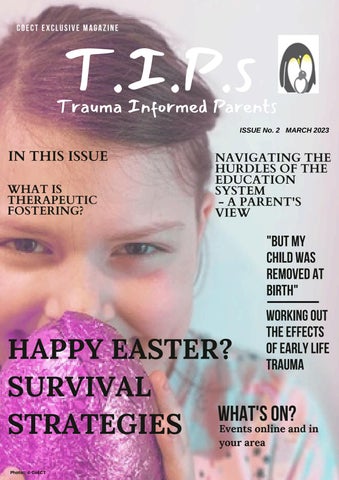
COECT EXCLUSIVE MAGAZINE
T.I.P.s
Trauma Informed Parents ISSUE No. 2 MARCH 2023
IN THIS ISSUE WHAT IS THERAPEUTIC FOSTERING?
NAVIGATING THE HURDLES OF THE EDUCATION SYSTEM - A PARENT'S VIEW
"BUT MY CHILD WAS REMOVED AT BIRTH" WORKING OUT THE EFFECTS OF EARLY LIFE TRAUMA
HAPPY EASTER? SURVIVAL STRATEGIES WHAT'S ON?
Events online and in your area
Photo:: © CoECT
In this issue CoECT News
Page 1
Editor's Note
Page 2
Meet the Team!
Page 3
"But my child was removed from birth" Working out the effects of early life trauma
Page 4
Navigating the hurdles of the education system - A Parent's Experience
Page 6
Why I wobble at Easter
Page 8
Ask the Experts
Page 10
Happy Easter? Survival Strategies
Page 11
Therapeutic Fostering or Standard Therapeutic Fostering?
Page 13
What's on Where? – Events and Connections
Page 14
Trauma Informed Qualifications
Page 17
Listening Circle Viewpoint
Page 18
Wellness - 5 minute de-stress
Page 19
Twas the Night Before Easter
Page 20
Contact Us
Page 21
www.coect.co.uk To advertise with us contact: tips@coect.co.uk ISSUE 2
T.I.P'S MAGAZINE
COECT News Update TRAINING NEWS Sarah Naish and Sarah Dillon have been to Hull delivering ‘Healing Children Through Therapeutic Parenting’ to Foster Parents and Kinship Carers for Hull City Council. We had a great day in Tewkesbury delivering Feeling Better, Removing Triggers to a group of foster parents. A large adoption agency commissioned us for bespoke training covering deescalation and therapeutic parenting. They have now requested further training on Compassion Fatigue (Blocked Care) and Neuro-Diversity. If you would be interested in arranging training for your organisation, please contact us at inspire@coect.co.uk for a free consultation
For booking details go to https://www.inspiretraininggroup.com/upcomingevents
ISSUE 2
T.I.P'S MAGAZINE
1
Editor’s Note Welcome Everyone! Spring is on its way, and you may have noticed the lighter evenings, snowdrops and daffodils starting to grow, a welcomed change after the winter months. British Summer Time starts soon, and we are excited to welcome in the new season along with our 2nd edition of TIPs! In this edition, we have lots to share with you, from strategies for the impending Easter holidays to our TIPs exclusive articles on ‘The Effects of Early Life Trauma in Children Who Are Removed at Birth’, a Parent’s Experience in Navigating the Education System, and ‘Insight into Therapeutic Fostering’. With the emphasis on Spring and the time for change, our well-being focus this issue is looking at being mindful when taking care of ourselves. Not always an easy priority to keep, especially when caring for others. Whether you are an Adopter, Foster Parent, Kinship Carer/ Special Guardian, Step-parent, or Bio parent of a child who is neurodiverse, we hope you will find useful articles and resources which resonate with you in this issue. The response to our first issue was overwhelming and Sarah, the Team and I would like to thank you all for your kind words of encouragement and the support we have received so far. As always, we would love to hear from you too, so email your thoughts or questions to TIPS@coect.co.uk Happy Reading!
Sair, Sarah and the team at The Centre of Excellence in Child Trauma. ISSUE 2
T.I.P'S MAGAZINE
2
Meet the Team! The Centre of Excellence in Child Trauma is made up of a team of experts who have essential real-life experience. We are Adopters, Foster Parents and Bio parents of neuro diverse children, and also work as professionals in the field.
Sarah Naish is a Therapeutic Parent, an Adopter of five siblings, former Foster Parent, retired Social Worker, Best selling international Author, Keynote Speaker and founder of three Independent Therapeutic Fostering Agencies.
Sair Penna is a Therapeutic Parent, Trainer, and Therapeutic Parenting Coach. Director of NATP, and Independent Panel Chair for two Therapeutic Fostering Agencies.
Sarah Dillon, is a Therapeutic Parent, an Attachment Therapist, Keynote speaker, former child in care, Author (Therapeutic Parenting) Head of Therapeutic Services (Fostering).
Alison Douglas is a Therapeutic Parent, Adopter, Social Worker and Operations Manager in two Fostering Agencies. Alison is also Safeguarding Lead at NATP.
Emma Edwards is a Therapeutic Parent, Adopter, Director of NATP and The Haven Parenting and Wellbeing Centre.
Jane Mitchell is a Therapeutic Parent, Adopter and Keynote Speaker, Author and Head of Family Stability in two Therapeutic Fostering Agencies .
ISSUE 2
T.I.P'S MAGAZINE
3
"But my child was removed at birth" - Working out the effects of early life trauma
I
Written by Sarah Naish ’d like to think that things have changed since I adopted my five children, 24 years ago. Sadly, this week at a conference, a delegate
came up to me and said, “You know that story you mentioned where the social worker told you that your youngest would ‘be your reward’ because she was removed at birth? Well, someone said the same thing to me 3 years ago”. So, I think in some areas, learning about in utero trauma, inherited conditions, and pre/post-natal stress, has not been properly absorbed. My youngest daughter was removed from her biological family at birth and placed in a loving foster home. It was for this reason that the social worker made the assumption that ‘she hadn’t suffered, would not remember anything’, and would therefore “be my reward”. Of course, that statement is problematic in itself on many levels, as firstly it automatically implies that the four older children would not be rewarding, and secondly that it is somehow the task of our traumatised children to ‘be rewarding’. It is not. We hear these kinds of statements all the time from friends, family, and school. The underlying belief seems to stem from the fact that the child ‘will not remember anything’. This completely ignores the myriad of ways in which the ISSUE 2
body indeed internalises trauma and experiences. When we think about the experiences of very young babies, we must consider; Stress levels in the mother, in particular the levels of cortisol Severe illness in pregnancy· Domestic violence (this impacts the foetus in the womb) Birth Trauma where child and mother were put under stress during labour Premature birth and temporary isolation from parents Emotional Absence, short period of emotional disconnection caused by Post Natal or Post Adoptive Depression Repeated hospitalisations Drugs or alcohol misuse – FASD might be diagnosed Cortisol, in particular, is linked to the baby’s early brain development. In my child’s case she had very high cortisol levels as a direct result of her birth mother’s experiences during pregnancy. This meant that my daughter looked like she had ADHD, (she didn’t). It also has an impact on cause and effect thinking due to the abnormal development of the amygdala, (the part of the brain responsible for survival mechanisms of fight/ flight/ freeze). Other effects we might see in the baby/ older child are; ·Sensory issues (jumping at loud noises, sensitivity to bright lights etc.)
Picture: ©Charley Chatty and the Wiggly Worry Worm
Memory issues Inherited psychiatric/ mental health conditions (NB there are usually environmental factors alongside) Inability to link cause and effect. Insecure attachments due to primary loss of birth mother Autism or behaviour that looks like Autism. ADHD or behaviour that looks like ADHD.
The notable difference between my youngest daughter, Charley, and my four older children, was that she did not have a fear of adults. Although this made life slightly easier, the high cortisol levels drove Charley to relentlessly seek out sugar as an antidote. She was unable to stop and reflect, and lived very much in the moment. As you can imagine, this caused a lot of difficulties!
As a baby I noticed that Charley was quite subdued. She did not seem to connect in the way that most babies had, in my previous experience. Looking logically at her early life I realised that she had experienced high levels of domestic abuse in utero, very high levels of maternal stress, alcohol abuse, removal from birth mother immediately at birth and then removal again, from her loving foster mum at 7 months. No wonder she was a little late developing and wary! T.I.P'S MAGAZINE
4
I have close friends with securely attached children. Yet they are neuro diverse due to extreme illness during mum’s pregnancy The children have a variety of ‘symptoms’ and diagnoses such as autism, sensory processing disorder, ADHD and very high intelligence. Like Charley, they do not have a fear of adults but there are striking similarities between them.
If you have a child from trauma who was removed at birth, you might sometimes feel that people are judging you for the problems your child faces, and the challenges displayed. It's important to educate others about the impact of early life trauma, so your child can access the right support.
USEFUL LINKS/ READING The Body Keeps the Score by Dr Bessel Van Der Kolk. Stress in pregnancy may influence baby brain developmentEdinburgh University The Complete Guide to Therapeutic Parenting Jane Mitchell/ Sarah Naish The National Association of Therapeutic Parents- resources https://www.naotp.com/resources
To help explain feelings of anxiety and high cortisol to your child, ‘Charley Chatty and the Wiggly Worry Worm’ is available from Amazon
www.coect.co.uk To advertise with us contact: tips@coect.co.uk
Would YOU like to run a Listening Circle in your area? It's really straightforward and you get FREE membership to NATP! Contact listeningcircles@coect.co.uk to arrange an informal chat
ISSUE 2
T.I.P'S MAGAZINE
5
NAVIGATING THE HURDLES OF THE EDUCATION SYSTEM A PARENT’S EXPERIENCE”
A
s a parent who has navigated the hurdles of the education system for the past 5 years, I know how
difficult and exhausting it can be at times. From supporting full and part-time schooling to flexi schooling, home education and education through alternative provisions, we have certainly had a journey finding an educational provision which meets our child’s needs. For some families, a school can be an exciting place where children thrive on the interactions they have with their peers, the learning experiences with which they are involved in, and look forward to going to school. For other families, the school system can be a hard system to navigate at times especially when your child does not fit into the mould of the school education system. For parents and carers who are familiar with the latter of the two experiences, it can be frustrating, stressful, and emotionally exhausting at times, a very similar feeling to compassion fatigue, but with an institution instead of a child, young person or another individual you are caring for. If your child is neurodiverse or has experienced adverse childhood experiences this can be magnified, especially when the mould of the school system may have difficulty meeting their needs. ISSUE 2
©Solstock from Getty Images via www.canva.com
Written By Sair Penna
When thinking about stressful situations, many events or experiences attached to navigating the school system come to mind for me and possibly for many of you too. The parent who has been comforting their child on a Sunday because their child’s anxiety is through the roof worrying about going to school the next day, knowing all they can do in this instance is to reassure their child, hoping their anxiety will subside and the problems they face won’t seem as bad for them on a Monday morning. The feeling of dread may seem allconsuming of the inevitable morning routine to school the next day. The parent who on a school morning encourages their child through the school run, treading on eggshells to not upset the balance in case they point blank refuse to go in. Whilst juggling their own mixed feelings of frustration, the pressure of timing
and guilt, and knowing deep down that their child is not coping with the school day but sending them in hoping the school staff will be able to help the child overcome this. The parent who eventually arrives at the school gates, feeling exhausted like they have run a marathon and all before 9 o’clock in the morning. Who then navigates the complexities of an invisible barrier for their child which prevents them from entering the school. This can be triggering, especially if you are a parent who has watched many other children going in with a smile on their faces and motivated to learn. One of the most heart-breaking things to see is your child upset because they don’t want to go to school, and as a parent, you feel helpless in supporting them through this. If you are fortunate to have a nurturing teacher or support staff who understands the situation and is attuned to your child’s T.I.P'S MAGAZINE
6
T.I.P.s ENJOYING TIPS MAGAZINE? Continue reading with a TIPs Magazine subscription You've reached the end of the free preview. If you've enjoyed this issue, you can get every issue of TIPs Magazine throughout the year.
DIGITAL — £15 per year 6 issues + full digital archive Read TIPs Magazine wherever you are, on your computer, tablet or phone. www.coect.co.uk/shop PRINT — £30 per year 6 printed issues delivered to your door Prefer a physical magazine? Subscribe to receive every issue throughout the year. www.coect.co.uk/shop
Looking for more support? TIPs Magazine is also included as part of TIPs Hub membership. Join the TIPs Hub for access to the magazine alongside our wider range of support, resources, learning and community. www.coect.co.uk/join
Keep reading. Keep connected. TIPs Magazine — £15 digital | £30 print TIPs Hub — magazine + support + resources + learning + community