COECT EXCLUSIVE MAGAZINE
T.I.Ps
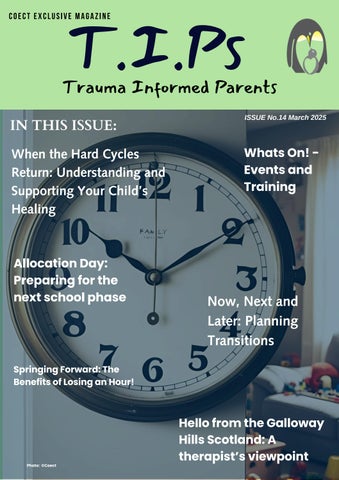
Trauma Informed Parents IN THIS ISSUE: When the Hard Cycles Return: Understanding and Supporting Your Child’s Healing
Allocation Day: Preparing for the next school phase
ISSUE No.14 March 2025
Whats On! Events and Training
Now, Next and Later: Planning Transitions
Springing Forward: The Benefits of Losing an Hour!
Photo: ©Coect
Hello from the Galloway Hills Scotland: A therapist’s viewpoint
In this issue
Editor's Note
Page 2
Meet the Team!
Page 3
Now, Next & Later: Planning Transitions
Page 4
When the Hard Cycles Return: Understanding and Supporting Your Child’s Healing
Page 7
Upcoming Events
Page 9
Allocation Day: Preparing for the next school phase
Page 14
Ask the Experts
Page 16
Hello from the Galloway Hills Scotland: A Therapist’s viewpoint
Page 18
Springing Forward: The Benefits of Losing an Hour!
Page 21
www.coect.co.uk
To advertise with us contact: tips@coect.co.uk
ISSUE 14
T.I.P'S MAGAZINE
1
Editor’s Note Dear Readers, As parents, we often encounter moments of change and transition that shape not only our children’s experiences but also our own journeys. Whether it's the excitement and apprehension of starting school, adapting to a new routine, or navigating emotional challenges, transitions are all part of parenting. In this issue, we explore the complexities of change and how it affects our children, especially those with traumatic backgrounds. Sarah Naish discusses how children, particularly those with traumatic backgrounds, struggle with transitions and routine changes, which can trigger significant anxiety. This article explores strategies to ease these difficulties, emphasizing the importance of compassion and empathy in helping children cope with their fears linked to changes. Sarah Watson, a children's and adolescent play and creative arts therapist and counsellor based in Dumfries and Galloway, highlights the importance of emotional connections in parenting and how, by making small communication changes, parents can positively impact their children's well-being, particularly for those who have experienced trauma. In her article, Jessica Spenceley addresses the challenges of parenting an adopted child and the cycles of regression that can occur during the healing process. She highlights the importance of maintaining connection through strategies like being a supportive teammate, prioritising joyful moments, and practicing self-compassion. Emma Edwards discusses a significant transition that most school-age children whose families intend for them to start school will undergo in the next couple of months. This process starts with choosing a school, and one of the pivotal moments in this change is allocation day when families learn which school their child has been assigned to. We have invited Dave Edwards, our Conflict Management and De-escalation Trainer and Consultant, to answer our Ask the Experts Q & A on this issue, which is all about managing challenging and violent behaviour at home. Sair Penna also discusses the upcoming transition to British Summer Time and the positive effects of losing an hour, particularly how it can contribute to our overall wellbeing. We hope you enjoy this issue. Warmest wishes
Sair, Sarah, and The Team at The Centre of Excellence in Child Trauma
ISSUE 14
T.I.P'S MAGAZINE
2
Meet the Team! The Centre of Excellence in Child Trauma is made up of a team of experts who have essential real-life experience. We are Adopters, Foster Parents and Bio parents of neuro diverse children, and also work as professionals in the field. Executive Editor - Sarah Naish
Executive Editor - Sair Penna
Managing Editor - Kathryn Talbot
Contributor -Emma Edwards Emma is a Therapeutic Parent, Adopter, Director of NATP and The Haven Parenting and Wellbeing Centre.
Contributor - Dave Edwards Dave is a Therapeutic Parent, Conflict Management & Point-of-Impact Crisis Intervention Trainer. He works within Family Services specialising in enabling parents with the knowledge and implementation of deescalation strategies, and supports parents and agencies in cases of child on parent violent.
Contributor - Jessica Spenceley
Sarah is a Therapeutic Parent, an Adopter of five siblings, former Foster Parent, retired Social Worker, Best selling international Author, Keynote Speaker and founder of three Independent Therapeutic Fostering Agencies.
Kathryn works across CoECT, specialising in communications and public relations.
Sair (Sarah) is a Therapeutic Parent, Trainer, Therapeutic Parenting Coach. Director of NATP, The Haven Parenting and Wellbeing Centre and Inspire Training Group and author, Sair works across CoECT supporting families.
Jessica is a therapeutic social worker with over 20 years of experience helping adoptive parents navigate their parenting journeys using the attachmentbased, trauma-informed parenting approach of TBRI®.
Contributor - Sarah Watson Sarah is a children's and adolescent play and creative arts therapist, and counsellor, based in Dumfries and Galloway. With a background in social work and experience supporting adoptive families, she has dedicated her career to addressing the mental health needs of children and families in her community.
ISSUE 14
T.I.P'S MAGAZINE
3
Now, Next, Later: Planning Transitions
W
hat is a transition? For us it might mean something big like, moving house, starting a new job. For our children, it can be as small as changing from playing with one toy to another, or the change from activity to bedtime routine. Our children have very high anxiety levels around change as in the past this often had a negative meaning for them. We may just be thinking about going out somewhere nice in the car. This could be a trigger for the child as they may have been taken in a car from, or to a traumatic event. Everyday experiences can be terrifying and we need to remain aware of that at all times. If everything seems to be going really well and then suddenly your child's behaviour changes out of the blue, (for the worse) - we need to try and look up what the possible triggers for that are. Sometimes we cannot identify them. Sometimes they are obvious. Where the child's early life was traumatic, their brain is hardwired for fear. They generally see adults as unsafe. Because of this, if there is a change in a boundary by yourself or by another adult, the fear/survival response kicks back in and takes over. The child reverts quickly and instantly to old negative behaviour patterns. The least useful thing we can do in this situation is to blame the child, or ask the child why. The child is either unaware, unconcerned, or deeply troubled and perplexed by their own behaviour. It is up to us, as therapeutic parents, to work out what is going on and how to fix it. ISSUE 14
Photo: ©CoECT
Written by Sarah Naish An empathic response to the new (old) behaviours is our best starting point. Preventative strategies Keep in mind what triggers there may be for your child. Sometimes these are not obvious and we can only identify them by the child’s reactions to a specific change. Give advance warning of activity changes even if it is something that happens at the same time every day. My son used to always be surprised that it was ‘suddenly’ shower time! Use timers, such as sand timers where the child can see how much time they have left. On computers and tablets, you can use a countdown alert as well. Set alarms. These can be fun songs or upbeat songs, relevant to the activity. It is less triggering for a child to have an alarm which informs them it is time for an activity change, than a parent telling them! As part of self-care, therapeutic parents need to take brainbreaks for recovery. This needs to be handled sensitively. The best way of minimising disruption to all is for respite carers to be trained in therapeutic parenting and to come to look after the child in their own home. This can also be reassuring for the child, and they get a little break from the hard work of attaching to their new parent. Pause and reflect whenever you see a reaction. Think about what has just happened, or what is about to happen. This can help you to avoid or minimise reactions in the future and secure.
Think about the timings of when you tell children about any major events such as contact, holidays, house moves etc. Nearly all therapeutic parents find that giving the child a lot of notice about a change is not necessarily helpful! This just gives more time for anxiety to build. Where there is an approaching contact meeting with significant others in the child’s life this is likely to provoke anxiety, stress, guilt, feelings of loss and grief. As parents and carers, we may see anger and rejection. It's important to keep a diary of your child’s reactions and responses and any deteriorations in behaviours such as bedwetting, aggression etc. This can help to determine later on how the contact is impacting on the child psychologically. If you feel the contact is not beneficial and you have evidence of deterioration in the child’s behaviours and emotional wellbeing, this needs to be shared in a practical fact based manner. Be proactive around contact arrangements. If the child is expected to travel for hours in a car each way for a contact session with able bodied adults, this is not acceptable. We need to be proactive about contact arrangements, ensuring that the transition is a short and disruptive for the child as possible, especially concerning travelling to and from the contact. T.I.P'S MAGAZINE
4
Having a planner on the wall with normal routines and small events can help the child to have visibility and feel secure about what is happening when. (See ‘Holidays’) Use Now/Next/Later cards or a daily planner which the child can carry around with them. It can be very reassuring for our children to have visibility about what the sequence of events is. Use transitional objects. This might be something with a familiar scent which the child can keep close such as a cloth or favourite toy. Avoid surprises! Don’t be tempted to even use the word ‘surprise’ unless your child is very well established with you and secure. Strategies during If your child hides (or goes blank emotionally) at pick up time, bear in mind that this is a survival strategy based on fear and the child is not doing it on purpose to annoy you. The child may be unsure that you are still safe, that you are not angry, or that you have not changed in anyway. This may be particularly prevalent where the child has been exposed to a parent who was unreliable in their response. Just carry on as normal, if possible speak to another adult and perhaps wonder aloud where the child might be without showing any anger. If there are not other adults around you can use the phone strategy and speak to an imaginary friend on the phone, using empathic commentary to lower the child’s fear response. Reassure the child that you will be with them for the transition, or name the person who will be. Use wondering aloud to keep up a narrative, explaining what you think is happening for the child. ‘I wonder if you are hiding under the bed because you are worried about what will happen when we leave the house? How can I help you feel less wobbly?’
ISSUE 14
Talk about how you will return to the same place. Sometimes our children cannot visualise this. ‘Once we get in the car I am going to drive to town and park in the shop car park. Then we will go to the supermarket and buy our dinner. After that we will get in the car and come home.’ Let the child know when they can return to the activity If a child is demonstrating sabotaging behaviours, approaching a significant contact, first of all try to tell the child about the contact as close as possible to the actual meeting. Let the child know that you know what is going on. ‘I can see that you are very wobbly at the moment. This might be because you are due to see X tomorrow. What is going to happen is…’ Give detailed information about where you are going, who will be there, how long for and where the child will go next. It is essential that the child takes a transitional object to ‘return home’ with. Strategies after If the transitions around contact are too difficult for the child to manage, you need to follow your instincts here. All too often contact is set up with adults who have been the cause of the cause of the child’s trauma, in order to meet the adult’s needs, not the child’s!. Sometimes it is difficult for the child to let us know that the contact is too difficult or frightening for them, so they tell us through their behaviours. Following contact, our children often have conflicting loyalties and confused feelings. Avoid planning exciting distracting activities and allow for some quiet ‘down time’ for reflection and reintegration. Use naming the need and empathic reflection to help the child to explore their feelings around the contact or other transition. ‘I think you might be very cross with me because you saw your Dad today and you are
missing him. That must feel really sad’. Navigating transitions with children, particularly those with a history of trauma, requires sensitivity, foresight, and a proactive approach. By understanding potential triggers and implementing supportive strategies, such as providing advance warnings, using visual aids, and maintaining consistent routines, we can help create a more secure environment for our children. Empathy and awareness are essential to help to address their fears and behaviours, allowing them to feel safe during changes. Ultimately, our role as parents is to support children with a nurturing approach that reduces their anxiety, ensuring that our children can adapt more comfortably to the transitions in their lives.
Extract taken from “The A-Z of Therapeutic Parenting” Sarah Naish. (2018) Jessica Kingsley Publishers
www.coect.co.uk
T.I.P'S MAGAZINE
5
Trauma-informed Life Story Work: Helping Children to find their Narrative Date: Wednesday 14th May Time: 10 am - 4 pm Location: Berkeley, Gloucestershire £120 per person
To book contact inspire@coect.co.uk 01453 519000
Counts towards Level 3 Certificate in Trauma-Informed Life Story Work Qualification
When the Hard Cycles Return: Understanding and Supporting Your Child’s Healing Written by Jessica Spenceley
downs is understanding why they happen and responding with connection. This is where TrustBased Relational Intervention (TBRI) can help. Why Do the Hard Cycles Return? It’s easy to think that once your child seems more secure, connected, and regulated, the hardest parts of the journey are behind you. But healing from trauma has many layers, and as children grow, challenges from the past often come back. Going through new developmental stages and meeting new social, emotional, and cognitive milestones can be overwhelming for children. And when children feel stressed, they regress. This a common reason why those old behaviour patterns return. This doesn’t mean you’re back at square one — it means your child is ready for deeper healing. Each cycle of regression is actually an opportunity to reinforce trust and connection and strengthen the foundation of your relationship. See the Need Beneath the Behaviour A core principle of TBRI is that challenging behaviours and emotions communicate underlying
ISSUE 14
Photo: ©JSpenceley
P
arenting an adopted child is not a straightforward journey. It’s a process of moving forward, slipping back, and finding your way again. The key to navigating these ups and unmet needs. Often, what your child is actually communicating in a difficult cycle is their deep need for comfort, safety, or co-regulation. So the next time things get tricky, take a moment before you respond and consider: Is my child hungry, thirsty, or tired? (Physical needs first!) Are they overwhelmed by sensory input? Does my child need to feel safe and soothed? When you are able to see the real need, you set yourself up to be able to respond with insight and compassion. That shift feels a whole lot better for both you and your child. Meeting the Need through Connection TBRI offers many strategies to help meet your child’s needs, all of which can be adapted to fit your own unique family. The common thread among them is that they are rooted in connection. However, maintaining connection can feel tough when you're back in a hard cycle. Here are a few ways to stay present and supportive during those moments.
Be their Teammate A very common fear among adopted children is that their forever family will reject and abandon them. This often becomes heightened when those hard cycles return because children worry that their “difficult behaviours” will push their parents away. Let your child know they aren’t alone. This might look like sitting beside them quietly during a meltdown, offering a gentle touch if welcomed, or modelling deep breaths to help regulate their emotions. Even a simple phrase like, I see you’re upset; let’s figure this out together, reinforces that you’re on the same team. Actively showing your child that you’re with them builds trust and strengthens your bond, while helping to reduce their fears. Prioritise Joy When challenges arise, it’s easy for fun and joy to slip into the background. Make it a priority to carve out regular moments of undivided attention with your child. It can be things like 10 minutes of child-led play, doing an activity together, or listening to
T.I.P'S MAGAZINE
7
them tell you all about their latest favourite thing. These moments show your child that they are seen, heard, and valued. Plus, those small moments of connection feel good and help you to maintain more of a sense of balance when things are tough.
The Ongoing Journey As you practice this again and again, you’re strengthening your child’s ability to trust – trust that they are safe, that their needs matter, and that you will show up for them. It’s those small moments, built up over time, that create lasting change.
Photo: ©Coect
Give yourself Grace While supporting your child, it’s also important to extend the same kindness and patience to yourself. Giving yourself grace means recognizing that you won’t always get it right – and that’s okay. When things get tough, small acts of self-care can make the cycle feel much easier to get through. It can be any number of things like taking deep breaths, stepping into another room for a moment to centre yourself, or reminding yourself, I’m doing the best I can, and that’s enough.
When old challenges resurface, it’s easy to feel like all your progress has been undone. But your child’s healing journey isn’t measured by the absence of
struggles – it’s measured by their growing ability to trust and connect. And your compassionate presence is what makes all the difference.
Jessica is the founder of Nurtured Belonging where she helps parents and adopted children overcome challenges, heal from the past, and build strong, connected relationships. To connect with Jessica, go to https://nurturedbelonging.com/
Need to talk to someone? Book a free 20-minute consultation All of our team have had first-hand experience of therapeutically parenting children with either trauma backgrounds or neurodiverse characteristics. We get how hard it can be at times.
www.thehavencentre.co.uk
ISSUE 14
T.I.P'S MAGAZINE
8
T.I.P.s ENJOYING TIPS MAGAZINE? Continue reading with a TIPs Magazine subscription You've reached the end of the free preview. If you've enjoyed this issue, you can get every issue of TIPs Magazine throughout the year.
DIGITAL — £15 per year 6 issues + full digital archive Read TIPs Magazine wherever you are, on your computer, tablet or phone. www.coect.co.uk/shop PRINT — £30 per year 6 printed issues delivered to your door Prefer a physical magazine? Subscribe to receive every issue throughout the year. www.coect.co.uk/shop
Looking for more support? TIPs Magazine is also included as part of TIPs Hub membership. Join the TIPs Hub for access to the magazine alongside our wider range of support, resources, learning and community. www.coect.co.uk/join
Keep reading. Keep connected. TIPs Magazine — £15 digital | £30 print TIPs Hub — magazine + support + resources + learning + community