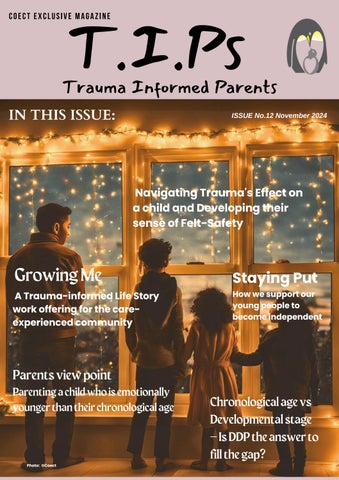
COECT EXCLUSIVE MAGAZINE
T.I.Ps
Trauma Informed Parents IN THIS ISSUE:
ISSUE No.12 November 2024
Navigating Trauma's Effect on a child and Developing their sense of Felt-Safety
Growing Me
Staying Put
A Trauma-informed Life Story work offering for the careexperienced community
How we support our young people to become independent
Parents view point Parenting a child who is emotionally younger than their chronological age
Photo: ©Coect
Chronological age vs Developmental stage – Is DDP the answer to fill the gap?
In this issue CoECT News
Page 2
Editor's Note
Page 3
Meet the Team!
Page 4
Chronological age vs Developmental stage – Is DDP the answer to fill the gap?
Page 5
Navigating Trauma's Effect on a child and Developing their sense of Felt-Safety
Page 8
What’s On - Training & Events
Page 10
Growing Me - A Trauma-informed Life Story work offering for the care-experienced community
Page 12
Staying Put - How we support our young people to become independent
Page 17
Ask the Experts
Page 20
Parent’s view point: Parenting a child who is emotionally younger than their chronological age.
Page 21
www.coect.co.uk
To advertise with us contact: tips@coect.co.uk
ISSUE 12
T.I.P'S MAGAZINE
1
COECT NEWS Fostering News Congratulations to True Fostering, who were nominated for an award at the Children and Young People Awards and won Highly Commended in their category. Our congratulations go to the foster families and staff team there.
First Trauma-Informed Life Story workshop launched We were excited to launch our new Trauma-Informed Life Story Work qualification in September. Our cohort attended their first in-person training day earlier in November at our training centre in Gloucestershire. The day was led by Sarah Naish and Sarah Dillon, and our course leader for the qualification, Helen Tavner, along with assessors Joanne Wilson and Emma Edwards who were also present to meet their students in person. The day was filled with engaging activities and discussions. We look forward to meeting everyone again for the second day of training, which will be held online. Our next cohort for the qualification starts in January, and the first in-person training day for this cohort will be in February. If you are interested in learning more about how this qualification can support you in working with children and young people to help them navigate their life stories in a trauma-informed way, please get in touch with us at inspire@coect.co.uk.
ISSUE 12
T.I.P'S MAGAZINE
1
2
Editor’s Note Welcome Everybody, With half-term, Halloween, and Bonfire Night behind us, winter is just around the corner. Surprisingly, the weather at CoECT headquarters in Gloucestershire has been mild. As Christmas approaches, you may be thinking about how to prepare your child or young person for the seasonal events that this time of year brings. Whether you embrace this season or not, it's important to consider the impact it can have on family members. For some, the Christmas lights and sounds associated with various activities can be quite intense, so keeping things low-key can be beneficial.
Our new discussion series, “Through the Keyhole,” will begin on 6 December and continue monthly throughout the next year. The first session will focus on how to navigate the Christmas season. In this edition of TIPS, we are focusing on the emotional age and the chronological age of the child, and the differences between the two, which can be apparent in some children. Laura Taylor, a trainer, therapeutic parent coach and social worker, has contributed to this edition and written an article about the Staying Put arrangement in foster care and how we can support young people in developing their independence. We are joined by Amanda Mauger-Jones, a DDP Informed Therapist, Therapeutic Parent Coach, and Trainer, who explores the differences between a child's chronological age and their developmental stage. She addresses whether Dyadic Developmental Psychotherapy (DDP) is an effective approach to bridging this gap. Emma Edwards has contributed an article from a parent's perspective on the challenges of parenting a child who is emotionally functioning at a younger age than their chronological age. Additionally, Jessica Spenceley discusses how therapeutic parenting can help address the effects of trauma on children and how parents can foster a sense of felt safety, which is essential for developing trusting relationships with their primary caregivers. I had the pleasure of meeting Ellie and Nicky from Growing Me CIC, a non-profit organisation that creates life story packs for parents and therapists working with children and young people. We were excited to share their pack at our first in-person training on Trauma-Informed Life Story Work, allowing attendees to explore the pack as a valuable resource in supporting a child's life story journey. Ellie and Nicky have kindly contributed to this edition by writing an article about their “Growing Me” Life Story resource and how their pack supports children and their families. This is the last edition of 2024, but we will return in January 2025 with our next edition. In the meantime, we wish you a stress-free lead-up to the Christmas period and a restful holiday break.
Sair, Sarah, and The Team at The Centre of Excellence in Child Trauma ISSUE 12
T.I.P'S MAGAZINE
3
Meet the Team! The Centre of Excellence in Child Trauma is made up of a team of experts who have essential real-life experience. We are Adopters, Foster Parents and Bio parents of neuro diverse children, and also work as professionals in the field. Executive Editor - Sarah Naish
Executive Editor - Sair Penna
Managing Editor - Kathryn Talbot
Contributor - Emma Edwards Emma is a Therapeutic Parent, Adopter, Director of NATP and The Haven Parenting and Wellbeing Centre.
Contributor - Jessica Spenceley
Contributor - Amanda MaugerJones Amanda is a therapeutic foster parent who is trained in empathic listening and is a Dyadic Developmental Psychotherapy (DDP) informed Practitioner. She is also a Trauma-Informed Trainer for the Centre of Excellence in Child Trauma.
Sarah is a Therapeutic Parent, an Adopter of five siblings, former Foster Parent, retired Social Worker, Best selling international Author, Keynote Speaker and founder of three Independent Therapeutic Fostering Agencies.
Kathryn works across CoECT, specialising in communications and public relations.
Jessica is a therapeutic social worker with over 20 years of experience helping adoptive parents navigate their parenting journeys using the attachment-based, trauma-informed parenting approach of TBRI®.
Sair (Sarah) is a Therapeutic Parent, Trainer, Therapeutic Parenting Coach. Director of NATP, The Haven Parenting and Wellbeing Centre and Inspire Training Group and author, Sair works across CoECT supporting families.
Contributors - Nicky & Ellie
Nicky is an adoptive mum, and Creative Director of Growing Me CIC. With a background in community art and design, Nicky loves finding wonder in the chaos! Becoming a mum through adoption has been full of messy-ness and beauty… And Growing Me was born out of a desire to nurture that, in a way that celebrates the wonderfully complicated relationships we have with ourselves, each other and the world around us. Ellie is Therapeutic Director of Growing Me CIC. As an HCPC registered Art Psychotherapist, Ellie has brought creativity and wonder into her work with careexperienced children and their families. Trained in Theraplay, Dyadic Developmental Psychotherapy (DDP), Dyadic Art Therapy, and trauma processing therapy EMDR, she delights in weaving colour and flow into evidence based practice.
ISSUE 12
T.I.P'S MAGAZINE
4
Chronological age vs Developmental stage – Is DDP the answer to fill the gap? Written by Amanda Mauger-Jones
I
For me, as a foster parent and special guardian, it would seem that everyone has an opinion of what additional supports are needed for my child to ‘bridge the gap’, but often this is from one single point of view, meaning that the bigger picture is often overlooked. As well as the academic interventions, there are also many different therapies which have been suggested; play therapy, music therapy, equestrian therapy. But who is overlooked by much of this? You. The parent. The consistent safe base. All these ‘new’ adults coming into our children’s lives can be confusing and at times, overwhelming for both us and our children. There has been increased chatter over DDP within the local authorities in recent years but what does this mean for parents and the children in their care? Is it really a ‘fix-all’ therapy which will solve all the of our parenting problems? Can it bridge the gap between chronological age and developmental stage? Dyadic Developmental Psychotherapy, DDP, was developed in the late 80’s by Dan Hughes, an American clinical psychologist when he was struggling to understand how he could support parents and children who had been ISSUE 12
Photo: ©Coect via canva.com
f you are reading this, it is safe to presume that you are experiencing what it is like to live or work with a child who has experienced trauma. It is recognised and understood that trauma impacts on all aspects of a child’s functioning but what does this look like to us parents who are caring for these children? What are the challenges we face as we try to understand their individual developmental stage, whilst also supporting them with the issues connected to their chronological age?
understand how he could support parents and children who had been effected by trauma. The underpinning values which he focused on was PACE; Playfulness, Acceptance, Curiosity and Empathy. Through the use of these values, Dan was able to assist children and their parents, to understand their troubled past whilst also creating a trust based relationship between parent and child, encouraging a positive attachment. Since that time, DDP has become one of the most recommended therapies offered to adoptive, foster and kinship parents. This all sounds great and a real problem solver but what does that look like for the family? The other side of the coin in this situation is that the parent is in crisis and has asked for help, only to be offered a miracle solution which they don’t understand. Let’s take some time to gain a clearer understanding. The support is for both parents and child. This allows the child’s expert, the parent, to share a clear insight into how things are ‘on the front line’.
DDP builds and supports trusting relationships This has to start at home and encourages positive attachments to be built between parent and child, which is challenging when a child has experienced being let down by adults before. DDP helps understand the communication through behaviour The worker will support the parent by giving them the confidence in understanding what is being communicated through their child’s behaviours and reactions. The worker will also allow the parents to offload without judgement or fear of criticism, allowing them to understand their own triggers and reactions. DDP promotes good self-care This in turn allows for better parent emotional regulation and positive reflection, making
T.I.P'S MAGAZINE
5
the parent more available for an attuned relationship with their child.
This holding of our own emotions is easier said than done which is why the work before the child is introduced is so important. Having that safe space for parents and empowering parents to stick with it is the key. So how does this all relate to working with the chronological age vs the developmental age? As the child and parents are focusing on the attachment relationship and strengthening the bond within the family, it will all be done with the developmental age of the child in mind. As I have experienced, a teenager can have a toddler tantrum when they are overwhelmed and unable to positively process the world around them. DDP understands this and the worker will be knowledgeable about the impact of trauma on brain development, allowing for the changes our children can exhibit. By focusing on feelings and connecting these to behaviours, a child will be able to safely regress and then regrow in a positive, safe and attached way, with the parents taking a leading role in showing their ‘stickability’ to their children.
Photo: Amanda Mauger-Jones
The DDP worker will always start by working with the parents and supporting them, whilst gaining a clear view of how their child is, before including the child in the sessions. It is important for the parents to be a place where they can regulate any of their negativity so that it doesn’t further impact on the relationship being built with the child. DDP is all based around building that stronger connection between parent and child, not just working with the child as an individual.
helped me to face each day. I was so inspired that I have spent the past few years continuing to support the children in my care whilst also learning and training so that I now offer this support to others. Through my work with the Centre of Excellence in Child Trauma and my own business, Edelweiss Therapeutic Consultancy, I offer that empathic listening ear to other parents, working with them to get closer to the light at the end
of the tunnel, so that they are in turn able to make it through the days, or weeks, until I speak with them again. This is done without judgement, prejudice or discrimination, allowing my parents to fill their cups with empathy and then attune positively with their children. There is no such thing as a ‘quickfix’, however with the support of DDP informed work, I have experienced the support I needed to find a way forward.
Have you listened to the CoECT podcast series? Scan the QR code or go to https://www.naotp.com /podcast-1 to find out more.
As a parent who has only ever parented children who have experienced trauma, I am so grateful for the DDP informed support I have been given, especially during the really challenging times. The reassurance that I was not on my own and that the behaviour was not due to my creation, ISSUE 12
T.I.P'S MAGAZINE
6
Navigating Trauma's Effect on a Child and Developing their Sense of Felt-Safety Written by Jessica Spenceley
A
Or that when their 12-year-old is upset, they need the sort of comfort, reassurance, and affection that they would give to a much, much younger child. Or that their 14-year-old has more in common with 10-year-olds and prefers the company of younger kids. Being around other teens makes their child feel very out of place because there is nothing for them to relate to or talk about. These sorts of scenarios are really common in children who have experienced trauma. However, they leave parents feeling confused and unsure of what to do. Parents ask me if they should keep offering up what their child seems to need? But then they worry that their child won’t “grow up”. They’re concerned that their parenting has somehow been causing these sorts of behaviours. And they wonder if they should offer up stronger boundaries or tough love. It’s hard to know what to do and how to respond because the impact of trauma is confusing. But how can trauma cause a child to be so on track or even advanced in certain areas of development, yet ISSUE 12
Photo: ©CoECT via Canva.com
doptive parents often reach out to me because their child’s behaviours don’t make sense to them. It’s not uncommon for a parent to tell me that their 11year-old is an academically advanced math whizz. Yet at night, he wants to be snuggled up, held like a baby, and fed with a bottle.
so far behind in others? Think of it like this. . . When a child (or adult) experiences trauma, the thinking part of their brain goes on pause and goes offline. The parts of the brain that control things like automatic responses, emotions, and sensory processing are very much online and are working in overdrive to help the child stay alive. When the traumatic event is over, the thinking part of the brain starts back up again, kind of like nothing happened. That’s why your child can be an academically advanced math whizz. Math involves the logical, thinking part of the brain that was on pause when the trauma occurred. But the other parts of the brain are the ones that experienced the trauma and are impacted by it. Those impacts can cause your child’s development to fall behind or go off track. That’s why your child may be emotionally younger than their actual age. That’s why your child may have sensory processing challenges. That’s why your child may go from 0 to 100 in the blink of an eye
for seemingly no reason. It’s the impact of trauma. Trust-Based Relational Intervention (TBRI) helps you to better understand how the legacy of your child’s past is showing up today. And, TBRI provides you with the skills and strategies you need to help your child along their healing journey. Felt-safety is one of the primary concepts in TBRI that I always encourage families to come back to because it is so powerful. Feltsafety is what it sounds like feeling safe. It’s not enough for you, as the parent, to know your child is safe; they need to feel it. Meeting your child where they are emotionally is a significant way to help your child to increase their sense of felt-safety. So, if your 10year-old is emotionally more like a 5-year-old, give your child the sort of nurturing, connection, and care you would to a 5-year-old. You don’t have to worry that your child will stay at a younger age because they won’t. By “going back” to your child’s younger emotional age, you are helping T.I.P'S MAGAZINE
8
your child to feel safe. And that is what will help your child to move forward on their developmental trajectory. Felt-safety helps to heal trauma As your child’s sense of felt safety increases, you’ll see their traumabased symptoms and behaviours decrease. And over time, that gap between your child’s emotional age and actual age will lessen.
Photo: ©CoECT via Canva.com
So, when you’re thinking of how to support your child to move forward, think felt-safety. The power of TBRI is in its simplicity and in the hope of healing for all children. If you’re curious about TBRI or are ready to implement it in your own family, learn about the TBRI® Caregiver Training at https://nurturedbelonging.com/. Jessica is the founder of Nurtured Belonging where she helps adopters
ISSUE 12
create a strong parenting base for their children so they can heal from early adversity and trauma. Jessica is also an Associate with
www.thehavencentre.co.uk
The Haven Parenting & Wellbeing Centre https://www.thehavencentre.co.uk.
T.I.P'S MAGAZINE
9
UPCOMING TRAINING DATES JANUARY 2025 First Steps In Therapeutic Parenting Cambridge Thursday 9th January, 10 am - 1 pm
Exploring the Foundations of Attachment Manchester Tuesday 14th January, 10 am - 1 pm
Therapeutically Managing Violent Behaviour Plymouth Tuesday 21st & Wednesday 22nd January 10 am - 4 pm each day
Managing Feelings for Parents Compassion Fatigue Portsmouth Tuesday 28th January, 10 am - 1 pm
FEBRUARY 2025 Exploring the Foundations of Attachment Bristol Wednesday 5th February, 10 am - 1 pm
Therapeutically Managing Violent Behaviour Nottingham Tuesday 11th & Wednesday 12th February 10 am - 4 pm each day
Managing Feelings for Parents Compassion Fatigue Merseyside Tuesday 11th February, 10 am - 1 pm
First Steps In Therapeutic Parenting Sussex Wednesday 26th February, 10 am - 1 pm
For more information click on the QR code or go to www.naotp.com/training
ISSUE 12
T.I.P'S MAGAZINE
10
UPCOMING MEET UP/LISTENING CIRCLE DATES Tuesday 3rd December 2024 Virtual Listening Circle for Supporting Professionals
Tuesday 10th December SGO/Kinship Carer Virtual Listening Circle Zoom
Tuesday 3rd December 2024 Virtual Listening Circle for Men
Thursday 12th December 2024 International Members Virtual Listening Circle Zoom
Wednesday 4th December 2024 Virtual Listening Circle Hosted by Suzanne Zoom
Friday 13th December 2024 Surrey Listening Circle Camberley
Saturday 7th December 2024 Berkshire Family Circle
Monday 10th January 2025 Surrey Listening Circle Camberley
Monday 9th December 2024 In-person Listening Circle Norwich - Clippesby Hall
Corporate Information Session Tue, 26 Nov | zoom
Corporate Information Session Tue, 03 Dec| zoom
For more information click on the QR code or go to https://www.naotp.com/training-events ISSUE 12
T.I.P'S MAGAZINE
11
Growing Me A Trauma-informed Life Story work offering for the care-experienced community Written By Ellie & Nicky
In this article Nicky and Ellie share their vision for accessible life story work, and their mutual love of nature metaphors! So, where did Growing Me come from? Nicky: Like many adoptive parents, I knew that my child would need a lot of help to build trust in adults, and a sense of safety in the world. Through trial, error, therapy, and a whole lot of love, we started to better attune to our child, and see the benefits of play and creativity. But the systems around our child were struggling, and our social workers kept changing. Arriving over a year late, my child’s life story book was printed on scratty paper, from a printer that was ISSUE 12
Photo: Ellie & Nicky in the wodds. ©Growing Me CIC
I
t was a passion for helping care-experienced children that brought Nicky and Ellie together. From their personal and professional expertise, grew Growing Me, a bright and colourful offering for the careexperienced community. Growing Me is a physical box, and a digital portal, through which a child and their trusted grown up are guided. It is a 10-step journey filled with games, animations, fun ideas, and creative activities. No matter a child’s chronological age, Growing Me engages the child within. Sometimes it is the cool, sassy, older children who benefit most from the nurture they missed out on.
running out of ink. Even before delving into the content, I could see that it was the opposite of the careful and sensitive document that could help our child build a positive sense of self, and understanding of their past.
Surely, I thought, there must be a way to make life story work more accessible, safer and more consistent, to help children feel understood, to feel loved, and to feel good about themselves. The seeds of an idea started to form.
Other adopters I spoke to had similar issues; content reading like a horror story, incorrect names, overworked social workers not given the time or resources to do what was needed. Very few families had usable life story books, and yet filling out forms to get further support forces parents to focus on negative behaviours, which doesn’t feel useful or healthy.
The metaphor of a tree had helped our family.
There can be massive waiting lists for suitable therapists, and sometimes no matter how skilled the professional, exploring feelings with someone new, is too big an ask for children who struggle with trust.
Born into a storm, a little seedling had to be moved in order to find safer ground. The growing tree needed to move several times before a forever home was found; a place where the sapling had everything it needed to grow. I used the tree’s rings to tell my child’s story so that they could explore the events from a distance, hear how brave the little sapling had to be, hear how the gardener loved the little sapling for all that it had been through, all that it was, and all that T.I.P'S MAGAZINE
12
T.I.P.s ENJOYING TIPS MAGAZINE? Continue reading with a TIPs Magazine subscription You've reached the end of the free preview. If you've enjoyed this issue, you can get every issue of TIPs Magazine throughout the year.
DIGITAL — £15 per year 6 issues + full digital archive Read TIPs Magazine wherever you are, on your computer, tablet or phone. www.coect.co.uk/shop PRINT — £30 per year 6 printed issues delivered to your door Prefer a physical magazine? Subscribe to receive every issue throughout the year. www.coect.co.uk/shop
Looking for more support? TIPs Magazine is also included as part of TIPs Hub membership. Join the TIPs Hub for access to the magazine alongside our wider range of support, resources, learning and community. www.coect.co.uk/join
Keep reading. Keep connected. TIPs Magazine — £15 digital | £30 print TIPs Hub — magazine + support + resources + learning + community