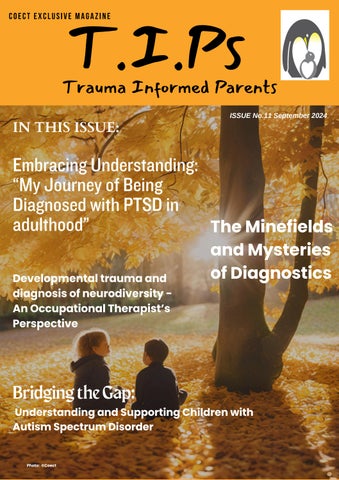
COECT EXCLUSIVE MAGAZINE
T.I.Ps
Trauma Informed Parents IN THIS ISSUE:
ISSUE No.11 September 2024
Embracing Understanding: “My Journey of Being Diagnosed with PTSD in adulthood” The Minefields Developmental trauma and diagnosis of neurodiversity An Occupational Therapist’s Perspective
and Mysteries of Diagnostics
Bridging the Gap: Understanding and Supporting Children with Autism Spectrum Disorder
Photo: ©Coect
In this issue CoECT News
Page 2
Editor's Note
Page 3
Meet the Team!
Page 4
Bridging the Gap: Understanding and Supporting Children with Autism Spectrum Disorder
Page 5
The Minefields and Mysteries of Diagnostics
Page 7
Embracing Understanding: “My Journey of Being Diagnosed with PTSD in Adulthood”
Page 11
The NATP Mens Group
Page 14
Ask the Experts
Page 15
Transitions: Saying Goodbye to Summer and Hello to Autumn
Page 16
An Occupational Therapist’s perspective of developmental trauma and diagnosis of neurodiversity
Page 17
www.coect.co.uk
To advertise with us contact: tips@coect.co.uk
ISSUE 11
T.I.P'S MAGAZINE
1
COECT NEWS Recent news from SAfER Fostering SAfER has now fully settled into their new offices in Cardiff after their move. Additionally, Sarah Naish recently met with foster parents from South and West Wales and joined them at their support groups. The feedback from foster parents who have transferred to SAfER Fostering shows appreciation for the therapeutic difference it offers and the wrap-around support for fostering families.
Wellbeing News
Our new Trauma-informed Life Story work Qualification has launched! The first cohort for our new customised qualification, the Level 3 Certificate in TraumaInformed Life Story Work, began in September. We are looking forward to meeting them for their first day of practical training at our training centre in Gloucestershire in November. This customised qualification has been externally accredited by the nationally recognised awarding body NCFE CACHE and it has also been accredited by the ACCPH which is a professional body that verifies and accredits Counsellors, Coaches, Psychotherapists, and Hypnotherapists. The second cohort for this course will start in February. You can find more information about this course on the Inspire website.
The Haven Parenting & Wellbeing Centre had an incredibly exciting summer. We received a nomination for the Global Corporate Live Wire Awards, and we are thrilled to share that we have been selected as the winner in the category of Coaching and Therapy Clinic of the Year for 2024/2025. We extend our heartfelt thanks to everyone who nominated us.
Fostering News We are delighted to announce that TRUE Fostering is a finalist in the 2024 Children & Young People’s Awards in the Fostering Category! TRUE would like to extend their thanks to all the amazing children, young people., foster parents and staff. Wish us luck for 24 October, when the winner will be announced at the Award ceremony!
NEW SCHOOLS AND EDUCATION SETTING TRAINING This autumn marks the launch of our Schools and Educational settings training. Our training is closely aligned with the "A-Z of Trauma-Informed Teaching" book by Sarah Naish et al. We offer a comprehensive guide to understanding and implementing trauma-informed practices in educational settings. School 10 will be available from October 2024. For more information go to trainingISSUE dates T.I.P'S MAGAZINE our NATP schools page here. Alternatively you can scan the QR code above.
1
Editor’s Note Welcome Everybody, We hope that the start of the school term has gone smoothly for you and your children or young people, if you have any. The summer holidays can be long, and whether that has been positive or not, it takes a certain amount of endurance to get through it. In September, there is a sense of change and renewal. It marks the start of a new term and a new season, bringing renewed hope for the future. This time of year can often lead parents to experience compassion fatigue and burnout. The school transition and the busyness of the first week can sometimes be the tipping point from being okay to being burnt out. However, embracing the change in routine can also be a helpful way to take care of yourself. You may even find new pockets of time in your daily routine for a well-deserved break to recharge. Perhaps it could even create an opportunity to sit in a quiet place with a warm drink for five minutes. This issue focuses on diagnoses and developmental trauma, and we are excited to introduce you to our contributors for this issue. We are joined by Dr Libby Gaskell who has written an article on the minefields and mysteries of diagnoses, and explores the challenges of distinguishing between developmental trauma, autism spectrum condition (ASC), and attention deficit hyperactivity disorder (ADHD) in children, highlighting the complexities and similarities between these conditions. Savannah Harder is an Occupational Therapist, who has written an article which explores the impact of developmental trauma on neurodiversity and the challenges in distinguishing between the two. She also discusses the potential benefits and drawbacks of receiving a diagnosis, highlighting the importance of accurate diagnosis and its impact on accessing support and resources. Jessica, a therapeutic social worker and TBRI practitioner has written an article which focuses on the importance of connection in healing trauma for adopted children on the autism spectrum. She introduces the Trust-Based Relational Intervention (TBRI) therapeutic parenting approach and provides specific strategies to help parents effectively connect with their children. Our contributor Rowan, also shares their journey of acceptance, treatment, and progress in managing their PTSD symptoms from early life experiences. Also, Dave, who has set up and runs NATP Men's Group, writes about establishing a supportive online community for therapeutic dads, offering advice and encouragement for navigating therapeutic parenting. Through a private Facebook page and monthly Zoom meetings, members can share experiences and receive support without pressure, helping them feel more empowered in their parenting journey. If you would like to submit any questions for our next magazine’s Ask the Experts section, please contact us at tips@coect.co.uk We will be back in November with Issue 12! Sair,
Sarah, and The Team at The Centre of Excellence in Child Trauma
ISSUE 11
T.I.P'S MAGAZINE
3
Meet the Team! The Centre of Excellence in Child Trauma is made up of a team of experts who have essential real-life experience. We are Adopters, Foster Parents and Bio parents of neuro diverse children, and also work as professionals in the field. Executive Editor - Sarah Naish
Executive Editor - Sair Penna
Managing Editor - Kathryn Talbot
Contributor - Sarah Dillon
Sarah is a Therapeutic Parent, an Adopter of five siblings, former Foster Parent, retired Social Worker, Best selling international Author, Keynote Speaker and founder of three Independent Therapeutic Fostering Agencies.
Kathryn works across CoECT, specialising in communications and public relations.
Sair (Sarah) is a Therapeutic Parent, Trainer, Therapeutic Parenting Coach. Director of NATP, The Haven Parenting and Wellbeing Centre and Inspire Training Group and author, Sair works across CoECT supporting families.
Sarah is a Therapeutic Parent, an Attachment Therapist, Keynote speaker, former child in care, Author (Therapeutic Parenting) and Head of Therapeutic Services (Fostering).
Contributor - Savannah Harder
Contributor - Dr Libby Gaskell
Contributor - Rowan Aderyn
Contributor - Jessica Spenceley
Savannah graduated in Occupational Therapy in 2019 from UWE Bristol after working for many years holistically with high support needs adults in residential settings. Since becoming a qualified OT she has focussed on paediatrics; first in the NHS then in the private sector. She currently works in special schools and specialist higher education settings as well as seeing clients in their homes.
Row is a Lead Business Architect in the Financial Services. They are also a founder of the charity Fostered Futures and a care experienced activist. With a passion and expertise in leading inclusive change to improve businesses and communities.
Libby is a chartered psychologist who has worked with children, young people, and their families for a number of years. Libby offers specialist therapeutic interventions and assessments for families who have been affected by trauma and attachment difficulty, and also offers consultation and training in these areas to various professional teams.
Jessica is a therapeutic social worker with over 20 years of experience helping adoptive parents navigate their parenting journeys using the attachment-based, traumainformed parenting approach of TBRI®.
Contributor - Dave Edwards Dave is a Conflict Management & Point-of-Impact Crisis Intervention Trainer. He works within Family Services specialising in enabling parents with the knowledge and implementation of de-escalation strategies, and supports parents and agencies in cases of child on parent violent. Dave specialises in men’s mental health, empathic listening, and therapeutic parenting strategies to support those he works with.
ISSUE 11
T.I.P'S MAGAZINE
4
Bridging the Gap: Understanding and Supporting Children with Autism Spectrum Disorder Written by Jessica Spenceley
C
onnection is at the heart of healing from adversity and trauma. Common strategies for connection like eye contact, touch, expressing empathy, and actively engaging in an activity all have the aim of creating stronger bonds with your child. Yet, for a child with Autism Spectrum Disorder, these sorts of strategies, however well-intentioned, may actually raise their feelings of anxiety, confusion, and fear. What you might then see are meltdowns, increased self-stimming, withdrawal, and avoidance. The therapeutic parenting approach of Trust-Based Relational Intervention (TBRI) understands the impact of early adversity and trauma, as well as diagnoses like Autism Spectrum Disorder (ASD). There are a lot of strategies that TBRI can offer to help you connect and create a more secure base for your child with ASD. Here are a few you might like to try: see the need, be alongside, and less is more. See the Need Children with ASD, and children who have experienced trauma, often have sensory sensitivities. Without awareness, these can become a challenge and barrier in your relationship. However, when you are able to see your child’s sensory needs ISSUE 11
Photo: ©Coect via canva.com
and meet them, you create a bridge for connection. To gain greater awareness around what might be happening for your child on a sensory level, ask yourself: 1) What does my child seek? 2) What does my child avoid? Exploring these questions gives you a lot of helpful information. For example, if you notice that your child craves movement, incorporate activities that allow your child to move around while also connecting with you. These can be things like going for a family bike ride, jumping on the trampoline together, or playing frisbee in the park. These sorts of activities can help to meet your child’s sensory needs, as well as their need for your presence and
connection. The aim here is to help your child feel safe and to strengthen your bond. Show your child that you are able and willing to meet them where they are, and that you’ll go at their pace. That will go a long way in building connection in your relationship. Be Alongside Now that you are holding your child’s sensory needs in mind and are going at their pace, try this simple shift in how you engage with your child: be alongside. What this might look like is sitting next to your child when you’re talking to them, rather than being
T.I.P'S MAGAZINE
5
in front and facing them. It could be getting down on the floor with your child and building your own Lego tower, instead of adding to the one they’re creating. It might be easing in with a shoulder touch, rather than a full-on cuddle. You are still together and engaged, but in an indirect way. When you use the strategy of being alongside your child, you’re actively helping them to manage their sensory experiences and emotions and remain regulated. This is a small shift that can have significant results in building the bonds of connection in your relationship. Less is More One of the most common ways that adults try to build connection is through words. However, children with ASD and children who have experienced trauma often have difficulty processing speech. When parents become wordy and use a lot of dialogue, it’s not uncommon for
children with ASD to become anxious and reactive. All of those words are just too much to process. Hold in mind the idea that less is more. For example, if you’re talking to your children about an activity you think would be fun to explore at the weekend, try using a few sentences rather than several paragraphs’ worth of words. The idea is to engage and get your point across, without overwhelming your child with too much information to process. By all means, use your words, but use them simply and intentionally. TBRI can help you to better understand your child’s needs, while providing you with strategies to create connection in a way that supports your unique family. Through developing increased awareness, making simple shifts, and adding in some straightforward tools, TBRI can help you to feel empowered as you support your child.
If you would like to learn more about TBRI, read The Connected Child by Karyn Purvis, David Cross, and Wendy Lyons Sunshine. Through her company, Nurtured Belonging, Jessica helps adopters create a strong therapeutic parenting base for their children so that they can heal from early adversity and trauma. Gain additional insights, including more on TBRI® at https://nurturedbelonging.com Jessica is also an Associate with The Haven Parenting & Wellbeing Centre www.thehavencentre.co.uk
WWW.TRAUMAREVOLUTION.CO.UK/TRAINING-PASS ISSUE 11
T.I.P'S MAGAZINE
6
The Minefields and Mysteries of Diagnostics Written By Dr Libby Gaskell Attention Deficit Hyperactive Disorder (ADHD)
Pathological Demand Avoidance (PDA)
Developmental Coordination Disorder (DCD)
Autism Spectrum Condition (ASC)
Photo: ©CoECT via Canva.com
Post Traumatic Stress Disorder (PTSD)
These days, we can read of so many different mental health and developmental condition diagnoses, with their descriptions, criteria, and ‘symptoms’ at the end of our fingertips online. The sources from where we get our information can sometimes not be well empirically validated, but even via reliable and valid websites, the sheer amount of information can be mind-boggling! Even the Diagnostic and Statistical Manual (DSM5), which documents all known ‘mental disorders’ for the use of qualified practitioners, is almost 1½ inches thick (yes, I’ve checked) and has VERY thin pages… What makes this sheer amount of information available to us on various conditions even more complex, is that so many of these conditions and their descriptions sound similar to each other. Those claiming to be one thing based on a person’s behaviours, appear to be ISSUE 11
something else a few pages on. So, it raises the question how we might navigate and pull apart these various diagnoses, which is particularly problematic when we are supporting a child with developmental trauma (DT). Developmental trauma, as the name suggests, affects various avenues of a child’s development. When referring to DT in this article, I also include reference to attachment insecurity, which often accompanies DT. When a child is exposed to traumatic, frightening, and confusing experiences chronically across developmental milestones, it makes total sense that their development may be delayed, hindered, or complicated in some way. DT affects a child’s social, emotional, relational, cognitive, and even physical development.
However, neuro-developmental conditions, such as autism spectrumcondition (ASC) or attention deficit hyperactivity disorder (ADHD), by virtue of being a ‘developmental disorder’, also affects children’s development on a social, emotional, relational, and at times cognitive level. So how do we separate out DT (based on traumatic life experiences) from other things such as ASC or ADHD (organic conditions)? As a clinician who is often asked to undertake this task I can say; with great difficulty at times! Despite this, below I have attempted to outline some common overlaps in DT and ASC and ADHD. I couldn’t possibly, in this article, cover these overlaps in any great depth, but they will hopefully serve to get the mind thinking and being curious of such behaviours. T.I.P'S MAGAZINE
7
ASC (autism) and DT:
Putting things in neat boxes, as I’ve done opposite, may offer a sense of organisation and reassurance to such complex presentations. However, if you are supporting a child with DT, please be aware that a child can indeed have trauma AND one of these co-occurring conditions. Therefore, it is not always a case of ‘either-or’, it is sometimes a case of holding and managing TWO conditions, maybe even THREE! Furthermore, parenting children with additional needs is inherently more challenging and stressful, and therefore if a parent has reduced emotional resources this could actually impact on the formation of a secure attachment. The complexity goes on and on.
©LGaskelll 2024
ADHD and DT:
©LGaskelll 2024
ISSUE 11
There are, of course, other conditions that could also be discussed. For example, personality disorders in older adolescents and adults often have behavioural traits that are similar to DT, so much so that research often highlights that a significant proportion of people with emotionally unstable personality disorder (EUPD) also had multiple adverse/abusive experiences in childhood (are we just applying a different name to the same set of behaviours here?). Postnatal depression is also a further noteworthy condition to mention when there also exists traumatic developmental experiences for that parent in their own upbringing, as the birth of a child could elicit vulnerabilities in their own attachment system and conjure buried trauma. Pathological demand avoidance – a specific profile linked with ASC – also has similarities with DT around the need for control, but with differing underlying reasons for such. My advice would be to always ensure you seek support from a suitably qualified practitioner if you are faced with any of these diagnostic conundrums as they can be, as per the title of this article, a bit of a minefield and mystery. Those who are highly experienced and knowledgeable in these areas are best placed to undertake the precarious task of teasing out these different traits from each other and establishing the correct clinical conclusions. It is of course most important that the child (or adult) being supported has their needs met and that everyone involved in their support is clear what their vulnerabilities are, regardless of how they are defined. T.I.P'S MAGAZINE
8
That said, there is indeed a role for diagnoses, in some cases more than others, which I wish to highlight. A diagnosis is sometimes a key to access additional support, they can increase shared understanding and empathy, and self-understanding and growth. Correct diagnosis is also important to ensure appropriate treatment and interventions are put in place to support someone, where support is required. For example, ASC is a life-long condition and intervention- if it is even needed may include support to manage any perceived difficulties. Whereas the interventions for DT are different, as an emphasis is placed on repair and the healing of attachment systems and the
development of reflective and logic-driven parts of the brain. The wrong diagnostic conclusion due to a lack of knowledge and distinction could set off in motion a path of utter therapeutic chaos! In summary, we need to be mindful of potential diagnostic overlaps. As with most things, it is establishing a balance in our approach to such matters that is significant; we need to recognise the importance and potential value of a diagnosis, whilst also ensuring we don’t allow any diagnosis to overshadow the beauty of individuality.
Have you listened to the CoECT podcasts? Scan the QR code or go to https://www.naotp.com/podcast-1 to find out more.
TRAINING DATES JANUARY/FEBRUARY 2025 JANUARY 2025
FEBRUARY 2025
Introduction to Therapeutic Parenting Manchester Thursday 9th January
Introduction to Therapeutic Parenting Sussex Wednesday 26th February
Introduction to Attachment Manchester Tuesday 14th January
Introduction to Attachment Bristol Wednesday 5th February
Therapeutically Managing Violent Behaviour Plymouth Tuesday 21st & Wednesday 22nd January
Therapeutically Managing Violent Behaviour Nottingham Tuesday 11th & Wednesday 12th February
Compassion Fatigue Portsmouth Tuesday 28th January
Compassion Fatigue Merseyside Tuesday 11th February
For more information click on the QR code or go to www.naotp.com/training ISSUE 11
T.I.P'S MAGAZINE
9
Programme Benefits This qualification helps the learner to develop the necessary skills to create a safe and supportive environment for the children, young people, and their families. This will enable them to successfully implement a strategy that prioritises the child's wellbeing and helps them create a positive narrative about their life story. Accreditation & Certification information Our course has been accredited by NCFE CACHE, an awarding organisation recognised by the qualification regulators for England and Wales. NCFE CACHE’s regulators are the Office of Qualifications and Examinations Regulation (Ofqual) in England and the Welsh Government in Wales. Accreditation & Eligibility to join ACCPH The Qualification is also accredited by The Independent Professional Body and Register for Counsellors, Coaches, Psychotherapists and Hypnotherapists (ACCPH) This means that on successful completion of the qualification, you will be eligible to join their accredited association. Training Days Day 1 In-person training - Wednesday 6th November 2024, 9:30 am - 4: 00 pm at our training centre in Gloucestershire - details will be given on enrolment Day 2 Online Live Training - Monday 10th February 10 am- 2:30 pm Not enrolled but interested in attending Day 1 to learn more about Traumainformed Life Story Work? Contact inspire@coect.co.uk for more details ISSUE 11
T.I.P'S MAGAZINE
Scan QR code or click below for more information.
10
Embracing Understanding: My Journey of Being Diagnosed with PTSD in Adulthood Written By Rowan Aderyn
T
hose four little letters hung in the air: PTSD. "But I can’t have Post Traumatic Stress Disorder. I have never been to war," I naively protested. My psychologist’s knowing smile hinted at a reality I had never comprehended. I was a thirty-something highly successful professional in the financial services industry. With a shed load of qualifications and a couple of educational or workrelated awards sat on my shelf. My wonderful husband and amazing children were the centre of my world. How had I found myself here? The small, nondescript room of the Swansea burns unit, hearing I was living with a mental health illness. A few months earlier, while making homemade soup, the bottom fell out of the jug. Spilling the contents over my hands, legs, feet, and stomach. I rushed to the shower to try and cool my burning skin. The icy water felt like a thousand bee stings. The resulting burns weren’t that bad, but after weeks of doctors' visits and dressings, my hand was still not healing. I found myself in the Swansea burns unit having the skin scraped away from my hand. This was what my body needed to heal. A few weeks later, I was finally able to get back to work and life. Or at least that’s what I thought. In the following months, anxiety seeped into everyday activities. I wasn’t surprised that I felt nervous ISSUE 11
cooking or pouring the kettle. But there were more and more occasions when my head began to spin, my arms would start to tingle, and I could feel that nauseous feeling taking over me. I couldn’t figure out what was causing me to feel so unwell. I didn’t recognise it as an anxiety attack. My breathing was always steady and level. I never felt out of breath, which is what I had assumed a panic attack looked like. I simply felt ill, so ill that one day, I got up and left my friend sitting alone in a café just as the food arrived. I was sure I was about to pass out. I drove home and spent an age pacing back and forth, necking glasses of orange juice, wondering if my blood sugars were off. For a long time, I honestly believed something was physically wrong. I didn’t think to get help until it started to impact work. I found myself sitting on my hallway floor at five in the morning, unable to move, my chest tight, frozen, stuck alone in the dark. I tried everything I could to muster the ability to leave my house and make the flight for work. For as long as I could remember, work had been my safe space, and I didn’t want to lose that. My husband suggested perhaps it was anxiety related to the burn. I didn’t buy it, but I was willing to try anything. I was lucky if you are treated by the Swansea burns unit,
for three years after you can reach out to their in-house psychology team. I made the phone call, and a few months later, after a couple of sessions, I was sitting across from a brilliant and insightful doctor being told I had PTSD. We discussed the burns, but it had quickly become apparent that the latest event was simply the straw that broke the camel’s back. What lay behind my increasing inability to tolerate heat was a fear of being trapped, of not healing, of not being able to move forward with my life. The weeks and weeks of visiting a doctor for them to peel away my dressings to expose my raw oozing hand and seeing no change, no improvement. The time forced off work, not being able to type or travel didn’t help either. I was made to sit with my thoughts. To slow down my constant drive forward. What was actually behind the fear of being stuck was a long history of being bullied, traumatised, and abused. I always knew I carried a past that haunted me, but I thought I had managed to outrun it. At least to keep ahead of it enough that it would not impact my present. My therapist was wonderful, helping me work through some elements of the bullying I suffered in high school and the impacts of the burn. After a few months of avoiding the hard stuff but tackling the sense of being stuck, I recovered my usual level of functioning. My sleep was still T.I.P'S MAGAZINE
11
T.I.P.s ENJOYING TIPS MAGAZINE? Continue reading with a TIPs Magazine subscription You've reached the end of the free preview. If you've enjoyed this issue, you can get every issue of TIPs Magazine throughout the year.
DIGITAL — £15 per year 6 issues + full digital archive Read TIPs Magazine wherever you are, on your computer, tablet or phone. www.coect.co.uk/shop PRINT — £30 per year 6 printed issues delivered to your door Prefer a physical magazine? Subscribe to receive every issue throughout the year. www.coect.co.uk/shop
Looking for more support? TIPs Magazine is also included as part of TIPs Hub membership. Join the TIPs Hub for access to the magazine alongside our wider range of support, resources, learning and community. www.coect.co.uk/join
Keep reading. Keep connected. TIPs Magazine — £15 digital | £30 print TIPs Hub — magazine + support + resources + learning + community