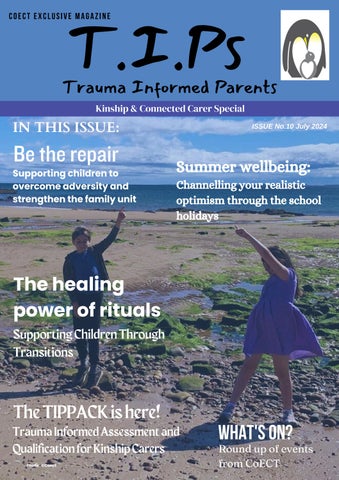
COECT EXCLUSIVE MAGAZINE
T.I.Ps
Trauma Informed Parents Kinship & Connected Carer Special
IN THIS ISSUE:
Be the repair
Supporting children to overcome adversity and strengthen the family unit
ISSUE No.10 July 2024
Summer wellbeing: Channelling your realistic optimism through the school holidays
The healing power of rituals Supporting Children Through Transitions
The TIPPACK is here! Trauma Informed Assessment and Qualification for Kinship Carers Photo: ©Coect
WHAT'S ON?
Round up of events from CoECT
In this issue CoECT News
Page 1
Editor's Note
Page 2
Meet the Team!
Page 3
Conference News
Page 4
The healing power of rituals
Page 5
4 Things to Avoid When Supporting Children to Tidy Up
Page 6
Protection from Care
Page 7
Be the Repair
Page 9
Innovations in Parenting Assessment and Preparation for Kinship and Connected Carers
Page 11
Therapeutically Managing Violent Behaviour in Children and Adolescents
Page 13
NATP Free Resource: Making Transitions in School
Page 14
Whats On - CoECT Events
Page 15
Nurturing Trauma-Informed Care for Vulnerable Children: A Guide to the TIPPAKC Qualification
Page 16
Ask the Experts
Page 17
Summer wellbeing: Channelling your realistic optimism through the school holidays.
Page 18
Child on Parent Violence
Page 20
www.coect.co.uk
To advertise with us contact: tips@coect.co.uk ISSUE 10
T.I.P'S MAGAZINE
COECT NEWS Autumn Conference News
After the success of our last virtual conference in June, we have started planning our next event. The upcoming virtual conference will focus on supporting Kinship, Connected Carers and Special Guardians. Our speakers will include Sarah Naish, Enza Smith MBE, and Gareth Thomas, all of whom have experience in Kinship Care. The conference will be held on the virtual platform Zoom. The conference is scheduled for Thursday 17 October 2024 from 10:00 am to 3:30 pm. Tickets are currently available for £12 per person and can be purchased from the NATP website.
Wellbeing News During this summer, we wrapped up our Day Retreats with great success. Our June retreat in Exeter and July retreat in Gloucestershire were both incredible experiences, allowing us to connect and spend valuable time with two fantastic groups of parents. These retreats provided a much-needed opportunity for them to reset their self-care routines, and of course, indulge in a relaxing afternoon at the spa. Our Day Retreats are taking a short break for the summer but will resume in September. For booking details, you can visit our Day Retreat page https://www.thehavencentre.co.uk/dayretreats
Fostering News We hosted a free ‘drop in’ event with our two Sarah’s (Naish and Dillon) alongside Gareth Thomas (Therapeutic Special Guardian & Foster parent), Gareth Griffiths (Manager at True and SAfER Fostering) and Sophie Naish (from COECT). It was a successful day with many people, from adopters, kinship carers , special guardians, and foster parents, all wanting to pick their brains about the issues they are facing and how they can better understand and support the children they care for through therapeutic parenting. The Therapeutic Parenting panel met with people on a 1:1 basis so they could have an in-depth discussion with those whom they wanted to get advice and guidance from. As you can imagine, the 2 Sarahs were very popular indeed! We look forward to hearing from Sunny Devon again through our Facebook and social media platforms! ISSUE 10
T.I.P'S MAGAZINE
1
Editor’s Note Welcome Everybody, The Summer holidays are approaching quickly. I am sure many parents and our supporting professionals who work with families will welcome the summer and the opportunities for some much-needed downtime. The end of the academic year and the start of the summer holidays can bring about mixed emotions. It may be accompanied by the sadness of things ending, but also the excitement for new beginnings starting in September. At the end of June, we hosted our Annual conference, a day dedicated to the fundamentals of Therapeutic Parenting, titled "Therapeutic Parenting Essentials." The event was a big success, with over 700 participants joining us online. For those who couldn't attend, we've made the conference available as a recording for purchase. This way, you can access this valuable resource at your convenience. You will find all the details for this later in this issue. Our next virtual event is our Autumn Conference, focusing on supporting Kinship Carers, Special Guardians, and Connected Carers. It will be held on Thursday 17 October; more information can be found on the back page. In this edition of TIPs, we have focused on Kinship Care. We are joined by Jessica Spenceley, a TBRI Practitioner and Social Worker who has written an article on rituals and routines and how they can help children feel safe, secure, and settled in the home. We also have articles on the new Kinship & Connected Carer training package from Inspire Training Group. This package provides a thorough assessment process and qualification as part of the training to support individuals embarking on their Kinship & Connected Care journey. Gareth Thomas, a Kinship Carer, has written an article called "Protection from Care," which provides a Kinship Carer's perspective of the care system. We also welcome Anita, a children's therapist who works with families, and explores the importance of repair within her article. We also feature our regular well-being section, which in this issue focuses on the use of realistic optimism during the school holiday. Also, our "Ask the Experts" section contains questions you have asked, which our team has answered. Whatever the summer has in store for you, we hope you find time to relax and recharge, even if it's just for a little while. Happy Reading! Sair, Sarah, and The Team at The Centre of Excellence in Child Trauma
ISSUE 10
T.I.P'S MAGAZINE
2
Meet the Team! The Centre of Excellence in Child Trauma is made up of a team of experts who have essential real-life experience. We are Adopters, Foster Parents and Bio parents of neuro diverse children, and also work as professionals in the field.
Executive Editor - Sarah Naish
Sarah is a Therapeutic Parent, an Adopter of five siblings, former Foster Parent, retired Social Worker, Best selling international Author, Keynote Speaker and founder of three Independent Therapeutic Fostering Agencies.
Managing Editor - Kathryn Talbot
Sair (Sarah) is a Therapeutic Parent, Trainer, Therapeutic Parenting Coach. Director of NATP, The Haven Parenting and Wellbeing Centre and Inspire Training Group and author, Sair works across CoECT supporting families.
Contributor - Sarah Dillon
Kathryn works across CoECT, specialising in communications and public relations.
Sarah is a Therapeutic Parent, an Attachment Therapist, Keynote speaker, former child in care, Author (Therapeutic Parenting) and Head of Therapeutic Services (Fostering).
Contributor - Gareth Thomas
Contributor - Anita Smith
Gareth has been a single foster parent and Kinship Carer to three children for seven years, and has volunteered with children for fourteen years. He is currently studying for a degree in psychology, with a view to becoming an educational psychologist.
Contributor - Emma Edwards Emma is a Therapeutic Parent, Adopter, Director of NATP and The Haven Parenting and Wellbeing Centre.
ISSUE 10
Executive Editor - Sair Penna
Anita is a child psychotherapeutic counsellor, clinical supervisor, and social worker. She works in private practice with children, young people, parents, carers and professionals to develop resilience and a strength-based trauma recovery path together.
Contributor - Jessica Spenceley
Jessica is a therapeutic social worker with over 20 years of experience helping adoptive parents navigate their parenting journeys using the attachment-based, traumainformed parenting approach of TBRI®.
T.I.P'S MAGAZINE
3
Conference News On Thursday 20 June we hosted our annual Centre of Excellence in Child Trauma Conference. Typically, our conferences are held in the autumn, but this year we tried something different by hosting a virtual Summer conference through a conference portal. Over 700 attendees accessed the conference virtually on the day. This was the first online conference since our 2020 event, and we found that the option to attend virtually was still popular among our delegates. It provided them with the flexibility to join from their own homes, and a recording was available for those who needed to catch up later. Photo: ©Coect
Missed the conference? You can purchase a recorded copy here
https://tinyurl.com/575wma3m
ISSUE 10
T.I.P'S MAGAZINE
4
Kinship & Connected Carer Special
The healing power of rituals Written by Jessica Spenceley
A
bove all, you want your child to feel safe and know that you will always care for, love, and support them. However, it’s difficult to know how to help your child to process and manage the losses and traumas they have experienced and to know how to help them to heal. When you, too, are in emotional pain from the circumstances that led to your child coming into your home, it’s even more difficult. However, you don’t have to struggle. Trust-Based Relational Intervention® (TBRI®) is a therapeutic approach to caregiving that can help. TBRI’s three principles—connection, Empowerment, and Correction—offer strategies, insights, and tools so that you don’t feel overwhelmed, uncertain, or alone. When it comes to using TBRI in your family, a really encouraging place to start is with rituals. Regardless of whether your child is a toddler, teen, or somewhere in between, rituals can help to increase the sense of nurturing, consistency, and safety in your relationship. And it is through relationships that children (and adults, too) heal. You are likely already incorporating some rituals with your child, and they can look like so many different things. However, what all rituals have in common is that they are small, regular, and predictable moments of connection. While they may seem small, rituals are quite powerful. Those small moments ISSUE 10
Photo: ©Coect via canva.com
with your child add up and make a big difference. And that’s how healing happens – in the small moments of connection, added up together over time. So, think about how you could use the power of rituals to help create a greater sense of connection with your child. What could they look like in your family? Maybe it’s discussing the best parts of your child’s day at dinner time. Maybe it’s putting a sweet message in your child’s school bag each morning. Maybe it’s going swimming together each Saturday. Maybe you have a special song that you sing to your child as they are snuggled in bed at bedtime. Whatever you decide, the main idea is that rituals are meaningful moments for you and your child. As you move forward and incorporate additional rituals into the relationship with your child
try to be mindful. Notice what happens in those moments. See how you both respond. Become aware of how it feels really good when you are in those rituals of connection. Notice how you look forward to them just as much as your child does. As you stick with them over time, see how those rituals start to become positive memories in your family’s story. There is no undoing of the past, but there is always hope for healing. TBRI’s rituals of connection can support your family along the way. If you would like to learn more about TBRI, read The Connected Child by Karyn Purvis, David Cross, and Wendy Lyons Sunshine. Through her company, Nurtured Belonging, Jessica helps adopters create a strong therapeutic parenting base for their children so that they can heal from early adversity and trauma. Gain additional insights, including more on TBRI® at https://nurturedbelonging.com/. Jessica is also an Associate with The Haven Parenting & Wellbeing Centre https://www.thehavencentre.co.uk/. T.I.P'S MAGAZINE
5
4 Things to Avoid When Supporting Children to Tidy Up Expect our child to independently organise their things Be aware of their emotional maturity rather than just their chronological age, as they might not have developed organisational skills yet. Children facing memory challenges may find it difficult to arrange their belongings, especially if they cannot recall where they have put things; children with working memory difficulties may require assistance in this regard, utilising visual aids and transparent boxes to help them remember where items belong.
Demand tidying up in the heat of the moment When children are emotionally dysregulated, they may struggle to understand requests or instructions easily. Asking them to tidy up could escalate the situation, leading to more chaos and possibly objects being thrown. Instead, wait, co-regulate, and reset the situation.
Hold our child to a higher standard than we hold for ourselves Unachievable expectations rarely benefit anyone. Imagine having to tidy up a large pile of items while feeling upset or angry. Can you picture yourself cleaning a room when you are hungry, tired, and emotionally dysregulated? It's challenging to even begin the task, let alone finish it.
Think that our way of organisation will work for our children Our logical processes are all individual and sometimes based on prior learning and experience. Organisational skills need to be taught at a stage appropriate level for the child to understand and for the task to be a meaningful learning opportunity.
The Haven Parenting & Wellbeing Centre Ltd ©2024
ISSUE 10
T.I.P'S MAGAZINE
6
Kinship & Connected Carer Special
Protection from care Written By Gareth Thomas Special Guardianship Orders (SGOs) are typically seen as viable alternatives to adoption. They are granted by the family courts as a way of keeping children within the care of their extended family. Where it’s no longer safe or suitable for children to remain in the care of their parents, but it’s not deemed necessary for ongoing involvement from Children’s Services (and the huge cost to Local Authorities which comes with this), an SGO makes a lot of sense. Yet this isn’t how they are always used. For some children and foster parents, an SGO is their only possible way out of an overstretched care system. Heading to court to request an SGO is done not just to provide stability and permanency to a child, but to protect them from a system designed to care but which, in reality, can sometimes actively harm. Outcomes for children in care are unacceptable. They are more likely to have mental health issues, lower levels of wellbeing, and additional or special educational needs. They are less likely to do well academically. And when children leave care, they are less likely to be in education, training or employment. (1) As a nation, we should be ashamed. The reasons for this are complex and include the number of times a child moves from one home to another, and appropriate training around understanding children with trauma. (2) ISSUE 10
Photo: ©CoECT via Canva.com
Despite this, some children thrive. Why? Again, the answers aren’t always so clear. Certain themes do appear repeatedly. Providing a sense of belonging. Maintaining stability. Helping the child feel understood, safe, and loved. That’s simply not the goal of our existing care system. It’s designed to safeguard children from harm and manage risk. It doesn’t quite have the same ring to it, does it? This all means that excellent foster parents, getting it right as often as is humanly possible, are swimming against the flow of water daily. It’s exhausting for people who, typically, already must think carefully about where they spend their time and energy.
allocated a social worker, or the long mysterious absence of a qualified social worker (as is often the case). It’s a way out from the crazy questions and dangerous decision-making of inexperienced and uninformed professionals. It shouldn’t have to be this way. Nobody should be representing themselves in court to protect a child from the care system. And yet it does happen. I should know. It happened to me.
1 Statistics briefing: children in care, NSPCC, January 2024 2 Factors associated with outcomes for looked-after children and young people: a correlates review of the literature
An SGO offers a way out. For children in care and their foster parents. It provides an escape from the constant change of T.I.P'S MAGAZINE
7
Level 3 Certificate in TraumaInformed Life Story Work
Enrolment Opens on 1st August 2024
You will learn about: Unit 1 - Understanding the importance of Trauma-informed life story work Unit 2 - Making sense of the child’s history Unit 3 - Understanding the child or young person Unit 4 - Communicating difficult histories Unit 5 - Triggers in and outside of the session and behaviours and how to support them Unit 6 - Looking after yourself Blended learning approach consisting of in-person training days, online live training & online
An Inspire Training Group Customised Qualification accredited with Nationally Recognised Awarding Body NCFE CACHE
learning platform.
www.inspiretraininggroup.com
For more information scan QR code
Be the Repair
Kinship & Connected Carer Special
Written By Anita Smith
A
Twenty years ago, when I began working within post-adoption support, many parents and carers had little or no idea of what support was available to them and felt shame, even failure, for needing to ask for support. The Adoption and Children Act 2002 set the scene for the provision of services to support parents in understanding the needs of their children who have endured early atrocities and attachment wounds to help them form healthy attachments within their families as they journey through childhood into adulthood. Although the intention is that we enable children to develop a new secure base within their families, those of you reading this may have already discovered that in real life, this isn’t always so easy to create! Within my therapy practice, I have come to witness that families are lifelong, not just significant, until a child becomes an adult. The journey through each chronological age and each developmental stage can benefit from consistent, compassionate therapeutic support that nurtures and tends to the whole family. This support can be alongside the struggles that children and their families experience repeatedly and often in isolation, and it can help them build a new secure base while simultaneously repairing early ruptures. ISSUE 10
Photo: ©Anita Smith
s a children’s therapist, I have been left pondering, “Does the secure base matter” within postadoption and special guardianship support? Can we ever rebuild or repair the secure base that has been lost (or even stolen) from children’s early lives? I believe so, but does the support system enable the repair or has the system itself become neglectful, even harmful?
Following the implementation of the 2002 Act, adoption services have strived hard over the years to ensure that once the decision has been reached that adoption is in the best interests of a child, good practice is in place pre- and post-placement to support the best of outcomes for all. Recently, however, I have noticed a worrying trend that may well benefit from being highlighted, addressed, and possibly even challenged. How do we hold the therapeutic narrative for children and their families whilst utilising the benefits of the ASGSF (Adoption and Special Guardianship Support Fund) and working within its constraints? How do we ensure that children and families can enter into (where necessary) long
term therapeutic relationships, which can become a meaningful support alongside day-to-day family life? The worrying trend that families are being informed that they need to be dependent upon themselves and not upon therapeutic relationships has left many children and families adrift between changes within therapy modalities and the search for other therapists. This was not the intention of the 2002 Act, which was rather to ensure that meaningful and ongoing supportive services were available to scaffold and hold the family steady through the emotional turbulence. Post adoption & special guardianship support appears to T.I.P'S MAGAZINE
9
T.I.P.s ENJOYING TIPS MAGAZINE? Continue reading with a TIPs Magazine subscription You've reached the end of the free preview. If you've enjoyed this issue, you can get every issue of TIPs Magazine throughout the year.
DIGITAL — £15 per year 6 issues + full digital archive Read TIPs Magazine wherever you are, on your computer, tablet or phone. www.coect.co.uk/shop PRINT — £30 per year 6 printed issues delivered to your door Prefer a physical magazine? Subscribe to receive every issue throughout the year. www.coect.co.uk/shop
Looking for more support? TIPs Magazine is also included as part of TIPs Hub membership. Join the TIPs Hub for access to the magazine alongside our wider range of support, resources, learning and community. www.coect.co.uk/join
Keep reading. Keep connected. TIPs Magazine — £15 digital | £30 print TIPs Hub — magazine + support + resources + learning + community