COECT EXCLUSIVE MAGAZINE
T.I.Ps
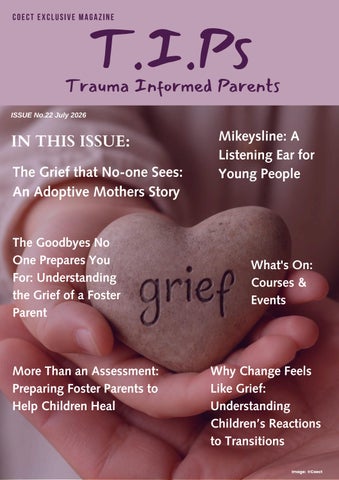
Trauma Informed Parents ISSUE No.22 July 2026
IN THIS ISSUE: The Grief that No-one Sees: An Adoptive Mothers Story
The Goodbyes No One Prepares You For: Understanding the Grief of a Foster Parent
More Than an Assessment: Preparing Foster Parents to Help Children Heal
Mikeysline: A Listening Ear for Young People
What's On: Courses & Events
Why Change Feels Like Grief: Understanding Children’s Reactions to Transitions Image: ©Coect
Meet the Team!
Executive Editor - Sarah Naish
Executive Editor - Sair Penna
Managing Editor - Kathryn Talbot
Contributor - Emma Edwards
Sarah is a Therapeutic Parent, an Adopter of five siblings, Best selling international Author, Keynote Speaker and founder of three Independent Therapeutic Fostering Agencies. Sarah is also and cofounder and CEO at The Centre of Excellence in Child Trauma C.I.C.
Kathryn is co-founder and managing editor of the TIPs magazine, at The Centre of Excellence in Child Trauma C.I.C specialising in public relations.
Sair (Sarah) is a Therapeutic Parent, Author, Parent Coach and Havening practitioner. Sair is also co-founder and Director of Training, Qualifications & Quality at The Centre of Excellence in Child Trauma C.I.C
Emma is a Therapeutic Parent, Adopter, Parent Coach. Emma is also co-founder and Director of Therapeutic Services and Ambassador for England at The Centre of Excellence in Child Trauma C.I.C.
Contributor -Jenny Stirling
Jenny graduated from Glasgow University and started her career on the AIDS ward before becoming a Practice Nurse in the East End of Glasgow. With her husband, she engaged in pastoral work with students in the Central Belt of Scotland while raising four children. Now they are grandparents living in the Highlands, and Jenny has spent the past four years working with Mikeysline, feeling honoured to hear personal stories.
ISSUE 22
T.I.P'S MAGAZINE
1
TRAUMA-INFORMED PARENTS
CONTENTS 4 The Grief that No-one Sees: An Adoptive Mothers Story
7 Why Change Feels Like Grief: Understanding Children’s Reactions to Transitions
13 Mikeysline: A Listening Ear for Young People
3 Editor's Note 9-12 UPCOMING EVENTS CoECT Training, Workshops and Events Schedule 2026 16 The Parent Behind the Parenting: Why Support Matters 18 More Than an Assessment: Preparing Foster Parents to Help Children Heal 20 The Goodbyes No One Prepares You For: Understanding the Grief of a Foster Parent
ISSUE 22
T.I.P'S MAGAZINE
2
From its beginnings as a Therapeutic Parenting Group on Facebook a decade ago, we have evolved into a Community Interest Company dedicated to supporting parents of children who have faced early life trauma and display neurodiverse characteristics. This edition focuses on the topic of grief and how it can affect parents and families.
Editor’s Note Welcome Everyone, As another school year comes to an end, many parents across the UK will be preparing themselves for the summer holidays. For some, it’s a chance to slow down, spend family time together and enjoy a break from the usual routine. For others, the change and uncertainty that comes with the summer break can feel a little harder. If you’re caring for a child who has experienced trauma or has additional emotional needs, you may already be thinking about how the weeks ahead might affect them. Changes in routine, new experiences and saying goodbye to familiar things can bring big feelings. As you’ll read in "Why Change Can Feel Like Grief for Children," even positive changes can sometimes feel overwhelming. This edition includes a lot about experiences such as grief, trauma, adoption, fostering and times when life feels overwhelming. We know these topics may feel personal for some readers, so please take care as you read and feel free to pause if you need to. From understanding children’s stories, to exploring therapeutic parent coaching, the message which runs throughout this one — talks about the childs need for connection, understanding and relationships where they feel safe. We share some important stories about the feelings that are often left unspoken, Emma Edwards shares her story as an adoptive mum. We are also joined by Jenny Stirling from Charity Mikeysline, a a mental health and suicide prevention charity, who has contributed with an article demonstrating the importance of young people having someone to talk to. From everyone at CoECT, we hope you enjoy this edition and wish you a peaceful summer. Warmest wishes Sair, Sarah & The Team at The Centre of Excellence in Child Trauma C.I.C
Sair Penna Executive Editor
Kathryn Talbot Managing Editor
TIPs Magazine ISSUE 22
T.I.P'S MAGAZINE
3
The Grief that No-one Sees: An Adoptive Mothers Story
I never expected grief to be such a constant companion in motherhood. When people hear the word adoption, they picture joy, hope, a family finally complete. And yes, those moments exist. But for me, adoption also arrived with a kind of grief I didn’t know how to name — a grief that began long before my children came home, and one that has followed me through every chapter of our lives together so far. My story starts with years of fertility treatment. Years of hospital appointments, injections, procedures, and the quiet heartbreak of another negative test. Each month felt like losing a future I had already imagined — the pregnancy I wouldn’t experience, the baby I wouldn’t carry, the milestones I would never witness in the way I once expected. I grieved a version of motherhood that so many people seem to take for granted and watched it slip further away with every failed attempt. People around us tried to be supportive and made well-meaning comments like ‘Your time will come’, ‘Everything happens for a reason.’, ‘Maybe you are trying too hard,’ but they didn’t fully understand the deep grief you feel. I wanted to hide away as I felt a failure but you can’t hide from a world where almost everywhere you go or everything you do you see families. The supermarket, the beach, walking along the road, even turning on the tv, there would be families or adverts for baby products. Even social events
ISSUE 22
Image: ©EEdwards
Written By Emma Edwards
became difficult as more and more family members and friends excitedly announced they were expecting, and whilst I was happy for them, I absolutely was and couldn’t wait to share their joy in their new arrival, it did not stop the overwhelming grief that felt like a punch in the stomach. When we turned to adoption, I thought the grief might ease. Instead, it changed shape. The assessment process was long and intrusive. Every part of our lives was examined, every past wound reopened. I learned to present myself as endlessly stable, endlessly capable, endlessly calm. I learned to hold my breath. I learned to wait and whilst waiting I read every book and article I possibly could about adoption, attachment and trauma. And then, finally, the call came. We had been matched with two children. I remember the excitement — the rush of hope, the sense that our lives were about to begin again. But alongside the joy was a heaviness I didn’t expect. I grieved for their birth parents, for the life those children should have had, for the losses and abuses they had already endured. I grieved that our family was being formed through trauma, through rupture, through someone else’s unimaginable pain.
When the children arrived, I thought love would be enough. I thought patience and warmth and stability would heal everything. I thought I would be the mother I had always imagined — playful, intuitive, endlessly gentle. But trauma rewrites the rules of parenting. I learned quickly that my children needed something different. They need structure where others need freedom. They need calm where others need excitement. They need therapeutic parenting, not the parenting I had grown up with or dreamed about. Things other families take for granted — birthday parties, sleepovers, holidays, even a simple trip to the shops — became mountains we can’t always climb. I grieve not being able to celebrate mine or my husband’s birthdays, treating them as just another day as my son can’t manage the focus being on anyone else in case he is forgotten. My children’s birthday’s whilst we make them special are always tinted with grief. Grief of them being born to someone else, but also grief of what their birth mother and father must be feeling knowing yet another birthday has passed without them. But amongst this grief is a real privilege that I am here celebrating their special day with them and watching them grown into the amazing individuals they are.
T.I.P'S MAGAZINE
4
I have lost count of how many invitations to social events including family weddings and special birthdays we declined, or those we did accept only to have to leave shortly after arriving or not even managing to attend at all. Slowly, the invitations stopped coming. Friends withdrew. Family members didn’t understand why we couldn’t “just discipline them properly” or “try harder.” Our world grew smaller, and I grieved the community I thought would surround us. As the children have grown older, the impact of early trauma has become louder, sharper, harder to contain. There have been violent outbursts, many violent outburst, holes in walls, broken doors and smashed belongings. Money missing and valuables having to be locked away. I have learnt to hide my handbag. learnt to sleep lightly, learnt to explain bruises I didn’t cause.
Image: ©COECT via Canva
There have been many days when the police have been called. Days when one child would run away. Days when I wonder if love is enough to keep us all afloat.
instead of partners. I grieve the version of myself that existed before trauma entered our home — the person who slept deeply, laughed easily, trusted her instincts.
Alongside all this come the meetings — endless meetings — where professionals debate whether my child should stay at home or be moved to residential care. I fight with everything I have, I fight to keep my child, to keep our family together, to be heard in rooms where my voice feels small. I grieve the fear of losing them, even as I fight to hold on.
And yet, through all of it, I love my children fiercely. That love has never wavered. It sits beside the grief, not in place of it.
The grief doesn’t stop there. It seeps into every corner of our lives. I grieve the toll it takes on my other child — the anxiety, the fear, the constant unpredictability. I grieve the strain on my marriage, the way we have become co‑strategists ISSUE 22
People often tell me I’m strong. They say they couldn’t do what I do. But I don’t feel strong. I feel like a mother doing what mothers do — showing up, again and again, even when the world steps back.
This is the part of adoption people rarely talk about. The grief that lives in the shadows. The grief that doesn’t mean regret, or failure, or lack of love. The grief that simply tells the truth. Because adoption is not just a story of rescue or redemption. It is a story of loss — mine, my children’s, their birth family’s — woven together with love, resilience, and hope. I am an adoptive mother and I am proud of that. But I am also a mother who grieves. And I am learning, slowly, that both can be true.
Have you subscribed to TIPs yet? Find out more by visiting our website www.coect.co.uk
T.I.P'S MAGAZINE
5
Introduction to Trauma-Informed Life Story Work Training
CLIENT TESTIMONIAL "This course has transformed the way I approach my work with clients. The practical tools and techniques have been invaluable."
- Jane D Choose from our online or in-person introductory day courses Thursday 24th September 2026, 10:00 - 15:00 (BST) Online Thursday 28th January 2027, 10:00 - 15:00 (GMT) Online Thursday 13th May 2027, 10:00 - 15:00 (BST) (In-person, Gloucestershire) www.coect.co.uk/live-events
Image: ©SPenna
Why Change Feels Like Grief: Understanding Children’s Reactions to Transitions Written By Sair Penna
As adults, when we think about grief the first thoughts that come to mind might be that grief is something that happens when someone dies. But grief can show up in lots of different ways. In children sometimes it's simply the sadness of losing something that felt familiar, safe or predictable.
Starting a new school year, moving house, changing schools, a favourite teacher leaving, a parent working different hours or even going back to school after the holidays can all feel like much bigger to a child than they do to us. As adults, we might think, "It's only a new classroom," or, "They'll soon settle in." But for some children, especially those who have experienced early trauma, are neurodivergent, or have been adopted or fostered, these changes can feel enormous. That's because children don't just cope with what's changing—they also have to let go of what felt safe for them..
For some children, routine is much more than simply liking things a certain way. It's what helps them feel calm and in control. Children who have experienced trauma often rely on predictability because life hasn't always felt safe. Neurodivergent children may also depend on routine because it helps them make sense of the world around them. When those familiar routines suddenly disappear, it's not unusual to see children become more anxious, clingy or emotional. They may struggle to sleep, have more meltdowns or seem unusually worried. It's easy to mistake these behaviours for "attention-seeking" or "challenging", but more often than not they're signs that a child is finding the change really hard. Another reason change can feel so overwhelming is because children usually don't get much choice. Adults decide when they move house, change schools, get a new teacher or adjust family routines. For children who have experienced instability or difficult early experiences, that lack of control can bring back feelings they don't even realise they're carrying.
Children build their world around familiar faces, routines and places. Knowing what happens next helps them feel secure. They know who will pick them up from school, where they sit in class, what bedtime looks like and what to expect each day. Those That's why you might hear things everyday routines may not seem like, "I'm not going!", "I hate my new important to us, but to a child they can teacher," or "I can't do it." be the things that make life feel steady. It might sound like defiance, but underneath there is often fear. So when those routines change, it can feel like the ground has shifted beneath their feet. ISSUE 22
Children also become attached to what makes places, not just people. A classroom, a bedroom, a favourite seat in the car, the walk to school or the smell of home can all become part of what makes them feel safe. Leaving those things behind can bring genuine sadness, even when the new situation is a positive one. For children who struggle with attachment, even small separations can feel much bigger than we expect. A favourite teacher moving schools or a parent starting a new job may leave them wondering, "Will they still be there for me?" They may never ask those questions out loud, but their behaviour often tells us they're worried. Some children also find the sensory side of change incredibly difficult. A different classroom might have brighter lights, noisier corridors, unfamiliar smells or a busier playground. For autistic children or those with sensory sensitivities, that's a lot for their nervous system to cope with all at once. What looks like refusing to settle may actually be a child who is completely overwhelmed. None of this means we should stop children experiencing change. Change is part of life, and learning to cope with it is an important skill. What children need isn't a life without change—they need adults who help them feel safe while they're going through it. There are lots of simple things that can help.
T.I.P'S MAGAZINE
7
Talking about changes ahead of time, looking at photos, visiting new places before they start or using calendars and visual timetables can make things feel less uncertain. Keeping as many familiar routines as possible also gives children something steady to hold onto while everything else feels different.
Instead of saying, "You'll be fine," we might say, "I know this feels like a big change," or "It's okay to miss your old teacher."
Giving children small choices can make a big difference too. It might be choosing their lunchbox, picking which shoes to wear or deciding which transitional toy/item comes on the journey. Those little choices help children feel they have some control when lots of other things are changing.
When we start looking beneath the behaviour, we often discover a child who isn't being difficult at all. They're grieving the loss of something that helped them feel safe.
Perhaps the biggest thing we can do is simply let children know it's okay to find change hard.
Children don't need us to fix every feeling. They just need to know we're willing to sit alongside them while they work through it.
It's also worth remembering that behaviour often says what words can't. A child who suddenly refuses school, has a meltdown or becomes unusually clingy isn't
TIPS Consults: Sometimes You Just Need to Talk It Through
usually trying to make life difficult. They're often telling us, in the only way they know how, "This feels really hard for me." We can't stop change from happening, and we can't protect our children from every goodbye or every new beginning. But we can be the calm, reassuring adult who walks beside them through it all.
For more resources Take a look at our website, members have access to over 100 webinars and resources. www.coect.co.uk
Membership Benefit
If you're parenting or caring for a child who has experienced trauma or displays neurodivergent characteristics, you've probably had moments where you've thought, "What am I missing?" or "Why is this so hard?" You're not alone. Sometimes it really helps to talk things through with people who understand. A TIPs Consultation is a one-hour online session led by two mrmbers of the CoECT team, who are there to listen, help you make sense of what's happening and explore ideas that could make family life a little easier. There are no silly questions and no judgement—just a safe space to talk openly about what's going on. The session takes place within the TIPs Hub, alongside a small group of up to six Hub members. Many of the parents and carers attending have faced similar challenges themselves, and where it's helpful, they'll share what's worked for them too. Often it's reassuring to realise that someone else has been where you are and understands just how tough things can feel. www.coect.co.uk/join
ISSUE 22
T.I.P'S MAGAZINE
8
T.I.P.s ENJOYING TIPS MAGAZINE? Continue reading with a TIPs Magazine subscription You've reached the end of the free preview. If you've enjoyed this issue, you can get every issue of TIPs Magazine throughout the year.
DIGITAL — £15 per year 6 issues + full digital archive Read TIPs Magazine wherever you are, on your computer, tablet or phone. www.coect.co.uk/shop PRINT — £30 per year 6 printed issues delivered to your door Prefer a physical magazine? Subscribe to receive every issue throughout the year. www.coect.co.uk/shop
Looking for more support? TIPs Magazine is also included as part of TIPs Hub membership. Join the TIPs Hub for access to the magazine alongside our wider range of support, resources, learning and community. www.coect.co.uk/join
Keep reading. Keep connected. TIPs Magazine — £15 digital | £30 print TIPs Hub — magazine + support + resources + learning + community